Introduction
Meatoplasty is considered a routine step in canal wall down tympanomastoidectomy and is possibly an underestimated procedure in mastoid surgery.Reference Raut and Rutka 1 Meatoplasty is performed to allow ventilation of the mastoid cavity. In addition, it allows easy access for examination and cleaning of the cavity. A narrow external meatus (or inadequate meatoplasty) can cause accumulation of debris in the exteriorised mastoid cavity with secondary infection and discharge. Other complications such as chronic otitis externa, hearing impairment, difficulty in fitting hearing aids and difficulty in examining the ear can also occur.Reference Fisch, Chang and Linder 2
Numerous surgical meatoplasty techniques have been described for widening the external meatus.Reference Paparella and Kurkjian 3 – Reference Mirck 6 Generally, a Körner flap meatoplasty is performed routinely as part of a canal wall down technique in cholesteatoma surgery. An overcorrection is required with Körner meatoplasty, as there is a tendency for external meatus narrowing after healing, together with collapse of the soft tissue and the pinna into the cavity.Reference Tos 7 In such cases, a standard technique such as M-meatoplasty cannot be applied for secondary correction as there is no longer any concha cartilage.Reference Mirck 6
We utilise a technique based on a transposition postauricular flap meatoplasty, which is used as a last resort for management of chronic otorrhoea. We have observed benefits from this method. Although this technique was initially reported for acquired canal stenosis,Reference Todd 8 we describe our modified transposition postauricular flap as a solution in the management of persistently infected radical cavities due to a narrow external meatus. Further, we present the results of this technique in our patient population.
Surgical technique
We prefer general anaesthesia for the modified Todd's meatoplasty, but local anaesthesia is also possible for an out-patient procedure. Oral or intravenous antibiotic prophylaxis is not routinely required.
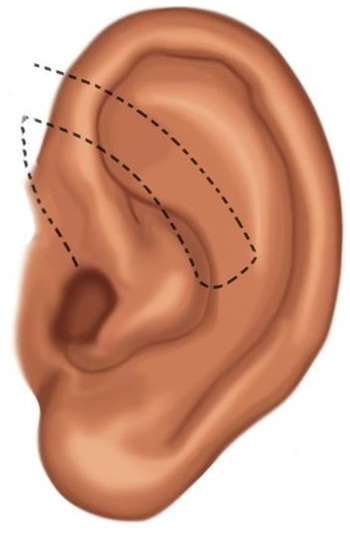
The incision lines are drawn with a marking pen. Both retroauricular and endaural incision lines are infiltrated with 1 per cent lidocaine with 1:200 000 adrenaline. An endaural incision is extended retroauricularly by turning around the root of the pinna and continuing along the postauricular fold for 4–5 cm. Then, the incision turns 1.5 cm backwards and ends in an incision running parallel to the previous incision up to the hairline border (Figure 1). The postauricular skin flap is developed by separating the skin from the underlying subcutaneous tissue. Usually, this is also an opportunity to correct a retroauricular indentation that has grown there over the years.
Endaural incision is extended to retroauricular incision.

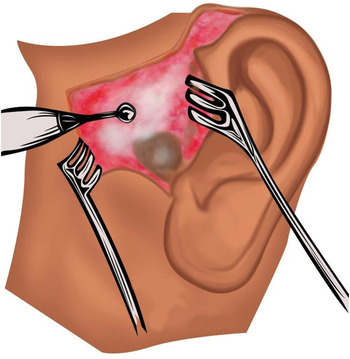
The cranial bony overhang of the cavity is drilled to enlarge the meatus and create a gutter-like crease (Figure 2). This important step was not originally described by Todd. We drill as a routine step in all of our cases.
Cranial bony overhang (so-called anterior buttress) of the cavity drilled out.

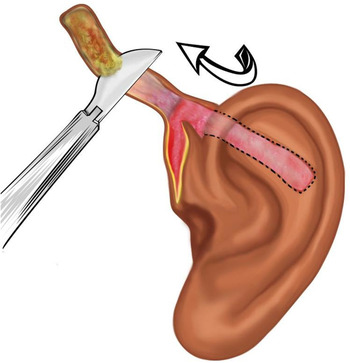
The next step is to reduce the soft tissue at the tip of the transposed postauricular flap by removing underlying subcutaneous tissue and thus creating a split skin graft analogue at the tip of the pedicle flap (Figure 3). Again, this modification is to improve Todd's initial technique.
Creating split skin graft analogue at the tip of the pedicle flap by removing underlying subcutaneous tissue.

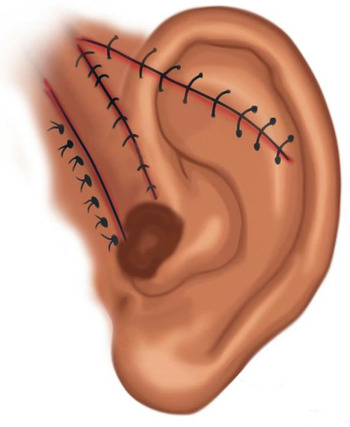
Finally, the postauricular flap is placed in the ear canal (into the endaural incision area) starting from the previously created gutter. The pedicle of the flap is sutured to the edges of the endaural incision (Figure 4).
Suturing the pedicle of the flap to the edges of the endaural incision.

The pinna is rotated backwards and upwards, and fixed with a subcutaneous traction suture which is yet another advantage of this technique. Finally, ear packing soaked in antibiotic ointment is placed for at least 10 days. Most sutures can be removed after 10 days (absorbable sutures can even be used) and routinely a new ear packing is placed for another week. The three-year post-operative result of one patient can be seen in Figure 5.
Three-year post-operative result.

Discussion
There are two types of postauricular flap meatoplasty. The first, described by Friedberg in 1977, is a large flap originally reported to treat congenital atresia.Reference Friedberg 9 The second, originally described by Todd in 1980, is a smaller flap.Reference Todd 8 Todd described a superiorly based postauricular flap meatoplasty in five revision cases of acquired stenosis. Healing was rapid in all cases, and the results were satisfactory and cosmetically acceptable. We have modified Todd's technique and applied it in patients who presented with persistently infected cavities due to a narrow external meatus after canal wall down mastoidectomy for cholesteatoma.
Our first modification was to drill away the cranial bony overhang of the cavity as a routine step in all of our cases. This provides more space to the anterosuperior part of the canal and enables the formation of a gutter-like crease which avoids the mass effect of the underlying subcutaneous tissue when the pedicle of the flap is placed in the ear canal. The modification allows us to create a large meatus, aiding cavity ventilation and self-cleaning.
The second modification was to reduce soft tissue from the tip of the transpositioned postauricular flap by removing underlying subcutaneous tissue, creating a split skin graft at the tip of the pedicle flap. In general, plastic surgeons heed the 3:1 rule to ensure viability of the complete flap: ‘The flap should not be longer than 3 times the width of its base’.Reference Sloan and Reinisch 10 Todd's original technique is not consistent with this rule. By thinning the tip of the flap, we make this part as thin as a free, split skin graft. This reduces the incidence of flap necrosis and again avoids the mass effect of the underlying subcutaneous tissue when placed in the preformed gutter. The split skin tip of the pedicle covers the mastoid cavity that was denuded from mucosa. Mucosa is often removed for drilling to enlarge epitympanum exposure, between the roof of the external auditory canal and the tegmen mastoideum at the anterior buttress (the anterior zygomatic cell tract region). The uncapping of cells in this region is often required in revisions of a canal wall down technique. The split skin tip of the pedicle will cover the denuded bone, and lead to fast healing and re-epithelialisation of the cavity.
Using this modified technique, we succeeded in creating a dry radical cavity within six weeks for every patient operated on. All cavities were easy to clean and the frequency of check-ups for assessment of the radical cavity was reduced to once per year.
As with every surgical technique, the modified Todd's meatoplasty has its own potential complications. In one diabetic patient, we observed a significant delay in wound healing, and a longer post-operative period was needed to attain a dry cavity. Smoking patients with poor micro-vascularisation could experience similar issues. Differences in skin colour between the postauricular and the preauricular regions should also be considered and discussed with the patient to avoid post-operative disappointments. In general, these skin colour changes disappear over time as a result of sun exposure. Only two cases required minor revisions, one with hair growth inside the cavity and the other with keloid formation. Hair growth could be avoided by designing the flap below the hairline. Keloid susceptibility can also be estimated pre-operatively, but it remains a possible pitfall, as for every surgical incision.
Current trends in cholesteatoma surgery appear to sway towards obliteration of the mastoid to avoid open cavity problems. Although obliteration techniques are very elegant, they do carry a potential risk of enclosing cholesteatoma within the cavity, whereas open techniques have the advantage of enabling post-operative monitoring of cholesteatoma recurrence. We think there are benefits from performing revision meatoplasty before shifting to an obliteration procedure when there is already a satisfactory radical cavity present. Here, a modified Todd's meatoplasty can be of value. With little surgical effort and risk, significant patient and physician satisfaction can be achieved.
Conclusion
In our view, the modification of the superiorly based postauricular flap meatoplasty is a last resort in open cavity treatments. When this is inapplicable, or after failure, a more time-consuming mastoid obliteration could still be considered according to the current trends.