Introduction
The move from hunting and gathering to food production through farming and animal husbandry represents one of the most profound cultural shifts in human prehistory. Based on the premise that ‘you are what you eat’ and that certain foods can have distinctive chemical compositions, palaeodietary studies of ancient human remains based on stable isotopes have made significant contributions to our understanding of the Mesolithic–Neolithic dietary transition, particularly in Northern Europe (Tauber Reference Tauber1981; Richards & Hedges Reference Richards and Hedges1999; Richards et al. Reference Richards, Schulting and Hedges2003a). In coastal regions this body of work has been especially productive in exploiting differences in the isotopic make-up of typical Mesolithic (wild and marine oriented) and Neolithic (domesticated and terrestrially oriented) foodstuffs (Tauber Reference Tauber1981, Reference Tauber, Hänsel and Herrmann1986; Richards & Mellars Reference Richards and Mellars1998; Schulting & Richards Reference Schulting and Richards2001, Reference Schulting and Richards2002a & b; Richards et al. Reference Richards, Price and Koche2003b; Schulting Reference Schulting, Marchand and Tresset2005; Fischer et al. Reference Fischer, Olsen, Richards, Heinemeier, Sveinbjörnsdóttir and Bennike2007; Price et al. Reference Price, Ambrose, Bennike, Heinemeier, Noe-Nygaard, Brinch Petersen, Vang Petersen and Richards2007; Woodman Reference Woodman, McCartan, Schulting, Warren and Woodman2008; Schulting et al. Reference Schulting, Fibiger, Macphail, McLaughlin, Murray, Price and Walker2013; see Schulting Reference Schulting, Pinhasi and Stock2011 for a review).
Portugal, occupying the south-west region of the Iberian Peninsula, is situated within an area of wider significance for understanding the nature, timing and direction of the Mesolithic–Neolithic transition in Europe (e.g. Zilhão Reference Zilhão, Hadjikoumis, Robinson and Viner2011). Despite this key location, as well as an abundance of prehistoric human remains, the region has received comparatively little attention. Lubell and colleagues (Reference Lubell, Jackes, Schwarcz, Knyf and Meiklejohn1994) provide a notable exception with a study in which radiocarbon values, as well as stable carbon and nitrogen isotope values, were measured from a sample of Mesolithic and Neolithic humans. These early findings showed a general shift from a marine to a terrestrial diet that was similar to that observed earlier in Northern Europe (e.g. Tauber Reference Tauber1981); they also, however, provided preliminary and unexpected evidence for the persistence of marine dietary regimes into the Neolithic period. In addition, their relatively small sample size and lack of any stable isotope baseline data from fauna prevented analysis of the degree to which Neolithic dietary practices were implemented and maintained throughout the period. Both interesting and challenging, the important findings by Lubell and colleagues have not been systematically revisited in the intervening 20 years.
In that context, this paper provides a substantial new set of stable carbon and nitrogen isotope data from 240 human bone collagen samples from 22 sites, and 35 faunal samples from 5 sites. Added to a small set of new radiocarbon dates (n=12), as well as other stable isotope and radiocarbon data collated from previously published sources, this dataset provides a new reference point from which to assess human dietary changes during and after the Mesolithic–Neolithic transition in south-west Europe. These data indicate a relatively sharp and sustained shift to terrestrial foods at the onset of the Early Neolithic. New evidence for the exploitation of marine resources during the Middle and Late Neolithic is also discussed.
Stable isotope analyses in archaeology
Based on the premise that human and animal tissues incorporate the chemical signatures of the foods they eat, palaeodietary analyses of ancient bone, based on stable isotopes, have become an invaluable and routine tool (for a review see Lee-Thorp Reference Lee-Thorp2008). The following key points on bone collagen and stable isotope ecology provide a framework in which the stable isotope data presented here are interpreted.
Relative to other bodily tissues, bone collagen has a slow turnover rate of up to (or, in some cases, more than) 20 years, and thus produces isotopic signatures recording a long-term dietary average (Hedges et al. Reference Hedges, Clement, Thomas and O'Connell2007). Also, when protein intake is adequate, bone collagen stable isotope values mainly reflect those of dietary protein (Ambrose & Norr Reference Ambrose, Norr, Lambert and Grupe1993).
Stable carbon (δ13C) and nitrogen (δ15N) isotope ratios are expressed in parts per thousand (per mil, ‰) relative to the VPDB and AIR standards. Terrestrial plants with C3 and C4 photosynthetic pathways produce 13C-depleted and -enriched δ13C values respectively, which are in turn passed on to the animals that consume them (DeNiro & Epstein Reference DeNiro and Epstein1978). Plants in aquatic, and particularly marine, ecosystems draw on isotopically heavier sources of carbon and, as with C4 plants, produce higher δ13C values (Chisholm et al. Reference Chisholm, Nelson and Schwarcz1982). Given that edible C4 plants were largely absent in Mesolithic and Neolithic Portugal, the δ13C signatures of humans and animals in this study are primarily an indicator of terrestrial- (lower values) and marine-/estuarine- (higher values) oriented dietary regimes. In Southern Europe, human diets based on C3 foods produce bone collagen δ13C values around −19 ‰ (e.g. van Klinken et al. Reference van Klinken, Richards, Hedges, Ambrose and Katzenberg2000). Stable nitrogen isotope values, on the other hand, increase by roughly 3–5‰ at each step ascending a food chain (DeNiro & Epstein Reference DeNiro and Epstein1981; Hedges & Reynard Reference Hedges and Reynard2007). This ‘trophic effect’ allows for a differentiation between herbivores, omnivores and carnivores. Marine and other aquatic ecosystems can have extended foodwebs in which higher trophic level animals, as well as humans that consume them, are highly 15N enriched (Schoeninger et al. Reference Schoeninger, DeNiro and Tauber1983).
Context and questions
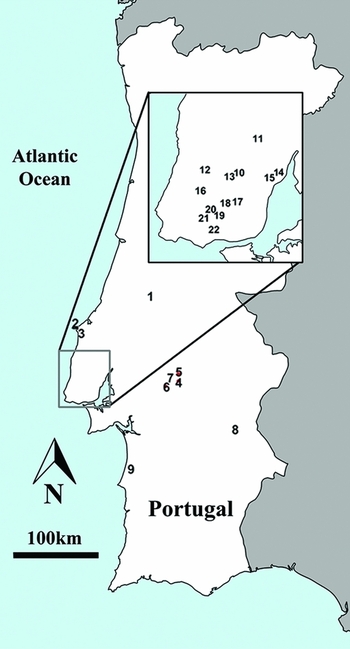
The sites from which the samples were obtained ranged in time from the Early Neolithic to the Bronze Age (i.e. between the end of the sixth and beginning of the second millennium BC), and were grouped by generic cultural period according to artefact typologies and radiocarbon data. Chronometric, geographic and contextual details for the sites analysed here are provided in Figure 1 below and Table S1 (in online supplementary material).
Map of Portugal showing locations for sites analysed in this study: 1) Senhora das Lapas, Cadaval and Ossos; 2) Furninha; 3) Paimogo 1; 4) Aldeinha; 5) Cabeceira 4; 6) Lobeira de Baixo 2; 7) Azinhal 1; 8) Sobreira 1 and Perdigões - Tomb 1; 9) Cerca do Zambujal and Lagar; 10) P. Salemas; 11) Monte do Castelo; 12) Penedo do Lexim; 13) Carcavelos; 14) Moita da Ladra; 15) Casal do Penedo and Verdelha dos Ruivos; 16) Folha das Barradas; 17) Trigache 2; 18) Pedras Grandes; 19) Monte Abraão, Pedra dos Mouros, and Estria; 20) Carrascal; 21) Agualva; 22) Leceia.

The Mesolithic in Portugal is disproportionately represented by two shell midden clusters—the Muge complex in the Tagus Valley of the Estremadura region and the Sado Valley complex about 100km to the south in the coastal Alentejo region (Arnaud Reference Arnaud2000; Cunha et al. Reference Cunha, Cardoso, Umbelino, Larsson, Kindgren, Knutsson, Loeffler and Åkerlund2003; Figure 1). Lining the shores of ancient estuarine environments, the Muge and Sado sites have yielded the largest Mesolithic skeletal collection in Europe, and have preserved archaeological evidence of hunting and gathering adaptations that exploited both aquatic and terrestrial resources (Cunha et al. Reference Cunha, Cardoso, Umbelino, Larsson, Kindgren, Knutsson, Loeffler and Åkerlund2003). A number of these sites have also provided evidence suggesting not only that ‘Mesolithic’ lifeways persisted for a time after the introduction of Neolithic practices, but that the two communities probably had some degree of contact (e.g. Arnaud Reference Arnaud2000).
Limited archaeological evidence for Early and Middle Neolithic occupations has led some authors to argue that Early Neolithic communities in this region may have been somewhat mobile, occupying small temporary camps, whereas Late Neolithic sites (e.g. ditched and walled enclosures) appear to reflect a more sedentary way of life (Boaventura & Mataloto Reference Boaventura and Mataloto2009: 55; Carvalho & Petchey Reference Carvalho and Petchey2013: 362; Mataloto & Boaventura Reference Mataloto and Boaventura2013: 84–86; Neves & Diniz Reference Neves and Diniz2014). According to Tomé and Oosterbeek (Reference Tomé, Oosterbeek, Bueno Ramirez, Cuenca and Cordero2011), the transition to agro-pastoralism was characterised by a mosaic of groups with different specialisation strategies and a strong mobility pattern that included coastal interactions and inland exchanges. Decorated pottery as well as domesticated animals are present from the onset of the Neolithic, and later material culture indicates that architectural and social complexity continued to develop throughout the period, particularly within decreasingly mobile inland networks. Archaeozoological and botanical evidence for subsistence is still sparse, and the extent to which Neolithic peoples were committed to agriculture, as opposed to hunting and gathering, remains a matter of debate (Carvalho & Petchey Reference Carvalho and Petchey2013: 362). There is some evidence, however, to suggest that even in the transition from the fourth to the first half of the third millennium BC, some Late Neolithic groups still relied partially on wild game (Davis & Moreno-Garcia Reference Davis and Moreno-Garcia2007; Davis & Mataloto Reference Davis and Mataloto2012), despite strong evidence for the secondary products revolution (Gonçalves Reference Gonçalves2000–Reference Gonçalves2001).The route by which Neolithic peoples, ideas and/or practices reached the western coast of Iberia has also been debated. The Demic Diffusion model posits that Neolithic practices migrated relatively slowly overland from the east, carried by Neolithic peoples who systematically colonised land as they moved (e.g. Ammerman & Cavalli-Sforza Reference Ammerman and Cavalli-Sforza1984). In opposition to Demic Diffusion, the Maritime Pioneer Colonisation (MPC) hypothesis argues that Neolithic practices reached the western coast of the Iberian Peninsula rapidly via seafaring shortly after they had arrived in the east (Zilhão Reference Zilhão1993, Reference Zilhão2001, Reference Zilhão, Hadjikoumis, Robinson and Viner2011). This MPC hypothesis is supported empirically by the very short time interval between radiocarbon measurements of the first appearance of Neolithic contexts in eastern and western Iberia.
Understandings of Mesolithic and Neolithic lifeways, as well as of the nature of the transition period between the two, could be significantly advanced through systematic stable isotope investigations of the abundant human skeletal materials that have been excavated in Portugal. In addition to the work of Lubell and colleagues in the early 1990s, a number of small projects have been undertaken to further develop a stable isotope database for the region (e.g. Carvalho Reference Carvalho2007; Umbelino et al. Reference Umbelino, Pérez-Pérez, Cunha, Hipólito, Freitas and Cabral2007; Diniz & Arias Reference Diniz, Arias, Almeida, Bettencourt, Moura, Monteiro-Rodrigues and Alves2012; Carvalho & Petchey Reference Carvalho and Petchey2013; Waterman et al. Reference Waterman, Silva and Tykot2014; Guiry et al. Reference Guiry, Hillier and Richards2015). Despite these valuable contributions, broader questions remain unaddressed. For instance, to what extent and with what consistency were Neolithic subsistence practices implemented after their first appearance along the Atlantic façade of Portugal? Did the transition occur rapidly, as in some parts of Northern Europe, or is there evidence for a gradual shift away from Mesolithic subsistence practices? Is the seemingly anachronistic evidence obtained by Lubell and colleagues (e.g. TO-2091 in Table S3) for the persistence of a marine dietary focus at Lagar during the Middle Neolithic an outlier or part of a previously undocumented trend? Answers to each of these enquiries may, in turn, have important implications for how we understand the wider European Mesolithic–Neolithic transition.
Results and discussion
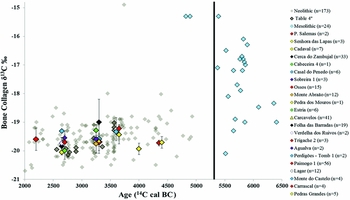
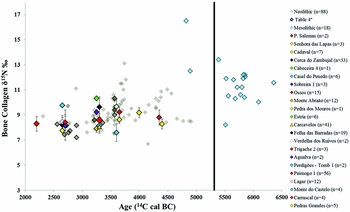
Collagen preservation varied between the sites sampled but was notably poorer in the interior Alentejo region. Specimens from 240 humans at 22 sites produced acceptable bone collagen δ13C and δ15N values averaging −19.6±0.6‰ and 8.6±0.9‰, respectively. Tables S2, S3 and S4 give the results of individual human analyses, site average summaries, and a list of 12 unpublished stable isotope-radiocarbon date pairs (Boaventura Reference Boaventura2009). Table S5 provides a list of stable isotope values available as a by-product of published radiocarbon measurements or previous palaeodietary work. Figures 2 and 3 show δ13C and δ15N values averaged by site and plotted against archaeological time period or calibrated BC radiocarbon age, respectively. Unfortunately, available information for the age and sex of individuals analysed did not allow for a systematic comparison of these categories with diet.
Average δ13C values for each site analysed in this study plotted against approximate archaeological time period. Time periods plotted are as follows: Late Neolithic/Bronze Age=2200 BC; Late Neolithic=2650–2700 BC; Middle–Late Neolithic=3250–3000 BC; Middle Neolithic=3600–3650 BC; Early–Middle Neolithic=4000 BC; and Early Neolithic=4350–4400 BC. Mesolithic and Neolithic δ13C-radiocarbon value pairs from Tables S3 and S4 in supplementary material are also plotted to help contextualise site averages. The transitional boundary (black line) is based on the earliest directly dated domestic mammals—two sheep bones from Caldeirão radiocarbon dated to c. 5300 cal BC (Zilhão Reference Zilhão2001; OxA-1035 [6330±80BP] and OxA-1034 [6230±80BP]).

Average δ15N values for each site analysed in this study plotted against approximate archaeological time period. Time periods plotted are as follows: Late Neolithic/Bronze Age = 2200 BC; Late Neolithic = 2650–2700 BC; Middle–Late Neolithic=3250–3000 BC; Middle Neolithic=3600–3650 BC; Early–Middle Neolithic =4000 BC; and Early Neolithic = 4350–4400 BC. Mesolithic and Neolithic δ13C-radiocarbon value pairs from Tables S3 and S4 in supplementary material are also plotted to help contextualise site averages. The transitional boundary (black line) is based on the earliest directly dated domestic mammals—two sheep bones from Caldeirão radiocarbon dated to c. 5300 cal BC (Zilhão Reference Zilhão2001; OxA-1035 [6330±80BP] and OxA-1034 [6230±80BP]).

These data affirm the early findings of Lubell and colleagues (Reference Lubell, Jackes, Schwarcz, Knyf and Meiklejohn1994). In addition, this larger and more geographically varied sample allows for a broader and more in-depth consideration of the nature of the Mesolithic–Neolithic shift from marine to terrestrially oriented diets in Portugal. Human data are further discussed below after a consideration of the faunal stable isotope baseline data.
Faunal stable isotope baseline
Thirty-five faunal samples from all five sites (Table S6) produced acceptable bone collagen data (averaging −20.2±1.2‰ and 5.5±1.3‰ for δ13C and δ15N respectively). Terrestrial domestic and wild herbivores from all sites (n=20) produced an average δ13C value of −20.5±1‰ (ranging 4.3‰, from −19.1 to −23.4‰) and δ15N values of 5.6±1.5‰ (ranging 6.4‰, from 3.2 to 9.6‰). Terrestrial omnivores, Sus sp. (n=9), from all sites produced similar δ13C and δ15N averages of −20.3±0.9‰ (ranging 2.9‰, from −18.2 to −21.1‰) and 5.1±0.6‰ (ranging 2.9‰, from 4.1 to 6‰) respectively. Unfortunately, small sample sizes for respective sites and species prevent meaningful comparison of inter-site variability. It is, however, apparent from the large intra-herbivore ranges for δ13C (e.g. 4.3‰ at Penedo do Lexim) and for δ15N (e.g. 6.4‰ at Cadaval) occurring within single sites that the stable nitrogen isotope baseline in Portugal probably varies by period and geographic region. This may be a function of complexities of nitrogen isotope biogeochemistry in plant-soil systems (see Szpak Reference Szpak2014 for a review). For this reason, the faunal stable isotope baseline provided here is relatively coarse.
Extent and consistency of adoption of Neolithic subsistence practices
The relative isotopic distinctiveness of typical Mesolithic versus Neolithic diets is key for assessing the extent to which Neolithic subsistence practices were embraced after their introduction. Stable carbon and nitrogen isotope data from Mesolithic peoples at Muge and Sado, as well as isolated individuals farther south in the Alentejo and Algarve regions, indicate varying subsistence practices that focus on the exploitation of wild resources (Table S5). These data (average δ13C=−17.8±1.3‰, n=79; and δ15N = 11.1±1.6‰, n=72) also indicate that marine and estuarine environments were more frequently and more heavily exploited than terrestrial ecosystems. For this reason, the cessation of stable isotope signatures indicative of the exploitation of marine and estuarine environments can be used as a marker for the extent and consistency of the shift away from Mesolithic dietary practices (Lubell et al. Reference Lubell, Jackes, Schwarcz, Knyf and Meiklejohn1994; Richards & Hedges Reference Richards and Hedges1999).
Average δ13C values from Neolithic humans (n=513; −19.6±0.8‰) and fauna (n=35; −20.2±1.2‰) are consistent with C3-based terrestrial diets, providing clear and nearly unanimous evidence for a sustained shift away from the use of marine resources (p=<0.05, Figure 2 & Table S7.1). Furthermore, temporal comparisons of δ13C values from our dataset (as well as select data from the literature; see Table S7.1), grouped by Early/Early Middle (n=21), Middle (n=45), Middle Late (119) and Late (n=92) Neolithic, showed no significant changes over the Neolithic period (p = >0.05, Table S7.1).
Human δ15N evidence (n=352; 8.7±1‰) also shows a sustained dietary shift beginning with the onset of the Neolithic (p = <0.05, Figure 3 and Table S7.2). Comparisons between dietary signatures from different Neolithic time intervals are, however, more complex, showing some statistically significant differences between earlier and later phases of the Neolithic (Table S7.2). The relatively high average δ15N values at some sites might, in the absence of the contrasting trend observed among the corresponding δ13C data, be interpreted as evidence for the consumption of aquatic resources. In the context of the high degree of variability observed in the faunal δ15N baseline (>6‰), it is possible that variation in human data reflects temporal and geographic differences between the δ15N baseline of the surrounding sites in the region. For this reason, it is not yet possible to draw meaningful cultural interpretations from δ15N differences observed between different periods of the Neolithic.
In summary, the decrease in human bone collagen δ13C values observed at the onset of the Neolithic is consistent across all sites, regardless of geographic region or absolute chronology, and provides firm evidence for a pervasive and fundamental dietary shift from varied, partly marine-oriented Mesolithic subsistence practices to a more homogeneous Neolithic diet based on terrestrial C3-derived foods. Variation in δ15N values is not inconsistent with this interpretation and could simply reflect temporal and geographic differences in soil 15N abundance.
These data also allow broader interpretation of the relative sharpness of the Mesolithic–Neolithic transition in Portugal. The earliest directly dated evidence for Neolithic subsistence practices comes from two sheep bones from Caldeirão, radiocarbon dated to c. 5300 cal BC (Zilhão Reference Zilhão2001; OxA-1035 [6330±80 BP] and OxA-1034 [6230±80 BP]). Taking this date as an approximate benchmark for the introduction of Neolithic practices, there is abundant stable isotope evidence for a continuation of Mesolithic subsistence practices up to the first appearance of Neolithic domesticates. Stable isotope evidence for individuals from the early period post-dating this introduction, however, is sparse. Two humans with high δ13C and δ15N values from shell midden sites (TO-130 and TO-356 in Table S5) indicate that Mesolithic subsistence practices focused heavily on the exploitation of marine resources persisted for perhaps as much as 500 years after the introduction of Neolithic diets. The earliest data for humans excavated from Neolithic contexts contemporary with these terminal Mesolithic individuals show dietary signatures that are fully terrestrial. In this context, the complete absence of intermediate (i.e. partly marine- or estuarine-derived) dietary signatures post-dating the introduction of Neolithic subsistence practices suggests that, while some Mesolithic groups continued to practise hunter-gatherer foodways, a gradual shift to, or adoption of, Neolithic diets did not occur (or at least is not observable). Nor did early Neolithic peoples choose to supplement their dietary staples with the kinds of wild foods that were clearly available to their Mesolithic neighbours. In other words, the contrasting evidence for either highly marine or fully terrestrial diets in the Early Neolithic implies that Mesolithic and Neolithic peoples, while cohabiting in certain areas of the Atlantic façade of Portugal, did not merge their dietary practices. This hypothesis, previously developed by Zilhão (e.g. Reference Zilhão1993, Reference Zilhão and Price2000, Reference Zilhão2001), and its implications for the eventual disappearance of Mesolithic communities in the region might be explored further by additional radiocarbon and stable isotope analyses of Late Mesolithic and Early Neolithic individuals.
Marine diets in the later Neolithic?
Data presented here shed additional, albeit limited, light on the mystery of apparent aquatic resource exploitation during the later Neolithic period in Portugal. Two caves at Melides near the Atlantic coast produced apparently anomalous results. In the context of the wider corpus of Neolithic stable isotope data, the analysis by Lubell and colleagues of individual TO-2091 appears to be an exceptional outlier. This individual (Gruta de Lagar I) comes from the Lagar cave and has a radiocarbon date (5340±70BP; 3741±106 cal BC) indicating that he or she had lived during the Middle Neolithic period yet produced stable isotope values which suggest that a significant amount of their dietary protein was derived from marine or estuarine foods (δ13C=−14.9‰ and δ15N=13.1‰). Stable isotope values generated as part of this project from 12 additional individuals also excavated from Lagar produced no further evidence for such heavily marine-oriented dietary practices (average δ13C=−19.3±0.4‰ and δ15N=9.7±0.6‰). As such, TO-2091 remains inexplicable in the context of other human diets from Lagar, but re-analysis of the sample confirms the earlier results. (See note by Jackes and Lubell following this article, containing new information on the samples from Melides.)
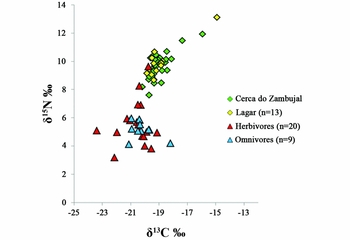
Analyses of humans (n=35) from Cerca do Zambujal, a Middle–Late Neolithic cave site located only a short distance from the entrance of the cave at Lagar hint, however, that TO-2091 could represent more than a peculiar dietary outlier or anachronism. While the majority of humans (n=33) produced terrestrial dietary signatures (average δ13C=−19.2±0.5‰ and δ15N=9.5±0.7‰) that fit comfortably within the wider Neolithic human and faunal dataset from Portugal, the stable isotope values of two individuals, S-EVA 6787 (δ13C=−15.9‰; δ15N=11.9‰) and S-EVA 6817 (δ13C=−17.4‰; δ15N=11.5‰), show evidence for partial reliance on marine or aquatic foods, similar to that observed by Lubell et al. (Reference Lubell, Jackes, Schwarcz, Knyf and Meiklejohn1994) for individual TO-2091 (Figure 4).
Stable carbon and nitrogen isotope data from Lagar and Cerca do Zambujal contextualised within all faunal herbivore and omnivore data.

The stable isotope values of these three individuals remain a puzzle. At a cursory glance, a common tendency towards the supplementary use of aquatic resources may seem logical given the close temporal and geographic proximity of these individuals, as well as their location on the Atlantic coast in a lagoon environment that could presumably offer access to abundant aquatic resources. On the other hand, these data points are dissonantly incongruous not only within the context of their respective sites and the wider Portuguese Neolithic dataset, but also within the whole of the Neolithic Atlantic façade of Europe. Nonetheless, the discovery of a small concentration of Neolithic individuals with an aquatic dietary focus could represent a previously hidden yet remarkable trend, and as such merits further exploration. Could these unusual Middle and Late Neolithic diets have a direct link or ancestry (despite our discussion above) with the subsistence practices of Mesolithic peoples? A similar argument for consumption of aquatic foods by Neolithic humans has been proposed in Germany (Bollongino et al. Reference Bollongino, Nehlich, Richards, Orschiedt, Thomas, Sell, Fajkošová, Powell and Burger2013). What could this tell us about human continuity in the area? Or, alternatively, are these stable isotope signatures explained simply by cultural, idiosyncratic or opportunistic dietary choices among a group of people otherwise practising a relatively homogeneous Neolithic subsistence focus? Further radiocarbon measurements and stable isotope and ancient DNA analyses are needed from individuals at Lagar and Cerca do Zambujal in order to investigate the processes that may underlie these anomalous aquatic dietary signatures.
Summary and conclusion
The stable isotope dataset presented here enables us to undertake the largest palaeodietary reconstruction in south-western Europe to date. For that reason, it is hoped that these analyses will provide a sturdy foundation for future studies of Neolithic and Mesolithic subsistence practices in this geographically important region.
These data have been used here to advance discussion of three developments at the Mesolithic–Neolithic transition and in the subsequent Neolithic dietary prehistory of Portugal. First, the large quantity of samples from varying funerary contexts, time periods and geographic regions provides a high-resolution understanding of the role of terrestrial, as opposed to marine, foodstuffs in Neolithic diets. In particular, results from δ13C analyses show that humans from Neolithic contexts not only had significantly different diets from their Mesolithic counterparts, but that they almost invariably (regardless of context) maintained terrestrial dietary focuses consistent with animal husbandry and farming. Second, this discussion has also allowed new insights into the nature of an enigmatic Mesolithic and Neolithic cohabitation on the Atlantic façade of Portugal. Despite a number of new analyses from Early Neolithic individuals, no evidence has been found for diets that obviously represent a transitional phase between typical Mesolithic and typical Neolithic subsistence regimes. These data suggest that little dietary admixture occurred between coexisting Mesolithic and Neolithic communities. Finally, we have reviewed new data from a small enclave of Middle and Late Neolithic individuals with conspicuously marine-oriented dietary practices. These data provide a unique counterpoint to the wider corpus of stable isotope studies of the European Neolithic and require further investigation.
While this dataset represents a significant advance in the study of prehistoric diet in south-western Europe, there are some key areas where supplementary data are needed. The wide range of variation in faunal δ15N values poses a challenge for contextualising the corresponding human data. This issue is exacerbated by difficulties in directly associating respective animal and human bone assemblages. Future work aimed at refining the δ15N baseline at both temporal and geographical scales will significantly advance interpretations of variation in Neolithic human diets. Another potentially rich area of research would be targeted stable isotope and ancient DNA analyses (e.g. Bollongino et al. Reference Bollongino, Nehlich, Richards, Orschiedt, Thomas, Sell, Fajkošová, Powell and Burger2013) of Early Neolithic and Late Mesolithic individuals. Such research could help to explore the temporal and genetic relationship between different communities with terrestrial and aquatic diets, and could possibly expose how these processes interacted with the introduction and eventual domination of Neolithic lifeways.
Acknowledgements
We would like to thank Ana Catarina Sousa for providing faunal material from Penedo do Lexim, as well as Marta Moreno-García and Simon Davis for additional faunal analysis data from that site; Miguel Ramalho and José Anacleto at the Geology Museum of Portugal; Luís Raposo at the National Museum of Archaeology (Portugal); the Portanta Association of Iberian Archaeology; and A.M. Soares for insights about radiocarbon dates. This research was funded by the Social Sciences and Humanities Research Council of Canada (SSHRC), the Natural Sciences Research Council of Canada (NSERC), the Max Planck Society, the Archaeology of Portugal Fund from the Archaeological Institute of America, and the Science and Technology Foundation (FCT), Portugal.
Supplementary material
To view supplementary material for this article, please visit http://dx.doi.org/10.15184/aqy.2016.34