Do flexibility provisions within international agreements promote cooperation? A “flexibility provision” is “any provision of an international agreement that allows a country to suspend the concessions it previously negotiated without violating or abrogating the terms of the agreement.”Footnote 1 Recent theoretical work on international law and politics emphasizes the uncertainty states face about the future costs of compliance.Footnote 2 Such uncertainty creates a “time inconsistency” problem that endangers the prospects for a cooperative agreement in the present. The opportunity to temporarily escape from contractual obligations—without incurring excessive retaliation from other partners—may encourage states to enter into deeper cooperative agreements and sustain those commitments over time. We shall call this the “flexibility hypothesis.” The argument suggests, counter to intuition, that formal provisions for relaxing treaty commitments can actually boost cooperation relative to what would otherwise be possible.
One of the most prominent applications of this theoretical proposition has been to the global trade regime, that is, the World Trade Organization (WTO) and its predecessor, the General Agreement on Tariffs and Trade (GATT). The multilateral trading system incorporates numerous provisions allowing members to waive their treaty obligations under specific circumstances.Footnote 3 Since the late 1970s, the most frequently used of these provisions has been “antidumping” (AD) protection.Footnote 4 WTO rules allow a member state to impose antidumping duties on low-priced imports that injure domestic producers. Given this policy instrument's legality within the WTO system, as well as the relatively low cost of invoking it,Footnote 5 antidumping has become the method of first resort for escaping from a WTO commitment.
Precisely for this reason, the practice of antidumping, and the flexibility argument more generally, has attracted intense criticism. More than a few studies have produced large estimates of the economic welfare losses caused by antidumping,Footnote 6 leading one critic to call antidumping “the leading obstacle to the free and fair trading system” of the WTO.Footnote 7 Several observers have also argued that the international trading regime's flexibility provisions, especially antidumping, undermine the normative basis for compliance by legitimating protectionism.Footnote 8 This perspective stands in sharp contrast to the flexibility argument, which depicts flexibility provisions, such as antidumping, as a facilitator of, rather than “obstacle” to, sustainable multilateral trade liberalization.
Surprisingly, given the critical implications of this debate for theory and policy, there are few empirical studies of the behavioral predictions of flexibility theory as applied to international law.Footnote 9 At present, we do not know if flexibility provisions such as antidumping indeed encourage states to join the WTO and make more liberalizing commitments when they do so. This is because of the failure of prior work to confront two challenges. First, according to the flexibility argument, several different endogenous variables are co-determined: specifically, (1) the existence of flexibility provisions in an agreement; (2) a state's decision to enter into the agreement; and (3) the level of concessions (for example, trade barrier reductions) the state commits to in the treaty. By assuming that some of these factors are exogenous, earlier studies may have produced biased results. Second, a multilateral regime does not offer a great deal of leverage for testing the merits of the flexibility argument. The global trading system, in particular, has included flexibility provisions since its inception, nominally available to every member. So far, no study has identified a source of variation in the concepts of interest that could provide a basis for an adequate empirical research design applied to the trade regime.Footnote 10
This article develops a novel set of empirical tests of the flexibility hypothesis that resolves both challenges. We start with the insight that, even if provisions for flexibility in an international agreement are constant over time and across members, not all states have the domestic institutional capacity to take advantage of such provisions. By definition, flexibility provisions are formalized in the regime; the agreement sets out intricate standards for their acceptable use. Implementing antidumping in accordance with WTO rules requires a costly domestic legal and bureaucratic apparatus. Whether states have a domestic institutional framework in place for antidumping thus serves as our source of variation. In this context, the flexibility hypothesis is that states with a domestic antidumping mechanism should be more likely to join the GATT/WTO and to agree to tight legal bindings on their tariffs.
We test this proposition quantitatively. Our estimation strategy corrects for the dual endogeneity of AD law adoption and WTO accession in a dynamic bivariate probit context. We also use a selection model to address tariff bindingsFootnote 11 upon accession to WTO, and an instrumental variable approach to study the impact of AD laws on applied tariffs. Our sample is comprised of 137 member- and nonmember-states from 1981 through 2003. The results provide remarkably strong support for flexibility theory. Namely, states are more likely to form a domestic AD mechanism when they join the GATT/WTO. But, correcting for that, having an AD system at home makes a state 4.1 [2.9, 5.1] times as likely to join the WTO and induces it to set its average tariff bindings a full 19.1 [11.1, 27.2] percentage points lower than otherwise.Footnote 12 Furthermore, we find that this is not simply a “signing bonus”; members with AD laws in place also maintain significantly lower applied tariffs.
We conclude that flexibility provisions such as antidumping encourage states to enter into the trading regime and to agree to, as well as implement, much deeper levels of tariff liberalization than they otherwise would. Our article is the first to provide large-scale evidence on this question. Note, however, that we do not attempt to estimate the net welfare impact of antidumping. Such an estimate would have to weigh the costs of antidumping protection against the gains from WTO membership and the resulting sustained reduction in tariffs. That is, we focus on the behavioral implications of the flexibility hypothesis, not the economic consequences of those behaviors.
This article proceeds as follows. The next section offers a review of some different strands of literature on flexibility provisions in international agreements, with special attention to applications to the global trade regime. The following two sections set up our data and variables and discuss our statistical tests and findings. The final section concludes by elaborating some implications for theories of international law and politics as well as for policy.
Background and Theory
Recent scholarship on international politics has begun to emphasize the positive, or behavioral, aspects of the design of international agreements.Footnote 13 This literature highlights the problem of “time inconsistency” in states' preferences for international cooperation. Specifically, governments face domestic political pressure to violate the terms of agreements. The magnitude of these pressures varies over time and may be so intense that upholding costly international commitments is temporarily impossible. However, even with uncertainty about the future costs of compliance, the expected value of the benefits of cooperation may be positive over a sufficiently long time horizon. The problem, then, is how to design an agreement so that one temporary, politically urgent violation does not beget a retaliatory spiral.
Of course, this is not necessary when uncertainty about the future costs of compliance is not too great—in which case the agreement's terms will accurately reflect anticipated future conditions. In the most important international problem areas, however, uncertainty is high. In principle, literal renegotiation of the terms of the agreement is one option. But renegotiation is costly in time and resources, particularly when large numbers of actors are involved,Footnote 14 as is most definitely the case in the global trade regime. In multilateral circumstances, the efficient alternative to renegotiation is building formal flexibility provisions into the agreement from the start. The formality of such provisions accomplishes three ends: (1) it defines legal standards that can constrain the abuse of such provisions; (2) it legitimates the use of such provisions insofar as it meets those standards, which in turn can prevent excessive retaliation from other parties; and (3) it provides a mechanism to assess, and limit demands on, the compensation due to the adversely affected parties.
This line of reasoning yields a number of insights about state behavior and the design of international agreements, at least in areas characterized by numerous actors and high uncertainty. Where there is no possibility of building flexibility provisions into an agreement, negotiating mutually acceptable terms would be more difficult and, by extension, states should only be willing to make shallow commitments.Footnote 15 Otherwise, states entering into a multilateral agreement under conditions of uncertainty should be likely to build flexibility provisions into the agreement. An international agreement with formal flexibility provisions should enjoy greater, more sustained levels of overall compliance, precisely because legal defections are possible when necessary.
So far as we are aware, there have been no more than a handful of empirical tests of the propositions we call “flexibility theory.” Koremenos, for instance, analyzes a sample of international treaties to see which ones include flexibility provisions (chiefly focusing on defined terms of expiry).Footnote 16 She does not examine, however, (1) whether any given country was more likely to join the agreement because of such provisions, or (2) whether members were willing to bind themselves to deeper commitments (and to implement those commitments over time) as a result of such provisions. Yet, according to Koremenos, Lipson, and Snidal, these characteristics of agreements share equal priority and are all endogenous.Footnote 17 Given the links between when countries join, what they agree to do, and whether there are any flexibility provisions in the agreement, a research design that treats two of those features as exogenous builds endogeneity bias into its results or, at a minimum, fails to tap the richness of the theory. The point is not that previous work is wrong, but rather that the theory calls for a far more multifaceted research design.
Notwithstanding the lack of extant evidence, the counterintuitive appeal of the flexibility theory has attracted many studies applying it to the global trade regime. For example, Sykes begins with two critical presumptions: first, that the GATT/WTO law indeed affects state behaviorFootnote 18; and second, that renegotiation is particularly difficult in the multilateral trading system. He concludes, “without the safety valve [of some kind of formal flexibility provision], greater protection would arise ex post.”Footnote 19 Finger and Nogues argue similarly that flexibility provisions in GATT/WTO were used by many Latin American countries as a quid pro quo to convince protectionist groups to accept broader trade liberalization.Footnote 20 Other authors have noted that the GATT/WTO regime's dispute settlement mechanism functions as the vehicle for “rebalancing,” assessing degrees of infractions and, at least under the WTO, authorizing capped levels of retaliation as a form of compensation.Footnote 21
How exactly does the global trade regime formally provide flexibility for its members? We will not provide an exhaustive list of the dozens of mechanisms built into the system since they are rather neatly summarized elsewhere.Footnote 22 Strictly speaking, the most literal flexibility provision is what the regime calls “safeguards,” in Article XIX, under which a member may introduce temporary tariffs if its industry is suffering injury from an unanticipated import increase, so long as it properly compensates the party whose export interests were harmed. However, by all accounts, safeguards are dramatically underused in favor of the most commonly used flexibility provision in the WTO, that is, antidumping.Footnote 23 Indeed, Hoekman and Kostecki call AD the “instrument of choice” for trade protection that is legal under the WTO.Footnote 24 Recall the data cited in the introduction, indicating that WTO member-states have initiated nearly twenty times as many antidumping actions as safeguard measures since 1995.
Yet even with knowledge of where to look first for the flexibility provisions in the trade regime, it is not clear how to empirically test any of the behavioral claims of the flexibility perspective in this setting. After all, it is not possible to observe a world in which GATT/WTO lacked provisions for legal use of antidumping. Article VI of the original 1947 GATT treaty recognized the right of member-states to impose AD duties to defend their producers from “material injury” caused by imports priced at “less than the normal value.” To be sure, the definitions of these key concepts have been significantly elaborated over time, in the 1967 Agreement on the Implementation of Article VI, the 1979 Tokyo Round Antidumping Code, and the 1994 Anti-Dumping Agreement.Footnote 25 Our point, however, is that the regime has always explicitly provided for the legal use of antidumping under certain conditions. Thus, the right to use antidumping, if not the precise legal framework for doing so, has been constant across time and member-states. This is where we seek to contribute.
The Domestic Institutional Prerequisites for Flexibility
Not all countries are equally able to take advantage of GATT/WTO's flexibility provisions and of AD in particular. This is a critical point: the proper functioning of international institutions hinges on domestic institutional capacities, a point that, in related contexts, other studies have also emphasized.Footnote 26 In order to meet the standards laid out in the trade regime for antidumping, a country must (1) conduct a domestic review process concluding that (2) the imports are being sold at “less than normal value” and (3) that they are causing “material injury” to domestic producers of “like” products.Footnote 27 This requires an intricate domestic legal apparatus, bureaucratic resources dedicated to the purpose of processing industry petitions and supporting antidumping decisions, and government economic and legal expertise adequate to defend antidumping actions challenged before the WTO Dispute Settlement Body. Close coordination with the private sector is also essential.Footnote 28 The creation of this kind of domestic institutional capacity requires a significant investment. Such costs thus deter some countries from establishing a domestic antidumping mechanism.
This article does not aim to provide a full account of the choice to adopt a domestic AD framework. Our point is simply that there are nontrivial barriers to doing so, which is why many countries still do not have an antidumping mechanism in place. While no prior study has brought large-scale empirics to bear on this issue, anecdotal evidence in support of this claim is not hard to find. For example, the Cambodian government wanted to set up an AD regime but initially failed to appreciate its obligations under WTO rules, a point on which the government was repeatedly hammered in its accession negotiations. As a result, it was compelled to seek externally funded technical assistance and has so far declined to implement any AD mechanism.Footnote 29 The experience of Cambodia shows that pressure from foreign governments makes it harder for WTO members to implement noncompliant antidumping laws.Footnote 30 For this reason, if a country's AD regime falls short of WTO standards, it sacrifices the long-run credibility of AD as a safety valve in the eyes of domestic industry. During a series of interviews we conducted in Geneva in May 2006, for instance, at least two delegations from developing countries reported difficulties convincing domestic protectionist interests that their governments had the credible capacity to defensibly use antidumping when needed. Establishing a politically effective AD system requires more than just passing a simple law. To convince skeptical domestic groups about its viability as an alternative to liberalized tariffs, the system must also meet WTO standards.
The experience of India illustrates some of the costs involved in establishing an adequate domestic antidumping mechanism. India's rise to its current status as the world's most frequent user of antidumpingFootnote 31 began in 1998, when it created a comprehensive, formal institutional framework for antidumping, in the form of the Directorate General of Anti-Dumping and Allied Duties (DGAD). DGAD employs a large staff responsible for a variety of stages in the life of an antidumping investigation. The process begins when an industry group petitions the DGAD. The DGAD committee then completes a review of the case, typically within twelve months. Once a decision is made, the DGAD passes on its recommendations to the central government. Only then does the Department of Revenue in the Ministry of Finance make its final decision. This entire process, once completed, is still subject to appeal to the nation's courts; antidumping petitions have been heard before the Supreme Court of India twenty-one times.Footnote 32
India's DGAD does far more than merely process each investigation. Namely, one of its chief functions is to facilitate communication between domestic industry and the central government. To this end, DGAD conducts regular training seminars designed to inform industry groups about WTO antidumping rules and their avenues for legal recourse in the event of unfair trade practices. It also maintains consultative relationships with nearly thirty Directorate General of Foreign Trade port offices, to obtain timely information about trade flows relevant to antidumping investigations. Furthermore, this bureaucracy expends a great deal of energy to ensure that India's antidumping policies comply with WTO standards. It maintains a pool of permanent staffers, supplemented by at least eighteen “consultants and advocates,” dedicated to this purpose.Footnote 33
An effective domestic antidumping mechanism therefore requires a major investment. The case of India shows that the function of such a system is not merely to process petitions, but also to monitor compliance with international legal standards and to convince domestic industry that the antidumping regime serves their interests. To perform these functions well, nations must dedicate time, resources, and expertise. At any given time, not all countries share a willingness or ability to bear these costs; hence, we observe variation in possession of functional antidumping mechanisms.
In the early postwar era, only eight countries (led by the United States, Canada, Australia, France, and the UK, core founding members of the GATT) possessed a domestic AD statute. By the mid-1980s, membership in the “AD Club” extended to a group of new users in the developing world, including Mexico, Brazil, India, Argentina, and Korea. During the 1990s, an even larger wave of adoption of AD mechanisms occurred, expanding the club to countries in all regions and levels of income. As of 2007, nearly a hundred countries (counting the European Union members separately) had an AD law on the books. Sixteen of the recent adopters put their AD mechanisms into place some years before joining the GATT/WTO (for example, China, Taiwan, Saudi Arabia, Korea, Ecuador, Bulgaria, Russia), while many others (for example, Mexico, Bolivia, Paraguay, Venezuela) did so as they acceded to the multilateral trade regime.Footnote 34
Hypotheses
We argue that those countries that possess a domestic AD mechanism will have a more credible capacity to defensibly exercise the chief and least costly WTO flexibility provision, antidumping. With this insight in hand, we can summarize some testable behavioral predictions of the flexibility theoryFootnote 35:
H1:
A country joining the GATT/WTO will be more likely to create (and use) a domestic AD mechanism.
H2:
A country with a domestic AD mechanism will be more likely to join the GATT/WTO.
H3:
Having an AD mechanism will induce a country to agree to lower tariff bindings than it otherwise would, when it joins the GATT/WTO.
H4:
Having an AD mechanism will induce a country to sustain lower applied tariffs than it otherwise would, after it joins the GATT/WTO.
We must emphasize one point before proceeding: our hypotheses speak to purely behavioral aspects of the flexibility argument. In contrast, the theory's welfare claim—that flexibility provisions can make outcomes more efficient—is far more difficult to substantiate. Whether breach of contract is on net “efficient” also depends on the possibility for abuse of the flexibility provision, shaped by a number of factors: for example, how clearly its standards are defined; how likely enforcement is in the wake of abuse; and how possible it is for parties to agree on, and for the regime to estimate, the compensation due in the event of an invocation of the flexibility provision.Footnote 36 Thus it is possible that the net welfare impact of AD provisions is negative rather than positive. However, if the behavioral predictions of the argument are correct, the trade regime's treatment of antidumping should result in at least some countervailing welfare gains. Either way, the behavioral predictions of flexibility theory are testable on their merits. We emphasize this point to forestall any confusion about what our findings mean.
Data and Variables
To examine the validity of the behavioral hypotheses of the flexibility theory we construct a data set with one row per year t per country i, for 137 independent countriesFootnote 37 from 1981–2003, yielding a usable sample of about 2,500 observations.
Endogenous Variables
We focus on three sets of endogenous variables. The first, wtoi,t, dichotomously flags whether country i was a formal member of GATT or WTO at any time in year t.Footnote 38 Out of our 137 countries, seventy were not members of GATT/WTO at some point in the sample; of these, forty-two ultimately joined by the end of the sample period. The second set of endogenous variables consists of binary indicators that country i (1) had a domestic AD law in place in year t (ad lawi,t) and (2) actually used that mechanism in year t by initiating an investigation or imposing an AD measure (ad usei,t). We obtain these data from Zanardi and the WTO's Web site.Footnote 39 Only nineteen of our countries had an AD law at the start of the sample period, but an additional forty-six adopted instruments by 2003.
The final set of endogenous variables concerns a country's tariffs. bound ratei measures country i's post–Uruguay Round bound ad valorem tariff levels as an unweighted average across all six-digit Harmonized System (HS) categories.Footnote 40 We do not have a source for pre–Uruguay Round bindings; moreover, this variable does not vary after 1995; and, naturally, we do not observe it for nonmembers. The average value of bound ratei for the WTO members in our sample is 38.5 (with standard deviation equal to 32.6). Because applied tariffs can differ dramatically from bound rates, we also collect data on two indicators of tariff policy: dutiesi,t, measured as import duties collected as a percent of total imports; and tariffsi,t, the unweighted average nominal MFN tariff.Footnote 41 The mean value of these variables for our usable sample is 10.5 and 17.8, respectively.
Exogenous Variables
A number of variables potentially influence WTO membership status, AD law adoption, and/or tariff policies. From the World Development Indicators, we control for the natural logarithm of total and also per capita gross domestic product (GDP), in constant 2000 U.S. dollars, as well as the log of import openness as a percent of GDP. We likewise control for each country's level of democracy, using Polity IV's scores ranging from −10 to 10. Democracies may be more likely to enter into the WTO to use it as a commitment device or as a signal to voters of the leadership's pursuit of the public interest.Footnote 42
We rely on instruments to identify the impact of exogenous changes in the endogenous variables. First, a country repeatedly targeted by others' AD actions will have a strong incentive to form (and use) an AD mechanism of its own, for retaliation or deterrence. Among developing countries, it is no accident that the most common targets of AD actions by the traditional users are now leading users of antidumping themselves (for example, Mexico, India, Argentina, Brazil, China). The evidence for this dynamic is not merely anecdotal. Using ten years of data for forty nations, Feinberg and Reynolds find that an AD investigation by country i against a given industry in country j is more likely when j itself recently conducted an AD investigation against that same industry in i.Footnote 43 To capture this effect, we construct a dichotomous variable, ad targeti,t, which flags whether country i's firms are the subject of AD actions by its trade partners. Second, as Bown and Crowley, and Feinberg and Reynolds show, AD actions by others against third parties deflect the global supply of goods into country i's market at suppressed prices, stimulating domestic demand for import relief.Footnote 44 Thus, even if country i's firms are not a direct target, antidumping use elsewhere may induce it to protect its market with antidumping as well. Hence we include a variable, region average ad lawi,t−1, measuring the proportion of country i's neighbors that possessed a domestic AD mechanism in year t−1.Footnote 45
As our regression results will show, these two instruments are powerful predictors of whether country i itself adopts an AD law. Also, because they focus on policy developments abroad, they are likely to have little direct impact on country i's WTO membership or tariff choices, other than through their influence on country i's adoption of an AD regime. Partial residuals of these instruments, obtained by regressing the instruments on the other exogenous variables, are uncorrelated (r < |0.01|) with GATT/WTO membership. Not surprisingly, these partial residuals are not collectively significant when added to the equations explaining WTO membership and tariff bindings discussed below. These results testify to the exogeneity of these instrumental variables for our purposes. Finally, we also compute regional average variables, all lagged by one year, for WTO membership, the bound tariff rate, and the applied tariff variables.
Analyses and Results
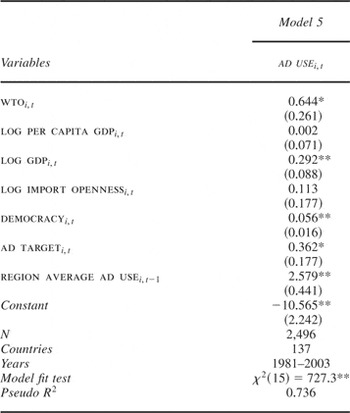
We conduct four sequential analyses of individual aspects of flexibility theory. The first, in Model 1, analyzes ad law and wto with a bivariate probit estimation. The second, Model 2, examines how possession of an AD mechanism shapes both the odds of accession to the WTO as well as the level at which the tariff is bound upon accession. The third, in Models 3 and 4, examines how an AD law shapes the evolution of applied tariffs, to see if any finding about bound rates in Model 2 is sustained in practice. The fourth, Model 5, quantifies the impact of WTO membership on AD use, rather than simply the adoption of an AD law. All four analyses model the dynamic nature of the endogenous variables explicitly, using a Markov chain approach where relevant. Taken together, the results strongly support the behavioral claims of flexibility theory: countries appear more likely to (1) join the WTO, (2) agree to lower tariff bindings, and (3) maintain lower tariffs in practice, if they have access to the primary flexibility provision in the WTO regime (by possessing a domestic AD mechanism).
Model 1: AD Laws and WTO Accession
To begin, we estimate a dynamic bivariate probit model of AD law adoption and WTO accession. We model the dynamic nature of each binary outcome with “observation-driven” Markov chains for each dependent variable.Footnote 46 This is a vital feature of the model, because both institutional characteristics, adoption and accession, are “sticky.” In practice, countries do not remove their AD mechanisms and do not drop out of the WTO. If we did not correct for this aspect of the data-generating process, their covariance would dramatically overstate the impact of each variable on the other. In other words, the fact that each phenomenon is sustained over time may not be due to the impact of the other, but rather to the self-propagating nature of each institutional state. Hence, by explicitly modeling these dynamics, we are using a highly conservative approach to estimation.
The model is as follows. Focusing first on AD law adoption, we consider two conditional probability equations describing whether country i has an AD law in place in year t, conditional on whether it had such a law in place the prior year t − 1:

where F(·) is the standard normal cumulative density, and X i,t is a vector of control variables, plus a constant. The key feature of this dynamic approach is that the covariates, including wto, are allowed to play a different role in AD law adoption than they do in keeping an AD law in place after it has first been adopted. In the equations above, this distinction is achieved by permitting β1* and γ* to differ from β1 and γ. Both equations in equation (1) can be combined:

where ̃1 = β1* − β and ̃ = γ* − γ1. The part of the equation determining the probability of transition from 0 to 1, then, is just the conventional probit model. The part driving the transition from 1 to 1, however, also incorporates the impact of interaction terms calculated by multiplying the lagged AD state (1 in this case) with each covariate.
The above equation describes a one-variable probit model with dynamics. We combine this specification with a parallel dynamic equation giving state transition probabilities for WTO membership,

where Z i,t is a vector of control variables, plus a constant. Together, the two equations reflect dual endogeneity, in that WTO membership determines AD law status in equation (2), and AD law status affects WTO membership in (3).Footnote 47 Furthermore, we suppose that the correlation of errors in the two equations, Corr(e i,t,u i,t) = ρ may be nonzero. If ρ ≠ 0, then estimating the two equations separately would allow endogeneity to bias β̂1 and α̂1. However, if ρ = 0, we could run two separate dynamic probit models and get consistent estimates of β1 and α1. Because we do not know ex ante what ρ actually is, we estimate the two equations jointly with a bivariate probit model that allows ρ ≠ 0.
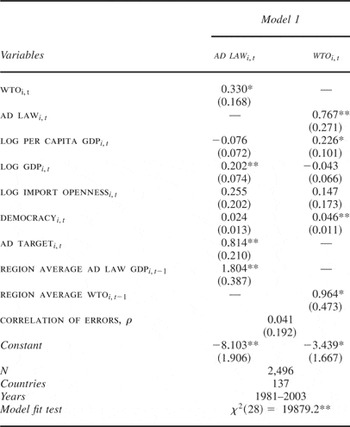
Table 1 displays the results of this model. To economize on space, the table shows only the first parts of each equation, which determine the probability of transition from 0 to 1 for each variable. Note that the Markov chain interactions prove to be collectively statistically significant (p < 0.001), justifying our use of this dynamic specification over the simple probit approach. Not surprisingly, because the two variables have virtually absorbing states, that is, countries joining the WTO do not drop out, and countries adopting an AD law do not remove it. the coefficient estimates of the Markov chain interaction terms are very close to the negative of the each covariate's coefficient in the displayed part of the equation. That is, the covariates' impact zeroes out once the absorbing state 1 has been reached, at which point the mere fact that such a state has been reached sustains itself in the future.Footnote 48 Absorption considerably attenuates the impact of each covariate; if we exclude these dynamics from the model, the estimated coefficients for ad law and wto become biased upwards by factors of 2.6 and 6.9, respectively.
Estimates of Markov chain bivariate probit model

Notes:
The table shows the parameters relevant to the probability of state transition from 0 to 1. In order to save space, the table omits the Markov interaction terms, which only matter after initial adoption/accession, and which are collectively significant with p < .001. Heteroscedastic-robust standard errors are in parentheses. In two-tailed tests,
* p < .05;
** p < .01.
Even with this conservative approach, ad law and wto have a positive and statistically significant impact on one another in Model 1. The substantive effects are also notable. Correcting for any correlation of unobservable sources of error, with all other variables at their sample means, WTO membership makes a country 2.3 [1.7, 3.1] times as likely to form its own antidumping mechanism in any given year, if it does not have one in place already. Likewise, having an AD law makes a country 4.1 [2.9, 5.1] times as likely to join the WTO in a given year, if it is not already a member. These findings are consistent with hypotheses (1) and (2) of the flexibility theory, respectively.
As this is the first empirical study of when countries accede to the WTO and of when they adopt AD laws, the findings regarding the other covariates in Table 1 should also be of interest. We emphasize that the instrumental variables, ad target and region average ad law, significantly boost a country's chances of forming a new AD mechanism. Namely, with all other variables at their sample means, moving those two variables from their minimum to maximum sample values magnifies the probability that country i will establish a domestic AD mechanism (assuming it did not have one already) by a factor of 147 [82, 243]. This powerful result is entirely consistent with the arguments and findings of prior research.Footnote 49 Similarly, country i is 7 [4, 15] times as likely to join the WTO if all, rather than none, of its regional neighbors are themselves members. Taken together, these findings unambiguously validate our choice of instrumental variables. Model 1 also reveals that large economies are more likely to adopt AD mechanisms, no doubt because of the opportunities that AD affords for shifting the terms of trade in their favor. Wealthier countries and democracies are more likely to join the WTO, the latter aspect of which is consistent with prior research on political regime types and international organizations.Footnote 50
One final important finding from Model 1 concerns the correlation of errors in the two equations. It turns out that we cannot reject the null hypothesis that the errors are wholly uncorrelated (it is not close, with p = .83) While the model builds in recursive endogeneity, by including each variable in the other's equation, this particular result means that there would be no discernible bias if we simply split the bivariate probit into the two equations (2) and (3) and estimated them separately.Footnote 51 We use this finding as the justification for Model 2's follow-up test of the impact of AD laws on both WTO membership and tariff bindings.
Model 2: AD Laws, WTO Accession, and Tariff Bindings
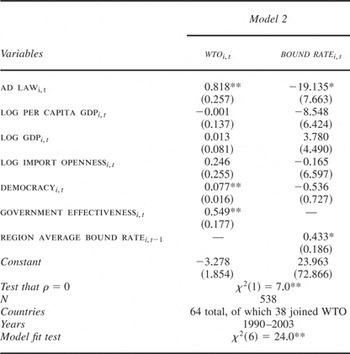
Model 1 establishes that the ability to take advantage of the regime's flexibility provisions makes a country more likely to join the agreement. But how does that ability affect the state's willingness to bind its tariffs tightly when it joins? A major constraint in answering this question is that we do not have data on pre–Uruguay Round tariff bindings. On the other hand, those bindings do not change over time after 1995. One approach would be to use a simple cross-section of WTO members to regress bound rate against ad law, but that would ignore the strong selection effect revealed by Model 1: states with AD laws are more likely than others to enter the regime in the first place. We therefore estimate a Heckman selection model, with the decision to enter the WTO as the first-stage outcome, and bound rate as the second-stage dependent variable.
The problem is that this approach can only be estimated using a pool of states that begin the sample period as nonmembers, some (but not all) of which ultimately join. And, because we only have post–Uruguay Round tariff bindings data, we are restricted only to those countries that contemplated joining GATT/WTO for the first time during or after the negotiation of that Round. Accordingly, Model 2 uses a subset of our larger sample, that is, just those sixty-four countries (out of our 137) that were not yet members of the GATT as of 1989. The first equation of Model 2 follows those countries each year from 1990 until they join the WTO (through 2003, if they do not), and the second equation, drawing on only one year's worth of observations for each new member, models each new member's bound rate upon accession.Footnote 52 Because it uses just a subsample of the observations in Model 1, that is, those in which wtoi,t−1 = 0, Model 2 does not need to incorporate Markov interaction terms, which are necessary only for analyzing Pr(wtoi,t = 1|wtoi,t−1 = 1). However, Model 2 further generalizes the dynamics in Model 1 by adding duration dependence terms.Footnote 53 It also incorporates a variable, government effectiveness, derived from the World Bank Governance Project, measuring the “competence of the bureaucracy and quality of public service delivery.”Footnote 54 Countries with public sectors with greater capacity are more able to handle the complex technical demands of WTO accession negotiations, but there is no reason to suspect that such governments make deeper tariff concessions when they join (and, in fact, they do not). The duration dependence terms and government effectiveness thus uniquely identify the WTO equation in our Heckman estimation.
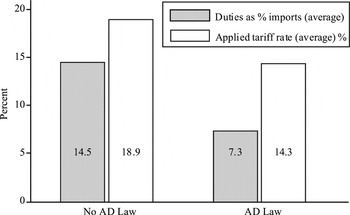
Before moving to these regression results, consider the basic information about these sixty-four countries revealed in Figure 1. Eighteen of these had an AD law in place by the year of accession, and a greater proportion of these (compared to those without an AD law) joined the WTO by 2003. Furthermore, those with an AD law bound their tariffs to less than half the level of new members who did not possess an AD law at the time of accession. As it turns out, these simple descriptive findings are echoed by the more sophisticated multivariate analysis in Model 2, shown in Table 2.
Percent joining the WTO and average bound tariff rate, by AD law status, sixty-four countries, 1990–2003

Estimates of Heckman model of WTO accession and tariff bindings

Notes:
The duration dependence terms in the wtoi,t equation, which are collectively significant with p < .001, are omitted from the table to save space. Heteroscedastic-robust standard errors are in parentheses. In two-tailed tests,
* p < .05;
** p < .01.
Model 2 provides a strong fit to the population.Footnote 55 The fact that the correlation of errors in the two equations is nonzero means that the Heckman approach is, in fact, required to correct for what would otherwise be selection bias in the estimates of the tariff bindings equation. In that light, our method improves upon that used by Moore and Zanardi, and Bagwell and Staiger, to explain variation in tariff bindings.Footnote 56 Note that, reassuringly, the estimates in the first (wto) equation for ad law and democracy are similar to those in Model 1. The chief finding, in support of hypotheses (2) and (3), is that the estimated coefficient for ad law is positive in the wto equation (with p < .02) and strongly negative in the bound rate equation (with p < .002). According to these estimates, possession of a domestic AD mechanism makes a country 5.3 [4.0, 6.1] times as likely to join the WTO and induces it to set its average tariff bindings a full 19.1 [11.1, 27.2] percentage points lower than otherwise. The latter figure may sound too large, except when one recalls that the average WTO member's bound rates weigh in at 38.5, with a standard deviation of 32.6. The domestic institutional capacity to take advantage of the WTO's most-used flexibility provision, antidumping, thus frees a member to bind its tariffs at about half the level it would otherwise.
Models 3 and 4: Effects on Applied Tariffs
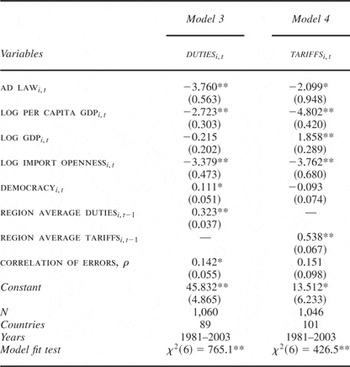
An important question remains. Is the beneficial impact of an AD law on bound rates undermined over time by higher-than-expected applied tariffs? Models 3 and 4 seek to answer this question using a “treatment effects” instrumental variables (IV) regression,Footnote 57 with AD law as the endogenous “treatment” and our two applied tariff indicators, duties and tariffs, as the second-stage outcomes. Because this analysis is motivated by questions about adherence to tariff bindings, we restrict this analysis to GATT/WTO member-years for the available sample period of 1981–2003. The instrumental variables that allow identification of the exogenous impact of AD law are region average ad law and ad target, which we know to be powerful predictors of ad law from Model 1.Footnote 58 Models 3 and 4, as with Model 1, incorporate Markov state interaction terms in the ad law equation, to avoid overstating the association between AD laws and tariff liberalization.Footnote 59 Before we discuss the results, consider the simple association in Figure 2. GATT/WTO members with AD laws appear to apply lower tariffs by either measure.
Indicators of applied tariffs, by AD law status, for 134 GATT/WTO members, 1981–2003

Does this association hold up in the multivariate analysis, correcting for endogeneity? The answer, revealed by the estimates in Table 3, is an unqualified “yes.” Controlling for the possibility that possession of an AD law is endogenous to tariff policy, exogenous adoption of an AD law significantly decreases a country's applied tariffs.Footnote 60 Considering that the sample means of duties and tariffs are 10.5 and 17.8, respectively, it appears from the estimated coefficients in Table 3 that an AD law allows a country to maintain average applied tariffs roughly one-tenth to one-third lower than they would otherwise be. We conclude that, in accordance with hypothesis (4), having the domestic institutional framework needed to use the regime's primary flexibility provision confers a durable commitment function, allowing the government to maintain substantially lower tariff rates. The impact of this domestic mechanism is not simply felt at the time of accession, as a “signing bonus”; rather, it lasts as long as the AD law stays in place.
Estimates of Markov chain instrumental variable models of applied tariffs

Notes:
These regressions include only GATT/WTO member-years. ad lawi,t is instrumented in a first-stage equation that includes Markov state interaction terms. Heteroscedastic-robust standard errors are in parentheses. In two-tailed tests,
* p < .05;
** p < .01.
Model 5: Does the WTO Increase Use of AD?
So far we have tested implications of the flexibility theory that speak to policy behaviors associated with beneficial effects on the welfare of the country's consumers as well as its foreign trade partners. Yet, as critics have argued, antidumping laws are vulnerable to abuse. Even proponents of flexibility theory would expect WTO members to use antidumping more frequently than nonmembers. Is this the case? Recall that Model 1 demonstrated only that countries joining the WTO become more likely to establish a domestic antidumping mechanism, it did not examine use of that system once in place. While we do not seek to evaluate the welfare impact of antidumping actions relative to the welfare benefits ensuing from the policy behaviors we have identified above, we can determine whether the WTO stimulates use of, and not merely adoption of, AD laws.
Model 5 in Table 4 once again takes advantage of the fact that Model 1's test of error correlation produced no discernible evidence of endogeneity bias. We estimate a single-equation Markov chain probit model, with ad usei,t as the dependent variable. Lending further support to hypothesis (1), wto has a statistically significant and positive coefficient. Holding other variables at their sample means, a WTO member is 6.7 [3.0, 17.6] times more likely to initiate an AD action in any given year, if it did not do so the prior year. If it did begin an AD action the prior year, the probability that a WTO member will initiate at least one AD action the next year is 0.13 [0.02, 0.30] higher than for a nonmember. Given the role that antidumping plays as the principal flexibility provision within the global trade regime, the WTO is effectively diffusing the practice across its membership. This pattern helps explain the oft-decried trend of the spread of antidumping to so-called “new users.”Footnote 61
Estimates of Markov chain probit model of AD use

Notes:
The table shows the parameters relevant to the probability of state transition from 0 to 1; others omitted to save space. Heteroscedastic-robust standard errors are in parentheses. In two-tailed tests,
* p < .05;
** p < .01.
Conclusion
This article asks the question, “Do flexibility provisions in international agreements promote cooperation?” The idea that they do—what we have called flexibility theory—has begun to dominate theoretical work on international law and politics. Yet, with one or two exceptions,Footnote 62 the field has produced little large-scale evidence bearing on the behavioral implications of the argument, either in general, or as applied to the trade regime. In part, this lack of evidence is attributable to two profound research design challenges: specifically, (1) the endogeneity of those institutions' design, their membership, and the concessions made in them, as well as (2) the lack of variability in the design of the most important global regimes (for example, the GATT/WTO system). Indeed, the empirical literature on the subject is so weakly developed that no prior work has explicitly recognized these challenges, let alone provided a research design to tackle them.
This article addresses these issues head-on and provides the first large-scale evidence about the behavioral predictions of the flexibility argument applied to the global trade regime. We overcome problem number one by using a series of techniques to directly model the jointness, endogeneity, and selection bias at work in the simultaneous determination of regime membership, terms of agreement, and flexibility provisions. Another key insight is that, even if the flexibility provisions in the regime are constant across time and members, the domestic institutional capacity to exercise those rights, at least nominally in keeping with the regime's standards, does indeed vary. Because, as virtually all observers admit, antidumping is by far the most accessible and most frequently used flexibility provision in the GATT/WTO system, we focus on the possession of a domestic AD mechanism as the key source of variation. This insight, then, resolves problem number two.
Our findings, perhaps somewhat surprisingly, provide remarkably strong support for the flexibility argument—particularly, as we have emphasized, its predictions about state behavior (rather than its welfare claims). Correcting for endogeneity and selection bias, our evidence reveals the following:
1. Countries joining GATT/WTO are more likely to establish and use a domestic AD mechanism.
2. Having an AD law makes a country significantly more likely to accede to the WTO.
3. Having an AD law allows a country to agree to significantly lower tariff bindings when it joins the WTO.
4. Having an AD law allows a country to maintain significantly lower applied tariffs after accession.
These findings constitute a number of important contributions to theoretical and policy debates about international law and politics. First, the literature has taken careful note of the recent proliferation of antidumping, but, in Prusa's words, “it is not clear exactly why so many new countries are embracing AD law.”Footnote 63 This article provides an explanation—namely that AD serves as the chief flexibility provision in the multilateral trading regime. A country contemplating joining the WTO and liberalizing deeply when doing so finds it politically useful to invest in a domestic AD mechanism, because it helps a member credibly reassure its import-competing producers that the state will defend their interests when truly urgent, notwithstanding the state's treaty commitment to liberalize. This in turn enables the state to overcome domestic resistance to WTO accession and major tariff liberalization. Besides providing an explanation for the spread of antidumping in particular, this study highlights a strategy for studying the role of flexibility in the design of other multilateral regimes, based on domestic sources of variation and multifaceted empirical modeling that reflects the endogeneity of institutional variables.
Second, we believe the central insight supporting our research design has value beyond the purposes of empirical testing. International institutions do not work in a vacuum. Rather, specific domestic institutional frameworks are required to take advantage of several important functions of international institutions. As our findings emphasize, these domestic-international linkages go both ways: joining an international institution creates new incentives to reshape domestic structures; likewise, customizing domestic legal mechanisms allows the state to engage the international legal system more profitably. This insight is not new, but it highlights the importance of directing future theorizing toward such domestic-international institutional interactions.
Third, there has been a great deal of recent interest in the spread of policies and practices across borders.Footnote 64 Scholarly attention has focused on the engines driving diffusion, for example, competitive pressures or policy emulation and learning. Our evidence highlights a unique, though not mutually exclusive, alternative. Namely, membership in international regimes changes incentives and causes countries to restructure their domestic policymaking frameworks to best take advantage of cooperative opportunities. This is distinct from competitive pressure. Variables designed to capture competitive, retaliatory effects in antidumping do have strong effects: if a country is a target of antidumping actions, or if its neighbors practice antidumping against third parties, it has a strong incentive to enter the “AD Club” itself. Indeed, these pressures are vital to our research strategy, because they provide powerful exogenous instruments for AD law adoption. The point, however, is that these effects would occur regardless of whether the country is a member of the WTO. Yet, as we have found, the WTO independently facilitates the spread of antidumping.
The tests in this study are not designed to rule out the learning mechanism, since diffusion per se is not our chief target of analysis. Nonetheless, it is worth noting that our project began with exactly this goal in mind; we originally suspected that antidumping has spread because the WTO emphasis on it might have inadvertently taught new adopters to use it. However, a number of informative discussions with individual country delegations and WTO Secretariat officials convinced us that learning was not the principal cause of antidumping adoption. Rather, the real motivation, they invariably said, was the need to credibly reassure import-competing interests at home that the government would be able to defend them when the costs of liberalization were prohibitively high. This is the heart of the flexibility argument.
Fourth, as others have observed, a highly legalized system such as the WTO creates new problems for states.Footnote 65 In particular, in order to meet more tightly defined standards over flexibility provisions, states need a highly sophisticated domestic institutional capacity. Such capacity is not easy to generate: it requires the dedication of significant resources and the development of expertise, not to mention the formation of state partnerships with private-sector stakeholders.Footnote 66 Two points follow from this logic. Barriers to adopting sophisticated domestic legal regimes are, by implication, barriers to accession and liberalization in the WTO system. Recognizing this relationship helps us understand why many developing countries have come late to the WTO party, and how, ironically, those with the most to gain from liberalization have done so the least (making only shallow tariff binding commitments). The other point is that, while others have argued that the ability to engage the WTO system is chiefly the product of a country's market power,Footnote 67 our findings imply that domestic institutional limitations also matter greatly.
Fifth, our results have important implications for broader debates about the design of the global trading rules and the welfare effects of flexibility provisions. The obvious question is: How “efficient” are provisions such as antidumping in the WTO system? Our tests do not directly estimate the net welfare effects of antidumping, so we can only speculate on this point. Yet a key implication of our findings is that there are at least some benefits to the inclusion of flexibility provisions in international agreements. The benefits are realized in the ex ante decision to join the trade regime as well as in the form of lower ex post tariffs, and they are substantively quite significant, which some scholars have doubted.Footnote 68 Specifically, if the WTO lacked a provision for antidumping, countries that could otherwise use that provision would have been 4.1 times less likely to join, would have bound their tariffs 19.1 percentage points higher upon accession, and would have maintained applied tariffs up to 30 percent higher than otherwise. How much additional commerce does antidumping thus indirectly make possible? To take one extant estimate, formal membership in the GATT/WTO boosts a country's trade with fellow members by 41 percent.Footnote 69 The increase in trade should be all the greater, considering that this statistic does not take into account the further reduction in tariffs attributable to the system's provision for antidumping.
On the other side of the ledger, there are ex post costs due to antidumping protection. Prusa estimates that each antidumping duty reduces imports of the affected product by 30 to 50 percent.Footnote 70 Even when they do not end in a duty order, investigations themselves have a comparable chilling effect on imports. This could potentially be said for the mere possession of a domestic antidumping instrument, in fact.Footnote 71 But only a small proportion of products are affected at any one time by threatened or observed antidumping actions, whether compliant or not with WTO standards. As a result, according to computable general equilibrium estimates by Gallaway, Blonigen, and Flynn, the entire stock of antidumping duties by a major user like the United States reduces its total goods imports by no more than 1 to 2 percent.Footnote 72 So, on one hand, we have a gain of more than 41 percent in trade; on the other, a loss of 2 percent. The former's benefits are felt all across the economy; the latter's costs are borne chiefly by domestic consumers and foreign suppliers of the products affected by antidumping. To be sure, the impact on trade flows is only a piece of the aggregate welfare picture, but even this back-of-the-envelope calculation suggests that the efficiency gains from the regime's incorporation of antidumping may be considerable.
Nonetheless, we do not wish to offer a Panglossian view of antidumping. The optimal treatment of antidumping in the multilateral trade regime must balance the benefits of flexibility against the potential for excessive use. As described earlier, the WTO's AD rules reflect the membership's desire to constrain such abuse. Recent research suggests that those rules work, if not perfectly, then reasonably well: a state is significantly less likely to conduct an AD investigation or impose an AD measure against firms in fellow WTO member-states than against otherwise-similar firms in nonmember nations.Footnote 73 As our evidence testifies, this function does not undermine the behavioral benefits of flexibility: the existing rules have succeeded in (1) encouraging states to join the multilateral trading system and to cut tariffs more deeply, while (2) simultaneously deterring countries from invoking this flexibility provision too frequently against other WTO members. Nevertheless, as dozens of WTO disputes on antidumping reveal, considerable latitude for interpretation still exists in the prevailing standards. Observers have focused their attention on the clarity of the rules defining “less than normal value,” the procedures for enforcement in the wake of abuse, and the challenges involved in estimating the compensation due in the event of noncompliance.Footnote 74 It remains to be seen whether, and to what extent, reforms tightening the WTO's AD standards would diminish the behavioral benefits of this flexibility provision as demonstrated here.