Introduction
Maternal glucocorticoid administration is standard of care for the prevention of neonatal morbidity and mortality associated with prematurity. However, significant evidence exists to support the notion that many diseases in adulthood are related to an unfavorable fetal environment, in particular conditions associated with elevations in glucocorticoid levels.Reference Barker 1 Using animal models, we and others have shown that antenatal administration of glucocorticoids is associated with increased blood pressure.Reference Figueroa, Rose, Massmann, Zhang and Acuna 2 , Reference Dodic, May, Wintour and Coghlan 3 In humans, following one course of antenatal glucocorticoid administration, an elevation in blood pressure without any obvious additional adverse effects was reported in children aged 14 years.Reference Doyle, Ford and Rickards 4 The mechanisms underlying the cardiovascular effects of antenatal steroids are poorly understood, but may include alterations in kidney structure and function, alterations in the renin angiotensin system and in vascular reactivity.Reference Adair and Dahly 5 Antenatal dexamethasone exposure is associated with increased responsiveness to ET-1 in the placental arteriesReference Kutzler, Molnar and Schlafer 6 and in the femoral arteries of the offspring.Reference Molnar, Howe, Nijland and Nathanielsz 7 Our laboratory has shown that antenatal betamethasone exposure in sheep at 80 days of gestational age is associated with higher arterial blood pressureReference Figueroa, Rose, Massmann, Zhang and Acuna 2 and increased sensitivity to endothelin (ET-1) in vitro Reference Pulgar and Figueroa 8 and in vivo.Reference Lee, Zhang and Flores 9 The effects of ET-1 are mediated by two receptors, ETA found in the smooth muscle cells (SMC) and ETB present in both the SMC and endothelial cells (EC). ET-1 vasoconstriction occurs as a result of both extracellular Ca2+ influx and intracellular Ca2+ release. Activation of the cyclic adenosine diphosphate ribose (cADPR) pathway via modulation of the ryanodine receptor (RyR) is a fundamental mechanism for regulating intracellular calciumReference Bai, Lee and Laher 10 – Reference Lee 16 including ET-1-induced vasoconstriction.Reference Giulumian, Meszaros and Fuchs 17 – Reference Thai and Arendshorst 19
The aim of this study was to further characterize the effects of antenatal glucocorticoid exposure on the ET-1 system, specifically to ascertain the role of the cADPR/RyR pathway in the increased sensitivity to ET-1 observed in the offspring exposed to antenatal glucocorticoids.
Materials and methods
Use and care of animals
Sheep were randomly selected to receive either betamethasone (0.17 mg/kg of a 1:1 mixture of betamethasone acetate and betamethasone phosphate [Celestone Soluspan (Schering, Kenilworth, NJ) (n=11)] or vehicle (n=13). Intramuscular injections were given 24 h apart at 80 and 81 days of gestation (term of gestation is 145 days). Although no sheep received more than 12 mg per dose, the premise was that the 12 mg dose represented the amount given to a 70 kg pregnant woman, which we adjusted to the body weight of the sheep. Pregnant sheep were maintained with free access to food and water in an open pasture throughout the entire pregnancy, and the offspring were raised by the mother until weaned at 3 months of age. To eliminate the endocrine changes associated with the estrous cycle, female sheep received a vaginal progesterone implant (Eazi-Breed CIDR, Pfizer Animal Health, NY, USA).Reference Lee, Zhang and Flores 9 Adult offspring of both sexes were euthanized under isoflurane general anesthesia at ∼1 year of age to obtain fourth- and fifth-generation segments of the right brachial artery. All procedures were approved by the Institutional Animal Care and Use Committee.
Arterial segment preparation
Under a dissecting microscope, the right brachial artery was dissected and followed until the arteries of ∼200 μm in diameter were identified. The arteries were then dissected free of their surrounding tissue, cut into 1.5–2 mm segments and mounted on a myograph (Multi Myograph, Model 610M Danish Myo Technologies, Aarhus, Denmark) using two stainless steel wires (diameter 40 μm). In all the arterial segments, the endothelium was disrupted by passing a human hair through the lumen of the vessel.Reference Pulgar and Figueroa 8 Successful removal of the endothelium was confirmed by the absence of relaxation following the addition of acetylcholine (10−6 M) in each arterial segment studied preconstricted with KCl (62.5 mM). The myograph chamber was filled with Krebs–Henseleit buffer (KHB) solution, maintained at 37°C and aerated with 95% O2/5% CO2. The vessels were washed and incubated for 30 min before determining the optimal diameter. Each arterial segment was stretched to its individual optimal lumen diameter following the normalization procedure previously described.Reference Pulgar and Figueroa 8 In all studies, after obtaining the optimal diameter, a 30-min equilibration period preceded the addition of the test substances.
Standard response to KCl
Once the optimal lumen diameter was set and following a 30-min equilibration period, the response to a single dose of 62.5 mM KCl was obtained for all segments by calculating the average of three consecutive doses tested at intervals of 10 min. This response was used to normalize tension between individual arterial segments.
Response to ET-1
A cumulative concentration–response curve was constructed for ET-1 by exposing the arterial segments to eight concentrations incremented in half-log intervals (10–8.6–10–7M), with each subsequent dose being introduced at intervals of 3 min. In parallel experiments, arterial segments were preincubated for 10 min with either one of two ADP-ribosyl cyclase inhibitors nicotinamide (NIC; 10 mM) or 2-2′-dihydroxy-azobenzene (DAB; 60 μM) before being exposed to ET-1. In all cases, each treatment was run in duplicate and the average response used for analysis.
Response to increasing concentrations of KCl
A concentration–response curve was constructed for KCl by exposing the arterial segments to nine different concentrations of KCl (6.25–75 mM). Each artery segment was exposed to a given dose for 2 min, washed with KHB and allowed to relax before the subsequent concentration was introduced. In parallel experiments, arterial segments were preincubated for 10 min with NIC (10 mM) and the same concentration of nicotinamide was added simultaneously with each dose of KCl. In all cases, each treatment was run in duplicate and the average response used for analysis.
Relaxation of KCl-induced vasoconstriction
A cumulative concentration–response curve for NIC, sodium nitroprusside (SNP) and NIC plus SNP was constructed by adding seven different concentrations (nicotinamide 0.5–10 mM, SNP 10–8.5–10–4 M) to arterial segments constricted with 62.5 mM KCl. After obtaining a stable level of constriction, drugs were added in a cumulative manner at 3 min intervals.
Solutions and drugs
KHB was contained in mM, NaCl 118.5, NaHCO3 25, KCl 4.7, KH2PO4 1.2, MgSO4 1.2, CaCl2 2.5 and glucose 5.5, with a final pH of 7.4. In all KCl solutions, NaCl was replaced in equimolar proportion by KCl. All drugs were obtained from Sigma Chemical Co. (St. Louis, MO, USA).
Data analysis
Concentration–response curves were analyzed by fitting individual experimental data to a sigmoid curve to determine maximal response and sensitivity and Hill coefficient using the nonlinear algorithm for a three-parameter Hill equation in SigmaPlot 12 (Systat Software Inc., San Jose, CA, USA). The contractile responses to the cumulative ET-1 and increasing KCl were expressed as fold-change over the standard KCl response. Relaxation responses were expressed as a percent relaxation using the KCl-preconstriction diameter. The data are shown as mean±s.e.m. The average response of two segments per artery tested with each pharmacological agent was used in all cases. Sample size refers to the number of sheep in each group.
ADP-ribosyl cyclase mRNA expression
We harvested second- and third-generation arteries from the brachial vascular bed and dissected them free of the connective tissue. After rinsing in sterile saline, segments were frozen in liquid nitrogen and stored at −80ºC. Analysis of gene expression was performed using reverse transcriptase-polymerase chain reaction (RT-PCR). Primers were constructed using published bovine sequences (NM_175798.3). Ribonucleic acid (RNA) from the brachial arterial segments was isolated using the RNeasy kit (Qiagen, Santa Clarita, CA, USA), followed by RNase-free DNase I digestion. Equal amounts of total RNA (100 ng per reaction) was assayed in triplicate for transcripts encoding the genes of interest using the one-step RTPCR kit (#4309169, Taqman; Applied Biosystems, Foster City, CA, USA). For the relative quantification of gene expression, the comparative threshold cycle method was used. Half of the arterial segments were slit open and the endothelium removed by rubbing with a cotton swab. The mRNA data are expressed as the ratio of the denuded artery over the endothelium intact artery.
Statistical analysis
Statistical differences were established using two- (dose and antenatal treatment as factors) and three-way ANOVA (dose, antenatal treatment and ADPR cyclase inhibitor as factors) and two-sample t-test with differences considered significant at the P<0.05 level. Sample size refers to the number of animals in each group.
Results
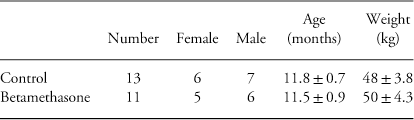
As shown in Table 1, no significant differences in sex distribution, age or body weight between the sheep in the vehicle-treated and the betamethasone groups were present.
Demographic characteristics of the adult sheep at the time artery harvest

Response to ET-1
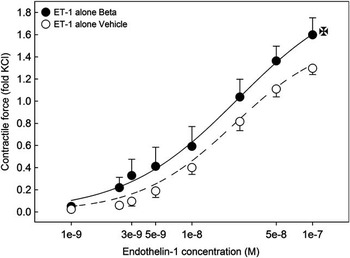
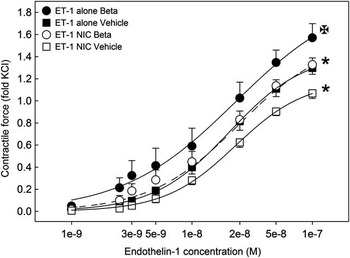
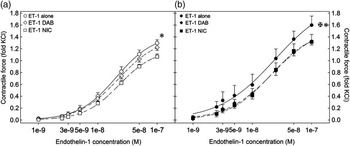
Incubation of the brachial artery segments with increasing concentrations of ET-1 resulted in a dose-dependent contraction in the vehicle and betamethasone groups (Fig. 1). However, the response to ET-1 was significantly higher in the arteries from the Beta sheep (F=3.5, P<0.05; two-way RM ANOVA). NIC decreased the ET-1 vasoconstriction in the betamethasone group to a level equivalent to that of the vehicle-exposed group (Fig. 2). Although both blockers significantly decreased ET-1 responsiveness in the Beta sheep (Fig. 3b), in vehicle-treated sheep NIC but not DAB significantly decreased the ET-1 effect (Fig. 3a). Three-way ANOVA followed by multiple comparisons of Beta v. vehicle revealed a significant Beta effect on ET-1 responsiveness in the absence of blockers (t=5.86; P<0.001), in the presence of NIC (t=4.11; P<0.001) and in the presence of DAB (t=2.09; P<0.05). The inhibitory effect of the two blockers, assessed as percent reduction of maximal response, was 15±5 and 5±5% in vehicle-treated sheep, and 17±5 and 12±6% in Beta-exposed sheep for NIC and DAB, respectively. No significant effects on the Hill coefficient were observed for either blocker.
Vasoconstriction response to endothelin-1 in denuded adult sheep brachial arteries exposed antenatally to either vehicle (■, n=13) or betamethasone (●, n=11). Data are normalized to the response to 62.5 mM potassium chloride (fold KCl). Data are shown as mean±s.e.m. ✠P<0.05 by two way ANOVA.

Effect of nicotinamide (NIC) pretreatment (□; ○) on the vasoconstriction response to endothelin-1 in the denuded adult sheep brachial arteries exposed antenatally to either vehicle (■, n=13) or betamethasone (●, n=11). Data are normalized to the response to 62.5 mM potassium chloride (fold KCl). Data are shown as mean±s.e.m. ✠Beta effect; *NIC effect P<0.05 by ANOVA.

Effect of ADP-ribosyl cyclase inhibitors nicotinamide (NIC: □;■)) and 2-2′-dihydroxy-azobenzene (DAB: ◇;◆) pretreatment on the contraction response to endothelin-1 (○;●) in the denuded brachial arteries from adult sheep exposed antenatally to either vehicle (Panel A; n=13) or betamethasone (Panel B, n=11). Data are normalized to the response to 62.5 mM potassium chloride (fold KCl). Data are shown as mean±s.e.m. ✠DAB effect; *NIC effect P<0.05 by ANOVA.

Response to depolarizing concentrations of KCl
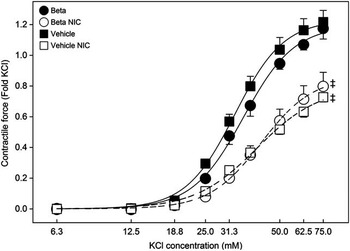
Exposure of the arterial segments to increasing concentrations of KCl (6.25–75 mM) resulted in a concentration-dependent contraction in both groups (Fig. 5). Nonlinear fit analysis of the KCl-induced vasoconstriction revealed no significant differences between groups E max expressed as fold-change from basal 1.3±0.08 v. 1.1±0.03 and EC50 expressed in mM 33±1.6 v. 33±0.87 for vehicle-treated and Beta-treated groups, respectively. Similarly, no significant differences were observed for the calculated Hill coefficient. The ADP-ribosyl cyclase inhibitor, nicotinamide at 10 mM, significantly attenuated the KCl-induced vasoconstriction in both groups (Fig. 4). NIC decreased E max and increased EC50 in both groups by similar magnitude; however, in the vehicle-treated group, a significant reduction in the calculated Hill coefficient was observed (from 4.8±0.21 to 3.9±0.32 in vehicle P<0.05 v. 5.0±0.25 to 5.3±0.40 in Beta).
Vasoconstriction response to KCl in the denuded adult sheep brachial arteries exposed antenatally to either vehicle (■, n=13) or betamethasone (●, n=11). The effect of nicotinamide (NIC) pretreatment is shown by the open symbols for each group (□;○). Data are normalized to the initial response to 62.5 mM potassium chloride (fold KCl). Data are shown as mean±s.e.m. ‡NIC effect P<0.05 by two-way ANOVA.

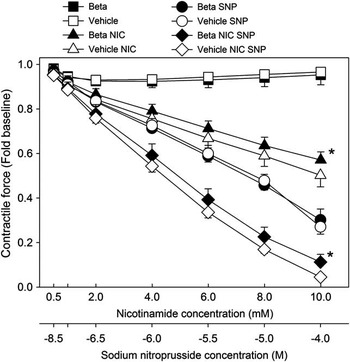
Relaxation evoked by nicotinamide and sodium nitroprusside (SNP) in the arteries constricted with KCl. Denuded adult sheep brachial arteries exposed antenatally to either vehicle (open symbols; n=13) or betamethasone (closed symbols; n=11). The effect of pretreatment with nicotinamide (△,▲), SNP (○,●) or nicotinamide plus SNP (◇,◆) was compared with no pretreatment (□,■). Data are normalized to the baseline response to 62.5 mM potassium chloride (fold baseline). Data are shown as mean±s.e.m. *Nicotinamide (NIC) effect P<0.05 by two-way ANOVA.

Relaxation of KCl-induced preconstruction
We studied the effect of increasing concentrations of NIC in the arteries preconstricted with 62.5 mM KCl. This KCl concentration elicited a stable contraction of the brachial artery segments, which lasted at least 30 min (Fig. 5). Addition of increasing concentrations of NIC to the bath resulted in a significant decrease in wall tension in both the groups. Interestingly, NIC-induced relaxation was significantly greater in the arteries from the vehicle-treated sheep (50% relaxation v. 40% relaxation; t=2.2, P<0.05). In contrast, the relaxation elicited by increasing concentrations of the nitric oxide (NO) donor SNP was more potent (70% relaxation) than that of NIC and was not statistically different when comparing both groups. An additive effect was observed when NIC and SNP were used in combination; however, as in the case of NIC alone, arteries of the vehicle-treated sheep exhibited a more pronounced response (95% relaxation) when compared with the Beta-treated sheep (88% relaxation; t=2.7, P<0.001).
CD38/ADP-ribosyl cyclase mRNA expression
Relative expression of CD38 was not significantly different between groups (0.7±0.30 in vehicle v. 1.3±0.35 in beta).
Discussion
In this study, we provide new insight into the mechanisms underlying the enhanced in vitro response to ET-1 that we and others have reported on animals exposed to antenatal glucocorticoids. The results of this study are important as a dysfunction in ET-1 function and/or regulation has been implicated in the development of hypertension in humans.Reference Schiffrin 20 Vascular contraction induced by ET-1 is most commonly mediated by the stimulation of ETA receptors but may also occur via activation of ETB receptors. Although ETA is purely vasoconstrictive, stimulation of ETB receptors may cause either vasoconstriction by a direct effect on SMC or vasodilatation by stimulating EC to release NO and/or prostacyclin.Reference Orleans-Juste, Labonte and Bkaily 21 ET-1-induced vasoconstriction occurs as a result of both extracellular Ca2+ influx and intracellular Ca2+ release with the activation of inositol trisphosphate (IP3) and RyRs contributing to the initiation and maintenance of smooth muscle contraction. Recent studies have shown that the ET-1-induced increase in intracellular Ca2+ concentration in SMC is mediated partly by the cADPR/RyRs signaling pathway. The ETB receptor is thought to be coupled exclusively with the CD38/cADPR pathway, whereas the ETA receptor is coupled with both the IP3 and CD38/cADPR pathways.Reference Barone, Genazzani and Conti 18 , Reference Thai and Arendshorst 19 In this study, we restricted the study to the effects of ET-1 on vascular SMC by denuding the arterial endothelium. In the SMCs, the most important endogenous modulators of ryanodine channel function are Ca2+ and cADPR.Reference Zalk, Lehnart and Marks 22 Nicotinamide is a by-product of the ADP-ribosyl cyclase reaction,Reference Lee 23 and when it accumulates it shifts the reaction toward NAD+, thus decreasing the production of the second messenger cADPR.Reference Sauve, Munshi, Lee and Schramm 24 ADP-ribosyl cyclase activity is found to be associated with CD38 in most tissues,Reference Lee 23 including the vasculature;Reference Zhang and Li 12 however, other proteins have been shown to possess this catalytic activity.Reference Malavasi, Deaglio and Funaro 25
Our data show that ET-1 resulted in a concentration-dependent vascular contraction in both groups, which was significantly stronger in the arteries of betamethasone-exposed sheep. Furthermore, we also observed a differential response to known inhibitors of ADP-ribosyl cyclase. In the arteries of vehicle-treated sheep, DAB was devoid of inhibitory effect, and nicotinamide had a significantly less pronounced inhibition compared with beta-exposed sheep. Contrary to the in vivo response,Reference Lee, Zhang and Flores 9 we did not find a systematic sex difference in response to ET-1 or to any of the drugs used. ADP-ribosyl cyclase activity is also present in the endothelium and plays an important role in the regulation of NO production. Thus, the absence of sex differences in the present study can be attributed to the lack of endothelial effects of the drugs used. In the absence of significant differences in CD38 mRNA expression between the two groups, we believe that the data indicate that antenatal betamethasone either potentiates the effects of cADPR on RyR or induces the expression of a different molecular form of ADP-ribosyl cyclase. In addition to CD38, other gene products are known to possess ADP-ribosyl cyclase activity.Reference Lee 23 , Reference Gul, Park and Kim 26 In the rat aorta, ADP-ribosyl cyclase enzymatic activity is not only not associated with CD38, it also has distinct catalytic and biochemical properties in response to inhibitors.Reference de Toledo, Cheng, Liang, Chini and Dousa 27 The upregulation of a different gene product with ADPR cyclase activity may also explain the fact that the inhibitory effect of DAB is present in the Beta group only.
As the activation of the CD38/cADPR pathway can be induced through the stimulation of both ETA and ETB,Reference Barone, Genazzani and Conti 18 , Reference Thai and Arendshorst 19 we cannot establish with certainty which receptor type is more important as a mediator of the effect in the sheep brachial artery. In a previous study, our lab demonstrated that ETB receptors may have a significant contribution. BQ788, a selective ETB receptor antagonist, increases the contractile response to ET-1 in the endothelium-intact arteries as it removes the ET-1-dependent NO generation from EC. However, in the arteries obtained from Beta sheep, BQ788 significantly inhibited ET-1-induced vasoconstriction,Reference Pulgar and Figueroa 8 thus suggesting that ETB receptors in the smooth muscle may have an important contribution in the contractile response.
To address the possibility of antenatal betamethasone having a generalized effect on the CD38/cADPR pathway, independent of specific agonist stimuli, we studied the response to KCl-induced vasoconstriction. Membrane depolarization by KCl is used to evaluate smooth muscle responsiveness in an agonist-independent manner, to remove the confounding effects of receptor density and/or signal transduction coupling. The initial influx of Ca2+ through the activation of voltage-dependent Ca2+ channels (VDCC) stimulates calcium-induced calcium release that gets further amplified into global Ca2+ waves via the recruitment of neighboring RyRs.Reference Laporte, Hui and Laher 28 Although there are several reports suggesting that membrane depolarization is capable of directly activating ADP-ribosyl cyclase,Reference Zhang and Li 12 , Reference Zhang, Harrison and Li 29 , Reference Geiger, Zou, Campbell and Li 30 it seems that it is the influx of calcium through VDCC that actually activates ADP-ribosyl cyclase following KCl.Reference Kuemmerle and Makhlouf 31 In isolated coronary arteries, nicotinamide was shown to attenuate the vasoconstriction induced by both KCl and direct activation of VDCC and was interpreted by the authors as being consistent with the existence of basal cADPR production.Reference Geiger, Zou, Campbell and Li 30 We found no significant differences in the response to KCl between the two groups and the increase in tension was similarly attenuated by nicotinamide in the two groups, suggesting that the nicotinamide effect may represent inhibition of basal cADPR production and calcium-induced cADPR production. In all the tissues examined, cADPR concentration has been found to be in the range of 100–200 nM, supporting a basal production of cADPR and thus inhibitable by nicotinamide.Reference Zhang and Li 12 , Reference Li, Zou and Campbell 32 The fact that antenatal betamethasone exposure is not associated with either an increase in CD38 or ET receptorReference Lee, Zhang and Flores 9 mRNA would indicate that the increased response to ET-1 is most likely at the level of signal transduction coupling.
We also studied the relaxation response of the preconstricted arteries to ascertain whether antenatal betamethasone also affected smooth muscle relaxation mechanisms. Both nicotinamide and SNP relaxed KCl-preconstricted arteries in a dose-dependent manner. Although the response to SNP was similar in both the groups, the effect of nicotinamide was significantly less pronounced in the arteries of the Beta sheep. This differential response to nicotinamide of Beta sheep was maintained when both SNP and nicotinamide were applied simultaneously. The effect of nicotinamide is thought to be primarily due to the inhibition of basal CD38 activity.Reference Fellner and Arendshorst 33 In contrast, NO-dilated vessels primarily through the activation of guanylyl cyclase and cGMP generation,Reference Archer, Huang and Hampl 34 but it does have additional vasodilatation mechanisms; inhibition of sarcoplasmic reticulum (SR) Ca2+ release through both IP3R and RyRs,Reference Li, Zou, Ge, Campbell and Li 35 and direct stimulation of Ca2+-activated K+ channels.Reference Bolotina, Najibi, Palacino, Pagano and Cohen 36 It has also been reported that SNP decreases ADP-ribosyl cyclase activity in the coronary vascular SMC.Reference Yu, Zhang, Zou, Campbell and Li 11 The mechanism by which cADPR activates the RyR in the SMCs is not completely understood, but abundant evidence implicates the protein (FK506-binding protein) FKBP12.6 Reference Bielefeldt, Sharma, Whiteis, Yedidag and Abboud 37 and activation of NADP(H) oxidase.Reference Zhang, Jin and Yi 38 , Reference Xu, Zhang and Xia 39 Binding of cADPR to FKBPs promotes the dissociation of FKBP12.6 from the RyR and stimulates Ca2+ release.Reference Noguchi, Takasawa and Nata 40 In addition, cADPR has been shown to activate NADP(H) oxidase in the SR leading to superoxide generation.Reference Zhang, Jin and Yi 38 Consistent with the effect of nicotinamide on KCl-induced vasoconstriction, the underlying mechanism for a less potent relaxation in the arteries of Beta-exposed animals could also be at the level of signal transduction coupling, such as increased expression of FKBP12.6 and/or NADP(H) oxidase.
In summary, in the offspring of sheep treated with clinically relevant doses of betamethasone at a gestational age similar to the period, when human fetuses are routinely exposed to glucocorticoids, the increased response to ET-1 is mediated by the activation of the CD38/cADPR signaling pathway. Further studies are required to identify the effectors downstream from cADPR affected by exposure to antenatal steroids.
Acknowledgments
Funded by NIH HL 68728 and HD 04784. Supported by Research Funds of Chonbuk National University in 2011.