






No CrossRef data available.
Article contents
Costs and benefits of communicating vigor
Published online by Cambridge University Press: 30 September 2021
Abstract
Why do we run toward people we love, but only walk toward others? One reason is to let them know we love them. In this commentary, we elaborate on how subjective utility information encoded in vigor is read out by others. We consider the potential implications for understanding and modeling the link between movements and decisions in social environments.
Information
- Type
- Open Peer Commentary
- Information
- Copyright
- Copyright © The Author(s), 2021. Published by Cambridge University Press
References
Becchio, C., Koul, A., Ansuini, C., Bertone, C., & Cavallo, A. (2018). Seeing mental states: An experimental strategy for measuring the observability of other minds. Physics of Life Reviews, 24, 67–80. doi: 10.1016/j.plrev.2017.10.002.CrossRefGoogle ScholarPubMed
Cavallo, A., Koul, A., Ansuini, C., Capozzi, F., & Becchio, C. (2016). Decoding intentions from movement kinematics. Science Reports, 6, 37036. doi: 10.1038/srep37036.CrossRefGoogle ScholarPubMed
Chouchourelou, A., Matsuka, T., Harber, K., & Shiffrar, M. (2006). The visual analysis of emotional actions. Social Neuroscience, 1(1), 63–74. doi: 10.1080/17470910600630599.CrossRefGoogle ScholarPubMed
Grezes, J., Frith, C., & Passingham, R. E. (2004). Brain mechanisms for inferring deceit in the actions of others. Journal of Neuroscience, 24(24), 5500–5505. doi: 10.1523/jneurosci.0219-04.2004.CrossRefGoogle Scholar
Hall, K., Oram, M. W., Campbell, M. W., Eppley, T. M., Byrne, R. W., & de Waal, F. B. M. (2017). Chimpanzee uses manipulative gaze cues to conceal and reveal information to foraging competitor. American Journal of Primatology, 79(3), 1–11. https://doi.org/10.1002/ajp.22622.CrossRefGoogle ScholarPubMed
Latash, M. L. (2012). The bliss (not the problem) of motor abundance (not redundancy). Experimental Brain Research, 217(1), 1–5. doi: 10.1007/s00221-012-3000-4.CrossRefGoogle Scholar
Manera, V., Becchio, C., Cavallo, A., Sartori, L., & Castiello, U. (2011). Cooperation or competition? Discriminating between social intentions by observing prehensile movements. Experimental Brain Research, 211(3–4), 547–556. doi: 10.1007/s00221-011-2649-4.CrossRefGoogle ScholarPubMed
Panzeri, S., Harvey, C. D., Piasini, E., Latham, P. E., & Fellin, T. (2017). Cracking the neural code for sensory perception by combining statistics, intervention, and behavior. Neuron, 93(3), 491–507. doi: 10.1016/j.neuron.2016.12.036.CrossRefGoogle ScholarPubMed
Patri, J.-F., Cavallo, A., Pullar, K., Soriano, M., Valente, M., Koul, A., … Becchio, C. (2020). Transient disruption of the inferior parietal lobule impairs the ability to attribute intention to action. Current Biology, 30, 4594–4605. doi: 10.1016/j.cub.2020.08.104.CrossRefGoogle ScholarPubMed
Pica, G., Piasini, E., Safaai, H., Runyan, C. A., Diamond, M. E., Fellin, T., … Panzeri, S. (2017). Quantifying how much sensory information in a neural code is relevant for behavior. Advances in Neural Information Processing Systems 30 (Nips 2017), 3686–3696.Google Scholar
Runeson, S., & Frykholm, G. (1983). Kinematic specification of dynamics as an informational basis for person-and-action perception: Expectation, gender recognition, and deceptive intention. Journal of Experimental Psychology: General, 112(4), 585–615. doi: 10.1037/0096-3445.112.4.585.vCrossRefGoogle Scholar
Sackaloo, K., Strouse, E., & Rice, M. S. (2015). Degree of preference and its influence on motor control when reaching for most preferred, neutrally preferred, and least preferred candy. OTJR: Occupation, Participation and Health, 35(2), 81–88. doi: 10.1177/1539449214561763.Google ScholarPubMed
Stephens, D. W., Brown, J. S., & Ydenberg, R. C. (2007). Foraging: Behavior and ecology. Chicago: University of Chicago Press.CrossRefGoogle Scholar
Summerside, E. M., Shadmehr, R., & Ahmed, A. A. (2018). Vigor of reaching movements: Reward discounts the cost of effort. Journal of Neurophysiology, 119(6), 2347–2357. doi: 10.1152/jn.00872.2017.CrossRefGoogle ScholarPubMed
van der Wel, R. P. R. D., Sebanz, N., & Knoblich, G. (2014). Do people automatically track others’ beliefs? Evidence from a continuous measure. Cognition, 130(1), 128–133. doi: 10.1016/j.cognition.2013.10.004.CrossRefGoogle ScholarPubMed
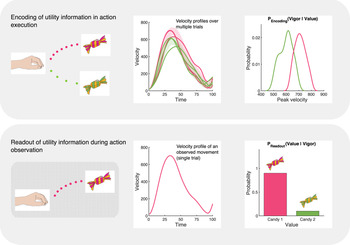
Figure 1. Analyzing vigor as a proxy for utility within the intersection information framework. Consider the example of a person reaching toward a preferred versus non-preferred candy. Top row: Encoding. The subjective utility assigned to each candy subtly changes the vigor (velocity) of the reaching movement. By conducting multiple trials, we can isolate the variance that reflects utility information from motor variability contributed from other sources and develop an encoding model (PEncoding), which maps utility to vigor. Bottom row: Readout. We can then examine if observers are able to use these subtle variations in movement vigor to unmask subjective views. By showing the recorded set of movements and asking observers to judge, on each trial, whether the hand grasped for the preferred versus the non-preferred candy a readout model (PReadout) can be developed, which maps vigor to utility choice. The intersection between encoding and readout allows us to examine the flow of utility information communicated between individuals through movement vigor.
Target article
Related commentaries (14)
A role of serotonin and the insula in vigor: Tracking environmental and physiological resources
Shadmehr and Ahmed propose that movement vigor can provide an easily measured proxy for hidden variables such as subjective value. The authors state that, with the increasing power of smart phones and presence of surveillance cameras, they “would not be surprised if someday soon the results of this research encourage the invention of machines that measure our movements and gather vigor-based estimates of our personal preferences.” An alternative perspective is that such machines already exist; human brains are such machines.
Human observers are remarkably good at estimating hidden variables from movement parameters (Becchio, Koul, Ansuini, Bertone, & Cavallo, Reference Becchio, Koul, Ansuini, Bertone and Cavallo2018). For example, they can easily discern the emotion of a person walking toward them (Chouchourelou, Matsuka, Harber, & Shiffrar, Reference Chouchourelou, Matsuka, Harber and Shiffrar2006). Studies have shown that subtle variations in movement kinematics are sufficient for observers to infer other people's intentions (Cavallo, Koul, Ansuini, Capozzi, & Becchio, Reference Cavallo, Koul, Ansuini, Capozzi and Becchio2016), attitudes (Manera, Becchio, Cavallo, Sartori, & Castiello, Reference Manera, Becchio, Cavallo, Sartori and Castiello2011), expectations (Grezes, Frith, & Passingham, Reference Grezes, Frith and Passingham2004; Runeson & Frykholm, Reference Runeson and Frykholm1983), and beliefs (van der Wel, Sebanz, & Knoblich, Reference van der Wel, Sebanz and Knoblich2014). A recent study from our laboratories demonstrates that naïve observers are sensitive to intention information encoded in less than 3% of the total variance of the movements (Patri et al., Reference Patri, Cavallo, Pullar, Soriano, Valente, Koul and Becchio2020).
Such studies raise the intriguing possibility that subjective utility information is not only encoded in movement vigor – as Shadmehr and Ahmed convincingly demonstrate – but can also be read out from movement vigor. In what follows, we briefly consider some of the implications of this idea within the conceptual framework of intersection information (Panzeri, Harvey, Piasini, Latham, & Fellin, Reference Panzeri, Harvey, Piasini, Latham and Fellin2017; Pica et al., Reference Pica, Piasini, Safaai, Runyan, Diamond, Fellin and Panzeri2017). This framework was initially proposed to quantify how sensory information encoded in a neural population is read out to inform single-trial behavioral choices (Panzeri et al., Reference Panzeri, Harvey, Piasini, Latham and Fellin2017; Pica et al., Reference Pica, Piasini, Safaai, Runyan, Diamond, Fellin and Panzeri2017). It has, subsequently, been extended to quantify how information about intentions encoded in movement kinematics is read out by observers (Patri et al., Reference Patri, Cavallo, Pullar, Soriano, Valente, Koul and Becchio2020). Here, we adapt the intersection information framework to elaborate on how subjective utility information encoded in movement vigor can be read out (Fig. 1). We then discuss the potential implications for understanding and modeling the link between movements and decisions in social environments.
Analyzing vigor as a proxy for utility within the intersection information framework. Consider the example of a person reaching toward a preferred versus non-preferred candy. Top row: Encoding. The subjective utility assigned to each candy subtly changes the vigor (velocity) of the reaching movement. By conducting multiple trials, we can isolate the variance that reflects utility information from motor variability contributed from other sources and develop an encoding model (PEncoding), which maps utility to vigor. Bottom row: Readout. We can then examine if observers are able to use these subtle variations in movement vigor to unmask subjective views. By showing the recorded set of movements and asking observers to judge, on each trial, whether the hand grasped for the preferred versus the non-preferred candy a readout model (PReadout) can be developed, which maps vigor to utility choice. The intersection between encoding and readout allows us to examine the flow of utility information communicated between individuals through movement vigor.
The logic of our proposal is straightforward. If humans and other animals tend to move faster (with increased vigor) toward things that they value more, then the value they assign to things can be inferred from the vigor with which they move. Importantly, the intersection information framework does not assume (or require) that the subjective utility information encoded in movement vigor is optimally read out. For example, an observer may read some features encoding utility information but ignore other informative features. Determining how (and how well) utility information is read out requires, first, measuring how it is encoded in movement parameters. Consider reaching for one of two candies, a candy with a preferred flavor versus a candy with a non-preferred flavor, as in (Sackaloo, Strouse, & Rice, Reference Sackaloo, Strouse and Rice2015). Operationally, encoding of utility information can be computed by asking human volunteers to reach for each candy. With the assumption that the physical constraints of reaching are identical (e.g., initial arm configuration, size, shape, weight, and position of the candy), variations in vigor (e.g., the onset latency and the velocity) of movements made toward different candies can be taken to reflect utility (Summerside, Shadmehr, & Ahmed, Reference Summerside, Shadmehr and Ahmed2018). One difficulty here is related to the motor variability across individual trials. By having each volunteer perform multiple repetitions of each movement, however, it is possible to isolate the variance that reflects utility from the trial-to-trial variance unrelated to utility. A statistical model (the encoding model) can be used to identify the specific movement features that carry utility information (Patri et al., Reference Patri, Cavallo, Pullar, Soriano, Valente, Koul and Becchio2020).
Having determined how utility information is encoded in movement parameters, one can proceed to investigate how it is read out. A simple way of doing this is to show naïve observers the recorded set of movements and ask them to judge, on each trial, whether the hand grasped for the preferred versus the non-preferred candy. Using the same logic as for encoding, a statistical readout model can be used to determine how observers combine information from different features to infer utility.
Readout is optimal (and intersection information maximal) when all available utility information is correctly read out. Human readout rarely achieves this absolute level of optimality. Real observers often ignore some of the features that encode information (Patri et al., Reference Patri, Cavallo, Pullar, Soriano, Valente, Koul and Becchio2020). Additionally, they may read features that do not encode utility information. Because such features do not carry information, they will add noise to the inference computation (Panzeri et al., Reference Panzeri, Harvey, Piasini, Latham and Fellin2017).
Suboptimality of readout may at first appear to be a glitch of evolution. However, an alternative view is that suboptimality of readout represents a rich opportunity for communication. For any given motor task or behavior, there is generally a large number of “motor-equivalent” solutions that can produce similar or functionally equivalent behaviors (Latash, Reference Latash2012). If not all the information encoded in vigor is read out, actors can exploit variance in the space of parameters that has no effect on the overall performance (so-called “good variance”; Latash, Reference Latash2012) to manipulate readout. In the reaching for a candy situation, for example, an actor trying to deceive the observer about the preferred candy may favor the vigor-equivalent solution that carries little utility information along the dimensions that are read out. Conversely, a combination of parameters that maximizes readout may be selected by an actor wanting to communicate their preference.
Evidence that action planning is influenced by readout consideration exists in primate studies using the informed forager paradigm. In this paradigm, the subordinate primate sees the location of hidden food, but the dominant does not. Using this paradigm, Hall et al. (Reference Hall, Oram, Campbell, Eppley, Byrne and de Waal2017) found that subordinate chimpanzees alter their gaze direction not only to withhold information about the location of the highly preferred banana, but also to mislead the dominant competitor toward the less preferred cucumber. It remains to be verified whether chimpanzees (and other primates) are also capable of tactfully manipulating vigor. Anecdotally, it certainly feels that we move with less or more vigor depending on the subjective value we want to communicate to others.
Shadmehr and Ahmed investigate the link between how the brain assigns value to things and how it controls our movements from the perspective of a solitary forager. In this commentary, we approach vigor research from the complementary perspective of a group forager (Stephens, Brown, & Ydenberg, Reference Stephens, Brown and Ydenberg2007). Viewed from this perspective, the latency with which we react and the speed with which we move become sources of information about subjective utility, that can, in turn, be read by other individuals. The intersection information framework provides a useful starting point for developing new experimental paradigms and mathematical tools for measuring how utility information is encoded and read out. Integrated with information about the neural basis of vigor, these measures could be used not only to achieve a better qualitative understanding of the social effect of communicating vigor, but also to help producing actual equations that quantify how the utility information flow between individuals shapes the behavior of a group.
In sum, the intersection information framework can be instrumental to the ambitious goal of incorporating the social dimensions into quantitative models of vigor. After all, one reason we run toward people we love is to let them know that we love them.
Acknowledgments
We are grateful to Laura Taverna for Figure 1.
Funding statement
This study was supported by INAIL (PR19-PAS-P1 – iHannes).
Conflict of interest
None.