Introduction
The impetus to study individual symptoms of psychosis rather than heterogeneous diagnostic categories such as schizophrenia (Bentall et al. Reference Bentall, Jackson and Pilgrim1988) has resulted in several studies examining auditory hallucinations from a psychological perspective. It is well established that auditory hallucinations can have a disabling impact upon the lives of those who experience them, and that reactions to this experience are diverse and often very individual. Psychological research in this area has flourished over the past decade, leading to an advance in our understanding of the emotional and behavioural impact of voices on those who hear them. Early research proposed that voice content was ‘directly responsible’ for a person's behavioural and affective response to their voices (Benjamin, Reference Benjamin1989). By contrast, more recent work has suggested that distress arising from the activity of voices can be better understood in the context of an individual's relationship with their voices (Chadwick & Birchwood, Reference Chadwick and Birchwood1994; Birchwood & Chadwick, Reference Birchwood and Chadwick1997).
Inspired by Beck's cognitive model of depression (Beck et al. Reference Beck, Rush, Shaw and Emery1979b), Chadwick & Birchwood (Reference Chadwick and Birchwood1994) were the first to propose that beliefs about voices may be a mediating factor in the relationship between voice experience and behavioural and affective response. They identified three key themes that characterized the voices of their group: their omnipotence, their intent to do good or harm (benevolence or malevolence), and the response to the voices (engagement, resistance or indifference). They found that voices believed to be malevolent were distressing and resisted, whereas voices believed to be benevolent were associated with positive emotion and engagement. Voice form and topography were not linked to affective or behavioural response to voices, suggesting that distress and behavioural repertoire in voice hearers is most closely tied to beliefs about voices, irrespective of content.
Chadwick & Birchwood (Reference Chadwick and Birchwood1995) used these qualitative findings to operationalize the concepts of voice power and purpose, in the Beliefs About Voices Questionnaire (BAVQ). This dichotomously rated self-report questionnaire comprises three subscales measuring beliefs about voices (benevolence, malevolence and power) and two subscales measuring response to voices (resistance and engagement). Using this scale, several studies have replicated the finding that voices perceived to be malevolent are largely resisted and provoke negative affective responses whereas voices perceived to be benevolent are engaged with (Birchwood & Chadwick, Reference Birchwood and Chadwick1997; Close & Garety, Reference Close and Garety1998; Sayer et al. Reference Sayer, Ritter and Gournay2000; van der Gaag et al. Reference van der Gaag, Hageman and Birchwood2003). van der Gaag et al. (Reference van der Gaag, Hageman and Birchwood2003) found that malevolent beliefs were not associated with the valence of voice content (good versus bad), providing further evidence that distress in voice hearers is inextricably bound to individual beliefs about voices, rather than voice content.
The findings on the relationship between beliefs about the power of voices, specifically, and behavioural and affective responses have been somewhat less clear-cut. Although some studies found an association between depression and omnipotence beliefs (Birchwood & Chadwick, Reference Birchwood and Chadwick1997; Birchwood et al. Reference Birchwood, Meaden, Trower, Gilbert and Plaistow2000, Reference Birchwood, Gilbert, Gilbert, Trower, Meaden, Hay, Murray and Miles2004), this significant relationship disappeared once other variables (namely malevolence and benevolence beliefs, duration of illness and insight) were included in the van der Gaag et al. (Reference van der Gaag, Hageman and Birchwood2003) study. Anxiety, on the other hand, was related to both benevolence and power beliefs. No other study has looked at anxiety, and the robustness of this finding is therefore unclear. However in a study using the Experience Sampling Method (ESM; Myin-Germeys et al. Reference Myin-Germeys, Oorschot, Collip, Lataster, Delespaul and van Os2009) rather than questionnaire measures, power appraisals were significantly related to a general measure of negative affect that included both anxiety and depression items (Peters et al. Reference Peters, Lataster, Greenwood, Kuipers, Scott, Williams, Garety and Myin-Germeys2011).
Inconsistent results have been reported for voice-specific distress: Birchwood & Chadwick (1997) found no association with omnipotence using the BAVQ, nor did Birchwood et al. (Reference Birchwood, Meaden, Trower, Gilbert and Plaistow2000) using the Voice Power Differential Scale (VPD). By contrast, in a large sample of patients, Birchwood et al. (Reference Birchwood, Gilbert, Gilbert, Trower, Meaden, Hay, Murray and Miles2004) found that individuals with high scores on the VPD showed increased voice-related distress compared to those with low VPD scores. Trower et al. (Reference Trower, Birchwood, Meaden, Byrne, Nelson and Ross2004) also reported a clear association between voice-related distress and the VPD, as did Hacker et al. (Reference Hacker, Birchwood, Tudway, Meaden and Amphlett2008) using the revised version of the BAVQ (BAVQ-R; Chadwick et al. Reference Chadwick, Lees and Birchwood2000a), which broadened the concept of omnipotence to include items about control (‘I cannot control my voices’) and omniscience (‘My voices seem to know everything about me’) in addition to power (‘My voice is very powerful’). Peters et al. (Reference Peters, Lataster, Greenwood, Kuipers, Scott, Williams, Garety and Myin-Germeys2011) also found that both control and power appraisals were related to voice-specific distress using the ESM.
The aim of the present study was to replicate and extend previous findings by investigating the relationships between beliefs about voices, response to voices and affect using a wide range of measures to assess distress and emotional difficulties. We hypothesized that: (a) omnipotent and malevolent appraisals would be associated with both voice-specific and general distress, including depression, anxiety, suicidal ideation and low self-esteem; (b) omnipotent and malevolent appraisals would be associated with resistance, and benevolence would be associated with engagement; and (c) behavioural and affective response would show stronger associations with beliefs about voices than voice experience and form (severity, intensity and frequency).
Method
Participants
Participants were recruited from the Psychological Interventions Clinic for Outpatients with Psychosis (PICuP), South London and Maudsley National Health Trust (NHS) Foundation Trust, UK, and assessed at baseline, prior to a randomized controlled trial (RCT) of cognitive behaviour therapy for psychosis (CBTp; see Peters et al. Reference Peters, Landau, McCrone, Cooke, Fisher, Evans, Carswell, Dawson, Steel, Howard and Kuipers2010). All participants were clinically stable out-patients with residual symptoms of psychosis, and did not have a primary diagnosis of alcohol or substance abuse or of an organic condition. All individuals eligible for the RCT had at least one distressing and persistent positive symptom of psychosis, scoring ⩾3 on at least one of the positive symptoms items of the Positive and Negative Syndrome Scale (PANSS; Kay et al. Reference Kay, Fizbein and Opler1987). Forty-six participants reported hearing voices [minimum score of 3 on the PANSS P3 (hallucinatory behaviour) item] and were included in the present study. All participants had been experiencing voices for at least 6 weeks prior to participation in the study. Forty-one (89.1%) were receiving atypical antipsychotics (including clozapine), two (4.3%) were receiving conventional antipsychotics and two (4.3%) were not taking any antipsychotic medication. Of those taking antipsychotic medication, all had been receiving the same medication, at the same dose, for at least 3 months prior to participation in the study.
Of the 46 participants, 26 (56.5%) were male and 20 (43.5%) were female. The average age of the participants was 36.5 (range 23–62, s.d.=10.45) years. Eighty-five per cent were single, and 30% were from Black Minority Ethnic groups (five participants did not state their ethnicity). Their mean age of illness onset was 28.9 (range 15–49, s.d.=9.14) years (information not available for one participant), and their mean duration of illness was 7.4 (range 0–32, s.d.=6.41) years (information not available for one participant). Twenty-four (52.2%) had had at least one hospital admission in the past 5 years. Average participant IQ, as measured by the Quick Test (Ammons & Ammons, 1962), was 94.07 (range 65–116, s.d.=11.69; information not available for one participant).
The mean scores for the PANSS positive, negative and general subscales were 18.24 (range 11–32, s.d.=5.03), 11.96 (range 7–27, s.d.=4.49) and 31.72 (range 19–50, s.d.=7.26) respectively.
Measures
Symptom measures
PANSS
This widely used observer-rated clinical interview measures positive, negative and general symptoms in psychosis. Each item is rated on a severity scale ranging from 1 (absence of psychopathology) to 7 (extremely severe). Three scores are derived: positive symptom scores (possible range of scores: 7–49); negative symptom scores (possible range of scores: 7–49); and general symptom scores (possible range of scores: 16–112). In the current study, item P3 (hallucinatory behaviour) was used as a measure of global voice severity.
Personal Questionnaires (PQs)
Voice intensity, frequency and associated distress were measured using PQs (Brett-Jones et al. Reference Brett-Jones, Garety and Hemsley1987) adapted for use with individuals with auditory hallucinations. PQs are particularly useful for the assessment of psychological dimensions of psychotic symptoms, in that they are devised for each individual, using that person's words to describe their beliefs, experiences or feelings (Peters, Reference Peters2007).
Participants were presented with five statements for each of the three dimensions measured in the revised PQs to represent different levels of: voice intensity (‘extremely loud’ to ‘very quiet’), voice frequency (‘every hour’ to ‘not at all in the last week’) and voice-associated distress (‘extremely upset’ to ‘I do not get upset anymore’). Each statement was written on a separate card. Each set of cards was presented in a random order and rated as to whether, at the time of presentation, the symptom was of greater or lesser intensity/frequency/distress than that stated on the card. A score of 1 was given if the symptom was of greater intensity/frequency/distress than that stated on the card, and a score of 0 if the symptom was of lesser intensity/frequency/distress. If the respondent indicated that the statement represented exactly the level of their voice experience, they were encouraged to nevertheless choose one of the two options available to them (i.e. only greater or lesser). The scores of 1 and 0 are summed once all the cards had been presented for each dimension, with a potential range of scores between 0 and 5.
This mode of responding is more convoluted than assessment using Likert scales, but the greater cognitive effort required increases the validity of the anchoring of the response, and avoids the possibility of respondents using only a limited range of the scale (e.g. extreme scores only).
BAVQ-R
This 35-item self-report questionnaire measures beliefs about the malevolence, benevolence and omnipotence of voices. Benevolence refers to the belief that voices experienced are helpful; malevolence refers to the belief that voices experienced are persecutory and evil; and omnipotence refers to the belief that voices experienced are powerful and controlling. The measure consists of three subscales related to beliefs: malevolence [six items (e.g. ‘My voice is persecuting me for no good reason’)]; benevolence [six items (e.g. ‘My voice wants to help me’); and omnipotence [six items (e.g. ‘My voice is very powerful’)]. Each item is rated on a four-point scale ranging from 0 (disagree) to 3 (strongly agree), with a potential range of scores for each subscale of 0–18. Two further subscales, ‘resistance’ [four items for emotion (e.g. ‘My voice frightens me’) and five items for behaviour (e.g. ‘When I hear my voice usually I tell it to leave me alone’); potential range of scores 0–27] and ‘engagement’ [four items for emotion (e.g. ‘My voice reassures me’) and four items for behaviour (e.g. ‘When I hear my voice usually I listen to it because I want to’); potential range of scores 0–24], measure emotional and behavioural responses to auditory hallucinations.
General distress measures
Beck Depression Inventory – 2nd edition (BDI-II; Beck et al. Reference Beck, Steer and Brown1996)
The BDI-II is a widely used 21-item self-report questionnaire that measures the severity of depression in clinical populations, including schizophrenia (Drury et al. Reference Drury, Birchwood and Cochrane2000). Items are rated on a four-point scale ranging from 0 to 3. Higher scores indicate greater depression, with a potential range of scores of 0–63.
Beck Anxiety Inventory (BAI; Beck et al. Reference Beck, Epstein, Brown and Steer1988)
The BAI is a widely used 21-item self-report measure of the severity of anxiety in adults. Items are rated on a four-point scale ranging from 0 to 3. Higher scores indicate greater anxiety, with a potential range of scores of 0–63.
Beck Scale for Suicide Ideation (BSS; Beck et al. Reference Beck, Kovacs and Weisman1979a)
The BSS is a 21-item self-report measure assessing severity of suicidal ideation, including an individual's thoughts, attitudes and intentions regarding suicide. The potential range of scores is 0–42.
The Rosenberg Self-Esteem Scale (RSE; Rosenberg, Reference Rosenberg1965)
The RSE is a self-report measure of global self-esteem that has demonstrated good reliability and validity across a range of clinical populations. It consists of 10 statements related to feelings of overall self-worth or self-acceptance. The items are answered on a four-point scale ranging from ‘strongly agree’ to ‘strongly disagree’. A higher score on this measure indicates lower self-esteem, with a potential range of scores of 10–40.
Procedure
Individuals referred to the PICuP were invited to an initial screening assessment, to gauge their suitability for entry into the trial. The PANSS was administered at this point by a trained research assistant. Individuals meeting the trial criteria (i.e. a score ⩾3 on at least one item of the PANSS positive) were then invited to complete the remaining trial measures.
Interviewers received intensive training in the administration of all measures used and study-specific procedures. Routine steps were taken to ensure the standardization of interview procedures (e.g. thorough interviewer training, the development and use of procedural guidelines), which served to reduce the introduction of both random and systematic errors. All interviewers were blind to the hypotheses of the current study at the time of administration.
Statistical analysis
Data were analysed using SPSS version 13.0 (SPSS Inc., USA).
Normality of variables
Histograms for all variables were examined to determine whether they met the criteria for use in parametric statistical tests. Distributions of scores on the BAVQ-R omnipotence, resistance, malevolence, PQ voice intensity, BDI, BAI, RSE and PANSS hallucinatory behaviour scales met the assumptions for normality. Non-parametric tests were used for correlations when variables were not normally distributed (BAVQ-R benevolence and engagement, PQ voice frequency, suicidal ideation, and PQ voice-associated distress).
Results
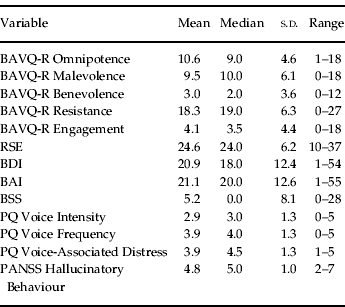
Table 1 displays descriptive statistics for each of the study variables. The mean scores on the BDI, BAI, BSS and RSE indicate that the present sample had moderate levels of depression and anxiety, low suicidal ideation and moderate self-esteem. Overall, 30% and 20% of the sample had minimal depression and anxiety respectively; 24% and 22% had mild depression and anxiety; 15% and 41% had moderate depression and anxiety, and 31% and 17% had severe depression and anxiety. A total of 48% had some suicidal ideation (i.e. scored above 0 on the BSS).
Descriptive statistics for study variables

BAVQ-R, Beliefs About Voices Questionnaire – Revised; RSE, Rosenberg Self-Esteem Scale; BDI, Beck Depression Inventory; BAI, Beck Anxiety Inventory; BSS, Beck Scale for Suicide Ideation; PQ, Personal Questionnaire; PANSS, Positive and Negative Syndrome Scale; s.d., standard deviation.
Hypothesis 1: Omnipotent and malevolent appraisals will be associated with both voice-specific and general distress
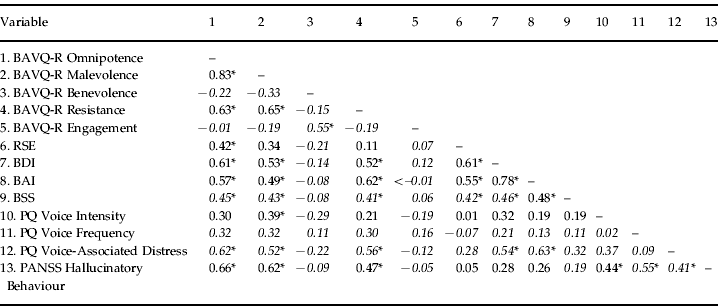
Table 2 displays correlations among all of the study variables, using two-tailed tests of significance. A p level <0.01 was used due to multiple testing. As predicted, omnipotence was significantly associated with all measures of distress (i.e. depression, anxiety, self-esteem, voice-related distress and suicidal ideation), and malevolence was significantly associated with all measures of distress apart from self-esteem, which only reached trend level. By contrast, global voice severity, voice frequency and voice intensity were not significantly associated with the distress measures, with only one significant correlation being found between voice-associated distress and global voice severity.
Intercorrelations among study variables

BAVQ-R, Beliefs About Voices Questionnaire – Revised; RSE, Rosenberg Self-Esteem Scale; BDI, Beck Depression Inventory; BAI, Beck Anxiety Inventory; BSS, Beck Scale for Suicide Ideation; PQ, Personal Questionnaire; PANSS, Positive and Negative Syndrome Scale.
Spearman's ρ was used instead of Pearson's r when data were not normally distributed (see italics).
* p<0.01.
Hypothesis 2: Omnipotent and malevolent appraisals will be associated with resistance, and benevolence will be associated with engagement
As predicted, both omnipotence and malevolence were significantly associated with resistance, and benevolence was significantly associated with engagement. By contrast, neither omnipotence nor malevolence was associated with engagement, and benevolence was not related to resistance.
Hypothesis 3: Behavioural and affective response will show stronger associations with beliefs about voices than voice experience and form (severity, intensity and frequency)
Regression analyses were carried out to identify the best predictor of affect and behavioural response, and the extent to which independent variables explained unique variance in each of the measures. Separate regression analyses were performed for each measure of distress. Depression, anxiety, suicidal ideation, self-esteem and voice-associated distress were treated as the primary dependent variables for distress; resistance and engagement were treated as the primary dependent variables for response to voices. Beliefs about voices (three subscales), global voice severity (PANSS P3 item) and voice frequency and intensity (both from the PQs) were the potential independent variables. Only those variables that correlated significantly with the dependent variables were entered into the regression analyses.
Linear and stepwise regression analyses were used when dependent variables were normally distributed (depression, anxiety, self-esteem and resistance). It was considered preferable to dichotomize the ordinal variable of voice-related distress because four out of the six potential values (0–5) had a frequency of 5 or lower (with scores of 3 and 5 accounting for 74% of the responses). Scores of 0–3 were categorized as ‘low distress’ (39% of the sample) and scores of 4–5 were categorized as ‘high distress’ (61% of the sample). Suicidal ideation was dichotomized into ‘no suicidal ideation’ (scores of 0; 52% of the sample), and ‘suicidal ideation’ (scores ⩾1; 48% of the sample). Logistic and forward Wald regressions were used for these two dependent variables.
Distress
For depression, anxiety, self-esteem and suicidal ideation, only malevolence and omnipotence were entered into the regression because none of the voice topography measures were significant. Global voice severity was entered into the equation for voice-associated distress, in addition to malevolence and omnipotence. Because of the potential interaction between the two belief variables, a linear or logistic regression was first carried out for each distress measure with the interaction variable (omnipotence×malevolence) entered at the same time as the belief variables, to check whether the interaction explained more variance than the main effects. If the interaction term was not significant, a stepwise or forward Wald regression was then carried out without the interaction term to identify the best predictor.
No significant interaction between omnipotence and malevolence was found for any of the distress measures, and the interaction term was therefore dropped from further analyses. Although the correlation between malevolence and omnipotence was high, the collinearity statistics were within an acceptable range [tolerance=0.31, variance inflation factor (VIF)=3.2]. Stepwise regressions showed that omnipotence was the only variable significantly associated with depression (β=0.61, adjusted R 2=0.36, p<0.001, accounting for 37% of variance), anxiety (β=0.57, adjusted R 2=0.31, p<0.001, accounting for 33% of variance) and self-esteem (β=0.42, adjusted R 2=0.16, p<0.01, accounting for 18% of variance).
Forward Wald regressions showed that omnipotence was the only variable significantly associated with voice-associated distress [B=0.36, Wald=10.6, p<0.001, odds ratio (OR) 1.44, 95% confidence interval (CI) 1.16–1.79]. The equation generated correctly classified 66.7% of individuals with low voice-associated distress and 82.1% of individuals with high voice-associated distress (the overall correct classification was 76.1%). The overall equation was significant (χ2=17.6, df=1, p<0.001). Beliefs about voice omnipotence was also the only variable significantly associated with suicidal ideation (B=0.16, Wald=5.04, p<0.05, OR 1.18, 95% CI 1.02–1.36). The equation generated by this analysis correctly classified 75% of individuals with low suicidal ideation and 59.1% of individuals with high suicidal ideation (the overall correct classification was 67.4%). The overall equation was significant (χ2=5.68, df=1, p<0.05).
Behavioural response
We did not undertake regression analyses for engagement because benevolence was she only significantly associated predictor variable.
No significant interaction was found between malevolence and omnipotence for resistance, and the interaction term was therefore dropped from further analyses. Resistance was then subjected to a stepwise regression, with malevolence, omnipotence and global voice severity as independent variables. Malevolence was the only variable significantly associated with resistance (β=0.65, adjusted R 2=0.41, p<0.001, accounting for 42% of variance).
Discussion
As predicted, and consistent with previous research using both questionnaire assessment (Chadwick & Birchwood, Reference Chadwick and Birchwood1994; van der Gaag et al. Reference van der Gaag, Hageman and Birchwood2003; Hacker et al. Reference Hacker, Birchwood, Tudway, Meaden and Amphlett2008) and ESM (Peters et al. Reference Peters, Lataster, Greenwood, Kuipers, Scott, Williams, Garety and Myin-Germeys2011), beliefs about voices showed stronger associations with behavioural and affective response than voice experience and form (severity, intensity and frequency) on all measures used. The only significant association between distress and voice topography was between global severity and voice-associated distress, but this relationship disappeared in the regression model once other factors were accounted for. These data are clear in suggesting that the general experience and form of a voice is not the most important determinant of distress in people who hear voices, and that individuals who experience particularly persistent voices are no more likely to experience elevated levels of distress compared to individuals with more irregular voices. These findings are consistent with the cognitive model of auditory hallucinations: that a person's voice appraisals, rather than voice activity per se, predict affect and behaviour (Birchwood & Chadwick, Reference Birchwood and Chadwick1997).
The appraisal of voices as omnipotent was significantly associated with both voice-specific and general distress, including depression, anxiety, self-esteem and suicidal ideation. Previous studies failing to find a relationship between power beliefs and distress (e.g. Birchwood & Chadwick, Reference Birchwood and Chadwick1997) may have been due to use of the first version of the BAVQ (Chadwick & Birchwood, Reference Chadwick and Birchwood1995), which had only one item pertaining to omnipotence, or because there was not enough power to detect a significant difference in a highly distressed sample (e.g. Birchwood et al. Reference Birchwood, Meaden, Trower, Gilbert and Plaistow2000). The present study also extends previous findings by demonstrating that omnipotence appraisals are related to a wide range of emotional problems, including anxiety, low self-esteem and suicidal ideation.
Although malevolence was significantly correlated with most measures of distress, it did not explain variance in distress above and beyond that predicted by omnipotence. The present findings therefore support Birchwood et al.'s (Reference Birchwood, Meaden, Trower, Gilbert and Plaistow2000) proposal that beliefs about power specifically are the most important appraisals in determining high levels of distress in a variety of arenas.
Beliefs about intent, however, were the best predictors of behavioural response. Consistent with previous research (Birchwood & Chadwick, Reference Birchwood and Chadwick1997; Close & Garety, Reference Close and Garety1998; Sayer et al. Reference Sayer, Ritter and Gournay2000; van der Gaag et al. Reference van der Gaag, Hageman and Birchwood2003), believing that voices were malevolent was related to resistance, whereas believing that voices were benevolent was related to engagement. Thus, voice hearers tend to act in accordance with their beliefs about the voice's intentions towards them, but their distress is related to how powerful they consider their voices to be.
It is possible that the lack of significant contribution of malevolence beliefs to distress, and of omnipotence beliefs to resistance, may have been due to the collinearity of omnipotence and malevolence, as they were highly correlated with each other. After all, the two types of appraisals are two sides of the same coin and are likely to be linked in the voice hearer's mind; that is, the voice's intention may be to do harm to the individual, but its ability to do so is embodied in the power dimension, suggesting that distress and emotional difficulties would only occur if the voice hearer believes the voice is capable of carrying out its malevolent intent. However, we tested for interaction effects for each measure of distress and for resistance, and none were significant. van der Gaag et al. (Reference van der Gaag, Hageman and Birchwood2003) also found that the two types of beliefs had differential effects in terms of their emotional and behavioural sequelae. They reported a significant relationship between omnipotence and both anxiety and depression, but no association with resistance or engagement, which, by contrast, was related to malevolence and benevolence, consistent with the present results. The authors interpret their findings as suggesting that believing that one's voice is powerful does not, in itself, trigger an approach or avoidance response, but that the important factor is whether the power is interpreted as malevolent or benevolent. The current findings support this view, and further suggest that believing that one's voices are powerful can be distressing even if they are not seen to have malevolent intent towards the self. For instance, it may be possible to believe your voices are your guardian angels (i.e. benevolent intent), but to nevertheless be distressed by their power over you in controlling your behaviour (even if this control is seen as acting in your best interest). However, overall these findings need to be viewed with caution because the β values in the stepwise regressions may not have been well estimated due to collinearity, and significant correlations were found between both types of beliefs and emotional and behavioural measures.
The limitations of this study warrant consideration. First, participants were recruited from a randomized control trial (RCT) of CBTp, and were seeking help specifically for distressing residual symptoms of psychosis. This recruitment strategy may potentially have introduced selection biases, particularly because we recruited only those who were able to complete lengthy psychological assessments. As such, the present results may not be generalizable to individuals in the acute phase of illness or with lower levels of functioning. Second, we did not collect specific measures of beliefs about the origins of individuals' voices or their content, so were unable to comment on the relationship between distress and voice content and, importantly, on the relationship between voice content and appraisals; that is, it may be that voices are believed to be powerful because they profess to be so. Third, this was a cross-sectional study, so we cannot infer causality for any of the relationships found. Although the literature reviewed generally suggests that appraisals of voices are determinants of distress and behaviour, the data in this study cannot preclude the alternative option that voice interpretations may be reframed retrospectively in part by the person's behavioural and/or emotional response. However, a dynamic interaction between distress and omnipotence is also possible, with the two factors serving to reinforce each other (Birchwood et al. Reference Birchwood, Gilbert, Gilbert, Trower, Meaden, Hay, Murray and Miles2004).
Csipke & Kinderman (Reference Csipke and Kinderman2006) have shown in a longitudinal study that beliefs about voices tend to persist over time without psychological intervention, even when there is a natural decline in voice activity. The present findings have several implications for psychological therapies. They suggest that encouraging an individual to re-examine their voice appraisals, particularly those relating to power, may be a better way to reduce distress than trying to reduce voice activity. Similarly, working with beliefs about the intentions of the voice may be the best route to behaviour change, whether this is to reduce engagement with, for example, a commanding voice perceived as benevolent, or whether the aim is to decrease resistance to voices so as to reduce safety behaviours, which prevent the disconfirmation of a malevolent voice. Indeed, a small RCT focusing on command hallucinations showed that a change in voice appraisals mediated the reduction in compliance behaviour at the end of therapy, whereas voice activity remained unchanged (Trower et al. Reference Trower, Birchwood, Meaden, Byrne, Nelson and Ross2004). Our findings also suggest that the goal of CBTp, and therefore the outcomes measured in CBTp trials, should not necessarily be a reduction in the severity or frequency of voices, but a change in people's appraisals and relationship with their voices (e.g. Chadwick et al. Reference Chadwick, Sambrooke, Rasch and Davies2000b), in order to reduce distress.
Conclusions
Appraisals about voices were found to be the main determinants of emotional and behavioural response to voices, over and above voice severity. Beliefs about the omnipotence of voices showed the strongest associations with multiple measures of distress, whereas beliefs about the intent of voices showed the strongest association with behaviour, with benevolence being associated with engagement with voices, and malevolence with resistance to voices.
Acknowledgements
E. R. Peters and E. Kuipers acknowledge support for some clinical sessions from the National Institute of Health Research (NIHR) Biomedical Research Centre for Mental Health, King's Health Partners. The data for this study were collected as part of an RCT supported by Culyer (Department of Health, UK) and subsequently by a donation from Eli Lilly.
Declaration of Interest
None.