Introduction
The resolution of pronominal anaphors during language comprehension has been a topic of great interest to theoretical linguists and psycholinguists for decades (see, among many others, Ariel, Reference Ariel1994; Crawley, Stevenson & Kleinman, Reference Crawley, Stevenson and Kleinman1990; Frederiksen, Reference Frederiksen1981; Gernsbacher, Reference Gernsbacher1989). Pronouns are often preceded by two or more potential antecedents and therefore pose ambiguities that must be resolved quickly. As such, anaphora resolution can provide valuable insights into the types of information that native comprehenders consider at various points in time (see e.g. Arnold, Eisenband, Brown-Schmidt & Trueswell, Reference Arnold, Eisenband, Brown-Schmidt and Trueswell2000; Garrod, Freudenthal & Boyle, Reference Garrod, Freudenthal and Boyle1994). In addition, the inventories of pronominal anaphors and the constraints on their use vary cross-linguistically, leaving reason to expect that the strategies that comprehenders use to resolve anaphors will also vary between languages, just as they do for other structures, such as the attachment of ambiguous relative clauses (Dussias & Sagarra, Reference Dussias and Sagarra2007). Furthermore, the potential for cross-linguistic variation in this domain of the grammar makes anaphora resolution a prime testing ground for the effects of cross-linguistic influence in bilingualism, particularly in bilinguals who speak two languages with different pronominal inventories and/or antecedent assignment strategies (Serratrice, Reference Serratrice2007; Sorace & Serratrice, Reference Sorace and Serratrice2009).
In the present study, we investigated anaphora resolution in monolinguals and heritage bilinguals. The aims of the study were twofold: first, we set out to determine whether the position of antecedent strategy (PAS; Carminati, Reference Carminati2002) proposed to account for the resolution of null and overt pronouns in Italian accurately predicts antecedent assignment in Spanish, another null-subject language which is typologically similar to Italian. Research on monolingual speakers of Peninsular Spanish suggests that Spanish lacks a categorical bias for the overt pronoun (Alsono-Ovalle, Fernández-Solera, Frazier & Clifton, Reference Alonso-Ovalle, Fernández-Solera, Frazier and Clifton2002; Filiaci, Sorace & Carreiras, Reference Filiaci, Sorace and Carreiras2014). Using improved materials, we find that Spanish speakers display a distinct bias for the overt pronoun that is in line with the PAS. Second, we examined whether Spanish heritage speakers (HSs) in the US would show the same antecedent biases as their monolingual counterparts, despite their extensive contact with English – a non-null-subject language in which overt pronouns tend to take different antecedents than in Spanish. In a previous offline study, Keating et al. (Reference Keating, VanPatten and Jegerski2011) found that Spanish HSs showed a bias to resolve null and overt pronouns in favor of the same antecedent, essentially treating them as interchangeable. In the present online study, Spanish HSs showed no bias for the overt pronoun. We first turn our attention to the claims of the PAS.
The position of antecedent strategy (PAS)
The PAS was initially proposed by Carminati (Reference Carminati2002) to account for the antecedent biases of Italian null and overt pronouns in intrasentential contexts, such as those in (1). (Null pronouns are referred to as pro and pro-drop refers to sentences or languages with no overt subject.)
-
(1)
-
a. Quando Mario ha telefonato a Giovanni, pro aveva appena finito di mangiare.
-
b. Quando Mario ha telefonato a Giovanni, lui aveva appena finito di mangiare.
“When Mario had phoned Giovanni, pro/he had just finished eating.”
-
In both versions of the sentence, the subject pronoun (pro, lui) can refer to either of the two antecedent NPs in the preceding subordinate clauses: Mario or Giovanni. However, monolingual Italian speakers are known to display distinct biases in the resolution of the two pronoun types. These biases are captured in the PAS, shown in (2) (taken from Filiaci, Reference Filiaci2010, p. 95):
-
(2)
-
a. The null pronoun prefers an antecedent in the SpecIP position.
-
b. The overt pronoun prefers an antecedent which is not in the SpecIP position.
-
When applied to the example above, the PAS predicts that the ambiguity of the null pronoun will be resolved in favor of the subject antecedent (Mario), and that the overt pronoun will be resolved in favor of the object antecedent (Giovanni).
Empirical support for the PAS in Italian is strong. Carminati (Reference Carminati2002) conducted more than a dozen offline and online experiments, the first of which is most relevant to our study. In her first experiment, Carminati conducted a self-paced reading study in which main clauses containing null or overt subject pronouns were pragmatically biased toward subject and object antecedents in a preceding subordinate clause, as in (3).
-
(3)
-
a. Dopo che Giovanni ha messo in imbarazzo Giorgio di fronte a tutti, pro si è scusato ripetutamente.
-
b. Dopo che Giovanni ha messo in imbarazzo Giorgio di fronte a tutti, lui si è scusato ripetutamente.
“After Giovanni embarrassed Giorgio in front of everyone, pro/he apologized repeatedly.”
-
c. Quando Giovanni ha messo in imbarazzo Giorgio di fronte a tutti, pro si è offeso tremendamente.
-
d. Quando Giovanni ha messo in imbarazzo Giorgio di fronte a tutti, lui si è offeso tremendamente.
“When Giovanni embarrassed Giorgio in front of everyone, pro/he was offended.”
-
In (3a) and (3b), the main clause context “he apologized repeatedly” is pragmatically biased toward Giovanni, whereas in (3c) and (3d), the context “he was offended” biases in favor of Giorgio. Reading times and answers to comprehension questions (e.g. who apologized?) supported the PAS. In her second experiment, Carminati tested the resolution of intrasentential anaphora using an offline questionnaire. In addition to the difference in method, the test sentences featured main clauses followed by subordinate clauses. The results confirmed the neat division of labor between null and overt subject pronouns found in the first experiment.
In the first of two self-paced reading experiments, Filiaci et al. (Reference Filiaci, Sorace and Carreiras2014) replicated the results of Carminati's first experiment in another group of Italian monolinguals using the same materials. These results suggest that the PAS is largely reliable in Italian despite some evidence that the bias for the overt pronoun may be weaker than that of the null pronoun (Carminati, Reference Carminati2002, Experiment 8; see also Carminati, Reference Carminati2005). We discuss Filiaci et al.'s study in more detail in the next section.
The cross-linguistic validity of the PAS
In light of the fact that many of the world's languages allow null subjects, the PAS has the potential to predict anaphoric behavior across languages. Although no two null-subject languages are identical, the PAS encapsulates syntactic and discourse tendencies common to null-subject languages more generally. In the Romance family, the null pronoun tends to indicate topic continuity, whereas its overt counterpart tends to signal a shift in discourse topic (Cameron, Reference Cameron1992; Shin & Cairns, Reference Shin, Cairns, Collentine, García, Lafford and Marín2009). The two predictions of the PAS in (2) capture the aforementioned tendencies. To the extent that null-subject languages are similar in these respects, despite other differences that may come to bear on the resolution of anaphora, the PAS should predict anaphoric behavior in null-subject languages other than Italian.
To our knowledge, the cross-linguistic validity of the PAS has only been directly tested in monolingual speakers of two other pro-drop languages, Spanish and Catalan (Mayol & Clark, Reference Mayol and Clark2010). Here we focus on Spanish. The existing database includes two offline studies (Alonso-Ovalle et al., Reference Alonso-Ovalle, Fernández-Solera, Frazier and Clifton2002; Keating et al., Reference Keating, VanPatten and Jegerski2011) and one online study (Filiaci et al., Reference Filiaci, Sorace and Carreiras2014). Alonso-Ovalle et al. conducted five experiments, the first of which directly tests the claims of the PAS. In their study, monolingual speakers of Peninsular Spanish residing in Madrid read two-sentence discourses in which the second of the two sentences began with a null or overt pronoun that could refer to either of the two antecedent NPs mentioned in the first sentence, as in (4).
-
(4)
-
a. Juan pegó a Pedro. pro Está enfadado.
-
b. Juan pegó a Pedro. Él está enfadado.
“Juan hit Pedro. He is angry.”
-
The results indicated a tendency to link null subjects with the subject of the previous sentence, but for overt subject pronouns, no bias toward any antecedent obtained. Keating et al. (Reference Keating, VanPatten and Jegerski2011) conducted a written questionnaire study in which participants – native Spanish speakers, Spanish heritage speakers, and adult L2 learners of Spanish – read complex sentences consisting of a main clause that introduced two referents, followed by a subordinate clause that contained either a null or an overt pronoun. Answers to post stimulus comprehension questions yielded results similar to those of Alonso-Ovalle et al. (Reference Alonso-Ovalle, Fernández-Solera, Frazier and Clifton2002).
The results of these two offline studies suggest that the overt pronoun in Spanish is not biased toward a particular antecedent. The implication is that the first prediction of the PAS applies in Spanish, whereas the second may not. However, both studies have limitations that must be addressed before firm conclusions can be made regarding the Spanish overt pronoun. Alonso-Ovalle et al. (Reference Alonso-Ovalle, Fernández-Solera, Frazier and Clifton2002) tested the resolution of extrasentential anaphora, whereas Carminati's (Reference Carminati2002) initial experiments tested intrasentential anaphora. In addition, they tested a small number of items (six per condition). Similar to Carminati's offline experiment, Keating et al. (Reference Keating, VanPatten and Jegerski2011) tested intrasentential anaphora, but their sentences were not lexically matched across null and overt conditions. More importantly, their monolingually raised Spanish speakers comprised speakers of different dialects of Spanish who resided in the US at the time of testing, some of whom had extensive immersion exposure to English. Neither study included an online measure of Spanish speakers’ antecedent preferences.
Filiaci et al.'s (Reference Filiaci, Sorace and Carreiras2014) study included two self-paced reading studies designed to test the cross-linguistic validity of the PAS in Spanish. We focus on the first experiment, which is a replication of Carminati's (Reference Carminati2002) Experiment 1 conducted in Italian and Spanish. Filiaci et al. found that both groups read clauses containing null pronouns significantly faster when they were pragmatically biased toward the noun in SpecIP. Conversely, when clauses containing overt pronouns were pragmatically biased toward the expected object antecedent, only the Italian monolinguals displayed the anticipated reading time advantage. The pattern of results was supported in the analyses of the comprehension question accuracy and the times taken to respond. The results of this online study coincide with the results of the aforementioned offline studies in showing that the Spanish overt pronoun lacks a clear antecedent bias.
The results of the studies conducted in Spanish are surprising in light of other evidence that shows that Spanish monolinguals prefer to associate the overt subject with a switch in discourse topic. Shin and Cairns (Reference Shin, Cairns, Collentine, García, Lafford and Marín2009) showed in a sentence-selection task that adult native Mexican speakers preferred null subjects when there was no change in topic and very strongly preferred overt pronouns when there was a switch in topic. Children did not demonstrate adult-like preferences until age 14–15 years, suggesting that sensitivity to continuity/topic-shift requires substantial exposure to native language input (for compatible evidence in Italian, see Sorace et al., Reference Sorace, Serratrice, Filiaci and Baldo2009). We return to this point in our discussion of bilinguals below. One difference between the PAS studies conducted in Spanish and the Shin and Cairns (Reference Shin, Cairns, Collentine, García, Lafford and Marín2009) study that might account for the discrepancy in the results is the dialect of Spanish chosen. The PAS studies focused on Peninsular Spanish, whereas Shin and Cairns tested Mexican Spanish. Despite differences in rates of use, there is no evidence to suggest that general patterns of pronoun use and interpretation differ between Peninsular and Mexican Spanish. However, in light of the strong preference for topic switches to involve pronoun changes in the Mexican monolinguals tested by Shin and Cairns, additional testing of the PAS with Mexican speakers is warranted.
Furthermore, if the Spanish overt pronoun has no antecedent bias, or a very weak bias, it is essential to keep the experimental design as clean as possible to avoid confounding factors. One limitation of Carminati's (Reference Carminati2002) study (and Filiaci et al.'s (Reference Filiaci, Sorace and Carreiras2014) replication of it), is that the critical main clauses were not lexically matched. As indicated in the Italian examples in (3), clauses containing null pronouns – (3a) and (3c) – and those containing overt pronouns – (3b) and (3d) – contained different propositional content. Although it is not immediately clear why unmatched items would affect the Spanish monolinguals but not the Italian monolinguals, lexically matched items minimize the possibility that extraneous variables are producing the results.
In light of the issues raised, the first goal of the present study was to test the cross-linguistic validity of the PAS in Mexican Spanish using lexically matched materials.
The PAS in bilinguals
Anaphora resolution is a fertile testing ground for examining cross-linguistic influence during language development (e.g. Belletti, Bennati & Sorace, Reference Belletti, Bennati and Sorace2007; Serratrice, Reference Serratrice2007; Sorace & Filiaci, Reference Sorace and Filiaci2006; Sorace, Serratrice, Filiaci & Baldo, Reference Sorace, Serratrice, Filiaci and Baldo2009). The research conducted to date focuses on bilinguals acquiring a null-subject language alongside a non-null-subject language (usually English) because this combination allows one to examine how bilinguals choose between competing strategies, particularly with respect to the overt pronoun, which has different antecedent tendencies in typologically distinct languages: English overt pronouns can refer to antecedents in any position, and, contra Italian, prefer those in subject position (see, among others, Crawley et al., Reference Crawley, Stevenson and Kleinman1990; Frederiksen, Reference Frederiksen1981; Grober, Beardsley & Carramazza, Reference Grober, Beardsley and Caramazza1978; Hudson-D’Zmura & Tanenhaus, Reference Hudson-D’Zmura, Tanenhaus, Walker, Joshi and Prince1998). Thus, in some cases of bilingualism, as is the case with Italian–English bilinguals, the PAS is in competition with the so-called “subject rule” of English (Serratrice, Reference Serratrice2007).
Heritage bilingualism in the US offers a unique opportunity to examine how bilinguals resolve the competition between the PAS and the “subject rule”. Similar to Spanish monolinguals, HSs in the US are exposed to Spanish from birth (or shortly thereafter) and learn Spanish naturalistically in the home via exposure to primarily aural (conversational) input. Second-generation speakers of immigrant parents typically receive abundant amounts of linguistically rich and contextually varied input in childhood, and usually continue to use Spanish with family members throughout adulthood. However, unlike their monolingually raised peers, HSs receive quantitatively less Spanish input due to childhood exposure to English that begins before age five and increases substantially when schooling begins. In terms of quality, some HSs may hear a contact variety of Spanish in the home if a caregiver has prolonged exposure to English, or may hear a non-native variety of Spanish if a caregiver is an L2 learner of Spanish. Unlike Spanish monolinguals, HSs are usually schooled in English-only schools from kindergarten onward and do not develop formal literacy skills in Spanish. In adulthood, they tend to be English-dominant and are often deemed “incomplete” learners or “attrited” speakers of Spanish (Montrul, Reference Montrul2008).
With respect to the use of subject pronouns, Spanish speaking children raised monolingually set the null subject parameter early in acquisition and use null and overt subjects in pragmatically appropriate contexts by age three years (Montrul, Reference Montrul2004a). However, as the Shin and Cairns (Reference Shin, Cairns, Collentine, García, Lafford and Marín2009) study shows, children do not fully master the constraints on pronominal subject distribution until mid-adolescence. If monolinguals need 15 years of sustained exposure to a null-subject language to fully acquire the distribution of pronominal subjects, then it is possible that Spanish HSs may be hindered in developing the relevant preferences. What is more, if there is “bleeding” between the systems, the more dominant English pattern may reinforce a non-monolingual preference pattern for subject use in Spanish. Indeed, a common finding in research on Spanish HSs is that they overextend the interpretive scope of the overt pronoun (see Lipski, Reference Lipski, Roca and Jensen1996; Montrul, Reference Montrul2004b, Reference Montrul2006; Silva-Corvalán, Reference Silva-Corvalán1994). This in turn may create a variety of Spanish that does not follow the monolingual pattern of bias in the input.
To date, only Keating et al. (Reference Keating, VanPatten and Jegerski2011) tested heritage bilinguals in Spanish. In their study, they administered an offline questionnaire to a group of Spanish HSs of Mexican descent residing in Southern California. Unlike the control group, the HSs displayed a bias to link both null and overt pronouns to antecedents in SpecIP with no difference between the two types of pronoun. The authors concluded that HSs obeyed the “subject rule” and attributed the bias to the limited exposure to Spanish input that HSs receive vis à vis their monolingual counterparts.
One limitation of all studies that test the PAS in bilinguals is the lack of independent tests to ensure that bilinguals have native-like knowledge of the syntax of null and overt subjects more generally. That is, it is not clear whether HSs – and other bilinguals tested in related research – violate the discourse constraints of the overt pronoun because they lack sufficient exposure to input that illustrates the relevant properties (Rothman, Reference Rothman2009), or because they lack monolingual-like knowledge of the constraints on the use of overt pronouns more generally, such as the constraints subsumed under the Overt Pronoun Constraint (Montalbetti, Reference Montalbetti1984). Second, the proficiency of Keating et al.'s (Reference Keating, VanPatten and Jegerski2011) HSs was not independently verified. Third, because Keating at al. used an untimed questionnaire, their HSs’ antecedent biases might reflect processes other than those engaged during real time language comprehension. In light of these limitations, the second goal of the present study was to examine whether Spanish HSs of Mexican descent resolve intrasentential anaphora similarly to Spanish monolinguals in an online task. Anticipating that they might not, we aimed to rule out syntactic deficits as a source of non-monolingual-like performance by administering independent tests of the syntax of Spanish null and overt subjects.
The present study
The present study examined the resolution of intrasentential anaphora in monolingual and heritage bilingual speakers of Mexican Spanish. Our questions were the following:
-
(i) Do monolingual speakers of Mexican Spanish resolve null and overt subject pronouns according to the predictions of the PAS?
-
(ii) Do Spanish heritage speakers of Mexican descent who have extensive immersion exposure to English resolve null and overt subject pronouns using the same antecedent assignment strategies as their monolingual counterparts?
In light of the results of the Shin and Cairns (Reference Shin, Cairns, Collentine, García, Lafford and Marín2009) study, we predicted that the Mexican monolinguals would resolve null and overt subject pronouns in line with the PAS. In the case of the Spanish HSs, we anticipated that they would pattern like their monolingual counterparts with respect to the null pronoun, but not the overt. Our predictions for the HSs are based on the results of Keating et al.'s (Reference Keating, VanPatten and Jegerski2011) offline study of the PAS, as well as the results of other studies showing that HSs tend to violate the discourse constraints on the use of overt pronouns (Lipski, Reference Lipski, Roca and Jensen1996; Montrul Reference Montrul2004b, Reference Montrul2006; Silva-Corvalán, Reference Silva-Corvalán1994).
Method
Participants
The monolingual Spanish speakers included 45 degree-seeking undergraduate students (24 females) enrolled at the University of Guanajuato located in the city and state of Guanajuato (Mexico). The monolinguals were born and raised in central Mexico, had lived in Mexico their entire lives, and pursued majors in fields unrelated to the language sciences.
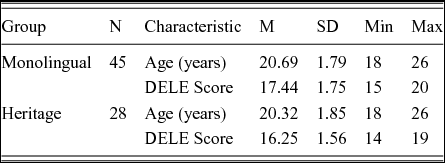
The Spanish HSs consisted of 28 undergraduate students (24 females), including 27 degree-seeking students at San Diego State University and one non-degree-seeking student from San Diego Mesa College. Of the 28 participants, 24 were born in the US and four were born in Mexico but moved to the US by age five years. All participants were of Mexican descent and had at least one immigrant parent. The participants completed a 20-item cloze passage taken from the superior level of the Diploma de Español como Lengua Extranjera (DELE), the same passage used in studies conducted by Silvina Montrul and colleagues (e.g. Montrul, Reference Montrul2005; Montrul, Foote & Perpiñán, Reference Montrul, Foote and Perpiñán2008). The HSs scored 70% or higher (i.e. at least 14 correct out of 20) and were therefore considered advanced. Table 1 displays the background characteristics of each group. The groups did not differ with respect to age (p > .4). Mean scores on the DELE passage were similar for the two groups (17.44 vs. 16.25), but statistically higher for the monolinguals (F(1,71) = 8.726, p = .004).
Background data

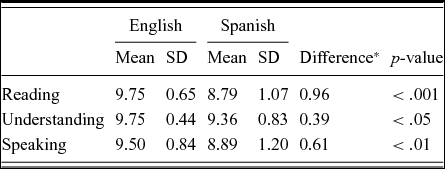
Table 2 displays the heritage speakers’ self-rated abilities in reading, comprehending, and speaking English and Spanish on a scale from 1 to 10. Excepting one participant whose self-rated ability to speak Spanish was 6, self-ratings for each skill and language ranged from a low of 7 to a high of 10, indicating strong abilities in both languages. Between-language comparisons for each of the three skills suggest that the heritage speakers’ abilities were stronger in English relative to Spanish. Participants’ self-reported abilities to read Spanish correlated positively with their scores on the DELE cloze passage (r = .436, p = .021).
Heritage speakers’ mean self-rated proficiencies in Spanish and English (10 = highly proficient, 1 = minimal ability)

*The difference refers to the mean self-rating in English minus the mean self-rating in Spanish.
Materials
Self-paced reading task
The materials for the self-paced reading experiment consisted of complex sentences comprised of two clauses: a subordinate clause that introduced two NPs of the same gender (e.g. el sospechoso “the suspect” and el policía “the policeman”) followed by a main clause that contained either a null or an overt pronoun (e.g. él “he”). The pronoun in the main clause could refer to either of the two referents in the preceding subordinate clause; however, main clauses contained context that biased semantically toward one of the two antecedent NPs in the subordinate clause, as shown in (5), in which the context “admitted his guilt” favors the suspect.
-
(5)
-
a. Después de que el sospechoso habló con el policía, pro admitió su culpabilidad.
-
b. Después de que el policía habló con el sospechoso, pro admitió su culpabilidad.
-
c. Después de que el sospechoso habló con el policía, él admitió su culpabilidad.
-
d. Después de que el policía habló con el sospechoso, él admitió su culpabilidad.
“After the suspect/policeman spoke with the policeman/suspect, pro/he admitted his guilt.”
-
There were 32 items in which pronoun (null vs. overt) was crossed with antecedent bias (SpecIP vs. direct object position) such that each item appeared in one of four versions. Versions (a)–(b) tested null pronouns and versions (c)–(d) tested overt pronouns. Different antecedent biases were created for each condition (null vs. overt) by altering the order of the two NPs in the subordinate clause. In this way, all versions of all items were lexically matched across conditions. Half of the items were followed by a “who”-type comprehension question that elicited participants’ final interpretation of the pronoun in the main clause, as in (6). The two NPs were counterbalanced across the A and B answer choices.
-
(6)


These who-type questions not only ensured that participants were actively engaged in resolving anaphora, but also served as an offline measure of pronoun resolution against which to compare participants’ online performance. The remaining 16 items were followed by a question that ascertained where the events depicted in the sentence likely occurred. The decision to assign a “who”-type versus a “where”-type question to a stimulus was random.
In addition to testing for predicted antecedent biases in an online task, our study independently assessed participants’ knowledge of properties related to the syntax of null and overt subjects in Spanish. These tests are described below.
Null subjects test
This task tested for knowledge that Spanish null subjects are required in weather expressions (e.g. Llueve “It rains”), existential constructions (Hay “There is/are”), impersonal expressions (Es obvio “It's obvious”), expressions with raising verb parecer “to seem” (Parece que “It seems that”), and with non-referring subjects such as impersonal they (Me robaron “They robbed me”). The test consisted of 20 short discourses – four for each of the five aforementioned constructions – that were followed by two sentences, as in (7). Participants were asked to choose the one that best completed the story, the option containing the null subject (i.e. pro in (7b)) being the only syntactically licit completion.
-
(7) Cuando la profesora de literatura pidió ejemplos del realismo mágico en la novela Cien años de soledad de Gabriel García Márquez, Jorge levantó la mano y dijo:
-
a. *Ello llueve por cien años seguidos.
-
b. Pro Llueve por cien años seguidos.
“When the literature professor asked for examples of magical realism in Gabriel García Márquez's novel One Hundred Years of Solitude, Jorge raised his hand and said:”
-
a. “It rains for one hundred years straight.”
-
b. “(Pro) Rains for one hundred years straight.”
Overt pronoun test
The overt pronoun test was adapted from the test used by Rothman and Iverson (Reference Rothman and Iverson2007), which assesses knowledge subsumed under the Overt Pronoun Constraint (OPC; Montalbetti, Reference Montalbetti1984). The OPC captures the fact that in null subject languages, overt pronouns cannot take a bound variable interpretation (i.e. they cannot take quantified or wh-elements as antecedents) whereas null subjects can. The test consisted of 40 short discourses, each of which was followed by a comprehension question about who was performing the action in each scenario. The 40 items tested four conditions, with 10 items each: (i) a quantified determiner phrase (QDP) or wh-antecedent followed by a null pronoun (100% acceptable); (ii) a QDP or wh-antecedent followed by an overt pronoun (a violation of the OPC); (iii) a referential determiner phrase (DP) antecedent followed by a null pronoun (100% acceptable); and (iv) a referential DP antecedent followed by an overt pronoun (marginally acceptable). Example (8) shows an item from condition (ii). If participants respect the OPC, they are expected to choose answer (b), which indicates that the overt pronoun ella “she” refers to someone other than the quantified antecedent cada una “every one of them”.
-
(8) Había muchas mamás en el parque con sus niños. CADA UNA vio que ella había dejado caer su cartera al irse.
¿Quién cree Ud. que debe haber dejado caer su cartera al irse?
-
a. la misma persona que CADA UNA.
-
b. otra persona.
“There were many moms in the park with their children. EVERY ONE OF THEM saw that she had dropped her wallet upon leaving.”
“Who do you believe must have dropped her wallet upon leaving?”
-
a. “the same person as EVERY ONE OF THEM.”
-
b. “someone else.”
Procedure
The monolinguals residing in Mexico completed the study in a multiuse room at the Centro de Auto-Aprendizaje de Idiomas, a self-learning language laboratory housed in the Language Department at the University of Guanajuato. The Spanish HSs were tested in a language processing laboratory at San Diego State University. Participants completed the tasks in the following order: background questionnaire, self-paced reading task, DELE cloze task, null subjects test, and OPC test. Most participants finished in 60–75 minutes.
Self-paced reading
Participants read the 32 critical items and 96 non-critical items one clause at a time in a non-cumulative moving window using SuperLab 4.5 stimulus presentation software. (Non-critical items included direct object pronouns and relative clauses.) The first press of the pacing button on a Cedrus RB-730 response pad displayed the subordinate clause. When the button was pressed a second time, the subordinate clause disappeared and the main clause appeared. The third press of the pacing button removed the main clause and displayed a comprehension question and two choices as answers. Data for analyses included reading times (RTs) for each clause, answers to the comprehension questions, and the time taken to answer them. Critical and non-critical items were divided into four presentation lists and pseudorandomized to ensure that critical items never appear consecutively. Participants took a short break after reading half of the items.
Null subjects and overt pronouns tests
These tests were computerized and administered using SuperLab 4.5. In each test, an item and its corresponding question probe appeared on the same screen and items were fully randomized for each participant such that every participant saw them in a different order. Data for analyses included responses to the comprehension probes.
Data trimming
For the self-paced reading task, data points of less than 600 ms were removed from the RTs of each clause. When this procedure resulted in the removal of data from clause 1 (the non-critical subordinate clause) the corresponding data for clause 2 (the critical main clause containing the null or overt pronoun) were also removed to ensure that RTs in the critical region were not affected by premature advancement of the first clause before it was read entirely. Likewise, data pertaining to comprehension questions that followed such items were also removed under the premise that a reader's answer to a comprehension question is not informative if they did not read one or both clauses in their entirety. However, RT data were not removed on the basis of answers to post-stimulus comprehension questions. This is because a portion of the comprehension questions assessed participants’ ultimate interpretation of each pronoun and therefore provide an offline measure of pronoun interpretation against which to compare participants’ online performance.
To account for small differences in length (three to five character spaces) between the null and overt versions of each item when the two were compared directly in the statistical analyses, residual RTs were calculated separately for each participant on the basis of all clauses read in the study, including non-critical items (Ferreira & Clifton, Reference Ferreira and Clifton1986; Trueswell, Tanenhaus & Garnsey, Reference Trueswell, Tanenhaus and Garnsey1994). The raw and residual RTs of each participant were screened for outliers (separately by subject and item) using the standard deviation (SD) method. Data points that were beyond 1.5 SDs above or below a participant's mean in each condition were removed from analysis. Combined, all data trimming procedures resulted in the removal of 11.2% of the raw RTs and 11.9% of the residual RTs.
Mean raw RTs for the critical main clause (clause 2) were submitted to separate mixed three-way ANOVAs with pronoun (null vs. overt) and antecedent bias (SpecIP vs. non-SpecIP) as within-subjects factors, and group (monolingual vs. heritage) as a between-subjects factor. Residual RTs were analyzed for each group via t-tests comparing null and overt conditions for each antecedent bias. Analyses were conducted separately by subjects and items (α = .05).
Results
Null subjects test
Accuracy rates for the selection of null subjects in required contexts were high for the monolinguals (M = 94.85, SD = 5.50) and the HSs (M = 96.95, SD = 5.33), with no differences between the groups (F 1(1,71) = 2.595, p = .112; F 2(1,38) = 2.030, p = .162). These results suggest that if the HSs perform differently than the monolinguals in the interpretation of null subjects in the self-paced reading task, the differences are not likely due to incomplete knowledge of the syntax of Spanish null subjects.
Overt Pronoun Constraint test
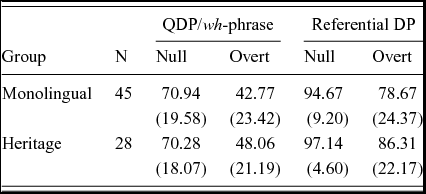
Table 3 below shows the extent to which participants interpreted embedded null and overt subjects as having a bound variable interpretation in two types of matrix clauses (QDP/wh- and referential NPs). Mixed three-way ANOVAs conducted on the answer choices revealed a significant main effect of embedded clause subject (F 1(1,71) = 83.578, p < .001; F 2(1,72) = 30.675, p < .001), reflecting that null subjects were more likely to be assigned bound variable interpretations than overt subjects. There was also a significant main effect of matrix clause type (F 1(1,71) = 152.415, p < .001; F 2(1,72) = 80.157, p < .001), reflecting that bound variable interpretations were more common with referential DPs than with QDP/wh-phrases. The main effects were qualified by a significant two-way interaction between matrix clause type and embedded clause subject that was significant in the analysis by participants and approaching significance in the analysis by items (F 1(1,71) = 15.653, p < .001; F 2(1,72) = 2.916, p = .092). The rates of bound variable interpretation for the null pronoun were expected to be around 90%, compared to the 70% found in our data. Closer inspection of the items revealed that participants did not treat quantified and wh-antecedents the same. Considering just the five items that tested quantified antecedents, both groups assigned bound variable interpretations to null pronouns around 90% of the time (monolingual: M = 88.89, SD = 16.27; heritage: M = 94.11, SD = 10.98). For the five items that tested wh-antecedents, the means dropped to chance levels and standard deviations were high (monolingual: M = 53.11, SD = 33.29; heritage: M = 46.61, SD = 31.15). This is likely due to the fact that all items that tested wh-antecedents used the wh-word quien “who”. The fact that all items in the task were followed by comprehension probes that began with “who” (e.g. “Who do you suppose that . . .”) probably rendered the wh-antecedent items more difficult to interpret. Either way, it is worth noting that there were no effects of (or interactions with) group in these analyses, which suggests that the groups were identical with respect to OPC effects. Thus, once again, if the HSs perform differently from the monolinguals regarding the interpretation of overt pronouns in the self-paced reading task, the differences are not likely due to non-monolingual-like knowledge of the syntax of overt subjects.
Rates of bound variable interpretation (%) for the Overt Pronoun Constraint test

Note: Standard deviations in parentheses.
Self-paced reading task
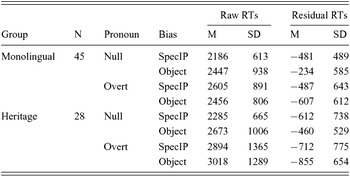
Prior to analysis, one item was removed because the (b) and (d) versions – i.e. the conditions that violated the expected antecedent preferences of null and overt pronouns, respectively – were made more difficult for reasons unrelated to pronoun–antecedent biases, leaving 31 items. Table 4 displays the raw and residual RTs of the critical clauses for each group and pronoun.
Mean raw and residual RTs in the critical region (clause 2)

Raw RTs
Analyses of the raw RTs revealed a significant main effect of pronoun (F 1(1,71) = 15.090, p < .001; F 2(1,60) = 29.989, p < .001), a main effect of bias that was significant in the analysis by participants (F 1(1,71) = 4.705, p = .033; F 2(1,60) = 0.995, p = .322), and a two-way interaction between pronoun and bias that was significant in the analysis by participants (F 1(1,71) = 7.097, p = .010; F 2(1,60) = 0.872, p = .354). Paired-samples t-tests conducted separately on the data for each group and pronoun revealed that both groups read clauses containing null subjects significantly faster when they were resolved in favor of antecedents in SpecIP, a finding that was significant by participants only (monolingual: t 1(44) = 2.343, p = .024; t 2(30) = 0.772, p = .446; heritage: t 1(27) = 2.059, p = .049; t 2(30) = 1.399, p = .172). Conversely, clauses containing overt subjects were read significantly faster when resolved in favor of object antecedents, a difference that was significant only for the monolinguals in the analysis by participants (monolingual: t 1(44) = 2.052, p = .046; t 2(30) = 0.796, p = .432; heritage: t 1(27) = 0.644, p = .525; t 2(30) = 0.515, p = .610).
Although the HSs as a group did not show the anticipated preference to link overt pronouns to object antecedents, standard deviations in the overt pronoun conditions were high and may have obscured the fact that some HSs performed in a monolingual-like way. The variability could be due to several factors, including HSs’ proficiency in Spanish, their age of first exposure to English, and their daily use of and exposure to Spanish. On the background questionnaire, participants indicated degree of current exposure to Spanish on a scale of 0 (never) to 10 (always) in different contexts, including use of Spanish with friends and family and exposure to Spanish input in three domains: television, music, and reading. To determine whether these factors influenced the resolution of overt pronouns, we ran correlations between these factors and HSs’ mean proportional increases in reading time between the two overt pronoun conditions which were calculated using the following formula: (mean RTs in the OvertSpecIP − mean RTs in the Overtobject) / mean RTs in the Overtobject . Correlations with DELE scores, self-rated Spanish proficiencies, age of first exposure to English, and use of Spanish with friends and family were not significant (rs < .3 and ps > .2). In contrast, there was a strong positive relationship between mean proportional increases and reading in Spanish (r = .403, p = .033), but not with exposure to oral Spanish input provided by television (r = .268, p = .167) or music (r = .220, p = .261). That is, participants who read more in Spanish were more likely to show an increased slow down when reading clauses in which the overt pronoun was biased against its preference for an object antecedent.
Residual RTs
Analyses were also conducted on the distinct antecedent biases (SpecIP vs. non-SpecIP), which entailed direct comparison of clauses with null and overt pronouns. To account for the differences in length, residual RTs were used. Paired-samples t-tests were conducted separately on the data for each group and pronoun. When the clause was biased towards an antecedent in SpecIP, there were no reading time differences between clauses containing null or overt pronouns for either group (ps > .3). When the bias was towards an antecedent in object position, participants read clauses containing overt pronouns significantly faster than those containing null subjects. This effect was fully significant for the monolinguals ((−607 ms vs. −234 ms): t 1(44) = 3.421, p = .001; t 2(30) = 2.292, p = .029). For the HSs, the effect was significant in the analysis by participants and approaching significance in the analysis by items ((−855 ms vs. −460 ms): t 1(27) = 2.913, p = .007; t 2(30) = 1.818, p = .079).
Comprehension accuracy
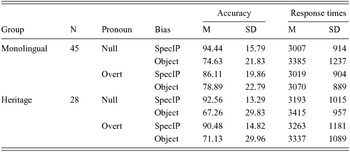
Answers to comprehension questions were deemed correct if the participant chose the semantically-biased antecedent. Comprehension questions affected by stray button presses and those answered in greater than 10,000 ms were excluded from analyses, as were questions affected by incomplete reading of the critical items preceding a question. Missing data amounted to 3.9%. In addition, RTs that were ±2 SDs from the mean for each condition were removed from analysis, resulting in the loss of an additional 4.5% of the RTs. Table 5 displays the mean accuracy rates and RTs to the “who”-type comprehension questions, which elicited participants’ ultimate interpretation of null and overt pronouns in clauses biased toward and against expected antecedent preferences.
Accuracy rates (%) and RTs for the “who”-type comprehension questions

The analysis of the accuracy data revealed a significant main effect of antecedent bias (F 1(1,71) = 54.204, p < .001; F 2(1,28) = 16.144, p < .001). The two-way interaction between bias and pronoun was significant in the analysis by participants (F 1(1,71) = 4.154, p = .045; F 2(1,28) = 1.906, p = .178). Analyses of the RTs to comprehension questions revealed no main effects or interactions.
Following up on the interaction found in the accuracy data, paired-samples t-tests conducted separately on the data for the null pronoun confirm the pattern found in the analysis of RTs in main clauses. Accuracy rates were higher for both groups after reading clauses in which null pronouns were disambiguated in favor of antecedents in SpecIP (monolingual: t 1(44) = 5.052, p < .001; t 2(14) = 2.410, p = .030; heritage: t 1(27) = 4.520, p < .001; t 2(14) = 2.732, p = .016). Accuracy rates in the overt condition showed a pattern distinct from what was observed in the RTs of main clauses with overt pronouns. They were higher for both groups after reading clauses in which overt pronouns were disambiguated in favor of antecedents in SpecIP. For monolinguals, the difference approached significance (t 1(44) = 1.699, p = .096; t 2(14) = 1.746, p = .103), whereas for the HSs the difference was fully significant (t 1(27) = 3.869, p = .001; t 2(14) = 2.957, p = .010).
Discussion
Our first research question asked whether monolingual speakers of Mexican Spanish interpreted null and overt pronouns in contexts of intrasentential reference according to the predictions of the PAS. The reading time results suggest that the PAS does apply in Mexican Spanish, as null pronouns were more often linked with antecedents in the SpecIP position and overt pronouns were more often linked with antecedents in the object position during online processing. Some corroboration for the PAS also was evident in the secondary analysis of residual RTs, although there the trend was less consistent, with only the antecedents in object position showing a reliable trend towards facilitated processing according to pronoun type. The accuracy rates for the comprehension questions also were only partially consistent with the primary reading time data, as questions that followed stimuli with either null or overt pronouns were responded to more accurately (though not more quickly) when the pronoun was linked with a SpecIP antecedent. We return to the offline results from the monolinguals in our discussion of the second research question and the bilingual data below.
The most noteworthy outcome with regard to monolingual processing of ambiguous pronouns was that the results were consistent with both aspects of the PAS, meaning a preference for SpecIP antecedents for null pronouns and a preference for non-SpecIP antecedents for overt pronouns, at least during online processing. These results stand in contrast with a previous online study of native Peninsular Spanish (Filiaci et al., Reference Filiaci, Sorace and Carreiras2014), which had found only the bias for a SpecIP antecedent for the null pronoun. Our findings should be interpreted with a degree of caution given that significance was largely limited to analyses by participants. Filiaci et al.'s study with Spanish participants was similar in this regard; items analyses did not reach significance, although some were marginally significant or trending toward significance. This lends some support for weaker antecedent biases overall in Spanish relative to Italian. Nevertheless, the results of the overt pronoun in this study are consistent with those obtained by Shin and Cairns (Reference Shin, Cairns, Collentine, García, Lafford and Marín2009) with a contextualized continuity of reference measure. This outcome suggests that speakers of Peninsular and Mexican Spanish may differ with regard to their tendencies for resolving the ambiguity of overt pronouns during sentence comprehension.
Alternatively, it is possible that the antecedent biases of our Mexican monolinguals differ from those of the Spanish and Italian monolinguals tested in previous research because of differences in stimuli design across the studies. The present study tested double the number of items used in previous online research, and critical items were lexically matched across all conditions; such differences in the materials could affect the results.
The second research question that guided the present study asked whether Spanish HSs of Mexican descent followed the same strategy as their monolingual counterparts during the interpretation of null and overt pronouns in contexts of intrasentential reference. The overall outcome of the present study suggests limited similarity between monolingual and bilingual interpretation of pronominal reference during sentence processing, as revealed by the online data from self-paced reading. Specifically, while the online bias of the null pronoun for a SpecIP antecedent was observed consistently across both groups, the bias of the overt pronoun for an antecedent in a lower syntactic position was observed only among the monolinguals. In short, both groups were similar in that they responded differently to null versus overt pronouns during online processing, but an important difference was that only the monolingual group showed a referential bias with overt pronouns, whereas the HSs showed no online preference with overt pronouns.
The online results from the present study thus present an interesting complement to previous research on pronoun interpretation among Spanish HSs, which had relied solely on an offline interpretation method and had found that heritage bilinguals treat null and overt pronouns the same when it comes to the assignment of intrasentential antecedents, selecting SpecIP antecedents for both at a rate of around 66% with ambiguous stimuli (Keating et al., Reference Keating, VanPatten and Jegerski2011). This same general trend was evident in the offline interpretation data from the present study and could, in principle, arise either at the level of the underlying representation of grammar or in the assignment of pronominal antecedents during online processing. Under a representational account, observed differences in the bilingual interpretation of null and overt pronouns would be traceable to differences in the syntax of null subjects. Such an account is contradicted by the results of the null and overt subject grammar tests in the present study, which showed that HSs had monolingual-like knowledge of Spanish pronouns. In addition, research on child L1 acquisition has found that the basic syntax of null subjects is acquired very early and that the initial developmental stages are characterized by extensive use of null third person pronouns regardless of referential context (Bel, Reference Bel2003; Shin, Reference Shin, Geeslin and Díaz-Campos2012), a pattern that has not been observed among adult HSs (Montrul, Reference Montrul2004b). It therefore seems very likely that adult HSs are at a later developmental stage, having acquired the fundamental syntax of null subjects completely in early childhood, which further suggests that a representational explanation for the offline results is implausible.
Alternatively, under a processing-based account, null subjects would be available in the underlying linguistic system, but subtle differences in the referential tendencies of pronouns would occur during online sentence comprehension. In other words, the data from the present study suggest not a qualitative, representational difference between the two groups, but rather a quantitative, exposure-based difference in processing strategy. The application of the PAS entails the rapid and complex integration of various sources of linguistic information in real time: first, there is the identification of a pronominal form and an assessment of its informativity ranking relative to other available referential expressions (i.e. lexical NP > stressed overt pronoun > overt pronoun > null pronoun, for Spanish) and second, the identification of the antecedent that fits the discourse-prominence preferences of the pronoun, which in the case of the PAS is claimed to occur on the basis of syntactic position. It is perhaps not surprising, then, given this complexity, that differentiation between null and overt pronouns requires extensive exposure to input and is characterized by a series of small rather than dramatic developmental shifts, not appearing in even the most basic sense until around age 8 in monolingual child L1 acquisition and only approaching adult-like preferences at around age 14 (Shin & Cairns, Reference Shin and Cairns2012). The outcome of the present study, on the other hand, is unexpected given the widely held assumption of incomplete acquisition of heritage languages, in which acquisition is halted around age five to six years when formal schooling in English begins. If Spanish HSs stopped acquiring the referential properties of null and overt pronouns at that point they would not be predicted to differentiate between the two, at least on the type of discourse felicitousness judgment measure employed by Shin and Cairns (Reference Shin and Cairns2012). Nevertheless, the online sentence processing data from the present study revealed differentiation between the two types of pronoun, at least in a comprehension-based measure. It might be inferred from this outcome that the assumption of incomplete acquisition can underestimate the developmental potential of heritage languages beyond early childhood, which is consistent with the continued development observed by Montrul and Sánchez-Walker (Reference Montrul and Sánchez-Walker2013) for differential object marking among child and adult HSs of Spanish. This is not to suggest that incomplete acquisition should be excluded entirely as a factor, but merely to observe that it is not necessarily absolute.
Looking beyond basic differentiation between null and overt pronouns during real-time sentence comprehension, the HSs in the present study still did not show a reliable PAS-like preference to link overt pronouns to non-subject antecedents, at least not at the group level. There was, however, considerable variability within the group, which suggests that some individuals were more monolingual-like than others in this regard. Correlation analysis examined potential links with several background variables that might reveal to what extent the interpretation of overt pronouns by HSs is shaped by the primary factors believed to affect heritage languages, which are incomplete acquisition, attrition, and cross-linguistic influence (Benmamoun, Montrul & Polinsky, Reference Benmamoun, Montrul and Polinsky2010), and language contact-induced change. First, PAS-like processing behavior with overt pronouns did not correlate with scores from the general proficiency test or with self-ratings of proficiency in Spanish. Such measures of language skill are admittedly coarse and can be difficult to interpret, but the lack of correlation may indicate that online application of the PAS is not associated with low language ability in Spanish. Second, there was no correlation with age of first exposure to English, which is an indirect indication that the PAS may not be subject to any strong influence from English, although this is only one of many possible measures of cross-linguistic influence. Finally, of the several different language use and exposure parameters queried, including use of Spanish with friends or family and exposure to input via television, music, or reading, only exposure to Spanish via reading showed a significant correlation with monolingual-like online interpretation tendencies for overt pronouns.
At first blush, this outcome might be taken as evidence that ongoing exposure to Spanish can either lead to additional acquisition in adulthood or it can mitigate the effects of attrition, but it is important to note that only exposure via reading was a factor and other sources of potential exposure were not. When compared alongside the results of Shin and Cairns (Reference Shin and Cairns2012), in which monolingual children do not develop adult-like pronominal usage preferences until puberty, one conclusion is that somehow literacy affects the acquisition of the distribution of pronoun function and antecedence preference in Mexican Spanish. That is, conversational input (and by extension, television, radio, and other aural media outlets) may not contain enough ambiguous data that need to be resolved during processing as might happen in more elaborate, possibly complex, and planned discourse as found in written text. What is more, given that the conversational Spanish of HSs may itself not completely resemble the Spanish of Mexican monolinguals further complicates the scenario. In short, access to written input that monolinguals get undergoing literacy may expose HSs to a variety of Spanish they do not encounter in their everyday oral–aural lives. For this reason, we find that there is a correlation between reading and ambiguity resolution in the present study.
It is also interesting to note that the HSs, despite showing differences from the Mexican monolinguals in the present study with regard to the online processing of overt pronouns, were largely similar to monolingual Spanish participants from previous research (Filiaci et al., Reference Filiaci, Sorace and Carreiras2014). A likely explanation for the similarity between the HSs in the present study and Spanish monolinguals in prior work is that independent causes of variation in pronominal reference, either cross-linguistic/dialectal in the case of Peninsular Spanish vs. Mexican Spanish vs. Italian, or developmental as well as dialectal in the case of Spanish HSs, yield similar manifestations because the referential tendencies of overt pronouns are less determinate than those of null pronouns. The relative strength and robustness of the referential preferences of null pronouns across diverse groups of participants, on the other hand, lends support to the claim that the subject antecedent strategy is universal.
Additional corroboration for the universality of the tendency to choose a subject antecedent for a pronoun comes from the offline data from the comprehension questions in the present study. Despite the online evidence of PAS-like differentiation between null and overt pronouns, the offline results from both groups reflected a general preference for a subject antecedent for either type of pronoun. There are at least two plausible explanations for this difference in the online and offline results. One scenario is that the mostly neutral antecedent preference with overt pronouns during online bilingual processing represents a conflict between the Spanish PAS and the English (and also universal) “subject rule” that is ultimately resolved in favor of the universal during the later stages of processing, which is reflected in the offline results from the questions that followed each stimulus. Alternatively, the tendency to assume a subject antecedent for any subject pronoun could also arise if a detailed syntactic representation of the stimulus is no longer available – perhaps because the processor is pushed to its limits by the demands of the task – but a basic representation of the discourse still offers a single antecedent, the discourse-prominent subject. In the case of the monolingual group, the intra-linguistic conflict account is not an option, so only a reliance on a default processing strategy under certain conditions could explain the offline results from both groups in the present study. Furthermore, the processing-based account could also explain the discrepancy with offline data from previous research on monolingual Spanish (Alonso-Ovalle et al., Reference Alonso-Ovalle, Fernández-Solera, Frazier and Clifton2002; Filiaci et al., Reference Filiaci, Sorace and Carreiras2014; Keating et al., Reference Keating, VanPatten and Jegerski2011), given that reliance on a default tendency in processing would presumably arise under certain conditions but not always.
One limitation to the present study is that phrase-by-phrase self-paced reading does not provide as much detail about the time course of sentence processing as do word-by-word self-paced reading or eye-tracking. However, in addition to practical advantages, an important advantage of the method chosen is consistency with previous online research on the PAS (Carminati, Reference Carminati2002; Filiaci et al., Reference Filiaci, Sorace and Carreiras2014), which ensures that the results of the current investigation are maximally comparable with those of prior work. A second limitation is that the HSs from Southern California represent just one of many diverse populations of Spanish HSs in the US. Whether or not a similar outcome would be observed in a replication of this experiment with heritage Spanish bilinguals in Chicago, Miami, or New York, for instance, is a question for future study.
In conclusion, the outcome of the current investigation suggests that the pronoun interpretation behavior of Spanish HSs can be less affected by extensive exposure to English than previously thought, at least as far as real-time sentence processing is concerned. Specifically, there was evidence of distinct processing strategies with null and overt pronouns, a tendency that has not been observed with offline methods and which highlights the potential of online methods like self-paced reading to be uniquely informative. With regard to monolingual varieties of Spanish, the present study also provided new evidence of the application of the PAS during online processing of null and overt pronouns with intrasentential antecedents. Both of these outcomes suggest that the tendency to link a null pronoun with a subject antecedent reflects a robust universal strategy that holds across a variety of contexts, but that the strategies associated with the interpretation of overt pronouns are more susceptible to variation. The present study has suggested that amount and type of exposure can be important factors in such variation, although additional factors that can shape such strategies in an individual user of multiple languages remain open for further investigation. Furthermore, testing the cross-linguistic validity of the PAS requires studying anaphora resolution in null-subject languages that lie outside the Romance family, such as Arabic, Japanese, and Turkish. We leave this to future research.
Supplementary Material
For supplementary material accompanying this paper, visit http://dx.doi.org/10.1017/S1366728914000418