Introduction
In many Western countries nursing home care for people with dementia is losing its institutional character. It is increasingly recognized that nursing home wards should have a homelike atmosphere, since residents with dementia can live several years in a care facility and benefit from a familiar environment (Moise et al., Reference Moise, Schwarzinger and Um2004). Residents with dementia should be able to bring at least some of their personal possessions and enjoy some privacy whenever they choose. In several countries, nursing home organizations try to cover this need for familiarity by providing group living home care (Verbeek et al., Reference Verbeek, Van Rossum, Zwakhalen, Kempen and Hamers2009). In the Netherlands in 2010, about 25% of the nursing home care for people with dementia was organized in group living home facilities (Aedes-Actiz Kenniscentrum Wonen-Zorg, 2011).
In Dutch facilities where group living home care is provided, residents live together in small groups, usually consisting of six to eight people. The personal care is integrated into daily routines, which means that care staff perform care tasks as well as domestic, social, and recreational tasks. Together with the staff, residents form a substitute household with normal household activities. The daily lives of the residents are kept as “normal” as possible (te Boekhorst et al., Reference te Boekhorst, Depla, de Lange, Pot and Eefsting2007). Traditionally, group living home care in the Netherlands was provided within small archetypical house-like facilities. For some years now, group living home care has also been provided on a larger scale. Several regular nursing homes have transformed their traditionally large dementia wards into smaller units where group living home care is provided. Also, many new facilities have been built that offer group living home care on a larger scale, with sometimes more than 150 residents with dementia. Contrary to most other countries that offer this type of dementia care, group living home facilities in the Netherlands are meant to serve as a complete substitute for regular nursing home care instead of an intermediate between home care and the nursing home (Verbeek et al., Reference Verbeek, Van Rossum, Zwakhalen, Kempen and Hamers2009).
The emphasis on daily life and a familiar, homelike, and relatively small environment is assumed to be better suited to the residential requirements and complex needs of persons with dementia (Hammer, Reference Hammer1999). However, there is still a lack of evidence on the effects of such an environment on residents’ quality of life. Day et al. (Reference Day, Carreon and Stump2000) found a homelike environment and small group sizes to be related to several positive outcomes, such as higher emotional well-being, pleasure, and social interaction among residents and with the care staff, and less anxiety, agitation, and depression. Yet, these findings were often generated from anecdotal research, or could also be attributed to staff characteristics (Fleming and Purandare, Reference Fleming and Purandare2010). Two Dutch studies on the effect of group living home care compared with traditional nursing home care found limited positive effects with respect to some subdomains of residents' quality of life (Te Boekhorst et al., Reference te Boekhorst, Depla, de Lange, Pot and Eefsting2009), but no effects on overall quality of life (Verbeek et al., Reference Verbeek, Zwakhalen, Van Rossum, Ambergen, Kempen and Hamers2010). Both research groups, however, found a modest positive effect of group living home care on the subdomain “having something to do.” Although the operationalization of this subdomain is more directed at measuring whether or not residents are able to amuse themselves than their involvement in activities, the results suggest that residents of group living care facilities might be more involved in activities than residents of more traditional nursing home facilities.
Activity involvement is important for the well-being of people with dementia. In particular, activities that are tailored to individual needs and preferences are expected to contribute to quality of life (Vernooij-Dassen et al., Reference Vernooij-Dassen, Vasse, Zuidema, Cohen-Mansfield and Moyle2010). Research findings show several positive outcomes of activity involvement such as more positive affect, less depressive symptoms, elevated interest and alertness, less boredom, higher nutrition intake, and decreased use of psychotropic medications (Schreiner et al., Reference Schreiner, Yamamoto and Shiotani2005; Volicer et al., Reference Volicer, Simard, Heartquist Pupa, Medrek and Riordan2006; Brooker et al., Reference Brooker, Wooley and Lee2007; Verkaik et al., Reference Verkaik, Francke, van Meijel, Spreeuwenberg, Ribbe and Bensing2011). The lack of activity involvement is related to several adverse outcomes: loss of physical function, social isolation, neuropsychiatric symptoms, and poor quality of life (Kolanowski et al., Reference Kolanowski, Buettner, Litaker and Yu2006). It is even suggested that lack of activity involvement results in “excess disability,” caused by atrophy of skills and functional capacities (Wells and Dawson, Reference Wells and Dawson2000). Despite these findings, activity involvement is still found to be a large unmet need among long-term care residents with dementia (Hancock et al., Reference Hancock, Woods, Challis and Orrell2006; Orrell et al., Reference Orrell, Hancock, Liyanage, Woods, Challis and Hoe2008).
The indication of higher activity involvement in small-scale group living home care facilities is remarkable, since an important subject of discussion in the Netherlands is the activity involvement of residents with dementia in group living homes as compared with those receiving traditional nursing home care. Due to strong emphasis on a homelike environment with normal household activities in group living home care facilities, family caregivers sometimes feel that there are too few activities and other services available for the residents. The smaller number of residents in group living home care facilities may play a role in this, since providing care on a small scale makes it financially more difficult to offer additional services or organize extra activities outside the living rooms of care units. Furthermore, some family caregivers argue that residents are bored because of the limited amount of time that the care staff are able to provide for activities in addition to their many other tasks (Verbeek et al., Reference Verbeek, Zwakhalen, Van Rossum, Kempen, Hamers and Verbeek2011). Also, care managers and professionals sometimes raise concerns about whether there is enough variation in activities to suit the individual needs and preferences of every resident in these facilities.
The limited research that is available on the relationship between small-scale dementia care – considering both the characteristics of group living home care and the small number of residents – and activity involvement is ambiguous. In a US study (Wood et al., Reference Wood, Harris, Snider and Patchel2005) on activity involvement of residents of a small homelike dementia care facility, the residents were found to be hardly involved in activities at all. These findings must be interpreted with caution because they are based on a single case-study design. The researchers proposed that a homelike environment might hinder nursing staff from recognizing the need for activity, since the stimulating environment seemed to make them forget that people with dementia need to be actively involved in activities.
Wood et al. (Reference Wood, Harris, Snider and Patchel2005; Reference Wood, Womack and Hooper2009) also argued that small resident groups seemed to create a less stimulating environment. In a more elaborate study, however, Cohen-Mansfield et al. (Reference Cohen-Mansfield, Thein, Dakheel-Ali and Marx2010) found nursing home residents with dementia to be socially engaged more often when they lived in small groups of four to nine people. Concerning the number of residents at the total facility site, Dobbs et al. (Reference Dobbs2005) found no relationship between total number of residents and activity involvement in nursing homes and residential care facilities. Yet, Kuhn et al. (Reference Kuhn, Kasayka and Lechner2002) found that residents of small residential care facilities – 10 to 28 residents – were less involved in activities than residents with dementia living in facilities consisting of 40 to 63 residents. It was suggested that these findings could be caused by the integral care tasks of the staff working in smaller facilities. Due to their responsibility for personal care, administration of medication, food preparation, housekeeping, and social and recreational activities, the staff are under pressure to focus on what they believe to be the most essential tasks, which are often the basic care needs of residents (Kuhn et al., Reference Kuhn, Kasayka and Lechner2002). This corresponds to the criticism that is sometimes heard from family caregivers in the Netherlands (Verbeek et al., Reference Verbeek, Zwakhalen, Van Rossum, Kempen, Hamers and Verbeek2011).
Since the jury is still out on the activity involvement of residents with dementia within small-scale care, the aim of the current study was to give further insight into this relationship. The following two research questions were investigated: (1) In what way is small-scale care related to overall activity involvement of residents with dementia? (2) To what extent is small-scale care related to the involvement of residents with dementia in different types of activities?
Methods
Design and sample
Data were derived from the Living Arrangements for people with Dementia (LAD) study, which is an ongoing monitoring study of the developments and variety in Dutch nursing home care for people with dementia, and its consequences for resident quality of life, quality of care, staff ratio, and staff well-being. Data collection takes place every two years. The design of the baseline measurement of this study has been described in detail elsewhere (Willemse et al., Reference Willemse, Smit, De Lange and Pot2011).
For the present study, data on 136 long-term care facilities providing nursing home care for people with dementia gathered in the first measurement cycle (November 2008–May 2009) of the LAD study were used. These were all non-private facilities, receiving state reimbursement through the Exceptional Medical Expenses Act (AWBZ) based on the referral status of residents according to the presence of neuropsychiatric symptoms. In the Netherlands, people with a primary diagnosis of dementia are cared for on dementia-specific care wards or in dementia-specific homes. In broad terms, the following five types of dementia care facilities can be distinguished, which were represented in our study: traditional large-scale nursing homes (n = 27), nursing home wards in a home for the aged (n = 17), large nursing homes where group living home care is provided (n = 31), group living homes close to the mother facility (n = 35), and stand-alone group living homes in the community (n = 26).
In each participating care facility a care manager was interviewed to obtain information on the number of residents and the number of group living home care characteristics, among other organizational characteristics. Twelve residents were randomly selected in each care facility to obtain data on residents' quality of life, involvement in activities, dependency on the Activities of Daily Living (ADL), neuropsychiatric symptoms, and demographics. If there were fewer than 12 residents with dementia in the facility, all residents were selected. A registered nurse (RN) or certified nursing assistant (CNA) who was mostly involved with a selected resident was asked to fill an observational questionnaire. All residents living in the participating care facilities were eligible to participate in this study. The care staff completed a total of 1,327 observational questionnaires, resulting in a response rate of 84%.
Measures
Involvement in activities
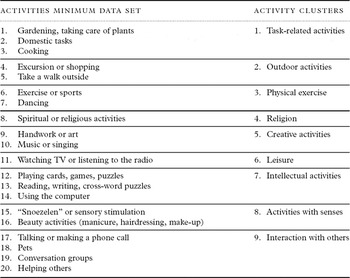
Residents’ involvement in activities was measured in three ways. First, the total number of activities that each resident was involved in for the past three days was obtained using the Activity Pursuit Patterns from the Resident Assessment Instrument Minimum Data Set (RAI-MDS). This instrument consists of a list of 20 activities (Table 1) for which an RN or a CNA reports whether or not the resident has been involved in these activities for the past three days. Secondly, for each activity in which the resident was involved, the RN/CNA listed whether that was one of the resident's preferred activities or not. Additional data were thereby collected on the number of preferred activities the residents were involved in over the past three days. Thirdly, to investigate the relationship between involvement in specific activity types and small-scale care, the 20 listed activities of the RAI-MDS were clustered into nine activity types (Table 1). Clustering was based on face validity. The authors independently clustered the activities into activity types. Items that could not be agreed upon were discussed until consensus was reached. It is important to note that the clustering of activity types involves validity problems in terms of number of items per activity type and overlap of construct. Therefore, these results of different activity types should not be compared with each other. It is only possible to look at the relationship of each separate activity type and small-scale care.
The 20 activities listed by the activity pursuit patterns of the MDS-RAI, divided in nine categories after clustering at face validity

Indicators of small-scale care
Although the participating care facilities represented five types of long-term dementia care, there was large overlap in organizational characteristics between different types of facilities, as well as a large variation in organizational characteristics within the types of facilities. This makes it invalid to compare different care types when studying the effect of small-scale care on residents’ activity involvement. We have to take into account the actual implementation of care characteristics (Smit et al., Reference Smit, Te Boekhorst, De Lange, Depla, Eefsting and Pot2011).
The relationship between small-scale dementia care and activity involvement was therefore studied with indicators of small-scale care. As a first indicator, group living home care characteristics that were integrated in all 136 care facilities were studied. Data on this indicator were obtained by the questionnaire “Group Living Home Characteristics” (te Boekhorst et al., Reference te Boekhorst, Depla, de Lange, Pot and Eefsting2011). This questionnaire was based on the statements of a Concept Map concerning the ideals of group living home care (te Boekhorst et al., Reference te Boekhorst, Depla, de Lange, Pot and Eefsting2007). The response categories have a 5-point Likert scale format. A principal axis analysis showed one factor with relatively high loadings (>0.4) on 14 items (Cronbach's α = 0.87). These include: (1) living rooms have a homelike atmosphere; (2) dinner is prepared in the kitchen of the living rooms; (3) nursing staff do the housekeeping; and (4) residents can get out of bed whenever they want. The scale ranges from 0 to 56 with a higher score indicating more characteristics of group living home care.
As a second indicator, the number of residents per care unit was measured. However, since the number of residents per unit was highly correlated with the questionnaire “Group Living Home Characteristics” (r = 0.69), this indicator was excluded from analysis. Last, the total number of persons with dementia in the care facility was recorded.
Resident characteristics
In order to adjust for differences in demographic characteristics and functional status of the participating residents, age and sex were assessed. Furthermore, data on ADL dependency were obtained with use of the Katz inventory (Katz, Reference Katz1983), ranging from 1 to 7, with a higher score indicating more dependency on ADL. The Katz inventory has good psychometric properties (Cronbach's α = 0.91). Neuropsychiatric symptoms were measured using the Neuropsychiatric Inventory Questionnaire (NPI-Q) (Kaufer et al., Reference Kaufer2000; De Jonghe et al., Reference De Jonghe, Kat, Kalisvaart and Boelaarts2003; Cronbach's α = 0.78) with a range of 0 to 36 and a higher score indicating more neuropsychiatric symptoms.
Statistical analysis
Multiple multilevel linear regression analyses were performed to study the relationship between the indicators of small-scale dementia care and the number of activities in which the residents were involved over the previous three days (in total and preferred activities). In model 1, the analysis with the indicators of small-scale care as predictors and the number of (preferred) activities as outcome was performed. In model 2, all resident characteristics (age, sex, neuropsychiatric symptoms, and ADL dependency) were added to the analysis as possible confounders.
Multiple multilevel logistic regression analyses were performed to study the relationship between the indicators of small-scale care and the types of activities residents were involved in. For each of the nine activity types, a dichotomous variable was computed that stated whether the resident was involved in this activity type or not. Model 1 concerns the unadjusted effects of indicators of small-scale care, separately for each type of activity as outcome. Model 2 concerns the effects of indicators of small-scale care adjusted for the potential confounding variables such as age, sex, neuropsychiatric symptoms, and ADL dependency. All analyses were performed using MLwiN 2.21 (Centre for Multilevel Modelling, University of Bristol, UK).
Results
Resident characteristics
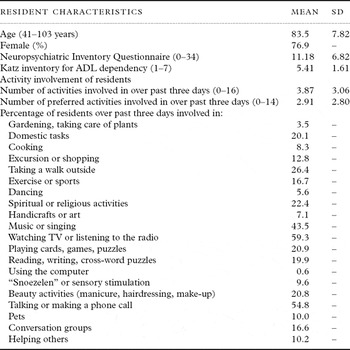
The study sample had a mean age of 83.5 years (SD = 7.8; Table 2). Approximately 77% of the nursing home residents were females. The sample scored high on the Katz ADL inventory (M = 5.4, SD = 1.6), meaning that the residents needed help in almost all domains of daily living. The mean score on the NPI-Q scale for neuropsychiatric symptoms was 11.2 (SD = 6.8).
Background characteristics and activity involvement of nursing home residents (1,327)

On average, the residents were involved in 3.9 activities in general (SD = 3.1, range 0–16)), and in 2.9 preferred activities (SD = 2.8, range 0–14) over the previous three days, although the large standard deviations indicate much inter-individual variety. Concerning the involvement in types of activities, most residents were involved in interaction with others (60.8% residents), leisure activities (59.3%), and creative activities (45.7%). Fewer residents were involved in other activity types, varying from 20% to 33% per type.
Description of care facilities
There was much variety within the participating care facilities concerning the indicators of small-scale care. The arrangements had a mean score of 30.7 (SD = 10.9) for the “Group Living Home Characteristics” questionnaire. Their average number of residents per unit was 9.2 (SD = 3.8), and the average number of residents in total was 44.6 (SD = 39.4).
Small-scale dementia care and activity involvement
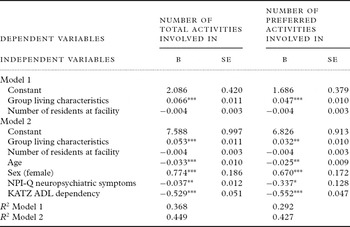
Unadjusted multiple multilevel linear regression analysis showed a significant relationship between the scores of “Group Living Home Characteristics” questionnaire and the overall activity involvement of residents with dementia (B = 0.066, p < 0.001; Table 3). No relationship was found for the total number of residents at the facility site and the overall activity involvement. In adjusted analysis, group living home care characteristics were still related to activity involvement at a p < 0.001 level (B = 0.053). The control variables, i.e. age, sex, neuropsychiatric symptoms, and ADL dependency, were also highly related to activity involvement: lower age, female sex, less neuropsychiatric symptoms, and low ADL dependency corresponded with more activity involvement.
Relationship between indicators of small-scale dementia care and residents' involvement in (preferred) activities forpast three days

*p < 0.05, **p < 0.01, ***p < 0.001.
Group living home characteristics: 14-item version of the questionnaire “Group Living Home Characteristics”; NPI-Q = Neuropsychiatric Inventory Questionnaire; Katz = Katz inventory for ADL dependency. NB: The explained variance (R 2) indicates the variance between the participating care facilities.
Similar results were found for involvement in preferred activities (B = 0.047, p < 0.001 for “Group Living Home Characteristics” in unadjusted analysis and B = 0.038, p < 0.01 in adjusted analysis; no significant relationship was found for number of residents). These results indicate that residents of care facilities with more characteristics of group living home care are more involved in overall and preferred activities than residents receiving long-term care with fewer characteristics of group living home care.
Small-scale dementia care and involvement in types of activities
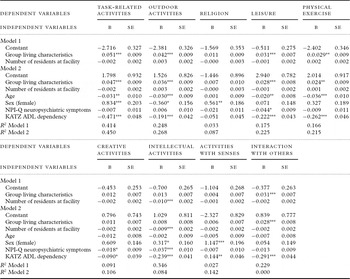
Logistic regression analyses showed that residents of facilities with more group living home characteristics were more involved in task-related, outdoor and leisure activities, physical exercise, and interaction with others (B ranging from 0.029 to 0.051, and p < 0.01 to 0.001 in unadjusted analysis, and B ranging from 0.024 to 0.047, and p < 0.01 to 0.001 in adjusted analysis; Table 4). The number of residents of the total facility site only predicted involvement in intellectual activities (unadjusted B = −0.010, p < 0.001; adjusted B = −0.009, p < 0.001), with residents of larger facilities being less involved in intellectual activities.
Relationship between indicators of small-scale dementia care and resident's involvement in activity types for past three days

*p < 0.05, **p < 0.01, ***p < 0.001.
Group living home characteristics: 14-item version of the questionnaire “Group Living Home Characteristics”; NPIQ = Neuropsychiatric Inventory Questionnaire; Katz = Katz inventory for ADL dependency. NB: The explained variance (R 2) concerns the variance between the participating care facilities.
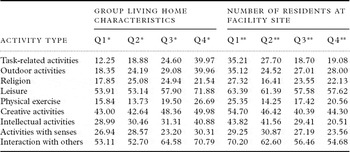
The results on involvement in types of activities and small-scale care are illustrated in Table 5. This table presents an overview of the mean percentage of residents who were involved in nine types of activities within care facilities arranged in quartiles corresponding to their scores on both “Group Living Home Characteristics” questionnaire and number of residents in the facility. For example, in living arrangements with the fewest group living home care characteristics, 12.3% of the residents were involved in task-related activities compared with 40.0% of the residents in living arrangements with the most group living home care characteristics. Moreover, 43.8% of the residents with the fewest residents at the total facility were involved in intellectual activities compared with 20.8% of the residents of the facilities with the most residents in total.
The mean percentages of residents who were involved in activity types in care facilities for people with dementia (n = 136), arranged in quartiles according to the score on the Group Living Home Characteristics questionnaire and the number of residents at the facility site

* Care facilities divided in quartiles according to their score on the “Group Living Home Care Characteristics” questionnaire; Q1 represents the lowest scoring quartile ranging from 8–21, Q2 ranges from 21–33, Q3 ranges from 33–40, and Q4 represents the highest scoring facilities with a range from 40 to 52.
** Care facilities divided in quartiles according to their total resident numbers; Q1 represents quartile of facilities with the least residents ranging from 6–18, Q2 ranges from 18–30 residents, Q3 ranges from 30–61 residents, and Q4 represents the facilities with the largest resident numbers ranging from 61 to 240.
Discussion
In this study, the relationship between activity involvement of residents with dementia and two indicators of small-scale care was studied. It was found that residents of facilities with more group living home care characteristics were involved in more activities over three days. This holds true for both activities in general and activities that they preferred. Furthermore, residents of facilities with more group living home characteristics were more involved in task-related activities, outdoor activities, leisure activities, physical exercise, and interaction with others. For the other types of activities (religion, creative activities, intellectual activities, and activities with senses), no differences were found. The number of residents at the total facility site was not related to the direct involvement in (preferred) activities. Concerning the involvement in activity types, the only finding was that a higher number of residents at the facility was related to less involvement in intellectual activities. These results indicate that small-scale dementia care as measured by the number of characteristics of group living home care has a positive effect on the activity involvement of residents.
A first explanation for the findings might be that a homelike environment may offer more opportunities or a better ambiance for residents to be involved in small activities, such as listening to music, watering plants, reading, cleaning, or having a group conversation, in the shared living room. Simply surrounding residents with activities is not enough to get them engaged in activities, as noted by Wood et al. (Reference Wood, Harris, Snider and Patchel2005). However, a stimulating environment might make it easier for care staff to offer these small activities. Small activities in the living room are important because they can be organized on a frequent basis. Therefore, we recommend that large-scale activities (like bingo, large holiday celebrations, and a visit to zoo) are complemented with small activities.
Another explanation might be the small resident groups that are common in facilities that provide group living home care, as illustrated by the high correlation between these characteristics found in our study sample. This corresponds to the findings of Cohen-Mansfield et al. (Reference Cohen-Mansfield, Thein, Dakheel-Ali and Marx2010) whereby nursing home residents living in small groups were socially engaged more often. Smaller groups of residents might cause the staff to become better acquainted with the residents and know more about their life history and personal preferences. The smaller environment may also enable the staff to pick up residents’ signals for activity involvement more easily. They might be less distracted by other residents or colleagues, and more aware when residents have not been active for a long time.
The fact that care staff of facilities that provide group living home care are responsible for the provision of activities is also likely to contribute to a higher activity involvement of residents. Although the responsibility for physical care of residents, domestic tasks, and activity provision can be demanding (Kuhn et al., Reference Kuhn, Kasayka and Lechner2002; Verbeek et al., Reference Verbeek, Zwakhalen, Van Rossum, Kempen, Hamers and Verbeek2011), it might also lead to higher awareness and control of activity involvement of residents.
While staff working in facilities with a high level of group living home care are focused on providing activities in the living room, staff working in more traditional facilities might hide behind a central activity program or occupational therapists to fulfill residents’ needs for activities. It is also possible that care staff working in living arrangements that provide group living home care are different from regular nursing home care staff with regard to their personal characteristics (te Boekhorst et al., Reference te Boekhorst, Willemse, Depla, Eefsting and Pot2008). Group living care staff might be more extrovert or equipped with more organizational skills than staff working in facilities that provide traditional nursing home care, characteristics that can influence the activity involvement of people with dementia. The points addressed here are all hypotheses. Further research is needed to determine the exact mechanism that lies behind the effect of small-scale care on activity involvement.
Our findings are in line with those of te Boekhorst et al. (Reference te Boekhorst, Depla, de Lange, Pot and Eefsting2009) and Verbeek et al. (Reference Verbeek, Zwakhalen, Van Rossum, Ambergen, Kempen and Hamers2010) that residents of group living homes score higher on the “having something to do” subdomain of quality of life than residents of regular nursing homes. With regard to the results from the US research of Kuhn et al. (Reference Kuhn, Kasayka and Lechner2002) and Wood et al. (Reference Wood, Harris, Snider and Patchel2005, Reference Wood, Womack and Hooper2009), it is possible that our contradictory results are caused by international differences in dementia care or care staff. The concept of small-scale dementia care varies across countries with respect to physical setting, number of residents, resident characteristics, domestic characteristics, and costs (Verbeek et al., Reference Verbeek, Van Rossum, Zwakhalen, Kempen and Hamers2009). Staff working in group living home facilities in the Netherlands might be better facilitated to perform integral care tasks than staff in the USA. Another explanation might be that the US findings are generated from observational data, whereas the findings of the current study are based on staff reports.
For feasibility reasons, it was not possible to perform systematic observations within this large sample of residents. This might have caused information bias. Care staff working in facilities with many characteristics of group living home care might have interpreted certain actions or behavior more easily as involvement in an activity. Moreover, because group living home care staff are responsible for activity provision themselves, they might have been better able to observe the involvement in activities than regular nursing home staff. It is hard to say to what extent this possible bias has influenced our study data. Another limitation of this study is that by using the Activity Pursuit Pattern questionnaire from the MDS-RAI, only the number of activities the person was involved in could be studied, and not the extent to which a resident was involved in this activity. Although the MDS-RAI instrument also includes a question on the length of time the residents are involved in activities during the day, this question was not sensitive due to the broadness of the answer categories ranging from none, 1/3 of the day, 2/3 of the day, to almost all day. Almost all residents in our sample were involved in activities for “1/3 of the day.” We were therefore restricted to the number of different activities a person was involved in. Although a person might be involved in only one activity, it is possible that he was involved in this for a long time, or for several times over the three days. Therefore, the question of whether small-scale dementia care is related to the actual time that residents are involved in activities remains unanswered. Finally, this study has a cross-sectional design, so an actual causal relationship between small-scale care and activity involvement cannot be demonstrated.
The current study provides some evidence to counter national criticism on activity involvement in small-scale care facilities. Small-scale care seems to offer more opportunities to involve residents in activities, and does not limit the activity types in which the residents are involved. In addition, this study provides further insight in the amount and types of activities people with dementia living in long-term care facilities are involved in. On average, the residents were involved in almost four activities in three days, and in three activities that they preferred doing. However, there was much inter-individual variety: 15% of the residents were not involved in any of the 20 activities at all during the three days, and 32% of the residents were not involved in interaction. This suggests that people with dementia are still hardly involved in activities. Considering the relationship of activity involvement with indicators of quality of life and possibly with excess disability, it is important to set an agenda for more activity involvement in dementia care practice.
This study also showed that, in addition to the way in which dementia care is organized, individual residents' characteristics play an important role in their activity involvement. Kuhn et al. (Reference Kuhn, Fulton and Edelman2004) have described the low activity involvement of persons with dementia with severe cognitive or functional impairment. They pleaded for more one-to-one and small group approaches to promote engagement and maximize their quality of life. Based on our study findings, it appears that higher dependent residents are still less involved in activities when they receive small-scale dementia care. It was found that neuropsychiatric problems and ADL dependency, as well as age and sex of residents, predicted activity involvement more accurately than the indicators of small-scale care. These findings indicate that residents who are older, male, and have more challenging behaviors and more ADL dependency should receive specific attention when it comes to activity involvement despite the type of care they receive. Extra effort should be made to explore their preferences and abilities in order to address their specific need for activation and purpose.
Conflict of interest
None.
Description of authors' roles
Dieneke Smit analyzed the data and drafted the paper. Jacomine de Lange helped to draft the paper, and Bernadette Willemse helped in analyzing the data. Anne Margriet Pot helped to draft the paper, checked the analyses, and is a principal investigator of the LAD study. All authors contributed to the design of the LAD study. All authors read and approved the final paper for publication.
Acknowledgments
The Living Arrangements for people with Dementia study is supported by a grant from the Netherlands Ministry of Health, Welfare and Sports and Alzheimer, Netherlands.