While incessant land disputes continue to fuel social tensions in peri-urban China, recent studies have increasingly recognized that villagers are no longer powerless or merely passive, dispossessed victims of state-led land requisitions. Sally Sargeson argues that the restructuring of power relationships between the government, villagers and capital during the land enclosure process is embedded in a mixture of flexible political and institutional reforms underpinned by both central initiatives and local policy experiments, rendering “land-losing” villagers as not only “victims” but also “villains” and “aspiring proprietors.”Footnote 1 Such complex characterizations of villagers are backed up by other research which shows that villagers in southern China remain defiant, even if they became much wealthier, after land requisitions. You-tien Hsing suggests that the villagers in Tianhe 天河 in Guangzhou organized themselves to resist land expropriation by the state.Footnote 2 According to Ray Yep, villagers remain hostile to land requisitions not because they wish to continue with family farming, which only allows them a subsistence living, but because state-led land requisitions deprive villagers of the opportunity to sell their land on the booming property market for lucrative economic gains.Footnote 3 However, some ethnographic studies have shown that some “land-losing” villagers living on the urban fringes of Guangzhou and Shenzhen have become rich “rentiers” by securing handsome incomes from leasing not only their private housing but also their collectively owned land and properties.Footnote 4 These seemingly contradictory findings suggest that some deeper conflicts arising through land requisitions, and their impact on reshaping the landscape of local governance, have been overlooked.
To fill this gap, I draw insights from field research conducted in Luogang 萝岗, Guangzhou, where many villagers have partially or completely lost their arable land to make way for industrialization projects led by the Guangzhou Development District (GDD).Footnote 5 Following the land requisitions, villagers were able to maintain a better standard of living by relying on two major sources of income. One was the rental income generated from leasing village houses to migrant workers working in the surrounding development zones. Having one to three housing units available to rent, many households were able to boost their income by 2,000 to 5,000 yuan per month.Footnote 6 Another source of income came from the dividends distributed by the village collective shareholding cooperatives (formerly known as production teams). Each villager received an annual dividend of about 13,000 to 18,000 yuan, which usually covered their subsistence needs.Footnote 7 I asked why their shareholding cooperatives were so wealthy. Some villagers told me that the government had returned some parcels of land to their shareholding cooperatives for office and factory development.Footnote 8 These explanations drew my attention to a compensation policy, specific to that locale, which has been largely unexplored by existing studies. Since the late 1980s, the Guangzhou municipal government has returned a certain portion of requisitioned land (about 10 per cent) to the village collectives as part of its overall compensation. All returned land is officially called “reserved commercial land” (ziliu jingji yongdi 自留经济用地 or ziliu fazhan yongdi 自留发展用地) and can legally be used for non-farming purposes. This provides a legitimate avenue through which villagers can use part of their collective arable land for commercial purposes such as the development of factories and storage buildings. Although villagers cannot sell this commercial land on the open market for immediate economic gains, they can lease it to outsiders and earn rental income.Footnote 9
As a result of this compensation policy, many “land-losing” villagers in Guangzhou are not landless or displaced farmers. Rather, they have become urban villagers who collectively own a certain amount of land for commercial use following land requisitions. These villagers no longer do farm work. Moreover, they have recently converted their household registration (hukou 户口) to urban residency status. However, I call them “villagers” rather than “urban residents” for two reasons. First, they remain entitled to the collective “reserved commercial land” and other collective assets, which sets them apart from those urban residents in the traditional urban neighbourhoods (shequ 社区). Second, all interviewees in this study still referred to themselves as “villagers” (cunmin 村民), even though their hukou status suggests that they are now part of the urban population. By exploring the process of land requisitions and its impact on the livelihood of “land-losing” villagers, I seek to answer two key questions. First, why did the local governments chose to return commercial land as part of their compensation packages? Second, how has this policy transformed the collective land system and reconfigured the institutional arenas for the interactions between the local state and villagers in daily governance? As the “reserved redevelopment land” policy has been widely adopted throughout Guangdong province, the relevant findings provide new insights into the complexities of land conflicts and their actual impact on state–village power restructuring in southern China.
“Non-agricultural” Hukou as Compensation in the 1980s
In 1983, the Guangzhou municipal government created the GDD administrative committee (hereafter GDDAC) to act as a local authority with regard to the building of a national development zone, namely the GDD, in the eastern part of the city.Footnote 10 Representing the municipal government, the GDDAC was granted a level of authority even higher than that of the district government in land administration.Footnote 11 Moreover, it benefited from a favourable policy in terms of revenue sharing with the municipal government. Revenue sharing in other places was usually adjusted every three years according to local economic growth. However, the GDDAC was exempt from this periodic adjustment. According to official statistics, the contracted amount the GDDAC was required to hand over to the municipal government was maintained at 22.37 million yuan, which was set according to the GDD's fiscal conditions in 1984. This initial quota ran from 1984 to 1995, even though the GDD's local revenue continued to grow within the same period. In other words, over a period of more than 10 years, the GDDAC could retain any income earned in excess of the quota of 22.37 million yuan.Footnote 12 Some studies suggest that the successive fiscal decentralizations promoted by the central state have incentivized its local agencies to convert rural land into lucrative property developments.Footnote 13 This argument is not completely true in this case. Undoubtedly, favourable fiscal policies stimulated the GDDAC to implement massive land requisitions for industrial development. However, the GDDAC also put pressure on local officials to minimize any resistance from villagers by actively responding to the villagers’ demands with the aim of expediting the development process in order to attract more investors. Some local officials suggested that they did not want to leave villagers with the impression that the farmers had been “bullied,” as this would lead to even stronger resistance against any ongoing land requisitions and thus cause further delays to their development projects.Footnote 14
The primary law governing land compensation and farmer resettlement in the 1980s was the “Implementation methods regarding land requisition for state construction,” which was promulgated by the provincial government in 1983. In line with this law, the GDDAC offered four types of compensation: (1) land compensation (tudi buchangfei 土地补偿费), which covered the value of the arable land requisitioned; (2) compensation for agricultural losses (qingmiao buchangfei 青苗补偿费), that is, agricultural products grown on the requisitioned land; (3) compensation for irrigation facilities (nongtian shuili fei 农田水利费), which compensated for any damage or loss to any irrigation facilities constructed by villagers; and (4) housing compensation and relocation expenses (chaiqianfei 拆迁费), which compensated for housing demolished on the land and any costs reasonably incurred by the relocation of villagers.Footnote 15
However, the compensation for the loss of the land was not directly allocated to individual households as the land was collectively owned. Villagers affected by land requisition only received small amounts of cash compensation, namely the qingmiao buchangfei, which amounted to 10 times the annual agricultural output of their arable land.Footnote 16 If the requisition involved relocating villagers’ houses, the affected villagers received chaiqianfei for the loss of their village houses and their relevant relocation expenses. In 1988, the compensation rate for arable land was set at 40,000 yuan per mu 亩. However, affected villagers only received about 2,500 yuan in cash (i.e. 6 per cent of the total compensation fees) to compensate for the loss of their agricultural output. The remaining fees were divided into two portions: 12,000 yuan (about 30 per cent) was deposited in the village collective bank accounts, while 25,500 yuan (about 64 per cent) was retained in trust by the township government.Footnote 17
These arrangements, however, did not necessarily render the villagers economically vulnerable. In fact, it could be said that quite the opposite was true: affected villagers experienced a remarkable improvement in their economic conditions. First, the interest generated from the bank deposits was sufficient for them to live off. Recalling his experience in the 1980s, a villager suggested that each affected villager received about 100 yuan of monthly interest.Footnote 18 This income meant that they were better off than the danwei 单位 (work unit) workers, who usually earned 36 to 60 yuan at that time. Moreover, employment opportunities associated with the construction of development zones provided additional sources of income. As the first phase of the development zones was located in a stretch of marshland, land reclamation was required to protect the area from flooding. In order to gain the villagers’ support for land requisitions, the GDDAC made it a policy to give villagers priority if they wanted to participate in the land reclamation projects.Footnote 19 Consequently, many villagers collected raw materials (such as sand and soil) from nearby rivers and hills and made handsome profits by selling them to the project contractors. Moreover, the affected villagers were granted “non-agricultural” hukou.Footnote 20
During the 1980s, the central government still imposed tight restrictions on the growth of cities by limiting the number of urban hukou given to rural farmers. The local government had to deal with the food and employment problems at its own expense if it wanted to provide non-agricultural hukou for the affected villagers. The revenue from its share of the land compensation fees meant that the township government had sufficient money to purchase grain from the central government for distribution among the affected villagers. Moreover, it used the same funds to develop township and village enterprises (TVEs) to provide jobs for villagers. As some village cadres recalled, these new TVEs, situated in the foothills near the villages and sometimes encroaching on arable land, engaged in a wide range of activities, such as processing local fruits, making furniture and electroplating products.Footnote 21 Land requisitions that were accompanied by the allocation of a non-agricultural hukou were unsurprisingly welcomed rather than resisted by villagers and, in the 1980s, still only affected a handful of villagers. Seeing that other farmers were still engaging in subsistence farming, the affected villagers felt grateful for their fortune. In the words of some villagers, land requisitions provided them with the opportunity to “wash their feet and leave the fields” (xijiao shangtian 洗脚上田).Footnote 22 One villager, who was granted a non-agricultural hukou through land requisitions in the early 1980s, said it was like winning the lottery.Footnote 23
“Reserved Commercial Land” as a Compensation Policy
However, from the early 1990s, the offer of an urban hukou as part of the compensation package was no longer enough to attract the villagers owing to the economic changes at both the national and the local levels. While TVEs continued to thrive in some coastal areas such as southern Jiansu province, TVEs in Guangzhou declined after an initial burst of expansion.Footnote 24 With the rapid growth of FDI in the area, the villagers quickly found that direct land leasing was more profitable than running their own TVE businesses. As a result, they closed down their factories and leased their land to outside investors.Footnote 25 Their target tenants were mostly investors from Hong Kong who set up some small factories providing support services for the larger FDI-invested companies in the GDD. The shrinkage of TVEs did not harm the overall income of village collectives, but it did have a significant impact on local employment. During the 1990s, the decline of TVEs in the area occurred at the same time as the state-owned enterprises were being reformed. Many danwei workers were laid-off and most welfare housing previously owned by the danwei was privatized.
These changes meant that an urban hukou no longer provided guaranteed access to education, health care, employment and other social services in urban areas. Many villagers preferred to keep their agricultural hukou status, which freed them, at least to some extent, from the one-child policy restriction and allowed them an additional child if the first was a girl. This change in desirability was also evident in the declining auction prices of urban hukou. During the 1980s, when the central government still imposed rigid restrictions on urban growth, only a small quota of urban hukou was allocated to each village every year. When distributing these hukou, priority was usually given to army veterans and village cadres, while the rest were usually sold to villagers by way of public auctions.Footnote 26 A villager reported that: “in the late 1990s, the auction price of each hukou once reached 20,000 yuan. A decade later, the price substantially dropped to a mere 4,000 yuan.”Footnote 27 In the villages where most of the land was requisitioned, an urban hukou was of no value and became difficult to allocate. Urban hukou, which was once one of the most power incentives offered to village collectives in land requisition, continued to lose its appeal in the eyes of the villagers in the 1990s. One village cadre recounted how, when his village was assigned a quota of converting ten agricultural hukou into urban ones, the village collective had to provide a subsidy of about 5,000 yuan to each villager who agreed to convert in order to meet this quota.Footnote 28 He further explained: “it turned out that those who were willing to accept this offer were mostly old villagers for whom raising a family was no longer a concern. Very few young villagers agreed to convert their hukou status, unless they wanted to further their studies in the urban areas.”
In response to the declining appeal of an urban hukou, the municipal government allowed the GDDAC to implement a “reserved commercial land” policy as part of the overall compensation offered in the early 1990s with the aim of quelling any villager resistance to land requisition.Footnote 29 This policy pacified villagers to some extent as requisitioned land had the potential to generate wealth for the villagers in the years to come. However, in return, the villagers had to provide their own essential services, such as medical care, school provision, and so on. Such a policy enabled the local state to withdraw from its responsibility to provide employment opportunities and social welfare, and thus reduced the immediate financial cost of land requisitions. This new arrangement led to a rapid growth of fiscally independent villagers as it profoundly transformed the three-tier ownership system which had taken root in the Maoist “commune-brigade-production team” system.
Rescaling of Collective Ownership and the Retreat of the State
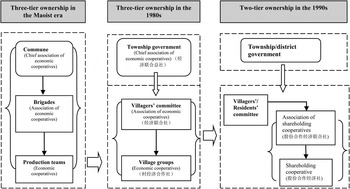
The “commune-brigade-team” system was officially defined as “three-tier ownership with production teams as the basic accounting units” (sanjisuoyou duiweijichu 三级所有 队为基础).Footnote 30 Under this structure, the ownership of arable land was collectively shared by three levels of authority, namely, the commune, the brigade and the production team (see Figure 1). The commune played a role akin to that of the local state. Brigades could be viewed as an extension of the commune and supervised the activities of production teams. This three-tier system combined ownership with governance authority, enabling the political power of the local state to intervene in rural villages not only as an administrator but also as a co-owner of the collective land. In the mid-1980s, the commune, brigades and production teams were gradually reorganized into township government, village committees and village groups, respectively. However, alongside this reorganization, the economic cooperatives (jingji hezuoshe 经济合作社) at various levels which were formed during the Maoist era continued to play a key role in holding and managing the collective assets. Consequently, as Peter Ho argues, the unspecified legal status of these rural collective economic organizations (nongcun jiti jingji zuzhi 农村集体经济组织) created institutional ambiguities which enabled governments at various levels to claim ownership over the collective land.Footnote 31 This also explains why the township government was allowed to hold in custody a large portion of the compensation fees for the collective land requisitioned during the 1980s.
Rescaling of Collective Ownership

What really transformed the multiple-tier power structure was the implementation of the “reserved commercial land” policy. Having introduced this policy to replace direct provision of employment and social welfare services to the affected villagers, the township government found no excuse to hold onto the lion's share of the land compensation fees. From the early 1990s onward, all land compensation fees and “reserved commercial land” were directly channelled back to the village collectives. This marked the fact that the township government gave up its role as a co-owner in the collective land system and left the ownership rights to the lower levels of village committees and village groups.Footnote 32 The result of the “reserved commercial land” policy, in a nutshell, was the retreat of the local state from the collective ownership system, leaving the authority of managing collective land and other assets to the grassroots organizations. Alongside its retreat from the collective ownership system, the local state reduced its presence in the day-to-day village governance.
Growth of Village Autonomy
Despite these changes, there was no sign that the collective regime in the villages would be dismantled. Instead, a more self-contained, collective village-based society was now in the making as a result of ownership restructuring. After the implementation of the “reserved commercial land” policy, village collectives began to hold on to more than 70 per cent of the land compensation fees and to manage all “reserved commercial land” after land requisitions. Under the collective land system, all compensation for land value belonged legally to the membership of the village group. Therefore, after paying qingmiao buchangfei to the affected farming households, the remaining portion of land compensation fees and all income derived from the “reserved commercial land” were placed under the management of the shareholding cooperatives. This arrangement was mandatory and undoubtedly a key factor sustaining the continuity of the collective system. However, such an institutional arrangement was unlikely to succeed if it could not effectively meet villagers’ principal needs. My interview findings suggest that most villagers were willing to accept the collective management of their land compensation fees chiefly for two reasons.
First, villagers considered that the total amount of compensation would be insufficient for them to sustain their future livelihoods.Footnote 33 The compensation fee in the late 1990s was increased to about 100,000 yuan per mu. This means that each villager could receive, at most, not more than 150,000 yuan in total, even if all compensation fees were directly distributed to them. Consequently, only a few villagers who had firmly established their income sources elsewhere or who had settled in urban areas wanted to withdraw all their cash compensation from the village collective. However, most villagers did not oppose the central pooling and management of their money and assets by the village collective, expecting that a higher rate of monetary return and the provision of better community facilities and services could be achieved. Second, the collective organization had constituted part of the established system and lifestyle of villagers for more than half a century.Footnote 34 In the Maoist period, they were dependent on their village collectives for coordinating agricultural production and all social welfare provision. In the 1980s, the state still offered very limited financial contributions for rural infrastructure and social services. Villagers thus relied on their collectives for most public goods and services, even though they no longer engaged in farming under the direct supervision of the production teams. Given this long dependent relationship with the village collectives, they did not feel an urgent need to make a change. The villagers’ willingness to accept the central management of land compensation fees led to a rapid expansion of their collective assets. For example, the village collective in one village which had lost all its arable land to urbanization by 2002 had accrued nearly 100 million yuan in compensation fees.Footnote 35
The growing collective income gave the village collectives the financial resources to provide more village facilities and social welfare services. In the 1980s, village collectives could only afford to construct basic village infrastructure such as village roads and water-supply systems. In the 1990s, with the increasing income derived from land compensation fees and the use of “reserved commercial land,” social welfare provision was extended to cover a much wider scope of services. Various social amenities and services, such as kindergartens, elementary schools, medical clinics, nursing homes for the elderly, and community recreational centres offering football fields, basketball courts, table tennis rooms and a mini library, were usually provided free of charge for village members. Moreover, village collectives organized security teams (zhibaodui 治保队) to maintain local order. Historically, villages received little assistance from the police forces and mutual trust was largely built on familial ties and personal relationships. After land requisitions, more and more migrants moved into the villages. As thefts and public disturbances steadily increased, villagers became fearful of the threat their new neighbours posed and organized security teams in response.Footnote 36 A village cadre suggested that the security team in his village had over 100 members who were mostly villagers.Footnote 37 The annual operational costs of the security team ran to about 1,500,000 yuan – all of these expenses were shouldered by the village collective.
In those fiscally independent villages which had developed their own social welfare system, the priority tasks of the village cadres had shifted from merely implementing state policies to serving the needs of villagers by using the collective income generated from land compensation fees and the “reserved commercial land.” In the past, it was the duty of cadres to implement state policies in a range of areas, including birth control, building control, social security, conscriptions and conflict mediation. As some village cadres suggested, nowadays, they were increasingly monitored and examined by their fellow villagers, who could vote them out in the next grassroots election if they did not act in the interests of villagers.Footnote 38 In the hope of securing villagers’ votes, village cadres had to demonstrate their contribution to the management of the collective assets, which motivated them to align with villagers and bargain with the state in land requisitions.
However, the underlying purpose of this self-organization structure was not to oppose land requisitions, as understood by the thesis of “village corporatism,” which is described as “a self-initiated strategy against local state-requisitions.”Footnote 39 Instead, the villagers under this study did not resist land requisitions because they realized that the more arable land that was requisitioned, the more commercial land they would get back in return. This is also evident from my interviews with those villagers who were still holding onto their arable land. Their shareholding cooperatives were empty shells which did not generate any income from either land compensation or “reserved commercial land.”Footnote 40 Moreover, very few outsiders came to lease houses from them as their villages were relatively far away from the industrial areas.Footnote 41 Denied these two sources of income, many villagers were forced to look for jobs outside the village. I asked why they had given up farming. One villager said:
Farming for your living was hard. We grew rice twice a year on our small plots. With an ox to help with ploughing and raking the earth, other farm work, including sowing, watering, pest control and harvesting, were all man-powered. Moreover, the orchards needed intensive care during the harvest season, requiring me to work intolerably long hours every day to get these tasks done. I did not want to [go back to] the old days when all my family members needed to get up at two o'clock in the morning to harvest lychees.Footnote 42
Another villager further explained:
Our hard work could not bring us fair rewards. Although the harvest was good, we had to sell our products in the markets at a very low price. The price of fertilizer substantially increased from 0.8 yuan to two yuan per catty between the late 1980s and the early 1990s. The income after deducting the cost of fertilizer was inadequate for us to make ends meet. Our problems got worse after China's entry into the WTO, given that local fruit lost its competitive advantage when the markets were increasingly dominated by foreign imports of fruit.Footnote 43
So it was that many villagers complained that the government's recent decision to slow down land requisitions was the main cause of their poverty and underdeveloped environment.Footnote 44
Villagers’ Resistance
While the villagers were amenable to the idea of land requisition, they had two major concerns: compensation and their development rights over the “reserved commercial land.” Land requisitions in many villages in the area were managed in several phases. For example, requisition in a village which lost more than 90 per cent of its arable land to urbanization was achieved in four phases: 400 mu was acquired for the construction of the Guangzhou–Shenzhen highway in the late 1980s; 4,000 mu for the construction of an economic and technological zone in the early 1990s; 700 mu for the East Erhuang highway in the mid-1990s; and 4,000 mu for the construction of other development zones. Throughout these requisition processes, villagers learned how to adapt their strategies for dealing with the government. In the 1980s, villagers voluntarily dedicated some arable land to the township government for the construction of highways; they expected to improve the local transportation conditions so that they could more efficiently deliver their fruit and vegetables to sell in nearby cities.Footnote 45 Without compensation, the village collective usually re-allocated any remaining land to affected villagers so that they could continue farming.Footnote 46 In the end, however, villagers no longer had any land left for cultivation and started demanding higher levels of compensation. Moreover, they became increasingly aware that the GDDAC was making enormous profits from leasing the requisitioned land for industrial development and thus could afford to pay them higher compensation.Footnote 47
Another significant conflict was related to the compensation offered for village housing that served not only as shelter but also as a major source of rental income. Before the mid-1990s, land requisitions mostly involved arable land and rarely touched the villagers’ houses. However, the juxtaposition of the well-developed industrial zones with traditional village settlements was quickly considered to be a “chaotic landscape” by the GDDAC.Footnote 48 In view of this, in the late 1990s the GDDAC decided to relocate some villages near the outskirts of the development zones. The requisition of villagers’ houses, however, triggered unexpectedly strong resistance. One important reason for resistance was that the ill-defined property titles of some village houses caused numerous disputes about compensation. In rural China, a zhaijidizheng 宅基地证 (homestead certificate) is the only legal document that can prove a villager's ownership rights (i.e. user rights) over his or her self-occupied houses. However, not all houses in the village had been notarized with a zhaijidizheng.
Before the mid-1990s, the township government did not strictly enforce building codes in villages. The village collectives were given room to allow house building in response to villagers’ demands for new housing and to earn income from “selling” housing lots to villagers. As some villagers mentioned, it was not too difficult to get a site on which to build a house as long as one was willing to pay.Footnote 49 As house building was not strictly regulated, the applications for title documents did not involve complex procedures. Nevertheless, it turned out that many houses built during this period did not have formal title documents. One important reason was that the absence of a housing market in rural China did little to encourage villagers to establish formal title ownership of their homes. In rural China, farmers’ housing was individually owned, but it was not allowed to be sold on the open market. Thus, the continued secure access of the villagers to their homes was seen as sufficient proof of their ownership. In other words, the traditional concept of “ownership” in rural China was largely based on use rights rather than the rights to sell or mortgage property. Legal certificates, which are primarily essential for market transactions, were therefore redundant to villagers. One villager, who submitted a tender for a housing site to the village committee in the 1990s, recalled that he paid about 60,000 yuan to the village collective as a “land premium.”Footnote 50 After the completion of his house, like many villagers, he did not apply for a formal zhaijidizheng certificate as the application involved an extra sum of money. The administrative fee for a zhaijidizheng was set at 70 yuan per square metre, which meant he would have had to pay 6,300 yuan for the title application. However, the administrative fee was only one consideration. Another important reason was that he simply did not feel that the missing title document was a problem: as he put it to me, all the people in the village agreed that he was the owner of the house and so naturally he was free to use his house for self-occupation or to lease it to migrant workers if he wished. Like many villagers who did not apply for the formal title deeds, he was upset when his ownership rights were questioned during the compensation assessment.
The compensation claims for some houses with more than 3.5 floors were another source of contention. Under the prevailing laws, the zhaijidizheng only permits a maximum building height of 3.5 storeys for each housing plot. However, during the late 1990s, the increasing income generated from leasing houses to migrant workers encouraged more and more villagers to rebuild their houses adding more floors, with some of the buildings reaching seven storeys high. The GDDAC defined these houses as “unauthorized” structures as the additional building works had been carried out without the prior approval of the government. Structures built after the announcement of village relocation plans were also subject to compensation claim disputes. After learning that their village would soon be relocated, many villagers mobilized all of their resources to add new storeys to their existing houses and to erect new houses in open spaces as fast as they could. According to some officials, the floor space of a village could nearly double within a month after announcing the programmes.Footnote 51 The GDDAC defined these houses as “unauthorized” or “illegal” structures and refused to pay out compensation for them.
Last but not least, the development of “reserved commercial land” became a major source of conflict between the local state and villagers. During the early 1990s, village collectives were required to pay a sum of money, a “charge for supporting services” (peitaofei 配套费), to the government to cover the costs of infrastructural facilities such as roads, water and power supply, and so on. However, many village collectives could not afford such a charge. For example, according to one village cadre, between 1994 and 1995, the compensation for each mu of land was about 80,000 yuan.Footnote 52 After paying qingmiao buchangfei to the affected villagers and reserving 20 per cent for social welfare provision, the shareholding cooperative only had 40,000 yuan left in the coffers, which was not enough for it to pay the peitaofei. Consequently, the village collective was forced to sell the “commercial land” back to the government at a price of about 67,000 yuan per mu. In the face of resistance from the villagers, the GDDAC dropped the peitaofei in the late 1990s. In the last decade, more conflicts have arisen between the government and the village collectives over planning control of the “land.” A key to understanding these conflicts is related to how the national land policy affects land management at the local level.
Concerned with environmental sustainability and food security, the State Council issued its “Notice on further regulation of land management and protection of arable land” in 1997 to make the preservation of arable land an important national strategy. Targets for arable land preservation were incorporated into the state's subsequent five-year development plans. According to the Five-Year Plan for 2006–2010, the total area of arable land of the country had to be maintained at a level of no less than 1.8 billon mu. To balance the need for development and preservation, this target was to be achieved through regulating the supply of development land and arable land. To this end, the central government set an annual quota for the conversion of arable land for construction (nongdi zhuanhuan zhibiao 农地转换指标) in each province – whenever arable land was used for construction purposes, an equal amount had to be provided somewhere else to ensure the overall arable land area of the province would not been reduced. To ensure effective local implementation of this policy, the Criminal Law was amended in 1998 to include specific provisions to enforce arable land protection. After this amendment, it became a criminal offence for local officials to grant approval for the conversion of arable land for development if the terms of the 1997 “Notice” were not met.
Owing to these control measures, it became increasingly difficult for the GDDAC to acquire the necessary planning permits for development from the provincial and municipal governments. In the past, when arable land was converted for industrial purposes in the GDD, an equal amount of arable land was created in other parts of the province under the administrative coordination of the provincial and the municipal governments. However, the GDDAC could no longer secure the quota as easily as before because provincial and municipal governments tended to cater more to the development needs of other less developed areas. This policy change not only slowed down local industrial development, it also affected the development of “reserved commercial land.” With the restricted land development quota, many construction projects had to be suspended. Local planners stated that construction projects would not resume until a new land quota was approved by higher level governments.Footnote 53 They further explained that the central government regularly took aerial photos to monitor closely any land-use changes in the area. Consequently, senior officials at the municipal and provincial levels were very unyielding about the enforcement of the land quota. Any contravention not only risked their career prospects but also made them liable for criminal prosecution. Under these circumstances, it was extremely difficult for the village collectives to obtain planning approval for the development of their “reserved commercial land.”
Responding to Villagers’ Resistance
Faced with demands for higher compensation, the GDDAC made some upward adjustments to its cash compensation. In the mid-1990s, with the construction of Science City underway, the GDDAC more than doubled the land compensation fee for arable land, from a unit rate of 40,000 yuan per mu adopted in 1988, to 80,000–100,000 yuan per mu.Footnote 54 In the 2000s, the land compensation rate was increased again, to 120,000–130,000 yuan per mu.Footnote 55 The GDDAC addressed the housing compensation conflicts by offering 60 per cent of the full compensation rate for those “unauthorized” housing structures built between January 1987 and December 2000. Moreover, it promoted a transparent mechanism for determining the compensation by making public the valuation reports of all housing acquired. However, it resolutely refused to pay any compensation for “unauthorized” constructions built after January 2001. Some local officials explained that housing built after January 2001 was considered illegal as the township government stopped granting housing sites and issuing zhaijidizheng in the late 1990s. To placate the villagers further, the GDDAC initiated a “home ownership scheme,” which not only offered the villagers compensation for their old village houses but also gave them the opportunity to buy dwellings at a subsidized price from the government. The average price of resettlement housing was set at 1,000 yuan per square metre, which was 40 per cent lower than the cost of construction.Footnote 56
Maintaining a socially and politically stable environment in order to retain and attract investment was one of the reasons the GDDAC compromised with the villagers in land disputes. More important reasons derived from the implementation of the “reserved commercial land” policy. As a pragmatic approach to pacifying the villagers, the “reserved commercial land” policy aimed to provide a self-help approach for villagers to sustain an improvement in their living standards after land requisitions. However, over the years, with the huge collective wealth generated from the development of the “reserved commercial land,” many urbanizing villages gradually evolved into fiscally independent communities. This put pressure on the GDDAC to be more responsive as village cadres aligned with the villagers in defending their economic interests. However, more importantly, the implementation of the “reserved commercial land” policy created some community development problems, which in turn pressured the district government to change its governance strategies in order to mitigate potential social unrest.
First, unemployment problems remained unsolved. After their land was taken away, it was difficult for villagers to find jobs in the non-farming sectors because they did not have the work experience and technical skills required by the local enterprises.Footnote 57 Even worse, many young villagers lacked the incentive to look for work elsewhere as they received financial support from their parents who obtained share dividends and rental income from leasing their properties to migrant workers.Footnote 58 Expanding populations of jobless villagers are seen as a potential source of social unrest, as some become addicted to gambling and drinking, presenting a great challenge to the village communities in peri-urban China.Footnote 59 Indeed, this was the experience of the villages under this study. Second, village-based medical services were wholly inadequate for the treatment of serious ailments. The income derived from land compensation fees and the “reserved commercial land” enabled villagers to establish their own community clinics. However, these village medical services could only provide the most basic of health care services. The lack of an affordable medical system was still a major cause of poverty as expensive hospitalization fees could swallow up the lifetime savings of a family, even though villagers had become rich “rentiers” after land requisitions. A third problem relates to the increasing number of conflicts that arose in the management and distribution of collective assets. Recent shareholding reforms in some villages in Beijing have empowered villagers to defend their economic interests.Footnote 60 However, established about two decades earlier, the shareholding reforms under this study resulted in not only the empowerment of villagers but also contention between village cadres and individual villagers over share allocation.
Although shareholding reforms were initiated by the Guangzhou municipal government in the 1990s, village collectives were still allowed a relatively high degree of freedom in the management of share allocation, given the fact that the township government largely reduced its presence in the villages after the implementation of the “reserved commercial land” policy. However, lacking formal rules to govern the management of collective assets, some village cadres received kickbacks from contractors involved in village construction projects, and leased properties on collective land out at extremely low rents through personal networks rather than public tender.Footnote 61 In one extreme case, village cadres gambled with the villagers’ compensation fees in Macau, compromising the financial well-being of the villagers.Footnote 62
Faced with these problems, since the early 2000s, the GDDAC and the township government have turned their attention back to the daily management of these urbanizing villages and have given increased financial and administrative support in the areas of infrastructure and social welfare provision. As part of this plan, the municipal government merged the GDDAC with the township government to form a new district government in 2005. To create job opportunities, the new district government introduced a “non-walled factory scheme,” which encouraged factories to contract out assignments to local households. Moreover, an “entrepreneurship scheme” was introduced to help villagers who wanted to start their own businesses. Under this scheme, a special fund of 20 million yuan was established in 2007 to provide subsidies for jobless villagers who had started their own business and had operated them for at least six months. Apart from these immediate measures, a vocational training centre was established in 2006 to provide training programmes and direct subsidies for job-seekers, especially those middle-aged villagers who encountered the most difficulties finding employment. Moreover, under the new cooperative medical system, the district government upgraded all village clinics and offered subsidies for villagers of one-third of their total insurance premiums.Footnote 63
Despite the increasing financial input from the state, villagers still relied heavily on the income generated from the “reserved commercial land” not only for dividends but also for public goods and services. In this context, any failure to meet villagers’ requests for land development might lead to a crisis in the village's self-contained social welfare system. This also explains why the district government sought to assist villagers in exploring development opportunities for their commercial land. The district government could not overcome the land quota hurdle, as the power to allocate land for development was vested with the higher level governments, so it tried to get around this problem by leasing or buying back the villagers’ land. In one village which had rented 1,100 mu of “reserved commercial land” to the district government, the village collectives received a total rental income of more than 3.3 million yuan each year. In another village, the village collective had sold all its “reserved commercial land” back to the government at a price of 380,000 yuan per mu. Without a land conversion quota, the district government could not use this land for development in the near future. As well as placating the villagers, leasing and buying back the land more importantly ensured that they could continue to access social welfare, the provision of which was increasingly dependent on the income derived from “reserved commercial land.”
Simultaneously, the district government encouraged the village collectives to build high-rise residential and commercial properties on their village sites. As the redevelopment of existing village sites did not involve the conversion of arable land, villagers did not need to wait for the land quota to be allocated by higher level governments. In 2009, the Ministry of Land and Resources initiated a development policy called sanjiu gaizao 三旧改造, which called for the redevelopment of three categories of old areas, namely, old towns, old industrial buildings and old villages. Under this policy, each house owner was guaranteed a domestic unit with an area of 240 to 280 square metres within the redevelopment building which would be built in-situ. Moreover, after paying a symbolic penalty fee of two yuan per square metre, villagers were allowed to claim monetary compensation for their “unauthorized” houses built between 1987 and 2000.Footnote 64 After the affected villagers were rehoused, the remaining floor areas provided by redevelopment would be sold or leased on the open market so that more collective income could be generated to improve community facilities and services. Given these incentives, some village collectives initiated the redevelopment of their village sites in collaboration with property developers.
In addition to these conciliatory measures, the district government actively engaged with shareholding reforms to give it more say in the management of collective assets. It introduced a new regulatory framework called “fixing shareholding rights,” which disallowed share re-allocation with the aim of removing the loopholes for possible cadre abuse in periodical share adjustments. Moreover, to improve transparency and accountability in the management of collective assets, it developed a new accounting system which gives it the power to audit the actual expenses and transactions of village collectives.
Conclusions
The empirical findings of this study suggest that land disputes in southern China are not simply an outcome of villagers’ resistance to land appropriation by an exploitative local state which has pursued economic efficiency as the single, ultimate goal of its policy to urbanize rural areas. Since the implementation of the “reserved commercial land” policy, local land politics have been complicated by two different types of conflict which have intertwined and transformed the landscape of daily governance. One is between the local state and the villagers. As the “reserved commercial land” policy gave villagers a share of the windfall of urbanization, the villagers under this study in general did not oppose land requisitions per se. Rather, they strived for three types of essential reimbursement, including greater cash compensation, equitable development rights over their commercial and housing land, and adequate access to state social welfare, both physical and social, of which they had long been deprived under the urban–rural dualist system. The second type of conflict arose because of internal clashes between village cadres and villagers. As a pragmatic compensation response, the “reserved commercial land” policy aimed at pacifying villagers and reducing the state's responsibility for social welfare provision. Over the years, the outcomes of this policy were not entirely what the policy makers had originally intended. The unexpected growth of the urbanizing villages’ territorial and financial autonomy provided the space for villagers to self-organize in the management of their ever-growing collective assets, which were mainly derived from land requisitions. However, it is worth noting that this self-organization movement led to increasing tension between village cadres and villagers in these fiscally independent villages, as the rapidly expanding collective wealth created incentives for local cadres to abuse the management of collective assets.
Faced with these two levels of conflicts, local officials increasingly recognized that they had to cajole and empower villagers in order to avoid widespread confrontations which would inevitably undermine the local investment environment. At the same time, the new district government, concerned that the mismanagement of collective assets by incompetent village cadres may paralyse a village-based welfare system that is reliant on the income generated from land compensation fees and “reserved commercial land,” has sought to regain its control and legitimacy in these villages It appears that the district government has not relied on the conventional coercive approach when attempting to re-establish its control over villages. Rather, it has engaged with a set of complex governance strategies through shareholding reforms and social welfare provision. These findings call for a refocused inquiry into how these intervention strategies will reshape the power dynamics between the state and villagers in the ongoing process of urbanization.
Appendix
An Overview of Informants