1. Introduction
The occurrence of ignimbrite and ash beds in the Proterozoic marine sedimentary succession of the Chhattisgarh Basin has been known for a long time (e.g. King, Reference King1885, p. 173, quoting Medlicott's unpublished 1866–67 report; Pascoe, Reference Pascoe1950, p. 375; Murti, Reference Murti and Radhakrishna1987, p. 248; Mishra & Babu Rao, Reference Mishra and Babu Rao1990; Das et al. Reference Das, Kundu, Das, Dutta, Kumaran, Ramamurthy, Thanavelu and Rajaiya1992, p. 279; Chakraborti, Reference Chakraborti1997; Das, Dutta & Das, Reference Das, Dutta and Das2001; Das et al. Reference Das, Dutta, Dutta, Thanavellu and Babu Rao2003). Patranabis-Deb (S. Patranabis-Deb, unpub. Ph.D. thesis, Jadavpur Univ. 2001) reported an approximately 300 m thick unit (Sukhda Tuff) of alternating mudrocks and ignimbrite consisting of welded and unwelded rhyolitic tuff, ash fall deposits, ash flow deposits and volcaniclastic sandstones in the Churtela Shale Formation near the top of the Chhattisgarh Supergroup, noting that a few tuff beds host phenocrysts of magmatic garnet. These garnets have been mentioned as ‘microphenocrysts’ in recent publications (Patranabis-Deb et al. Reference Patranabis-Deb, Bickford, Hill, Chaudhuri and Basu2007; Subba Rao et al. Reference Subba Rao, Mukherjee, Khan and Sridhar2006); we use the term ‘phenocryst’ in this report. SHRIMP ages of euhedral igneous zircon, many showing typical oscillatory zoning, from these ignimbrites range from 990 Ma to 1020 Ma (Patranabis-Deb et al. Reference Patranabis-Deb, Bickford, Hill, Chaudhuri and Basu2007).
Garnet in volcanic rocks is rare and to our knowledge, there are no other reports of almandine in Precambrian volcanic rocks (Harangi, Reference Harangi1999; Harangi et al. Reference Harangi, Downes, Kosa, Szabo, Thirlwall, Mason and Mattey2001). This is the first discovery (S. Patranabis-Deb, unpub. Ph.D. thesis, Jadavpur Univ. 2001). The purpose of this short note is to describe these garnets and infer their mode of origin in the context of their ignimbrite host.
2. Geological setting
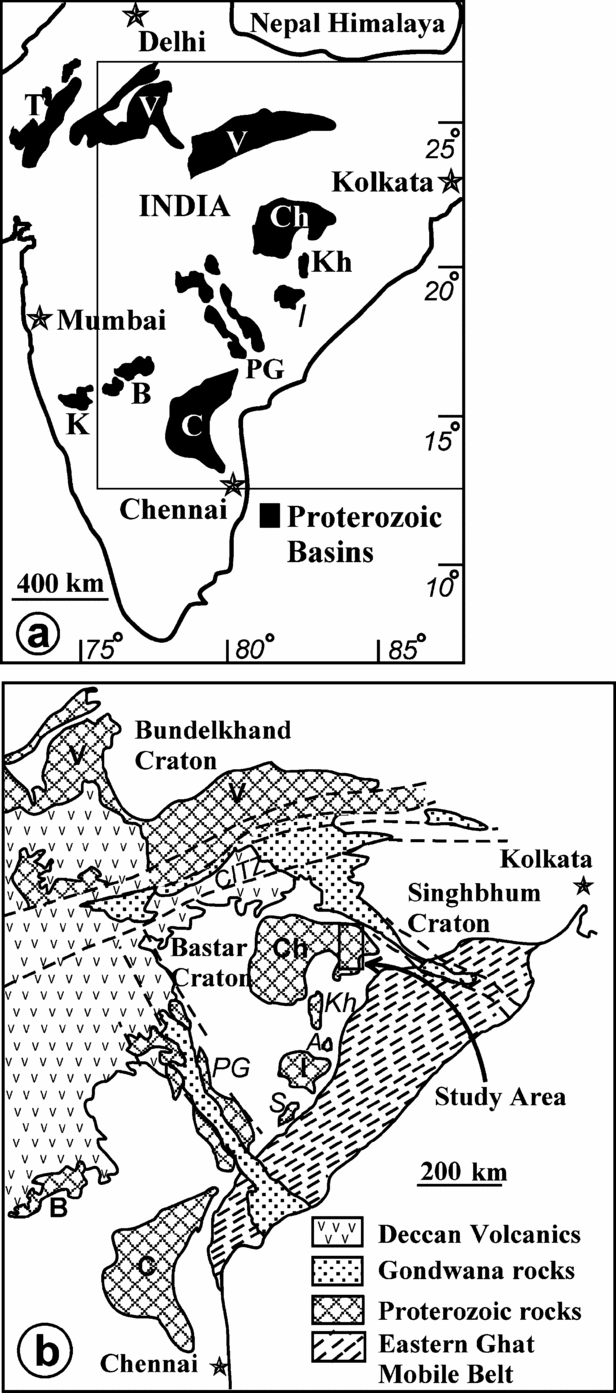
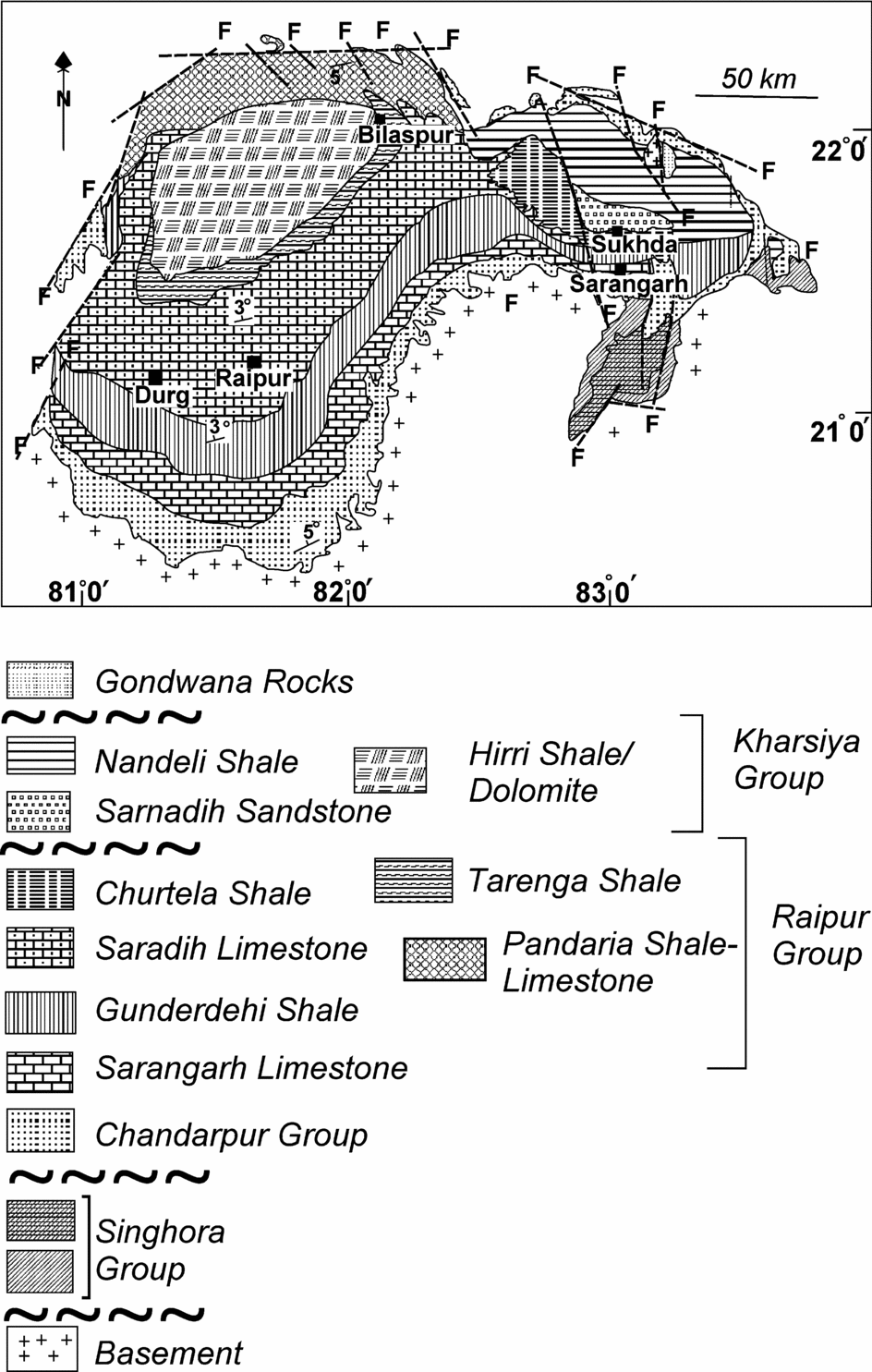
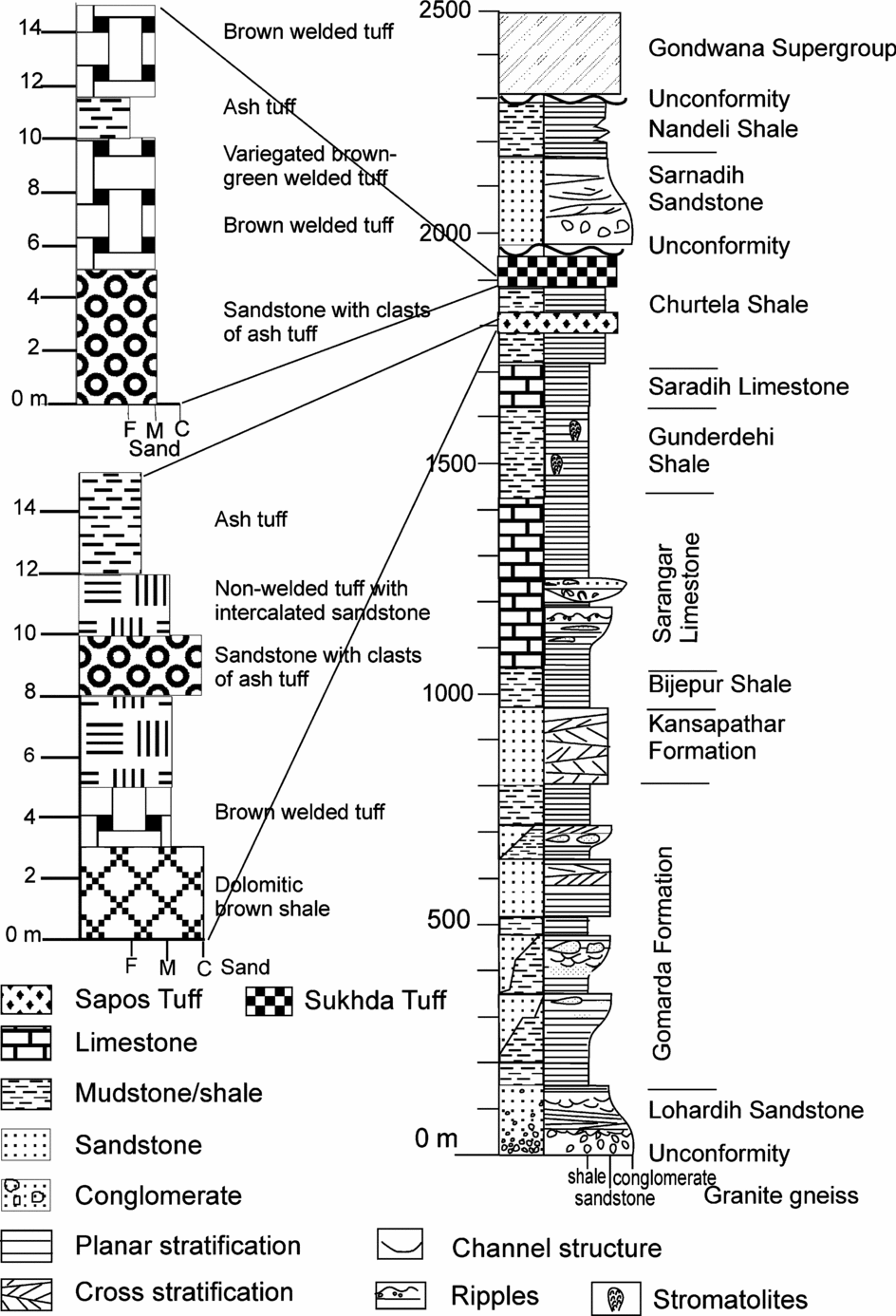
The Chhattisgarh Basin, in the State of Chhattisgarh, is one of the large marine Proterozoic basins in southern peninsular India, the sediments of which remain largely unmetamorphosed and undeformed. It is considered to be approximately coeval with the Vindhyan Basin to the north (Fig. 1). Extrapolated ages of these basins from a few reliable depositional ages obtained from U–Pb zircon dating and Pb–Pb limestone dating indicate that sedimentation took place from about 1750 Ma until no later than 950 Ma (Ray et al. Reference Ray, Martin, Veizer and Bowring2002; Ray, Veizer, & Davis, Reference Ray, Veizer and Davis2003; Rasmussen et al. Reference Rasmussen, Bengtson, Fletcher and McNaughton2002; Sarangi, Gopalan & Kumar, Reference Sarangi, Gopalan and Kumar2004; Malone et al. Reference Malone, Meert, Pandit, Tamrat and Pradhan2006; Patranabis-Deb et al. Reference Patranabis-Deb, Bickford, Hill, Chaudhuri and Basu2007; Basu, Reference Basu2007). A few palaeontologists, however, claim that at least the lower age limit extends into the lowermost Cambrian (e.g. Azmi et al. Reference Azmi, Joshi, Tiwari, Joshi, Mohan, Srivastava and Sinha2006; De, Reference De2006, Reference De2007). Geological mapping of the western part of the Chhattisgarh Basin is more complete than the eastern part, the latter being less easily accessible and having been sliced by a number of normal faults (Fig. 2). Thus, formation names between the two parts do not all match. The Geological Survey of India currently has no project in the basin. The Indian Statistical Institute is conducting both basic and facies mapping of the basin at a slow pace (e.g. Patranabis-Deb, Reference Patranabis-Deb2004; Patranabis-Deb & Chaudhuri, Reference Patranabis-Deb and Chaudhuri2007). The basin-fill is about 2300 m thick in the eastern part with an unconformity at about 2000 m above the base (Fig. 3). Volcanic units (ignimbrite, suspected rhyolitic ash flows, brownish and greenish volcaniclastic sandstones and shale) occur below this unconformity. The units are named by the locality. In this paper, we use ‘Sukhda Tuff’ as an umbrella term. The tuff units are bedded and show vertical jointing. Many have volcanic bombs, volcanic rock fragments, and clusters of large crystals. Some are aphyric, silicified and tough, reminiscent of ‘porcellanite’ beds of the Vindhyan (cf. Auden, Reference Auden1933).
(a) Location map of the Chhattisgarh (Ch) in India. T – Trans Aravalli, V – Vindhyan, Kh – Khariar, I – Indravati, C – Cuddapah, B – Bhima, K – Kaladgi, PG – Pranhita–Godavari Valley Basins; locations of the Central Indian Tectonic Zone (CITZ) and the Eastern Ghat Mobile Belt (EGMB) are also shown. (b) Major stratigraphic units in peninsular India. A – Ampani, S – Sukma. Modified from Patranabis-Deb et al. (Reference Patranabis-Deb, Bickford, Hill, Chaudhuri and Basu2007).

Simplified geological map of the Chhattisgarh Basin showing the outcrop location of Sukhda Tuff (solid rectangle). Dashed lines marked ‘F’ indicate normal faults. Modified from Patranabis-Deb (Reference Patranabis-Deb2004), Das et al. (Reference Das, Dutta, Dutta, Thanavellu and Babu Rao2003), Das, Dutta & Das (Reference Das, Dutta and Das2001) and S. Patranabis-Deb (unpub. Ph.D. thesis, Jadavpur Univ. 2001).

Stratigraphic section showing the position of tuff beds. Modified from Patranabis-Deb (Reference Patranabis-Deb2004), Das et al. (Reference Das, Dutta, Dutta, Thanavellu and Babu Rao2003), Patranabis-Deb & Chaudhuri (Reference Patranabis-Deb and Chaudhuri2002, Reference Patranabis-Deb and Chaudhuri2007) and S. Patranabis-Deb (unpub. Ph.D. thesis, Jadavpur Univ. 2001).

The specific outcrop from which most of the samples were collected is a small ‘digging’ (Lat. N21°53′; Long. E83°05′) by the side of the Dhabara-Kharsia road about 20 km WSW of Raigarh (the nearest Railway Station) and about 175 km NE of Raipur (state capital).
3. Samples and methods
Based on hand-specimen examinations and thin-section studies of many samples, we selected five samples from five different horizons of the Sukhda Tuff for petrographic investigations of garnets in polished thin-sections. Activation Laboratories performed chemical analysis of bulk ignimbrite samples using inductively coupled plasma mass spectrometry, results of which will be discussed elsewhere (Activation Laboratories in Ancaster, Ontario, is accredited by the Standards Council of Canada (SCC) and is an ISO/IEC 17025 with CAN-P-1579 registered laboratory). Optical microscopy (transmitted and reflected light), scanning electron microscopic imaging and microanalyses (FEI Quanta FEG 400), and electron probe microanalyses (CAMECA SX50 as SX100) of garnets were carried out at Indiana University (USA) using standard procedures.
4. Mode of occurrence
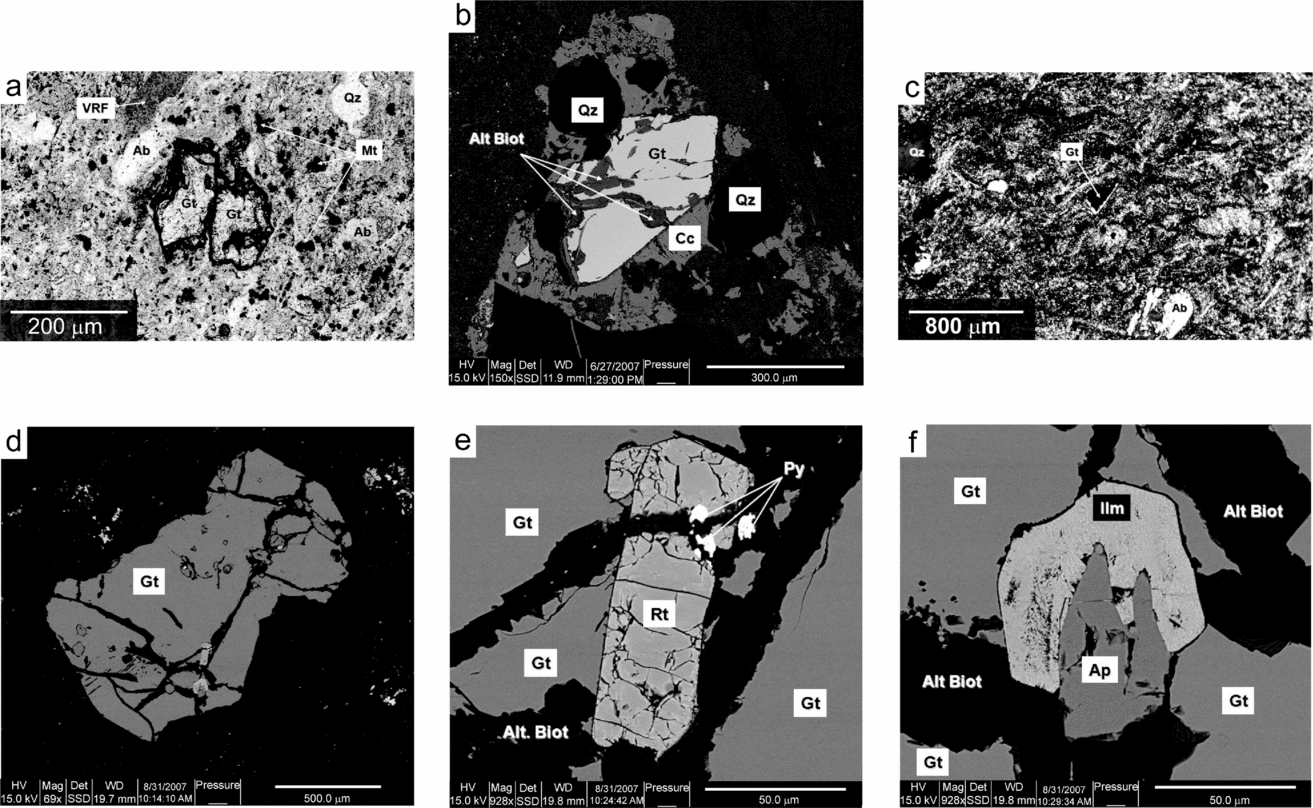
Ignimbrite beds of Sukhda Tuff in the Churtela Shale Formation hosting garnet are mostly welded to nonwelded tuff with variable degrees of eutaxitic texture, curved (devitrified) glass shards and flattened vesicles (Fig. 4a–c; see also fig. 3 in Patranabis-Deb et al. Reference Patranabis-Deb, Bickford, Hill, Chaudhuri and Basu2007). Volcanic rock fragments are abundant. Clusters of plagioclase (glomerocrysts?) are present in a few samples. Multi-mineral clasts are rare and consist of accessory phases. Quartz and albite are the principal phenocrysts; others include titanomagnetite–ilmenite, monazite, apatite, rutile/anatase, sphene, zircon and garnet. More than 90% (by number) of these crystals are fractured or broken and occur as angular to subangular grains in the tuff. Unbroken grains are commonly subhedral. Most quartz phenocrysts are embayed, the shape of a few of which is suggestive of β-quartz morphology (hexagonal symmetry but no obvious twinning). The groundmass consists of very fine-grained albite, quartz, magnetite and glass. Calcite, quartz and zeolite are common secondary minerals.
(a) Fractured anhedral garnet (Gt) in tuff; other phenocrysts are quartz (Qz), albite (Ab) and magnetite (Mt); one volcanic rock fragment (VRF) aligns with flow/compaction texture. The image is in plane polarized light and the scale bar is 200 μm. (b) BSE image of garnet (Gt)–quartz (Qz) association in volcanic ash (upper right and left). Note the nearly euhedral elongated shape of the garnet, extensive alteration to and precipitation of calcite (Cc) and fracture-filling by biotite (Alt Biot). Biotite is now altered to being colourless and non-pleochroic under optical microscope. Scale bar is 300 μm. (c) Fragmented garnet, quartz and albite phenocrysts in a groundmass of volcanic ash of the Sukhda Tuff; cross-polarized light optical image; scale bar is 800 μm. (d) BSE image of a large broken and fractured garnet with interlocking ilmenite, apatite and rutile; scale bar is 500 μm. See enlargements in Figure 1e and f. (e) Garnet (Gt) partially encloses rutile (Rt). The biotite in the fracture filling vein is altered (Alt Biot). Grains of secondary pyrite (Py) are associated with biotite. This is a BSE image with a scale bar of 50 μm. (f) BSE image of subhedral ilmenite and apatite in subophitic interpenetrative relationship within garnet; scale bar is 50 μm.

Garnet grains range in size from about 20 μm to about 2 mm; larger grains are elongated in shape (Fig. 4b), a few resembling the dodecahedral face in an octahedron–dodecahedron combination (see fig. 117, p. 72 in Dana, Reference Dana1955). Garnet occurs (1) as isolated subhedral single crystals and as angular broken grains (Fig. 4c), and (2) in rock fragments in association with quartz, albite, hydro-biotite (altered biotite), zircon, monazite, titanomagnetite–ilmenite, rutile–sphene and apatite (Fig. 4d–f). All garnet grains are optically clear and isotropic. In rare cases, rutile, ilmenite, zircon and monazite are fully or partially included in larger garnet grains (Fig. 4d, e). Systematically distributed inclusions of quartz and albite or any other typically metamorphic mineral, a feature common in many metamorphic garnets, are absent. A few broken grains retain parts of original crystal faces. Edges of many grains appear to have reacted with the magma. Fractures are commonly filled in with secondary carbonate (calcite), quartz, biotite (the biotite is now altered and leached to being colourless and non-pleochroic but with significant Fe and Mg peaks in energy dispersive spectra) and pyrite. Resorption at the edges of the garnets is also common and the resulting space is filled with secondary calcite that may have replaced the ash (Fig. 4b, c).
5. Chemical composition
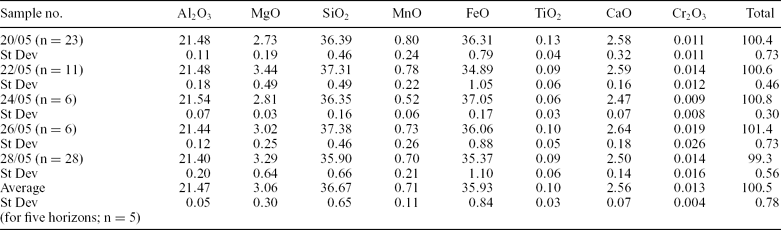
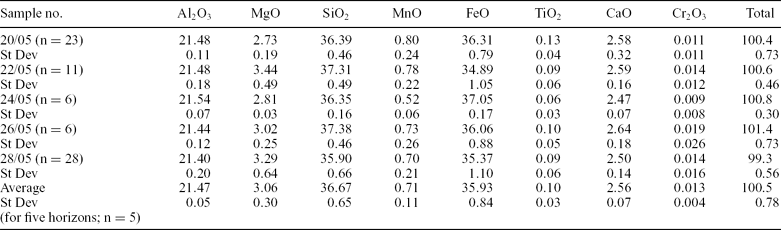
Light contrast back-scattered electron (BSE) images of all garnets in all five polished thin-sections show no evidence of compositional zoning. Electron probe microanalyses (EPMA) of spots along traverses across about 30 garnet grains confirm the absence of major-element zoning. Scanned cathodoluminescence (CL) colour of isolated quartz phenocrysts, including those in contact with garnet, is blue and consistent with the CL colour of control samples with known volcanic provenance (Zinkernagel, Reference Zinkernagel1978; Seyedolali et al. Reference Seyedolali, Krinsley, Boggs, O'Hara, Dypvik and Goles1997; see also Bernet & Bassett, Reference Bernet and Bassett2005; Bernet, Kapoutsos & Bassett, Reference Bernet, Kapoutsos and Bassett2007). Average composition of the garnets shows that they are primarily almandine (Al78.7Py12.3Gr7.4Sp1.6). Standard deviations of concentrations of major oxides (average: FeO = 35.9% ± 0.8%; MgO = 3.1% ± 0.3%; CaO = 2.6% ± 0.7%; MnO = 0.71% ± 0.11%) show that that the variability of compositions within samples and between samples is extremely low (Table 1; Appendix 1 (Table A1) available online as supplementary material at http://multimediafluids.uam.elogim.com/journals/geo).
Average chemical composition of garnet grains (electron probe microanalysis; five samples represent five tuff horizons)
6. Discussion
6.a. Garnet in volcanic rocks
Garnets rich in the almandine molecule are typically metamorphic in origin, commonly stable at high pressures compatible with depths >20 km in the Earth. They also occur in lower crustal plutonic igneous rocks (MacKenzie & Guilford, Reference MacKenzie and Guilford1980; Nesse, Reference Nesse2004; Blatt, Tracy & Owens, Reference Blatt, Tracy and Owens2006). Garnets are not common in hypabyssal or volcanic igneous rocks. If found in such rocks, they commonly occur as xenocrysts or as transported restite phases from the source region of a magma (e.g. White & Chappell, Reference White and Chappell1977; Green, Reference Green1977; Allen & Clarke, Reference Allen and Clarke1981; Deer, Howie & Zussman, Reference Deer, Howie and Zussman1982). Nonetheless, magmatic garnets have been reported from Phanerozoic calc-alkaline volcanic rocks of andesitic–dacitic–rhyolitic composition from various localities (e.g. Fitton, Reference Fitton1972; Bacon & Duffield, Reference Bacon and Duffield1981; Barley, Reference Barley1987; Gilbert & Rogers, Reference Gilbert and Rogers1989; Beddoe-Stephens & Mason, Reference Beddoe-Stephens and Mason1991; Gilbert, Reference Gilbert1991; Branney, Kokelaar & McConnell, Reference Branney, Kokelaar and McConnell1992; Gilbert, Bickle & Chapman, Reference Gilbert, Bickle and Chapman1994; Harangi, Reference Harangi1999; Shinjoe et al. Reference Shinjoe, Orihashi, Sumii and Nakai2002). Because increased MnO content allows a garnet to be stable at lower pressures, volcanic garnets tend to contain much more than 10 mol.% spessartine (approximately >4% MnO; Green, Reference Green1976, Reference Green1977; Day, Green & Smith, Reference Day, Green and Smith1992). Garnet may also be found in vesicles of igneous rocks, owing its origin to hydrothermal and fumarolic activities (Pabst, Reference Pabst1938; Burt et al. Reference Burt, Sheridan, Bikun and Christiansen1982; Purcell & Robertson, Reference Purcell and Robertson1984; Hollabaugh, Robertson & Purcell, Reference Hollabaugh, Robertson and Purcell1989; White, Reference White1992; Filimonova, Reference Filimonova2004).
6.b. Garnet (Al78.7Py12.3Gr7.4Sp1.6) in the Sukhda Tuff
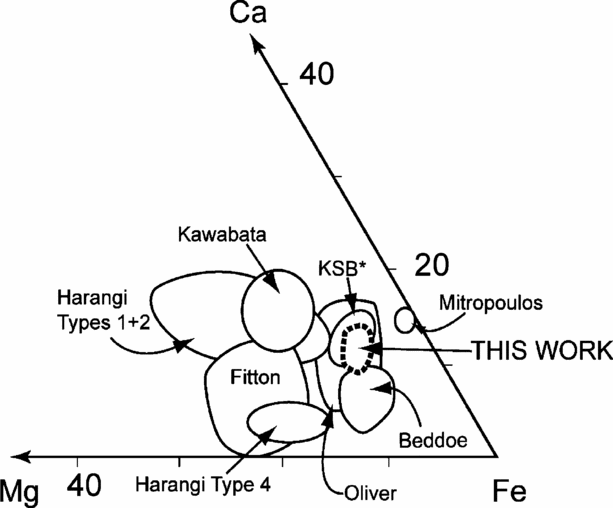
Garnets in the Sukhda Tuff have a very limited range of chemical composition (Table 1; Fig. 5), regardless of size and mode of occurrence, suggestive of a single source and a single mode of origin. Because they occur in ignimbrites, these garnets are expected to be fractured and would not exhibit the textural relationships with other phases as is commonly observed in crystalline metamorphic or igneous rocks including lava flows. We discuss possible origins of the Sukhda garnets in this context.
Compositional domains of garnet phenocrysts in volcanic rocks from various parts of the world identified with the first-author names only (Beddoe-Stephens & Mason, Reference Beddoe-Stephens and Mason1991; Fitton, Reference Fitton1972; Harangi et al. Reference Harangi, Downes, Kosa, Szabo, Thirlwall, Mason and Mattey2001; Kawabata & Takafuji, Reference Kawabata and Takafuji2005; KSB: Kimata et al. Reference Kimata, Nishida, Shimizu, Saito and Togawa1995, Sisson & Bacon, Reference Sisson and Bacon1992 and Bacon & Duffield, Reference Bacon and Duffield1981; garnet reported by Mitropoulos, Katerinopoulos & Kokkinakis, Reference Mitropoulos, Katerinopoulos and Kokkinakis1999 is rich in spessartine). The fields in Ca–Mg–Fe space, calculated from cation ratios, are bounded at 1σ distances from the mean except for Harangi's data (see text).

Somewhat rare vesicles varying in size from a few microns to about a millimetre in the Sukhda Tuff are commonly filled by zeolite and calcite, and are devoid of garnet. Therefore, a hydrothermal origin is not an option to consider.
Metamorphic garnets (e.g. MacKenzie & Guilford, Reference MacKenzie and Guilford1980; Day, Green & Smith, Reference Day, Green and Smith1992; Nesse, Reference Nesse2004; Blatt, Tracy & Owens, Reference Blatt, Tracy and Owens2006; Williams, Turner & Gilbert, Reference Williams, Turner and Gilbert1982) are commonly (but not universally) zoned and contain many inclusions. The garnets in the Sukhda Tuff do not show any of these features. Furthermore, we did not observe xenocrysts of any other metamorphic mineral in the tuff during examination with the optical microscope and SEM. We do see, however, rounded zircon grains (<100 μm) in heavy mineral separates from an associated volcaniclastic sandstone. These zircons record Archaean crystallization events at 2539 and 2680 Ma (our unpublished SHRIMP data) and suggest the possibility for older metamorphic or granitic material to be present in the Sukhda Tuff. A potential source of garnet xenocrysts in the region could be Palaeoproterozoic granulite facies rocks or their reworked products in earlier (pre-Sukhda) Mesoproterozoic tectonites. However, the mineral assemblages described from such rocks (Bhowmik et al. Reference Bhowmik, Sarbadhikari, Spiering and Raith2005) are not seen in the Sukhda Tuff. Metapelite enclaves in the basement granite contain spessartine-rich garnets (Al10–19Py0Gr14–20Sp61–76) that are compositionally far removed from the almandine in the Sukhda Tuff (Subba Rao et al. Reference Subba Rao, Sreenivas, Charan and Sridhar2007). Garnet xenocrysts that commonly occur in mantle-derived xenoliths are usually pyrope and, if associated with diamondiferous kimberlite, contain sufficient Cr to be distinctive (e.g. Richardson et al. Reference Richardson, Gurney, Erlank and Harris1984, Reference Richardson, Erlank, Harris and Hart1990; Barley, Reference Barley1987; Gauthier et al. Reference Gauthier, Deruelle, Viramonte and Aparicio1994; Schulze et al. Reference Schulze, Valley, Spicuzza and Channer2003; Scully, Canil & Schulze, Reference Scully, Canil and Schulze2004; Hood & McCandless, Reference Hood and McCandless2004; Malkovets et al. Reference Malkovets, Griffin, O'Reilly and Wood2007). Kimberlite clan rocks occur in the region (e.g. Mainkar, Lehmann & Haggerty, Reference Mainkar, Lehmann and Haggerty2004; Fareeduddin, Pant & Neogi, Reference Fareeduddin, Pant and Neogi2006; Kumar, Heaman & Manikyamba, Reference Kumar, Heaman and Manikyamba2007). The type of garnets in the Sukhda Tuff (almandine) and the absence of significant Cr make it highly unlikely that these kimberlites were the source of the Sukhda garnets. Volcanic rocks with metamorphic xenocrysts of garnet typically also contain xenoliths of the metamorphic source (e.g. Day, Green & Smith, Reference Day, Green and Smith1992; Barley, Reference Barley1987). The complete absence of metamorphic xenoliths in the Sukhda Tuff makes it unlikely that the garnets are xenocrysts from metamorphic sources.
Various degrees of partial melting may have produced the parent magma of the Sukhda Tuff, and this magma may have carried restite garnets to the surface. A literature survey indicates that restite garnets may have distinctive characters in each case. For example, Brousse, Bizouard & Salat (Reference Brousse, Bizouard and Salat1972) describe normally-zoned high-pressure Ca-rich almandine, Birch & Gleadow (Reference Birch and Gleadow1974) describe inclusion-rich restite garnet, and Saleh & Makroum (Reference Saleh and Makroum2003) mention garnet as an accessory phase along with zircon, apatite and monazite in aluminous granite, the principal minerals in which are quartz, albite, K-feldspar and mica. The latter association is somewhat compatible with what we find in the Sukhda Tuff, except for the absence of K-feldspar and other restite phases in the Sukhda Tuff. Although the characteristics of the garnets in the Sukhda Tuff do not match restite garnets reported in the literature, we cannot fully rule out a restite origin for Sukhda garnets, because textural attributes of high-pressure phenocrysts are not different from those of restites. Yet, because there are no known garnet-bearing igneous granitic rocks in the region, it is unlikely that the garnets in the Sukhda Tuff are of restite origin.
In the Sukhda Tuff, most of the garnet grains are broken (Fig. 4a). However, one type of garnet grain has ‘subophitic’ ilmenite–apatite penetrative intergrowth that is typically found in igneous rocks (Fig. 4b). The elongated shape of this garnet type (Fig. 4b, d) is also unusual for metamorphic or eclogitic garnets, at least as illustrated in publications on metamorphic petrology. Biotite (now altered) and quartz that have precipitated in fractures within garnet grains (Fig. 4e, f) do not extend into the enclosing ash. The biotite is texturally not in a metamorphic reaction relationship with the garnet. The composition of these garnets (Al78.7Py12.3Gr7.4Sp1.6) indicates crystallization at high pressure (e.g. Green, Reference Green1977). However, given the extent of alteration of the host rocks, absence of any lava flow, and paucity of outcrops, one cannot yet determine a reasonably definitive composition of the parent melt. We infer that garnet phenocrysts in association with ilmenite, apatite, rutile, zircon and monazite crystallized possibly at lower crustal depths and ascended rapidly before pyroclastic eruption.
6.c. Larger context
The primary purpose of this paper is to report on discovering almandine in Proterozoic tuffs. However, it is important to consider the larger context, that is, in relation to other reported occurrences, and if possible, to infer the conditions under which these garnets had originated.
Although very rare in volcanic, hypabyssal or pyroclastic rocks, garnet phenocrysts have been described from basalts (Aydar & Gourgaud, Reference Aydar and Gourgaud2002), andesites (Fitton, Reference Fitton1972; Gill, Reference Gill1981; Barnes & Allen, Reference Barnes, Allen, Snoke and Barnes2006), dacites (Fitton, Reference Fitton1972; Gilbert & Rogers, Reference Gilbert and Rogers1989), rhyolites (Bacon & Duffield, Reference Bacon and Duffield1981; Clemens & Wall, Reference Clemens and Wall1984; Smith & Cole, Reference Smith and Cole1996; Friedman et al. Reference Friedman, Diakow, Lane and Mortensen2001; Mitropoulos, Katerinopoulos & Kokkinakis, Reference Mitropoulos, Katerinopoulos and Kokkinakis1999) and trachyte–phonolites (Dingwell & Brearley, Reference Dingwell and Brearley1985). They range in composition from the high-pressure almandine–pyrope variety (Barnes & Allen, Reference Barnes, Allen, Snoke and Barnes2006; Beddoe-Stephens & Mason, Reference Beddoe-Stephens and Mason1991; Kimata et al. Reference Kimata, Nishida, Shimizu, Saito and Togawa1995) to a low-pressure (~3 kbar) spessartine-rich variety (Frondel, Reference Frondel1970; Gauthier et al. Reference Gauthier, Deruelle, Viramonte and Aparicio1994). Some are zoned (Dingwell & Brearley, Reference Dingwell and Brearley1985; Beddoe-Stephens & Mason, Reference Beddoe-Stephens and Mason1991; Gilbert, Bickle & Chapman, Reference Gilbert, Bickle and Chapman1994; Kimata et al. Reference Kimata, Nishida, Shimizu, Saito and Togawa1995; Kawabata & Takafuji, Reference Kawabata and Takafuji2005) and some are unzoned and uniform in composition (Reymer, Reference Reymer1983; Aydar & Gourgaud, Reference Aydar and Gourgaud2002). Some have inclusions (Bacon & Duffield, Reference Bacon and Duffield1981; Birch & Gleadow, Reference Birch and Gleadow1974) and some are inclusion-free (Birch & Gleadow, Reference Birch and Gleadow1974). They may be nearly euhedral (Gauthier et al. Reference Gauthier, Deruelle, Viramonte and Aparicio1994; Beddoe-Stephens & Mason, Reference Beddoe-Stephens and Mason1991; Aydar & Gourgaud, Reference Aydar and Gourgaud2002), subhedral (Green & Ringwood, Reference Green and Ringwood1968), or anhedral due to fragmentation in ignimbrites (Wood, Reference Wood1974; Aydar & Gourgaud, Reference Aydar and Gourgaud2002). Euhedral phenocrysts of garnet, as illustrated in photomicrographs of thin-sections in the literature, are equant (Oliver, Reference Oliver1956; Fitton, Reference Fitton1972; Birch & Gleadow, Reference Birch and Gleadow1974; Beddoe-Stephens & Mason, Reference Beddoe-Stephens and Mason1991; Kimata et al. Reference Kimata, Nishida, Shimizu, Saito and Togawa1995; Pearce, Reference Pearce2001; Harangi et al. Reference Harangi, Downes, Kosa, Szabo, Thirlwall, Mason and Mattey2001). They all appear to be cross-sections of equidimensional dodecahedra. Euhedral phenocrysts in the Sukhda Tuff, however, are elongate (Fig. 4b, d) and differ from the rest. We conclude that, in general, there is no single set of criteria that can be applied to ‘classify’ garnets in volcanic rocks as phenocrysts. Instead, each occurrence has to be evaluated on its own merits, including the possibility of detecting submicroscopic melt inclusions (Kawabata & Takafuji, Reference Kawabata and Takafuji2005).
Garnet phenocrysts may exhibit distinct chemical groupings. For example, garnets in basalt and andesite may be richer in Mg than those in rhyolite, which probably is more due to higher pressure during crystallization than the bulk composition of the melt (Gill, Reference Gill1981; Aydar & Gourgaud, Reference Aydar and Gourgaud2002). Harangi et al. (Reference Harangi, Downes, Kosa, Szabo, Thirlwall, Mason and Mattey2001) describe different types of garnet phenocrysts in Neogene calc-alkaline andesites, dacites and rhyodacites, which have different major, minor and trace element (including REE) distributions and variable δ18O values. In Figure 5, we plot the cationic proportions of Ca–Mg–Fe (corresponding to calculated proportions of grossular–pyrope–almandine, neglecting the spessartine molecule) of garnet phenocrysts, obtained from the literature and of this study. The fields mark approximately 1σ distances from the mean, except for those of Harangi et al. (Reference Harangi, Downes, Kosa, Szabo, Thirlwall, Mason and Mattey2001, fig. 3), which we keep intact. (Mitropoulos, Katerinopoulos & Kokkinakis (Reference Mitropoulos, Katerinopoulos and Kokkinakis1999) report three analyses on one spessartine-rich grain. The field marked KSB indicates reports of one analysis each by Kimata et al. (Reference Kimata, Nishida, Shimizu, Saito and Togawa1995), Sisson & Bacon (Reference Sisson and Bacon1992) and Bacon & Duffield (Reference Bacon and Duffield1981). These two fields understandably show very small deviations from the mean.) Compared to other literature values, compositions of Sukhda garnets show very little variation (the field marked with broken lines in Fig. 5; Table 1). We infer that garnets in the Sukhda Tuff crystallized from the same magma pool that erupted in pulses to lay down synsedimentary tuff horizons. The scenario is very different from that of ‘long-lasting magmatism in which magma compositions changed continuously’, generating garnets of different compositions (cf. Harangi et al. Reference Harangi, Downes, Thirlwall and Gmeling2007).
Figure 5 also shows how the fields of garnet compositions from different eruptions of different times overlap. This is not surprising. Garnet composition would depend on the bulk composition of the parent melt, pressure and temperature of crystallization, and the activity of H2O during crystallization. Parent rocks of the garnets plotted in Figure 5 range from basalt to rhyolite that have crystallized under different P–T conditions and with different activities of H2O. We infer that garnet phenocrysts crystallize in different compositional windows defined by the combination of parameters mentioned above.
Petrogenesis of Sukhda garnets and their parent tuff is far less constrained. Judging solely from chemical composition (MnO = 0.71% and CaO = 2.6%) one might be tempted to put P–T conditions at about 8 kbar and 900°C with large uncertainties (cf. Green & Ringwood, Reference Green and Ringwood1968; Green, Reference Green1976, Reference Green1977; Day, Green & Smith, Reference Day, Green and Smith1992). However, given the state of alteration of the tuffs, we cannot estimate the original composition of the magma that hosted the garnet phenocrysts. Biotite in contact with garnet phenocrysts is also altered, rendering gethermometric estimation unreliable. Hence, at this time we must refrain from hazarding guesses to infer specific conditions of origin of these garnets except that these phenocrysts formed under high pressure and possibly at lower crustal depths. Almandine phenocrysts of similar composition are reported in other studies on much younger volcanic rocks. Because these rocks have escaped extensive alteration, their bulk compositions can be determined accurately, which invokes origin in the lower crust.
7. Summary and conclusions
Chemically unzoned and nearly inclusion-free almandine garnet occurs in the Sukhda Tuff, mostly as fragments. A few subhedral and nearly euhedral large (up to ~2 mm long) crystals in magmatic textural relationship with apatite, rutile and ilmenite are also found in rock fragments. The whole-rock chemistry of the tuff is not instructive because of extensive alteration/devitrification of some of the minerals and glass shards to clay, silica, zeolite, plagioclase and calcite. The tuff does not contain any metamorphic xenocryst or restite phase. Evidence in the form of (a) texture: (1) subophitic relationship of nearly euhedral garnet with other nearly euhedral to subhedral minerals such as apatite, rutile and ilmenite, (2) association with euhedral magmatic zircon, (3) eutaxitic texture of the host rock; (b) blue-luminescing co-existing quartz; and (c) absence of (1) metamorphic xenoliths and xenocrysts, and (2) any garnet-bearing granite in the region, suggests that these garnets are phenocrysts rather than xenocrysts or restites. The garnets have very low MnO (~0.7%) and some CaO (~2.6%) and likely crystallized under high pressure compatible with lower crustal depths.
Acknowledgements
We are extremely grateful to Dr A. K. Chaudhuri, who introduced the first author (SPD) to the field, and guided her for many years and throughout the course of this research. The field work was a part of a research programme of the Indian Statistical Institute (ISI) on Proterozoic sedimentary successions in peninsular India. A BOYSCAST Fellowship of the Government of India enabled SPD to conduct research in the USA. An NSF equipment grant to Juergen Schieber (EAR-0318769) provided funds for the purchase of the analytical SEM that was used for acquiring the images used in this report. Chusi Li helped enormously with electron probe microanalysis as did Ruth Droppo with illustrations. We are very grateful for the generous support from Indiana University without which this research could not have been carried out. Jane Holland, Jennie Gilbert, Szabolcs Harangi and David Pyle kindly provided editorial and science feedback to vastly improve an earlier draft, and we thank them. Online supplementary appendix may be found at http://multimediafluids.uam.elogim.com/journals/geo.