Introduction
Palliative care (PC) aims to improve patients’ quality of life and comfort through an approach that relieves physical, psychosocial, and spiritual suffering — total suffering — using a holistic approach assessing all domains of end-of-life experience. The concept of total suffering has been investigated, demonstrating an intricate web of symptoms and interdependent and intimate correlations between physical and psychological distress during advanced illness (Julião et al., Reference Julião, Antunes and Nunes2020). Although patients with serious illnesses have multiple needs at the end of their lives, they typically do not receive whole-person care of sufficient quality to meet their complex and multi-dimensional needs (Adler et al., Reference Adler, Goldfinger and Kalman2000; Gore et al., Reference Gore, Brophy and Greenstone2000; Wenger et al., Reference Wenger, Solomon and Roth2003; van der Eijk et al., Reference van der Eijk, Faber and Al Shamma2011; Foley et al., Reference Foley, Timonen and Hardiman2012a, Reference Foley, Timonen and Hardiman2012b; Csikai and Weisenfluh, Reference Csikai and Weisenfluh2013).
It is known that the majority of patients admitted to PC suffer from cancer (Bostwick et al., Reference Bostwick, Wolf and Samsa2017; Capelas et al., Reference Capelas, Coelho and Murinello2019) with up to one-third of cancer patients suffering from psychological distress and psychosocial comorbidity increasing to more than 50% in advanced stages of cancer with poor prognosis (Hotopf et al., Reference Hotopf, Chidgey and Addington-Hall2002).
Psychological assessments are not routinely performed in general medical settings. The scenario in cancer is not dissimilar (Maguire, Reference Maguire1985; Breitbart, Reference Breitbart1995), with these problems being under-diagnosed and under-treated (Meakin, Reference Meakin1992; Kristeller et al., Reference Kristeller, Zumbrun and Schilling1999; Murillo and Holland, Reference Murillo and Holland2004).
For various reasons, end-of-life care faces many challenges in the assessment, documentation, and treatment of psychosocial and spiritual distress, including the overlap between disease progression and depressive symptoms; and patient, family, and healthcare professional (HCP) specific barriers (Greenberg, Reference Greenberg2004; Bernacki and Block, Reference Bernacki and Block2014; Rankin et al., Reference Rankin, Butow and Thein2015; Granek et al., Reference Granek, Nakash and Ariad2019). Physicians often do not address patients’ and families’ psychosocial concerns, focusing on more biomedical aspects of the dying, such as diagnoses, treatments, and physical procedures. However, patients regularly bring up concerns related to death with their physicians to which the physicians do not respond (Ahluwalia et al., Reference Ahluwalia, Levin and Lorenz2012). While psychosocial issues, including spiritual well-being, features of hope, the opportunity to say goodbye, and a broad range of end-of-life concerns, are undoubtedly significant to patients and their loved ones, these are often inadequately understood and poorly integrated into the patient's overall treatment plan (Steinhauser et al., Reference Steinhauser, Christakis and Clipp2000).
There is evidence to support that terminally ill psychological interventions (Chochinov et al., Reference Chochinov, Wilson and Enns1997; Julião et al., Reference Julião, Barbosa and Oliveira2013, Reference Julião, Oliveira and Nunes2014, Reference Julião, Oliveira and Nunes2017; Breitbart et al., Reference Breitbart, Pessin and Rosenfeld2018; Saracino et al., Reference Saracino, Rosenfeld and Breitbart2019) and medications are as safe and efficient as in the general medical setting (Holland and Alici, Reference Holland and Alici2010; Nakash et al., Reference Nakash, Levav and Aguilar-Gaxiola2014). Therefore, clinical efforts should be undertaken in assessing and documenting psychological and spiritual distress, and interventions offered that address in all areas of end-of-life suffering, including depression, anxiety, desire for death, spiritual, and dignity-related distress; feeling a burden, loss of hope, and physical symptoms (Girgis et al., Reference Girgis, Johnson and Currow2006; Kelly et al., Reference Kelly, McClement and Chochinov2006).
Medical consultations are crucial interactions, based on attentive listening and sharing, focusing on physical well-being and multiple aspects of patient personhood (Chochinov et al., Reference Chochinov, McClement and Hack2015), including social, mental, and spiritual vulnerability (Mørck et al., Reference Mørck, Langhoff and Christophersen2018).
Documentation of clinical encounters are key components of good professional practice and delivery of quality healthcare (Mathioudakis et al., Reference Mathioudakis2016). In the words of Caius Titus “Verba volant, scripta manent” (spoken words fly away, written words remain), i.e., if it is not written down, it did not happen. The quality of documentation is essential since it directly impacts the ways in which physicians are able to review past medical history and interact with patients accordingly. Documentation is not only about capturing data about the patient but includes physician's impressions and recommendations.
In this study, we examined possible differences in the documentation of physical, psychosocial, and hope related concerns within the first consultation with our home-based PC team (HPCT). To explore this question, we used a retrospective design, comprised of an anonymized patient database, enabling us to examine the frequency of documentation addressing physical, psychosocial, and hope related concerns raised in the first assessment by our PC consultation service.
Methods
The home-based PC team
The tertiary HPCT began in December 2017, serving a population of nearly 374,000 inhabitants of Sintra, a suburban area of Lisbon. The HPCT is a public PC team regulated under the Portuguese Ministry of Health. It is composed of six physicians, six nurses, two physiotherapists, one psychologist, two social workers, and two staff secretaries. All team members have advance or intermediate PC training.
Besides its home PC activity, the HPCT extends its clinical services to outpatient PC clinic and PC consultation to 30 units within the Sintra area (including primary care and continuous care units), in close collaboration with the main general hospitals of the Lisbon region.
Patient registration model
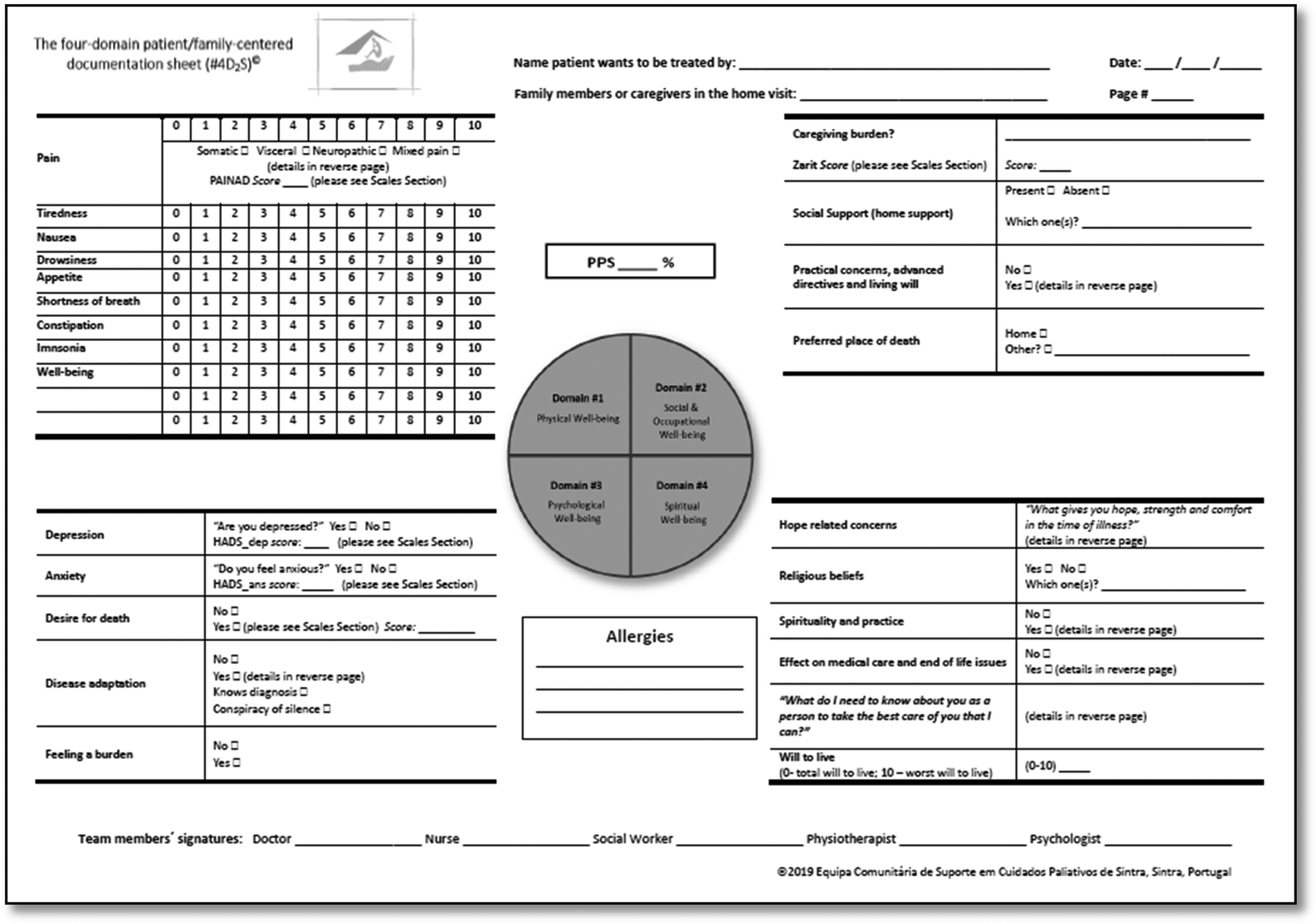
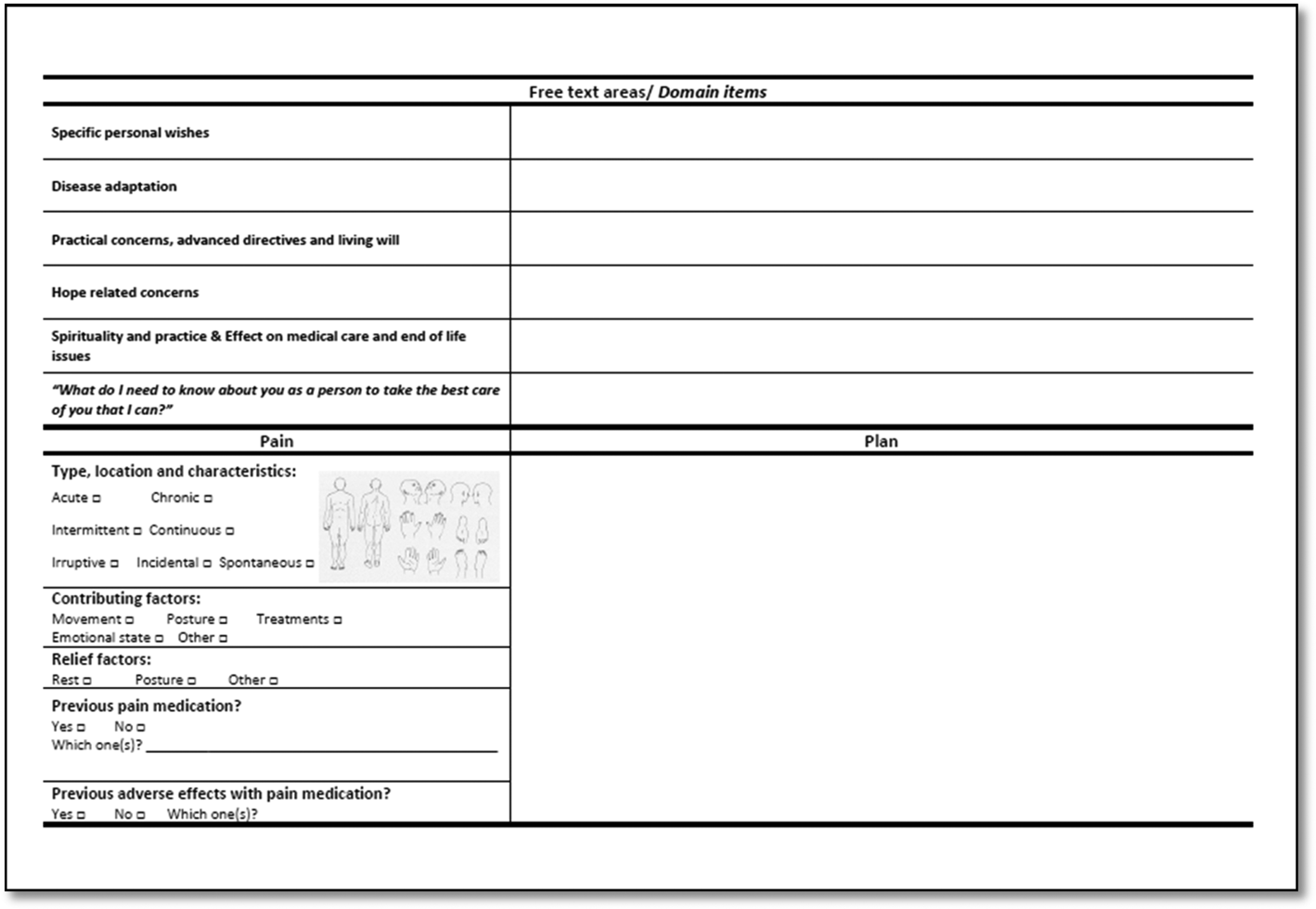
Our HPCT developed a four-domain patient/family-centred documentation sheet (coined the #4D2S) (Figures 1 and 2), designed for application at each clinical encounter, from admission to follow-up, until discharge. This was adapted by MJ from a document entitled Palliative Care Needs Assessment Guidance of the HSE Clinical Strategy and Programmes Division (Palliative Care Needs Assessment Guidance, 2014). After its initial adaptation, it was revised and modified by the team, and piloted for 3 months until a final model was reached #4D2S). During the pilot period, team meetings were undertaken to discuss the daily applicability and difficulties in the #4D2S completion and one training session was provided by MJ to the team to address any discrepancies or concerns, particularly psychosocial assessments regarding desire for death, will to live, depression, anxiety, sense of burden, and hope-related issues.
The four-domain patient/family-centered documentation sheet (#4D2S©) — front page.

The four-domain patient/family-centered documentation sheet (#4D2S©) — reverse page.

The final #4D2S document is composed of four main patient/family-centred domains: #1 physical well-being domain composed by following the Edmonton Symptom Assessment Scale (ESAS) items: pain, tiredness, nausea, drowsiness, appetite, shortness of breath, constipation, insomnia, and well-being (rated from 0 — absence of symptom to 10 — extreme exacerbation of the symptom) (Bernardo, Reference Bernardo2005; Hui and Bruera, Reference Hui and Bruera2017); #2 social and occupational well-being domain, including the Zarit score (Ferreira et al., Reference Ferreira, Pinto and Laranjeira2010), social support, advanced directives, and living will; #3 psychological well-being domain composed of the single question “Are you depressed?” (dichotomous answer: yes or no) (Chochinov et al., Reference Chochinov, Wilson and Enns1997; Julião et al., Reference Julião, Nunes and Sobral2016), the question “Do you feel anxious?” (dichotomous answer: yes or no) (Palliative Care Needs Assessment Guidance, 2014), feeling a burden, and desire for death (Chochinov et al., Reference Chochinov1995); and finally, #4 spiritual well-being domain comprised of hope-related concerns (using the question “What gives you hope, strength and comfort in the time of illness?”), religious believes, spiritual personal practices; the dignity question (DQ) (“What do I need to know about you as a person to give you the best care possible?;” “O que precisamos saber sobre si enquanto pessoa para podermos dar-lhe o melhor cuidado possível?”) (Chochinov et al, Reference Chochinov, McClement and Hack2015; Julião et al., Reference Julião, Courelas and Costa2018) and will to live (0 — total will to live; 10 — worst possible will to live) (see Figures 1 and 2).
In each initial consultation with cognitively intact patients, team members (mainly physicians and nurses) were encouraged to use the #4D2S as they determined most useful and suitable, with efforts to gather as much holistic information as possible from patients and family/caregivers. As per team protocol, a nurse and a physician were present for the initial PC consultation (unless urgent clinical situations precluded both being available). Therefore, the #4D2S is typically filled in the presence of both HCP during the consultation, with most items assessed by the physician, and nurses playing a reinforcing and clarification role.
Database registries
When each patients’ multidisciplinary clinical record is closed (due to death or discharge), each record is entered into an anonymous database by a database administrator. Each #4D2S item is carefully screened (front page — Figure 1) as is every free text item (reverse page — Figure 2). All data on the front page of the screening sheet are entered into the anonymized database. If an item on the front page is missing, the free text might contain relevant information, i.e., documenting that the assessment of that item was made during the clinical encounter. If that is the case, the database variable will be completed using the information in the free text item(s), as both measurable and descriptive data are equally important when physicians evaluate and attend patients (Bjørn et al., Reference Bjørn, Burgoyne and Crompton2009). Descriptive data can be more elusive, situational, and difficult to capture by preset standards (Møller and Bjørn, Reference Møller and Bjørn2011), but critically important since it is challenging to capture socio-emotional data in other ways. All data pertaining to the items were included in the anonymized database; for those variables that allowed for free text, this information was included in the data entry.
In this report, we consider “entry(ies)” as the anonymously recorded sociodemographic and clinical data per home PC patient only, i.e., one entry is the equivalent to all the information belonging to one patient. All patients anonymously registered in the database gave their written informed consent after reading an information sheet complying with the European Union General Data Protection Privacy Regulation Privacy Laws. The anonymization implies the removal of any personal data with the aim of irreversibly preventing the identification of the individual to whom it relates. According to the National Ethics Committee for Clinical Research, “Personal data that have been rendered anonymous in such a way that the person is no longer identifiable, are no longer considered personal data and are therefore not covered by the General Data Protection Regulation.” For this reason, the study was not submitted to an Ethics Committee.
Statistical analysis
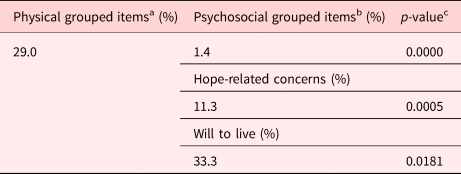
The statistical package STATA MP® 15 was used. For this work — and for an analysis between the different measures’ associations —, we considered grouping all documented ESAS physical subscales (named as physical grouped items), namely, pain, tiredness, nausea, drowsiness, appetite, shortness of breath, constipation, insomnia, and well-being; and also grouping all documented psychosocial items (named as psychosocial grouped items), namely, the single question “Are you depressed?,” the question “Do you feel anxious?,” feeling a burden to others, and the DQ (Table 3). Comparisons between physical grouped items, psychosocial grouped items, hope-related concerns, and will to live were performed using the exact McNemar paired test.
Results
Data collection
We retrospectively analyzed all entries, i.e., patients in our anonymous database between October 2018 (when #4D2S was first use by the team) and January 2020, identifying the first consultation per patient. From a total of 174 entries, 141 home PC patients (81%) had a first recorded consultation and, therefore, were analyzed (33 entries were rejected from analysis based on the following reasons: six were children; 14 had a palliative performance score (PPS) ≤ 20% and, therefore, unable to respond to assessment questions; and 13 with no assessments due to non-face to face medical consulting).
Patient's characteristics
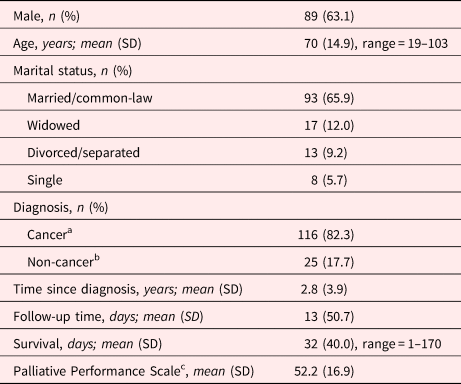
Sixty-three percent of the patients were male. The average age was 70 years ranging from 19 to 103 years. The majority (82%) of patients were diagnosed with cancer, with a mean PPS of 52%. All sociodemographic and clinical data are outlined in Table 1.
Summary characteristics of patients (N = 141)

SD, standard deviation.
a Colorectal, n = 19; breast, n = 13; stomach, n = 10; lung, n = 10; haematological, n = 8; pancreas, n = 8; esophagus, n = 7; brain, n = 6; ovarian, n = 6; prostate, n = 6; bladder, n = 5; liver, n = 5; skin, n = 4; bone, n = 3; uterus, n = 3; thymus, n = 2; gallbladder, n = 1. Metastatic tumors n = 45.
b Congestive heart failure, n = 7; amyotrophic lateral sclerosis, n = 7; chronic obstructive pulmonary disease, n = 2; dementia, n = 6; chronic kidney disease, n = 2; fragility syndrome in the elderly, n = 1.
c Palliative Performance Scale scores: 100% = healthy, 0% = dead.
Physical, psychosocial, and hope assessment
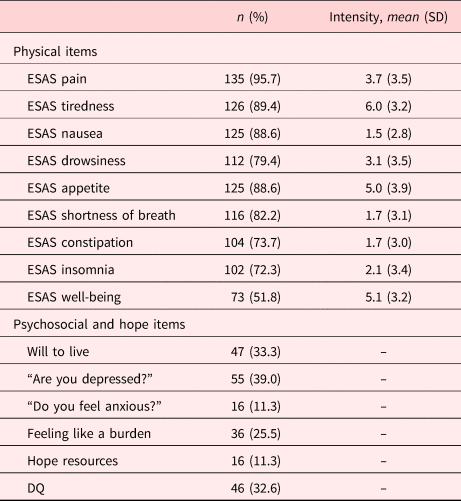
Table 2 shows the frequencies for each of the physical, psychosocial, and hope items assessed at the first PC consultation and the ESAS physical item severity. Using the exact McNemar paired test, we found significant differences between the frequencies of all documented items of the ESAS physical subscale (physical grouped items) (29%), all documented psychosocial items (psychosocial grouped items) (1%), hope-related concerns (11%), and will to live (33%) (p = 0.0000; p = 0.0005; p = 0.0181, respectively) (Table 3).
Frequency of physical, psychosocial, and hope items assessed at the first PC consultation (N = 141)

ESAS, Edmonton System Assessment Scale; DQ, Dignity Question.
Comparisons between the frequencies of physical, psychosocial, hope, and will to live items assessed at the first PC consultation

ESAS, Edmonton Symptom Assessment Scale.
a Physical grouped items: all the following ESAS items documented: pain, tiredness, nausea, drowsiness, appetite, shortness of breath, constipation, insomnia, and well-being.
b Psychosocial grouped items: all the following items documented: the single question “Are you depressed?,” the question “Do you feel anxious?,” burden, and the DQ.
c Exact McNemar paired test.
Discussion
This study reports the prevalence of physical, psychosocial, and hope related items documented by a home-based tertiary PC team during the course of the first PC consultation. We found a substantive difference in reporting, favoring physical symptoms over non-physical concerns and issues. Our main findings are aligned with other studies that demonstrate that psychological distress, spirituality, and hope-related dimensions of PC are not always viewed as essential components of patients’ quality of life or as critical factors in coping with illness, healing, and achieving a sense of coherence (Riba et al., Reference Riba, Donovan and Andersen2019).
We anticipated finding more robust documentation of physical symptoms since clinicians often prioritize acute physical needs before dealing with more chronic and time-consuming issues such as hope, psychosocial, and spiritual concerns (Hui and Bruera, Reference Hui and Bruera2016). The prominence of physical symptom documentation was, however, striking, given a relative paucity of symptom-related distress within this cohort; no ESAS item exceeded a mean score of 3.5. Yet, it would appear that clinicians prioritize attentiveness to and documentation of physical issues, implying they feel that they are more important than non-physical issues, or they are more at ease dealing with these issues, particularly in the context of an initial consultation. Perhaps they feel that more time is needed to build a therapeutic relationship before approaching more sensitive topics.
Limitations and strengths
Our study has some limitations. We cannot affirm the extent to which #4D2S helped clinicians identify and document patient issues and distress, over and above the non-standardized approach that preceded its implementation. Despite the significant non-assessment of psychosocial and spiritual items, we are unable to establish if this was is due to discomfort of HCP in assessing and documenting those items. Also, our sample was composed primarily of cancer patients from one PC setting only. How #4D2S would perform in non-cancer settings remains to be determined.
There are some strengths in our study, namely, the #4D2S model is holistic, covering four domains of end-of-life experience. Because it is standardized, it allows for a formatted, routinized, and predictable approach to documentation. Using this model of assessing, documenting, and caring for patients may safeguard against a more fragmented, narrowly medicalized approach to seriously illnesses patients nearing end of life. The #4D2S enables documentation of a holistic assessment in a fashion that is complete, facilitates future research, while being mindful that each patient determines how much and what can be discussed in a first clinical encounter.
Future research
We feel that there are still opportunities to improve the quality and written documentation of PC consultations. Our study points in several directions for future research, particularly the need to compare standardized approaches with current, intuitive driven practices, in order to establish the efficacy and utility of innovations such as #4D2S. This tool can also be used to start to compare the prominence of physical, psychosocial, spiritual, and hope related issues across various care settings and across malignant and non-malignant illness trajectories. Finally, additional research needs to examine the reasons why non-physical sources of distress are not being evaluated or documented with the same rigor as physical suffering toward end-of-life. Failures to evaluate and attend to the psychosocial and spiritual domains of patient experience have vital implications for palliative patients’ quality of life and well-being. Raising awareness of physical and non-physical aspects of end-of-life distress, by way of standardized approaches such as #4D2S, will be crucial to ensure that the needs of patients are recognized and addressed.
Conclusion
Assessing physical, psychosocial, spiritual, and hope related issues are an essential component of PC and critical for the provision of optimal care and enhancement of the patient's quality of life. Comprehensive assessments will help HCP shape individualized holistic and appropriate care plans to meet patients’ specific needs, increasing their perceived awareness of their patients’ concerns and improving doctor–patient communication across the disease trajectory.
Author contribution
M.J., M.A.S., A.B., D.R., and E.B. were responsible for the conception and design. B.N., M.J., M.A.S., A.B., D.R., P.F.S., B.A., E.B., and H.M.C. were responsible for analyzing the data and writing the initial draft and final report. M.A.S. and P.C. were responsible for the collection and assembly of data. All coauthors supervised the statistical analysis, revision of the final report and had full access to all of the data.
Acknowledgments
The authors thank to each member of the Equipa Comunitária de Suporte em Cuidados Paliativos de Sintra and to all patients and families cared for since the beginning of our team's activity.
Funding
Bárbara Antunes is funded by the National Institute for Health Research (NIHR) Applied Research Collaboration East of England (ARC EoE) programme. The views expressed are those of the author and not necessarily those of the NHS, the NIHR or the Department of Health and Social Care.
Conflict of interest
There are no conflicts of interest.