


Malnutrition is a primary cause of child mortality and morbidity in developing countries, particularly during the first 5 years of life. Among different forms of malnutrition, child stunting (low length-for-age) and wasting (low weight-for-height) remain important public health problems( Reference Black, Allen and Bhutta 1 ). Stunting is a multi-causal problem occurring as a result of a cumulative process of growth retardation which not only depends on temporary food shortages( Reference Smith, Ruel and Ndiaye 2 , Reference Victora, Adair and Fall 3 ), but is also associated with socio-economic, hygiene and other nutritional factors( Reference Black, Allen and Bhutta 1 , Reference Grantham-McGregor, Cheung and Cueto 4 , Reference Walker, Wachs and Gardner 5 ). Additionally, maternal characteristics are associated with the risk of child malnutrition. Examples include the negative association between maternal height and child stunting( Reference Bove, Miranda and Campoy 6 ) and the relationship between maternal nutritional status and intra-uterine growth restriction and low birth weight( Reference Black, Allen and Bhutta 1 , Reference Walker, Wachs and Gardner 5 ). During the first 2 years of life, children are highly vulnerable to becoming stunted, leading to irreversible development deficiencies towards adulthood( Reference Black, Allen and Bhutta 1 , Reference Horton 7 ). These include immediate consequences like child mortality, short-term consequences like child morbidity or disability, and long-term consequences like shorter adult height, lower attained schooling, reduced economic productivity and, for females, lower offspring birth weight( Reference Black, Allen and Bhutta 1 , Reference Victora, Adair and Fall 3 , Reference Grantham-McGregor, Cheung and Cueto 4 ). Wasting is considered a better predictor of child mortality than stunting since it is an indicator of the acute nutritional status generally associated with failure to gain weight or recent weight loss mainly related to acute diseases and acute food shortage( Reference Black, Allen and Bhutta 1 ).
More recently, the rate of overnutrition in all age groups has also been on the increase in developing countries. More problematically, its coexistence with undernutrition has led to the concept of the double burden of malnutrition( Reference Armstrong, Dorosty and Reilly 8 , Reference Monteiro, Conde and Popkin 9 ), which offers important challenges to public health nutrition policies. Moreover, the rapid urbanization phenomenon particularly in Latin America has led to a larger heterogeneity of poverty and malnutrition, scaling up the need for more recent information to build evidence for the formulation of effective interventions and policies adapted to rural and urban areas( Reference Smith, Ruel and Ndiaye 2 , Reference Horton 7 , Reference Bhutta, Ahmed and Black 10 – Reference Ruel 13 ).
According to the Human Development Index, Ecuador is one of the least developed countries in South America together with Bolivia, Colombia and Paraguay( 14 ). From a nationally representative survey conducted in 2004, high rates of stunting in the first 2 years of life were reported: 3·2 % for children under 5 months, 9·8 % for children aged 6–11 months and 28·4 % for children aged 12–23 months. In contrast, rather low rates of wasting were described: 2·1 % for children under 5 months, 3 % for children of 6–11 months and 4·6 % for children 12–23 months of age; while child overweight prevalence was: 5·3 % for children under 5 months, 3·9 % for children aged 6–11 months and 4·1 % for children aged 12–23 months( 15 ). Ecuador has a rich cultural diversity as well as social, regional and ethnic inequities. Although it is known that poverty and malnutrition affect mostly rural areas and indigenous households( 15 , Reference Hall and Patrinos 16 ), an integral assessment of the determinants of malnutrition (i.e. stunting, wasting and overweight) must also comprise the large urban inequities.
The present study aimed to identify and compare the socio-economic, health-related, hygiene and nutritional determinants of stunting, wasting and overweight among infants of urban and rural areas in the Ecuadorian highlands.
Materials and methods
Setting and survey design
A cross-sectional study was conducted from June to September 2008 in a rural (Nabon) and an urban (Cuenca) canton of Azuay Province, in the southern Ecuadorian highlands.
Cuenca is the third largest city in Ecuador and is the province capital. Cuenca is located at approximately 2550 m above sea level and has the highest population density in the province, with 2 % of indigenous population( 17 ). Nabon is located in the countryside, at 3000 m above sea level and 70 km from Cuenca. Nabon has a considerable territorial dispersion, which makes it difficult to access the different communities. Most of the inhabitants of Nabon (93 %) live in the rural areas and 35 % consider themselves as indigenous population( 18 ). From all Ecuadorian indigenous communities, the Quechua group (34 %) is the most predominant in Azuay Province( 19 ).
Participants (study size, methods of selection)
The study sample consisted of children aged 0–24 months and their caregivers. In Nabon, the visited households were randomly selected from the census register of children under 24 months of age from all communities of the canton handled by the local workers of INFA (National Institute of Childhood and Family). In Cuenca, there was no such child register available to be used as sampling frame. Therefore, we adopted a cluster random sampling scheme to select the households. Since the urban plan represents a strict symmetric division in blocks, we opted to use residential blocks as the primary sampling unit because of the convenience of selection. The sample size was calculated for both settings with the aim of: (i) estimating the prevalence of stunting with a precision of 5 % and a 95 % confidence interval; and (ii) detecting a difference of 15 % in the prevalence of stunting between the rural and urban areas with a statistical power of 90 % and type I error of 5 %. For both calculations we assumed an average stunting prevalence of 30 %( 15 ) and a non-response of 20 %. For Nabon, this resulted in a minimal sample size of 232 participants taking into account a correction for the finite population (estimated population size was 400 infants). For Cuenca, a minimal sample size of 465 participants was necessary assuming an intra-cluster coefficient of 0·2 and an average cluster size of two infants per block. From this calculation we derived that we needed to sample 230 blocks. However, during the sampling procedure it became obvious that we had overestimated the average cluster size, which was closer to a mean of 1·5 infants per block. Therefore, after the first week of surveying, we decided to sample 400 blocks from a total of 3111 blocks by random selection to satisfy the proposed level of precision. All households belonging to a selected block were visited door-to-door and the surveys were conducted in households with children under 24 months of age without restriction in the number of infants who could be found per block. In every household the youngest child that met the inclusion criteria was selected.
Data were collected by trained medical students by face-to-face interview of child primary caregivers at their homes.
Ethics
The study was approved by the Ethical Committee of the University Hospital of Ghent, Belgium and the Ethical Committee of the Central University of Quito, Ecuador. Prior to the interview, caregivers received an explanation of the study goal and methodology, and written informed consents were obtained from those willing to participate.
Survey instrument
The collection of household key indicators was based on the Knowledge–Practices–Coverage Rapid Core Assessment Tool on Child Health survey. This instrument also assessed child morbidity: diarrhoea defined by three loose stools per day, presence of blood in the stool, persistent cough, difficult breathing, oedema, fever and convulsions( Reference Swindale and Bilinsky 20 ). In addition, questions regarding hand-washing practices and child-care practices during feeding were composed for three focus groups with ten participants each to discuss the practices of infant care. Socio-economic characteristics were assessed using the questionnaire on Unsatisfied Basic Needs (UBN), which was developed by the Integrated Social Indicator System for Ecuador( 21 ) following the World Bank recommendations( Reference Grosh and Glewwe 22 ). This approach defines a household as ‘poor’ when at least one of the ten deprivations related to education, health, nutrition, housing, public services and employment opportunities is present, and as ‘better off’ when no deprivation is reported( Reference Ochoa-Aviles, Andrade and Huynh 23 ).
The full questionnaire was pre-tested and checked for repeatability in a convenience sample of 100 households with children under 24 months of age recruited from child-care centres in a neighbouring canton (Azogues, Cañar Province).
Anthropometry measurements and growth characteristics
Anthropometric measurements of both infant and mother were taken in duplicate by teams of two trained data collectors. Birth weight was recorded from parental recall or birth certificate. Following the method described in the Anthropometric Indicators Measurement Guide of the Food and Nutrition Technical Assistance Project( Reference Cogill 24 ), maternal and infant weight was measured with an accuracy of 0·1 kg using an electronic scale (SECA model 803, Hanover, MD, USA); maternal height was measured using a stadiometer (Health-o-Meter model Portrod, Alsip, IL, USA), recumbent infant length was measured with a length board (SECA model 210) and infant mid-upper arm circumference was measured using a non-stretchable measuring tape (SECA model 201). Following the method described in the WHO Multicentre Growth Reference Study measurement and standardization protocol( Reference de Onis, Onyango and Van den Broeck 25 ), infant head circumference was measured using a calibrated metric tape (SECA model 201). All length measurements were taken with an accuracy of 0·1 cm.
Data analysis
Z-scores for length-for-age (LAZ), weight-for-age (WAZ), weight-for-length (WLZ) and BMI-for-age (BMIZ) were calculated using the WHO 2006 growth standard references( 26 ). Child stunting was defined as LAZ<−2, wasting as WHZ<−2 and overweight as BMIZ > 2. Mothers were classified as underweight (BMI < 18·5 kg/m2), normal weight (BMI = 18·5–24·9 kg/m2), overweight (BMI = 25·0–29·9 kg/m2) or obese (BMI ≥30·0 kg/m2), following the WHO criteria( 27 ).
We first conducted descriptive analyses to compare characteristics between the urban and rural study samples. For this purpose we used χ 2 tests in the case of categorical variables and Student's t tests for continuous variables. We then assessed the associations between candidate determinants and stunting, wasting, overweight and the continuous variables LAZ, WLZ and BMIZ. This was done first by explorative bivariate analysis. Each determinant with a modest association with one of the outcomes (P < 0·20) was a candidate to be included in a multivariate regression model. Regression analysis was conducted first using the pooled data, after which we stratified the analysis by study site (rural and urban). Regression models were compiled starting from a saturated regression model using a manual backward elimination strategy removing non-significant predictors based on a Wald test (P > 0·05). Using this strategy, a logistic regression model was used for the binary outcomes of stunting (LAZ<−2), wasting (WLZ<−2) and overweight (BMZ > 2), while a linear regression model was adopted for the continuous indices LAZ, WLZ and BMIZ.
Because in some cases the mother was absent during the home visit, maternal anthropometry could not be collected, resulting in missing data (24·3 %). Nevertheless, to analyse the associations between maternal anthropometry and child nutritional status we decided to repeat the analysis on a maternal subset of the data with maternal anthropometry available.
Principal component analysis (PCA) was used to compile a proxy index for household socio-economic status (SES), a care index and a hygiene index. The SES index was based on: (i) house ownership; (ii) housing material for walls and floors; (iii) toilet type; (iv) household's source of water; (v) number of people who sleep in the caregiver's bedroom; (vi) paternal occupation; and (vii) maternal occupation. These variables were selected because they were considered important indicators of household SES, and not all of them are part of the key determinants of the UBN classification. Education level and medical attendance were not included in the SES index because we decided to assess those variables as such, considering their individual importance on child malnutrition. For the SES index we used the first PCA factor that explained 39 % of the variance. The index was subsequently divided into quintiles and then grouped as the poor 40 %, the middle 40 % and the rich 20 %. This categorization was chosen in accordance with other studies( Reference Filmer and Pritchett 28 , Reference Engebretsen, Tylleskar and Wamani 29 ). Because disparities in SES were huge between the rural and urban settings, we decided to calculate an additional SES index per sub-sample using the same methodology to assess the association between the distribution of poverty and child nutritional status.
The PCA to create the care index comprised caregiver's information concerning child-care practices during feeding: (i) whether he/she was younger than 15 or older than 60 years old; (ii) whether he/she talked to the child during feeding; (iii) whether he/she sat next to the child during feeding; (iv) whether he/she taught the child about food during feeding; (v) whether the child is allowed to feed him/herself; and (vi) whether the caregiver let the child eat with his/her own fingers. The first PCA factor, which explained almost 28 % of the variance, was used to create the care index and was divided into tertiles.
The PCA to create the hygiene index included: (i) hand-washing practices of the caregiver (whether the caregiver washed his/her hands before food preparation, before feeding children, after defecation and/or after attending to a child who had defecated); (ii) hand-washing practices of the child's hands (whether the child's hands were usually washed before feeding and after defecation); (iii) the use of soap for hand-washing practices (whether soap was used to wash the caregiver's hands and the child's hands); and (iv) source of water for feeding. The first PCA factor, which explained almost 29 % of the variance, was used to create the hygiene index and was divided into tertiles.
All data entry was done in duplicate using EpiData software version 3·1, which allowed cross-checking of double data entry. Data management and analysis were performed with the statistical software package Stata version 10·0. To account for the clustered sampling in the case of Cuenca, we used robust estimation of the standard errors (CLUSTER option in Stata 10·0). Statistical significance was set at P < 0·05 and all tests were two-sided.
Results
Urban–rural differences
In total 703 infants, 476 infants from Cuenca (urban area) and 227 infants from Nabon (rural area), were included in the present study. The sample characteristics of the two settings are presented in Table 1. We observed a significantly higher (P < 0·001) prevalence of stunting (37·4 % v. 17·7 %) and severe stunting (6·2 % v. 3·4 %) among infants of the rural area. No significant differences in the prevalence of wasting and overweight were observed. Urban mothers were on average slightly older. Rate of facility-based delivery was significantly higher (P = 0·006) in the urban area, where most mothers preferred to attend medical centres instead of traditional healers. We did not observe important differences in maternal nutritional status between study samples. However, rural mothers were significantly shorter (P < 0·001). Breast-feeding period, either exclusive at 6 months (P = 0·030) or partial breast-feeding (P = 0·005), was significantly longer in the rural area. SES determined by PCA and by the UBN indicator showed that Nabon households were significantly poorer (>96 % of households in Nabon were poor) compared with Cuenca (P < 0·001). However, the two methods showed somewhat inconsistent results for Cuenca. According to the UBN approach 38·9 % of households were poor, in contrast to 10·7 % according to the SES index.
Main characteristics of the respondents according their living area: children aged 0–24 months and their caregivers (n 703), Cuenca (urban area) and Nabon (rural area), Azuay Province, Ecuador, June–September 2008
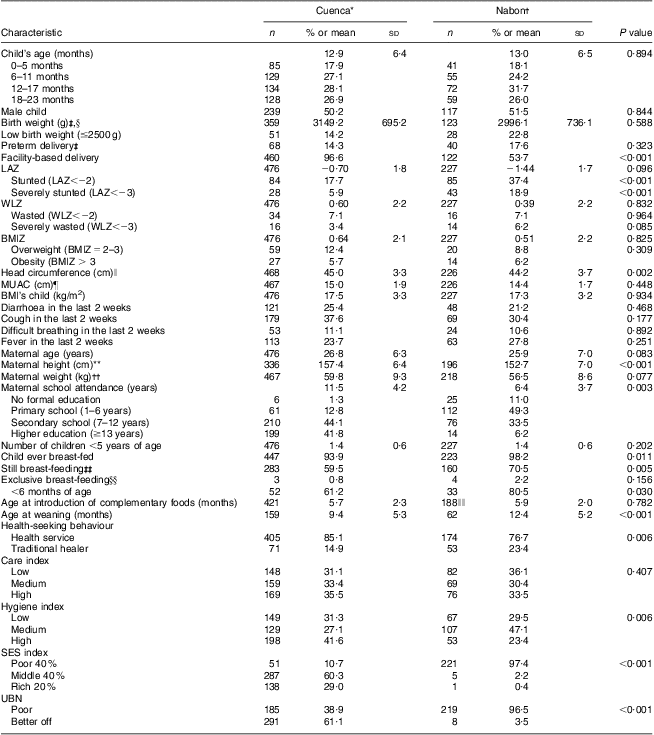
LAZ, length-for-age Z-score; WLZ, weight-for-length Z-score; BMIZ, BMI-for-age Z-score; MUAC, mid-upper arm circumference; SES, socio-economic status; UBN, poverty definition based on Unsatisfied Basic Needs.
*Cuenca's data set (476 observations).
†Nabon's data set (227 observations).
‡Birth weight and preterm delivery information was obtained mainly from caregiver recall instead from an official record (83·3 % and 93·1 %, respectively).
§Missing values = 221 (31·4 %).
∥Missing values = 9 (1·3 %).
¶Missing values = 10 (1·4 %).
**Missing values = 171 (24·3 %).
††Missing values = 18 (2·6 %).
‡‡Current breast-feeding, exclusive and not exclusive, at the time of the survey.
§§Exclusive breast-feeding only for the group of children with age ≥6 months (Cuenca n 391, Nabon n 186).
∥∥Missing values = 2 (0·9 %).
In addition, a total of 530 children, 336 infants from Cuenca and 194 infants from Nabon, were included for the maternal subset analysis. We did not observe any significant difference in the predictors between the pooled data set and the maternal subset.
Stunting determinants
Results of the multivariate regression models for LAZ and potential determinants of stunting are presented in Table 2. For the pooled data set, child's age, male gender and preterm delivery were positively associated with stunting, whereas facility-based delivery and maternal education were negatively associated with stunting. When analysing the determinants for both locations separately, we did not observe any significant determinants of stunting in the urban area; while for the rural area older children and those who had diarrhoea episodes in the last 2 weeks prior to the survey were more likely to be stunted. On the other hand, mean LAZ for the pooled data set was negatively associated with child's age and preterm delivery, and positively associated with facility-based delivery and maternal education. For the urban sub-sample, mean LAZ was negatively associated with child's age and positively associated with maternal education. In Nabon, mean LAZ was negatively associated with child's age, a greater number of children under 5 years of age in the household and diarrhoea episodes in the last 2 weeks.
Multivariate regression models for LAZ and stunting (linear and logistic regression, respectively) for the pooled data set and in Cuenca (urban area) and Nabon (rural area) separately: children aged 0–24 months and their caregivers (n 703), Azuay Province, Ecuador, June–September 2008
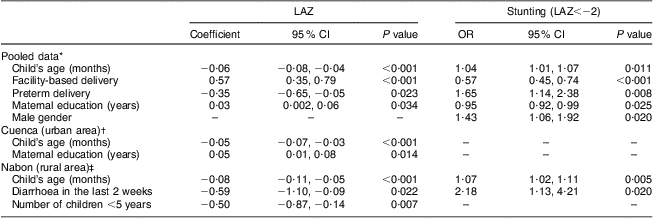
LAZ, length-for-age Z-score.
*Model adjusted for location (urban v. rural) for pooled data (703 observations in data set).
†Cuenca's data set (476 observations).
‡Nabon's data set (227 observations).
Additionally, for the maternal subset analysis of the urban area (n 336), infants of mothers with higher maternal BMI were less likely to be stunted (OR = 0·92; 95 % CI 0·84, 0·99; P = 0·027). In the rural area (n 194), infants of shorter mothers were more likely to be stunted (OR = 0·004; 95 % CI 0·00004, 0·39; P = 0·018), as were infants from households with a low SES index (OR = 0·79; 95 % CI 0·64, 0·98; P = 0·030); whereas mean LAZ was positively associated with maternal height (5·15 LAZ per cm; 95 % CI 2·02, 8·29; P = 0·001).
Wasting determinants
Results of the multivariate regression models for WLZ are presented in Table 3. We did not observe any significant determinant of wasting for the pooled data set or for the urban/rural subsets. Mean WLZ for the pooled data set was negatively associated with facility-based delivery and child diarrhoea. In the rural area (Nabon), infants who were not delivered in a facility and who had ever been breast-fed had a higher mean WLZ. No significant associations with any of the determinants were observed for the mean WLZ in the urban area (Cuenca). In the maternal subset, a negative determinant of wasting was hygiene index in Cuenca only (OR = 0·57; 95 % CI 0·36, 0·89; P = 0·013).
Multivariate regression models for WLZ and wasting (linear and logistic regression, respectively) for the pooled data set and in Cuenca (urban area) and Nabon (rural area) separately: children aged 0–24 months and their caregivers (n 703), Azuay Province, Ecuador, June–September 2008
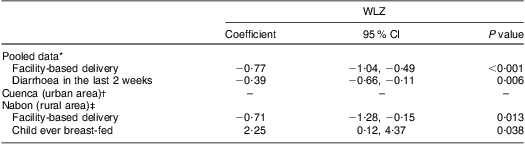
WLZ, weight-for-length Z-score.
*Model adjusted for location (urban v. rural) for pooled data (703 observations in data set).
†Cuenca's data set (476 observations).
‡Nabon's data set (227 observations).
Overweight determinants
Results of the multivariate regression models for BMIZ and overweight (BMIZ > 2) determinants are presented in Table 4. For the pooled data set, overweight was less likely for infants delivered at a facility. In Cuenca, facility-based delivery was also a negative determinant of overweight and, surprisingly, infants with cough episodes seemed less likely to be overweight. In Nabon, infants who were not delivered in a facility and who had ever been breast-fed had a higher mean BMIZ. In the maternal subset of both locations, no maternal-related predictors of overweight were observed.
Multivariate regression models for BMIZ and overweight (linear and logistic regression, respectively) for the pooled data set and in Cuenca (urban area) and Nabon (rural area) separately: children aged 0–24 months and their caregivers (n 703), Azuay Province, Ecuador, June–September 2008
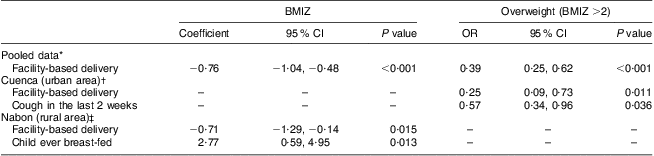
BMIZ, BMI-for-age Z-score.
*Model adjusted for location (urban v. rural) for pooled data (703 observations in data set).
†Cuenca's data set (476 observations).
‡Nabon's data set (227 observations).
Discussion
The present results demonstrated that stunting is a multi-causal problem influenced by several determinants related to physiological factors, poor access to health services, education, maternal nutritional status, fetal growth and SES, while we observed that wasting is closely related to inadequate child care. This might be a consequence of access to basic services or education. Our results also demonstrated increasing rates of infant overweight and that an important determinant is the poor access to health services. Our findings on stunting prevalence are in agreement with the better growth prospects reported for children from urban areas in Ecuador and other Latin American countries( Reference Smith, Ruel and Ndiaye 2 , 15 , Reference Urke, Bull and Mittelmark 30 ). On the other hand, our results are similar to reported rates for young children in neighbouring countries( Reference Bove, Miranda and Campoy 6 , Reference Urke, Bull and Mittelmark 30 – Reference Martorell and Young 32 ), and we observed considerably higher rates of wasting (7·1 % v. 1·8 % for rural, 7·1 % v. 1·6 % for urban) and overweight (8·8 % v. 2·8 % for rural, 12·4 % v. 3·5 % for urban) than previously reported in Ecuador but for children under 5 years old( 15 ).
Age and gender are factors that influence individual susceptibility to malnutrition( Reference Engebretsen, Tylleskar and Wamani 29 , Reference Wamani, Astrom and Peterson 33 ). Accordingly, we observed that in both areas stunting was more prevalent in older children up to 24 months. Typically, mean linear growth is restricted up to the age of 24 months after which a status quo is observed( Reference Victora, de Onis and Hallal 34 ). We also observed that boys were more likely to be stunted for the pooled sample, an observation previously described in other studies( Reference Engebretsen, Tylleskar and Wamani 29 , Reference Wamani, Astrom and Peterson 33 ).
According to the UNICEF modified conceptual framework( Reference Shrimpton and Kachondham 35 ), the temporal factors of child malnutrition are related to maternal nutritional status and fetal growth. Prematurity is a common cause of infant mortality and its prevention has been suggested as crucial for the application of stunting management strategies( Reference Espo, Kulmala and Maleta 36 , Reference Victora, Aquino and de Carmo Leal 37 ). Our results also demonstrated the influence of preterm delivery on stunting for the pooled sample. Although it might be expected that medical facilities are better in the urban area, because of the higher prevalence of prematurity in the rural area, we observed that prematurity was independent of facility-based delivery. We also found a very strong positive association between maternal height and ponderal growth; however, this was found in the rural area only. On the other hand, less child stunting was observed for urban mothers with higher BMI. We hypothesize that in the urban area other determinants of stunting are more relevant than maternal height due to the population variability and/or maternal height having reached a levelling off status.
In the same framework, child morbidity and inadequate dietary intake are considered immediate causes of child malnutrition. Diarrhoea prevalence has been related to acute malnutrition; however, repeated episodes can also lead to chronic status of growth faltering, particularly in poor living areas, as we observed in the present study( Reference Ruel 13 , 15 , Reference Espo, Kulmala and Maleta 36 ). The fact that diarrhoea prevalence was related to lower WLZ in Nabon only might point to a lower and/or more varied hygiene index score distribution in this sample. The negative relationship between overweight and cough prevalence was unexpected. However, this relationship should be interpreted with caution since the causality cannot be determined in a cross-sectional study. In addition, previous studies describe that the relationship between child malnutrition and burden of disease works in both directions( 15 ). On the other hand, the benefits of exclusive breast-feeding for infant development and growth are widely acknowledged( Reference Kramer and Kakuma 38 ). Indubitably, breast-feeding practices were better in the rural area. Our data also suggested that the ever breast-fed children had higher WLZ and BMIZ in Nabon only. We consider that this observation is not consistent enough because no significant associations were observed when specifying duration and exclusivity of breast-feeding.
Malnutrition can also be related to underlying causes like poor access to health services and inadequate maternal and child care practices( Reference Shrimpton and Kachondham 35 , Reference Buitrón, Hurtig and San Sebastián 39 ). Accordingly, our results demonstrated the importance of facility-based delivery as a protective factor against stunting for the pooled sample and overweight for the pooled and urban samples. As a direct association is difficult to explain, we suspect that mothers who deliver in a health facility have a different health-seeking behaviour that might affect child malnutrition. We also found that poor hygiene was associated with a higher prevalence of wasting in the urban area only, which might be explained by the more heterogeneous hygienic practices among urban households.
Basic causes of child malnutrition, like education and economic resources, are usually more complex and require longer terms to be resolved( Reference Shrimpton and Kachondham 35 ). The very strong impact of maternal education on child malnutrition has been widely described in developing countries, including Latin America( Reference Bove, Miranda and Campoy 6 , Reference Urke, Bull and Mittelmark 30 , Reference Wamani, Astrom and Peterson 33 , Reference Burchi 40 – Reference Kac and García Alvear 42 ). Lower levels of maternal education were found as a determinant of stunting for the pooled sample, with also a higher mean LAZ positively associated with maternal education in the urban area only. This finding might be related to the fact that, in the urban centre, education could be valorized into better job opportunities and therefore lead to considerably higher income. This rural–urban difference of maternal education related to SES has also been addressed in some Andean countries( Reference Hatt and Waters 11 , Reference Larrea and Kawachi 43 ). The strong association between low household economic status and child malnutrition has been reported for several Latin American countries( Reference Smith, Ruel and Ndiaye 2 , Reference Bove, Miranda and Campoy 6 , Reference Urke, Bull and Mittelmark 30 , Reference Wamani, Astrom and Peterson 33 , Reference Burchi 40 – Reference Kac and García Alvear 42 , Reference Van de Poel, Hosseinpoor and Speybroeck 44 ). Although we observed a significant positive crude association between UBN and SES index, and the mean LAZ respectively (results not shown), this relationship disappeared when the model was adjusted for urban/rural location in the pooled data set. Only for the maternal subset we observed that infants from rural households with a low SES index were more likely to be stunted. These findings suggest strong differences in SES between the urban and rural locations, but smaller differences in associations with child malnutrition within the study sub-samples. We also hypothesize that this is because part of the association is probably captured by more direct determinants of malnutrition which further attenuate the association between child malnutrition and SES proxies (i.e. UBN classification and SES index). One of the proxies of SES related to stunting is the number of children in the household, which influences the resources available to each child in terms of finances, time and attention( 15 , Reference Sereebutra, Solomons and Aliyu 45 ). In our study, we observed that a greater number of children under 5 years old in the household was related to mean LAZ in Nabon only, and this could be seen as a proxy of economic burden and maternal occupational burden. A remarkable finding was the inconsistent results of prevalence of poverty in Cuenca using the UBN method and the SES index. Apparently larger socio-economic inequalities coexist at urban level. We believe that the inclusion of parental occupation (ranked according to salary) in the construction of the SES index gives an important additional argument to classify and explain better the SES at urban level.
The present study has a number of limitations that need to be addressed. First, mere associations can be described and only non-causal relationships could be established due to the cross-sectional study design. Second, as the study was questionnaire-based, some questions that required a good memory were vulnerable to recall bias (like birth weight and morbidity in the last 2 weeks); also it cannot be excluded that some questions triggered a social prestige bias (like hygiene or care practices). Third, we could not obtain maternal anthropometry in cases where the mother was not home during the interviews. In such cases, the caregiver was interviewed and it remains unclear to what extent this might have influenced the data quality. However, after testing possible variations between the pooled data set and the maternal subset, we did not find any significant difference. Fourth, some immediate (nutrient intake) and underlying (food security) determinants of the conceptual framework of child malnutrition were not assessed. Finally, although the determinants of child malnutrition would remain the same, Ecuadorian governmental policies have changed since the data were collected (2008), particularly those regarding better access to health services( 46 ).
Conclusions
In the present study, the major proxies of child malnutrition identified were stunting followed by overweight. Stunting being the main child nutritional failure in Ecuador, our results demonstrated persistent and alarming rates since they were are as high as those reported nationally in 1986, which could protract the goal of reducing stunting to 12 % by 2015( 15 ). Thus, the intervention strategies must be targeted to the most vulnerable population groups by tackling the most relevant determinants. The present study also identified and compared the sociodemographic and socio-economic determinants of child malnutrition between infants from rural and urban areas of the Ecuadorian highlands. We did not observe common determinants between both settings for any type of malnutrition. For the pooled sample, stunting was more likely among male, older and preterm infants, as well as infants not delivered at a facility and infants of mothers who had lower levels of maternal education; whereas overweight was also more likely for infants delivered at a facility. Urban determinants were related to maternal nutritional status (maternal BMI) for stunting, child morbidity (cough) and access to health services (facility-based delivery) for overweight, and child care (hygiene index) for wasting. Rural determinants of stunting were related to maternal nutritional status (maternal height), child morbidity (diarrhoea) and inherent factors (child's age) and SES; whereas no significant determinants were observed for overweight and wasting. Therefore, we suggest that intervention strategies must be related mainly to primary health issues and education.
Acknowledgements
Sources of funding: This work was financially supported by the Flemish Interuniversity Council–Institutional University Cooperation (VLIR-UOS), within the cooperation between Cuenca University (Ecuador) and Ghent University (Belgium). Conflicts of interest: The authors declare that there are no conflicts of interest related to this study. Authors’ contributions: This work is the result of original research in which all authors collaborated during the study design, data collection or data analysis.



