INTRODUCTION
Scavenging is a common behaviour within marine systems and fulfils an important ecosystem service by recycling the nutrients and energy contained in dead animals. Carrion is a fragmented, nutrient rich source of food eaten by scavengers (Britton & Morton, Reference Britton and Morton1994). Many decapods (such as Carcinus maenas, Nephrops norvegicus, Liocarcinus depurator, Cancer pagurus and Necora puber) have been shown to scavenge as part of their feeding regime (Bergmann et al., Reference Bergmann, Wieczorek, Moore and Atkinson2002). Britton & Morton (Reference Britton and Morton1994) state that a true scavenger must be able to detect carrion over a distance through chemoreception, perhaps aided by sound and bioluminescence from other scavengers already present at the carrion. Chemical odours from carrion can disperse across large distances (Ide et al., Reference Ide, Takahashi, Nakano, Sato and Omori2006) and can indicate the location, quantity and quality of the food source. The quality is determined by detection of nitrogenous compounds such as amino acids, ATP, and sugars (Zimmer-Faust, Reference Zimmer-Faust1991). When the concentration of a chemical reaches a certain threshold this will trigger a locomotory response toward the carrion (Britton & Morton, Reference Britton and Morton1994). Studies of marine scavengers have largely concentrated on sub-littoral invertebrates or avian scavengers along the shore. The potential of coastal seabird and marine mammal populations as a source of carrion to local marine communities is understudied.
The shore crab C. maenas is found on all British coasts inhabiting hard and soft intertidal habitats (Baeta et al., Reference Baeta, Cabral, Neto, Marques and Pardal2005) and has a peak foraging period during the night and at high tide (Mente, Reference Mente and Mente2003; Neal & Pizzolla, Reference Neal and Pizzolla2008). Like many decapods, the shore crab has dimorphic claws; a large dominant crusher claw and a smaller cutter claw (Mariappan et al., Reference Mariappan, Balasundaram and Schmitz2000; Juanes et al., Reference Juanes, Lee, McKnight and Kellogg2008). The smaller cutter claw generally lacks the proximal molariform tooth (Vermeij, Reference Vermeij1977). The large claw is designed for ripping or tearing its food where the smaller claw has evolved to manipulate the food item prior to eating. Govind (Reference Govind1992) showed these have around 100% slow twitch fibres in comparison with the cutter with 90% fast twitch fibres.
Shore crabs are seen to occur in two major colour states (green and red) with an intermediate orange stage. Wolf (Reference Wolf1998) investigated green and red differences testing a hypothesis from Aldrich (Reference Aldrich1986) that the colours represent different energetic strategies and life history stages. Aldrich's (Reference Aldrich1986) hypothesis was that the red morphs indicated a strategy favouring reproduction, while green crabs were putting more resources into growth. These differences in strategy are manifested in changes in the inter-moult interval and carapace strength. Red crabs grow more slowly but have stronger carapaces than green forms. These differences would suggest that the muscle (protein) turnover in green crabs could be faster than in red crabs.
Shore crabs are known to feed on a wide range of benthic invertebrates and scavenge on whatever is available to them. Along many coasts large seabird colonies could represent an important source of carrion due to their proximity to the water, and relatively high mortality of fledglings during the breeding season. The Atlantic puffin (Fratercula arctica) spends most of its life out at sea feeding and only comes ashore to breed and lay its eggs. A major puffin breeding colony is located on the Isle of May (Firth of Forth, North Sea 56°45′N 04°54′W) (SNH, 2008). This colony has around 8% of the UK and Ireland puffin population (Wanless et al., Reference Wanless, Harris, Murray and Wilson2003). Wanless et al. (Reference Wanless, Harris, Murray and Wilson2003) have shown that puffins create 40,000 to 70,000 burrows on the island during May each year. The area of Kirkhaven contains 12% of the island's breeding population, with more than 7000 chicks fledging from this area each year. The fledging rate of puffins from the colony (leaving the burrow alive) is reported to be 0.78 birds per egg. Post-fledgling survival is dependent on the availability of marine prey, particularly the lesser sand eel (Ammodytes marinus) (Eilertsen et al., Reference Eilertsen, Barrett and Pedersen2008). Sand eel abundance has been highly variable in recent years (Harris et al., Reference Harris, Newell, Daunt, Speakman and Wanless2008) and is negatively correlated with the rate of mortality of puffin chicks. If these chicks die outside the breeding burrows, but are not consumed by gulls, the chick carcasses could provide a source of carrion to the local marine system.
The grey seal (Halichoerus grypus) is another seasonal source of carrion during the autumn breeding season. There are more than 1200 grey seal pups born each year on the Isle of May and the overall pre-weaning mortality of pups can be as high as 9–15%. The body mass of dead pups on the colony range from 10.7 to 15.8 kg but it is also known that pups failing to reach 30 kg will not be weaned successfully (Baker & Baker, Reference Baker and Baker1988; Pomeroy et al., Reference Pomeroy, Twiss and Duck2000). Shore crabs could potentially feed on dead grey seal pups washed ashore in the winter and dead puffins in the summer.
Differences in stable isotope composition (δ15N and δ13C) between animals have been widely used as indicators of relative trophic level and to determine the ultimate source of their food resources (e.g. terrestrial or marine carbon fixation; Peterson & Fry, Reference Peterson and Fry1987). The tissues of living organisms will have a variable proportion of light and heavy isotopes of the same element (i.e. 12C and 13C or 14N and 15N) that reflects the food they have ingested. This makes δ15N and δ13C stable isotope analyses a useful tool for ecological studies (Peterson & Fry, Reference Peterson and Fry1987; Post, Reference Post2002; Yokoyama et al., Reference Yokoyama, Tamaki, Harada and Shimoda2005; Carabel et al., Reference Carabel, Godínez-Domínguez, Verísimo, Fernández and Freire2006).
Prior to the development of stable isotope ecology, food web structure and trophic positions could only be determined by direct observation of foraging behaviour or by the analysis of stomach contents or faeces. Methods requiring the identification of digested prey remains have a number of drawbacks. The difficulty comes with ‘detectability, quantifiability and digestibility among prey species’ (Renones et al., Reference Renones, Polunin and Goni2002). Carmichael et al. (Reference Carmichael, Rutecki, Annett, Gaines and Valiela2004) noted that gut analysis is biased towards the detection of prey with calcified body-parts such as shells or bones. Gut analysis will also only give a snapshot of food that the animal had in its stomach at death (Rybczynski et al., Reference Rybczynski, Walters, Fritz and Johnson2008). As an organism's isotopic composition is determined by its food source (Vanderklift & Ponsard, Reference Vanderklift and Ponsard2003) stable isotope analysis can elucidate trophic structure and dynamics of ecological communities (e.g. Sotiropulos et al., Reference Sotiropulos, Tonn and Wassenaar2004). This enhances our understanding of the structure of food webs.
Stable isotopes are presented as a ratio of heavy to light isotopes as parts per thousand (‰) with respect to an internationally agreed standard (Equation 1):

δ15N increases with increasing trophic level, with an average increase of approximately +3.4‰ at each marine trophic level (Minagawa & Wada, Reference Minagawa and Wada1984; Post, Reference Post2002). This difference, Δ15N, has been termed the trophic enrichment factor which is referred to as TEFfood-consumer. This increase is mainly due to the excretion of 15N-depleted nitrogen through urea and ammonia (Michener & Kaufman, Reference Michener, Kaufman, Marshall, Brooks and Lajtha2007). A comparison of δ15N values not confirmed as a trophic enrichment is noted as δ15Nfood-consumer.
The stable isotope value of δ13C in organisms varies across the aquatic environment and can be used to differentiate between benthic and more pelagic primary production benthic δ13C values are less negative (–15‰) than those of pelagic organisms (–18 and –30‰) (Boutton, Reference Boutton, Coleman and Fry1991). Therefore, if a benthic scavenger was consuming seabird carrion (being part of the pelagic food web) then the δ13C will be shifted towards a more negative value.
A number of studies have noted that carbon and nitrogen stable isotope ratios are also influenced by the type of tissue used for analysis (Gannes et al., Reference Gannes, Martı'nez del Rio and Koch1998). Waddington & Mcarthur (Reference Waddington and Macarthur2008) showed δ13C discrimination between different tissues in the rock lobster (Panulirus cugnus) exceeding a difference comparable to one trophic level. This could well be due to the turnover rate of the type of tissue used. Therefore, the use of highly metabolically active tissues such as the hepatopancreatic tubules, which are the site of digestion (Brunet et al., Reference Brunet, Arnaud and Mazza1994) may be better at detecting short term changes in the diet in comparison to muscle.
The aim of this study was to use stable isotope analysis to determine whether seabirds or seals were a source of carrion for shore crabs. We predicted that if shore crabs had fed on this carrion, carbon and nitrogen isotope ratios would show a trophic enrichment of 3.4‰ for Δ15N and 0.2–1‰ for Δ13C relative to the isotope values obtained from seabirds or seals.
MATERIALS AND METHODS
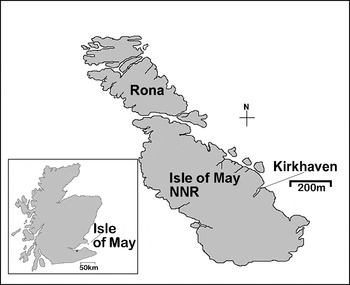
Shore crabs were collected using six creels (traps) at Kirkhaven, a mid-intertidal area on the Isle of May in May and July 2008 (Figure 1). Creels were baited with tinned fish sealed in permeable gauze containers to prevent consumption by the captured crabs. Two collections took place, the first (IOM1) was before puffin fledging had occurred (5–8 May 2008) and the second (IOM2) after fledging (29–31 July 2008). On each sampling visit the creels were deployed over three successive nights (soak time of 12 hours, total of 18 deployments before fledging and 18 after fledging). Each morning the creels were recovered and shore crabs were separated from the by-catch, and only the intermoult animals were kept. Carapace width, sex, colour form and claw dominance were measured prior to transport to the laboratory for preparation and sampling.
Map of the Isle of May (56°45′N 04°54′W) showing the location of main sampling site at Kirkhaven.

Crabs were chilled with crushed ice for 2 hours, placed in individual sample bags and then placed in a freezer (–18°C) for a minimum of 12 hours. The ‘crusher claw’ (typically the right claw; Juanes et al., Reference Juanes, Lee, McKnight and Kellogg2008) was then removed and propodus, carpus and merus muscle were dissected out. Claw muscle samples were obtained from 50 males (25 each from IOM1 and 25 from IOM2) with 50–75 mm carapace widths. Of these, hepatopancreas was sampled from 40 crabs (20 from IOM1 and 20 from IOM2). Muscle and hepatopancreas samples were returned to the freezer in individual glass vials and frozen for a further 12 hours prior to freeze-drying at –40°C for 3 days.
For comparison, the pectoral muscle from five adult and five juvenile puffins and the latissimus dorsi muscle from a male grey seal, all collected from the Isle of May in the previous season were also frozen and freeze-dried as described above.
All samples were ground with a pestle and mortar, ensuring that any carapace fragments were removed. A sub-sample (0.5–0.7 mg) from each sample was weighed out (MX5 Microbalance, Mettler Toledo, USA) into a 5 mm × 3 mm tin capsule and placed in a well plate. The δ15N and δ13C values were determined using continuous flow isotope ratio mass spectrometry using a Thermo Fisher Delta Plus XP interfaced with a Costech ECS 4010 elemental analyser at the NERC Life Sciences Mass Spectrometry Facility (LSMSF), East Kilbride, UK. Laboratory standards of gelatin and alanine were analysed within sample runs to correct for drift and linearity. Gelatin has reproducibility (SD) of around 0.18‰ for δ15N and 0.10‰ for δ13C. Both were routinely checked against primary international isotope standards provided by the International Atomic Energy Agency (IAEA) and the National Institute of Standards and Technology (NIST). The isotopic ratios for one of the main prey items (sand eel) of seabirds and grey seals in the North Sea were taken from Thompson & Furness (Reference Thompson and Furness1995).
RESULTS
In this study 43 male and 3 female shore crabs were caught in the IOM1 sampling and 56 males and 4 females were caught in the IOM2 sample. Twenty-five ‘right handed’ males from IOM1 were sampled, along with 20 ‘right handed’ and 5 ‘left handed’ males from IOM2. Carapace widths ranged from 50–75 mm in both samples. There was no evidence from these five individuals that claw type influenced either δ15N or δ13C values. IOM1 had a mean ± SD carapace width of 60.2 ± 9.42 mm and of these 14 and 10 were red and green variants, respectively. The IOM2 animals had a mean carapace width of 63.43 ± 12.17 mm, with 9 red and 16 green forms. There was no significant difference in isotopic ratio between colour types in δ15N (F1,47 = 0.07, P = 0.796) and δ13C (F1,47 = 1.06, P = 0.308) regardless of sampling period.
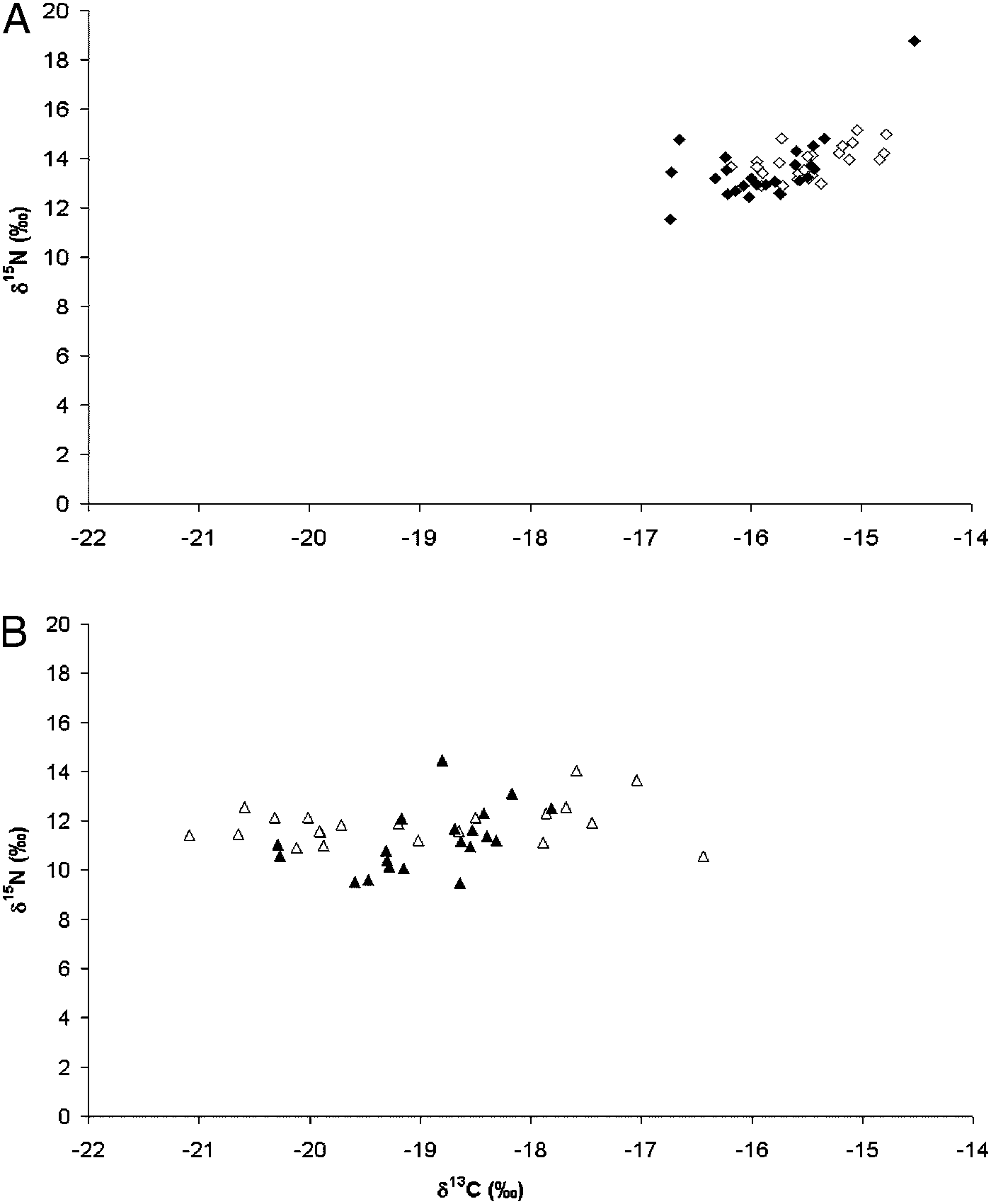
In the IOM1 sample, δ15N in claw muscle ranged from +12.88‰ to +15.15‰ (mean +13.85‰ ± 0.65SD) and δ13C ranged from –16.18‰ to –14.77‰ (mean –15.46‰ ± 0.39SD). In the IOM2 sample δ15N ranged from +10.56‰ to +14.05‰ (mean +13.53‰ ± 1.33SD) and δ13C ranged from –16.73‰ to –14.51‰ (mean –15.87‰ ± 0.49SD), (Figure 2A). There was no significant difference in δ15Nclaw (F1,48 = 1.14, P = 0.291) but there was a significant difference in δ13Cclaw (F1,48 = 10.47, P = 0.002) between sampling periods.
Stable isotope composition of the shore crab (Carcinus maenas) from (A) claw muscle and (B) hepatopancreas collected from trap-caught animals at Kirkhaven, Isle of May in May (pre-seabird fledging: IOM1, open points) and July 2008 (post-seabird fledging: IOM2, solid points).
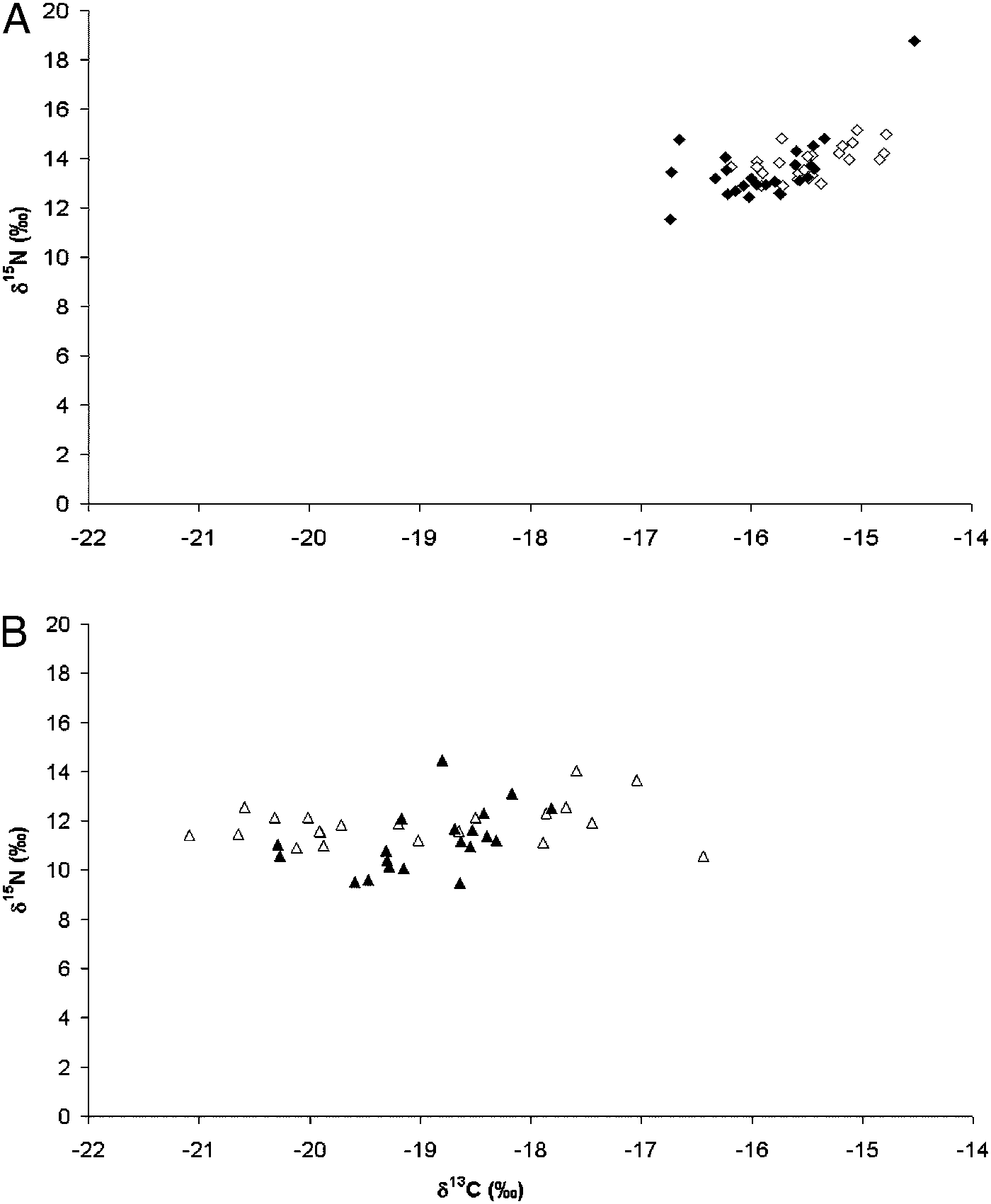
There was no significant difference in δ15Nhepatopancreas (F1,40 = 4.14, P = 0.049) between the two sampling periods (Figure 2B). δ13Chepatopancreas was highly variable and the ratio of C:N was 6.21 ± 1.42 for hepatopancreas while in the claw it was 3.42 ± 0.14. The high C:N ratio found in hepatopancreas indicated that lipids had not been effectively removed from this tissue and therefore no further analysis was carried out on δ13Chepatopancreas (a C:N ratio close to 3.2 normally indicates that most lipids have been removed).
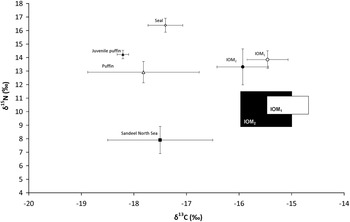
Mean differences between the isotope ratio of crab, puffin and seal were: Δ15Npuffin–IOM1 = –0.93‰, Δ15Npuffin–IOM2 = –0.39‰, Δ15Nseal–IOM1 = +2.54‰, Δ15Nseal–IOM2 = +3.09‰ (Figure 3). Δ15Nsandeel–puffin = +5.02‰ consistent with trophic enrichment for puffins feeding on sand eels (close to expected +3.4‰ with allowances for differences in location and sampling time).
Stable isotope composition of claw muscle from the shore crab (Carcinus maenas) and from tissues of potential carrion food sources (Atlantic puffin Fratercula arctica and grey seal Halichoerus grypus), together with sand eels (Ammodytes marinus) the main prey of puffin and seals. Rectangles represent the estimated position of the stable isotope ratio of potential food items consumed by shore crabs at IOM1 (white box) and IOM2 (black box). These are based on a trophic enrichment factor of 3.4‰ for δ15N and 0.39‰ for δ13C (Post, Reference Post2002).

DISCUSSION
In this study we sampled crabs close to a puffin colony, before and after fledging. We hypothesized that δ15N would increase in crab muscle between sampling periods if crabs had fed on seabird carrion due to the higher trophic level at which puffins feed. In fact, the opposite occurred. Crabs captured and sampled later in the year had been feeding at a slightly lower (but not a whole) trophic level, after the presumed period of greatest carrion availability (Figure 2).
An explanation might have been that sufficient muscle protein turnover had not yet occurred. However, in comparison to muscle, hepatopancreas tissue is a more metabolically active tissue but this also showed no significant change over this period. There was also no evidence from isotope ratios that the red shore crabs, previously shown to be larger and more dominant than green forms (Wolf, Reference Wolf1998) differed in their feeding behaviour. Therefore, the δ15N results do not support our hypothesis that shore crabs feed on puffin carrion in summer. The δ15N of muscle in grey seal was greater than in shore crabs indicating that crabs were not feeding on any seal carrion during the summer. This was expected given that the peak in seal carrion availability occurs during the autumn pupping period.
The lack of occurrence of carrion in the diet of shore crabs may have been due to the fact that carrion was not as common as expected. It is difficult to quantify the mortality of puffin fledglings and determine their fate once they have left the colony. It is likely that even if puffin mortality is high, much of the carrion is intercepted by scavenging gulls. Puffin tissue may not be a preferred food source for shore crabs due to the relatively low level of lipids in muscle. Watts (Reference Watts2008) found a higher mortality and a greater weight loss in crabs fed on puffin when compared to crabs fed on mussel tissue (Mytilus edulis), indicating that puffin may not be a staple item.
The δ15N from claw muscle and hepatopancreas did not change between the first and second sampling periods. Isotope turnover rates for these tissues in shore crabs are not known. Kurle (Reference Kurle2009) showed that in rats a switch in diet could be detected in muscle and liver after 45.3 days and 7.8 days, respectively. It is therefore likely that the sampling period in this study would have been sufficient to detect any obvious changes in the diet of shore crabs. Also as expected sand eels, puffins (adults and juveniles) and grey seals are seen to occupy a pelagic food web based around a δ13C of –17.5‰. In comparison, shore crabs have a more benthic food web with a δ13C of –15.5‰ (Figure 3), indicating that these scavenging crabs did not have access to pelagic food supply such as puffin carcases.
Unlike terrestrial systems where scavenging can be observed, the same cannot be said for marine and other aquatic systems. In future studies a wider range of food sources as well as potential carrion should be collected and measured throughout the year. In particular, a similar study undertaken before and after the grey seal breeding season would establish any transfer of nutrients from seal pups to marine scavengers. As seasonal feeding patterns have been seen in other decapods such as Nephrops norvegicus and Procambarus acutus (Dickson & Giesy, Reference Dickson and Giesy1982; Aguzzi et al., Reference Aguzzi, Sarda and Allue2004) the small variation in isotope ratios found in shore crabs in this study is likely to be only a fraction of a much wider seasonal pattern in diet.
In summary, the stable isotope ratios of carbon and nitrogen indicated that shore crabs were not feeding on carrion from seabirds such as Atlantic puffins despite its potential availability during the post-fledging period.
ACKNOWLEDGEMENTS
The authors would like to thank Dr Francis Daunt and Mr Mark Newell from the Centre of Ecology and Hydrology (CEH), for puffin samples and advice about locations on the Isle of May. William Paterson (Sea Mammal Research Unit, University of St Andrews) kindly provided the grey seal muscle sample. We would like to thank the University Marine Biological Station Millport for lending the creels and Dr Claire Peddie for letting us store them at her farm. Sampling of crabs was undertaken by a permit from Scottish Natural Heritage. Stable isotope measurements were provided by a NERC Life Sciences Mass Spectrometry Facility grant-in-kind (EK117-12-07).