Introduction
Coarctation of the aorta is the narrowing of the aorta seen typically at the isthmus distal to the origin of the left subclavian artery and near the insertion of the ductus arteriosus. Coarctation of the aorta accounts for 4–10% of congenital heart anomaliesReference Reller, Strickland, Riehle-Colarusso, Mahle and Correa1–Reference Rothman3 and many of those affected present in the neonatal period. Isolated coarctation of the aorta does occur, but most neonates present with more complex anatomy. Aortic arch hypoplasia is present in 60–80% of patients with neonatal Coarctation of the aorta.Reference Conte, Lacour-Gayet and Serraf4 Coarctation of the aorta is also commonly associated with bicuspid aortic valve, with or without left ventricular outflow tract obstruction, and ventricular septal defect (VSD).
A variety of surgical approaches have been used to repair coarctation of the aorta.Reference Ungerleider, Pasquali and Welke5 While lateral thoracotomy is the more common approach for isolated coarctation of the aorta, extended end-to-side anastomosis with arch augmentation can reduce the recurrence of re-coarctation.Reference Rakhra, Lee and Iyengar6, Reference Sakurai, Stickley and Stümper7 Although this technique is more invasive, requiring median sternotomy and cardiopulmonary bypass, it allows for more extensive arch repair and can be used as a single-stage approach for the repair of other cardiac anomalies. This is the preferred approach at our centre. Herein, we have described our experience of coarctation of the aorta repair over an eight-year period, focusing on post-operative complications and reintervention.
Materials and methods
Patients 0–1 years of age with coarctation of the aorta and/or hypoplastic arch with and without concomitant VSD were included. Patients were operated on by a single surgeon between January 2006 and December 2014. Following Institutional Review Board approval, data were gathered retrospectively from medical records. Data included demographics, pre-operative and post-operative course, operative approach, complications, outcomes, and reinterventions. Arch hypoplasia was defined as a transverse arch cross-sectional dimension with a value <−2 Z score for BSA. Patients with interrupted arch or additional significant intracardiac comorbidities were excluded. Complications assessed included vocal cord injury (paresis = cord weakness or lack of full mobility, palsy = cord immobility), post-operative chylothorax, G-tube requirement due to feeding difficulty, wound infections, sepsis, and hypertension at 6 months. Reintervention for hemodynamically significant re-coarctation was defined as balloon catheter dilatation or operative repair following initial surgery.
Results
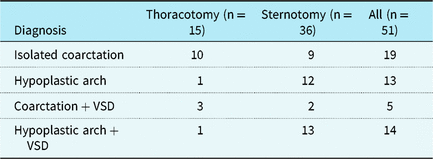
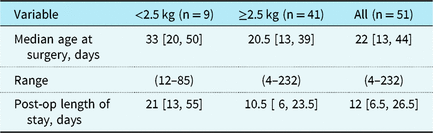
Sixty-six patients met inclusion criteria; patient demographics are summarized on Table 1. A total of 15 patients (23%) underwent lateral thoracotomy with repair by end-to-end anastomosis while 51 patients (77%) underwent median sternotomy with extended end-to-side anastomosis and cardiopulmonary bypass. Cardiac anatomy is described in Table 2 for both groups. Median post-operative length of stay was 6 days [5, 9.5] for patients who had thoracotomy and 18 days [8, 29.25] for those who had sternotomy. Patients ≤2.5 kg had a median post-operative length of stay of 27 days [14, 48.5]. Post-operative LOS for patients >2.5 kg was 10 days [6, 21.25] (Table 3).
Patient demographics.

Summary of cardiac anatomy per group.

Mean age and length of stay summarized by weight.

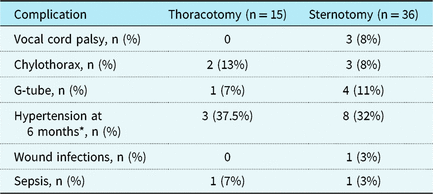
Summary of post-surgery non-cardiac complication.

Complications
There was one death occurring secondary to non-cardiac causes (airway complication) during recovery in the CICU. Complications included chylothorax in 5 (9.8%), G-tube feeding requirement in 8 (12.1%), vocal cord palsy in 2 (3%) and vocal cord paresis in 10 (15%) (Table 4). Additionally, one patient became septic secondary to staphylococcal epidermidis PICC line infection. This patient also accounted for the only incision site infection during post-operative hospitalization. A second patient developed gram-negative sepsis. All infections were resolved with antibiotic treatment. Data for post-operative hypertension were available for 33 patients. Of these, 10 (30.3%) developed systemic hypertension at six months post-op. Among those, 4 were patients weighing ≤2.5 kg (33%) at the time of surgery and 6 were patients >2.5 kg (9%) (p < 0.05).
Reintervention
Nine patients (13.6%) required any form of reintervention and four (6%) required surgical reintervention. Three of these patients underwent balloon angioplasty alone, one had redo sternotomy with arch repair using homograft patch augmentation, and two underwent balloon angioplasty and later required surgical reintervention with aortic arch patch augmentation. When classified by weight, one patient weighing ≤2.5 kg (8.3%) and three patients weighing >2.5 kg (5.4%) required surgical reintervention. In the sternotomy group, four patients (11.1%) required surgical reintervention, while in the thoracotomy group, two patients (13.3%) required surgical reintervention.
Discussion
There has always been the belief that some degree of aortic hypoplasia often exists with coarctation of the Aorta. As the neuro-developmental outcomes continue to be no worse among patients undergoing short-length cardiopulmonary bypass, there is more confidence in the midline approach as the latter might result in no residual arch gradients compared to a focal thoracotomy.
Our data indicate the relative safety of the procedure with the only mortality related to an airway event post-procedure. As cardiac centres gain more experience in the context of complex cardiac lesions, surgical times and procedures during cardiopulmonary bypass continue to decrease with lesser complications. Among short-term complications, vocal cord paresis and paralysis (15%) were the most common. This is lower than currently published literature with some reports noting a 25–30% degree of vocal cord dysfunction and need for a Gastrostomy tube.Reference Pham, Connelly, Wei, Sykes and O'Brien8 In our cohort, 12% of our population needed a G-tube. Pham et al. when comparing vocal cord dysfunction and associated dysphagia post-Norwood repair and isolated coarctation repair noted similar degrees of dysphagia, indicating this complication inherent to the site of instrumentation rather than the complexity of repair.Reference Pham, Connelly, Wei, Sykes and O'Brien8 There were no patients who required a tracheostomy following the operation.
Long-term complications related to residual systemic hypertension were present in 30% of the studied population. The incidence (although not statistically significant) was slightly lower in the sternotomy group. Re-intervention rates were comparable in the thoracotomy group although numbers are limited in this group. The re-intervention rates were also higher in smaller babies probably related to smaller arches taking a longer time to grow even after initial repair.
In the cohort <2.5 kg, the smallest child was 1.25 kg. Re-intervention rates were higher in this particular group compared to the larger babies at time of surgery with a similar degree of residual hypertension. This is in contrast to Bursch et al. who noted in their evaluation of 197 patients that low weights did not affect outcomes in re-intervention rates after coarctation repair in neonates and infants less than 3 months of age.Reference Burch, Cowley and Holubkov9
Our data are similar to other centres that there is an increasing trend towards the use of median sternotomy in the repair of isolated neonatal coarctation. The advantages of the decreased rate of re-coarctation as well as post-operative systemic hypertension continue to evolve with a decreasing trend towards the same. The incidence of other post-operative complications continues to be slightly higher in the sternotomy and this needs to be factored in whenever such a decision is made with regard to surgical approach. There needs to be ongoing assessment of multicentre data to assess if the recent shift in strategy to use a midline approach confers the benefit that an isolated thoracotomy traditionally accomplished.
Limitations
Limitation of this study is its retrospective nature. Over the period of the study, the surgical team had a gradual change in strategy to median sternotomy for coarctation of the aorta repair. In addition, over the last three years of the data period, patients are cared for in a paediatric cardiac intensive care unit (ICU) as opposed to a general paediatric ICU. Consistent data on the use of antihypertensive medications are not available as some patients have left the medical system.
Acknowledgments
This project was partially funded by the NCATS grant UL1 TR000064.