Introduction
Language observers may have noticed the existence of two past tense forms for the verb to sneak in American English, sneaked and snuck. Interestingly, both forms have not always coexisted; the original form is sneaked, and snuck has only recently become a real competitor for sneaked (Hogg, Reference Hogg and Nixon1988: 31–32). The verb to drag seems to be somewhat in the same situation with the original past tense form dragged as well as the new form drug (Bybee & Moder, Reference Bybee and Moder1983: 252). However, drug is much less frequent than snuck. Murray's (Reference Murray1998) study on the attitudes towards snuck and drug suggests some difference in the usage of these forms across registers.
This study investigates the historical development of the neologisms snuck and drug in American English as well as their current distribution across registers in British and American English and relates the register distribution to Murray's (Reference Murray1998) attitude data.
Strong and weak verb patterns
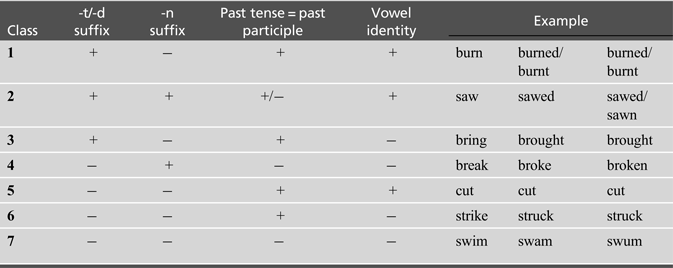
Historically, drag and sneak were weak verbs with the past tense and past participle forms dragged and sneaked (Simpson & Weiner, Reference Simpson and Weiner2010). The distinction between weak and strong verbs is somewhat related to the distinction between regular and irregular verbs, yet this relation is not uncomplicated. While regular English verbs form their past tense and past participle by adding -ed to the stem, there are a number of ways in which English verbs can be irregular. Quirk et al. (Reference Quirk, Greenbaum, Leech and Svartvik1985: 104–105) distinguishes seven classes of irregular verbs (see Table 1), some of which are strong verb classes (classes 4, 6 and 7). In the strong verb pattern, past tense and past participle forms are formed by changing the stem vowel (Strang, Reference Strang1970: 196). Comparatively, in the weak verb pattern, the past tense and past participle are formed by adding a /t/ or /d/ suffix. The weak verb pattern thus consists of all the regular verbs and those irregulars that have /t/ or /d/ inflection (classes 1, 2 and 3). Note that the /t/ or /d/ inflection may substitute a final /d/ in the root as in build/built and bleed/bled, and that some irregular weak verbs have vowel change stemming from sound changes (Strang, Reference Strang1970: 147, 196). While weak verbs use the same form for both past tense and past participle, strong verbs may use the same form or different forms for the past tense and the past participle (Quirk et al., Reference Quirk, Greenbaum, Leech and Svartvik1985: 103).
Classes of irregular English verbs.
From Quirk et al. (Reference Quirk, Greenbaum, Leech and Svartvik1985: 104).

The strong verb pattern is inherited by all Germanic languages, including English, from Proto-Indo-European, whereas the weak verb pattern is a Germanic innovation (Taylor, Reference Taylor1994: 143). Thus, even though the strong verb pattern is historically older than the weak verb pattern, the weak verb pattern has proved very productive, now counting the vast majority of Germanic verbs. In Old English there were approximately 360 strong verbs, yet in Present Day English there are only around 60 strong verbs left (Strang, Reference Strang1970: 147). Among the original strong verbs that have changed to weak verbs since the Old English period are climb, help, melt, step, walk and wash (Greenbaum, Reference Greenbaum1996: 133). This very strong productivity of the weak verb pattern fits in with the overall trend towards regularisation in linguistic change (Strang, Reference Strang1970: 98–101; 146–148). Interestingly, in spite of the general trend towards regularisation, there are some instances of change in the reverse direction, for example, the verbs sneak and drag, which were originally weak, have developed new strong forms, namely snuck and drug.
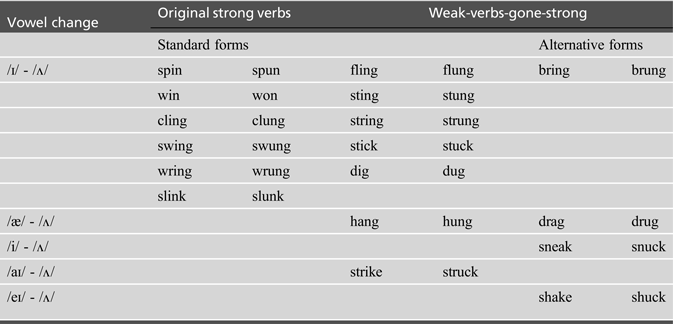
Snuck and drug are not the only examples of this unexpected change. Five other originally weak verbs developed a strong form in the 16th century. These are hang/hung, string/strung, stick/stuck, strike/struck and dig/dug. Even more interesting is that the strong past tense forms that developed for these five verbs have the same vowel as snuck and drug, namely /ʌ/ (Hogg, Reference Hogg and Nixon1988: 34). While the sound pattern of the drag/drug alternation has an analogical form in the hang/hung alternation, no verb has the alternation /i/ in the present tense and /ʌ/ in the past tense similar to sneak/snuck (Hogg, Reference Hogg and Nixon1988: 32–33). As can be seen from Table 2, the /ɪ/ -/ʌ/ alternation is common, while hang/hung and drag/drug are the only examples of the /æ/-/ʌ/ alternation, and sneak/snuck is likewise the only example of the /i/-/ʌ/ alternation.
English strong verbs with past tense and past participle in /ʌ/.
Based on Bybee & Moder (Reference Bybee and Moder1983: 122)
The existence of several weak-verbs-gone-strong with similar vowel patterns shows that productivity is not a prerogative of regular verbs. And, as will be seen below, this change seems to take place despite negative attitudes towards the newer forms.
Attitudes towards drug and snuck
The Oxford Advanced Learners’ Dictionary (OALD) (Turnbull et al., Reference Turnbull, Lea, Parkinson, Phillips, Francis, Webb, Bull and Ashby2010) states that snuck is ‘very common in informal speech in North American English and some people use it in British English too. However, many people think that it is not correct and it should not be used in formal writing.’ According to the Oxford English Dictionary (OED) (Simpson & Weiner, Reference Simpson and Weiner2010), snuck is originally and still chiefly an American English phenomenon, and the earliest example of snuck in the OED is from 1932. Drug, on the other hand, is not mentioned in the OALD at all, and the OED describes it as ‘nonstandard and regional’. The OED further states that drug is primarily used in the Southern and Midland US.
In line with the OALD and OED descriptions of snuck and drug as incorrect and nonstandard, Murray (Reference Murray1998) found that many Midwestern American speakers had negative attitudes toward snuck and drug, but not toward their regular counterparts sneaked and dragged. Nevertheless, Murray's data suggested no regional affiliation in terms of traditional dialect boundaries for either drug or snuck. Instead, there seems to be an effect of socio-economic class on the preference of dragged to drug, in that the irregular form is less likely to be accepted by speakers of the highest socio-economic class than by speakers of the middle or lower socio-economic classes. Furthermore, for a majority of speakers in all socio-economic classes, drug is perceived as ‘incorrect’, while dragged is perceived as ‘correct’. There is no such socio-economic effect on the acceptance of snuck, which is much less stigmatised and more broadly accepted than drug, though snuck is considered informal by some speakers and elicits some negative comments. Creswell (Reference Creswell, Little and Montgomery1994: 154) even suggests that snuck may be in the process of replacing sneaked as the standard past tense form of the verb to sneak. This is in line with Murray's (Reference Murray1998) apparent-time data, which suggests that snuck and drug may be on the rise, as their acceptance is significantly higher among younger speakers than among older speakers and drastically so for snuck.
Murray's (Reference Murray1998) findings may reflect a difference across registers with respect to the choice between the regular and the irregular form, such that sneaked and dragged are perceived as more correct and associated with upper-class speech because they are the preferred forms in formal and written registers, while snuck and drug are perceived as colloquial and less correct because they are the preferred forms in informal and spoken registers, with this preference for the regular form being stronger for drag than for sneak.
The study
This article presents a study on the usage of snuck and drug, using corpus data, thus bringing the data on snuck and drug up to date by looking at real-time data for the historical development of snuck and drug as well as the current variation across geographic varieties (British and American English) and registers with respect to the usage of snuck and drug. Hence, the study investigates when snuck and drug were first attested, whether these new past tense forms are increasing or decreasing in usage in American English, whether the new forms are more common in British or American English, and in which registers the new forms primarily are used as well as relates the register distribution to Murray's (Reference Murray1998) attitude data.
Data and methods
The present data stem from two corpora of American English and one corpus of British English. The contemporary data used for a comparison of British and American English and register distribution within the two varieties are from the Corpus of Contemporary American English (COCA) and the British National Corpus (BNC). COCA currently consists of 450 million words and covers the time period 1990–2012. New texts and transcriptions of speech are regularly added to COCA, allowing it to be continually up to date. The BNC covers the years 1980–1993 and consists of 100 million words. The corpus used for historical American data is the Corpus of Historical American English (COHA), which covers the period from 1810 to 2009 with 400 million words evenly distributed over the years covered. All three corpora are divided into the following registers: spoken, fiction, magazine, newspaper and academic.Footnote 1
The register distribution for the historical data was disregarded, as there are too few tokens for each decade to allow for an analysis of register variation over time. Past tense and past participle are analysed together as there are too few tokens to allow for separate analyses of the two forms. Thus, the term past tense is used to refer to the past tense and the past participle collectively. As seen below, there are very few drug tokens in the data, which unfortunately limits the number of statistical analyses that can be performed on the dragged/drug data.
In order to count only verbal occurrences, the corpus searches were restricted by means of PoS-tags (Part of Speech tags), which are easily applied in all three corpora. The specific PoS-tags used here were [snuck].[v*] and [drug].[v*], which search for all verbal occurrences of the words snuck and drug respectively. Since the form snuck unambiguously refers to the past tense form of the verb to sneak, a simple search gives the same result as the PoS-tagged one. The form drug, however, is ambiguous between the noun drug the verb to drug and the past tense form of the verb to drag. A search restricted by the PoS-tag [drug].[v*] returns a combined count of the two verbal uses. The search options in BNC, COCA and COCA offer no way of distinguishing between these two verbal uses of the form drug, so all occurrences returned by the [drug].[v*] tagged search were manually analysed and categorised as either a present tense or infinitival form of the verb to drug or a past tense form of the verb to drag. The drug counts thus represent the result of this manual analysis.
The historical development of snuck
Neither of the past tense forms of sneak appear in COHA until the 1830s, when the first instance of sneaked is attested. The first instance of snuck is attested in 1889. Both forms increase in usage from their first occurrence to 2009, suggesting that the use of the verb to sneak is becoming more common in this period. The relative increase of snuck starts off slowly, and snuck is not a serious competitor until the 1960s, when its increase accelerates. Figure 1 shows the absolute usage of the two past tense forms of the verb to sneak over time, and Figure 2 shows the relative usage of the two past tense forms over time.
Number of sneaked/snuck tokens (absolute numbers) in American English over time. Data from COHA.
Per cent sneaked/snuck tokens in American English over time. Data from COHA.
Statistical analyses show a significant increase in the use of snuck relative to sneaked and a strong correlation between decade and per cent snuck occurrences. These results suggest that the absolute increase in snuck occurrences (as shown in Figure 1) is not only due to a general increase in the use of the verb to sneak, but also due to an increased tendency to use snuck instead of sneaked as the past tense form of sneak (as shown in Figure 2).Footnote 2
The historical development of drug
Interestingly, the first instance of drug in COHA is attested in the same decade as the first instance of snuck, namely the 1880s. However, drug never gains the same frequency as snuck. In contrast to snuck, which increases drastically, drug is rare or not attested at all for all periods in COHA (see Figure 3). Dragged increases in absolute terms, though not steadily. The verb to drag seems to be more frequent overall than the verb to sneak, which makes the small numbers of drug even smaller in relative terms.
Number of dragged/drug tokens (absolute numbers) in American English over time. Data from COHA.
Figure 3 shows the absolute usage of the two past tense forms of the verb to drag over time. No figure of the relative usage is presented due to the very low number of drug occurrences. Statistical analyses did not show a significant increase in per cent drug occurrences, thus providing no evidence that the relative occurrence of drug increases over time.Footnote 3
Variety and register variation for snuck
The BNC and COCA data suggest that British English has an overall preference for sneaked, while both past tense forms of the verb to sneak are almost equally common in American English, which shows a slight preference for sneaked. Statistical tests confirm this pattern.Footnote 4
Three American English registers show a preference for one of the forms; snuck is favoured in speech and sneaked is favoured in academic and newspaper writing, but none of these preferences are close to categorical. In British English, there is a strong preference for sneaked in all registers, and snuck is generally rare. In both varieties, the register with the highest relative frequency of snuck is the spoken register. There is no evidence that the register distribution differs for British and American English. For the combined counts from both varieties, the spoken register is the only register that differs significantly from all the other registers.Footnote 5 These results thus suggest a main difference between speech and writing, which, in the light of Murray's (Reference Murray1998) findings, can be seen as evidence that there is a link between register distribution and attitudes. It thus seems plausible to suggest a relation between the reported attitude that snuck is less correct than sneaked and the observation that the neologism snuck primarily is used in speech, while the ‘safer’ form sneaked prevails in writing. Figure 4 shows the relative usage of sneaked and snuck across registers for both American and British English.
Per cent sneaked/snuck tokens divided by register in British and American English. American English data from COCA. British English data from BNC.
Due to the smaller size of the BNC and the very low frequency of snuck in this corpus, all numbers and especially those for the registers that show a 100 per cent preference for sneaked should be treated with caution and cannot be taken to imply categorical usage of sneaked. It should, moreover, be noted that the BNC only covers the years 1980–1993, so it is not possible to say anything about the usage of snuck after 1993. Based on the historical American English data, there is reason to infer, as suggested by Creswell (Reference Creswell, Little and Montgomery1994: 152), that snuck may be increasing in British English too, but unfortunately the BNC does not provide comparable data to investigate this hypothesis.
Variety and register variation for drug
It is noteworthy that there are no instances of drug as past tense or past participle forms of drag in the BNC. Also, drug is quite rare in COCA, where it is most common in the spoken register, but even here it only makes up 3 per cent of the past tense and past participle forms of drag. Drug is not that rare in all areas of the US though, as shown by Bernstein's (Reference Bernstein, Little and Montgomery1994: 140) finding that 39% of high-school students in Silsbee, Texas, prefer drug to dragged.
Despite the infrequency of drug in both BNC and COCA, there is a significant association between variety and relative use of dragged and drug,Footnote 6 thus supporting the observation that drug is primarily an American English occurrence. Similar to the snuck data, the smaller size and the years of coverage of the BNC need to be taken into consideration, so that even though the BNC data suggests categorical usage of dragged in British English, there may be instances of drug in British English not reported in the BNC. Figure 5 shows the relative use of dragged and drug in British and American English.
Per cent dragged/drug tokens divided by register in British and American English. American English data from COCA. British English data from BNC.
Conclusion
Summing up, snuck and drug are neologisms first attested in the 1880s. The present real-time data supports Murray's (Reference Murray1998) suggestion, based on apparent-time data, that snuck, if not replacing sneaked, then at least is increasing in relative use. Drug, on the other hand, stays a minority form over time, and there is no evidence that the form is becoming common. Snuck is generally much more common than drug, in both British and American English. Furthermore, both strong past tense forms are more common in American English than in British English. With respect to register, the strong form is most common in the spoken register for both American and British English and least common in the academic and newspaper registers, which could be taken to support an association between language use and language attitudes, (as reported by Murray, Reference Murray1998); the idea that snuck is informal may be related to the fact that snuck is mainly used in informal registers and rarely in formal ones. This relation is even more distinct for drug, as drug is much less used, and if so chiefly in speech, and thus elicits heavier negative attitudes.
Further research may investigate whether snuck has become more common in British English since 1993, and whether drug has spread to British English since 1993. More recent and comparable corpus data on British English after the BNC cut-off point is much needed in order to answer these and other questions about current British English.
CAMILLA SØBALLE HORSLUND is currently a PhD student of English Linguistics at Aarhus University, Denmark. Her linguistic interests are broad and include second language acquisition, regional and register variation, and on-going changes in present-day English. Her PhD project investigates the relationship between levels of language (e.g. phonetics and phonology, syntax and the lexicon) in second language acquisition. Prior publication: ‘Polemic and Descriptive Negations. The Effect of Prominence and Register on the Interpretation of Negations’, in (Pré)publications 197: Aarhus, 2011. Email: engcsh@dac.au.dk