Dhanapāla and His Prose Poem
The Tilakamañjarī, Dhanapāla's poem in prose (gadyakāvya) is one of the masterpieces of classical Sanskrit literature and deserves to be better known. What he says in one of the introductory verses about his contemporary audience is also true about the readers of our time: “People, smelling danger, turn away from prose which contains a forest of unbroken lines (i.e. compounds filling whole lines) and lots of descriptions, as they keep away from the many-coloured tiger which lives in the dense Daṇḍaka forest”.Footnote 1 Although Dhanapāla shows more restraint in his descriptions and in the use of alliteration and long compounds than his illustrious predecessor Bāṇa, the extremely intricate plot of the Tilakamañjarī might discourage those who otherwise appreciate Sanskrit poetry. I am certain, however, that once a taste for gadyakāvya is acquired all these deterring factors turn into sources of delight.Footnote 2
Dhanapāla was a celebrated scholar and poet of his time. He worked under the patronage of several Paramāra rulers in the tenth and eleventh centuries: he completed his Prakrit lexicon in the year when king Sīyaka sacked Mānyakheṭa (972–973),Footnote 3 received the title Sarasvatī from king Muñja (reg. circa 973–995)Footnote 4 and composed the Tilakamañjarī for the most renowned Paramāra king, Bhojadeva (reg circa 1000–1055).Footnote 5 According to Jain legends, Dhanapāla had been the chief pandit in Bhoja's assembly for several years when he was converted to Jainism by his brother Śobhana;Footnote 6 that he wrote the Tilakamañjarī after his conversion is evident from the very first verse in which he invokes the Jina. Bhojadeva, if one can believe the later Jain biographies, was not amused when the poet recited his magnum opus in front of him, even though a golden bowl had to be placed under the book to collect the ambrosial rasa flowing from it. While the king might have preferred a gadyakāvya extolling his own glorious exploits (more along the lines of Bāṇa's Harṣacarita perhaps), at least he wanted to see his own name in the novel as that of the hero, and Dhārā, his capital city, as the hero's city. And he wanted, finally, the references to Jain holy sites replaced with Śaiva ones. But he made the most insulting comment on the first verse: misinterpreting the first two syllables, sa vaḥ as śavaḥ, he suggested Dhanapāla to get rid of the ‘corpse’ and replace it with Śiva. Dhanapāla, however, replied that these changes would pollute his work, and those who cannot distinguish the three sibilants sa, śa and ṣa are like snakes (or, punningly, scoundrels, dvijihva), betraying their low birth. Bhoja was furious and threw the manuscript into a fire. Later Dhanapāla could restore most of his work thanks to the memory of his brilliant daughter.Footnote 7
How much of this story belongs to the realm of pure fiction is impossible to tell. Granoff, in her study on Jain legendaries, very aptly remarks that “the biographies of poets we are given are remarkably stable and consistent, so much so that we are tempted to speak not of ‘biographies of poets’ but of a ‘biography of the poet’”.Footnote 8 Still, it is certainly true that the Tilakamañjarī is not a Bhojacarita and a Māheśvara king might have favoured a tale with a more Śaiva orientation. Not that Dhanapāla's novel is overbearingly Jain, let alone proselytising. It is a tale about saṃsāra, the world of transmigration and the workings of past karma determining the characters’ fate in their present life. The intricacy of the plot reflects, as Warder pointed out, the complex interconnectedness of people's fates.Footnote 9 Divine agency enters the plot through the Goddess of Fortune, Śrī or Lakṣmī, who, within the frame of karmic law, helps two celestial couples find each other again in their human incarnations. But the reader will only be told towards the end of the novel that the god Jvalanaprabha was reborn as Harivāhana, the hero of the story, whose prospective father, Meghavāhana, had been put to the test by the Goddess at the beginning of the tale.
King Meghavāhana's Encounter with a Vetāla
The novel begins with a problem well-known in Indian literature: Meghavāhana, the king of Ayodhyā, and his chief queen are unhappy because they have no son. A visiting sorcerer sage (vidyādharamuni) advises the king to worship Rājalakṣmī, the Fortune of Kings, who is “gentle by nature, always present, the family deity of all kings”.Footnote 10 “You are worthy of the respect of the whole world – says the sage to the king – you are pure and pious, you control your senses, you have firm devotion and a truly noble heart, you avoid negligence and know what is appropriate on different occasions, you have regularly demonstrated your valour befitting your kṣatriya class: if you worship her duly, whose favour was secured by the heroism of Ikṣvāku, Bharata, Bhagīratha and other kings and who ab ovo sides with your lineage, she would surely become gracious and grant you before long the thing you wish for as a boon”.Footnote 11 Obeying the sage's advice, the king builds a temple for Rājalakṣmī where he diligently worships her image every day.
One day Meghavāhana visits the temple of Ṛṣabha at Śakrāvatāra near Ayodhyā and there the god (vaimānika) Jvalanaprabha gives him a divine pearl necklace that belonged to his wife and with the help of which she will recognise her husband in their next, human incarnation.Footnote 12 Meghavāhana offers the necklace to Śrī during his evening worship with the following words: “O Goddess! It is the result of venerating your lotus-feet that celestial beings – who are honoured in all the three worlds and whose power matches Indra's – wish to appear in the presence of people like me, a mere human, and make their form, which belongs to the sphere of yogic cognition, directly visible, and, showing respect, confer dignity upon me with great honours such as bestowing a glance and conversation. And as for this, although that magnanimous divine person, a disinterested friend whose thoughts are supremely devoted to helping others, handed over one of his ornaments that adorned his body, still it belongs to you. Therefore it should not touch my body, for divine bodies are the worthy recipients of divine ornaments. So let someone belonging to your entourage have it, or let it attain again supreme splendour suited to its [former] position in the world of gods, even if it has come to the world of men as a consequence of the unseen workings of karma”.Footnote 13 Then he places the necklace at the feet of the image of the Goddess.
At that moment the king hears a blood-curdling laugh; he is surprised and finds the situation somewhat curious but not at all frightening. Then he notices a horrible vetāla appearing on the left side of the Goddess: he is immensely tall, his emaciated body radiates blackness, he wears bone ornaments and a tiger-skin wet with blood and snake-poison; he carries a skull-bowl filled with gore and he snacks on the body of a failed magician.Footnote 14 Meghavāhana remains serene, takes a good look at the creature and asks with a smile the cause of his unseemly laughter. But why does the king remain composed? Why does he smile? When we read Dhanapāla's description of the vetāla, horror and disgust seem to be the appropriate reactions to such an apparition. On the other hand, some characteristics of the monster are so ‘over the top’ that they border on being funny in a slightly morbid way. For example, “He displayed a chest dark like a layer of fresh mud on which, in the hollows between its ribs – the protrusion of which was made visible from afar due to the extreme leanness of his body – baby snakes were slumbering: it was like a field of unrighteousness present before one's eyes, on which poison sprouts densely in the wake of the plough”,Footnote 15 or “His skull-bowl, filled with gore, slipped from the squeeze of his fingers separated by its massive weight and the flood of spilling blood tore off the jars on the temple's columns. Then with his left hand – the arm connected to which was shown to have extremely miraculous length by his power – he pulled back the bowl, as massive as the frontal globe of the elephants guarding the quarters, into the same upright position, though it had rolled far away”,Footnote 16 or “Under his left armpit he tucked the neck of a vetāla-sādhaka Footnote 17 who had delivered a blow with his sword in vain and who was crying out this-and-that extremely pitifully from inside, like a sacrificial animal, as his breath that had been firmly held back escaped. Meanwhile the vetāla kept cutting slices of meat with his right hand – in which he was constantly brandishing a sharp knife – from the sādhaka's limbs that had been roasted in the poisonous fire flaming up from the mouth of the venomous snake that was his waist-band, and ate them together with the sādhaka’s bones as a condiment”.Footnote 18 Meghavāhana perhaps smiles at the absurdity of a black, grisly vetāla appearing in the temple of the white, benign Goddess.
The vetāla, for his part, finds the king's procedure of worship ridiculous. He thinks that one should gain the favour of servants before approaching the master, and he being the chief attendant of Śrī (svaparijanaprāgrahara) surely deserves preferential treatment. Meghavāhana's reaction shows that he cannot take the situation seriously, his answer is decidedly ironical (sopahāsa): “All you've said is correct, there is no fault in your argumentation. I've been enlightened”.Footnote 19 He is very sorry that he has neglected the vetāla who is “endowed with the wealth of all qualities of someone worthy of service” (sarvasevyaguṇasaṃpadupetaṃ) and offers him some fruit and sweets he brought for the pūjā of the Goddess. The vetāla laughs at the proposition and points out the obvious, namely that he is not vegetarian. Anyway, he can appease his hunger with the limbs of those many vile magicians who try to harm his mistress. What he really needs is a skull-bowl he could use at the libation ceremony (tarpaṇa) for his father who was killed by a wicked magician, and he presumes that the king, as a good warrior, has a decent stock of heads cut-off in battle.
Meghavāhana – still smiling – is very sorry that he has no supply of skulls readily available, but he is more than happy to offer his own head, provided that it has the necessary auspicious marks (śubhalakṣaṇa). The vetāla considers himself fortunate to receive such an offer, grinds his knife and offers it to the king. Meghavāhana, without batting an eyelid, declares himself unworthy of being killed by a divine weapon and prepares to decapitate himself with his own sword. But he cannot completely behead himself, because his right hand becomes paralysed and then he passes out. In the next moment acclamations of heavenly women are heard, and Goddess Śrī herself appears on a white lotus, surrounded by divine ladies. The king recognises her, but he still has a sneaking suspicion that this is just another attempt to scare him, so, without any sign of agitation, he addresses her as a common woman: “Who are you, madam? Why have you come to this temple?”Footnote 20
The Goddess introduces herself as Rājalakṣmī and asks Meghavāhana what she could do for him. The king's only wish is to finish beheading himself so that he can go to final extinction, having paid off his debt to the vetāla. Lakṣmī is yet more impressed and says:
“King, you are certainly not familiar with my nature and that is why you speak in this way. I have always been surrounded by gentle attendants, nocturnal demons don't even come near me, let alone become my servants. This weird fellow here in a strange outfit, whom you have put down as a vetāla, is not an evil demon. He is the chief of my doorkeepers, the yakṣa called Mahodara. He did not wait for my arrival but came straight away to perform a test of courage and he showed you all this realistic and complex magical apparition which he conjured up with his own divine power”.Footnote 21
Since there is no need to behead himself any more, the king can come forward with his real request, and the Goddess promises him that he will have a most illustrious son. She also tells Meghavāhana to give the divine necklace to his son once he has grown up (at this point in the story only Lakṣmī knows that prince Harivāhana will be a reincarnation of Jvalanaprabha, the god to whom this necklace originally belonged; Meghavāhana and the reader will only get the full picture towards the end of the novel).
Goddesses and Head-Offerings
Dhanapāla has been labelled as an epigone of Bāṇa by several scholars of classical Indian literature.Footnote 22 But, as Kansara pointed out, Dhanapāla wished to emulate Bhāṇa and a careful reading of the Tilakamañjarī shows not just the similarities but also the differences between the works of these two masters of Sanskrit prose.Footnote 23 Instead of simply cataloguing the items Dhanapāla borrowed from Bāṇa's works, it might be more fruitful to study how and why Dhanapāla modified the material of his intertexts, to examine the ‘alchemy’ of his allusions.Footnote 24
Meghavānaha's encounter with Rājalakṣmī and the vetāla certainly calls to mind the story of King Puṣyabhūti in Bāṇa's Harṣacarita. Puṣyabhūti undertakes to act as an assistant of Bhairavācārya, a Śaiva sādhaka, in the performance of a fire sacrifice (a homa-type sādhana) that conjures up a vetāla.Footnote 25 The king has been “initiated by Śaiva procedure” (śaivena vidhinā dīkṣitaḥ)Footnote 26 before he sets out on the fourteenth night of the dark half-month to the cremation ground where the sādhana is going to take place. In the description of Puṣyabhūti's journey, Bāṇa foreshadows several aspects of the following events. For instance, “encircling spots of darkness that occupy the bottom of the netherworld appeared to impede [his progress], as if demons dwelling at the bottom of the netherworld were rising to form obstacles [of the ritual]”,Footnote 27 or “he was being followed by Rājalakṣmī though she had not been commanded to do so”.Footnote 28 At the place of the sacrifice the king and the three disciples of Bhaivavācārya take up positions as guardians of the quarters (Puṣyabhūti guards the southern direction), thus, as Bāṇa fancies, forming a protective cage with their arms around the maṇḍala. And protection is indeed necessary to keep away the noisy goblins who are trying to disrupt the ritual.Footnote 29
Just after midnight a serious obstacle arises in the form of a giant, dark, human-like being who springs up from a chasm near the maṇḍala. He turns out to be Śrīkaṇṭha, the protective serpent deity (kṣetrādhipati nāga) of the region, outraged at not being given bali offering by the sādhaka. The king defeats the insolent nāga, but spares his life when he notices his sacred thread. At that moment Śrī manifests herself in the middle of his magic sword called Aṭṭahāsa (“[Śiva's] boisterous laughter”) that was once presented to him by Bhairavācārya. The goddess of royal fortune, won over by the king's heroism, grants him a boon. The selfless Puṣyabhūti requests siddhi (success or magical attainment) for Bhairavācārya, which Lakṣmī grants, and she also promises that Puṣyabhūti will be the founder of a great royal lineage in which one day a universal emperor called Harṣa will be born.Footnote 30 From the perspective of the ritual, the disruptive appearance of the nāga is a major obstacle (vighna) to be overcome, and it is the task of the assistant to ward off the obstacle, while Bhairavācārya presumably continues the performance of his homa. Lakṣmī's first offer of a boon might also be regarded as an obstacle, but the king is wise enough (and perhaps not simply altruistic) to request success for the sādhaka.
In the Tilakamañjarī, Meghavāhana has no intention of taking part in a vetālasādhana. The radiating whiteness of everything connected with his worship is in stark contrast to the ubiquitous blackness of the nocturnal ritual in the Harṣacarita. The appearance of the vetāla is not compatible at all with the worship of Lakṣmī, and the king's smile betrays that he is aware of the absurdity of the situation. He seems to realise that what he sees might not be real, that it might, in fact, be a test of courage (vibhīṣikā). Puṣyabhūti demonstrates his valour by defeating a serpent deity of superhuman strength, his adherence to dharmic values by sparing the nāga’s life after noticing the symbol of his brahmanhood, and his generosity by using Lakṣmī's offer for the benefit of the sādhaka. Dhanapāla's hero also knows the rules of the game and he comes forward with his real request only after showing his selfless and disinterested nature.
In the Harṣacarita, the head that is almost severed does not belong to the hero but to his enemy, the nāga. In Dhanapāla's novel, Meghavāhana's altruism goes as far as offering his own head to the strange attendant of the Goddess: “He girded himself, made obeisance to the deity (i.e. Lakṣmī), then rocked the jewelled floor in a dignified manner with his left leg, its steady shank kept upright, and with the joint of his right knee turned sideways. Because he was afraid that his skull might escape, he grasped with his left hand the mass of his hair that had been tied up, and smote upon his own broad shoulder, discarding mercy, with his sword which resembled the staff-like smoke of the fire of Death's anger”.Footnote 31 The vetāla offers his own knife but Meghavāhana prefers to use his own sword: perhaps this better suits his self-sacrifice (not to mention the fact that the monster's knife is pretty disgusting). Moreover, before striking with his sword he bows to the Goddess, and this sign of worship indicates that the ultimate recipient of his offering is Lakṣmī. When later the king refers to this incident he does not even mention Mahodara, just says that Rājalakṣmī became extremely pleased when she witnessed the heroic act (sāhasa) of decapitation.Footnote 32
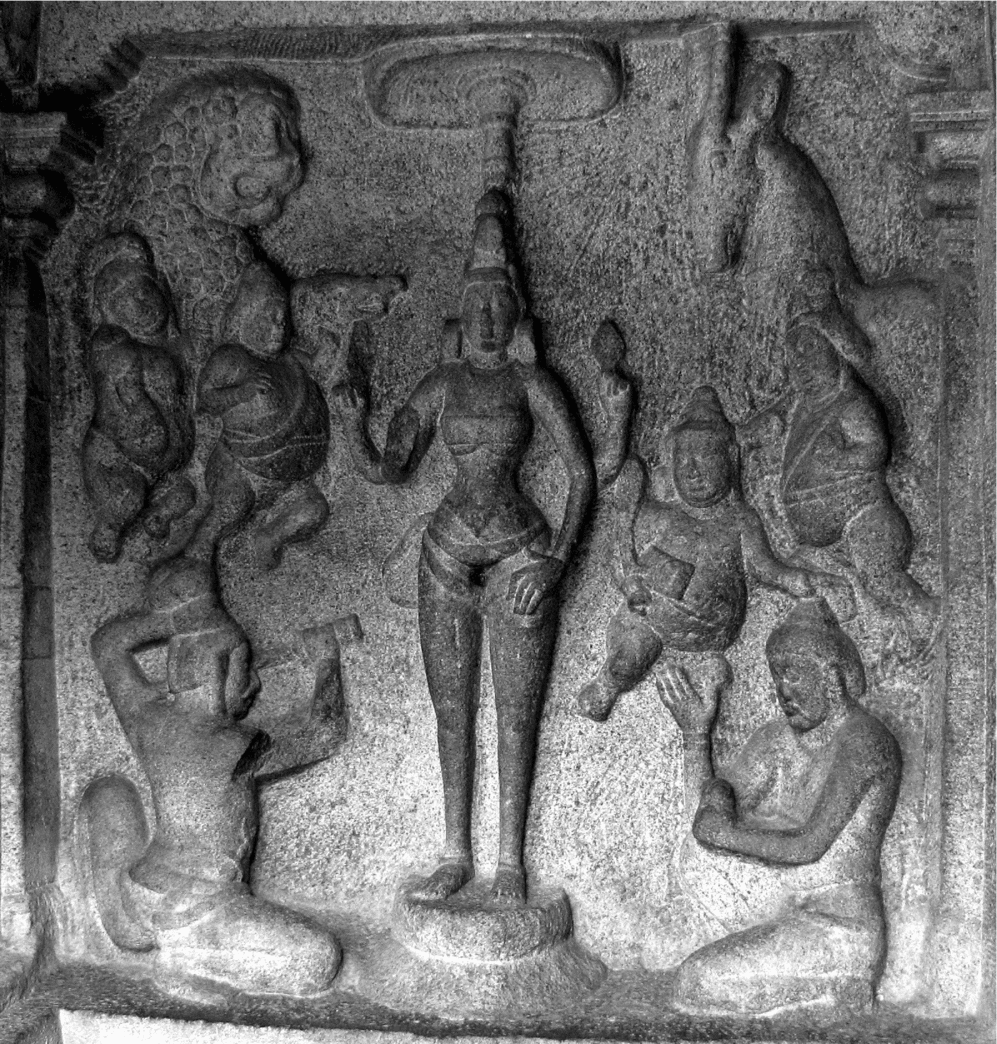
When one reads the description of beheading in the Tilakamañjarī, a scene well-known from several south Indian sculptures comes to mind: a devotee of Durgā beheading himself in front of the Goddess. One among the better known of these sculptures is shown here in Fig. 1. This is in the so-called Varāha Cave in Māmallapuram (Tamil Nadu) and was sculpted under Pallava patronage in the seventh century. In Māmallapuram itself we find three more similar images,Footnote 33 and the self-beheading devotee of Durgā also appears on many sculptures from the Coḷa period in Tamil Nadu (e.g. in the tenth-century temples of Puñcai and Puḷḷamaṅkai). Meghavāhana's posture, the way he kneels down and grabs his hair, suggests that Dhanapāla had an image very similar to these in his mind. Although I am not aware of such sculptures from the Paramāra kingdom, we do find examples further north than the Tamil region. A small relief, showing Pallava influence, on the Virūpākṣa Temple in Paṭṭadakal (Cāḷukya dynasty, eighth century) represents Durgā killing the Buffalo Demon with a devotee engaged in beheading himself to her right.Footnote 34 The figures flanking an image of Durgā from Besnagar (now in the Gwalior Museum, possibly datable to the Gupta period) are unfortunately too mutilated, but one of them seems to hold a sword.Footnote 35
Devotee decapitating himself in front of the Goddess (Varāha Cave in Māmallapuram, author's photograph)

It is not only Durgā who receives such sacrifice: in Karṇāṭaka we find Hoysala sculptures of devotees of Bhairava decapitating themselves, e.g. one of the door-keepers in the Bhairava shrine in the Lakṣmīdevī Temple in Doḍḍa-Gaddavaḷḷi (early twelfth century),Footnote 36 or the figures on the so-called Bhairava-pādukas (sandals).Footnote 37 Then there are the so-called ‘hero-stones’ commemorating valiant self-sacrifice depicting people severing their own heads, widely spread throughout Tamil Nadu and Andhra Pradesh,Footnote 38 though the figures are often in a standing position. A terracotta figure of a bearded, kneeling man cutting his own throat with a sword is kept in the Mathurā Museum; according to its label, it comes “from the Jumna river” and is dated to the Gupta period.Footnote 39
The mythological archetype of self-beheading is Rāvaṇa. We read in the Rāmāyaṇa (3.30.17, 7.9–10) that Rāvaṇa, in order to become equal to Kuvera, his half-brother, embarked on severe austerities and offered one of his ten heads every thousand years to Brahmā in the fire. When he was about to severe his tenth head, Brahmā appeared and granted him the boon of invincibility against the hand of any divine being.Footnote 40 In later sources, we see Rāvaṇa offering his heads to Śiva,Footnote 41 and this is the version we find in sculptural representations. For example, on a frieze of the Hosa Makuṭeśvara Temple in Mahākūṭa (Cāḷukya dynasty, seventh century), Rāvaṇa appears in a kneeling position, handing over his heads to Śiva and Pārvatī who are sitting on the bull;Footnote 42 in a niche of the Kailāsanātha Temple in Ellora (Rāṣṭrakūṭa dynasty, eighth century), we see the demon in the familiar kneeling posture, grasping his hair with his left hand while cutting his neck from behind with his right hand, positioned below a liṅgam that is surrounded by his already-severed nine heads.Footnote 43
That Dhanapāla was aware of this mythological intertext is shown by the fact that he compares Meghavāhana, who is in the process of self-decapitation, to the ten-headed rākṣasa: “as his body was darkened by the ointment of the spreading, intense radiance of the sword and as his reflected head was visible in each pearl-mirror of the single string of his necklace, he (Meghavāhana) was like Rāvaṇa when he had set about cutting his second throat in order to placate Pārvatī incensed by the disrespect regarding obeisance”.Footnote 44 The simile is intriguing because Rāvaṇa is presented as seeking the favour of a goddess, just like Meghavāhana, though in one case it is the goddess Pārvatī, and, in the other, Śrī/Lakṣmī appearing as the Fortune of Kings. Rāvaṇa seems to have insulted Śiva's wife in some version of the myth, while Meghavāhana was accused by the vetāla of having violated the rules of protocol when he forgot about Lakṣmī's attendant (whom he had never heard about before).
In the mediaeval literatures of India we find many stories about people offering their blood, body parts or heads to goddesses, from the Devīmāhātmya to the various versions of the Vetālapañcaviṃśatikā or the retellings of the Bṛhatkathā.Footnote 45 That the motif was well-known in the Paramāra court is shown by the fact the king Bhojadeva, Dhanapāla's patron, included it two times in his own collection of stories, the Śṛṅgāramañjarī. In both tales a king attempts to severe his own head to offer it to the goddess Āśāpurā, thus pressurising her into resurrecting those who died due to the king's fault.Footnote 46 Worshipping the Goddess with self-decapitation did not belong only to the realm of fables. A Tamil inscription from Andhra Pradesh dated to the ninth century records the donation of land commemorating the “great tapas (self-torture)” (mētavam) of a heroic person who offered nine pieces from his own body (navakaṇṭam) to the goddess Bhaṭāri and finally cut his own head. The relief on the stone shows a headless, kneeling figure with a sword in his right hand and his own head in his left.Footnote 47 Obtaining a son was one of the boons a Goddess could confer: an inscription from the Kannaḍa-speaking area dated 991 ce refers to a loyal subject who offered his head to the Goddess on the birth of the king's son in fulfilment of his vow.Footnote 48 The Goddesses who receive such bloody offerings belong to the more terrifying (ghora) variety (Caṇḍī, Caṇḍikā, Vindhyavāsinī, Kātyāyanī, etc.). But could the gentle (saumya) Lakṣmī be worshipped with head-offerings?
To answer this question let us return first to Pallava art. The iconography of the goddess images in Māmallapuram has recently been discussed in detail by Charlotte Schmid.Footnote 49 The Goddess riding a lion on the north wall of the Shore Temple, the Goddess standing on a lotus and framed by a lion and a gazelle above in the Varāha Cave, and the Goddess standing on the head of a buffalo and framed by the same animals in the Ādivarāha Cave are all flanked by two devotees, one of whom is in the process of decapitating himself. As Schmid pointed out, all these Goddesses seem, in fact, to represent different aspects of the same deity who defeated the buffalo demon, who receives bloody offerings and who is associated with a lion and a gazelle. Moreover, the Goddess in the Varāha Cave stands on a lotus, which is usually one of Lakṣmī's accoutrements, and holds a discus and a conch, objects usually associated with Viṣṇu, Lakṣmī's spouse.Footnote 50
There are, in fact, two Goddesses in the Varāha Cave: one is seated on a lotus and is flanked by two elephants (Gajalakṣmī), and the other one we have seen above with the two kneeling devotees at her feet. Next to Gajalakṣmī we find a panel showing Viṣṇu in his Boar Incarnation (Varāha) with the Goddess Earth (Bhūdevī) rescued from the waters and sitting comfortably on his thigh. On the opposite wall, next to the other Goddess, Viṣṇu's Trivikrama avatāra is conquering the three worlds with his steps. As Schmid argues, the images in this cave correspond to the major functions of royal power: securing fortune through victorious conquest on one hand (Trivikrama and the Goddess receiving the head-offering), preserving and redistributing prosperity on the other (Varāha and Gajalakṣmī). The two Goddesses can both be regarded as different aspects of Devī, the Goddess, manifesting herself as the Fortune of Kings, Rājalakṣmī.Footnote 51 The one with the self-beheading devotee at her feet can be identified with the Goddess of Victory, often called Koṟṟavai in mediaeval Tamil inscriptions and literary works,Footnote 52 and can be associated with the bellicose Goddess of the Devīmāhātmya, the slayer of the Buffalo Demon, who is repeatedly addressed in that text as Lakṣmī and Alakṣmī, Good and Bad Fortune,Footnote 53 Śrī, Viṣṇu's only beloved,Footnote 54 and, last but not least, the Fortune of Kings (bhūbhṛtāṃ Lakṣmī).Footnote 55
But let us turn from south India to north of the Vindhya and to traditions and texts that might have had more direct influence on Dhanapāla. We saw in the Harṣacarita that the Goddess appeared in the centre of the king's sword which is described as “the best companion of temerity” (susahāyaṃ sāhasasya) and “the path on which Laksṃī or fortune arrives” (āgamanamārgaṃ lakṣmyāḥ), and that she introduced herself as “Śrī, Glory, the graceful statuette upon the victory columns of the arms of great warriors, the female swan spoilt by fulfilling her desire to frolic on the waves of the river of blood-shed in battles, the peahen in the thicket of the kings’ white parasols, the lioness who playfully roams in the forest of extremely sharp sword blades, the lotus in the water of scimitar blades”.Footnote 56 In other words, she is the Goddess of Victory, and as such she is naturally impressed by Puṣyabhūti's heroism (śaurya).
In Bāṇa's other gadyakāvya, the Kādambarī, King Śūdraka is described with the following words: “Rājalakṣmī, the Fortune of Kings, long dwelled in the pure water of the stream of his sword blade”,Footnote 57 and “Rājalakṣmī often came to him, like a women who goes to a secret rendezvous, in the nights of battle rainy with showers of rut flowing from the sloping temples of elephants, moving in the darkness of a thousand breastplates torn from the door-like chests of mighty warriors, drawn to him by his sword which seemed uneven with drops of water from the stream of its blade exuded because he squeezed it tightly in his fist, but to which in fact big pearls stuck as he was splitting the temple lobes of rutting elephants”.Footnote 58 The Goddess of Victory can be impressed by heroic deeds, she is “addicted to coming together with heroes”,Footnote 59 but she is also fickle: she is “the bee which roams playfully above the beds of blue lilies that are the circles of the swords of great warriors”.Footnote 60 There is a well-established tradition of Lakṣmī's denouncement in classical Indian literature, a famous example of which is found in the Kādambarī. She is mainly censured for her volatile nature: “Though secured in the cage of creepers that are the swords brandished by thousands of warriors unbridled in their pride, she escapes. Though guarded by close ranked elephants dark with their showers of liquid rut, she slips away”.Footnote 61 She is claimed to have learnt cruelty (pāruṣya) from her favourite dwellings, the sword blades, and she is even compared to a piśācī: “Like a depraved flesh-eating demoness who shows herself as several times the height of a man and drives the timid into a frenzy of fear, she shows many men the way to prosper and gives miserable specimens of mankind delusions of grandeur”.Footnote 62 She is said to be utterly deceitful: “even when represented as a model, she performs tricks, even as a carved statue she deceives”.Footnote 63
In the Tilakamañjarī Lakṣmī expresses her astonishment when the king remains firm in his resolve to offer his head to her servant, since all her attendants (and of course herself) are gentle (saumya), and Mahodara only played (a rather cruel) joke on him just to test his courage. The sorcerer sage, who advised Meghavāhana to worship Rājalakṣmī, described her as “gentle by nature” (prakṛtisaumyā), but also as one “whose was bought by the heroism of Ikṣvāku, Bharata, Bhagīratha, and other kings” (Ikṣvāku-Bharata-Bhagīrathādi-bhūpālaparākramakrītā).Footnote 64 Mahodara himself, however, said some unflattering words about the Goddess when he was still chatting with the king as a vetāla: he called Lakṣmī “unreasonable because of her conceit of power” (aiśvaryamadaniścetanā), and “fickle by nature” (prakṛticañcalā) “whose heart is captivated by the temerity of heroic men” (vīrapuruṣasāhasākṣiptahṛdayā).Footnote 65 One might say that this is still part of the trick (māyā) the naughty yakṣa played on the king, and indeed in Dhanapāla's story Lakṣmī appears “as white as unsunn'd snow”, and it is her strange, black doorkeeper who has a rather cruel and impish nature. But is not it telling that she employs such an attendant, who can be described as anything but gentle?
One of the possible Jain intertexts of Dhanapāla's novel is the Kuvalayamālā, a Prakrit campū completed by Uddyotanasūri in 779 ce in Gūrjaradeśa. The novel begins with the story of Daḍhavamma, king of Aüjjhā (Ayodhyā), and his queen Piyaṃgusāmā, who is unhappy because she has no son. She retires to the “Chamber of Anger” where she implores her husband to ask for a boon from some deity. Daḍhavamma assures her that he will do whatever is required of him and lists several possibilities: he could cut a piece of flesh from his own arm with a sharp sword and perform homa with it in front of the ‘three-eyed’ Śiva (Tiṇayana); or he could present his head as bali-offering to Kātyāyanī (Kaccāiṇī), the Goddess who killed the buffalo demon; or he could sell human flesh in a cremation ground where vetālas make clicking sounds (kilikileṃta) delighted by slightly burnt corpses; or he could offer his own blood to bhūtas and mātṛs (spirits and mother-goddesses); or he could hold boiling bdellium (guggulu) on his head.Footnote 66 His minister however advises him that, instead of risking his own life in those perilous rituals, he should propitiate his own lineage-goddess (kuladevayā), Rāyasiri (Rājaśrī), the Fortune of Kings, who has produced great royal lineages (mayārāyavaṃsappasūyā) and has been close to his ancestors (puvvapurisasaṃṇejjhā).Footnote 67
Daḍhavamma takes his minister's advice, saying: “A son should also perform that very ritual practiced by the ancestors which is not censured by the world: this is the rule among the people”.Footnote 68 Then he prepares a lavish offering for Śrī and worships her with a hymn in which she is praised, among others, as the Goddess “who dwells on the tip of swords” and “who is caressed upon the chests of thousands of kings”,Footnote 69 and is addressed as Kittī, Fame: we see once again that for a king, Rājalakṣmī is the Goddess of Victory whose love a hero obtains with his sword. At the end of his hymn the king tries to blackmail Śrī: “Therefore appear before me within three days, or else you will have to accept my head from my sword”.Footnote 70
Daḍhavamma continues with his worship for two days, but Lakṣmī does not make an appearance. “On the third day the king, his curved, black eyebrows trembling in his furstration that [Śrī] had not shown herself, his face made wrinkled and terrifying by his frown, grasped the mass of his long, black, curly, beautiful hair that had been caressed by the touch of passionate and playful women's palms, delicate like lotus petals, and with his right hand he grabbed his precious sword which had made the pearls burst forth from the temple lobes of the enemy's many elephants. Then he said: “Why more delay? May you be in heaven, in the netherworld, or in a bed of lotuses in the milk ocean: hereby accept, Goddess, my head from my sword!’ With these words he stroke down upon the arch of his neck”.Footnote 71
Though his minister suggested the worship of Rājalakṣmī as a ritual that is less dangerous to one's life than the other ones listed by the king, Daḍhavamma nevertheless ends up decapitating himself. This option was on his original list, but then he proposed to offer his head to Kātyāyanī, the Goddess who killed the Buffalo Demon, in other words Durgā Mahiṣāsuramardinī, a likely recipient of such offerings. But he is ready to perform the same self-sacrifice for Rājalakṣmī: a fearless act of heroism, a sāhasa, or even a serious threat of such an act will surely secure the favour of the Goddess of Victory.
Fortunately King Daḍhavamma does not have to complete his own beheading: as the reader already expects at this point of the story, amidst celestial acclamations his right arm becomes immobilised, and Lakṣmī herself appeares in front of him. She asks the king why he is causing pain to his neck “that has been spoiled by the thrilling sensation of being embraced by the delicately slender arms of Jayasirī (Jayaśrī), the Fortune of Victory”.Footnote 72 Daḍhavamma demands an explanation why the Goddess failed to make an appearance for three nights, and Lakṣmī teases him in reply: “So great is this ascetic that he lost his stamina just in three nights!”Footnote 73 The king points out his rightful self-esteem: “An exceptional person whose wealth is his dignity regards even a trifle insult as big as Mount Meru. One who is not like that is just a lowly wretch”.Footnote 74
Lakṣmī comes to the point and offers a boon, the king asks for a son. The Goddess inquires whether he has ever entrusted a son to her whom she is supposed to return now. The king quickly adopts the joking tone and tells her to give him one of her own sons. Lakṣmī is uncomprehending: “Where am I supposed to have a son from?” The king replies with a smile: “O Goddess! You have lain and slept happily on the bed of the broad chests of so many kings of the whole world, headed by Bharata, Sagara, Mādhava, Nala, Nahuṣa, Māndhātṛ, and Dilīpa, and yet you do not have a single son?”Footnote 75 “I was joking”, says Lakṣmī, and grants Daḍhavamma an excellent son.
At the end of his novel Uddyotana answers criticisms that one could level against his work. Thus one may ask, “Why does the king play jokes with the Goddess?” Uddyotana's answer: “But racy words surely befit Rajjasirī, Royal Fortune, don't they?”Footnote 76 Flirtation appeals to Lady Fortune as much as bravado does: we find Meghavāhana and Lakṣmī exchanging similar pleasantries in Dhanapāla's novel. Lakṣmī takes the initiative when she asks Meghavāhana why he has formulated his request in such an oblique way, since the king requested not to be the last scion of Ikṣvāku's lineage, and that his chief queen, Madirāvatī, may share the glory of the former queens in the family who gave birth to distinguished sons. “Are you afraid that if you spoke in a different way your other beloveds, getting the news from somewhere, would become jealous and torment you?”,Footnote 77 she teases the king, and then assures him that none of her attendants will inform his other wives, except perhaps the naughty Mahodara. Meghavāhana laughs and proclaims that far from being afraid of Mahodara, he is not scared even of Puraṃdara, that is Indra, king of the Gods. Let the yakṣa tell the good news to whomever he wants, let the other queens be jealous, or rather let Lakṣmī arrange that they too give birth to sons: in that way they will have no reason to trouble him.
In Uddyotana's novel, too, Lakṣmī keeps his promise, and Daḍhavamma's son, Prince Kuvalayacaṃda will be one of the central characters in the story. When after many adventures he returns to Ayodhyā and is consecrated as crown prince, his father expresses his wish to practice dharma. In order to receive guidance as to which dharma he should follow, Daḍhavamma propitiates his family deity. On the second night of his worship Kulasirī (Kulaśrī), Lady Fortune of Ikṣvāku's lineage, presents him the tenets of Jainism written with brāhmī characters on a golden slab (kaṇayasilāyalaṃ).Footnote 78
Lakṣmī's relation to Jainism is less prominent in the Tilakamañjarī. She helps two celestial couples find each other again in their human incarnations. The two celestial ladies built two Jina-temples, one on Mount Ekaśṛṅga and the other one on Mount Ratnakūṭa, following the prediction of a sage that these two mountains would be the sites of their reunion with their husbands. When the two ladies died, Śrī entrusted the task of guarding the temples to her short-tempered watchman, Mahodara.Footnote 79
Mahodara: a Yakṣa with Character
At one point in Dhanapāla's tale, Gandharvaka, the young vidyādhara, flying in his aeroplane near the Praśāntavaira hermitage, chances upon the unconscious Malayasundarī, the daughter of the king of Kāñcī, one of the heroines of the novel. When she refused to marry the general of the army of the king of Ayodhyā (Meghavāhana) in order to secure peace, her father sent her secretly to the hermitage while publicly announcing her death. The reason she refused the marriage was that she was in love with Samaraketu, the incarnation of the god Sumālin, her husband in her previous life when she was the celestial lady Priyaṃvadā (though at this stage neither of them knows anything about their former incarnations). In the hermitage, unable to bear the separation from her beloved, she tries to poison herself and that is when Gandharvaka finds her, lying unconscious among the trees.
He takes her in the aeroplane and flies south in search of medicinal plants. Near the Ekaśṛṅga mountain his vehicle is suddenly stopped and he sees in front of him “a man of terrifying strength, his body straight and beautifully dark like the trunk of a priyaṅgu tree that has been thoroughly scraped, his belly slightly fat, watching him with unblinking, sharp-pupiled eyes looking somewhat angry, and repeatedly tossing a huge Banyan tree held in his right hand, from the top of which many tender leaves have been removed”.Footnote 80 Gandharvaka's heart sinks, but he tries to ask the formidable person as politely as he can to give way. When he finds that a deaf ear is turned to his entreaties, Gandharvaka loses patience and rebukes the man: “You look divine in appearance, but judging from your behaviour you are as extremely callous as a denizen of hell”.Footnote 81 This remark finally has an effect: Mahodara (because he is, of course, the immovable watchman) flies into a rage, he “reveals his vetāla-form” (āviṣkṛtavetālarūpaḥ) and starts shouting at Gandharvaka: “You great criminal! Are you insulting even me, the yakṣa general called Mahodara, who is affectionate towards all suffering beings, whose eyes are fixed on the path of supremely pure dharma, who has been appointed by his masters to chastise those who misbehave, and who permanently resides at a peaceful sanctuary?”Footnote 82 He once actually saved both Malayasundarī and Samaraketu from drowning in the sea, and now this second-rate vidyādhara calls him callous, the very one who does not respect the airspace around the temple the yakṣa is guarding? Mahodara winds himself up so badly that with an angry “huṃ” he hurls the aeroplane into Lake Adṛṣṭapāra, and transforms Gandharvaka into a parakeet.
Mahodara demands respect for himself and for his position as Lakṣmī's attendant and if he feels that somebody has wounded his self-respect he can become quite unpleasant, as we saw when he emerged before Meghavāhana. On the other hand, there is always something slightly comical about him: his looks and behaviour are so grotesque that the king cannot take him entirely seriously, even though he is ready to sacrifice his head to him. The encounter between King Puṣyabhūti and the nāga Śrīkaṇṭha in Bāṇa's Harṣacarita is a very serious affair: a major obstacle to the completion of the ritual is manifested in the form of the nāga, who, feeling denied proper worship, hurls insults at the magician and the king. Puṣyabhūti reciprocates in kind and in a heroic fight defeats Śrīkaṇṭha and defends the ritual enclosure. Their confrontation resembles Mahodara's second appearance in the novel, when he becomes an insurmountable obstacle to Gandharvaka's progress. Abuse follows insult and the young sorcerer's magical powers are not enough to defend him against the yakṣa's fury (who became furious, and this is the comical aspect of this episode, because he, a tender-hearted creature, was said to be cruel and diabolical). But in Dhanapāla's novel nothing happens accidentally: Mahodara's flinging the aeroplane into the lake (with Malayasundarī on board) will certainly have its role in the intricate plot which mirrors the inscrutable workings of karma.
Meghavāhana in the Tilakamañjarī keeps smiling during the entire conversation with Mahodara-vetāla, and yet he is ready to decapitate himself when the monster asks for his skull. As if the king knew the rules of the game called “barter in human flesh” (mahāmāṃsavikraya), when tantric practitioners (sādhakas) offer human flesh, often their own, to the denizens of the cremation ground, including vetālas, in order to secure their favour.Footnote 83
One such ritual is described in Uddyotana's Kuvalayamālā. Towards the end of the novel Mahāvīra narrates to Gautama and his other disciples the story of Prince Vaïragutta, who made a vow that he would find in seven days a mysterious thief who was plundering the city; if not, he would kill himself in a fire. Six days passed but the prince found no trace of the thief. He decided to sell human flesh (mahāmāṃsa) in the cremation ground to propitiate a vetāla and ask his help. He cut a piece of flesh out of his own thigh, and after some time a vetāla presented itself as a willing buyer. This was, however, a particularly picky vetāla, since first he preferred the meat roasted, then asked for some bones as a side dish, some blood to wash down the dinner and, finally, demanded that the prince gave him his own head to be used as a cup. Vaïragutta obediently provided everything, and he was about to chop off his head when the vetāla stopped him saying: “I am satisfied with this unparalleled heroic valour of yours, so choose a boon right now. I shall give you today whatever you ask for”.Footnote 84
Mahāvīra is halfway through the story when he is interrupted by Gautama: “My Lord, do the piśācas or rākṣasas, these divine beings, consume human flesh or other insupportable food?”Footnote 85 Mahāvīra assures his disciple that these creatures do not consume human flesh: “These vyantaras are playful by nature, like children. So they play with humans, and when they see a courageous man they feel delighted, and it is like this when [they see] a prince who resembles a strong wrestler: they test his courage with various plays. That's why they pretend they have eaten the flesh, but actually they throw it away”.Footnote 86 As Warder has pointed out, “This is a remarkable rationalisation of this strange popular rite, bringing it into line with Jaina conceptions about the nature of the gods”.Footnote 87 Uddyotanasūri's attitude is comparable to that of his master, the illustrious Jain scholar Haribhadra, who made fun of the irrationality of the epic and Purāṇic legends in his Dhuttakkhāna (The Story of the Rogues).
It is the same attitude we find in Dhanapāla's novel. Meghavāhana's lighthearted reaction to the appearance of the bizarre vetāla indicates that he might have had an inkling of the unreality of what he saw. He played the game nevertheless, but he seems to have been aware that it was just a game. Lakṣmī's words prove that he was right and everything he saw was an illusion (māyājāla) conjured up by the yakṣa's divine power (divyaśakti).Footnote 88 Lakṣmī claims that Mahodara took action all by himself, though it seems more likely that the Goddess (and Dhanapāla, the author of the novel) delegated all the darker aspects of her character to her attendant. When Lakṣmī teases the king that he is afraid of the jealousy of his wives, she singles out Mahodara as someone who cannot keep a secret: “This rascal who makes mischief without any reason will surely spill the beans in some way or another, and, since he is naturally fond of fooling around, he will make them angry”.Footnote 89
In Uddyotanasūri's novel a real vetāla’s repugnant dietary habits are said to be unreal, just part of a joke these playful creatures are fond of playing: in this way a ritual that is taken seriously by the tāntrikas is being smiled upon. In the Tilakamañjarī the vetāla himself is unreal, his whole demeanour is surreal and the somber self-sacrifice is part of a game. But it is a game for those who play by the rules: Meghavāhana might allow himself some mildly ironic remarks, but he does not hesitate to fulfil an absurd and cruel request. Though poor Gandharvaka takes the yakṣa seriously, he commits the mistake of confronting him: he has to face the real fury of the vetāla inside Mahodara.
Appendix: The Śaiva Mahodara
Mahodara in the Tilakamañjarī, Lakṣmī's attendant yakṣa might well have been the author's invention, and it was certainly Dhanapāla who made him such a lively character. I am not aware of a similar figure from the Jain tradition, and it would probably be a misplaced attempt to search for a single source from which Dhanapāla might have drawn inspiration and to depreciate his creative genius.
There is, however, a doorkeeper called Mahodara in the Śaiva tradition who is also connected to a (or the) goddess and who might possibly have been in Dhanapāla's mind when he drafted the yakṣa in the Tilakamañjarī. According to the lost Triśirobhairava, a scripture of the Trika, a branch of the Goddess-centred Śākta Śaivism, Mahodara is one of the guardians of the door, mentioned together with Diṇḍi.Footnote 90
Apart from Tantric texts, we meet Mahodara in the Haracaritacintāmaṇi, “a collection of Śaiva myths for the instruction of the laity compiled in the thirteenth century by the Kashmirian Śākta Śaiva Jayadratha”.Footnote 91 Chapter 22 is about Pārvatī, whose complexion has become dark as a water lily after eight years of asceticism to win Śiva's heart. One day she is amusing herself with her husband when Nandirudra announces the advent of dusk. Śiva declares that there is no dusk or night or day apart from Pārvatī, the supreme Śakti, and it is her he is going to worship. Pārvatī, however, is not impressed: she thinks Śiva is making fun of her dark body. She decides to practice tapas until she becomes Gaurī, Fair. Two lions, hoping for a prey, watch her concentrating on the tip of her nose above their cave. Then Brahmā reminds the Goddess that she is after all the Lord's Supreme Power whose nature is freedom, the Mother of the Gods, so she can surely cast away her blackness and become white at her pleasure. Devī first tries her power on the lions and transforms them into two gaṇas (Śiva's divine attendants) called Diṇḍi and Mahodara, having three eyes, four arms, matted hair and staff in hand. Then she takes on a fair body and becomes Gaurī, while her old dark body she turns into Durgā Kātyāyanī, the Goddess with eighteen arms holding various weapons. She turns the abandoned bodies of the two lions into Durgā's riding animals, Somānandi and Upanandi.Footnote 92
Dhanapāla certainly could not have been familiar with the Haracaritacintāmaṇi since he lived about two hundred years earlier. But the tradition of the doorkeeper Mahodara in Śākta Śaivism is older than the thirteenth century, and perhaps the myth related by Jayadratha is also not entirely his invention. In the Śaiva myth, the Goddess divests herself of her darkness and creates the terrifying Durgā out of her own, old, black body, while she herself metamorphoses into the fair and gentle Gaurī. She also transforms the two ferocious beasts into loyal attendants, while the new, awe-inspiring Goddess receives their old lion bodies. In the Tilakamañjarī, Lakṣmī is utterly pure, white, gracious and gentle. Yet, she has a strange attendant who knows about her darker side and who himself can assume the appearance of a grisly monster, playing cruel jokes on people just to test their courage. Lakṣmī claims that she only has saumya attendants, but Mahodara is anything but sweet-tempered. She also claims that the yakṣa acted on his own initiative, but heroic deeds are ultimately performed to impress the Goddess of Victory, not a mere attendant.