1 Introduction
Berg (Reference Berg2000) is a critical response to the traditional formal feature-based analysis of word classes, which characterises nouns as [ + N, -V], verbs as [-N, +V] and adjectives as [ + N, +V]. Berg links this account to Chomsky (e.g. Reference Chomsky1981), but see also e.g. Stowell (Reference Stowell1981) and Fukui & Speas (Reference Fukui and Speas1986). Berg interprets these abstract feature matrices as implying that adjectives should be equally similar to (or dissimilar from) nouns and verbs – the so-called ‘equidistance hypothesis’ (Reference Berg2000: 270). He discusses research that problematises the notion of equidistance and instead mostly points to adjectives being more similar to nouns than to verbs. This research is based on syntax (e.g. Ross Reference Ross1972; Comrie Reference Comrie1975), semantics (e.g. Givón Reference Givón1984) or semantics and pragmatics (e.g. Croft Reference Croft1991). As is of course well known, these levels of language also lie at the basis, more generally, of most theoretical accounts of lexical categories. For a focus on morphosyntax see e.g. Palmer (Reference Palmer1971), Aarts (Reference Aarts2007); for a semantically based theory of lexical categories see e.g. Langacker (Reference Langacker1987, Reference Langacker2008); for pragmatics see e.g. Thompson (Reference Thompson and Hawkins1988); and for certain combinations of those see e.g. Givón (Reference Givón2001; morphosyntax and semantics) and Croft (Reference Croft1991, Reference Croft2001; semantics and pragmatics).
Berg's study is innovative in that he builds on work in psycholinguistics on phonological cues to lexical categorisation (e.g. Sereno & Jongman Reference Sereno and Jongman1990; Kelly Reference Kelly1992). He investigates the phonology of English adjectives relative to nouns and verbs, and concludes that adjectives are more similar in this respect, too, to nouns than they are to verbs. In accounting for this, he proposes the ‘cross-level harmony constraint’ (Berg Reference Berg2000: 289; see also Reference Berg2009; Berg & Koops Reference Berg and Koops2010). According to this constraint, individual word classes behave to some extent consistently across different levels of analysis – syntax, semantics, pragmatics and also, he specifically argues, phonology. Berg sees the ‘cross-level harmony constraint’ not as inviolable but as a ‘soft’ constraint, ‘to the effect that individual counterexamples cannot disprove it’ (Reference Berg2000: 289).
As Berg himself observes, cross-level harmony bears similarity to Anderson's notion of ‘structural analogy’ (Reference Anderson1992, Reference Anderson2006, Reference Anderson2011) between syntax and phonology, a prominent example being the putative existence of heads in both syntactic (phrases and sentences) and phonological structures (syllables). Other functional linguists have made similar proposals, including Ross (Reference Ross1995) and Carstairs-McCarthy (Reference Carstairs-McCarthy1999). Anderson argues that such structural analogies between syntax and phonology are the natural result of their shared perceptual-cognitive basis (Reference Anderson2006: 607). He presents the possible existence of fundamental structural analogies between syntax and phonology as a problem for theories in which Universal Grammar is completely autonomous from general perception and cognition, a position he considers to be exemplified by Carr (Reference Carr, Burton-Roberts, Carr and Docherty2000, Reference Carr2006; cited by Anderson Reference Anderson2006: 602 and passim).
Berg suggests that cross-level harmony is beneficial in processing lexical categories (Reference Berg2000: 289) and may also assist acquisition (Berg & Koops Reference Berg and Koops2010: 46). To see how this might work with respect to syntax and phonology (for pragmatics and semantics see section 2, below), consider that nouns and adjectives often belong to the same noun phrase, while verbs tend to be (part of) separate constituents, i.e. verb phrases, e.g. [My old friend] [arrived punctually]. The phonological similarity of adjectives to nouns noted by Berg and their dissimilarity from verbs may facilitate parsing utterances into their main constituents as well as producing them (Reference Berg2000: 288–9). Berg obviously focuses here on attributive adjectives. PredicativeFootnote 2 adjectives are part of the verb phrase ([My old friend][was punctual]), and so phonological similarity between those adjectives and verbs would also yield processing and acquisition advantages.Footnote 3
With respect to harmony with the pragmatic level, consider that predicative adjectives, like verbs, are used for predication (Croft Reference Croft1991, Reference Croft2001). Regarding semantic harmony, finally, following Bolinger (Reference Bolinger1967), both Wierzbicka (Reference Wierzbicka1986) and Croft (Reference Croft1991) have pointed to an association between attributive use and relatively time-stable (what Bolinger calls ‘characterizing’ or ‘classifying’) properties, and between predicative use and temporary states (Bolinger's ‘occasion’).Footnote 4 This is parallel to the semantics of nouns, which typically describe time-stable objects, versus verbs, which describe relatively fleeting events (Givón Reference Givón1984; Croft Reference Croft1991, Reference Croft2001).
In a study that sets out to assess the degree of similarity of adjectives to nouns or verbs more precisely than was done by Berg (Reference Berg2000), Hollmann (Reference Hollmann2014) hypothesises that if Berg's cross-level harmony constraint is correct, then we may also expect phonological differentiation within the category of adjectives: since prototypically attributive adjectives are noun-like they may be phonologically closer to nouns than prototypically predicative adjectives, which are more verb-like.
The present article sets out to test whether such differentiation exists. I will argue, using data from the Corpus of Contemporary American English (henceforth COCA, Davies Reference Davies2008–),Footnote 5 that there is indeed supporting evidence. Thus, Berg's ‘cross-level harmony constraint’, originally proposed to help account for certain similarities and dissimilarities between entire lexical categories, appears relevant also for similarities and dissimilarities involving subclasses of a category, namely prototypically attributive and predicative adjectives.
The hypothesis and indeed the article as a whole assume a usage-based model of grammar. In this approach, the claim is that when speakers are exposed to items occurring in different constructions with different frequencies, those distributional (dis)preferences may be stored as part of those speakers’ grammatical knowledge. The (dis)preferences of adjectives could in principle be stored on an item-by-item basis or as two distinct but overlapping subclasses in speakers’ mental grammars. The question as to which of these scenarios is accurate is impossible to answer conclusively in this article. However, I will argue in section 4, below, that experimental evidence presented in Boyd & Goldberg's (Reference Boyd and Goldberg2011) study of a-adjectives (e.g. asleep, afloat), which show a strong predicative preference, suggests that these subclasses may be psychologically real.
The usage-based framework I will adopt in this article is Radical Construction Grammar (Croft Reference Croft2001). Whilst other models are available, Radical Construction Grammar includes careful consideration of the noun, verb and adjective categories from a cross-linguistic perspective, which enhances the robustness of the theory, also when applied to a single language.
Croft points out that attributively and predicatively used adjectives instantiate different propositional act functions, viz. modification and predication, respectively. Croft actually reserves the label ‘adjective’ for the former, using ‘predicate adjective’ for the latter.Footnote 6 There is a long tradition in descriptive English grammar to apply the term ‘adjective’ equally to both. This is motivated by their morphological and syntactic similarities and their shared property semantics. But whilst the traditional position is to suggest that the two positions are available to (most members of) this category, Croft argues that the distributional facts of occurrence in attributive and predicative constructions, if taken seriously, force us to posit two ‘distinct but overlapping classes’ (Reference Croft2013: 10).Footnote 7 As I have noted, above, experimental evidence from Boyd & Goldberg (Reference Boyd and Goldberg2011) may provide some support for the psychological realism of these classes; see section 4, below.
The remainder of this article starts (section 2) with additional discussion of Berg (Reference Berg2000), the psycholinguistic literature which was his point of departure, and Hollmann's (Reference Hollmann2014) study of the phonology of nouns, verbs and adjectives. Section 3 moves on to the method used in the present study, explaining how I collected and analysed the COCA data in order to assess the hypothesis. The analysis itself and discussion of the results are found in section 4. Section 5 is the conclusion.
2 Previous scholarship
Berg's (Reference Berg2000) analysis of the phonology of English adjectives as compared to nouns and verbs is based on psycholinguistic scholarship dating to the 1980s and 1990s (Kelly & Bock Reference Kelly and Bock1988; Sereno & Jongman Reference Sereno and Jongman1990; Cassidy & Kelly Reference Cassidy and Kelly1991; Kelly Reference Kelly1992; Sereno Reference Sereno, Hinton, Nichols and Ohala1994). Work in this area has continued since, mainly focused on nouns and verbs. Most research has continued to be carried out by psycholinguists, e.g. Monaghan et al. (Reference Monaghan, Chater and Christiansen2005), Monaghan et al. (Reference Monaghan, Christiansen and Chater2007), Farmer et al. (Reference Farmer, Christiansen and Monaghan2006), Monaghan et al. (Reference Monaghan, Christiansen and Fitneva2011), Reilly et al. (Reference Reilly, Westbury, Kean and Peelle2012), Monaghan et al. (Reference Monaghan, Shillcock, Christiansen and Kirby2014), Dingemanse et al. (Reference Dingemanse, Blasi, Lupyan, Christiansen and Monaghan2015). Some theoretical linguists, apart from Berg (Reference Berg2000), have engaged with these findings as well; see especially Taylor (Reference Taylor2002: 180–5), Don & Erkelens (Reference Don and Erkelens2008), Hollmann (Reference Hollmann2012, Reference Hollmann2013, Reference Hollmann2014), Lohmann (Reference Lohmann2017).
Berg investigates the three word classes in relation to the following phonological properties:
(i) number of syllables
(ii) final obstruent voicing
(iii) frontness of the stressed vowel
(iv) trochaic versus iambic stress pattern in disyllabic words
The claims emerging from the psycholinguistic literature are that English nouns (i) contain a greater number of syllables, on average, than verbs, (ii) have fewer voiced final obstruents than verbs, (iii) contain fewer front stressed vowels and (iv) are typically trochaic, whilst verbs tend to be iambic.
Berg analyses all nouns, verbs and adjectives in the English part of the CELEX databaseFootnote 8 and finds that for all four parameters adjectives are more similar to nouns than to verbs. As explained in section 1, above, Berg's explanation involves adjective–noun affinities on other levels too and the benefits accruing from these uniformities for language processing – his ‘cross-level harmony constraint’ (Reference Berg2000: 289).
Berg's study deserves merit for taking the psycholinguistic evidence for the role of phonology seriously. However, his analysis does not include several other parameters found to be relevant in the psycholinguistic research he cites:
(v) mean syllable length in phonemes
(vi) nasal consonants
(vii) height of the stressed vowel
According to the literature, nouns display increased syllable length compared to verbs, contain more nasal consonants and fewer high stressed vowels.
In addition to these seven parameters Hollmann (Reference Hollmann2012, Reference Hollmann2013) suggests that the presence or absence of a final obstruent may play a role too: in his nonce-word production experiment nouns ended in obstruents significantly less often than verbs. There are in fact further parameters that psycholinguists have looked at, conveniently summarised by Lohmann (Reference Lohmann2017), which I come back to in section 3.2, below, where I discuss the phonological analysis conducted in the present article.
Hollmann (Reference Hollmann2014) observes that Berg (Reference Berg2000) does not use any statistical analysis to help determine how similar, exactly, adjectives are to nouns, phonologically speaking, and how dissimilar from verbs. Hollmann (Reference Hollmann2014) collects his nouns, verbs and adjectives from the 100-million-word British National Corpus, which contains speech and writing. He analyses the most frequent nouns, verbs and adjectives in the BNC (n = 117, 84 and 31, respectively) in terms of all eight phonological properties mentioned above, using the method outlined in his (Reference Hollmann2012, Reference Hollmann2013) studies. He finds that Berg is correct in rejecting the equidistance hypothesis, and that adjectives on the whole bear more similarity to nouns than to verbs. Since predicatively used adjectives, whilst certainly less frequent than attributive ones, are nevertheless by no means rare (see, for example, the ratio of 2:1, cited in section 1, above, reported by Croft Reference Croft1991 for four languages), it is perhaps unsurprising that adjectives do not pattern with nouns across the board. Hollmann (Reference Hollmann2014) suggests that an obvious avenue for further research is the question as to whether prototypically attributive adjectives might pattern phonologically with nouns, with prototypically predicative adjectives patterning with verbs – the hypothesis tested in the present article.
Before moving on to the methodology, section 3, it is important to ask why word classes may have certain phonological properties, and what evidence previous scholarship offers to support the answer to that question. Psycholinguists have argued that phonological regularities may act as cues to lexical category assignment both in language acquisition and in online processing more generally (Farmer et al. Reference Farmer, Christiansen and Monaghan2006; Monaghan et al. Reference Monaghan, Christiansen and Chater2007; Monaghan et al. Reference Monaghan, Christiansen and Fitneva2011; Reilly et al. Reference Reilly, Westbury, Kean and Peelle2012; Monaghan et al. Reference Monaghan, Shillcock, Christiansen and Kirby2014; Dingemanse et al. Reference Dingemanse, Blasi, Lupyan, Christiansen and Monaghan2015).
In terms of evidence, psycholinguistic and linguistic research that focuses on corpus analysis shows that phonological cues are in principle available to the language user. Recent work in the area of cultural evolution, using an iterated learning paradigm, in which learners are exposed to some data based on an artificial language, which they must reproduce and pass on to the next ‘generation’ of learners, suggests that over time words with similar meanings but very different phonological representations may develop phonological regularities (see e.g. Winters et al. Reference Winters, Kirby and Smith2015). This indicates that available cues in real language may be used by speakers.
The question as to whether speakers do indeed draw upon existing phonological regularities in real languages is addressed only rarely, but Don & Erkelens (Reference Don and Erkelens2008) and Hollmann (Reference Hollmann2012, Reference Hollmann2013) offer possible research paradigms. Don & Erkelens (Reference Don and Erkelens2008) carry out a comprehension experiment using nonce words, designed so as to share phonological similarities to familiar Dutch nouns and verbs. Hollmann (Reference Hollmann2012, Reference Hollmann2013) relies on an experiment in which speakers were asked to produce novel English nouns and verbs, whose phonological properties are then compared to regularities described in the literature.
The present study is based on corpus data, and would therefore ideally be supplemented by a comprehension and/or production study in future. I return to this in the discussion in section 4 and in the conclusion, section 5, below.
3 Method
This study analyses phonological differences between prototypically attributive versus predicative adjectives. In section 3.1 I explain how I collected the adjectives; section 3.2 covers the analytical methods used.
3.1 Data collection
I use data from COCA, a 560-million-word corpus of present-day written and spoken American English. In order to avoid bias due to nominal and verbal phonology I omit denominal and deverbal adjectives (using the Oxford English Dictionary and the Online Etymology Dictionary to determine origins).Footnote 9
The compilation of my sample of adjectives was guided by a decision to focus on the most frequent adjectives. The first reason for this is that these may be assumed to have the largest influence on a speaker's mental grammar, including the possible categories of prototypically attributive and prototypically predicative adjectives.
The second reason is that there is evidence to suggest that speakers require a fair amount of exposure before they are able to detect adjectival distributional preferences: Hao (Reference Hao2015), cited by Goldberg & Boyd (Reference Goldberg and Boyd2015: e192), found that children until the age of 10 used a-adjectives such as asleep and afloat, which are restricted to predicative position in adult(-like) speech, in attributive position as frequently as other adjectives, such as sleepy and floating. Goldberg & Boyd argue that these errors emerge due to a lack of sufficient exposure. The distributional preference in the case of a-adjectives is extremely strong. My interest in prototypically attributive versus predicative adjectives is broader, i.e. I wish to go beyond the relatively few cases in English that are (virtually) restricted to attributive or predicative position. One expects the token frequency needed to learn preferences of adjectives whose distribution is less fixed to be higher than is the case for a-adjectives.
In order to obtain the most frequent adjectives I used the list of the 5,000 most frequent words in COCA.Footnote 10 This list contains 839 adjectives. Of these, 129 are adjectival in origin.Footnote 11, Footnote 12 In order to assess their preference for the attributive or predicative construction, I ran two queries. Using ROUGH as an example, for attributive position I searched for DET ROUGH_j* NOUN. For predicative position I searched for BE ROUGH_j*_.|;|:. (As always with corpus searches, these algorithms were compromises: I could also have included adjective–noun sequences without determiners, predicative constructions with different copulas, etc. Alternatively, I could have analysed 100, 200 or 500 random tokens of each adjective, and worked out its distributional preference based on that. Nevertheless, for the purposes of this study these algorithms seemed adequate.) Finally, I tested for statistically significant differences between attributive and predicative tokens by using the exact binomial test (see e.g. Sheskin Reference Sheskin2007), which yielded 119 adjectives with a statistically significant (p <.05) preference for either of the two constructions.Footnote 13 (As one of the reviewers notes, the fact that such a large proportion of adjectives have a statistically significant preference provides some justification for asking the research question about the phonological properties of the attributive and predicative groups, compared to those of nouns and verbs.)
The list of prototypically attributive adjectives is as follows:
other, new, high, small, large, young, long, little, only, major, whole, recent, red, short, single, medical, foreign, common, poor, similar, serious, simple, blue, dark, various, deep, individual, middle, total, senior, critical, very, wild, quick, light, bright, tiny, soft, broad, United, primary, male, strange, Supreme, yellow, prime, unique, ethnic, brown, golden, German, rare, gray, vast, solid, sharp, proper, brief, immediate, double, grand, severe, junior, straight, extreme, alternative, ultimate, minor, relevant, elderly, pale, round, eager, administrative, maximum, medium, minimum, mild, improved, dried, innovative, dumb, integrated, dense
The prototypically predicative adjectives are:
best, sure, better, strong, free, full, clear, difficult, likely, wrong, ready, nice, necessary, tough, safe, fair, clean, comfortable, sick, slow, equal, gay, glad, smooth, flat, rough, unlikely, blind, scared, naked, uncomfortable, minimal, shy, unfair, cruelFootnote 14
Both lists are ordered from most to least frequent. The median frequency of the prototypically attributive adjectives, above, is 24,389; that of the predicative ones is 21,101. It would have been desirable to control for frequency completely, but that would make it difficult to get a sufficiently large data set of common adjectives to allow for meaningful statistical comparison.
3.2 Phonological analysis
All frequent prototypically attributive and predicative adjectives described above were transcribed phonologically, following the Cambridge English Pronouncing Dictionary (16th edition).
The forms United and Supreme cover both capitalised and lower-case spellings (see footnote 10). When capitalised, they will form part of fixed phrases such as United States and Supreme Court. In these contexts speakers may reduce their pronunciation. For example, whilst the Cambridge English Pronouncing Dictionary renders the first syllable of united with a full vowel, when part of United States speakers may reduce that vowel to schwa in rapid speech. I have followed the Cambridge English Pronouncing Dictionary; a more fine-grained analysis might try to differentiate between ordinary and fixed-phrase usages.
The phonological analyses of the attributive versus predicative adjectives from COCA followed Hollmann's (Reference Hollmann2012, Reference Hollmann2013) scoring scheme. However, Hollmann (Reference Hollmann2012, Reference Hollmann2013) took as his starting point Monaghan et al.'s (Reference Monaghan, Chater and Christiansen2005) summary of the literature specifically on nouns and verbs. Monaghan et al. also discuss phonological differences between open and closed class words (Reference Monaghan, Chater and Christiansen2005: 144–6), and some of the parameters in question turn out to be significant also in their subsequent consideration of nouns and verbs in their (CHILDES; MacWhinney Reference MacWhinney2000)Footnote 15 corpus data (see also Monaghan et al. Reference Monaghan, Christiansen and Chater2007). For the sake of completeness they are included here as well.
Lohmann (Reference Lohmann2017) takes a similarly inclusive approach in his study of conversion processes between English nouns and verbs, which he analyses in terms of fifteen parameters. Drawing on his list, with a few adjustments, the parameters I look at are:
1. Word length in syllables: nouns have been found to have more syllables, on average, than verbs (see e.g. Monaghan et al. Reference Monaghan, Chater and Christiansen2005). I count the number of syllables of each adjective and assign a score (1, 2, …).
2. Syllabic complexity: verbs in child-directed speech have been found to contain more complex syllables than nouns by Monaghan et al. (Reference Monaghan, Christiansen and Chater2007), who define this as ‘the proportion of phonemes in the word that were consonants’ (268). Lohmann (Reference Lohmann2017) operationalises this parameter differently, as ‘the average number of phonemes per syllable for each word’. I treat that as a separate parameter (see 3, below), and follow Monaghan et al.'s definition instead. Words are scored on a scale [0–1].
3. Mean syllable length in phonemes: compare 2, above. Words are scored on a scale [1–…].
4. Word onset complexity: Monaghan et al. (Reference Monaghan, Chater and Christiansen2005) label this ‘onset complexity’ but their explanation makes it clear that they only look at word-initial onsets, not all onsets. Shi et al. (Reference Shi, Morgan and Allopenna1998), who Monaghan et al. refer to, do not provide any examples to illustrate their notion of onset complexity. Whether word-initial onset complexity, general onset complexity, or perhaps even both would provide the clearest distinction between word classes is an empirical question which should be addressed in future research. For present purposes, I follow Monaghan et al.'s interpretation, and Lohmann's (Reference Lohmann2017) more precise term. Scores represent the number of consonants in the initial onset [0–].
5. Ratio of reduced vowels: Monaghan et al. (Reference Monaghan, Christiansen and Chater2007) find that nouns in their corpus data contain a higher ratio of reduced vowels than verbs. Lohmann (Reference Lohmann2017) expands on Monaghan et al.'s definition by including not only schwas but also syllabic consonants. This adds useful precision, so I follow Lohmann. The scale is [0–1].
6. Vowel backness of the tonic syllable: According to Sereno & Jongman (Reference Sereno and Jongman1990) and Sereno (Reference Sereno, Hinton, Nichols and Ohala1994) frequent nouns tend to have more back vowels than frequent verbs. I score vowel advancement [0, 1, 2], dividing up the vowel space as per Hollmann (Reference Hollmann2012, Reference Hollmann2013).
7. Average vowel backness: Monaghan et al. (Reference Monaghan, Christiansen and Chater2007) report a similar tendency for vowel advancement in all syllables for nouns and verbs in child-directed speech as was described under 6. The scoring method is as in 6.
8. Average vowel height: Monaghan et al. (Reference Monaghan, Chater and Christiansen2005) observe that their nouns on average contain lower vowels than their verbs. Again, I use a scale [0, 1, 2], and again divide the vowel space following Hollmann (Reference Hollmann2012, Reference Hollmann2013).
9–13. Differences in place of articulation: Monaghan et al. (Reference Monaghan, Chater and Christiansen2005), Monaghan et al. (Reference Monaghan, Christiansen and Chater2007) and other studies have shown that a number of places of articulation are associated with consonants in nouns and verbs to different degrees, either in general (in which case the scale is [0–1]) or in word-initial position (where the scale is [0, 1]). Nasals (parameter 9) are said to be more common in nouns; velars (10), in verbs; coronals (11), in nouns in Monaghan et al.'s (Reference Monaghan, Chater and Christiansen2005) CHILDES data but in verbs in Lohmann's (Reference Lohmann2017) CELEX data; bilabials (12), in nouns; word-initial bilabials (13), also in nouns. My set of velars was slightly larger than Lohmann's (Reference Lohmann2017), as I included not only [k, g, ŋ] but also [w] (cf. e.g. Ladefoged & Johnson Reference Ladefoged and Johnson2011: 43). My set of coronals was also larger than Lohmann's (Reference Lohmann2017), who looked at [d, t, ʤ, ʧ, ð, θ, n, l, r, s, z]; I also included [ʃ, ʒ].
14–15. Approximants and word-initial approximants: Monaghan et al. (Reference Monaghan, Christiansen and Chater2007) find more approximants word-initially in verbs than in nouns; Lohmann's (Reference Lohmann2017) data do not replicate that but he does find more approximants in general in monosyllabic verbs than in monosyllabic nouns. My scales are [0–1] and [0, 1], respectively.
16–17. Final voicing and final obstruent voicing: Lohmann (Reference Lohmann2017) does not include either of these but Monaghan et al. (Reference Monaghan, Chater and Christiansen2005) mention final voicing in their literature review as a parameter that Kelly (Reference Kelly1992) suggests is more common in verbs than in nouns. Monaghan et al. (Reference Monaghan, Chater and Christiansen2005) do not find a significant difference for this parameter, which may be why Lohmann omitted it. However, Monaghan et al. use a scale that does not clearly follow from what Kelly suggests: they contrast vowels (scored 0) with voiced consonants (1) and unvoiced consonants (2). Kelly does not seem to include vowels in his consideration, and anyway since voicing is a binary feature it is not clear why Monaghan et al. treat this parameter as a three-point scale. Berg (Reference Berg2000), Taylor (Reference Taylor2002) and Hollmann (Reference Hollmann2012, Reference Hollmann2013) operationalise this parameter as final obstruent voicing. In this study I aim for comprehensiveness and so include both final voicing in general (with scores of 0 for unvoiced and 1 for voiced) and voiced final obstruents (again with a scale of [0, 1], but with missing values for words that do not end in obstruents.
18. Presence of a final obstruent: Hollmann (Reference Hollmann2012, Reference Hollmann2013) found more final obstruents in the novel English verbs produced in his experiment than in the novel nouns. The scale used is [0, 1].
19. Initial stress: A number of studies, including Kelly (Reference Kelly, Morgan and Demuth1996), have reported that disyllabic nouns tend to have initial stress more often than verbs. Berg (Reference Berg2000) extends that generalisation to trisyllabic words. The scale used here is [0, 1], with the lower value assigned to polysyllabic words with non-initial stress and the higher value to words with stressed first syllables. Monosyllabic words do not receive a score.
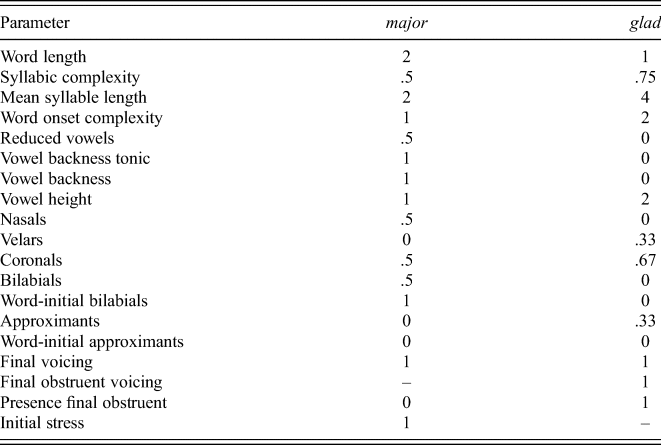
Table 1 offers a sample analysis of two adjectives from COCA, the first prototypically attributive, the second predicative.
Phonological analysis of two adjectives from COCA: major, glad

I analyse the differences between prototypically attributive and predicative adjectives for all 19 phonological parameters using the Mann–Whitney U-test. I also calculate the point-biserial correlation coefficient r, which sheds light on the effect size of each parameter.
For all significant (p <.05) and nearly significant (p < .1) differences, the direction of the pattern in the data was compared to the psycholinguistic literature cited above. For example, the literature suggests that nouns tend to contain more bilabial consonants than verbs. If prototypically attributive adjectives in the present study were found to contain on average 0.18 bilabial consonants, and prototypically predicative adjectives only 0.07, then this would conform to the directionality of the pattern displayed by nouns and verbs. As it happens, these are exactly the values obtained for the adjectives in my study; see section 4, below.
4 Analysis and discussion
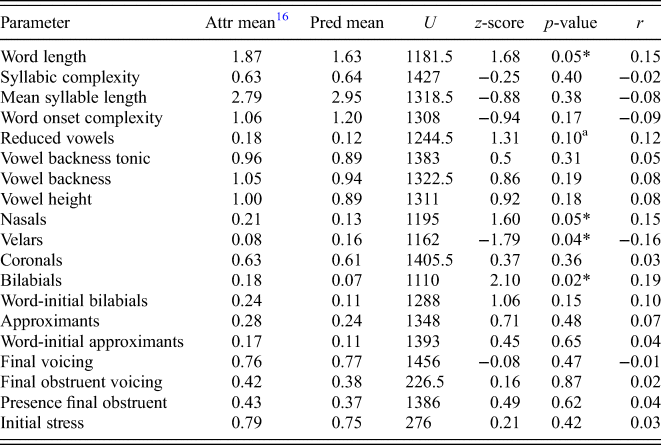
The results of the Mann–Whitney U-test and the point-biserial coefficient r values are presented in table 2, where * indicates statistical significance at p < 05 and a indicates p < .1.
Phonological differences between prototypically attributive and predicative adjectives

All four significant differences, viz. word length, nasals, velars and bilabials, support the hypothesis that prototypically attributive adjectives pattern with nouns, and prototypically predicative adjectives with verbs. The effect sizes in three of these cases are only small, but one parameter, bilabials, displays a small-to-medium-sized effect.
Turning to the nearly significant difference in the data, i.e. reduced vowels, this also goes in the expected direction: prototypically attributive adjectives have a higher proportion of reduced vowels than predicative ones, just as nouns have a higher proportion than verbs.
It may be that the pattern observed in relation to reduced vowels is due to the interaction between syntactic position and prosodic prominence. Predicative position is typically at or towards the end of a sentence, which in English and many other languages is associated with new and important information (see e.g. Halliday Reference Halliday1967: 22; Sperber & Wilson Reference Sperber and Wilson1986: 216), so these adjectives will tend to be accented. Attributive adjectives, by contrast, are less likely to be accented. Scholars have pointed to cases where they are, e.g. a SIMILAR case involves the English -teen numbers (Ladd Reference Ladd2008: 239; capitals original), but the point is that these are exceptions, in which the noun is ‘fairly unspecific’ (ibid.). If attributive adjectives are accented less often, then the higher proportion of reduced vowels may be an unsurprising result of their distribution.
Regardless of how the high proportion of reduced vowels has come about, in a usage-based perspective one could suggest that these high degrees of reduction may be noticed, stored and drawn on by speakers in lexical category assignment in online language processing. One way to test this might be to set up a production experiment similar to the one used by Hollmann (Reference Hollmann2012, Reference Hollmann2013) for nouns and verbs. One could encourage speakers to produce novel English adjectives, to fit into empty attributive or predicative slots in sentences. If the novel attributive adjectives contain more schwas and syllabic consonants than the novel predicative adjectives then that would indicate that speakers may have stored this phonological property of these adjectives and actively draw on it in distinguishing between them and prototypically predicative ones. Experimental confirmation of the use speakers make use of phonology would be equally welcome for the four cues for which statistically significant differences were obtained. This must remain as an idea for future research.
The question as to whether distribution itself determines phonology is also worth asking in relation to the four significantly different properties. Of these, word length might seem the most suspect. However, if anything, one would expect prototypically attributive adjectives to be shorter than predicative ones: many authors, going back to Schuchardt (Reference Schuchardt1885) and Zipf (Reference Zipf1935), have pointed to the inverse correlation between token frequency and length, and we have seen that the token frequencies of the former in my corpus are a little higher. As regards the remaining significant differences, consonants may over time be subject to lenition processes, which may ultimately go all the way to zero (see e.g. Honeybone Reference Honeybone, de Carvalho, Scheer and Ségéral2008). Given that this process tends to apply mostly in non-prominent positions (see e.g. Hopper & Traugott Reference Hopper and Traugott2003: 156), one might expect the ratio of nasals, velars and bilabials to be higher in predicative adjectives than in attributive ones. This is true for velars, so position might help explain that, but not for nasals and bilabials. I conclude that distribution appears to play only a limited role in the explanation of the phonological properties of prototypically attributive and predicative adjectives, and that where it does, it is possible, under the usage-based approach adopted here, that speakers store and make use of the phonological patterning.
As regards the non-significant differences, finally, it may be worth noting that these are also mostly in the expected direction, apart from vowel height, (word-initial) approximants, final obstruent voicing and presence of a final obstruent. Monaghan et al.'s (Reference Monaghan, Chater and Christiansen2005) and Lohmann's (Reference Lohmann2017) results for coronals in nouns and verbs differ, with the pattern in my data in line with the findings of Monaghan et al. The p-values associated with at least some of the non-significant differences suggest that a larger sample might yield additional significant differences; one might indeed consider the relatively modest sample size as a possible explanation as to why the number of significant results, although all in the expected direction, was relatively low.
Overall, then, the results of this study add weight to Berg's notion of cross-level harmony. As regards the theoretical significance of that finding, I have already pointed to the challenge this notion and Anderson's structural analogies between syntax and phonology (Reference Anderson1992, Reference Anderson2006, Reference Anderson2011) pose for a theory of Universal Grammar as existing independently from general perceptual and cognitive mechanisms and abilities (Carr Reference Carr, Burton-Roberts, Carr and Docherty2000, Reference Carr2006). I would now like to explore in some detail what the findings might mean for a theory of word classes that does not make such an assumption. I hinted in section 1, above, that Radical Construction Grammar (Croft Reference Croft2001) is well placed to accommodate the empirical findings of this study.
Radical Construction Grammar defines nouns, verbs and adjectives differently from other theories: rather than focusing on morphosyntactic properties, semantics or pragmatics (compare the approaches referred to in section 1, above), Croft combines pragmatics and semantics. The former is the starting point: Croft argues that of fundamental importance (to speakers, and in this usage-based theory therefore also to grammarians) are propositional act functions (cf. also Searle Reference Searle1969). The three main ones Croft defines as follows:
The act of reference identifies a referent and establishes a cognitive file for that referent, thereby allowing for future referring expressions [which, in turn, are acts of reference as well; WBH] coreferential with the first referring expression. The act of predication ascribes something to the referent . . . The act of modification (of referents) functions to enrich a referent's identity by an additional feature of the referent, denoted by the modifier.
(Reference Croft2001: 66; small capitals original)Propositional act constructions are prototypically headed by lexical items that belong to three main semantic classes: object, property and action words. Croft argues that these classes correspond to ‘the commonsense ontology of types of entities’ (Croft Reference Croft1991: 38)Footnote 17 and he offers the detailed semantic decomposition given in table 3.
Semantic properties of the lexical semantic classes objects, properties and actions (Croft Reference Croft2001: 87)

Relationality is defined, following Langacker (Reference Langacker1987: 214–16) in terms of whether ‘a concept inherently requires reference to another concept’ (Croft Reference Croft2001: 87). Stativity distinguishes between states and processes. Croft defines transitoriness in terms of the question as to ‘whether the concept represents a transitory state or process or an inherent and permanent state of the entity in question’ (Reference Croft2001: 87) and adds that ‘only states can be permanent’ (ibid.). Gradabality, finally, is defined as ‘whether the entity is gradable along of scalar dimension, such as height’ (ibid.).
Moving on to the Radical Construction Grammar use of the ‘noun’, ‘verb’ and ‘adjective’ labels, Croft reserves these for the prototypical combinations of the three main propositional act functions: object words that refer are called ‘nouns’, action words that predicate are labelled ‘verbs’, and ‘adjectives’ are property words that modify (see also footnote 6, above). Non-prototypical combinations are also possible, but if a speaker uses, for example, an action word to refer, as in Running is bad for your knees (Croft Reference Croft2001: 89; emphasis added), the gerund running is not seen as ‘a verb used as a noun’, as it may be in certain other approaches. Similarly, a property word that is used to predicate, as in That cypress is big (Croft Reference Croft2001: 89; emphasis added), is not simply called an ‘adjective’, but a ‘predicate adjective’. As I observed above, in footnote 6, ‘predicate property word’ might have been even more useful in order to highlight the distinction between it and (prototypical) adjectives, which are modifying property words, but Croft chooses to maintain the link with the more traditional label.
The brief summary, above, displays a crucial characteristic of Radical Construction Grammar: it does not take categories such as noun, verb or adjective to be basic ‘building blocks’ (Croft Reference Croft2013) of the grammar – where I intend ‘grammar’ both in the meaning of the speaker's mental grammar and the linguist's theory of what such mental grammars look like. Speakers engaged in communication do not normally conceptualise and express objects, actions or properties in isolation. Instead, utterances normally consist of predications about some referent(s), and may contain modification. The building blocks, then, are constructions, such as, in the case of adjectives and predicate adjectives, the attributive noun phrase construction (which allows one to modify a referent) and the subject predicate construction (which allows one to predicate a property of a referent).
In terms of language acquisition, children are usually exposed to utterances containing predications that include one or more referring expressions and possibly one or more modifiers. An example from the MPI-EVA-Manchester Corpus (see Lieven et al. Reference Lieven, Salomo and Tomasello2009), which forms part of the CHILDES database, of an utterance that includes all three propositional act functions is given below:
(1) that one's got an orange hat and that one's got a purple hat
This utterance contains four referring expressions (that one 2x, an orange hat, a purple hat), two predications ('s got an orange hat and 's got a purple hat) and two modifiers (orange and purple).Footnote 18
I would argue that in some cases, the lexical category acquisition process may be facilitated as well by older speakers focusing the child's attention on specific object, action or property words. The following exchange from the same corpus in the CHILDES database illustrates how this may happen for property words:
(2) Mother: Eleanor, <what's that > [/] what's that, darling ?
Child: it's a rainbow.
Mother: and what colors can you see in it ?
Child: red blue and [/] and yellow.
With Croft (Reference Croft2013), I have described prototypically attributive and prototypically predicative adjectives as distinct but overlapping classes. In a Radical Construction Grammar perspective, the overlap is not unexpected: the way in which one may wish to enrich one's description of a referent will typically be in terms of a property (e.g. an orange hat), and what one might wish to predicate of a referent, although prototypically an action (e.g. the hat fell on the floor), will not infrequently be a property of that referent (e.g. that hat is orange).
Boyd & Goldberg (Reference Boyd and Goldberg2011) report on experimental evidence that suggests that speakers generalise across a-adjectives (e.g. asleep, afloat) to set up a class of these adjectives, which includes information about their strong preference for predicative position. The evidence comes mainly from an experiment with novel a-adjectives, such as ablim, which subjects used predicatively more often than novel non-a-adjectives, such as zoopy. This would be difficult to explain if the distribution of a-adjectives was stored purely on an item-by-item basis, without any generalisation and category formation.
Boyd & Goldberg do note that the predicative preference subjects display for novel a-adjectives is significantly weaker than it is for familiar a-adjectives (Reference Boyd and Goldberg2011: 71 and passim). They speculate ‘that membership in the a-adjective category is gradient, and the degree of dispreference that an adjective shows for attributive use is directly proportional to the degree to which it is viewed as an a-adjective’ (Boyd & Goldberg Reference Boyd and Goldberg2011: 71). They suggest that speakers’ knowledge of a-adjectives may include the morphological fact that they consist of a- followed by ‘a semantically related stem’ (Boyd & Goldberg Reference Boyd and Goldberg2011: 61), such as sleep or float, which is of course missing in the case of novel forms such as ablim; compare *blim.
Based on the experimental evidence provided by Boyd & Goldberg (Reference Boyd and Goldberg2011), I suggest that the distinct but overlapping classes of prototypically attributive and predicative adjectives may be psychologically real as well. Like a-adjectives, they each appear to have certain phonological properties, which may help in their categorisation. Moreover, these phonological properties seem to be aligned with those of the head of the constituent they typically appear in, viz. noun phrases and verb phrases. A-adjectives, with their specific phonology, morphology and very strong distributional preference, may be a salient subclass of the category of prototypically predicative adjectives.
Given the high number of adjectives that may occur to a greater or lesser extent in both modification and predication constructions, the acquisition of these classes presumably presents a challenge. The work by Hao (Reference Hao2015), reported on by Goldberg & Boyd (Reference Goldberg and Boyd2015), offers an indication of the magnitude of this challenge and provides an insight into when, in the language acquisition process, these categories might emerge.
As was mentioned in section 3.1, above, up until the age of 10 children do not properly restrict a-adjectives to predicative use. If a-adjectives are extreme and rather salient instances of the prototypically predicative class, then their distribution may be easier to acquire than that of adjectives that have a less strong preference for one position or the other. We know that children ‘tend to pick up on the most frequent nouns, verbs and adjectives first, and then extend their range’ (Clark Reference Clark2004: 472), and at least some a-adjectives are very frequent, e.g. afraid and alive, which occur 27,727 and 24,184 times, respectively, in COCA, ranking them sixteenth and twenty-first among the most frequent adjectives in the corpus. This should enhance the ease of acquisition of their distribution. Bearing all this in mind I would like to suggest very tentatively that the prototypically attributive and prototypically predicative categories emerge quite late. Up until approximately the age of 10 English-speaking children may have one large, undifferentiated category of adjectives. Only at that age may they begin to differentiate between the two classes, possibly starting with salient cases such as a-adjectives, followed by other adjectives which may not share equally prominent phonological and/or morphological characteristics but are frequent and have strong distributional preferences. Examples might be other, the most frequent adjective of all in COCA, which in my searches yields 63,123 attributive tokens as against 25 predicative ones, and only, which in my COCA searches occurs 1,093 times attributively but never predicatively. As the prototypically attributive and predicative categories expand, speakers will make more and more of the phonological generalisations that are described in the present article. These generalisations may in turn assist in acquisition and in processing more generally (see section 2, above, for references), although the modest effect sizes suggest that speakers cannot rely on phonology too much.
5 Conclusion
This article set out to test the hypothesis that attributive adjectives phonologically pattern with nouns, while predicative adjectives pattern with verbs.
The data set, based on the most frequent adjectives from COCA, was subjected to statistical analysis to distinguish between prototypically attributive and prototypically predicative ones. Phonological analysis yielded support for the hypothesis: prototypically attributive and predicative adjectives display significant differences for word length, proportion of nasals, velars and bilabials, and a trend for reduced vowels – all in the direction predicted by the hypothesis. All effect sizes were small, apart from bilabials, which showed a small-to-medium-sized effect.
The first conclusion to emerge from the study, then, is that there is evidence for Berg's (Reference Berg2000) cross-level harmony, which may facilitate language processing, not only at the level of the traditional word classes nouns, verbs and adjectives but also for these two classes of adjectives.
Anderson has discussed his similar concept of structural analogies between syntax and phonology (Reference Anderson1992, Reference Anderson2006, Reference Anderson2011) in the context of the debate around the nature of Universal Grammar, and has suggested that the analogy exists because syntax and phonology share the same perceptual-cognitive basis (Reference Anderson2006: 607). The present study may be interpreted as additional evidence against a theory of Universal Grammar as existing independently from general perceptual and cognitive mechanisms and abilities, a position which Anderson (Reference Anderson2006) ascribes to Carr (Reference Carr, Burton-Roberts, Carr and Docherty2000, Reference Carr2006).
Whilst the findings from the present study challenge an autonomous conception of Universal Grammar, they are not incompatible with all linguistic theories. I have suggested, using a Radical Construction Grammar perspective (Croft Reference Croft2001), that the prototypically attributive and predicative adjectives might emerge as classes from exposure to utterances containing relevant modification and predication constructions. These classes overlap substantially, but their emergence may start from extreme and salient examples, such as so-called a-adjectives (see e.g. Boyd & Goldberg Reference Boyd and Goldberg2011) in the case of prototypically predicative adjectives, and highly frequent and almost exclusively attributive adjectives such as only and other in the case of prototypically attributive ones. As the number of prototypically attributive and predicative adjectives in a speaker's mental grammars increases, so will the likelihood that they will crystallise into distinct but overlapping classes, partly based on the phonological similarities described here.
Hao's (Reference Carr2015) study on a-adjectives provides a possible clue as to the complexity and timeline of the acquisition process of the two overlapping categories. Briefly, the age of acquisition would probably be around 10 years or older. More research will be needed to add further support and precision to this.
Additional research would be welcome also in relation to a range of other issues and questions. Firstly, I noted that corpus-based studies, which make up most of the literature on phonological properties of word classes thus far, can point to the availability of these regularities as cues to lexical categorisation. However, in order to confirm whether speakers do in fact make use of them, comprehension and/or production experiments are needed, possibly based on the nonce word paradigms developed by Don & Erkelens (Reference Don and Erkelens2008) and Hollmann (Reference Hollmann2012, Reference Hollmann2013).
Another avenue for future research would be to test some predictions that may arise from the current proposal, that there is partially phonologically defined distinction between prototypically attributive and predicative adjective classes in English. One such prediction might be that the more evenly distributed a given adjective is between attributive and predicative contexts, the more ‘neutral’ its phonological identity should be with respect to word length, ratio of nasals, velars and bilabials, and perhaps reduced vowels. This prediction could be tested through corpus analysis or again in comprehension or production tasks with nonce words. If corpus data are used, the challenge will be to identify enough adjectives that are not derived from other word classes, especially nouns and verbs.
In addition to lending support to cross-level harmony and to a theoretical conception of grammar such as Radical Construction Grammar, in which categories such as word classes and possible subclasses emerge from exposure and usage, this study has another theoretical implication. Berg (Reference Berg2000), Taylor (Reference Taylor2002), Don & Erkelens (Reference Don and Erkelens2008), Hollmann (Reference Hollmann2012, Reference Hollmann2013, Reference Hollmann2014) and Lohmann (Reference Lohmann2017) all consider the phonological level in their analysis of word classes. Other theoretical linguistic work on this topic tends to emphasise either distribution or meaning – a state of affairs that is lamented by Kelly, who argues that it is unwise for linguists to make a priori assumptions about what level will be most relevant to lexical categorisation (Reference Kelly1992: 362–3; see also Hollmann Reference Hollmann2012, Reference Hollmann2013, Reference Hollmann2014). The findings of the present article suggest that Kelly's lament, more than two-and-a-half decades on, still deserves to be addressed more widely, in any theorising on lexical categorisation that aspires to having a solid connection with our understanding of language acquisition, processing and cultural evolution.