INTRODUCTION
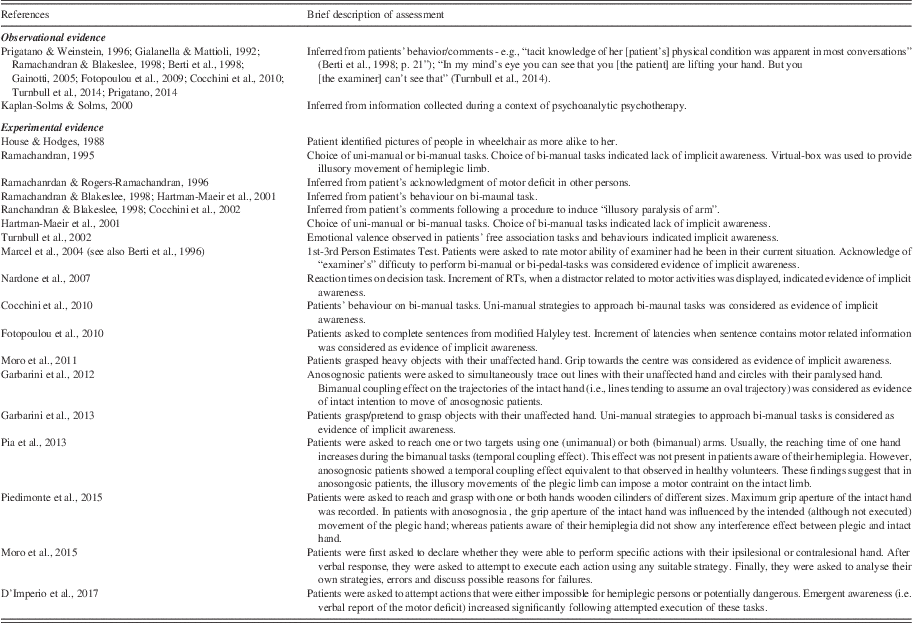
Anosognosia for hemiplegia is usually assessed asking the patients about their motor abilities (Marková & Berrios, Reference Marková and Berrios2014). Patients may be asked to respond to structured interviews investigating their ability to move their limbs (Jenkinson, Preston, & Ellis, Reference Jenkinson, Preston and Ellis2011; Nurmi & Jehkonen, Reference Nurmi and Jehkonen2014; see also Table 1) or to rate their motor performances in everyday tasks (e.g., Marcel, Tegnér, & Nimmo-Smith, Reference Marcel, Tegnér and Nimmo-Smith2004; Della Sala, Cocchini, Beschin, & Cameron, Reference Della Sala, Cocchini, Beschin and Cameron2009; Prigatano, Reference Prigatano2014; see also Table 1). Invariably, these evaluations suggest some degree of metacognition: patients are asked to estimate their own motor skills and, in some cases, they are asked to comment on their previous performance and use of strategies (Moro, Scandola, Bulgarelli, Avesani, & Fotopoulou, Reference Moro, Scandola, Bulgarelli, Avesani and Fotopoulou2015).
Methods assessing less overt aspects of anosognosia for motor impairment

However, there is evidence to suggest that lack of explicit awareness may be associated to some degree of insight (e.g., Cocchini, Beschin, Fotopoulou, & Della Sala, Reference Cocchini, Beschin, Fotopoulou and Della Sala2010; D’Imperio, Bulgarelli, Bertognoli, Avesani, & Moro, Reference D’Imperio, Bulgarelli, Bertagnoli, Avesani and Moro2017; Fotopoulou, Pernigo, Maeda, Rudd, & Kopelman, Reference Fotopoulou, Pernigo, Maeda, Rudd and Kopelman2010; House & Houdges, Reference House and Hodges1988; Marcel et al., Reference Marcel, Tegnér and Nimmo-Smith2004; Nardone, Ward, Fotopoulou, & Turnbull, Reference Nardone, Ward, Fotopoulou and Turnbull2007; Prigatano, Reference Prigatano2014). Patients may verbally deny their motor deficits yet abstain from activities requiring the use of both hands (Bisiach & Geminiani, Reference Bisiach and Geminiani1991) or adopt successful strategies in approaching bi-manual tasks using one hand (Cocchini et al., Reference Cocchini, Beschin, Fotopoulou and Della Sala2010; Garbarini, Piedimonte, Dotta, Pia & Berti, Reference Garbarini, Piedimonte, Dotta, Pia and Berti2013; Moro, Pernigo, Zapparoli, Cordioli, & Aglioti, Reference Moro, Pernigo, Zapparoli, Cordioli and Aglioti2011) or refrain to perform potentially dangerous activities for hemiplegic patients (D’Imperio et al., Reference D’Imperio, Bulgarelli, Bertagnoli, Avesani and Moro2017). In contrast, Ramachandran (Reference Ramachandran1995) reported on anosognosic patients who consistently chose bi-manual rather than uni-manual tasks concluding that they did not show a “tacit knowledge” of their paralysis.
Brain damaged patients can suffer from different degrees of motor deficits, and those with moderate or mild motor impairment may also show anosognosia. However, to accurately interpret “responses to specific questions, such as - Can you move your hand? – […], the criterion of complete paralysis [is] necessary” (Nathanson, Bergman, & Gordon, Reference Nathanson, Bergman and Gordon1952, p. 381). This leads to the exclusion from the assessment of patients showing moderate and mild forms of motor impairment. Furthermore, the exclusion from assessment of several left-brain damaged patients may be due to associated language difficulties. Therefore, the assessment of anosognosia for right and left-brain damaged patients not showing severe hemiplegia ought to rely on different methods enabling the examiner to reliably interpret the patients’ responses according to their degree of motor impairment.
Inspired by a previous study by Ramachandran (Reference Ramachandran1995), this study aims at devising a novel method to investigate less explicit aspects of anosognosia by asking patients to judge the difficulty of several motor tasks, rather than estimate their own motor disability. This instrument, labeled Errand Choice Task, allowed us to assess patients with different degrees of motor impairment as well as left-brain damaged patients showing with language deficits.
METHOD AND MATERIALS
Participants
A total of 138 participants were recruited for this study. None had any previous history of psychiatric disorders. The study was completed in accordance with the Helsinki Declaration and all participants gave informed consent.
Patient group
A group of 73 (33 women) brain damaged patients recruited in the Brain Injury Rehabilitation Unit, Somma Lombardo Hospital (Italy) entered the study.Footnote 1 Their demographic and clinical data are detailed in Table 2. They all suffered from a first stroke; 30 had unilateral left hemisphere damage (LBD) and 43 had unilateral right hemisphere damage (RBD). Clinical neuroimaging (CT/MRI scans) showed that most patients (n=56) had a lesion encompassing, or limited to, the frontal and parietal lobes. Compared to RBD, the LBD patients had on average a longer onset-assessment interval; this difference fell short of significance (t-crit=1.882; p=.064).
Demographic and clinical features of LBD and RBD patients entering the study

Note. Means, standard deviations (in parentheses) and range are shown. ADL= activity of daily life (Katz et al., Reference Katz, Ford, Moskowitz, Jackon and Jaffe1963).
F-P=number of patients with a lesion enchroaching upon the frontal (F) and the parietal (P) lobes.
F or P=number of patients with a lesion LIMITED to the frontal (F) or the parietal (P) lobes.
To be considered for the experiment, patients had to present with clear contralesional motor impairment in their upper limb, as assessed by means of the Motricity Index (Wade, Reference Wade1992). During this assessment, the patient sat on a chair or a wheelchair; three left/right upper limb movements were assessed: “pinch grip,” “elbow flexion,” and “shoulder abduction.” For each of these movements, a score from 0 (no movement) to 33 (normal power) is given. The score for upper limb movements is then calculated by adding the score for the three movements plus 1, to give a total score between 1 (severe motor impairment) and 100 (no motor impairment). Poor performance due to apraxia, tremor, or ataxia is not considered as evidence of paresis. As reported in Table 2, the scores indicate that the patients presented with various degrees of motor impairment, with 43 out of 73 patients showing complete paresis in their upper limb
Patients’ independence in performing daily tasks (such as mobility, bathing, dressing) was evaluated by means of an ADL scale (Activity of Daily Life; Katz, Ford, Moskowitz, Jackon, & Jaffe, Reference Katz, Ford, Moskowitz, Jackon and Jaffe1963; Mahoney & Barthel, Reference Mahoney and Barthel.1965) where lower scores indicate lower degrees of independence. As reported in Table 2, the patients obtained on average a score of 8.5 out of 20, indicating an important decline of everyday independence. A series of t test analyses was conducted to compare demographical (age, education level) and clinical (onset from lesion, motor impairment for upper limb, and ADL score) variables between LBD and RBD. No significant differences were found.
Patients were also assessed with a comprehensive neuropsychological battery. Extrapersonal neglect was assessed by means of two cancellation tasks (Line cancellation, Albert, Reference Albert1973; and Star cancellation, Wilson, Cockburn, & Halligan, Reference Wilson, Cockburn and Halligan1987) and by means of a Line Bisection Test (Wilson et al., Reference Wilson, Cockburn and Halligan1987). Personal neglect was assessed by means of the Fluff Test (Cocchini, Beschin, & Jehkonen, Reference Cocchini, Beschin and Jehkonen2001), the Comb/Razor Test (Beschin & Robertson, Reference Beschin and Robertson1997) and the One Item Test (Bisiach, Perani, Vallar, & Berti, Reference Bisiach, Perani, Vallar and Berti1986). Reasoning abilities were assessed by means of the Vertical version of the Raven Progressive Matrices (Gainotti, D’Erme, Villa, & Caltagirone, Reference Gainotti, D’ Erme, Villa and Caltagirone1986; norms in Spinnler & Tognoni, Reference Spinnler and Tognoni1987). Non-verbal short-term memory was measured with the Corsi Blocks test (Spinnler & Tognoni, Reference Spinnler and Tognoni1987). Table 3 reports percentage of patients showing pathological performance on these tests.
Percentages of patients showing pathological performance on tasks assessing contralesional neglect, reasoning abilities, and memory processing

Note. In brackets, percentages of patients showing evidence of neglect on one, two, or all three tests.
Control group
A group of 65 (42 women) right-handed, healthy volunteers entered the study to refine the items and the scoring system of the Errand Choice Test (see below). Their mean age was 44.4 (SD=21.0; range=17–82 years), and they had a mean of 11.7 years of formal education (SD=4.7; range=3–20 years). Controls’ age was significantly lower than LBD (t-crit=4.5; p<.01) and RBD (t-crit=4.9; p<.01), whereas education level was not significantly different between controls and both patient groups.
ASSESSMENT PROCEDURES
Anosognosia Assessment
Visual-Analogue Test for Anosognosia for motor impairment (VATAm)
To assess evidence of anosognosia for upper limb motor deficits, all brain damaged patients underwent the VATAm (Della Sala et al., Reference Della Sala, Cocchini, Beschin and Cameron2009). In this test, patients are requested to rate (from 0=no problem to 3=severe problem), one at a time, their ability to perform a series of simple everyday motor tasks, such as clapping their hands. For the purpose of this study only the sub-scale for the upper limb, which consists of eight bi-manual tasks, was considered (score range: 0–24). There were also four check questions, for which the expected ratings lay at one or the other extreme of the scale. Performance on the check questions was not added to the score, as they were used solely to ensure the participants’ compliance and reliability.
The patients’ self-evaluation was compared with the ratings of their caregivers who filled in the questionnaire evaluating the patient’s motor skills. The resulting score, that is, the caregiver-patient discrepancy value, obtained by subtracting the patient’s self-rating of the eight bi-manual tasks from those given to the patient by their caregivers, could be checked against available norms (Della Sala et al., Reference Della Sala, Cocchini, Beschin and Cameron2009). This score indicates the patient’s degree of awareness/unawareness for their upper limb motor impairment. In the VATAm, the possible discrepancy value for upper limb items ranges from −24 (negative values indicate patient’s overestimation of their motor deficit compared to the caregiver’s judgment) to +24 (positive values indicate patient’s underestimation of their motor deficit compared to the caregiver’s judgment, that is, unawareness of their own deficits). According to the norms set in Della Sala et al. (Reference Della Sala, Cocchini, Beschin and Cameron2009), values falling between 3.8 and 8.0, 8.1 and 16.0, or 16.1 and 24.0 were taken to indicate mild, moderate or severe anosognosia, respectively.
Errand Choice Test (ECT)
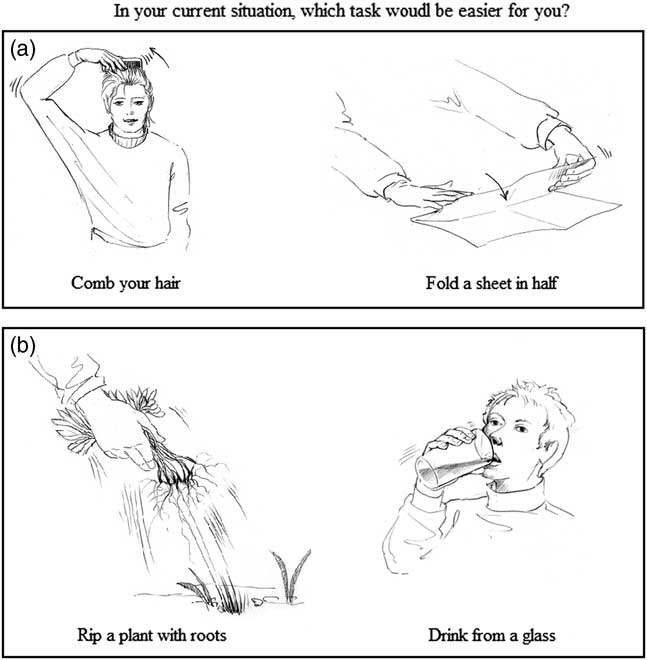
A novel task was devised for the purpose of this study: The Errand Choice Test. To assess the perception of one’s own motor skills and its implication on task choice, participants were presented with a list of 18 pairs of everyday tasks. Each pair consisted of one task usually performed with one hand (uni-manual task – e.g., “Comb your hair”) and one task usually performed with both hands (bi-manual task – e.g., “Fold a sheet in half”). Each task was illustrated by a drawing to clarify the type of performance requested and to emphasize whether the tasks required the use of either only one or both upper limbs (see Figure 1a for an example). For each pair, participants had to decide which task they would find it easier to perform in their current condition.
Examples of experimental items (a) and check items (b).

Material and procedure for this test were refined by means of three pilot studies with small groups of healthy volunteers and brain damaged patients (not included in the final sample groups). The three phases of the pilot studies allowed us to (i) (phase 1) classify each task as either uni-manual (i.e., a task usually performed with one hand) or bi-manual (i.e., a task usually performed using two hands); (ii) (phase 2) create unambiguous illustrations of each task to facilitate comprehension, minimize memory load, and underline the use of one or two hands; and (iii) (phase 3) select the tasks less sensitive to age or gender.
In the final version of the Errand Choice Test, drawings for each pair of tasks were presented on an A4 sheet on the ipsi-lesional side of the testing desk, the question they depicted was also read aloud by the experimenter while pointing to the corresponding drawing. Sixteen pairs (each consisting of one uni-manual and one bi-manual task) constituted the experimental trials. In half of the trials the uni-manual task was presented first and to the left side of the A4. Two check items were also used. Based on pilot data, in each pair of the check items, one of two tasks was clearly much easier to be performed than the other one (i.e., “Drink from a glass” – easy task; “Rip a bush with roots” – difficult task) even with no motor impairment (see Figure 1b for examples). If participants did not provide the expected response on these check questions, their data were excluded from further analyses.
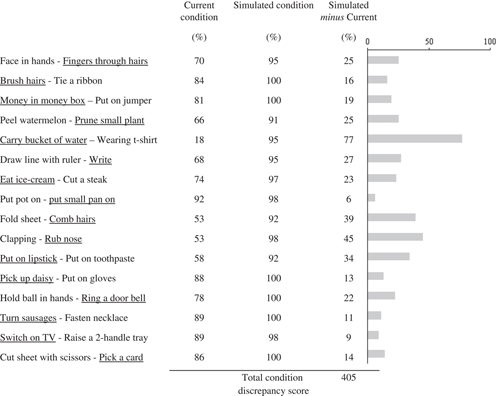
The eighteen pairs (16 experimental trials and 2 check pairs) were presented in a fixed pseudo-random order with the two check questions as first and last items (core actions for each pair are listed in Table 4). For each item in the pairs, participants were invited to evaluate the difficulty of the tasks and then indicate which of the two tasks they would consider easier to perform in their current situation (Current condition). There was no time limit for responses and questions could be repeated if required. The scoring system is detailed in the Result section.
Percentages of uni-manual choices made by the controls in the Current and Simulated conditions.

Note. Uni-manual tasks are underlined.
To assess the reliability of the Errand Choice Test, 28 patients were asked to perform it again on Current condition between 1 and 3 days later. Brain damaged patients performed the VATAm and ECT in random order. In addition, the controls were presented a second time with the same pair of tasks but, on this occasion, they were asked to re-evaluate the task difficulty indicating which task they would consider easier to perform should they not be able to move one of their arms (Simulated condition).
Statistical Analyses
As in previous studies (e.g., Cocchini, Gregg, Beschin, Dean, & Della Sala, Reference Cocchini, Gregg, Beschin, Dean and Della Sala2009a), a t test for single cases by Crawford and Garthwaite (Reference Crawford and Garthwaite2007) was used to established cutoff scores of the new ECT. Analysis of variance (ANOVA) and t test analyses for independent groups have been used to compare hemispheric differences and different awareness degrees. In case of multiple comparisons, we adopted Bonferroni correction. Finally, non-parametric Spearman correlations have been run to analyze reliability of ECT and its relationship with others variables.
RESULTS
VATAm (Upper Limb Sub-scale)
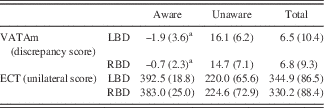
Fourteen out of 30 LBD patients (46.6%) showed evidence of severe (7 cases), moderate (5 cases) or mild (2 cases) explicit anosognosia. Twenty-one of the 43 RBD patients (48.8%) showed evidence of severe (8 cases), moderate (7 cases) or mild (6 cases) explicit anosognosia. Averaged discrepancy scores for aware and unaware LBD and RBD patients are shown in Table 5. The differences between aware and unaware LBD and RBD patients were not reliable (t-crit=−1.169; p=ns; t-crit=.635; p=ns, respectively).
Average (SD) of VATAm and ECT scores for aware and unaware patients

a Note that negative scores indicates patients’ overestimation of their motor impairment compared to caregivers’ rating.
Errand Choice Test
Controls
One healthy volunteer was excluded as he interrupted the test. Therefore, analyses were carried out on 64 healthy volunteers’ responses and their performance on the two conditions. Table 4 illustrates the scores on Current and Simulated conditions. Scores in both conditions poorly correlated with age (r=.066; p=.602 and r=−.134; p=.291, current and simulated condition, respectively). In all pairs, uni-manual choices increased under Simulated condition. The difference between the two conditions represented the “awareness” factor. In other words, the proportion of controls who identified the uni-manual task as easier only when they simulated hemiplegia represented the “pure” impact of being aware of not being able to move one arm.
This difference (i.e., Simulated minus Current) for each pair of items was then considered to assign a weighted score for each choice and develop a weighted scoring system (See Table 4). To establish a cut-off value and interpret each individual patients’ performance, controls’ performance during the Simulated condition was then recalculated assigning the related weighted score of each pair when the uni-manual task was chosen. The overall weighted score could range from 0 (if no uni-manual task was chosen) to 405 (if all uni-manual tasks were chosen). On average, healthy volunteers under Simulated condition obtained a weighted score of 389.25 (SD=29.35; range=289–405).
Crawford and Garthwaite’s (Reference Crawford and Garthwaite2007) t test was used to establish the lowest value (weighted score) below which performance should be considered abnormal. An overall weighted score lower than 318 (of 405) was significant with p<.01, and it was then set as cutoff point to interpret the patients’ performance.
Patients
One LBD patient (case 57) and one RBD patient (case 20) were excluded from further analyses as they failed at least one check question. Therefore, further analyses were run on a sample of 29 LBD and 42 RBD patients. Each patient was assigned a weighted score every time the unimanual task was chosen as easier. For example, had a patient chosen as easier tasks “Fingers through hairs” in the first pair, “Prune a small plant” in the fourth pair and “Pick up a card” in the last pair, this patient’s ECT score would have been 64 (i.e., 25+25+14; See Table 4 for weighted scores for each pair).
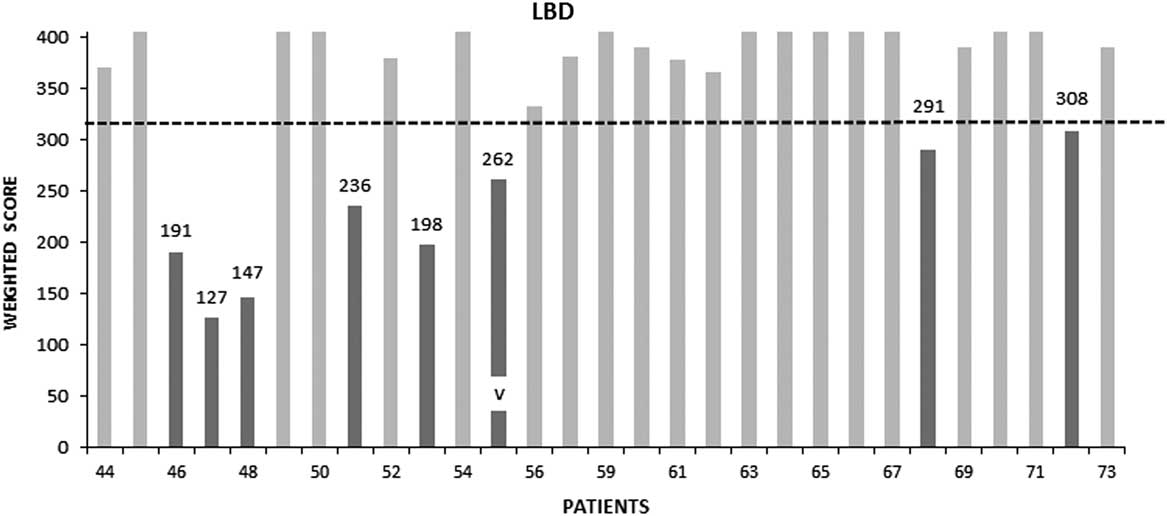
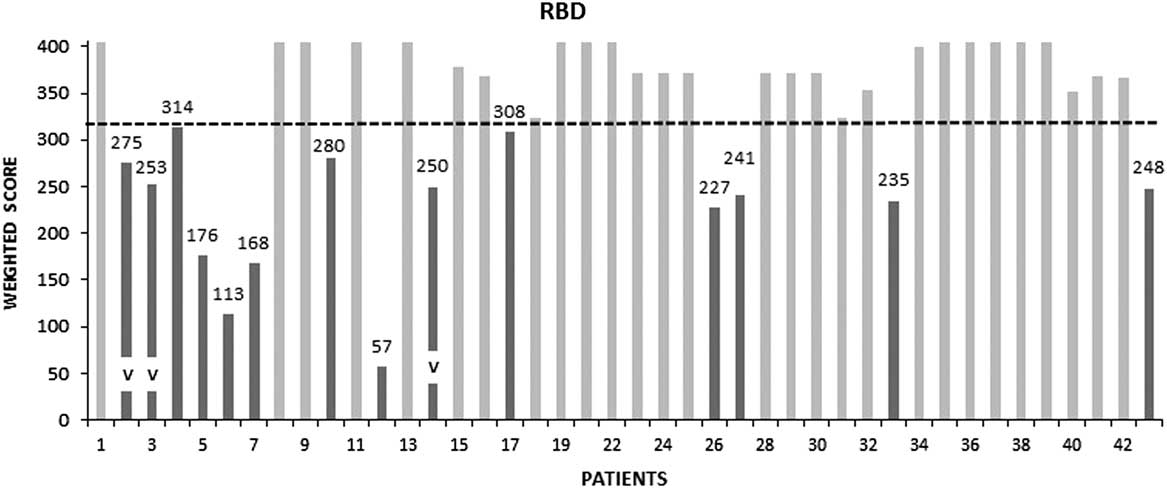
Looking at individual scores, 22 patients (8–27.6% LBD patients, and 14–33.3% RBD patients) performed below cutoff on the Errand Choice Test showing evidence of lack of awareness in estimating task difficulty given their motor impairment (see Figures 2 and 3). Six of the 8 anosognosic LBD patients and 7 of the 14 anosognosic RBD patients had complete paresis. Errand Choice Test scores for aware and unaware LBD and RBD patients are shown in Table 5. The overall difference between LBD and RBD patients’ scores was not significant (t-crit=.693; p=ns). Considering aware and unaware patients separately, the ECT differences between LBD and RBD patients were also not significant (t-crit=−1.507; p=ns; t-crit=−.865; p=ns., for aware and unaware patients, respectively).
LBD performance on the Errand Choice Test. Dashed line indicates cut-off. Darker bars indicate pathological performance with score reported. Patient 57 was excluded for failing check questions. V: Patient performing below cut-off on the Errand Choice Test who did not show lack of awareness (i.e., score=−7.5) on the VATAm (V).

RBD performance on the Errand Choice Test. Dashed line indicates cut-off. Darker bars indicate pathological performance with score reported. Patient 20 was excluded for failing check questions. V: Patient performing below cut-off on the Errand Choice Test who did not show lack of awareness on the VATAm (V). Patients: 2, 3 and 14 obtained a score of −2, 1 and 0, respectively.

The 28 (10 LBD and 18 RBD) patients who performed the Errand Choice Test twice obtained an average score of 307.79 (SD=111.53) on first testing and an average re-test score of 298.54 (SD=122.02). The difference was not significant (t-crit=.965; p=ns). A Spearman correlation run between the test and the re-test scores indicated a high positive correlation (r=.91; p<.001).
Finally, we calculated a weighted score on Current condition (i.e., when they were free to think that they could use both hands) for each of the 64 controls, following the same scoring procedure used with the patients. We then compared the performance of the Controls with those the 49 aware patients and the 22 anosognosic patients. Not surprisingly, patients aware of their motor deficit scored very high (mean=387.1; SD= 22.8) on the Errand Choice Test, indicating that they considered the uni-manual tasks easier than the bi-manual tasks. Anosognosic patients and controls obtained similar scores (anosognosic patients’ mean=235.8; SD=63.9; controls’ mean=241.0; SD=64.01), indicating that anosognosic patients’ rating was led by the incorrect assumption they could use both hands. A2 (LBD, RBD)×2 (aware, unaware) ANOVA showed a significant effect of awareness (F(1,67=217.02; p<.001) but no other interactions. Two further t test analyses between controls and both aware and unaware patients showed a significant difference only between controls and aware patients (t-crit=15.22; p<.001).
Comparing Performance Errand Choice Test and VATAm
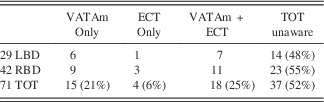
Two patients were excluded from the Errand Choice Test analyses (see above). Therefore, results from 71 patients (29 LBD and 42 RBD) on the VATAm and Errand Choice Test were compared. As shown in Table 6, a total of 37 (52.1%) patients showed evidence of unawareness on at least one test, 25.3% of them showed lack of awareness on both tests, and VATAm identified 15% more patients as anosognosics than the Errand Choice Test.
Number of patients showing lack of awareness on the VATAm and ECT

A non-parametric Spearman correlation run with all 71 patients between Errand Choice Test scores and VATAm discrepancy scores resulted in a negative significant correlation (r=−.48; p<.001), indicating that those patients who were less aware on the VATAm were also less aware on difficulty of bimanual tasks.
DISCUSSION
Often, the behavior of patients is not consistent with their explicit acknowledgement/denial of their motor deficit (e.g., Cocchini et al., Reference Cocchini, Beschin, Fotopoulou and Della Sala2010; Moro et al., Reference Moro, Pernigo, Zapparoli, Cordioli and Aglioti2011; Ramachandran & Blakeslee, Reference Ramachandran and Blakeslee1998). Some studies have shown that patients may indirectly acknowledge hemiplegia when it is attributed to another person (e.g., Marcel et al., Reference Marcel, Tegnér and Nimmo-Smith2004). It follows that anosognosia for one’s own motor deficits manifests at different degrees of awareness (e.g., Marcel et al., Reference Marcel, Tegnér and Nimmo-Smith2004; see Heilman, Reference Heilman2014 for a recent review) and methods to assess anosognosia should reflect such complexity (Jenkinson et al., Reference Jenkinson, Preston and Ellis2011).
By means of a newly devised test (the Errand Choice Test), we investigated less evident aspects of awareness for different degrees of severity of motor impairment in a sample of 73 brain damaged patients who were asked to judge task complexity rather than focus on their own deficit. On this test, they had to identify which of the two possible motor tasks (one uni-manual and one bi-manual) would be easier to perform in their current condition. Poor comprehension or general poor compliance were addressed using check items whereby participants were asked to identify the easiest task between two uni-manual tasks of clearly different difficulty. Our sample showed a relatively low exclusion rate as only two participants did not provide the expected responses and their results had to be excluded from the analyses.
The Errand Choice Test proved to be reliable showing a very high test re-test correlation, suggesting that the task is relatively sheltered by fluctuations of possible confounding variables, such as attentional disorders, perseveration, general lack of compliance, and practice effect. Moreover, despite reduced risky decision-making has been associated with ageing (e.g., Di Rosa et al., Reference Di Rosa, Mapelli, Arcara, Amodio, Tamburin and Schiff2017), the ECT performance seems unrelated by age. This may be due to the low complexity of the decision task required in this test, which is, therefore, suitable for different ages.
A sample of 65 healthy volunteers performed the test under two different conditions. Data collected under “Current” (i.e., being able to use both upper limbs) and “Simulated” (i.e., pretending to be unable to use one arm) conditions allowed us to identify the actual impact of awareness for possible motor impairment on each item. Comparison of data from these two conditions enabled us to establish whether the choice of uni-manual task mainly depends on general perception of ease or on awareness that one arm could not be moved (Simulated condition). For example, in the Current condition 53% of the controls considered the uni-manual task “Scratching your nose” easier than the bi-manual task “Clapping your hands”.
However, in the Simulated condition the choice of the uni-manual task rose to 98%, suggesting that the increased percentage (i.e., from 53% to 98%) of uni-manual choices was mainly driven by the “awareness” of not being able to move one arm. This information was then implemented to develop a weighted scoring system to interpret clinical data in terms of normal/pathological performance. To minimize the risk of false positives, we calculated a conservative cut-off (i.e., 318 with p<.01; which corresponds to a value nearly 3 standard deviations from the norms’ mean). Considering this cut-off, we identified a sizeable group of 31% (i.e., 22/71) brain damaged patients showing distorted perception of task difficulty. These patients may engage in motor activities without adopting correct strategies to compensate for their motor impairment, increasing their chance to use risky behaviors.
It should be noted that 9 of 22 anosognosic patients did not have complete hemiplegia of their upper limb. As suggested by Nathanson et al. (Reference Nathanson, Bergman and Gordon1952), also non-paretic patients may show considerable lack of awareness for their motor deficits and these may have passed unnoticed due to methodological shortcomings. This may explain why patients showing hemiplegia may need longer assistance after discharge from rehabilitation, as some of them may be unable to adopt safety measures (Hartman-Maeir, Soroker, & Katz, Reference Hartman-Maeir, Soroker and Katz2001).
Another significant outcome of the present study is the weak hemispheric asymmetry of anosognosia. Despite unawareness was numerically more frequent and on average more severe amongst RBD patients than LBD patients, the difference between the two groups was not significant, suggesting that lack of awareness for right hemiplegia may not be a negligible factor. While there is a general agreement on the association between anosognosia and right-hemisphere damage (for recent reviews, see Heilman, Reference Heilman2014; Nurmi & Jehkonen, Reference Nurmi and Jehkonen2014; Orfei et al., 2007; Pia, Neppi-Modona, Ricci, & Berti, Reference Pia, Neppi-Modona, Ricci and Berti2004; see also Table 1), the relationship between awareness and left hemisphere is more debatable (Morin, Reference Morin2007, Reference Morin2017).
Investigations of anosognosia for hemiplegia following damages of the dominant hemisphere are scant (see e.g., Nurmi & Jehkonen, Reference Nurmi and Jehkonen2014 Table 4), and some authors consider anosognosia for right hemiplegia a rare occurrence that can be observed only in very specific circumstances (e.g., Baier et al., Reference Baier, Vucurevic, Müller-Forell, Glassl, Geber, Dieterich and Karnath2014). However, recent studies have reported a less sporadic occurrence of anosognosia following damage of the left hemisphere (Appelros, Karlsson, & Hennerdal, 2007; Cocchini, Beschin, Cameron, Fotopoulou, & Della Sala, Reference Cocchini, Beschin, Cameron, Fotopoulou and Della Sala2009b; Grotta & Bratina, Reference Grotta and Bratina1995; Hartman-Maier et al., Reference Hartman-Maeir, Soroker and Katz2001; Hartman-Maier, Soroker, Ring, & Katz, Reference Hartman-Maeir, Soroker, Ring and Katz2002; Hartman-Maier, Soroker, Oman, & Katz, Reference Hartman-Maeir, Soroker, Oman and Katz2003; Hibbard, Stein, Gordon, & Sliwinski, Reference Hibbard, Stein, Gordon and Sliwinski1992).
For example, Hartman-Maier and colleagues (2003) reported that anosognosia at admission was present in 53% of right- and up to 41% of left-brain damaged patients. The authors reported similar pattern of results in chronic phases where anosognosia was observed on 27% right- and 23% left-brain damaged patients. Appelros et al. (2007) examined anosognosia in a large sample of brain damaged patients and reported non-significant hemispheric difference for anosognosia with “only” 54% of the 46 anosognosic patients suffering right-brain lesion. It is possible that presence and frequency of anosognosia following LBD may be inflated to an inability to recognize or represent the correct action (Pazzaglia, Pizzamiglio, Pes, & Aglioti, Reference Pazzaglia, Pizzamiglio, Pes and Aglioti2008). However, in our final analyses we only considered patients who provided correct responses to all the check questions, suggesting that these patients had an appropriate understanding of the task and were able to correctly recognize the target actions.
Outcomes from studies with intra-carotid sodium amobarbital procedure (Wada Test) are also far from conclusive about the relationship between left hemisphere and awareness. Nearly all of these studies showed a higher frequency of anosognosia for left hemiplegia, which ranged between 66% (Dywan, McGlone, & Fox, Reference Dywan, McGlone and Fox1995) and 100% (Gilmore, Heilman, Schmidt, Fennell, & Quisling, Reference Gilmore, Heilman, Schmidt, Fennell and Quisling1992); however, in these same studies the frequency of anosognosia for right hemiplegia ranged from 0% to 86% (Buchtel, Henry, & Abpu-Khalil, Reference Buchtel, Henry and Abou-Khalil1992; Carpenter et al., Reference Carpenter, Berti, Oxbury, Molyneux, Bisiach and Oxbury1995; Durkin, Meador, Nichols, Lee, & Loring, 1994; Dywan et al., Reference Dywan, McGlone and Fox1995; Gilmore et al., Reference Gilmore, Heilman, Schmidt, Fennell and Quisling1992; Kaplan, Meadows, Cohen, Bromfield, & Ehrenberg, Reference Kaplan, Meadows, Cohen, Bromfield and Ehrenberg1993; Lu et al., Reference Lu, Barrett, Schwartz, Cibula, Gilmore, Uthman and Heilman1997), and the difference between the two hemisphere conditions could also range from 0% (Dywan et al., Reference Dywan, McGlone and Fox1995) to 100% (Gilmore et al., Reference Gilmore, Heilman, Schmidt, Fennell and Quisling1992; for a revision see Cocchini & Della Sala, Reference Cocchini and Della Sala2010, Table 7.2).
It seems, therefore, that despite anosognosia for motor impairment is more frequently associated to a lesion (or anaesthetization) of the right hemisphere, unawareness for right motor impairment is not a negligible phenomenon as commonly thought, although it may be less easily detectable.
The debate about hemispheric asymmetry of anosognosia may denote some contradictions possibly generated, as suggested by Baier et al. (Reference Baier, Vucurevic, Müller-Forell, Glassl, Geber, Dieterich and Karnath2014), by different researcher’s concept of anosognosia and consequently different selection of patients and methods, leading to investigations of potentially different underlying mechanisms (see also Jenkinson et al., Reference Jenkinson, Preston and Ellis2011; Morin, Reference Morin2017). The strong link between right brain damage and relatively rare severe cases of anosognosia characterized by an explicit and vehement denial of complete hemiplegia may represent a specific form of anosognosia, associated to lesions to particular brain areas (i.e., right insula: Baier & Karnath, Reference Baier and Karnath2008; Karnath, Baier, Nägele, Reference Karnath, Baier and Nägele2005; Vocat, Staub, Stroppini, & Vuilleumier, Reference Vocat, Staub, Stroppini and Vuilleumier2010; right premotor cortex: Berti et al., Reference Berti, Bottini, Gandola, Pia, Smania, Stracciari and Paulesu2005; wide cortical and subcortical network: Moro et al., Reference Moro, Pernigo, Tsakiris, Avesani, Edelstyn, Jenkinson and Fotopoulou2016) or on the presence of associated “right brain damage deficits” (e.g., unilateral spatial neglect; Cocchini, Beschin, & Della Sala, Reference Cocchini, Beschin and Della Sala2002; Feinberg, Reference Feinberg1997; Vocat et al., Reference Vocat, Staub, Stroppini and Vuilleumier2010) that render difficult the discovery of hemiplegia for the unattended limb/s. It should be noted that 26% of our LBD patients showed some degree of personal neglect; however, up to 52% of RBD patients showed the same deficit; therefore, the merely presence of neglect cannot account for the hemispheric asymmetry for anosognosia.
It must, however, be considered that a growing number of studies (e.g., Cocchini et al., Reference Cocchini, Beschin, Fotopoulou and Della Sala2010; Fotopoulou et al., Reference Fotopoulou, Pernigo, Maeda, Rudd and Kopelman2010; Garbarini et al., Reference Garbarini, Rabuffetti, Piedimonte, Pia, Ferrarin, Frassinetti and Berti2012; Marcel et al., Reference Marcel, Tegnér and Nimmo-Smith2004; Moro et al., Reference Moro, Pernigo, Zapparoli, Cordioli and Aglioti2011; Nardone et al., Reference Nardone, Ward, Fotopoulou and Turnbull2007; Preston, Jenkinson, & Newport, Reference Preston, Jenkinson and Newport2010; Prigatano, Reference Prigatano2014; Ramachandran, Reference Ramachandran1995) have demonstrated that anosognosia reveals itself in different domains and contexts, showing different clinical correlates. Therefore, the use of different, more specific methodologies may enable researchers and clinicians to identify less apparent manifestations of anosognosia, such as lack of awareness in patients showing different degrees of anosognosia and anosognosia for different degrees of motor impairment.
A further observation concerns the “similar performance” (scores) observed between anosognosic patients and healthy volunteers during the Current condition. Patients unaware of their motor impairment perceived the difficulty of the tasks similarly to healthy volunteers, as if they could still use both hands. These findings are in line with previous studies reporting a preserved motor planning in anosognosic patients, which was equivalent to healthy volunteers (e.g., Garbarini et al., Reference Garbarini, Rabuffetti, Piedimonte, Pia, Ferrarin, Frassinetti and Berti2012). Moreover, the anosognosic patients’ ability to perceive the complexity of each task per se is not altered. Therefore, the anosognosic patients’ ability to perceive the complexity of each task per se is not altered; however, they failed to take into account their motor impairments.
This does not necessarily suggest that the cause for anosognosia in all our patients can be easily traced back to a single mechanism. On the contrary, a sizable sample of 19 patients showed different performance on the two tests. Regardless of the rather speculative interpretation of single cases, it seems that lack of awareness can be caused by different reasons and the related manifestations may not be equally evident to a unique assessment method. This would be in line with the idea that anosognosia is a multifaceted syndrome (Prigatano, Reference Prigatano2014) and may explain the relatively low, although significant, correlations between the Errand Choice Test and the VATAm. Overall suggesting that the use of a battery of tests rather than single measure of anosognosia may lead to a more detailed picture.
To conclude, evidence of anosognosia has been associated with poor rehabilitation outcome (Appelros, Karlsson, Seiger, & Nydevik, Reference Appelros, Karlsson, Seiger and Nydevik2002; di Legge, Fang, Saposnik, & Hachinski, Reference Di Legge, Fang, Saposnik and Hachinski2005; Gialanella & Mattioli, Reference Gialanella and Mattioli1992; Gialanella, Monguzzi, Santoro, & Rocchi, Reference Gialanella, Monguzzi, Santoro and Rocchi2005; Hartman-Maeir et al., Reference Hartman-Maeir, Soroker, Ring and Katz2002; Maeshima et al., Reference Maeshima, Dohi, Funahashi, Nakai, Itakura and Komai1997) and increment of the risk of falls and a greater exposure to dangerous behaviors (D’Imperio et al., Reference D’Imperio, Bulgarelli, Bertagnoli, Avesani and Moro2017; Hartman-Maeir et al., Reference Hartman-Maeir, Soroker and Katz2001; Mograbi & Morris, Reference Mograbi and Morris2013; Palmer & David, Reference Palmer and David2013; Starkstein, Jorge, Mizrahi, Adrian, & Robinson, Reference Starkstein, Jorge, Mizrahi, Adrian and Robinson2007). These risks may be even greater for those patients who show a false awareness of their abilities by explicitly acknowledging their motor impairment but still misjudging the difficulty of bi-manual tasks. These patients may possess a false sense of awareness of their own motor limitations, making them more prone to potentially risky situations.