Introduction
The association between urbanicity and schizophrenia is long-established (March et al. Reference March, Hatch, Morgan, Kirkbride, Bresnahan, Fearon and Susser2008). Initial findings of greater first admission rates for schizophrenia in urban centers (Faris & Dunham, Reference Faris and Dunham1939) were subject to debate as to whether they reflected causal effects of urban residence on mental health or resulted from selection of ill or prodromal persons into more urban areas (Lapouse et al. Reference Lapouse, Monk and Terris1956; Pedersen, Reference Pedersen2015; Eaton, Reference Eaton1974; Freeman, Reference Freeman1994). Subsequently, a number of studies found that risk for schizophrenia is greater among those born or raised in more urban areas (Lewis et al. Reference Lewis, David, Andreasson and Allebeck1992; Marcelis et al. Reference Marcelis, Navarro-Mateu, Murray, Selten and Van Os1998; Mortensen et al. Reference Mortensen, Pedersen, Westergaard, Wohlfahrt, Ewald, Mors, Andersen and Melbye1999; Pedersen & Mortensen, Reference Pedersen and Mortensen2001a ). Some reported that risk increased with the degree of urbanization of the place of birth or upbringing (Lewis et al. Reference Lewis, David, Andreasson and Allebeck1992; Pedersen & Mortensen, Reference Pedersen and Mortensen2001b ), and Pedersen & Mortensen (Reference Pedersen and Mortensen2001a ) reported a dose–response relationship between the duration of urban residence during upbringing and schizophrenia risk in Denmark (Pedersen & Mortensen, Reference Pedersen and Mortensen2001a ). These associations cannot be readily explained by selection of individuals into urban areas because individuals do not generally choose where they are born or raised. In addition, previous studies have shown that findings persists after adjustment for family history of schizophrenia and other mental disorders, suggesting that they are not simply artifacts of selection of ill parents into more urban areas (Pedersen & Mortensen, Reference Pedersen and Mortensen2001b ). Although a few studies have reported discrepant findings (Suvisaari et al. Reference Suvisaari, Haukka, Tanskanen and Lonnqvist2000), evidence for this risk factor is generally regarded as strong, and is often invoked to illustrate the importance of the social environment in the etiology of schizophrenia (van Os et al. Reference Van Os, Krabbendam, Myin-Germeys and Delespaul2005, Reference Van Os, Kenis and Rutten2010).
A number of potential explanations for the urbanicity association have been investigated, including exposure to infections, environmental toxins, obstetric complications, vitamin D deficiency, cannabis, social processes, and stress (Kelly et al. Reference Kelly, O'Callaghan, Waddington, Feeney, Browne, Scully, Clarke, Quinn, McTigue, Morgan, Kinsella and Larkin2010; Padhy et al. Reference Padhy, Sarkar, Davuluri and Patra2014). Unfortunately, explanations have not been clearly identified, as results for many candidate mechanisms are mixed (McGrath & Scott, Reference McGrath and Scott2006). One alternative explanation is that the association is induced by familial factors that increase both schizophrenia risk and the probability that a person will be born or raised in an urban area (Pedersen & Mortensen, Reference Pedersen and Mortensen2006b ). This possibility is supported by two findings. First, using information from Danish registries, Pedersen & Mortensen (Reference Pedersen and Mortensen2006a , Reference Pedersen and Mortensen b ) found that the place of birth of an individual's nearest oldest sibling was associated with schizophrenia above and beyond the individual's own place of birth or upbringing (Pedersen & Mortensen, Reference Pedersen and Mortensen2006a ). For example, among individuals brought up in rural areas, those whose older sibling was born in the capital had about 1.6 times the risk of schizophrenia as those whose older sibling was born in a rural area (Pedersen & Mortensen, Reference Pedersen and Mortensen2006a ). Second, a recent Swedish register-based study found that the association between population density during upbringing and schizophrenia was attenuated after accounting for unobserved familial factors within extended and nuclear families (Sariaslan et al. Reference Sariaslan, Larsson, D'Onofrio, Langstrom, Fazel and Lichtenstein2015). These findings are not completely incompatible with a causal effect of urbanicity; for example, they could be explained by exposures that accumulate in the family prior to an individual's birth (Pedersen & Mortensen, Reference Pedersen and Mortensen2006b ). However, they are also compatible with a scenario in which the association is induced by another familial factor, such as genetic susceptibility. There is evidence for genetic effects on features of residential location during adulthood, such as urbanicity and deprivation (Whitfield et al. Reference Whitfield, Zhu, Heath and Martin2005; Sariaslan et al. Reference Sariaslan, Fazel, D'Onofrio, Langstrom, Larsson, Bergen, Kuja-Halkola and Lichtenstein2016). If some genes that increase schizophrenia risk also predispose toward living (and raising children) in more urban locations, for example, by influencing personality characteristics (Jokela et al. Reference Jokela, Elovainio, Kivimaki and Keltikangas-Jarvinen2008), or if the chances of reproduction among those with genetic risk are greater in more urban areas, a spurious association between urbanicity and schizophrenia could result (Jablensky & Kalaydjieva, Reference Jablensky and Kalaydjieva2003). Controlling for family history would not entirely remove this influence because many people with schizophrenia do not have an affected first-degree relative, and family history captures only the end of a continuum of genetic risk (Yang et al. Reference Yang, Visscher and Wray2010). To our knowledge, no studies have assessed whether differences in genetic risk might explain the associations of urbanicity at birth and during upbringing with schizophrenia using measures of genetic liability other than family history. Here we used polygenic risk scores (PRSs) for schizophrenia, which provide individual-level continuous indices of genetic risk, to capture additional information about genetic liability in a population-based nested case–control study in Denmark.
Our aims were to (1) estimate the association between PRS and urbanicity to assess whether those born and raised in more urban areas have greater genetic susceptibility to schizophrenia; and (2) assess whether the associations of urban birth and upbringing with schizophrenia are explained by differences in genetic risk.
Method
Study population
Danish population registry data were used to create a population-based nested case–control study. Three population registries were linked using a unique personal identifier assigned to all Danish residents: the Danish Civil Registration System (Pedersen et al. Reference Pedersen, Gotzsche, Moller and Mortensen2006), the Danish Neonatal Screening Biobank (Norgaard-Pedersen & Hougaard, Reference Norgaard-Pedersen and Hougaard2007), and the Danish Psychiatric Central Research Register (Mors et al. Reference Mors, Perto and Mortensen2011). The Civil Registration System was established in 1968 and contains dates of birth and death, place of birth and residence, and links to parents and siblings. Danish residents are required to notify the government of address changes within 5 days; in Denmark, it is unlikely that this mandatory information is not reported (Pedersen et al. Reference Pedersen, Gotzsche, Moller and Mortensen2006). The Neonatal Screening Biobank contains dried blood spot samples collected at birth from nearly all newborns born in Denmark since 1981. The Psychiatric Central Register contains all inpatient psychiatric diagnoses since 1969 and outpatient and emergency room visits since 1994. Diagnoses are those made by the treating clinician and are recorded as the International Classification of Diseases (ICD)-8 and ICD-10 codes. Denmark has free, universal healthcare coverage and no private psychiatric hospitals, making it extremely likely that severe mental disorder is captured in the registry. The study was approved by the Danish Data Protection Agency and the Danish Scientific Ethics Committee.
The study population included all singleton births from 1981 through 2000. This population was linked to the Psychiatric Central Register to identify incident cases of ICD-10 F20 schizophrenia first assigned from 1994 through September 2009. Cases were each matched to one randomly selected control with the same sex and birthdate who had not yet been diagnosed with schizophrenia at the time of the case's diagnosis. DNA was extracted from the bloodspots, whole-genome amplified (in triplicate using the QiagenREPLI-g mini kit and the three separate reactions were pooled), and genotyped with Illumina Human 610-Quad BeadChip array or Illumina Infinium CoreExome beadchip (Agerbo et al. Reference Agerbo, Mortensen, Wiuf, Pedersen, McGrath, Hollegaard, Norgaard-Pedersen, Hougaard, Mors and Pedersen2012; Meier et al. Reference Meier, Agerbo, Maier, Pedersen, Lang, Grove, Hollegaard, Demontis, Trabjerg, Hjorthoj, Ripke, Degenhardt, Nothen, Rujescu, Maier, Moo, Werge, Mors, Hougaard, Borglum, Wray, Rietschel, Nordentoft, Mortensen and Mattheisen2015). Details of genotyping and quality control have been published (Agerbo et al. Reference Agerbo, Mortensen, Wiuf, Pedersen, McGrath, Hollegaard, Norgaard-Pedersen, Hougaard, Mors and Pedersen2012, Reference Agerbo, Sullivan, Vilhjalmsson, Pedersen, Mors, Borglum, Hougaard, Hollegaard, Meier, Mattheisen, Ripke, Wray and Mortensen2015; Borglum et al. Reference Borglum, Demontis, Grove, Pallesen, Hollegaard, Pedersen, Hedemand, Mattheisen, Uitterlinden, Nyegaard, Orntoft, Wiuf, Didriksen, Nordentoft, Nothen, Rietschel, Ophoff, Cichon, Yolken, Hougaard, Mortensen and Mors2014; Meier et al. Reference Meier, Agerbo, Maier, Pedersen, Lang, Grove, Hollegaard, Demontis, Trabjerg, Hjorthoj, Ripke, Degenhardt, Nothen, Rujescu, Maier, Moo, Werge, Mors, Hougaard, Borglum, Wray, Rietschel, Nordentoft, Mortensen and Mattheisen2015). Principal components analysis was used to generate principal components to capture population ancestry and prevent confounding due to population stratification (Price et al. Reference Price, Patterson, Plenge, Weinblatt, Shadick and Reich2006). Related individuals, outliers (>±4 s.d.) with respect to the first 10 principal components, and those whose sex in the Civil Registration System was inconsistent with genotype were removed, leaving 1692 cases and 1724 controls forming 1549 complete matched pairs.
PRS estimation
A meta-analysis was conducted of all Psychiatric Genetics Consortium samples (Schizophrenia Working Group of the Psychiatric Genomics Consortium, 2014), excluding the Danish sample, yielding a training sample of 34 600 cases and 45 968 controls. Single nucleotide polymorphisms (SNPs) were retained if their minor allele frequency was ⩾10% and imputation information score ⩾0.9 in both the training and target samples. Indels and SNPs in the extended major histocompatibility complex region, except for rs7746199, were excluded. Missing SNPs were imputed using the 1000 Genomes Project reference panel (Schizophrenia Working Group of the Psychiatric Genomics Consortium, 2014). Approximately 100 000 SNPs were selected from among those not in linkage disequilibrium (R 2 values ⩽0.1 in 500 kb windows), preferentially retaining those that were most associated in any region. PRSs were calculated in the Danish sample using a p value cut-off of <0.05 following previous work (Schizophrenia Working Group of the Psychiatric Genomics Consortium, 2014; Wray et al. Reference Wray, Lee, Mehta, Vinkhuyzen, Dudbridge and Middeldorp2014; Agerbo et al. Reference Agerbo, Sullivan, Vilhjalmsson, Pedersen, Mors, Borglum, Hougaard, Hollegaard, Meier, Mattheisen, Ripke, Wray and Mortensen2015). A PRS is a weighted sum of schizophrenia risk alleles, where the weights are the log odd ratios of disorder from the training sample. Higher PRS is associated with an increased risk of schizophrenia (Agerbo et al. Reference Agerbo, Sullivan, Vilhjalmsson, Pedersen, Mors, Borglum, Hougaard, Hollegaard, Meier, Mattheisen, Ripke, Wray and Mortensen2015).
Urbanicity
We considered urbanicity at two time points: birth and age 15. Urbanicity at birth was measured using the mother's address on each individual's birthdate. Urbanicity at age 15 was used as a proxy for urbanicity during upbringing and was measured according to the individual's address on his/her 15th birthday. Urbanicity was categorized by municipality into five levels, in keeping with prior studies: capital (Copenhagen), capital suburb, provincial city (city with >100 000 residents), provincial town (city with >10 000 residents), and rural areas. Those born or living in rural areas were used as reference groups. For analyses of urbanicity at age 15, we omitted those with a matching (onset) date before age 15, leaving 1620 controls, 1595 cases, and 1456 complete pairs. These analyses also include an extra urbanicity level to accommodate those who lived in Greenland or abroad at age 15.
Parental characteristics
History of mental disorder in one or both parents before the matching date was gathered from the psychiatric registry and diagnoses were categorized hierarchically as follows: broad schizophrenia or bipolar disorder [ICD-10 F20-F29, F30-F31, or corresponding ICD-8 diagnoses (Pedersen et al. Reference Pedersen, Mors, Bertelsen, Waltoft, Agerbo, Mcgrath, Mortensen and Eaton2014)], another mental disorder (another ICD-10 F diagnosis or corresponding ICD-8 diagnosis), and none. Paternal age at the time of each individual's birth was gathered from the CRS and categorized as follows: ⩽20, 21–25, 26–30, 31–35, 36–40, >40, and missing (due to a missing paternal link in the register, n = 42). Parental place of birth was obtained from the civil registry and categorized as: both parents born in Denmark, only one parent born in Denmark, and both parents born abroad, in Greenland, or unknown.
Analysis
PRSs were standardized and adjusted for ancestry using the first 10 principal components in all analyses. Conditional logistic regression among the matched pairs was used to estimate incidence rate ratios (IRRs) of schizophrenia and 95% confidence intervals (CIs). Matched analyses adjust for age, sex, and date of birth by design. The mean PRS for each level of urban birth and residence was estimated in the entire sample, adjusted for the first 10 principal components as well as age, sex, and year of birth. Associations between PRS and being born or residing in an urban v. a rural area were estimated using generalized estimating equations among cases and controls residing in the capital or rural areas (the highest and lowest levels of urbanicity) at birth or age 15, and adjusted for the first 10 principal components and age, sex, and year of birth (model 1) as well as other covariates (models 2 and 3). Analyses were conducted using SAS version 9.4 (SAS Institute, Carey, North Carolina, USA).
Results
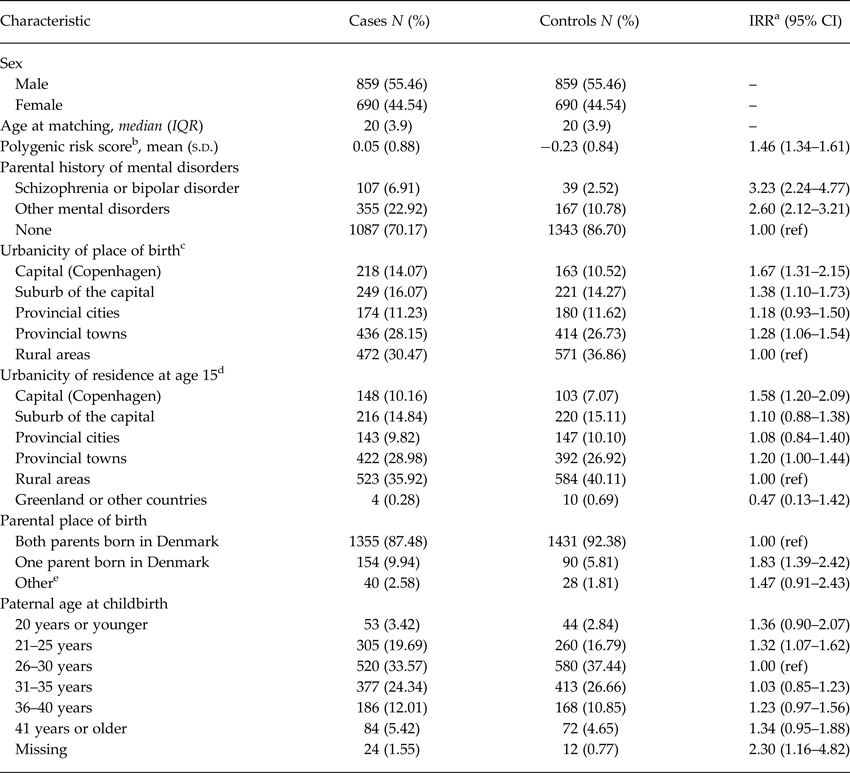
The sample consisted of 1692 schizophrenia cases who were born in Denmark between 1981 and 2000, and 1724 controls matched on age, sex, and date of birth. Characteristics of the 1549 complete matched pairs are displayed in Table 1. PRS, urbanicity at birth, residence in the capital at age 15, parental psychiatric history, parental place of birth, and paternal age were associated with incidence of schizophrenia, similar to prior studies of the entire Danish population (Mortensen et al. Reference Mortensen, Pedersen, Westergaard, Wohlfahrt, Ewald, Mors, Andersen and Melbye1999; Pedersen & Mortensen, Reference Pedersen and Mortensen2001a ; Cantor-Graae & Pedersen, Reference Cantor-Graae and Pedersen2007; Petersen et al. Reference Petersen, Mortensen and Pedersen2011). Details of the association between the PRS and schizophrenia in a subset of this cohort have been published previously (Agerbo et al. Reference Agerbo, Sullivan, Vilhjalmsson, Pedersen, Mors, Borglum, Hougaard, Hollegaard, Meier, Mattheisen, Ripke, Wray and Mortensen2015).
Sample characteristics for 1549 incident cases of schizophrenia and 1549 individually age- and sex-matched controls

a IRRs are adjusted for age, sex, and date of birth by design.
b Normalized to the sample.
c Provincial cities = municipalities having a town with more than 100 000 inhabitants; provincial towns = municipalities having a town with between 10 000 and 100 000 inhabitants; rural areas = other municipalities in Denmark (largest town has <10 000 inhabitants).
d Only pairs whose date of matching (case onset) is after the 15th birthday (1456 pairs).
e Both parents born abroad, in Greenland or missing.
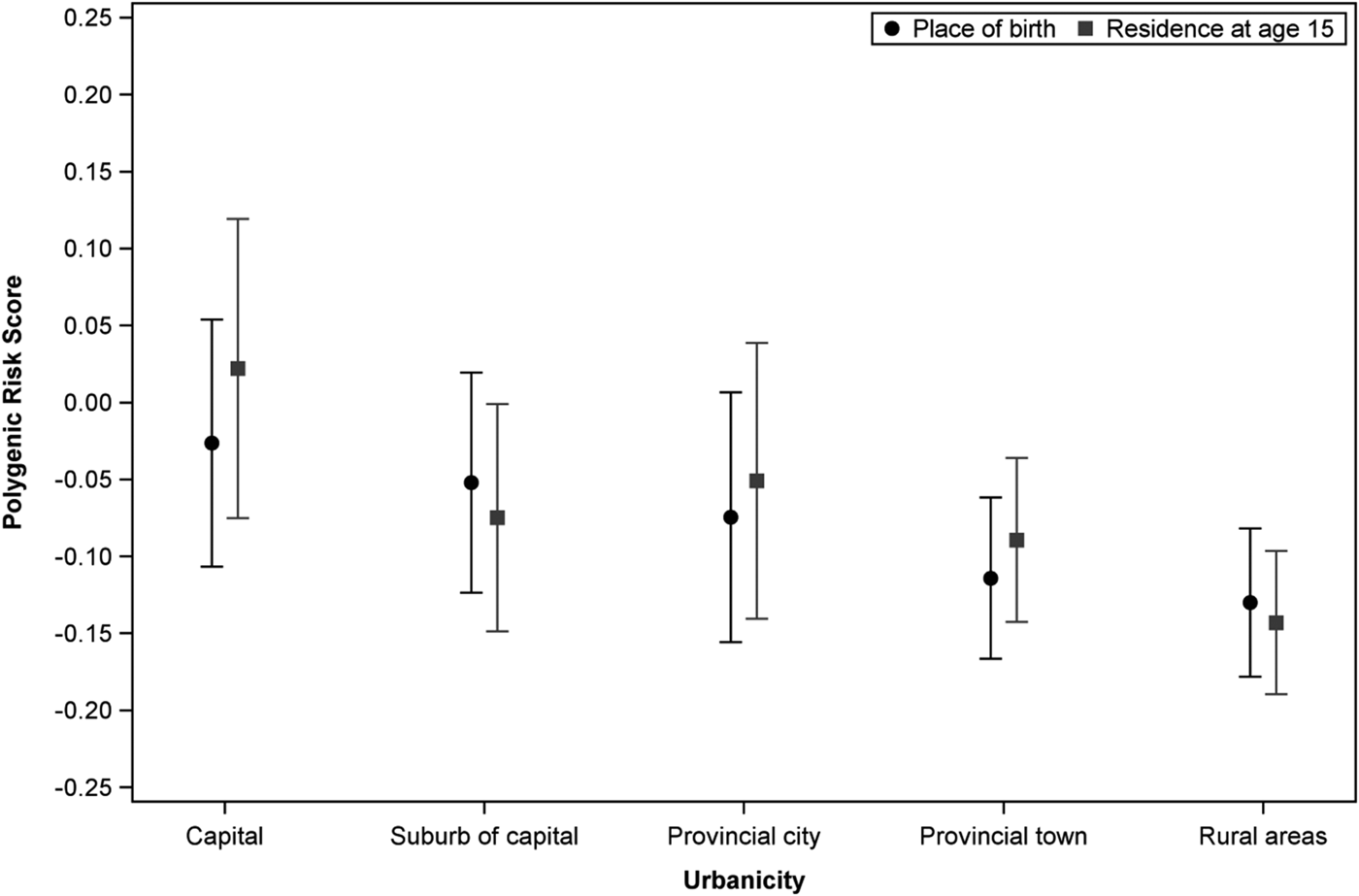
Figure 1 displays mean PRS, adjusted for ancestry, age, sex, and year of birth, according to urbanicity at birth and at age 15. PRS was highest among those born in the capital, decreased with decreasing urbanicity, and was lowest among those born in rural areas. The mean PRSs for each level of urbanicity at age 15 were similar to those at birth.
Mean polygenic risk score for schizophrenia, according to urbanicity at birth and at age 15, among 3416 schizophrenia cases and controls. Polygenic risk score adjusted for the first 10 principal components as well as age, sex, and year of birth. Only those whose date of matching (case onset) is after the 15th birthday and who lived in Denmark at age 15 (n = 3214) are used when considering urbanicity at age 15.

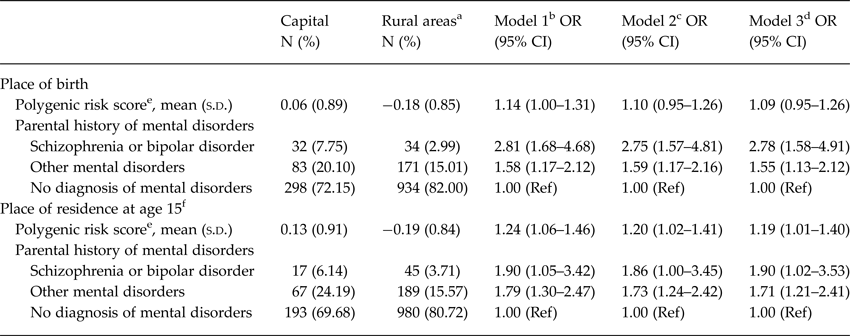
Table 2 shows the associations of PRS and parental history with being born or residing (at age 15) in the capital compared with a rural area, under different model adjustments. Regarding place of birth, each standard deviation increase in the PRS was associated with 1.14-fold greater odds (95% CI 1.00–1.31) of being born in the capital compared with a rural area, although estimates were not significantly different from unity after adjustment (Table 2, models 2 and 3). Regarding place of upbringing, each standard deviation increase in PRS was associated with a 1.24-fold (95% CI 1.06–1.46) increase in the odds of residing in the capital compared with a rural area at age 15. This estimate changed only slightly after adjustment for parental history of mental disorder [model 2 odds ratio (OR) 1.20, 95% CI 1.02–1.41] and for paternal age and parental place of birth (model 3 OR 1.19, 95% CI 1.01–1.40). Parental history of mental disorder was associated with greater odds of birth and residence in the capital (Table 2).
Associations of polygenic risk score for schizophrenia with being born in the capital and living in the capital at age 15, compared with being born or living in rural areas

Note: Analysis includes only those residing in the lowest and highest levels of urbanicity at either birth or age 15.
a Municipalities in Denmark where largest town has <10 000 inhabitants.
b Model 1: adjusted for sex, age, year of birth, and the first 10 principal components.
c Model 2: model 1, plus polygenic risk score and parental history of mental disorder are adjusted for one another.
d Model 3: model 2 additionally adjusted for parental place of birth and paternal age at childbirth.
e Normalized to the sample.
f Only those aged 15 or older at the time of matching are considered for the analysis with place of residence at age 15.
Versions of Fig. 1 and Table 2 calculated among cases and controls separately are provided in the online Supplementary Material. However, these results may possibly be influenced by collider-stratification bias (Cole et al. Reference Cole, Platt, Schisterman, Chu, Westreich, Richardson and Poole2010).
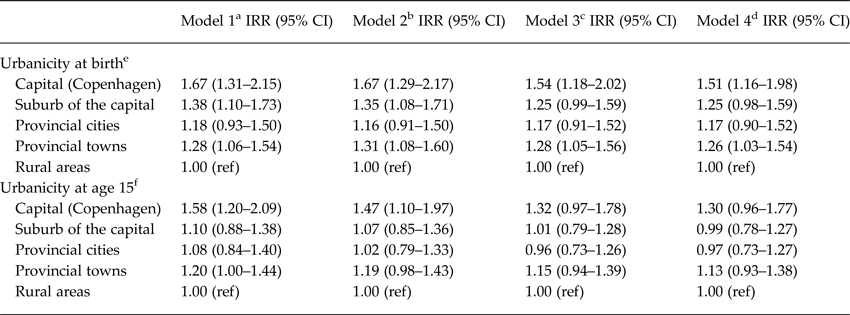
Associations between urbanicity and schizophrenia under different adjustments are displayed in Table 3. The first column (model 1) displays associations adjusted for age, sex, and date of birth by the matched design, as in Table 1. Compared with birth in rural areas, birth at higher levels of urbanicity was associated with greater risk of schizophrenia, with the exception of birth in provincial cities (Table 3, top). The greatest risk was for birth in the capital (IRR = 1.67, 95% CI 1.31–2.15). Adjustment for the PRS resulted in no change in the IRR for birth in the capital and minimal changes to the IRRs for other urbanicity levels (Table 3, top, model 2). The overall association between urbanicity and schizophrenia remained in this model (p = 0.001). Subsequent adjustment for parental history slightly attenuated the IRR for birth in the capital (IRR = 1.54, 95% CI 1.18–2.02) and capital suburb (IRR = 1.25, 95% CI 0.99–1.59); other estimates were minimally affected (Table 3, top, model 3). Final adjustment for paternal age and parental place of birth produced minimal change in estimates (Table 3, top, model 4). The overall association between urbanicity and schizophrenia remained in models 3 (p = 0.016) and 4 (p = 0.028).
Associations of urbanicity at birth and during upbringing with the risk of schizophrenia under different adjustments

a Model 1: adjusted for sex, age, and date of birth by design.
b Model 2: model 1 additionally adjusted for the polygenic risk score and the first 10 principal components.
c Model 3: model 2 additionally adjusted for parental history of mental disorders.
d Model 4: model 3 additionally adjusted for parental place of birth and paternal age at childbirth.
e Provincial cities = municipalities having a town with more than 100 000 inhabitants; provincial towns = municipalities having a town with between 10 000 and 100 000 inhabitants; rural areas = other municipalities in Denmark (largest town has <10 000 inhabitants).
f Only includes pairs whose date of matching (case onset) is after the 15th birthday (1456 pairs).
Residence in the capital at age 15 was also associated with greater risk of schizophrenia compared with residence in rural areas (IRR = 1.58, 95% CI 1.20–2.09). Adjustment for the PRS produced a slight change in this estimates (IRR = 1.47, 95% CI 1.10–1.97), but other estimates were minimally affected (Table 3, bottom). The overall association between urbanicity and schizophrenia was still present under this adjustment (p = 0.037). Further adjustment for parental history of mental disorders attenuated this estimate slightly more (IRR = 1.32, 95% CI 0.97–1.78). Final adjustment for paternal age and parental place of birth (model 4) resulted in little additional change. The overall association between urbanicity and schizophrenia was attenuated in models 3 (p = 0.148) and 4 (p = 0.151). There were no statistical interactions between PRS and urbanicity at birth (p = 0.208) or age 15 (p = 0.140).
Discussion
In this study, we included information on polygenic risk for schizophrenia, along with information on parental history of mental disorder, to assess whether the association between urbanicity and schizophrenia may be confounded by genetic liability. We found that genetic liability, as we measured it, does not appear to explain the association between urbanicity at birth and schizophrenia. There was no association in the full sample between PRS and birth in the capital compared with rural areas, the highest and lowest levels of urbanicity. Furthermore, adjusting the urbanicity–schizophrenia associations for the PRS had little effect on the magnitude of risk ratios. The changes in risk ratio estimate that resulted from adjusting for both measures of genetic liability simultaneously were slight, and urbanicity at birth was still associated with schizophrenia under full adjustment. These results using a direct index of genetic liability corroborate findings from prior studies that used family history alone (Pedersen & Mortensen, Reference Pedersen and Mortensen2001b ; Mortensen et al. Reference Mortensen, Pedersen and Pedersen2010) in concluding that the association between urbanicity at birth and schizophrenia is not confounded by genetic liability.
Our results regarding urbanicity at age 15 were somewhat less straightforward than to those for urbanicity at birth. While we found some evidence in support of confounding due to genetic liability, risk ratio estimates were only partially attenuated when genetic liability was controlled for. Therefore, while a degree of confounding may be present, it may be inappropriate to conclude that the association between urbanicity during upbringing and schizophrenia is entirely explained by genetic risk. Additional studies using larger samples with urbanicity measured during upbringing may be necessary to confirm the magnitude of confounding present. Knowledge of which windows of exposure are more likely to reflect causal associations may help to narrow down the list of candidate mechanisms and constituent causes that explain the urbanicity associations.
‘Passive’ gene–environment correlation refers to scenarios in which a child ‘inherits’ both gene and environment from his or her parents (Jaffee & Price, Reference Jaffee and Price2007). This is the type of correlation we assessed in our first aim, as both PRS and place of residence were ‘inherited’ by the cases and controls. However, in this context, passive correlation could be driven by a second mechanism, selective gene–environment correlation, operating among parents. Selective gene–environment correlation occurs when a person's genetically influenced traits cause him/her to seek out certain environments (Jaffee & Price, Reference Jaffee and Price2007). For example, if parents with certain genetically influenced personality traits or preferences are more likely to have or raise children in more urban areas, this could give rise to passive gene–environment correlation among offspring. This study was designed assuming that selective migration by parents could occur before a child's birth or at any point during upbringing. However, we lacked genetic and behavioral information on parents with which we might have assessed this process directly. Other factors may also influence parents’ choice of residential location, including children's behaviors or characteristics, which may themselves be genetically influenced. We are unable to distinguish between these (possibly co-occurring) influences in our data. Regardless of the mechanism(s) involved, the strength of PRS–urbanicity correlation in this study appeared to be modest. Interestingly, the association between PRS and urban birth appeared to be stronger in controls, who represent the underlying population, than in cases (see online Supplementary Material). Nevertheless, there was no evidence that the PRS confounded the association between urbanicity at birth and schizophrenia. Other explanations for the familial basis of the association, such as shared environmental factors or exposures that are transmitted between family members, have been discussed previously (Pedersen & Mortensen, Reference Pedersen and Mortensen2006a ). Continued research including direct measurement of hypothesized mechanisms that are consistent with the familial basis for the association may be warranted (Pedersen & Mortensen, Reference Pedersen and Mortensen2006b ).
A small number of prior studies have investigated PRS for schizophrenia in relation to other established risk factors. Sariaslan et al. found that PRS for schizophrenia, calculated among a population-based twin sample not selected for mental disorder, predicted living in deprived neighborhoods in adulthood and that the association between schizophrenia and neighborhood deprivation in adulthood was explained by shared genetic influences (Sariaslan et al. Reference Sariaslan, Fazel, D'Onofrio, Langstrom, Larsson, Bergen, Kuja-Halkola and Lichtenstein2016). However, other interpretations of these results have been put forth (Gage et al. Reference Gage, Smith and Munafò2016). A prior Danish study of schizophrenia PRS in relation to socioeconomic status found no evidence that PRS explained the association between parental socioeconomic status at birth and schizophrenia (Agerbo et al. Reference Agerbo, Sullivan, Vilhjalmsson, Pedersen, Mors, Borglum, Hougaard, Hollegaard, Meier, Mattheisen, Ripke, Wray and Mortensen2015). Power et al. reported that schizophrenia PRS was associated with ever v. never cannabis use and quantity of use in adult twins, although French et al. did not find associations between PRS and cannabis use in three adolescent and youth samples (Power et al. Reference Power, Verweij, Zuhair, Montgomery, Henders, Heath, Madden, Medland, Wray and Martin2014; French et al. Reference French, Gray, Leonard, Perron, Pike, Richer, Seguin, Veillette, Evans, Artiges, Banaschewski, Bokde, Bromberg, Bruehl, Buchel, Cattrell, Conrod, Flor, Frouin, Gallinat, Garavan, Gowland, Heinz, Lemaitre, Martinot, Nees, Orfanos, Pangelinan, Poustka, Rietschel, Smolka, Walter, Whelan, Timpson, Schumann, Smith, Pausova and Paus2015). Mehta et al. reported a U-shaped association between schizophrenia PRS and age at first childbirth among women, consistent with the U-shaped association between maternal age and risk of schizophrenia in offspring (Mehta et al. Reference Mehta, Tropf, Gratten, Bakshi, Zhu, Bacanu, Hemani, Magnusson, Barban, Esko, Metspalu, Snieder, Mowry, Kendler, Yang, Visscher, Mcgrath, Mills, Wray and Lee2016). Finally, a prior study using the current dataset indicated no association between schizophrenia PRS and risk of infection among controls (Benros et al. Reference Benros, Trabjerg, Meier, Mattheisen, Mortensen, Mors, Borglum, Hougaard, Norgaard-Pedersen, Nordentoft and Agerbo2016).
To our knowledge, this is the first study to use a polygenic measure to assess the role of genetic liability in explaining differences in schizophrenia risk according to urbanicity at birth and during upbringing. Strengths of this study include the nested case–control design, which estimates incidence in a country-wide population-based cohort. Urbanicity was measured prospectively and independently of the outcome, without relying on self-reports or recall. The psychiatric registry provides national coverage of psychiatric diagnoses, enabling us to include information on parental history of psychiatric disorder in addition to PRS.
This study has a number of limitations. First, although the discovery sample used in this study was large (Schizophrenia Working Group of the Psychiatric Genomics Consortium, 2014), PRSs for schizophrenia tend to have low individual predictive ability and they capture only proportions of variance in a trait due to common SNPs (Purcell et al. Reference Purcell, Wray, Stone, Visscher, O'Donovan, Sullivan, Sklar, Ruderfer, Mcquillin, Morris and O'Dushlaine2009). We cannot rule out that use of a more optimal measure of genetic liability could have fully explained the urbanicity–schizophrenia associations. However, we combined the PRS with parental history information to capture information on genetic liability, rather than relying on the PRS alone.
Second, as mentioned above, the only information on parents available in this study was psychiatric history. Although this is helpful for quantifying genetic risk to offspring, it tells us little about parental characteristics that may influence choice of residence. Direct measures on parents, such as genetic information, behavioral data, or personality characteristics, would enable direct assessment of hypothesized mechanisms of gene–environment correlation. Such information was unfortunately not available in this study.
Third, because the Neonatal Screening Biobank started in 1981, the cases and controls were relatively young at the end of follow-up. This resulted in a relatively smaller sample that may have affected our ability to detect adjusted associations between urbanicity and schizophrenia. The slightly smaller base associations we found between urbanicity and schizophrenia compared with older and larger Danish cohorts (Pedersen & Mortensen, Reference Pedersen and Mortensen2001b ) are not ideal for assessing confounding and may reduce the applicability of our findings to earlier cohorts. In addition, the cases and controls have not yet completely passed through the age period of heightened risk for schizophrenia, meaning that our findings may not apply to those with onset later in adulthood.
Other limitations include the use of a slightly smaller sample for investigation of urbanicity at age 15, which may preclude direct comparability with the investigation of urbanicity at birth. The psychiatric registry contains diagnoses given by treating clinicians, although studies have indicated that schizophrenia diagnoses are valid (Jakobsen et al. Reference Jakobsen, Hansen, Dam, Larsen, Gether and Werge2008; Uggerby et al. Reference Uggerby, Ostergaard, Roge, Correll and Nielsen2013). Finally, this study was conducted among a specific population and may not generalize to other settings.
We assessed the role of genetic liability to schizophrenia, indexed by both PRS and parental history of mental disorder, in the association of urbanicity at birth and during upbringing with schizophrenia. While results regarding urbanicity during upbringing may be suggestive of a degree of confounding, we found that genetic liability did not explain the association between urbanicity at birth and schizophrenia. Research is needed to identify the mechanisms or constituent causes that comprise this ubiquitous exposure.
Supplementary material
The supplementary material for this article can be found at https://doi.org/10.1017/S0033291717001696.
Acknowledgements
This study was supported by the Intramural Research Program of the National Institute of Mental Health, the Danish Strategic Research Council, the Faculty of Health Sciences at Aarhus University, the Lundbeck Foundation Initiative for Integrative Psychiatric Research (iPSYCH), the Stanley Medical Research Institute, and a European Research Council advanced grant (Dr Mortensen; GA294838). Genotyping was supported by funding from a philanthropic gift to the Stanley Center for Psychiatric Research at the Broad Institute. The funders of the study had no role in study design, data collection and analysis, decision to publish, or preparation of the manuscript. The authors acknowledge the work of the Schizophrenia Working Group of the Psychiatric Genetics Consortium. Results from this study were presented at the International Congress on Schizophrenia Research on 25 March 2017.
Declaration of interest
None.
Ethical Standards
The authors assert that all procedures contributing to this work comply with the ethical standards of the relevant national and institutional committees on human experimentation and with the Helsinki Declaration of 1975, as revised in 2008.
Disclaimer
The views and opinions expressed in this article are those of the authors and should not be construed to represent the views of any of the sponsoring organizations, agencies, or the US government.