Healthcare-associated infections (HAId) occur in healthcare facilities, ambulatory settings, or during home-based care while individuals receive care for other conditions. 1 In low- and middle-income countries (LMICs), the burden of HAIs is significantly higher in intensive care units (ICUs) and among neonates. 2 The World Health Organization (WHO) estimates that 10 of every 100 patients admitted to a healthcare facility in a developing country acquires at least 1 HAI. 3 Performing HAI surveillance allows a hospital to track HAI trends over time and to detect outbreaks. HAI surveillance provides data to target infection prevention and control (IPC) activities to prevent HAIs, to improve patient safety and outcomes, to decrease the length of hospital stay, and to decrease costs for patients, families, and the health system. 2–Reference Henderson, Willis, Roderick, Bail and Brideson4
The ability to use complex HAI case definitions, detect hospital outbreaks, and implement IPC activities is limited by scarce human and material resources. As a result, an increase in HAIs is often only detected in low-resource settings when clusters or outbreaks of infections make them more noticeable. 2,Reference Henderson, Willis, Roderick, Bail and Brideson4 The feasibility and effectiveness of a simplified HAI surveillance protocol to detect and track changes in HAI rates in LMICs is not well known. Reference Sastry, Masroor and Bearman5 Although HAI surveillance does occur in some healthcare facilities in India, a standardized approach for detecting and tracking these infections is lacking. Instead, as in many LMICs, the surveillance protocols and case definitions used vary between facilities. Reference Bammigatti, Doradla, Belgode, Kumar and Swaminathan6
Here, we describe how implementation of a standardized HAI surveillance system detected an outbreak in a low-resourced Indian hospital caused by Burkholderia cepacia, a gram-negative bacillus found in soil and water. B. cepacia causes nosocomial infections in intensive care unit (ICU) patients, and outbreaks have been linked to contaminated equipment and solutions. Reference LiPuma7–10 We also describe how HAI surveillance data were used to direct IPC interventions to decrease transmission.
Methods
Conducting standardized surveillance
Sher-i-Kashmir Institute of Medical Sciences (SKIMS), Srinagar, is a 780-bed, tertiary-care, teaching hospital in northern India. It joined an HAI surveillance network coordinated by the All India Institute of Medical Sciences (AIIMS), New Delhi and the Indian Council of Medical Research (ICMR) in March 2018. The HAI surveillance methods it used were developed by AIIMS with support from the US Centers for Disease Control and Prevention (CDC). The surveillance network’s case definitions for healthcare-associated bloodstream infection (BSI) and urinary tract infection were modified from CDC National Healthcare Safety Network. 11,12 Hospital staff followed standardized HAI surveillance protocols and submitted data into a locally developed online password-protected database. 13 SKIMS could access their own data but not those of other network sites.
Although many sites in the AIIMS HAI surveillance network have resource constraints, they are required to have a minimum set of capacities available to adequately perform standardized HAI surveillance. SKIMS met the network’s minimum standards by having a quality-assured bacteriology laboratory capable of conducting blood and urine culture and antimicrobial susceptibility testing. It also had a hospital IPC team with a designated infection control nurse (ICN) to collect and input HAI surveillance data.
AIIMS trained IPC staff at SKIMS to conduct HAI surveillance and to access their data. These staff participated in ongoing training sessions that provided instructions to all network sites on how to improve data collection, analyze data, and implement HAI prevention bundles. Data quality at surveillance hospitals was monitored by teams of AIIMS, ICMR, and US CDC staff who conducted on-site data quality visits at each hospital in the surveillance network. Standardized data quality tools were used to monitor adherence to surveillance protocols and the microbiology laboratory’s capacity to support HAI surveillance.
Ethical approval was provided by the Health Ministry Screening Committee, Ministry of Health and Family Welfare, Government of India.
Detection and confirmation of the outbreak
A routine review of SKIMS HAI data by the AIIMS surveillance network coordination team on April 10, 2018, found a high rate of healthcare-associated B. cepacia BSIs in a surgical intensive care unit (SICU) compared to the HAI network’s overall crude B. cepacia BSI rate. This review of surveillance data also showed that these cases were associated with high mortality.
In May 2018, SKIMS and AIIMS staff investigated bacteriology laboratory records and the automated bacterial identification system (VITEK-2 Compact) data files for all B. cepacia cases starting on January 1, 2017.
Outbreak investigation
A multidisciplinary team consisting of physicians, epidemiologists, ICNs, data managers, and laboratory scientists from AIIMS, and US Centers for Disease Control and Prevention (CDC) provided onsite and remote support to SKIMS IPC staff from May through September 2018.
Case definition and case detection
An outbreak case was defined as a B. cepacia or B. cepaciae complex (BCC) BSI in a patient hospitalized at SKIMS for >2 days between October 1, 2017, and October 10, 2018.
Outbreak cases were identified by reviewing laboratory records and data-collection forms that were completed as part of routine HAI surveillance. Pathogen and antimicrobial susceptibility testing data from outbreak cases was collected from laboratory systems.
Additional blood cultures positive with B. cepacia or BCC before October 1, 2017, were identified by looking through laboratory registers, automated ID and AST system outputs, and the corresponding medical charts.
Descriptive epidemiology
Data were collected from patient records using a standardized investigation form adapted from the CDC healthcare-associated outbreak investigation tool kit. 14 The form captured sociodemographic data; clinical history; and exposure to intravenous medications, oral medications, fluids, procedures, and antibiotics. The data were stored and analyzed using Epi Info version 7.2 software.
Infection control assessment
SKIMS ICNs, with support from AIIMS, conducted a self-appraisal of the entire hospital’s IPC practices in August 2018 using the World Health Organization’s assessment tool for IPC programs in healthcare facilities (IPCAT-H). 15 This tool is used to assess 8 core components of IPC: organization of the IPC program, availability and use of IPC technical guidelines, human resources for IPC, HAI surveillance, microbiology laboratory support, the healthcare environment, monitoring and evaluation of IPC, and linkages between the health facility and public health structures.
In addition to the IPCAT-H assessment, ICNs and AIIMS staff asked clinicians and health workers about their IPC and patient care practices and potential patient exposures. Their answers were recorded using a questionnaire based on the CDC healthcare-associated outbreak investigation tool kit. 14
Finally, ICNs and AIIMS staff observed medication and intravenous fluid preparation and administration and adherence to hand hygiene and standard and transmission-based precautions in the SICU.
Environmental evaluation and laboratory investigation
Environmental samples were taken from high-touch surfaces near 3 of the case patients identified in the SICU during the onsite outbreak investigation. High-touch surfaces that were sampled included bed railings, tables, a supply cart, intravenous pumps, sinks, and faucets. Samples of intravenous medications, saline, and mouthwash for patient oral care were also taken. Environmental samples were collected using swabs premoistened with phosphate-buffered saline with 0.02% Tween 80, which were enriched and cultured on nonselective media. Water and fluids were cultured using a membrane filtration technique. Reference Chinn and Sehulster16,Reference Rawlinson, Ciric and Cloutman-Green17
All environmental samples were tested at SKIMS using conventional bacteriology culture methods, followed by identification and antimicrobial susceptibility testing using VITEK 2 Compact (Biomerieux). B. cepacia or BCC isolates from environmental samples identified at SKIMS were confirmed at AIIMS using matrix-assisted laser desorption ionization–time-of-flight mass spectrometry (MALDI-TOF MS).
Data analysis
Patient data were analyzed using Epi Info version 7.2 software. Pathogen and antimicrobial susceptibility data were exported from VITEK into WHONET 2018. 18 WHONET was used to analyze the antibiotic susceptibility patterns of B. cepacia and frequency of B. cepacia compared to other organisms.
Results
Case finding
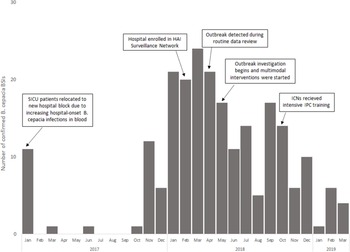
In total, 185 patients met the outbreak case definition. B. cepacia cases began to increase in October 2017 and peaked in March 2018 (Fig. 1). Among them, 144 (79%) of these cases were in the SICU at the time of the infection. Medical records were available to review for 121 of the 185 cases.
Epidemic curve of B. cepacia bloodstream infections, January 2017 to March 2019.

As part of the investigation, efforts were made to identify B. cepacia and BCC BSIs that occurred before the outbreak period. B. cepacia and BCC BSIs were first detected in 2013, after the hospital laboratory installed an automated bacterial identification system. At least 49 B. cepacia and BCC BSIs were documented from August 2013 to September 2015. From October 2015 to January 2017, 47 B. cepacia and BCC BSIs were detected, including 11 cases in January 2017 which resulted SICU closure and relocation of patients to a newly constructed SICU. Between February and September 2017, 2 cases of B. cepacia were reported from the new SICU.
Between August 2013 and January 2017, the hospital made several attempts to identify the cause of these infections. Samples were referred to a nearby reference laboratory for confirmation, but an outbreak investigation was not done to look for additional cases or to establish a source. The cause of the B. cepacia and BCC BSIs was not identified. Efforts to use this information to guide IPC measures were limited due in part to the absence of dedicated IPC personnel and the lack of a program to track HAIs in early 2017.
Descriptive epidemiology
Of the 121 patients for whom medical records were available, 91 (75%) were male. The median age was 35 years (range, 3 months–85 years). Although 57 (47%) of the case patients died (Table 1), these deaths could not be solely attributed to the B. cepacian–related infection or complications.
Characteristics and Clinical Features of Patients With B. cepacia Bloodstream Infections, January 1–October 10, 2018 (N=121)

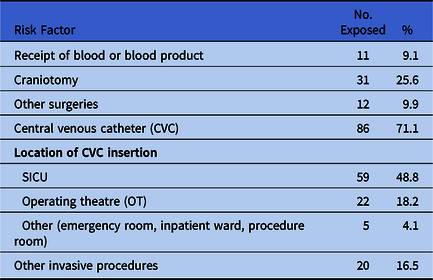
Possible exposures were evaluated among the 121 cases reviewed. Among these cases, 86 (71%) had a central venous catheter (CVC) in place, of which 42 (49%) were inserted in the SICU. The median number of days from CVC insertion to positive B. cepacia or BCC blood culture collection for these cases was 2 (range, 1–4). No common invasive procedures, surgeries, or intravenous medications were identified among the case patients (Table 2).
Selected Risk Factors and Exposures Among Patients With B. cepacia Bloodstream Infections, January 1–October 10, 2018 (N=121)

Infection control assessment
The IPC assessment found that the hospital infection control committee (HICC) did not meet regularly, did not have a dedicated budget, and did not have full-time staff available to implement, monitor, and/or evaluate IPC practices. No IPC guidelines were available at the hospital. Hand hygiene audit forms were present at the hospital but were not being used due to lack of training.
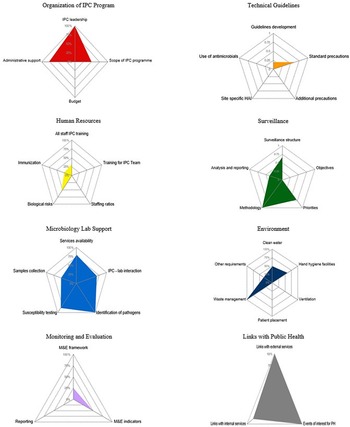
Of the 8 areas assessed using the WHO IPCAT-H assessment tool, the lowest scoring were availability and use of technical guidelines (33%), human resources for IPC (27%), and monitoring and/or evaluating IPC practices (38%). The highest scoring area was microbiology laboratory support (80%) (Fig. 2).
Results of infection prevention and control self-assessment using the World Health Organization’s IPCAT-H tool, August 2018.

During the onsite outbreak investigation, gaps in IPC practices were observed. The same bottle of intravenous saline was used as flush for multiple patients. Sterile intravenous saline sets were opened well before they were used. Hand hygiene near the point of clinical care in the SICU was limited because the only sink was placed next to a single toilet used by both patients and staff and alcohol-based hand rub was only available at the nurse’s station. Adherence to the SICU policy limiting visitors was inconsistent. Incorrect use of personal protective equipment was observed; multiple visitors were given the same gown to wear and healthcare providers were not wearing gloves while suctioning intubated patients. Environmental cleaning practices in the SICU were variable and incomplete, and routine cleaning activities, such as mopping, were not charted. Femoral venous catheters were used in several patients without a clear clinical indication.
Environmental evaluation and laboratory investigation
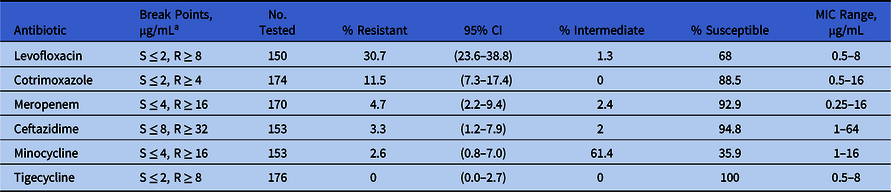
During the onsite investigation, 30 environmental samples were collected in the SICU, of which 4 grew BCC: a large, opened saline bottle used as intravenous flush for multiple patients, a used syringe sitting next to a case patient, an unopened bottle of chlorhexidine mouthwash, and a swab from the outer rim of the sink’s water faucet. MALDI-TOF conducted at AIIMS confirmed the presence of BCC, which included 1 B. cepacia isolate and 3 B. cenocepacia isolates. Based on CLSI break points, these isolates were 100% sensitive to tigecycline and 69% sensitive to levofloxacin (Table 3).
Antibiotic Susceptibility Pattern of B. cepacia Bloodstream Infection Isolates, October 1, 2017, to October 10, 2018 (N=183)

Note. CI, confidence interval; MIC, minimum inhibitory concentration.
a All break points except for tigecycline are cited according to CLSI M100. Tigecycline susceptibility interpretation and MIC range adopted from US Food and Drug Administration, as recommended by CLSI M100.
Interventions
During the onsite outbreak investigation, onsite trainings on IPC and HAI surveillance were provided to staff at SKIMS and meetings were held with administration to advocate for the strengthening of the hospital’s IPC program. In response to the outbreak, the hospital administration hired 4 full-time ICNs and designated 2 doctors to support monitoring and evaluation of IPC activities.
Following the outbreak investigation, the HICC began to meet monthly to review HAI cases, identify IPC gaps and evaluate the implementation of corrective and preventive actions. The ICNs received intensive training at AIIMS in October 2018.
A multimodal strategy was initiated to improve IPC practices in the SICU. SICU staff were trained on the appropriate handling and administration of intravenous fluids and all facility staff were trained in safe injection practices. Single-dose saline vials were mandated, and multidose vials were stopped. Routine and terminal and environmental cleaning procedures in the SICU were improved. A central-line insertion bundle to prevent central-line–associated BSIs was initiated in the SICU and inappropriate specimen sampling from CVCs and use of femoral CVCs were stopped. Hand hygiene compliance improved after alcohol-based hand rubs were provided to improve access to hand hygiene supplies, and ICNs started continuous monitoring. The chlorhexidine mouthwash from which B. cepacia was isolated was stopped, and an alternate product was procured. The water tank supplying water to the hospital was treated with high-strength calcium hypochlorite, as recommended by the WHO. 11,19,20
Treatment regimens were changed based on HAI surveillance data. Given the relatively low susceptibility to fluoroquinolones and minocycline among BCC BSIs reported to the surveillance system, treatment for all patients with B. cepacia bacteremia was changed to meropenem or tigecycline (Table 3).
A single source of the B. cepacia BSI outbreak was not identified. Following the implementation of the multimodal IPC strategy, the monthly case count of B. cepacia BSIs declined. Ongoing surveillance has identified additional cases, consistent with a multifactorial cause of the outbreak.
Discussion
In this investigation, a standardized, multihospital HAI surveillance system with effective network-level coordination and real-time data monitoring was able to detect an outbreak and track its progression in response to IPC interventions in a lower-resourced hospital.
Several key factors contributed to this success. First, the effective implementation of the HAI surveillance protocols at the hospital, including training and education of hospital surveillance staff and investments in quality-assured bacteriology services, led to the systematic identification and reporting of BSIs, including those caused by BCC. Expanding participation in structured HAI surveillance and prevention networks may allow for the detection of additional outbreaks that may otherwise go unnoticed.
Second, the network coordination team’s regular monitoring of HAI surveillance data, facilitated by an online data reporting, analysis, and visualization system, allowed for the detection of the outbreak soon after the hospital started reporting data to the surveillance system. The presence of accurate, timely, and user-friendly data was also essential in monitoring the effect of IPC interventions. Reference Pittet, Allegranzi and Sax21
Third, the efforts of the HICC team, particularly the ICNs, to collect data, analyze results, provide feedback to clinical staff, and implement IPC interventions were essential. The availability of fully dedicated staff to coordinate IPC activities is a key component of hospital-level IPC programs. The presence of these dedicated staff can lead to reductions in HAIs Reference Bammigatti, Doradla, Belgode, Kumar and Swaminathan6,Reference Umscheid, Mitchell and Doshi22 and are an element of India’s national IPC guidelines from the National Centre for Disease Control that should be implemented in all health facilities. 23
A single source of the outbreak was not identified. It is likely that poor IPC practices combined with a persistent reservoir of Burkholderia created an environment where medications, fluids, and surfaces could be contaminated with BCC and where BCC could be transmitted between staff and patients. This finding is consistent with studies reported that the main modes of BCC transmission were person-to-person contact, contaminated medications, devices, surfaces and other environments. Reference LiPuma7,24 The short period of time from line insertion to BSI onset in patients with central venous catheters suggested that central-line insertion practices played a role in the outbreak. Additionally, growth of BCC from a water tap in the SICU is also consistent with reports of B. cepacia outbreaks in Indian hospitals attributable to biofilm in the water delivery systems. Reference Trivedi, Patil, Shettigar, Gangwar and Jana25 The reduction in cases following the outbreak investigation was likely due to a multimodal approach that included interventions to improve IPC practices, change suppliers of potentially contaminated medical products, and attempts to eliminate potential reservoirs of infection. These results support the SENIC study’s findings that dedicated infection control staff and surveillance leads to reduced HAIs. Reference Haley, Culver and White26 The persistence of BCC cases after the investigation, although at lower levels compared to the peak of the outbreak, reflects the ongoing need to effectively implement IPC precautions and advocate for resources to remediate infrastructure and potential environmental reservoirs.
This study had several limitations. First, patient medical records were incomplete, limiting the utility of chart abstraction. Second, collection of multimodal strategy intervention data were limited due to staff inexperience. Third, isolation and identification of B. cepacia at the hospital may have been limited because specific growth media was not always available, potentially underrepresenting the scope of the outbreak. Fourth, additional molecular characterization of BCC isolates from outbreak cases was not done, so we were unable to determine whether a single strain or multiple strains of B. cepacia caused the infections. Fifth, a case control study to further identify risk factors for infection was not performed because staff had limited time, experience, and training. Even with these limitations, enough information was present to identify possible reasons for the outbreak, to target IPC activities, and to document an initial reduction in cases.
Healthcare-associated infections and outbreaks can occur in all health facilities. This outbreak underscores how conducting HAI surveillance in hospitals can detect outbreaks or other unusual events in addition to monitoring the impact of IPC efforts on preventing HAIs. Efforts should be made to dedicate IPC staff, to support HAI surveillance, to provide training on outbreak detection and response, and to provide quality-assured laboratories so that infections like B. cepacia will not go undetected, will not continue to spread, and will not cause preventable morbidity and mortality.
Acknowledgments
The findings and conclusions in this report are those of the authors and do not necessarily represent the official position of the US CDC or the US Department of Health and Human Services.
Financial support
No financial support was provided relevant to this article.
Conflicts of interest
This work was supported by the US CDC (cooperative agreement no. 1U2GGH001869).