INTRODUCTION
Ten species of clownfish sea anemones inhabit the shallow waters of the Indo-Pacific (Fautin & Allen, Reference Fautin and Allen1992). Some clownfish sea anemones can develop into dense populations carpeting the sea bottom (Fautin & Allen, Reference Fautin and Allen1997; Richardson et al., Reference Richardson, Harriott and Harrison1997; Brolund et al., Reference Brolund, Tychsen, Nielsen and Arvedlund2004; Scott et al., Reference Scott, Malcolm, Damiano and Richardson2011), providing structural support for their symbiotic algae, clownfish and shrimp (Fautin et al., Reference Fautin, Guo and Hwang1995; Porat & Chadwick-Furman, Reference Porat and Chadwick-Furman2004; Chadwick et al., Reference Chadwick, Ďuriš, Horká and Por2008), and performing important functions in the community, competing with corals, sponges and macroalgae (Chadwick & Morrow, Reference Chadwick, Morrow, Dubinsky and Stambler2011), and predating mussels, crabs and small fish (Fautin & Allen, Reference Fautin and Allen1997). The bulb-tentacle anemone Entacmaea quadricolor (Rüppell & Leuckart, 1828) is a clownfish anemone widely distributed in the shallow waters of the tropical Indian and Pacific Oceans (Fautin & Allen, Reference Fautin and Allen1997; Richardson et al., Reference Richardson, Harriott and Harrison1997; Chadwick & Arvedlund, Reference Chadwick and Arvedlund2005), but their population density and distribution patterns vary greatly among different locations. In the Red Sea, a single population of E. quadricolor can spread out over several kilometeres, even though there are only up to a few anemones per square metre (Brolund et al., Reference Brolund, Tychsen, Nielsen and Arvedlund2004; Chadwick & Arvedlund, Reference Chadwick and Arvedlund2005; Chadwick et al., Reference Chadwick, Ďuriš, Horká and Por2008; Huebner et al., Reference Huebner, Dailey, Titus, Khalaf and Chadwick2012; Dixon et al., Reference Dixon, Needham, Al-Horani and Chadwick2014). In the Pacific, however, dense populations of E. quadricolor have been reported from a number of places, with the individuals clustering within a small area of 1–4 m (Mariscal, Reference Mariscal1970; Fautin, Reference Fautin1986; Kobayashi & Hattori, Reference Kobayashi and Hattori2006; Hattori & Kobayashi, Reference Hattori and Kobayashi2007; Astakhov et al., Reference Astakhov, Ponomarev, Thu and Phuong2008; Astakhov, Reference Astakhov2012) or carpeting tens to hundreds of metres (Fautin & Allen, Reference Fautin and Allen1997; Richardson et al., Reference Richardson, Harriott and Harrison1997; Debelius, Reference Debelius2001).
Previous studies have identified two major threats to clownfish and their host anemones. Bleaching, caused by elevated seawater temperature, has been reported to reduce the abundance of clownfish anemones (Jones et al., Reference Jones, Gardner and Sinclair2008; Saenz-Agudelo et al., Reference Saenz-Agudelo, Jones, Thorrold and Planes2011), and the abundance and reproductive output of clownfish (Saenz-Agudelo et al., Reference Saenz-Agudelo, Jones, Thorrold and Planes2011). And extensive collecting at several locations has reduced not only the abundance of sea anemones (Shuman et al., Reference Shuman, Hodgson and Ambrose2005; Jones et al., Reference Jones, Gardner and Sinclair2008), but also the abundance of adult clownfish (Planes et al., Reference Planes, Jones and Thorrold2009).
Previous reports of dense populations of E. quadricolor (e.g. Fautin & Allen, Reference Fautin and Allen1997; Debelius, Reference Debelius2001) mainly aimed to show how spectacular they were, without providing data on the population density or substratum coverage. Given the threats faced by E. quadricolor, it is critical to provide these data to support informed management. Ecological data on clownfish and clownfish anemones are very limited in the western Pacific (Kobayashi & Hattori, Reference Kobayashi and Hattori2006; Hattori & Kobayashi, Reference Hattori and Kobayashi2007). Even in Hong Kong, where SCUBA diving has been commonly used as a tool in ecological studies since the 1980s, dense populations of clownfish anemones have not been mentioned in books on coastal ecology (Morton & Morton, Reference Morton and Morton1983) and coral ecology (Scott, Reference Scott1984). There was only one quantitative report of a clownfish anemone population, with 258 E. quadricolor at Bluff Island (Yeung, Reference Yeung2000). The aims of the present study are thus to document the distribution and abundance patterns of the four populations of E. quadricolor and their associated clownfish in Hong Kong, including one that has become an attraction to local and overseas recreational divers (Supplementary Materials 1 and 2), and to understand what local environmental factors have permitted the development of these assemblages.
MATERIALS AND METHODS
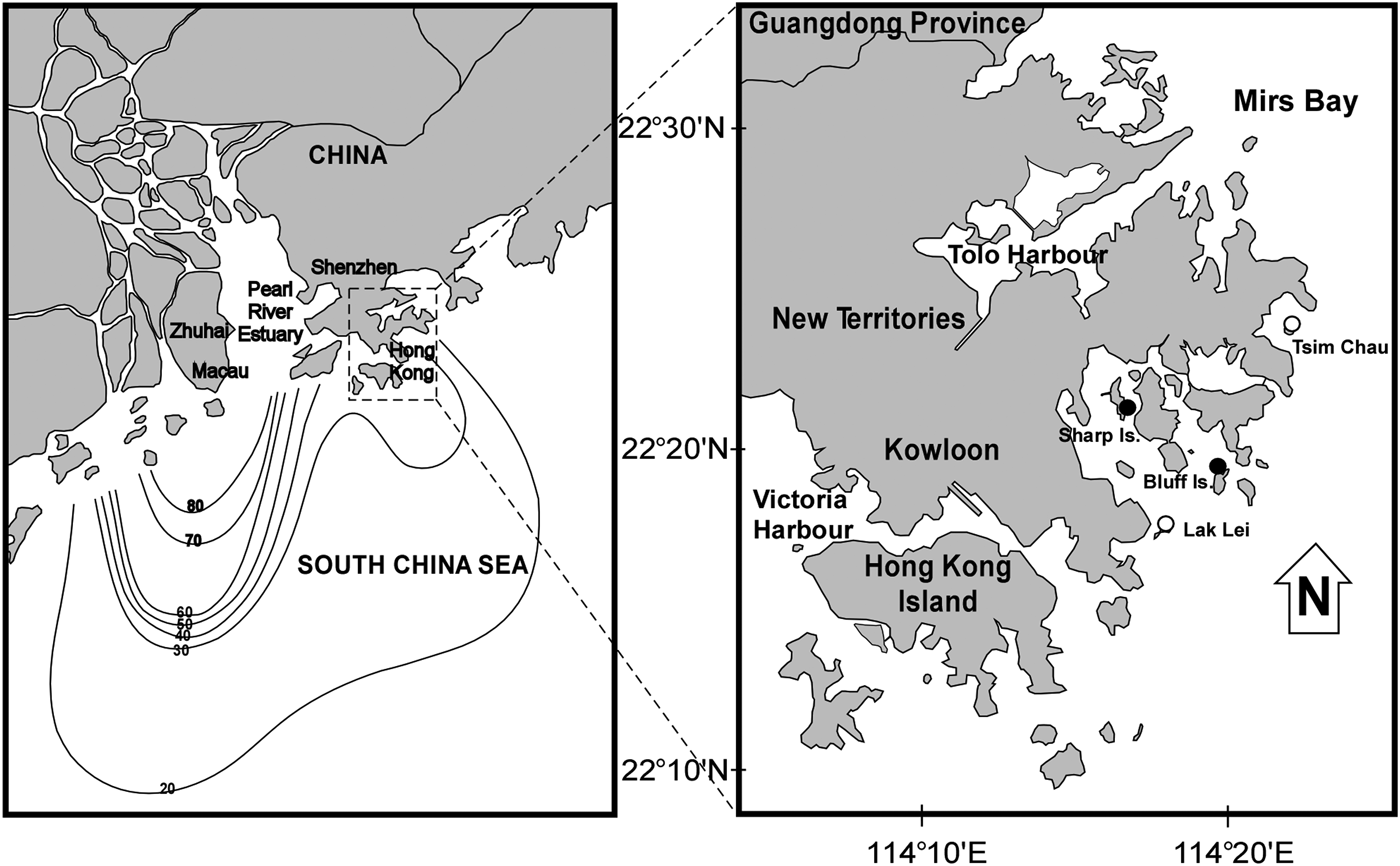
Hong Kong is situated on the south-east coast of China facing the South China Sea (Figure 1). Due to the influence of freshwater discharge from the River Pearl, the coastal waters exhibit a transition from an estuarine zone in the west to an oceanic zone in the east (Morton & Morton, Reference Morton and Morton1983). Entacmaea quadricolor is common in the oceanic zone as small clusters of individuals; but four populations of this host anemone, including the Bluff Island population (Yeung, Reference Yeung2000), each with at least hundreds of individuals, were discovered by recreational divers some 15 years ago (personal communication with dive shop operators and underwater photographers Raymond Man and James Lee).
Map showing the influence of the discharge of the River Pearl on the hydrology of Hong Kong, with eastern Hong Kong enlarged to show the four study sites. Numbers indicate the percentage dilution by freshwater loaded with sediment (modified after Morton & Morton, Reference Morton and Morton1983). Different symbols indicate whether the site is open (solid circle) or sheltered (open circle).

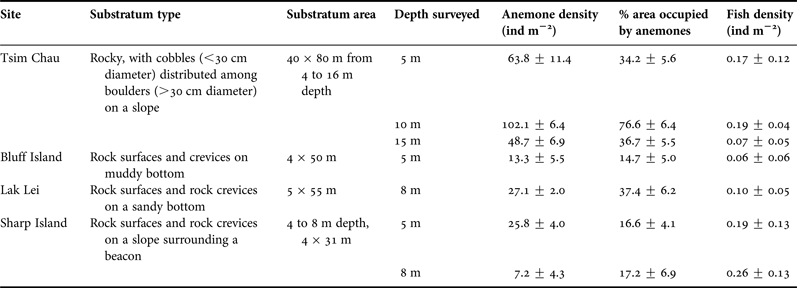
In May–June 2011, we surveyed the populations of Entacmaea quadricolor and their associated clownfish at the four sites, which vary in exposure to the open ocean (Figure 1), substratum type and water depth (Table 1; Supplementary Materials 1 and 2). These different habitat settings would allow us to understand the importance of local environmental factors permitting the development of these dense anemone populations. At each site, we located the population of E. quadricolor by a quick SCUBA survey around the area, and determined the total substratum area occupied using a tape measure. Depending on the vertical distribution of the host anemone, each site was further divided into one of three water depths. At each depth, three 10 m transects parallel to the shore were laid. Along each transect, we conducted a photoquadrat survey to determine the percentage cover and density of E. quadricolor. The underwater photographic system consisted of a Canon 5D Mark II digital camera in an underwater housing and a substrobe. A quadrat (0.75 × 0.75 m) was placed on the bottom by a diver, and a digital photograph of the substratum was taken by another diver. This photographic process was repeated every metre along the transect. In the laboratory, each photograph was inspected on a computer screen to count all E. quadricolor. Coral Point Count with Excel extensions (Kohler & Gill, Reference Kohler and Gill2006) was used to determine the percentage anemone cover, after overlaying 100 stratified random points.
Characteristics of four assemblages of Entacmaea quadricolor and associated anemonefish Amphiprion clarkii. Densities of and percentage area occupied by E. quadricolor are the mean ± standard deviation (SD) of three 1 × 10 m transects, each transect with 8–11 quadrats (0.75 × 0.75 m). Densities of A. clarkii are the mean ± SD of three 3 × 10 m transects.

Along each transect, we also conducted an underwater clownfish survey. The survey area covered 1.5 m to either side of the transect. A diver swam along the transect slowly and recorded the location and composition (i.e. adults and juveniles) of each social group of clownfish. The adults and juveniles were identified based on the body size and coloration (Yeung, Reference Yeung2000): in juveniles the caudal fin is transparent; in males the upper and lower edges of the caudal fin are orange; in females the caudal fin is white or white with a trace of orange colour.
Since the four populations did not all inhabit the same water depth ranges, it
was not possible to compare the site × depth differences using a two-way
analysis of variance (ANOVA). We compared different depths at the same site, or
different sites at the same depth using Student's t-test, or
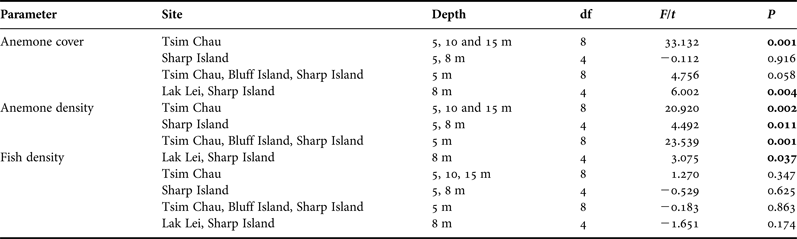
one-way ANOVA followed by the Tukey test to compare treatment means (Table 2). Abundance data were
 $\sqrt {\lpar x + 1\rpar }$
transformed and percentage cover data were arc-sine
transformed prior to analysis (Zar, Reference Zar1999).
Results of statistical analyses comparing the site or depth differences in anemone cover (%), anemone density (ind m−2), and anemonefish density (ind m−2). Significant differences (P < 0.05) are highlighted in bold.
RESULTS
Among the three depths at Tsim Chau, E. quadricolor coverage and density were highest at 10 m (coverage: 5 m: 38.1%; 10 m: 76.6%; 15 m: 36.7%; 1F = 33.132, P = 0.001; Tukey test: 10 m > (5 m = 15 m) and density: 5 m: 63.8 ind m−2; 10 m: 102.1 ind m−2; 15 m: 48.7 ind m−2; F = 20.920, P = 0.002; Tukey test: 10 m > (5 m = 15 m)) (Tables 1 and 2). At Sharp Island, anemone cover was not significantly different between the 5 and 8 m depths (5 m: 16.6%; 8 m: 17.2%; t = − 0.112, P = 0.916); however, the density at 5 m was significantly higher than the density at 8 m (5 m: 25.8 ind m−2; 8 m: 7.5 ind m−2; t = 4.492, P = 0.011). Based on the density data and total substrate area, the estimated total population size was 226,240 individuals at Tsim Chau, 2340 individuals at Bluff Island, 7452 Individuals at Lak Lei and 2338 individuals at Sharp Island.
At 5 m, Tsim Chau, Bluff Island and Sharp Island did not differ significantly in anemone coverage (F = 4.765, P = 0.058) but differed significantly in density (F = 23.539, P = 0.001; Tukey test: Tsim Chau (63.8%) > (Sharp Island (25.8%) = Bluff Island (13.3%)). At 8 m, Lak Lei had both higher anemone coverage (37.4% vs 17.2%) and abundance (27.4 vs 7.2 ind m−2) than Sharp Island (Tables 1 and 2).
Amphiprion clarkii was the only clownfish hosted by the four populations of E. quadricolor. This fish was present at low densities across the sites, ranging from 0.06 to 0.26 ind m−2 (Table 1). In total, we encountered 91 individuals; among them only 9 were juveniles. The clownfish typically occurred as only few social groups along the transect, with each group consisting of 1–12 individuals occupying 1–3 m of the transect. Most social groups were small, with only 2–4 individuals. There were no statistical site/depth differences in clownfish abundance (Table 2).
DISCUSSION
The clownfish anemone Parasicyonis actinostoloides (one of the synonyms of E. quadricolor, Fautin & Allen, Reference Fautin and Allen1997; Fautin, Reference Fautin2013) was mentioned in Hong Kong subtidal waters in the 1980s (Morton & Morton, Reference Morton and Morton1983; Scott, Reference Scott1984; Morton, Reference Morton1988). But Yeung (Reference Yeung2000) was the first report of a relatively dense assemblage of E. quadricolor, with 258 E. quadricolor hosting 28 social groups of A. clarkii in an area of 27 × 31 m (0.31 anemones m2) at depths from 1 to 4 m at Bluff Island. The sea anemones reported in Yeung's study were much less abundant than those reported in our study in terms of both overall number of individuals (i.e. from 2338 at Sharp Island to 226,240 at Tsim Chau) and mean density (Tsim Chau: 71 ind m−2; Bluff Island: 12 ind m−2; Lak Lei: 27 ind m−2; and Sharp Island: 19 ind m−2). Since the Bluff Island population surveyed in our study was the only one we found around the part of the island studied by Yeung (Reference Yeung2000), we believe that the population has increased substantially over the last decade but moved to slightly deeper water from 1–4 m to 5 m. The exact cause for this shift to deeper water is unknown, but strong waves generated by typhoons, which have been known to damage shallow communities by scouring (Hutchinson & Williams, Reference Hutchinson and Williams2003), could be responsible as they may have dislodged the anemones from the shallow water, and removed sediments from the rocks in deeper water, opening up space for anemones to attach (Supplementary Material 2, Figure b).
Dense clusters of E. quadricolor have been reported from a number of places in the Pacific. Although such reports varied in details, from only a photograph of the site (e.g. Fautin & Allen (Reference Fautin and Allen1997)), several photographs plus some description of the site (Debelius, Reference Debelius2001), to quantitative surveys of population structure (Richardson et al., Reference Richardson, Harriott and Harrison1997; Kobayashi & Hattori, Reference Kobayashi and Hattori2006; Hattori & Kobayashi, Reference Hattori and Kobayashi2007; Scott et al., Reference Scott, Malcolm, Damiano and Richardson2011), they all showed that E. quadricolor populations comparable to the population in Tsim Chau in terms of the area of substratum cover and density are not uncommon in the Pacific. The close proximity of the individuals indicated that they were likely formed by asexual reproduction.
The abundance and percentage cover of E. quadricolor from the 10 m deep transect at Tsim Chau (102.1 ind m−2, 77% substratum cover) were comparable to those at Canyons, North Solitary Island (NSI), Australia (249–305 ind m−2, 81–94% substratum cover, Scott et al., Reference Scott, Malcolm, Damiano and Richardson2011). However, only one species of clownfish anemone and one species of clownfish were found in Hong Kong, in contrast to two species of clownfish anemones (E. quadricolor and Heteractis crispa) and three species of clownfish (A. akindynos, A. latezonatus and A. melanopus) in NSI. In addition, clownfish densities (adult and juvenile) are very low in our study sites (0.07–0.26 ind m−2), compared to adult fish densities of 0.43–0.86 ind m−2 at four locations of NSI (Scott et al., Reference Scott, Malcolm, Damiano and Richardson2011), up to 3.7 ind m−2 on the Great Barrier Reef, Australia (Jones et al., Reference Jones, Gardner and Sinclair2008), up to two (Huebner et al., Reference Huebner, Dailey, Titus, Khalaf and Chadwick2012) or three fish per anemone in the northern Rea Sea (Chadwick & Arvedlund, Reference Chadwick and Arvedlund2005), and 2.2–8.8 fish per anemone in the Philippines (Shuman et al., Reference Shuman, Hodgson and Ambrose2005). Many studies indicated that clownfish social group number and size are positively correlated with the abundance of clownfish anemones (Moyer, Reference Moyer1980; Hattori, Reference Hattori1991; Scott et al., Reference Scott, Malcolm, Damiano and Richardson2011). In Hong Kong, however, many clownfish anemones are unoccupied, and their abundance has no correlation with the number of fish. Low densities of clownfish were also shown in the photographs of E. quadricolor taken in the Coral Sea (Fautin & Allen, Reference Fautin and Allen1997) and Indonesia (Debelius, Reference Debelius2001). In Hong Kong, water temperatures fluctuate between 15 and 30°C. The low temperatures in winter are probably responsible for the lack of other species of clownfish in Hong Kong. Even for A. clarkii, which is the most widely distributed species, probably due to its greater resistance to low temperature, the reproductive season is restricted to the warmer months from April, when water temperature rises to 22°C, to September, when the temperature drops to 28.5°C, in Hong Kong, with a hatching time of 11 days in April and 7 days in September (Yeung, Reference Yeung2000). During the summer months, we also saw egg masses, indicating A. clarkii is able to reproduce locally, but it is unknown whether the recruits all come from local waters and whether protecting breeding adults can enhance their abundance. It should thus be determined whether the low densities of clownfish, especially juveniles, indicate recruitment limitation due to the short reproductive season, or high mortality of juveniles before they reach these anemone populations. In addition, it should be determined whether collecting by SCUBA divers for home aquaria (personal communication with dive shop operators and underwater photographers Raymond Man and James Lee) has contributed to the low densities of clownfish. Although such collecting tends to target adults, losing adults could adversely affect the embryos and juveniles due to the loss of protection.
Previous studies have indicated that several biotic and abiotic factors (such as habitat suitability, nutrient content and flow speed of the water body, disturbance by storm or human collecting, predation by fish and the anemone's reproductive strategy) can explain the variation in anemone abundance and cover among sites (Dunn, Reference Dunn1981; Chadwick & Arvedlund, Reference Chadwick and Arvedlund2005; Hattori, Reference Hattori2006; Scott et al., Reference Scott, Malcolm, Damiano and Richardson2011; Dixon et al., Reference Dixon, Needham, Al-Horani and Chadwick2014). Dunn (Reference Dunn1981) suggested that the clustering form of E. quadricolor must be more abundant at shallower parts of the reef with more calm waters such as a lagoon. But this is in contrast to our observation that there were strong currents at Tsim Chau, probably because sedimentation rates are too high for most places in Hong Kong waters. For example, Parry (Reference Parry2000) reported that sedimentation rates often exceed 9 cm yr−1 in Hong Kong waters, and sediment concentrations are often higher than 50 mg l−1 in the western part of Victoria Harbour. Tsim Chau, located in the more open water with lower water turbidity, may allow more sunlight to reach the bottom, promoting these anemones to develop into a dense population. Moreover, the substratum at Tsim Chau is dominated by cobbles of 10–30 cm in diameter, with many solid surfaces and crevices for the host anemones to attach. At the other three sites, high sedimentation and substratum availability can be limiting factors for the expansion of the sea anemone population. In addition, at our study sites E. quadricolor are usually found at least 4 m below water surface, which is consistent with the results of a recent study showing this species to be most abundant at the mid depth of a reef slope in the Red Sea (Dixon et al., Reference Dixon, Needham, Al-Horani and Chadwick2014). At Tsim Chau where the distribution extended from 5 to 15 m below the water surface, E. quadricolor was also most abundant at the mid depth (i.e. 10 m). However, the cause for this distribution pattern is unknown; photo inhibition in the shallow water (Dixon et al., Reference Dixon, Needham, Al-Horani and Chadwick2014) is an unlikely explanation as in Hong Kong waters the water turbidity is much higher than on a typical Red Sea reef. Instead, strong waves generated by typhoons are known to damage shallow coastal communities in exposed sites (Hutchinson & Williams, Reference Hutchinson and Williams2003), which might be responsible for the lack of E. quadricolor in shallow waters. In fact, the shallow water (1–4 m) rocks at our study sites are dominated by the barnacles Megabalanus tintinnabulum and Balanus trigonus, which are resistant to scouring caused by wave actions.
In conclusion, our study has shown that E. quadricolor is a dominant benthic invertebrate at the four studied Hong Kong sited. A comparison of E. quadricolor density across the sites with different habitat characteristics shows that moderately exposed rock surfaces on slopes are required for this species to develop into a large and dense population in Hong Kong, reflecting the need to maintain a sediment-free surface in the turbid waters strongly influenced by river discharge and sediment suspension. We believe that bleaching (Jones et al., Reference Jones, Gardner and Sinclair2008; Frisch & Hobbs, 2009; Saenz-Agudelo et al., Reference Saenz-Agudelo, Jones, Thorrold and Planes2011) and extensive collecting of clownfish anemones and clownfish in the South China Sea and Australia (Shuman et al., Reference Shuman, Hodgson and Ambrose2005; Jones et al., Reference Jones, Gardner and Sinclair2008; Planes et al., Reference Planes, Jones and Thorrold2009) and other stressors (Ang et al., Reference Ang, Choi, Cornish, Fung, Lee, Lin, Ma, Tam and Wong2005; Dumont et al., Reference Dumont, Lau, Astudillo, Fong, Chak and Qiu2013; Au et al., Reference Au, Zhang, Chung and Qiu2014; Qiu et al., Reference Qiu, Lau, Cheung and Chow2014) could also affect the clownfish assemblages in Hong Kong, where recreational activities are intense. Our data have provided a baseline for monitoring these clownfish and clownfish anemones for signs of stress and over-collecting.
ACKNOWLEDGEMENTS
We thank Dr Anna Scott for providing useful information about her study of E. quadricolor populations in Australia, Raymond Man and James Lee (Ocean Sky Divers, Hong Kong) for help with underwater work and for providing information on divers visiting local sea anemones assemblages, Dr Gerry Allen for providing the geographical location of a photograph of a E. quadricolor population in the Coral Sea, Dr Michael Arvedlund for directing me to Debelius (Reference Debelius2001) for reference, and Dr Daphne Fautin and an anonymous referee for critical comments on the manuscript.
FINANCIAL SUPPORT
This study was supported by Environment and Conservation Fund, Hong Kong (project number ECF 2009/29).
Supplementary materials and methods
The supplementary material for this article can be found at http://www.journals.cambridge.org/MBI.