
 L





1. Introduction
Families of p-adic cusp forms for
 $\mathrm{GL}_2$
over
 $\mathbf{Q}$
were first introduced by Hida in his seminal work [Reference HidaHid86] later leading to the construction of the eigencurve by Coleman and Mazur [Reference Coleman and MazurCM98]. Generalizations to reductive groups of higher rank, called eigenvarieties, were constructed using overconvergent cohomology of locally symmetric spaces (e.g. [Reference BellaïcheBel21, Reference Bellache and ChenevierBC09, Reference UrbanUrb11]) or coherent cohomology of Shimura varieties (e.g. [Reference Andreatta, Iovita and PilloniAIP15, Reference Andreatta, Iovita and PilloniAIP16]). These are rigid analytic spaces providing the correct setup for the study of p-adic deformations of automorphic forms. In order to obtain arithmetic applications, such as constructing p-adic L-functions or proving explicit reciprocity laws for Euler systems, one needs to perform a meaningful limit process requiring to understand the geometry of eigenvarieties at the points corresponding to the p-stabilizations of the automorphic forms we are interested in.
While the geometry of an eigenvariety at points of cohomological weight is well understood thanks to classicality results for p-adic overconvergent modular forms of small slope [Reference BijakowskiBij17, Reference Bijakowski, Pilloni and StrohBPS16, Reference ColemanCol96], the study at classical points which are limit of discrete series (such as weight 1 Hilbert modular forms or weight (2, 2) Siegel modular forms) is more involved (e.g. [Reference Bellaïche and DimitrovBD16, Reference BetinaBet20, Reference Betina and DimitrovBD21, Reference Betina, Dimitrov and PozziBDP22]) with richer consequences. For example, the smoothness at such points is a crucial input in the proof of many cases of the Bloch–Kato conjecture, the Iwasawa Main conjecture and Perrin-Riou’s conjecture (e.g. [Reference Bertolini, Darmon and VenerucciBDV22, Reference Bertolini, Seveso and VenerucciBSV22, Reference Castella and WanCW22, Reference Loeffler and ZerbesLZ21]). Far more fascinating is the study of the geometry at singular points, especially at the intersection between irreducible components of the eigenvariety, as such classical points are related to trivial zeros of adjoint p-adic L-functions (e.g. [Reference BellaïcheBel21, Reference Betina and DimitrovBD21, Reference Betina and HsiehBH22, Reference Dasgupta, Darmon and PollackDDP11, Reference Dasgupta, Kakde and VentulloDKV18]). The aim of this paper is to study the geometry of the Hilbert eigenvariety at classical intersection points of the cuspidal and the Eisenstein loci. Such intersections occur at weight 1 Eisenstein series which are cuspidal as p-adic modular forms, very similar to those considered in Ribet’s famous proof of the converse to Herbrand’s theorem [Reference RibetRib76].
Let F be a totally real number field of degree d with ring of integers
 $\mathfrak{o}$
. Let
 $\Sigma$
be the set of embeddings of F in
 $\overline{\mathbf{Q}}$
and
 $\Sigma_p$
denote the set of places of F above an odd prime number p.
Let
 $\phi_1$
and
 $\phi_2$
be two finite order Hecke characters of F such that
 $\phi=\phi_1^{-1}\phi_2$
is totally odd and let
 $\mathfrak{n}$
denote the prime-to-p part of the level of the corresponding weight 1 Hilbert–Eisenstein series
 $E_1(\phi_1,\phi_2)$
whose adelic q-expansion is given in (3.1). The eigencurve
 $\mathcal{C}$
parameterizing finite slope overconvergent Hilbert eigenforms of parallel weight and tame level
 $\mathfrak{n}$
is endowed with a locally finite flat map
 $\mathsf{w}$
to the one-dimensional space
 $\mathcal{W}^{\parallel}$
of parallel weights. It contains a closed analytic subspace
 $\mathcal{C}_{\mathrm{cusp}}$
parameterizing cuspidal eigenforms (see § 3.2). In addition, the Hilbert cuspidal eigenvariety
 $\mathcal{E}$
parameterizing finite slope overconvergent Hilbert cuspidal eigenforms of tame level
 $\mathfrak{n}$
is endowed with a locally finite and torsion-free map
 $\kappa$
to the
 $(d+1)$
-dimensional weight space
 $\mathcal{W}\times \mathcal{W}^{\parallel}$
. The functoriality properties of eigenvarieties yield the following commutative diagram.

As we are interested in points lying on an Eisenstein component, we have to additionally assume that one of the characters, say
 $\phi_1$
, has conductor relatively prime to p. Then the p-stabilization
 $f_{\phi_1}$
of
 $E_1(\phi_1,\phi_2)$
, having
 $U_{v}$
-eigenvalue
 $\phi_1(v)$
for all
 $v\in \Sigma_p$
, belongs to an Eisen-stein family
 $\mathcal{E}_{\phi_1,\phi_2}$
whose geometric constant terms are all multiples of the imprimitive Deligne–Ribet p-adic L-function
 $\zeta_{\phi_1,\phi_2} \in \overline{\mathbf{Z}}_p [\![ X ]\!]$
(see (3.4) and Proposition 3.7), and the interpolation formula (3.5) implies that
 $$ \zeta_{\phi_1,\phi_2}(0)= L(0,\phi) \cdot \prod_{v\in \Sigma_p} (1-\phi(v))\prod_{\mathfrak{q}|\mathfrak{n}, \mathfrak{q}\,\nmid\, \mathrm{cond}(\phi)}(1-\phi(\mathfrak{q})^{-1}\mathrm{N}_{F/\mathbf{Q}}(\mathfrak{q})^{-1}) $$
vanishes if, and only if, the set
 $\Sigma_p^{\mathrm{irr}}=\{ \mathfrak{p} \in \Sigma_p \mid \phi(\mathfrak{p})=1 \}$
of irregular primes for
 $\phi$
is non-empty. The Gross–Kuzmin conjecture [Reference Kuz’minKuz72] further predicts that
 $\mathrm{ord}_{X=0}\zeta_{\phi_1,\phi_2}(X)=\# \Sigma_p^{\mathrm{irr}}$
and Gross [Reference GrossGro81] proposed a formula for the expected leading term at
 $X=0$
. The formula was proven by Darmon, Dasgupta and Pollack [Reference Dasgupta, Darmon and PollackDDP11] when
 $\# \Sigma_p^{\mathrm{irr}}=1$
, and in general by Dasgupta, Kakde and Ventullo [Reference Dasgupta, Kakde and VentulloDKV18]. Henceforth, we assume that
 $\# \Sigma_p^{\mathrm{irr}} \geqslant 1$
, so that
 $f_{\phi_1}$
defines a point on
 $\mathcal{C}_{\mathrm{cusp}}$
. It is important to observe that if the restriction
 $\phi_p$
of the Hecke character
 $\phi$
to
 $(\mathfrak{o}\otimes \mathbf{Z}_p)^\times$
does not factor through the norm, then
 $f_{\phi_1}$
does not define a point on the Andreatta–Iovita–Pilloni eigenvariety [Reference Andreatta, Iovita and PilloniAIP16], nor on the Kisin–Lai eigencurve [Reference Kisin and LaiKL05]. To palliate this problem, we revisit the former construction in § 2 and perform a twisted descent by an arbitrary finite order character of
 $(\mathfrak{o}\otimes \mathbf{Z}_p)^\times$
. Our main result describes the geometry of the cuspidal eigenvarieties at
 $f_{\phi_1}$
.
Theorem A. Assume
 $\Sigma_p^{\mathrm{irr}}=\{ \mathfrak{p} \}$
and that the Leopoldt defect
 $\delta_{F,p}$
vanishes. Set
 $d_{\mathfrak{p}}=[F_{\mathfrak{p}}:\mathbf{Q}_p]$
.
-
(i) If
 $d_{\mathfrak{p}}= 1$
, then
$\mathcal{E}$
is smooth at
$f_{\phi_1}$
and
$\mathcal{C}_{\mathrm{cusp}}$
is of complete intersections at
$f_{\phi_1}$
.
-
(ii) If
$d_{\mathfrak{p}} = d-1$
, then the weight maps
$\kappa:\mathcal{E} \to \mathcal{W} \times \mathcal{W}^{\parallel}$
and
$\mathsf{w}:\mathcal{C}_{\mathrm{cusp}}\to \mathcal{W}^{\parallel}$
are étale at
$f_{\phi_1}$
. -
(iii) If
$d_{\mathfrak{p}} = d$
, then
$\mathcal{E}$
and
$\mathcal{C}_{\mathrm{cusp}}$
are smooth at
$f_{\phi_1}$
. The weight maps
$\kappa:\mathcal{E} \to \mathcal{W} \times \mathcal{W}^{\parallel}$
and
$\mathsf{w}:\mathcal{C}_{\mathrm{cusp}}\to \mathcal{W}^{\parallel}$
are étale at
$f_{\phi_1}$
if, and only if,
$\mathscr{L}(\phi) +\mathscr{L}(\phi^{-1}) \ne 0$
(see (4.2) for the definition of the
$\mathscr{L}$
-invariants). -
(iv) If
$2 \leqslant d_{\mathfrak{p}} \leqslant d-2$
, then the local ring of any irreducible component of
$\mathcal{E}$
at
$f_{\phi_1}$
is not factorial (hence, not regular). In particular,
$\mathcal{E}$
and
$\mathcal{C}_{\mathrm{cusp}}$
are not smooth at
$f_{\phi_1}$
.


The non-vanishing of
 $\mathscr{L}(\phi) +\mathscr{L}(\phi^{-1})$
is established in Proposition 4.3 in the Galois case. We note in passing that when
 $\# \Sigma_p^{\mathrm{irr}} \geqslant 2$
one can deduce from [Reference Dasgupta, Kakde and VentulloDKV18, § 3.2] that
 $\mathcal{C}_{\mathrm{cusp}}$
is singular while
 $\kappa:\mathcal{E} \to \mathcal{W} \times \mathcal{W}^{\parallel}$
is ramified at
 $f_{\phi_1}$
(see Remark 6.5).
Let us now briefly describe the techniques involved in the proof. Mazur’s deformation theory provides a powerful tool to analyze the completed local rings
 $\mathcal{T}$
of eigenvarieties at classical points whose Galois representation are irreducible and p-regular, as one can then define a trianguline deformation functor which is representable by a ring surjecting to
 $\mathcal{T}$
and whose tangent space computes in terms of Galois cohomology. In the ordinary case, this further leads to modularity lifting
 $\mathcal{R}=\mathcal{T}$
theorems allowing precise control of
 $\mathcal{T}$
even when the classicality theorems alluded to above are not available (see [Reference Wake and Wang-EricksonWW21] and [Reference Bellache and ChenevierBC09, § 7.6.3]). Some of this can be salvaged for representations which are reducible but still regular at p (see [Reference Bellache and ChenevierBC06]). However, for reducible Galois representation which are irregular at p, these approaches are no more viable. A tentative approach to palliate to this difficulty is to instead consider a well tailored deformation functor of an indecomposable representation having the same semi-simplification. This was used successfully in [Reference BetinaBet20, Reference Betina, Dimitrov and PozziBDP22] for
 $\mathrm{GL}_2$
over
 $\mathbf{Q}$
and it generalizes well to the Hilbert modular setting in case (i) of the above theorem. The reason is that when
 $d_{\mathfrak{p}}=1$
the classes unramified away from
 $\mathfrak{p}$
produced by Ribet’s method lie on a specific line in the d-dimensional cohomology group
 $\mathrm{H}^1(F,\phi^{-1})$
. Beyond this case, there is no such canonical line and we have to resort to other methods.
Pseudo-characters and generalized matrix algebras have efficiently been used to study deformations of reducible representations (see, for example, the book of Bellache and Chenevier [Reference Bellache and ChenevierBC09]) and our completed local rings
 $\mathcal{T}$
carry such objects. However, in the absence of an
 $\mathcal{R}=\mathcal{T}$
theorem, there is no direct description of the tangent space of
 $\mathcal{T}$
in Galois theoretic and eventually linear algebra terms. A genuine difficulty is the translation of the ordinarity condition at places in
 $\Sigma_p^{\mathrm{irr}}$
which is essential to shape the geometry. Ultimately our proof of cases (ii–iv) of Theorem A uses in a delicate mix of Galois theoretic and modular properties of (nearly) ordinary cuspidal Hida families. Our analysis of the geometry turns out to be closely related to the basic question in deformation theory whether a pseudo-character is the trace of a representation. In cases (ii) and (iii), we can show that the
 $\mathcal{T}$
-valued pseudo-character does come from an actual representation, reflecting the fact that the extension group
 $\mathrm{H}^1(F,\phi)$
admits a ‘modular’ parametrization (see § 6.3). In contrast, in case (iv),
 $\mathrm{H}^1(F,\phi)$
lacks canonical lines reflecting the non-existence of
 $\mathcal{T}$
-valued Galois representation ultimately forcing
 $\mathcal{T}$
to be singular.
Describing the geometry of
 $\mathcal{C}$
at
 $f_{\phi_1}$
requires the additional study of the congruence ideal between the Eisenstein and cuspidal families specializing to
 $f_{\phi_1}$
. For example, when
 $\mathsf{w}:\mathcal{C}_{\mathrm{cusp}}\to \mathcal{W}^{\parallel}$
is étale at
 $f_{\phi_1}$
, we show in Corollary 6.2 that the complete local ring of
 $\mathcal{C}$
at
 $f_{\phi_1}$
is isomorphic to
 $\varLambda \times_{\overline{\mathbf{Q}}_p} \varLambda \times_{\overline{\mathbf{Q}}_p} \varLambda$
, if
 $d_{\mathfrak{p}}=d$
, and to
 $\varLambda \times_{\overline{\mathbf{Q}}_p} \varLambda$
, if
 $d_{\mathfrak{p}}=d-1$
, where
 $\varLambda\simeq \overline{\mathbf{Q}}_p[\![ X ]\!]$
is the completion of
 $\mathcal{O}_{\mathcal{W}^{\parallel},\mathsf{w}(f_{\phi_1})}$
. Our next result determines in full generality, i.e., assuming neither
 $\#\Sigma_p^{\mathrm{irr}}=1$
nor
 $\delta_{F,p}=0$
, the congruence ideal
 $\mathcal{I}_{\phi_1,\phi_2} \subset \overline{\mathbf{Z}}_p [\![ X ]\!]$
between the Eisenstein family
 $\mathcal{E}_{\phi_1,\phi_2}$
and the cuspidal families (see § 3.4).
Theorem B (Theorem 3.8). If
 $\#\Sigma_p^{\mathrm{irr}}\geqslant 1$
, then one has
 $\displaystyle\mathcal{I}_{\phi_1,\phi_2} \cdot \overline{\mathbf{Z}}_p [\![ X ]\!][1/p]=(\zeta_{\phi_1,\phi_2} )$
.
The points of intersection between the Eisenstein components and the Hilbert cuspidal eigenvariety correspond to zeros of the Deligne–Ribet p-adic L-function. In his proof of the Iwasawa Main Conjecture over totally real fields Wiles had to treat these trivial zeros separately (see [Reference WilesWil90, § 11]), as the cohomological classes constructed by Ribet’s method do not have the required local property at p. Such difficulties seem to be inherent to the non-Gorenstein nature of the singularity, as Hida’s congruence ideal
 $\mathbf{C}^0$
and Mazur’s module
 $\mathbf{C}^1$
, forming the bridge between the analytic and arithmetic sides of Iwasawa’s main conjecture, differ. Geometrically, Theorem B asserts that the intersection multiplicity between
 $\mathcal{E}_{\phi_1,\phi_2}$
and
 $\mathcal{C}_{\mathrm{cusp}}$
at
 $f_{\phi_1}$
is given by the order of vanishing of
 $\zeta_{\phi_1,\phi_2}$
. Our proof crucially uses the existence of a fundamental exact sequence for the space of Coleman families of parallel weight in full generality (Theorem 2.5). To this end, we prove that parallel weight p-adic automorphic sheaves on the Hilbert modular varieties introduced in [Reference Andreatta, Iovita and StevensAIS14] extend to invertible sheaves on the minimal compactification, allowing us to define geometric q-expansions of Coleman families. Our method is very general and has the potential to extend to unitary and symplectic Shimura varieties to study Eisenstein congruences in parallel weight.
The study of the geometry of the Hilbert eigenvariety presented here informed the fundamental work [Reference Darmon, Pozzi and VonkDPV24] of Darmon, Pozzi and Vonk computing the Fourier coefficients of the infinitesimal cuspidal deformation of
 $f_{\phi_1}$
in the anti-parallel direction, and further relating those to values of the Dedekind–Rademacher cocycle at real multiplication points. Those values are shown to be Gross–Stark p-units in the narrow Hilbert class field of F as predicted by the explicit class field theory for real quadratic fields proposed by Dasgupta, Darmon and Vonk [Reference Darmon and DasguptaDD06, Reference Darmon and VonkDV21, Reference Darmon and VonkDV22] which can be seen as an analogue of the singular moduli theory of elliptic units for imaginary quadratic fields. Their approach relies on p-adic methods in the theory of automorphic forms and fits in the emerging p-adic Kudla program where real analytic families of Eisenstein series are replaced by p-adic families parametrized by the weight. Using a vast generalization of Ribet’s method, Dasgupta and Kakde [Reference Dasgupta and KakdeDK23] significantly refined the approach of [Reference Dasgupta, Kakde and VentulloDKV18] to prove the Brumer–Stark conjecture and thus generalized [Reference Darmon, Pozzi and VonkDPV24, Theorem B] to arbitrary totally real fields. Theorem A(i) would also have applications to the arithmetic of elliptic curves over F once the diagonal cycles method of [Reference Bertolini, Darmon and RotgerBDR15] becomes available for Shimura curves.
We close the introduction by describing two new applications in Iwasawa theory.
CM congruences and Katz p-adic L-functions at
 $s=0$
. Suppose that
 $\phi$
is quadratic, denote by H the corresponding CM quadratic extension of F and by
 $\mathscr{C}\!\ell_H(p^{\infty}) $
its ray class group of level
 $p^\infty$
. Assuming that there is a unique prime
 $\mathfrak{p}$
of F above p, the Eisenstein series
 $E_1(\mathbf{1},\phi)$
, which in this case is also a theta series relatively to H, has a unique p-stabilization
 $f_{\mathbf{1}}$
. As
 $\phi(\mathfrak{p})=1$
,
 $\mathfrak{p}$
splits in H, hence there exists a nearly-ordinary theta family
 $\Theta_{\mathbf{1}}$
specializing to
 $f_{\mathbf{1}}$
in weight 1. By Theorem A(iii), the congruence module
 $\mathbf{C}^0(\mathbf{1})$
attached to
 $\Theta_{\mathbf{1}}$
(see [Reference Hida and TilouineHT93, (6.9)]) is not supported at the prime of
 $\mathbf{Z}_p [\![ \mathscr{C}\!\ell_H(p^{\infty}) ]\!]$
corresponding to the trivial character
 $\mathbf{1}$
, as predicted by a conjecture of Hida and Tilouine [Reference Hida and TilouineHT93, p. 192]. This implies that the Katz [Reference KatzKat78] p-adic L-function
 $\zeta_H \in \mathbf{Z}_p [\![ \mathscr{C}\!\ell_H(p^{\infty}) ]\!]$
does not vanish at
 $\mathbf{1}$
. Recently, Hsieh and the first named author established a p-adic analogue of Kronecker’s second limit formula for the value
 $\zeta_H(\mathbf{1})$
involving the p-adic regulator of F (see [Reference Betina and HsiehBH22, Proposition 4.8]).
Iwasawa’s growth for the compositum of all
 $\mathbf{Z}_p$
-extensions. Suppose that
 $\# \Sigma_p = 2$
and that
 $\phi$
is not quadratic. Let
 $H_{\infty}$
denote the compositum of all
 $\mathbf{Z}_p$
-extensions of the CM field H cut out by
 $\phi$
, and let
 $M_{\infty}$
be the maximal abelian unramified p-extension of
 $H_{\infty}$
. Then
 $Y_{\infty}=\mathrm{Gal}(M_{\infty}/H_{\infty})$
is a finitely generated torsion module over
 $\mathbf{Z}_p[\![ \mathrm{Gal}(H_{\infty}/H) ]\!]= \mathbf{Z}_p[\![ X_1,\ldots,X_r ]\!]$
, whose study occupies a central place in the classical Iwasawa theory. Under the assumptions of Theorem A(iv) we show in Corollary 6.12 that
 $Y_{\infty}/(X_1,\ldots,X_r) Y_{\infty}$
is infinite. This is in contrast with the case where p is inert in H and
 $H_\infty^{\mathrm{cyc}}$
the cyclotomic
 $\mathbf{Z}_p$
-extension (so that
 $r=1$
), as then
 $Y_{\infty}^{\mathrm{cyc}}/X\cdot Y_{\infty}^{\mathrm{cyc}}$
is finite [Reference WashingtonWas97, Chapter 13].
An algebro-geometric proof of the rank-one Gross–Stark conjecture. In addition to the above applications, our work provides a new proof of the rank-one Gross–Stark conjecture over totally real fields (Corollary 6.4). A distinctive advantage of our approach is its natural potential to extend to higher-rank settings thereby offering a framework for studying trivial zeros of more general p-adic L-functions.
1.1 General notation
Given a local or a global field L, we let
 $\mathcal{O}_L$
denote its ring of integers,
 $\Sigma_L$
denote the set of infinite places and
 $\mathrm{G}_L=\mathrm{Gal}(\overline{L}/L)$
denote the absolute Galois group. Given a finite field extension K of L, we let
 $\mathrm{N}_{K/L}$
denote the relative norm. We fix an embedding
 $\iota_p:\overline{\mathbf{Q}} \to \overline{\mathbf{Q}}_p$
and consider the resulting partition
 $\Sigma=\coprod_{ \mathfrak{p}\in\Sigma_p}\!\Sigma_{\mathfrak{p}}$
, where
 $\Sigma_{\mathfrak{p}}$
is canonically in bijection with
 $\mathrm{Hom}_{\mathbf{Q}_p-\text{alg}}(F_{\mathfrak{p}},\overline{\mathbf{Q}}_p)$
. We let
 $\log_p:\overline{\mathbf{Q}}_p^\times\to \overline{\mathbf{Q}}_p$
be the p-adic logarithm normalized by
 $\log_p(p)=0$
. For simplicity, we sometimes write
 $\log_p$
for
 $\log_p\circ \iota_p$
.
Rigid analytic spaces will usually be denoted with calligraphic letters:
 $\mathcal{C}$
,
 $\mathcal{E}$
, etc. Given a reduced
 $\mathbf{Q}_p$
-affinoid space
 $\mathcal{X}$
, we let
 $\mathcal{O}_{\mathcal{X}}^\circ$
is the subring of power-bounded elements in
 $\mathcal{O}_{\mathcal{X}}$
. We endow the
 $\mathbf{Q}_p$
-algebra
 $\mathcal{O}(\mathcal{X})$
with the coarsest locally convex topology [Reference SchneiderSch02]. For any
 $x \in\mathcal{X}$
, the local ring
 $\mathcal{O}_{\mathcal{X},x}$
is a Henselian local topological ring endowed with the finest locally convex topology such that for any admissible affinoid
 $\mathcal{U}$
of
 $\mathcal{X}$
containing x, the localization morphism
 $\mathcal{O}(\mathcal{U}) \to \mathcal{O}_{\mathcal{X},x}$
is continuous [Reference SchneiderSch02, Chapter I]. For any finite type
 $ \mathcal{O}_{\mathcal{X},x} $
-module M, we endow M with the quotient locally convex topology associated to a surjection
 $ \mathcal{O}_{\mathcal{X},x}^n \twoheadrightarrow M$
(see [Reference Bellache and ChenevierBC06, p.7]).
2. Twisted Coleman families and Hilbert eigenvarieties
Weight 1 Hilbert modular forms are limits of discrete series and as such contribute to the coherent cohomology of the Hilbert modular variety but not to its Betti cohomology. In the ordinary case, a geometric definition of p-adic Hilbert modular forms is given in Hida’s book [Reference HidaHid04] and a control theorem is established under the assumption that
 $p\geqslant 5$
is unramified in F. Rather than extending his results and methods based on the study of the Igusa tower, we follow Andreatta, Iovita and Pilloni [Reference Andreatta, Iovita and PilloniAIP16] who construct families of overconvergent modular sheaves at a fixed finite level. The classicity results are then unconditional (using the work of Bijakowski) and are well tailored for our applications, as inverting p seems crucial to establish the fundamental exact sequence (2.26). Furthermore, we show that the overconvergent modular sheaves in parallel weight extend to invertible sheaves over the minimal compactification.
2.1 Formal models for Hilbert modular schemes
Following [Reference RapoportRap78], [Reference ChaiCha90] and [Reference DimitrovDim04], we introduce the Hilbert modular schemes with
 $\mu_{\mathfrak{n}}$
-level structure and their various compactifications. Let
 $T=\mathrm{Res}_{\mathfrak{o}/\mathbf{Z}}\mathbf{G}_m$
and denote by
 $\mathscr{T}$
(respectively,
 $\widehat{\mathbf{G}}_m$
) the formal group obtained by completing T (respectively,
 $\mathbf{G}_m$
) along the identity section. Let
 $\mathcal{O}$
be the ring of integers of a finite extension K of
 $\mathbf{Q}_p$
containing the values of
 $\phi_p$
and all the embedding of F into
 $\overline{\mathbf{Q}}_p$
. We let
 $\mathfrak{d}$
denote the different ideal of F.
Let
 $\mathfrak{n}$
be an integral ideal of
 $\mathfrak{o}$
relatively prime to p and divisible by a rational integer
 $\geqslant 4$
, and let
 $\mu_{\mathfrak{n}}$
be the Cartier dual of the constant group scheme
 $(\mathfrak{o}/\mathfrak{n})$
over
 $\mathbf{Z}_p$
. We set
 $\Delta_{\mathfrak{n}}=\mathfrak{o}_{+}^\times/E_{\mathfrak{n}}^2$
, where
 $\mathfrak{o}_{+}^\times$
denotes the group of totally positive units and
 $E_{\mathfrak{n}}=\{u\in \mathfrak{o}^\times\mid u\equiv 1 \pmod{\mathfrak{n}}\}$
. Given a fractional ideal
 $\mathfrak{c}$
of F, we consider the functor attaching to any
 $\mathbf{Z}_p$
-scheme S, the set of quadruplets
 $ (A, \iota, \alpha, \lambda)$
with:
-
–
$A \rightarrow S$
an abelian scheme of relative dimension d with real multiplication
$\iota:\mathfrak{o} \hookrightarrow \mathrm{End}_S (A)$
; -
–
$\alpha:\mu_{\mathfrak{n}} \otimes \mathfrak{d}^{-1} \hookrightarrow A[\mathfrak{n}]$
an
$\mathfrak{o}$
-linear embedding of group schemes étale locally over S; -
–
$\lambda$
a
$\mathfrak{c}$
-polarization, i.e., an
$\mathfrak{o}$
-linear isomorphism
$\lambda:A^\vee\xrightarrow{\sim} A\otimes \mathfrak{c}$
satisfying the Deligne–Pappas condition.


Under the above assumptions on
 $\mathfrak{n}$
, this functor is representable by a scheme
 $X_{\mathfrak{c}}$
of finite type over
 $\mathbf{Z}_p$
, endowed with a universal abelian scheme
 $\pi: A_{\mathfrak{c}} \rightarrow X_{\mathfrak{c}}$
. Let
 $\omega $
be the conormal
 $\mathfrak{o} \otimes \mathcal{O}_{X_{\mathfrak{c}}} $
-module
 $e^{*}(\Omega_{A_{\mathfrak{c}}/X_{\mathfrak{c}}})$
, where
 $e:X_{\mathfrak{c}}\rightarrow A_{\mathfrak{c}}$
is the identity section. Let
 $\overline{X}_{\mathfrak{c}}$
be a toroidal compactification of
 $X_{\mathfrak{c}}$
and let
 $\pi: G_{\mathfrak{c}} \rightarrow \overline{X}_{\mathfrak{c}}$
be the semi-abelian scheme extending
 $A_{\mathfrak{c}}$
to
 $\overline{X}_{\mathfrak{c}}$
. The conormal sheaf
 $\omega$
extends naturally to an
 $\mathfrak{o} \otimes \mathcal{O}_{\overline{X}_{\mathfrak{c}}}$
-module which is also denoted by
 $\omega$
and we denote by
 $\displaystyle X^*_{\mathfrak{c}}=\mathrm{Proj}(\bigoplus\nolimits_{k\geqslant 0} \mathrm{H}^0(\overline{X}_{\mathfrak{c}}, \det(\omega)^k ))$
the minimal compactification of
 $X_{\mathfrak{c}}$
. Let
 $\overline{\mathscr{X}_{\mathfrak{c}}} $
(respectively,
 $\mathscr{X}^*_{\mathfrak{c}}$
) denote the formal completion of
 $\overline{X}_{\mathfrak{c}}$
(respectively,
 $X_{\mathfrak{c}}^*$
) along its special fiber. The natural group action of
 $\epsilon\in \mathfrak{o}_{+}^\times$
on
 $X_{\mathfrak{c}}$
sending
 $(A, \iota, \alpha, \lambda)$
to
 $(A, \iota, \alpha, \epsilon \cdot \lambda)$
factors through the finite group
 $\Delta_{\mathfrak{n}}$
, because the multiplication by
 $\epsilon\in E_{\mathfrak{n}}$
induces an isomorphism between
 $(A, \iota, \alpha, \lambda)$
and
 $(A, \iota, \alpha, \epsilon^2 \cdot \lambda)$
. This action extends to both
 $X_{\mathfrak{c}}^*$
and
 $\overline{X}_{\mathfrak{c}}$
. All these constructions remain valid over
 $\mathbf{Z}[1/\mathrm{N}_{F/\mathbf{Q}}(\mathfrak{n})]$
ensuring the compatibility with the transcendental theory. Given
 $n\in\mathbf{Z}_{\geqslant 1}$
and
 $v \in [0,{1}/({4 p^{n-1}})]\cap \mathbf{Q}$
, we let
 $\overline{\mathcal{X}}_{\mathfrak{c}}(v)$
(respectively,
 $\mathcal{X}^{*}_{\mathfrak{c}}(v)$
) denote the v-overconvergent strict neighborhood of the ordinary locus
 $\overline{\mathcal{X}}_{\mathfrak{c}}(0) \subset \overline{X}_{\mathfrak{c}}^{\mathrm{rig}}$
(respectively,
 $\mathcal{X}^{*}_{\mathfrak{c}}(0) \subset X^{*\mathrm{rig}}_{\mathfrak{c}}$
), i.e., the locus where the troncated p-adic valuation of the total Hasse invariant is at most v. Under the assumption
 $p\geqslant 3$
, Fargues [Reference FarguesFar11, Theorem 7] constructed a canonical
 $\mathfrak{o}$
-stable subgroup of rank
 $p^{nd}$
 $$ \mathscr{H}_n \hookrightarrow G_{\mathfrak{c}}[p^n]_{\mid \overline{\mathcal{X}}_{\mathfrak{c}}(v)}. $$
Consider the étale covering
 $$\overline{\mathcal{X}}_{\mathfrak{c}}(\mu_{p^n},v)=\mathrm{Isom}^{\mathfrak{o}}_{\overline{\mathcal{X}}_{\mathfrak{c}}(v)}(\mathscr{H}_n,\mu_{p^n} \otimes \mathfrak{d}^{-1}) \to \overline{\mathcal{X}}_{\mathfrak{c}}(v), $$
with Galois group
 $T(\mathbf{Z}/p^{n}\mathbf{Z})$
. After enlarging K so that
 $p^{v}\in K$
, following [Reference Andreatta, Iovita and PilloniAIP16, § 3], we consider the normal formal model
 $\overline{\mathscr{X}_{\mathfrak{c}}}(v)$
(respectively,
 $\mathscr{X}^*_{\mathfrak{c}}(v)$
) of
 $\overline{\mathcal{X}}_{\mathfrak{c}}(v)$
(respectively,
 $\mathcal{X}^{*}_{\mathfrak{c}}(v)$
) obtained via normalization of a certain admissible blow-up of
 $\overline{\mathscr{X}_{\mathfrak{c}}}$
(respectively,
 $\mathscr{X}^*_{\mathfrak{c}}$
) [Reference Andreatta, Iovita and PilloniAIP15, § 5.2], then we define the formal models
 $\overline{\mathscr{X}_{\mathfrak{c}}}(\mu_{p^n},v)$
and
 $\mathscr{X}^*_{\mathfrak{c}}(\mu_{p^n},v)$
by taking normalizations in the generic fiber, and finally we define
 $\mathscr{X}_{\mathfrak{c}}(\mu_{p^n},v)$
as the largest open over which
 $G_{\mathfrak{c}}$
is an abelian scheme. To sum up, we have the following commutative diagram of formal schemes.

2.2 The Hodge–Tate map
As
 $\overline{\mathscr{X}_{\mathfrak{c}}}(v)$
is an admissible normal formal
 $\mathcal{O}$
-scheme,
 $\mathscr{H}_n$
extends to a finite flat
 $\mathfrak{o}$
-stable subgroup (see [Reference Andreatta, Iovita and PilloniAIP15, Proposition 4.1.3])
 $$\mathscr{H}_n\hookrightarrow G_{\mathfrak{c}}[p^n]_{|\overline{\mathscr{X}_{\mathfrak{c}}}(v)} $$
whose generic fiber is isomorphic to
 $\mathfrak{o}/(p^n)$
for the étale topology (see [Reference Andreatta, Iovita and PilloniAIP16, Lemma 3.3]). We consider the conormal sheaf
 $\omega_{\mathscr{H}_n}=e^*(\Omega_{\mathscr{H}_n/\overline{\mathscr{X}_{\mathfrak{c}}}(v)})$
of
 $\mathscr{H}_n$
and we recall that the Hodge–Tate map is a morphism of abelian sheaves over
 $\overline{\mathscr{X}_{\mathfrak{c}}}(v)$
for the fppf-topology
 $$ \mathrm{HT}:\mathscr{H}_n^D \to \omega_{\mathscr{H}_n}, $$
sending an S-point
 $x \in \mathscr{H}_n^D(S)=\mathrm{Hom}_{\mathfrak{o}}(\mathscr{H}_n, \mathbf{G}_m \otimes \mathfrak{d}^{-1})$
to
 $x^*(({dt}/{t}) \otimes 1) \in \omega_{\mathscr{H}_n}(S)$
, in view of the canonical isomorphism
 $\omega_{\mathbf{G}_m \otimes \mathfrak{d}^{-1} \mid S}=\mathfrak{o}\otimes \mathcal{O}_S\cdot ({dt}/{t})$
. As
 $n-\tfrac{1}{2} \leqslant n-v (({p^n-1})/({p-1}))$
, arguing exactly as in [Reference Andreatta, Iovita and PilloniAIP15, Proposition 4.2.1] yields a canonical isomorphism
 \begin{align*}\omega\otimes_{\mathcal{O}_{\overline{\mathscr{X}_{\mathfrak{c}}}(v)}}\bigg(\frac{\mathcal{O}_{\overline{\mathscr{X}_{\mathfrak{c}}}(v)}}{(p^{n-({1}/{2})})}\bigg)&=\omega_{G_{\mathfrak{c}}[p^n]}\otimes_{\mathcal{O}_{\overline{\mathscr{X}_{\mathfrak{c}}}(v)}}\bigg(\frac{\mathcal{O}_{\overline{\mathscr{X}_{\mathfrak{c}}}(v)}}{(p^{n-({1}/{2})})}\bigg)\\ &\xrightarrow{\sim}\omega_{\mathscr{H}_n}\otimes_{\mathcal{O}_{\overline{\mathscr{X}_{\mathfrak{c}}}(v)}}\bigg(\frac{\mathcal{O}_{\overline{\mathscr{X}_{\mathfrak{c}}}(v)}}{(p^{n-({1}/{2})})}\bigg). \end{align*}
Moreover, by [Reference Andreatta, Iovita and StevensAIS14, Proposition 6.1],
 $p^{{v}/({p-1})}$
annihilates the cokernel of the linearized Hodge–Tate map
 \begin{align}\overline{\mathrm{HT}}: \mathscr{H}_n^D \otimes\frac{\mathcal{O}_{\overline{\mathscr{X}_{\mathfrak{c}}}(v)}}{(p^{n-({1}/{2})})}\to\omega\otimes_{\mathcal{O}_{\overline{\mathscr{X}_{\mathfrak{c}}}(v)}}\frac{\mathcal{O}_{\overline{\mathscr{X}_{\mathfrak{c}}}(v)}}{(p^{n-({1}/{2})})}.\end{align}
We let
 $\mathscr{F}_{n}$
be the subsheaf of
 $\omega$
over
 $\overline{\mathscr{X}_{\mathfrak{c}}}(\mu_{p^n},v)$
constructed in [Reference Andreatta, Iovita and PilloniAIP16, Proposition 3.4]. It is locally free of rank 1 over
 $\mathfrak{o} \otimes \mathcal{O}_{ \overline{\mathscr{X}_{\mathfrak{c}}}(\mu_{p^n},v)}$
and uniquely characterized by the facts that it contains
 $p^{{v}/({p-1})} \cdot \omega$
and that the induced Hodge–Tate map yields a
 $\mathfrak{o}$
-linear isomorphism
 \begin{align} \overline{\mathrm{HT}}: \mathscr{H}_n^D \otimes \frac{\mathcal{O}_{\overline{\mathscr{X}_{\mathfrak{c}}}(\mu_{p^n},v)}}{(p^{n-({1}/{2})})} \xrightarrow{\sim} \mathscr{F}_{n} /p^{n-({1}/{2})} \mathscr{F}_{n}.\end{align}
2.3 Andreatta–Iovita–Pilloni–Stevens overconvergent modular sheaves
The weight space
 $$ \mathcal{W}=\mathrm{Hom}_{\mathrm{cont}}(T(\mathbf{Z}_p),\mathbf{G}_m) $$
is the rigid analytic generic fiber of the formal scheme
 $\mathrm{Spf}(\mathcal{O} [\![ T(\mathbf{Z}_p) ]\!])$
. The group of connected components of the weight space is isomorphic to the group of tamely ramified characters of the corresponding torus, while each connected component is isomorphic to a rigid open polydisc. Given an affinoid
 $\mathcal{V}$
in
 $\mathcal{W}$
, the universal character
 \begin{align}\kappa_{\mathcal{V}}: T(\mathbf{Z}_p) \longrightarrow \mathcal{O}_{\mathcal{V}}^\times\end{align}
is w-analytic for some
 $w \in \mathbf{Q}_{\gt0}$
(see [Reference Andreatta, Iovita and PilloniAIP15, § 2.2]), which after shrinking
 $\mathcal{V}$
can be assumed to be
 $n-\tfrac{1}{2}$
. Let
 $\mathscr{T}_{n}^\circ \subset \mathscr{T}$
denote the formal subgroup of units congruent to 1 modulo
 $p^{n-({1}/{2})}$
, and let
 $\mathscr{T}_{n} \subset \mathscr{T}$
denote the formal subgroup generated by
 $T(\mathbf{Z}_p)$
and
 $\mathscr{T}_{n}^\circ$
. By [Reference Andreatta, Iovita and PilloniAIP16, p. 9],
 $\kappa_{\mathcal{V}}$
extends uniquely to a character
 \begin{align} \kappa_{\mathcal{V}}:\mathscr{T}_{n} \times \mathscr{V} \to \widehat{\mathbf{G}}_m \times \mathscr{V},\end{align}
where
 $\mathscr{V}=\mathrm{Spf}(\mathcal{O}_{\mathcal{V}}^\circ)$
is a formal model of
 $\mathcal{V}$
. Henceforth, we fix
 $n \in \mathbf{Z}_{\geqslant 1}$
such that
 $\phi_p$
factors through
 $T(\mathbf{Z}/p^{n-1}\mathbf{Z})$
, while keeping the notation from previous subsections. Let
 $\gamma_{n}^{\circ}: \mathscr{I}_{n} \to \overline{\mathscr{X}_{\mathfrak{c}}}(\mu_{p^n},v)$
be the formal
 $\mathscr{T}_{n}^\circ $
-torsor constructed in [Reference Andreatta, Iovita and PilloniAIP16, § 3.4]. A point
 $x\in \mathscr{I}_{n}(R)$
over a normal admissible
 $\mathcal{O}$
-algebra R corresponds to isomorphism classes of
 $(A,\iota,\alpha, \lambda, P, \Omega)$
, where:
-
– P is an
$\mathfrak{o}$
-generator of
$\mathscr{H}^D_{n}(R)=\mathscr{H}^D_{n}(R\otimes_{\mathcal{O}} K) \simeq \mathfrak{o}/(p^n)$
such that
$(A,\iota,\alpha,\lambda, P)$
corresponds to the point
$\gamma_{n}^{\circ}(x) \in \overline{\mathscr{X}_{\mathfrak{c}}}(\mu_{p^n},v)(R)$
; and -
–
$\Omega$
is an
$\mathfrak{o} \otimes R$
-basis of
$\mathscr{F}_{n}(R)$
such that
$\overline{\mathrm{HT}}(P)=\Omega \mod p^{n-({1}/{2})}$
via (2.3).


We set
 $\kappa_{\mathcal{V}}^{\circ}= \kappa_{\mathcal{V} \mid \mathscr{T}_{n}^\circ \times \mathscr{V} }$
. Andreatta, Iovita, Pilloni and Stevens [Reference Andreatta, Iovita and PilloniAIP16, Reference Andreatta, Iovita and StevensAIS14] defined the p-adic automorphic sheaf
 \begin{align}\omega^{\kappa_{\mathcal{V}}^{\circ}}=(\gamma_{n}^{\circ})_*(\mathcal{O}_{ \mathscr{I}_{n}}\widehat{\otimes} \mathcal{O}_{\mathcal{V}}^\circ)[-\kappa_{\mathcal{V}}^{\circ}],\end{align}
which is invertible on
 $\overline{\mathscr{X}_{\mathfrak{c}}}(\mu_{p^n},v) \times \mathscr{V}$
. In addition, as
 $\gamma_{n}^{\circ}$
is equivariant for the action of
 $t\in T(\mathbf{Z}_p)$
sending
 $(A,\iota,\alpha, \lambda, P, \Omega)$
to
 $(A,\iota,\alpha, \lambda, t\cdot P, t\cdot \Omega)$
in a compatible way with the
 $\mathscr{T}_{n}^\circ$
-torsor structure, we obtain a
 $\mathscr{T}_{n}$
-morphism
 $$\gamma_{n}: \mathscr{I}_{n} \xrightarrow{\gamma_{n}^{\circ}} \overline{\mathscr{X}_{\mathfrak{c}}}(\mu_{p^n},v) \to \overline{\mathscr{X}_{\mathfrak{c}}}(v), $$
allowing us to define a coherent sheaf
 \begin{align}\omega^{\kappa_{\mathcal{V}}}=(\gamma_{n})_*(\mathcal{O}_{\mathscr{I}_{n}} \widehat{\otimes} \mathcal{O}_{\mathcal{V}}^\circ)[-\kappa_{\mathcal{V}}]\end{align}
on
 $\overline{\mathscr{X}_{\mathfrak{c}}}(v) \times \mathscr{V}$
which is invertible on the generic fiber. There is an inclusion of coherent sheaves
 $\omega^{\kappa_{\mathcal{V}}} \hookrightarrow \overline{h}_{n\ast}( \omega^{\kappa_{\mathcal{V}}^{\circ}})$
over
 $\overline{\mathscr{X}_{\mathfrak{c}}}(v) \times \mathscr{V}$
, where
 $\omega^{\kappa_{\mathcal{V}}}$
is exactly the sheaf of invariant sections of
 $\overline{h}_{n\ast}( \omega^{\kappa_{\mathcal{V}}^{\circ}})$
under the (twisted) action of
 $T(\mathbf{Z}/p^{n}\mathbf{Z})$
. This clarifies the relationship between these sheaves.
The sheaf
 $\omega^{\kappa_{\mathcal{V}}}$
can be used to give a geometric definition of Coleman families of overconvergent Hilbert modular forms. Namely, an element
 $f_{\mathcal{V}} \in \mathrm{H}^0(\overline{\mathcal{X}}_{\mathfrak{c}}(v) \times \mathcal{V}, \omega^{\kappa_{\mathcal{V}}})$
can be seen as a rule assigning to each normal admissible
 $\mathcal{O}_{\mathcal{V}}^{\circ}$
-algebra R and a tuple
 $(A,\iota,\alpha, \lambda, P, \Omega) \in \mathscr{I}_{n}(R)$
an element
 $f_R(A,\iota,\alpha, \lambda, P, \Omega) \in R[1/p]$
such that for all
 $ t \in T(\mathbf{Z}_p)$
 \begin{align}f_R(A,\iota,\alpha, \lambda, t^{-1} P, t^{-1} \Omega) =\kappa_{\mathcal{V}}(t) f_R(A,\iota,\alpha, \lambda, P, \Omega).\end{align}
2.4 Classicality for overconvergent modular forms
For any
 $k\in \mathbf{Z}[\Sigma]$
, we let
 \begin{align}\omega^{k}=\bigotimes_{\sigma \in \Sigma} \omega_\sigma^{k_\sigma },\end{align}
where
 $\omega=\bigoplus_{\sigma \in \Sigma} \omega_{\sigma}$
is the direct sum decomposition of the classical automorphic sheaf on any Hilbert modular variety over K. We let
 $X_{\mathfrak{c},1}(p^n)$
, respectively
 $X_{\mathfrak{c},0}(p^n)$
, be the Hilbert modular variety over K of level
 $\Gamma_1^1(\mathfrak{c},\mathfrak{n} p^n)$
, respectively
 $\Gamma_1^1(\mathfrak{c},\mathfrak{n} ) \cap \Gamma_0(\mathfrak{c},p^n)$
(see [Reference DimitrovDim04] for a precise definition). As the covering
 $\mathrm{pr}: X_{\mathfrak{c},1}(p^n) \to X_{\mathfrak{c},0}(p^n)$
is étale with Galois group
 $T(\mathbf{Z}/p^{n}\mathbf{Z})$
, there is a natural decomposition
 \begin{align}\mathrm{pr}_{*}( \mathrm{pr}^{*}(\omega^{k}))=\bigoplus_{\phi_p \,: \,T(\mathbf{Z}/p^{n}\mathbf{Z}) \to K^\times} \omega^{k}(\phi_p).\end{align}
It is unclear whether
 $\omega^{k}(\phi_p)$
extends to an invertible sheaf on a toroidal compactification
 $\overline{X}_{\mathfrak{c},0}(p^n)$
, as the morphism between the toroidal compactifications
 $\overline{X}_{\mathfrak{c},1}(p^n) \to \overline{X}_{\mathfrak{c},0}(p^n)$
may be ramified at the non-multiplicative cusps.
By (2.6), the specialization of
 $\omega^{\kappa_{\mathcal{V}}^{\circ}}$
at a point of
 $\mathcal{V}(K)$
corresponding to an algebraic character
 $k \in \mathbf{Z}[\Sigma]$
is the invertible sheaf
 $(\gamma_{n}^{\circ})_*(\mathcal{O}_{\mathscr{I}_{n}})[-k^{\circ}]$
on
 $\overline{\mathcal{X}}_{\mathfrak{c}}(\mu_{p^n},v)$
which is canonically isomorphic to the classical automorphic sheaf
 $\omega^{k}$
from (2.9). The étale covering of rigid spaces
 $\overline{\mathcal{X}}_{\mathfrak{c}}(\mu_{p^n},v)\to \overline{\mathcal{X}}_{\mathfrak{c}}(v)$
, defined using the canonical subgroup
 $\mathscr{H}_n$
, allows one to similarly decompose the pushforward of
 $\omega^{k}$
into a direct sum of invertible sheaves
 $\omega^{k}(\phi_p)$
over
 $\overline{\mathcal{X}}_{\mathfrak{c}}(v)$
. By construction, for any
 $\phi_p:T(\mathbf{Z}_p) \to T(\mathbf{Z}/p^{n}\mathbf{Z}) \to K^\times$
,
 $\omega^{k}(\phi_p)$
is the specialization of
 $\omega^{\kappa_{\mathcal{V}}}$
at the point of
 $\mathcal{V}(K)$
corresponding to the locally algebraic character
 $$ T(\mathbf{Z}_p) \to \mathcal{O}_K^\times, \quad x \mapsto \phi_p(x) \cdot \prod_{\sigma \in \Sigma} \sigma(x)^{k_\sigma}. $$
The classicality results of [Reference Pilloni and StrohPS17, Reference BijakowskiBij16, Reference BijakowskiBij17] imply that the natural inclusion
 \begin{align}\mathrm{H}^0(\overline{X}_{\mathfrak{c},1}(p^n)^{\mathrm{an}}, \omega^{k}) \hookrightarrow \mathrm{H}^0(\overline{\mathcal{X}}_{\mathfrak{c}}(\mu_{p^n},v), \omega^{k})\end{align}
obtained from the restriction along the open immersion
 $\overline{\mathcal{X}}_{\mathfrak{c}}(\mu_{p^n},v) \hookrightarrow \overline{X}_{\mathfrak{c},1}(p^n)^{\mathrm{an}}$
becomes an isomorphism when restricting to the part where for all
 $\mathfrak{p}\in \Sigma_p$
, the Hecke operator
 $U_{\mathfrak{p}}$
has slope strictly less than
 $\min_{\sigma \in \Sigma_{\mathfrak{p}}}(k_{\sigma}) - d_{\mathfrak{p}}$
. One should be careful to use an mth power of
 $U_{\mathfrak{p}}$
so that
 $\mathfrak{c} \mathfrak{p}^m$
and
 $\mathfrak{c}$
have the same image in the narrow class group
 $\mathscr{C}\!\ell_F^+$
of F. Koecher’s principle and the rigid analytic GAGA yield isomorphisms
 $$\mathrm{H}^0(X_{\mathfrak{c},0}(p^n),\omega^{k}(\phi_p)) \xrightarrow{\sim} \mathrm{H}^0(\overline{X}_{\mathfrak{c},1}(p^n),\omega^{k})[\phi_p] \xrightarrow{\sim}\mathrm{H}^0(\overline{X}_{\mathfrak{c},1}(p^n)^{\mathrm{an}}, \omega^{k}) [\phi_p]. $$
Hence, the inclusion
 $ \mathrm{H}^0(X_{\mathfrak{c},0}(p^n),\omega^{k}(\phi_p)) \hookrightarrow \mathrm{H}^0(\overline{\mathcal{X}}_{\mathfrak{c}}(v), \omega^{k}(\phi_p)) $
obtained by taking the
 $\phi_p$
-isotypic components in (2.11) restricted to the same small slope part for
 $U_{\mathfrak{p}}$
(
 $\mathfrak{p}\in \Sigma_p$
) is an isomorphism as well.
2.5 Twisted p-adic families of arithmetic Hilbert modular forms
In order to define Coleman families interpolating eigenforms for
 $G=\mathrm{Res}_{F/\mathbf{Q}}\mathrm{GL}(2)$
one needs to perform a descent from the fine moduli space to the Shimura variety for G using the action of
 $\Delta_{\mathfrak{n}}$
, while moving to a
 $(d+1)$
-dimensional weight space. Indeed, the algebraic automorphic forms for G have weights
 $(k, \mathsf{w})\in \mathbf{Z}[\Sigma]\times \mathbf{Z}$
, where for all
 $\sigma\in \Sigma$
we have
 $k_\sigma\geqslant 1$
and
 $k_\sigma\equiv \mathsf{w}\pmod{2}$
. Our normalization is such that
 $\mathsf{w}$
is the purity weight, i.e., the automorphic form has central character of the form
 $\phi \vert \cdot \vert_F^{\mathsf{w}}$
for some finite order Hecke character
 $\phi$
. As a consequence we only consider p-adic weights
 $\kappa$
which are in the image of
 \begin{align} \mathcal{W}\times \mathcal{W}^{\parallel} \longrightarrow \mathcal{W}, \quad (\nu,\mathsf{w})\mapsto \phi_p\cdot \nu^{2} \cdot \mathsf{w} \circ \mathrm{N}_{F/\mathbf{Q}},\end{align}
where
 $\mathcal{W}^{\parallel}=\mathrm{Hom}_{\mathrm{cont}}(\mathbf{Z}_p^\times,\mathbf{G}_m)$
is the rigid analytic generic fiber of the formal scheme
 $\mathrm{Spf}(\mathcal{O} [\![ \mathbf{Z}_p^\times ]\!])$
. As parallel weight satisfy
 $k_\sigma=2-\mathsf{w}$
for all
 $\sigma\in \Sigma$
(see, for example, [Reference Barrera, Dimitrov and JorzaBDJ22, I.1]), we consider the following embedding of the subspace of parallel weights
 \begin{align}\mathcal{W}^{\parallel} \to \mathcal{W}\times \mathcal{W}^{\parallel}, \quad \mathsf{w}\mapsto (\mathrm{N}_{F/\mathbf{Q}} \cdot\mathsf{w}\circ \mathrm{N}^{-1}_{F/\mathbf{Q}}, \mathsf{w}) .\end{align}
We let
 $\mathscr{G}_{n}^\circ \subset \widehat{\mathbf{G}}_m$
denote the formal subgroup of units congruent to 1 modulo
 $p^{n-({1}/{2})}$
and
 $\mathscr{G}_{n} \subset \widehat{\mathbf{G}}_m$
the formal subgroup generated by
 $\mathbf{Z}_p^\times$
and
 $\mathscr{G}_{n}^\circ$
. We recall that
 $n\in\mathbf{Z}_{\geqslant 1}$
is chosen so that
 $\phi_p$
factors through
 $T(\mathbf{Z}/p^{n-1}\mathbf{Z})$
, and we fix an affinoid
 $\mathcal{U}\subset \mathcal{W}\times \mathcal{W}^{\parallel}$
whose image by (2.12) is contained in an affinoid
 $\mathcal{V}\subset \mathcal{W}$
such that
 $\kappa_{\mathcal{V}}$
is
 $(n-\tfrac{1}{2})$
-analytic. By definition, the pushforward
 $\kappa_{\mathcal{U}}:\mathscr{T}_{n} \times \mathscr{U} \to \widehat{\mathbf{G}}_m \times \mathscr{U}$
of
 $\kappa_{\mathcal{V}}$
via the natural map
 $\mathcal{O}_{\mathcal{V}}^\circ \to \mathcal{O}_{\mathcal{U}}^\circ$
coming from (2.12) factors through
 \begin{align} (\nu_{\mathcal{U}}, \mathsf{w}_{\mathcal{U}}):\mathscr{T}_{n} \times \mathscr{G}_{n} \times\mathscr{U} \to \widehat{\mathbf{G}}_m \times \mathscr{U},\end{align}
i.e.,
 $\kappa_{\mathcal{U}}=\phi_p\cdot \nu_{\mathcal{U}}^2\cdot \mathsf{w}_{\mathcal{U}}\circ\mathrm{N}_{F/\mathbf{Q}}$
. Henceforth, we assume that
 $\phi_{p}(\epsilon)=1$
for all
 $\epsilon\in E_{\mathfrak{n}}$
. It is worth noting that this condition is satisfied by the restriction to
 $T(\mathbf{Z}_p)$
of any totally odd finite order Hecke character
 $\phi:\mathbf{A}_F^\times/F^\times \to \overline{\mathbf{Q}}^\times$
having tame conductor
 $\mathfrak{n}$
. As
 $\mathrm{N}_{F/\mathbf{Q}}(\epsilon)=1$
for all
 $\epsilon\in E_{\mathfrak{n}}$
, applying (2.8) to a global section
 $f_{\mathcal{U}} \in \mathrm{H}^0(\overline{\mathcal{X}}_{\mathfrak{c}}(v) \times \mathcal{U}, \omega^{\kappa_{\mathcal{U}}})$
, where
 $v \leqslant {1}/({4p^{n-1}})$
, for all
 $\epsilon\in E_{\mathfrak{n}}$
the automorphism
 $A \xrightarrow{\epsilon\cdot } A$
yields
 \begin{align*}f_{\mathcal{U}}(A,\iota,\alpha, \lambda, P, \Omega)&= f_{\mathcal{U}}(A,\iota,\alpha, \epsilon^2 \lambda, \epsilon P, \epsilon \Omega)=\kappa_{\mathcal{U}}(\epsilon^{-1}) f_{\mathcal{U}}(A,\iota,\alpha, \epsilon^2 \lambda, P, \Omega)\\ &= \phi_p(\epsilon^{-1})\mathsf{w}_{\mathcal{U}}(\mathrm{N}_{F/\mathbf{Q}}(\epsilon^{-1})) \cdot \nu_{\mathcal{U}} (\epsilon^{-2}) f_{\mathcal{U}}(A,\iota,\alpha, \epsilon^2 \lambda, P, \Omega)\\ &= \nu_{\mathcal{U}} (\epsilon^{-2}) f_{\mathcal{U}}(A,\iota,\alpha, \epsilon^2 \lambda, P, \Omega).\end{align*}
Hence, the following action of
 $\epsilon\in \mathfrak{o}_{+}^\times$
on
 $\mathrm{H}^0(\overline{\mathcal{X}}_{\mathfrak{c}}(v) \times \mathcal{U}, \omega^{\kappa_{\mathcal{U}}})$
factors through the finite group
 $\Delta_{\mathfrak{n}}$
 \begin{align}(\epsilon \cdot f_{\mathcal{U}})(A,\iota,\alpha, \lambda, P, \Omega)=\nu_{\mathcal{U}} (\epsilon^{-1}) \cdot f_{\mathcal{U}}(A,\iota,\alpha, \epsilon \lambda, P, \Omega).\end{align}
Let
 $\mathbf{M}^{\dagger}_{\mathcal{U}}(v)=\bigoplus_{\mathfrak{c} \in \mathscr{C}\!\ell_F^+} \mathrm{H}^0(\overline{\mathcal{X}}_{\mathfrak{c}}(v) \times \mathcal{U}, \omega^{\kappa_{\mathcal{U}}})^{\Delta_{\mathfrak{n}}}$
denote the Banach
 $\mathcal{O}(\mathcal{U})$
-module of
 $\Delta_{\mathfrak{n}}$
-invariants and let
 \begin{align}\mathbf{M}^{\dagger}_{\mathcal{U}}= \varinjlim_{v\gt0} \mathbf{M}^{\dagger}_{\mathcal{U}}(v)\end{align}
be the Fréchet
 $\mathcal{O}(\mathcal{U})$
-module of Coleman families. The corresponding submodule of cuspidal Coleman families
 $\mathbf{S}^{\dagger}_{\mathcal{U}}$
is defined by replacing the sheaf
 $\omega^{\kappa_{\mathcal{U}}}$
with
 $ \omega^{\kappa_{\mathcal{U}}}(-D)$
, where D is the divisor with normal crossings at infinity of
 $\overline{\mathscr{X}_{\mathfrak{c}}}(v)$
. For an affinoid
 $\mathcal{U}$
of
 $\mathcal{W}^\parallel$
, we let
 $\omega^{\mathsf{w}_{\mathcal{U}}}$
denote the sheaf of parallel weight
 $(\mathrm{N}_{F/\mathbf{Q}} \cdot\mathsf{w}_{\mathcal{U}}\circ \mathrm{N}^{-1}_{F/\mathbf{Q}}, \mathsf{w}_{\mathcal{U}})$
and we analogously define
 $\mathbf{M}^{\dagger}_{\mathcal{U}}$
and
 $\mathbf{S}^{\dagger}_{\mathcal{U}}$
.
By [Reference Andreatta, Iovita and PilloniAIP16, § 3.7] the Hecke correspondences
 $T_v$
, for
 $v \,\nmid\, \mathfrak{n} p$
, and
 $U_{v}$
, for
 $v \in \Sigma_p$
, act continuously on the Banach
 $\mathcal{O}(\mathcal{U})$
-module
 $\bigoplus_{\mathfrak{c} \in \mathscr{C}\!\ell_F^+} \mathrm{H}^0(\overline{\mathcal{X}}_{\mathfrak{c}}(v) \times \mathcal{U}, \omega^{\kappa_{\mathcal{U}}})$
. Moreover, they commute with the action of
 $\Delta_{\mathfrak{n}}$
, hence also act continuously on the Fréchet
 $\mathcal{O}(\mathcal{U})$
-modules
 $\mathbf{M}^{\dagger}_{\mathcal{U}}$
and
 $\mathbf{S}^{\dagger}_{\mathcal{U}}$
, generating a commutative algebra of endomorphisms. It is shown in [Reference Andreatta, Iovita and PilloniAIP16, Lemma 3.27] that
 $U_p=\prod_{v \in \Sigma_p} U_{v}^{e_{v}} $
is a compact operator.
2.6 Adic version of the formal function theorem
Recall that we have a proper morphism
 $\overline{\pi}_n: \overline{\mathscr{X}_{\mathfrak{c}}}(\mu_{p^n},v) \to \mathscr{X}^*_{\mathfrak{c}}(\mu_{p^n},v)$
of admissible formal
 $\mathcal{O}$
-schemes. Let C be a cusp and
 $\overline{C}=\overline{\pi}_n^{-1}(C)$
. Let:
-
–
$\widehat{\overline{\pi}}_n: \widehat{\overline{\mathscr{X}_{\mathfrak{c}}}}(\mu_{p^n},v)_{\mid \mathscr{V}} \longrightarrow \widehat{\mathscr{X}^*_{\mathfrak{c}}}(\mu_{p^n},v)_{\mid \mathscr{V}}$
be the formal completion of
$\overline{\pi}_n$
along
$ \overline{C} \times \mathscr{V} \to C \times \mathscr{V}$
; -
–
$\widehat{\mathrm{R}^n \overline{\pi}_{n \ast} }(\omega^{\kappa_{\mathcal{V}}^{\circ}})$
be the formal completion of the coherent
$\mathcal{O}_{ \mathscr{X}^*_{\mathfrak{c}}(\mu_{p^n},v)_{\mid \mathscr{V}}}$
-module
$\mathrm{R}^n \overline{\pi}_{n \ast} (\omega^{\kappa_{\mathcal{V}}^{\circ}})$
along
$C \times \mathscr{V} $
and
$\widehat{\omega^{\kappa_{\mathcal{V}}^{\circ}}}$
be the completion of
$\omega^{\kappa_{\mathcal{V}}^{\circ}}$
along
$ \overline{C} \times \mathscr{V}$
.


Proposition 2.1. The canonical homomorphism
 \begin{align} \widehat{\mathrm{R}^n \overline{\pi}_{n \ast} }(\omega^{\kappa_{\mathcal{V}}^{\circ}}) \longrightarrow \mathrm{R}^n \widehat{\overline{\pi}}_{n \ast} (\widehat{\omega^{\kappa_{\mathcal{V}}^{\circ}}})\end{align}
is an isomorphism.
Proof. The statement being local it suffices to consider the case
 $\pi: \mathscr{X} \longrightarrow \mathrm{Spf}(\widehat{A})$
, where
-
(i)
$\mathrm{Spf}(\widehat{A}) \subset \mathscr{X}^*_{\mathfrak{c}}(\mu_{p^n},v)_{\mid \mathscr{V}}$
is an affine open containing the closed formal subscheme
$C \times \mathscr{V} $
, defined by an open ideal
$\mathfrak{m}_C$
; -
(ii)
$\pi: \mathscr{X} \longrightarrow \mathrm{Spf}(\widehat{A})$
is algebraizable by a proper morphism
$\pi^{\mathrm{alg}}: X \to \mathrm{Spec}(A)$
of schemes of finite type over
$\mathcal{O}$
; and -
(iii)
$\overline{C} \times \mathscr{V} =\pi^{-1}(C \times \mathscr{V} )$
a divisor of
$\mathscr{X} $
.


One has the following diagram of our schemes and their formal completions.

Here
 $\widehat{ \mathscr{X}}^{\overline{C}}$
is the formal completion of
 $\mathscr{X} $
along
 $\overline{C}\times \mathscr{V}$
and
 $\widehat{A}_{\mathfrak{m}_C}$
is the
 $\mathfrak{m}_C$
-adic completion of
 $\widehat{A}$
. Note that
 $\pi$
is also the p-adic completion of the proper morphism of noetherian schemes
 $\pi^{\mathrm{alg}}_{\mid \widehat{A}}$
which is obtained from
 $\pi^{\mathrm{alg}}$
by base change. By Grothendieck’s formal existence theorem [Reference GrothendieckGro60, Theorem 3], the sheaf
 $\omega^{\kappa_{\mathcal{V}}^{\circ}}$
is the p-adic completion of a coherent sheaf
 $\omega^{\kappa_{\mathcal{V}}^{\circ}}_{\mathrm{alg}}$
on the scheme
 $X_{\mid \widehat{A} }$
. Nevertheless, since the completion is transitive with a finer topology,
 $\widehat{\omega^{\kappa_{\mathcal{V}}^{\circ}}}$
is the completion
 $\omega^{\kappa_{\mathcal{V}}^{\circ}}_{\mathrm{alg}}$
with respect to
 $\overline{C} \times \mathrm{Spec}(\mathcal{O}( \mathscr{V})/(p))$
. Applying the theorem on formal functions to
 $\pi^{\mathrm{alg}}_{\mid \widehat{A}}:X_{\mid \widehat{A} } \to \mathrm{Spec}(\widehat{A} )$
with respect to the ideal
 $\mathfrak{m}_C \cdot( \widehat{A} )$
yields
 $$ \widehat{\mathrm{R}^n (\pi^{\mathrm{alg}}}_{\mid \widehat{A} })_{\ast}(\omega^{\kappa_{\mathcal{V}}^{\circ}}_{\mathrm{alg}}) \simeq \mathrm{R}^n (\widehat{\pi} )_{\ast} (\widehat{\omega^{\kappa_{\mathcal{V}}^{\circ}}}). $$
The desired assertion then follows from the isomorphism
 $$ \mathrm{R}^n (\pi^{\mathrm{alg}}_{\mid \widehat{A} })_{\ast}(\omega^{\kappa_{\mathcal{V}}^{\circ}}_{\mathrm{alg}}) \simeq \mathrm{R}^n (\pi)_{\ast}(\omega^{\kappa_{\mathcal{V}}^{\circ}}) $$
resulting again from the theorem on formal functions, this time applied to
 $\pi^{\mathrm{alg}}_{\mid \widehat{A}}: X_{\mid \widehat{A} } \to \mathrm{Spec}(\widehat{A} )$
and the ideal (p).
2.7 Toroidal compactifications and descent to the minimal compactification
Throughout this subsection, we only consider parallel weights. We will recall the geometric q-expansions of Coleman families at various cusps. For any
 $U\subset F\otimes_{\mathbf{Q}} \mathbf{R}$
, we let
 $U_+$
denote the subset consisting of totally positive elements. By [Reference DimitrovDim04, Definition 3.2], any cusp C of
 $\mathscr{X}^*_{\mathfrak{c}}(\mu_{p^n},v)$
gives rise to:
-
(i) two fractional ideals
$\mathfrak{a}$
and
$\mathfrak{b}$
of F and a positive polarization
$\beta:\mathfrak{b}^{-1}\mathfrak{a} \simeq \mathfrak{c}$
; -
(ii) a decomposition
$\mathfrak{n}=\mathfrak{n}' \mathfrak{n}''$
with isomorphisms
$\mathfrak{n}'' \mathfrak{b}/\mathfrak{b} \simeq \mu_{\mathfrak{n}''} \otimes \mathfrak{d}^{-1}$
and
$\mathfrak{a}/p^n\mathfrak{n}' \mathfrak{a} \simeq \mathfrak{o}/p^n \mathfrak{n}' $
(the cusp is unramified at
$\mathfrak{n}'$
).


We denote by
 $\mathscr{P}(\mathfrak{c},p^n)$
the set of cusps on
 $\mathscr{X}^*_{\mathfrak{c}}(\mu_{p^n},v)$
and denote by
 $\mathscr{P}(\mathfrak{c})=\mathscr{P}(\mathfrak{c},1)$
the set of cusps on
 $\mathscr{X}_{\mathfrak{c}}^*(v)$
, which can be described in the same manner as above by replacing
 $n\in \mathbf{Z}_{ \geqslant 1}$
by 0. Set
 $M=\mathfrak{a}\mathfrak{b}\mathfrak{n}''{}^{-1}$
and
 $M^* = \mathrm{Hom}(\mathfrak{a}\mathfrak{b}\mathfrak{n}''{}^{-1},\mathbf{R})$
. The construction of the toroidal compactification
 $\overline{\mathscr{X}_{\mathfrak{c}}}(\mu_{p^n},v)$
of
 $\mathscr{X}_{\mathfrak{c}}(\mu_{p^n},v)$
at the cusp
 $C \in \mathscr{P}(\mathfrak{c},p^n)$
involves the following data (see [Reference RapoportRap78]).
-
(C1) A smooth projective rational polyhedral cone decomposition
$\Sigma^{C}$
of
$M_{+}^*$
invariant under
$E_{\mathfrak{n} p^n}$
with finitely many orbits. We recall that
$\epsilon \in E_{\mathfrak{n} p^n}$
acts by multiplication by
$\epsilon^2$
. -
(C2) A toric
$\mathcal{O}$
-scheme
$S_{\Sigma^C}$
covered by
$S_{\sigma}=\mathrm{Spec}(\mathcal{O}[q^\xi; \xi \in M, \sigma(\xi) \geqslant 0 ])$
for
$\sigma \in \Sigma^C$
, and endowed with a natural toric embedding
$S^0_{\Sigma^C}=\mathrm{Spec}(\mathcal{O}[q^\xi]_{\xi \in M}) \hookrightarrow S_{\sigma}$
. -
(C3) The formal completion of
$\overline{\mathscr{X}_{\mathfrak{c}}}(\mu_{p^n},v)$
along the divisor
$\overline{\pi}_n^{-1}(C)$
is isomorphic to
$\widehat{S}_{\Sigma^{C}}/E_{\mathfrak{n} p^n}$
, where
$\widehat{S}_{\Sigma^{C}}$
is the formal completion of
$S_{\Sigma^{C}}$
along the special fiber of the divisor
$S_{\Sigma^C} \setminus S^0_{\Sigma^C}$
. -
(C4) The completed local ring
$\widehat{\mathcal{O}}_{\mathscr{X}^*_{\mathfrak{c}}(\mu_{p^n},v),C}$
at the point
$C:\mathrm{Spf}(\mathcal{O}) \to \mathscr{X}^*_{\mathfrak{c}}(\mu_{p^n},v)$
is isomorphic to the
$E_{\mathfrak{n} p^n}$
-invariant global sections
$\mathrm{H}^0(\widehat{S}_{\Sigma^{C}},\mathcal{O}_{\widehat{S}_{\Sigma^{C}}})^{E_{\mathfrak{n} p^n}}=\mathcal{O}[\![ q^\xi ]\!]_{\xi \in M_{+} \cup \{0\}}^{E_{\mathfrak{n} p^n}}$
. -
(C5) A Tate object
$(G_{\mathfrak{c}})_{\mid\widehat{S}_{\Sigma^{C}}}$
uniformized by the 1-motive
$[\mathfrak{b} \xrightarrow{q} \mathbb{G}_m \otimes \mathfrak{a}^{-1}\mathfrak{d}^{-1}]$
. In particular, one has
$\omega_{\mid \widehat{S}_{\Sigma^{C}}} \simeq \omega_{\mathbb{G}_m \otimes \mathfrak{a}^{-1}\mathfrak{d}^{-1} }\simeq \mathfrak{a} \otimes \mathcal{O}_{\widehat{S}_{\Sigma^{C}}}\! \cdot ({dt}/{t})$
, where
${dt}/{t}$
is the canonical invariant differential of
$\mathbb{G}_m$
. -
(C6) The action of
$\epsilon \in E_{\mathfrak{n} p^n}$
induces at the level of the conormal sheaves
$$\omega_{\mid \widehat{S}_{\epsilon^2 \cdot \sigma}} \longrightarrow \omega_{\mid \widehat{S}_{ \sigma}}, \quad \frac{dt}{t} \longmapsto \epsilon \cdot \frac{dt}{t}. $$


Recall the canonical proper adic morphism
 $\overline{\pi}_n: \overline{\mathscr{X}_{\mathfrak{c}}}(\mu_{p^n},v) \to \mathscr{X}^*_{\mathfrak{c}}(\mu_{p^n},v)$
from (2.1). Choose an affinoid
 $\mathcal{U}$
in
 $\mathcal{W}^{\parallel}$
such that the universal character
 $\mathsf{w}_{\mathcal{U}}$
is
 $(n-({1}/{2}))$
-analytic and let
 $\mathscr{U}=\mathrm{Spf}(\mathcal{O}(\mathcal{U})^\circ)$
.
Proposition 2.2. Assume that
 $\phi_p$
factors through
 $T(\mathbf{Z}/p^{n-1}\mathbf{Z})$
. The restriction
 $\mathscr{I}_{n \mid \widehat{S}_{\Sigma^{C}}}$
of the
 $\mathscr{T}_{n}^\circ$
-torsor
 $\mathscr{I}_{n} \to \overline{\mathscr{X}_{\mathfrak{c}}}(\mu_{p^n},v)$
along
 $ \widehat{S}_{\Sigma^{C}} \to \overline{\mathscr{X}_{\mathfrak{c}}}(\mu_{p^n},v)$
is the trivial
 $\mathscr{T}_{n}^\circ$
-torsor, i.e.,
 $\mathscr{I}_{n \mid \widehat{S}_{\Sigma^{C}}} \simeq \widehat{S}_{\Sigma^{C}} \times \mathscr{T}_{n}^\circ$
. In particular, the direct image
 $(\overline{\pi}_n)_* (\omega^{\mathsf{w}_{\mathcal{U}}^{\circ}})$
is an invertible sheaf on
 $\mathscr{X}^*_{\mathfrak{c}}(\mu_{p^n},v) \times \mathscr{U}$
.
Proof. To prove the assertion, it is sufficient to produce a section of
 $\mathscr{I}_{n \mid \widehat{S}_{\Sigma^{C}}} \to\widehat{S}_{\Sigma^{C}}$
. The isomorphism
 $\mathfrak{a}/p^n\mathfrak{n}' \mathfrak{a} \simeq\mathfrak{o}/p^n\mathfrak{n}' $
given by the level structure of the cusp C yields
 $\omega_{\mid \widehat{S}_{\Sigma^{C}}}=\mathfrak{a} \otimes \mathcal{O}_{\widehat{S}_{\Sigma^{C}}} \cdot({dt}/{t}) = \mathfrak{o} \otimes\mathcal{O}_{\widehat{S}_{\Sigma^{C}}} \cdot ({dt^{\xi}}/{t^{\xi}})$
, where
 $\xi \in \mathfrak{a}$
is such that its image under the identification
 $\mathfrak{a}/p^n \mathfrak{a} \simeq \mathfrak{o}/p^n \mathfrak{o} $
equals 1 and
 $({dt^{\xi}}/{t^\xi})= \xi \otimes 1 \cdot ({dt}/{t})$
.
The canonical subgroup
 $\mathscr{H}_{n \mid \widehat{S}_{\Sigma^{C}}} \hookrightarrow (G_{\mathfrak{c}})_{\mid \widehat{S}_{\Sigma^{C}}}$
is the multiplicative group given by an injection
 $$\mu_{p^n} \otimes \mathfrak{d}^{-1} \mathfrak{a}^{-1} \hookrightarrow \mathbf{G}_m \otimes \mathfrak{d}^{-1}\mathfrak{a}^{-1}. $$
It follows from [Reference Andreatta, Iovita and StevensAIS14, Lemma 2.9, § 4.1] that we have the following
 $\mathfrak{o}$
-linear maps.

Here the horizontal Hodge–Tate map sends the generator
 $(\xi\mod{p^n})$
of
 $\mathfrak{a}/p^n \mathfrak{a}$
to
 ${dt^\xi}/{t^\xi} \pmod{p^n}$
. According to the universal property of
 $\mathscr{I}_{n}$
, the data
 $((G_{\mathfrak{c}})_{\mid \widehat{S}_{\Sigma^{C}}},\xi \in \mathscr{H}_{n}^D(\widehat{S}_{\Sigma^{C}}), {dt^{\xi}}/{t^{\xi}})$
gives a section
 $\widehat{S}_{\Sigma^{C}} \to \mathscr{I}_{n \mid \widehat{S}_{\Sigma^{C}}} $
. This implies that
 $\mathscr{I}_{n \mid \widehat{S}_{\Sigma^{C}}} \simeq \widehat{S}_{\Sigma^{C}} \times \mathscr{T}_{n}^\circ$
and that
 $\omega^{\mathsf{w}_{\mathcal{U}}^{\circ}}$
can be trivialized on
 $\widehat{S}_{\Sigma^{C}} \times \mathscr{U}$
, namely,
 \begin{align}\omega^{\mathsf{w}_{\mathcal{U}}^{\circ}}_{\mid \widehat{S}_{\Sigma^{C}} \times \mathscr{U}} = \mathcal{O}_{\widehat{S}_{\Sigma^{C}}\times \mathscr{U}}\cdot \mathsf{w}_{\mathcal{U}}^{\circ},\end{align}
where
 $\mathsf{w}_{\mathcal{U}}^{\circ}: \mathscr{T}_{n}^\circ \times\mathscr{U} \to \widehat{\mathbf{G}}_m \times \mathscr{U}$
is defined as the pullback of the
 $(n-\tfrac{1}{2})$
-analytic character
 $\kappa_{\mathcal{V}}^{\circ}$
from § 2.3 by the composed map of (2.12) and (2.13). As
 $\mathsf{w}_{\mathcal{U}}^{\circ}(\epsilon)=1$
for all
 $\epsilon \in E_{\mathfrak{n} p^n}$
(because
 $\mathsf{w}_{\mathcal{U}}^{\circ}$
factors through
 $\mathrm{N}_{F/\mathbf{Q}}$
), (C6) yields that the trivialization (2.20) descends to a trivialization on
 $\widehat{S}_{\Sigma^{C}}/E_{\mathfrak{n} p^n} \times \mathscr{U}$
, namely,
 \begin{align}\omega^{\mathsf{w}_{\mathcal{U}}^{\circ}}_{\mid \widehat{S}_{\Sigma^{C}/E_{\mathfrak{n} p^n}}\times \mathscr{U}} =\mathcal{O}_{\widehat{S}_{\Sigma^{C}/E_{\mathfrak{n} p^n}}\times \mathscr{U}}\cdot \mathsf{w}_{\mathcal{U}}^{\circ}.\end{align}
Thus, (C3) and Proposition 2.1 yield that the completed stalk of
 $(\overline{\pi}_n)_* (\omega^{\mathsf{w}_{\mathcal{U}}^{\circ}})$
is free of rank 1 at any cusp C and, hence,
 $(\overline{\pi}_n)_* (\omega^{\mathsf{w}_{\mathcal{U}}^{\circ}})$
is invertible on
 $\mathscr{X}^*_{\mathfrak{c}}(\mu_{p^n},v)\times \mathscr{U}$
.
Remark 2.3. In the non-parallel setting given an affinoid
 $\mathcal{U}$
in
 $\mathcal{W}\times \mathcal{W}^{\parallel}$
, the sheaf
 $(\overline{\pi}_n)_* (\omega^{\kappa_{\mathcal{U}}^{\circ}})$
on
 $\mathscr{X}^*_{\mathfrak{c}}(\mu_{p^n},v) \times \mathcal{U}$
is not necessarily invertible as the monodromy action of
 $E_{\mathfrak{n} p^n}$
on
 $\widehat{S}_{\Sigma^{C}}$
forces the constant term of any sections of
 $\omega^{\kappa_{\mathcal{U}}^{\circ}}$
to vanish.
2.8 The specialization map for overconvergent p-adic modular forms
The geometric results of the previous subsection have the following important consequence.
Corollary 2.4. For any
 $\mathsf{w} \in \mathscr{U}(\mathcal{O})$
, the natural specialization map
 $\mathbf{M}^{\dagger}_{\mathcal{U}}\to \mathbf{M}^{\dagger}_{\mathsf{w}}$
is surjective.
Proof. Consider the adjunction homomorphism for n such that
 $\phi_p$
factors through
 $T(\mathbf{Z}/p^{n-1}\mathbf{Z})$
:
 \begin{equation}\nu_n: (\overline{\pi}_n)_* (\omega^{\mathsf{w}_{\mathcal{U}}^{\circ}})\otimes_{\mathcal{O}_{\mathscr{U}},\mathsf{w}^{\circ}}\mathcal{O} \longrightarrow(\overline{\pi}_n)_* (\omega^{\mathsf{w}_{\mathcal{U}}^{\circ}}\otimes_{\mathcal{O}_{ \mathscr{U}},\mathsf{w}^{\circ}}\mathcal{O})=(\overline{\pi}_n)_*(\omega^{\mathsf{w}^{\circ}}).\end{equation}
Proposition 2.2 asserts that
 $(\overline{\pi}_n)_* (\omega^{\mathsf{w}_{\mathcal{U}}^{\circ}})$
is an invertible sheaf on
 $\mathscr{X}^*_{\mathfrak{c}}(\mu_{p^n},v) \times \mathscr{U}$
, hence its specialization
 $(\overline{\pi}_n)_* (\omega^{\mathsf{w}_{\mathcal{U}}^{\circ}})\otimes_{\mathcal{O}_{ \mathscr{U}},\mathsf{w}^{\circ}} \mathcal{O}$
is an invertible sheaf on
 $\mathscr{X}^*_{\mathfrak{c}}(\mu_{p^n},v)$
. Similarly,
 $(\overline{\pi}_n)_*(\omega^{\mathsf{w}^{\circ}})$
is an invertible sheaf on
 $\mathscr{X}^*_{\mathfrak{c}}(\mu_{p^n},v)$
. As
 $\mathscr{X}^*_{\mathfrak{c}}(\mu_{p^n},v)$
is normal and
 $\nu_n$
is an isomorphism over the open
 $\mathscr{X}_{\mathfrak{c}}(\mu_{p^n},v)$
whose complement has codimension at least 2, it follows that
 $\nu_n$
is an isomorphism of invertible sheaves. Passing to the generic fiber
 $\mathcal{X}^*_{\mathfrak{c}}(\mu_{p^n},v)$
and using the finiteness of
 $h_n$
from (2.1), we obtain a canonical isomorphism
 $\nu: \overline{\pi}_{*} (\omega^{\mathsf{w}_{\mathcal{U}}})\otimes_{\mathcal{O}(\mathcal{U}),\mathsf{w}} K \xrightarrow{\sim}\overline{\pi}_{*}(\omega^{\mathsf{w}})$
of coherent sheaves on
 $\mathcal{X}^*_{\mathfrak{c}} (v)$
. As
 $\mathcal{X}^*_{\mathfrak{c}}(v)$
is an affinoid, the resulting specialization map is surjective:
 $$ \mathrm{H}^0(\mathcal{X}^{*}_{\mathfrak{c}} (v)\times \mathcal{U}, \overline{\pi}_{*}(\omega^{\mathsf{w}_{\mathcal{U}}}) ) \twoheadrightarrow \mathrm{H}^0(\mathcal{X}^{*}_{\mathfrak{c}} (v), \overline{\pi}_{*}( \omega^{\mathsf{w}}) ).$$
2.9 Geometric q-expansion, the residue map and the fundamental exact sequence
Keeping the notation from the previous subsections, we obtain from (2.21) and (C3) a geometric q-expansion at a cusp
 $C \in \mathscr{P}(\mathfrak{c},p^n)$
 \begin{equation}\mathrm{Ev}_{C,v}: \mathrm{H}^0(\overline{\mathscr{X}_{\mathfrak{c}}}(\mu_{p^n},v)\times \mathscr{U},\omega^{\mathsf{w}_{\mathcal{U}}^{\circ}}) \longrightarrow \mathcal{O}(\mathscr{U}) [\![ q^\xi ]\!]_{\xi \in M_{+} \cup \{0\}}^{E_{\mathfrak{n} p^n}},\end{equation}
and we denote its geometric constant term by
 $a_{C}(0,\cdot)$
. Since all the cusps of
 $\overline{\mathscr{X}_{\mathfrak{c}}}(\mu_{p^n},v)$
belong to the ordinary locus
 $\overline{\mathscr{X}_{\mathfrak{c}}}(\mu_{p^n},0) \subset \overline{\mathscr{X}_{\mathfrak{c}}}(\mu_{p^n},v)$
, one has the following commutative diagram.

Here the horizontal map corresponds to the restriction along the open immersion
 $\overline{\mathcal{X}_{\mathfrak{c}}}(\mu_{p^n},0) \hookrightarrow \overline{\mathcal{X}_{\mathfrak{c}}}(\mu_{p^n},v)$
at the level of the generic fiber. By the irreducibility of the Igusa tower [Reference HidaHid09, Reference RibetRib75], the special fiber of
 $\overline{\mathscr{X}_{\mathfrak{c}}}(\mu_{p^n},0) $
is geometrically irreducible and the map (2.23) is injective for
 $v=0$
; it then follows from the diagram (2.24) that injectivity also holds for
 $v\gt0$
after inverting p. Combining these observations with (2.7), we obtain an injective map
 $$\mathrm{Ev}_{C}: \mathrm{H}^0(\overline{\mathcal{X}}_{\mathfrak{c}}(v) \times \mathcal{U} ,\omega^{\mathsf{w}_{\mathcal{U}}}) \hookrightarrow \mathrm{H}^0(\overline{\mathscr{X}_{\mathfrak{c}}}(\mu_{p^n},v)\times \mathscr{U},\omega^{\mathsf{w}_{\mathcal{U}}^{\circ}}) \otimes_{\mathbf{Z}_p} \mathbf{Q}_p \hookrightarrow \mathcal{O}(\mathscr{U}) [\![ q^\xi ]\!]_{\xi \in M_{+} \cup \{0\}}^{E_{\mathfrak{n} p^n}}\otimes_{\mathbf{Z}_p} \mathbf{Q}_p. $$
Note that these Fourier coefficients are unnormalized, while we use the normalized Fourier coefficient in next subsection. We refer the reader to [Reference Dasgupta, Darmon and PollackDDP11, § 2] or [Reference ShihShi20, § 2] for their relationship.
Recall that for
 $n\in \mathbf{Z}_{ \geqslant 1}$
, we denote by
 $\mathscr{P}(\mathfrak{c},p^n)$
the set of cusps of the formal scheme
 $\mathscr{X}^*_{\mathfrak{c}}(\mu_{p^n},v)$
. Set
 $\mathscr{P}_1(\mathfrak{c},p^n)=\mathscr{P}(\mathfrak{c},p^n)/\Delta_{\mathfrak{n}}$
and
 $\mathcal{O}(\mathcal{U})[\mathscr{P}_1(p^n)]=\bigoplus_{\mathfrak{c}\in \mathscr{C}\!\ell_F^+} \mathcal{O}(\mathcal{U})[\mathscr{P}_1(\mathfrak{c},p^n)]$
. We have
 $\mathcal{O}(\mathcal{U})[\mathscr{P}_1(\mathfrak{c},p^n)]=\mathcal{O}(\mathcal{U})[\mathscr{P}(\mathfrak{c},p^n)]^{\Delta_{\mathfrak{n}}}$
. By the definition of the space
 $\mathbf{M}^{\dagger}_{\mathcal{U}}$
and the above discussion, we obtain a morphism
 \begin{align}\mathrm{res}: \mathbf{M}^{\dagger}_{\mathcal{U}} \to \mathcal{O}(\mathcal{U})[\mathscr{P}_1(p^n)]^{(\phi_p)}, \quad \mathcal{F} \mapsto \sum_{C\in \mathscr{P}_1(p^n)} a_{C}(0,\mathcal{F}) \cdot [C],\end{align}
where
 $\mathcal{O}(\mathcal{U})[\mathscr{P}_1(p^n)]^{(\phi_p)}$
is the subgroup of
 $\mathcal{O}(\mathcal{U})[\mathscr{P}_1(p^n)]$
on which
 $T(\mathbf{Z}/p^{n}\mathbf{Z})$
acts via
 $\phi_p$
.
Theorem 2.5. One has a Hecke equivariant exact sequence of
 $\mathcal{O}(\mathcal{U})$
-modules
 \begin{align}0\to \mathbf{S}^{\dagger}_{\mathcal{U}} \to \mathbf{M}^{\dagger}_{\mathcal{U}} \xrightarrow{\mathrm{res}} \mathcal{O}(\mathcal{U})[\mathscr{P}_1(p^n)]^{(\phi_p)} \to 0.\end{align}
Proof. Using the notation of diagram (2.1), it has been shown in [Reference Andreatta, Iovita and PilloniAIP16, Corollary 3.20] that
 $$ \mathrm{R}^1 (h_n\circ \overline{\pi}_n)_{*}(\omega^{\mathsf{w}_{\mathcal{U}}^{\circ}}(-D)) =0. $$
As the rigid analytic space
 $\mathcal{X}^*_{\mathfrak{c}}(v)$
is an affinoid, it follows from [Reference BoschBos14, § 6.3], that
 \begin{equation}\mathrm{H}^1(\overline{\mathcal{X}}_{\mathfrak{c}}(\mu_{p^n},v)\times \mathcal{U},\omega^{\mathsf{w}_{\mathcal{U}}^{\circ}}(-D))=\mathrm{R}^1 (h_n\circ \overline{\pi}_n)_{*}(\omega^{\mathsf{w}_{\mathcal{U}}^{\circ}}(-D))(\mathcal{X}^*_{\mathfrak{c}}(v)\times \mathcal{U})=0.\end{equation}
We have an exact sequence
 \begin{equation}0 \to \mathcal{O}_{\overline{\mathscr{X}_{\mathfrak{c}}}(\mu_{p^n},v)\times \mathscr{U}} (-D) \to \mathcal{O}_{\overline{\mathscr{X}_{\mathfrak{c}}}(\mu_{p^n},v)\times \mathscr{U}} \to (\mathbf{j} \times \mathbf{1})_{*}(\mathcal{O}_{D \times \mathscr{U}}) \to 0,\end{equation}
where
 $\mathbf{j}: D \hookrightarrow \overline{\mathscr{X}_{\mathfrak{c}}}(\mu_{p^n},v) $
is the closed immersion of the divisor with normal crossings at infinity. The following exact sequence is obtained by taking the tensor product of (2.28) with the invertible sheaf
 $\omega^{\mathsf{w}_{\mathcal{U}}^{\circ}}$
and the projection formula:
 \begin{equation} 0 \to \omega^{\mathsf{w}_{\mathcal{U}}^{\circ}} (-D) \to \omega^{\mathsf{w}_{\mathcal{U}}^{\circ}} \to (\mathbf{j} \times \mathbf{1})_{*}( (\mathbf{j} \times \mathbf{1})^{*}(\omega^{\mathsf{w}_{\mathcal{U}}^{\circ}} ) ) \to 0. \end{equation}
On the other hand, it follows from (2.21) that
 \begin{equation}(\mathbf{j} \times \mathbf{1})^{*}(\omega^{\mathsf{w}_{\mathcal{U}}^{\circ}} ) \simeq \mathcal{O}_{D \times \mathscr{U}}.\end{equation}
Finally, (2.27), (2.29) and (2.30) yield the following short exact sequence (we take the generic fiber)
 \begin{align}0 \to \mathrm{H}^0(\overline{\mathcal{X}}_{\mathfrak{c}}(\mu_{p^n},v) \times \mathcal{U},\omega^{\mathsf{w}_{\mathcal{U}}^{\circ}}(-D))&\to \mathrm{H}^0(\overline{\mathcal{X}}_{\mathfrak{c}}(\mu_{p^n},v) \times \mathcal{U},\omega^{\mathsf{w}_{\mathcal{U}}^{\circ}})\nonumber\\&\to \mathrm{H}^0(\overline{\mathcal{X}}_{\mathfrak{c}}(\mu_{p^n},v) \times \mathcal{U}, (\mathbf{j} \times \mathbf{1})_{*}(\mathcal{O}_{D \times \mathcal{U} }) ) \to 0.\end{align}
Since D is proper over
 $\mathrm{Spf}(\mathcal{O})$
and
 $\mathbf{j}$
is affine, it follows that
 \begin{align}\mathrm{H}^0(\overline{\mathcal{X}}_{\mathfrak{c}}(\mu_{p^n},v) \times \mathcal{U}, (\mathbf{j} \times \mathbf{1})_{*}(\mathcal{O}_{D \times \mathcal{U} }) )&=\mathrm{H}^0(D \times \mathcal{U}, \mathcal{O}_{D \times \mathcal{U}})\nonumber\\&= \mathrm{H}^0(D, \mathcal{O}_{D}) \otimes \mathcal{O}(\mathcal{U}) = \mathcal{O}(\mathcal{U})[\mathscr{P}(\mathfrak{c},p^n)].\end{align}
The desired short exact sequence (2.26) is obtained from (2.31) and (2.32) by taking a direct sum over
 $\mathscr{C}\!\ell_F^+$
, then a direct limit on v and, finally,
 $\Delta_{\mathfrak{n}}$
-invariants.
3. The Eisenstein congruence ideal
The main goal of this section is to prove Theorem B. The proof presented in § 3.4 mixes three ingredients. The first is the surjectivity of the geometric residue map established in § 2.9. The second is the duality (3.7) between the cuspidal Hecke algebra and the space of cuspidal Hida families based on the fact, established in § 3.2, that the eigencurves
 $\mathcal{C}$
and
 $\mathcal{C}^{\mathrm{full}}$
are locally isomorphic at f. The third is a formula for the constant terms of the Eisenstein families presented in § 3.3.
Along the way, we extend the existing construction [Reference Andreatta, Iovita and PilloniAIP16] of an eigenvariety for
 $\mathrm{GL}_{2/F}$
by introducing a twist by a finite order character
 $\phi_p$
of
 $(\mathfrak{o}\otimes \mathbf{Z}_p)^\times$
. The novelty is best illustrated when restricting to parallel weights, where the construction in [Reference Andreatta, Iovita and PilloniAIP16] boils down exactly to the cuspidal locus of the Kisin–Lai eigencurve [Reference Kisin and LaiKL05], whereas our eigencurve has no dense subset of crystalline points and also interpolates p-ordinary Eisenstein series. Although rather formal, this extension is crucial for our global applications unless the level of the weight 1 Eisenstein series is relatively prime to p.
3.1 Eisenstein families
In this section, we recall the definitions of weight 1 Eisenstein series and Eisenstein families with coefficients in the Iwasawa algebra
 $\varLambda_{\mathcal{O}}=\mathcal{O} [\![ X ]\!]$
. We fix a topological generator
 $\gamma$
of the Galois group
 $\mathrm{Gal}(F_{\infty}/F)$
, where
 $F_{\infty}$
is the cyclotomic
 $\mathbf{Z}_p$
-extension of F, and we let
 $u\in 1+p\mathbf{Z}_p$
be such that
 $\gamma\cdot \zeta=\zeta^u$
for all
 $\zeta\in \mu_{p^{\infty}}$
. For any integer
 $k\in \mathbf{Z}_{\geqslant 1}$
, the weight k specialization
 $\varLambda_{\mathcal{O}}\to \mathcal{O}$
map sends X to
 $(u^{k-1}-1)$
.
Let
 $\phi_1$
and
 $\phi_2$
be two primitive finite order Hecke characters of F having conductors
 $\mathfrak{n}_1$
and
 $\mathfrak{n}_2$
, respectively, such that
 $\phi=\phi_1^{-1}\phi_2$
is totally odd and
 $\phi_1$
has conductor relatively prime to p. By enlarging the field K, we may assume that its ring of integers
 $\mathcal{O}$
contains all the values of
 $\phi_1$
and
 $\phi_2$
. We assume, in addition, that
 $\phi\not\equiv\omega_p^{-1}\pmod{\varpi}$
, with
 $\varpi$
a uniformizer of
 $\mathcal{O}$
, which is automatically satisfied if
 $\Sigma_p^{\mathrm{irr}}\ne\varnothing$
. The weight 1 Eisenstein series
 $E_1(\phi_1,\phi_2)$
has level
 $\mathfrak{n}_1\mathfrak{n}_2$
and central character
 $\phi_1\phi_2$
which we will see as a (possibly imprimitive) character of modulus
 $\mathfrak{n}_1\mathfrak{n}_2$
. Let
 $\delta(\phi_i)=1$
, if
 $\mathfrak{n}_i=\mathfrak{o}$
, and 0 otherwise (
 $i=1,2$
). Following [Reference Dasgupta, Darmon and PollackDDP11, Proposition 2.1], the adelic Fourier coefficients of
 $E_1(\phi_1,\phi_2)$
are given by
 \begin{equation}\begin{aligned}C(\mathfrak{b},E_1(\phi_1,\phi_2)) & =\sum_{\mathfrak{a}|\mathfrak{b}} \phi_1\left(\frac{\mathfrak{b}}{\mathfrak{a}}\right)\phi_2(\mathfrak{a}),\quad\text{for } (0)\ne \mathfrak{b}\subset \mathfrak{o}, \\C((0),E_1(\phi_1,\phi_2)) & =2^{-d}\sum_{[\mathfrak{c}]\in\mathscr{C}\!\ell_F^+}(\delta(\phi_1)\phi_1^{-1}(\mathfrak{c}\mathfrak{d})L(0,\phi)+\delta(\phi_2)\phi_2^{-1}(\mathfrak{c}\mathfrak{d})L(0,\phi^{-1}))[\mathfrak{c}].\end{aligned}\end{equation}
As
 $\mathfrak{n}_1$
is relatively prime to p, the p-stabilization
 $f_{\phi_1}$
of
 $E_1(\phi_1,\phi_2)$
, defined recursively for all
 $v\in \Sigma_p$
relatively prime to
 $\mathfrak{n}_2$
as
 $$ E_1(\phi_1,\phi_2)-\phi_2(v) (\begin{smallmatrix} \varpi_v & 0 \\ 0 & 1 \end{smallmatrix})\cdot E_1(\phi_1,\phi_2), $$
is a p-ordinary modular form. Following [Reference WilesWil88, § 1.3] there exists a
 $\varLambda_{\mathcal{O}}$
-adic Eisenstein series
 $\mathcal{E}_{\phi_1,\phi_2}$
having adelic Fourier coefficients given by
 \begin{align}C(\mathfrak{b},\mathcal{E}_{\phi_1,\phi_2}) &=\sum_{\mathfrak{a}|\mathfrak{b}, (p)+\mathfrak{a}=\mathfrak{o}}\phi_1\left(\frac{\mathfrak{b}}{\mathfrak{a}}\right)\phi_2(\mathfrak{a})(1+X)^{{\log_p(\mathrm{N}_{F/\mathbf{Q}}(\mathfrak{a}))}/{\log_p(u)}},\quad\text{for } (0)\ne \mathfrak{b}\subset \mathfrak{o}, \end{align}
 \begin{align}C((0),\mathcal{E}_{\phi_1,\phi_2}) & =2^{-d} \zeta_{\phi_1,\phi_2}(X)\sum_{[\mathfrak{c}]\in\mathscr{C}\!\ell_F^+} \delta(\phi_1) \phi_1^{-1}(\mathfrak{c}\mathfrak{d}) [\mathfrak{c}]. \end{align}
The constant term of
 $\mathcal{E}_{\phi_1,\phi_2}$
is related to the imprimitive p-adic zeta function
 \begin{equation}\zeta_{\phi_1,\phi_2}(X)=\zeta_{\phi}(X)\prod_{\mathfrak{q}|\mathfrak{n}, \mathfrak{q}\,\nmid\, \mathrm{cond}(\phi)}(1-\phi(\mathfrak{q})^{-1}(1+X)^{-({{\log_p(\mathrm{N}_{F/\mathbf{Q}}(\mathfrak{q}))}/{\log_p(u)}})}\mathrm{N}_{F/\mathbf{Q}}(\mathfrak{q})^{-1})\in \varLambda_{\mathcal{O}},\end{equation}
where we recall that
 $\zeta_{\phi}(X)$
is the p-adic inverse Mellin transform of the Deligne–Ribet p-adic L-function
 $L_p(s,\phi\omega_p)$
satisfying the interpolation property that, for all positive integers k, one has
 \begin{equation} \zeta_{\phi}(u^{k-1}-1)=L_p(1-k,\phi\omega_p)=L(1-k,\phi\omega_p^{1-k})\cdot \prod_{ \mathfrak{q}\in\Sigma_p} (1-\phi\omega_p^{1-k}(\mathfrak{q}) \mathrm{N}_{F/\mathbf{Q}}(\mathfrak{q})^{k-1}).\end{equation}
One sees that the weight 1 specialization of
 $\mathcal{E}_{\phi_1,\phi_2}$
is
 $f_{\phi_1}$
. As the Eisenstein family
 $\mathcal{E}_{\phi_1,\phi_2}$
is p-ordinary, the argument of [Reference PilloniPil13, § 6] shows that for any open admissible affinoid
 $\mathcal{U}$
of
 $\mathcal{W}^{\parallel}$
, the push-forward of the Eisenstein family
 $\mathcal{E}_{\phi_1,\phi_2}$
along the natural inclusion
 $\Lambda_{\mathcal{O}} \hookrightarrow \mathcal{O}(\mathcal{U})$
belongs to the module
 $\mathbf{M}^{\dagger}_{\mathcal{U}}$
introduced in (2.16), for
 $\mathfrak{n}$
the prime-to-p part of
 $\mathfrak{n}_1\mathfrak{n}_2$
and n such that
 $\mathfrak{n}_1\mathfrak{n}_2$
divides
 $\mathfrak{n} p^n$
.
3.2 Eigenvarieties
We recall that a Banach
 $\mathcal{O}(\mathcal{U})$
-module P satisfies the property
 $(\mathbf{Pr})$
if there is a Banach
 $\mathcal{O}(\mathcal{U})$
-module Q such that
 $P \oplus Q$
is potentially orthonormalizable [Reference BuzzardBuz07, § 2].
Lemma 3.1. The Banach
 $\mathcal{O}(\mathcal{U})$
-modules
 $\mathbf{M}^{\dagger}_{\mathcal{U}}(v)$
and
 $\mathbf{S}^{\dagger}_{\mathcal{U}}(v)$
satisfy
 $(\mathbf{Pr})$
.
Proof. We recall that
 $(\overline{\pi}_n)_* (\omega^{\mathsf{w}_{\mathcal{U}}^{\circ}})$
is a line bundle on
 $\mathscr{X}^*_{\mathfrak{c}}(\mu_{p^n},v) \times \mathscr{U}$
by Proposition 2.2. We choose a finite affinoid cover
 $\{ \mathcal{B}_i \}_{1\leqslant i \leqslant r}$
of
 $\mathcal{X}^*_{\mathfrak{c}}(\mu_{p^n},v)$
such that
 $(\overline{\pi}_n)_* (\omega^{\mathsf{w}_{\mathcal{U}}^{\circ}})_{\mid \mathcal{B}_i\times\mathcal{U} }$
is a free sheaf of rank 1 for every i, and we consider the augmented Čech complex associated to that line bundle:
 $$0 \to M_0=\mathrm{H}^0(\mathcal{X}^*_{\mathfrak{c}}(\mu_{p^n},v) \times \mathcal{U}, (\overline{\pi}_n)_* (\omega^{\mathsf{w}_{\mathcal{U}}^{\circ}})) \to M_1 \to \cdots \to M_r \to 0.$$
This complex is exact because
 $h_n:\mathcal{X}^*_{\mathfrak{c}}(\mu_{p^n},v) \to \mathcal{X}^*_{\mathfrak{c}}(v)$
is finite and
 $\mathcal{X}^*_{\mathfrak{c}}(v)$
is an affinoid (so it has no cohomology in degree
 $\geqslant\!1$
by [Reference BoschBos14, § 6]), hence
 $M_0$
satisfies
 $(\mathbf{Pr})$
by [Reference PilloniPil13, Lemma 5.2]. We deduce that both
 $\mathbf{M}^{\dagger}_{\mathcal{U}}(v)$
and
 $\mathbf{S}^{\dagger}_{\mathcal{U}}(v)$
satisfy
 $(\mathbf{Pr})$
as direct
 $\mathcal{O}(\mathcal{U})$
-factors in
 $\bigoplus_{\mathfrak{c} \in \mathscr{C}\!\ell_F^+} \mathrm{H}^0(\mathcal{X}^*_{\mathfrak{c}}(\mu_{p^n},v) \times \mathcal{U}, (\overline{\pi}_n)_* (\omega^{\mathsf{w}_{\mathcal{U}}^{\circ}}))$
.
Buzzard’s eigenvariety machine [Reference BuzzardBuz07, § 5] then allows us to associate an eigencurve
 $\mathcal{C}$
to the data
 $$(\mathcal{O}_{\mathcal{U}}, \mathbf{M}^{\dagger}_{\mathcal{U}}, \mathbf{Z}[T_{\mathfrak{l}}, U_{\mathfrak{p}}: \mathfrak{l} \,\nmid\, \mathfrak{n} p, \mathfrak{p}\in \Sigma_p]),$$
where the affinoids
 $\mathcal{U}$
form an admissible cover of
 $\mathcal{W}^{\parallel}$
such that for v sufficiently small the
 $\mathcal{O}(\mathcal{U})$
-module
 $\mathbf{M}^{\dagger}_{\mathcal{U}}(v)$
admits a slope decomposition with respect to the compact operator
 $U_p$
. Let
 $\mathbf{M}^{ \leqslant s}_{\mathcal{U}}(v)$
denote the projective finite type
 $\mathcal{O}(\mathcal{U})$
-module of elements of slope at most
 $s\in \mathbf{Q}_{ \geqslant 0}$
and consider the finite and flat affinoid
 $\mathcal{O}(\mathcal{U})$
-algebra
 $\mathcal{T}^{ \leqslant s}_{\mathcal{U}}$
defined as the image of
 $\mathcal{O}(\mathcal{U})[T_{\mathfrak{l}}, U_{\mathfrak{p}}: \mathfrak{l} \,\nmid\, \mathfrak{n} p, \mathfrak{p} \in \Sigma_p]$
in
 $\mathrm{End}_{\mathcal{O}(\mathcal{U})}(\mathbf{M}^{ \leqslant s}_{\mathcal{U}}(v))$
. The Hilbert eigencurve
 $\mathcal{C}$
, obtained by glueing together
 $\mathrm{Spm}(\mathcal{T}^{ \leqslant s}_{\mathcal{U}})$
above the spectral curve for
 $U_p$
, is reduced and endowed with a locally finite flat morphism
 $\mathsf{w}: \mathcal{C} \rightarrow \mathcal{W}^{\parallel}$
called the weight map.
Similarly, we obtain a cuspidal Hilbert eigencurve
 $\mathsf{w}: \mathcal{C}_{\mathrm{cusp}} \rightarrow \mathcal{W}^{\parallel}$
which is locally finite and flat and a Hilbert cuspidal eigenvariety
 $\kappa:\mathcal{E}\to \mathcal{W}\times\mathcal{W}^{\parallel}$
of dimension
 $d+1$
which is locally finite and torsion-free. The ordinary locus (i.e., the locus where the
 $U_p$
-slope is zero) of
 $\mathcal{C}$
(respectively,
 $\mathcal{C}_{\mathrm{cusp}}$
and
 $\mathcal{E}$
) has a formal model given by the ordinary Hida Hecke algebra
 $\mathfrak{h}$
(see [Reference HidaHid89]) (respectively, cuspidal ordinary Hecke algebra
 $\mathfrak{h}^{\mathrm{cusp}}$
and the nearly-ordinary Hecke algebra
 $\mathfrak{h}^{\mathrm{no}}$
) of level
 $\mathfrak{n} p^\infty$
constructed using the Hecke operators
 $\{T_{\mathfrak{l}}, U_{\mathfrak{p}}: \mathfrak{l} \,\nmid\, \mathfrak{n} p, \mathfrak{p}\in \Sigma_p\}$
. By construction of
 $\mathcal{C}$
, there exist bounded global sections
 $\{ T_{\mathfrak{l}},U_{\mathfrak{p}}\}_{\mathfrak{l} \,\nmid\,\mathfrak{n} p, \mathfrak{p}\in \Sigma_p}$
. A fundamental tool in the study of the geometry of
 $\mathcal{C}$
is the universal two-dimensional pseudo-character
 \begin{equation}\tau_{\mathcal{C}}:\mathrm{G}_{F} \rightarrow \mathcal{O}_{\mathcal{C}}(\mathcal{C}),\end{equation}
which is unramified at all primes
 $\mathfrak{l}\,\nmid\, p\mathfrak{n}$
and maps an arithmetic Frobenius
 $\mathrm{Frob}_{\mathfrak{l}}$
to
 $T_{\mathfrak{l}}$
(see [Reference ChenevierChe04, Proposition 7.1.1]). While
 $\tau_{\mathcal{C}}$
interpolates p-adically the traces of semi-simple p-adic Galois representations attached to the classical points of
 $\mathcal{C}$
which are De Rham at p, the semi-simple p-adic Galois representation attached to an arbitrary specialization of
 $\tau_{\mathcal{C}}$
is only trianguline at
 $v\in\Sigma_p$
and
 $U_{v}$
interpolates the crystalline period (see, for example, [Reference Barrera, Dimitrov and JorzaBDJ22, § 5.3]). The above discussion also holds if one replaces
 $\mathcal{C}$
by
 $\mathcal{E}$
. Let
 $\mathcal{C}^{\mathrm{full}}$
(respectively,
 $\mathcal{E}^{\mathrm{full}}$
) be the p-adic eigencurve (respectively, eigenvariety) over
 $\mathcal{W}^{\parallel}$
(respectively,
 $\mathcal{W}\times\mathcal{W}^{\parallel}$
) of tame level
 $\mathfrak{n}$
constructed by the data
 $$(\mathcal{O}_{\mathcal{U}}, \mathbf{M}^{\dagger}_{\mathcal{U}}, \mathbf{Z}[T_{\mathfrak{l}}, U_{\mathfrak{p}}, U_{\mathfrak{q}} : \mathfrak{l} \,\nmid\, \mathfrak{n} p, \mathfrak{p}\in \Sigma_p, \mathfrak{q} \mid \mathfrak{n} ]), $$
It is endowed with a locally finite surjective morphism
 $\mathcal{C}^{\mathrm{full}}\to \mathcal{C}$
(respectively,
 $\mathcal{E}^{\mathrm{full}}\to \mathcal{E}$
). We recall that
 $\mathfrak{n}_1$
is relatively prime to p. The following proposition asserts that these surjective morphisms are indeed isomorphisms locally at (not necessarily classical) intersection points of
 $\mathcal{E}_{\phi_1,\phi_2}$
with
 $\mathcal{C}_{\mathrm{cusp}}$
.
Proposition 3.2. Let
 $\mathcal{P}$
be a maximal ideal of
 $\mathfrak{h}[1/p]$
corresponding to an intersection point of
 $\mathcal{E}_{\phi_1,\phi_2}$
and
 $\mathcal{C}_{\mathrm{cusp}}$
. Then
 $\mathcal{C}^{\mathrm{full}}\to \mathcal{C}$
is étale at
 $\mathcal{P}$
. An analogous assertion also holds for
 $\mathcal{E}$
.
Proof. We only deal with the case of
 $\mathcal{C}$
, the proof for
 $\mathcal{E}$
being very similar. By functoriality of the eigenvariety machine, for each
 $\mathfrak{n}'\mid \mathfrak{n}$
, one has a closed immersion
 $\iota_{\mathfrak{n}'}: \mathcal{C}_{\mathfrak{n}'} \hookrightarrow \mathcal{C}$
from the eigencurve
 $\mathcal{C}_{\mathfrak{n}'}$
of tame level
 $\mathfrak{n}'$
. As
 $\mathcal{P}$
has tame level exactly
 $\mathfrak{n}$
, it does not belong to the image of
 $\iota_{\mathfrak{n}'}$
for any
 $\mathfrak{n}' \supsetneq\mathfrak{n}$
. After shrinking
 $\mathcal{U}$
to avoid the image of
 $\iota_{\mathfrak{n}'}$
for any
 $\mathfrak{n}' \supsetneq\mathfrak{n}$
, the classical points in
 $\mathcal{U}$
are all
 $\mathfrak{n}$
-new. Using the Zariski density of classical points and the strong multiplicity one theorem, one concludes that
 $\mathcal{C}^{\mathrm{full}}$
is reduced at
 $\mathcal{P}$
, and
 $U_{\mathfrak{q}}\in \mathcal{O}_{\mathcal{C}}(\mathcal{U})$
for all
 $\mathfrak{q}\mid \mathfrak{n}$
as in [Reference Betina, Dimitrov and PozziBDP22, Proposition 4.4].
For
 $\mathcal{P}$
as in the above proposition, we denote by
 $\varLambda_{\mathsf{w}(\mathcal{P})}$
(respectively
 $\mathcal{T}_{\mathcal{P}}$
and
 $\mathcal{T}_{\mathcal{P}}^{\mathrm{cusp}}$
) the complete localization of
 $\varLambda_{\mathcal{O}}[1/p]$
(respectively
 $\mathcal{C}^{\mathrm{full}}$
and
 $\mathcal{C}^{\mathrm{cusp},\mathrm{full}}$
) at
 $\mathsf{w}(\mathcal{P})$
(respectively at
 $\mathcal{P}$
). Set
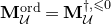 $\mathbf{M}^{\mathrm{ord}}_{\mathcal{U}}=\mathbf{M}_{\mathcal{U}}^{\dagger, \leqslant 0}$
and
 $\mathbf{S}^{\mathrm{ord}}_{\mathcal{U}}=\mathbf{S}_{\mathcal{U}}^{\dagger, \leqslant 0}$
, and let
 $\mathbf{S}^{\mathrm{ord}}_{\mathcal{P}}=\mathbf{S}^{\mathrm{ord}}_{\mathcal{U}} \widehat{\otimes}_{\mathcal{T}^{\mathrm{cusp},\leqslant 0}_{\mathcal{U}}} \mathcal{T}_{\mathcal{P}}^{\mathrm{cusp}} $
and
 $\mathbf{M}^{\mathrm{ord}}_{\mathcal{P}}=\mathbf{M}^{\mathrm{ord}}_{\mathcal{U}} \widehat{\otimes}_{\mathcal{T}^{\leqslant 0}_{\mathcal{U}}} \mathcal{T}_{\mathcal{P}}$
. By [Reference HidaHid93, Theorem 5] (or [Reference HidaHid04, Theorem 4.30]), we have the following perfect pairing
 \begin{equation}\mathcal{T}_{\mathcal{P}}^{\mathrm{cusp}} \times \mathbf{S}^{\mathrm{ord}}_{\mathcal{P}}\to \varLambda_{\mathsf{w}(\mathcal{P})} \quad(h,\mathcal{F})\mapsto C(\mathfrak{o},h\cdot \mathcal{F}).\end{equation}
3.3 Constant terms of Eisenstein families
Applying Hida’s ordinary idempotent
 $e=\displaystyle\lim_{n\to\infty} U_p^{n!}$
to (2.26) yields a short exact sequence
 \begin{equation}0\to \mathbf{S}^{\mathrm{ord}}_{\mathcal{U}} \to \mathbf{M}^{\mathrm{ord}}_{\mathcal{U}} \xrightarrow{\mathrm{res}} e\cdot \mathcal{O}(\mathcal{U})[\mathscr{P}_1(p^n)]^{(\phi_p)} \to 0.\end{equation}
We let
 $(e_1,e_2)$
be the canonical basis of
 $F^2$
. The group
 $\mathrm{GL}_2(F)$
acts on the left on
 $F^2$
by
 $$g \ast (x,y)= (x,y) \cdot g^{-1} \quad \text{for all }g \in \mathrm{GL}_2(F). $$
This action extends to an action of
 $\mathrm{GL}_2(\mathbf{A}_{F,f})$
on
 $\mathbf{A}_{F,f}^2$
. As we showed in § 2.7, a cusp of level
 $\Gamma_1(\mathfrak{n} p^n)$
corresponds to two fractional ideals
 $\mathfrak{a}$
and
 $\mathfrak{b}$
with extra data (see [Reference DimitrovDim04, Definition 3.1] for more details). In fact, we can associate to a cusp an
 $\mathfrak{o}$
-lattice L of
 $F^2$
(see [Reference DimitrovDim04, § 3]) and
 $\mathrm{GL}_2(\mathbf{A}_{F,f})$
acts on such lattices (hence acts on the cusps) as follows
 $$g \ast L = F^2 \cap (L \cdot g^{-1}) \quad \text{for all } g \in \mathrm{GL}_2(\mathbf{A}_{F,f}). $$
In particular,
 $\mathfrak{b}= g \ast L \cap (F\cdot e_1)$
and
 $ \mathfrak{a}^{-1}\mathfrak{d}^{-1}= g \ast L \cap (F\cdot e_2)$
. For
 $[\mathfrak{c}]\in \mathscr{C}\!\ell_F^+$
, we let
 $\infty(\mathfrak{c})=( \mathfrak{o} \oplus \mathfrak{d}^{-1}\mathfrak{c}^{-1}, \alpha_{\mathfrak{n} p^n}: \mathfrak{c} /\mathfrak{n} p^n \mathfrak{c} \simeq \mathfrak{o}/\mathfrak{n} p^n )$
be the unramified cusp in the sense of [Reference DimitrovDim04, Definition 3.2] associated to the pair of ideals
 $(\mathfrak{a},\mathfrak{b}) = (\mathfrak{c}, \mathfrak{o})$
. As
 $\mathrm{GL}_2(\mathbf{A}_{F,f}) $
acts transitively, it follows that the set of cusps of level
 $\Gamma_1(\mathfrak{n} p^n)$
can be identified with the orbit of
 $\infty=\infty(\mathfrak{d}^{-1})$
given, up to isomorphisms, by
 \begin{equation}B(F)^+ \backslash \mathrm{GL}_2(\mathbf{A}_{F,f}) / \Gamma_1(\mathfrak{n}p^n),\end{equation}
where
 $B(F)^+$
is the group of upper triangular matrices having a totally positive determinant.
Lemma 3.3. Representatives of (3.9) can be taken of the form
 $(\begin{smallmatrix} t_1 & 0 \\ 0 & t_2\end{smallmatrix})\cdot g$
, where:
-
(i)
$g\in \mathrm{GL}_2(\widehat{\mathfrak{o}})$
with
$g_v=(\begin{smallmatrix} 1 & 0 \\ 0 & 1\end{smallmatrix})$
for all
$v\,\nmid\, \mathfrak{n} p$
; and -
(ii)
$t_i\in \mathbf{A}_{F,f}^\times$
with
$\mathrm{val}_v(t_i)=0$
for all
$v\mid \mathfrak{n} p$
(
$i=1,2$
).


Definition 3.4. A cusp of level
 $\Gamma_1(\mathfrak{n} p^n)$
or level
 $\Gamma_1(\mathfrak{n}) \cap \Gamma_0(p^n)$
is p-ordinary (multiplicative) if it is represented by
 $t\cdot g$
for some
 $t\in T(\mathbf{A}_{F,f})$
and for some
 $g\in \mathrm{GL}_2(\widehat{\mathfrak{o}})$
with
 $g_p\in \Gamma_{0}(p^n)$
.
Lemma 3.5.
-
(i) The cusps of
$\coprod_{\mathfrak{c} \in \mathscr{C}\!\ell_F^+} \overline{\mathscr{X}_{\mathfrak{c}}} (v)$
are exactly the cups of level
$\Gamma_1(\mathfrak{n})$
. -
(ii) The cusps of
$\coprod_{\mathfrak{c} \in \mathscr{C}\!\ell_F^+} \overline{\mathscr{X}_{\mathfrak{c}}}(\mu_{p^n},v)$
are exactly the p-ordinary cusps of level
$\Gamma_1(\mathfrak{n} p^n)$
.


Proof.
-
(i) Mumford’s semi-abelian scheme associated to any cusp of level
$\Gamma_1(\mathfrak{n})$
is p-ordinary. -
(ii) Since the lattice
$\mathfrak{o} \oplus\mathfrak{o}$
is endowed with the natural unramified
$\Gamma_1(\mathfrak{n} p^n)$
-level structure
$\alpha_{\mathfrak{n}p^n}$
(see [Reference DimitrovDim04, Definition 3.2]), the level structure at p of Mumford’s semi-abelian scheme associated to a p-ordinary cusp of level
$\Gamma_1(\mathfrak{n} p^n)$
is necessary of multiplicative type (see [Reference DimitrovDim04, § 3]).


Recall that
 $\mathfrak{n}_i=\mathrm{cond}(\phi_i)$
for
 $i=1,2$
. As before, we denote by
 $\mathfrak{n}$
the prime-to-p part of
 $\mathfrak{n}_1\mathfrak{n}_2$
and let n be the smallest positive integer such that
 $\mathfrak{n}_1\mathfrak{n}_2$
divides
 $\mathfrak{n} p^n$
. Denote by
 $\mathfrak{n}'_1$
the prime-to-
 $\mathfrak{n}_2$
part of
 $\mathfrak{n}_1$
and denote by
 $\mathfrak{n}'_2$
the prime-to-
 $\mathfrak{n}_1$
part of
 $\mathfrak{n}_2$
. For any
 $\alpha\in \mathbf{A}_{F,f}$
and for
 $i=1,2$
, we denote by
 $\alpha_{\mathfrak{n}_i}$
the
 $\mathfrak{n}_i$
-part of
 $\alpha$
. We next recall the constant terms of
 $E_k(\phi_1,\phi_2)$
for all
 $k\geqslant 2$
computed in [Reference ShihShi20, § 3] (see also [Reference Dasgupta and KakdeDK21]). In [Reference ShihShi20], the Eisenstein series
 $E_k(\phi_1,\phi_2)$
is a member of a family of adelic Eisenstein series evaluated at
 $s=({1-k})/{2}$
(see also [Reference BumpBum97, § 3.7]). This family is defined via explicit choices of local sections
 $f_{\phi_1,\phi_2,s,v}$
in the normalized induced representations
 $\mathrm{Ind}_{B(F_v)}^{\mathrm{GL}_2(F_v)} (\phi_2|\cdot|^s_v,\phi_1|\cdot|_v^{-s})$
for v a place of F (see [Reference ShihShi20, § 3.4]). We consider a specific value of the local intertwining operator (see [Reference BumpBum97, (7.22)])
 $$M_{\phi_1,\phi_2,v,s}=\int_{F_v} f_{\phi_1,\phi_2,s,v}\bigg(\bigg(\begin{matrix}0 & -1 \\ 1 & x \end{matrix}\bigg)\bigg(\begin{matrix}1 & 0 \\ \varpi_v^{\mathrm{val}_v(\mathfrak{n}_2)} & 1 \end{matrix}\bigg)\bigg)\, dx. $$
Proposition 3.6 [Reference ShihShi20, Proposition 3.10]. The geometric constant term of
 $E_k(\phi_1,\phi_2)$
at the p-ordinary
 $\Gamma_1(\mathfrak{n} p^n)$
-cusp
 $(\begin{smallmatrix} t_1 & 0 \\ 0 & t_2 \end{smallmatrix})\cdot (\begin{smallmatrix} a & b \\ c & d \end{smallmatrix})$
is zero, unless the following three conditions hold:
-
(i)
$\mathrm{val}_v(c)\geqslant \mathrm{val}_v(\mathfrak{n}_2)$
for all
$v\mid \mathfrak{n}'_2$
; -
(ii)
$\mathrm{val}_v(c)=0$
for all
$v\mid \mathfrak{n}'_1$
; -
(iii)
$\mathrm{val}_v(c)=\mathrm{val}_v(\mathfrak{n}_2)$
for all v dividing both
$\mathfrak{n}_1$
and
$\mathfrak{n}_2$
;


in which case, letting
 $\varepsilon_v(s,\phi_{1,v},\psi_v)$
denote the local epsilon factor, it is given by
 \begin{align}&\phi_1(t_1)\phi_2(t_2) \mathrm{N}_{F/\mathbf{Q}}\bigg(\frac{t_1}{t_2}\bigg)^{-k/2}\phi_2^{-1}(\mathfrak{n}_1')\mathrm{N}_{F/\mathbf{Q}}(\mathfrak{n}_1')^{-1}\phi_{2}(d_{\mathfrak{n}_2}\hat{\mathfrak{o}})\phi_1^{-1}\bigg(\frac{-c_{\mathfrak{n}_1}}{\mathfrak{n}_2'}\bigg) \nonumber\\&\quad \times L^{(\mathfrak{n})}(1-k,\phi)\cdot \prod_{v|\mathfrak{n}_1,v|\mathfrak{n}_2} M_{\phi_1,\phi_2,v,(1-k)/2}\prod_{v|\mathfrak{n}_1}\varepsilon_v(2-k,\phi_{1,v},\psi_v)^{-1}.\end{align}
Proposition 3.7. The constant term
 $a_C(0,\mathcal{E}_{\phi_1,\phi_2})$
of
 $\mathcal{E}_{\phi_1,\phi_2}$
at the p-ordinary
 $\Gamma_1(\mathfrak{n} p^n)$
-cusp C represented by
 $(\begin{smallmatrix} t_1 & 0 \\ 0 & t_2 \end{smallmatrix})\cdot (\begin{smallmatrix} a & b \\ c & d \end{smallmatrix})$
belongs to
 $\zeta_{\phi_1,\phi_2}\cdot \mathcal{O}(\mathcal{U})^\times$
if the three conditions of Proposition 3.6 hold; otherwise, it is zero.
Proof. The specialization of
 $\mathcal{E}_{\phi_1,\phi_2}$
at
 $k \geqslant 2$
such that
 $\omega_p^{k-1}=\mathbf{1}$
is the p-stabilization of the weight k Eisenstein series
 $E_k(\phi_1,\phi_2)$
of level
 $\Gamma_1(\mathfrak{n}_1\mathfrak{n}_2)$
. As in [Reference Betina, Dimitrov and PozziBDP22, Proposition 4.7], one obtains the assertions by computing the constant terms of
 $E_k(\phi_1,\phi_2)$
at all p-ordinary
 $\Gamma_1(\mathfrak{n} p^n)$
-cusps using the formula (3.10) from Proposition 3.6, all the terms of which interpolate p-adically (see [Reference ShihShi20, Proposition 4.5]).
3.4 Hecke duality and Proof of Theorem B
The Eisenstein ideal
 $\mathcal{J}_{\phi_1,\phi_2}\subset \mathfrak{h}^{\mathrm{cusp}}$
associated to
 $\mathcal{E}_{\phi_1,\phi_2}$
is the image of the kernel of the
 $\mathcal{E}_{\phi_1,\phi_2}$
-projection
 $\mathfrak{h} \to \varLambda_{\mathcal{O}}$
via the natural surjection
 $\mathfrak{h} \twoheadrightarrow \mathfrak{h}^{\mathrm{cusp}}$
of the Hida Hecke algebra introduced in § 3.2. The congruence ideal
 $\mathcal{I}_{\phi_1,\phi_2}\subset \varLambda_{\mathcal{O}}$
of the Eisenstein family
 $\mathcal{E}_{\phi_1,\phi_2}$
is uniquely characterized by the following commutative diagram of
 $ \varLambda_{\mathcal{O}}$
-algebras.

We next establish a precise relation between the congruence ideal and the constant term of
 $\mathcal{E}_{\phi_1,\phi_2}$
. Previously, it was only known by the work of Wiles [Reference WilesWil90, Theorem 4.1] that, after inverting p and the height one primes corresponding to trivial zeros,
 $(\zeta_{\phi_1,\phi_2})$
divides
 $ \mathcal{I}_{\phi_1,\phi_2}$
.
Theorem 3.8. If
 $\phi\not\equiv\omega_p^{-1}\pmod{\varpi}$
, then one has
 $ \mathcal{I}_{\phi_1,\phi_2} \cdot \varLambda_{\mathcal{O}}[1/p] = \zeta_{\phi_1,\phi_2} \cdot \varLambda_{\mathcal{O}}[1/p]$
.
Proof. As
 $\varLambda_{\mathcal{O}}[1/p]$
is a Dedekind domain, it suffices to show equality after localization at an arbitrary maximal ideal
 $\mathcal{P}$
. Localizing the isomorphism in (3.11) at
 $\mathcal{P}$
, we obtain
 \begin{equation} {\mathcal{T}^{\mathrm{cusp}}_{\mathcal{P}}}/{\mathcal{J}_{\phi_1,\phi_2,\mathcal{P}}} \simeq {\varLambda_{\mathsf{w}(\mathcal{P})}}/{\mathcal{I}_{\phi_1,\phi_2,\mathcal{P}}}.\end{equation}
Choose a sufficiently small open admissible affinoid
 $\mathcal{U}$
of
 $\mathcal{W}^{\parallel}$
containing
 $\mathcal{P}$
. The image of
 $\mathcal{E}_{\phi_1,\phi_2}$
under the map res from (3.8) is contained in a free of rank 1 direct summand in
 $ \mathcal{O}(\mathcal{U})[\mathscr{P}_1(p^n)]^{(\phi_p)}$
having
 $\mathcal{O}(\mathcal{U})$
-basis
 $c_{\phi_1,\phi_2}$
. The module
 $\mathbf{M}_{\phi_1,\phi_2}=\mathrm{res}^{-1}(\mathcal{O}(\mathcal{U})\cdot c_{\phi_1,\phi_2})$
is Hecke stable and fits in a short exact sequence of free
 $\mathcal{O}(\mathcal{U})$
-modules
 $$0\to \mathbf{S}^{\mathrm{ord}}_{\mathcal{U}} \to \mathbf{M}_{\phi_1,\phi_2} \xrightarrow{\mathrm{res}} \mathcal{O}(\mathcal{U})\cdot c_{\phi_1,\phi_2} \to 0. $$
Recall that
 $\mathrm{Spec}(\varLambda_{\mathcal{O}})$
is the irreducible component of
 $\mathrm{Spec}(\mathfrak{h})$
corresponding to
 $\mathcal{E}_{\phi_1,\phi_2}$
. Taking the complete localization of the above short exact sequence at
 $\mathcal{P}$
viewed as a maximal ideal of
 $\mathcal{T}^{\leqslant 0}_{\mathcal{U}}$
, we obtain a short exact sequence of free
 $\varLambda_{\mathsf{w}(\mathcal{P})}$
-modules
 \begin{equation}0\to \mathbf{S}^{\mathrm{ord}}_{\mathcal{U},\mathcal{P}} \to \mathbf{M}_{\phi_1,\phi_2,\mathcal{P}} \xrightarrow{\mathrm{res}} \varLambda_{\mathsf{w}(\mathcal{P})}\cdot c_{\phi_1,\phi_2} \to 0.\end{equation}
If
 $\zeta_{\phi_1,\phi_2}\notin \mathcal{P}$
, then
 $ (\zeta_{\phi_1,\phi_2}) =\varLambda_{\mathsf{w}(\mathcal{P})}\supset\mathcal{I}_{\phi_1,\phi_2,\mathcal{P}}$
. Otherwise, as
 $\mathrm{res}(\mathcal{E}_{\phi_1,\phi_2})\in \zeta_{\phi_1,\phi_2} \cdot \varLambda_{\mathsf{w}(\mathcal{P})}^\times \cdot c_{\phi_1,\phi_2}$
by Proposition 3.7, there exists a
 $\varLambda_{\mathsf{w}(\mathcal{P})}$
-adic cuspform
 $\mathcal{H}\in \mathbf{S}^{\mathrm{ord}}_{\mathcal{U},\mathcal{P}}$
congruent to
 $\mathcal{E}_{\phi_1,\phi_2}$
modulo
 $\zeta_{\phi_1,\phi_2}$
. Using (3.7), one obtains a surjective
 $\varLambda_{\mathsf{w}(\mathcal{P})}$
-algebra homomorphism
 \begin{equation}{\mathcal{T}^{\mathrm{cusp}}_{\mathcal{P}}}/{\mathcal{J}_{\phi_1,\phi_2,\mathcal{P}}}\twoheadrightarrow{\varLambda_{\mathsf{w}(\mathcal{P})}}/{(\zeta_{\phi_1,\phi_2})}, \quad h\mapsto C(\mathfrak{o},h\cdot \mathcal{H}) \mod \zeta_{\phi_1,\phi_2}.\end{equation}
In view of (3.12), this precisely shows the inclusion of principal ideals
 $(\zeta_{\phi_1,\phi_2}) \supset \mathcal{I}_{\phi_1,\phi_2,\mathcal{P}} $
in the discrete valuation ring
 $ \varLambda_{\mathsf{w}(\mathcal{P})}$
. It remains to show the opposite inclusion.
Observe that the freeness of
 $\mathcal{T}^{\mathrm{cusp}}_{\mathcal{P}} $
as
 $\varLambda_{\mathsf{w}(\mathcal{P})}$
-module allows us to lift the isomorphism (3.12) to a morphism
 $\mathcal{T}^{\mathrm{cusp}}_{\mathcal{P}} \to \varLambda_{\mathsf{w}(\mathcal{P})}$
of
 $\varLambda_{\mathsf{w}(\mathcal{P})}$
-modules (though not necessarily to an algebra homomorphism). Using (3.7), this lift gives rise to a
 $\varLambda_{\mathsf{w}(\mathcal{P})}$
-adic cuspform
 $\mathcal{G}$
(not necessarily an eigenform) with Fourier coefficients in
 $\varLambda_{\mathsf{w}(\mathcal{P})}$
, such that
 $C(\mathfrak{m},\mathcal{G}) \equiv C(\mathfrak{m},\mathcal{E}_{\phi_1,\phi_2}) \mod \mathcal{I}_{\phi_1,\phi_2,\mathcal{P}}$
for all non-zero ideals
 $\mathfrak{m} \subset \mathfrak{o}$
. As this does not provide in general a congruence between the constant terms, we are led to split the remainder of the argument in two cases. As
 $\mathcal{I}_{\phi_1,\phi_2,\mathcal{P}} \subset (\zeta_{\phi_1,\phi_2})$
, one can define a
 $\varLambda_{\mathsf{w}(\mathcal{P})}$
-adic family
 \begin{equation} \mathcal{F}_0=\frac{\mathcal{E}_{\phi_1,\phi_2}- \mathcal{G}}{2^{-d} \zeta_{\phi_1,\phi_2}} \in \mathbf{M}_{\phi_1,\phi_2,\mathcal{P}}, \end{equation}
which provides a section of the map res in (3.13), i.e.,
 $\mathbf{M}_{\phi_1,\phi_2,\mathcal{P}}=\mathbf{S}^{\mathrm{ord}}_{\mathcal{U},\mathcal{P}} \oplus \varLambda_{\mathsf{w}(\mathcal{P})}\cdot \mathcal{F}_0$
as
 $ \varLambda_{\mathsf{w}(\mathcal{P})} $
-module.
Assume first that
 $\mathfrak{n}_1\ne\mathfrak{o}$
. In this case (3.3) yields
 $C((0),\mathcal{E}_{\phi_1,\phi_2}) =0$
, hence
 $\mathcal{E}_{\phi_1,\phi_2} \equiv \mathcal{G} \mod \mathcal{I}_{\phi_1,\phi_2,\mathcal{P}}$
by the q-expansion principle. Consequently,
 $\mathrm{res}(\mathcal{E}_{\phi_1,\phi_2})\in \mathcal{I}_{\phi_1,\phi_2,\mathcal{P}}\cdot c_{\phi_1,\phi_2}$
which combined with
 $\mathrm{res}(\mathcal{E}_{\phi_1,\phi_2})\in \zeta_{\phi_1,\phi_2} \cdot \varLambda_{\mathsf{w}(\mathcal{P})}^\times \cdot c_{\phi_1,\phi_2}$
from Proposition 3.7, implies that
 $(\zeta_{\phi_1,\phi_2})\subset \mathcal{I}_{\phi_1,\phi_2,\mathcal{P}}$
.
Suppose now that
 $\mathfrak{n}_1=\mathfrak{o}$
. Given
 $[\mathfrak{c}]\in\mathscr{C}\!\ell_F^+$
, it follows from (3.3) that the value of
 $\mathcal{E}_{\phi_1,\phi_2}$
at the ‘infinity’ cusp
 $\infty(\mathfrak{c})$
of
 $\overline{\mathscr{X}_{\mathfrak{c}}}(\mu_{p^n},v)$
equals
 $2^{-d} \zeta_{\phi_1,\phi_2}(X) \phi_1^{-1}(\mathfrak{c}\mathfrak{d})\ne 0$
(see § 3.3). Then
 $ \mathcal{F}_0$
has constant term 1 at
 $\infty=\infty(\mathfrak{d}^{-1})$
and its specialization
 $F_{\mathcal{P}}$
in weight
 $\mathsf{w}(\mathcal{P})$
lies the generalized eigenspace
 $\mathbf{M}^{\dagger}_{\mathsf{w}(\mathcal{P})}[\![ E_{\mathcal{P}} ]\!]$
attached to the specialization
 $E_{\mathcal{P}}$
of
 $\mathcal{E}_{\phi_1,\phi_2}$
in weight
 $\mathsf{w}(\mathcal{P})$
. In particular, for any prime
 $\mathfrak{q}\,\nmid\, \mathfrak{n} p$
the operator
 $S_{\mathfrak{q}}$
acts on
 $F_{\mathcal{P}}\!\!\mod\! \varpi$
as
 $(\phi_1\phi_2 \omega_p)(\mathfrak{q})$
. The operator
 $S_{\mathfrak{q}}$
defined in [Reference Andreatta, Iovita and PilloniAIP16, p. 24] is renormalized by the factor
 $\mathrm{N}_{F/\mathbb{Q}}(\mathfrak{q})^{-2}$
to match the determinant formula of the p-adic Galois representations described in [Reference Andreatta, Iovita and PilloniAIP16, Theorem 5.1]. Throughout this work (as in [Reference De MariaDeM20, p. 44]) we do not renormalize
 $S_{\mathfrak{q}}$
.
If the inclusion of principal ideals
 $\mathcal{I}_{\phi_1,\phi_2,\mathcal{P}} \subset (\zeta_{\phi_1,\phi_2}) $
of
 $\varLambda_{\mathsf{w}(\mathcal{P})}$
was strict, then:
-
(i)
$C(\mathfrak{m},F_{\mathcal{P}}) =0$
for all non-zero ideals
$\mathfrak{m} \subset \mathfrak{o}$
; and -
(ii) for
$[\mathfrak{c}]\in\mathscr{C}\!\ell_F^+$
, the value of
$F_{\mathcal{P}}$
at the cusp
$\infty(\mathfrak{c})$
of
$\overline{\mathscr{X}_{\mathfrak{c}}}(\mu_{p^n},v)$
equals
$\phi_1^{-1}(\mathfrak{c}\mathfrak{d})$
.


Inspired by the work of Emerton [Reference EmertonEme99, Proposition 1] when
 $F=\mathbf{Q}$
, further extended by Lafferty [Reference LaffertyLaf19, p. 766], we now provide a contradiction using a geometrically flavored argument based on the irreducibility of the Igusa tower
 $\overline{\mathscr{X}_{\mathfrak{c}}}(\mu_{p^\infty},0)$
. As the special fiber
 $\overline{\mathscr{X}_{\mathfrak{c}}}(\mu_{p^\infty},0)_1$
is geometrically irreducible by a theorem of Ribet [Reference RibetRib75] (see also [Reference HidaHid09]), the q-expansion principle shows that
 $F_{\mathcal{P}}$
coincides with its constant term
 $C((0),F_{\mathcal{P}})$
seen as a modular form of weight 0 (see [Reference Andreatta, Iovita and StevensAIS14, Proposition 4.2] for more details). Hence, by the definition of the operator
 $S_{\mathfrak{q}}$
, the value of
 $S_{\mathfrak{q}}(C((0),F_{\mathcal{P}}))$
on
 $\overline{\mathscr{X}_{\mathfrak{c}}}(\mu_{p^\infty},0)$
is exactly the value of
 $C((0),F_{\mathcal{P}})$
on
 $\overline{\mathscr{X}_{\mathfrak{c}\mathfrak{q}^{-2}}}(\mu_{p^\infty},0)$
. Combining this with the fact that
 $S_{\mathfrak{q}}$
acts on
 $F_{\mathcal{P}} \mod \varpi$
as
 $(\phi_1\phi_2 \omega_p)(\mathfrak{q})$
, we find
 $$ (\phi_1\phi_2 \omega_p)(\mathfrak{q})\cdot \phi_1^{-1}(\mathfrak{c}\mathfrak{d})\equiv \phi_1^{-1}(\mathfrak{c}\mathfrak{q}^{-2}\mathfrak{d}) \pmod{\varpi}, $$
that is,
 $\phi=\phi_2 \phi_1^{-1}\equiv \omega_p^{-1}\pmod{\varpi}$
. This contradicts our running assumption on
 $\phi$
. Hence, we conclude that
 $\mathcal{I}_{\phi_1,\phi_2,\mathcal{P}} = (\zeta_{\phi_1,\phi_2}) $
.
The techniques employed in the above proof, namely the construction of the
 $\varLambda_{\mathsf{w}(\mathcal{P})}$
-adic form
 $\mathcal{F}_0$
in (3.15), have the following important consequence.
Proposition 3.9. Let
 $\mathcal{P}$
be a maximal ideal of the ordinary Hecke algebra
 $\mathfrak{h}[1/p]$
corresponding to an Eisenstein intersection point of
 $\mathcal{E}_{\phi_1,\phi_2}$
and
 $\mathcal{C}_{\mathrm{cusp}}$
, and let
 $\mathcal{T}_{\phi_1,\phi_2,\mathcal{P}}$
be the quotient of
 $\mathcal{T}_{\mathcal{P}}$
acting faithfully on the
 $\varLambda_{\mathsf{w}(\mathcal{P})}$
-module
 $\mathbf{M}_{\phi_1,\phi_2,\mathcal{P}} $
in (3.13). Then, one has an isomorphism of
 $\varLambda_{\mathsf{w}(\mathcal{P})}$
-modules
 \begin{equation}\mathcal{T}_{\phi_1,\phi_2,\mathcal{P}} \simeq \mathcal{T}_{\mathcal{P}}^{\mathrm{cusp}} \times_{\varLambda_{\mathsf{w}(\mathcal{P})}/(\zeta_{\phi_1,\phi_2})} \varLambda_{\mathsf{w}(\mathcal{P})},\end{equation}
and a perfect pairing of
 $\Lambda_{\mathsf{w}(\mathcal{P})}$
-modules
 \begin{equation}\mathcal{T}_{\phi_1,\phi_2,\mathcal{P}}\times \mathbf{M}_{\phi_1,\phi_2,\mathcal{P}} \to \varLambda_{\mathsf{w}(\mathcal{P})}, \quad (h,\mathcal{G})\mapsto C(\mathfrak{o},h\cdot \mathcal{G}).\end{equation}
In particular, there exists an element
 $h_0 \in \mathcal{T}_{\phi_1,\phi_2,\mathcal{P}}$
such that for any
 $\mathcal{G} \in \mathbf{M}_{\phi_1,\phi_2,\mathcal{P}}$
, we have
 $$C(\mathfrak{o},h_0 \cdot \mathcal{G}) \cdot \sum_{[\mathfrak{c}]\in\mathscr{C}\!\ell_F^+} \phi_1^{-1}(\mathfrak{c}\mathfrak{d}) [\mathfrak{c}] = C((0), \mathcal{G}).$$
Proof. The isomorphism (3.16) follow from the localization of (3.11) at
 $\mathcal{P}$
and Theorem 3.8.
We assume first that
 $\mathfrak{n}_1 \ne \mathfrak{o}$
. By Nakayama’s lemma, to show the perfectness of the pairing (3.17) of free
 $\varLambda_{\mathsf{w}(\mathcal{P})}$
-modules, it suffices to establish that it is right injective residually and left injective. As
 $C((0),\mathcal{E}_{\phi_1,\phi_2}) = 0$
by (3.3) we deduce that
 $C((0),\mathcal{G}) = 0$
for all
 $\mathcal{G} \in \mathbf{M}_{\phi_1,\phi_2,\mathcal{P}}$
. The left injectivity in (3.17) then follows from q-expansion principle and from the formula
 $C(\mathfrak{o} , h\cdot (T_{\mathfrak{q}} \cdot \mathcal{G})) = C(\mathfrak{q}, h\cdot \mathcal{G})$
, where
 $\mathfrak{q}$
is any non-zero integral ideal of
 $\mathfrak{o}$
(see [Reference HidaHid04, (4.67)]), since by definition
 $\mathcal{T}_{\phi_1,\phi_2,\mathcal{P}}$
acts faithfully on
 $\mathbf{M}_{\phi_1,\phi_2,\mathcal{P}}$
. For right injectivity of the reduction of (3.17) modulo the maximal ideal of
 $\varLambda_{\mathsf{w}(\mathcal{P})}$
, we use again the vanishing of the constant term, the q-expansion principle and the formula
 $C(\mathfrak{o} , T_{\mathfrak{q}} \cdot \overline{\mathcal{G}}) = C(\mathfrak{q}, \overline{\mathcal{G}})$
for
 $\overline{\mathcal{G}}$
in the generalized eigenspace
 $\mathbf{M}_{\phi_1,\phi_2,\mathcal{P}}\otimes_{\varLambda_{\mathrm{\mathsf{w}}(\mathcal{P})}}\overline{\mathbf{Q}}_p$
.
If
 $\mathfrak{n}_1=\mathfrak{o}$
, we consider a
 $\varLambda_{\mathsf{w}(\mathcal{P})}$
-basis of
 $\mathbf{M}_{\phi_1,\phi_2,\mathcal{P}}$
adapted to the direct sum decomposition
 $\mathbf{S}^{\mathrm{ord}}_{\mathcal{U},\mathcal{P}} \oplus \varLambda_{\mathsf{w}(\mathcal{P})}\cdot \mathcal{F}_0$
and a
 $\varLambda_{\mathsf{w}(\mathcal{P})}$
-basis of
 $\mathcal{T}_{\phi_1,\phi_2,\mathcal{P}}$
obtained by completing a lift of a basis of
 $\mathcal{T}_{\mathcal{P}}^{\mathrm{cusp}}$
by the element
 $h_0=(0,2^{-d} \zeta_{\phi_1,\phi_2})$
which belongs to
 $\mathcal{T}_{\phi_1,\phi_2,\mathcal{P}}$
by (3.16). The pairing (3.17) is represented by a block upper triangular matrix with coefficients in
 $\varLambda_{\mathsf{w}(\mathcal{P})}$
, because
 $h_0$
annihilates
 $\mathbf{S}^{\mathrm{ord}}_{\mathcal{U},\mathcal{P}}$
. Moreover, by (3.7) the matrix has an invertible block of co-dimension 1. The perfectness of the pairing (3.17) is then equivalent to the last diagonal coefficient being in
 $\varLambda_{\mathsf{w}(\mathcal{P})}^\times$
. By construction, this coefficient is given by
 $$C(\mathfrak{o},h_0\cdot \mathcal{F}_0)=C\left(\mathfrak{o},h_0\cdot \frac{\mathcal{E}_{\phi_1,\phi_2}}{2^{-d} \zeta_{\phi_1,\phi_2}}\right)= 1. $$
4.
$\mathscr{L}$
-invariants and Galois deformations

Let
 $\phi$
be a finite order totally odd character of
 $\mathrm{G}_{F}$
. Henceforth, we assume that
 $\phi$
is irregular at the prime
 $\mathfrak{p}$
of F determined by
 $\iota_p$
, i.e.,
 $\phi$
has trivial restriction to
 $\mathrm{G}_{\mathfrak{p}}$
. In this section, we first review Darmon, Dasgupta and Pollack’s definition [Reference Dasgupta, Darmon and PollackDDP11] of an
 $\mathscr{L}$
-invariant attached to
 $\phi$
at
 $\mathfrak{p}$
and we show its non-vanishing. We then define a nearly-ordinary deformation functor for a residually reducible representation and compute its tangent space using Galois cohomology under the assumption that the Leopoldt defect
 $\delta_{F,p}$
vanishes.
4.1 Non-vanishing of an
$\mathscr{L}$
-invariant

Let
 $w_0\mid \mathfrak{p}$
be the prime of
 $H=\overline{\mathbf{Q}}^{\ker(\phi)}$
singled out by
 $\iota_p$
. As
 $\mathfrak{p}$
splits completely in H, i.e.,
 $F_{\mathfrak{p}}=H_{w_0}$
, the group
 $\mathrm{Gal}(H/F)$
acts freely and transitively on the set of primes of H above
 $\mathfrak{p}$
and we have a canonical identification
 $ \Sigma_{\mathfrak{p}} \simeq \mathrm{Hom}_{\mathbf{Q}_p-\text{alg}}(H_{w_0},\overline{\mathbf{Q}}_p)$
via
 $\iota_p$
. Consider the homomorphisms
 \begin{equation}\begin{aligned}\mathrm{ord}_{\mathfrak{p}} &:\mathcal{O}_{H}\bigg[\frac{1}{\mathfrak{p}}\bigg]^\times\otimes \overline{\mathbf{Q}}_p \longrightarrow \overline{\mathbf{Q}}_p, \quad u\otimes 1\mapsto \mathrm{ord}_{w_0}(u), \\ \log_{\mathfrak{p}} &:\mathcal{O}_{H}\bigg[\frac{1}{\mathfrak{p}}\bigg]^\times\otimes \overline{\mathbf{Q}}_p \longrightarrow \overline{\mathbf{Q}}_p,\quad u\otimes 1\mapsto \log_p( \mathrm{N}_{F_{\mathfrak{p}}/\mathbf{Q}_p}(\iota_p(u)))=\sum_{\sigma\in \Sigma_{\mathfrak{p}}} \log_p(\sigma(\iota_p(u))),\end{aligned}\end{equation}
where
 $\mathcal{O}_{H}[{1}/{\mathfrak{p}}]^\times$
denotes the group of
 $\mathfrak{p}$
-units and we recall that
 $\iota_p$
embeds H into
 $H_{w_0}$
. As in [Reference Dasgupta, Darmon and PollackDDP11, (7)], the p-adic number
 \begin{equation}\mathscr{L}^{\mathfrak{p}}(\phi)=-\frac{\log_{\mathfrak{p}}(u_{\phi})}{\mathrm{ord}_{\mathfrak{p}}(u_{\phi})}\in \overline{\mathbf{Q}}_p,\end{equation}
depends only on
 $\phi$
and
 $\mathfrak{p}$
, and not on the particular choice of a basis
 $u_{\phi}$
of the line
 $(\mathcal{O}_{H}[{1}/{\mathfrak{p}}]^\times\otimes \overline{\mathbf{Q}}_p)[\phi]$
. If
 $\mathfrak{p}\in\Sigma_p$
is the unique irregular prime for
 $\phi$
, then
 $\mathscr{L}^{\mathfrak{p}}(\phi)$
coincides with Gross’
 $\mathscr{L}$
-invariant
 $\mathscr{L}(\phi)$
from [Reference GrossGro81]. We next describe an explicit basis of
 $\mathrm{H}^1(F,\phi)$
. One has an exact sequence
 \begin{equation}0\to \mathrm{Hom}(\mathrm{G}_H,\overline{\mathbf{Q}}_p)\to \mathrm{Hom}((\mathcal{O}_H\otimes \mathbf{Z}_p)^\times, \overline{\mathbf{Q}}_p)\to \mathrm{Hom}(\mathcal{O}_H^\times,\overline{\mathbf{Q}}_p),\end{equation}
of left
 $\overline{\mathbf{Q}}_p[\mathrm{Gal}(H/F)]$
-modules. Consider the coset decomposition as in [Reference Betina, Deo and FitéBDF21, (3)]
 \begin{equation} \mathrm{Hom}_{\mathbf{Q}-\text{alg}}(H,\overline{\mathbf{Q}})= \coprod_{\sigma\in \Sigma} \tilde{\sigma}\cdot\mathrm{Gal}({H}/{F}),\end{equation}
where:
-
– for
$\sigma\in\Sigma_{\mathfrak{p}}$
,
$\tilde{\sigma}$
denotes the unique extension to H determining via
$\iota_p$
the place
$w_0$
; -
– for
$\sigma\in \Sigma\setminus\Sigma_{\mathfrak{p}}$
,
$\tilde{\sigma}$
denotes an arbitrary extension of
$\sigma$
to H.


As in [Reference BetinaBet18, § 4], using the natural identification
 \begin{align*}\mathrm{Hom}_{\mathbf{Q}-\text{alg}}(H,\overline{\mathbf{Q}}_p)=\coprod_{w|p}\mathrm{Hom}_{\mathbf{Q}_p-\text{alg}} (H_w,\overline{\mathbf{Q}}_p),\end{align*}
we consider the basis
 $(\log_p(\iota_p \circ \tilde\sigma\circ g^{-1}(\cdot)))_{\sigma\in \Sigma, g\in \mathrm{Gal}(H/F) }$
of
 $\mathrm{Hom}((\mathcal{O}_H\otimes \mathbf{Z}_p)^\times,\overline{\mathbf{Q}}_p)$
. As
 $(\mathcal{O}_H^\times \otimes \overline{\mathbf{Q}}_p)[\phi]$
vanishes, it follows from (4.3) that
 \begin{align*}\mathrm{Hom}(\mathrm{G}_H,\overline{\mathbf{Q}}_p)[\phi^{-1}]\simeq\mathrm{Hom}((\mathcal{O}_H\otimes\mathbf{Z}_p)^\times,\overline{\mathbf{Q}}_p)[\phi^{-1}],\end{align*}
yielding the following.
Lemma 4.1. The space
 $\mathrm{H}^1(F,\phi)\simeq \mathrm{Hom}(\mathrm{G}_H,\overline{\mathbf{Q}}_p)[\phi^{-1}]$
is d-dimensional with basis
 $([\eta_{\phi}^{(\tilde{\sigma})}])_{\sigma\in \Sigma}$
, where
 $\eta_{\phi}^{(\tilde{\sigma})}$
is the cocycle whose image in
 $\mathrm{Hom}((\mathcal{O}_H\otimes \mathbf{Z}_p)^\times,\overline{\mathbf{Q}}_p)$
equals
 $$ (u \otimes v) \mapsto \displaystyle\sum_{g\in \mathrm{Gal}(H/F)} \phi(g) \log_p ( \iota_p \circ \tilde\sigma\circ g^{-1} (u) \cdot v). $$
Moreover
 $[\eta_{\phi}^{(\tilde{\sigma})}]$
is only ramified at the prime of F determined by
 $\sigma$
via the decomposition
 $\Sigma=\coprod_{\mathfrak{q}\in\Sigma_p} \Sigma_{\mathfrak{q}}$
.
As
 $(\phi-\mathbf{1})$
is a basis of the coboundaries and
 $\phi(\tau)=-1\ne 1$
, where
 $\tau \in \mathrm{G}_F$
denotes a complex conjugation, each
 $[\eta]\in \mathrm{H}^1(F,\phi)$
is represented by a unique cocycle
 $\eta$
such that
 $\eta(\tau)=0$
. We will fix
 $\tau$
and
 $\eta$
throughout this article and make no further comment. The image of
 $\eta_{\mathbf{1}}=\log_p\circ \epsilon_{\mathrm{cyc}} \in \mathrm{Hom}(\mathrm{G}_\mathbf{Q},\overline{\mathbf{Q}}_p)$
, where
 $\epsilon_{\mathrm{cyc}}$
denotes the p-adic cyclotomic character, under the natural restrictions

corresponds to
 $\log_p\circ \mathrm{N}_{H/\mathbf{Q}}$
. The following cohomological interpretation of
 $\mathscr{L}^{\mathfrak{p}}(\phi)$
will be used in § 5.4.
Proposition 4.2. Let
 $\mathrm{loc}_{\mathfrak{p}}$
denote the restriction map of
 $\mathrm{G}_F$
to
 $\mathrm{G}_{\mathfrak{p}}$
.
-
(i) There exists a unique
$[\eta_{\phi}^{(\mathfrak{p})}]\in \mathrm{H}^1(F,\phi)$
unramified outside
$\mathfrak{p}$
and such that
$$ \mathrm{loc}_{\mathfrak{p}}([\eta_{\phi}^{(\mathfrak{p})}-\eta_{\mathbf{1}}]) \in \ker ( \mathrm{Hom}(\mathrm{G}_{\mathfrak{p}},\overline{\mathbf{Q}}_p) \to \mathrm{Hom}(\mathrm{I}_{\mathfrak{p}},\overline{\mathbf{Q}}_p) ). $$
-
(ii) Under the local Artin map, one has the following equality in
$\mathrm{Hom}(F_{\mathfrak{p}}^\times,\overline{\mathbf{Q}}_p)$
:
$$ \mathrm{loc}_{\mathfrak{p}}([\eta_{\phi}^{(\mathfrak{p})}-\eta_{\mathbf{1}}] ) = \mathscr{L}^{\mathfrak{p}}(\phi) \mathrm{ord}_{\mathfrak{p}}. $$
-
(iii) For all
$\sigma\in \Sigma\setminus \Sigma_{\mathfrak{p}}$
,
$\mathrm{loc}_{\mathfrak{p}}([\eta_{\phi}^{(\tilde{\sigma})}]) \in \overline{\mathbf{Q}}_p^\times \cdot \mathrm{ord}_{\mathfrak{p}}$
. -
(iv) One has
$\mathscr{L}^{\mathfrak{p}}(\phi) \ne0$
.


Proof.
-
(i) By Lemma 4.1, any
$[\eta]\in \mathrm{H}^1(F,\phi)$
unramified outside
$\mathfrak{p}$
can be written as
$\displaystyle \sum\nolimits_{\sigma \in \Sigma_{\mathfrak{p}}} h_\sigma [\eta_{\phi}^{(\tilde{\sigma})}]$
for some
$h_\sigma\in \overline{\mathbf{Q}}_p$
. Moreover, the condition
$\eta_{|\mathrm{I}_{\mathfrak{p}}}=\eta_{\mathbf{1}|\mathrm{I}_{\mathfrak{p}}}$
yields
$h_{\sigma}=1$
for all
$\sigma\in \Sigma_{\mathfrak{p}}$
as required. -
(ii) We follow the proof of [Reference Betina, Dimitrov and PozziBDP22, Proposition 2.4]. Choose
$u_0\in\mathcal{O}_{H}[{1}/{w_0}]^\times$
having non-zero valuation at
$w_0$
, and 0 at all other finite places. Then
$u_{\phi}=\sum_{g\in \mathrm{Gal}(H/F)} \phi(g) g^{-1}(u_0)$
is a basis of the line
$(\mathcal{O}_{H}[{1}/{\mathfrak{p}}]^\times\otimes \overline{\mathbf{Q}}_p)[\phi]$
. Consider the exact sequence (4.5)coming from localization at p of the dual of the Artin reciprocity map and the diagonal inclusion, from which we deduce
\begin{equation}0\to \mathrm{Hom}(\mathrm{G}_H,\overline{\mathbf{Q}}_p)\xrightarrow{(\mathrm{loc}_{w_0},(\mathrm{loc}_{w}^\circ)_{w\ne w_0})} \mathrm{Hom}\Bigg( H_{w_0}^\times \times\prod_{w_0 \ne w|p} \mathcal{O}_{H_w}^\times , \overline{\mathbf{Q}}_p\Bigg)\to \mathrm{Hom}\bigg(\mathcal{O}_H\left[\frac{1}{w_0}\right]^\times,\overline{\mathbf{Q}}_p\bigg),\end{equation}
(4.6)
\begin{equation}0=(\eta_{\phi}^{(\mathfrak{p})}-\eta_{\mathbf{1}})(u_0)= (\mathrm{loc}_{w_0}(\eta_{\phi}^{(\mathfrak{p})}-\eta_{\mathbf{1}})) (u_0) + \sum_{w_0\ne w \mid p} (\mathrm{loc}^\circ_{w}(\eta_{\phi}^{(\mathfrak{p})}-\eta_{\mathbf{1}})) (u_0).\end{equation}


It follows from part (i) and the local–global compatibility in class field theory that

where we have used that
 $\log_p( \mathrm{N}_{H/\mathbf{Q}}(u_0))=0$
as
 $\mathrm{N}_{H/\mathbf{Q}}(u_0) \in \pm p^{\mathbf{Z}}$
.
-
(iii) For each
$\sigma\in \Sigma\setminus \Sigma_{\mathfrak{p}}$
, we have seen in Lemma 4.1 that
$\eta_{\phi}^{(\tilde{\sigma})}$
is unramified at
$\mathfrak{p}$
. A similar computation to the one above shows that which is non-zero by the Baker–Brumer theorem as the elements
$$\eta_{\phi}^{(\tilde{\sigma})}(\mathrm{Frob}_{\mathfrak{p}})=-\sum_{g\in \mathrm{Gal}(H/F)} \phi(g)\log_p( \iota_p \circ \tilde\sigma\circ g^{-1}(u_0)),$$
$( g^{-1}(u_0))_{g \in \mathrm{Gal}(H/F)}$
are
$\mathbf{Z}$
-linearly independent (this follows from examining the valuations at the
$[H:F]$
places of H above
$\mathfrak{p}$
).
-
(iv) The proof mixes ingredients all present in Gross [Reference GrossGro81]. For w a place of H above
$\mathfrak{p}$
and
$u\in H_w^\times$
, we let
$|u|^\circ_{w}=q_{w}^{-\mathrm{ord}_{w}(u)} \mathrm{N}_{H_w/\mathbf{Q}_p}(u)$
denote its local absolute value, where
$q_w$
is the order of the residue field (see [Reference GrossGro81, (1.8)] where it is denoted by
$||u||_{w,p}$
). Exactly as in [Reference GrossGro81, Proposition 1.16], one checks using the Baker–Brumer theorem, the injectivity of the
$\overline{\mathbf{Q}}$
-linear map: where
\begin{align*} \lambda_{\mathfrak{p}}: \mathcal{O}_H\left[\frac{1}{\mathfrak{p}} \right]^{\times,\tau=-1} \otimes \overline{\mathbf{Q}} & \hookrightarrow \overline{\mathbf{Q}}_p[\mathrm{Gal}({H}/{F})] \\ u \otimes 1 & \mapsto \sum_{g \in \mathrm{Gal}(H/F)} \log_p(|\iota_p\circ g^{-1}(u)|^\circ_{w_0})[g]= \sum_{g \in \mathrm{Gal}(H/F)} \log_{\mathfrak{p}}(g^{-1}(u))[g], \end{align*}
$\mathcal{O}_H [{1}/{\mathfrak{p}} ]^{\times,\tau=-1} $
is the submodule on which the complex conjugation
$\tau$
acts by
$-1$
. As
$\lambda_{\mathfrak{p}}$
is
$\mathrm{Gal}(H/F)$
-equivariant, taking the
$\phi$
-isotypic component (note that
$\phi$
is totally odd), yields
$$ 0\ne \lambda_{\mathfrak{p}}(u_{\phi})=\mathrm{ord}_{w_0}(u_0) \mathscr{L}^{\mathfrak{p}}(\phi)\sum_{g\in \mathrm{Gal}(H/F)} \phi(g^{-1})[g].$$


Proposition 4.3. Assume that there is a unique prime
 $\mathfrak{p}$
in F above p, and that the fields F and H are both Galois. Then
 $\mathscr{L}(\phi) + \mathscr{L}(\phi^{-1}) \ne 0$
.
Proof. As F and H are Galois, the set of representatives
 $\{ \tilde\sigma| \sigma \in \Sigma_{\mathfrak{p}}\}$
defined in (4.4) can be identified with the decomposition subgroup of
 $\mathrm{Gal}(H/\mathbf{Q})$
at
 $w_0$
. In particular,
 $\tilde{\sigma} (u_0)/u_0\in\mathcal{O}_H^{\times}$
for all
 $\sigma \in \Sigma_{\mathfrak{p}}$
.
For any
 $\sigma \in \Sigma_{\mathfrak{p}}=\Sigma\simeq\mathrm{Gal}(F/\mathbf{Q})$
and
 $g \in \mathrm{Gal}(H/F)$
, we let
 $g_{\sigma}= \tilde\sigma g \tilde\sigma^{-1}$
. Using the notation from the proof of Proposition 4.2(ii), we have
 \begin{align*}-\mathrm{ord}_{w_0}(u_0) \cdot \mathscr{L}(\phi)& = \sum_{\sigma \in \Sigma_{\mathfrak{p}}} \sum_{g\in\mathrm{Gal}(H/F)} \phi(g) \log_p( \iota_p \circ \tilde\sigma g^{-1} (u_0))\\ &= \sum_{\sigma \in \Sigma} \sum_{g\in \mathrm{Gal}(H/F)} \phi(g) \log_p(\iota_p \circ g_{\sigma}^{-1} \tilde\sigma (u_0)) \\&= \sum_{\sigma \in \Sigma} \sum_{g\in \mathrm{Gal}(H/F)} \phi(g)\log_p(\iota_p \circ g_{\sigma}^{-1} (\tilde\sigma (u_0)/u_0))\\ &\quad + \sum_{\sigma \in \Sigma_{\mathfrak{p}}} \sum_{g\in\mathrm{Gal}(H/F)} \phi(g) \log_p( \iota_p \circ g_{\sigma}^{-1} (u_0 )) \\ &= \sum_{\sigma \in \Sigma_{\mathfrak{p}}} \sum_{g\in\mathrm{Gal}(H/F)} \phi(g) \log_p(\iota_p \circ g_{\sigma}^{-1} (u_0)) \\ &= \sum_{\sigma \in \Sigma} \sum_{g\in \mathrm{Gal}(H/F)} \phi(\tilde\sigma^{-1}g\tilde\sigma) \log_p(\iota_p \circ g^{-1}(u_0)),\end{align*}
the penultimate equality following from
 $ {\tilde{\sigma}(u_0)}/{u_0} \in \mathcal{O}_H^{\times}$
and the vanishing of
 \begin{align*}(\mathcal{O}_H^{\times} \otimes_{\mathbf{Z}} \overline{\mathbf{Q}})[\phi(\tilde\sigma^{-1} \text{$\cdot$ }\tilde\sigma) ].\end{align*}
We proceed by contradiction assuming that
 $\mathscr{L}(\phi) + \mathscr{L}(\phi^{-1})=0$
, i.e.,
 \begin{equation}\sum_{g\in \mathrm{Gal}(H/F)}\log_p(\iota_p \circ g^{-1}(u_0)) \sum_{\sigma \in \Sigma}( \phi(\tilde\sigma^{-1}g\tilde\sigma) +\phi(\tilde\sigma^{-1}g^{-1}\tilde\sigma)) =0.\end{equation}
Since the kernel of
 $\log_p$
on
 $\overline{\mathbf{Q}}^\times$
consists of elements of the form
 $p^a \cdot u$
, where
 $a \in \mathbf{Q}$
and u is a root of unity, one can check using the valuations at places w of H dividing p that the only possible non-trivial
 $\mathbf{Q}$
-linear relation between these logarithms is
 $$ \sum_{g\in \mathrm{Gal}(H/F)}\log_p(\iota_p \circ g^{-1}(u_0))=0. $$
The Baker–Brumer theorem then implies that this is the only possible non-trivial relation over
 $\overline{\mathbf{Q}}$
. As the
 $\overline{\mathbf{Q}}$
-valued function
 $g\mapsto \sum_{\sigma \in \Sigma} ( \phi(\tilde\sigma^{-1}g\tilde\sigma) +\phi(\tilde\sigma^{-1}g^{-1}\tilde\sigma))$
is non-constant (e.g., the parity of
 $\phi$
implies that the values at
 $\mathbf{1}$
and
 $\tau$
differ), this contradicts (4.7).
Lemma 4.4. We have:
-
(i)
$\dim_{\overline{\mathbf{Q}}_p} \ker(\mathrm{H}^1(F,\phi) \xrightarrow{\mathrm{loc}_{\mathfrak{p}}} \mathrm{H}^1(F_{\mathfrak{p}},\overline{\mathbf{Q}}_p))=\max(d-d_{\mathfrak{p}}-1,0)$
; -
(ii) if
$\Sigma_p^{\mathrm{irr}}= \{\mathfrak{p}\}$
, then
$ \dim_{\overline{\mathbf{Q}}_p} \ker( \mathrm{H}^1(F,\phi) \to \bigoplus\nolimits_{\mathfrak{q} \ne \mathfrak{p}} \mathrm{H}^1(F_{\mathfrak{q}},\phi))=d_{\mathfrak{p}}.$


Proof.
-
(i) By Lemma 4.1,
$\{ \eta_{\phi}^{(\tilde{\sigma})} \}_{ \sigma\in \Sigma\setminus \Sigma_{\mathfrak{p}}}$
is a basis of
$\ker(\mathrm{H}^1(F,\phi) \to \mathrm{H}^1(\mathrm{I}_{\mathfrak{p}},\overline{\mathbf{Q}}_p))$
, proving the claim if
$d=d_{\mathfrak{p}}$
. Otherwise, the dimension is at most
$|\Sigma\smallsetminus\Sigma_{\mathfrak{p}}|=d-d_{\mathfrak{p}}$
and, in fact, it is one less because
$\mathrm{H}^1(\mathrm{G}_{\mathfrak{p}}/\mathrm{I}_{\mathfrak{p}},\overline{\mathbf{Q}}_p)=\ker(\mathrm{H}^1(F_{\mathfrak{p}},\overline{\mathbf{Q}}_p)\to \mathrm{H}^1(\mathrm{I}_{\mathfrak{p}},\overline{\mathbf{Q}}_p))$
is a line in which any element of the above basis has a non-zero image by Proposition 4.2(iii). -
(ii) By Lemma 4.1, we have
As
$$\dim_{\overline{\mathbf{Q}}_p} \ker(\mathrm{H}^1(F,\phi) \to \bigoplus_{\mathfrak{q} \ne \mathfrak{p}} \mathrm{H}^1(\mathrm{I}_{\mathfrak{q}},\phi))=d_{\mathfrak{p}}.$$
$\mathrm{H}^1(\mathrm{G}_{\mathfrak{q}}/\mathrm{I}_{\mathfrak{q}},\phi^{\mathrm{I}_{\mathfrak{q}}})$
vanishes for all primes
$\mathfrak{q}\in \Sigma_p\setminus \{\mathfrak{p}\}$
(see [Reference Dasgupta, Darmon and PollackDDP11, § 1.2]), the restriction map
$\mathrm{H}^1(F_{\mathfrak{q}},\phi)\to \mathrm{H}^1(\mathrm{I}_{\mathfrak{q}},\phi)$
is injective by the inflation-restriction exact sequence, proving the claim.


4.2 Nearly ordinary cuspidal deformation functor
Let
 $\phi_1$
and
 $\phi_2$
be finite order Hecke characters such that
 $\phi=\phi_2\phi_1^{-1}$
is totally odd and irregular at a unique prime
 $\mathfrak{p}$
above p, i.e.,
 $ \Sigma_p^{\mathrm{irr}}=\{\mathfrak{p} \}$
. The goal of this subsection is to introduce a nearly-ordinary deformation functor and compute its tangent space. This is used in §§ 5.2 and 5.4 to prove Theorem A(i) and (iv), respectively. Let
 $\mathcal{A}$
be the category of Artinian local
 $\overline{\mathbf{Q}}_p$
-algebras A with maximal ideal
 $\mathfrak{m}_A$
and residue field
 $\overline{\mathbf{Q}}_p$
, where the morphisms are local homomorphisms of
 $\overline{\mathbf{Q}}_p$
-algebras inducing identity on the residue field. Let
 $[\eta]$
be a non-trivial cocycle of the
 $d_{\mathfrak{p}}$
-dimensional space
 $\ker (\mathrm{H}^1(F,\phi^{-1}) \to \prod_{\mathfrak{q} \in \Sigma_p\setminus\{\mathfrak{p}\}} \mathrm{H}^1(F_{\mathfrak{q}},\phi^{-1}) )$
(see Lemma 4.4) and fix a representative
 $\eta$
such that
 $\eta(\tau)=0$
. As the centralizer of the image of
 $\rho=(\begin{smallmatrix} \phi_1 & \phi_2 \eta \\ 0 & \phi_2 \end{smallmatrix})$
consists only of scalar matrices, the functor
 $\mathcal{D}_{\eta}$
assigning to
 $A\in \mathcal{A}$
the set of lifts
 $\rho_A:\mathrm{G}_F\to \mathrm{GL}_2(A)$
of
 $\rho$
modulo strict equivalence is pro-representable by a complete Noetherian local
 $\overline{\mathbf{Q}}_p$
-algebra
 $\mathcal{R}^{\mathrm{u}}_\eta$
(see [Reference MazurMaz89]).
Definition 4.5. Let
 $\mathcal{D}^{\mathrm{no}}_{\eta}$
be the functor assigning to
 $A\in \mathcal{A}$
the set of couples
 $(\rho_A, \mathrm{Fil}_A)$
such that:
-
(i)
$\rho_A: \mathrm{G}_F\to \mathrm{GL}_2(A)$
is a continuous representation lifting
$\rho$
; -
(ii) for
$\mathfrak{q}\in \Sigma_p\setminus \{\mathfrak{p}\}$
,
$\rho_{A|\mathrm{G}_{\mathfrak{q}}}$
has a
$\mathrm{G}_{\mathfrak{q}}$
-stable quotient, free of rank 1 as an A-module, lifting
$\phi_1$
; -
(iii)
$\mathrm{Fil}_A\subset A^2$
is a free direct factor over A of rank 1 which is
$\mathrm{G}_{\mathfrak{p}}$
-stable;


modulo strict equivalence relation
 $(\rho_A,\mathrm{Fil}_A)\sim (M\rho_AM^{-1}, M\cdot\mathrm{Fil}_A)$
for
 $M\in 1+\mathrm{M}_2(\mathfrak{m}_A)$
. Let
 $\mathcal{D}^{\mathrm{ord}}_{\eta} \subset \mathcal{D}^{\mathrm{no}}_{\eta}$
be the subfunctor of ordinary deformations, i.e., those for which the inertia subgroups act trivially on the free rank 1 quotients in parts (ii) and (iii).
Proposition 4.6. We fix a representative
 $ \rho_{\mathrm{u}}=(\begin{smallmatrix} a&b\\ c& d\end{smallmatrix}) : \mathrm{G}_F\to \mathrm{GL}_2(\mathcal{R}^{\mathrm{u}}_\eta)$
of the universal deformation of
 $\rho$
and denote by
 $(e_1,e_2)$
the canonical basis of
 $(\mathcal{R}^{\mathrm{u}}_\eta)^2$
.
-
(i) The functor
$\mathcal{D}^{\mathrm{no}}_{\eta}$
is pro-representable by a complete Noetherian local
$\overline{\mathbf{Q}}_p$
-algebra
$\mathcal{R}^{\mathrm{no}}_{\rho_{\mathrm{u}}}$
, which is the quotient of
$\mathcal{R}^{\mathrm{u}}_\eta[\![ Y]\!]$
by the ideal
$\mathscr{J}^{\mathrm{no}}_{( \rho_{\mathrm{u}},Y)}$
defined in (4.12). The universal deformation is given by the pushforward
$\rho^{\mathrm{no}}$
of
$ \rho_{\mathrm{u}}$
along
$\mathcal{R}^{\mathrm{u}}_\eta \hookrightarrow \mathcal{R}^{\mathrm{u}}_\eta[\![ Y]\!] \twoheadrightarrow \mathcal{R}^{\mathrm{no}}_{\rho_{\mathrm{u}}}$
together with the universal nearly-ordinary line
$\mathcal{R}^{\mathrm{no}}_{\rho_{\mathrm{u}}}\cdot (e_1+ Y e_2)$
at
$\mathfrak{p}$
. Changing the representative
$\rho_{\mathrm{u}}$
with
$\rho_{\mathrm{u}}'=M \rho_{\mathrm{u}} M^{-1}$
for
$ M=( \begin{smallmatrix}\alpha & \beta \\ \gamma & \delta \end{smallmatrix} ) \in \ker (\mathrm{GL}_2(\mathcal{R}^{\mathrm{u}}_{\eta}) \to \mathrm{GL}_2(\overline{\mathbf{Q}}_p) )$
induces an isomorphism
$\mathcal{R}^{\mathrm{no}}_{\rho_{\mathrm{u}}} \simeq \mathcal{R}^{\mathrm{no}}_{\rho'_{\mathrm{u}}} $
of
$\mathcal{R}^{\mathrm{u}}_\eta$
-algebras sending Y to
$M\cdot Y=({\gamma + \delta Y})/({\alpha + \beta Y})$
. -
(ii) The functor
$\mathcal{D}^{\mathrm{ord}}_{\eta}$
is pro-representable by a complete Noetherian local
$\overline{\mathbf{Q}}_p$
-algebra
$\mathcal{R}^{\mathrm{ord}}_\eta$
which is the quotient of
$\mathcal{R}^{\mathrm{u}}_\eta$
by the ideal
$\mathscr{J}^{\mathrm{ord}}$
defined in (4.11), and which is independent from the particular choice of
$\rho_{\mathrm{u}}$
. -
(iii) We have an injective map for the tangent space
$t^{\mathrm{no}}_{\eta}$
of
$\mathcal{R}^{\mathrm{no}}_{\rho_{\mathrm{u}}}$
given by where by an abuse of notation
$$\mathrm{Hom}_{\overline{\mathbf{Q}}_p-\mathrm{alg}}(\mathcal{R}^{\mathrm{no}}_{\rho_{\mathrm{u}}},\overline{\mathbf{Q}}_p[\varepsilon]) \hookrightarrow \mathrm{H}^1(F,\mathrm{ad}\rho) \oplus \overline{\mathbf{Q}}_p,\quad \varphi \mapsto \left(\left[\frac{\varphi(\rho^{\mathrm{no}}) \rho^{-1} -\mathbf{1}_2}{\varepsilon} \right], \frac{\varphi(Y)}{\varepsilon}\right),$$
${\lambda \varepsilon}/{\varepsilon}$
simply means
$\lambda \in \overline{\mathbf{Q}}_p$
.


Proof. We show parts (i) and (ii) simultaneously by analyzing the local deformation conditions at the primes above p, starting with those at the unique irregular prime
 $\mathfrak{p}$
. We have
 \begin{equation}\begin{pmatrix}1\;\;\;\;&0\\ -Y\;\;\;\;& 1\end{pmatrix} \begin{pmatrix} a(g)\;\;\;\;&b(g)\\ c(g)\;\;\;\;& d(g)\end{pmatrix}\begin{pmatrix} 1\;\;\;\;&0\\ Y\;\;\;\;& 1\end{pmatrix}=\begin{pmatrix} a(g)+b(g)Y\;\;\;\; & b(g) \\ c(g)+(d(g)-a(g))Y-b(g)Y^2\;\;\;\; & d(g)-b(g)Y\end{pmatrix},\end{equation}
leading us to consider the following ideals of
 $\mathcal{R}^{\mathrm{u}}_{\eta}[\![ Y ]\!]$
:
 \begin{align}\begin{aligned}\mathcal{I}^{\mathrm{no}}_{(\rho_{\mathrm{u}},Y,\mathfrak{p})}&=(c(g)+(d(g)-a(g))Y-b(g)Y^2; \ g \in \mathrm{G}_{\mathfrak{p}} ) \\ \mathcal{I}^{\mathrm{ord}}_{(\rho_{\mathrm{u}},Y,\mathfrak{p})}&= (d(g)-1-b(g)Y; \ g \in \mathrm{I}_{\mathfrak{p}} ) + \mathcal{I}^{\mathrm{no}}_{(\rho_{\mathrm{u}},Y,\mathfrak{p})}.\end{aligned}\end{align}
As
 $[\eta]$
is non-trivial and unramified outside
 $\mathfrak{p}$
, it is necessarily ramified at
 $\mathfrak{p}$
, guaranteeing the existence of
 $g_{\mathfrak{p}}\in \mathrm{I}_{F_{\mathfrak{p}}}$
such that
 $\eta(g_{\mathfrak{p}})\neq 0$
. This implies that
 $b(g_{\mathfrak{p}})\in (\mathcal{R}^{\mathrm{u}}_{\eta})^\times$
, hence
 $ Y \equiv ({d(g_{\mathfrak{p}})-1})/{b(g_{\mathfrak{p}})} \mod \mathcal{I}^{\mathrm{ord}}_{(\rho_{\mathrm{u}},Y,\mathfrak{p})}$
and
 $\mathcal{R}^{\mathrm{u}}_{\eta}[\![ Y ]\!]/ \mathcal{I}^{\mathrm{ord}}_{(\rho_{\mathrm{u}},Y,\mathfrak{p})} \simeq \mathcal{R}^{\mathrm{u}}_{\eta}/ \mathscr{J}^{\mathrm{ord}}_{( \rho_{\mathrm{u}},\mathfrak{p})}$
, where
 $\mathscr{J}^{\mathrm{ord}}_{( \rho_{\mathrm{u}},\mathfrak{p})}$
is the image of
 $\mathcal{I}^{\mathrm{ord}}_{(\rho_{\mathrm{u}},Y,\mathfrak{p})} $
via the homomorphism
 $\mathcal{R}^{\mathrm{u}}_{\eta}[\![ Y ]\!]\to \mathcal{R}^{\mathrm{u}}_{\eta}$
sending Y to
 $({d(g_{\mathfrak{p}})-1})/{b(g_{\mathfrak{p}})}$
.
Letting
 $M=( \begin{smallmatrix}\alpha & \beta \\ \gamma & \delta \end{smallmatrix} ) \in \ker (\mathrm{GL}_2(\mathcal{R}^{\mathrm{u}}_{\eta}) \to \mathrm{GL}_2(\overline{\mathbf{Q}}_p) )$
and
 $ \rho'_{\mathrm{u}}(g)=(\begin{smallmatrix}a'(g)&b'(g)\\ c'(g)& d'(g)\end{smallmatrix})=M \rho_{\mathrm{u}}(g) M^{-1}$
another representative of the universal deformation, a direct calculation shows that
 \begin{equation}\mathcal{I}^{\mathrm{no}}_{(\rho_{\mathrm{u}},Y,\mathfrak{p})}=\mathcal{I}^{\mathrm{no}}_{(\rho'_{\mathrm{u}}, M{\kern1pt}\cdot{\kern1pt} Y,\mathfrak{p})}\quad\text{and}\quad\mathcal{I}^{\mathrm{ord}}_{(\rho_{\mathrm{u}},Y,\mathfrak{p})}=\mathcal{I}^{\mathrm{ord}}_{(\rho'_{\mathrm{u}}, M{\kern1pt}\cdot{\kern1pt} Y,\mathfrak{p})}.\end{equation}
It follows that the ideals
 $\mathscr{J}^{\mathrm{ord}}_{( \rho_{\mathrm{u}},\mathfrak{p})}$
and
 $\mathscr{J}^{\mathrm{ord}}_{( \rho'_{\mathrm{u}},\mathfrak{p})}$
are equal, hence their common value, denoted by
 $\mathscr{J}^{\mathrm{ord}}_{\mathfrak{p}}$
, defines a deformation condition in the sense of Ramakrishna.
Let
 $\mathfrak{q} \in \Sigma_p \setminus \{ \mathfrak{p} \}$
and choose
 $ g_{\mathfrak{q}} \in \mathrm{G}_{\mathfrak{q}}$
such that
 $\phi_1(g_{\mathfrak{q}}) \ne \phi_2(g_{\mathfrak{q}})$
. By Hensel’s lemma and [Reference Bellache and ChenevierBC09, Lemma 1.4.3], there exists a matrix
 $M=( \begin{smallmatrix}\alpha & \beta \\ \gamma & \delta \end{smallmatrix} ) \in \mathrm{GL}_2(\mathcal{R}^{\mathrm{u}}_{\eta})$
with
 $\gamma \in \mathfrak{m}_{\mathcal{R}^{\mathrm{u}}_{\eta}}$
such that
 $M \rho_{\mathrm{u}}(g_{\mathfrak{q}}) M^{-1}=(\begin{smallmatrix}\alpha_{\mathfrak{q}}& 0 \\ 0 & \beta_{\mathfrak{q}} \end{smallmatrix})$
. As
 $\mathrm{res}_{\mathfrak{q}}([\eta])=0$
, it follows that
 $\alpha_{\mathfrak{q}} - \phi_1(g_{\mathfrak{q}})\in \mathfrak{m}_{\mathcal{R}^{\mathrm{u}}_{\eta}}$
and
 $\beta_{\mathfrak{q}} - \phi_2(g_{\mathfrak{q}})\in \mathfrak{m}_{\mathcal{R}^{\mathrm{u}}_{\eta}}$
. This also implies that
 $b'(g) \in \mathfrak{m}_{\mathcal{R}^{\mathrm{u}}_{\eta}}$
for all
 $g \in \mathrm{G}_{\mathfrak{q}}$
, where
 $(\begin{smallmatrix}a'(g)&b'(g)\\ c'(g)& d'(g)\end{smallmatrix})=M \rho_{\mathrm{u}}(g) M^{-1}$
. The ideals
 $$\mathscr{J}^{\mathrm{no}}_{\mathfrak{q}}=( b'(g); g \in \mathrm{G}_{\mathfrak{q}} ) \quad \text{and}\quad \mathscr{J}^{\mathrm{ord}}_{\mathfrak{q}}= (a'(g)-1; g \in \mathrm{I}_{\mathfrak{q}} ) + \mathscr{J}^{\mathrm{no}}_{\mathfrak{q}}$$
of
 $\mathcal{R}^{\mathrm{u}}_{\eta}$
do not depend on the particular choice of M (nor on the choice of
 $\rho_{\mathrm{u}}$
), as any other choice would differ by a diagonal matrix of
 $\mathrm{GL}_2(\mathcal{R}^{\mathrm{u}}_{\eta})$
and conjugating by it would not affect these ideals. Therefore,
 $\mathcal{D}^{\mathrm{ord}}_{\eta}$
is representable by
 $\mathcal{R}^{\mathrm{ord}}_\eta=\mathcal{R}^{\mathrm{u}}_\eta/\mathscr{J}^{\mathrm{ord}} $
, where
 \begin{equation}\mathscr{J}^{\mathrm{ord}}= \sum_{\mathfrak{q} \mid p}\mathscr{J}^{\mathrm{ord}}_{\mathfrak{q}},\end{equation}
and, similarly,
 $\mathcal{D}^{\mathrm{no}}_{\eta}$
is representable by
 $\mathcal{R}^{\mathrm{no}}_{\rho_{\mathrm{u}}}=\mathcal{R}^{\mathrm{u}}_\eta [\![ Y ]\!]/\mathscr{J}^{\mathrm{no}}_{( \rho_{\mathrm{u}},Y)}$
, where
 \begin{equation}\mathscr{J}^{\mathrm{no}}_{( \rho_{\mathrm{u}},Y)} = \mathcal{I}^{\mathrm{no}}_{(\rho_{\mathrm{u}},Y,\mathfrak{p})} + \sum_{\mathfrak{q} \in \Sigma_p \setminus \{\mathfrak{p} \}} \mathscr{J}^{\mathrm{no}}_{\mathfrak{q}}.\end{equation}
The universal nearly-ordinary deformation
 $\rho^{\mathrm{no}}:\mathrm{G}_F \to \mathrm{GL}_2(\mathcal{R}^{\mathrm{no}}_{\rho_{\mathrm{u}}})$
is the pushforward of
 $\rho_{\mathrm{u}}$
along
 $\mathcal{R}^{\mathrm{u}}_\eta \hookrightarrow \mathcal{R}^{\mathrm{u}}_\eta [\![ Y ]\!] \twoheadrightarrow \mathcal{R}^{\mathrm{no}}$
. To see this, let x be a point of
 $\mathcal{D}_\eta^{\mathrm{no}}(A)$
which is then represented by a pushforward
 $\rho_A$
of
 $ \rho_{\mathrm{u}}$
along the homomorphism
 $\varphi_A: \mathcal{R}^{\mathrm{u}}_\eta \to A$
, and a
 $\mathfrak{p}$
-nearly-ordinary line
 $F_A\subset A^2$
. The
 $\mathfrak{q}$
-nearly-ordinary lines for
 $\mathfrak{q} \in \Sigma_p \setminus \{\mathfrak{p}\}$
are uniquely determined by
 $\rho_A$
thanks to Hensel’s lemma, i.e., when a
 $\mathfrak{q}$
-nearly-ordinary line exists it is necessarily unique. The filtration
 $F_A$
has a basis
 $e_1+y e_2$
with
 $y\in \mathfrak{m}_A$
, because
 $F_A \otimes_{A} \overline{\mathbf{Q}}_p = e_1 \cdot \overline{\mathbf{Q}}_p$
(since
 $[\eta]$
is ramified at
 $\mathfrak{p}$
). Let
 $\widetilde\varphi_A: \mathcal{R}^{\mathrm{u}}_{\eta}[\![ Y]\!] \to A$
be the homomorphism extending
 $\varphi_A$
and sending Y to y. By construction,
 $\widetilde\varphi_A$
factors through
 $\mathcal{R}^{\mathrm{no}}_{\rho_{\mathrm{u}}}$
, and even
 $\varphi_A$
factors through
 $\mathcal{R}^{\mathrm{ord}}_{\eta}$
if
 $x \in \mathcal{D}_\eta^{\mathrm{ord}}(A)$
. This shows the desired representability and finishes the proof of parts (i) and (ii).
-
(iii) By Mazur’s deformation theory
$\mathrm{Hom}_{\overline{\mathbf{Q}}_p-\mathrm{alg}}(\mathcal{R}^{\mathrm{u}}_\eta,\overline{\mathbf{Q}}_p[\varepsilon])=\mathrm{H}^1(F,\mathrm{ad}\rho)$
. As
$\mathcal{R}^{\mathrm{u}}_\eta[\![ Y]\!]$
is formally smooth over
$\mathcal{R}^{\mathrm{u}}_\eta$
of relative dimension 1, its tangent space is given by Finally
$$\mathrm{Hom}_{\overline{\mathbf{Q}}_p-\mathrm{alg}}(\mathcal{R}^{\mathrm{u}}_\eta[\![ Y]\!] ,\overline{\mathbf{Q}}_p[\varepsilon]) = \mathrm{H}^1(F,\mathrm{ad}\rho) \oplus \mathrm{Hom}_{\overline{\mathbf{Q}}_p-\mathrm{alg}}(\overline{\mathbf{Q}}_p[\![ Y]\!] ,\overline{\mathbf{Q}}_p[\varepsilon]). $$
$\mathcal{R}^{\mathrm{no}}_{\rho_{\mathrm{u}}}$
is a quotient of
$\mathcal{R}^{\mathrm{u}}_\eta[\![ Y]\!]$
, hence its tangent space is a subspace of the above.


For any
 $v \in \Sigma_p$
, we let
 $\chi_{v}$
be the character acting on the
 $\mathrm{G}_{v}$
-stable free rank 1 quotient of
 $\rho^{\mathrm{no}}$
. The universal deformation ring of the character
 $\phi_{1 \mid \mathrm{I}_{F_v} }:\mathrm{I}_{F_v} \to \overline{\mathbf{Q}}_p$
is given by
 $\overline{\mathbf{Q}}_p[\![ X_\sigma :\sigma \in \Sigma_v ]\!]$
. As
 $\chi_{v}$
lifts
 $\phi_{1 \mid \mathrm{I}_{F_v} }$
, this endows
 $\mathcal{R}^{\mathrm{no}}_{\rho_{\mathrm{u}}}$
a structure of
 $\varLambda^{\mathrm{no}}=\varLambda[\![ X_\sigma : \sigma\in \Sigma ]\!]$
-algebra, where the
 $\varLambda$
-structure is that associated to the determinant of
 $\rho^{\mathrm{no}}$
, because
 $\varLambda$
is the universal deformation ring of the character
 $\det(\rho):\mathrm{G}_F \to \overline{\mathbf{Q}}_p^\times$
. This shows that
 \begin{equation}\mathcal{R}^{\mathrm{no}}_{\rho_{\mathrm{u}}}/(X_\sigma: \sigma\in\Sigma) = \mathcal{R}^{\mathrm{ord}}_{\eta}.\end{equation}
Henceforth, we fix a
 $\rho_{\mathrm{u}}$
and we compute
 $ t^{\mathrm{no}}_{\eta}$
. Fixing a basis
 $(e_1,e_2)$
of
 $V_\rho =\overline{\mathbf{Q}}_p^2 $
such that
 $\rho(\tau)=(\begin{smallmatrix} 1 & 0\\ 0 & -1 \end{smallmatrix})$
allows us to identify
 $\mathrm{ad} V_\rho$
with
 $\mathrm{M}_2(\overline{\mathbf{Q}}_p)$
. As
 $\rho$
is upper triangular, the subspace
 $W_\rho\subset \mathrm{ad} V_\rho$
of upper triangular matrices fits in the following non-split short exact sequence of
 $\overline{\mathbf{Q}}_p[\mathrm{G}_F]$
-modules
 \begin{equation}0\rightarrow W_\rho \rightarrow \mathrm{ad} V_\rho \xrightarrow{\mathbf{c}} \phi \rightarrow 0,\end{equation}
where the map
 $\mathbf{c}$
sends
 $(\begin{smallmatrix} a & b \\ c & d \end{smallmatrix})$
to c. Restricting to the decomposition group
 $\mathrm{G}_{\mathfrak{p}}$
yields the map
 $$\mathbf{c}_{\mathfrak{p}}:\mathrm{H}^1(F,\mathrm{ad} V_\rho) \xrightarrow{\mathbf{c}_*} \mathrm{H}^1(F,\phi)\xrightarrow{\mathrm{loc}_{\mathfrak{p}}} \mathrm{H}^1(F_{\mathfrak{p}},\overline{\mathbf{Q}}_p). $$
In addition, for each regular prime
 $\mathfrak{q}$
, the property
 $[\eta]_{|\mathrm{G}_{\mathfrak{q}}}=0$
implies that there exists
 $\lambda_{\mathfrak{q}}\in \overline{\mathbf{Q}}_p$
such that
 $\eta_{|\mathrm{G}_{\mathfrak{q}}}=\lambda_{\mathfrak{q}}(\phi^{-1}-1)$
and
 $\mathrm{ad} V_{\rho \mid \mathrm{G}_{\mathfrak{q}}} \simeq \phi \oplus \phi^{-1} \oplus \overline{\mathbf{Q}}_p^2$
. One deduces a homomorphism of
 $\overline{\mathbf{Q}}_p[\mathrm{G}_{\mathfrak{q}}]$
-modules
 \begin{equation}\mathrm{ad} V_\rho \xrightarrow{\mathbf{b}_{\mathfrak{q}}} \phi^{-1},\quad\left(\begin{matrix} a & b \\ c & d \end{matrix}\right)\mapsto b+\lambda_{\mathfrak{q}}(d-a)-\lambda_{\mathfrak{q}}^2 c,\end{equation}
allowing us to define the map
 $$\mathbf{b}_{\mathfrak{q}}:\mathrm{H}^1(F,\mathrm{ad} V_\rho) \xrightarrow{\mathrm{loc}_{\mathfrak{q}}} \mathrm{H}^1(F_{\mathfrak{q}},\mathrm{ad} V_\rho)\xrightarrow{\mathbf{b}_{\mathfrak{q}}} \mathrm{H}^1(F_{\mathfrak{q}},\phi^{-1}). $$
It follows from Proposition 4.6(iii) that one has an inclusion
 $ t^{\mathrm{no}}_{\eta} \hookrightarrow \mathbf{K}_1 \oplus \overline{\mathbf{Q}}_p$
, where
 \begin{equation}\mathbf{K}_1 =\ker\bigg(\mathrm{H}^1(F,\mathrm{ad} V_\rho)\xrightarrow{(\mathbf{c}_{\mathfrak{p}},(\mathbf{b}_{\mathfrak{q}})_{\mathfrak{q} \in \Sigma_p \setminus \{\mathfrak{p}\}})} \mathrm{H}^1(F_{\mathfrak{p}},\overline{\mathbf{Q}}_p) \oplus \bigoplus_{\mathfrak{q} \in \Sigma_p \setminus \{\mathfrak{p}\}} \mathrm{H}^1(F_{\mathfrak{q}},\phi^{-1}) \bigg).\end{equation}
As
 $\ker(\mathbf{c}_{\mathfrak{p}})\supset \mathrm{H}^1(F,W_\rho)$
, we have
 $$\displaystyle \mathbf{K}_2=\mathbf{K}_1 \cap \mathrm{H}^1(F,W_\rho)=\ker\bigg(\mathrm{H}^1(F,W_\rho)\xrightarrow{(\mathbf{b}_{\mathfrak{q}})_{\mathfrak{q} \in \Sigma_p \setminus \{\mathfrak{p}\}}} \bigoplus_{\mathfrak{q} \in \Sigma_p \setminus \{\mathfrak{p}\}} \mathrm{H}^1(F_{\mathfrak{q}},\phi^{-1}) \bigg). $$
In order to find an upper bound for the dimension of
 $\mathbf{K}_1 $
we establish some intermediate calculations. The short exact sequence of
 $\overline{\mathbf{Q}}_p[\mathrm{G}_F]$
-modules
 $$0\rightarrow \phi^{-1} \rightarrow W_\rho \rightarrow \overline{\mathbf{Q}}_p^2 \rightarrow 0,$$
where the map
 $W_\rho \twoheadrightarrow \overline{\mathbf{Q}}_p^2$
is given by
 $(\begin{smallmatrix} a & b \\ 0 & d\end{smallmatrix}) \mapsto (a,d)$
, yields a long exact sequence
 \begin{equation}0\rightarrow \mathrm{H}^{0}(F, W_\rho ) \rightarrow \mathrm{H}^{0}(F, \overline{\mathbf{Q}}_p^2)\xrightarrow{\delta}\mathrm{H}^1(F,\phi^{-1}) \rightarrow \mathrm{H}^1(F, W_\rho ) \rightarrow \mathrm{H}^1(F, \overline{\mathbf{Q}}_p^2) \rightarrow \mathrm{H}^{2}(F,\phi^{-1}).\end{equation}
Lemma 4.7. Suppose that
 $\delta_{F,p}=0$
.
-
(i) One has
$\dim_{\overline{\mathbf{Q}}_p} \mathrm{H}^1(F, W_\rho)=d+1$
and
$\mathrm{H}^2(F,W_\rho )=\mathrm{H}^2(F,\phi)=\{0\}$
. -
(ii) The image of the connecting homomorphism
$\delta:\mathrm{H}^{0}(F, \overline{\mathbf{Q}}_p^2)\to\mathrm{H}^1(F,\phi^{-1}) $
is generated by defining the residual representation
$$[\eta] \in \ker \bigg(\mathrm{H}^1(F,\phi^{-1}) \to \prod_{\mathfrak{q} \in \Sigma_p \setminus \{\mathfrak{p}\}}\mathrm{H}^1(F_{\mathfrak{q}},\phi^{-1}) \bigg)$$
$\rho$
.


Proof.
-
(i) Lemma 4.1 and the global Euler characteristic formula shows
$\mathrm{H}^2(F,\phi)=\{0\}$
. Counting dimensions in (4.17) and again applying the global Euler characteristic formula, proves the rest. -
(ii) Let
$\rho'=(\begin{smallmatrix}0 & \eta' \\ 0 & 0\end{smallmatrix}) \in Z^1(F, W_\rho )$
, where
$\eta' \in Z^1(F,\phi^{-1})$
represents an element in the image of
$\delta$
. It follows from (4.17) that the cohomology class
$[\rho']$
vanishes, i.e.,
$\rho'=\rho M \rho^{-1}-M$
for some upper triangular matrix
$M \in W_\rho$
. A direct computation then shows that
$[\eta']\in \overline{\mathbf{Q}}_p\cdot [\eta]$
.


Proposition 4.8. Suppose that
 $\delta_{F,p}=0$
.
-
(i) Then
$\dim_{\overline{\mathbf{Q}}_p} \mathbf{K}_2 \leqslant d_{\mathfrak{p}}+1$
. -
(ii) Suppose moreover that
$d_{\mathfrak{p}}\lt d$
. Then
$\dim_{\overline{\mathbf{Q}}_p} \mathbf{K}_1 \leqslant d$
, in particular
$\dim_{\overline{\mathbf{Q}}_p} (t^{\mathrm{no}}_{\eta}) \leqslant d+1$
.


Proof.
-
(i) By Lemma 4.7, the long exact sequence (4.17) gives rise to a short exact sequence
(4.18)By Lemma 4.4(ii) the space
\begin{equation}0 \to \frac{\mathrm{H}^1(F,\phi^{-1})}{(\overline{\mathbf{Q}}_p\cdot[\eta])} \xrightarrow{\varphi} \mathrm{H}^1(F, W_\rho ) \rightarrow \mathrm{H}^1(F, \overline{\mathbf{Q}}_p^2) \rightarrow 0.\end{equation}
is
$$\displaystyle\ker\bigg( \mathrm{H}^1(F,\phi^{-1}) \to \bigoplus_{\mathfrak{q} \in \Sigma_p \setminus \{\mathfrak{p}\}} \mathrm{H}^1(F_{\mathfrak{q}},\phi^{-1})\bigg)$$
$d_{\mathfrak{p}}$
-dimensional and contains the line
$\overline{\mathbf{Q}}_p\cdot [\eta]$
. As the map
$[\eta']\mapsto \left[(\begin{smallmatrix}0& \eta' \\ 0& 0\end{smallmatrix})\right]$
identifies the latter with
$\mathbf{K}_2\cap \mathrm{im} (\varphi)$
, we deduce that
$\dim_{\overline{\mathbf{Q}}_p} (\mathbf{K}_2\cap \mathrm{im} (\varphi))=d_{\mathfrak{p}}-1$
. It follows from (4.18) and
$\delta_{F,p}=0$
that
$\dim_{\overline{\mathbf{Q}}_p}(\mathbf{K}_2) \leqslant (d_{\mathfrak{p}}-1)+2\cdot 1=d_{\mathfrak{p}}+1$
.
-
(ii) Clearly
$\mathbf{K}_1 /\mathbf{K}_2$
injects in
$\ker(\mathrm{H}^1(F, \phi) \to \mathrm{H}^1(F_{\mathfrak{p}}, \overline{\mathbf{Q}}_p))$
. Using part (i) and Lemma 4.4(i), we find
$\dim_{\overline{\mathbf{Q}}_p} (\mathbf{K}_1 ) = \dim_{\overline{\mathbf{Q}}_p}(\mathbf{K}_2)+ \dim_{\overline{\mathbf{Q}}_p} (\mathbf{K}_1 /\mathbf{K}_2) \leqslant (d_{\mathfrak{p}}+1)+(d-d_{\mathfrak{p}}-1)=d$
. The second assertion then follows from (4.16).


5. Local geometry of the eigenvariety
In this section we prove Theorem A. We assume
 $\Sigma_p^{\mathrm{irr}}=\{\mathfrak{p}\}$
and
 $\delta_{F,p}=0$
, and we recall the basis
 $\eta_{\mathbf{1}}\in\mathrm{Hom}(\mathrm{G}_F,\overline{\mathbf{Q}}_p)$
from § 4.1.
5.1 Nearly-ordinary pseudo-characters and generalized matrix algebras
Recall that
 $\mathcal{T}^{\mathrm{cusp}}$
(respectively,
 $\mathcal{T}^{\mathrm{no}}$
,
 $\varLambda$
,
 $\varLambda^{\mathrm{no}}$
) denotes the complete local ring of
 $\mathcal{C}_{\mathrm{cusp}}$
(respectively,
 $\mathcal{E}$
,
 $\mathcal{W}^{\parallel}$
,
 $\mathcal{W}\times\mathcal{W}^{\parallel}$
) at
 $f=f_{\phi_1}$
(respectively, f,
 $\mathsf{w}(f)$
,
 $\kappa(f)$
), whose maximal ideal is denoted by
 $\mathfrak{m}$
(respectively,
 ${\mathfrak{m}}_{\mathrm{no}}$
,
 $\mathfrak{m}_{\varLambda}$
,
 $\mathfrak{m}_{\varLambda^{\mathrm{no}}}$
). As
 $\mathcal{T}^{\mathrm{cusp}}$
(respectively,
 $\mathcal{T}^{\mathrm{no}}$
) is reduced, finite and torsion-free over
 $\varLambda$
(respectively,
 $\varLambda^{\mathrm{no}}$
), generated by
 $\{T_{\mathfrak{l}},U_v : \mathfrak{l}\,\nmid\, \mathfrak{n} p, v\in \Sigma_p\}$
, it is equidimensional of dimension 1 (respectively,
 $d+1$
). We recall that
 $U_v$
is the normalized Hecke operator specializing to Hida’s
 $U_v^\circ$
in classical weights. There exists a continuous two-dimensional pseudo-character
 $\mathrm{Ps}_{\mathcal{E}}: \mathrm{G}_F \rightarrow \mathcal{O}(\mathcal{E})$
such that for all primes
 $\mathfrak{l} \,\nmid\, p\mathfrak{n}$
we have
 $\mathrm{Ps}_{\mathcal{E}}(\mathrm{Frob}_{\mathfrak{l}})= T_{\mathfrak{l}}$
. Let
 $\mathrm{Ps}_{\mathcal{T}^{\mathrm{no}}}: \mathrm{G}_F \rightarrow \mathcal{T}^{\mathrm{no}}$
be the push-forward of
 $\mathrm{Ps}_{\mathcal{E}}$
by
 $\mathcal{O}(\mathcal{E}) \rightarrow \mathcal{T}^{\mathrm{no}}$
. As
 $\mathcal{T}^{\mathrm{no}}$
is reduced its total quotient ring
 $\mathbf{L}$
is a product of fields indexed by the finite set of its minimal primes. Recall the that
 $\phi=\phi_2\phi_1^{-1}$
is totally odd, i.e.,
 $\phi(\tau)=-1$
for any complex conjugation
 $\tau$
. By [Reference WilesWil88, § 2] there exists a generically irreducible continuous representation
 $$\rho_{\mathbf{L}}= (\begin{smallmatrix} a & b \\ c & d \end{smallmatrix}):\mathrm{G}_F\to \mathrm{GL}_2(\mathbf{L}), $$
such that
 $\mathrm{tr}(\rho_{\mathbf{L}})=\mathrm{Ps}_{\mathcal{T}^{\mathrm{no}}}$
,
 $\det(\rho_{\mathbf{L}})=\phi_1\phi_2 \chi_{\mathrm{cyc}}$
, where
 $\chi_{\mathrm{cyc}}:\mathrm{G}_F\to \varLambda^\times$
is the universal cyclotomic character. Hida’s nearly-ordinary cuspidal Hecke algebra
 $\mathfrak{h}^{\mathrm{no}}$
of tame level
 $\mathfrak{n}$
introduced in [Reference HidaHid89] is a canonical integral formal model of the admissible open of
 $\mathcal{E}$
defined as the locus where
 $ |U_v|_p=1$
for all
 $v\in \Sigma_p$
. Hence,
 $\mathcal{T}^{\mathrm{no}}$
is the strict completed local ring of
 $\mathfrak{h}^{\mathrm{no}}$
at f and the irreducible components of
 $\mathrm{Spec}(\mathcal{T}^{\mathrm{no}})$
, i.e., the minimal prime ideals of
 $\mathcal{T}^{\mathrm{no}}$
are in bijection with the nearly-ordinary cuspidal Hida eigenfamilies containing f. It follows from [Reference HidaHid89, Theorem I] that
 $\rho_{\mathbf{L}}$
is nearly-ordinary, i.e., for every
 $v\in \Sigma_p$
there exists
 $\mathbf{Fil}_{\mathbf{L},v} \in \mathbf{P}^1(\mathbf{L})$
such that
 $\mathbf{Fil}_{\mathbf{L},v}$
is stable by
 $\mathrm{G}_{v}$
and the action on the quotient is by a character
 $\phi_1\chi_{v}:\mathrm{G}_v \to (\mathcal{T}^{\mathrm{no}})^\times$
whose precomposition with the Artin reciprocity map
 $\mathrm{rec}_{v}: F_{v}^\times \rightarrow \mathrm{G}^{\mathrm{ab}}_{v}$
sends any uniformizer
 $\varpi_v \in F_{v}^\times$
to the corresponding Hecke operator
 $U_{\varpi_v}=\left[(\begin{smallmatrix} \varpi_v & 0 \\ 0 & 1 \end{smallmatrix})\right]$
. As
 $U_{v} f= \phi_1(v) f$
, precomposing the restriction of
 $\chi_v$
to the inertia subgroup of
 $\mathrm{G}^{\mathrm{ab}}_{v}$
with the local Artin reciprocity map yields a homomorphism
 $\mathcal{O}_{F_v}^\times \to (\mathcal{T}^{\mathrm{no}})^\times$
which is congruent to
 $\mathbf{1}$
modulo
 ${\mathfrak{m}}_{\mathrm{no}}$
and is therefore trivial on the torsion part of
 $\mathcal{O}_{F_v}^\times $
. Choosing a basis of the free part of
 $\mathcal{O}_{F_v}^\times$
, we deduce that
 $\chi_v:\mathrm{I}_v\to (\mathcal{T}^{\mathrm{no}})^\times$
factors through the tautological character
 \begin{equation}\chi_v:\mathrm{I}_v \to \mathcal{O}_{F_v}^\times \to \overline{\mathbf{Q}}_p[\![ X_\sigma : \sigma\in \Sigma_v]\!]^\times,\end{equation}
yielding a natural continuous
 $\overline{\mathbf{Q}}_p$
-algebra homomorphism
 $\overline{\mathbf{Q}}_p[\![ X_\sigma : \sigma\in \Sigma_v]\!] \to \mathcal{T}^{\mathrm{no}}$
. Recall also that the determinant map yields a continuous
 $\overline{\mathbf{Q}}_p$
-algebra homomorphism
 $\varLambda=\overline{\mathbf{Q}}_p[\![ X]\!] \to \mathcal{T}^{\mathrm{no}}$
, where the identification
 $\mathcal{O}[\![ X]\!]=\mathcal{O}[\![ \mathrm{Gal}(F_\infty/F)]\!]$
is induced by the fixed topological generator
 $\gamma$
of
 $\mathrm{Gal}(F_{\infty}/F)$
. The density of classical points in
 $\mathcal{E}$
and the compatibility between the local and global Langlands correspondences for
 $\mathrm{GL}_2$
at places above p, implies that the resulting injective homomorphism
 \begin{equation}\varLambda^{\mathrm{no}}=\varLambda[\![ X_\sigma : \sigma\in \Sigma ]\!] \to \mathcal{T}^{\mathrm{no}}\end{equation}
is precisely that given by weight map
 $\mathsf{w}: \mathcal{E} \to \mathcal{W}\times\mathcal{W}^{\parallel}$
. By [Reference Dasgupta, Kakde and VentulloDKV18, Lemmas 4.3 and 4.6], there exists
 $\gamma_0 \in \mathrm{G}_F$
and a basis
 $(e_1,e_2)$
of
 $\mathbf{L}^2$
such that the following properties hold:
-
(P1)
$\phi(\gamma_0) \ne 1$
and
$\rho_{\mathbf{L}}(\gamma_0)=(\begin{smallmatrix} \phi_1(\gamma_0) & 0 \\ 0 & \phi_2(\gamma_0) \end{smallmatrix})$
; -
(P2)
$\rho_{\mathbf{L}}= (\begin{smallmatrix} a & b \\ c & d \end{smallmatrix})$
such that
$a(\mathrm{G}_F)\subset \mathcal{T}^{\mathrm{no}}, \quad d(\mathrm{G}_F)\subset \mathcal{T}^{\mathrm{no}}, \quad b(\mathrm{G}_F)c(\mathrm{G}_F)\subset {\mathfrak{m}}_{\mathrm{no}}$
; -
(P3) for all
$v \in \Sigma_p$
,
$\mathbf{Fil}_{\mathbf{L},v}$
is in general position in the basis
$(e_1,e_2)$
, i.e., with
\begin{align*}\mathbf{Fil}_{\mathbf{L},v}= \mathbf{L} \cdot ( e_1+ y_v e_2)\subset\mathbf{L}^2\end{align*}
$y_v \in \mathbf{L}^\times$
; thus, for all
$g\in \mathrm{G}_v$
one has
$$ y_v \cdot b(g) = d(g)-\phi_1\chi_{v}(g) \text{ and } y_v^{-1} \cdot c(g)= a(g)- \phi_1\chi_{v}(g). $$


Let
 $\mathbf{B}$
(respectively,
 $\mathbf{C}$
) be the
 $\mathcal{T}^{\mathrm{no}}$
-module generated by
 $b(\mathrm{G}_F)$
(respectively,
 $c(\mathrm{G}_F)$
). As
 $\rho_{\mathbf{L}}$
is absolutely irreducible, it follows from [Reference Bellache and ChenevierBC06, Proposition 2] that
 $\mathbf{B}$
and
 $\mathbf{C}$
are torsion-free and of finite type, hence they can be endowed with the locally convex topology.
Proposition 5.1. Assume
 $\Sigma_p^{\mathrm{irr}}=\{\mathfrak{p}\}$
. There is a natural injection
 \begin{equation} \mathrm{Hom}(\mathbf{B}/{\mathfrak{m}}_{\mathrm{no}} \mathbf{B}, \overline{\mathbf{Q}}_p) \hookrightarrow \ker\bigg(\mathrm{H}^1(F,\phi^{-1}) \to \bigoplus_{\mathfrak{q} \ne \mathfrak{p}} \mathrm{H}^1(F_{\mathfrak{q}},\phi^{-1})\bigg), \quad h\mapsto \left[g\mapsto \frac{h(b(g))}{\phi_2(g)}\right].\end{equation}
Moreover,
 $y_{\mathfrak{p}} \cdot \mathbf{B} \subset \mathfrak{m}_{\mathrm{no}}$
.
Proof. The first assertion follows by the same arguments as in [Reference Dasgupta, Darmon and PollackDDP11, Theorem 4.2 and (113)] using the fact, established in [Reference Bellache and ChenevierBC06, Proposition 3], that the cocycles in the image of
 $\mathrm{Hom}_{\mathcal{T}^{\mathrm{no}}}(\mathbf{B}/{\mathfrak{m}}_{\mathrm{no}}\mathbf{B}, \overline{\mathbf{Q}}_p) \hookrightarrow\mathrm{H}^1(F,\phi^{-1})$
are continuous. In virtue of [Reference Dasgupta, Kakde and VentulloDKV18, Lemma 4.8],
 $\mathbf{B}$
is generated by
 $\{b(g) \mid g\in \mathrm{I}_{\mathfrak{p}}\}$
and, hence,
 $y_{\mathfrak{p}} \cdot\mathbf{B} \subset {\mathfrak{m}}_{\mathrm{no}}$
by (P3) noting the fact that
 $\phi_{\mid \mathrm{G}_{\mathfrak{p}}}=\mathbf{1}$
.
By rescaling
 $(e_1,e_2)$
, we henceforth assume that
 $y_{\mathfrak{p}}=1$
. The above proposition then yields the following additional non-formal property of our GMA:
-
(P4)
$\mathbf{B} \subset \mathfrak{m}_{\mathrm{no}}$
.

This property and the fact that the
 $\mathcal{T}^{\mathrm{no}}$
-module
 $\mathbf{C}$
may not in general be contained in
 ${\mathfrak{m}}_{\mathrm{no}}$
will play an important role in the proof of Theorem A.
5.2 Regularity and an
$R=T$
theorem

In this subsection we prove Theorem A(i) by establishing an
 $R=T$
theorem. It will become clear in § 5.4 that one should not expect such modularity results in general. If
 $d_{\mathfrak{p}}=1$
, then Lemma 4.4(ii) implies that
 $\ker(\mathrm{H}^1(F,\phi^{-1}) \to \bigoplus_{\mathfrak{q} \ne \mathfrak{p}} \mathrm{H}^1(F_{\mathfrak{q}},\phi^{-1}))$
is a line. Choosing a basis
 $\eta=\eta_{\phi^{-1}}^{(\mathfrak{p})}$
of this line, we consider
 $\mathcal{R}^{\mathrm{no}}_{\rho_{\mathrm{u}}}$
and
 $\mathcal{R}^{\mathrm{ord}}_{\eta}$
from Proposition 4.6.
Theorem 5.2. Assume
 $d_{\mathfrak{p}}=1$
and
 $\delta_{F,p}=0$
.
-
(i) There is a natural isomorphism of regular local
$\varLambda^{\mathrm{no}}$
-algebras
$\mathcal{R}^{\mathrm{no}}_{\rho_{\mathrm{u}}}\xrightarrow{\sim}\mathcal{T}^{\mathrm{no}}$
. -
(ii) There is a natural isomorphism of
$\varLambda$
-algebras
$\mathcal{R}^{\mathrm{ord}}_{\eta}\xrightarrow{\sim}\mathcal{T}^{\mathrm{cusp}}$
which are local complete intersection rings. Moreover the Zariski tangent space of
$\mathcal{C}_{\mathrm{cusp}}$
at f has dimension at most
$d-1$
.


Proof.
-
(i) As the image of the morphism (5.3) is one-dimensional generated by
$[\eta]$
, [Reference Bellache and ChenevierBC09, Proposition 1.7.4] ensures the existence of a deformation
$\rho_{\mathcal{T}}^{\mathrm{no}}:\mathrm{G}_F \to \mathrm{GL}_2(\mathcal{T}^{\mathrm{no}})$
of
$\rho=(\begin{smallmatrix} \phi_1 & \phi_2\eta \\ 0 & \phi_2 \end{smallmatrix})$
such that
$\det\rho_{\mathcal{T}}^{\mathrm{no}}=\phi_1\phi_2\chi_{\mathrm{cyc}}$
and
$\mathrm{tr}(\rho_{\mathcal{T}}^{\mathrm{no}})(\mathrm{Frob}_{\mathfrak{l}})=T_{\mathfrak{l}}$
for all
$\mathfrak{l} \,\nmid\, \mathfrak{n} p$
. The argument used in [Reference Betina, Dimitrov and PozziBDP22, Proposition 3.4(i)] based on the nearly-ordinariness of
$\rho_{\mathcal{T}}^{\mathrm{no}} \otimes \mathbf{L}$
and the non-vanishing of
$[\eta]_{\mid \mathrm{I}_{\mathfrak{p}}}$
implies that
$\rho_{\mathcal{T}}^{\mathrm{no}}$
satisfies the condition of Definition 4.5(iii). Moreover, as
$\phi_{\mid \mathrm{G}_{\mathfrak{q}}} \ne \mathbf{1}$
for
$\mathfrak{q}\in \Sigma_p\setminus \{\mathfrak{p}\}$
, Hensel’s lemma yields that
$\rho_{\mathcal{T}}^{\mathrm{no}}$
satisfies condition (ii) in Definition 4.5. Thus, we obtain a
$\varLambda^{\mathrm{no}}$
-algebra homomorphism (5.4)which is surjective as
\begin{equation}\mathcal{R}^{\mathrm{no}}_{\rho_{\mathrm{u}}} \to \mathcal{T}^{\mathrm{no}},\end{equation}
$\mathcal{T}^{\mathrm{no}}$
is generated over
$\varLambda^{\mathrm{no}}$
by the Hecke operators
$\{T_{\mathfrak{l}},U_v :\; \mathfrak{l} \,\nmid\, \mathfrak{n} p, v\in \Sigma_p \}$
. As
$\mathcal{T}^{\mathrm{no}}$
is equidimensional of dimension
$d+1$
, Proposition 4.8 implies that (5.4) is an isomorphism of regular local
$\varLambda^{\mathrm{no}}$
-algebras.
-
(ii) Reducing the isomorphism (5.4) modulo the ideal
$(X_\sigma : \sigma\in \Sigma)\subset \varLambda^{\mathrm{no}}$
makes the the nearly-ordinary characters
$\chi_v$
unramified yielding a
$\varLambda$
-algebra isomorphism
$\mathcal{R}^{\mathrm{ord}}_{\eta}\xrightarrow{\sim}\mathcal{T}^{\mathrm{cusp}}$
(see (5.2)). Finally, as
$\{X_\sigma : \sigma\in \Sigma\}$
is a regular sequence of d elements in
$\mathcal{T}^{\mathrm{no}}$
, it follows that the ring
$\mathcal{T}^{\mathrm{cusp}}$
is local complete intersection.


The local ring
 $\mathcal{R}^{\mathrm{ord}}_{\eta}$
pro-represents the sub-functor of
 $\mathcal{D}^{\mathrm{no}}_{\eta}$
requiring additionally that the quotients occurring in Definition 4.5 to be unramified. As explained in Proposition 4.6,
 $\mathrm{Fil}_A$
is then uniquely determined, showing, in particular, that the tangent space
 $t^{\mathrm{ord}}_{\eta}$
of
 $\mathcal{R}^{\mathrm{ord}}_{\eta}$
is contained in
 $\mathbf{K}_1 $
(see (4.16)). Arguing as in the proof of Proposition 4.8, we get the following exact sequence
 $$0 \to \mathbf{K}_3 \to t^{\mathrm{ord}} \to \ker(\mathrm{H}^1(F, \phi^{-1}) \to \mathrm{H}^1(F_{\mathfrak{p}}, \overline{\mathbf{Q}}_p)) ,$$
where
 $\mathbf{K}_3=\ker(\mathbf{K}_2 \to \mathrm{Hom}(\mathrm{G}_F,\overline{\mathbf{Q}}_p))$
is associated to
 $(\begin{smallmatrix} a & b \\ 0 & d\end{smallmatrix}) \mapsto a$
. As by (4.18) one has
 $ \mathbf{K}_2\xrightarrow{\sim}\mathrm{H}^1(F, \overline{\mathbf{Q}}_p^2)$
in this case, one deduces that
 $\dim_{\overline{\mathbf{Q}}_p} \mathbf{K}_3 = \dim_{\overline{\mathbf{Q}}_p} \mathbf{K}_2 -1=1$
, hence
 $\dim t^{\mathrm{ord}} \leqslant d-1$
.
5.3 Étaleness and the reducibility ideal
The aim of this subsection is to prove Theorem A(ii) and (iii).
Lemma 5.3. If
 $d_{\mathfrak{p}} \geqslant d-1$
, then
 $\mathbf{C} \subset\mathfrak{m}_{\mathrm{no}}$
. In particular, property (P4) implies that
 $\mathbf{B}\mathbf{C}\subset \mathfrak{m}_{\mathrm{no}}^2$
.
Proof. The properties of generalized matrix algebras stated in [Reference Bellache and ChenevierBC06, Proposition 3] yield a natural injection of
 $\mathrm{Hom}(\mathbf{C}/ \mathfrak{m}_{\mathrm{no}} \mathbf{C},\overline{\mathbf{Q}}_p)$
in
 $\mathrm{H}^1(F,\phi)$
. As
 $y_{\mathfrak{p}}=1$
, the relation (P3) becomes
 \begin{align}b(g)=d(g)-\phi_1(g)\chi_{\mathfrak{p}}(g) \quad\text{and}\quad c(g)=a(g)-\phi_1(g)\chi_{\mathfrak{p}}(g) \quad\text{for all } g\in \mathrm{G}_{\mathfrak{p}},\end{align}
implying, in particular, that
 $c(\mathrm{G}_{\mathfrak{p}})\subset {\mathfrak{m}}_{\mathrm{no}}$
. Letting
 $\pi:\mathbf{C} \twoheadrightarrow \mathbf{C}^{*}= {\mathbf{C}}/({{\mathfrak{m}}_{\mathrm{no}} \cap \mathbf{C}})$
denote the projection of
 $\mathcal{T}^{\mathrm{no}}$
-modules, we deduce a natural injection
 $$\mathrm{Hom}( \mathbf{C}^{*}/{\mathfrak{m}}_{\mathrm{no}} \mathbf{C}^{*},\overline{\mathbf{Q}}_p) \hookrightarrow \ker(\mathrm{H}^1(F,\phi) \to \mathrm{H}^1(F_{\mathfrak{p}},\overline{\mathbf{Q}}_p)),$$
the latter space being zero by Lemma 4.4(i). Nakayama’s lemma implies
 $\mathbf{C}^{*}=0$
, i.e.,
 $\mathbf{C}\subset {\mathfrak{m}}_{\mathrm{no}}$
.
Theorem 5.4. Assume
 $d_{\mathfrak{p}}\geqslant d-1$
. Then
 $\mathcal{C}_{\mathrm{cusp}}$
and
 $\mathcal{E}$
are smooth at
 $f_{\phi_1}$
. Moreover the weight maps
 $\kappa:\mathcal{E} \to \mathcal{W}$
and
 $\mathsf{w}:\mathcal{C}_{\mathrm{cusp}}\to \mathcal{W}^{\parallel}$
are ramified at
 $f_{\phi_1}$
if, and only if,
 $d_{\mathfrak{p}} = d$
and
 $\mathscr{L}(\phi) +\mathscr{L}(\phi^{-1}) = 0$
.
Proof. By property (P4) and Lemma 5.3, the
 $\mathrm{G}_F$
-representation
 $\rho_{\mathbf{L}}$
takes values in
 $\mathrm{GL}_2(\mathcal{T}^{\mathrm{no}})$
and reduces to
 $(\begin{smallmatrix} \phi_1 & 0 \\ 0 & \phi_2 \end{smallmatrix})$
modulo
 $\mathfrak{m}_{\mathrm{no}}$
. Hence, the pushforward
 $\rho_{\mathcal{T}^{\mathrm{cusp}}}=(\begin{smallmatrix} a & b \\ c& d \end{smallmatrix})$
along
 $\mathcal{T}^{\mathrm{no}} \twoheadrightarrow \mathcal{T}^{\mathrm{cusp}}$
takes values in
 $\mathrm{GL}_2(\mathcal{T}^{\mathrm{cusp}})$
and has same reduction modulo
 $\mathfrak{m}$
. With a slight abuse of notation, we still denote by
 $\chi_v$
its composition with the surjection
 $\mathcal{T}^{\mathrm{no}} \twoheadrightarrow \mathcal{T}^{\mathrm{cusp}}$
. Recall the Cartesian diagram

where the vertical maps are reduction modulo the ideal
 $(X_\sigma : \sigma\in \Sigma)\subset \varLambda^{\mathrm{no}}$
. This implies that the Zariski relative tangent spaces of
 $\mathsf{w}^{\#}$
and
 $\kappa^{\#}$
are isomorphic:
 \begin{equation}\mathrm{Hom}_{\overline{\mathbf{Q}}_p}\bigg(\frac{\mathfrak{m}}{(\mathfrak{m}^2,\mathfrak{m}_{\varLambda})},\overline{\mathbf{Q}}_p\bigg)\simeq \mathrm{Hom}_{\overline{\mathbf{Q}}_p}\bigg(\frac{{\mathfrak{m}}_{\mathrm{no}}}{({\mathfrak{m}}_{\mathrm{no}}^2,\mathfrak{m}_{\varLambda^{\mathrm{no}}})}, \overline{\mathbf{Q}}_p\bigg).\end{equation}
We take an element of the tangent space of
 $\mathcal{T}^{\mathrm{cusp}}$
, which we see as a
 $\overline{\mathbf{Q}}_p$
-algebra homomorphism
 $$\varphi: \mathcal{T}^{\mathrm{cusp}}/\mathfrak{m}^2 \rightarrow \overline{\mathbf{Q}}_p[\varepsilon].$$
By a standard argument in deformation theory, one has
 \begin{equation}\varphi\circ \rho_{\mathcal{T}^{\mathrm{cusp}}}= ( \mathbf{1}_2 +\varepsilon(\begin{smallmatrix} a' & b' \\ c' & d' \end{smallmatrix}) ) (\begin{smallmatrix} \phi_1 & 0 \\ 0 & \phi_2 \end{smallmatrix})=(\begin{smallmatrix} (1+\varepsilon a')\phi_1 & \varepsilon b' \phi_2\\ \varepsilon c' \phi_1& (1+\varepsilon d')\phi_2 \end{smallmatrix}):\mathrm{G}_F\to \mathrm{GL}_2(\overline{\mathbf{Q}}_p[\varepsilon]),\end{equation}
where
 $a', d' \in \mathrm{H}^1(F,\overline{\mathbf{Q}}_p)$
,
 $[b'] \in \mathrm{H}^1(F,\phi^{-1})$
and
 $[c'] \in \mathrm{H}^1(F,\phi)$
, and
 $\varphi$
belongs to the relative tangent space (5.7) if, and only if,
 $d'=-a'$
. As
 $\delta_{F,p}=0$
, we have that
 $a'=\lambda\eta_{\mathbf{1}}$
and
 $d'=\mu \eta_{\mathbf{1}}$
for some
 $(\lambda,\mu)\in \overline{\mathbf{Q}}_p^2$
. Moreover, for
 $v\in \Sigma_p$
the character
 $\varphi(\chi_v)=\mathbf{1}+\chi'_v\varepsilon$
is unramified, i.e.,
 $\chi'_v$
is unramified.
Suppose first that
 $d_{\mathfrak{p}}=d-1$
and let us show in this case the vanishing of the relative tangent space (5.7). For this, we additionally assume that
 $\varphi$
vanishes on
 $\mathfrak{m}_{\varLambda}$
, i.e.,
 $\mu=-\lambda$
. Let
 $\mathfrak{q}\ne \mathfrak{p}$
be the regular prime in
 $\Sigma_p$
and choose
 $ g_{\mathfrak{q}} \in \mathrm{G}_{\mathfrak{q}}$
such that
 $\phi_1(g_{\mathfrak{q}}) \ne \phi_2(g_{\mathfrak{q}})$
. As
 $ b(g_{\mathfrak{q}})c(\mathrm{G}_{\mathfrak{q}})\subset {\mathfrak{m}}^2$
by Lemma 5.3, and
 $$(\varphi(d)-\phi_1 \varphi(\chi_{\mathfrak{q}}))(g_{\mathfrak{q}}) =((\mathbf{1}-\varepsilon a')\phi_2-\phi_1(\mathbf{1}+\chi'_{\mathfrak{q}}\varepsilon))(g_{\mathfrak{q}})\in \overline{\mathbf{Q}}_p[\varepsilon]^\times,$$
we deduce from property (P3) that
 $(\varphi(a)-\phi_1 \varphi(\chi_{\mathfrak{q}}))(\mathrm{G}_{\mathfrak{q}})=((\mathbf{1}+\varepsilon a')\phi_1-\phi_1(\mathbf{1}+\chi'_{\mathfrak{q}}\varepsilon))(\mathrm{G}_{\mathfrak{q}})= \{0\}$
. Hence,
 $a'_{|\mathrm{G}_{\mathfrak{q}}}= \lambda\eta_{\mathbf{1}|\mathrm{G}_{\mathfrak{q}}}=\chi'_{\mathfrak{q}}$
is unramified implying
 $\lambda=0$
and
 $\chi'_{\mathfrak{q}}=0$
. Hence,
 $a'=d'=0$
and it follows then from (5.5) that
 $b'_{|\mathrm{I}_{\mathfrak{p}}}=c'_{|\mathrm{I}_{\mathfrak{p}}}=0$
. By Proposition 5.1, [b′] is also unramified at
 $\mathfrak{q}$
, hence unramified everywhere and, therefore,
 $[b']=0$
. As
 $\phi^{-1}_{\mid \mathrm{G}_{\mathfrak{p}}}$
is trivial, it follows that all coboundaries vanish on
 $\mathrm{G}_{\mathfrak{p}}$
, hence we have
 $b'_{\mid \mathrm{G}_{\mathfrak{p}}} = 0$
. Using again (5.5), the vanishing of d′ and
 $b'_{\mid \mathrm{G}_{\mathfrak{p}}}$
, first implies
 $\chi'_{\mathfrak{p}}=0$
which combined with the vanishing of a′, yields
 $c'_{|\mathrm{G}_{\mathfrak{p}}}=0$
. It follows then from Lemma 4.4(i) that
 $[c']=0$
. As
 $b'(\gamma_0)=c'(\gamma_0)=0$
, we conclude that
 $a'=b'=c'=d'=0$
. So far we have shown that
 \begin{equation}\begin{aligned}\varphi(T_{\mathfrak{l}})&= \varphi\circ \mathrm{tr}(\rho_{\mathcal{T}^{\mathrm{cusp}}})(\mathrm{Frob}_{\mathfrak{l}})=\phi_1(\mathfrak{l}) + \phi_2(\mathfrak{l}) \in \overline{\mathbf{Q}}_p \quad \text{for all $\mathfrak{l} \,\nmid\, \mathfrak{n} p$,} \\ \varphi(U_v)&= \phi_1 \varphi \circ \chi_v(\mathrm{Frob}_v)= \phi_1(\mathrm{Frob}_v) \in \overline{\mathbf{Q}}_p \quad\text{for all } v\in \Sigma_p.\end{aligned}\end{equation}
Given that
 $\mathcal{T}^{\mathrm{cusp}}$
is generated over
 $\varLambda$
by the Hecke operators
 $\{T_{\mathfrak{l}},U_v : \mathfrak{l} \,\nmid\, \mathfrak{n} p, v\in \Sigma_p \}$
, we can conclude that
 $\varphi$
factors through the maximal ideal, hence
 $\dim_{\overline{\mathbf{Q}}_p} \mathfrak{m}/(\mathfrak{m}^2,\mathfrak{m}_{\varLambda})=0$
. In particular, the local homomorphism
 $\kappa^{\#}: \varLambda \to \mathcal{T}^{\mathrm{cusp}}$
is unramified. But
 $\kappa^{\#}$
is also finite flat by construction of
 $\mathcal{C}_{\mathrm{cusp}}$
, hence
 $\kappa^{\#}$
is étale. As
 $\mathcal{T}^{\mathrm{cusp}}$
is the pushout of (5.6), the local homomorphism
 $ \mathsf{w}^{\#}: \varLambda^{\mathrm{no}} \to \mathcal{T}^{\mathrm{no}}$
is also unramified. Moreover, since
 $\mathcal{T}^{\mathrm{no}}$
has Krull dimension
 $d+1$
and
 $\varLambda^{\mathrm{no}}$
is regular of dimension
 $d+1$
, the unramifiedness of
 $\mathsf{w}^{\#}$
implies that
 $ \mathcal{T}^{\mathrm{no}}$
is also regular of dimension
 $d+1$
. Now, we can invoke the miracle flatness theorem to claim that
 $ \mathsf{w}^{\#}$
is flat, and even étale, as it is also unramified.
Now suppose that
 $d_{\mathfrak{p}}=d$
, i.e.,
 $\Sigma_p = \{ \mathfrak{p} \}$
, and recall that the infinitesimal character
 $\varphi(\chi_{\mathfrak{p}})=\mathbf{1}+\chi'_{\mathfrak{p}}\varepsilon$
is unramified. By (5.5) we have
 $c'=\lambda \cdot \eta_{\mathbf{1}}$
on
 $\mathrm{I}_{\mathfrak{p}}$
, therefore
 $ c' = \lambda \cdot \eta_{\phi}^{(\mathfrak{p})}$
by Proposition 4.2(i), and similarly one has
 $b' =\mu \eta_{\phi^{-1}}^{(\mathfrak{p})}$
. Using (5.5), Proposition 4.2(ii) yields
 \begin{align}\mu \mathscr{L}(\phi^{-1})&=\mu (\eta_{\phi^{-1}}^{(\mathfrak{p})}-\eta_{\mathbf{1}})(\mathrm{Frob}_{\mathfrak{p}}) = (b' - d')(\mathrm{Frob}_{\mathfrak{p}})\nonumber\\&=- \chi'_{\mathfrak{p}}(\mathrm{Frob}_{\mathfrak{p}}) = (c'-a')(\mathrm{Frob}_{\mathfrak{p}})=\lambda (\eta_{\phi}^{(\mathfrak{p})}-\eta_{\mathbf{1}})(\mathrm{Frob}_{\mathfrak{p}})=\lambda \mathscr{L}(\phi).\end{align}
As
 $\mathscr{L}(\phi^{-1}) \cdot \mathscr{L}(\phi) \ne 0$
by Proposition 4.2(iv), we obtain
 $\mu= ({\mathscr{L}(\phi)}/{\mathscr{L}(\phi^{-1})})\lambda $
. If we assume that
 $\mathscr{L}(\phi) +\mathscr{L}(\phi^{-1}) \ne 0$
, then the relative tangent space imposing the additional condition
 $\lambda +\mu=0$
has to vanish and we conclude exactly as in the case
 $d_{\mathfrak{p}}=d-1$
. It remains to treat the case where
 $\mathscr{L}(\phi) +\mathscr{L}(\phi^{-1}) =0$
In this case, we only know by (5.10) that the tangent vector
 $\varphi$
is determined uniquely by
 $\lambda \in \overline{\mathbf{Q}}_p$
. Hence, the tangent space is at most one-dimensional. As the Krull dimension of
 $\mathcal{T}^{\mathrm{cusp}}$
is one, the tangent space is exactly one-dimensional coinciding with the relative tangent space, hence
 $\mathcal{T}^{\mathrm{cusp}}$
is a discrete valuation ring and the weight map
 $\Lambda\to \mathcal{T}^{\mathrm{cusp}}$
is ramified. Finally,
 $\mathcal{T}^{\mathrm{no}}$
is also regular, since it has Krull dimension
 $d+1$
, and its quotient by the ideal
 $(X_{\sigma}, \sigma \in \Sigma) $
, generated by d elements, is a discrete valuation ring.
5.4 Failure of factoriality in the middle range
In this subsection, we treat the remaining case where
 $2 \leqslant d_{\mathfrak{p}} \leqslant d-2$
, thus proving Theorem A(iv). We prove that given any minimal prime ideal
 $\mathcal{P}$
of
 $\mathcal{T}^{\mathrm{no}}$
, the local ring
 $\mathcal{T}=\mathcal{T}^{\mathrm{no}}/\mathcal{P}$
is never factorial. Let
 $\mathfrak{m}$
denote the maximal ideal of
 $\mathcal{T}$
. We let
 $\mathrm{Ps}: \mathrm{G}_F \rightarrow \mathcal{T}$
be the pseudo-character obtained by reducing
 $\mathrm{Ps}_{\mathcal{T}^{\mathrm{no}}}$
from § 5.1 modulo
 $\mathcal{P}$
. By a slight abuse of notation, we denote by
 $\mathbf{B}$
and
 $\mathbf{C}$
their respective images along the projection
 $\mathbf{L} \twoheadrightarrow \mathcal{T}^{\mathrm{no}}_{\mathcal{P}}$
, where
 $\mathcal{T}^{\mathrm{no}}_{\mathcal{P}}$
is nothing but the field at the generic point corresponding to
 $\mathcal{P}$
.
Proposition 5.5. Suppose
 $d_{\mathfrak{p}} \geqslant 2$
and
 $\delta_{F,p}=0$
. Given
 $0\ne [\eta]\in \mathrm{H}^1(F,\phi^{-1})$
unramified outside
 $\mathfrak{p}$
, there does not exist a nearly-ordinary deformation
 $\rho_{\mathcal{T}}^{\mathrm{no}}:\mathrm{G}_F\to \mathrm{GL}_2(\mathcal{T})$
of
 $\rho=(\begin{smallmatrix} \phi_1 & \phi_2\eta \\ 0 & \phi_2\end{smallmatrix})$
whose trace equals Ps.
Proof. If a nearly-ordinary deformation
 $\rho_{\mathcal{T}}^{\mathrm{no}}$
as in the statement existed, it would give a surjective
 $\varLambda^{\mathrm{no}}$
-algebra homomorphism
 $\varphi:\mathcal{R}^{\mathrm{no}}_{\rho_{\mathrm{u}}}\to \mathcal{T}$
, where
 $\mathcal{R}^{\mathrm{no}}_{\rho_{\mathrm{u}}}$
is the Noetherian
 $\varLambda^{\mathrm{no}}$
-algebra representing the nearly-ordinary deformation functor
 $\mathcal{D}^{\mathrm{no}}_{\eta}$
(one can check that
 $\rho_{\mathcal{T}}^{\mathrm{no}}$
satisfies Definition 4.5(iii) using
 $\eta_{|\mathrm{I}_{\mathfrak{p}}}\ne 0$
as in [Reference Betina, Dimitrov and PozziBDP22, Proposition 3.4]). As
 $\mathcal{T}$
is equidimensional of dimension
 $d+1$
, Proposition 4.8 would then imply that
 $\varphi$
is an isomorphism.
As
 $d_{\mathfrak{p}} \geqslant 2$
, by Lemma 4.1 there exists a cocycle
 $[b]\in \mathrm{H}^1(F,\phi^{-1}) \setminus (\overline{\mathbf{Q}}_p \cdot [\eta])$
which is unramified outside
 $\mathfrak{p}$
. The representation
 $\rho_{\varepsilon}=(1+(\begin{smallmatrix} 0 & b \\ 0 & 0\end{smallmatrix})\varepsilon)\rho$
endowed with the filtration
 $\overline{\mathbf{Q}}_p[\varepsilon]\cdot e_1$
yields a non-trivial element
 $\varphi_{\mathcal{R}}\in\mathrm{Hom}_{\overline{\mathbf{Q}}_p}(\mathcal{R}^{\mathrm{no}}_{\rho_{\mathrm{u}}}/\mathfrak{m}_{\varLambda^{\mathrm{no}}},\overline{\mathbf{Q}}_p[\varepsilon])$
, hence a non-trivial element
 $\varphi_{\mathcal{T}}=\varphi_{\mathcal{R}}\circ\varphi^{-1} \in\mathrm{Hom}_{\overline{\mathbf{Q}}_p}(\mathcal{T}/\mathfrak{m}_{\varLambda^{\mathrm{no}}},\overline{\mathbf{Q}}_p[\varepsilon])$
. Meanwhile,
 $\mathrm{tr} \rho_{\varepsilon}=\mathrm{tr}\rho$
implies that
 $\varphi_{\mathcal{T}}(T_{\mathfrak{l}})=0$
for all
 $\mathfrak{l}\,\nmid\, \mathfrak{n} p$
. Moreover,
 $\varphi_{\mathcal{T}}(U_v)=0$
, as
 $\mathrm{Frob}_v$
acts trivially on the quotient by the line generated by
 $e_1$
(respectively,
 $e_2$
) for
 $v=\mathfrak{p}$
(respectively,
 $v\in \Sigma_p\setminus \{\mathfrak{p}\}$
). Hence,
 $\varphi_{\mathcal{R}}\circ\varphi^{-1}$
is trivial after all, leading to a contradiction.
Corollary 5.6. Let the assumption be as in Proposition 5.5. Then one has
 \begin{equation}\dim_{\overline{\mathbf{Q}}_p} \mathrm{Hom}_{\mathcal{T}}(\mathbf{B}/\mathfrak{m} \mathbf{B},\overline{\mathbf{Q}}_p) \geqslant 2.\end{equation}
Proof. If
 $\dim_{\overline{\mathbf{Q}}_p} \mathrm{Hom}_{\mathcal{T}}(\mathbf{B}/\mathfrak{m} \mathbf{B},\overline{\mathbf{Q}}_p) = 1$
, then the argument of Theorem 5.2 would give a
 $\mathrm{GL}_2(\mathcal{T})$
-valued nearly-ordinary deformation of
 $(\begin{smallmatrix} \phi_1 & \phi_2\eta \\ 0 & \phi_2\end{smallmatrix})$
for some
 $0\neq \eta\in \mathrm{H}^1(F,\phi^{-1})$
unramified outside
 $\mathfrak{p}$
, contradicting Proposition 5.5.
Theorem 5.7. If
 $2 \leqslant d_{\mathfrak{p}} \leqslant d-2$
and
 $\delta_{F,p}=0$
, then
 $\mathcal{T}$
is not factorial. In particular, Theorem A(iv) holds.
Proof. Suppose that
 $\mathcal{T}$
is factorial domain. By Gauss’s lemma, the representation
 $\rho_{\mathbf{L}}$
from § 5.1 can be conjugated by a diagonal matrix so that it takes values in
 $\mathrm{GL}_2(\mathcal{T})$
and that the resulting ideal
 $\mathbf{B}\subset \mathcal{T}$
is as large as possible, i.e., the greatest common divisor of the generators of
 $\mathbf{B}$
is 1. By Corollary 5.6, the ideal
 $\mathbf{B}$
is not monogenic and, hence,
 $\mathbf{B}\subset \mathfrak{m}$
. It follows from (5.3) that there is a natural injection
 \begin{equation}\mathrm{Hom}(\mathbf{B}/{\mathfrak{m}} \mathbf{B}, \overline{\mathbf{Q}}_p) \hookrightarrow \mathrm{im}(\mathrm{H}^1(F_{\mathfrak{p}},\phi^{-1})\to \mathrm{H}^1(\mathrm{I}_{\mathfrak{p}},\phi^{-1})),\end{equation}
implying that
 $b^{\mathrm{no}}=\dim_{\overline{\mathbf{Q}}_p} \mathrm{Hom}(\mathbf{B}/{\mathfrak{m}} \mathbf{B},\overline{\mathbf{Q}}_p) \leqslant d_{\mathfrak{p}}$
. Hence, we have
 \begin{equation} \dim_{\overline{\mathbf{Q}}_p}\left( \frac{\mathbf{B}+\mathfrak{m}^2}{\mathfrak{m}^2}\right)=\dim_{\overline{\mathbf{Q}}_p}\left( \frac{\mathbf{B}}{\mathbf{B}\cap\mathfrak{m}^2} \right)\leqslant \dim_{\overline{\mathbf{Q}}_p} \left(\frac{\mathbf{B}}{\mathfrak{m} \mathbf{B}}\right)\leqslant d_{\mathfrak{p}}.\end{equation}
As
 $\dim_{\overline{\mathbf{Q}}_p} (\mathfrak{m}/\mathfrak{m}^2)\geqslant \dim(\mathcal{T})=d+1$
, we deduce that
 \begin{equation} \dim_{\overline{\mathbf{Q}}_p} \left(\frac{\mathfrak{m}}{\mathbf{B}+\mathfrak{m}^2}\right)=\dim_{\overline{\mathbf{Q}}_p} \left(\frac{\mathfrak{m}}{\mathfrak{m}^2}\right)-\dim_{\overline{\mathbf{Q}}_p}\left( \frac{\mathbf{B}+\mathfrak{m}^2}{\mathfrak{m}^2}\right)\geqslant d+1-d_{\mathfrak{p}}\geqslant 3.\end{equation}
We contradict this by a Galois deformation argument showing
 $\dim_{\overline{\mathbf{Q}}_p} \mathrm{Hom}(\mathfrak{m}/(\mathbf{B}+\mathfrak{m}^2),\overline{\mathbf{Q}}_p) \leqslant 2$
. Given any
 $\varphi\in \mathrm{Hom}(\mathfrak{m}/(\mathbf{B}+\mathfrak{m}^2),\overline{\mathbf{Q}}_p)$
the corresponding representation
 $\varphi\circ\rho_{\mathbf{L}}: \mathrm{G}_F \to \mathrm{GL}_2 (\overline{\mathbf{Q}}_p[\varepsilon])$
is lower triangular of the form
 $(\begin{smallmatrix} \phi_1(1+\lambda\eta_{\mathbf{1}}\varepsilon) & 0 \\ \ast &\phi_2(1+\mu \eta_{\mathbf{1}}\varepsilon)\end{smallmatrix})$
for some
 $\lambda, \mu\in \overline{\mathbf{Q}}_p$
. For any
 $v\in \Sigma_p$
 $\varphi(\chi_v)=1+\chi'_v \varepsilon$
with
 $\chi'_v\in \mathrm{Hom}(\mathrm{G}_v, \overline{\mathbf{Q}}_p)$
. Since
 $y_{\mathfrak{p}} \mathbf{B} \subset \mathfrak{m}$
and
 $\mathbf{B}$
has at least two generators, Gauss’s lemma yields that
 $y_{\mathfrak{p}} \in \mathcal{T}$
and, hence,
 $y_{\mathfrak{p}} \mathbf{B} \subset \mathbf{B}$
. It then follows from (P3) that
 $\chi'_{\mathfrak{p}}=\mu \cdot \eta_{\mathbf{1}|\mathrm{G}_{\mathfrak{p}}}$
. Since
 $\phi(\mathfrak{q})\ne 1$
for
 $\mathfrak{q}\in \Sigma_p\setminus \{\mathfrak{p}\}$
,
 $\mathrm{tr}(\varphi\circ\rho_{\mathbf{L} \mid \mathrm{G}_{\mathfrak{q}}})=\phi_1\varphi(\chi_v) + (\phi_1\varphi(\chi_v))^{-1} \det(\varphi\circ\rho_{\mathbf{L} \mid \mathrm{G}_{\mathfrak{q}}})$
can be written uniquely as the sum of two characters lifting
 $\phi_1 + \phi_2$
. In particular, this implies that
 $\chi'_{\mathfrak{q}}=\lambda\cdot \eta_{\mathbf{1}|\mathrm{G}_{\mathfrak{q}}}$
. As the
 $\varLambda^{\mathrm{no}}$
-algebra
 $\mathcal{T}$
is topologically generated by
 $\{T_{\mathfrak{l}},U_v : \mathfrak{l}\,\nmid\, \mathfrak{n} p, v\in \Sigma_p\}$
and the image by
 $\varphi$
of all these quantities is uniquely determined by
 $\lambda$
and
 $\mu$
, it follows that tangent space of
 $\mathcal{T}/(\mathbf{B}+\mathfrak{m}^2)$
is at most two-dimensional.
6. Arithmetic applications
This section provides some arithmetic applications of our results. For simplicity, we assume that
 $\phi_1=\mathbf{1}$
, hence
 $\phi=\phi_2$
, and we denote by
 $\mathrm{Ps}_{\mathcal{T}^{\mathrm{cusp}}}$
the pushforward of the pseudo-character
 $\mathrm{Ps}_{\mathcal{T}^{\mathrm{no}}}$
from § 5.1 along the natural projection
 $\mathcal{T}^{\mathrm{no}}\twoheadrightarrow \mathcal{T}^{\mathrm{cusp}}$
. The corresponding family of p-adic Galois representations
 \begin{equation}\rho_{\mathbf{K}}=(\begin{smallmatrix} a & b \\ c & d \end{smallmatrix}):\mathrm{G}_F\to \mathrm{GL}_2(\mathbf{K}),\end{equation}
where
 $\mathbf{K}$
is the total quotient ring of
 $\mathcal{T}^{\mathrm{cusp}}$
, enjoys all the properties of
 $\rho_{\mathbf{L}}$
in addition to being ordinary at all
 $v\in \Sigma_p$
. Exactly as in § 5.1, by the results of [Reference Dasgupta, Kakde and VentulloDKV18] there exists
 $\gamma_0 \in \mathrm{G}_F$
and a basis
 $(v_1,v_2)$
of
 $\mathbf{K}^2$
such that the properties (P1), (P2), (P3) and (P4) from § 5.1 hold for
 $ \rho_{\mathbf{K}}$
. In particular, a and d take values in
 $\mathcal{T}^{\mathrm{cusp}}$
, while b takes value in the maximal ideal
 $\mathfrak{m}$
of
 $\mathcal{T}^{\mathrm{cusp}}$
.
6.1 Geometric construction of Eisenstein congruences at trivial zeros
In this subsection, we do not assume the vanishing of the Leopoldt defect
 $\delta_{F,p}$
.
Proposition 6.1. Assume
 $\# \Sigma_p^{\mathrm{irr}}=1$
. Then
 $\zeta_{\phi}\cdot\varLambda=X\cdot \varLambda$
, i.e.,
 $\zeta_{\phi}$
has a simple trivial zero at
 $X=0$
.
Proof. Suppose
 $\zeta_{\phi}\cdot \varLambda \subset X^2\cdot \varLambda$
. It then follows from Proposition 3.7 that the constant terms of
 $\mathcal{E}_{\mathbf{1},\phi}$
vanish modulo
 $X^2$
, hence by Theorem 2.5 there exists a cuspidal family
 $\mathcal{F}$
with Fourier coefficients in
 $\varLambda$
such that
 $\mathcal{F} \equiv \mathcal{E}_{\mathbf{1},\phi} \pmod{X^2}$
. As
 $\mathcal{F}\mod{X^2}$
is an eigenform, it corresponds (by Hida duality and after renormalizing X) to the
 $\overline{\mathbf{Q}}_p$
-algebra homomorphism
 $$\varphi_{\mathcal{F},\varepsilon}:\mathcal{T}^{\mathrm{cusp}}\to{\varLambda}/({X^2}) = \overline{\mathbf{Q}}_p[\varepsilon]$$
such that
 $\varphi_{\mathcal{F},\varepsilon}\circ \mathrm{Ps}_{\mathcal{T}^{\mathrm{cusp}}}=1+\phi\cdot( 1+\eta_{\mathbf{1}}\cdot \varepsilon)$
and sending
 $U_{\mathfrak{p}}$
to 1 (see (3.2)).
It follows that
 $ \varphi_{\mathcal{F},\varepsilon}(a)=1$
and
 $ \varphi_{\mathcal{F},\varepsilon}(d)=\phi(1+\eta_{\mathbf{1}}\varepsilon)$
. By Proposition 5.1,
 $\varphi_{\mathcal{F},\varepsilon}\circ b$
yields an element of
 $\mathrm{H}^1(F,\phi^{-1})$
which is unramified outside
 $\mathfrak{p}$
. Furthermore, it follows from (5.5) that
 $\varphi_{\mathcal{F},\varepsilon}(b)=\eta^{(\mathfrak{p})}_{\phi}\varepsilon$
, hence
 $$\varphi_{\mathcal{F},\varepsilon}(U_{\mathfrak{p}})=\varphi_{\mathcal{F},\varepsilon}(\chi_{\mathfrak{p}}(\mathrm{Frob}_{\mathfrak{p}}))=\varphi_{\mathcal{F},\varepsilon}((d-b)(\mathrm{Frob}_{\mathfrak{p}}))=1-\mathscr{L}(\phi)\varepsilon.$$
As
 $\mathscr{L}(\phi)\neq 0$
by Proposition 4.2(iv), this leads to a contradiction.
Recall that the Eisenstein family
 $\mathcal{E}_{\mathbf{1},\phi}$
is the unique non-cuspidal eigenfamily containing
 $f=f_{\mathbf{1}}$
, unless
 $d_{\mathfrak{p}}=d$
in which case there is also the Eisenstein family
 $\mathcal{E}_{\phi,\mathbf{1}}$
. Let
 $\mathbf{M}^{\mathrm{ord}}_{\mathfrak{m}_f}=\mathbf{M}^{\mathrm{ord}}_{\mathcal{U}} \widehat{\otimes}_{\mathcal{T}^{\leqslant 0}_{\mathcal{U}}} \mathcal{T}$
be the completed localization of
 $\mathbf{M}^{\mathrm{ord}}_{\mathcal{U}}$
with respect to the maximal ideal
 $\mathfrak{m}_f$
corresponding to f. Combining Proposition 6.1 with (3.16) has the following consequence.
Corollary 6.2. Assume
 $\# \Sigma_p^{\mathrm{irr}}=1$
and also assume that
 $\mathscr{L}(\phi) +\mathscr{L}(\phi^{-1}) \ne 0$
when
 $d_{\mathfrak{p}} = d$
. Then
 $$\mathcal{T} \simeq \begin{cases} \varLambda \times_{\overline{\mathbf{Q}}_p} \mathcal{T}^{\mathrm{cusp}} & \text{if } d_{\mathfrak{p}}\lt d, \\ \varLambda \times_{\overline{\mathbf{Q}}_p} \varLambda \times_{\overline{\mathbf{Q}}_p} \mathcal{T}^{\mathrm{cusp}} & \text{if } d_{\mathfrak{p}}=d. \end{cases}$$
We now construct a cuspidal family that enjoys intriguing arithmetic properties and is directly related to the Gross–Stark conjecture through its Fourier coefficients at p.
Theorem 6.3. Assume that
 $\# \Sigma_p^{\mathrm{irr}}=1$
, and further assume that
 $\mathscr{L}(\phi) +\mathscr{L}(\phi^{-1}) \ne 0$
when
 $d_{\mathfrak{p}} = d$
. There exists a cuspidal family
 $\mathcal{F}$
with coefficients in
 $\varLambda$
containing f, such that
 $\mathcal{F}$
is an eigenform modulo
 $X^2$
and the corresponding
 $\overline{\mathbf{Q}}_p$
-algebra homomorphism
 $\varphi_{\mathcal{F},\varepsilon}:\mathcal{T}^{\mathrm{cusp}}\to \varLambda/(X^2) = \overline{\mathbf{Q}}_p[\varepsilon]$
satisfies
 \begin{equation} \varphi_{\mathcal{F},\varepsilon}\circ \mathrm{Ps}_{\mathcal{T}^{\mathrm{cusp}}}=(1+\lambda \eta_{\mathbf{1}}\cdot\varepsilon)+\phi( 1+\mu \eta_{\mathbf{1}}\cdot \varepsilon), \end{equation}
where
 \begin{equation} (\lambda,\mu)= \begin{cases} \displaystyle\left(0, -\frac{1}{\log_p(u)}\right) & \text{if } d_{\mathfrak{p}}\lt d, \\ \displaystyle\left(- \frac{\mathscr{L}(\phi)}{(\mathscr{L}(\phi)+\mathscr{L}(\phi^{-1}))\log_p(u)}, -\frac{\mathscr{L}(\phi^{-1})}{(\mathscr{L}(\phi)+\mathscr{L}(\phi^{-1}))\log_p(u)}\right) & \text{if } d_{\mathfrak{p}}=d. \end{cases} \end{equation}
Moreover, the Fourier coefficients
 $C(\mathfrak{l},\mathcal{F})$
, for
 $\mathfrak{l} \,\nmid\, \mathfrak{n} p$
and
 $C(v,\mathcal{F})$
, for
 $v\in\Sigma_p$
satisfy
 $$ \left.\frac{d}{dX}\right|_{X=0} C(\mathfrak{l},\mathcal{F})= \begin{cases}\displaystyle\frac{\log_p(\mathrm{N}_{F/\mathbf{Q}}(\mathfrak{l}))}{\log_p(u)} & \text{if } d_{\mathfrak{p}}\lt d,\\ \displaystyle\frac{(\mathscr{L}(\phi)+\phi(\mathfrak{l})\mathscr{L}(\phi^{-1})) \log_p(\mathrm{N}_{F/\mathbf{Q}}(\mathfrak{l}))}{(\mathscr{L}(\phi)+\mathscr{L}(\phi^{-1}))\log_p(u)} & \text{if } d_{\mathfrak{p}}=d,\end{cases} $$
 $$ \left.\frac{d}{dX}\right|_{X=0} C(v,\mathcal{F})= \begin{cases} \displaystyle\delta_{\mathfrak{p}}(v)\cdot \frac{\mathscr{L}(\phi)}{\log_p(u)} & \text{if } d_{\mathfrak{p}}\lt d,\\ \displaystyle\frac{\mathscr{L}(\phi)\mathscr{L}(\phi^{-1})}{(\mathscr{L}(\phi)+\mathscr{L}(\phi^{-1}))\log_p(u)} & \text{if } d_{\mathfrak{p}}=d. \end{cases}$$
Here,
 $\delta_{\mathfrak{p}}(v)$
is 1 if
 $v=\mathfrak{p}$
, and zero otherwise.
Proof. Proposition 3.9 induces a perfect pairing
 \begin{equation}\mathbf{M}^{\mathrm{ord}}_{\mathfrak{m}_f} \times \mathcal{T} \to \varLambda, \quad (\mathcal{F},h) \mapsto C(\mathfrak{o},h\cdot \mathcal{F}).\end{equation}
Set
 $\mathcal{T}'=\mathcal{T}/ X \mathcal{T}$
whose maximal ideal is denoted by
 ${\mathfrak{m}}^\prime$
, and let
 $\mathbf{M}^{\dagger}_{1} [\![ f ]\!]$
be the generalized eigenspace at f in the space of weight 1 overconvergent forms. The perfect pairing (6.4) yields a natural isomorphism:
 \begin{equation}\mathbf{M}^{\dagger}_{1}[\![ f ]\!] \xrightarrow{\sim} \mathrm{Hom}_{\overline{\mathbf{Q}}_p}( \mathcal{T}', \overline{\mathbf{Q}}_p); \ g\mapsto [h\mapsto C(\mathfrak{o},h\cdot g)].\end{equation}
We set
 $\displaystyle p'=\prod\nolimits_{ \mathfrak{q}\in\Sigma_p\setminus \{\mathfrak{p}\}} \mathfrak{q}$
and we let
 $E_1^{(p')}$
denote the unique p′-stabilization of
 $E_1(\mathbf{1},\phi)$
such that for all
 $\mathfrak{q}\in \Sigma_p\setminus \{\mathfrak{p}\}$
one has
 $U_{\mathfrak{q}}\cdot E_1^{(p')}= E_1^{(p')}$
. Note that when
 $d_{\mathfrak{p}}=d$
we have
 $E_1^{(p')}=E_1(\mathbf{1},\phi)$
. It is easy to see that
 $(U_{\mathfrak{p}} -1)^2\cdot E_1^{(p')}=0$
, hence
 $E_1^{(p')}\in \mathbf{M}^{\dagger}_{1}[\![ f ]\!]$
. By definition, one can verify using (3.1), that
 \begin{equation} C((0),E_1^{(p')})=2^{-d} \prod_{\mathfrak{q}\in \Sigma_p\setminus\{\mathfrak{p}\}} (1-\phi(\mathfrak{q})) \sum_{[\mathfrak{c}]\in\mathscr{C}\!\ell_F^+}( L(0,\phi)+\delta(\phi)\phi^{-1}(\mathfrak{c}\mathfrak{d})L(0,\phi^{-1}))[\mathfrak{c}]\neq 0.\end{equation}
The element
 $E^{\dagger}=f-E_1^{(p')}\in \mathbf{M}^{\dagger}_{1}[\![ f ]\!]\setminus\{0\}$
gives via (6.5) a
 $\overline{\mathbf{Q}}_p$
-module homomorphism
 $ \mathcal{T}'/\mathfrak{m}'^2 \to \overline{\mathbf{Q}}_p$
, whose restriction yields a tangent vector
 $[\varphi_{\varepsilon}]:\mathfrak{m}'/{\mathfrak{m}'}^2\to \overline{\mathbf{Q}}_p$
of
 $\mathcal{T}'$
. The latter determines uniquely a
 $\overline{\mathbf{Q}}_p$
-algebra homomorphism
 $\varphi_{\varepsilon}:\mathcal{T}' \twoheadrightarrow \overline{\mathbf{Q}}_p[\varepsilon]$
, corresponding to the
 $\varepsilon$
-eigenform
 $f_\varepsilon= f + \varepsilon E^{\dagger}$
. We have
 \begin{equation}\begin{aligned}\varphi_{\varepsilon}(T_{\mathfrak{a}})& =C(\mathfrak{o},T_{\mathfrak{a}} \cdot f_\varepsilon) =C(\mathfrak{a},f_{\varepsilon})=C(\mathfrak{a},f)+\varepsilon C(\mathfrak{a},E^{\dagger}) ,\\ \varphi_{\varepsilon}(U_{\mathfrak{q}})& =C(\mathfrak{o},U_{\mathfrak{q}} \cdot f_\varepsilon) =C(\mathfrak{q},f_{\varepsilon})=C(\mathfrak{q},f)+\varepsilon C(\mathfrak{q},E^{\dagger}) ,\\ \varphi_{\varepsilon}(h_0) \sum_{[\mathfrak{c}]\in\mathscr{C}\!\ell_F^+} [\mathfrak{c}]& =C(\mathfrak{o},h_0 \cdot f_\varepsilon) \sum_{[\mathfrak{c}]\in\mathscr{C}\!\ell_F^+} [\mathfrak{c}]=C((0),f_{\varepsilon})=C((0),E^{\dagger}) \cdot \varepsilon =- C((0),E_1^{(p')}) \cdot \varepsilon \ne 0,\end{aligned}\end{equation}
for all integral ideals
 $\mathfrak{a}$
(respectively,
 $\mathfrak{q}$
) of F prime to
 $\mathfrak{n} p$
(dividing
 $\mathfrak{n} p$
). We have a natural pseudo-character
 $\mathrm{Ps}_{\varepsilon}:\mathrm{G}_F\to \mathcal{T}'\xrightarrow{\varphi_{\varepsilon}} \overline{\mathbf{Q}}_p[\varepsilon]$
sending
 $\mathrm{Frob}_{\mathfrak{l}}$
to
 $C(\mathfrak{l},f_{\varepsilon})$
for all prime ideals
 $\mathfrak{l}\,\nmid\, \mathfrak{n} p$
. Since
 $C(\mathfrak{l},E^{\dagger})=0$
for all prime ideals
 $\mathfrak{l}\,\nmid\, \mathfrak{n} p$
, we have
 $\mathrm{Ps}_{\varepsilon}=\phi+1$
by (6.7) and the Chebotarev density theorem. It follows from Corollary 6.2 that the maximal ideal of
 $\mathcal{T}$
is equal to
 $$\begin{cases}(\mathfrak{m}_{\varLambda},0)\oplus (0,\mathfrak{m}) & \text{if } d_{\mathfrak{p}}\lt d, \\(\mathfrak{m}_{\varLambda},0,0)\oplus (0,\mathfrak{m}_{\varLambda},0) \oplus (0,0,\mathfrak{m})& \text{if }d_{\mathfrak{p}}=d.\end{cases} $$
Therefore,
 $[\varphi_{\varepsilon}]$
can be written as
 $$[\varphi_{\varepsilon}]=\begin{cases}[\varphi_{\varepsilon,(\mathbf{1},\phi)}^{\mathrm{eis}}]+[\varphi_{\varepsilon}^{\mathrm{cusp}}] & \text{if } d_{\mathfrak{p}}\lt d,\\ [\varphi_{\varepsilon,(\mathbf{1},\phi)}^{\mathrm{eis}}]+[\varphi_{\varepsilon,(\phi,\mathbf{1})}^{\mathrm{eis}}]+[\varphi_{\varepsilon}^{\mathrm{cusp}}] & \text{if } d_{\mathfrak{p}}=d,\end{cases} $$
for some
 $\overline{\mathbf{Q}}_p$
-algebra homomorphisms
 $\varphi_{\varepsilon}^{\mathrm{cusp}}: \mathcal{T}^{\mathrm{cusp}} \to \overline{\mathbf{Q}}_p[\varepsilon]$
and
 $\varphi_{\varepsilon,(\mathbf{1},\phi)}^{\mathrm{eis}},\varphi_{\varepsilon,(\phi,\mathbf{1})}:\varLambda \to \overline{\mathbf{Q}}_p[\varepsilon]$
. Moreover, the latter two homomorphisms induce reducible pseudo-characters
 $\mathrm{Ps}^{\mathrm{eis}}_{\varepsilon,(\mathbf{1},\phi)},\mathrm{Ps}^{\mathrm{eis}}_{\varepsilon,(\phi,\mathbf{1})}:\mathrm{G}_F \to \varLambda \to \overline{\mathbf{Q}}_p [\varepsilon]$
sending
 $g\in \mathrm{G}_F$
respectively to
 $$1+\phi(g)\left(1-\frac{\alpha \cdot \eta_{\mathbf{1}}(g)}{\log_p(u)}\cdot \varepsilon\right)\quad\text{and}\quad\left(1-\frac{\beta \cdot \eta_{\mathbf{1}}(g)}{\log_p(u)}\cdot \varepsilon\right)+\phi(g) $$
for some
 $\alpha,\beta\in\overline{\mathbf{Q}}_p$
. Here
 $\mathcal{E}(\mathbf{1},\phi) \mod X^2$
(respectively,
 $\mathcal{E}(\phi,\mathbf{1}) \mod X^2$
) gives rise to the infinitesimal pseudo-character
 \begin{align*}g \mapsto 1+\phi(g)\bigg(1-\frac{\eta_{\mathbf{1}}(g)}{\log_p(u)}\cdot\varepsilon\bigg) \bigg(\text{respectively}, g\mapsto\bigg(1-\frac{\eta_{\mathbf{1}}(g)}{\log_p(u)}\cdot\varepsilon\bigg)+\phi(g)\!\bigg).\end{align*}
By (3.3), we know that the constant term of
 $\mathcal{E}(\mathbf{1},\phi)$
is non-zero, and has a simple zero at
 $X=0$
by Proposition 6.1. Thus, using the operator
 $h_0$
from Proposition 3.9, which determines the constant term via Hida’s duality, we must have
 $\alpha\neq 0$
. If
 $d_{\mathfrak{p}}\lt d$
, using
 $\mathrm{Ps}_{\varepsilon}=\phi+1$
we find
 \begin{equation}\varphi_{\varepsilon}^{\mathrm{cusp}} \circ\mathrm{Ps}_{\mathcal{T}^{\mathrm{cusp}}}(g)=1+\phi(g)\left(1+\frac{\alpha\cdot \eta_{\mathbf{1}}(g)}{\log_p(u)}\cdot\varepsilon\right)\!.\end{equation}
After rescaling
 $\varphi_{\varepsilon}^{\mathrm{cusp}}$
if necessary, we obtain the desired cuspidal family
 $\mathcal{F}$
via Hida’s duality.
We now assume that
 $d_{\mathfrak{p}}=d$
. First, we show that
 $\beta \ne 0$
. If
 $\beta=0$
, then (6.8) holds again as
 $\mathrm{Ps}_{\varepsilon}=\phi+1$
. One can verify by using (5.5) that
 $\varphi_{\varepsilon}^{\mathrm{cusp}}(c)=0$
on
 $\mathrm{G}_F$
as it is in
 $\mathrm{H}^1(F,\phi)$
and unramified everywhere (here F has a unique prime above p). In addition, (5.5) and Proposition 4.2 imply that
 $$1=\varphi_{\varepsilon}^{\mathrm{cusp}}(c-a)(\mathrm{Frob}_{\mathfrak{p}})=\varphi_{\varepsilon}^{\mathrm{cusp}}(b-d)(\mathrm{Frob}_{\mathfrak{p}})=1+\alpha\mathscr{L}(\phi)\varepsilon, $$
which leads to a contradiction as
 $\mathscr{L}(\phi)\ne 0$
by Proposition 4.2. Therefore, we must have
 $\beta\neq 0$
. Moreover, using (5.5) and Proposition 4.2, one obtains the following equation (as in (5.10))
 $$\alpha\mathscr{L}(\phi)=\beta\mathscr{L}(\phi^{-1}). $$
It follows from
 $\det(\rho_{\mathbf{K}})=\phi\chi_{\mathrm{cyc}}$
that
 $$\phi(1- \eta_{\mathbf{1}}(\log_p u)^{-1}\varepsilon)=\varphi_{\varepsilon}^{\mathrm{cusp}}(\phi\chi_{\mathrm{cyc}})= \left(1+\frac{\alpha \cdot \eta_{\mathbf{1}}}{\log_p(u)}\cdot \varepsilon\right)\phi\left(1+\frac{\beta \cdot \eta_{\mathbf{1}}}{\log_p(u)}\cdot \varepsilon\right). $$
Hence, we obtain another equation
 $\alpha+\beta=-1$
and, thus,
 $$\alpha=-\frac{\mathscr{L}(\phi^{-1})}{\mathscr{L}(\phi)+\mathscr{L}(\phi^{-1})} \quad\text{and}\quad\beta=-\frac{\mathscr{L}(\phi)}{\mathscr{L}(\phi)+\mathscr{L}(\phi^{-1})}. $$
This again gives the desired cuspidal family
 $\mathcal{F}$
by Hida’s duality and completes the proof of the first part of the claim.
Finally, the argument regarding the properties of the Fourier coefficients of
 $\mathcal{F}$
is essentially the same as that in [Reference Betina, Dimitrov and PozziBDP22, Proposition 5.7], to which we refer the reader for details.
We note that if
 $d_{\mathfrak{p}} \geqslant d-1$
and
 $\delta_{F,p}= 0$
, then the cuspidal family
 $\mathcal{F}$
constructed in the above theorem is an eigenfamily by Theorem A(ii) and (iii).
We highlight that
 $\mathcal{F}$
coincides
 $\pmod{X^2}$
with the
 $\varLambda_{\mathcal{O}}$
-adic cuspidal family
 $\mathscr{H}$
that Darmon, Dasgupta and Pollack built in [Reference Dasgupta, Darmon and PollackDDP11, Proposition 3.4] using purely analytic arguments assuming
 $\delta_{F,p}= 0$
under the non-vanishing hypothesis [Reference Dasgupta, Darmon and PollackDDP11, (11)]. This algebraic construction will be expanded in a forthcoming work of Betina and Hsieh on trivial zeros of Katz p-adic L-functions using p-adic Eisenstein congruences for the unitary group
 $\mathrm{U}(2,1)$
.
Arguing as in [Reference Betina, Dimitrov and PozziBDP22, Corollary 5.9], Theorem 6.3 yields a geometrically flavored proof of the rank 1 Gross–Stark conjecture over totally real fields.
Corollary 6.4. Assume that
 $\# \Sigma_p^{\mathrm{irr}}=1$
, and further assume that
 $\mathscr{L}(\phi) +\mathscr{L}(\phi^{-1}) \ne 0$
when
 $d_{\mathfrak{p}} = d$
. Then we have
 $$\zeta_{\phi}'(0)=- \frac{\mathscr{L}(\phi)}{\log_p(u)} L(0,\phi).$$
In particular,
 $\mathrm{ord}_{X=0}\zeta_{\phi}(X)=\# \Sigma_p^{\mathrm{irr}}$
.
Proof. We sketch the argument when
 $d_{\mathfrak{p}}=d$
. A similar argument applies when
 $d_{\mathfrak{p}}\lt d$
. The idea is to write
 $E_1(\mathbf{1},\phi)-f$
as the following linear combination
 $$( \mathscr{L}(\phi^{-1}) + \mathscr{L}(\phi) ) (E_1(\mathbf{1},\phi)-f)=E_{\mathbf{1},\phi}+ E_{\phi,\mathbf{1}}. $$
of the generalized p-adic overconvergent weight 1 modular forms
 $$E_{\mathbf{1},\phi}= \frac{ (\mathscr{L}(\phi)+ \mathscr{L}(\phi^{-1}))}{\log_p(u)^{-1}\mathscr{L}(\phi)} \left.\frac{d}{dX}\right|_{X=0}(\mathcal{F}-\mathcal{E}_{\mathbf{1},\phi})$$
and
 $$E_{\phi,\mathbf{1}}= \frac{(\mathscr{L}(\phi)+ \mathscr{L}(\phi^{-1}))}{\log_p(u)^{-1}\mathscr{L}(\phi^{-1})} \left.\frac{d}{dX}\right|_{X=0}(\mathcal{F}-\mathcal{E}_{\phi,\mathbf{1}}).$$
This is obtained by comparing the Fourier coefficients of
 $\mathcal{F} \mod X^2$
at non-zero ideals of
 $\mathfrak{o}$
, which are fully determined in Theorem 6.3, with those of
 $\mathcal{E}_{\mathbf{1},\phi} \mod X^2$
and
 $\mathcal{E}_{\mathbf{1},\phi} \mod X^2$
, defined in (3.2). It is crucial to observe that by Proposition 3.9 the same linear combination is automatically satisfied by the constant terms at the infinity cusps as well. By computing them directly, we obtain
 \begin{align*} &\sum_{[\mathfrak{c}]\in\mathscr{C}\!\ell_F^+}( L(0,\phi)+\delta(\phi)\phi^{-1}(\mathfrak{c}\mathfrak{d})L(0,\phi^{-1}))[\mathfrak{c}]\\ &\quad=2^{d} \log_p(u) \cdot \left.\frac{d}{dX}\right|_{X=0} C\bigg((0), - \frac{1}{\mathscr{L}(\phi)}\mathcal{E}_{\mathbf{1},\phi}-\frac{1}{\mathscr{L}(\phi^{-1})} \mathcal{E}_{\phi,\mathbf{1}}\bigg)\\ &\quad= -\log_p(u) \sum_{[\mathfrak{c}]\in\mathscr{C}\!\ell_F^+} ( \mathscr{L}(\phi)^{-1} \zeta_{\phi}'(0) + \delta(\phi) \mathscr{L}(\phi^{-1})^{-1} \zeta_{\phi^{-1}}'(0) \phi^{-1}(\mathfrak{c}\mathfrak{d}) ) [\mathfrak{c}]. \end{align*}
If
 $\phi$
is ramified, i.e.,
 $\delta(\phi)=0$
, the asserted formula follows immediately, whereas if
 $\phi$
is a totally odd character of
 $\mathscr{C}\!\ell_F^+$
, it follows from the linear independence of characters. Finally, as
 $\mathscr{L}(\phi)\neq 0$
by Proposition 4.2, it follows that
 $\zeta_{\phi}(X)$
has a simple zero at
 $X=0$
.
Remark 6.5. Let
 $E_1^{\mathrm{reg}}$
be the unique stabilization of
 $E_1(\mathbf{1},\phi)$
at all
 $\mathfrak{q} \in \Sigma_p\setminus \Sigma_p^{\mathrm{irr}} $
such that
 $U_{\mathfrak{q}}\cdot E_1^{\mathrm{reg}}= E_1^{\mathrm{reg}}$
. Assume that
 $\Sigma_p^{\mathrm{irr}}$
contains at least two irregular primes,
 $\mathfrak{p}_1$
and
 $\mathfrak{p}_2$
. Let
 $E_1^{(\mathfrak{p}_1)}$
(respectively,
 $E_1^{(\mathfrak{p}_2)}$
) be the unique
 $\mathfrak{p}_1$
-stabilization (respectively,
 $\mathfrak{p}_2$
-stabilization) of
 $E_1^{\mathrm{reg}}$
. Then, it follows from Proposition 3.6 that both of
 $E_1^{(\mathfrak{p}_1)}$
and
 $E_1^{(\mathfrak{p}_2)}$
are p-adically cuspidal, distinct, and hence belong to the cuspidal generalized eigenspace
 $\mathbf{S}^{\dagger}_{1}[\![ f ]\!] \subset \mathbf{M}^{\dagger}_{1}[\![ f ]\!] $
. In particular,
 $\dim_{\overline{\mathbf{Q}}_p} \mathbf{S}^{\dagger}_{1}[\![ f ]\!] \geqslant 2$
, hence
 $\dim_{\overline{\mathbf{Q}}_p} \mathcal{T}^{\mathrm{cusp}}/ X \mathcal{T}^{\mathrm{cusp}} \geqslant 2$
by (3.7). It follows that
 $\mathcal{T}^{\mathrm{cusp}}$
is ramified over
 $\varLambda$
.
6.2 An unramified Iwasawa module structure
Recall that we set
 $H=\overline{F}^{\ker \phi}$
. Let
 $H_{\infty}$
be the compositum of all
 $\mathbf{Z}_p$
-extensions of H. Then, we have
 $\mathrm{Gal}(H_{\infty}/H)\simeq \mathbf{Z}_p^r$
for some
 $r\in \mathbf{Z}_{\geqslant 2}$
. We identify
 $\mathbf{Z}_p[\![ \mathrm{Gal}(H_{\infty}/H)]\!]$
with
 $\mathbf{Z}_p[\![ X_1\ldots,X_r]\!]$
via
 $\gamma_i\mapsto X_i+1$
for
 $i=1,\ldots,r$
, where
 $\gamma_1,\ldots,\gamma_r$
are topological generators of
 $\mathrm{Gal}(H_{\infty}/H)$
. Denote by
 $M_{\infty}$
the maximal abelian unramified p-extension of
 $H_{\infty}$
. The Galois group
 $Y_{\infty}=\mathrm{Gal}(M_{\infty}/H_{\infty})$
has a natural action of
 $\mathrm{Gal}(H_{\infty}/H)$
given by
 $\gamma\cdot g=\tilde{\gamma} g \tilde{\gamma}^{-1}$
for all
 $\gamma\in \mathrm{Gal}(H_{\infty}/H)$
and
 $g\in Y_{\infty}$
, the action being independent of the choice of lifting
 $\tilde{\gamma}\in Y_{\infty}$
of
 $\gamma$
, as
 $Y_{\infty}$
is an abelian. Therefore, we can view
 $Y_{\infty}$
as a
 $\mathbf{Z}_p[\![ X_1,\ldots,X_r]\!]$
-module. It is known [Reference GreenbergGre73] that
 $Y_{\infty}$
is a finitely generated torsion module over
 $\mathbf{Z}_p[\![ X_1,\ldots,X_r]\!]$
. The structure of this module has been extensively studied, and several deep conjectures (most notably Greenberg’s generalized conjecture) have been proposed regarding its behavior.
The goal of this subsection is to construct an infinite extension
 $L_{\infty}$
of
 $H_{\infty}$
which is contained in
 $M_{\infty}$
and such that the natural map
 $Y_{\infty}\to \mathrm{Gal}(L_{\infty}/H_{\infty})$
factors through the quotient by
 $(X_1,\ldots,X_r)$
.
Recall
 $\rho_{\mathbf{K} }=(\begin{smallmatrix} a & b \\ c & d \end{smallmatrix})$
from (6.1) satisfying the properties (P1), (P2), (P3) and (P4) and set
 $x(g,h)=b(g)c(h)$
for all
 $g,h\in \mathrm{G}_F$
. The functions a, d and x satisfy the properties (I)–(IV) in [Reference WilesWil88, p. 563–564]. For a
 $\overline{\mathbf{Q}}_p$
-algebra homomorphism
 $\varphi_{\varepsilon}\in \mathrm{Hom}(\mathcal{T}^{\mathrm{cusp}}, \overline{\mathbf{Q}}_p[\varepsilon])$
, we write
 $$\varphi_{\varepsilon}(a)=1+a'\varepsilon,\quad \varphi_{\varepsilon}(d)=\phi(1+d'\varepsilon), \quad \text{and} \quad \varphi_{\varepsilon}(x)=x'\varepsilon. $$
In addition, for all
 $v\in \Sigma_p$
, we write
 $\varphi_{\varepsilon}(\chi_v)=1+\chi'_v \varepsilon$
, where
 $\chi_v:\mathrm{G}_F\to \mathcal{T}^{\mathrm{no}}\twoheadrightarrow \mathcal{T}^{\mathrm{cusp}}$
is the unramified character mapping
 $\mathrm{Frob}_v$
on
 $U_v$
. One can verify by the above quoted properties (II)–(IV) that for all
 $g,h,l\in \mathrm{G}_F$
, the functions a’,d’ and x’ satisfy:
-
(T1)
$a'(gh)=a'(g)+a'(h)+x'(g,h)$
; -
(T2)
$d'(gh)=d'(g)+d'(h)+x'(h,g)$
; -
(T3)
$x'(gh,l)=x'(h,l)+\phi(h)x'(g,l)$
; -
(T4)
$x'(g,hl)=x'(g,h)+\phi(h)x'(g,l)$
; and -
(T5)
$a'(\gamma_0)=d'(\gamma_0)=x'(g,\gamma_0)=x'(\gamma_0,g)=a'(1)=d'(1)=x'(g,1)=x'(1,g)=0$
.


Remark 6.6. For an arbitrary regular prime
 $\mathfrak{q}$
, one can use Hensel’s lemma to write
 $\rho_{\mathbf{K}}$
in a basis where
 $\rho_{\mathbf{K} }(\mathrm{Frob}_{\mathfrak{q}})=(\begin{smallmatrix} \alpha & 0 \\ 0 & \beta \end{smallmatrix})$
with
 $\alpha,\beta \in \mathcal{T}^{\mathrm{cusp},\times}$
and
 $\alpha\neq \beta \mod \mathfrak{m}$
. In this basis,
 $\rho_{\mathbf{K} }$
satisfies properties similar to properties (T1)–(T5) with
 $\gamma_0$
replaced by
 $\mathrm{Frob}_{\mathfrak{q}}$
. Property (P3) holds only for the irregular prime
 $\mathfrak{p}$
, while property (P4) still holds.
Proposition 6.7. Assume
 $\Sigma_p^{\mathrm{irr}}=\{\mathfrak{p}\}$
,
 $\Sigma_p \setminus \Sigma_p^{\mathrm{irr}}=\{\mathfrak{q} \}$
,
 $\delta_{F,p}=0$
and that
 \begin{equation}\text{there exists a surjective $\overline{\mathbf{Q}}_p$-algebra homomorphism } \varphi_{\varepsilon}: \mathcal{T}^{\mathrm{cusp}}/(X)\twoheadrightarrow \overline{\mathbf{Q}}_p[\varepsilon].\end{equation}
Then
 $x'\neq 0$
on
 $\mathrm{G}_F\times \mathrm{G}_F$
.
Note that by Theorem A(iv) the assumption (6.9) is always satisfied when
 $2 \leqslant d_{\mathfrak{p}} \leqslant d-2$
.
Proof. Suppose
 $x'=0$
on
 $\mathrm{G}_F\times \mathrm{G}_F$
. Then
 $a',d'\in \mathrm{Hom}(\mathrm{G}_F,\overline{\mathbf{Q}}_p)$
. Since
 $\delta_{F,p}=0$
, we can write
 $a'=\lambda\eta_{\mathbf{1}}$
and
 $d'=\mu \eta_{\mathbf{1}}$
for some
 $\mu,\lambda\in \overline{\mathbf{Q}}_p$
. We show that this results in
 $\mu=0=\lambda$
and
 $\chi'_{v}=0$
on
 $\mathrm{G}_v$
for all
 $v\in \Sigma_p$
, thereby contradicting (6.9). Since
 $\varphi_{\varepsilon}(\det (\rho_{\mathbf{K} }))=\phi$
by (6.9), we have
 $\lambda+\mu=0$
. Moreover, for the regular prime
 $\mathfrak{q} \in \Sigma_p \setminus \Sigma_p^{\mathrm{irr}}$
, we have
 $$\varphi_{\varepsilon}(a+d)=\varphi_{\varepsilon}(\chi_{\mathfrak{q}}+\phi\chi_{\mathrm{cyc}}\chi_{\mathfrak{q}}^{-1}) $$
on
 $\mathrm{G}_{\mathfrak{q}}$
. It is straightforward to verify from the fact that
 $\phi(\mathfrak{q})\ne 1$
, and that a (respectively, d) lifts
 $\mathbf{1}$
(respectively,
 $\phi$
), that
 $a'=\chi'_{\mathfrak{q}}$
and
 $d'=-\chi_{\mathfrak{q}}$
on
 $\mathrm{G}_{\mathfrak{q}}$
, which yields
 $\mu=0=\lambda$
as
 $\chi'_{\mathfrak{q}}=0$
on
 $I_{\mathfrak{q}}$
. Thus,
 $\chi'_{\mathfrak{q}}=0$
on
 $\mathrm{G}_{\mathfrak{q}}$
.
To show
 $\chi'_{\mathfrak{p}}=0$
on
 $\mathrm{G}_{\mathfrak{p}}$
, one can see from (5.1) that
 $\phi^{-1}\varphi_{\varepsilon}(b)$
lies in
 $\mathrm{H}^1(F,\phi^{-1})$
and is unramified outside
 $\mathfrak{p}$
. Moreover, (5.5) yields that
 $\varphi_{\varepsilon}(b)=0$
on
 $\mathrm{I}_{\mathfrak{p}}$
, since
 $d'=0$
and
 $\chi'_{\mathfrak{p}}=0$
on
 $\mathrm{I}_{\mathfrak{p}}$
. Thus,
 $\phi^{-1}\varphi_{\varepsilon}(b)$
is unramified everywhere and, hence, trivial. In particular,
 $\chi'_{\mathfrak{p}}=0$
on
 $\mathrm{G}_{\mathfrak{p}}$
(again by (5.5)).
Let
 $g_0,l_0\in \mathrm{G}_F$
be such that
 $x'(g_0,l_0)\neq 0$
. Then, we can recover
 $\rho_{\mathbf{K} }$
from x(g, h) by setting
 $b(g)=({x(g,l_0)})/({x(g_0,l_0)})$
and
 $c(g)=x(g_0,g)$
for all
 $g\in \mathrm{G}_F$
. Set
 \begin{equation}\eta_{b}(g)=x'(g,l_0) \quad \text{and} \quad \eta_c(g)=x'(g_0,g) \quad\text{for all }\mathrm{G}_F.\end{equation}
Corollary 6.8. Assume the hypotheses of Proposition 6.7. Then one has
 $x'\neq 0$
on
 $\mathrm{G}_H\times \mathrm{G}_H$
.
Proof. One can verify from properties (T3) and (T4) that
 $\phi^{-1}\eta_b\in\mathrm{Z}^1(F,\phi^{-1})$
and
 $\eta_c\in \mathrm{Z}^1(F,\phi)$
. Furthermore, it follows from property (T5) that neither
 $\phi^{-1}\eta_b$
nor
 $\eta_c$
is a non-zero coboundary. Hence, by Proposition 6.7, the cohomology class
 $[\phi^{-1}\eta_b] \in \mathrm{H}^1(F,\phi^{-1})$
is non-zero.
In particular, the homomorphism
 $g \in G_H \mapsto x'(g,l_0)\neq 0$
is non-zero by the inflation-restriction exact sequence (here
 $l_0 \in \mathrm{G}_F$
). Therefore, one can choose
 $g_1\in \mathrm{G}_H$
such that the cocycle
 $g \mapsto x'(g_1,g)$
is non-zero (because
 $x'(g_1,l_0) \ne 0$
with
 $(g_1,l_0) \in G_H \times \mathrm{G}_F$
). By the same argument, the homomorphism
 $h \in G_H \mapsto x'(g_1,h)$
is non-zero.
Since
 $H_{\infty}$
is defined to be the compositum of all
 $\mathbf{Z}_p$
-extensions of H, one has:
-
–
$\eta_b=0=\eta_c$
on
$\mathrm{G}_{H_{\infty}}$
; and -
–
$d'|_{\mathrm{G}_{H_{\infty}}}$
is a group homomorphism.


Definition 6.9. Let
 $L_{\infty}$
denote the extension of
 $H_{\infty}$
cut out by
 $d|_{\mathrm{G}_{H_{\infty}}}$
.
Lemma 6.10. Assume the hypotheses of Proposition 6.7 and suppose that
 $\phi$
is non-quadratic. Then
 $d'\neq 0$
on
 $\mathrm{G}_{H_{\infty}}$
. In particular, the field
 $H_{\infty}$
is a proper subfield of
 $L_{\infty}$
.
Proof. Suppose that
 $d'=0$
on
 $\mathrm{G}_{H_{\infty}}$
. Since the functions
 $\eta_b,\eta_c$
, and d′ all vanish on
 $\mathrm{G}_{H_{\infty}}$
, it follows from property (T2) that the map
 $d':\mathrm{G}_H\to \overline{\mathbf{Q}}_p$
factors through the quotient
 $\mathrm{Gal}(H_{\infty}/H)$
. As
 $\mathrm{Gal}(H_{\infty}/H)$
is an abelian group, we have
 $d'(gh)=d'(hg)$
for all
 $g,h\in \mathrm{G}_H$
. Therefore, by property (T2), we have
 \begin{equation}x'(g,h)=x'(h,g) \quad \text{for all } g,h\in \mathrm{G}_H.\end{equation}
By Corollary 6.8, we choose an element
 $h_1\in \mathrm{G}_H$
such that
 $x'\neq 0$
on
 $\mathrm{G}_H\times \{h_1\}$
. It then follows from (6.11) and the inflation-restriction exact sequence that
 $$x'(\cdot,h_1)=x'(h_1,\cdot) \in \mathrm{Hom}(\mathrm{G}_H,\overline{\mathbf{Q}}_p)[\phi]\cap \mathrm{Hom}(\mathrm{G}_H,\overline{\mathbf{Q}}_p)[\phi^{-1}] ,$$
which is trivial, since the character
 $\phi$
is not quadratic. This contradiction implies that the function d’ must be non-trivial on
 $\mathrm{G}_{H_{\infty}}$
.
Lemma 6.11. For any
 $\gamma\in \mathrm{Gal}(H_{\infty}/H)$
, we denote by
 $\tilde{\gamma}$
an arbitrary lift to
 $\mathrm{Gal}(L_{\infty}/H)$
. Let the assumption be as in Proposition 6.7. Then
 $d'(\tilde{\gamma}g\tilde{\gamma}^{-1})=d'(g)$
for all
 $\gamma\in \mathrm{Gal}(H_{\infty}/H)$
and
 $g\in \mathrm{Gal}(L_{\infty}/H_{\infty})$
. In particular,
 $L_{\infty}$
is Galois over H.
Proof. The proof follows the same argument as that of [Reference BetinaBet20, Lemma 4.1].
Corollary 6.12. Assume the hypotheses of Proposition 6.7 and suppose that
 $\phi$
is non-quadratic. Then
 $L_{\infty}$
is unramified over
 $H_{\infty}$
. In particular, we obtain a surjective homomorphism
 $$\frac{Y_{\infty}}{(X_1,\ldots,X_r)}Y_{\infty}\twoheadrightarrow \mathrm{Gal}(L_{\infty}/H_{\infty}).$$
Proof. By Lemma 6.11, to show that
 $L_{\infty}$
is unramified over
 $H_{\infty}$
, it suffices to prove that
 $d'=0$
on
 $\mathrm{G}_{H_{\infty}}\cap I_{F_v}$
for all
 $v\in \Sigma_p$
. For an irregular prime
 $\mathfrak{p}$
, we have
 $\mathbf{B}\subset \mathfrak{m}$
by (P4). Since
 $\varphi_{\varepsilon}(b)=0$
on
 $\mathrm{G}_{H_{\infty}}$
and
 $\chi'_{\mathfrak{p}}=0$
on
 $I_{F_{\mathfrak{p}}}$
, we have
 $d'=0$
on
 $\mathrm{G}_{H_{\infty}}\cap I_{F_{\mathfrak{p}}}$
by (5.5). For the regular prime
 $\mathfrak{q}$
, we write
 $\rho_{\mathbf{K} }$
in a GMA as in Remark 6.6. We then have that d′ is 0 on
 $\mathrm{I}_{\mathfrak{q}}$
, as we have seen in the proof of Proposition 6.7 that
 $-d'=a'=\chi'_{\mathfrak{q}}$
on
 $\mathrm{G}_{\mathfrak{q}}$
. Therefore,
 $L_{\infty}$
is unramified over
 $H_{\infty}$
at p. Moreover, the extension
 $L_{\infty}/H_{\infty}$
is unramified at
 $\mathfrak{n}$
by [Reference Betina, Dimitrov and PozziBDP22, Proposition 4.4]. From this, we obtain a natural surjection
 $Y_{\infty}\twoheadrightarrow \mathrm{Gal}(L_{\infty}/H_{\infty})$
which factors through the quotient
 $Y_{\infty}/(X_1,\ldots,X_r)Y_{\infty}$
by Lemma 6.11.
6.3 GMAs and residual extensions
Throughout this subsection, we assume that
 $d_{\mathfrak{p}} \geqslant d-1$
,
 $\delta_{F,p}=0$
and that
 $\mathscr{L}(\phi)+\mathscr{L}(\phi^{-1}) \ne 0$
if
 $d_{\mathfrak{p}}=d$
. Recall that we showed in § 5.3 that
 $\mathcal{T}^{\mathrm{no}}=\varLambda^{\mathrm{no}}$
and there exists a unique, up to Galois conjugacy, nearly-ordinary Hida family
 $\mathcal{F}^{\mathrm{no}}$
containing f whose Fourier coefficients are all in
 $\varLambda^{\mathrm{no}}$
. By Lemma 5.3 and (P4), we have a nearly-ordinary deformation
 $\rho_{\mathcal{T}^{\mathrm{no}}}=\rho_{\mathbf{L}}:\mathrm{G}_F\to \mathrm{GL}_2(\mathcal{T}^{\mathrm{no}})$
of
 $(\begin{smallmatrix} 1 & 0 \\ 0 & \phi \end{smallmatrix})$
, such that (5.5) holds. We aim to show that
 \begin{equation}\dim_{\overline{\mathbf{Q}}_p}\mathrm{Hom}(\mathbf{B}/{\mathfrak{m}}_{\mathrm{no}} \mathbf{B},\overline{\mathbf{Q}}_p) = d_{\mathfrak{p}}.\end{equation}
Recall that we have a decomposition
 $\Sigma=\coprod_{ \mathfrak{q}\in\Sigma_p} \Sigma_{\mathfrak{q}}$
. To simplify the notation, we set
 $\eta_{\sigma}=\log_p\circ \sigma$
for all
 $\sigma\in \Sigma$
. Note that under this notation
 $\eta_{\mathbf{1}}=\sum_{\sigma\in \Sigma} \eta_{\sigma}$
. Recall that
 $\varLambda^{\mathrm{no}}=\overline{\mathbf{Q}}_p[\![ X, \{X_{\sigma} \}_{ \sigma\in \Sigma} ]\!]$
such that for all
 $ \mathfrak{q}\in\Sigma_p$
, we have
 \begin{equation}\chi_{\mathfrak{q}}|_{\mathrm{I}_{\mathfrak{q}}} \equiv 1+\sum_{\sigma\in \Sigma_{\mathfrak{q}}} \eta_{\sigma} \cdot X_{\sigma},\;\chi_{\mathrm{cyc}}\equiv 1- \frac{\eta_{\mathbf{1}}}{\log_p(u)} \cdot X \pmod{{\mathfrak{m}}_{\mathrm{no}}^2}.\end{equation}
Here
 $\chi_{\mathfrak{q}}$
is the character defined in § 5.1. Define a natural basis of
 $\mathrm{Hom}_{\overline{\mathbf{Q}}_p-\mathrm{alg}}(\mathcal{T}^{\mathrm{no}},\overline{\mathbf{Q}}_p[\varepsilon])$
by taking:
-
(i)
$\varphi_{\varepsilon,0}$
, the morphism sending X to
$\varepsilon$
and each
$X_{\sigma}$
to 0 (i.e.,
$\varphi_{\mathcal{F},\varepsilon}$
from Theorem 6.3); and -
(ii) for
$\sigma \in \Sigma$
,
$\varphi_{\varepsilon,\sigma}$
is the element sending
$\rho_{\mathcal{T}^{\mathrm{no}}}$
to
$(\begin{smallmatrix} \ast & \ast \\ \ast & \phi \end{smallmatrix})$
and
$X_{\sigma'}$
to
$\delta_{\sigma,\sigma'} \varepsilon$
for all
$\sigma' \in \Sigma$
.


The tangent vector
 $\varphi_{\varepsilon,\sigma}$
always exists, since we can consider the vector
 $\varphi_{\varepsilon,\sigma}'$
sending X to
 $\varepsilon$
and
 $X_{\sigma'} $
to
 $\delta_{\sigma,\sigma'} \varepsilon$
, and then translate by a multiple of the tangent vector
 $\varphi_{\varepsilon,0}$
to ensure that the bottom-right entry of the image of
 $\rho_{\mathcal{T}^{\mathrm{no}}}$
is
 $\phi$
(as
 $\mu \ne 0 $
in Theorem 6.3), without affecting the value of
 $\varphi'_{\varepsilon,\sigma}(\chi_{\mathfrak{p}})_{\mid \mathrm{I}_{\mathfrak{p}}}$
(as
 $\varphi_{\varepsilon,0}(\chi_{\mathfrak{p}})$
is unramified). Here, the image of
 $\rho_{\mathcal{T}^{\mathrm{no}}}$
under any tangent vector has the form (5.8).
For any weight character
 $\kappa=((2v_{\sigma})_{\sigma \in \Sigma},w) \in \mathbf{Z}_p^{d}\times \mathbf{Z}_p$
, we let
 $\varphi_{\kappa,\varepsilon}= w \varphi_{\varepsilon,0} + \sum_{\sigma \in \Sigma} 2 v_{\sigma} \varphi_{\varepsilon,\sigma} $
. The composition
 $\varphi_{\kappa,\varepsilon}\circ b$
gives rise to a cocycle
 $\eta_{\kappa}\in \mathrm{H}^1(F,\phi^{-1})$
unramified outside
 $\mathfrak{p}$
as defined in (5.3). Recall from Lemma 4.1 that every such cocycle is uniquely determined by its restriction to
 $\mathrm{I}_{\mathfrak{p}}$
.
Proposition 6.13. Let the notation be as above. Assume that either the hypothesis of Theorem A(ii) holds, or the hypothesis of Theorem A(iii) holds and
 $\mathscr{L}(\phi)+\mathscr{L}(\phi^{-1}) \ne 0$
. Then, for any weight character
 $\kappa=((2v_{\sigma})_{\sigma},w)\in \mathbf{Z}_p^d\times \mathbf{Z}_p$
, one has
 $$\eta_{\kappa}|_{\mathrm{I}_{\mathfrak{p}}}= w \mu\eta_{\mathbf{1} \mid \mathrm{I}_{\mathfrak{p}}}- \sum_{\sigma\in \Sigma_{\mathfrak{p}}} 2v_{\sigma}\eta_{\sigma},$$
where
 $\mu \ne 0$
is defined in (6.3). In particular, (6.12) holds.
Proof. If
 $v_{\sigma}=0$
for all
 $\sigma\in \Sigma$
, the assertion follows immediately from (5.5) and Theorem 6.3. For the remaining cases, we recall that (5.5) reads
 $b=d- \chi_{\mathfrak{p}}$
on
 $\mathrm{G}_{\mathfrak{p}}$
. Then the first part of the assertion follows from (6.13) and Theorem 6.3. In particular,
 \begin{align*}\dim_{\overline{\mathbf{Q}}_p} \mathrm{Hom}(\mathbf{B}/{\mathfrak{m}}_{\mathrm{no}} \mathbf{B},\overline{\mathbf{Q}}_p) \geqslant [F_{\mathfrak{p}}:\mathbf{Q}_p];\end{align*}
Remark 6.14. Using the canonical basis of
 $\mathrm{Hom}(\mathrm{G}_{\mathfrak{p}},\overline{\mathbf{Q}}_p)$
given by
 $\{\eta_{\sigma}\}_{\sigma \in \Sigma}$
and
 $\mathrm{ord}_{\mathfrak{p}}$
, one can compute the
 $\mathrm{ord}_{\mathfrak{p}}$
-coordinate of
 $\eta_{\kappa \mid \mathrm{G}_{\mathfrak{p}}} \in \mathrm{Hom}(\mathrm{G}_{\mathfrak{p}},\overline{\mathbf{Q}}_p)$
in Proposition 6.13, and thereby relate it to a partial
 $\mathscr{L}$
-invariant, as in the proof of Proposition 4.2 (see the discussion in [Reference Darmon, Pozzi and VonkDPV24, § 3.4]); however, we do not pursue this here.
Glossary of notation

Acknowledgements
We would like to thank Fabrizio Andreatta, Joë Bellaïche, Denis Benois, Henri Darmon, Harald Grobner, Ming-Lun Hsieh, Chi-Yun Hsu, Adrian Iovita, Mahesh Kakde, David Loeffler, Alexandre Maksoud, Vincent Pilloni, Alice Pozzi, Eric Urban, Jan Vonk and Sarah Zerbes for helpful comments and for many stimulating conversations. We also thank the anonymous referees for their careful reading of the manuscript.
Conflicts of interest
None.
Financial support
The first and third named authors acknowledge support from the START-Prize Y966 of the Austrian Science Fund (FWF). The second named author was partially supported by the Agence Nationale de la Recherche grant numbers ANR-18-CE40-0029 and ANR-16-IDEX-0004.
Journal information
Compositio Mathematica is owned by the Foundation Compositio Mathematica and published by the London Mathematical Society in partnership with Cambridge University Press. All surplus income from the publication of Compositio Mathematica is returned to mathematics and higher education through the charitable activities of the Foundation, the London Mathematical Society and Cambridge University Press.


 Open access

