Introduction
Dementia is a severe disease that affects cognition, performance of daily activities, mood, and behavior. About 80% of the people with dementia living in a nursing home show one or more neuropsychiatric symptoms, such as depression, agitation, anxiety, apathy, and aggression (Zuidema et al., Reference Zuidema, Derksen, Verhey and Koopmans2007). Nowadays, there is a trend toward deinstitutionalization, the consequence of which is that people with dementia stay at home longer and usually make the transition to a nursing home in a later stage of the disease (Kolanowski et al., Reference Kolanowski, Fick, Frazer and Penrod2010). One effect of this development is that the care for people with dementia in nursing homes has become more demanding for professional caregivers in recent years (Lawrence et al., Reference Lawrence, Fossey, Ballard, Moniz-Cook and Murray2012). Research shows that the complex needs of residents places high demands on caregivers and may lead to significant burden (De Rooij et al., Reference De Rooij, Luijkx, Declercq, Emmerink and Schols2012).
Person-centered care, as developed by Tom Kitwood (Reference Kitwood1997), supports caregivers to cater to the individual needs, lifestyle, and preferences of people with dementia. Research has shown that delivering person-centered care in nursing homes can positively influence the behavior, mood, and quality of life of people with dementia (Finnema et al., Reference Finnema, Dröes, Ribbe and Van Tilburg2000; Olazarán et al., Reference Olazarán2010; Rokstad et al., Reference Rokstad, Røsvik, Kirkevold, Selbaek, Saltyte Benth and Engedal2013; Boersma et al., in press). Some studies indicate that person-centered care can also positively influence the job satisfaction of the caregivers (Van den Pol-Grevelink et al., Reference Van den Pol-Grevelink, Jukema and Smits2012; Barbosa et al., Reference Barbosa, Sousa, Nolan and Figueiredo2014). Other research did not find significant influences on the job satisfaction of caregivers after implementation of new person-centered care methods (Finnema et al., Reference Finnema2005; Lauriks et al., Reference Lauriks, Osté, Hertogh and Dröes2008; Fritsch et al., Reference Fritsch, Kwak, Grant, Lang, Montgomery and Basting2009). Job satisfaction is defined by Spector (Reference Spector1997) as an attitude concerning the extent to which people like (satisfied) or dislike (unsatisfied) their job. Bakker et al. (Reference Bakker, Demerouti and Sanz-Vergel2014) thoroughly investigated the concept of job satisfaction. They state that job-related outcomes are related to both burnout and work engagement. Burnout is presumably caused, among other things, by high job demands, whereas work engagement is presumably caused by the availability of job resources. Job demands in nursing home care are, for example: high caseload, complexity of tasks, and emotional demands, all leading to the experience of work pressure. Examples of job resources in nursing home care are social support by colleagues, supervision and coaching, and control over time. Individual characteristics (e.g. personality, personal resources) influence both burnout and work engagement (Bakker et al., Reference Bakker, Demerouti and Sanz-Vergel2014). This brief description of the concept of job satisfaction shows that it represents a variety of dimensions, perspectives, and experiences.
In the Netherlands, a new person-centered care method, the Veder Contact Method (VCM), has recently been developed and implemented in daily dementia care by Foundation Theatre Veder (2016). VCM was developed as a variant of the Veder method as “a living-room theatre performance.” Both methods provide tools for caregivers to improve the communication with people with dementia, in order to achieve reciprocity in contact and promote feelings of well-being, identity and self-esteem, but VCM is integrated in 24-h daily care. VCM is applied within the time available during daily care moments, such as washing, eating, having tea/coffee, or going to bed (Boersma et al., Reference Boersma, Van Weert, Van Meijel, Van de Ven and Dröes2017b), whereas the original Veder method is an interactive theatre performance, applied in the living room of nursing homes. Van Dijk et al. (Reference Van Dijk, Van Weert and Dröes2012) showed that even 2 h after a living-room theatre performance, the people with dementia were more alert, less confused, and were having more fun. They also felt more at home and were more socially involved. In the “Methods” section the intervention VCM is comprehensively described.
In previous qualitative research on the original Veder method as a “living-room theatre performance,” caregivers reported more job satisfaction (Van Dijk et al., Reference Van Dijk, Van Weert and Dröes2011). Following this finding, we assumed that VCM might also positively influence the job satisfaction of caregivers working with people with dementia in nursing homes. As described above, job satisfaction includes several interrelated concepts. We, therefore, designed a study on job satisfaction using both quantitative and qualitative methods. Our aim was to determine whether caregivers’ job satisfaction improved after implementing VCM, and which specific aspects of job satisfaction improved. The target question of the present study was: Does implementation of VCM on nursing home wards have a positive impact on the job satisfaction of professional caregivers who were trained in applying the method in daily care?
Methods
The present study is part of a larger study, i.e. “The implementation of the VCM in daily nursing home care for people with dementia: an evaluation based on the RE-AIM framework” (Boersma et al., Reference Boersma, Van Weert, Van Meijel, Van de Ven and Dröes2017b). The acronym RE-AIM represents Reach, Effectiveness, Adoption, Implementation and Maintenance.
Design
This mixed-methods study combined quantitative and qualitative research methods (Johnson et al., Reference Johnson, Onwuegbuzie and Turner2007). Using a quasi-experimental design (a pre-test–post-test control group design) we obtained insight into whether the implementation of VCM influenced job satisfaction of the caregivers. Additionally, qualitative research was conducted on the experimental wards to gain a more profound understanding of how working with VCM influences job satisfaction. After the implementation of VCM, focus groups were executed with caregivers, as well as individual interviews with managers from the experimental wards.
Settings and participants
Caregivers from six wards from four nursing homes spread across different regions of the Netherlands, where VCM was implemented (experimental groups) were compared with caregivers from six control wards from the same four nursing homes providing Care as Usual (CAU). Matching took place on type of ward (open or closed), number of residents on the ward, and applied care method (e.g. small-scale living or conventional residential living) (see Appendix A). All caregivers from the participating wards, who were involved in the 24-h care for people with dementia and who worked on the ward with a permanent contract, were included in the study. Two volunteers who took care of the people with dementia at least once a week also participated in the study. Temporary staff, students, and caregivers who only worked during night shifts and were unable to follow the training program, were excluded. Participating caregivers and volunteers were asked to sign an informed consent form, ensuring the confidentiality of the data (Dutch Trial Register, number NTR4248).
Based on our expected moderate changes in the job satisfaction of the caregivers a power analysis showed 45 caregivers in the experimental, and 45 caregivers in the control group were needed via an independent samples t-test (1–β = 0.80, α = 0.05, d=0.6) (Cohen, Reference Cohen1977). The sample size calculation was thereafter corrected for clustering of caregivers within wards using the following formula N = 45*(1+(m–1)*ICC), where we intended to include eight wards per group and we assumed an average number of eight participating caregivers per ward (i.e. m = 8 in the formula above) and an intra-class correlation coefficient of 0.05 (Adams et al., Reference Adams, Gulliford, Ukoumunne, Eldridge, Chinn and Campbell2004), yielding a total of 64 caregivers per group. Foundation Theatre Veder informed the caregivers of the experimental wards about the implementation of VCM. All participating caregivers were assured that the collected data would be treated confidentially.
The Veder Contact Method (VCM)
Both VCM and the Veder method as “living-room theatre performance” combine core elements of treatments from existing and internationally used methods, such as reminiscence (Woods et al., Reference Woods, Spector, Jones, Orrell and Davies2005), validation (Feil, Reference Feil1992), integrated emotion-oriented care (Finnema et al., Reference Finnema2005), and neuro-linguistic programming (Bandler and Grinder, Reference Bandler and Grinder1975). This is combined with theatrical, musical, and poetic communication. VCM seeks to improve the contact between the caregiver and resident by stimulating focused interaction and reciprocity. The theatrical stimuli are applied to the (often apathetic) people with dementia, sometimes literally to wake them up, and entice them to engage in interaction. VCM follows a fixed procedure: (1) greeting by one-on-one contact, (2) appealing to long-term memory, (3) communication about the present time (connection to short-term memory), and (4) saying goodbye. The VCM tools, procedural steps and key elements of VCM, as well as the communication strategies, are described in Appendix B. More information about VCM can be found on http://www.theaterveder.nl/nl/english (last accessed 13 May, 2017). With a multi-faceted nine-month training program, Foundation Theatre Veder taught the caregivers in groups of up to 20 people to apply these different steps of VCM during daily care moments. The initial training program consisted of five team meetings of 3 h each focussing on knowledge transfer and skills training. In addition, three on-the-job coaching sessions of 3 h each were organized, including behavioral observation and direct feedback. The training- and coaching-program took place in the four participating nursing homes. The implementation of VCM took place between January 2013 and October 2014. In Boersma et al. (Reference Boersma, Van Weert, Van Meijel, Van de Ven and Dröes2017b) the intervention and its implementation are described in more detail.
Measuring instruments and procedures
Quantitative measurements in the experimental group and the control group were carried out at T0 (baseline, before the implementation of VCM) and T1 (nine months after the start of the implementation when the implementation phase was completed). At T0 and T1, the first author and researcher (PB) distributed the surveys to the caregivers in a closed envelope, personally or via their manager if the caregiver was not present. Caregivers were asked to return the survey as soon as possible. A pre-stamped envelope was provided to send the completed surveys back to the researcher. The surveys were numbered, but only the first researcher knew which number was connected to which caregiver to send out reminders if necessary. The qualitative methods, focus groups, and interviews were carried out on the experimental wards at T1. Participating caregivers in the focus groups received a gift certificate.
Caregiver characteristics
At baseline (T0), information was gathered on caregivers’ age, gender, nationality, education, current position, current job experience, and number of hours employed.
Quantitative data
Job satisfaction (Leiden Quality of Work Questionnaire)
As a quantitative measure, we used the validated self-report questionnaire Leiden Quality of Work Questionnaire (LQWQ) (Van der Doef and Maes, Reference Van der Doef and Maes1999). The LQWQ consists of 23 items, divided over five subscales. The scale has been applied in earlier research among caregivers in dementia care (Te Boekhorst et al., Reference Te Boekhorst, Willemse, Depla, Eefsting and Pot2008). The subscale “work and time pressure” (five items) measures demands, the subscale “job satisfaction” (six items) measures job satisfaction in general, the subscale “autonomous decision making” (four items) measures control regarding the work, the subscales “social support from colleagues” (four items), and “social support from supervisors” (four items) measure social support. For all subscales a higher score indicates better quality of work (i.e. the caregiver experiences less demands, more satisfaction, more control, and more social support). The items are scored on a four-point Likert scale, ranging from “totally disagree” to “totally agree.” The reliability of the subscales in the study of Te Boekhorst et al. (Reference Te Boekhorst, Willemse, Depla, Eefsting and Pot2008) ranged from 0.72 to 0.90. The reliability of the subscales in the present study were similar: work and time pressure that measures job demands (Cronbach's α 0.67), job satisfaction (Cronbach's α 0.86), autonomous decision making (Cronbach's α 0.70), social support from colleagues (Cronbach's α 0.87), and social support from supervisor (Cronbach's α 0.90).
Qualitative data
Additional qualitative data about the job satisfaction of the caregivers were collected via focus groups with caregivers and semi-structured interviews with managers of all six experimental wards. These qualitative data were collected and analyzed as part of the process analysis of the implementation of VCM, and were described in Boersma et al. (Reference Boersma, Van Weert, Van Meijel and Dröes2017a).
Focus groups
The focus groups were conducted in the nursing homes with trained caregivers to investigate how working with VCM influences their job satisfaction. Every focus group consisted of caregivers from the same team. Focus groups were made up of at least three and at most eight participants per ward (Kitzinger, Reference Kitzinger1995). The team managers of the wards asked the caregivers to participate in the focus groups, based on purposive sampling. Selection criteria were (1) participation in the training program, (2) a variety of professions and expertise, and (3) being available (e.g. not having a day off or holiday). The first author and researcher (PB) acted as moderator during the focus group interviews; a total of four female research assistants (two bachelor students, two master students) acted as observers in the different focus groups (SeY, MD, LW, and LB). Within the context of the earlier executed process analysis (Boersma et al., Reference Boersma, Van Weert, Van Meijel and Dröes2017a), a predetermined topic list was developed based on the five constructs of the RE-AIM framework. Job satisfaction was an aspect from this topic list. From this topic list, which included the aspect of job satisfaction, we derived an interview schedule. The central question in this schedule regarding job satisfaction was: “How did implementation of VCM influence your job satisfaction?” Probing questions such as “If VCM does influence your job satisfaction, can you tell me more about that?”; “If VCM does not influence your job satisfaction, can you explain?”; or “What do you mean exactly?” were asked in order to stimulate the participants to tell more about their experiences. The focus groups lasted 52–96 minutes (mean duration 73 minutes). All focus groups were audiotaped and subsequently transcribed verbatim.
Interviews
Eleven managers who were involved in the implementation of VCM were approached by e-mail or phone to participate in the study. The interviews with the managers were conducted face-to-face by the first author and researcher (PB). The predetermined topic list used for the focus groups was also used for the interviews. The central question for the managers was: “How did implementation of VCM influence the job satisfaction of the caregivers of your ward and in what way?” The interviews took place in the nursing home of the interviewee and lasted 37–98 minutes (mean duration 60 minutes). All interviews were audiotaped and subsequently transcribed verbatim.
Analysis
Data management
If possible, caregivers who handed in an incomplete LQWQ questionnaire were immediately asked to complete the questionnaire. To determine whether the data was missing at random (MAR) or not, we compared baseline characteristics of completers and non-completers. Significant differences on baseline characteristics between cases with a complete LQWQ and cases with one or more missing values on the LQWQ were only found for function (the group of caregivers with missing values had fewer nurses, more volunteers, and team managers). We, therefore, concluded that there were no structural missing data, and assumed that our missing data were MAR (Rubin, Reference Rubin1976). In the experimental group missing values on each of the 23 items ranged from 0 (0.0%) to 3 (4.0%) at T0, and from 0 (0.0%) to 7 (9.3%) at T1; in the control group from 0 (0.0%) to 3 (8.3%) at T0, and from 0 (0.0%) to 3 (8.3%) at T1. Working with only complete-case analysis, which is actually the best method for dealing with data MAR, would reduce the power (Eekhout et al., Reference Eekhout, de Boer, Twisk, De Vet and Heymans2012). Following Eekhout et al. (Reference Eekhout, De Vet, Twisk, Brand, De Boer and Heymans2014), we therefore decided to use multiple imputation. Missing item values were imputed using multiple imputation by creating five imputation datasets (Eekhout et al., Reference Eekhout, De Vet, Twisk, Brand, De Boer and Heymans2014), which is advised as the minimum by Van Buuren (Reference Van Buuren2012). The variables age, gender, nursing education level, working experience as caregiver, working experience with people with dementia, experimental or control group, moment of measurement, working hours according to contract, and type of contract served as independent variables. These variables were chosen because they could be predictable for the item scores.
Quantitative data analysis
Data were analyzed with SPSS for Windows version 22 (IBM Corp., Armonk, NY, USA). Baseline characteristics of the caregivers were calculated using percentages, means and standard deviations, or median and interquartile ranges, depending on the distribution of the data. Differences in baseline characteristics of the experimental and control groups were tested using χ 2 tests or Fisher's exact tests for dichotomous or nominal variables, and independent samples t-tests or Mann–Whitney U-tests for interval or ordinal variables. The same statistical tests were used to perform a non-response analysis of caregivers from the experimental group and the control group who dropped out before the post-tests, and finally, the caregivers who dropped out during the study were compared with caregivers who completed the study. To examine differences in changes in job satisfaction between caregivers of the experimental group and the control group, a non-parametric Mann–Whitney U-test was performed on the difference-score (d-score) between T1 and T0 in the imputation dataset. The mean p value of the five imputation sets is reported. Baseline characteristics that differed between the groups were tested for potential confounding influence via a one-way ANOVA on the d-score. Subscales of the LQWQ that were related to potential confounders were retested via linear regression analysis on the d-scores. All statistical tests were conducted two-sided with an α level of 0.05.
Qualitative data analysis
The verbatim transcripts of the focus groups and interviews were analyzed using a deductive method of data analysis. The data were gathered within the context of the process analysis (Boersma et al., Reference Boersma, Van Weert, Van Meijel and Dröes2017a) and were coded based on a predetermined analysis scheme derived from the five constructs of the RE-AIM framework (Reach, Effectiveness, Adoption, Implementation, and Maintenance) (Glasgow et al., Reference Glasgow, Vogt and Boles1999). “Job satisfaction” was a category within the construct “adoption,” which is defined as the willingness of caregivers to change their behavior as a result of the implemented intervention. The totality of codes and text fragments were entered in the qualitative software program NVivo (qualitative data analysis software; QSR International Pty Ltd. Version 10, 2012). To answer the research question from the present study, all data under “job satisfaction” in the “adoption” construct were selected and subsequently coded by two independent researchers (PB and JvW) to ensure reliability of coding. The outcomes showed few differences between the two researchers. A within-cases analysis was carried out: text fragments from each ward were organized per theme using the predetermined analysis scheme (Braun and Clarke, Reference Braun and Clarke2006). The results were discussed in the research group (PB, JvW, RMD, and BvM) to achieve consensus on the main outcomes of the analyses. In the “Results” section, quotations that reflect the responses given by the interviewees are presented to illustrate the findings. The quotations are coded based on the respondents’ number (Resp) and function (Caregiver vs. Manager).
Ethical issues
This study was approved by the Medical Ethical Committee and the Scientific Committee of the EMGO Institute for Health and Care Research of the VU University medical center in Amsterdam (number 2009/142). Prior to participation, the caregivers and managers from the 12 wards, including the caregivers participating in the focus groups, gave written informed consent after being informed about the study orally and in print. In addition, prior to the focus groups and interviews, all caregivers and managers gave oral informed consent for this part of the study.
Results
Response
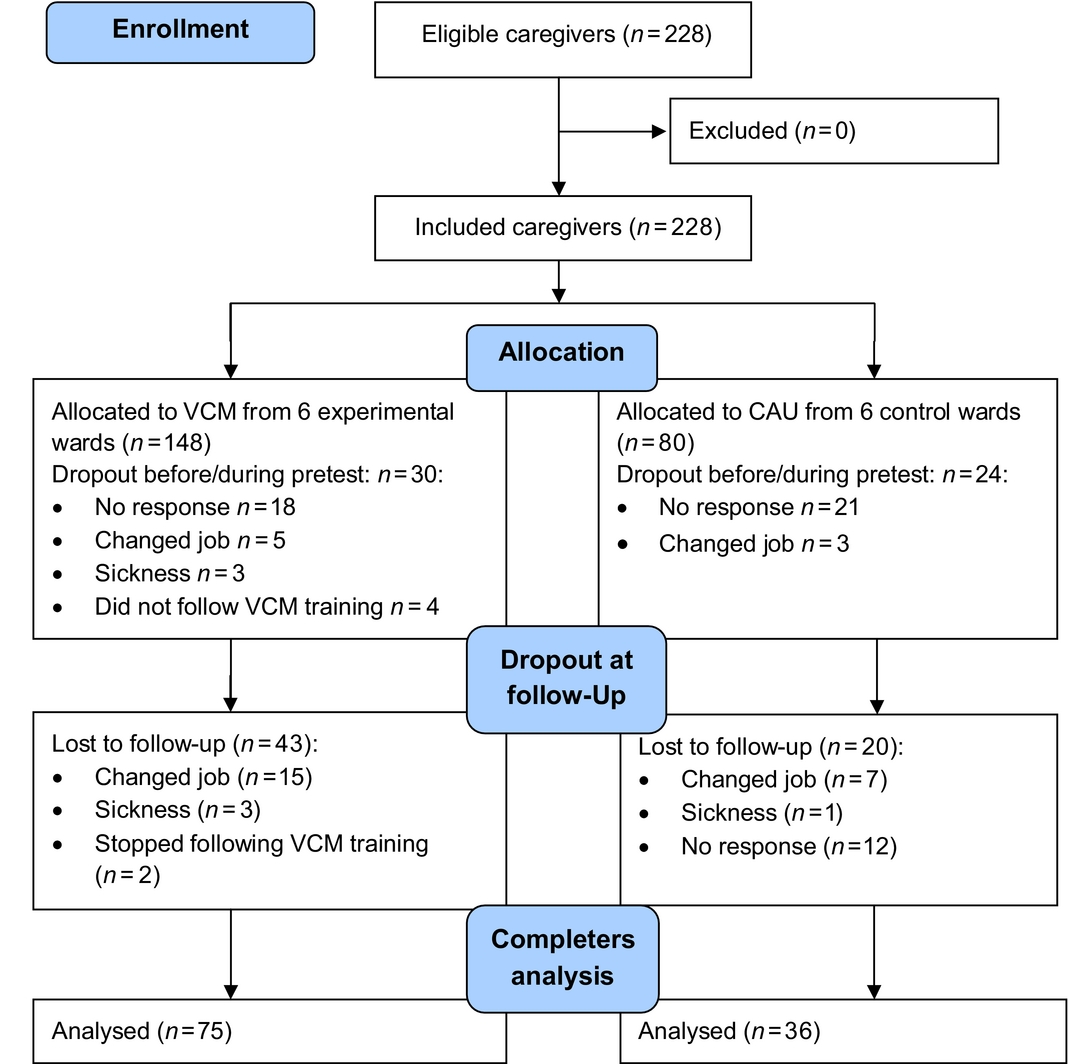
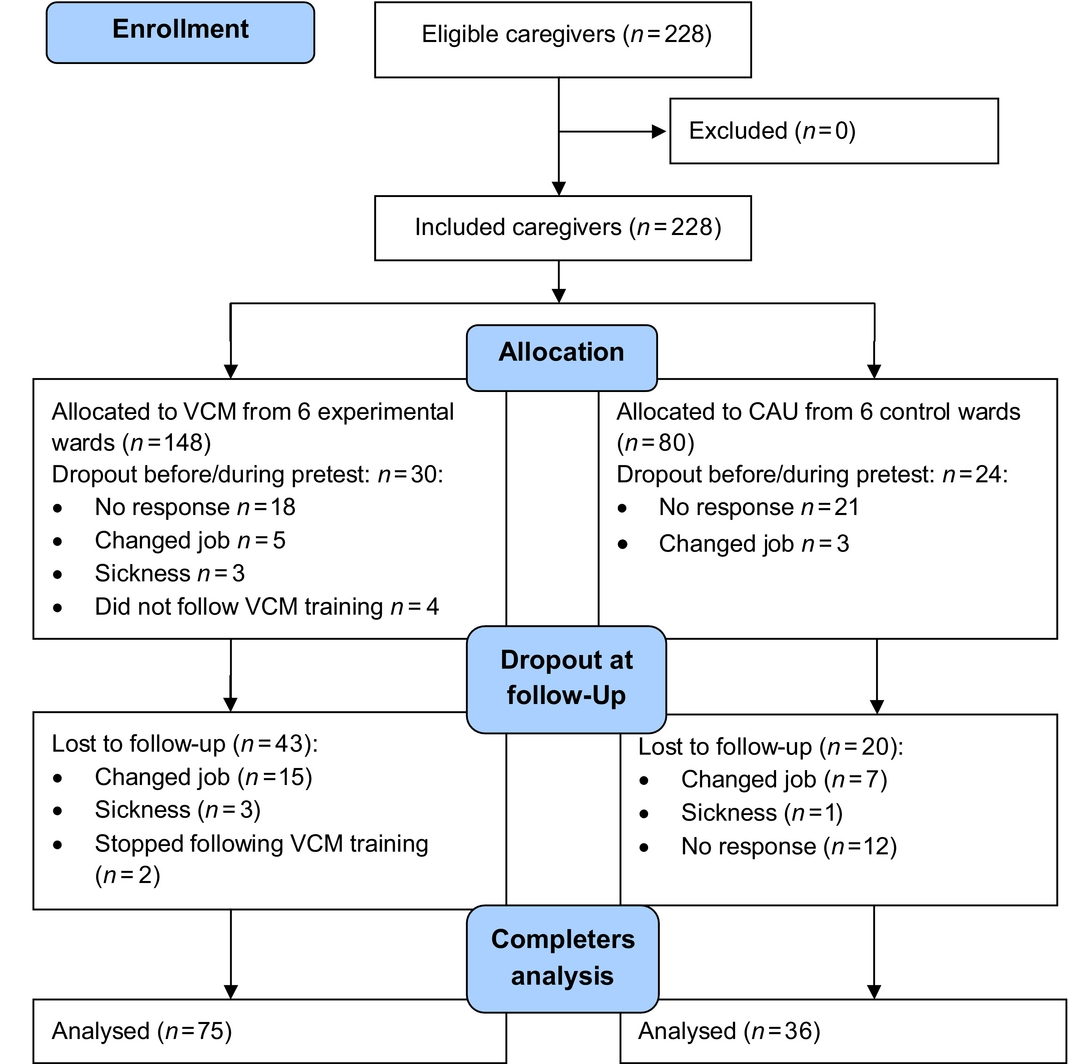
A Consort diagram for the recruitment of the caregivers is shown in Figure 1. Two hundred and twenty-eight caregivers were eligible and included in the study. Of the 148 included caregivers in the experimental group, 118 filled (80%) in the survey at pre-test. Seventy-five of them completed the post-test (51%). In the control group 80 caregivers were included; 56 (70%) caregivers filled in the survey at pre-test, and 36 of them completed the study (45%).
Flow chart caregivers.
Background characteristics
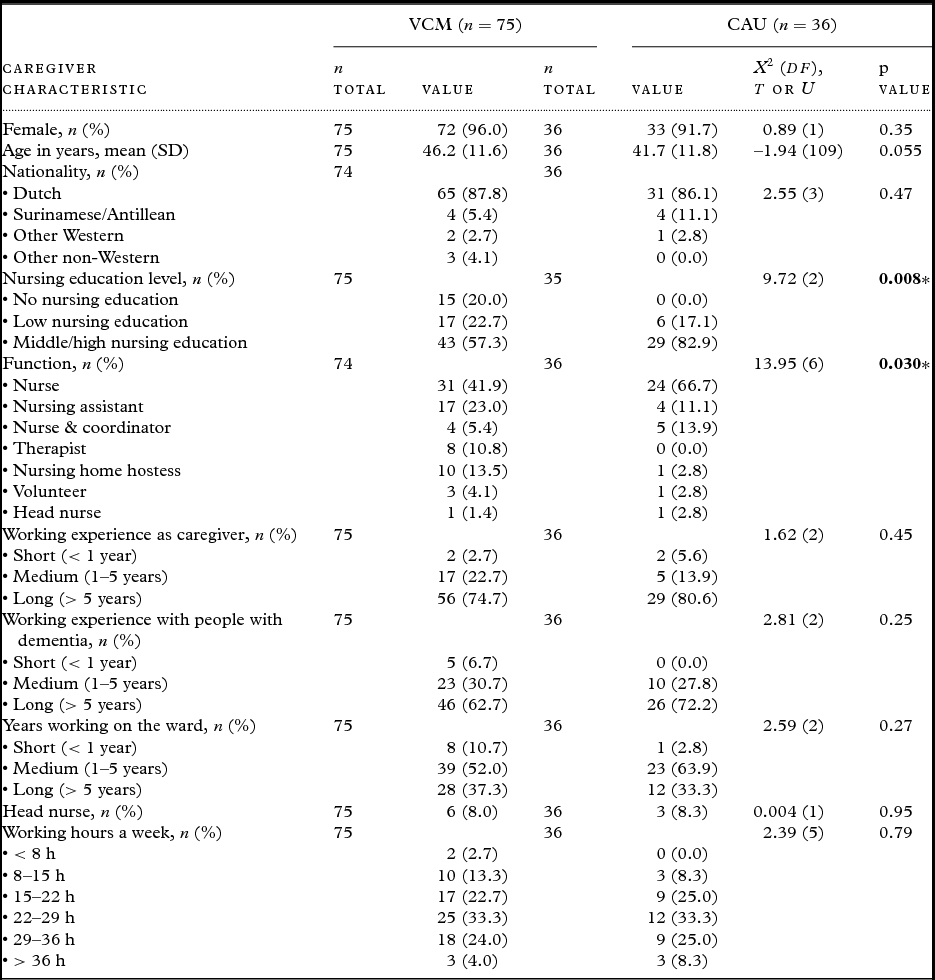
Significant differences were found between caregivers from the experimental group and the control group who completed the study on nursing educational level (p = 0.008) and function (p = 0.030). Caregivers on the control wards were more highly educated and differed in function: more qualified nurses and fewer nursing assistants, more coordinators, fewer therapists, and fewer hostesses (see Table 1). A relation was found at the pre-test between the educational level and scores on the subscales “autonomous decision making” (p = 0.004) and “social support from colleagues” (p = 0.031), making educational level a potential confounder in the effect study. It was therefore included as a covariate in the analyses. Further analyses showed significant differences in function (p = 0.019) between caregivers who completed the study and caregivers who dropped out. The latter group contained significantly more nursing assistants, fewer nurses who combined their function with a function as coordinator and fewer head nurses. Finally, caregivers from the control group who dropped out had significantly more working experience with people with dementia (p = 0.011) and worked on the ward longer (p = 0.021) in comparison with caregivers from the experimental wards who dropped out.
Baseline characteristics of caregivers who completed the study

*Significant on a p = 0.05 level.
Quantitative outcomes
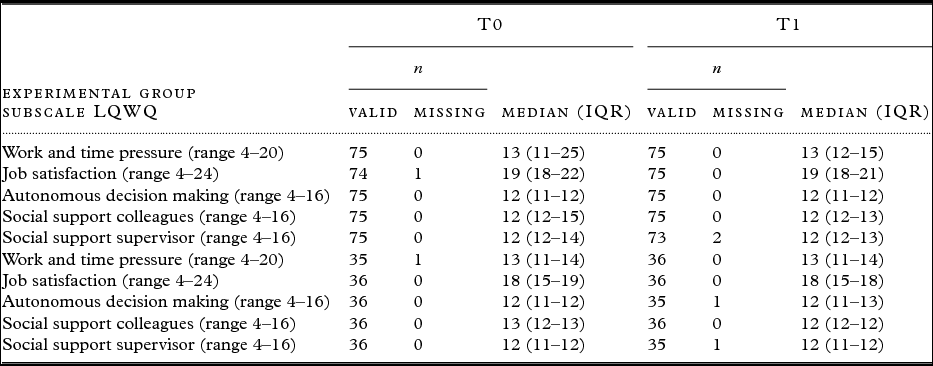
As Table 2 shows, median scores on the subscales were approximately the same in the experimental group and in the control group at both times. Also, the interquartile range was not very large, indicating a low variability.
Median and interquartile range (IQR; 25th–75th percentile) of subscales LQWQ (original dataset)

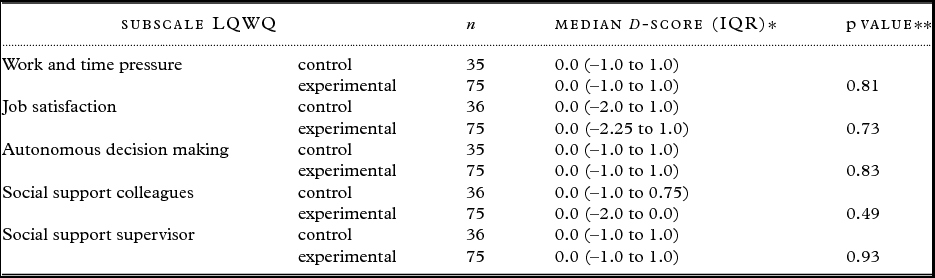
Results of the non-parametric Mann–Whitney U-tests are summarized in Table 3. No significant changes between T0 and T1 were found on the five subscales of the LQWQ between the experimental and the control group. After correcting for the baseline difference in “educational level of the caregivers,” the changes for the subscales “autonomous decision making,” and “social support from colleagues” remained insignificant (p = 0.88 and p = 0.99, respectively).
Median d-score and p values subscales LQWQ (d between T1 and T0)

*Median d-score of the original dataset.
**Mean p value of the five imputation sets without correction for educational level (the p values remained not significant after correction).
Qualitative outcomes
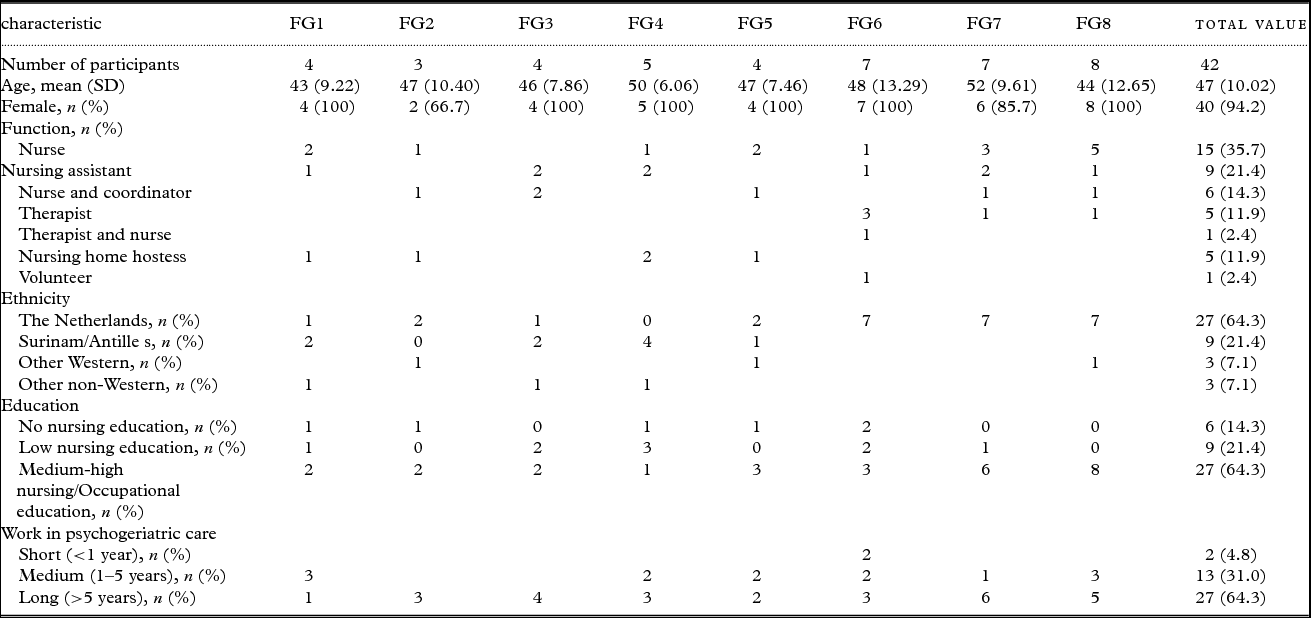
Forty-two caregivers participated in the focus groups. Their average age was 47 years, 40 of them were female and 64% worked in psychogeriatric nursing home care more than five years. Table 4 describes all the characteristics of the caregivers from the focus groups.
Characteristics of the participants of the eight focus groups (n = 42) FG1 = Focus group1, FG2 = Focus group2, etc

At first sight, the qualitative data of the focus groups seemed to support the outcomes of the quantitative data of the LQWQ. A proportion of the caregivers reported that implementation of VCM did not influence their job satisfaction. When talking more about the influence of implementing VCM on their daily caring tasks, some of the caregivers reported several aspects that could be interpreted as indicators of a more positive job satisfaction. In contrast to the caregivers, most interviewed managers immediately mentioned that VCM had a positive influence on the job satisfaction of the caregivers. They reported that with VCM, caregivers could handle difficult behavior of the residents more easily and they also noticed more fun in the interaction between caregivers and residents. Managers concluded that these changes had influenced the job satisfaction of the caregivers. The different aspects reported by caregivers and managers are summarized and clarified in the following three themes:
-
1. Facilitation of the care
Some caregivers reported a positive influence on their care skills when applying VCM. They felt VCM supported them in handling difficult behavior of residents. A nurse and coordinator (Resp 48) explained that taking time for one-to-one contact helped her to handle complex behavior of residents:
Resp: For me . . . uh . . . I think . . . you recognise the compliments residents give without using words. You are accomplishing something. You see the results of your work . . . and you think: ‘Okay, I have a plan in my mind and I will write it down later, but of course there is more to it’. And then suddenly, you get these wonderful surprises you didn't expect, like. . .
Int: No.
Resp: Hey, this is working really well.
Int: Yes. Or see emotion or gratitude.
Resp: Yes, or. . . or that there is physical improvement. Or somebody . . . who cannot improve physically is still content in his situation.
Int: Yes. Nice.
Resp: And. . . yes. Then I think: Yes . . . of course that's what we all want.
Int: Yes.
Resp: And that to me . . . that makes me grow.
Int: Yes.
Resp: Which make it easier to provide care, you know. . . it seems to me, when I look around me. . . Like this morning, a colleague and I talked about this. I said: ‘Gosh, that lady. . .’ One of our residents is really deteriorating physically. . . . Which makes our work a lot more . . .
Int: Yes.
Resp: . . . Indeed, and that . . . this lady has a lot of pain and you have to deal with this as best you can. So it really becomes a matter of, you know, slow down. . . Spend all your time on her, and not think about ‘but I still have five more residents to go’. You know, you have to let that go. And it feels so good if you can do that. Because that is what makes the work enjoyable. I said to my colleague: ‘I really like it so much, taking care of that resident.
Int: Yes.
Resp: Yes, you have. . . you have the time. . .
Int: Yes.
Resp: . . . So, you should also take the time. . . And if you need help, you can ring a colleague.
Int: Yes.
Resp: That's just great. This can make me so happy. But you do have to let go of the rest.
On the other hand, caregivers reported that VCM did not influence their job satisfaction, particularly when it did not help them to deal with difficult behavior of residents, i.e. when residents did not respond positively.
-
2. Cheering up residents
Caregivers and managers reported that VCM helps to cheer up residents, and that working with happy residents is nicer and it is easier to sustain. Two caregivers explained
With VCM I can get a resident in a different mood, which is rewarding. (Resp 32, nursing assistant)
I think VCM does influence my work, if the residents are happier, then the work is just more fun and better, and I can keep going longer. (Resp 21, nurse)
-
3. Team building
Caregivers and managers reported the influence of attending the training together as a team. They noticed that this supported team building, which also may contribute to caregivers’ job satisfaction. Two caregivers articulated this as follows:
We now work together as a team much better, and yes, I think if colleagues get along with each other, collaborate well, this has a positive effect on the residents, and then you enjoy your work more. (Resp 14, nursing assistant)
As a team we came together more. And that certainly affects the job satisfaction. (Resp 46, nurse and coordinator)
A manager explained this in another way
VCM implementation is actually no education, no training, it is the team . . . the team together . . . the caregivers have experienced the implementation of VCM as added value. (Resp 47)
In summary, some caregivers experienced positive influences of using VCM on different aspects of their job, more specifically when they gained new care skills by applying VCM and when they noticed that residents benefitted from VCM, e.g. when it helped them cheer up the residents. Managers mentioned comparable positive influences. Caregivers as well as managers reported that attending the training together as a team had contributed to the team building.
Discussion
This study assessed the influence of using VCM in the communication with people with dementia on the job satisfaction of nursing home caregivers. The quantitative self-report survey showed no significant difference in caregiver's job satisfaction after implementation of VCM. The qualitative results from the focus groups and interviews suggested that implementation of VCM influences some aspects of the daily work of caregivers. Caregivers who experienced benefits from applying VCM mentioned that it helped them to deal with residents who show difficult behavior or depressed mood. Both caregivers and managers reported that the implementation trajectory of VCM had contributed to the team building, which for some had increased the pleasure they find in their work. Below we will discuss the findings in relation to the Veder method as “living-room theatre performance,” in relation to our previously executed process analysis (Boersma et al., Reference Boersma, Van Weert, Van Meijel and Dröes2017a) and in relation to other studies.
The qualitative findings of the present study are in line with the qualitative findings of Van Dijk et al. (Reference Van Dijk, Van Weert and Dröes2011). In their study, the interviewed caregivers reported that execution of the Veder method as “living-room theatre performance” contributed to their job satisfaction. Playing a living-room theatre performance delighted the caregivers as it brought about positive reactions in the residents, which led to a closer contact with the residents. Comparable with the experiences of caregivers who implemented VCM, the caregivers who executed a “living-room theatre performance” experienced improved (inter) personal relations with colleagues. Although not statistically proven on a group level, the qualitative findings suggest that both the Veder method as a “living-room theatre performance” and VCM contain elements that can positively influence the job satisfaction of nursing home caregivers.
The themes “facilitating the care” and “cheering up residents” extracted from the qualitative data are related to the subscale “work and time pressure.” In the process analysis of Boersma et al. (Reference Boersma, Van Weert, Van Meijel and Dröes2017a), caregivers and managers reported that applying VCM was easy and required no extra time. Caregivers managed to integrate the method in their communication with the residents during the execution of daily caring tasks. Thus, VCM may have alleviated the job demands of some of the interviewed nursing home caregivers, resulting in a more positive work experience.
The third theme extracted from the present study, i.e. “team building,” is related mainly to the subscale “social support from colleagues” and was also mentioned in the process analysis (Boersma et al., Reference Boersma, Van Weert, Van Meijel and Dröes2017a). During the training, caregivers shared work-related and personal experiences with each other, which resulted in mutual trust and subsequently to better collaboration. In the same process analysis, caregivers reported that VCM provided a method that supported them to discuss difficult behavior of residents with colleagues. In this respect one could assume that VCM increased caregivers’ skills, and consequently also autonomy in the collaboration with colleagues of other disciplines. The influence of VCM in relation to social support from supervisors was not mentioned either in the process analysis (Boersma et al., Reference Boersma, Van Weert, Van Meijel and Dröes2017a) or in the present study.
Although some caregivers and managers reported that VCM influenced the job satisfaction positively, we did not find this on the subscale job satisfaction. Looking at the data in more detail, we see that caregivers already scored high on this subscale at T0 (i.e. the median score in the experimental group at T0 was 19 – range 4 to 24; in the control group this was 18), which leaves little room for improvement. Possibly the caregivers in the nursing homes were already highly motivated and satisfied about their job. Brodaty et al. (Reference Brodaty, Draper and Low2003) described in their study, in which 253 nursing home caregivers were included, that 91% were content with their job. They also found that troublesome residential behavior was not the most important factor on nursing staff burden. Other factors, such as the ability to accept residents’ behavior, leaderships styles, age of the caregiver, working experience, opportunities to discuss the psychological stress about their work were more important in experiencing strain.
Although in the focus groups and the interviews both caregivers and managers reported influences of VCM related to aspects of job satisfaction as measured with the LQWQ, i.e. job satisfaction in general, work and time pressure, social support from colleagues and indirectly also autonomous decision making, no statistically significant changes on the LQWQ could be demonstrated on a group level. Although it is possible VCM does not affect job satisfaction, another possibility is that the LQWQ is simply not sufficiently sensitive to assess the type of changes in job satisfaction associated with applying person-centered care. In the literature, we found two reviews focusing on the relation between person-centered care and job satisfaction in nursing homes (Van den Pol-Grevelink et al., Reference Van den Pol-Grevelink, Jukema and Smits2012; Barbosa et al., Reference Barbosa, Sousa, Nolan and Figueiredo2014). Three studies in the review of Van den Pol-Grevelink et al. (Reference Van den Pol-Grevelink, Jukema and Smits2012) used subscales of the LQWQ (Berkhout et al., Reference Berkhout, Boumans, Van Breukelen, Abu-Saad and Nijhuis2004; Boumans et al., Reference Boumans, Berkhout, Vijgen, Nijhuis and Vasse2008; Te Boekhorst et al., Reference Te Boekhorst, Willemse, Depla, Eefsting and Pot2008). Other studies, in both reviews, used other self-report instruments for measuring job satisfaction: The Maastricht Work Satisfaction Scale for Healthcare and indicators adapted from Montgomery (Reference Montgomery1993). In the review of Barbosa et al. (Reference Barbosa, Sousa, Nolan and Figueiredo2014), stress (as an outcome of demands) was measured with the General Health Questionnaire and the Hassles subscale of the Nurses Hassles and Uplifts scale. Based on these reviews two aspects are worth mentioning. First, the used scales cover different concepts as indicators of job satisfaction. Second, both sub) reviews reported mixed results on (scales of these instruments, suggesting that person-centered care methods do not influence all aspects of the job satisfaction of caregivers working with people with dementia in nursing homes. None of the included studies in psychogeriatric care found significant differences on the subscales autonomous decision making and social support from the supervisor with the LQWQ. However, Te Boekhorst et al. (Reference Te Boekhorst, Willemse, Depla, Eefsting and Pot2008) and Berkhout et al. (Reference Berkhout, Boumans, Van Breukelen, Abu-Saad and Nijhuis2004) found significant differences for the subscales work and time pressure (job demands) and social support from colleagues. Te Boekhorst et al. (Reference Te Boekhorst, Willemse, Depla, Eefsting and Pot2008) also found significant differences for the subscales autonomous decision making and job satisfaction. Boumans et al. (Reference Boumans, Berkhout, Vijgen, Nijhuis and Vasse2008) found no significant difference for any of the subscales of the LQWQ used in psychogeriatric care. Although the interventions in the three mentioned studies were all classified as person-centered care, one might question whether they are comparable. The intervention involved in Te Boekhorst et al. (Reference Te Boekhorst, Willemse, Depla, Eefsting and Pot2008) concerned care in small-scale living arrangements, in Berkhout et al. (Reference Berkhout, Boumans, Van Breukelen, Abu-Saad and Nijhuis2004) resident-oriented care and in Boumans et al. (Reference Boumans, Berkhout, Vijgen, Nijhuis and Vasse2008) demand-oriented care. We believe the intervention VCM in the present study is most comparable with resident-oriented and demand-oriented care. The studies using the LQWQ and the studies in both reviews using other instruments for measuring job satisfaction and stress also reported mixed results. Summarizing, with these instruments it appears difficult to find convincing evidence of person-centered care influencing the job satisfaction of caregivers.
Recently, two other studies in dementia care used the LQWQ to measure job satisfaction. Willemse et al. (Reference Willemse, De Jonge, Smit, Visser, Depla and Pot2014) investigated the staff's person-centeredness in relation to job characteristics and job-related well-being, and found a significant difference on the subscale social support from colleagues. They concluded that social support from colleagues was an important factor for job satisfaction, especially for caregivers who have a less person-centered attitude. In another study, Willemse et al. (Reference Willemse, De Jonge, Smit, Dasselaar, Depla and Pot2016) investigated the relation between an unhealthy work environment and the prescription of psychotropic drugs and physical restraints. In this study, 993 nursing home caregivers filled in the LQWQ and minimal significant differences on the LQWQ were found (p = 0.049 for the subscale social support from colleagues). In our study (Boersma et al., in press) caregivers already scored high on person-centeredness at the start of the implementation of VCM, which may explain why we found no improvement on the subscale social support from colleagues.
In conclusion, the LQWQ seems sensitive enough to measure some changes after implementation of person-centered care methods, but the results are minimal and mixed and therefore make proper interpretation difficult. It is not unique that we found no significant results in our study with the LQWQ. These findings are in line with the review of Bakker et al. (Reference Bakker, Demerouti and Sanz-Vergel2014), who concluded that our knowledge of the concepts underlying job satisfaction is still limited. The relation between job demands (i.e. work and time pressure) and job resources (i.e. social support and being in control), work engagement, motivation and burnout and how these concepts are associated with or influence the job satisfaction of nursing home caregivers, is unclear. Also, Bakker et al. (Reference Bakker, Demerouti and Sanz-Vergel2014) described that personal resources (i.e. positive self-evaluations referring to a persons’ sense of ability to successfully control and impact his or her environment) influence job resources, and to make it even more complicated, they state that daily fluctuations in burnout and work engagement cause daily fluctuations in job satisfaction. Because of this complexity of the concept of job satisfaction, and because the wards were not randomized, the results should be interpreted with caution. Although the sample in the present study consisted of caregivers working in nursing homes spread across different regions in the Netherlands, and caregivers who vary in age, education, working experience, and ethnicity, the results cannot be generalized. As described before, the present study is part of a larger implementation study (Boersma et al., Reference Boersma, Van Weert, Van Meijel, Van de Ven and Dröes2017b). In the context of this implementation study, a process analysis was executed (Boersma et al., Reference Boersma, Van Weert, Van Meijel and Dröes2017a), which showed a variety of facilitators and barriers that need to be acknowledged before a nursing home can think about implementing VCM in daily care. We subsequently investigated the impact of the implementation on the behavior of the caregivers and the behavior, mood, and quality of life of the people with dementia was investigated through observations. This study showed that implementation of VCM positively affected the behavior of nursing home caregivers (i.e. they were able to apply VCM during their daily caring tasks and they showed more positive communicative behavior). The implementation of VCM also affected social behavior (e.g. speech and relation with environment) and quality of life (i.e. positive affect and social relations) of the people with dementia. Altogether, the influences of VCM on job satisfaction are minimal, but considering the whole study we think the results are worthwhile.
Limitations
Some limitations need to be mentioned. First, the use of a self-report questionnaire. Although the LQWQ-questionnaire has been successfully used before in nursing home care (Berkhout et al., Reference Berkhout, Boumans, Van Breukelen, Abu-Saad and Nijhuis2004; Te Boekhorst et al., Reference Te Boekhorst, Willemse, Depla, Eefsting and Pot2008; Willemse et al., Reference Willemse, De Jonge, Smit, Visser, Depla and Pot2014; Reference Willemse, De Jonge, Smit, Dasselaar, Depla and Pot2016), the use of a self-report questionnaire in this study also involved some risks. With a self-report questionnaire, we rely on the honesty of the caregivers. As job satisfaction is influenced by individual characteristics and even by the variance in daily measurements, a self-report questionnaire measured at two moments (T0 and T1) may not be the preferred instrument. Bakker et al. (Reference Bakker, Demerouti and Sanz-Vergel2014), therefore, suggested using diaries in research or the experience sampling method (ESM; Dimotakis et al., Reference Dimotakis, Ilies, Bakker, Daniels, Bakker and Daniels2013). In ESM participants answer multiple questions during several days, which provides insight into job demands and work engagement during the different daily tasks of caregivers. Furthermore, there is always the risk of response bias, caregivers who tend to answer questions in a certain way, regardless of the actual meaning of the question, e.g. caregivers who respond with socially desirable answers. Response bias is a potential danger to the validity of the study. Although some questions are “reversed” in the LQWQ-questionnaire to prevent this bias, it is still an issue in self-report questionnaires. The descriptive analysis of the data showed that the median score of all items (after recoding) of the LQWQ was three, which means caregivers agree with the statements. This is in line with the findings of Brodaty et al. (Reference Brodaty, Draper and Low2003), who reported that nursing home caregivers are quite satisfied with their job. We assume caregivers do not easily give an extremely positive answer, as there are always aspects of the work they are less satisfied with. We also used qualitative methods to get more profound information in addition to the results from the quantitative study. Although the combination of both methods provided us with more insight into how applying VCM may relate to job satisfaction, many questions also remain unanswered. We agree with Bakker et al. (Reference Bakker, Demerouti and Sanz-Vergel2014) that future studies should also look for possibilities to observe “behavior,” specifically related to job satisfaction. However, although these relation between behavior and job satisfaction is not yet clearly understood, there are indications from other research that burnout may result in more aggressive behavior (Rafii et al., Reference Rafii, Oskouie and Nikravesh2004) and that work engagement could increase proactive behavior (Sonnentag, Reference Sonnentag2003).
A second limitation is the sample size. In contrast to the study design, six instead of eight experimental wards were enrolled due to the higher numbers of eligible residents expected on these wards (Boersma et al., in press). As a consequence fewer caregivers could be recruited, and some also dropped out during the study. This resulted in the sample size of the present study being relatively small. Based on the power calculation, we needed 64 caregivers in both groups, which were not achieved for the control group. Therefore, the study was somewhat underpowered. Apart from leave, sickness, or quitting the training, the most important reason for dropping out of the study was that caregivers neglected to fill in the questionnaires. Despite the many reminders in person by the researcher or via the manager, these caregivers could not be persuaded. In the experimental group 49% dropped out, and in the control group 55% dropped out of the study. A significant difference for function was found between caregivers who completed the study and those who dropped out. More nursing assistants were found in the dropout group, while nurses who combined their function with a function as a coordinator and head nurses more often completed the study. The duration of the study might probably explain this difference. Some of the caregivers who changed jobs (n = 22) were nursing assistants and busy with their vocational education. Part of this education is that they regularly change wards. Obviously this had little to do with not being satisfied with their job. The fact is that more experienced caregivers completed the study, which may have biased the outcomes, although the median scores in Table 2 do not give the impression that a more equally spread educational level and working experience would have led to significant effects.
The third limitation concerns missing data. In our data set there was a relatively high percentage of missing data. In the experimental group at most 9.3% data was missing at post-test, and for the control group at pre-test and post-test at most 8.3% data was missing. The underlying reason for this could not be traced, but since the complete cases analysis differ only on function from the caregivers with missing items, we assumed they were MAR. We, therefore, used multiple imputation to deal with the missing data (Eekhout et al., Reference Eekhout, De Vet, Twisk, Brand, De Boer and Heymans2014).
The quasi-experimental study design is the fourth limitation to mention. The non-randomized wards are a threat to the external validity. The fact that Foundation Theatre Veder selected the experimental wards and the nursing home management selected the control wards may have led to systematic differences between the experimental and control groups at the beginning of the study, although the characteristics of the wards were comparable (see Appendix A).
A fifth limitation consists of the roles of the first researcher and the team managers. The first author and researcher (PB) collected all qualitative data and at the same time executed the quantitative part of the study. We think we limited the risk of confirmation bias by having the qualitative data independently coded by two researchers (PB and JvW). The statistical analyses were also executed by two researchers (PB and BW). JvW and BW both did not participate in the data collection.
The team managers selected the participating caregivers for the focus groups based on purposive sampling with clear criteria (see, Methods, qualitative data/focus groups). As described in Table 4, the participating caregivers in the focus groups differed in age, function, ethnicity, education, and experience working in psychogeriatric care. So team managers have apparently not selected only, for example, highly educated caregivers or caregivers with more working experience.
The last limitation we want to describe is the possibility of contamination between the experimental and control wards and the “Hawthorne effect.” In one of the four nursing homes there was incidental exchange of staff between the experimental and control ward. Although contamination cannot be completely ruled out, we assume that this concerned only a small number of the total group of caregivers. Also, the influence of the “Hawthorne effect,” i.e. that caregivers of the control wards changed their opinion about job satisfaction merely due to the fact that they were involved in the research and received attention for their professional activities (Polit, Reference Polit2003), is assumed to be small, as the median score of the subscales of the experimental group and the control group at T0 and T1 were more or less the same.
Conclusions and recommendations
The quantitative outcomes of our study indicate that working with the person-centered method VCM does not positively influence the job satisfaction of the caregivers. However, results from the qualitative data suggest that working with VCM does have some positive influences on the daily working tasks of nursing home caregivers. These possible positive influences do not seem to automatically influence the job satisfaction of caregivers as measured in this study. Further qualitative and quantitative research is recommended to gain insight into the relationship between the experience of providing person-centered care and different aspects of job satisfaction of caregivers of people with dementia.
Conflicts of interest
None.
Description of authors’ roles
PB, JvW, BvM, and RMD contributed to the study design. PB collected the data. PB and JvW coded the transcripts. BW supervised the statistical analyses. All authors discussed the results. PB wrote the initial draft of the paper. All authors critically reviewed the paper.
Acknowledgments
This study was conducted in cooperation with 12 participating nursing home wards of four nursing homes and Foundation Theatre Veder, who executed the implementation of VCM in the four nursing homes. The authors are very grateful to the participating caregivers and managers working in the nursing homes. This study was realized with grants from Inholland University of Applied Sciences, Fonds NutsOhra, and Health agency VGZ. The funders were not involved in the design, execution, or writing phase of the study.
Ethical approval
The Medical Ethics Committee and the Science Committee of the VU University Medical Centre Amsterdam approved the study protocol with number 2009/142 (Dutch Trial Registration NTR4248).
Supplementary material
To view supplementary material for this article, please visit https://doi.org/10.1017/S1041610217001582