Introduction
It is common practice to prescribe diuretics at discharge following paediatric cardiac surgery. This is based on scant evidence from historical retrospective studies that describe cases of pleural effusion developing due to fluid accumulation in the post-operative period. Reference Talwar, Agarwala and Mittal1 More recent studies have cast doubt on the necessity of routine diuretic prescriptions after discharge. Bosci et al. reported 39% of patients developed a pleural effusion, though this was while in the hospital, and the cohort dated to 2002. Reference Bocsi, Hambsch and Osmancik2 In this study, a post-operative, in-patient, diuretic regimen was not described. A second study from 1997 by Vaynblat et al. described pleural drainage in children undergoing tetralogy of Fallot repair with a median age of 9.4 years. Reference Vaynblat, Chiavarelli and Anderson3 They found that higher post-operative right atrial pressures were associated with increased pleural drainage from chest tubes. This study highlights that certain repairs in patients with expected right-sided diastolic dysfunction or those with single ventricles may be at higher risk for pleural effusions than those after routine repairs.
Based on this limited historical evidence and the rarity of pleural effusions in our own practice, we investigated the need for routine diuretics after discharge. We previously conducted a prospective, single-armed, non-blinded study conducted at our institution where no outpatient diuretics were prescribed for standard risk and five days of diuretics for those deemed “high risk.” Reference Penk, Baptista de Faria and Collins4 This study was halted after 61 patients due to four readmissions for pericardial effusions which was higher than a historical baseline (2.9% versus 0.2%, p = 0.003). No patients were readmitted for pleural effusions.
Furosemide may suppress the incidence of symptomatic pericardial effusion, though it likely does not target the inflammatory nature of post-pericardiotomy syndrome. Non-steroidal anti-inflammatory drugs have been shown to treat post-pericardiotomy syndrome. Reference Horneffer, Miller and Pearson5 A recent quality improvement project by Trivedi et al. that similarly reduced outpatient furosemide after surgery did not find an increase in pericardial effusion. Reference Trivedi, Diaz-Castrillon and Morell6 That centre had implemented targeted ibuprofen to prevent pericardial effusion just prior to their intervention.
We used results from the prospective trial at our centre Reference Penk, Baptista de Faria and Collins4 and from the quality improvement project by Trivedi (5) to design an optimised medication regimen for paediatric cardiac surgery patients at discharge. We combined the limited approach with furosemide used in our prospective trial and adopted the criteria for non-steroidal inflammatory drugs described in Trivedi’s project. We initiated a quality improvement project to prospectively monitor for readmissions after this became the standard discharge regimen at our institution. In this report, we examine outcomes since instituting this medication regimen.
Materials and methods
Design
This is a single-centre description of a quality improvement initiative following implementation of the discharge medication regimen. The regimen aimed to limit the duration of discharge medications while also preventing readmissions. The team prospectively monitored for readmissions for pericardial and pleural effusions. Monitoring was via communication with the in-patient admitting team of physicians and the surgical follow-up clinic. After two years of monitoring for readmissions, the team retrospectively collected data to evaluate the type of patients treated and the degree of compliance with the prescribed regimen. Further changes to the regimen were anticipated if readmission rates increased; however, readmissions were rare. The rarity of the outcome is also why continual prospective data collection was not deemed necessary. We describe the patient characteristics, the medication regimens prescribed, and outcomes regarding readmission for pericardial or pleural effusion in this cohort. To further evaluate pericardial effusion rates using this medication regimen, we compare the incidence of pericardial effusion rates with this new medication regimen with targeted ibuprofen to the rates in the prior prospective study where only furosemide was used in a limited fashion.
Patient population
Paediatric patients aged 3 months to 18 years undergoing cardiac surgery were included. Exclusion criteria included (1) significant residual lesions requiring diuretics (greater than mild systolic dysfunction, greater than mild residual shunting lesions such as ventricular septal defect, greater than mild mitral or aortic valve regurgitation, lung disease requiring diuretics and systemic hypertension requiring diuretics), (2) chylous effusions post-operatively, (3) status post-heart transplant, (4) surgery resulting in single-ventricle physiology, and (5) admission for over two weeks as their expected diuretic regimen would already be very limited. Eligible patients were screened from the surgical database. The new outpatient medication regimen was implemented on 10/15/2021, and consecutive patients were then screened for eligibility through 10/15/2023.
Data collection
Demographic, surgical, in-patient, echocardiogram, and radiologic reports and out-patient follow-up data were recorded from the Electronic Medical Record.
Medication regimen
The medication regimen prescribed upon discharge included criteria for furosemide and criteria for ibuprofen (see Figure 1 for discharge regimen decision-making). Patients with no risk factors were discharged without furosemide and with ibuprofen only “as needed” for pain control. Patients at “high risk” for pleural effusion were prescribed furosemide 1 mg/kg/dose (maximum 20 mg) twice per day for five days. “High risk” for pleural effusion criteria were those established in the prior prospective study. These criteria included:
Flowchart for assignment of medication regimen based on risk assessment. ASD = atrial septal defect.

-
1. Chest tube drainage >4 ml/kg/day in the 24 hours prior to removal and removed on the day of discharge.
-
2. Patient >10% fluid overloaded on day of discharge based on discharge weight/pre-operative weight.
-
3. Pleural effusion evident on discharge chest radiograph or echocardiogram (>trace on echocardiogram) or re-development of pleural effusion while in-patient after chest tube removal.
-
4. Greater than trace pericardial effusion on discharge echocardiogram.
-
5. Post-tetralogy of Fallot repair with a transannular patch (due to presumed increased central venous pressure from elevated right ventricular end-diastolic pressure)
-
6. Status post-atrioventricular canal repair based on the opinion of the chief surgeon.
Patients deemed at risk for pericardial effusion were prescribed ibuprofen (10 mg/kg/dose) three times per day for two weeks (with meals) and furosemide twice per day for five days. No medications for gastric prophylaxis were recommended. Patients were thought to be at risk for pericardial effusions if they had undergone atrial septal defect repair, had a rub on admission to the cardiac ICU, or had diffuse ST segment elevation (>2 mm) on electrocardiogram at any point during their hospitalisation. Due to concern for prolonged ibuprofen use in children aged 3–6 months, a mixed approach of five days of ibuprofen and two weeks of furosemide twice per day was used for patients in this age group at risk for pericardial effusion. A review of paediatric studies found that short courses of ibuprofen are safe for children 3–6 months of age. Reference Ziesenitz, Zutter, Erb and van der anker7
We anticipated that providers would not always be perfectly compliant, and some patients would be prescribed longer courses of diuretics. We did not assess families’ compliance with medication once they were home. Therefore, in any case where prolonged diuretics were still prescribed, we reviewed in-patient progress notes, echocardiograms, and chest X-rays to evaluate decision-making. After collecting data on all patients who met inclusion/exclusion criteria, we decided to only include patients who were prescribed <20 days of diuretics in the primary analysis, as this is similar to the intended regimen and we believed it still constituted a limited outpatient medication regimen when compared to the historical practice prior to the prospective study of prescribing diuretics for >30 days. A secondary analysis was performed to compare the characteristics of patients who received this limited regimen of <20 days and those who received ≥20 days of medication. This secondary analysis was done to evaluate if there was systematic bias by providers in deviation from the medication regimen.
A secondary comparison of incidence of pericardial effusion was performed with the prospective trial previously completed at our institution. Reference Penk, Baptista de Faria and Collins4 That trial was prospective but otherwise used the same inclusion/exclusion criteria and exact same diuretic regimen. The only difference with the new regimen described in this project is the addition of ibuprofen.
Statistical analysis
Continuous variables are presented as median and interquartile range, while descriptive variables are presented as absolute counts and percentages. Continuous variables were compared using a Mann–Whitney-U test and descriptive variables using Fisher’s exact test. Analyses were all run in a local Jupyter Python environment. A p-value of less than 0.05 was considered statistically significant.
Results
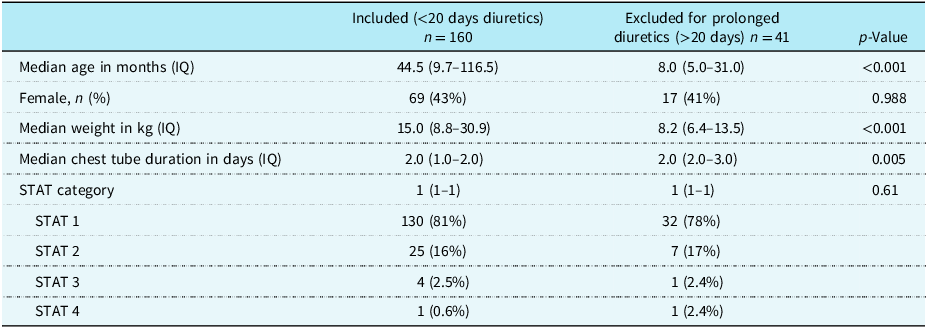
A total of 575 patients were identified, of which 374 met inclusion criteria for age. Of those, 173 were excluded for listed criteria. There were 201 patients who met inclusion/exclusion criteria. Of these, 41 (20.4%) were prescribed ≥20 days of diuretics. There were no readmissions for pericardial or pleural effusions in this group. There were 160 patients who used <20 days of diuretics. The median age of these patients was 44.5 months (Interquartile range (IQR) 9.7–116.5). Demographic and other characteristics are reported in Table 1.
Patient demographics and clinical characteristics

Table 1. Long description
The table compares patient demographics and clinical characteristics based on the duration of diuretic use, specifically less than 20 days and 20 or more days. It has 8 rows and 4 columns. The columns are labeled ‘Included (<20 days diuretics)’, ‘Excluded for prolonged diuretics (>20 days)’, and ‘p-Value’. The rows are labeled with different characteristics: Median age in months (IQR), Female (n %), Median weight in kg (IQR), Median chest tube duration in days (IQR), and STAT category. Row 1: Median age in months (IQR), Included (<20 days diuretics), 44.5 (9.7–116.5), Excluded for prolonged diuretics (>20 days), 8.0 (5.0–31.0), p-Value, <0.001. Row 2: Female (n %), Included (<20 days diuretics), 69 (43 percent), Excluded for prolonged diuretics (>20 days), 17 (41 percent), p-Value, 0.988. Row 3: Median weight in kg (IQR), Included (<20 days diuretics), 15.0 (8.8–30.9), Excluded for prolonged diuretics (>20 days), 8.2 (6.4–13.5), p-Value, <0.001. Row 4: Median chest tube duration in days (IQR), Included (<20 days diuretics), 2.0 (1.0–2.0), Excluded for prolonged diuretics (>20 days), 2.0 (2.0–3.0), p-Value, 0.005. Row 5: STAT category, Included (<20 days diuretics), Excluded for prolonged diuretics (>20 days), p-Value. Row 6: STAT 1, Included (<20 days diuretics), 1 (1 percent), Excluded for prolonged diuretics (>20 days), 1 (1 percent), p-Value, 0.61. Row 7: STAT 2, Included (<20 days diuretics), 130 (81 percent), Excluded for prolonged diuretics (>20 days), 32 (78 percent), p-Value, 0.61. Row 8: STAT 3, Included (<20 days diuretics), 25 (16 percent), Excluded for prolonged diuretics (>20 days), 7 (17 percent), p-Value, 0.61. Row 9: STAT 4, Included (<20 days diuretics), 1 (0.6 percent), Excluded for prolonged diuretics (>20 days), 1 (2.4 percent), p-Value, 0.61. The table shows significant differences in median age, median weight, and median chest tube duration between the two groups, with p-values less than 0.001 and 0.005 respectively. The STAT category distribution is relatively similar between the two groups.
The median days of diuretics for the 160 patients treated with a limited diuretic regimen was 5 (IQR 0–7). The breakdown of treatment duration was 61 (30.3%) went home on no furosemide, 74 (36.8%) went home on 5 days of furosemide, and 17 (8.5%) and 8 (4.0%) went home on 6–10 or 11–20 days of furosemide, respectively. This results in a compliance rate of 79.6% for <20 days and 77.6% if <10 days is used as a cut-off point. Reasons for longer duration of diuretics in these patients included “small pleural effusions” and “depressed function.”
There were 53 (33.1%) of these patients who were “high risk” for pericardial effusion, and all received prescriptions for ibuprofen. In all cases, the reason for prescribing ibuprofen was correctly identified and aligned with the intended medication regimen. No patients were readmitted for kidney injury or bleeding.
There were 2/160 (1.3%) patients readmitted for pericardial effusion. The first was 8.7 years old and had been prescribed ibuprofen after repair of sub-valvar and valvar aortic stenosis, though parents reported that it was not given. That patient was admitted 14 days after discharge at a point when ibuprofen should still have been administered. The patient was treated with a pericardial drain. The second patient was 4 years old after ventricular septal defect repair. She was admitted 14 days after discharge for pericardial and pleural chylous effusions. The patient had been discharged on ibuprofen for 2 weeks and furosemide for 5 days. The patient was treated with pericardial and pleural drains.
There was one readmission for pleural effusion in a 4-month-old 4 days after discharge after transannular repair of tetralogy of Fallot. The discharge echocardiogram showed severe pulmonary regurgitation. This patient was still taking furosemide two times per day and ibuprofen as prescribed by the regimen.
Comparison to previous prospective trial
There were 61 subjects in the previous prospective trial using the same inclusion/exclusion criteria, and we compare the outcomes for those trial patients with the 160 patients who received <20 days of diuretics with the regimen of furosemide and ibuprofen described in this report. In the prospective trial, 4/61 (6.6%) were readmitted for pericardial effusion compared to 2/160 (1.3%) since the addition of targeted ibuprofen to the regimen (p = 0.04).
Secondary comparison to patients who did NOT receive a limited diuretic regimen
A secondary analysis was performed to compare the characteristics of patients who deviated from the regimen and received >20 days of diuretics (n = 41) and those we included in the limited diuretics cohort (≤20 days) (Table 1). Reasons for extending diuretics were given for 16/41 patients, and the most common were pleural effusion at discharge and “hazy xray.” Patients who received >20 days of diuretics were younger, weighed less, and had chest tubes in place longer during the initial hospitalisation. There was no difference in surgical complexity between the two groups. Despite the younger age of those receiving longer courses of diuretics, there were still 43 patients under 1 year of age who received the limited (<20 days) diuretic regimen.
Discussion
We implemented a discharge medication regimen of limited or no furosemide with the addition of targeted ibuprofen and found this was effective at preventing readmission for pericardial and pleural effusions. The only readmission for pleural effusion would not have been prevented by a longer duration of furosemide as the child was taking furosemide when readmitted shortly after discharge. The incidence of pericardial effusion was lower with this regimen that added targeted ibuprofen compared to our prior trial that used furosemide alone. Reference Penk, Baptista de Faria and Collins4
There were two readmissions for pericardial effusion in this cohort which is an incidence of 1.3%. This is an expected complication after paediatric cardiac surgery. Elias et al. performed an analysis of 142,633 paediatric cardiac surgical patients for readmission for pericardial effusion through the Pediatric Health Information System database. Reference Elias, Glatz and O’Connor8 They found a 1.1% incidence of readmission, similar to our results. Our prior prospective study with furosemide alone had a 6.6% incidence, though this was in a small sample of 61 patients. It was enough to halt that prior study with the presumption that furosemide was suppressing the rate of readmission for pericardial effusion. The decrease in incidence to 1.3% with the addition of ibuprofen suggests that targeted ibuprofen could be as effective as historically longer courses of furosemide. The benefit is that only 33.1% of our patients had to take ibuprofen for a duration of only 2 weeks.
Trivedi et al. published the most comparable data to ours with a quality improvement project that reduced outpatient furosemide prescriptions from 32 to 14 days with no increase in pleural effusions. Reference Trivedi, Diaz-Castrillon and Morell6 The study description includes that this centre started using targeted non-steroidal anti-inflammatory drugs prescribed for one month after discharge in patients with risk factors for pericarditis just prior to implementing their reduced furosemide regimen. The incidence of pericardial effusion significantly decreased (p = 0.03) in the post-implementation cohort of patients using non-steroidal anti-inflammatory drugs, similar to our findings.
The quality improvement project by Trivedi, our previous prospective study, and this analysis yield very similar results across two centres. All three projects support the hypothesis that readmissions for pleural effusions do not increase when outpatient furosemide use is decreased. The three projects’ findings are consistent in that the addition of targeted ibuprofen reduces the incidence of pericardial effusion. Both projects show extremely rare readmissions with a reduction in the duration of medication. It seems likely that future efforts could use quality improvement processes to reduce the duration and frequency of these medications further. In the Trivedi project, they had used one month of non-steroidal anti-inflammatory drugs, whereas we used two weeks; both had very rare readmissions. Perhaps this dose could be decreased to twice per day or even shorter duration? Similarly, given that there were no preventable readmissions for pleural effusions over so many patients, it would be reasonable to eliminate the non-compliant longer courses of diuretics and possibly reduce further the types of patients considered “high risk” who received five days of diuretics. In this process, we may find that there are some patients who may benefit from targeted diuretics. We would hypothesise that the group most likely to actually require diuretics are those with systemic venous hypertension limiting lymphatic clearance of fluid from the lungs.
The primary limitation to this analysis is that 41 patients, or 20% of those who met inclusion/exclusion criteria, received prolonged diuretics. This is not unexpected as practice changes are implemented and actually is a reasonable rate of success for a quality improvement initiative. In most cases, reasons for deviation from the regimen were not given, suggesting lack of compliance. The patients who received prolonged diuretics were younger, and we suspect that providers could be more concerned about adopting this new regimen in younger patients. However, there could also have been clinical factors more common in young patients that providers were treating. When documenting reasons for deviations, the presence of pleural effusions was the most common, and this finding may have been more prevalent in the young. There remains the possibility that some of those patients were treated differently because of perceived clinical risk. Younger patients, or those with some evidence of pleural effusion, may be more at risk if strictly treated with limited diuretics without any consideration of clinical factors.
Despite what providers may have perceived as an increased risk of readmission for younger patients, the patients readmitted had a wide variation in ages (8 years, 4 years, and 4 months). The vast majority of patients, 152/160 (95%), went home with ≤10 days of diuretics. This includes 43 patients under a year of age who were not readmitted. This is a large number of patients treated as intended with no evidence of significant pleural effusions and a pericardial effusion rate similar to the national average. Lastly, it is not likely that a different intended medication regimen could have prevented any of the three readmissions described.
In conclusion, a medication regimen using limited outpatient medications was used without leading to readmissions for pleural effusions. Targeted ibuprofen was used in this medication regimen, and there were fewer readmissions for pericardial effusions than a previous trial that used limited furosemide alone in the discharge medication regimen. Future work could focus on further reduction of medication duration while focusing on younger age and presence of pleural effusions at discharge to determine if these groups require a course of diuretics to prevent readmission.
Financial support
This research received no specific grant from any funding agency, commercial or not-for-profit sectors.
Competing interests
The author(s) declared no potential conflicts of interest with respect to the research, authorship, and/or publication of this article. No undisclosed authors contributed to this manuscript.
Ethical standard
This was a quality improvement project rather than human subjects research, so IRB approval was not obtained. We based the addition of ibuprofen off of the quality improvement initiative where this medication was added for targeted individuals after paediatric cardiac surgery. That addition was described in ref.no 6 by Trivedi et al.