New Democracy (xin minzhuzhuyi, 新民主主义) was the defining political paradigm of the early years of the People's Republic of China (PRC). Between the revolution in 1949 and the announcement of the beginning of the “transition to socialism” in 1953, the Chinese Communist Party (CCP) promoted New Democracy as a policy designed to unite a broad coalition of social classes behind national reconstruction and the creation of a prosperous “New China.” Owing to its relatively short-lived period of implementation, historians have often dismissed New Democracy as little more than a cynical tactic deployed by the CCP to diminish resistance during the takeover of China. This article argues that, regardless of the CCP leadership's intentions, the concept of New Democracy played an important role in shaping everyday social and cultural activity in the early PRC. It does so through an exploration of the history of the PRC's first English-language newspaper, The Shanghai News (hereafter referred to as “the News”).Footnote 1 The News has received little attention from historians and has been written out of official histories of the development of China's “external propaganda” (duiwai xuanchuan 对外宣传) apparatus.Footnote 2 This article presents the first in-depth investigation of the history of this landmark newspaper, which began publication on June 10, 1950 and ceased on December 31, 1952, and demonstrates that the News occupies an important, but neglected, place in the history of propaganda production in the PRC and in newspaper publishing in Shanghai. The News was a product of a distinctive set of New Democratic values that were reflected in its format, target readership, business model, and hiring practices. The radical political climate of early-1950s Shanghai rendered the New Democratic assumptions under which the News was established redundant within the space of only a few years. A focus on the fortunes of this important experiment in the production of external propaganda, however, allows greater understanding of the significance of New Democratic ideals in shaping life and work in the early PRC, overcoming teleological narratives of creeping authoritarianism.
New Democracy was enshrined as the guiding political doctrine of the PRC in Article One of the provisional constitution signed on 29 September 1949. The concept evolved out of the CCP's experience of “united front” coalition building during the 1937–1945 war against Japan. It was defined by Mao Zedong 毛泽东 (1893–1976) in his 1940 article On New Democracy as an historical stage preceding a transition to socialism, in which a coalition of non-party political and social groups would cooperate in building a prosperous China, transforming “the colonial, semi-colonial and semi-feudal form of society into an independent, democratic society.” This entailed courting capitalists and intellectuals, and encouraging private enterprise, alongside the state sector, to revive production. New Democracy was not supposed to resemble Western liberal democracy. Mao dismissed the latter as “bourgeois democracy,” a class dictatorship serving only the privileged. In New Democratic China, he argued, the revolutionary state would protect the interests of all classes, especially the workers and peasants, against all exploiters, resulting in truer freedom for all.Footnote 3 While Mao never specified how long New Democracy would last, historians generally agree that the policy's retirement, signaled by the announcement of the “General Line for the Transition to Socialism” in October 1953, came earlier than planned. Creeping state intervention in the economy derailed the private sector and non-party elites were persecuted in a series of mass mobilization campaigns. The abandonment of New Democracy has long served as an important way-marker in teleological histories of creeping Chinese totalitarianism, culminating in the excesses of the Great Leap Forward (1958–1962) and the Cultural Revolution (1966–1976).
Recent scholarship has emphasized the need to break away from teleological narratives in PRC history, to explore continuities from the Republican period (1911–1949), and to approach the impacts of government policies from the perspective of ordinary people.Footnote 4 In this vein Neil Diamant has argued for the development of a more holistic understanding of the complex and overlapping ways people experienced state initiatives in their everyday lives, moving away from simplistic chronologies demarcated by campaigns and major government policies.Footnote 5 While a rich literature now exists on the fate of capitalists, intellectuals, and religious followers who were first co-opted and then marginalized by the CCP in the early 1950s, the concept of New Democracy itself has received short shrift from historians.Footnote 6 Conceptual histories of the development of the idea abound, but there have been few dedicated studies analyzing the real-world impacts of the policy through archival research (Nara Dillon's work on private charity in Shanghai is a notable exceptionFootnote 7). Some historians have dismissed New Democracy entirely as a “bogus” rhetorical device, deployed to obscure the CCP's authoritarian agenda.Footnote 8 Certainly, New Democracy was espoused by the CCP as part of a strategy to win power, but most current scholarship suggests that the CCP genuinely sought cooperation with capitalists and intellectuals in the early 1950s. The transition to socialism was accelerated by a series of unforeseen economic and political crises, beginning with the outbreak of the Korean War (1950–1953) and culminating the in Three and Five Antis Campaigns (san fan yundong 三反运动 and wu fan yundong 五反运动) of 1951–1952.Footnote 9 Regardless of the CCP leadership's intentions, New Democracy had a life of its own: it was given pride of place in the provisional constitution, taught to CCP cadres and state officials as government policy, and widely publicized throughout the country. Central and local government in the PRC was monolithic neither in officials’ understanding of central policy, nor in the ways they interacted with society. State actors often held contradictory understandings of government policy and divergent priorities, including over important issues such as the nature of “democracy” and the degree to which certain groups were to be empowered.Footnote 10 Focusing on the everyday work of local-level propaganda production allows new perspectives on the lived reality of New Democracy.
Although the News was state-owned, its short history broadly paralleled that of Shanghai's privately owned newspapers and publishing companies in the early PRC. The News's printing press was located at 150 Yan'an East Road, close to the heart of China's newspaper industry. Shanghai had been home to a dynamic newspaper and publishing trade since the mid-nineteenth century. According to CCP statistics, there were forty-nine newspapers published regularly in the city in March 1949, with between 500,000 and 700,000 copies sold each day.Footnote 11 Zhang Jishun has characterized the CCP's early approach towards privately owned newspapers after the “Liberation” of Shanghai in May 1949 as “adaptive authoritarianism.” Fourteen newspapers, owned either by the former government or by private individuals considered hostile to the new government, were closed immediately after the takeover. The city's most influential daily, Shen bao (申报) was dissolved and reconstituted as the Jiefang ribao (解放日报), the flagship state-owned newspaper for East China. Xinwen bao (新闻报) was reincorporated as Xinwen ribao (新闻日报), a joint state-private company. Several independent newspapers, including Dagong bao (大公报), Wenhui bao (文汇报) and Xinmin bao (新民报) were permitted to continue to operate, receiving substantial financial support from the state. Research by scholars including Jennifer Altehenger, Robert Culp, Nicolai Volland, and Zhang Jishun has demonstrated that much of Shanghai's private publishing sphere reacted positively to the establishment of the New Democratic political order, and some even embraced regime change as a commercial opportunity. CCP policy towards cultural production was improvised and adaptive: cooperation, rather than total control, was the CCP's goal. Publishers struggled, however, to reconcile the creation of lively, saleable products with the demands of the rapidly changing political situation.Footnote 12 A series of economic crises compelled capitalists to become increasingly dependent on state aid. This led, eventually, to the creation of state-private enterprises as a step towards state-ownership. The CCP may have initially envisioned a lively newspaper industry thriving as part of the New Democratic mixed economy, but as Zhang has observed, economic crises and mass mobilization campaigns had brought private newspaper publishing to its knees by late 1952. Shanghai's newspaper industry was reorganized to cement state control at the end of the year.Footnote 13 A study of the News, which launched, published 795 issues, and closed, all within the same period, allows us to understand how New Democratic ideals served as a guide for action in shaping commercial and political publishing in early 1950s Shanghai. The early demise of New Democracy was not inevitable. Focusing on the short history of this publication allows us to explore the rapidly evolving and contested character of New Democracy as it was understood at the time, separate from teleological concerns over “what happened next.”
Historical literature on external propaganda production in the PRC remains underdeveloped. Western scholarship produced during the Cold War presented the PRC's propaganda as a dangerous medium, projecting the power of the monolithic communist state at home and overseas.Footnote 14 Most historical literature has focused on long-running publications, with a focus on the role of foreign experts in propaganda production, and on the evolution of the principles that have guided propaganda work in the PRC to the present day.Footnote 15 Cultural historians are increasingly inclined to explore the processes behind the manufacture of rich and varied propaganda materials by state officials at different levels, as well as how ordinary people interacted in unexpected ways with the finished product.Footnote 16 This study of the News offers new insights in to the human dimensions of propaganda production, divergences in central and local government policy, decisions made, and paths not taken in the early PRC.
To today's reader the News appears distinctly odd at first glance. Its main function was to publicize the PRC's successes, condemn American imperialism, articulate visions of socialist internationalist and anti-colonial solidarity, and report local Shanghai news. Jarringly, this orthodox propaganda was juxtaposed with large amounts of advertising for Chinese and foreign-owned companies. Commercial advertising was encouraged as a sign of lively New Democratic economy.Footnote 17 It is notable that most of the foreign companies that advertised in the News were those that had operated in China before the revolution, however, including some that were implicated most deeply in what the CCP called the “imperialist exploitation of China.” The presence of advertising for these foreign-owned firms, that were vilified elsewhere in the press for their part in China's subjugation, in this state-owned publication charged with propagating anti-imperialism, made the News remarkable. It was even more noteworthy given the emphasis the PRC's foreign affairs bureaucracy placed on presenting a carefully sanitized and ideologically coherent image of “New China” to foreign audiences.
The incongruous juxtaposition of competing socialist and capitalist worldviews in the pages of the News was a consequence of the remarkable decision made by officials charged with the important task of setting up the PRC's first external propaganda newspaper to fund its political mission using a commercial business model, generating income through sales and advertising. In this way, the News's idiosyncrasies were firmly the product of New Democracy. Nicolai Volland has demonstrated that cultural production in the early PRC needs to be understood as an activity situated in national and local contexts, but international in its ambitions.Footnote 18 In this regard, the News's editors drew consciously on Shanghai's international reputation to promote a distinctive vision of local and national state building efforts.Footnote 19
This article has two main sections. The first discusses the reasons for the establishment of the News and outlines its target audiences. It then explains the reasons for the News's distinctive character as a socialist propaganda organ in which commercial advertising for foreign “imperialist” companies and luxury goods featured prominently. Records of domestic and overseas sales are used to assess the News's commercial performance and efficacy as a propaganda organ. The News struggled financially throughout its short existence. The editors struggled to reconcile the newspaper's format (a local daily) with their desire to find readers across the world. The second section offers a detailed examination of the staffing of the News using personnel records. The staff were a mixture of idealistic university graduates and people who had previously worked for the external propaganda organs of the CCP's predecessor, the Guomindang (GMD) government of the Republic of China (1927–1949). The latter group understood employment at the News as a chance for a “new life” in “New China.” The article concludes by discussing the closure of the News in the context of the abandonment of New Democracy. New Democratic principles were outpaced by events and after only two and a half years the News's commercial business model, and the hiring practices that had resulted in the recruitment of staff with undesirable political backgrounds, proved unsustainable. Ultimately, this article argues that New Democracy must be taken seriously as a political paradigm. New Democratic ideals of cross-class coalition, national strengthening and the promotion of a lively commercial economy influenced decision making by central and local authorities as they experimented with new political and organizational forms in the early 1950s. Both the adoption of the policy and its abandonment had profound impacts on the ways non-party elites and ordinary workers experienced the transformative years from 1949 to 1953.
The Shanghai News as Propaganda Medium and Commercial Enterprise
The decision to launch the News was taken in May 1950 by the International News Bureau, a body tasked with producing propaganda for foreign audiences, under the supervision of the Central People's Government's General Administration of Press and Publication (GAPP).Footnote 20 The editor-in-chief, a non-party intellectual named Jin Zhonghua 金仲华 (1907–1968), was instructed to establish the newspaper on May 20, 1950 and to publish the first edition on June 10. The newly appointed senior staff had to find an appropriate building and machinery, recruit staff and prepare for publication within the space of a few days. This tight deadline caused long-term problems for the newspaper, not least because the building chosen proved to be seriously dilapidated.Footnote 21 Little serious thought appears to have been given to the News's business model or target audience. The News may have been conceived as a Chinese version of The Moscow News, an English-language newspaper founded in 1930 to provide news to foreigners in the USSR.Footnote 22 A more immediate influence was the China Daily Tribune, an English-language newspaper set up in 1946 by the GMD's Ministry of Foreign Affairs and closed when the CCP seized Shanghai. The News inherited a significant proportion of the Tribune's senior staff, office and manual workers, and printing machinery, as well as retaining its commercial business model.Footnote 23 The News aspired to be self-funding, through sales and advertising, akin to a privately owned publication, in line with the principles of the New Democratic economy.
According to Shen Suru 沈苏儒 (1919–2009), who worked for the News, the newspaper was established in Shanghai because of the need to inform the large numbers of foreigners in the city of laws and regulations.Footnote 24 The CCP pursued a policy of closing down foreign businesses and cultural organizations, but the foreign withdrawal from China was a protracted process, for which there was no advance timetable. There were 32,045 foreign nationals in Shanghai in June 1949, of whom 11,939 remained by December 1950.Footnote 25 In 1949, Shanghai's English-reading community was served by three newspapers: the American-owned Shanghai Evening Post and Mercury and left-leaning China Weekly Review, and the British-owned North China Daily News and Herald, established in 1850. The CCP moved quickly to establish a monopoly on the dissemination of news and other information. On “Liberation Day,” May 28, 1949, the authorities forbade newspapers from reporting military secrets, spreading rumors, and criticizing the new regime. Following the foundation of the PRC on October 1, 1949, foreign journalists were prohibited from working in China without permission and the New China News Agency (hereafter referred to as “Xinhua”) became the sole authorized provider of news. The Post closed down in September 1949. Publication of the North China Daily News finally ceased on March 31, 1951 after a long delay, during which the newspaper practiced self-censorship. The China Weekly Review moved to monthly publication in 1950 before closing permanently in June 1953. This left the News as the only English-language daily in the PRC.Footnote 26 The editors explained the decision to establish the newspaper to readers in more expansive terms than Shen's in the first issue:
The Shanghai News [sic] which appears today for the first time is a paper owned and published by the Chinese. In choosing English as its medium of expression it has in view the need of helping the English reading public to acquire an understanding of the new Shanghai and the new China as a whole. Inasmuch as Shanghai is one of China's largest cities and a place where contacts with foreign countries are most frequently made, many foreign nationals often come into contact with China through their contacts with Shanghai.
A year has passed since the liberation of Shanghai. Within the year Shanghai, and other parts of China, underwent the greatest and most fundamental changes in their history, which will continue to advance at an accelerating tempo. The aim of this publication is to report faithfully such changes, together with important relevant comments, to all those who are deeply concerned about the growth of the new Shanghai and the new China.Footnote 27
The editors’ stated desire to draw on Shanghai's international reputation to publicize the achievements of “New China” spoke to a regional pride of place that is distinctive when contrasted with the national- or Beijing-focused character of the rest of the PRC's external propaganda output. An internal report written in January 1951 identified three target audiences: “(1) oppressed nationalities in Southeast Asia (2) foreigners in China [and] (3) the people of the New Democratic Countries and peace-loving people in imperialist countries.”Footnote 28 As we shall see, the News's editors struggled to reconcile the competing needs of these diverse groups.
The News's reporting focused primarily on the successes of “New China,” and the evils of imperialism. In late June 1950, not long after the publication of the first issue, American-led United Nations (UN) forces entered the Korean War. Chinese forces joined the conflict in October. Reporting in the News focused on Chinese and North Korean victories, alleged massacres undertaken by American troops, and claims that US forces had deployed biological weapons.Footnote 29 Reprinted articles from other periodicals gave this reporting an international dimension, including articles from the Soviet Pravda, the Cominform journal For a Lasting Peace, For a People's Democracy! and a special report by the London Daily Worker correspondent Alan Winnington on the “U.S. Invasion of Korea.”Footnote 30 Considerable coverage was also devoted to the compassionate treatment of captured UN prisoners of war (POWs) accorded by the Chinese. As part of their “political education,” POWs were encouraged to contribute articles and letters to newspapers testifying to the benevolence of their captors and calling for an end to the war.Footnote 31
Beyond the Korean conflict, the editors focused on praising the virtues of the Soviet Union and the Soviet-led World Peace Movement, as well as reporting on anti-colonial struggles.Footnote 32 A typical issue, published on June 18, 1950, contained the following articles: “Outrages of US Military Personnel in Japan,” “Railway Freight Volume Up 250%,” “All USSR to Mark Gorky 14th Death Anniversary,” “Play on Factory Health to be Broadcast Today,” “Italian Mayors Demand Peace,” and “China Signs for World Peace,” by Song Qingling (宋庆龄, 1893–1981).Footnote 33 Song, the widow of Sun Yat-sen (Sun Zhongshan 孙中山, 1866–1925), was a prominent non-party intellectual who championed CCP rule as providing a solution to China's endemic poverty. Articles she wrote featured prominently in the News and other external propaganda.Footnote 34 The News frequently related local events to international affairs. This was particularly true with reporting on the World Peace Movement.Footnote 35 In turn, news of local events was carried to readers across the world, resulting in the dissemination of a specific, Shanghai-based form of socialist internationalism (albeit to a limited audience).
The News's editorial stance was solidly orthodox. What creates the impression of the News as an idiosyncratic publication, however, is the combination of anti-imperialist propaganda and optimistically worded commercial advertising for the services of foreign-owned companies in its pages. Foreign firms, including Butterfield & Swire, Jardine, Matheson & Company, and The Hong Kong and Shanghai Banking Corporation (HSBC), which were attacked elsewhere in the Chinese press as exploitative “imperialist-capitalist” enterprises, paid for large advertisements in the News. Such advertisements appeared most incongruous when featured in special editions marking important revolutionary dates.Footnote 36 In the issue celebrating Army Day on August 1, 1951, compliments were offered to readers by HSBC, the Mercantile Bank of India and China, Follies “Home of Fashion,” King Chen Manufacturing Co. (producers of ink and watercolor paint) and vodka manufacturers Farimex Distilling Works. Advertisements for private companies were printed next to similar ones for the state-owned People's Bank of China and China National Petroleum Group.Footnote 37 In general, the directors of large foreign companies remaining in China held out little hope for their prospects, but the fate of larger firms, including Swire, Jardines, and HSBC was not decided during the period in which the News operated (Swire and Jardines transferred their assets to the Chinese in 1954, HSBC in 1955). Aside from normal commercial purposes, these inexpensive advertisements may have been an attempt to placate the Chinese authorities, or a show of “business as usual.”
Similarly, advertisements for luxury products featured alongside articles heralding the spartan ethos of the Chinese people in pursuit of national reconstruction. In October 1952, for example, the shop Gastronome on Shaanxi Road wanted readers to know that they had “Just received fresh Trappist Cheese.” In December, Gastronome's Christmas advertisement offered readers the finest caviar and smoked salmon.Footnote 38 Advertisements such as these appealed to both expatriate foreigners and Chinese elites holding on to their luxurious lifestyles despite the changing political climate.Footnote 39 Only a few years later, the publication of this type of advertising alongside government propaganda would be unthinkable. As noted above, commercial advertising was common in the early 1950s, but the advertising in the News was distinctive both in terms of which companies placed adverts and in the target audience of foreigners and elite Chinese readers. The News's eccentricities in this regard bear testament to the continuity of commercial and cultural forms between the Republican and socialist periods.Footnote 40
The presence of these commercial advertisements spoke to one of the core problems facing the News's editors, which was to reconcile its ambitions as an international propaganda tool with its format and function as a local newspaper. Rather than seeing commercial advertising as intrinsically problematic, in internal reports the News's editors emphasized its important political functions, including: promoting the New Democratic economy and international trade; serving the readership by promoting cultural events and economic opportunities; demonstrating to imperialists and other doubters that “New China” was flourishing; and earning income to support the newspaper's political mission. Crucially, advertising was the only profitable part of the News's operation. Advertising revenues accounted for an average of 34 percent of the newspaper's monthly income between June 1950 and May 1951. Some months, this figure was substantially higher, including rising to 55 percent in September 1950.Footnote 41
Advertisers were difficult to find. A 1951 report by the advertising department noted that while potential advertisers could “easily believe that the readers of an English-language newspaper have consumer power,” the economy was depressed, international trade was only beginning to develop, and foreign companies within China were closing. Chinese advertisers feared that placing English-language advertisements might be a political mistake. In fact, the report noted that the content of advertisements was not a matter of great concern as long as they were neither “reactionary” nor “pornographic.”Footnote 42 One exception was advertising for foreign films: early issues contained advertisements for a range of films from different countries. On June 19, 1950 the News advertised the American films “Golden Earrings,” starring Marlene Dietrich and the musical “Hello, Frisco, Hello,” alongside a British adaptation of Charles Dickens's “Great Expectations” and the Chinese production “The Vampire.” On November 12, 1950, soon after Chinese troops entered Korea, a notice in the News thanked readers for pointing out the impropriety of disseminating American cultural propaganda and declared that it would no longer print such advertisements.Footnote 43
In its first six months, the newspaper's income totaled 238,536,065 yuan (equivalent to 8,369 US Dollars at the time).Footnote 44 Expenditure amounted to 556, 417,190 yuan (US$19,523), resulting in a deficit of 317,881,125 yuan (US$11,154). This precarious financial situation continued throughout 1951 and 1952.Footnote 45 In June 1951, a typical month, readers purchased an average of only 2,070 copies domestically and 199 overseas each day. In September, a relatively successful month, the most copies sold in one day was 3,050 and the average 2,660.Footnote 46 To contextualize these sales figures, the 379,164 copies sold between January and July 1952, amounted to less than one percent of sales of all Shanghai-based newspapers. Jiefang ribao sold over a hundred thousand copies a day in August 1951.Footnote 47 Of course, nobody expected the News to have a comparable circulation with Jiefang ribao, but its low sales were significant relative to its high production costs.Footnote 48
The staff of the News understood commercial success to be secondary to the fulfilment of the newspaper's ideological mission. Nevertheless, internal records show that financial concerns preoccupied the newspaper's staff at all levels. The News was the primary vehicle through which the new government communicated with foreigners. The editors estimated that one in seventeen foreigners in Shanghai bought the newspaper in 1951.Footnote 49 Many of those who remained in Shanghai after 1949 purchased the newspaper for information on international and local events that was unobtainable elsewhere.Footnote 50 Importantly, this included the publication of regular lists of the names of people who had been granted exit visas. The continued emigration of foreigners dramatically reduced the News's potential readership within China. By 1952, only 6,749 foreigners (not all of whom could read English) remained in the city, down from 11,939 in late 1950.Footnote 51 Replacing this lost readership and increasing revenue by selling to overseas readers proved difficult. The passage of the Trading with the Enemy Act in Washington DC on December 17, 1950 signaled the creation of an international sanctions regime imposed upon the PRC by the United States and its allies.Footnote 52 Sanctions made it illegal to conduct financial transactions with China from many countries, meaning that the News could not receive payments. Later, external propaganda publications were distributed overseas by the state-run International Bookstore, but this organization was still finding its feet in 1950.Footnote 53 Additionally, the News's format as a local newspaper proved unsuitable for export. Readers overseas did not need to know about winter service changes to Shanghai's bus routes, for instance.Footnote 54 On June 3, 1951, the pattern of distribution of 3,483 copies sold was as follows: 1,573 purchased in Shanghai; 1,200 sent to North Korea (see below); 449 elsewhere in China; and 261 overseas.Footnote 55
To address the newspaper's dire financial situation, the editors devised a “commercialization” (qiyehua 企业化) plan in early 1951. This entailed increasing the sale price, cutting costs, attracting new advertisers, and broadening the overseas readership.Footnote 56 In February 1951, the News announced that it was expanding from two to four pages to increase coverage of important events.Footnote 57 The real reason was that the editors wished to double advertising space.Footnote 58 At a meeting of the commercial bureau on April 6, 1951, the assembled staff discussed ways of promoting the paper, drawing on traditional commercial marketing techniques from the Republican era. As well as displaying advertisements in the windows of major companies, department stores, and shops in areas of the city frequented by foreigners, those present considered the opportunities afforded by parades and celebrations, including International Workers Day, to promote the newspaper. Strikingly, they also discussed taking advantage of mass campaigns, including the Campaign to Resist America and Aid Korea (kang Mei yuan Chao yundong 抗美援朝运动), as promotional opportunities.Footnote 59 The average monthly loss made by the News from June to December 1950 was 52,073,300 yuan (US$1,827). This increased to 56,002,964 yuan (US$1,965) in January 1951, but decreased over the ensuing months losses to 34,989,755 yuan (US$1,698), 5,410,375 yuan (US$263), and 4,812,172 yuan (US$233), before increasing again in May 1951 to 24,475,497 yuan (US$1,188).Footnote 60 Revenues increased, but income still amounted to only 59 percent of costs in May 1951. Rather than successful commercialization, this slight, but significant, upturn in business may have been the result of a large order placed by military organizations in Northeast China Military Region for use in prisoner of war camps in North Korea, about which more will be said below.Footnote 61
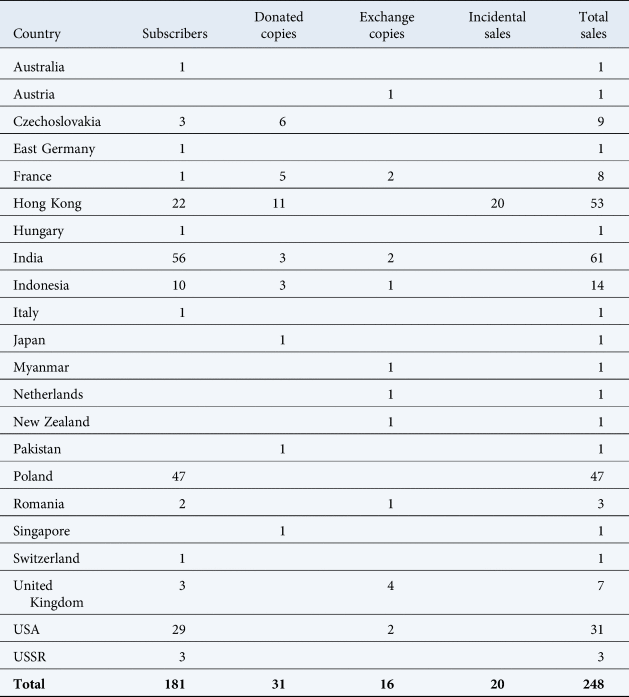
A diverse range of international subscribers purchased the newspaper, but never in great numbers: the table below shows destination countries of 248 copies sold overseas on June 3, 1951.Footnote 62 The statistics show that, at least in numerical terms, the News had little impact among its target audiences. Of course, readership statistics can only provide us with limited information and tell us little about how purchasers engaged with the newspaper's content. The country to which the most copies were sent on June 3 was India, where fifty-six copies went to subscribing organizations and individuals, three were donated to progressive organizations and two given in exchange for other newspapers. The News had a small constituency of readers in Indonesia, but mostly failed to reach “oppressed nationalities” in Southeast Asia. Beyond this, circulation across Asia was limited, except for in the British colony of Hong Kong, where there were twenty-two subscribers. Hong Kong was the only place outside mainland China where readers could purchase the newspaper incidentally, without a subscription. Copies of the News made their way to friendly socialist countries, but only in very small numbers, except for in Poland, where there were forty-seven subscribers. The final overseas group targeted by the News was “peaceful” people in imperialist countries: there were twenty-nine subscribers in America and two exchange relationships in place; and in Britain there were three subscribers and four exchanges. That the PRC's only daily English-language newspaper was selling so few copies overseas was a source of serious concern to the News's leadership.Footnote 63
Distribution of The Shanghai News by country on June 3, 1951 (source: SMA B37-1-29-20)

In January 1953, subscription fees paid by forty-seven international subscribers were refunded by the News as part of its winding-up process, allowing an insight into who bought the News overseas at that time. Institutional subscriptions included The Denver Post, the reference libraries of the Federal Reserve Bank of New York and the UN, the Ministry of Information of Indonesia, the Czechoslovakian Embassy in North Korea, and the Soviet news agency VOKS. Subscriptions in the US were managed largely through agents, including Universal Distributors Co., New York, and the Progressive Book Shop in Los Angeles. Among the subscribers was the Committee for a Democratic Far Eastern Policy, a front organization for the Communist Party of the USA. The News was also stocked by progressive booksellers elsewhere, including the Willing Book Co., Hong Kong and the Biblioteca Feltrinelli, Milan. Among its Indian subscribers were the general secretary of the Kerala Peace Committee in Kottayem and the left-wing Free Press Journal, published by the People's Publishing House in Bombay.Footnote 64 This list tells us little about the ways individual readers engaged with the newspaper's ideological or informational content, but it is clear that the majority of overseas subscribers were already self-identified left-wing organizations and progressive individuals. It is unlikely that the News changed many minds, but its international circulation will have contributed to efforts to promote the PRC within the global socialist movement, if only in a relatively minor way.Footnote 65
In a June 1951 report the editorial office staff confessed to being perplexed by the “audience question” (duixiang wenti 对象问题). The News's inflexible format as a local daily proved a considerable obstacle to gaining overseas readers. Foreigners in China and overseas, they observed, had very different reasons for buying the newspaper.Footnote 66 Earlier that year the editors had been advised by the Newspaper Affairs Committee, a body comprised of senior cadres who oversaw work at the News, to “face overseas” (mianxiang haiwai 面向海外), but the GAPP had countermanded this instruction, ordering the News to limit their audience to foreigners within China. Jin Zhonghua told his staff, rather unhelpfully, that the News should be easy to sell overseas despite its format, because people would be hungry for information on events in Shanghai and across the country. The editorial line should pay special attention to the needs of readers in Hong Kong and Southeast Asia, he advised, while also including more local news. To increase sales, he suggested, the News should target Chinese readers with “foreign minds” (yang tounao 洋头脑) and recently returned overseas Chinese.Footnote 67 The “audience question” remained unsolved.Footnote 68
The largest order refunded when the News closed was for 16,000 issues for the Education Section of the Prisoner of War Management Department of the Chinese People's Volunteer Army (CPVA) in Pyoktong County, North Korea.Footnote 69 Pyoktong County was home to POW camps holding thousands of UN soldiers. Here the News and other publications were used as “study materials” in “thought reform,” a form of political education designed to change individuals’ thinking and behavior through peer pressure, coercion, and rewards.Footnote 70 Facing meagre food rations, unsanitary conditions, and plummeting winter temperatures, the extent of a POW's engagement with political study could determine whether or not they survived.Footnote 71 As part of political education, POWs would first be given English-language news articles to read and discuss as a group. Later, they were expected to write their own pieces, which were often published in the News.Footnote 72 This created a feedback loop: the main audience for the extensive coverage of events such as the POWs’ Christmas festivities in 1951 were the POWs themselves.Footnote 73 The News's original mission statement was internationalist and optimistic. Rather than reaching out to foreigners in China or overseas, it found its largest constituency of readers through deployment in support of coercive political indoctrination in POW camps.
Despite a lack of direct evidence, it is not unreasonable to suggest that lessons learned from the News's lack of success will have informed the later development of China's external propaganda apparatus. The News was one of several English-language publications produced in the early PRC. The others included the fortnightly journal People's China, first published on January 1, 1950, as a “forum of truth and a clearing house of actual revolutionary experience”; the more colorful China Pictorial, which began publication in 1951 as a translated version of the magazine Renmin Huabao 人民画报; and China Reconstructs, a bi-monthly (later, monthly) periodical that was first published in January 1952.Footnote 74 Cagdas Ungor has shown that the PRC's external propaganda apparatus was under-resourced, overly bureaucratic, and profoundly disrupted by political campaigns in the early 1950s. In contrast to the News, however, the three publications named above had clearly delineated rationales behind their publication and were designed to appeal to specific target audiences. Key principles, developed in the course of the revolution and firmed-up in the 1950s, guided external propaganda production in the PRC. Two of the most important of these were: “inside and outside are different” (neiwai youbie 内外有别), meaning that external propaganda should not simply replicate domestic propaganda, but should meet the needs of its audience; and “not forcing oneself on others” (bu qiangjia yu ren 不强加于人), meaning that propaganda should be subtle and made relatable by being directed at “middle-of-the-road masses.” The aim was to make external propaganda lively and enticing to new readers, avoiding political jargon and controversial viewpoints.Footnote 75
The heavily politicized and hectoring tone of the News stood in sharp contrast to that adopted in the more successful China Reconstructs, which ran from 1952 to 1990. China Reconstructs presented its readers with beautifully illustrated stories of “New China,” focusing on New Democratic themes including national reconstruction, poverty alleviation, and the empowerment of previously marginalized groups.Footnote 76 While the News made little attempt to engage readers who were not already in sympathy with its ideological perspective, China Reconstructs prioritized winning readers’ goodwill by familiarizing them with Chinese news and culture through lively articles, sympathetic pictorials, and imaginative arts and crafts activities. A typical issue from May 1954 contained articles on international trade, Christian life in China, exchanges of exotic animals, and “A Day with Tibetan Women.”Footnote 77 While the News's editors seldom addressed their readers directly, China Reconstructs encouraged comment from its readers. The most effusive efforts were printed in a readers’ letters section. As Jin Zhonghua, the editor-in-chief of the News, was one of the founding editors of China Reconstructs, along with Song Qingling and Israel Epstein, we might, with a degree of caution, infer that the latter publication's successes were informed, at least in part, by the failures of the former. Regardless, it was clear that the News did not conform to the accepted principles of good external propaganda work. Neither did it conform to the principle that “inside and outside are different,” nor appeal to the “middle-of-the-road masses.” The commercial model adopted under the New Democratic ethos of 1950 resulted in the News having a distinctly odd format, as a socialist mouthpiece reliant on advertising from “imperialist exploiters” and a local newspaper seeking international audiences. The News can only be judged a disappointment, both as a propaganda medium and as a commercial venture. Failure was not inevitable, however. Next, we shall explore what working on the News meant to the individuals who devoted two and half years of their lives to the project.
New Democracy and the Staff of the News
New Democracy was a policy designed to reassure non-party groups and individuals that they would be allowed to play meaningful roles in the new order. With the creation of a “New China,” came the opportunity for a “new life.” On June 6, 1950, just days before the News began publication, Mao reaffirmed New Democratic principles in a major speech titled “Don't Hit Out in All Directions.” He called for the Party to ally with capitalists, democratic personages, and intellectuals for the good of the country, saying: “Many of them were our enemies before, but now that they have broken with the enemy camp and come over to our side, we should unite with all these people.”Footnote 78 The staffing of the News reflected the new government's willingness to draw on Shanghai's unique depth of expertise in newspaper production and foreign languages. Examining people's experiences in this moment of transition allows us to gain a better understanding of how people encountered New Democracy as a lived reality. This section draws on employee registration forms completed for the personnel department of the News in spring 1951. Individuals’ political backgrounds and employment histories conditioned their experiences at the News. Here we will consider what working at the News may have meant for different groups including: idealistic university graduates; people whose careers to that point had been interrupted by war and economic turbulence; graduates from the East China News College, a political education institution for intellectuals; and senior figures with close links to the GMD.Footnote 79 For those with politically difficult backgrounds, employment at the News signaled a fresh start in the spirit of New Democracy. Working at the News was demanding for everyone. In January 1951, the News had a staff of sixty-one, which increased to seventy-four by October 1952 (thirty-four workers and forty office staff).Footnote 80 A December 1950 report by the management office noted that the staff was kept as small as possible and this meant that individuals were overburdened by work. This situation was compounded, the report noted, by a lack of experience among those in senior positions, many of whom had never worked in the newspaper industry, or on an English-language newspaper, before.Footnote 81 The second part of this section follows the fortunes of the News's staff as the impacts of mass campaigns, most prominently the Three Antis, were felt in the workplace. This was a foretaste of things to come. When the newspaper closed in December 1952, a few fortunate individuals were able to use their time at the News as a springboard for successful careers in Beijing. The majority were either relocated at short notice to Beijing or were compelled to register for “political study.”
Enthusiastic university graduates employed by the News were inspired, or so they wrote on their personnel forms, by the idea of building “New China.” Of these, a large proportion had graduated from St. John's University in Shanghai and many were already CCP members. Several had internationalized backgrounds and had gained experience working with international agencies, including the United States Information Agency (USIA), or studying overseas. Twenty-nine-year-old He Fei 何飞 (1920?–), was a graduate in foreign languages from St. John's, employed as a journalist at the News. In 1946, he worked for the United Nations Relief and Rehabilitation Administration (UNRRA) as a translator. The following year, he began two years of overseas study at the University of Missouri. On returning home in August 1949, he found work at the Shanghai People's Radio Station and then at the News. Many younger colleagues forged successful careers in English-language publishing or the foreign affairs organs after the News closed. They included twenty-five-year-old Fang Yingyang 方应旸 (1925–1969), a university graduate from a professional family background who worked in the editorial office. After graduating from Central China University in 1946, Fang had worked for the university's foreign language department as a teaching assistant for two years before finding work with USIA. In December 1949, he was recruited to the Foreign Affairs Department of the Nanjing Municipal Government. In February 1950, he joined the China New Democratic Youth League and was assigned to the News in June. His stated goal was to raise his political and technical understanding and “serve the people.” He went on to work for China Reconstructs in Beijing. Yang Xiling 杨熙龄 (1927–1989), a twenty-three-year-old St. John's graduate, also came from a professional family background and worked as a journalist. After graduation in 1948, he had taught briefly in a secondary school and became a member of the CCP. He was employed by Jiefang ribao in August 1949 and was transferred to the News in June 1950. He would later become a prolific translator and writer. Twenty-four-year-old Meng Jiqing's 孟纪青 (1926–2009) career followed a similar path: he graduated in the same year as Yang and worked for Jiefang ribao. He later played an important role in setting up the magazine Peking Review. For the idealistic young Fang, Yang and Meng, the News was an opportunity to serve “New China” and a stepping-stone to careers in Beijing.Footnote 82
These graduates worked alongside a slightly older cohort of people for whom the foundation of “New China” held the potential for a period economic prosperity after several decades of turbulence that had disrupted their lives and careers. Xu Zhirong 徐芝荣 (1917?–), for example, was a thirty-two-year-old translator-editor from Yangzhou who began her working life as a teacher in Guilin in 1940, having fled the Japanese occupation of China's eastern seaboard. She moved to Chongqing in 1945 and worked as a secretary for the Soviet news agency Telegrafnoye agentstvo Sovetskogo Soyuza (TASS). In 1946, she returned with TASS to the GMD capital Nanjing where, after the takeover in 1949, she was employed by Xinhua as a translator-editor. She wrote that she hoped, on starting work at the News, to become a journalist capable of working independently. Wu Yifang 吴薏芳 (1919?–) came from a poor peasant background in Anhui with a middle school education and spoke no foreign languages. She had worked for TASS in Chongqing between 1942 and 1945. Four years of unemployment had followed before she resumed work with TASS in Shanghai in June 1949. The job at the News may have represented an opportunity for this thirty-year-old woman to find some stability. Her file recorded her aspiration as simply “hoping to do this job well.” The career of Li Jingshu 李景书 (1911?–), a thirty-eight-year-old employed in the editorial office had been similarly disrupted. She had moved jobs and locations many times during the Japanese invasion, before finally finding work at Xinwen bao after the war. From December 1949 to June 1950 she was unemployed and “studied” at the News College. She hoped, her file stated, to continue her political education in her new role, especially on the Korean conflict.Footnote 83 For Xu, Wu, and Li, New Democracy offered the chance to advance their careers in a period of relative stability after the tumultuous 1930s and 1940s.
A significant proportion of the staff were recruited from the News College. The CCP held that people were products of their environment and believed that the old society had corrupted the citizens of Shanghai. Government organizations like the News required skilled workers in all fields, so the News College was set up to educate intellectuals (broadly defined) in the newspaper industry in the new political realities of the PRC. Those who were willing to reform their thinking and behavior in line with the CCP's ideals were promised an opportunity to prove themselves.Footnote 84 One graduate of the College who seized this chance was Shen Suru. Shen had worked for the USIA as a translator after graduating from Jinan University in 1946. He was employed as a journalist for Xinwen bao between 1946 and 1949, and as a translator for the China Weekly Review before registering at the College in 1949. He joined the News in 1951 and became the head of the News Section. He was sent to Beijing in 1953 to work for People's China and China Reconstructs, and later became one of the PRC's foremost authorities on external propaganda work.Footnote 85
Working at the News represented a chance to prove oneself for people like Wang Xuewen 王学文 (1904?–), a forty-five-year-old switchboard operator and Zhu Xiansheng 朱贤生 (1909?–), a forty-year-old accountant and advertising expert who had both worked previously for the English-language newspaper The China Press. The Press was aligned with the GMD through its major shareholder, the politician H. H. Kung 孔祥熙 (1881–1967). Having close links to the much-loathed GMD was not a bar to recruitment at the News. Among the staff were many who had worked for the Press or the China Daily Tribune. This included Guangdong-born editorial advisor Li Cai 李才 (1889?–), who was sixty-one in 1950 and who had been the general editor of the Tribune between 1945 and 1949. He had a career in English-language news dating back to his position as general editor of the Peking Gazette in 1915. Li had worked at the Shanghai Gazette (1918–1922) and Canton Gazette (1923–1927) before becoming the head of the GMD's Kuo Min News Agency 国民新闻社 from 1927 until 1941. Similarly, Jiang Yongqing 江永青 (1893?–), fifty-seven years old, had begun his career in publishing in 1909 and had worked for English-language publications in Shanghai, Beijing, and Hankou. He was employed by the GMD's propaganda organs from 1940 to 1948.Footnote 86
One of the first editors of the News, Lu Tongping 鲁潼平 (1905–2008?), was in his mid-forties at the time of the revolution and working as editor at the Tribune. Lu was from Hunan province and was a cousin of the high-ranking CCP leader Liu Shaoqi. Despite this familial connection, Lu and his immediate family's lives were entwined closely with the fortunes of the GMD. Lu had enrolled in Qinghua University in 1923 and studied overseas at the University of Missouri (1927) and the University of Chicago (1928), where he received his PhD in 1930. Between 1930 and 1949, he had worked variously at the propaganda department of the GMD Ministry of Foreign Affairs, the Chinese embassy in the United States, and the Central Bank of China. He had joined the GMD in 1943.Footnote 87 Lu Tongping's elder brother was Lu Diping 鲁涤平 (1887–1935), a high-ranking GMD official who had served as the Provincial Chairman for Hunan, Jiangxi, and Zhejiang before his untimely death in 1935.Footnote 88 His other brother, Lu Dangping 鲁荡平 (1895–1975), an editor of several GMD-aligned newspapers, had been an early member of the Tongmenghui 同盟会, a revolutionary group from which the core of the GMD emerged, and had left for Taiwan in 1949. The fact that people like Lu Tongping, Li Cai, and Jiang Yongqing were employed producing external propaganda for the new government despite their close association with the enemy is evidence of the CCP's willingness to utilize the skills and experience available to them in Shanghai when it came to producing external propaganda.
The News's editor-in-chief, Jin Zhonghua, was a progressive liberal who had made his name in the 1930s as general editor of the magazine World Culture (Shijie zhishi 世界知识). Like Song Qingling, he was an archetypal representative of the progressive “democratic persons” (minzhu renshi 民主人士) courted by the CCP as part of their cross-class coalition. During the 1937–1945 war, Jin had edited several anti-Japanese publications and had worked with Song producing propaganda for the China Defense League.Footnote 89 He had also worked for both TASS and the USIA as a translator.Footnote 90 “Democratic personages” like Jin and Song were typically disillusioned with the GMD and understood their new roles as a way of contributing to a better society. In the early 1950s, Jin served conjointly as editor-in-chief of the News, Xinwen ribao, Wenhuibao, and China Reconstructs. He attended the first three sessions of the National People's Congress, participated in national and municipal Political Consultative Committees and served as one of several vice mayors of Shanghai between 1953 and 1966.Footnote 91 The CCP's inclusive policy only went so far: non-party intellectuals were accorded privileged status, but they were not permitted real authority. Jin's work at the News was overseen by a Newspaper Affairs Committee, formed of senior CCP cadres including Xia Yan 夏衍 (1900–1995), the chief of the Shanghai Municipal Party Committee Propaganda Bureau and Huang Hua 黄华 (1913–2010), the head of the Shanghai Foreign Affairs Department.Footnote 92 Jin's second in command was Chen Linrui 陈麟瑞 (1905–1969), who had studied overseas and worked for the UN's International Labor Organization before 1949. After “Liberation” he worked as the head of Xinhua's English-language branch in Shanghai before being assigned to the News.Footnote 93
These brief biographical sketches illustrate the importance of New Democracy when it came to setting up a propaganda newspaper to represent “New China” to the world. It is perhaps no great surprise that the CCP was willing to co-opt progressive intellectuals with international backgrounds like Jin Zhonghua and Chen Linrui, and recruit personnel from the News College's political study classes. The opportunities offered to those whose lives and careers were bound up with the GMD are more remarkable. Unfortunately, the moderation offered under New Democracy did not endure. Nara Dillon has shown that the turning point for New Democracy in Shanghai came at the turn of the year 1951–1952, with the launch of the Three Antis Campaign (against corruption, waste, and bureaucracy in government organizations) and Five Antis Campaign (targeting bribery, tax evasion, theft of state assets, cheating on labor or materials, and stealing state economic intelligence in private enterprises). Attacks on non-party elites during both campaigns undermined previous efforts to develop cross-class coalition.Footnote 94
The Three Antis was an internal discipline campaign conducted within government organizations. At the height of the movement one third of the staff of the News were taken away from routine work to participate in “tiger beating” investigations rooting out corruption amongst the senior staff. One report noted that before the campaign “seriously degenerate bourgeois thinking” had prevailed, marked by prevalent “formalism” (a focus on maintaining appearances rather than true endeavor in pursuit of revolutionary goals). Investigations uncovered alleged losses of over one hundred million yuan through corruption and waste, with senior managers identified as the main culprits. One in every seven staff members were accused of some form of corruption. The accused were not to be “forever despised” the report stressed, but rather admit their guilt, accept their punishment, and then be allowed to make a fresh start as good comrades. The report noted that the campaign had so intimidated the senior staff that they now sought to avoid any responsibility, including, in one case, seeking approval from the editor before authorizing the purchase of a single light bulb.Footnote 95 As well as enduring campaigns, working in government organizations after 1949 involved long working hours, exacerbated by lengthy political meetings before and after work. Individuals’ thoughts and behavior were subjected to intense scrutiny. Additionally, News employees who came from affluent, internationalized backgrounds will have found acclimatizing to the political climate of struggle and sacrifice difficult. Lu Tongping, for one, did not stay long at the News. In early 1951, he left mainland China and joined an exodus of refugees from Shanghai in crowded Hong Kong. He found work for the New York Times and eventually settled in America in 1955.Footnote 96 In 1953, a former Jiefang ribao reporter named Miu Yi'en 缪奕恩 (dates unknown), who followed a similar path to Hong Kong, told American officials that he had begun his working life enthusiastically after graduating from St. John's in 1951. He was thoroughly disillusioned by the culture of false accusations and evasion of responsibility that characterized office politics after the Three Antis campaign. Moreover, Miu resented taking orders from middle-ranking Party members who were not intellectuals.Footnote 97
The mass campaigns of 1951–1952 created an opportunity for the state to impose control over the entire newspaper industry in Shanghai. In the spring of 1952, the CCP launched a thought reform campaign to transform the “bourgeois” attitudes of the staff of Shanghai's newspapers. Nationalization was not the intended outcome of the campaign, but it eventually evolved into a systematic restructuring designed to increase state control. By February 1953, several smaller newspapers had been amalgamated or closed, and Dagong bao was moved to Tianjin. Wenhui bao and Xinmin bao were nationalized.Footnote 98 The News was closed during this process of reorganization and consolidation. Another contributing factor behind the closure was that the International News Bureau was reorganized and became the Foreign Languages Press in March 1952. The Press was given overall responsibility for producing printed external propaganda nationally. The News's closure was part of this effort to centralize and homogenize the production of propaganda, with an emphasis on policing the flow of information out of China under the principle of “inside and outside are different.”Footnote 99 On December 28, 1952 the News announced, rather suddenly, to its readers that it would cease publication at the end of the month.Footnote 100 The newspaper's editors and staff had received only eight days’ notice. The staff were assembled and told by Huang Hua that the newspaper had “already completed its historical task,” and that some of the staff would be appointed to new roles in Beijing.Footnote 101 Shen Suru later recalled: “So it was like this, the English-language The Shanghai News had completed its historical mission. In January 1953, we cadres and workers, who were still in the prime of our lives, longed for the capital with unbounded enthusiasm, laughing and singing we set out on a new path.”Footnote 102
Reports from the time suggest that Shen's excitement was not widely shared. Two further meetings were held to address the staff's concerns. Twelve News employees were dispatched to the Foreign Languages Press and nineteen (mostly technical workers) to the attached Foreign Languages Printing Press. Three went to join Xinhua, two to China Reconstructs, and one each to the Chinese edition of For a Lasting Peace, For a People's Democracy! and World Culture. Relocation was not voluntary, and only immediate family were permitted to accompany those heading north. Those staying behind offered to help with “communicating with families remaining in Shanghai” to put their colleagues’ hearts at ease. The thirty or so employees who stayed in Shanghai were instructed to register at the News College by February 6.Footnote 103 This must have been a blow for those whose careers had previously been disrupted by war and revolution, and whose ambitions were simply to perform well in their roles. At the College, the News employees joined more than 500 individuals from other reorganized media organizations. Zhang Jishun has shown that when “training” was completed in November 1953, only thirteen of this group “graduated” to resume work in the media.Footnote 104
In the mass campaigns of the late 1950s and 1960s, non-party intellectuals such as those co-opted to produce the News became the targets of increasingly fierce criticism. This was especially true of those with links to the GMD. Even celebrated “democratic personages” like Jin Zhonghua found themselves under attack. Jin was among seventeen high officials accused in 1966 of being “counterrevolutionaries” during the Cultural Revolution (1966–76) in his capacity as a vice mayor of Shanghai. He was violently interrogated, denounced as a “foreign spy,” and killed.Footnote 105 His junior colleagues at the News, Meng Jiqing and Yang Xiling, who had made successful careers for themselves in Beijing, experienced similar persecution. Fang Yingyang, who had been transferred to Beijing in 1952, was detained in early November 1968 for investigation of “historical problems,” and was accused of being an American spy due to his time working for the USIA. He committed suicide in January 1969.Footnote 106
Conclusion
Given the CCP's role in undermining the cross-class coalition it had built through mass campaigns, along with the triumphalism with which the transition to socialism was announced in 1953, it is tempting to simply dismiss New Democracy as little more than a slogan deployed to minimize dissent during the revolution. Our focus on the short history of the News has demonstrated that, whatever the intentions of the CCP leadership, the concept of New Democracy had a life of its own in the early 1950s. The CCP saw external propaganda as a vital weapon in the early Cold War. It is significant, therefore, that the PRC's first English-language daily adopted a commercial business model, funding its ideological mission through sales and advertising. The News's distinctly unusual character, in which propaganda was juxtaposed with commercial advertising, stood in stark contrast to the PRC's other carefully curated external propaganda publications. The News's target readership diminished as foreigners departed from China. This left the editors struggling to reconcile its format as a local daily with their desire to increase international sales. The News proved ultimately unsuccessful as both a commercial venture and as a propaganda vehicle, but failure was not inevitable. Seen from the perspective of the staff in their run-down building on Yan'an Road, employment at the News represented a chance for new careers serving their country in the spirit of New Democracy. For some, this opportunity came despite their close links to the GMD. For others, working on the newspaper may have held the promise of stability after decades of disruption. New Democracy was a tumultuous period in which the aspirational goals of the new government (embodied, in turn, in the News's own stated goals) conflicted with the CCP's actions in driving social change using mass campaigns and intervening increasingly directly in the economy in response to political and economic crises. The assumptions on which the News was established in mid-1950 no longer held true by the end of 1952. While New Democracy was compromised, this article has demonstrated that the principles at the heart of the policy served as a guide to action in setting up the News. Moreover, the newspaper's staff had a lived experience of the period that presupposed neither the early abandonment of the policy, nor the severe repression and chaos of the late 1950s and 1960s.