Introduction
The mid-1960s witnessed a landmark change in the area of civil rights policy in the United States. After a series of tortuous internal battles, with Southern legislators using all available procedural tools to maintain their states' discriminatory Jim Crow legal systems, the United States Congress adopted two statutes—the Civil Rights Act of 1964 and the Voting Rights Act of 1965—which insured civil and political equality for all Americans. The Acts of 1964 and 1965 were the culmination of a decade-long struggle by black Americans to secure the citizenship rights that had been denied to them for more than a half century.Footnote 1 Beginning with the Brown v. Board of Education (1954) Supreme Court decision, the civil rights movement built momentum, as formal organizations like the National Association for the Advancement of Colored People (NAACP) grew in strength and informal (grass roots) organizations spread throughout the South and the Nation.Footnote 2 As national public opinion shifted increasingly toward providing new civil rights guarantees for blacks, Congress responded with new legislation: the Civil Rights Act of 1957 (the first civil rights law since 1875), the Civil Rights Act of 1960, and a legislative proposal to prohibit the poll tax in 1962 (which would be ratified by three-quarters of the states in 1964 and become the 24th Amendment to the United States Constitution).
It has been a common strategy for scholars working on the civil rights movement to start with the Brown decision and follow the course of political events through the Acts of 1964 and 1965 (and beyond). And this strategy has been reasonable, as obvious changes in the national political environment were occurring in the mid-1950s and building toward the end of the decade. However, like legal historians Risa Golubuff, Kenneth Mack, and others, we argue that establishing a baseline (or starting point) near 1954 obscures prior pertinent events that affected the types and trajectories of subsequent political actions.Footnote 3 Whereas legal historians highlight the important work of civil rights advocates in the years preceding Brown, we concentrate on the important legislative battles that took place during the 1940s, which presaged the legal victories of the late 1940s and early 1950s.
It is true that the events of the early 1950s reinvigorated the civil rights agenda and helped set the stage for the “classical” era of the 1960s, but concerns about race and black Americans' rights had not vanished entirely from the national agenda with the end of Reconstruction. The president and Congress were confronted with civil-rights-related issues at various points between 1891 and 1940,Footnote 4 and a series of consequential decisions were made that affected not only the course of civil rights in the nation but also the way the parties lined up on the issue and how black voters responded to the parties' positions.Footnote 5 Moreover, the following decade—the 1940s—was an especially crucial “bridge period” between the nascent civil rights era of the earlier half-century and the full-fledged civil rights movement of the 1950s and 1960s. Specifically, the 1940s represented a trial run for those who would continue to advocate for civil rights in subsequent decades.
In this article, we focus on two particularly important dynamics. First, we examine the process of partisan “sorting out” on civil rights issues that first began in the late 1930s.Footnote 6 Here we contribute to an ongoing debate over the timing of the Democratic Party's embrace of what would become known as the “civil rights agenda.”Footnote 7 Like those legal historians who have noted the importance of legal decisions preceding Brown, we suggest that the partisan racial realignment took place long before the passage of landmark civil rights legislation in the 1960s.Footnote 8 Second, we argue that the record of legislative defeats during the 1940s helps to explain why civil rights advocates came to see the courts and executive branch agencies as the venues most likely to ensure continued progress in the cause of racial equality. In this way, therefore, we set the scene for the “turn” to the courts by demonstrating that the legal strategy emerged as a consequence of multiple failed efforts to pursue legislative remedies.
To investigate how the civil rights issue evolved during the 1940s, we choose Congress as our level (or focus) of analysis. We do so for reasons of both tractability and substance. Clearly the president and the courts played an important role in the civil rights debate during this decade. For example, Franklin Delano Roosevelt unilaterally instituted fair employment practices in the national defense industry (Executive Order 8802) in 1941,Footnote 9 the Supreme Court declared the white primary unconstitutional in 1944 (Smith v. Allwright),Footnote 10 and Harry Truman desegregated the federal work force (Executive Order 9980) and the armed services (Executive Order 9981) in 1948.Footnote 11 However, it is fair to say that the most lasting victories of the civil rights movement were statutory: the Acts of 1964 and 1965 (and their subsequent enforcements and extensions) swept Jim Crow style discrimination away once and for all. As such, charting the course to these victories is crucial for a full understanding of how the civil rights issue developed over time. Other actors, such as the president, enter the drama at various points—for example, on “fair employment,” which will be covered in detail—and we will describe their contributions when appropriate. But to study statutory evolution on civil rights requires a concentrated focus on Congress.
This work builds on our earlier research, which examined the 1891–1940 era in detail.Footnote 12 As we documented, the last decade of the nineteenth century and the first two decades of the twentieth century saw little attention paid to civil rights, as black citizens were not in a position to be electorally pivotal and therefore were largely ignored by national politicians. In the 1920s and 1930s, following the first great migration, the growing black population in the North, led by emerging civil rights groups such as the NAACP, forced civil rights gradually back onto the national agenda. The focus during these decades was antilynching legislation. In the 1920s, the Republicans promoted the issue, but by the 1930s, the Democrats had become the chief sponsors. In each case, antilynching legislation was passed in the House (in 1922 under the Republicans; in 1937 and 1940 under the Democrats), only to run into a filibuster in the Senate led by Southern Democrats. Other interesting variation included: (1) a bare majority of Northern Democrats in the House supporting antilynching legislation as early as 1922, and (2) a significant majority of Republican senators twice opposing a cloture motion that would have forced the Senate to consider the House-passed antilynching legislation in 1938.
Therefore, as the decade of the 1940s dawned, some political uncertainty existed in Congress. A partisan realignment on civil rights was well underway by the late 1930s, as Northern Democrats had become the champion of black interests,Footnote 13 even as the Party's Southern wing actively opposed such reform efforts. Republicans continued to mostly support civil rights initiatives through the 1930s, but solid support from the “Party of Lincoln” could no longer be taken for granted, as the cloture votes in 1938 indicated. This was important, as Republicans would often find themselves as the pivotal coalition in congressional voting on civil rights during the 1940s. With Northern and Southern Democrats lined up on opposite ends of the issue, Republicans were in a position to behave strategically—supporting or opposing civil rights legislation depending upon the electoral benefits/costs involved.
For a time, civil rights advocates hoped for the best from the Republican Party, and devised a legislative strategy around winning support from Republicans and Northern Democrats. With the continued emergence of a “conservative coalition” of Republicans and Southern Democrats, however, it became clear to civil rights advocates that a more diversified approach was needed.Footnote 14 As a result, they increasingly pursued their goals through the courts and the administrative state.
Our analysis focuses on the five Congresses that convened during the 1940s: the 77th (1941–1942), 78th (1943–1944), 79th (1945–1946), 80th (1947–1948), and 81st (1949–1951).Footnote 15 Whereas antilynching was the only meaningful civil rights issue on the congressional agenda in the 1920s and 1930s, a broader set of issues emerged in the 1940s. We look at the four sets of civil rights initiatives that were both debated on the floor and generated roll-call votes: (1) efforts to eliminate the poll tax in Southern elections; (2) attempts to federalize soldier voting during World War II, thereby threatening state-level electoral institutions; (3) attempts to institute fair employment practices (prohibit discrimination) among private sector employers, labor unions, and agencies of the federal government; and (4) efforts to eliminate discrimination in public education, through conditional federal assistance for state-level school lunch programs.Footnote 16 These civil rights initiatives fell into two distinct categories: political equality (anti-poll tax and soldier voting) and economic equality (fair employment and school lunches). In this way, the legislative battles of the 1940s mirrored the legal battles that would emerge as the decade wound to a close.
In the following sections, we provide in-depth case studies of each of these four civil rights issues and discuss the congressional proceedings, individual roll-call votes, and eventual legislative outcomes. We focus first on the anti-poll tax, which was perhaps the major civil rights issue of the 1940s; it was regularly on the congressional agenda throughout the decade and it would continue to highlight (as did the antilynching bills of the prior two decades) the stark differences between the majoritarian House, which consistently supported such legislation, and the super-majoritarian Senate, led by Southerners, which consistently opposed such legislation.Footnote 17 We then turn to soldier voting, which was a more focused (and contextual) attempt to limit black voting rights, but also dealt with the larger issue of federal power versus states' rights; the battle over soldier voting also involved the poll tax as applied to servicemen, which makes it a natural follow-up to the anti-poll tax case. In the third and fourth case studies, we focus on civil rights legislation that extended beyond voting rights. We begin with the legislative effort to end employment discrimination, via the creation of a Fair Employment Practices Commission, which was designed to promote both racial and economic equality for black workers. We then take up the school lunch program, which represented a more targeted attempt to end discriminatory practices aimed at school-age children.
To summarize our results, we find that voting on anti-poll tax and school lunch legislation contrasts with voting on a federal soldier ballot and fair employment legislation. In the former cases, Republicans consistently lined up with Northern Democrats against Southern Democrats. In the latter cases, Republicans sometimes joined with Southern Democrats in a conservative coalition against Northern Democrats. Thus, civil rights outcomes did not follow strictly from the political/economic basis of the legislation; rather, they were conditioned on the perceived case-by-case electoral advantage of the pivotal Republican bloc in Congress.
Anti-Poll Tax Legislation
As the decade of the 1940s opened, eight Southern states—Alabama, Arkansas, Georgia, Mississippi, South Carolina, Tennessee, Texas, and Virginia—maintained a state-level law requiring a fee (typically between $1 and $2) to vote; this constituted, in effect, a tax at the voting poll.Footnote 18 As another World War started to wage outside the borders of the United States, and denunciations of fascism abroad began to ring out throughout the country, political activists and leaders turned their attention to restrictions on civil rights and liberties at home. To maintain internal consistency, these individuals felt that domestic discriminatory practices needed to be addressed. Rather that revive antilynching, they focused on eliminating the poll tax as “a modest way of demonstrating the nation's adherence to the principle of liberty.”Footnote 19
An anti-poll tax movement (as compared with another antilynching campaign) was also an easier sell politically. Whereas lynching was a crime of violence mostly against blacks, the poll tax represented political repression mostly against whites—roughly 60% of those disenfranchised by the poll tax were estimated to be white.Footnote 20 And this was consistent with the historical design of the institution. That is, whereas the poll tax was often portrayed as a device to promote white solidarity, it was adopted by Southern state governments in the late nineteenth and early twentieth centuries as a way to repress not only the black population but also poor whites who could be swayed by populist arguments.Footnote 21 Stated simply, the poll tax was a means for the white, economic elite to maintain power. Therefore, it had both race-based and class-based dimensions.
By the late 1930s, the various groups that made up the New Deal coalition took aim at the poll tax. First, President Roosevelt and leaders of the national Democratic Party saw an untapped political market in the blacks and whites disenfranchised by the poll tax. Moreover, their relationship with the Southern Democratic elite, which had been tenuous since the party was swept into power in 1932, grew icy later in the decade. The elimination of the two-thirds nomination rule at the National Convention in 1936, Roosevelt's failed Court-packing plan in 1937, and his failed purge of Southern Democrats in the 1938 congressional primaries, drove a wedge between the two regional coalitions of the party. As a result, national Democrats saw little cost in attempting to reform electoral institutions in the South. Second, the NAACP and a host of progressive organizations, such as the Southern Conference for Human Welfare (SCHW), the National Committee to Abolish the Poll Tax (NCAPT), the Southern Electoral League, and the Women's Committee of the national Democratic Party, came out strongly against the poll tax and highlighted its many corrupt and undemocratic features.Footnote 22 And again, such a coalition was easier to build because the victims of the poll tax included both blacks and whites.
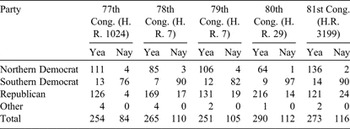
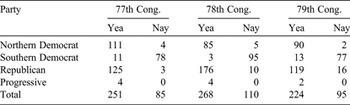
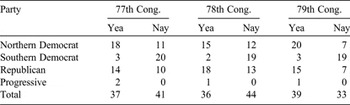
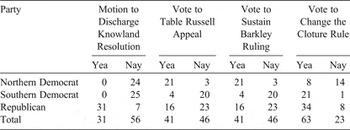
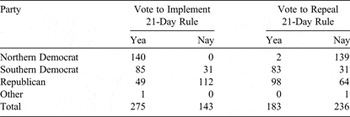
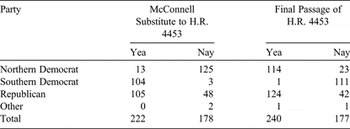
In each of the five Congresses that convened in the 1940s, the 77th (1941–1942) through 81st (1949–1951), an anti-poll tax bill was passed in the House, and by large margins. Moreover, in the first three of these Congresses, the House discharged the anti-poll tax bill from the conservative-controlled Rules Committee, which had tried to bottle it up. However, none of these House-passed anti-poll tax bills became law, as each was blocked in the Senate. Three times cloture was invoked but failed, once a filibuster exhausted the anti-poll tax advocates, and once a bill died in committee without the need of a filibuster. Tables 1, 2, and 3 provide summary statistics of the key roll-call votes.Footnote 23 Apart from these unsuccessful attempts to roll back the poll tax generally, a more limited effort to exempt military servicemen during World War II was successful. This case will only be covered briefly, but will be examined in detail in the following section (Soldier Voting and the Federal Ballot). The remainder of this section will examine the more general anti-poll tax legislation in Congress.
Final-Passage Votes on Anti-Poll Tax Bills in the House, 77th–81st Congresses.

Source: Congressional Record, 77th Congress, 2nd Session, (October 13, 1942), 8174; 78th Congress, 1st Session, (May 25, 1943), 4889; 79th Congress, 1st Session, (June 12, 1945), 6003; 80th Congress, 1st Session (July 21, 1947), 9551–52; 81st Congress, 1st Session, (July 26, 1949), 10248.
Discharge Votes on Anti-Poll Tax Bills in the House, 77th–79th Congresses.

Source: Congressional Record, 77th Congress, 2nd Session, (October 12, 1942), 8079; 78th Congress, 1st Session, (May 24, 1943), 4812; 79th Congress, 1st Session, (June 11, 1945), 5895.
Cloture Votes on Anti-Poll Tax Legislation in the Senate, 77th–79th Congresses.

Source: Congressional Record, 77th Congress, 2nd Session, (November 23, 1942), 9065; 78th Congress, 2nd Session, (May 15, 1944), 4470; 79th Congress, 2nd Session, (July 31, 1946), 10512.
The first anti-poll tax bill was introduced prior to the period examined here, in 1939 during the 76th Congress (1939–1941), by Representative Lee E. Geyer (D-CA). The bill was written by the SCHW, and Geyer agreed to sponsor it on their behalf.Footnote 24 The Geyer Bill (H.R. 7534), which was introduced as an amendment to the Hatch Act,Footnote 25 framed the anti-poll tax measure as an effort to eliminate corruption (“pernicious political activities”) in the federal election process. The claim was that individuals with financial means often paid the poll tax of others, to secure their votes. Eliminating the poll tax would therefore clean up the federal electoral process. The measure was referred to the Judiciary Committee, and although subcommittee hearings were held, no additional progress on the bill was made before the Congress adjourned.
Representative Geyer introduced his bill (H.R. 1024) again in January 1941, on the first day of the 77th Congress,Footnote 26 and it was once again referred to the Judiciary Committee. Geyer then offered a resolution (H. Res. 110) to make H.R. 1024 a special order of business, which was sent to the Rules Committee.Footnote 27 Although the Judiciary Committee held extensive hearings on the legislation, it did not act further upon it. This led advocates of the bill to start a discharge petition;Footnote 28 for a time, few signatures were obtained, but with the passage of the Soldier Voting Act (the Ramsay Act) on September 15, 1942, which included a poll tax waiver for military servicemen, new momentum for a broader poll tax prohibition was created.Footnote 29 (The Soldier Voting Act will be considered at length in the next section.) On September 22, 1942, the discharge petition, complete with 218 signatures, was filed on H. Res. 110 and placed on the Discharge Calendar.Footnote 30 The discharge petition against the Rules Committee was considered on October 12, and after a short debate, the motion to discharge H. Res. 110 from the Rules Committee passed 251 to 85.Footnote 31 The discharge roll call appears in Table 2. It was overwhelmingly sectional, with a near-unanimous majority of both Northern Democrats and Republicans (only seven defections total) supporting the measure against a large majority of Southern Democrats.
Once discharged, H. Res. 110 was considered and passed by the same 251 to 85 margin; it provided for floor consideration of H.R. 1024 (and therefore had the effect of discharging H.R. 1024 from the Judiciary Committee).Footnote 32 Debate on H.R. 1024 began immediately and bled into the next day. Southerners, led by Representative Hatton Sumners (D-TX), chairman of the Judiciary Committee, Representative Pete Jarman (D-AL), and Representative Sam Hobbs (D-AL), argued that the bill was unconstitutional and railed against the federal government's intrusion into state affairs. Representative William Colmer (D-MS) was more visceral in his assessment, stating that H.R. 1024 was a “force bill” whose sole aim was “to enfranchise the Negro in the South,”Footnote 33 whereupon Representative Arthur Mitchell (D-IL)—the single black member of the House—replied that “if the Negro is good enough to … shed blood for this country, then he is entitled to vote in peacetime as well as wartime.”Footnote 34 Finally, after 4 hours of debate (as stipulated in the special order), H.R. 1024 was voted on and passed 254 to 84.Footnote 35 The roll call appears in Table 1 and follows the same basic pattern as the discharge roll call; all but eight members of the coalition of Northern Democrats and Republicans successfully opposed all but thirteen Southern Democrats.
The Geyer Bill (H.R. 1024) was then sent to the Senate, where it was referred to the Judiciary Committee. An amended bill was favorably reported out of committee on October 26; the amendment struck out the entirety of the original bill's text (except the enacting clause) and replaced it with the language of S. 1280, a bill proposed by Senator Claude Pepper (D-FL).Footnote 36 The Pepper Bill was also an anti-poll tax bill, but it dropped the corruption justification of the Geyer Bill and also sought to eliminate the poll tax requirement in primary as well as general elections (whereas the Geyer bill dealt strictly with the latter).
On November 13, after reconvening in a post-election lame-duck session, Senator Alben Barkley (D-KY), the majority leader, offered a motion that the chamber proceed to the consideration of the amended version of H.R. 1024.Footnote 37 Led by Senators Tom Connally (D-TX), Theodore Bilbo (D-MS), Richard Russell (D-GA), and Wall Doxey (D-MS), the Southerners began an extended filibuster against the motion, and for the next week they ground the Senate agenda to a halt using an assortment of dilatory tactics.Footnote 38 In terms of arguments raised during the filibuster, Connally stressed the unconstitutional nature of the bill, as it ran counter to Article I, Section 2, which (he believed) gave states the exclusive jurisdiction to determine voter qualifications in all elections (federal as well as state);Footnote 39 Bilbo and Doxey saw blatant opportunism in the bill, and believed that Northerners would happily trample on Southern rights in order to curry electoral favor with black voters; and Russell (as well as Bilbo) cautioned against the centralizing tendency in the bill and warned that it was merely the first step in the federal government's plan to control elections in the South.Footnote 40
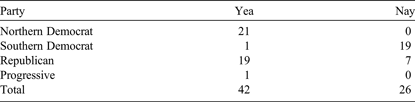
Eventually, on November 20, Connally forged an agreement with Barkley to bring the filibuster to an end and allow a cloture vote on the bill itself.Footnote 41 Per Senate Rule XXII (at the time), cloture only extended to measures, not motions; therefore, the Southerners had nothing to fear by continuing to filibuster. Their willingness to strike a deal was therefore an indication of how confident they were in winning the eventual cloture vote. After a short debate on the bill, the Senate on November 23 sought to shut off debate (invoke cloture) on H.R. 1024, but the vote failed 37 to 41.Footnote 42 The anti-poll tax forces could not even muster a majority, let alone the two-thirds necessary, to invoke cloture. The breakdown appears in Table 3. A majority of both Northern Democrats and Republicans supported cloture, but there were considerable defections (21 in all), whereas Southern Democrats were strongly united (only 3 defections) in opposition. And per the stipulations of the “gentleman's agreement” between Connally and Barkley—which Senator Allen Ellender (D-LA) revealed after the vote—the anti-poll tax bill would not be considered again for the remainder of the session.Footnote 43
The Southerners had emerged triumphant, which led Connally to remark: “Free debate, free speech, and the Constitution of the United States won a memorable victory.”Footnote 44 Anti-poll tax advocates outside of Congress were disappointed and quickly weighed in. Walter White, executive secretary of the NAACP, called the outcome “a rebellion against constitutional government by a handful of outlaws,” whereas the NCAPT opined that the cloture vote “dashed the hopes of 10,000,000 Negro and white voteless Americans for a share in our democracy,” but vowed to continue the anti-poll tax fight in the next Congress.Footnote 45
An anti-poll tax bill (H.R. 7), copying the Pepper language, was taken up again in the 78th Congress.Footnote 46 The House sponsor was Representative Vito Marcantonio (AL-NY),Footnote 47 a member of the American Labor Party (ALP).Footnote 48 Knowing that he faced hostile Judiciary and Rules Committees,Footnote 49 Marcantonio followed the same strategy laid out by Geyer in the prior Congress: he offered a resolution (H. Res. 131) to make H.R. 7 a special order of business, which was sent to the Rules Committee; he then started a discharge petition, and when the necessary 218 votes were reached more than 2 months later, he filed it and sought to discharge H. Res. 131 from the Rules Committee.Footnote 50 Debate on the discharge petition took place on May 24, 1943, and was relatively short, but caustic. Representative Edward Cox (D-GA) called the anti-poll tax effort a “sorry bid for the Negro vote,” whereas Representative John Rankin (D-MS), noting Marcantonio's political heritage, charged that “communism … is responsible for bringing this measure to the floor of the House, when everyone knows it violates the Constitution of the United States.”Footnote 51 These arguments aside, the motion to discharge passed, 268 to 110, as did the roll call on H. Res. 131 (265 to 105).Footnote 52 H.R. 7 was then considered the following day, and after limited debate it passed 265 to 110.Footnote 53 The roll calls on both discharge and final passage, which appear in Tables 1 and 2, reveal large majorities of Northern Democrats and Republicans opposing a large majority of Southern Democrats.
H.R. 7 was then sent to the Senate, where it stalled. Finally, after additional hearings, the bill was favorably reported out of the Judiciary Committee on November 12.Footnote 54 Before the Senate was ready to consider the legislation, however, two events occurred. First, in April 1944, a new Soldier Voting Act was adopted, which, although instituting a federal war ballot and maintaining a poll-tax exemption for servicemen, kept the power to determine eligibility requirements in state hands. (See the following section for a lengthy discussion.) Second, also in April 1944, the Supreme Court ruled on the legality of the white primary in Smith v. Allwright and judged it to be unconstitutional. Southerners interpreted these events as one victory and one defeat. Given the Court's ruling on the white primary, Southern senators now had extra incentive to protect their remaining set of Jim Crow institutions and form a united front against H.R. 7.Footnote 55
Finally, on May 9, 1944, Senator Pat McCarran (D-NV), chairman of the Judiciary Committee, moved to consider the legislation.Footnote 56 His motion carried, as, according to Keith Finley, “southerners proved so confident that they could defeat a cloture bid and so sure that their Senate colleagues lacked the will for a fight that they did not resist the effort to take up the bill.”Footnote 57 A filibuster against the bill then commenced, while Majority Leader Barkley worked with Southern senators to prepare a cloture petition.Footnote 58 A showdown vote was scheduled for May 15, and over the next few days, the debate raged, with Senator James O. Eastland (D-MS) now leading the Southern juggernaut against H.R. 7; arguments involved the now-ubiquitous unconstitutionality of the law as well as its connection to communism, which was first raised on the House side.Footnote 59 Finally, on May 15, the Senate moved to invoke cloture on H.R. 7, which failed 36 to 44.Footnote 60 As had occurred 2 years earlier, the anti-poll tax forces could not even manage a majority, let alone the two-thirds necessary, to shut off debate. The vote, which appears in Table 3, looks very similar to the roll call in 1942: a majority of both Northern Democrats and Republicans opposed a majority of Southern Democrats, but the anti-poll tax coalition suffered numerous defections (25 in total) whereas the Southerners remained strongly unified (only 2 defections). Speaking for the anti-poll tax forces outside of Congress, the NAACP's Walter White called the Senate's performance “a farce from start to finish.”Footnote 61
Undeterred by the prior year's outcome, Representative Marcantonio once again introduced his anti-poll tax bill (H.R. 7) on the first day of the 79th Congress, and the events played out almost exactly as in the previous Congress.Footnote 62 Marcantonio offered a resolution (H. Res. 139) to make H.R. 7 a special order of business, which was sent to the Rules Committee; he then started a discharge petition, and when the necessary 218 votes were reached more than 3 months later, he filed it and sought to discharge H. Res. 139 from the Rules Committee.Footnote 63 On June 10, 1945, the motion to discharge passed, 224 to 95, as did the roll call on H. Res. 139 (220 to 94).Footnote 64 H.R. 7 was then considered the following day, and after a short debate, it passed 251 to 105.Footnote 65 As in the prior Congress, the roll calls on both discharge and final passage, which appear in Tables 1 and 2, reveal large majorities of Northern Democrats and Republicans opposing a large majority of Southern Democrats.
The difference occurred in the Senate. On July 29, 1946, Majority Leader Barkley offered a motion that the Senate proceed to the consideration of H.R. 7, to which the chamber agreed, after which Barkley immediately moved to shut off debate.Footnote 66 Barkley and other party leaders were not optimistic about the cloture vote's chances—President Truman, for example, offered no meaningful support—but pressure from the NCAPT spurred him to make the effort.Footnote 67 What he did not want was to waste valuable floor time on debate, hence his quick procedural action. Barkley's cloture motion was considered on July 31, and it was defeated 39 to 33.Footnote 68 Although failing to garner the necessary two-thirds to end debate, the anti-poll tax forces finally managed a majority. As Table 3 indicates, fewer Northern Democratic and Republican defections were in evidence on the vote. Progress had been made. Comparing the three cloture votes in the table, a switch of 15 and 18 votes would have ended debate in the 77th and 78th Congresses, respectively, whereas a switch of only 8 votes would have ended debate in the 79th Congress.Footnote 69
Anti-poll tax advocates were upbeat as the 80th Congress convened. The Republicans had taken control of both the House and Senate for the first time in almost two decades, and the relatively close cloture vote in 1946 suggested that better days were ahead. On January 3, 1947, the opening day of the Congress, Representative George H. Bender (R-OH) introduced the anti-poll tax bill (H.R. 29) for the new majority party,Footnote 70 after which it was referred to the Committee on House Administration.Footnote 71 As the Republicans controlled the committees, a discharge petition was not necessary; on July 16, the bill was reported favorably out of committee and back to the floor.Footnote 72 Five days later, Representative Ralph Gamble (R-NY) moved to suspend the rules and pass H.R. 29, and, after a short debate, the measure passed 290 to 112 (meeting the two-thirds requirement).Footnote 73 As the roll-call breakdown in Table 1 indicates, the majority coalition of Northern Democrats and Republicans experienced only 15 defections. H.R. 29 was then referred to the Senate Committee on Rules and Administration.
On April 30, 1948, H.R. 29 was reported favorably and without amendment out of committee and back to the Senate floor.Footnote 74 On July 29, Senator Kenneth Wherry (R-NE) offered a motion to proceed to the consideration of H.R. 29, and debate commenced and covered a couple of days, with most of the discussion centering on the bill's constitutionality. On August 2, Wherry sought to shut off debate on the motion and proceed to the consideration of H.R. 29.Footnote 75 After some procedural clarifications, Senator Richard Russell (D-GA) then submitted a point of order against Wherry's attempt to invoke cloture, stating that Rule XXII (the cloture rule) applied not to motions but only to measures, and that a “motion to proceed” was not in fact a “pending measure.”Footnote 76 A short discussion followed on the meaning of the word “measure,” before Senator Arthur Vandenberg (R-MI), the president pro tempore, reluctantly (as he was a supporter of the anti-poll tax legislation) sustained Russell's point of order.Footnote 77 Vandenberg used this as an opportunity to call for filibuster reform, which would be instituted less than a year later, but the short-term result was that the Southerners had triumphed. Led by Russell, they had taken advantage of Senate rules to stymie the anti-poll tax movement yet again. Senator Robert Taft (R-OH) appealed Vandenberg's ruling, but it too was subject to unlimited debate. As a result, the Republicans admitted defeat and moved on to other things.Footnote 78
In the 81st Congress, the Democrats were back in control, having regained majorities in both chambers after the 1948 elections. But the anti-poll tax forces had one last battle left in them, and on March 3, 1949, Representative Mary T. Norton (D-NJ) introduced H.R. 3199, an anti-poll tax bill containing the same language as the Pepper Bill, and it was referred to the Committee on House Administration (where Norton was chair).Footnote 79 On June 24, it was favorably reported out of committee and referred to the Committee of the Whole.Footnote 80 On July 25, H.R. 3199 was made a special order—after the Rules Committee had failed to act on H. Res. 276, governing procedural consideration of H.R. 3199, for 21 days—which was adopted on a 265 to 100 roll call.Footnote 81 After a short debate, the bill passed 273 to 116.Footnote 82 The breakdown of this vote, which appears in Table 1, reveals again that a majority of Northern Democrats and Republicans opposed a majority of Southern Democrats (although the number of Republican defections increased somewhat). H.R. 3199 was then referred to the Senate Committee on Rules and Administration.
Once in the Senate, the bill languished in committee. In March 1949, a revision to the cloture rule in the Senate was completed; hearkening back to the 1947 anti-poll tax battle, the revision increased the threshold for shutting off debate from two-thirds of all members voting to two-thirds of the entire chamber (voting or not), but also extended the rule's provisions to include motions as well as measures.Footnote 83 (We cover this revision in more detail in the Fair Employment Practices Commission [FEPC] section.) Thus, while the “Russell Strategy” from 1947 would not work against H.R. 3199, achieving cloture was now more difficult as a higher bar was in place. As a result, according to Steven Lawson, “[Democratic leaders], wary of the increased difficulty in ending the filibuster, declined to call up the measure.”Footnote 84 The anti-poll initiative would thus die an ignominious death.
Norton's initiative in the 81st Congress would be the last statutory attempt to eliminate the poll tax. Beginning in the mid-1940s, a movement to adopt a constitutional amendment was underway, and converts came from both parties.Footnote 85 Some of the strongest converts were in fact Southern Democrats. Most Southern leaders viewed the poll tax itself as an anachronism (and an embarrassment),Footnote 86 but wanted any state-level repeals to be effected outside of federal authority. From their viewpoint, an act of Congress could potentially be the first gambit in a broader federal strategy to dismantle Jim Crow. A constitutional amendment, on the other hand, would eliminate the problem (the poll tax) but do it without federal interference (and all the subsequent problems that would entail). Therefore, led by Senator Spessard Holland (D-FL), a constitutional movement gained steam through the 1950s. Finally, a constitutional proposal banning the poll tax in national elections was passed in Congress in 1962 and ratified by a sufficient number (three-quarters) of states in 1964. This became the Twenty Fourth Amendment.Footnote 87
Soldier Voting and the Federal Ballot
With the United States' entrance into World War II in December 1941, Congress was confronted with the civil rights issue in a new and different way. The war meant that a non-trivial number of United States citizens—American servicemen—would be abroad during the upcoming 1942 election cycle. As a result, in the early months of 1942, concerns were raised about how these members of the armed forces would be able to participate in the upcoming elections.
As a policy guide for soldier-voting advocates, the most recent comparable example was in 1918 during World War I, when more than 2,000,000 voters were abroad on Election Day.Footnote 88 In that case, only two half-hearted attempts were made in Congress to regulate or oversee the soldier-voting process. Neither was successful. Moreover, the War Department took a largely hands-off approach by agreeing to cooperate with state efforts to collect soldier votes (either through state commissions set up in Europe, or via state-level absent-voting laws) and initiating no separate electoral procedures of its own. Difficulties in setting up state election commissions in military camps and few established state-level absent-voter laws specifically for soldiers meant that only a small fraction of American servicemen participated in the 1918 congressional elections.Footnote 89 For soldier-voting advocates in 1942, a reprisal of the 1918 outcome was unacceptable, and they began pressuring Congress to take a stronger role in the process.
The early months of 1942 saw little action at the federal level, as Congress focused on building up a domestic production machine for the war effort. Finally, on July 20, 1942, Representative Richard Ramsay (D-WV) introduced H.R. 7416, a bill to provide a method of voting in federal elections for American servicemen serving abroad during time of war.Footnote 90 More specifically, the bill would permit all military personnel who were absent from their given state of residence, but registered and electorally qualified, to vote in elections for president, vice president, senators, and representatives. H.R. 7416 was sent to committee and reported back a day later without amendment.Footnote 91 Two days later, the House agreed to consider the Ramsay Bill under open rule, and debate began.Footnote 92 Southern Democrats, led by Representative John E. Rankin (D-MS), objected to the federal government's “intrusion” into elections, which they believed under the Constitution were the sole responsibility of the states. However, the Ramsay Bill, as written, would have placed control of the so-called “war ballots” in the hands of the states themselves.Footnote 93 This stipulation, once understood, largely mollified Southern representatives.Footnote 94 The one hitch occurred when Representative Estes Kefauver (D-TN) offered an amendment that would have eliminated any poll tax requirement for soldiers to vote. Kefauver argued that “if we feel that these boys are capable of serving on the battlefield to protect us and this country, we ought to feel that they are capable of voting in an election without registration and without a poll tax.”Footnote 95 Despite his plea, the amendment failed on a 33 to 65 division vote.Footnote 96 After additional tinkering, the Ramsay Bill—largely and substantively unaltered—passed on a 134 to 19 division vote.Footnote 97 The bill was then referred to the Senate Committee on Privileges and Elections.
On August 17, the Ramsay Bill (H.R. 7416) was reported out of committee with amendments.Footnote 98 The chief amendment was a more explicit protection of states' rights, namely that requirements such as the poll tax would be left untouched. Once reported, a vigorous debate ensued with passionate arguments on both sides, ranging from the need to allow soldiers who were risking their lives for democracy to vote to the desire to uphold the sanctity of the Constitution and the rights of states.Footnote 99 On August 24, a critical point was reached when Senator C. Wayland Brooks (R-IL) offered an amendment to the committee bill that hearkened back to the failed Kefauver amendment in the House.Footnote 100 The text of the amendment read “No person in military service in time of war shall be required, as a condition of voting in any election for President, Vice President, electors for President or Vice President, or for Senator or Member of the House of Representatives, to pay any poll tax or other tax or make any payment to any State or political subdivision thereof.”
In adopting the anti-poll tax language of the Kefauver Amendment, Brooks upped the ante and challenged the Southerners to risk the passage of the Ramsay Bill to protect their Jim Crow institutions. Majority Leader Barkley urged Brooks to withdraw his amendment, fearing that its inclusion could sink the entire bill,Footnote 101 but Brooks was unmoved.
The next day, August 25, voting was set to commence, when an additional amendment was offered by Senator John Danaher (R-CT), who sought to extend soldier voting rights to “primary elections, nominating conventions, and caucuses,” as the generic language of “elections” in the underlying bill was believed to refer only to general elections.Footnote 102 Although this served as another threat to Jim Crow, as primaries were the true locus of electoral power in the South at the time, Keith Finley notes that Southern Democrats realized that “the bill would not become law until after the southern states held their primaries that year,” which meant that they would not need to worry about the potential law's effect on primary elections for another 2 years, by which time, many felt, the war would be over.Footnote 103 The proximate threat, as Barkley had warned, was the anti-poll tax amendment, as it would affect general elections in November.
Faced with a threat to their Jim Crow system, Southern Democrats considered using a filibuster, the same device they had used effectively in 1938 to shut down the attempt to pass antilynching legislation.Footnote 104 Instead, they allowed the measure to come to a vote. They did this, according to Finley, because “a filibuster against a bill providing absentee ballots to servicemen would appear unpatriotic and could alienate northern colleagues.”Footnote 105 Southerners realized that they would need to be strategic in their opposition to civil rights and allow certain limited initiatives to come to a vote, so as to reserve their serious stonewalling tactics for cases of broader concern, such as more general anti-poll tax bills (which would cover all citizens in peace as well as war) and fair employment legislation, which would more directly threaten Jim Crow.
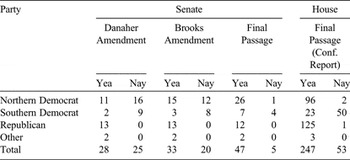
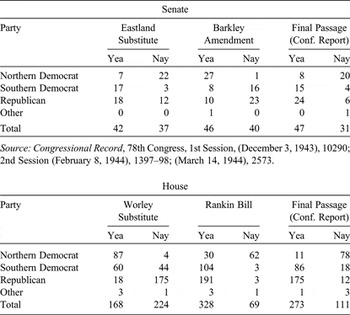
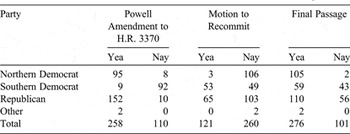
On August 25, the Danaher Amendment was considered first, and it passed 28 to 25; the Brooks Amendment then came to a vote, and it passed 33 to 20; and finally the amended Ramsay Bill was considered and it passed 47 to 5.Footnote 106 The partisan breakdown of these 3 votes appears in Table 4. Northern and Southern Democrats largely voted together to oppose extending soldier voting rights to primary elections, but enough Northern Democrats defected and joined with the unified group of Republicans (and independents) to pass the Danaher Amendment. A majority of Northern Democrats then joined with the Republicans, against a majority of Southern Democrats, to adopt Brooks' anti-poll tax amendment. With both amendments in place, Southern Democrats largely gave up their opposition, and a majority joined with the nearly-unified coalition of Northern Democrats and Republicans to pass the amended Ramsay Bill.
Congressional Roll Calls on Soldier Voting (Ramsay Bill), 77th Congress.

Source: Congressional Record, 77th Congress, 2nd Session, (August 25, 1942), 6962, 6971, 6972; (September 9, 1942): 7079.
The Senate then insisted that its changes be adopted and requested a conference with the House, to which the House agreed.Footnote 107 On September 9, the House considered the conference report, which in the end was the same as the Senate version of the bill (as the House conferees agreed to the Senate amendments).Footnote 108 After a reprise of the chamber's earlier debate, the House passed the conference bill, 247 to 53.Footnote 109 As Table 4 indicates, a nearly unified group of Northern Democrats and Republicans opposed a majority of Southern Democrats in adopting the conference report. Three days later, the Senate briefly discussed the matter before agreeing to the conference report without a recorded vote.Footnote 110 The bill was then presented to President Roosevelt, who signed it into law (Public Law 712) on September 15.Footnote 111 The Ramsay Act (or Soldier Voting Act of 1942) would thus govern soldier voting in the November 1942 midterm elections, which were less than 2 months away.
Republican strategy on soldier voting in 1942, especially with regard to the anti-poll tax provision, was designed by Representative Joe Martin (R-MA), who in his role as national committee chairman sought to reach out to black voters and make the Party competitive once again in the black community.Footnote 112 Martin believed that representing blacks' interests and exposing the Democrats' regional rift on civil rights could only help Republicans at the polls. And a general uptick in the black vote for the Republicans did occur in the 1942 midterm elections. This was the result, according to NAACP Director Walter White, of the positive stances taken by Republicans on black issues relative to the many negative stances taken by Southern Democrats; he also warned, however, that future black support for the Republican Party could not be taken for granted, in part because he believed that a regular alliance between “reactionary” Republicans and Southern Democrats was emerging.Footnote 113 White would prove to be prescient.
The subsequent public assessment of the Ramsay Act would be largely negative. The cumbersome institutional design (and admittedly short period of implementation) would result in minimal participation by servicemen in the 1942 elections. Only 137,686 applications for war ballots were received by the War Department, and only 28,051 soldiers submitted their war ballots in accord with their respective state laws.Footnote 114 Given that there were between 4,000,000 and 5,000,000 American servicemen abroad, this incredibly low level of soldier participation was considered unacceptable, especially at the highest levels of the federal government.Footnote 115 As Robert A. Garson notes: “The president was embarrassed at this denial of suffrage and accordingly urged Congress to pass a new bill that would avoid these pitfalls.”Footnote 116
A new Soldier Voting Act would be adopted in 1944, replacing the 1942 Act, but the design of the legislation would stray considerably from the preferences of President Roosevelt and his Northern Democratic allies.Footnote 117 The guiding force for the new legislation would be the Republicans, who now viewed a coalition with the Southern Democrats as a better vehicle for serving their interests. Roland Young summarizes the strategic positions of the three groups in Congress, as they looked ahead to the next round of legislative wrangling over the soldier vote. “The Northern Democrats wanted a federal ballot, which would make it easy for soldiers to vote for the presidential candidate. The Republicans wanted a State ballot, which would give the soldiers greater opportunity to vote for State officials as well as the presidential candidate. The Southern Democrats also wanted a State ballot, so that the States would continue to regulate the standards of residence, registration, and voter eligibility.”Footnote 118
In addition, according to Young, the Republicans were “less willing [than in 1942] to waive state regulations if the results would make it easier for a Democrat to be elected president.”Footnote 119 Republican leaders, such as Senator Robert Taft (OH), knew that President Roosevelt would likely benefit from easier federal soldier voting rules, as servicemen by late-1943 tilted toward Roosevelt and the Democratic Party.Footnote 120 Therefore, for Taft, stipulations that would dampen the soldier vote, especially as Republicans sought to pick up seats in Congress and vie for the presidency in 1944, made sense and were worth the potential costs.Footnote 121
A drive to amend the Ramsay Act began to gain momentum in late 1943, during the first session of the 78th Congress. The House and Senate held hearings in October and November,Footnote 122 and an initial showdown was set up before the Christmas break. The stakes were considered to be high. Correspondent Allen Drury, covering the Senate drama for the United Press, was told by a more seasoned news reporter that “the fight boils down to the fact that the Democrats think they can win the coming Presidential election if they have the soldier vote and the Republicans think they can win if they can manage to cut it off.”Footnote 123
The leaders of the new federal soldier voting legislation—and therefore the standard-bearers for Roosevelt and his administration—were Theodore Francis Green (D-RI) and Scott Lucas (D-IL) in the Senate and Francis E. Worley (D-TX) in the House. Senators Green and Lucas would move first by introducing their bill on June 29, 1943.Footnote 124 Favorably reported out of committee on November 15, the Green–Lucas bill (S. 1285) proposed to amend the Ramsay Act by inserting sweeping new federal provisions into the voting process for servicemen.Footnote 125 At the heart of the bill was the creation of a five man War Ballot Commission to manage and administer the new voting system, with four members appointed by the president (and constrained to be two Democrats and two Republicans) and the fifth member being the Chief Justice of the Supreme Court. This War Ballot Commission would distribute federal ballots in advance of presidential, House, and Senate elections,Footnote 126 and all members of the armed services, as well as merchant marines and United States civilians working overseas,Footnote 127 would be instantly eligible (that is, they would not first be required to apply to their state's secretary of state for an absentee ballot). In addition, potential voters from states with a poll tax requirement would have said requirement waived (in keeping with the stipulation in the original Ramsay Act). Finally, completed ballots (which would be double-sealed to preserve secrecy) would be returned to the War Ballot Commission, which would organize and deliver them to the appropriate states.
Debate commenced on November 22, and lasted on and off for almost 2 weeks.Footnote 128 Southern Democrats were outraged by the Green–Lucas bill, and led by Senators James O. Eastland (MS) and “Cotton Ed” Smith (SC), they denounced their Northern wing's attempt to “federalize” the election process. Although occasional racial demagoguery seeped into the debate, Southern orators structured their arguments on constitutional grounds, by claiming that Congress was usurping the states’ rights (as laid out in Article I, Section 2) to determine voter qualifications. Beneath these constitutional arguments, however, lurked a baser concern. As Boyd A. Martin states: “Once the authority of Congress was extended to determine suffrage qualifications, on lines of the state poll-tax features of the Green–Lucas bill, the states would lose their power to prevent universal suffrage.”Footnote 129 Southerners reacted as if their entire Jim Crow system was under assault, even as most objective observers felt that the bill's main effect would be to remove bureaucratic impediments to soldier voting rather than broaden the base of the Southern electorate. For Eastland, Smith, and other Southern senators, however, the Green–Lucas bill represented the first domino, as “even a slight change in the election laws could pave the way for the eventual enfranchisement of the Negro.”Footnote 130
Rather than resort solely to a negative, Constitution-based argument, Southerners went on the offensive. Led by Senators Eastland, John L. McClellan (D-AR), and Kenneth McKellar (D-TN), a substitute amendment to the Green–Lucas bill was offered on December 1.Footnote 131 The Eastland–McClellan–McKellar substitute was a pure states' right alternative to Green–Lucas. Individual states, not the federal government, would be wholly responsible for all aspects of elections. The states would be encouraged to revise their election laws to enable citizens to vote in both federal and state elections. The states would also be responsible for printing postcards that servicemen could use to acquire absentee ballots; said postcards would be sent directly to the Secretaries of War and the Navy for distribution to their respective military units. Servicemen would then request an absentee ballot from their particular state by filling out and mailing back the postcard (free of charge); ballots would then be processed by state election officials.
Apart from placing all election authority in the hands of the states, the Eastland–McClellan–McKellar substitute had a practical limitation (or benefit, from Southerners' perspective). State legislatures were afforded little time to alter their election laws and institute the necessary ballot structure. And only nine state legislatures were scheduled to convene in 1944. Special sessions would need to be organized quickly, and many states would in all likelihood forego such attempts. Therefore, the Eastland–McClellan–McKellar substitute, if adopted, could greatly reduce the soldier vote in 1944. For Southern senators, this was a small price to pay to maintain firm control over their electoral institutions.Footnote 132
After nearly 2 days of contentious debate, the Eastland–McClellan–McKellar substitute was considered and passed on a 42 to 37 vote.Footnote 133 The partisan breakdown of the vote appears in Table 5. Unlike 1942, a majority of Southern Democrats joined a majority of Republicans in opposing a majority of Northern Democrats. A “conservative coalition” had formed for disparate reasons; Republicans sought to limit national Democratic electoral power, whereas Southern Democrats endeavored to maintain Jim Crow and restrict black voting rights. S. 1285, now embodying the language of the Eastland–McClellan–McKellar substitute, was then sent to the House and referred to committee.
Congressional Roll Calls on Soldier Voting (S. 1285), 78th Congress.

Source: Congressional Record, 78th Congress, 2nd Session, (February 3, 1944), 1228–30; (March 15, 1944), 2639.
On January 17, a slightly revised version of S. 1285—dubbed the “Rankin Bill,” for Representative John Rankin (D-MS), who would shepherd the bill through the House—was reported out of committee, and on February 1, 1944, the House took up the legislation.Footnote 134 Rankin announced that debate time would be split evenly between advocates of S. 1285 and advocates of H.R. 3982, the Worley Bill (and House analogue of the Green–Lucas Federal Soldier Voting Bill). Debate commenced and concluded on February 3,Footnote 135 when the Worley Bill was offered as a substitute to the Rankin Bill. The Worley substitute failed 168 to 224, after which the Rankin Bill passed 328 to 69.Footnote 136 The partisan breakdowns appear in Table 5. A majority of both Northern and Southern Democrats voted in favor of the Worley substitute, against a nearly unanimous majority of Republicans. But enough Southern Democrats withheld their support to sink the bill. When the chamber turned to the Rankin Bill, the predicted conservative coalition formed, and a near-unanimous majority of Southern Democrats joined with a large majority of Republicans to defeat a majority of Northern Democrats. In the end, the Rankin Bill's alterations to the original S. 1285 were minimal, and did little more than offer “recommendations” to the states about their electoral machinery and adopt timing deadlines for postcard applications.Footnote 137
The slight majority of Southern Democrats in favor of creating a federal soldier voting law—that is, in support of the Worley Bill—may have been the result of presidential pressure. A little more than a week earlier, on January 26, Roosevelt communicated his displeasure to Congress about the course of soldier voting legislation. The president called the Senate measure (the Eastland–McClellan–McKellar substitute, now embodied in S. 1285) “a fraud on the soldiers and sailors and marines … [in that] it would not enable any soldier to vote with any greater facility than was provided by Public Law 712 (the 1942 Act) under which only a negligible number of soldiers' votes were cast.”Footnote 138 He also used the opportunity to lobby on behalf of the Worley Bill and a “new” Green–Lucas bill (S. 1612) in the Senate, which incorporated many of the same tenets as the original version. Whereas Roosevelt's “going public” ploy failed to swing enough votes behind the Worley Bill, positive momentum for federal soldier voting legislation was building in the Senate. On February 7, the House revision of S. 1285 (the Rankin Bill) was sent back to the Senate and considered on the floor the following day.Footnote 139 Amid debate, attempts to re-inject federal provisions were made. Chief among them was Majority Leader Barkley's amendment that federal ballots be provided to servicemen, merchant marines, and United States citizens working abroad if state ballots were not available to them (either because of state law or tardiness of delivery). Barkley's amendment was viewed as a “modified” Green–Lucas bill, and with President Roosevelt's tongue-lashing still fresh in senators' minds, it passed 46 to 40.Footnote 140 The breakdown appears in Table 5. This was another conservative coalition vote, as a majority of Northern Democrats opposed a majority of both Republicans and Southern Democrats. The amendment passed because of the near-perfect unity among Northern Democrats and a scattering of support from Southern Democrats and Republicans.Footnote 141
The House was unwilling to accept the Barkley Amendment to S. 1285 and asked for a conference, to which the Senate agreed.Footnote 142 And after disputes about whether committee seniority or subcommittee membership should be the primary criterion for selection, ten conferees were chosen, five from each chamber: Worley, Rankin, Herbert Bonner (D-NC), Karl LeCompte (R-IA), and Mathew Ellsworth (R-OH) from the House, and Green, Tom Connally (D-TX), Carl Hatch (D-NM), Warren Austin (R-VT), and Hugh Butler (R-NE) from the Senate.Footnote 143 This conference slate—believed to be evenly split between pro- and anti-federal ballot members—was viewed by many as a blow to those who hoped to obtain a federal ballot with “teeth,” and Rankin announced his belief that such a plan was unlikely.Footnote 144
On March 9, the conference report was submitted to the Senate.Footnote 145 It was viewed as a federal–state compromise that favored the states. A federal ballot would be created, which would cover servicemen, merchant marines, and United States citizens working overseas, for general as well as primary and special elections. But its opportunity for use was considerably limited. In order for an individual to receive a federal ballot, two conditions were necessary: (1) the governor in the respective state would need to certify by July 15 that a federal ballot was authorized for use in the state's elections, and (2) said individual would need to apply for a state absentee ballot by September 1 and attest to have not received said ballot by October 1. The biggest sticking point was the first condition, as state governments could prohibit the use of federal ballots in their states by simply not adopting the necessary enabling legislation. Southerners would thus be able to protect and maintain their state electoral institutions.
After some often heated debate, on March 14, the Senate adopted the conference report on S. 1285 on a 47 to 31 roll call.Footnote 146 The breakdown of the vote appears in Table 5. A conservative coalition appeared once again, as a majority of both Southern Democrats and Republicans opposed and defeated a majority of Northern Democrats. The House, after some perfunctory debate, adopted the conference report the follow day by a sizeable margin, 273 to 111.Footnote 147 The same conservative coalition was in evidence on this vote. The enrolled conference bill was then presented to the president on March 21, but after conferring with state governors about the likelihood that federal ballot confirmation could be achieved by July 15 (and receiving a majority of “negative” replies), Roosevelt opted to allow the bill to become law without his signature.Footnote 148 Thus, S. 1285 became Public Law 227 on April 1, 1944.Footnote 149
Public Law 227 had the effect of amending Public Law 712 (the Ramsay Act), by striking out Sections 3–15 and replacing them with the text of the conference report on S. 1285. Sections 1 and 2 of Public Law 712 were left intact, and Section 2 included the anti-poll tax stipulation that had so irritated Southern Democrats. And although they believed (and continued to argue) that the Section 2 stipulations were unconstitutional, Southern politicians felt it would be prudent to sidestep any potential constitutional challenges for the immediate period. Therefore, the Southern states that still used a poll tax adopted legislation or state constitutional amendments to exempt military servicemen.Footnote 150 Other Jim Crow restrictions such as literacy/comprehension tests and residency/record-keeping requirements, as well as more blatant acts such as failing to mail/distribute the state absentee ballots, could still be used in the interim.
In the end, only twenty of the forty-eight states certified the federal war ballot, and only a handful of these were Southern states.Footnote 151 The availability of the federal ballot also had little effect on the 1944 election. As Theodore Penton notes, servicemen returned 2,793,203 absentee ballots (after receiving 4,110,767) but only 108,692 federal ballots, which meant that the federal ballot represented less than 4 percent of all military ballots cast.Footnote 152 And, finally, the two bedfellows in the fight against the federal war ballot fared differently in the aftermath. The Southern Democrats received immediate gratification and trumpeted Public Law 227 as a victory for white supremacy,Footnote 153 whereas the Republicans lost their gamble, as Roosevelt was reelected and the Democrats picked up a number of seats in Congress. Moreover, by entering into a coalition with Southern Democrats to limit black voting rights, the Republicans stepped away from the careful cultivation of black voters that Joe Martin had pursued in the early 1940s. The black press and black interest groups reacted angrily toward the Republicans, and party leaders, such as Robert Taft, attempted to assuage them.Footnote 154 In many ways, however, irreparable damage had been done.
The Fair Employment Practices Commission (FEPC)
At the same time Congress was struggling with questions of political equality for blacks, domestic labor unrest brought the issue of economic equality to the forefront and opened up a “second front” in the campaign for black civil rights. In early 1941, A. Philip Randolph, president of the Brotherhood of Sleep Car Porters, threatened to organize 100,000 black citizens for a march on Washington to protest discrimination in employment and the armed forces.Footnote 155 The war in Europe loomed large in the administration's reaction to Randolph, as advisers warned President Roosevelt that such a large protest would highlight domestic troubles “at a time when a semblance of unity was most essential to national prestige.”Footnote 156 Additionally, a protest of this size, when combined with pre-existing racial instability in the nation's capital, threatened to generate violence and mass disorder.Footnote 157
In response, on June 25, 1941, President Roosevelt issued Executive Order 8802 to formally prohibit “discriminatory employment practices because of race, color, creed or national origin in government service, defense industries, and by trade unions.”Footnote 158 The order declared it “the duty of employers and of labor organizations…to provide for the full and equitable participation of all workers in defense industries, without discrimination because of race, creed color, or national origins.”Footnote 159 To administer this prohibition, E.O. 8802 created the non-salaried, five-man FEPC, located within the Office of Production Management, and authorized it to “receive and investigate complaints of discrimination” and to “take appropriate steps to redress valid grievances.”Footnote 160
The issuance of E.O. 8802 by Roosevelt was monumental, as Robert A. Garson notes: “For the first time since Reconstruction, a president had made open cause with civil rights groups.”Footnote 161 That said, Roosevelt acted strategically, issuing the order only after Randolph's threat. More specifically, E.O. 8802 was meant to ameliorate black citizens (as a tool to “reduce, deflect, and absorb discontent”) rather than to serve as an actual policy solution to the problem of employment discrimination; it was also intended simply to be a war order, and therefore its provisions would only persist through the conclusion of hostilities.Footnote 162 As a consequence, the FEPC proved institutionally weak, and by 1945 Southern Democrats who viewed job segregation as the “linchpin of racial apartheid in the South” successfully defunded it.Footnote 163
This was not the end of the story, however, as E.O. 8802 initiated an important policy feedback loop. Specifically, Roosevelt's order led to the “formation of a new, sprawling bloc of liberal interest groups that campaigned to resuscitate the FEPC.”Footnote 164 By 1944, for example, four members of Congress—three Democrats and one Republican—introduced legislation to create a permanent FEPC.Footnote 165 The NAACP, the National Urban League, a variety of Jewish and Christian organizations, and labor unions such as the Congress of Industrial Organizations (CIO) were also involved in the push for new fair employment legislation and a permanent FEPC.Footnote 166 Moreover, whereas Roosevelt's “temporary” FEPC did not have formal powers to punish those guilty of discrimination, it performed a series of well-publicized investigations into discriminatory employment practices. This publicity, according to Louis Ruchames, led some employers to abandon their discriminatory practices, while mobilizing black voters who had faith “in the eventual realization of the [FEPC's] main objective.”Footnote 167 Thus, the FEPC, although provisional in scope, helped create through its own actions a demand for a permanent charter.
With supporters of fair employment inside Congress and an active constituency outside Congress, FEPC advocates instigated two periods of intense wrangling (in 1945–1946 and 1949–1950) over legislation that would have created a permanent FEPC with stronger enforcement powers than the one initiated by E.O. 8802. During each episode, Southern Democrats used filibusters and other dilatory tactics to prevent the bill from passing, whereas Republicans sought to signal their support for civil rights by backing measures that would have reformed the parliamentary tactics used so skillfully by the Southern Democrats, even as they voted against the Northern Democrats' FEPC measures.Footnote 168 The political struggle over FEPC legislation, therefore, provides insights into the continuing process of partisan realignment driven by debates over civil rights.
FEPC Episode 1: 1945–1946
By 1945, members of both parties who supported the FEPC recognized the need for legislation that would make the body permanent. Within a month of the beginning of the 79th Congress, five Republicans and six Democrats had individually introduced FEPC legislation,Footnote 169 with party affiliation having no impact on the language of the policy proposed. As Representative Mary Norton (D-NJ), chair of the House Labor Committee, argued in the Committee report, “the provisions of ten of these bills are identical…[and] the bill…introduced by the chairman was based very largely on the provisions of the above identical bills.”Footnote 170 On February 16, 1945, Representative Norton introduced one piece of FEPC legislation (H.R. 2232) that combined aspects of each of these bills.Footnote 171 The “Norton Bill” outlawed discrimination in employment “by private employers, labor unions, and agencies of the federal government” and created a five-member “quasi-judicial agency” empowered to issue cease-and-desist orders to those practicing employment discrimination, to subpoena those suspected of discrimination, and to “issue regulations necessary to carry out the provisions of the act.”Footnote 172
In working to bring H.R. 2232 to the floor for a vote, Representative Norton was eventually stymied by the Southern-controlled Rules Committee. Undeterred, Norton attempted to force the bill out of committee with a discharge petition, which was filed on April 27, 1945.Footnote 173 By December, however, Norton's petition had gathered only 157 signatures, and Representative Al Gore (D-TN) blamed its stalled progress on the Republican Party, noting that only 50 of the signatures were Republican even though there were 190 Republicans in the House.Footnote 174 In response, Minority Leader Joseph Martin (R-MA) cited the unanimous Republican support within the Rules Committee for a special rule, but offered neither an explanation for the 140 missing signatures nor an argument on behalf of the Norton Bill.Footnote 175
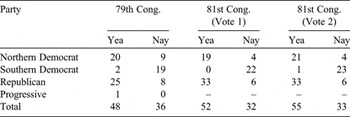
At approximately the same time, Southern Democrats in the Senate won enough Republican support to attach anti-FEPC amendments to H.R. 3368 (the 1945 War Agencies Appropriations Bill). On June 30, debate commenced on an amendment offered by Majority Leader Barkley (D-KY) to cut FEPC appropriations for 1946 from $446,000 to $250,000. As Barkley made clear, this amendment served as a compromise to both fund the FEPC and avoid a protracted debate that threatened to leave important war-related agencies without funding.Footnote 176 Senator Dennis Chavez (D-NM), the FEPC's chief advocate in the Senate, did not prevent a vote on the Barkley compromise, and it passed 42 to 26.Footnote 177 As Table 6 documents, the amendment garnered broad support from Northern Democrats and Republicans, whereas Southern Democrats who sought to liquidate the FEPC opposed the compromise measure.
Senate Vote on Compromise FEPC Funding Measure, 79th Congress.
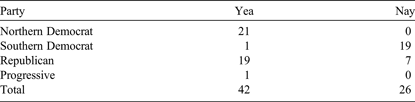
Source: Congressional Record, 79th Congress, 1st Session, (June 20, 1945), 7065.
After successfully slashing FEPC funds, House opponents then moved to kill the Commission entirely. In July 1945, Representative Francis Case (R-SD) offered an amendment to the same War Appropriations Bill to prohibit any money from being spent on the FEPC after June 1946 unless Congress passed legislation making the body permanent. This amendment passed 142 to 116.Footnote 178 Soon thereafter, the Senate approved H.R. 3368 with the House language, and on July 15, 1945, the measure became law. By December, all but three of the FEPC's field offices had closed and most of its staff had left.Footnote 179
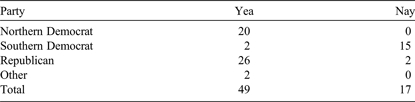
When Congress reconvened in 1946, Senator Chavez renewed the FEPC debate with a “surprise move that some senators called trickery.”Footnote 180 On January 17, 1946, after the Senate dispensed with morning business, Chavez was recognized and requested that the Senate move to consideration of S. 101, his FEPC proposal. The Chavez Bill, like Norton's proposal in the House, would have gone beyond E.O. 8802 by prohibiting discrimination in private firms and labor unions and by imbuing the FEPC with strong investigatory and enforcement powers.Footnote 181 To force debate, Chavez utilized a “little-used rule” that stipulated that “motions for consideration made before 2 p.m. are not debatable,” and therefore not susceptible to a filibuster.Footnote 182 Southerners protested angrily and claimed that Majority Leader Barkley had promised them that no controversial matter would be presented during the first months of the new session.Footnote 183 Chavez's motion was affirmed on a 49 to 17 roll call; as the vote breakdown in Table 7 indicates, all Northern Democrats and all but two Republicans joined to force a debate on FEPC legislation.Footnote 184
Senate Vote on Motion to Proceed to Chavez Bill, 79th Congress
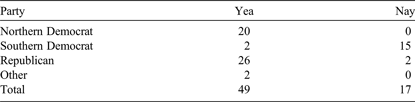
Source: Congressional Record, 79th Congress, 2nd Session, (January 17, 1946), 81.
Almost immediately, Southern Democrats made clear their intent to filibuster the measure, led by Senators James Eastland (D-MS), John Bankhead (D-AL), and Theodore Bilbo (D-MS) who announced that they would speak for “30 days at a time.”Footnote 185 During the debate itself, Southern Democrats attacked the FEPC with arguments similar to those used against other civil rights initiatives (such as anti-poll tax legislation). Eastland invoked the threat posed by a large central government and argued that “under the bill, all industry in this country will be nationalized, and we will have bureaucratic control of the whole economic life of the United States.”Footnote 186 Senator Pappy O'Daniel (D-TX) characterized the FEPC bill as a “nefarious, communistic, brain abscess,” and stated that the FEPC represented “a fight between the Republicans of the North and the northern Democrats who wish to get themselves reelected, reelected, and reelected by virtue of the minority votes which come from the members of the Negro race.”Footnote 187 Senator John Overton (D-LA) echoed O'Daniel's claim and characterized the bill as a malicious attempt to “enable the National Democratic administration to hold within its ranks Negro votes from pivotal states.” He went on to argue that black voters would be forever loyal to the Republican Party because of a collective “sense of gratitude” for its antislavery efforts; therefore, the Democrats were wrong to court them. And he closed by proclaiming, “we do not want the Negroes in the party. They do not belong in the Democratic Party.”Footnote 188
In response to Overton, Senator Homer Capehart (R-IN) replied that “we in the Republican Party want the votes of the Negroes of America because they are Americans.”Footnote 189 Overton's claim also led Senator James Mead (D-NY) to articulate why black voters had found a home in the Democratic Party. “In New York,” Mead argued, “the Negro supported the successive administrations of Franklin Delano Roosevelt because he realized that in his day, President Roosevelt had the well-being of the Negro at heart, just as did Lincoln when he was alive.”Footnote 190
This very explicit debate regarding the FEPC and the representation of black interests suggests that while the historic linkage between black voters and the Republican Party no longer existed, it had not been replaced by a durable, inter-racial Democratic coalition. Republicans took steps in the early 1940s to signal their support for civil rights issues; Joe Martin's efforts as national chairman have already been mentioned (in the prior section). In addition, the Republican Party in 1944 added a plank to its platform calling for “the establishment by Federal legislation of a permanent Fair Employment Practice Commission.” The Democratic Party platform made no mention of the FEPC and remained vague on civil rights generally by stating “racial and religious minorities have the right to live, develop and vote equally with all citizens and share the rights that are guaranteed by our Constitution. Congress should exert its full constitutional powers to protect those rights.”Footnote 191 The Republican's platform change followed Republican gains in the 1942 election—forty-four House seats and seven Senate seats—which some attributed to the newfound support of black voters unhappy with the Democrats' inability to pass civil rights legislation.Footnote 192 Although the NAACP warned Republican leaders that the 1942 elections did not signal a durable shift toward their party, some political observers believed otherwise and predicted “a reversion of the Negro vote to the Republican column.”Footnote 193
It is important, therefore, to view the Republican Party's legislative strategy on the FEPC with this coalitional dynamic in mind. Republican Steering Committee Chair Robert Taft's (R-OH) position-taking on the FEPC is particularly illustrative of party efforts to cautiously reach out to black voters while attempting to adhere to conservative doctrine. Taft, along with 25 fellow Republicans, supported Chavez's parliamentary maneuver to begin debate on the FEPC bill in January 1946.Footnote 194 In response to the Southern Democrats' filibuster, Taft pushed for cloture. His reasons, however, did not grow out of his support for the underlying bill. Instead, Taft said, “I will always vote for cloture on any bill, whether I approve of it or no, when I feel that the debate has been sufficiently long to enable both sides to fully present their views…I say that because I am convinced that when two-thirds of the membership of the Senate favors a certain measure, if one-third can block a vote on the measure the Senate will render itself completely futile, and in the end will discredit Congress.”Footnote 195
Six days later, Taft voiced support for the intent of the FEPC by noting that “in most cities the average income of the Negroes is considerably lower than the average income of white people,” and that “discrimination in employment makes it very difficult for colored people to make their living in honest ways.”Footnote 196
Despite his positions on cloture and the social costs of discrimination, Taft did not support the Chavez Bill. Instead, he used floor speeches such as those cited previously to highlight the plight of black citizens and to call for a voluntary FEPC without enforcement power. Explaining his position, Taft argued that the Chavez bill violated “every principle that I had declared as a Republican…on the general subject of the regulation of business and the extension of the arbitrary power of the government,” but that his substitute amendment to create a voluntary commission avoided these problems.Footnote 197 Other Republican senators adopted a similar approach.Footnote 198
In the end, Southern Democrats marshaled the support needed to sustain the filibuster. On February 9, 1946, a cloture motion was defeated 48 to 36.Footnote 199 As Table 8 illustrates, a majority of both Northern Democrats and Republicans opposed nearly all Southern Democrats (only 2 defections). Eight Republicans, however, voted with the Southern Democrats to oppose cloture. This is important, as these 8 Republicans were pivotal to the outcome.Footnote 200 If they had instead supported cloture, the motion would have achieved the necessary two-thirds (and passed with 56 votes). This suggests strategic action on the part of Republicans. That is, although an overwhelming number supported cloture, thereby allowing them to credibly claim that they wanted a debate on the FEPC, they simultaneously provided just enough support to Southern Democrats to prevent consideration of the Chavez measure.
Cloture Votes on FEPC Bills in the Senate, 79th and 81st Congresses.

Source: Congressional Record, 79th Congress, 2nd Session, (February 9, 1946), 1219; Congressional Record, 81st Congress, 2nd Session, (May 19, 1950), 7299; (July 12, 1950), 9982.
FEPC Episode 2: 1949–1950
After the prolonged debate over the FEPC in 1945–1946 no new legislation made it beyond the committee stage until 1949–1950. President Truman used his State of the Union Address in 1949 to direct Congress to pass his civil rights program—which included a permanent FEPC.Footnote 201 Following Truman's appeal, Senator J. Howard McGrath (D-RI) and Representative Adam Clayton Powell (D-NY) each introduced legislation (S. 1728 and H.R. 4453) identical to the bills debated during the 1945–1946 episode.Footnote 202 Before Congress proceeded to consider these proposals, however, members in both chambers sought to amend chamber rules in ways that would prevent civil rights legislation from being stalled procedurally; specifically, filibuster reform was initiated in the Senate, and a new 21-day rule was adopted in the House. As both measures are directly related to the FEPC fight, we will briefly consider them before examining the debate on the bills themselves.
On January 5, 1949, during the first week of the 81st Congress, Senator Wayne Morse (R-OR) introduced S.J. Res. 12 and Senators Leverett Saltonstall (R-MA), William Knowland (R-CA), and Homer Ferguson (R-MI) introduced S.J. Res. 13, each of which aimed to reform the Senate's filibuster rules by extending them to “any matter pending before the Senate.” The primary distinction between these proposals centered on the requirement for cloture. Whereas the Morse resolution called for a simple majority vote to invoke cloture, the Saltonstall–Knowland–Ferguson resolution called for a two-thirds majority.Footnote 203 Despite these differences, Morse explained that there existed “no division [among Republicans] as to the desirability and necessity…of having an antifilibuster resolution adopted at the earliest possible date.” Instead it was the Democrats, he argued, who constructed the “barriers and blocks which have been thrown in the way of an antifilibuster resolution.”Footnote 204 Echoing Morse, Knowland stated that “on this side of the aisle…[we] came out with the unanimous opinion that it should be Republican policy to take steps necessary to try to force action on an antifilibuster resolution.”Footnote 205 These remarks put Democrat Alben Barkley (KY), the vice-president elect, on the defensive, and he replied by indicating his own desire for filibuster reform and noting that he had spoken to members of the Rules Committee about bringing this up for a vote “as soon as possible.”Footnote 206
Through January and February, Republicans, backed by civil rights groups, continued to insist on filibuster reform, to no avail.Footnote 207 Truman and his advisors expressed concern that a prolonged debate over the filibuster would grind the Senate to a halt and push angry Southerners to join more frequently with Republicans to defeat administration policy. Senate Democrats shared this view, and on February 7, 1949, they voted unanimously to defeat a discharge resolution (filed by Senator Knowland) that would have brought his stalled filibuster resolution out of the Rules and Administration Committee and onto the floor for debate (see Table 9).Footnote 208
Cloture Reform Votes in the Senate, 81st Congress.

Source: Congressional Record, 81st Congress, 1st Session, (February 7, 1949), 865; (March 11, 1949), 2274-75; (March 17, 1949): 2724.
This vote, however, did not put an end to the debate over filibuster reform. On February 27, Majority Leader Scott Lucas (D-IL) indicated that he would soon seek a ruling on the question of whether the filibuster could be used against motions to proceed to specific pieces of legislation.Footnote 209 As noted previously, this issue emerged during the anti-poll tax debate in the 80th Congress, when Senator Vandenberg ruled that that cloture motions could only be brought against measures (and not motions). With Truman's support, Lucas worked to reopen this question by circulating a petition to request a formal decision from Vice President Alben Barkley.Footnote 210 By March 9, the Lucas petition had the signatures of sixteen Republicans and seventeen Democrats, thereby surpassing the sixteen-signature requirement and ensuring a decision from Barkley. On March 10, after a prolonged debate, Barkley overruled the Senate parliamentarian by deciding on behalf of the petition signatories.Footnote 211 In explaining his decision, Barkley argued that when the Senate adopted Rule XXII in 1917, it did so to establish “such rules as would enable it to transact its business.” And as “a motion to proceed is an absolutely indispensible process in the enactment of legislation,” Barkley argued, it fit with the intent of Rule XXII, thereby suggesting that both motions and measures should be subject to a cloture vote.Footnote 212
Senator Richard Russell (D-GA) immediately appealed Barkley's ruling. Lucas sought to table Russell's appeal, but his motion failed 41 to 46.Footnote 213 The Senate then overruled Barkley (by failing to sustain his ruling) by the same 41 to 46 vote, thereby protecting the Southern Democrats' “motions” strategy.Footnote 214 Despite this defeat, the Senate continued to debate filibuster reform, as both parties wanted the issue resolved. Southern Democrats were in a position of strength but also realized that they needed to tread carefully. As Keith Finley explains:
They held all the cards. Any change in chamber rules would first have to meet the approval of the Southern bloc… however, they knew that they would have to grant at least some minor concessions or risk appearing as nothing but obstructionists. They had to accept a change if for no other reason then to convince their colleagues and the American people that the southern caucus consisted of reasonable men capable of temperate actions. A positive perception of them, southerners hoped, would prove beneficial in future civil rights battles.Footnote 215
The Democrats used the weekend—March 12 and 13—to agree on a compromise. The new proposal made clear that cloture would now apply to motions as well as measures, but it also stipulated that debate could only be limited by the votes of two-thirds of the entire Senate, instead of two-thirds of those present.Footnote 216 This compromise, Finley argues, represented nothing but a “complete victory for the South,” as it raised the cloture requirement and thus made filibusters harder to break.Footnote 217 On March 17, the compromise passed by a vote of 63 to 23.Footnote 218
As Table 9 illustrates, the coalition that failed to sustain Barkley's ruling and then supported the new filibuster compromise included a majority of both Southern Democrats and Republicans. Here we see Republican opportunism in action. As Arthur Krock notes, the Republican position on filibuster reform suggested that party members sought to “regain some favor among minority groups that have been Democratic for years.”Footnote 219 When an opportunity presented itself to support meaningful reform, however, as it did after Barkley's ruling, the Republicans balked. On the day of the vote, a number of Republicans echoed the argument offered by Senator Guy Cordon (R-OR), who expressed support for civil rights legislation and cloture reform but opposition to Barkley's ruling because “there can be no law unless there is precedent.”Footnote 220 Republicans thus positioned themselves as reluctant opponents, forced into their position by Barkley's “activist” decision to infer the intent of those who crafted Rule XXII and to use this interpretation as an explanation for overturning established practice.Footnote 221 Their strategy here, similar to their support for a voluntary FEPC, revealed their willingness to substitute symbolic gestures for support of initiatives that would have effected meaningful change.
In the House, the 1949 procedural debate led to an important rules change benefitting civil rights advocates. As noted, the House Rules Committee acted as the primary obstacle to FEPC during the 1945–1946 battle, and between 1946 and 1949 it successfully bottled up additional pieces of FEPC legislation.Footnote 222 To prevent the Rules Committee from burying legislation, the House adopted the 21-day rule on January 3, 1949.Footnote 223 This rule stipulated that “if the Committee on Rules shall adversely report, or fail to report within 21 calendar days after reference, any resolution pending before the committee providing for an order of business for the consideration by the House of any public bill or joint resolution favorably reported by a committee,” the chairman of that committee may bring the bill to the floor directly.Footnote 224 This measure passed 275 to 143, as all Northern Democrats and a majority of Southern Democrats opposed a majority of Republicans (see Table 10).Footnote 225 As to why the Southern Democrats joined in the adoption of the 21-day rule, Eric Schickler writes: “In the wake of the surprising Democratic victory in November 1948, many southerners were apparently willing to identify their interests with those of their party and its leadership. Even such noted conservatives as Edward Hebert (D-LA) and Otto Passman (D-LA) backed the change.”Footnote 226
House Votes on the 21-Day Rule, 81st Congress.

Source: Congressional Record, 81st Congress, 1st Session, (January 3, 1949), 10; 2nd Session, (January 20, 1950), 719.
By the second session of the 81st Congress, however, Southern Democrats came to regret their support for this rules change. On January 20, 1950, led by Representative Edward Eugene Cox (D-GA), they organized a vote to repeal the 21-day rule, which failed 183 to 236.Footnote 227 As Table 10 indicates, Southern Democrats' support for the repeal mirrors their original support for the change. And a majority of Republicans joined the Southerners in their repeal attempt; but a near-unanimous majority of Northern Democrats (only 2 defections) along with a sizeable group of Republicans (64) kept the rule in place, at least for the time being. In explaining these voting dynamics, Schickler notes: “The increase in southern defections and in Republican support for the rule are each largely attributable to Cox's linking [it] with … a bill to create a permanent Fair Employment Practices Commission.”Footnote 228 Contemporaneous accounts of the vote also highlight the important role of the FEPC.Footnote 229 In addition, news reports suggested that Republican support for preserving the 21-day rule came despite appeals from the Republican leadership to back repeal. One member noted that Republican defections resulted from the leadership not “checking to see what effect it might have on the individual Republican member in his home district.”Footnote 230 Another member stated that Southern Democrats, who crafted voting coalitions with the Republicans, had in this case “pushed such voting unions too far.”Footnote 231
With this important procedural roadblock cleared and with Southern Democrats in the Senate filibustering FEPC legislation, Representative Adam Clayton Powell's House bill—H.R. 4453—emerged as the centerpiece of the renewed debate on this issue. Powell introduced his bill in 1949, but House Democrats had successfully kept it off the floor until 1950.Footnote 232 Finally, on February 22, 1950, Representative John Lesinski (D-MI), chair of the House Education and Labor Committee, successfully initiated a floor debate on Powell's FEPC legislation.Footnote 233 During the debate, Southern Democrats raised a litany of traditional objections to the legislation, but it was a Republican, Representative Samuel McConnell (PA), who undermined this effort by introducing a substitute amendment modeled after the voluntary measure pushed by Senator Taft in 1946. The McConnell substitute provided no mechanisms for enforcement or penalties for practicing employment discrimination, and it stipulated that “the absence of individuals of a particular race or religion in the employ of a person” did not constitute “evidence of discrimination.”Footnote 234
Viewing the McConnell substitute as a threat to a strong FEPC, Powell spoke out against it and asked FEPC supporters to oppose it. Without any mechanisms for enforcement, he argued, Congress would be passing a law asking employers to simply accept “good advice.” Statements in support of the McConnell amendment from those who had historically opposed the FEPC also led Powell to argue that this was “nothing but a subterfuge to kill the FEPC.”Footnote 235 Some Democratic FEPC supporters, however, viewed the McConnell compromise as the only viable option. Representative Franklin Roosevelt Jr. (D-NY), speaking on behalf of those who adopted the “take anything” approach, argued that “we felt that it was more important to keep the FEPC issue alive and send a bill to the Senate than to vote to kill it, though we did not like the bill at hand.”Footnote 236
As Table 11 illustrates, Northern Democrats took Powell's side on the McConnell substitute by voting as a bloc against it. Nonetheless, it passed 222 to 178, thanks to strong support from Republicans and Southern Democrats.Footnote 237 The next day, the House voted on final passage of H.R. 4453 in the form of the McConnell substitute. In this case, Northern Democrats sided with Roosevelt (and a majority of Republicans) by overwhelmingly supporting the compromise language and helping to pass the measure in a 240 to 177 vote.Footnote 238 (Southern Democrats, after supporting the McConnell substitute, defected at the final-passage stage.) Powell, after casting a symbolic vote against the compromise measure, publicly condemned the bill as a “fraud, a sham, and a hypocrisy” and claimed that “it takes Republicans off the spot and will allow them to attempt to fool the people in their districts.”Footnote 239
House Votes on FEPC Legislation, 81st Congress.

Source: Congressional Record, 81st Congress, 2nd Session, (February 22, 1950): 2253; (February 23, 1950), 2300.
As happened so frequently during these civil rights battles, the Senate filibuster made any movement on House-passed legislation impossible. In this case, the Senate did not even take up the voluntary measure, but instead sought to invoke cloture on the compulsory McGrath Bill.Footnote 240 In May 1950, Majority Leader Lucas (D-IL) indicated that the Senate would reopen the FEPC debate but that he would only allow “two or three days of talk” on the matter in order to prevent the Senate from grinding to a halt.Footnote 241 By May 10, the debate had begun, and on May 19, the attempt to invoke cloture was defeated 52 to 32 (See Table 8).Footnote 242 A majority of both Northern Democrats and Republicans voted to shut off debate, but 10 defections (6 of which were Republican) combined with unanimous opposition among Southern Democrats proved to be the difference. In the aftermath of the failed vote, Republicans blamed the Democrats. Senator Knowland (R-CA), for example, highlighted the fact that whereas “78.5 percent of the Republican membership of the Senate voted for cloture, only 36.5 percent of the Democrats” supported the measure.Footnote 243 On July 12, 1950, Majority Leader Lucas orchestrated one more attempt to invoke cloture only to see the motion go down to defeat by a similar margin (55 to 33).Footnote 244
To restate, these two periods of political struggle over the FEPC suggest that party–race coalitional dynamics remained fluid. While the Democratic Party had made significant inroads with black voters, its Southern contingent continued to handicap efforts to fully incorporate them into the party. At the same time, Republicans in the early 1940s remained optimistic about their chances of counteracting Democratic gains among black voters. Their opposition to New Deal-style government initiatives, however, prevented them from embracing the FEPC measures advanced by Northern Democrats, and they relied on largely symbolic appeals, such as changes to their platform and support for procedural reform. By the late 1940s, the Republican Party's embrace of a purely voluntary FEPC, consistent with the preferences of Southern Democrats, suggested that the dictates of conservative ideology took precedence over outreach to black voters.
The Powell Amendment and the School Lunch Program
Amid the catalogue of failed civil rights proposals discussed to this point, one success stands out: Representative Adam Clayton Powell's (D-NY) amendment to the 1946 Permanent School Lunch Bill (H.R. 3370). On February 19, 1946, the House began debate on the School Lunch Bill, which, as argued by its chief sponsor, Representative John Flannagan (D-VA), aimed to provide federal money as “aid to the states in the operation of school lunch programs as permanent and integral parts of their school systems.”Footnote 245 Prior to 1946, Congress had authorized federal aid for school lunch programs on a year-by-year basis, but with H.R. 3370, Flannagan sought to permanently establish the program, to provide an appropriation of $50,000,000 to state agencies for disbursement to schools, and to distribute $15,000,000 to public schools for the resources necessary to “employ and train school lunch administrators, supervisors and managers…to equip school lunchrooms…[and] to develop programs of nutrition education.”Footnote 246
During the debate over this proposal, the question of racial discrimination became an important point of contention.Footnote 247 Representative John Vorys (R-OH) noted that the original bill considered by the Subcommittee on Agricultural Appropriations included a provision that would “guarantee that in states where they have separate schools for white children and black children…the black children are assured of participating in this program,” whereas Representative Cliff Clevenger (R-OH) argued that the Agriculture Committee excised the antidiscrimination clause to ensure that the bill made it out of committee and onto the floor for debate.Footnote 248 These accusations led Representative Malcolm Tarver (D-GA), chairman of the Subcommittee on Agricultural Appropriations, to defend the bill by noting that in all the years of the school-lunch program “there has never been a provision in the bill of the kind to which the Gentleman [Rep. Vorys] referred…no complaint has ever been received by our committee of any discrimination in the use of the funds.”Footnote 249 The concerns about discrimination voiced by these Republicans did not lead them to offer an amendment to ensure the protection of minority groups, which suggests that this might have simply been a ploy to create controversy (i.e., embarrass the Democrats) and delay passage of the bill.
Instead, Adam Clayton Powell introduced an amendment the next day, February 20, which passed 114 to 48 on a division vote. It read “No funds made available pursuant to this title shall be paid or disbursed to any state or school if, in carrying out its functions under this title, it makes any discrimination because of race, creed, color or national origins of children or between types of schools, or with respect to a state that maintains separate schools for minority and majority races, it discriminates between such schools on this account.”Footnote 250
The language of this amendment sparked an important debate about Powell's intent, as some claimed that his goal was to prevent states that maintained segregated schools from receiving federal school-lunch funds. For example, Representative Sam Russell (D-TX) argued that if adopted, the Powell amendment would “deny funds to the colored race as well as the white race in any state or district where the schools are separated.”Footnote 251 During the debate, additional members, both Republicans and Democrats, echoed this concern.
In response, Powell clarified his intent. “The purpose of my amendment,” he stated, “is not in any way to alter existing education patterns. The purpose of my amendment is to assure that even where there are separate schools…the money allocated for the school lunch programs shall be allocated fairly to all people without regard to race, creed, color, or nation of origin.”Footnote 252 Therefore, whereas Russell portrayed the Powell amendment as an attack on segregation, Powell himself indicated that his amendment was actually a concession to the doctrine of “separate but equal.”Footnote 253
Even with this concession, some members remained suspicious. Representative Paul Stewart (D-OK), for example, argued that the word “‘discrimination’ as used…is broad enough to destroy the Oklahoma separate school system.”Footnote 254 As Table 12 demonstrates, however, when the Powell Amendment was considered in the full House on February 21, it garnered large majorities in three separate votes: as a stand-alone amendment to the underlying bill (258 to 110); then immediately after the amendment vote, when Representative Clevenger's motion to recommit the entire measure to the Agriculture Committee was defeated (121 to 260); and finally, when the amended bill came up for final passage (276 to 101).Footnote 255 The first two votes pitted majorities of both Northern Democrats and Republicans against a majority of Southern Democrats. The final-passage vote was supported by majorities of all three groups. On the whole, the Powell Amendment generated the starkest division, whereas the motion to recommit and final-passage vote created divisions within the Southern Democratic and Republican ranks. A significant number of Southern Democrats and Republicans, for example, expressed their opposition to the bill by citing concerns about expanding federal power and “statism.”Footnote 256
House Votes on Powell School Lunch Amendment, 79th Congress.

Source: Congressional Record, 79th Congress, 2nd Session, (February 21, 1946): 1540–42.
On February 26, the Senate debated its own school lunch bill (S. 962) and voted to substitute its language into H.R. 3370; the Senate's version would increase the cost of the school lunch program almost twofold over the House's version.Footnote 257 The Senate then insisted on its version of the bill and asked for a conference, to which the House agreed a day later.Footnote 258 On May 23, the conference report was considered in the House and agreed to without debate; the same scenario occurred in the Senate a day later.Footnote 259 The only change included in the compromise measure dealt with the “amount of money spent and the method [ratio] of distributing federal matching funds.”Footnote 260 More important for civil rights advocates, the antidiscriminatory language inserted by Representative Powell remained intact.
The enrolled bill was then presented to the President Truman on May 25, and he signed it into law on June 4, 1946.Footnote 261 The National School Lunch Act of 1946 (Public Law 396),Footnote 262 complete with the Powell Amendment attached, is considered a “landmark law” by Steven S. Stathis, a leading congressional analyst. Per Stathis: “For the first time, regular federal appropriations were authorized to provide states cash grants for public and private education.”Footnote 263
In his autobiography, Powell calls this “the first civil rights amendment” to pass Congress in the post-Reconstruction era.Footnote 264 Powell's claim rings true, even if his School Lunch Amendment was not an effort to undo Jim Crow. Prior to the ultimate acceptance of the conference report on H.R. 3370, however, Powell would embrace a new strategy for pushing civil rights proposals through Congress. In April 1946, during debate over the what would become the 1947 District of Columbia Appropriations Act, Powell offered an amendment that would have banned federal money from going to “any agency, office, or department of the District of Columbia which segregates the citizens of the District of Columbia in employment, facilities afforded, services performed, accommodations furnished, or aid granted.”Footnote 265 In opposing this amendment, Representative William Poage (D-TX) linked it to the school lunch fight, arguing:
There are those of you who would not believe 1 month ago when the Member from New York offered a similar amendment to the school-lunch program that it had the implications that you now see evident. One month ago there were those of us who pointed out to you that the Member from New York was determined to see that there were no school lunches throughout the United States unless the school lunches were served to whites and colored together. All of us here today can plainly foresee that the action proposed here is intended as a step in a program of change through the nation. There is no man and no woman so dense on this floor today who does not realize what is done here today will next month or next year be quoted as a precedent for doing the same thing in your state and in mine.Footnote 266
In this case, the amendment failed. But for Powell, it was a major shift in strategy and represented an important development in his approach to civil rights, and one that has largely gone unexplained. Indeed, many of those looking at legislation offered by Powell in the 1950s—especially his 1956 amendment to the School Construction Aid BillFootnote 267—fail to highlight the importance of the 1946 school lunch battle to this effort.
Conclusion
By the end of the 1940s, civil rights advocates fighting for legislation to outlaw the poll tax, to protect the voting rights of black soldiers, and to create a Fair Employment Practices Commission (FEPC) had very little to show for their efforts. Indeed, the one legislative “success” of this decade (the school lunch program) was itself a tacit endorsement of the doctrine of “separate but equal.” Nevertheless, close attention to these defeats is important, we argue, because it allows us to better understand how civil rights advocates regrouped and developed the strategies that would ultimately lead to the formal elimination of Jim Crow in the 1960s. In this way, we heed historian Richard Dalfiume's call for those studying the civil rights movement to pay attention to the “forgotten years” of the revolution.Footnote 268
We also follow the lead of legal historians who have drawn our attention to the formative impact of legal strategies in the years preceding Brown. As Risa Goluboff and Kenneth Mack argue, legal advocacy in the 1940s demonstrates an intentional effort to link civil rights and class issues.Footnote 269 They find, however, that the success achieved in Brown led to a course of legal advocacy that intentionally avoided class issues and instead worked to undermine segregation. The legacy of Brown, therefore, represents “only one possible form of civil rights doctrine.”Footnote 270 Sophia Lee has also stressed the early but ultimately abandoned effort to link class and civil rights that emerged in the 1940s; in this case, the NAACP used the post-New Deal administrative state—specifically the National Labor Relations Board—to contest discrimination by employers and unions.Footnote 271 These works are all important because they show the early and often overlooked work of civil rights activists who pushed for both economic and social equality.
What these studies do not tell us, however, is why civil rights advocates adopted a strategy that relied so heavily on the courts and the administrative state. Goluboff makes the point that prior to the 1940s, organizations such as the NAACP and the National Urban League “saw little success in court.”Footnote 272 Similarly, as we show here, and as we demonstrate for the years from 1891 to 1940, those who held the White House offered little support for meaningful civil rights reform.Footnote 273 As a consequence, Congress remained the primary site for civil rights advocacy through the late 1940s. However, as we document in our case studies, the parties' continuing evolution (or “sorting”) on civil rights during the 1940s explains why civil rights advocates began to turn to the judiciary and the executive branch to press their claims.
By the end of the 1930s, as our earlier work illustrates, the historic coalition between the Republican Party and black voters broke down; Northern Democrats' efforts to pass antilynching legislation led many black voters who had migrated to Northern cities to view the Democratic Party as the vehicle for pushing civil rights reforms through Congress.Footnote 274 This sorting influenced the civil rights battles of the 1940s, as the rift between Northern and Southern Democrats, which had opened in the 1930s, widened and persisted. Northern Democrats continued their active pursuit of black voters, whereas Southern Democrats fought to maintain their Jim Crow institutions back home. At the same time, we find that Republicans were not ready to completely abandon their outreach to black voters, and at different points throughout the decade attempted to signal their support for civil rights. For example, Republicans in the House signed discharge petitions on civil rights measures to force floor debates, and Republicans in both chambers supported important procedural changes that influenced the likelihood of meaningful civil rights reform becoming law. As a consequence, legislative remedies to Jim Crow continued to appear possible to civil rights advocates.
When asked to endorse the substance of the civil rights proposals spearheaded by Northern Democrats and backed by black organizations and interest groups, however, Republicans were less than reliable. Whereas Republicans joined with Northern Democrats in support of anti-poll tax legislation and Powell's antidiscrimination amendment to the school lunch program, they also joined with Southern Democrats in opposition to a strong federal war ballot (for electoral reasons, in an effort to dampen Roosevelt's vote total in 1944) and a strong FEPC (for ideological reasons, in keeping with their conservative, small-government paradigm).
The joining of Republicans and Southern Democrats in opposition to liberal-leaning policy produced a durable conservative coalition in Congress that stretched deep into the twentieth century. And while labor issues served as the primary glue in the conservative alliance,Footnote 275 civil rights represented an important formative issue. For example, in our earlier work, we find that, in 1938, Republicans and Southern Democrats in the Senate joined to oppose cloture on antilynching legislation.Footnote 276 And Ira Katznelson builds on this, stating that “soldier voting [in the mid-1940s] became a key site at the early stages of the development between southern Democrats who feared for their social order and Republicans who especially disliked the New Deal's alteration of the balance between capital and labor.”Footnote 277 Our case studies, anchored by a close examination of roll-call votes, help underscore the formative nature of race in the development of the conservative coalition during the 1940s.
The Republican Party's equivocation on civil rights, along with its growing conservative alliance with Southern Democrats, had both substantive and strategic consequences. Substantively, by preventing passage of meaningful civil rights legislation, the Republicans helped perpetuate a system of “legal protection against discrimination throughout the 1940s [that] was grossly inadequate to the task.”Footnote 278 As legal historians working on the 1940s demonstrate, these conditions led black workers and citizens to continue sending complaints to civil rights advocacy organizations and for these organizations to continue pressing for legal remedy. Strategically, the rise and resilience of the conservative coalition in Congress led civil rights advocates to expand their focus and adopt the legal and administrative remedies documented by legal historians. For not only did civil rights advocates begin to see some progress by pressing their claims in these venues, they now knew that they could not confidently rely on the historically friendly Republican Party and the now-friendly national Democratic Party to work together consistently to pass legislation. While civil rights advocates continued to push for statutory gains, they also directed increased attention to other institutional actors who might provide help. This decision helps explain the emergence of a court-based litigation strategy for pushing civil rights measures near this time,Footnote 279 and the increased pressure on executive branch agents to act on the claims of civil rights advocates.Footnote 280 This broadening of focus—by looking to multiple institutional actors for assistance—played an important role in shaping the contours of the civil rights revolution, and through our analysis of the defeats endured by civil rights advocates in Congress through 1950, it becomes increasingly clear why this strategy was adopted.