1. Introduction
Absent externalities or cognitive limitations, mutually agreeable trade creates Pareto improvements. Agreements, however, often come with uncertainty. For example, performance of the terms of the deal does not occur simultaneously in many settings. This creates the possibility of post-agreement opportunistic behaviour (Williamson, Reference Williamson1993). Alternatively, reliance expenditures may be made, leaving the investor exposed if the other party backs out of the agreement. Anticipating these risks, agreements may not be made and gains from trade not realized. How to overcome these difficulties is a core area of concern in institutional economics.
It is argued that social preferences can facilitate trade. If individuals care about their reputation or are intrinsically motivated to have concern for other's well-being, then they are willing to perform the terms of the agreement even when the opportunity arises to break the agreement and benefit financially. If individuals trust that others have strong social concerns, they can be expected to be willing to make the trusting, but risky, investment. In other words, if strong social preferences lead individuals to experience a nonmonetary disutility for gaining at the expense of others, then the disutility discourages breaching an agreement.
When these pro-social behaviours are not prevalent, it is argued that formal contract arrangements are needed to facilitate trade. Legal institutions, developed to enforce agreements and resolve disputes, can be utilized. For example, in ancient Athens as the population and economy grew with a large influx of foreign merchants, informal mediation customs were formalized and incorporated into the institutions governing the city. Specific features, such as using witnesses when finalizing an agreement and the submission of disputes to selected professional arbitrators, were developed (McCannon, Reference McCannon2011). Demand for alternative dispute resolution mechanisms may arise when time delay and costs to litigation are prevalent in publicly provided courts (Marselli et al., Reference Marselli, McCannon and Vannini2015). A robust literature has evaluated informal governance in contracting (Jain and Sood, Reference Jain and Sood2016; Naraparaju, Reference Naraparaju2016). As another example, there is a long tradition in development economics arguing for strong contract enforcement mechanisms as a primary vehicle of growth (Clague et al., Reference Clague, Keefer, Knack and Olson1999). Arguments for the trade-promoting role of the rule of law date back to Von Hayek (Reference Von Hayek1944).
Hence, there are two distinct paths to facilitate contract performance. One is that enforceable contracts are needed when social preferences are lacking. Or, put another way, contract enforcement and trust in pro-social behaviours of others are substitutes. It is this assumption that we challenge here. Contract enforcement is often imperfect. A judge may not enforce the agreement or, with direct litigation costs and high opportunity costs caused by backlogs in the legal system, the expected return from a dispute may be incomplete. An alternative hypothesis, then, is that social preferences and contract enforcement are complements where individuals are more likely to enter into a contract when they have and believe others have greater ‘other-regarding’ concerns. As North (Reference North1990) argues, ‘formal rules can complement and increase the effectiveness of informal constraints’ (p. 46).
Amongst the many social preferences that one could study, we feel that trust and trustworthiness are central components to trade. Trust, operationalized here as the willingness to make wealth-creating investments without the guarantee of personal gain, is a socially advantageous behaviour. Trustworthiness is the willingness to reciprocate trusting behaviours of others. Trust and trustworthiness reduce the need for costly monitoring and ex post sanctioning of breach. Hence, we explore the relationship between the trust level exhibited by individuals and their willingness to engage in potentially risky investments under imperfect contract enforcement.
We design a contract formation game and implement it in a laboratory setting. In it, the recipient of the investment first proposes a contract that stipulates how much to invest and what the return will be. The player with the endowment then chooses whether to accept the terms and make the investment. The contribution provided triples, and the recipient is free to choose how much to give back. Four treatments of this Contract Game are considered. In one treatment, the contract message is cheap talk. In the other three treatments, the contract, if agreed to, is enforced with a known probability.
We explore which subject characteristics correlate with differences in willingness to enter into agreements and, importantly, changes in behaviour when contract enforcement improves. Two differing assessments are done to provide measurements of trust.
First, experimental economics has established a well-studied mechanism for eliciting measurements of trust and trustworthiness. In the Trust Game (Berg et al., Reference Berg, Dickhaut and McCabe1995) one of the two players has an endowment and chooses how much of it to invest with the other. The investment grows and the recipient is given the opportunity to return a portion. Without an enforcement mechanism, the amount given back is taken as a measurement of one's trustworthiness. The initial investment is expected to be profitable if the player with the endowment believes that s/he is paired with someone who will reciprocate; i.e. if there is trust. Second, subjects completed a survey of common questions regarding their level of trust in others. Responses provide an alternative measurement of differences in trust levels between subjects.
These measurements are used to identify the role of social preferences in contracting. Contract enforcement and trust are substitutes if those with lower assessed levels disproportionately increase their willingness to enter into contracts as enforcement increases. Alternatively, contract enforcement and trust are complements if those who exhibit higher levels enter agreements at a greater rate as the enforcement of those agreements improves.
One would expect individuals with higher levels of trust and trustworthiness to be more willing to enter into a trade and make larger investments. Also one would expect, when the likelihood of enforcement is greater, an increase in the frequency of entering into trades. The open question is the interaction effect. Does trade escalate amongst those without the level of trust that would encourage them to invest in its absence, or does the facilitation of trade come from an escalation of investment by those who have stronger social preferences?
We present evidence that, contrary to common belief, trust and contract enforcement are complements. We first demonstrate that, as to be expected, higher enforcement leads to the greater probability of an agreement being reached and a larger investment being made. Second, we establish that more trusting individuals are more likely to enter into a contract and, again, make larger investments. Third, our primary result is that trade escalates amongst those with greater levels of trust in the high enforcement treatments. In other words, with uncertain enforcement those who trust others disproportionately benefit from enhanced contract enforcement.
A standard risk assessment is administered as well. One would presume that enforceable contracts would facilitate investments especially by risk-averse individuals. We show that the generosity of the proposed returns on the investment is driven to a large degree by one's risk preferences. Risk-averse individuals propose contracts with greater returns to the investor, presumably to encourage performance, mitigating risks of deviation. Trust and contract enforcement, while encouraging more and larger investments, do not drive the distribution of the ‘pie’. Additionally, the rate of contract formation and size of the investments are unrelated to risk preferences. Thus, risk preferences trust are distinct.
Furthermore, it is a subject's willingness to trust others, rather than his or her trustworthiness, which explains contract formation. A subject's willingness to reciprocate explains, in part, the generosity of the proposed returns.
While numerous studies have explored alterations in the basic framework of the Trust Game, a complementary literature uses it as an assessment tool to measure social preferences, as is done here. We are also not the first to investigate the role of communication in this environment (Ben-Nur and Putterman, Reference Ben-Nur and Putterman2009) or the building of trust in repeated games (Bohnet and Huck, Reference Bohnet and Huck2004). These two strands of literature do not consider explicit agreements and cannot therefore address the substitutes versus complements issue.
The survey questions regarding trust have received considerable attention. For example, cross-country differences in responses to the questions are correlated with growth (Zak and Keefer, Reference Keefer and Zak2001). Glaeser et al. (Reference Glaeser, Laibson, Scheinkman and Souter2000), Gächter et al. (Reference Gächter, Hermann and Thoni2004) and Holm and Nystedt (Reference Holm and Nystedt2008) have all compared these survey responses to behaviour. Thus, we follow this literature's lead by using the survey responses applying them to contracting.
We are not the first to investigate experimentally the role of social preferences in contracting. How social preferences affect breach of contract is studied by Bohnet et al. (Reference Bohnet, Frey and Huck2001), Eigen (Reference Eigen2012), and Wilkinson-Ryan (Reference Wilkinson-Ryan2016). While these do not consider contract formation, as is done here, Malhotra and Murnighan (Reference Malhotra and Murnighan2002) do, and they document how individuals who first experience a history of non-binding agreements see less reduction in trust when the ability to form an agreement is lost than those who first have experience with binding agreements. Lazzarini et al. (Reference Lazzarini, Miller and Zenger2004) address the substitutes or complements question. They operationalize social norms as reputation in repeated play and uncertainty as a probability less than one of continuing for another round. They find that contracts complement social norms, similar to what is argued here. Rather than consider repeated play, we focus on direct measurements of social preferences. In other words, Lazzarini et al. (Reference Lazzarini, Miller and Zenger2004) investigate the ability to achieve cooperative outcomes in a repeated game that are not equilibria of the stage game, while we measure nonmonetary components of utility and whether they act to build or destroy wealth.
Two closely related works also allow for an agreement stage prior to engaging in a trusting investment decision. Ben-Nur and Putterman (Reference Ben-Nur and Putterman2009) consider the interaction between communication and enforceable contracts in the Trust Game. They find that the ability to form agreements, prior to making their investment decision, increases trusting contributions. Their design does not allow for imperfect enforceability and does not focus on differences between individuals. Deck (Reference Deck2010) also considers a variant of the Trust Game where subjects negotiate over the price before performance. The results indicate that success in trade escalates when the buyer moves first with payment as it, presumably, facilitates trust. Again, we use behaviour in the standard Trust Game to differentiate subjects, allow for enforcement of agreements and consider the impact on investment sizes.
2. Methods
Two methods are employed, which differ in whether trust is measured using a laboratory game of a social values survey. The former will be referred to as the Trust Game treatment (TG) and the latter is referred to as the Trust Survey treatment (TS).
Subjects
For the TG treatment we recruited undergraduate students at Saint Bonaventure University. An online reservation manager was used to recruit and schedule. Five experimental sessions, each lasting approximately one hour, were conducted in February 2014 with 95 experimental subjects in total. At the end of each session, after engaging in the games, subjects completed a risk assessmentFootnote 1 and background questionnaire.
For the TS treatment, undergraduate students were solicited at West Virginia University. Three experimental sessions were held in April 2016 with 99 subjects. Hence, there were a total of 194 subjects who engaged in the experiment.
Defining trust
The concept of trust is difficult to formally define and, consequently, numerous definitions exist. It is quite common in experimental economics to use the Trust Game as a measurement tool to study trusting behaviour. In a seminal contribution to the laboratory measurement of trust, Glaeser et al. (Reference Glaeser, Laibson, Scheinkman and Souter2000) contrast behaviour in the Trust Game to commonly used survey responses from the World Values Survey (the two mechanisms used here). Glaeser et al. (Reference Glaeser, Laibson, Scheinkman and Souter2000) find that some correlation exists between the two, but it is not perfect.
A proper definition of trust is allusive. Rousseau et al. (Reference Rousseau, Sitkin, Burt and Camerer1998) attempt to synthesize a cross-disciplinary view of trust. They acknowledge that different conceptions exist across fields, but also emphasize that there are conflicting concepts within each field. Mayer et al. (Reference Mayer, Davis and Schoorman1995) conceive of trust as the ‘willingness to be vulnerable’, while Doney et al. (Reference Doney, Cannon and Mullen1998) state it as the ‘willingness to rely on another’. Both view it as a trait that enables cooperative behaviour (Gambetta, Reference Gambetta1988). Therefore, the observed behaviour in our incentivized game can be thought of as measuring the effects of trust.
At the individual level, trust can be differentiated into a calculative-based trust and a relational trust (Poppo et al., Reference Poppo, Zhou and Li2015). The calculative trust is based on credible information regarding the interaction of others (Williamson, Reference Williamson1993). The relational trust is based on repeated interaction over time – information from within the relationship itself (Doney et al., Reference Doney, Cannon and Mullen1998). We limit our attention here to calculative trust, rather than investigate repeated interaction amongst the same players building reputation.
Rousseau et al. (Reference Rousseau, Sitkin, Burt and Camerer1998) propose that trust is ‘a psychological state comprising the intention to accept vulnerability based upon positive expectations of the intentions or behaviour of another’ (p. 395). Mayer et al. (Reference Mayer, Davis and Schoorman1995) emphasize that trust assumes the willingness to make unilateral commitments despite the fact that the counterparty can refuse to cooperate and thus harm the trustor's interests.
Therefore, we will use an incentivized game to measure calculative trust. While this focuses on behaviour, it does not deal with the acknowledgement by the trustor that the counterparty can fail to reciprocate. Therefore, we also measure the change in behaviour as the subject gains experience with other players.Footnote 2 A subject who revises downward his/her behaviour after experiencing the outcomes of the interactions with others, we argue, allows us to capture the acknowledgement that the subject's behaviour is exposed to the counterparty's reciprocity. Furthermore, to investigate the expectations dimension to trust, we use survey responses regarding the trust one feels and expects in others. This three-pronged approach to measuring trust captures the defining dimensions to the important social concept provided in the literature.
Measuring trust
In the TG treatment, subjects played the Trust Game initially created by Berg et al. (Reference Berg, Dickhaut and McCabe1995). In this game, one subject takes on the role of Player A, while a second is Player B. Player A is endowed with five experimental dollars (E$) and chooses how much to give to Player B. Any amount (0, 1, 2, 3, 4 or 5) could be given. The amount contributed to Player B triples. Player B, then, is given the choice of how much of the tripled amount to give back.
Thus, there is no external enforcement mechanism to ensure a return of the investment or encourage an interest payment. There is no communication or repeated interaction to facilitate wealth creation. Choices are made anonymously and remain confidential so there are no social ramifications either within the laboratory or after the experiment to affect decision making.
In the TS treatment subjects completed an online assessment approximately two weeks prior to arriving in the laboratory. The survey first collects basic background information (gender, year in school, major, etc.). It also asks six trust-related questions. First, as is common, the question from the General Social Survey and World Values Survey is asked,
Generally speaking, would you say that most people can be trusted, or that you can't be too careful in dealing with people?
A subject's response to this question is GSS = 1 if they respond that they believe most people can be trusted, and zero otherwise. Along with using the standardized question, we adopt additional questions developed by Glaeser et al. (Reference Glaeser, Laibson, Scheinkman and Souter2000) who link survey responses and laboratory game behaviour on trust. We ask
Do you think most people would try to take advantage of you if they got the chance, or would they try to be fair?
Would you say that most of the time people try to be helpful, or that they are mostly just looking out for themselves?
The indicator variable GSS fair and GSS helpful are equal to one if the fair, helpful response is given by the subject. Furthermore, Glaeser et al. (Reference Glaeser, Laibson, Scheinkman and Souter2000) create survey questions designed to assess behaviour towards others. Three questions developed by them are adopted here:
How often do you lend money to friends?
How often do you lend personal possessions to your friends (e.g. CDs, clothes, bicycle, etc.)?
How often do you intentionally leave your door unlocked?
Indicator variables Money, Lend and Lock capture the value of each of these questions, which lie on a Likert scale from a value of one for ‘disagree strongly’ to a value of four for ‘agree strongly’. For each of these six, higher values capture more trusting responses.
Measuring contracts
In both treatments subjects played what we refer to as the Contract Game, which is a straightforward extension of the Trust Game. In it, Player B first makes a proposal. The proposal identifies how much of Player A's 5 E$ endowment is to be given. The proposal also announces how much of the tripled contribution is to be returned. The amounts asked for and offered back are the variables Proposed Offer and Proposed Return. Knowing this proposal, Player A then chooses how much to give and Player B selects how much of the tripled amount to give back. As in the Trust Game, Player A is free to give any amount. If Player A gives the amount requested in the proposal, then we say an agreement is reached, rather Contract = 1. When this occurs, if Player B does not return the amount specified, then we say the agreement is breached (Breach = 1). When breach occurs, the agreed upon terms are enforced with a probability p. With probability 1 – p, whatever amount B chooses is returned. If Player A gives an amount different from what was proposed, an agreement is not reached. Again, Player B is free to return any amount desired.
Thus, one can think of the type of contracts being considered as form-adhesion contracts (Eigen, Reference Eigen2012) rather than negotiated contracts. Additionally, one can interpret the enforcement mechanism to be a decision requiring specific performance.
Procedure
Each subject was given a letter ID to preserve confidentiality. They did not know who they were paired with when making their choices. In the TG treatment sessions, the subjects first played four rounds of the Trust Game followed by four rounds of the Contract Game. In the TS treatment sessions, since the survey was completed online approximately two weeks prior to coming to the laboratory, the session began with the Contract Game.
Each session began with a description of the game. Printed instructions were distributed and PowerPoint slides were presented providing the rules. Subjects were given the opportunity, and encouraged, to ask questions. A proficiency quiz was administered before the first round of play. In each round of each game a new random pairing was made. Subjects were informed of their earnings from the previous round before making their selections in the next.
The TG treatment began with the Trust Game. In it each subject made his/her choices if selected to be Player A and also if selected to be Player B at one time on a paper form. They first had to respond to the question, ‘if you are selected to be Player A how much of your 5 E$ would you like to give to Player B?’ The amount selected by a player i in round r is denoted Air in the analysis. Second, each subject had to respond to a series of five questions, ‘if you are selected to be Player B and Player A gives you 5 E$ (which triples to 15 E$), how much of your 15 E$ would you like to give back?’ The amount selected for this question by player i in round r is the variable B5ir. The following four questions were phrased identically, except the amount given was 4, 3, 2, and 1 respectively, creating the variables B4ir, B3ir, B2ir and B1ir. Thus, each subject provided a full contingency plan. Responses were collected and randomly separated into two stacks (an ‘A’ group and a ‘B’ group). One from the A group was paired with one in the B group scored, and the results were posted on a spreadsheet projected at the front of the room. The pairing and scoring was done in front of the subjects. This procedure was used to ensure that the subjects knew that pairings were random and that these choices were binding.
Next, subjects in the TG treatment played four rounds of the Contract Game. Each round differed in the probability of contract enforcement, p. We selected p = 0, 1/6, 1/2, and 5/6. In a round with p = 1/6, subjects were informed, before they made any selections, that an agreement, if reached, would be enforced if a role of the die came up with only one pip showing. After selections were made, the die was rolled with one subject selected to monitor and announce the outcome out loud. Similarly, in a round with p = 5/6, subjects were informed that an agreement if reached would be enforced unless a one came up on the role of the die. The publicly viewable randomization was done to ensure the subjects knew the actual enforcement probability. For a round with p = 1/2, a coin flip, with heads as enforcement and tails resulting in no enforcement, was conducted in full view of the subjects, again with one subject selected as a monitor announcing the outcome aloud. In the TS treatment, the laboratory session commenced with the Contract Game.
In each round of the Contract Game, each subject first provided, on a paper form distributed, what their proposal would be if selected as Player B. Specifically, they were asked to complete the message, ‘If you give me ___, then I will return ___ to you’. The messages were collected, random pairings were selected and the proposals were presented. With the message, role and enforcement probability, each subject then made their decisions. A distinction between the procedure used in the Trust Game and the Contract Game is that in the former the subjects did not know their role (A or B), while in the latter only in the stage-0 message selection did they not know their role. After the actual contributions decisions were made, the public randomization was done and the round was scored. The round's outcomes was known before proceeding to the next round.
Sessions in both treatments varied the order of the enforcement probability to disentangle any potential adaptation from the enforcement regime's effect.
Finally, before the first round of play, subjects were informed that they would be financially compensated. Specifically, they were informed that a minimum payment of $10 would be earned. Also, one round would be selected at random and the amount earned in that game would be paid in ‘real’ dollars. Subjects earned between $10 and $34 with a mean of $16.45.
3. Descriptive findings
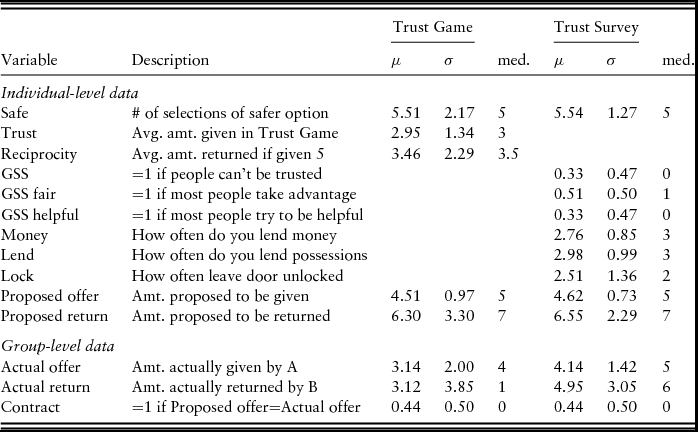
Consider, first, the TG treatment. The analysis uses the average of the trusting investments made in all four rounds of the Trust Game. For reciprocity, we use the amount a subject is willing to give back when in the role of Player B. The analysis presented uses the average amount returned if offered all five experimental dollars. If a subject i is in the role of Player A in the Contract Game, then Trust Ai is his/her level of trust and Reciprocity Ai is his/her level of trustworthiness. If i is Player B in the Contract Game, then Reciprocity Bi is his/her level of reciprocity. Table 1 summarizes the outcomes.
Outcomes

Individuals in both treatments exhibit, on average, a modest amount of risk aversion. The two samples produce similar risk measurements. Overall, 30% of the subjects are risk neutral.
In the TG treatment, subjects give just less than 60% of their endowment. This is in line with previous research. A contribution of all five dollars, though, results in a loss of approximately 30%. Again, this replicates previous findings where trusting investments are not fully reciprocated.
The sample mean for GSS of 33.3% is close to what arises in the overall US population of 39.9% (Glaeser et al., Reference Glaeser, Laibson, Scheinkman and Souter2000). The correlation between the surveyed questions is high, but not perfect.Footnote 3
Individuals in the Contract Game typically request a full investment and, on average, offer a 39.6% return on the investment. Proposed offers are strikingly similar in the two treatments. Agreements are reached in less than one-half of the dyads, which is not surprising given that many negotiations take place with very little enforcement and there is no sanction for breaching the contract when it is enforced. The actual amount given by Player A in the Contract Game is greater than in the Trust Game. This suggests, unsurprisingly, that the ability to enter into contracts promotes investment.
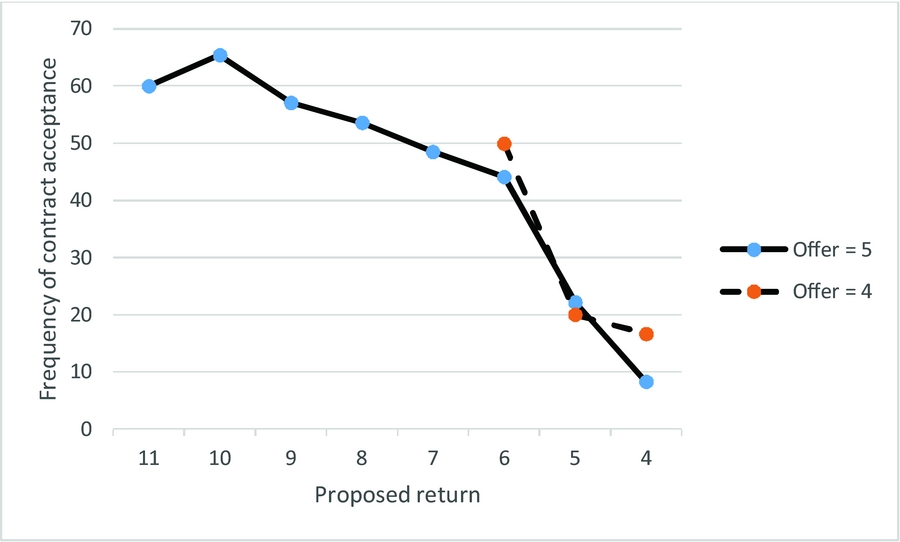
Consider the offers made. Overall, 61% of all groupings had a proposal that requested all five, while an offer of four is requested 17% of the groupings. Figure 1 provides the proportion of groups where a contract was agreed to, for each contract proposal made.
Contract Proposals and Formation.

As one would expect, when the proposed contract offers more generous terms, acceptance of the agreement is more frequent. As proposed returns decrease so too does the acceptance rate. For the most part, a similar pattern exists when a proposed investment of four is requested.
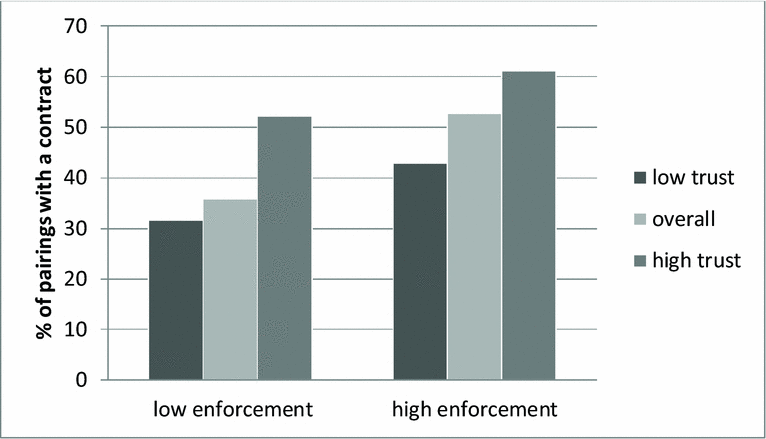
To address the relationship between contract enforcement, acceptance and trusting behaviour, Figure 2 presents a breakdown of the TG treatment sample reporting the proportion of dyads able to reach an agreement. Since the subject in the Player A role makes the decision to accept the proposal, their trust is considered.
Contract Formation, Contract Enforcement, and Trust.

Contract formation rates escalate with increased enforcement. Low enforcement is defined as p = 0 or 1/6, while in high enforcement it is either a probability of 1/2 or 5/6. In Figure 2 high trust is the subsample of those who contributed, on average, more than 4, while low trust are those averaging less than 2. Overall (middle columns), high enforcement leads to more than a 15-percentage-point increase in contract enforcement's frequency. Also, those with low trust levels consistently avoid entering into contracts. Thus, contract enforcement and strong pro-social preferences facilitate trade. While Figure 2 clearly illustrates that trust and enforcement are important drivers of contract formation, it is not obvious what the interaction between them is.
To operationalize trust in the TS treatment, we follow, again, the lead of Glaeser et al. (Reference Glaeser, Laibson, Scheinkman and Souter2000) by aggregating responses to the survey questions. The three survey questions from the General Social Survey are aggregated such that GSS Index = GSS + GSS fair + GSS helpful. Similarly, the behaviour towards others is combined into a single variable where Behave Index = Money + Lend + Lock.
Considering GSS Index, agreements are much more likely to arise if the player is trusting. In the TS treatment, 49% of dyads where the subject in the role of Player A has a GSS Index value of 2 or 3 (out of 3), an agreement is entered into. For those with lower surveyed levels of trust, only 41.5% of proposals were accepted. This corresponds to the results presented in Figure 2.
To present suggestive evidence that contract enforcement complements trusting preferences, consider the dyads where an agreement is reached. When the subject has GSS Index > 2, 43.2% of this cohort arises when enforcement is low. Alternatively, for contracts agreed to by subjects with GSS Index < 2, only 34.7% arise when contract enforcement is low. This suggests that trusting subjects respond more to the high contract enforcement.
Is there evidence of a relationship between trust and the size of the investments made? As shown in Table 1, proposed and actual offers made tend to exceed the level of trusting investments previously given. Thus, the ability to enter into imperfectly enforced agreements increases the amount invested. In the TG treatment sample, 65% of the subjects gave a greater investment than in the Trust Game. As stated previously, contract proposals, for the most part, request a full investment. In only 9.7% of the pairings did the proposed investment request less than the amount the subject, in the role of Player A, had given in the Trust Game. In this subsample, only 22.2% of the time did the subjects comply with the proposal and form a contract. In 64.3% of the scenarios where an agreement did not form, the subject made an offer greater than what was requested. In fact, in 57.1% of these scenarios the subject gave strictly more than they had in the Trust Game. Thus, even when confronted with a situation where less is being requested than the subject would typically give, the individual did not reduce his or her contribution. Hence, the amount invested increased and poor proposals did not draw down the contributions of the offer's recipient.
Similarly, contract enforcement encouraged greater investments. With high enforcement, the average amount actually invested was 3.42. With low enforcement, though, investment was only 2.85, which is close to the mean value of Trust of those in the role of Player A, 2.91. Thus, in low enforcement rounds individuals behave as they would in the game, without communication and enforcement. The introduction of contract enforcement increases investment.
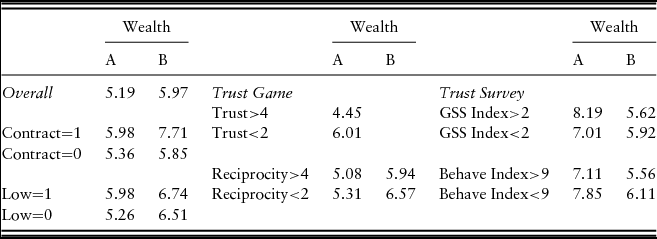
Consequently, one can summarize the experiments and appreciate the role of trust and contract enforcement by looking at the outcomes generated in the Contract Game. Table 2 presents the wealth gained in the Contract Game. The data are broken down into subsamples to compare subjects with different previous outcomes.
Wealth Creation in the Contract Game

Player Bs generate more wealth due to second-movers’ strategic advantage. Contracts improve wealth for both players, consistent with the argument that contracts facilitate mutually advantageous trade. High contract enforcement is valuable to the investor as it reduces uncertainty, encouraging investment. Contract enforcement is disadvantageous to Player B since it limits opportunistic behaviour.
Interestingly, trusting individuals in the role of Player A earn less in the TG treatment, presumably because they are willing to make contributions without enforcement. Reciprocating individuals earn less wealth due to the fact that they are defined as those willing to return more of the investment. Trustworthy individuals (reciprocity of those in the role of Player A) earn similar amounts as those lacking trustworthiness. This is evidence that contrasts in behaviour and outcomes are stronger for trust than they are for trustworthiness.
Those who respond with higher trust levels in the survey earn greater wealth, but the results for behaviour towards others mirrors the outcomes of the first treatment. Outcomes when in the role of Player B do not differ substantially.
Thus, the data analysis provides evidence that trust and contract enforcement affect the decision to enter into a contract and the size of the investment made. An econometric investigation is needed to ensure that these effects are not misattributed to other measureable drivers of behaviour and to investigate, formally, the interaction between trust and contract enforcement.
4. Results
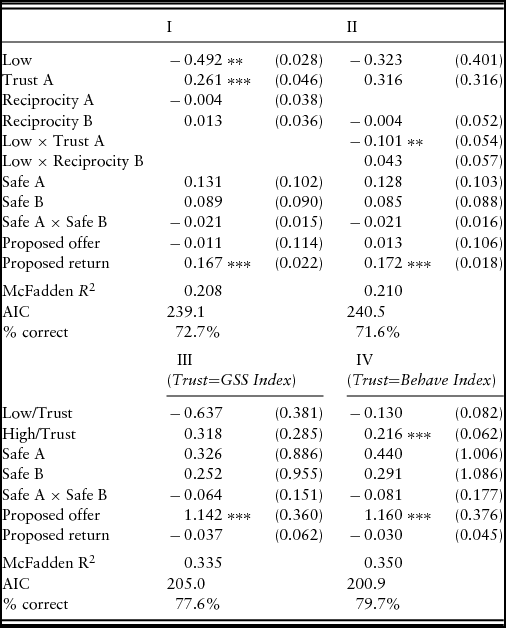
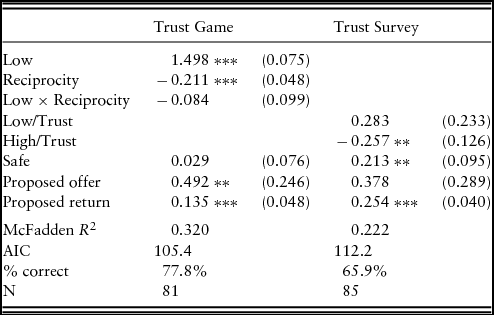
First, we consider the pairwise-level data. Probit models are estimated with the indicator variable Contract as the dependent variable. The top panel of Table 3 presents the results for the TG treatment. Each specification includes a set of control variables and session fixed effects.Footnote 4 Standard errors are clustered by round.
Contract formation

Notes: Binary probit; Dependent variable = Contract.
Standard errors clustered by round of play.
*** 1%, ** 5%, * 10% level of significance.
As to be expected, choices made with a reduced probability of agreement enforcement lead to a decreased likelihood of a contract being made. While the risk preferences are unrelated to the formation of a contract, more generous contract terms lead to more agreements.
As postulated, individuals who exhibit higher levels of trust in the standard Trust Game also see greater rates of agreements being reached. When the individual who is offered a contract trusts others, then s/he is more likely to accept the offer made. The marginal effect, estimated at the mean, is that one more dollar given is associated with a 10.3-percentage-point increase in the likelihood of a contract being agreed to.
Also, the trustworthiness of Player A and the reciprocity of Player B are unrelated to the likelihood of a contract formation. It is the trusting behaviour of Player A, and not his trustworthiness, that matters.
The second column (II) allows for an interaction effect. The negative and statistically significant coefficient on Low × Trust A provides evidence that social preferences complement formal contracting. When contract enforcement is low, trusting individuals, while more likely to enter into an agreement than those who exhibit low levels of trust, do not form contracts very often. When contract enforcement is greater, the probability of joining into an agreement escalates. This is evidence that those who exhibit high degrees of trusting behaviours flourish when contract enforcement is high.
At the mean in II, the marginal effect of Trust A is 0.124, while the marginal effect of the interaction term is −0.043. Given that contracts arise in 44% of pairings, the role of both trust and contract enforcement has an economically significant impact on contract formation.
The main results presented are robust. The significance of trust and contract enforcement continues to hold when alternative standard errors are calculated (e.g. heteroscedastic-robust) or if binary logit or linear probability models are estimated. Furthermore, the results are not sensitive to the way in which trust, trustworthiness and reciprocity are measured. The specification presented averages the choices over the four rounds. Instead, if only the first or last round is considered, the results continue to hold in that trust has a positive and statistically significant relationship to contract formation.
The bottom panel of Table 3 considers responses to the survey in the TS treatment. As is done in Glaeser et al. (Reference Glaeser, Laibson, Scheinkman and Souter2000), the index of the three social values questions and the index of the behaviours towards others are considered. The specifications in III and IV are estimated via a logit model with the control variables used previously.
The results are in line with those in the top panel. Subjects who behave in a more trusting manner are more likely to enter into an agreement, specifically when the enforcement is high. While, as to be expected, they perform worse under the low enforcement regimes, the behaviour improves substantially when contract enforcement improves. An F-test of the linear restriction that High/Trust – Low/Trust = 0 is rejected in both specifications. Thus, the complementary nature of trust and contract enforcement are robust to the assessment method.
One would expect that entering into a contract is viewed as a risky decision. While the results in Table 3 control for risk preferences, a subject's risk aversion can be expected to be more pronounced when contract enforcement is weak. If Safe is interacted with Low and included in II, the interaction is statistically insignificant, but the relationship between A's trust and contract formation persists. Similarly, an interaction between trust and risk preference does not have a significant impact on the likelihood of contract enforcement.
Finally, instead of combining the enforcement probabilities into the binary variable Low, if four variables are created to capture the four treatments (enforcement probabilities of 0, 1/6, 1/2 and 5/6) the primary results continue to hold. Using the enforcement probability of 5/6 as the omitted variable, indicator variables for each level of enforcement have negative coefficients and the interaction terms have statistically significant relationships. Thus, the main findings in Table 3 are robust.
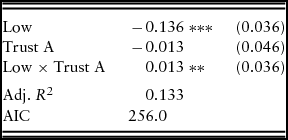
As discussed previously, the proper definition of trust and its operationalization are controversial. Table 3 presents both the standard measurement used in experimental economics and the standard measurement used in empirical macroeconomics and development. As emphasized, though, trust is a pro-social behaviour acknowledging that the counterparty can refuse to cooperate. While a subject's acknowledgement that reciprocation may not necessarily follow cannot be observed and measured, we argue that changes in one's giving, as the subject interacts with others, captures one's adjustment to the environment acknowledging the uncertainty of the counterparty's response. Therefore, Table 4 re-estimates column II of Table 3 but, instead, uses the improvement in giving between the final and initial round as an alternative measurement of improved trust.Footnote 5
Contract formation

Notes: Linear Probability; Dependent Variable = Contract.
Trust A mean = 0.163, st. dev. = 1.92, min = −4, median = 0, and max = 5.
Standard errors clustered by session.
*** 1%, ** 5%, * 10% level of significance.
The positive and statistically significant coefficient on the interaction term matches the findings of Table 3. While improved contract enforcement and a growth in the amount one is willing to give in the Trust Game lead to more frequent contract formations, the interaction effect is positive and statistically significant. It is those who do not pull back in the fact of poor social interactions with others who are the ones responding positively to improved contract enforcement.
Now that the relationship between trust and contract enforcement in the formation of agreements has been established, the investigation can turn to the terms of the proposals made. The escalation in the frequency of agreements identified can be thought of as illustrating the expansion of the extensive margin generated by trusting individuals with improved contract enforcement. The related issue of the impact on the intensive margin, namely the size of the investment made, deserves investigation.
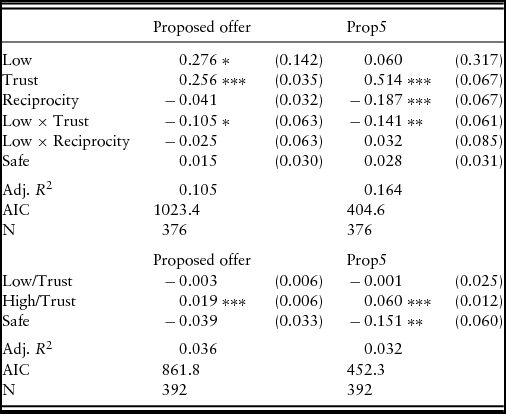
Thus, consider the amount requested in the proposal. Table 5 presents the results. Since in the experimental design each subject makes a proposal not knowing his or her role, information for all subjects can be used. Hence, the individual-level data set is analysed. The results with standard OLS regressions with Proposed offer as the dependent variable are presented. Additionally, since over three-fifths of dyads had a proposal requesting all five, an indicator variable, Prop5, is defined as equal to one if and only if Proposed offer = 5. Results from a probit model estimation are presented as well. Again, individual background control variables and session fixed effects are included. Standard errors presented are clustered by round of play.
Offers

Notes: Trust = Behave Index.
McFadden R 2 presented in the second column of both panels.
Standard errors clustered by round of play.
*** 1%, ** 5%, * 10% level of significance.
The social preference of trust in the first column of the top panel reveals that it is an important determinant of proposals made. The low enforcement rounds experience an upward shift in the relationship between trust and the size of the proposed investment. Proposals increase with increased trust, but the rate of increase is greater with the high enforcement. Hence, so long as Trust A > 2.63 (the point of intersection), individuals with high trust invest more under high contract enforcement. Thus, not only do enforcement and trust, independently, lead to larger investments, but there is a positive interaction effect between the two.
Interestingly, given the person's level of trust, those who reciprocate are less likely to ask for a full investment. Risk preferences do not play much of a role.
These results are mirrored in the TS treatment. The bottom panel uses Behave Index as the trust measurement. While trusting individuals behave similarly to untrusting ones when enforcement is weak, investments are, again, greater for trusting individuals in high enforcement. Similar results arise if GSS Index is used instead.
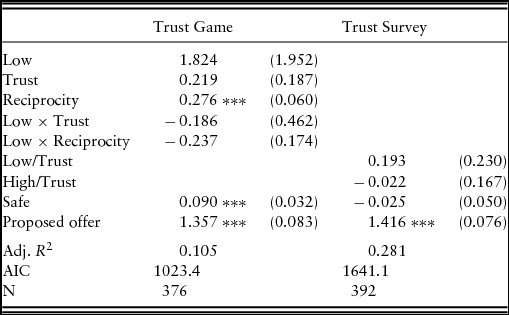
Similarly, the generosity of the proposed return on the offer can be considered. Again, since individuals make the proposed returns not knowing which role they will take, information for all subjects can be used. Background control variables are included, along with session fixed effects. Standard errors clustered by round of play are presented.
Returns

Notes: OLS; Dependent variable = Proposed return.
Trust = GSS Index in the second column.
Standard errors clustered by round of play.
*** 1%, ** 5%, * 10% level of significance.
The generosity of the contract terms is determined primarily by one's risk preference and reciprocity. More risk-averse individuals offer better returns in the proposal, as do those willing to reciprocate the trusting investments of others. The former can be explained by larger returns acting as a form of insurance against a failed negotiation. The latter can be explained by reciprocity capturing altruistic preferences. No statistically significant interaction effects exist. Thus, risk preferences and altruism have distinct effects on the terms of trade.
In the second column, the results from the TS treatment are presented. The variable GSS Index is used (but similar findings arise if the Behave Index is used instead). Again, the generosity of the return is not correlated with the level of assessed trust.
Finally, we turn to the subset of observations in which an agreement was reached to investigate the determinants of breach of contract. Since the decision is solely that of the recipient of the investment, the characteristics of the receiver are considered. The background controls and session fixed effects are included. Standard errors are clustered by round of play.
Breached Contracts

Notes: Binary probit; Dependent variable = Breach.
Trust = GSS Index in the second.
Standard errors clustered by round of play.
*** 1%, ** 5%, * 10% level of significance
Breach of contract is determined mostly by the probability of enforcement and the terms of the agreement. As to be expected, breach is more likely when contract enforcement is low. Those who reciprocate more in the Trust Game are less likely to break an agreement when it is reached. The TG treatment indicates that there is no strong interaction effect with reciprocity and the probability of contract enforcement.
In the TS treatment, again, the terms of the contract correlate with breach. So too do risk preferences, which is to be expected given that enforcement is probabilistic. Evidence exists that trusting individuals are less likely to breach contracts. This effect is especially pronounced in the high enforcement regime.
5. Conclusion
A common argument is that when social norms of honouring agreements are lacking, formal, enforceable contracting and pro-social behaviours substitute for one another. We investigate the alternative hypothesis that social preferences and contract enforcement are complements. Three measurements of trust are developed to capture the complex conception of the trait. The Trust Game is used as an assessment tool to measure individuals’ levels of trust, trustworthiness and reciprocity as a direct behaviour. Changes in behaviour, as one experiences the outcomes of the interaction with others, allow for a recognition in the uncertainty of counterparty cooperation that is necessary in trusting behaviour. Third, a survey assessing trusting behaviours and beliefs is also administered since positive expectations of others are a key component to trust as well. A Contract Game is implemented where individuals can first enter an agreement before making the investments. We show that people who exhibit higher levels of trust are more likely to reach an agreement and make larger investments. Also, increased contract enforcement does both as well. The paper's contribution is to show that there is a significant interaction effect. Trusting individuals outpace those with lower levels of trust, in both the frequency of entering into an agreement as well as the size of the investment made, when contract enforcement is high. Thus, social preferences and contract enforcement are complements rather than substitutes.
The environment considered could be expanded to gain a deeper understanding of this relationship. For example, the experimental design employed does not allow for sanctions, either retaliation inflicted by parties to the agreement or external punitive punishments. This is in order to replicate actual contract law, which does not utilize sanctions, but also to limit the complexity of the environment so as to be able to focus on the enforcement probability. Not including punishments strengthens the results as well. A selfish individual always has the incentive to breach an agreement reached in this environment and, thus, by not discouraging breach, allows for only the social preferences of reciprocity and trust to be expressed. It seems reasonable to presume that the effect of punishment on the expression of social preferences may be an important factor. Also, while previous research has studied repeated play to mimic the evolution of social norms, the analysis here focuses on measuring levels of social preferences. One may want to combine the two approaches to allow for the development of norms to alter preferences and their combined impact on contracting. These extensions, though, are left for future analysis.
An open question, then, is that the results indicate that improved legal institutions will have limited effects in situations where social preferences are weak. How to improve these pro-social behaviours, to allow for the formal institutions to succeed, is an important direction for future research. Furthermore, the concept of social preferences is broad. A further delineation of the exact nature of these preferences, and the influences on their expression, provides the opportunity to expand our understanding of institutional design and success.