




No CrossRef data available.
The Janus Face of Brussels: Socialization and Everyday Decision Making in the European Union
Published online by Cambridge University Press: 18 October 2005
Abstract
This article examines the European Union's Committee of Permanent Representatives, or COREPER, a group composed of the EU permanent representatives (permreps) and responsible for preparing upcoming ministerial meetings of the Council. As the heart of everyday decision making in the EU, COREPER is a key laboratory to test whether and how national officials become socialized into a Brussels-based collective culture and what difference this makes for EU negotiations. The key scope conditions for COREPER socialization are high issue density/intensity and insulation from domestic politics. COREPER also displays a range of socialization mechanisms, including strategic calculation, role playing, and normative suasion. Based on extensive interview data and a detailed case study of negotiations for a controversial EU citizenship directive, this article documents a socialization pathway in COREPER marked by adherence to a set of norm-guided rules and principled beliefs in collectively legitimating arguments and making decisions. COREPER socialization does not indicate a pattern of national identities being replaced or subsumed; rather, the evidence points to a socialization process based on a “logic of appropriateness” and an expanded conception of the self.For feedback on earlier versions, I am grateful to the project participants and especially Jeffrey Checkel, Matthew Evangelista, Iain Johnston, and Michael Zürn. I thank the editors and two anonymous reviewers for comments that greatly improved the final product. I also acknowledge generous support from the Max Planck Institute for the Study of Societies and the American Political Science Association's Small Grant Program, which funded portions of field research associated with this project.
Information
- Type
- Research Article
- Information
- Copyright
- © 2005 The IO Foundation and Cambridge University Press
Not many international institutional environments can match the density or robustness of collective decision-making norms found in the European Union (EU).1
For a discussion of this point, see Kahler 1995, 82–89; and Wallace 1994, 41–50.
Recent exceptions include Trondal 2001 and 2002; Egeberg 2004 and 1999; Egeberg, Schaefer, and Trondal 2003; and Joerges and Vos 1999.
Since 1962, COREPER has met weekly in two formats: COREPER II is composed of the EU ambassadors and works primarily on the monthly meetings of the foreign ministers in the General Affairs Council (GAC); COREPER I is made up of the EU Deputies, and they preside over a wide range of so-called “technical” Councils such as the Environment, Fisheries, Employment and Social Policy, and so on. Thus, strictly speaking, COREPER consists of fifty members (twenty-five ambassadors, and twenty-five deputies) who are jointly referred to as the EU permanent representatives. For the more subtle differences in prestige and clout between COREPER I and II, see Lewis 2002; and Hayes-Renshaw and Wallace 1997.
There are two substantive exceptions: the Agricultural Council (which is prepared by the Standing Committee on Agriculture [SCA]) and the Ecofin Council (prepared by the Economic and Finance Committee [EFC], which has its own vertical channels to the finance ministers, effectively bypassing COREPER).
COREPER is the main preparatory body for the Council of the European Union, the legislative heart and unabashed defender of national interests in the EU. Composed of senior civil servants and career diplomats, COREPER members meet weekly and have evolved a style of decision making that is rooted in a collective culture with its own informal norms, rules, and discourse.5
See Lewis 2000; and Bostock 2002.
Dietrich von Kyaw was Germany's EU Ambassador from 1993–99. For a discussion of his Verräter quip, see Lionel Barber, “The Men Who Run Europe,” The Financial Times, 11 March 1995, Sec. 2, I–II. See also Hayes-Renshaw and Wallace 1997, 224–25; and Wallace 1973, 56.
The central question of this article is whether and how the context and quality of interaction among national representatives in COREPER can have transformative effects on basic actor properties. Unlike traditional rationalist accounts, which begin from the premise that institutional environments primarily affect strategy,7
For examples, see Eising 2002, 87; and Bjurulf and Elgström 2004.
Following Checkel's definition of socialization as “a process of inducting actors into the norms and rules of a given community,”9
Checkel, this volume.
Ibid.
Ibid.
Joining the COREPER “club” involves more than behaviorial adaptation to institutional norms that alter incentives and strategies. EU permreps also internalize group-community standards that become part of an expanded conception of the self. This internalization includes a distinct epistemic value in the collective decision-making process itself.12
This is compatible with what Lax and Sebenius call the development of “process interests” or “intrinsic interests in the character of the negotiation process itself.” Lax and Sebenius 1986, 72.
Author's interview, 20 February 1996. All interviews were conducted in Brussels unless noted otherwise.
Members of COREPER describe themselves as being bound by a “dual loyalty.” It is their responsibility faithfully to represent their Member States; but it is also their responsibility to reach agreement. The Roman god Janus, facing in two directions, is thus COREPER's patron saint, mascot, or role model.14
Bostock 2002, 217.
Thus the identity configuration of EU permreps appears, even at first glance, more subtle and complex than zero-sum notions of loyalty and allegiance. In COREPER, what one sees instead is the cognitive blurring of sharp definitional boundaries between the “national” and “European” frames, and a shared sense of responsibility to deliver both at home and collectively. As this article will show, the pattern of socialization found in COREPER does not lead to the creation of a new overarching supranational identity, but rather to a more complex configuration of identity than is typically acknowledged.
The remainder of this article is organized as follows. The next section provides a concise summary of the theoretical argument. The second section details the pathway of socialization found in COREPER, with an emphasis on the scope conditions and mechanisms at work. The necessary scope conditions are high issue density/intensity and insulation from domestic politics, both of which imply that the socialization process in COREPER is forged by the “quality” of the link. The mechanisms explaining how socialization occurs in this institutional environment include strategic calculation, role playing, and normative suasion. Following this, the third section discusses methods and the strategy of empirical triangulation. Section four contains the empirical story, which traces the negotiations of a controversial EU citizenship directive that was quietly resolved by COREPER and sent to the ministers for formal adoption. Specifically, the case covers the 1994 local elections directive granting all EU citizens the right to vote and run for office in the local elections of their current residence (that is, granting nonnational EU citizens local voting and participation rights). Finally, a brief concluding section summarizes how the identity configuration of permreps muddies conventional distinctions between “national” and “supranational” agency.
Overview of the Theoretical Argument
For rationalists, identities and interests are taken as preset and given, and the empirical focus is on the role of formal decision rules, relative power, and instrumental rationality in explaining bargaining outcomes.15
State agents are motivated more by a “logic of anticipated consequences and prior preferences”16March and Olsen 1998, 949.
See Schimmelfennig 2000; and Schimmelfennig, this volume.
Constructivism relaxes the assumption of preset, given interests and identities, allowing for the possibility that institutional environments may have transformative effects on basic actor properties. Relative power brokering and instrumental rationality are accorded less primacy than in rationalism, and supplemented with attention to the deliberative aspects of negotiation, such as the role of discourse, persuasion, and the collective legitimation of arguments. According to the constructivist approach, EU institutions are hypothesized to have “thick” socializing effects on actors, which go beyond instrumental adaptation and strategic calculation to include the internalization of norms and rules into self-conceptions. In other words, the densities of institutional and normative environments are considered causal variables that, under the right background conditions, can have transformative effects on basic actor properties, including how individuals see themselves (conceptions of the self) and how they conceptualize their interests. In the case of successful socialization, then, the constructivist expects to see interests that “have been conditioned by a community standard that delimits the acceptable.”18
Hurd 1999, 397.
Checkel, this volume.
The socialization story documented here does not disprove or contradict a rationalist reading,20
See Zürn and Checkel, for a thoughtful “double interpretation.”
For a discussion of different “models of theoretical dialogue” between rationalism and constructivism, including the tricky issues of “paradigmatic privileging” and “first mover” advantages, see Jupille et al. 2003, 19–28.
Alternative Explanations: Internalized Norms or Diplomacy 101?
The alternative explanation for everyday EU decision making is standard negotiation theory and two-level games analysis.22
The literature on negotiation theory is voluminous. Classic works include Lax and Sebenius 1986; Raiffa 1982; Iklé 1964; Rapoport 1960; Pruitt 1981; Strauss 1978; Zartman and Berman 1982; and Walton and McKersie 1965. See also Jones 1994; Kramer and Messick 1995; and Rubin and Sander 1988. On two-level games, see Putnam 1988; and Evans 1993.
To illustrate such differences, one can hypothesize four measures that would support the appropriateness logic and cut against the grain of conventional bargaining and two-level games analysis wedded to a logic of consequences.
1. Noninstrumental self-restraint in demands and arguments. Unlike the instrumental cost-benefit logic implicit in negotiation theory, self-restraint is now motivated by a sense of responsibility or obligation (especially to protect what Lax and Sebenius call “process” and “relationship” interests).23
See fn. 12 for their definition of “process” interests. “Relationship” interests are those in which negotiators “stress the value of their relationships,” which can sometimes (under iterative bargaining) take on “an almost transcendent status.” Lax and Sebenius 1986, 72.
Kerremans 1996, 232.
2. Self-enforcing adherence to informal decision-making norms without threats of external sanctioning. If standard negotiation theories were on the mark, one would expect to see a utilitarian conception of rule-following behavior, supplemented by evidence of regularized cost-benefit analysis. The reason, as Hurd explains, is because “any loyalty by actors toward the system or its rules is contingent on the system providing a positive stream of benefits … actors do not value the relation itself, only the benefits accruing from it.”25
Hurd 1999, 387.
For example, one would expect to see wide recourse to formal rules such as the 1994 Ioannina Compromise, which holds that under conditions of qualified majority voting when a clear blocking minority does not exist (but at least twenty-three to twenty-five votes oppose), the Council will still “do all within its power” to find a “satisfactory solution.” Dinan argues that the Ioannina Compromise was a “face-saving device” for “anti-EU” back-benchers in the British parliament and has “had no practical impact on EU decisionmaking.” Dinan 1998, 299. For a similar argument—that the impact of the infamous 1966 Luxembourg Compromise to protect “vital national interests” has been highly exaggerated and largely unimportant for bargaining outcomes—see Golub 1999.
See Checkel, this volume.
Although it should be added here that evidence of this measure may be compatible with either Type I or Type II internalization. Additional tests are needed to measure the degree of “taken-for-grantedness.” A useful index to operationalize the distinction used here is the discussion in Hurd 1999 of “habitual” versus “holistic” internalization.
COREPER norms are informal and self-enforcing29
See the “Socialization Mechanisms” section below.
See also Gheciu, this volume, in which she codes successful socialization as cases where norms are accepted because they are considered normal and “the right thing to do” is to comply with them; norms are not accepted just because they are directly linked to instrumental rewards.
Author's interview, 18 March 1997.
Hurd 1999, 388–89.
Wendt 1999, 361.
3. Empathy and other-regarding behavior not linked to calculative reasoning. The alternative explanation would expect to find empathic behavior linked to instrumental calculations, and in an issue-intensive, in-camera setting such as COREPER, this would be based on both longer time horizons (for example, “I may need help next week”) and reputational concerns. But the internalized norms argument expects to see acts of empathy and other-regarding behavior based on a different kind of calculus. The difference from the consequentialist logic is that the internalized norms model expects such acts to be what Wendt calls “self-binding” or “unilateral initiatives with no expectation of specific reciprocity.”34
Wendt 1999, 362.
More specifically, evidence for Type II—internalized norms—socialization would include those cases in which national representatives worked to convince superiors back in the capitals to accept another delegation's plea or argument while dropping their own, even when veto options existed. This practice would be coded as normative suasion because actors who are persuaded by another's argument then defend the position to their authorities, seeking to convince those authorities to accept the reasoning while at the same time dropping their own unconvincing claim. In other words, these actors are successfully persuaded to change positions, and this carries potential costs to implement (that is, they risk the ire of the capital). Especially relevant for the collective community standards argument are those cases in which the group actively “plots” solutions to overcome domestic reserves, sometimes faking group outrage or artificially simulating a delegation's isolation on a position.35
For a discussion of “plotting” practices in COREPER, see the “Mechanisms” section below.
But the empathy indicator is also clearly a case in which it is misleading to frame the question as “rationalism versus constructivism,” as both schools offer similar predictions. Indeed, Keohane discusses several different ways that states can interpret self-interests “empathetically,” some of which are consistent with standard bargaining (this would include other-regarding behavior he terms “instrumentally interdependent” and “situationally interdependent”) and some of which are more akin to the internalized norm conception (for example, what he calls “empathetic interdependence”).36
Keohane 1984, 120–25.
4. Limits on instrumentalism through the collective legitimation of arguments. Such acts would be especially relevant—and contrary to standard negotiation predictions—where delegations drop demands after failing to convince the group, despite a theoretical recourse to the threat or use of veto under the unanimity decision-rule. Evidence that standards of appropriateness exist can be seen in cases where group outrage is used to signal that certain things are just not acceptable. One can further contextualize the internalized norms argument into Type I cases in which agents follow “socially expected behavior in a given setting or community” and Type II cases of accepting community norms as “the right thing to do,”37
Checkel, this volume.
The Pathway of Socialization in COREPER
COREPER is “responsible for preparing the work of the Council and for carrying out the tasks assigned to it by the Council.”38
Art. 207, Treaty on European Union.
Author's interview, 12 July 1996.
Author's interview, 20 February 1996.
Scope Conditions
Issue density/intensity
COREPER's structural placement imparts a coherence and continuity in the representation of interests that would otherwise be difficult to match. In terms of structural location, COREPER occupies a unique institutional vantage point in the EU system. Vertically placed between the experts and the ministers and horizontally situated with cross-sectoral policy responsibilities, the permreps have a general overview of the Council's work. Relative to the experts meeting in the working groups, they are political heavyweights; but compared to the ministers, they are both policy generalists and experts in the substantive questions of a file.
Since the Council's work is based on a concept of sectoral differentiation, pursuing the “national interest” across its sixteen or so formations requires national systems of interest intermediation and interministerial coordination that are complex even for the smallest member states or those with the most centralized EU affairs machinery. It is here that the permreps in COREPER, with their cross-Council negotiating mandates and intersectoral policy responsibilities, practice an essential aggregation function. A central feature of COREPER's institutional environment is the density of issues and issue-areas that are covered in the agendas of the weekly meetings. No other site of everyday EU decision making approximates the intensity of weekly COREPER negotiations (measured in terms of the number of weekly agenda items and the horizontal nature of these agendas). Thus the agendas of COREPER meetings are qualitatively different than the type encountered at the Council working group level. Unlike the “contact thesis” then, which equates socialization with the amount of interaction,42
See Checkel, this volume.
Not only is COREPER distinguished by the intensity of negotiations, but the permreps' involvement across the different domains of EU decision making is pervasive as well. In addition to the regular cycle of weekly meetings, the permreps sit beside their ministers during Council sessions, briefing them and offering tactical suggestions. Permreps attend European Council summits and can serve as behind-the-scenes consultants. The growth of codecision (now considered the EU's “ordinary” legislative procedure) has also created an intense negotiation forum between members of the European Parliament (MEPs) and the deputy permreps who represent the Council.43
Reinforcing the intensity of interactions, the EU permreps also accumulate a great deal of experience through long periods of participation.44
See Checkel, this volume, for a discussion of the methodological problems in conflating the intensity and duration of interaction.
Lewis 1998, 111–13.
Butler 1986, 30.
In sum, the first scope condition is COREPER's unique structural position in everyday EU decision making, with a brand of intensity that is generated by the density and scope of agendas and widespread participation in nearly all aspects of the Council's work; this is reinforced by extensive periods of interaction and numerous informal venues for negotiation. This scope condition can also be restated in hypothesis form:
H1: The internalization of new role conceptions and conceptions of the self in line with group-community norms is more likely when individuals are in settings where contact is intense and sustained.
Insulation
One of the central features of COREPER diplomacy is a high degree of insulation from the normal currents of domestic constituent pressures. The meetings themselves are treated with an air of confidentiality, and many sensitive national positions are ironed out in restricted sessions in which the permreps clear the room and can speak frankly and in confidence that what is said will not be reported to the capitals or the media. This often includes group discussion on how an agreement will be packaged and sold to the authorities back home. “At our level, publicity does not exist,” an ambassador explained, “Our body is absolutely black; we can do deals.”47
Author's interview, 23 May 2000.
Author's interviews, 23 May 2000; and 18 April 1997.
See Checkel, this volume.
A structural feature of COREPER that often goes unnoticed is that insulation affords member states the capacity to reshape domestic constraints. As an ambassador put it, “COREPER is the only forum in the EU where representatives don't have a domestic turf to defend.” Because of this, he went on to add, “it is often politically necessary to present a position knowing it is unrealistic. My minister of finance needs certain arguments to be presented. He has certain pressures from his constituencies. We have to make it look like we fought for this even though we both know it will lead nowhere. I will present it, and if it receives no support, I will drop it.”50
Author's interview, 15 May 2000.
Stasavage 2004, 673.
Domestic insulation has enabled the permreps to develop de facto decision-making capabilities.52
The permanent representatives have no formal decision-making authority. Juridical decision-making authority is a power exclusively reserved for the ministers, and formal voting is expressly prohibited at any other level of the Council (compare Art. 7[1] of the Council's Rules of Procedure).
Recent studies of the Council have documented the growth and importance of the A-point procedure in the EU legislative process. See, for example, van Schendelen 1996; and Gomez and Peterson 2001.
To summarize, the second scope condition for COREPER socialization is insulated—from both domestic constituencies and domestic line ministries—negotiation, coupled with de facto (as opposed to juridical) decision-making authority. This can be restated as follows:
H2: The internalization of new role conceptions and conceptions of the self in line with group-community norms is more likely when individuals are in private, in-camera settings with a high degree of domestic insulation.
Having identified the key conditions under which to expect socialization, I turn now to the major factors that explain how this process occurs and how it can lead to shared understandings of appropriateness—understandings that produce behaviors different from those based on instrumental and utilitarian calculations alone.54
I thank an anonymous reviewer for suggesting this language.
Socialization Mechanisms
Strategic Calculation and Role Playing: Adherence to Informal Norms
A distinctive feature of COREPER's institutional environment is a robust set of durable yet unwritten and purely informal decision-making norms. One of the most striking aspects of these informal norms is their seemingly “self-binding” nature (Wendt's term). Why do national representatives comply? The interview data strongly suggests that COREPER participants practice pro-norm behavior (in the absence of external sanctioning) because it leads to the acquisition of social influence and diffuse, intangible “social capital.”55
For a discussion of “social capital,” see Putnam 1993, 169–70.
See Checkel, this volume.
The explanation does not end there, however. To get what you want in COREPER, you must also subscribe to socially accepted standards of behavior. Evidence of this pattern would support what this volume calls Type I internalization or role-playing socialization. These informal norms act as cognitive markers for newcomers to adapt to the group's accepted standards. As I will show below in the case of Austria's “opt-out” argument, the group can reject arguments with exaggerated ferocity to shame capitals and pressure a change in national demands. Group outrage is used to signal that certain behavior and justification for demands is simply not done or is not acceptable.
Five informal norms stand out. First, there is a norm of diffuse reciprocity, or the diffuse balancing of concessions over an extended shadow of the future.57
See Keohane 1986 for the classic treatise on “diffuse reciprocity.”
Second, there is a norm of thick trust and the ability to speak frankly, which is reinforced by weekly meetings, trips, and lunches. Thick trust is especially important during endgame negotiations or restricted sessions when the “real knives come out on the table.”58
Author's interview, 14 March 1996. On the concept of thick trust, see Putnam 1993, 167–71.
Author's interview, 17 February 1997.
Author's interview, 18 March 1997.
Finally, there is a culture of compromise premised on a basic willingness to accommodate divergent interests and reinforced by the other norms listed above. This culture is facilitated by the “dynamic density” of COREPER's work and the horizontal nature of agendas. The normative effects of this culture include a self-restraint in the calculations and defense of interests, seen for example when delegations quietly drop reserves after failing to convince the others of their arguments.
Taken together, these informal norms are widely practiced and firmly institutionalized in COREPER's organizational culture.62
See Noël 1967; and Lewis 2003.
Normative suasion
COREPER has its own locution, with signals, key phrases, and unspoken meaning. There is also a certain element of theatricality, in manufacturing intrigue; how else could one sit through yet another round of fishing quotas, as one permrep alluded. All of this is the typical grammar of diplomats, to be expected in issue-intensive, insulated settings where negotiators develop long-term interpersonal relationships. Going further though, one also sees a wide range of discursive resources that permreps can use in presenting and collectively legitimating arguments. This real possibility for normative suasion is what separates COREPER from the alternative argument of “normal” interstate negotiation. For example, as the local election case study will show, COREPER is considered the EU's locus classicus for “opt-out” negotiations, since permreps use collective legitimation to determine who warrants special consideration backed by standards of fairness where persuasive justifications carry the day (rather than relative power, voting weights, or the decision-rule). Evidence of this pattern would tend to support Checkel's hypothesis63
See Checkel, this volume.
Learning the derogation discourse is an important tool of the trade in COREPER, and senior permreps develop idiosyncratic methods for signaling when they need special dispensations. For many, this includes having a sense of humor when isolated or when national political sensitivities are being discussed. Normative suasion is an important socialization mechanism in COREPER, and unlike the mechanism of strategic calculation, it is sustained over time without respect to the structure of incentives or the existence of external sanctions. But argumentative resources are intertwined by consequentialist and appropriateness logics, and it is often difficult to tease the two motivations apart.
Put differently, in COREPER, arguments matter. While a truism in almost any type of negotiation, there are no comparable sites within the Council where the persuasive power of one's arguments weighs on outcomes.64
But see Puetter's 2003 analysis of the Eurogroup Council as a deliberative process based on a “shared normative framework.”
Although it is important to emphasize here that EU permreps, without exception, stress the importance of the decision-rule in contextualizing negotiations. It is a cliché in COREPER that qualified majority voting is the surest way to reach consensus.
Participants claim that even in rare instances when they do vote, it is exceptional that this is done without the consent of the “no's.”66
Author's interviews, 15 May 2000; and 12 July 1996.
Author's interview, 29 May 2000. Based on survey data of 218 national officials in the EU, Egeberg, Schaefer, and Trondal find that influence on committees is considerably higher among those with demonstrable expertise than those from big states per se. Egeberg, Schaefer, and Trondal 2003, 28, tab. 11.
Another example of normative suasion is how permreps engage in the collective “plotting” of agreements.68
See Lewis 2002, 292, for an example.
Two-level games researchers call this “COG collusion.” Evans 1993, 406–7.
Author's interview, 15 May 2000.
Author's interview, 26 May 2000.
In general, as standard negotiation theory explains, plotting and underlining opposition are tools of the trade to deal with recalcitrant bargaining positions. But in COREPER, this takes on an additional layer of collective legitimation as a framework of shared meaning within the standards of appropriateness. As Risse argues, in a “collective communicative process” actors are engaged in determining “whether norms of appropriate behavior can be justified, and which norms apply under given circumstances.”72
Risse 2000, 7.
Methods and Data
My research design follows a methodological strategy of “empirical triangulation” combining several qualitative and quantitative data sources: semi-structured interviews, archival documentation (Council documents such as the travaux preparatoires, press releases, agendas, and so on), and secondary sources. My primary data sources are semi-structured interviews with COREPER participants. To date, I have conducted 118 interviews at the permanent representations and with regular COREPER participants from the Commission and the Council General Secretariat (CGS).73
The sample includes: thirty-one permanent representatives (eighteen ambassadors and thirteen deputies), thirty-two top advisors to the permreps (known as the “Antici” [COREPER II] and “Mertens” [COREPER I] counselors), thirty policy specialists, nine legal advisors, ten officials in national capitals, and six others.
Specifically, February–July 1996, February–April 1997, May 2000, and May–June 2003.
Controlling for Prior Exposure and Self-Selection
Three methods were used to limit potential measurement problems, such as prior exposure to EU decision making. First, interview subjects were asked direct questions about their initial participation in COREPER negotiations, how they articulated their written instructions, and what, if any, changes occurred over time. Second, the interviews sampled “newcomers” at two levels: individual participants and new member states (both Nordic and Central/Eastern European newcomers are included in the sample). Third, I was able to re-interview some participants at a later date and compare their responses.
Several generalizable patterns emerged. The interviews track similar learning curves for newcomers, even those with different backgrounds and from different national administrative cultures. Participants typically claim that when they began attending the Committee, they learned that defending instructions alone had limited effectiveness.75
One common response was that following written instructions alone (that is, just reading from them) was a sure way to be left out of the discussion.
Another pattern is that newcomers initially tend to view their counterparts as rivals. “I saw my colleagues as opponents at first,” one deputy commented.76
Author's interview, 17 March 1996.
Author's interview, 14 March 1996.
See Checkel, this volume.
Author's interview, 14 March 1996.
In summary, while no guarantee against potential measurement bias, the built-in controls of triangulation, newcomer sampling, and re-interviewing help to minimize such effects. More importantly, they strengthen the case for the independent causal influence of socialization dynamics within COREPER. To directly test the four socialization measures spelled out in section two, the argument now shifts to an examination of the 1994 local elections directive, a controversial and politically unpopular extension of voting and participatory rights for EU citizens. With this directive, for the first time, the EU allowed citizens from any member state to vote and run for office in municipal elections based on wherever they resided in the EU.80
Numerically, the directive enfranchised approximately 5.3 million EU citizens living in another EU-15 member state. Lewis 1998, tab. 5-2, 215.
Socialization in COREPER: The Case of the 1994 Local Elections Directive
The EU foreign affairs ministers, meeting in the GAC, adopted a directive on the right to vote and run for municipal elections on 19 December 1994.81
Council Directive 94/80/EC. The full title is the directive “[L]aying down detailed arrangements for the exercise of the right to vote and to stand as a candidate in municipal elections by citizens of the Union residing in a Member State of which they are not nationals.” Official Journal L 368/38, 31 December 1994.
The local elections directive covered sensitive domestic political issues of electoral and citizenship laws, requiring the majority of member states to pass constitutional amendments to extend rights to “nonnational” EU citizens. The directive effectively established a principle of equal treatment between national and nonnational EU citizens. Moreover, the principle of equal treatment was agreed upon at a level of maximum coverage, with a minimalist interpretation of acceptable national “opt-outs.” The principle of equal treatment agreed to in COREPER even went beyond earlier Commission proposals that considered minimum residency requirements a prerequisite for expanding local voting rights to Community nationals.82
The Commission's position was for minimum residence at least equal to the term of local office to vote, and double the term of office in order to stand for election. European Communities Bulletin 9-1986, 44. In effect, this would apply the Luxembourg derogation (see discussion below) to the entire EU.
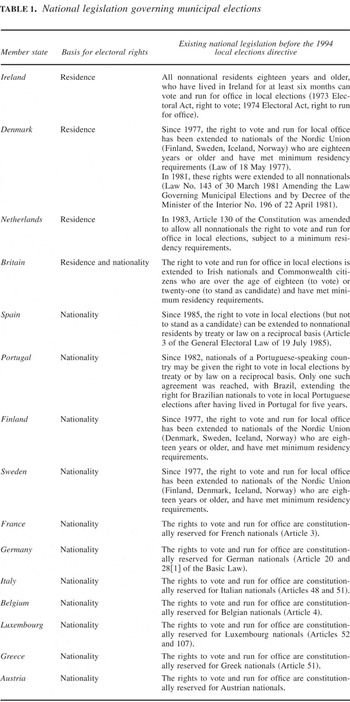
During negotiations, several delegations (including Denmark, France, the Netherlands, and Sweden) initially voiced preferences for maintaining residency requirements that already existed in national law (see Table 1). However, the final terms of the directive allowed minimum residency rules in Luxembourg and, on an extremely limited basis, in Belgium. It was a shared understanding among the EU permreps that “opt-outs” would have to meet high standards for justification because of the potential for derogations to water down the scope and application of local voting rights. From the earliest discussions in COREPER, there was an informal and sometimes shifting majority of members who defended the need for equal treatment between national and nonnational EU citizens. Counterfactually, the argument presented here is that minus socialization, the final outcome would have been very different—if agreement would have been reached at all.
National legislation governing municipal elections

Explaining the Local Elections Negotiations: Testing the Alternative Explanation
This article contends that everyday EU decision making is not all about relative power, formal decision-rules, and instrumental interest calculations. If it were, the alternative argument is that bargaining behavior and everyday outcomes can be explained with standard negotiation theory and two-level games analysis. However, if the alternative explanation was correct, one would expect to see a very different sequence of bargaining behavior leading to a different kind of outcome than what occurred in this case. First, although at least four delegations (Denmark, France, Greece, and Austria) were interested in derogations and could have credibly linked such claims to the “shadow of the veto”, none did. Moreover, after failing to convince the group on the merits of their special circumstances, each reconsidered or dropped their demands. In the counterfactual “diplomacy 101” scenario, COREPER sans socialization, this behavior would remain anomalous.
Second, the alternative explanation would not hypothesize a maximalist interpretation of Article 8(b) establishing the principle of equal treatment between national and nonnational EU citizens in municipal elections. Given the sensitive domestic political issues concerning electoral and citizenship laws,83
In fact, Eurobarometer data from this era show no issue-area where EU citizens opposed EU action more. Eurobarometer, No. 39, EC, DG X, 1993. Cited in Eurostat 1996, 241. For example:

Relevance of Scope Conditions
The local elections case provides solid evidence for how scope conditions play a role in promoting socialization. The intensity dimension is seen in the complex linkages between local elections and the larger political stakes of implementing the necessary secondary legislation of the Maastricht Treaty on time. Specifically, the treaty set a 31 December 1994 deadline to reach agreement on the detailed implementation rules for local voting rights. There was a general perception of responsibility among the permreps to reach agreement on a directive that would become a key substantive component of the fledgling EU citizenship chapter agreed to at Maastricht. This sense of responsibility comes out clearly in content analysis of interviews with participants, who claimed there was a shared belief that if it was sent to the ministers they would either not reach agreement at all or would be unable to “contain” discussions for derogations. A protracted stalemate on local elections, a heated debate among the foreign ministers, or a substantively watered-down directive in the scope and terms of application were all scenarios that the EU permreps collectively wanted to avert. Within this context, negotiations were both intense and sustained, supporting Hypothesis 1 (that internalized group-community standards are more likely under such conditions).
The local elections case also illustrates the importance of the second background condition: insulation. In this instance, many of the permreps were instructed by their capital to keep negotiations at their level and avoid the GAC. One official claimed his ambassador's instructions clearly signaled the need to “keep it away from the press, where it would have been politicized quickly.”84
Author's interview, 10 May 1996.
Author's interview, 18 April 1997.
Negotiating Derogations: Collective Legitimation and the Principle of Equal Treatment
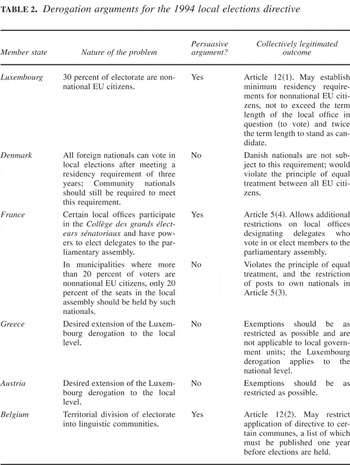
The most critical stage of negotiations centered on who would receive derogations from the scope and application of the directive. The entire agreement hinged on this issue, because it would define how extensive coverage was and whether the principle of equal treatment would be interpreted in a maximal or minimal sense. When the ambassadors began derogation discussions in the fall of 1994, nearly half were under instruction to seek special consideration, although the presentation of these “special problems” would only be played out over the next seven weeks. In particular, six member states would claim serious domestic political difficulties: Luxembourg, Denmark, France, Greece, Austria, and Belgium. See Table 2.
Derogation arguments for the 1994 local elections directive

Luxembourg received the earliest support for a derogation, and discussion reiterated why this was justified, given the high proportion of nonnational Community residents—nearly 30 percent of the total electorate.87
In the other member states, the average proportion of nonnational EU residents to nationals varied from 0.1 percent (Finland) to 6 percent (Belgium) of the electorate. See Lewis 1998, tab. 5-3, 222.
Council Directive 93/109/EC. Official Journal L 329/34, 30 December 1993. Following adoption of the EP voting directive, a number of researchers predicted the local elections directive would be more controversial. See, for example, Koslowski 1994, 389; and Oliver 1996, 475, 489.
Denmark, for example, already allowed all foreign nationals the right to vote in local elections after a minimum residency of three years. They therefore wanted to extend this residency requirement to nonnational EU citizens as a special clause to the directive. But few supported a fixed residency requirement, under the logic that Danish nationals were not subject to the same restriction and, it was argued, this would violate the principle of equal treatment between national and nonnational EU citizens.89
Author's interview, 21 May 1996.
Group discussion led to a consensus that equal treatment should not be enforced by sliding scale, whereas justification in the case of Luxembourg could be extended by varying degrees to other domestic contexts.90
Author's interviews, 21 May 1996; 18 April 1997; and 18 May 2000.
France requested a derogation because of special problems in municipalities where mayors had authority to elect Senate delegates. Specifically, the French wished to exclude municipal offices with independent powers in Senate elections from the scope of the directive. Based on this argument, they received support and understanding in COREPER. The group's rationale for accepting the derogation was that Article 8b(1) of the Maastricht Treaty clearly delimits the scope of voting and participatory rights to the municipal level.
In addition, the French made a second special request to restrict the directive's scope by limiting the number of local seats open to nonnational EU citizens in specific municipalities. In October, under pressure from Paris and the political signals being sent from the Senate, the French ambassador was instructed to argue for a clause limiting the number of seats open to other member states' citizens to 20 percent in municipalities where more than 20 percent of the electorate were nonnational EU citizens.91
Author's interview, 10 March 1997.
In the basic local government units where the number of voters within the scope of Article 3 represents more than 20% of national voters, the Member State of residence may limit to this proportion the number of elected representatives who are nationals of other Member States authorized to sit in the assemblies of such local authorities.92
Council Document 8810/94, 7 September 1994, 8.
In practical terms, this would have extended the Luxembourg derogation to the local level. Greece showed early support for the idea, but the German, Portuguese, Spanish, Italian, and British delegations placed the “gravest reservations” on the proposal as a violation of the principle of equal treatment.93
Author's interviews, 4 and 18 March 1997.
See discussion below.
Why the French would drop this reserve requires a two-part explanation, of which neither part fits the standard negotiation story. First, the French ambassador became convinced that a maximal interpretation of equal treatment was essential and the quota system was incompatible with this concept.95
Author's interviews, 10 March 1997; 18 May 2000; and 23 May 2000.
Author's interview, 18 May 2000.
Greece and Austria both experienced difficulties generating understanding for their special problems. Both arguments were rejected in COREPER, and each shows a dynamic of collective legitimation that the alternative explanation would miss because of the irreducible quality of communicative rationality involved. Nor can standard negotiation theory explain why the rejectees made no recourse to the “shadow of the veto.” One rejection came informally and was essentially unspoken, while the other required a more dramatic technique. Raised initially at the working-group level and during informal bilateral talks, the Greek delegation voiced what one group member described as “their hypothetical concern that they could have the future obligation to give Turkish citizens the right to vote” should Turkey ever become an EU member state.97
Author's interview, 17 February 1997.
A similar hypothetical concern was raised by Austria, but this time the group relied on a more explicit rejection from the presidency, then held by Germany, to delegitimize and even “shame” Austria's claim for special understanding. “They were afraid of how the directive would be accepted internally,” a group representative recalled, “They are afraid of extreme Right movements and they have a high standard of living, so it was not easy to explain to them the advantage of the directive.”98
Author's interview, 18 March 1997.
[German Ambassador] von Kyaw [as Chair] waited to see what would happen. But the second time Austria raised the issue, von Kyaw was very rough to the Austrian Permanent Representative. The Austrian Ambassador said in COREPER, “What is the logical argument why you cannot accept our case?” Von Kyaw replied very sharply, “We are here meeting very pragmatically, I don't have to explain the logical case to you.” He said this very rough and it was the last we heard of the Austrian derogation.99
Author's interview, 10 March 1997.
Interviews at Austria's permanent representation confirm that the group rejection was presented back in Vienna as a consensus among the other member states for a maximal interpretation of the directive's application, but that the group gave assurances that a review procedure would enable future reevaluation.100
Author's interviews, 18 March 1996; and 10 May 1996.
It is plausible that differences between the Greek and Austrian appeals to the group were partly a function of the latter's noviceness (Austria joined the EU in January 1995). One large member state's ambassador with senior status among the group summarized Austria's behavior in this case as simply, “they were too new.”101
Author's interview, by telephone to national capital, 22 April 2003.
See Checkel, this volume.
An irony here is that few EU specialists would code Greece as an exemplar at internalizing EU norms. For an argument that Greece is a laggard in adopting EU norms, see Marks 1997.
The noviceness argument is also relevant for relating the differential behavior of Greece and Austria to what this volume calls role-playing (Type I) socialization. As Checkel explains, role-playing socialization involves a process whereby an agent learns new roles, acquiring the knowledge to act upon them.104
Checkel, this volume.
Whatever the case, the interviews consistently confirm that the group rejection of Austria's demand was a key delimiter in derogation negotiations. Indeed, from this point on, a maximal interpretation of equal treatment prevailed. For those who still had outstanding derogation claims—including Denmark, France, and Belgium, as well as Greece's hypothetical and as-yet informal request—the Austrian rejection served as a marker for the standards by which derogation arguments would be measured.
The final “special” problem was raised by Belgium, which proved to be the endgame of derogation talks. Because of cleavages between the French, Dutch, and German language communities in Belgium, the directive had the potential to alter linguistic majorities within municipalities.105
Strategically, the Belgian delegation waited to present their case until the others' arguments had been heard. One ambassador recalled that the issue was “How to accept the Belgium problem without opening the Pandora's box of Treaty revision?” “We were able to do it in COREPER,” he added, “but it would have been difficult to do in a crowded, mediacized General Affairs Council.”106Author's interview, 18 March 1997.
The Belgian ambassador requested a restricted session to clear the room and said, “We will need constitutional changes to transpose this directive and the Flemish Chamber will not accept it without a derogation.” Unlike the other failed derogation arguments, the Belgian problem was justified with a persuasive argument, and one that genuinely convinced the others, even those who were initially skeptical. According to an ambassador from one of the large member states, “An example of persuasion and being convinced was the Belgian derogation on local elections. When I first read it, I thought, ‘This is stupid.’ But I became convinced they had a real problem there.”107
Author's interview, 18 May 2000.
The Belgian derogation was settled the following week over lunch (on 7 December), again in the restricted, ambassadors-only format. The terms of the derogation are included as an annex to the directive. Specifically:
Belgium states that if it were to make use of the derogation provided for in Article 12(2) that derogation would be applied to only some of the local government units in which the number of voters within the scope of Article 3 exceeded 20% of all voters where the Belgian government regarded the specific situation as justifying an exceptional derogation of that kind.108
Official Journal L 386/47, 31 December 1994.
The 7 December lunch included a group discussion of how to explain the Belgian derogation to their capitals. As one participant explained, “we had a discussion of the type of arguments we could use back to our capitals to explain why this derogation was necessary.”109
Ibid.
The trickiest conversations were with Paris and Lisbon. The French ambassador used his considerable seniority to convince his foreign minister that the directive was acceptable. Likewise, the Portuguese ambassador sold the compromise reached in COREPER, but only after a lengthy conversation with his foreign minister. In this case, the minister and ambassador agreed that dissatisfaction with the extent of derogations did not warrant the use (or threat) of veto, but instead it was decided that Portugal would abstain.110
As one of the largest “exporters” of EU citizens, Portugal preferred no derogations beyond the Luxembourg exception. As such, the Portuguese were skeptical of both the French concession regarding scope and the limited territorial application for Belgium. An official at Portugal's permrep explained that the abstention “was an elegant way to live with the text. It was a special way to avoid disagreement, but to make a political gesture.” Author's interview, 10 March 1997.
Alternative Explanations Revisited: Internalized Norms or Diplomacy 101?
Critical to showing that this goes beyond simple negotiation theory, I found ample evidence of how group discussions collectively legitimated some arguments while rejecting others. The group actively persuaded delegations with derogation instructions to accept a strong interpretation of the principle of equal treatment. In some cases persuasion was informal and bilateral, in others it was via strategic interventions of the German presidency, and sometimes (as in the case of Austria), this persuasion was at the collective COREPER level.
As negotiations reached their final stages, the issue of how to handle the Belgian argument was contained within COREPER's institutionalized remit to find solutions. This differs from the standard logic of two-level games analysis (that is, Belgium shows they have “tied hands” to gain a dispensation) because of the socialization component involved. Without the collective legitimation of derogation claims by group-community standards, one would have expected the principled commitment to equal treatment of national and nonnational EU citizens to unravel at this stage because of recourse to the veto and the capacity of veto threats to become credibly linked to the Belgian exception. If this were all about instrumental rationality, relative power, and the formal decision-rule, one would have expected a style of brinkmanship by Denmark, France, Greece, and Austria as the Belgian issue lurked in the background and the 31 December deadline loomed. In short, one would have seen a different outcome. As the participants saw it, the Belgian problem lurked in the background even before the Belgian ambassador asked for a partial, flexible derogation; the issue was more how to justify the Belgian exception without opening the Pandora's box of special dispensations for any member with sensitive national concerns. Reaching a normative consensus on acceptable derogations was based on group-community standards of fairness, and included obligations of appropriate self-restraint for those delegations who lacked persuasive arguments (which helps account for the complete lack of veto threats, even among “exporter” states such as Portugal).
In the case of Austria's argument, the instrumental rationale (“Why can't the group explain the logical case to us”) not only failed, but group norms were used to shame the Austrian position and delegitimize the argument as unacceptable. The Belgian ambassador, widely considered the doyen of COREPER during the late 1980s and 1990s, used his considerable argumentative resources to convince the others that the derogation would be of a closed nature, and used as sparingly as possible. The Belgian derogation unambiguously demonstrates the power of persuasion and role of argumentative rationality in everyday EU decision making: a small state with a “good” argument convinced the others, some of whom were initially skeptical, to accept their claim and in a few cases “go out on a limb” to sell the agreed results back home to the capital.
The local elections example thus offers empirical support for the internalized norms argument, and the case evidence displays both Type I and Type II characteristics. Type I internalization—rule-following behavior based on socially expected standards111
See Checkel, this volume.
Type II internalization—accepting group-community standards as “the right thing to do”112
Ibid.
Author's interview, by telephone to national capital, 22 April 2003.
In summary, the local elections case offers evidence that COREPER socialization affects not only strategies, but also conceptions of the self. Evidence of an expanded conception of the self, in which permreps practice internalized group-community standards based on a noncalculative logic of appropriateness, can be seen in both the bargaining behavior and outcome of the local elections case. The interview and case-study data offer confirming evidence for the four socialization measures discussed in section two. First, I have shown noninstrumental self-restraint among several delegations after they failed to convince the others of their argument (including Denmark, France, and Greece). Second, there were numerous examples of self-enforcing adherence to informal norms, such as the “self-control” of derogation claimants to not explicitly reference veto options or drop reserves based on favorable cost-benefit ratios. Third, evidence of empathy and other-regarding behavior not linked to calculative reasoning can be seen in the “reasoned consensus” to legitimate Belgium's derogation claim even though several ambassadors had to sell the validity of Belgium's case to their superiors while dropping their own claims. Fourth, and finally, this case illustrates the limits on instrumentalism through the collective legitimation of arguments. Restricted sessions were used to collectively accept and reject derogation claims (and “plot” ways to sell the Belgian derogation to ministers) around a shared understanding of maximal interpretation of equal treatment. As a result, the internalized norms argument can more fully account for the way in which Denmark, France, and Greece quietly dropped, or chose not to articulate, derogation claims than can “diplomacy 101.” More dramatically, the group rejection of Austria's claim demonstrates how collective legitimation places limits on instrumental behavior by signaling that certain behavior is just not acceptable. In sum, the constructivist logic of internalized norms can better account for both the bargaining behavior and outcomes of the local elections case than the rationalist logic of consequences alone.
Conclusion: Blurring the National and the European
COREPER's institutional architecture challenges the conventional dichotomy that sharply demarcates the national and European levels. As a collectivity of member-state representatives, COREPER exemplifies the imagery of national and European levels of governance becoming amalgamated.114
H. Wallace 2000, 7.
Moravcsik 1998, 54–60, 479–85.
W. Wallace 2000, 529–30.
March and Olsen 1998, 952.
Perhaps surprisingly, permreps do not self-reflectively see these as competitive or contradictory role/identity sets. My findings are somewhat at odds with others in this volume, such as Beyers and Hooghe, who offer clear-cut evidence of ranked “primary” and “secondary” allegiances among EU officials.118
See Beyers, this volume; and Hooghe, this volume. See also Egeberg 1999; and Egeberg, Schaefer, and Trondal 2003.
The testimonies of the permreps interviewed for this project suggest that identities and role conceptions are not so clearly juxtaposed at this level of the EU system. Overall, the evidence points to a pattern of symbiosis between national and collective identities.120
The symbiosis analogy is a trademark of some of the subtler findings (now often overlooked) in the early neofunctionalist literature on the ECSC and EEC. See Haas 1958, 526; and Lindberg and Scheingold 1970, 94–95.
See Laffan 2004, 90–94, for a conceptual discussion of “double hatting” among Council actors. I also thank the editors for suggesting this point.
For a conceptualization of how “the European dimension is included in national self-conceptions,” see Waever 1995, 412, 430. For a detailed case study on Germany, see Katzenstein 1997.
Risse 2004, 251.
Ibid., 251–52.
See Legro 1997 for a discussion of how pro-norm behavior may exist in “varying strengths” within a given community.
For a detailed analysis of how socialization is affected by domestic organizational embeddedness, see Beyers, this volume.
Finally, it is worth further consideration how the socialization effects identified in this article are potentially reversible. That is to say, the Brussels-based culture of decision making, endowed with dense informal norms and standards of appropriateness, could be undone. First, there is little, if any, evidence to support a “holistic” internalization thesis in which norm compliance becomes automatic.127
On “holistic” internalization, see Hurd 1999, 398.
This study did find hard evidence of Type II internalization,129
See Checkel, this volume.
Second, it is possible to imagine scenarios in which the scope conditions for this socialization story were fundamentally altered: either the density of issue coverage (for example, due to the increased fragmentation of preparatory authority among rival committees) or insulation (for example, because of domestic political pressures to address the “democratic deficit” and increase transparency). Changing the scope conditions would likely alter what neofunctionalists called l'engrenage effects,130
Roughly translated, l'engrenage means “getting caught up in the gears.” See Dinan 1998, 166.
Could enlargement change expectations of collective legitimation and group-community norms? Many Brussels insiders see the EU-25 as a qualitative leap in heterogeneity that will have unintended consequences for the Council's everyday decision-making environment.
References
REFERENCES
Bjurulf, Bo, and
Ole Elgström.
2004.
Negotiating Transparency: The Role of Institutions.
Journal of Common Market Studies
42 (2):249–69.CrossRefGoogle Scholar
Bostock, David.
2002.
COREPER Revisited.
Journal of Common Market Studies
40 (2):215–34.CrossRefGoogle Scholar
Butler, Michael.
1986.
Europe: More Than a Continent.
London:
William Heinemann.
Council of the European Union.
1997.
Council Guide, Volume II: Comments on the Council's Rules of
Procedure, Sept 1996.
Luxembourg:
Office for Official Publications of the European Communities.
De Wilde d'Estmael, Tanguy, and
Christian Franck.
1996.
Belgium. In
The European Union and Member States: Towards Institutional
Fusion?, edited by
Dietrich Rometsch and
Wolfgang Wessels,
37–60.
Manchester, England:
Manchester University Press.
Dinan, Desmond, ed.
1998.
Encyclopedia of the European Union.
Boulder, Colo.:
Lynne Rienner.
Egeberg, Morten.
1999.
Transcending Intergovernmentalism? Identity and Role Perceptions of
National Officials in EU Decision Making.
Journal of European Public Policy
6 (3):456–74.CrossRefGoogle Scholar
Egeberg, Morten.
2004.
An Organisational Approach to European Integration: Outline of a
Complementary Perspective.
European Journal of Political Research
43 (2):199–219.CrossRefGoogle Scholar
Egeberg, Morten,
Günther Schaefer, and
Jarle Trondal.
2003.
The Many Faces of EU Committee Governance.
West European Politics
23 (3):19–40.CrossRefGoogle Scholar
Eising, Rainer.
2002.
Policy Learning in Embedded Negotiations: Explaining EU Electricity
Liberalization.
International Organization
56 (1):85–120.CrossRefGoogle Scholar
Eurostat, Statistical Office of the European
Communities.
1996.
Social Portrait of Europe.
Luxembourg:
Office for Official Publications of the European Communities.
Evans, Peter.
1993.
Building an Integrative Approach to International and Domestic
Politics: Reflections and Projections. In
Double-Edged Diplomacy: International Bargaining and Domestic
Politics, edited by
Peter Evans,
Harold Jacobson, and
Robert Putnam,
397–430.
Berkeley:
University of California Press.
Golub, Jonathan.
1999.
In the Shadow of the Vote? Decision Making in the European
Community.
International Organization
53 (4):733–64.CrossRefGoogle Scholar
Gomez, Ricardo, and
John Peterson.
2001.
The EU's Impossibly Busy Foreign Ministers: ‘No One is in
Control.’
European Foreign Affairs Review
6 (1):53–74.CrossRefGoogle Scholar
Haas, Ernst.
1958.
The Uniting of Europe: Political, Social, and Economic Forces,
1950–1957.
Stanford, Calif.:
Stanford University Press.
Hayes-Renshaw, Fiona, and
Helen Wallace.
1995.
Executive Power in the European Union: The Functions and Limits of
the Council of Ministers.
Journal of European Public Policy
2 (4):559–82.CrossRefGoogle Scholar
Hayes-Renshaw, Fiona, and
Helen Wallace.
1997.
The Council of Ministers.
New York:
St. Martin's Press.
Hurd, Ian.
1999.
Legitimacy and Authority in International Politics.
International Organization
53 (2):379–408.CrossRefGoogle Scholar
Iklé, Fred Charles.
1964.
How Nations Negotiate.
New York:
Harper & Row.
Joerges, Christian, and
Ellen Vos, eds.
1999.
EU Committees: Social Regulation, Law, and Politics.
Portland, Ore.:
Hart.
Jones, Bernie.
1994.
A Comparison of Consensus and Voting in Public Decision
Making.
Negotiation Journal
10 (2):161–72.CrossRefGoogle Scholar
Jupille, Joseph,
James Caporaso, and
Jeffrey Checkel.
2003.
Integrating Institutions: Rationalism, Constructivism, and the Study
of the European Union.
Comparative Political Studies
36 (1/2):7–41.CrossRefGoogle Scholar
Kahler, Miles.
1995.
International Institutions and the Political Economy of
Integration.
Washington, D.C.:
Brookings Institution Press.
Katzenstein, Peter.
1997.
United Germany in an Integrating Europe. In
Tamed Power: Germany in Europe, edited by
Peter Katzenstein,
1–48.
Ithaca, N.Y.:
Cornell University Press.
Keohane, Robert.
1984.
After Hegemony: Cooperation and Discord in the World Political
Economy.
Princeton, N.J.:
Princeton University Press.
Keohane, Robert.
1986.
Reciprocity in International Relations.
International Organization
40 (1):1–27.CrossRefGoogle Scholar
Kerremans, Bart.
1996.
Do Institutions Make a Difference? Non-Institutionalism,
Neo-Institutionalism, and the Logic of Common Decision-Making in the
European Union.
Governance
9 (2):217–40.CrossRefGoogle Scholar
Koslowski, Rey.
1994.
Intra-EU Migration, Citizenship and Political Union.
Journal of Common Market Studies
32 (3):369–402.CrossRefGoogle Scholar
Kramer, Roderick, and
David Messick, eds.
1995.
Negotiation as a Social Process.
London:
Sage.
Laffan, Brigid.
2004.
The European Union and Its Institutions as “Identity
Builders.” In
Transnational Identities: Becoming European in the EU, edited
by
Richard Herrmann,
Thomas Risse, and
Marilynn Brewer,
75–96.
Lanham, Md.:
Rowman and Littlefield.
Lax, David, and
James Sebenius.
1986.
The Manager as Negotiator: Bargaining for Cooperation and
Competitive Gain.
New York:
Free Press.
Legro, Jeffrey.
1997.
Which Norms Matter? Revisiting the Failure of
Internationalism.
International Organization
51 (1):31–63.CrossRefGoogle Scholar
Lewis, Jeffrey.
1998.
Constructing Interests: The Committee of Permanent Representatives
and Decision-Making in the European Union.
Ph.D. diss.,
University of Wisconsin–Madison.
Lewis, Jeffrey.
2000.
The Methods of Community in EU Decision-Making and Administrative
Rivalry in the Council's Infrastructure.
Journal of European Public Policy
7 (2):261–89.CrossRefGoogle Scholar
Lewis, Jeffrey.
2002.
National Interests: COREPER. In
The Institutions of the European Union, edited by
John Peterson and
Michael Shackleton,
277–98.
Oxford:
Oxford University Press.
Lewis, Jeffrey.
2003.
Institutional Environments and Everyday EU Decision Making:
Rationalist or Constructivist?
Comparative Political Studies
36 (1/2):97–124.Google Scholar
Lindberg, Leon, and
Stuart Scheingold.
1970.
Europe's Would-Be Polity: Patterns of Change in the European
Community.
Englewood Cliffs, N.J.:
Prentice-Hall.
March, James, and
Johan Olsen.
1998.
The Institutional Dynamics of International Political Orders.
International Organization
52 (4):943–69.CrossRefGoogle Scholar
Marks, Michael.
1997.
Moving at Different Speeds: Spain and Greece in the European
Union. In
Tamed Power: Germany in Europe, edited by
Peter Katzenstein,
142–66.
Ithaca, N.Y.:
Cornell University Press.
Moravcsik, Andrew.
1998.
The Choice for Europe: Social Purpose and State Power from Messina
to Maastricht.
Ithaca, N.Y.:
Cornell University Press.
Noël, Emile.
1967.
The Committee of Permanent Representatives.
Journal of Common Market Studies
5 (3):219–51.CrossRefGoogle Scholar
Oliver, Peter.
1996.
Electoral Rights Under Article 8B of the Treaty of Rome.
Common Market Law Review
33 (3):473–98.Google Scholar
Pruitt, Dean.
1981.
Negotiation Behavior.
New York:
Academic Press.
Puetter, Uwe.
2003.
Informal Circles of Ministers: A Way Out of the EU's
Institutional Dilemmas?
European Law Journal
9 (1):109–24.Google Scholar
Putnam, Robert.
1988.
Diplomacy and Domestic Politics: The Logic of Two-Level
Games.
International Organization
42 (3):427–60.CrossRefGoogle Scholar
Putnam, Robert.
1993.
Making Democracy Work: Civic Traditions in Modern Italy.
Princeton, N.J.:
Princeton University Press.
Raiffa, Howard.
1982.
The Art and Science of Negotiation: How to Resolve Conflict and Get
the Best Out of Bargaining.
Cambridge, Mass.:
Harvard University Press.
Rapoport, Anatol.
1960.
Fights, Games, and Debates.
Ann Arbor:
University of Michigan Press.
Risse, Thomas.
2000.
‘Let's Argue!’: Communicative Action in World
Politics.
International Organization
54 (1):1–39.CrossRefGoogle Scholar
Risse, Thomas.
2004.
European Institutions and Identity Change: What Have We
Learned? In
Transnational Identities: Becoming European in the EU, edited
by
Richard Herrmann,
Thomas Risse, and
Marilynn Brewer,
247–71.
Lanham, Md.:
Rowman and Littlefield.
Rubin, Jeffrey, and
Frank Sander.
1988.
When Should We Use Agents?: Direct vs. Representative
Negotiation.
Negotiation Journal
4 (4):395–401.CrossRefGoogle Scholar
Schimmelfennig, Frank.
2000.
International Socialization in the New Europe: Rational Action in an
Institutional Environment.
European Journal of International Relations
6 (1):109–39.CrossRefGoogle Scholar
Stasavage, David.
2004.
Open-Door or Closed Door? Transparency in Domestic and International
Bargaining.
International Organization
58 (4):667–703.CrossRefGoogle Scholar
Strauss, Anselm.
1978.
Negotiations: Varieties, Contexts, Processes, and Social
Order.
San Francisco:
Jossey-Bass.
Trondal, Jarle.
2001.
Administrative Integration Across Levels of Governance: Integration
Through Participation in EU Committees.
ARENA Report No. 01/7.
Oslo, Norway:
ARENA Centre for European Studies, University of Oslo.
Trondal, Jarle.
2002.
Beyond the EU Membership—Non-Membership Dichotomy?
Supranational Identities among National EU Decision-Makers.
Journal of European Public Policy
9 (3):468–87.CrossRefGoogle Scholar
Van Schendelen, M. P. C. M.
1996.
‘The Council Decides’: Does the Council Decide?
Journal of Common Market Studies
34 (4):531–48.Google Scholar
Waever, Ole.
1995.
Identity, Integration and Security: Solving the Sovereignty Puzzle
in EU Studies.
Journal of International Affairs
48 (2):389–431.Google Scholar
Wallace, Helen.
1973.
National Governments and the European Communities.
London:
Chatham House.
Wallace, Helen.
2000.
The Institutional Setting: Five Variations on a Theme. In
Policy-Making in the European Union, 4th ed., edited by
Helen Wallace and
William Wallace,
3–37.
Oxford:
Oxford University Press.
Wallace, William.
1994.
Regional Integration: The West European Experience.
Washington, D.C.:
Brookings Institution Press.
Wallace, William.
2000.
Collective Governance. In
Policy-Making in the European Union, 4th ed., edited by
Helen Wallace and
William Wallace,
523–42.
Oxford:
Oxford University Press.
Walton, Richard, and
Robert McKersie, eds.
1965.
A Behavioral Theory of Labor Negotiations: An Analysis of a Social
Interaction System.
New York:
McGraw-Hill.
Wendt, Alexander.
1999.
Social Theory of International Politics.
Cambridge:
Cambridge University Press.
Zartman, William, and
Maureen Berman.
1982.
The Practical Negotiator.
New Haven, Conn.:
Yale University Press.
National legislation governing municipal elections
Derogation arguments for the 1994 local elections directive
 You have
Access
- 216
- Cited by