INTRODUCTION
Management and nutrition during the pre- to postpartum period influence milk production, the incidence of peripartum metabolic disorders and reproductive performance. Therefore, management of cows during this stage is crucial for the productivity of dairy cattle (Overton & Waldron Reference Overton and Waldron2004). The periparturient period of dairy cattle is characterized by dramatic changes in nutrient demand that necessitate remarkable coordination of metabolism to meet requirements for energy, glucose and amino acids (AA) by the mammary glands following calving (Bell Reference Bell1995). To meet their energy requirements during the periparturient period and early lactation, dairy cows mobilize large amounts of fatty acids from adipose tissue, resulting in increased concentrations of nonesterified fatty acids (NEFA) in the bloodstream. Although NEFA can be used by other tissues for energy and for milk fat, the liver typically extracts NEFA in proportion to their supply (Emery et al. Reference Emery, Liesman and Herdt1992). Hepatic capacities for fatty acid oxidation and export as very-low-density lipoproteins (VLDL) are low in ruminants (Grummer Reference Grummer1993); therefore, excessive uptake of NEFA by the liver can lead to the development of hepatic lipidosis (fatty liver caused by the accumulation of triglycerides within the liver parenchyma). Furthermore, it has been demonstrated that triglyceride accumulation in the liver reduces the capacity of the liver to detoxify ammonia to urea, which, in turn, may affect gluconeogenic capacity from propionate, the predominant glucogenic precursor (Overton et al. Reference Overton, Emmert and Clark1998).
Choline is a nutrient involved with the transport of fat from the liver, synthesized in part from methionine, and required for the synthesis of phosphatidylcholine, a phospholipid found in the membranes of VLDL (Kuksis & Mookerjea Reference Kuksis and Mookerjea1978; Zeisel Reference Zeisel, Shils and Young1988). Hence, choline deficiency in transition dairy cattle may be associated with hepatic lipidosis (Hartwell et al. Reference Hartwell, Cecava and Donkin2000). Phosphatidylcholine, derived from choline, is involved in intracellular signalling; it is an integral constituent of all cell membranes and is an abundant source of labile methyl groups for transmethylation reactions (Hartwell et al. Reference Hartwell, Cecava and Donkin2000). Erdman (Reference Erdman, Van Horn and Wilcox1992) suggested that choline may be required for tissue metabolism and milk production in dairy cows and, because very little dietary choline escapes rumen degradation (Dawson et al. Reference Dawson, Grime and Lindsay1981), choline may limit milk production. Research has suggested that early lactation dairy cattle can produce more milk when they receive rumen-protected choline (RPC; Erdman & Sharma Reference Erdman and Sharma1991). Piepenbrink & Overton (Reference Piepenbrink and Overton2003) reported that feeding RPC tended to increase yields of milk fat, 35 g/kg fat-corrected milk (FCM) and total solids. The microbial populations in the rumen quickly degrade dietary choline (Atkins et al. Reference Atkins, Erdman and Vandersall1988); therefore, the only practical means of directly increasing choline to the dairy cows is to feed it in a rumen-protected form. If synthesis of choline and related compounds during the periparturient period is diminished, the severity of hepatic lipid infiltration may be exacerbated by providing additional choline through the diet. Cooke et al. (Reference Cooke, Silva Del Rio, Caraviello, Bertics, Ramos and Grummer2007) reported RPC can prevent and possibly alleviate fatty liver induced by feed restriction in dairy cattle. The benefit could be similar to the effects reported when hepatocytes isolated from rats fed a choline-free diet were supplemented with choline or methionine in vitro (Yao & Vance Reference Yao and Vance1988). Supplementation with either nutrient increased concentrations of phosphatidylcholine in media and export of triglycerides from the hepatocytes as VLDL.
Methionine is a sulphur-containing AA that is involved in many pathways including the synthesis of phospholipids, carnitine, creatine and the polyamines. In addition to being used for protein synthesis, methionine can be used to provide methyl groups for a variety of reactions and to provide sulphur groups for the synthesis of cysteine. Methionine has been identified as one of the most limiting AA for the synthesis of milk and milk protein by dairy cows fed diets based on maize (Overton et al. Reference Overton, Emmert and Clark1998). One approach that has been used to supply additional methionine to the cow has been to protect it from ruminal degradation for subsequent absorption in the small intestine. Rumen-protected methionine (RPM) in the diets of lactating dairy cows has increased post-rumen AA supply and concentration of milk protein percentage (Overton et al. Reference Overton, LaCount, Cicela and Clark1996) and also yields of milk, milk fat and milk protein during early lactation (NRC 2001; Socha et al. Reference Socha, Putnam, Garthwaite, Whitehouse, Kierstead, Schwab, Ducharme and Robert2005). The pathways of methionine and choline metabolism are interrelated. Methionine is the source of the methyl donor S-adenosylmethionine, the metabolite that provides methyl groups for the de novo synthesis of choline.
Choline and methionine metabolism are closely associated, and as much as 0·28 of absorbed methionine is used for choline synthesis (Emmanuel & Kennelly Reference Emmanuel and Kennelly1984). Methionine plays a direct role in VLDL synthesis in bovines and acts to reduce plasma ketones during early lactation (Durand et al. Reference Durand, Chilliard and Bauchart1992). Active synthesis of phosphatidylcholine is necessary for VLDL secretion from rat hepatocytes (Yao & Vance Reference Yao and Vance1988). Thus, supplying choline directly may enhance synthesis of phosphatidylcholine and increase VLDL synthesis or serve to increase methionine availability for lipoprotein synthesis to indirectly alter liver triacylglyceride clearance as VLDL. The effects of choline, in this regard, may depend on the supply and profile of AA absorbed from the small intestine of the dairy cow. During periods of reduced feed intake, AA may be important sources of carbon for gluconeogenesis (Bell Reference Bell1995). Increasing the availability of AA may increase glucose production, increase hepatic AA oxidation or directly promote protein synthesis.
The objective of the current research was to study the effect of feeding different levels of ruminally protected methionine and choline from 4 weeks prepartum to 10 weeks postpartum on productive performance, including milk yield and composition and plasma metabolites of Holstein dairy cows.
MATERIALS AND METHODS
Cows, treatments and experimental design
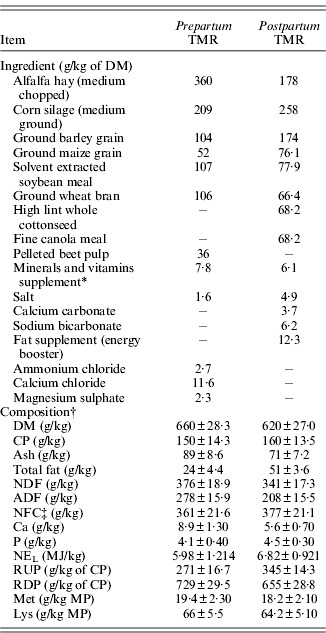
Forty Holstein dairy cows in their first and second lactation (body condition score (BCS)=3·6±0·18; mean±s.d.) were used from December 2007 to June 2008 in a lactation study beginning 4 weeks postpartum. Cows were added to the experiment over a period of c. 5 weeks. Cows were housed in individual tie stalls and cared for under experimental procedures and protocols approved by the veterinary organization of Iran. Selection of cows was based on parity, milk yield of previous lactation (milk yield of dams for the cows in their first lactation) and BCS. Ten cows per treatment (six in 1st lactation and four in 2nd lactation) were randomly assigned to receive one of the following treatments in a 2×2 factorial design 4 weeks before their expected calving dates, using block randomization based on parity: no supplement (control), 18 g/d of RPM product, 60 g/d of RPC product or 18 g/d of RPM+60 g/d of RPC. The RPM product (SmartamineM™M (Adisseo, Antony, France)) was a white, granular powder coated with a polymer (2-vinyl pyridine-Co Styrene) sensitive to acidic pH in the abomasum and contained 0·75 DL-methionine. The RPC product (COL 24® (Soda Feed Ingredients, Monaco, France)) is a rumen-protected source of choline chloride. COL 24® is produced by encapsulating choline chloride with a coating matrix able to resist rumen breakdown and release choline in the intestine and contained 0·24 choline chloride. Cows were fed a total mixed ration (TMR) ad libitum. The forage was 0·57 of the total dry matter (DM) of the dry period diet and 0·44 of the total DM of the lactation diet. The RPM and RPC were top dressed onto the TMR. Samples of both the dry-cow and lactating-cow TMR diets were taken three times per week and frozen until samples were processed for analysis. Similarly, ort samples were also taken three times weekly, on days that feed samples were not taken. Feed and ort samples were collected from 4 weeks before expected calving dates until 10 weeks into lactation. All samples were dried at 60°C for 72 h, and then weighed to determine moisture loss. Dried samples were ground through a 1-mm screen and the nutrient contents of samples were analysed monthly. Chemical analyses of samples were based on the AOAC Official Method (2000) number 925·40 for DM, 923·03 for ash, 984·13 for crude protein (CP) and 972·16 for total fat. Neutral detergent fibre (NDF) and acid detergent fibre (ADF) were determined as described by Van Soest et al. (Reference Van Soest, Robertson and Lewis1991). The NDF was assayed with a heat-stable amylase and both NDF and ADF are expressed inclusive of residual ash. Non-fibre carbohydrate (NFC) was calculated as the difference between 100 and the sum of CP, NDF, total fat and ash. Amounts of feed offered and refused were measured daily throughout the experiment, and weekly analyses of DM content of the TMR were used to calculate dry matter intake (DMI). Pre- and postpartum diets (Table 1) were formulated to meet the nutrient requirements of dairy cows using the Cornell Net Carbohydrate and Protein System (CNCPS) version 5 (Fox et al. Reference Fox, Tedeschi, Tylutki, Russell, Van Amburgh, Chase, Pell and Overton2004).
Ingredients and nutrient composition of pre- and postpartum diets

* Contained 180 g Ca/kg, 70 g P/kg, 30 g Mg/kg, 4 g Fe/kg, 0·5 g Cu/kg, 5 g Mn/kg, 4 g Zn/kg, 0·1 g Co/kg, 0·1 g I/kg, 0·03 g Se/kg, 0·4 g antioxidant/kg, 5×10⁵ IU vitamin A/kg, 105 IU vitamin D/kg and 2×10³ IU vitamin E/kg.
† Contents declared as mean±s.d. Analysis conducted with 12 and 30 pre- and postpartum TMR samples, respectively.
‡ NFC=1000−(CP+ash+total fat+NDF).
Blood sampling, milking and milk composition analysis
Blood samples were obtained 3 h after feeding from the coccygeal vein at –15 d relative to expected calving, parturition day (day 0) and 7, 15, 30 and 60 d after parturition. Blood samples were collected in heparinized Vacutainers (Becton Dickinson, Franklin Lakes, NJ) tubes. Blood samples were placed on ice immediately following collection. Plasma was harvested after centrifugation of the blood at 3000 g for 15 min. Plasma was stored at −20°C until subsequent analysis for NEFA, triglycerides, glucose, plasma urea nitrogen (PUN), aspartate aminotransferase (AST), total protein and β-hydroxybutyrate (BHBA) (Coverdale et al. Reference Coverdale, Tyler, Quigley and Brumm2004). Because there was a possibility that actual calving would differ from the expected calving date, blood samples were taken from −20 d to −10 d relative to the expected calving date, every other day.
Cows were milked thrice daily at 06.00, 14.00 and 22.00 h, with no provision of water or concentrate while milking. Milk yield was measured on one day each week for all cows. The milk samples from individual cows were sent to the laboratory weekly for the analysis of milk contents and proportions of fat, protein and lactose by Milk-O-Scan (Foss Electric, Denmark). The following formula was used for the calculation of 40 g/kg FCM of each cow (Gaines Reference Gaines1928): FCM=[(0·4×kg milk)+(0·15×kg milk× fat g/kg)]. Also, the yield of energy corrected milk (ECM) was calculated by the following formula (DeFrain et al. Reference DeFrain, Hippen, Kalscheur and Schingoethe2006): ECM=[(0·327×kg milk)+ (12·95×kg fat)+(7·2×kg protein)].
Statistical analyses
The repeated measurements of milk yield and composition, DMI and plasma metabolites were analysed as a linear mixed model (Proc Mixed) with the best fitted covariance structure of SAS (SAS Institute 2002). Parameters were estimated by the restricted maximum likelihood (REML) method. The statistical model included the fixed effects of treatment (main effects of the treatment, i.e. RPM and RPC), parity, time (week of lactation for milk yield and composition and DMI and measurement date for plasma metabolites), RPM×RPC, RPM×time, RPC×time, RPM×RPC× time and the random effect of cow within treatment and parity. The error covariance structure used for the repeated measures was the first-order heterogeneous autoregressive structure (ARH (1)) as it resulted in the smallest Akaike's information criterion (AIC).
RESULTS
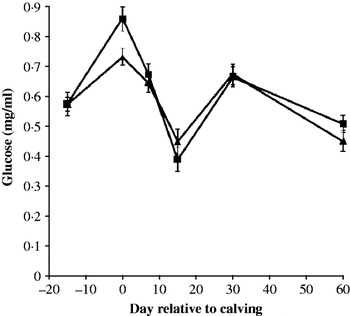
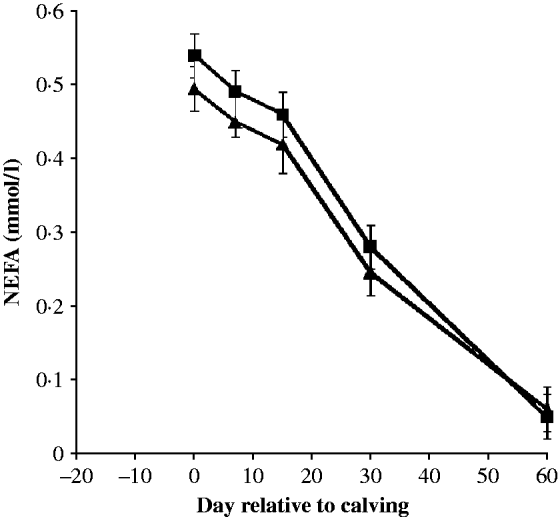
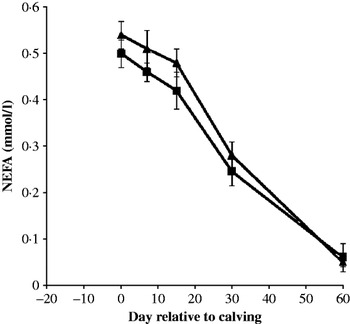
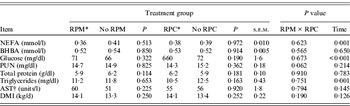
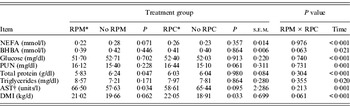
The effects of supplemental RPM and choline on plasma metabolites of pre- and postpartum dairy cows are shown in Tables 2 and 3, respectively. Feeding RPM and/or RPC did not significantly affect plasma triglycerides, glucose, total protein, NEFA, BHBA, PUN and AST during the prepartum period, but there was a significant interaction effect of RPM×time on plasma glucose in both the pre- and postpartum periods (Fig. 1). In addition, for prepartum glucose concentrations, there was a tendency for an interaction effect of RPC and day of sampling (P<0·08; Table 2). For postpartum plasma NEFA concentrations, there were significant interaction effects of RPC or RPM with day of sampling (P<0·05; Figs 2 and 3) and concentrations of NEFA decreased after calving. In addition, for prepartum PUN, there was a tendency for an interaction effect of RPM and RPC and a combination of the zero levels of RPM and RPC increased prepartum PUN concentrations (least squares means=0·151 mg/ml P<0·06). RPM had a significant effect on the postpartum concentrations of plasma total protein and AST (P<0·05; Table 3) and there were tendencies for an effect of RPC on the postpartum concentrations of PUN (P<0·06) and AST (P<0·09). For postpartum concentrations of NEFA and triglycerides, there were tendencies for the main effect of RPM (P<0·07) and interaction effect of RPM×time (P<0·08), respectively. There was a tendency for the interaction effect of RPM × RPC on the postpartum BHBA concentrations and a combination of RPC feeding and zero level of RPM increased the postpartum BHBA concentrations (least squares means= 0·410 mmol/l; P<0·06; Table 3).
Least-square means (±s.e.) of plasma glucose in pre- and postpartum dairy cows supplemented with RPM (▪) or not supplemented with RPM (▲).

Least-square means (±s.e.) of plasma NEFA in postpartum dairy cows supplemented with RPM (▪) or not supplemented with RPM (▲).
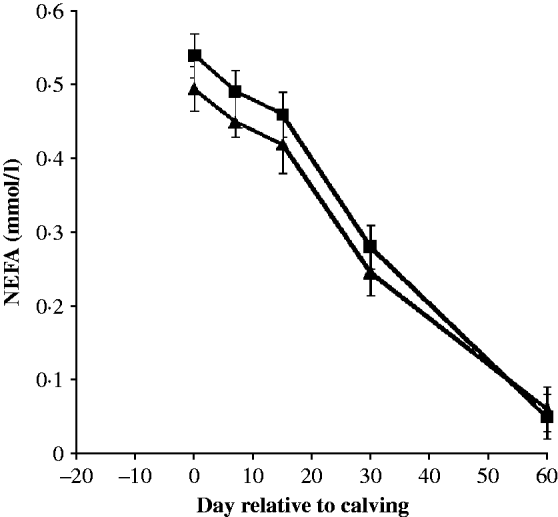
Least-square means (±s.e.) of plasma NEFA in postpartum dairy cows supplemented with RPC (▪) or not supplemented with RPC (▲).

The effects of supplemental RPM and choline on plasma metabolites of prepartum dairy cows

* RPM, rumen-protected methionine; RPC, rumen-protected choline.
† AST, aspartate aminotransferase.
The effects of supplemental RPM and choline on plasma metabolites of postpartum dairy cows
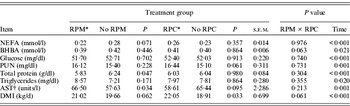
* RPM, rumen-protected methionine; RPC, rumen-protected choline.
† AST, aspartate aminotransferase.
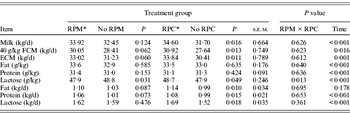
Feeding RPC increased milk yield, FCM, ECM and postpartum DMI (P<0·05; Tables 3 and 4). There was a tendency for an interaction between RPC and RPM for postpartum DMI and simultaneous feeding of RPM and RPC increased postpartum DMI (least squares means=21·51 kg/d; P<0·06), but there were no effects of treatments on prepartum DMI. In addition, there was no significant interaction between RPM and RPC for milk yield, FCM and ECM. Feeding RPM and RPC decreased (P<0·03) and increased (P<0·04) lactose content of milk, respectively, but the treatments did not significantly affect fat and protein contents of milk. Also, RPC increased fat, protein and lactose yields (P<0·05). There was a significant interaction effect of RPM×RPC for lactose content of milk and a combination of RPC feeding and the zero level of RPM increased the lactose content of milk (least squares means=0·049; P<0·05). For FCM (P<0·06), ECM (P<0·06), fat (P<0·08) and protein (P<0·07) yields, there were tendencies for the effect of RPM.
The effects of supplemental RPM and choline on productive indices of lactating dairy cows across the lactation weeks

* RPM, rumen-protected methionine; RPC, rumen-protected choline.
DISCUSSION
In the current study, RPM supplementation tended to reduce the postpartum concentrations of NEFA. Part of the effects of RPM may be the result of increased NEFA clearance or might have been due to increased concentrations of insulin, which lowers plasma NEFA concentrations through reduced lipolysis. In contrast to the results of the current study, Bateman et al. (Reference Bateman, Spain, Kerley, Belyea and Marshall1999) reported no significant effect of RPM on the plasma concentrations of NEFA. However, the current study is in accordance with Zahra et al. (Reference Zahra, Duffield, Leslie, Overton, Putnam and LeBlank2006), who reported that feeding RPC did not significantly affect plasma concentrations of NEFA. Differences in plasma concentrations of BHBA among treatments in the current experiment were not significant, suggesting that methionine and choline supplementation did not affect hepatic ketogenesis directly.
Feeding RPM increased prepartum plasma glucose levels in the current study and under such conditions gluconeogenesis may be enhanced, or glucose uptake by peripheral tissues is reduced. Strzetelski et al. (Reference Strzetelski, Kowalski, Kowalczyk, Borowiec, Osięglowski and Ślusarczyk2009) reported that addition of RPM resulted in a significant increase in blood serum glucose content before calving, which is in accordance with the findings of the current study.
The concentration of PUN reflects the protein status of the cow and her diet, such as diet CP concentration, digestibility of CP and the energy level of a ration (Roseler et al. Reference Roseler, Ferguson, Sniffen and Herrema1993). Overton et al. (Reference Overton, Emmert and Clark1998) and Bateman et al. (Reference Bateman, Spain, Kerley, Belyea and Marshall1999) reported that the concentrations of urea nitrogen in plasma were not affected by the supplementation of RPM in dairy cows, which is consistent with the current study.
The first 2 weeks post-calving is when liver function is most likely to become impaired because of triglyceride infiltration into hepatocytes; therefore, higher levels of AST post-calving may be indicative of reduced liver function (Kida Reference Kida2002). Feeding RPC tended to reduce postpartum concentrations of plasma AST in the present study, but Zahra et al. (Reference Zahra, Duffield, Leslie, Overton, Putnam and LeBlank2006) reported no significant effect of RPC supplementation on serum AST concentrations. On the other hand, the results of the current study showed a significant effect of RPM supplementation on the postpartum AST concentrations and, similarly, Kröber et al. (Reference Kröber, Kreuzer, Senn, Langhans and Sutter2000) reported the significant effect of RPM on plasma concentrations of AST in early lactating dairy cows.
In contrast to the results of the current study for postpartum DMI, several studies have reported that the supplementation of RPC (Pinotti et al. Reference Pinotti, Baldi and Dell'Orto2002; Piepenbrink & Overton Reference Piepenbrink and Overton2003; Zahra et al. Reference Zahra, Duffield, Leslie, Overton, Putnam and LeBlank2006; Davidson et al. Reference Davidson, Hopkins, Odle, Brownie, Fellner and Whitlow2008) in the diet of dairy cows had no effect on DMI. Several studies have reported that the supplementation of RPM had no effect on DMI (Overton et al. Reference Overton, LaCount, Cicela and Clark1996; Girard et al. Reference Girard, Lapierre, Matte and Lobley2005; Lara et al. Reference Lara, Mendoza, Landois, Barcena, Sanchez-Torres, Rojo, Ayala and Vega2006), but Strzetelski et al. (Reference Strzetelski, Kowalski, Kowalczyk, Borowiec, Osięglowski and Ślusarczyk2009) reported a significant effect of RPM on DMI. Feeding RPC increased postpartum DMI and this was due to higher milk yield in RPC-fed cows than cows fed other treatments.
As in the current study, Davidson et al. (Reference Davidson, Hopkins, Odle, Brownie, Fellner and Whitlow2008) reported that milk yield was significantly higher for RPC-fed cows than cows fed other treatments and Erdman & Sharma (Reference Erdman and Sharma1991) reported that RPC-fed cows tended to produce more milk and more FCM. Also, Strzetelski et al. (Reference Strzetelski, Kowalski, Kowalczyk, Borowiec, Osięglowski and Ślusarczyk2009) and Overton et al. (Reference Overton, LaCount, Cicela and Clark1996) reported that yields of milk, CP and percentages of fat and CP in milk were not affected by RPM. However, in contrast to the results of current study, Janovick Guretzky et al. (Reference Janovick Guretzky, Carlson, Garrett and Drackley2006) reported RPC did not affect the daily yields of 35 g/kg FCM, fat and protein for Holstein and Jersey cows during the periparturient period.
The greater ECM requires greater glucose and AA. Glucose is essential to provide NADPH for de novo milk fat synthesis and adenosine triphosphate (ATP) for protein synthesis from AA. The significant effect of RPC on ECM suggests that RPC can positively impact milk energy output. In addition, RPM and RPC had a positive effect on milk lactose concentration. In contrast to the current study, Strzetelski et al. (Reference Strzetelski, Kowalski, Kowalczyk, Borowiec, Osięglowski and Ślusarczyk2009) reported no significant effect of RPM on the milk content of lactose in dairy cows.
There may be several explanations for the significant effect of RPC supplementation on the yield of milk protein in dairy cows. First, RPC may serve to spare methyl groups, and hence S-adenosylmethionine, as the methyl group donor usually necessary for the synthesis of lecithin. Second, RPC may serve as the methyl group donor for remethylization of homocysteine via its metabolite betaine. Third, betaine may also spare methionine by substituting for S-adenosylmethionine as the methyl group donor in some metabolic processes (Brüsemeister & Südekum Reference Brüsemeister and Südekum2006).
In conclusion, feeding RPC increased postpartum DMI, milk yield, FCM, ECM and milk lactose content. In addition, RPC supplementation increased milk fat, protein and lactose yields, and tended to increase PUN concentration after calving, but had no other effects on the plasma metabolites measured. Feeding RPM tended to increase FCM, ECM and milk fat and protein yields, and reduced plasma protein concentration and increased plasma AST concentration after calving. The higher DMI and milk yields of cows fed RPC in the present study suggest that supplemental RPC can improve lactation performance of dairy cows.