Introduction
China's rapid urbanisation and re-settlement patterns are associated with a number of factors: the consolidation of land, an ageing population, smaller families and the dissipation of conventional family-based old-age support (traditionally, older parents have lived with their offspring). These on-going social, political, economic and demographic changes have especially stark implications for older people in rural areas, where social and institutional support arrangements are least developed. In addition, this population typically has a hard time adapting to high-rise living after spending decades in single-storey courtyard homes (Zhan et al. Reference Zhan, Feng, Chen and Feng2011; Zhou Reference Zhou2013). They face a complex situation that is constantly evolving as urbanisation and labour migration shape family dynamics (Zeng and Wang Reference Zeng and Wang2003), and local government initiatives for village renovation call for the re-settlement of seniors.
In many areas of China, as in the City L that we studied, a major problem impeding further economic development is the scarcity of urban land, even as rural land often goes underutilised. To ameliorate the land shortage resulting from urbanisation and industrial development, a couple of villages under the jurisdiction of City L initiated ‘village renovation’ projects. In effect, high-rise apartment buildings replace traditional single-storey courtyard homes as the land is appropriated for other uses. Local governments can generate revenues from land sales to help develop the local economy and accelerate village renovation. However, older people whose homes are bought may have difficulty finding suitable alternative housing and affording a new apartment (even one priced at a discount). Living in high-rise apartments entails a dramatic lifestyle change for older people, who in many cases are both physically and mentally challenged by the adjustment. To address this problem, some villages in City L established senior centres (cun laonian gongyu).
These senior centres represent an emerging housing option that differs from government-funded institutional care provided only to the most vulnerable population, the ‘Three-No’ and ‘Five-Guarantee’ elders.Footnote 1 By contrast, senior centres are wholly funded by village collectives as part of the village renovation process and are designed to house the area's registered senior residents in dormitory-like accommodation. Eligibility for these centres is not stringent. Village residents over the age of 60 can reside in the senior centres until they die, without any asset test or income test. By staying in the same villages where they have resided for years, these seniors can live independently and remain in close contact with their children and friends (Zhou Reference Zhou2013). Additionally, as compared with privately funded nursing homes and senior centres, these centres are virtually always free of charge and some of them also provide meals and room-cleaning services (although this varies according to the fiscal capacity of the village). None of the senior centres provides intensive medical services or registered nursing care, nor do they provide long-term support for activities of daily living (ADLs) for severely disabled older people. However, they do provide an alternative living option for seniors in rural areas, and in that sense may help to address the dilemma faced by local households as development and ‘urban–rural integration’ collide with the demographic reality of China's contemporary households.
Re-settling rural elders into communal living arrangements as part of a village renovation process differs from assisted living or institutional care facilities as they exist in high-income countries. A widely accepted definition of ‘institutional care’ in the developed world is ‘a set of care provided at places of residence, which includes nursing supervised assistance with ADLs, health care and rehabilitation, primarily for the aged’ (Wingard, Jones and Kaplan Reference Wingard, Jones and Kaplan1987 156). Unlike this definition, which has a service-centred focus, institutional care in China has a location-based emphasis: all non-home-based living arrangements for seniors are considered institutional care, even if they provide few supportive services. Thus, these senior centres in rural China represent a new type of institutional care for China, although these facilities cannot be equated with nursing homes or even Western concepts of assisted living facilities.
In this paper, we examine this relatively new mode of living arrangement for China's rural older people. Combining quantitative and qualitative methods in one locality in north-east China, our research questions include: Which older residents choose to live in senior centres and why? How do living arrangement choices differ between communities with or without this new housing option, and what are the observed correlates of shared versus independent living in both settings? Interviews with senior centre residents illustrate the roles played by individual and household needs and intergenerational support in these decisions, and shed light on the question of whether the new housing option will help to address the long-term care dilemma faced by rural households.
Our study contributes to the literature because few studies have documented the role of senior centres funded by village collectives, and few empirical studies examine the re-settlement of older rural residents concomitant with China's land consolidation and how this process may interact with traditions of filial piety and ‘social contracts’ between parents and children. Mixed-method studies such as this one can deepen our understanding of why rural older Chinese choose to live the way they do, and how ‘social contracts’ between parents and children may evolve in communities with and without this new housing option for older rural residents.
Explaining living arrangement choices: theory and reality
A strict interpretation of rational choice theory implies that a living arrangement choice, such as a rural elder's decision to move to a senior centre, reflects that individual's rational calculation of the costs and benefits of each available alternative, with the chosen arrangement maximising personal utility. The theory attempts to explain a social phenomenon through ‘rational calculations made by self-interested individuals’ (Scott Reference Scott, Browning, Halcli and Webster2000 136). A choice of living arrangements, however, cannot entirely be explained in this way. To have a better understanding of the reasons behind an elder's housing choices, we need to examine not only individual interests but the constraints placed on those interests by village renovation processes and policies, as well as the interaction between the elder's interests and those of other family members, the degree of mutual altruism involved, and the costs and benefits of shared household goods compared with the value placed on privacy and the avoidance of future conflicts (Salcedo, Schoellman and Tertilt Reference Salcedo, Schoellman and Tertilt2012). All of these factors change as health status changes over a person's lifecycle, so older people of different ages will be affected by village renovation processes in different ways.
Other scholars have suggested various conceptual frameworks that highlight the multiple determinants and their dynamic interactions. For example, Lawton and Nahemow (Reference Lawton, Nahemow, Eisdorfer and Lawton1973) propose an ecological framework that considers the ageing process as a continuous adaptation. According to this framework, ‘a person's functioning is the result of the biological, psychological, and social resources, environmental characteristics, and the “fit” between ever-changing individuals and their ever-changing environments’ (Greenfield Reference Greenfield2012 .2). When older individuals’ physical condition and social capability no longer fulfil the requirements of the original living arrangement, they consider alternatives that better suit their needs and capabilities (Lawton et al. Reference Lawton, Weisman, Sloane and Calkins1997). However, during this process of environmental adaption over the lifecycle, some seniors’ housing arrangements may go against their wishes due to limited financial resources or care support options (Wiseman Reference Wiseman1980).
Both of these approaches would suggest that income, wealth or other measures of resource constraints play a key role in living arrangement choices. In addition, health and ageing also shape the lifecycle choice of living arrangements, especially during those phases when intensive care is needed. In developed Western societies, where the seniors typically desire to stay in their own homes to avoid unnecessary conflicts with the younger generations and to maximise their freedom, large cohorts of older men and women entering the ranks of the eldest seniors spurred a trend of institutionalisation in the 1980s. This trend was only later countered by laws and policies to promote innovative community-based care to enable seniors to grow old in their own homes (Tomassini et al. Reference Tomassini, Glaser, Wolf, Broese van Groenou and Grundy2004). Health-based needs and resources have been widely recognised as correlates of housing choice in Western countries (Martikainen et al. Reference Martikainen, Moustgaard, Murphy, Eliniö, Koskinen, Martelin and Noro2009; Tomassini et al. Reference Tomassini, Glaser, Wolf, Broese van Groenou and Grundy2004). Because adequate health and functional abilities are deemed necessary for maintaining independence, the health status of older people is highlighted in housing decisions in previous studies (Hays, Pieper and Perser Reference Hays, Pieper and Perser2003). A person's disability level and health conditions are empirically associated with a greater likelihood of moving into a nursing home or other dependent arrangement (Luppa et al. Reference Luppa, Luck, Weyerer, Konig, Brahler and Riedel-Heller2010; Waite and Hughes Reference Waite and Hughes1999). Meanwhile, privacy and independence can be purchased in most countries and settings by those who can afford to do so (Burch and Matthews Reference Burch and Matthews1987). Financial resources and home ownership also reduce the probability of entering a nursing home in developed countries (McGarry and Schoeni Reference McGarry and Schoeni2000; Mutchler and Burr Reference Mutchler and Burr2003; Sarma, Hawley and Basu Reference Sarma, Hawley and Basu2009).
Although developing countries exhibit many similarities, they differ in terms of resource constraints and multigenerational co-residence traditions, which are increasingly confronted by rapid economic and demographic changes. In developing countries, families are traditionally responsible for caring for their older parents at home, and a cultural stigma often surrounds institutional care (Cameroon Reference Cameroon2000; Chen Reference Chen1996; Knodel and Chayovan Reference Knodel and Chayovan1997). As strict interpretations of Confucianism-based filial piety are becoming less common in China, and families themselves are shrinking and increasingly mobile, older adults’ living arrangements have become more diverse, with most seniors living alone instead of with family members (Izuhara Reference Izuhara2000; Li and Chen Reference Li and Chen2011). Explanations for this trend include the economic independence of older people, an increase in available housing and health changes over the lifecycle (Li and Chen Reference Li and Chen2011; Palmer and Deng Reference Palmer, Deng, Gustafsson, Li and Sicular2008).
Health, functional status and wealth are often significant determinants of older people's living arrangements in developed countries, but these factors are not consistently found to be the most pivotal in developing countries (Duan and Li Reference Duan and Li2013; Edmonds, Mammen and Miller Reference Edmonds, Mammen and Miller2005; Sereny Reference Sereny2011; Yang, Pei and Ma Reference Yang, Pei and Ma2012). Edmonds, Mammen and Miller note that in South Africa, intergenerational support between older people and other family members, and the inter-dependence between two and even three generations, are more pivotal determinants of living arrangements. A study using panel data from Indonesia similarly found that shared living arrangements most often cater to the needs of both adult children and of older parents (Johar and Maruyama Reference Johar and Maruyama2011). The children's needs are found to be pivotal determinants for older parents’ housing choices in China (Pimentel and Liu Reference Pimentel and Liu2004; Zhang and Li Reference Zhang and Li2004).
These findings from previous studies suggest that in developing countries the motivation to live independently may be different than in Western societies, and may not necessarily be in pursuit of freedom. Conventional ‘social contracts’ between parents and children may be increasingly shaped by government support programmes to supplement family-based care for older people (Chui Reference Chui2007). Other factors determining older people's housing choices include the eligibility requirements for senior centres, local policies on old-age support and the market supply of home-based care services. But few empirically grounded studies are concerned with the re-settlement of seniors due to land consolidation and ‘social contracts’ between parents and children. This study is intended to deepen the understanding of how rural older Chinese choose to live, the reasons for their choices in light of new housing options, and how ‘social contracts’ between parents and children may evolve in communities with and without this new housing option.
Data, setting and methodology
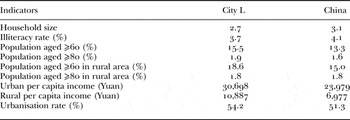
In China, rural areas are generally under the jurisdiction of a municipality. For example, the 12 villages that constitute our research site are under the jurisdiction of City L, located in Province S in eastern coastal China. With a population of 1.3 million, City L's municipal revenue comes primarily from agriculture, manufacturing and steel processing. As shown in Table 1, City L has a slightly higher per capita income than the national average in both urban and rural areas, and exceeds the national mean in its percentage of urban inhabitants and those above age 60. City L has been promoted as a demonstration region within Province S to test a model involving ‘joint development between urban and rural areas’. Since 2001, City L has undergone a series of related changes: urbanisation (population migration towards urban areas), the expansion of formal land management and the centralisation of industrial districts.
Characteristics of City L compared with the national average

Source: China Sixth Nationwide Population Census, 2012.
The senior centres studied in this research are not formally registered as long-term care institutions because their original function was to provide temporary residency to the village's seniors during the period of renovation. However, they may address the problems that rural older people face, and offer a new and relatively permanent housing solution as they become more widely accepted. By the year 2013 there were 1,472 long-term care institutions in Province S, 61 per cent of which were government-established urban welfare centres for the aged (Jing Lao Yuan). Fifteen per cent were assisted living facilities (Laonian Gongyu), and of these, 65 per cent were government owned and the remaining 35 per cent were private. Additional types of long-term care institutions included rural welfare centres (8%, Fu Li Yuan), nursing homes (3%, Yang Lao Yuan), sanatoriums (1%, Liao Yang Yuan) and others (12%, Qita Jigou).Footnote 2 The senior centres in this study fall under the residual 12 per cent category, although since 2008 they have been widely established in the rural villages under the jurisdiction of City L.
Data collection
This study gathered both quantitative and qualitative data from a survey and interviews in City L. The quantitative survey data were collected in July 2012 under ‘the Health and Health Support of Rural Elderly’ collaborative research project sponsored by the Asia Health Policy Program of the Shorenstein Asia-Pacific Research Center at Stanford University and the Institute for Population and Development Studies at Xi'an Jiaotong University. Local government officials classified villages under the jurisdiction of City L according to their economic development level as good, average or poor. By using stratified random sampling, four villages were selected from each of these three economic development levels for a total of 12 villages. To identify whether the living arrangement choices and support mechanisms differ between communities with and without the new housing option, within each economic development grouping our sample included two villages with senior centres and two without. Within every village, a systematic sampling method is used to randomly select households with at least one person aged between 55 and 79, as follows. Household registration information was obtained from the local statistical bureau and verified by village leaders. Where more than one person in this age group lived in the selected household, one was randomly selected to participate. In villages with senior centres, respondents were selected in households and senior centres, respectively, to keep the sample balanced. Overall, this survey recruited 690 individuals; 647 of them gave valid and complete questionnaire responses. Since we are specifically interested in studying intergenerational dynamics, we excluded the few survey respondents without living children. The final data-set was composed of 627 middle-aged and older rural Chinese.
In addition, qualitative data were collected from group discussions and in-depth interviews in 2013 to investigate details about what roles senior centres play in terms of housing arrangements and support for daily activities. We interviewed between six and eight older residents from three of the previously sampled six villages with senior centres. This included one group discussion at a senior centre in one village and 16 in-depth interviews in the other two villages. The in-depth interviews included 12 seniors living in the senior centres and three not living in the centres. All interviews were recorded and transcribed by our investigators. Although not a strictly random sample, the characteristics of these 22 men and women were broadly consistent with the characteristics of the other survey participants. Because the intent was to explore how, when and why older residents chose to move to a senior centre, we unfortunately do not have interviews from villages that lacked senior centres, and we only quote residents of senior centres in this paper. We also conducted several interviews with village leaders, from which we derive the information (summarised above) regarding construction of senior centres and eligibility criteria.
Measurements of variables
Our survey asked respondents about both their current and preferred living arrangements; they were categorised under the labels ‘independent living’ (including living alone or with only a spouse), ‘shared living’ (with children or other relatives) or ‘living in a senior centre’. For those villages without senior centres, living arrangements included only the first two categories. The preferred living arrangement was measured by the following question: ‘If you were given a chance to choose freely, regardless of all other concerns, what kind of living arrangement would you prefer?’ The respondents’ choices were coded as ‘living in senior centres or other long-term care institutions’, ‘living with children’ and ‘living independently’.
Health status was evaluated through a series of questions about ADLs and chronic conditions. Our ADLs measure reflects an individual's capability to perform a set of personal ADLs, activities requiring physical strength, mobility and flexibility, and instrumental ADLs. For each activity, the results are scored as 3 if the respondent is able to perform that activity ‘independently’, 2 if he or she ‘needs help’ and 1 if he or she is ‘dependent’. The values of all items are summed. The capacity for ADL scoreFootnote 3 ranges from 15 to 45, with a higher score meaning the older person exhibits a better capability of performing these activities. We also collected self-reports about the presence of 12 chronic diseases.Footnote 4 ‘Chronic disease’ equals 1 if the respondent reports having one or more of the 12 diseases, and otherwise equals 0. The financial or socio-economic status of the respondents was categorised based on three simple indicators: self-reported annual income, house ownership and working status. Annual income refers to the total earnings from the previous year of the respondent and, if married, the respondent's spouse, including any pension income. House ownership was measured with the question ‘Do you have any houses that are registered under your or your spouse's name?’ Working status was measured by the answer to the question, ‘What is your working status’ (Gong Zuo)? Three responses were provided: ‘never work or no longer work = 1’, ‘part-time work = 2’ and ‘full-time work = 3’. In the regression model, working status is recoded as a dummy variable with ‘never work or no longer work’ used as the reference.
The characteristics of adult childrenFootnote 5 play a pivotal role in the living arrangements of older family members in China. The number of children was collected as a continuous variable; the other variables are categorical. The gender of children was coded as ‘only daughter(s)’, ‘only son(s)’ and ‘both daughter(s) and son(s)’ (reference group). Migration status was categorised as ‘no migration = 1’ (i.e. none of the children had migrated for work, study or to live), ‘partial migration = 2’ and ‘all migration = 3’ (i.e. all of the senior's adult children were no longer residing in the same or nearby villages). Given the large-scale labour and marriage migration in China, conflict of lifestyles and habits among families with children-in-law from different counties or provinces could influence the living arrangement choice of rural older parents. The origins of children-in-law were categorised into ‘all from the same county’, ‘at least one from another county within the same province’ and ‘at least one from a different province or country’. Considering that providing child-care assistance before grandchildren are in junior high school is a pivotal determinant for co-residence in China, ‘grandchildren < 10 years’ was used to measure the child-care need of adult children. The variable ‘grandchildren <10 years’ was coded as ‘having at least one grandchild aged under ten years = 1’ and ‘having all grandchildren aged ten or over = 0’. Socio-demographic characteristics included gender (male = 1), age, marital status and education. Marital status was categorised as ‘married’ and ‘single’, with the latter including unmarried, divorced or widowed. Educational attainment was coded as ‘illiterate’, ‘primary school’ or ‘middle/high school and above’.
Analytical methodology
This study adopted both uni-variate and multi-variate descriptive analyses of our observational, cross-sectional data. t-Tests or F-tests were applied to compare the differences at both village and individual levels. Furthermore, to investigate the correlations between the living arrangement and its potential determinants, we adopted two logistic models: Model 1 only considered basic socio-economic indicators; Model 2 expanded the indicators to include seniors’ preferences and mutual family support. Both models were applied to two samples: the sub-sample of villages with senior centres and the sub-sample of villages without senior centres. For the villages with senior centres, since the dependent variable ‘living arrangement’ is a categorical variable including three categories, the study applied multinomial logistic regression; for the sub-sample of villages without senior centres, the dependent variable was coded as a dummy variable and logistic regression was applied. All the data analysis was completed in Stata 11. The scissor-and-sort technique was adopted in qualitative data analysis (Stewart and Shamdasani Reference Stewart and Shamdasani1990). All the interviews were transcribed and separately coded by three researchers. Each researcher adopted an inductive approach to analyse the topics that were mentioned in the interviews. Then three researchers compiled their topics and finalised a list of the topics most relevant to the main research question. The entire qualitative analysis was executed manually, without employing any qualitative analysis software.
Correlates of living arrangements for older rural residents
Characteristics of villages and samples
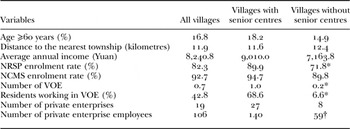
The only statistically significant differences between the two types of sampled villages are that villages with senior centres have higher enrolment in the New Rural Social Pension (NRSP) programme, more village-owned enterprises and (logically) a higher percentage of residents working in village-owned enterprises (Table 2). These results are consistent with the observation that the village collective is almost always the source of financing for the senior centre.
Descriptive results at the village level

Notes: NRSP: New Rural Social Pension; NCMS: New Cooperative Medical Scheme. VOE: village-owned enterprises.
Source: Authors’ analysis of our survey data from the community questionnaire.
Significance levels: † p < 0.1, * p < 0.05 (t-test).
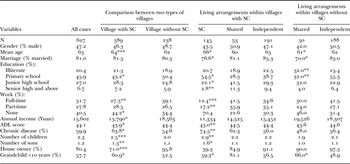
Looking at the characteristics of the sampled individuals and their households, as shown in Table 3, the average age of the sampled older men and women is 63 years old, with 81 per cent married and 47 per cent male. More than half have no more than a primary school education, nearly 60 per cent are still working (often in agriculture) at least part-time and about 80 per cent own their houses. Nearly 60 per cent of the respondents have at least one chronic disease; however, they report usually being able to manage their daily activities independently. On average, they have two children, and usually one is a son. Comparing the respondents in the two types of village, only gender and marital status do not exhibit significant differences. The sample residing in villages with senior centres are older on average, have lower annual household incomes (although at the village level when including the working-age population, incomes are not statistically different, see Table 2), suffer more limitations on ADLs and fewer own their own house. By contrast, seniors residing in villages without senior centres are on average less educated; a larger share are still engaged in full-time work, with fewer chronic conditions, fewer children, fewer sons and fewer grandchildren younger than ten years.
Characteristics of sampled older residents, by village type and living arrangement

Notes: SC: senior centre. ADL score: activities of daily living score.
Source: Authors’ analysis of our survey data from the personal questionnaire.
Significance levels: † p < 0.1, * p < 0.05, ** p < 0.01, *** p < 0.001 (t-test/F-test).
In villages with senior centres, the health of seniors living in senior centres is significantly worse than that of their counterparts with other living arrangements. Interestingly, they also have more children compared to the other sampled group. For villages without senior centres, the significant differences are in age, marital status, education and number of grandchildren under the age of ten.
Living arrangements and possible correlated factors
The previous descriptive analysis indicated several uni-variate correlates of different living arrangements. In this section, we investigate the further interactions between living arrangements and related factors in a multi-variable descriptive analysis, to provide a better understanding of the current needs of the rural older residents.
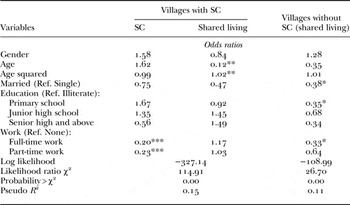
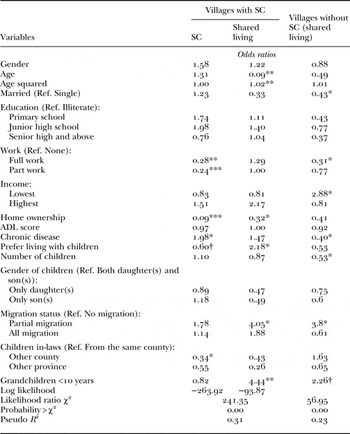
Table 4 shows the results from the first logistic model, with living arrangement as the dependent variable and basic socio-economic indicators as explanatory variables. In villages with senior centres, age and work status have the highest correlation with choice of living arrangement. The correlation between ‘shared living’ and age is ‘U’-shaped, meaning both younger and older seniors are more likely to live with their children, but older residents in the middle tend to live independently. Seniors who still work either full- or part-time usually live independently rather than at senior centres. These correlations suggest that older people's living arrangements might be influenced by their own needs as well as the needs of their children.
Correlations between living arrangements and basic indicators

Notes: SC: senior centres. Ref.: reference group. For the sub-sample of villages without SC, the dependent variable is a dichotomous variable for shared living or independent living, with independent living as the reference group or base case. For the sub-sample of villages with SC, the dependent variable for living arrangement is coded as three categories, with independent living as the reference group or base case.
Source: Authors’ analysis of our survey data.
Significance levels: * p < 0.05, ** p < 0.01, *** p < 0.001.
In villages without senior centres, the statistically significant correlates of living arrangements are marital status, education level and work status. Single and illiterate older parents tend to stay with their children. In terms of work status, those participating in full-time work are more likely to be living alone.
Logistic Model 2 expands the possible explanatory factors by including the respondents’ preferences, health condition and financial situation, as well as the characteristics of their children and grandchildren. The results of Model 2 presented in Table 5 show that age, marriage status and work status maintain the same correlations with living arrangements as they do in Model 1.
Correlations between living arrangements and expanded indicators

Notes: SC: senior centre. Ref.: reference group. ADL score: activities of daily living score. For definitions of the dependent variables, see Table 4.
Source: Authors’ analysis of our survey data.
Significance levels: † p < 0.1, * p < 0.05, ** p < 0.01, *** p < 0.001.
In villages with senior centres, Model 2 also reveals that home ownership, chronic disease, preference of living arrangement, migration status of children and presence of young grandchildren (under ten years old) are also statistically significant correlates of seniors’ living arrangements. Seniors who own their own homes (and those with sons- or daughters-in-law from other counties) tend to live alone rather than at senior centres or with their children. Older men and women with chronic diseases, however, are more likely to stay at senior centres than to live alone. Seniors’ personal preference is also a significant indicator: those who prefer to live with children can usually have their preference accommodated. Thus, the senior centres appear to provide a valuable extra alternative, providing seniors with more options for living arrangements and enabling them to follow their preferences. Additionally, seniors are more likely to co-reside with their adult children if one of their adult children migrates and they have grandchildren younger than ten years old.
In villages without senior centres, low income, chronic diseases, number of children and migration status of children are the statistically significant indicators. The correlate of presence of young grandchildren (under ten years old) is also significant at the 10 per cent level. Seniors with chronic diseases are more likely to live alone. Surprisingly, the more children seniors have, the less likely they are to live with them. Only those older men and women with the lowest incomes tend to live with their children. These results suggest that resources remain a significant constraint on the poor, who feel they must live with their children to pool resources and share household public goods even if they might have preferred more independence or privacy. In addition, those older people with one or more of their adult children migrating elsewhere for work and a grandchild younger than ten years old are more likely to co-reside with their adult children.
If we compare the findings in both types of village – those with and without senior centres – work status, health status, children's migration status and presence of young grandchildren are correlated with living arrangements in both. A priori, it is not entirely clear if parents would be more or less likely to co-reside with adult children who migrate some distance to work; they might move into the child's home to care for it and grandchildren while the adult child is away, or they might stay in their own home and be further separated from their children. We find that in City L, older parents are more likely to co-reside with their adult children if the adult children migrate (e.g. commuting to not-too-distant urban areas for work), especially when they have grandchildren younger than ten years. These findings suggest that older parents cater to their adult children's needs, such as providing child care for young grandchildren and tending to household chores if their children travel to urban areas for work. The major difference is that older men and women with chronic diseases were more likely to live at senior centres if they have the option, whereas in villages without senior centres older residents tend to live alone. Hence living at senior centres provides one potential solution for older parents concerned about troubling their children because of their chronic health troubles. In addition, older residents from villages with senior centres appear to base their living arrangement decisions on their home ownership, personal preferences, and their own needs as well as those of their children. Older residents of villages without senior centres are more restricted by financial incapacity and their children's needs.
Complementary findings from qualitative analysis: the dynamics of living arrangements in older residents’ own words
This section investigates the determinants of seniors’ living arrangements, especially the reasons for their preferred and actual living arrangements, through interviews with older men and women residing in villages with senior centres. Combining these results with findings from the quantitative analysis allows for a deeper probe into the dynamics surrounding living arrangement decisions than can be provided by cross-sectional survey data alone.
The determinants of preferred living arrangements
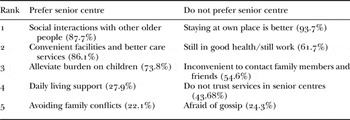
In the questionnaire survey, we sought to learn about residents’ preferred living arrangements as well as the reasons for their preferences by asking them an open-ended question. The two main reasons they gave for preferring to stay at senior centres were better social interactions with others their own age, and convenient facilities with better care services (Table 6). (Even though intensive medical services or registered nursing care is not provided at the centres, the meals and room-cleaning services that some senior centres provide are usually thought of as care services.) The respondents also said they wanted to alleviate the burden on their children by living in a centre. Those who preferred not to stay at senior centres emphasised that their own homes are better than the institutions. Another factor is that they are in good health and still working. Slightly more than half were concerned about the inconvenience of contacting families and friends if they lived at the senior centres; and more than 40 per cent said they did not believe that the services provided in senior centres were of high quality. Hence, these findings suggest that older people choose their living arrangements by prioritising their own needs for social support and long-term care, while also taking into account their extended family's financial situation and the dynamics of intergenerational relationships.
Reasons for preferred living arrangement choices

Source: Authors’ analysis of our survey data.
The determinants of actual living arrangements
The interviews reveal how older men and women negotiate changing conditions and the complex considerations that influence whether or not to live in a senior centre. This section provides quotes from several older people living in senior centres, revealing multiple motivations for their choosing to live in the centres: the necessity created by village renovation, their inability to adapt to apartment living, their wish to avoid intergenerational conflict and their adult children's habits (which differ from their own), and their personal preference for the advantages the senior centres offer.
During the interviews, some of senior residents confessed that they moved (at least initially) to the senior centre because the village renovation project had demolished their houses and they had chosen to give their new homes (which were issued as compensation) to their adult children. In rural China, parents assume important responsibility for guaranteeing housing for their sons. These testimonies are consistent with the quantitative finding that if the older respondent owns a house, he or she is more likely to live independently.
All02: I used to live with my spouse at our house. Due to the village renovation project, our house was levelled. As compensation we were issued two apartments. I gave both to my sons…
Interviewer: Why do you live at this senior centre?
All02: Otherwise I have nowhere to stay.
In many cases, however, the village renovation process meant that even those older residents who owned the newly issued houses by themselves had to move into a senior centre when the houses were under construction. There were not many other alternatives for these residents.
As I am getting older, it is harder for me to rent a temporary house around this neighbourhood. (AII03)
People don't feel like leasing houses to us, as we are getting older and sicker. They are afraid that we might die in their houses. So they just tell us there is no housing available for now. (Azx02)
Some of the respondents noted that apartment buildings (which do not always have elevators) are less convenient than single-storey courtyard homes. Most of the village senior centres were built to resemble condensed versions of a courtyard complex, so seniors preferred staying in them rather than moving into new apartments.
Even though my children are living in an apartment, I am still not quite used to it. It's not convenient living in the apartment. (All01)
Meanwhile, senior centre residents of different ages are affected by the village renovation process in different ways. For the oldest, the inconvenience of apartment buildings can mainly be attributed to their worsening health.
My children are living in apartments; however, I am too old to climb the stairs. (Azx05)
As I am getting older, it would be better for me to live at a courtyard. I cannot even climb to the second floor anyway. I am almost 80 years old now. (Azx06)
Although living in an apartment building may have some benefits for older people, such as more up-to-date and modern facilities, adapting to a novel arrangement can be challenging. The senior centres provide an alternative choice and allow the rural older people one option that may seem closer to their old way of life.
Young people always prefer apartments; however, I have been living at courtyard housing for my entire life. This is better for me. I am not used to having a bathroom within my house, and I don't know how to use those household electronics anyway. (All04)
We might categorise health conditions and the lack of attractive housing alternatives as the most significant external factors that prompt older residents to move into senior centres. At the same time, some older people note intergenerational conflicts (such as strained relationships with adult children, especially sons- and daughters-in-law) and differences in living habits as factors that make senior centres an attractive living option.
I have suffered from my mother-in-law back then. Now I still have to suffer from my daughter-in-law's bad temper. Staying at this senior centre, the food is not as good, but I feel much better. (Adz04)
Even if familial conflicts are only mild and intermittent irritants, differences in habits and lifestyles frequently give rise to tensions among the two or three generations that live together. Older people usually have to accommodate their children to avoid household conflicts.
Old people can no longer live with their children. Our lifestyles are already extremely different. And children usually will not consider your needs and preferences. (All05)
Young people are always busy, they leave right after breakfast for work; however, by the time they are gone, I still have not got up yet. (Azx01)
You have to be very considerate, otherwise how can we share one apartment? However, [when] living at the senior centres [it] is easier to express our preferences. (Azx02)
Although most of the interviewees moved into the senior centres because of village renovation, they have found the arrangement agreeable and many actually prefer living there. They feel a sense of freedom and companionship because they can communicate easily with other residents at the centre.
I have been living here for three years; I prefer to stay here. Living with children is really inconvenient. (Adz01)
It's very convenient staying here, since you can manage your schedule as the way you want. (Azx01/Azx06)
In the apartment buildings, neighbours don't even know each other. Living here [it] is pretty easy to find someone to talk to. (Azx07/Azx04)
Moreover, even though none of the senior centres provides intensive medical services or registered nursing care, residents offer one another mutual support. This is consistent with the answers given in the questionnaires addressing why seniors might prefer senior centres.
For those trivial medical conditions, I don't need to inform my children. Other residents here would help me out. However, for severe ailments, I have to rely on my children. (Azx01)
Usually other residents here help to take care of me. My children occasionally would come; however, they cannot be here all the time. (Azx09)
Living in the senior centre is not bad at all. We often socialise and help each other. I don't feel like staying with my children, simply because it is not convenient. When I get sicker, I will have to rely on my children. (All03)
As village leaders revealed in interviews, although most older residents were willing to move into the senior centres during the village renovation, a few were reluctant. Those residents were usually younger, in better financial condition and willing to live with their children, or they had children who had temporarily relocated to work in big cities. This is consistent with the previous quantitative findings, and is once again suggestive of lifecycle and health issues’ roles in shaping living arrangements in rural China.
Integrated findings from quantitative and qualitative analysis: intergenerational support in villages with and without senior centres
Patterns of intergenerational dynamics, including financial, emotional and instrumental support, are closely associated with older people's living arrangements, as substitutes for or complements to co-residence support. Using the quantitative data from our questionnaire survey, we first compare the intergenerational support that seniors receive from their children in villages with senior centres and without. Then we use the qualitative data to confirm and complement the findings from the quantitative data, particularly to explore how senior centres are associated with patterns of intergenerational support that may differ from communities that lack such centres.
Financial support
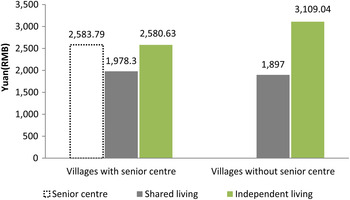
We measured financial support from children based on the total amount that the parent had received from each child during the past 12 months. In villages without senior centres, older parents who live independently receive significantly more financial support from their children than those who live with their children (Figure 1). This phenomenon, however, is not statistically significant in villages that have senior centres. One possible explanation for this is that villages with senior centres are usually better off financially, and senior centres reduce older people's cost of living, since they are free of charge. Therefore, older parents living in these centres are not in need of monetary support from their children.
Financial support from children.

In the interviews, the majority of parents said they had never received direct monetary support from their children; they usually live on their previous savings and pensions, supplemented by some in-kind support from their children. Moreover, since these parents have been assigned new apartments as part of the village renovation programme, their children usually occupy the new apartment and pay for its furnishings. The older parents sometimes even provide financial support to their children and grandchildren. Adult children in turn usually provide material support to their parents: sons frequently give gifts of food, whereas daughters often give their parents clothes.
I have never received money from my children, since I have enough for myself. However, my children usually buy me something. For example, my daughter usually buys me clothes. (AII01)
My children usually don't give me money; however, they usually buy clothes, food and other gifts for me during Chinese festivals. (AII02)
My children don't give me money; on the contrary, I gave each of them 50,000 Yuan for building the house, 5,000 Yuan for decoration. They have to pay for their children's tuition. (Adz01)
Emotional support
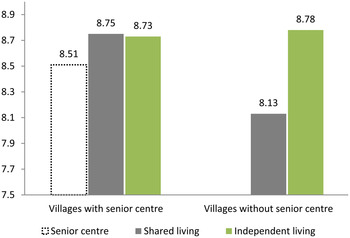
Emotional support is measured on a three-point scale with three questions.Footnote 6 The mean of the total score across all children for each older parent is taken. In villages without senior centres, older parents living independently appear to receive more emotional support from their children than those who are co-residing or are in shared living arrangements and the difference is statistically significant (Figure 2). For villages with senior centres, there is no significant difference in emotional support between the two groups.
Emotional support from children.

These differences in emotional support within villages without senior centres might stem from the fact that the choice of living arrangements is usually based on pragmatic needs rather than pure preference. In these cases, co-residence might be more likely to lead to intergenerational conflict, or to continue despite such conflicts, compared with villages with a senior centre option. Senior centres are thus alternatives for households facing familial conflicts, and may also prevent future difficulties. However, one concern expressed in the interviews is that the location of the centres, or the centres themselves, might be a barrier to their children visiting.
My children are all married, if we live together, there might be more conflicts. However, now I am staying at this senior centre, my children occasionally visit me, our relationship actually got better ever since… (AII03)
Instrumental support
Older parents said that their children are usually able to provide assistance with health care when needed; however, less than half said their children provide daily living support (richang shenghuo zhaoliao). In villages without senior centres, parents living with their children receive slightly more support (for both daily living and health-care needs) than those living independently. However, these differences are not substantially or statistically significant, and may reflect the lower need for such support when the older parent is cared for under the same roof. In villages with senior centres, there are no substantive differences in support for daily living or health-care needs among seniors in the three living arrangements.
These interview results reinforce the finding that even within senior centres, adult children are still the primary providers for long-term care and medical support. This reliance on family appears mainly due to the lack of health-care resources at senior centres, a concern voiced by some interviewees.
Of course it would be my children taking care of me if I got sick. Otherwise who else would I turn to? (Azx07)
You cannot rely on the village collectives to provide you health care; how can they support so many older people? (Azx08)
I still have to depend on my children when I get sick … both my son and daughter come to take care of me; they take good care of me. (Azx05)
If I got sick, of course it would be my children taking care of me. (Azx06)
When the older parents are in good health, they usually try not to ‘bother’ their children, and children in turn may give them gifts rather than provide them with daily necessities. This propensity could explain the low ‘daily living support’ (‘richang shenghuo zhaoliao’) reported in both sets of villages. Furthermore, the interviewees said that they strive to provide whatever their children might need, and hope that if one day they are sick this caretaking will be reciprocated. However, this ‘social contract’ of reciprocity cannot always be enforced, and many older parents wonder if their children will take care of them when the time comes.
I usually cook for my children; if they are busy or in need of help, they just call me. (Adz01)
When my children are in need, they just call me. I have babysat for my four sons’ children. I also help them clean their houses. When I get sick, I hope they can take care of me; however, I don't know whether they will or not. (AII02)
Discussion
With fewer adult children and the incremental collapse of the Confucian ideal of filial piety, many studies question how China will support its rural older population, especially as adult children increasingly migrate to work or settle in urban areas. Some analysts suggest that improving health care and expanding the social safety net with old-age support programmes will help societies like China meet the challenges associated with low fertility and population ageing (Lee, Mason and Members of the NTA Network Reference Lee and Mason2014; Zimmer and Kwong Reference Zimmer and Kwong2003). China has recently announced a ‘new type’ of urbanisation plan that emphasises ‘human-oriented development’ and greater integration between rural and urban areas by fostering the transition of industrial structures, living environments, social security systems and lifestyles (Zhu and Zhan Reference Zhu and Zhan2013). Village renovation projects represent part of this trend, and village senior centres might be one institutional form that enables China to transition from traditional to new support mechanisms for its burgeoning older population.
Using quantitative and qualitative information from 12 villages under the jurisdiction of one municipality in north-eastern coastal China, we studied the living arrangement choices of the rural older people based on a 2012–13 sample of 627 residents aged 55 and older, residing in villages equally divided between those with and without senior centres. Our findings suggest that older people in rural China sometimes must re-settle because of village renovation, and that in this process they increasingly have the ability to choose their living arrangements rather than simply accept new high-rise living or conform to the economically expedient and traditional social norm of living with a son. Seniors’ chosen living arrangements not only appear to prioritise their own needs for social support and long-term care, but also to consider the entire extended family's financial circumstances and intergenerational relationships. Older men and women from villages without senior centres appear to be more constrained. These findings confirm that conventional patterns of co-residence have increasingly been shaped by government support programmes supplementing family-based care for older people (Chui Reference Chui2007).
Our results in this study re-enforce and extend those found in some previous studies, including those that document that the preference for living with adult children stems mainly from reciprocal motives to provide mutual support: older parents receive physical care and emotional support while in turn helping their adult children with housework, caring for grandchildren and even providing financial assistance (Sereny and Gu Reference Sereny and Gu2011; Yang, Pei and Ma Reference Yang, Pei and Ma2012). Three-generation and grandparent–grandchildren ‘skipped-generation’ households are formed to cater to the needs of intergenerational support (Zhang and Li Reference Zhang and Li2004). In this study, we also find that older parents tend to live with their adult children if the children temporarily migrate to nearby cities, especially when the grandchildren are younger than ten years old. However, this ‘social contract’ of reciprocity cannot always be enforced; for example, our study reveals that older parents with chronic health problems are less likely to reside with their children. Although children may still live nearby and be willing to assist, the decrease in multigenerational living and the high rate of labour migration suggest that without the support of the social security system, the rural older people who become chronically disabled may be at risk of lacking a nearby family member to assist with ADLs. In villages with senior centres, the centres provide older residents who are managing chronic diseases with an alternative option for living independently.
Our study also extends the current understanding of the motives for intergenerational transfers, such as monetary support and gifts between parents, children and grandchildren. If transfers from adult children to their parents rise when recipient income falls, this can be construed as evidence of altruism rather than exchange (Cox Reference Cox1987). Cai, Giles and Meng (Reference Cai, Giles and Meng2006) find that children in China support parents with low household incomes when the parents’ income falls below the poverty line, which is consistent with an altruistic motive. Similarly, Park and Porter (Reference Park and Porter2010) find that those older adults who benefit from windfall income due to urban housing reforms receive considerably less financial help from their children, which is consistent with an altruistic motivation for transfers. Data limitations preclude a direct test of altruistic motivations for the intergenerational transfers that we observed, but our analyses and interviews both support the proposition that rural Chinese residents balance altruistic concerns for the needs and desires of parents and children with more pragmatic concerns when deciding their living arrangements. In our study, older people living independently receive less financial support in villages with senior centres (as they are usually in a better financial condition and can provide more financial support) than those in villages without senior centres, which also indirectly confirms the altruistic motivation for transfers. However, it cannot be argued that senior centres represent windfall wealth in the same sense as urban housing reforms giving property rights to urban residents at below-market prices did, since senior centres do not provide long-term ownership rights. Indeed, many rural older people had few other viable housing options during the village renovation process.
A community senior centre may represent an attractive option to rural seniors when they are still functionally independent and eager for interaction with others their age. The inconvenience of high-rise apartment buildings, and sometimes the desire to give new apartments to their children, are important factors in seniors’ choice of the centres (Zhan et al. Reference Zhan, Feng, Chen and Feng2011). The mutual support that is common among residents at senior centres partly reduces their dependence on their children, which in turn may reduce the overall strain on families. When rural elders living with their children cannot provide any help and must depend heavily on their children because of health issues, the intergenerational relationships may become more complicated, and some studies allege the resulting conflicts can lead to a higher mortality risk for seniors (Liu et al. Reference Liu, Xiao, Cai and Li2015). Senior centres can potentially represent an important option for older women, as one of the main reasons they opt not to live with their children is to avoid possible conflict with family members, particularly their daughters-in-law (Du Reference Du1998). However, village senior centres are not fully equipped nursing homes and lack medical services and long-term care staff. They function more as dormitory-style accommodation. The oldest seniors or those struck with disabling medical conditions almost always have to fall back on their adult children for assistance with daily activities and long-term care. This limits the role of senior centres in addressing the long-term care needs of local households facing development, ‘urban–rural integration’ and resulting demographic changes.
Our quantitative and qualitative results also suggest that seniors’ level of health and functional independence shapes traditional and emerging patterns of intergenerational support, or ‘social contracts’ between parents and children, in rural China, although further studies with longitudinal data would shed further light on this complicated issue. In villages with senior centres, both the youngest and oldest seniors appear to be the most likely to live with their children. The interviews also revealed that village senior centres provide an option that allows older people to continue living independently until they are in need of medical and long-term care. Not only is this living arrangement rent-free for the family, but it also makes it possible for older parents to donate the new apartments built during village renovations to their adult children. We hypothesise that by accepting living in a senior centre during their ‘middle years’ when seniors are ‘retired’ but still functionally independent, they may actively reinforce the ‘social contract’. Thus, they may expect reciprocal financial and instrumental support if and when they ever need time-intensive assistance for an acute medical condition or long-term care for a disabling illness. However, our cross-sectional evidence is only suggestive of such a dynamic, which for some older people may represent only hopeful expectation rather than a reliable ‘social contract’.
Another limitation of this study is obvious: the qualitative analyses focus on exploring the motives of older people moving into senior centres and the pattern of intergenerational support. The reasons why some older people chose not to move into senior centres were not described in detail; the dynamics of living arrangement choice in villages without senior centres was not revealed due to limited qualitative data on seniors living in those villages. More generally, cross-sectional analyses cannot tease out causality from correlation; much of policy relevance could be learned about the dynamics of living arrangement choices when detailed longitudinal data and careful study design support studies that can pinpoint causality.
Although some sceptical observers might doubt the value of devoting village collective funds to senior centres, arguing that they are mere expedients to appease an otherwise restless constituency, a case can be made that senior centres can play an important role in mitigating the strains on rural Chinese families from population ageing, smaller families, widespread migration for work and the rapid urbanisation that is re-structuring land rights and social support arrangements. Senior centres add an additional choice to older people's menu of living arrangement options, which might otherwise be increasingly constrained by demographic and economic changes as well as the re-zoning of rural land. Less clear is whether the senior centres are merely a transitional institutional arrangement or a more permanent fixture in China's rural landscape. With development and urbanisation, more and more villages may establish senior centres and foster markets enabling family members to purchase long-term care and other support services for older parents. Many of the younger seniors may also opt to migrate with their adult children to urban areas, especially if affordable housing policies adapt to support multigenerational living. Most rural seniors, especially those who lack support from adult children, would benefit from additional policy support – such as improving the new rural pension scheme (NRSP), adding catastrophic medical spending coverage within the new co-operative medical scheme and setting up a funding mechanism for long-term care of the poor.