

Wellbeing is generally understood as a comfortable, happy, and healthy state of being, which depends on one's subjective experiences as well as living conditions (Ben-Arieh, Casas, Frønes, & Korbin, Reference Ben-Arieh, Casas, Frønes, Korbin, Ben-Arieh, Casas, Frønes and Korbin2014). The importance of enhancing students’ wellbeing is recognised by an increasing body of research regarding the notion of student wellbeing and the ways to enhance the wellbeing of all students (McLellan & Steward, Reference McLellan and Steward2015; Miller, Connolly, & Maguire, Reference Miller, Connolly and Maguire2013). There is, however, a lack of consensus regarding the conceptualisation and definition of student wellbeing (McLellan & Steward, Reference McLellan and Steward2015; Soutter, O'Steen, & Gilmore, Reference Soutter, O'Steen and Gilmore2012). Students’ wellbeing has been implicitly or explicitly defined as students’ quality of life, and the terms wellbeing and quality of life have been used interchangeably despite them being different concepts (Yamaguchi, Reference Yamaguchi2015). To evaluate one's quality of life, objective and subjective measures are usually required (Vittersø, Reference Vittersø2004), whereas only subjective assessments may be used to evaluate one's wellbeing (Yamaguchi, Reference Yamaguchi2015). Therefore, wellbeing does not equate to quality of life but may be understood as an aspect of quality of life (Yamaguchi, Reference Yamaguchi2015). The terms student wellbeing and child wellbeing have also been used interchangeably. However, it must be noted that not all children are students. According to the UNESCO Institute for Statistics (2015), 124 million children and adolescents do not attend school. As such, child wellbeing needs to be understood as a different concept from student wellbeing. Specifically, student wellbeing takes on an educational perspective and emphasises school contextual factors and the ways that school practices and actions influence children's wellbeing in school (Noble & McGrath, Reference Noble, McGrath, Fava and Ruini2014). Nevertheless, it is acknowledged that a child's home and community also have a significant impact on their sense of student wellbeing (Noble & McGrath, Reference Noble, McGrath, Fava and Ruini2014).
The different philosophical traditions in the study of student wellbeing have also contributed to its lack of a uniform definition. Those whose beliefs on this topic are rooted in hedonism tend to equate student wellbeing with a student's satisfaction with life in school and a prevalence of positive emotions in comparison with negative emotions (Diener, Reference Diener and Diener2009). Definitions of student wellbeing developed by De Fraine, Van Landeghem, Van Damme, and Onghena (Reference De Fraine, Van Landeghem, Van Damme and Onghena2005), and Hascher (Reference Hascher, Mayring and von Rhoeneck2003) are rooted in the hedonic philosophical tradition. Hascher (Reference Hascher, Mayring and von Rhoeneck2003) claimed that student wellbeing “. . . is an emotional experience characterised by the dominance of positive feelings and cognitions towards school, persons in school and the school context in comparison to negative feelings and cognitions towards school life” (p. 129). Likewise, De Fraine et al. (Reference De Fraine, Van Landeghem, Van Damme and Onghena2005) defined student wellbeing as “the degree to which a student feels good in the school environment” (p. 297). Others, whose beliefs align with the eudaimonists, assert that students experience a sense of wellbeing when they are provided with opportunities in school to realise their potential by pursuing meaningful and purposeful goals (Keyes & Annas, Reference Keyes and Annas2009). Fraillon's (Reference Fraillon2004) definition of student wellbeing is aligned with the eudaimonic perspective, and he believed that it “. . . is the degree to which a student is functioning effectively in the school community” (p. 24). His conceptualisation of the aspects comprising student wellbeing included constructs such as autonomy, competence, engagement, and connectedness, all of which have been associated with wellbeing conceived from the eudaimonic philosophical tradition of wellbeing (Henderson & Knight, Reference Henderson and Knight2012). As neither view in itself is sufficient to capture the complexity of student wellbeing, the definition as well as conceptualisation of student wellbeing should include both hedonic and eudaimonic approaches (Seligman, Reference Seligman2011). The authors of this paper would adopt the following definition of student wellbeing as it incorporates both philosophical traditions and has been developed by 26 experts on student wellbeing from various countries: “Student well-being is a sustainable state characterised by predominantly positive feelings and attitude, positive relationships at school, resilience, self-optimisation and a high level of satisfaction with learning experiences” (Noble, McGrath, Wyatt, Carbines, & Robb, Reference Noble, McGrath, Wyatt, Carbines and Robb2008, p. 9).
As a result of these different conceptualisations and definitions of student wellbeing, researchers have developed different scales to assess students’ wellbeing (McLellan & Steward, Reference McLellan and Steward2015). These inconsistencies in definitions, conceptualisations, and assessments of student wellbeing may lead to a research base that is perplexing and contradictory, which may impede research on student wellbeing from progressing more effectively (Soutter, O'Steen, & Gilmore, Reference Soutter, O'Steen and Gilmore2014). Moreover, gaps exist in the literature about student wellbeing, particularly in regard to students with autism spectrum disorder (ASD). Students with ASD have qualitative impairments in social communication, and restrictive, repetitive patterns of behaviours, interests, or activities (American Psychiatric Association, 2013). They may face difficulties in developing, maintaining, and understanding relationships with their peers and teachers (Hart & Whalon, Reference Hart and Whalon2011), display strong reactions to seemingly little changes to daily school routines (Carpenter, Reference Carpenter2013), and might also have atypical sensory processing patterns (Ashburner, Ziviani, & Rodger, Reference Ashburner, Ziviani and Rodger2010).
These impairments and characteristics associated with ASD may have an adverse impact on their experiences in school, thereby negatively affecting their mental health (Mayes, Gorman, Hillwig-Garcia, & Syed, Reference Mayes, Gorman, Hillwig-Garcia and Syed2013), relationships (Rowley et al., Reference Rowley, Chandler, Baird, Simonoff, Pickles, Loucas and Charman2012), and educational attainment (Keen, Webster, & Ridley, Reference Keen, Webster and Ridley2015). For instance, Hebron and Humphrey (Reference Hebron and Humphrey2014) found that students with ASD experienced greater mental health problems, such as anxiety, depression, anger, and possessed lower self-concept than students without disability. In regard to relationships with their peers, students with ASD reported feeling more lonely, and had poorer friendship quality and social network status than their peers without disability (Locke, Ishijima, Kasari, & London, Reference Locke, Ishijima, Kasari and London2010). Students with ASD also tended to fare more poorly in terms of academic outcomes compared to students without disabilities; most students with ASD do not participate in postsecondary education (Chiang, Cheung, Hickson, Xiang, & Tsai, Reference Chiang, Cheung, Hickson, Xiang and Tsai2012). Only about 2% of students with ASD who finished school in Australia obtained a degree or a higher qualification (Australian Bureau of Statistics, 2011). This is about 10 times less than the number of students without disability. As mental health (Kern, Waters, Adler, & White, Reference Kern, Waters, Adler and White2015), relationships with others (Hascher, Reference Hascher2008), and educational attainment (McLellan & Steward, Reference McLellan and Steward2015) have been found to influence one's wellbeing, it is likely that the wellbeing of students with ASD is lower than their typically developing peers.
To the authors’ knowledge, researchers have yet to define the term domain in relation to student wellbeing. The term domain appears to be derived in several ways in the area of child wellbeing. Some researchers define the term conceptually, for example, areas of interests, aspects, dimensions, and policy concern regarding child wellbeing (Lee, Reference Lee, Ben-Arieh, Casas, Frønes and Korbin2014), broad constructs that are composed of statistical indicators or a set of measures (O'Hare & Gutierrez, Reference O'Hare and Gutierrez2012), and outcomes of child development and the contexts that influence the outcomes (Moore & Theokas, Reference Moore and Theokas2008). Other researchers have employed factor analysis to uncover the latent variables of a construct that cannot be measured directly as it has many facets (Field, Reference Field2009); hence, the factors derived from student wellbeing instruments were treated as domains in this review. Recognising that some researchers use the terms domains, dimensions, aspects, and components interchangeably (O'Hare & Gutierrez, Reference O'Hare and Gutierrez2012), these were considered domains in this review if they satisfied the following criteria: (a) consisted of a set of measures or indicators of student wellbeing, and (b) referred to a student's level of functioning. Based on these definitions, a domain, for the purpose of the current study, is understood as comprising a set of measures or indicators of student wellbeing and refers to a student's level of functioning.
The purpose of this literature review was to analyse research on student wellbeing to identify the domains in its composition, and to investigate how the school experiences of students with ASD relate to these domains. Doing so has the potential to determine which domains students with ASD most require support in, so that specific resources to facilitate their development may be provided by policymakers and school leaders. Developing each domain of student wellbeing also enhances the overall wellbeing of these students. To the authors’ knowledge, no student wellbeing studies focus on students with ASD. Hence, student wellbeing studies regarding typically developing students were included in the review.
The research questions guiding the literature review were
1. How did researchers develop instruments to assess student wellbeing?
2. What are the domains of student wellbeing identified by research?
3. How do the school experiences of students with ASD relate to the domains of student wellbeing?
Method
The research took place in two distinctive stages: (a) a literature review on domains of student wellbeing, and (b) an analysis of research articles on the school experiences of students with ASD in relation to the domains of student wellbeing.
Stage 1: Literature Review on Domains of Student Wellbeing
In the first stage of this review, electronic searches were conducted using three databases, namely, Educational Resources Information Center (ERIC), Scopus, and PsycINFO, to locate articles on student wellbeing. Limits were set to identify journal articles that were in English, peer reviewed, and published from 1989 onwards. Only articles published since 1989 were included, as children's wellbeing gained increasing international attention following the development of the United Nations Convention on the Rights of the Child in 1989, and its subsequent ratification by numerous countries in 1990 (Foley et al., Reference Foley, Blackmore, Girdler, O'Donnell, Glauert, Llewellyn and Leonard2012). The convention emphasised children's rights and implied the need to foster a sense of wellbeing in children (Ben-Arieh et al., Reference Ben-Arieh, Casas, Frønes, Korbin, Ben-Arieh, Casas, Frønes and Korbin2014). The combinations of keywords student, pupil, and well-being/wellbeing were used in the search. Articles were included in this review if they were published in peer-reviewed journals in English and satisfied any of the following criteria: (a) utilised a student wellbeing instrument that contained subscales of student wellbeing, (b) employed factor analysis to uncover the latent variables of student wellbeing, and (c) reported on a set of measures or indicators of student wellbeing that refers to a student's level of functioning in relation to their wellbeing in school. Articles were excluded if they (a) were not about primary or high school students, (b) focused on an aspect of student wellbeing (e.g., emotional wellbeing, social wellbeing), and (c) focused on general wellbeing rather than student wellbeing.
The electronic search returned a total of 503 articles. The first author screened the titles and abstracts of all articles to determine candidacy for inclusion in this review. An article was eliminated if the title or abstract contained words that aligned with the exclusion criteria (e.g., it contained the word “university students”). If the abstract or title did not include such words, she scanned the methods section to determine if the article satisfied one or more of the inclusion criteria. Using this process, nine articles were included. An Excel sheet was created by the first author. It included the titles of all 503 journal articles. The first author indicated in the Excel sheet the inclusion criteria that an article satisfied if it was included in a review. Likewise, if an article was rejected, the first author indicated the reason for excluding it in the Excel sheet. This file was then emailed to the second author who went through all 503 articles in the Excel sheet. She followed the same review process and independently coded it. Both authors agreed on the articles to include, the inclusion criteria that each article fulfilled, as well as the articles to exclude. The reasons for exclusion differed between the two authors at times; however, this was attributed to each noticing different abstract components on the first pass, and did not affect the outcome, as meeting just one exclusion criterion was enough to get an article excluded.
After completing the electronic searches, hand searches were carried out in the reference lists of the nine articles identified from the electronic literature search. Scopus was also used to conduct a cited reference search on the nine articles. The title of each of the articles was searched through the database Scopus to locate articles that cited each of the nine articles. Three additional studies were identified from the hand searches.
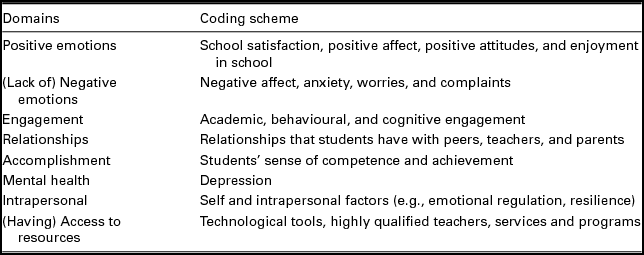
The first author developed a coding scheme to re-categorise the domains of student wellbeing originally derived from the 12 studies for the purpose of this literature review (see Table 1). The first and second author read the description of the original domains in each study and independently coded them based on the coding scheme, with 100% agreement.
Coding Scheme to Re-categorise Domains Derived From Student Wellbeing Studies

Stage 2. Literature Review on School Experiences of Students With ASD
In the second stage of this review, electronic searches were conducted using three databases, namely, ERIC, Scopus, and PsycINFO to locate articles on the school experiences of students with ASD. Limits were set to identify articles that were in English, peer reviewed, and published from 1994 onwards. Only articles published since 1994 were included, as following the 1994 Salamanca Statement (UNESCO, 1994), the drive towards inclusive education and including students with disabilities in mainstream school settings gained significant momentum on an international scale (Karin, Ellen, Evelien, Micke, & Katja, Reference Karin, Ellen, Evelien, Mieke and Katja2012). The Salamanca statement specified that all children should be provided access to mainstream schooling (Falkmer, Oehlers, Granlund, & Falkmer, Reference Falkmer, Oehlers, Granlund and Falkmer2015). Various combinations of keywords school experiences, experiences, Asperger, autism, autistic, students, and pupils were used in the search. The keyword school experiences was combined with Asperger, autism, and autistic while the keyword experiences was combined with students and pupils, and Asperger, autism, and autistic. Articles were included in this review if they (a) were published in peer-reviewed journals in English, and (b) reported on mainstream school experiences or education of primary or high school students with ASD from the students’ perspectives. Articles were excluded if (a) they did not focus on students’ experiences or education in school (e.g., interventions, home education, educational strategies for teachers), (b) the focus was on a specific aspect of school (e.g., bullying, physical education, transition), (c) they were not about primary or high school students (e.g., adults, preschoolers, university students), (d) they included other stakeholders in addition to students with ASD (e.g., teachers, parents, students with other disabilities), and (e) students were not fully included in school (e.g., integration).
A total of 272 articles were returned from the electronic search. The first author screened the titles and abstracts of the results from the electronic search to determine an article's inclusion in this review. An article was eliminated if the title or abstract contained words that aligned with the exclusion criteria (e.g., it contained the words “students with intellectual disability”) or contradicted the inclusion criteria. The first author created an Excel sheet, which included the titles of all 272 journal articles. The first author indicated in the Excel sheet the inclusion criteria that an article satisfied if it was included in a review. Likewise, if an article was rejected, the first author indicated the reason for excluding it in the Excel sheet. The second author then went through all 272 articles, following the same review process, and independently coded them. Both authors agreed on the articles to include, the inclusion criteria that each article fulfilled, as well as the articles to exclude. The reasons for exclusion differed between the two authors at times; however, this was attributed to each noticing different abstract components on the first pass, and did not affect the outcome, as meeting just one exclusion criterion was enough to get an article excluded.
This was followed by hand searches in the reference lists of the four articles identified from the electronic literature search and the journals Focus on Autism and Other Developmental Disabilities, Research in Autism Spectrum Disorders, and Journal of Autism and Developmental Disorders. These journals were selected due to their frequent publications in the area of ASD (Tobin, Drager, & Richardson, Reference Tobin, Drager and Richardson2014). The database Scopus was also used to conduct a cited reference search on the four articles. Each title was searched through Scopus to locate articles that cited each of the four articles. No additional studies were identified from the hand searches.
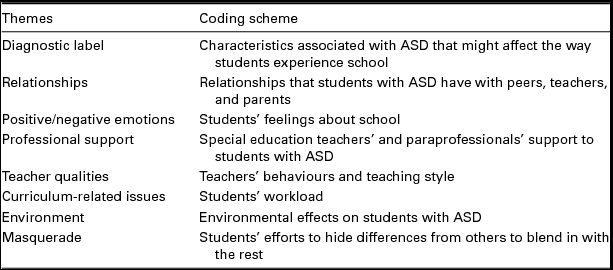
For the purpose of this literature review, a coding scheme was developed to re-categorise the original themes, as the descriptions of the themes were similar in some studies even though they were named differently (see Table 2). The second author reviewed the themes of each study and coded them based on the coding scheme established by the first author. Through weekly meetings whereby disagreements were discussed, consensus regarding the coding of the themes was reached.
Coding Scheme to Re-categorise Themes Derived From Studies on Experiences of Students With ASD
The re-categorised themes were then related to the domains identified from the 12 studies on student wellbeing. To do so, the descriptions of the themes from the four articles were coded for the domains of student wellbeing based on the coding scheme for domains of student wellbeing that were derived from Stage 1 of this literature review (see Table 1). For instance, the theme relationship was identified in the study conducted by Humphrey and Lewis (Reference Humphrey and Lewis2008) and Poon et al. (Reference Poon, Soon, Wong, Kaur, Khaw, Ng and Tan2014). However, Humphrey and Lewis's descriptions of the theme relationship were found to be related to four domains of student wellbeing, namely, relationships (peers), positive emotions, negative emotions, and mental health, whereas Poon et al.’s (Reference Poon, Soon, Wong, Kaur, Khaw, Ng and Tan2014) descriptions were related to only three domains, specifically relationships (peers), positive emotions, and negative emotions. The first and second author separately coded them, reaching consensus.
Results
The authors of the study were seeking to address the following research questions in this literature review.
How did Researchers Develop Instruments to Assess Student Wellbeing?
In total, 12 studies met the inclusion criteria. They were published between 2004 and 2015. The researchers in one study used a student wellbeing instrument that contained various subscales (Tian, Liu, Huang, & Huebner, Reference Tian, Liu, Huang and Huebner2013). Factor analysis was employed in five studies to uncover the latent variables of student wellbeing (Engels, Aelterman, Van Petegem, & Schepens, Reference Engels, Aelterman, Van Petegem and Schepens2004; Hascher, Reference Hascher2008; Kern et al., Reference Kern, Waters, Adler and White2015; McLellan & Steward, Reference McLellan and Steward2015; Miller et al., Reference Miller, Connolly and Maguire2013). The researchers in six studies reported on a set of measures or indicators of student wellbeing that referred to a student's level of functioning (De Fraine et al., Reference De Fraine, Van Landeghem, Van Damme and Onghena2005; Pietarinen, Soini, & Pyhältö, Reference Pietarinen, Soini and Pyhältö2014; Soutter et al., Reference Soutter, O'Steen and Gilmore2012, Reference Soutter, O'Steen and Gilmore2014; Van Petegem, Aelterman, Rosseel, & Creemers, Reference Van Petegem, Aelterman, Rosseel and Creemers2007; Van Petegem, Aelterman, Van Keer, & Rosseel, Reference Van Petegem, Aelterman, Van Keer and Rosseel2008). A total of 16,976 students participated in the studies included in this review. Two studies (Soutter et al., Reference Soutter, O'Steen and Gilmore2012, Reference Soutter, O'Steen and Gilmore2014) had 49 participants, one study (Pietarinen et al., Reference Pietarinen, Soini and Pyhältö2014) had 170 participants, one study (Tian et al., Reference Tian, Liu, Huang and Huebner2013) included 361 participants, three studies (Kern et al., Reference Kern, Waters, Adler and White2015; Miller et al., Reference Miller, Connolly and Maguire2013; Van Petegem et al., Reference Van Petegem, Aelterman, Van Keer and Rosseel2008) had about 500 participants, and the rest of the studies (De Fraine et al., Reference De Fraine, Van Landeghem, Van Damme and Onghena2005; Engels et al., Reference Engels, Aelterman, Van Petegem and Schepens2004; Hascher, Reference Hascher2008; McLellan & Steward, Reference McLellan and Steward2015; Van Petegem et al., Reference Van Petegem, Aelterman, Rosseel and Creemers2007) included more than 1,700 participants each. The ages of these students ranged from 7 to 21. The number of female and male participants were included in the reports of nine studies. Based on these nine studies, 49.4% were female. None of the studies indicated that students with disabilities, specifically students with ASD, were included as participants. It was therefore assumed that only students without disabilities participated in these studies.
According to Hair, Black, Babin, and Anderson (Reference Hair, Black, Babin and Anderson2010), Cronbach's alphas .60 and .70 are deemed acceptable especially for exploratory research. Hence, the student wellbeing instrument used by Tian et al.’s (Reference Tian, Liu, Huang and Huebner2013) study that contained subscales of student wellbeing had a good overall reliability of α = .93 and α = .92 for each of its subscales, although it was not reported how the instrument was developed. All student wellbeing instruments developed by the researchers in the five studies that employed factor analysis to uncover the latent variables of student wellbeing had an acceptable or good overall reliability or model fit. Researchers of three of these studies (Engels et al., Reference Engels, Aelterman, Van Petegem and Schepens2004; Hascher, Reference Hascher2008; Kern et al., Reference Kern, Waters, Adler and White2015) reported on the reliability of the factors derived, which ranged from α = .67 to .95. They used a combination of methods such as consulting students’ and adults’ perspectives on student wellbeing, using items from existing questionnaires, developing items from documents regarding students’ education, and conducting pilot studies.
Four teams of researchers consulted the views of students to construct the items for the questionnaire. Kern et al. (Reference Kern, Waters, Adler and White2015) explored what was important to student wellbeing by asking students what they wanted to find out about their wellbeing. Engels et al. (Reference Engels, Aelterman, Van Petegem and Schepens2004) conducted 64 panel discussions with 342 students to identify the learning environments that were important to their wellbeing, and to check students’ perceptions against those stated in the literature on student wellbeing. McLellan and Steward (Reference McLellan and Steward2015) sought the opinions of a small group of students to determine the items to be included in their instrument. Hascher (Reference Hascher2008) stated that students were consulted in designing the questionnaire, without providing details about how this consultation was done.
Three teams of researchers consulted adults’ perspectives to assist in the development of the instrument to assess student wellbeing. Engels et al. (Reference Engels, Aelterman, Van Petegem and Schepens2004) ascertained the instrument's validity by consulting experts’ opinions such as student supervisors; individuals employed at student guidance centres that were responsible for students’ wellbeing, as well as educational inspection team members who would be using the finalised instrument. Kern et al. (Reference Kern, Waters, Adler and White2015) sought the views of pastoral staff to establish what was relevant to student wellbeing. McLellan and Steward (Reference McLellan and Steward2015) included the input of teachers and adults in the project's steering group when considering the items to be incorporated into their student wellbeing instrument.
All except one team of researchers (i.e., Engels et al., Reference Engels, Aelterman, Van Petegem and Schepens2004) used or adapted items from existing instruments assessing wellbeing. Hascher (Reference Hascher2008) adapted the Berner Well-Being Questionnaire for Adolescents to suit the school context. Kern et al. (Reference Kern, Waters, Adler and White2015) used several items from nine existing scales that examined engagement, perseverance, connectedness, positive and negative emotions, overall wellbeing, agency and pathways of hope, tendencies to experience gratitude, one's mindset, health, illness and wellbeing, and stressful life events. Miller et al. (Reference Miller, Connolly and Maguire2013) combined items from six scales, each separately assessing self-esteem, psychological health, school environment, enjoyment of education, parent relations, and peer relationships. McLellan and Steward (Reference McLellan and Steward2015) used some of the items from the instrument European Social Survey that comprised hedonic and eudaimonic approaches of wellbeing.
Only McLellan and Steward (Reference McLellan and Steward2015) created items for their instrument from documents regarding students’ education. They developed additional items using the document Every Child Matters from the United Kingdom. Every Child Matters stated five outcomes or entitlements that are essential for youths to be successful, confident and responsible during adulthood: (a) being healthy, (b) keeping safe, (c) enjoying and achieving, (d) providing positive contributions, and (d) economic wellbeing. These outcomes were derived after consultations with children and youths.
Researchers of all except one study (Kern et al., Reference Kern, Waters, Adler and White2015) conducted a pilot study for their instrument. Engels et al.’s (Reference Engels, Aelterman, Van Petegem and Schepens2004) pilot version of the student wellbeing instrument was tested on 306 students to establish its validity, and adapt the items in terms of its difficulty, length, clarity, and relevance to better suit high school students. Hascher (Reference Hascher2008) pilot tested her instrument on 136 secondary school students. Through pilot testing, the Cronbach's alphas for the scales were increased, a few scales were renamed, and single items were removed. Miller et al. (Reference Miller, Connolly and Maguire2013) carried out pilot testing on 60 students to determine the feasibility of the questionnaire. McLellan and Steward (Reference McLellan and Steward2015) piloted their instrument with students in two primary and one high school. The pilot testing ensured that the primary and high school version of the instrument had the same items.
Out of the six studies that included a set of measures or indicators of student wellbeing, two (i.e., Soutter et al., Reference Soutter, O'Steen and Gilmore2012, Reference Soutter, O'Steen and Gilmore2014) did not use any student wellbeing instruments. Instead, Soutter et al. (Reference Soutter, O'Steen and Gilmore2012, Reference Soutter, O'Steen and Gilmore2014) created a student wellbeing model and derived the domains of student wellbeing by reviewing the literature on wellbeing from various fields such as economics, sociology, health profession, and psychology. The student wellbeing model was subsequently used to determine students’ and teachers’ perspectives on wellbeing (Soutter et al., Reference Soutter, O'Steen and Gilmore2012, Reference Soutter, O'Steen and Gilmore2014). Researchers of one out of the four remaining studies (i.e., De Fraine et al., Reference De Fraine, Van Landeghem, Van Damme and Onghena2005) did not report the method used to develop the student wellbeing instrument and its reliability. Researchers of the other three studies (i.e., Pietarinen et al., Reference Pietarinen, Soini and Pyhältö2014; Van Petegem et al., Reference Van Petegem, Aelterman, Rosseel and Creemers2007, Reference Van Petegem, Aelterman, Van Keer and Rosseel2008) stated that the student wellbeing instrument used in their study had an acceptable or good reliability ranging from α = .77 to .80. To develop the instrument, Pietarinen et al. (Reference Pietarinen, Soini and Pyhältö2014) conducted two pilot studies with 228 students and sought feedback from students, teachers, researchers, and academics. However, the student wellbeing instruments used in the studies conducted by Van Petegem et al. (Reference Van Petegem, Aelterman, Rosseel and Creemers2007) and Van Petegem et al. (Reference Van Petegem, Aelterman, Van Keer and Rosseel2008) were developed and validated by other researchers.
What are the Domains of Student Wellbeing Identified by Research?
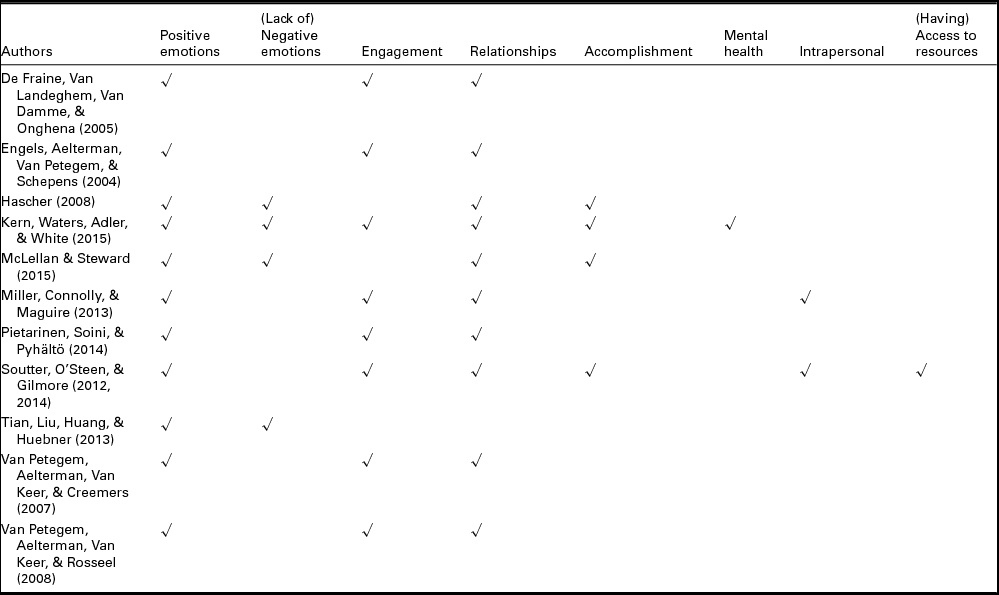
Eight domains of student wellbeing were inferred and identified from the 12 studies included in this review, ranging from two to six domains derived from each study (see Table 3). They are (a) positive emotions, (b) (lack of) negative emotions, (c) engagement, (d) relationships, (e) accomplishment, (f) mental health, (g) intrapersonal, and (h) (having) access to resources.
Domains Inferred From Student Wellbeing Studies
Positive emotions refer to feelings such as joy, contentment, interest, and affection (Diener, Reference Diener and Diener2009). Positive emotions may be derived when students interact with others or participate in school activities that they are interested in (Noble et al., Reference Noble, McGrath, Wyatt, Carbines and Robb2008). Students’ satisfaction in school and their attitudes towards school were considered part of this domain, as their value judgements give rise to positive emotions (Seligman, Reference Seligman2011). The domain positive emotions was identified from all studies in this review. Positive emotions are also associated with curriculum (De Fraine et al., Reference De Fraine, Van Landeghem, Van Damme and Onghena2005; Engels et al., Reference Engels, Aelterman, Van Petegem and Schepens2004; Miller et al., Reference Miller, Connolly and Maguire2013; Van Petegem et al., Reference Van Petegem, Aelterman, Van Keer and Rosseel2008). Negative emotions referred to emotions such as worries about school, complaints, and anxiety. The domain negative emotions was identified in six studies (i.e., Hascher, Reference Hascher2008; Kern et al., Reference Kern, Waters, Adler and White2015; McLellan & Steward, Reference McLellan and Steward2015; Pietarinen et al., Reference Pietarinen, Soini and Pyhältö2014; Tian et al., Reference Tian, Liu, Huang and Huebner2013).
Engagement is a multidimensional concept consisting of psychological, academic, behavioural, cognitive, and affective components (Upadyaya & Salmela-Aro, Reference Upadyaya and Salmela-Aro2013). It refers to students’ sense of school belonging, the time they spend on school-related activities (Appleton, Christenson, & Furlong, Reference Appleton, Christenson and Furlong2008; Upadyaya & Salmela-Aro, Reference Upadyaya and Salmela-Aro2013), their school attendance and adherence to school rules, their enthusiasm in, and effort devoted to learning (Huebner et al., Reference Huebner, Hills, Jiang, Long, Kelly, Lyons, Ben-Arieh, Casas, Frønes and Korbin2014), and their interests in school-related challenges (Huebner et al., Reference Huebner, Hills, Jiang, Long, Kelly, Lyons, Ben-Arieh, Casas, Frønes and Korbin2014; Upadyaya & Salmela-Aro, Reference Upadyaya and Salmela-Aro2013). The domain engagement was derived from all except three studies (i.e., Hascher, Reference Hascher2008; McLellan & Steward, Reference McLellan and Steward2015; Tian et al., Reference Tian, Liu, Huang and Huebner2013).
The domain relationships was identified from all except two studies (Pietarinen et al., Reference Pietarinen, Soini and Pyhältö2014; Tian et al., Reference Tian, Liu, Huang and Huebner2013). This domain within the school context includes relationships with peers, teachers, and parents. It is believed that having positive interpersonal relationships, especially those with teachers and peers, are crucial to students’ wellbeing (Norrish, Williams, O'Connor, & Robinson, Reference Norrish, Williams, O'Connor and Robinson2013).
Accomplishment refers to an individual's sense of capability in doing everyday tasks and experiencing a sense of competence and achievement (Kern et al., Reference Kern, Waters, Adler and White2015). Students experience a sense of accomplishment when they pursue meaningful goals (Norrish et al., Reference Norrish, Williams, O'Connor and Robinson2013). It has features of both hedonia and eudaimonia, as the achievement of goals that are worthwhile would lead to positive emotions (Sheldon et al., Reference Sheldon, Abad, Ferguson, Gunz, Houser-Marko, Nichols and Lyubomirsky2010). The domain accomplishment is derived from five studies (i.e., Hascher, Reference Hascher2008; Kern et al., Reference Kern, Waters, Adler and White2015; McLellan & Steward, Reference McLellan and Steward2015; Soutter et al., Reference Soutter, O'Steen and Gilmore2012, Reference Soutter, O'Steen and Gilmore2014).
The domain mental health was identified from the study conducted by Kern et al. (Reference Kern, Waters, Adler and White2015). Individuals with mental health problems may be depressed and possess suicidal tendencies (Li, Chan, Chung, & Chui, Reference Li, Chan, Chung and Chui2010). Specifically, Kern et al. (Reference Kern, Waters, Adler and White2015) identified the factor depression and its items reflected the regularity that students experience negative emotions such as gloominess, anger, loneliness, and misery.
The intrapersonal domain was identified from the studies conducted by Miller et al. (Reference Miller, Connolly and Maguire2013) and Soutter et al. (Reference Soutter, O'Steen and Gilmore2012, Reference Soutter, O'Steen and Gilmore2014). This domain is concerned with the self and intrapersonal factors such as emotional regulation, self-esteem, and resilience. Likewise, the domain (having) access to resources was identified from the study carried out by Soutter et al. (Reference Soutter, O'Steen and Gilmore2012, Reference Soutter, O'Steen and Gilmore2014). The resources that students may need to have access to in order to enhance their sense of wellbeing included but were not limited to the following: (a) technological tools, (b) highly qualified teachers, (c) positive learning environment, and (d) services and programs that are affordable and appropriate (Soutter et al., Reference Soutter, O'Steen and Gilmore2012, Reference Soutter, O'Steen and Gilmore2014).
How do the School Experiences of Students With ASD Relate to the Domains of Student Wellbeing?
In total, four studies published between 2008 and 2015 met the inclusion criteria. All were qualitative studies and the main data collection method was interviews. In addition to interviews, Humphrey and Lewis (Reference Humphrey and Lewis2008) used student diaries and drawings. A total of 42 high school students with ASD participated in these studies. According to researchers of three of these studies that reported on the ages of these students, the participants were between the ages of 11 to 17. Out of the four studies, three stated the number of female and male participants in their reports. Based on these three studies, 22.7% were female. The number of original themes that emerged from the qualitative analyses conducted in the four studies ranged from three to six.
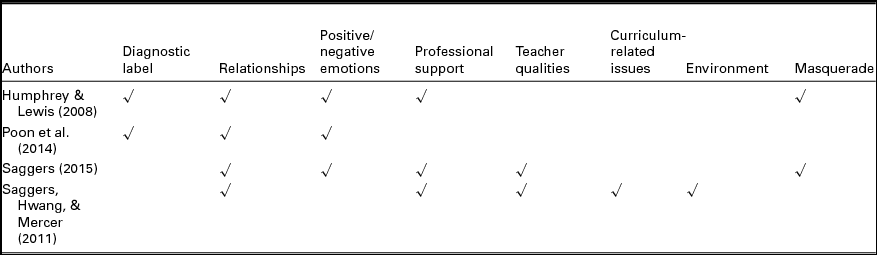
Based on the coding scheme to re-categorise the original themes, eight themes emerged from the four studies: (a) diagnostic label, (b) relationships, (c) positive/negative emotions, (d) professional support, (e) teacher qualities, (f) curriculum-related issues, (g) environment, and (h) masquerade (see Table 4). The theme diagnostic label was identified from three studies (i.e., Humphrey & Lewis, Reference Humphrey and Lewis2008; Poon et al., Reference Poon, Soon, Wong, Kaur, Khaw, Ng and Tan2014; Saggers, Reference Saggers2015). The theme relationships was derived from all four articles. Researchers of all except one study (i.e., Saggers, Hwang, & Mercer, Reference Saggers, Hwang and Mercer2011) made references to the theme positive/negative emotions. The theme professional support was obtained from three studies (i.e., Humphrey & Lewis, Reference Humphrey and Lewis2008; Saggers, Reference Saggers2015; Saggers et al., Reference Saggers, Hwang and Mercer2011). Researchers of two studies (i.e., Saggers, Reference Saggers2015; Saggers et al., Reference Saggers, Hwang and Mercer2011) referred to the theme teacher qualities. The themes curriculum-related issues and environment were derived from one study (i.e., Saggers et al., Reference Saggers, Hwang and Mercer2011). The theme masquerade was identified from two studies (i.e., Humphrey & Lewis, Reference Humphrey and Lewis2008; Saggers, Reference Saggers2015).
Themes Derived From Studies on the School Experiences of Students With ASD

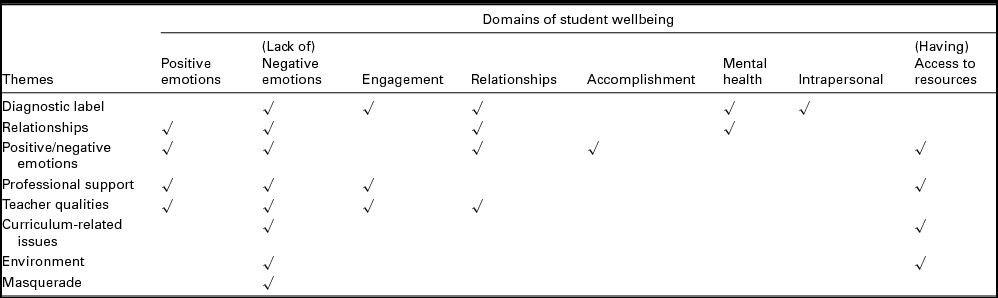
These eight themes were related to the eight domains of student wellbeing as identified from the 12 studies on student wellbeing (see Table 5).
Domains of Student Wellbeing in Relation to Themes on School Experiences of Students With ASD

The themes relationships, positive/negative emotions, professional support, and teacher qualities were found to be related to the domain positive emotions. Peer relationships contributed to positive emotions experienced by students with ASD when their friends showed support by standing up for them when they were teased (Humphrey & Lewis, Reference Humphrey and Lewis2008; Poon et al., Reference Poon, Soon, Wong, Kaur, Khaw, Ng and Tan2014; Saggers, Reference Saggers2015). Students with ASD expressed appreciation for the professional support they received from special education teachers (Saggers et al., Reference Saggers, Hwang and Mercer2011). Students also enjoyed school when they had teachers who listened and related to them, and made the subjects that they had trouble learning fun and easy (Saggers et al., Reference Saggers, Hwang and Mercer2011).
All themes were found to be associated with the domain (lack of) negative emotions. Humphrey and Lewis (Reference Humphrey and Lewis2008) revealed that due to the social naivety that students with ASD may possess, they were victims of exploitation and ridicule by their peers, which left them upset. The sensory sensitivities that students with ASD possess also contributed to negative emotions such as stress, anxiety, and frustration, as the school environment is often chaotic and unpredictable (Humphrey & Lewis, Reference Humphrey and Lewis2008; Saggers, Reference Saggers2015). Therefore, the themes diagnostic label and environment were related to the domain negative emotions. The theme relationships was linked to this domain as students with ASD reported that having negative peer relationships left them stressed and upset (Humphrey & Lewis, Reference Humphrey and Lewis2008; Saggers et al., Reference Saggers, Hwang and Mercer2011). Although support from special education teachers and paraprofessionals may foster students’ positive emotions, if it is poorly managed and leads to students with ASD feeling singled out, negative emotions may be experienced (Humphrey & Lewis, Reference Humphrey and Lewis2008; Saggers, Reference Saggers2015; Saggers et al., Reference Saggers, Hwang and Mercer2011). Thus professional support was associated with negative emotions. The theme teacher qualities was also related to negative emotions as students with ASD reported disliking inflexible, strict, and disruptive teachers (Saggers, Reference Saggers2015; Saggers et al., Reference Saggers, Hwang and Mercer2011). The theme curriculum-related issues was associated with this domain. Students with ASD felt afraid and anxious about failing academically (Poon et al., Reference Poon, Soon, Wong, Kaur, Khaw, Ng and Tan2014), and attested that their biggest worry was a heavy workload as they felt overwhelmed, exhausted, stressed, and had trouble with timely submission of their assignments (Saggers, Reference Saggers2015; Saggers et al., Reference Saggers, Hwang and Mercer2011). Students with ASD experienced anxiety and rejection when they attempted to appear “normal” to fit in (Humphrey & Lewis, Reference Humphrey and Lewis2008; Saggers, Reference Saggers2015). Thus the theme masquerade was associated with negative emotions.
Saggers et al. (Reference Saggers, Hwang and Mercer2011) reported that students with ASD may possess low psychological and affective engagement levels. Although they understand that there are benefits to socialising with others, they found it boring. This may be due to their restricted interests. As such, the theme diagnostic label was related to the domain engagement. The theme professional support was also associated with engagement. Students were able to access the curriculum better when support was provided by special education teachers and paraprofessionals (Saggers, Reference Saggers2015; Saggers et al., Reference Saggers, Hwang and Mercer2011). Students also mentioned their preference for teachers with a flexible teaching style (Saggers, Reference Saggers2015; Saggers et al., Reference Saggers, Hwang and Mercer2011), as it was believed that such teachers were more likely to adapt instructional practices to engage students with ASD (Sciutto, Richwine, Mentrikoski, & Niedzwiecki, Reference Sciutto, Richwine, Mentrikoski and Niedzwiecki2012). Therefore the theme teacher qualities was related to engagement.
The themes teacher qualities and positive/negative emotions were associated with the domain relationship, as students liked teachers who listened and connected with them (Saggers et al., Reference Saggers, Hwang and Mercer2011). They attributed the success of their inclusive education in mainstream school to these teachers (Saggers et al., Reference Saggers, Hwang and Mercer2011). The theme diagnostic label was also related to relationships as it was mentioned earlier that characteristics associated with ASD may cause students to have social communication difficulties, which in turn negatively affect their relationships with their peers (Humphrey & Lewis, Reference Humphrey and Lewis2008; Saggers et al., Reference Saggers, Hwang and Mercer2011). Participants in all four studies on the experiences of students with ASD reported that they were bullied and teased regularly by their peers (Humphrey & Lewis, Reference Humphrey and Lewis2008; Poon et al., Reference Poon, Soon, Wong, Kaur, Khaw, Ng and Tan2014; Saggers, Reference Saggers2015; Saggers et al., Reference Saggers, Hwang and Mercer2011).
Students in Poon et al.’s (Reference Poon, Soon, Wong, Kaur, Khaw, Ng and Tan2014) study claimed that negative emotions such as fear and stress were experienced when they thought about academic failure. On the contrary, a top student expressed a liking for the school as he felt that he was learning well (Poon et al., Reference Poon, Soon, Wong, Kaur, Khaw, Ng and Tan2014). Therefore, the theme positive/negative emotions was associated with the domain accomplishment.
The theme diagnostic label was related to the domains intrapersonal and mental health. This is because students integrate having ASD into their identity and the ways they perceive the label could affect their mental health (Poon et al., Reference Poon, Soon, Wong, Kaur, Khaw, Ng and Tan2014). Negative emotions arose when students with ASD constructed the label in negative terms such as being “a freak” or “crazy” (Humphrey & Lewis, Reference Humphrey and Lewis2008), and believed that other students had similar views about ASD (Poon et al., Reference Poon, Soon, Wong, Kaur, Khaw, Ng and Tan2014). In the long run, students who possess such negative self-perceptions are at risk of depression (Poon et al., Reference Poon, Soon, Wong, Kaur, Khaw, Ng and Tan2014). The theme relationships was also related to mental health as students with ASD who are often teased and bullied by their peers may develop depression and suicidal tendencies (Humphrey & Lewis, Reference Humphrey and Lewis2008; Mayes et al., Reference Mayes, Gorman, Hillwig-Garcia and Syed2013; Simpson, Mundschenk, & Heflin, Reference Simpson, Mundschenk and Heflin2011).
The themes related to the domain access to resources were positive/negative emotions, professional support, curriculum-related issues, and environment. Students explained that negative emotions such as stress and anxiety were experienced and they had difficulty concentrating when the school environment was chaotic and noisy (Humphrey & Lewis, Reference Humphrey and Lewis2008; Saggers, Reference Saggers2015; Saggers et al., Reference Saggers, Hwang and Mercer2011). Support from special education teachers and paraprofessionals were also deemed an important resource for students with ASD as they valued such support when it was provided subtly and did not make them feel different from their peers (Humphrey & Lewis, Reference Humphrey and Lewis2008; Saggers, Reference Saggers2015; Saggers et al., Reference Saggers, Hwang and Mercer2011). Students believed that having access to computers would lighten their workload considerably as it was easier for them to type their assignments than handwrite them (Saggers, Reference Saggers2015; Saggers et al., Reference Saggers, Hwang and Mercer2011).
Recommendations
The findings presented in this review contributed to the existing gap in the literature about student wellbeing, particularly in regard to students with ASD. The findings suggested that students with ASD have positive and negative experiences in school, which influenced their student wellbeing and educational outcomes. The importance of student wellbeing of students with ASD cannot be overstated, as students who possess a sense of wellbeing are more likely to make positive contributions to society during adulthood (Noble et al., Reference Noble, McGrath, Wyatt, Carbines and Robb2008). The analysis also revealed current gaps in the existing knowledge about student wellbeing. For example, mental health and access to resources as domains of student wellbeing have yet to be explored (see Table 3). Similarly, curriculum issues and environment in relation to school experiences of students with ASD need to be explored in more depth (see Table 4).
Schools can provide programs, interventions, and resources to support students with ASD to ensure their student wellbeing is enhanced. It is essential that schools develop a climate of acceptance of all students by embracing individual differences (Lindsay, Proulx, Scott, & Thomson, Reference Lindsay, Proulx, Scott and Thomson2014; Lindsay, Proulx, Thomson, & Scott, Reference Lindsay, Proulx, Thomson and Scott2013). Facilitating disability awareness among peers and encouraging students with ASD to disclose their condition to their peers is also a useful strategy to build acceptance in schools (Lindsay et al., Reference Lindsay, Proulx, Scott and Thomson2014, Reference Lindsay, Proulx, Thomson and Scott2013). This could prevent students with ASD from experiencing negative emotions that arise from their attempts to fit in with their peers without disability. An accepting culture could also reduce ostracism and bullying of students with ASD (Foreman & Arthur-Kelly, Reference Foreman and Arthur-Kelly2014). To develop and maintain positive peer relationships, schools could provide social skills instruction to students with ASD to foster their social interaction skills (Carter et al., Reference Carter, Common, Sreckovic, Huber, Bottema-Beutel, Gustafson and Hume2014).
Besides peer relationships, the quality of teacher–student relationships is crucial in promoting positive emotions and reducing negative emotions in students with ASD. Teachers tend to have poorer relationships with students with ASD as compared to students without disabilities as they may have difficulties understanding some of the behaviours exhibited by the former group of students (Blacher, Howell, Lauderdale-Littin, DiGennaro Reed, & Laugeson, Reference Blacher, Howell, Lauderdale-Littin, DiGennaro Reed and Laugeson2014). It is thus vital that teachers receive sufficient training and possess awareness and knowledge about ASD (Simpson et al., Reference Simpson, Mundschenk and Heflin2011). Adequately trained teachers would also be more prepared and confident in adapting instructional materials to engage students with ASD, which may in turn promote students’ sense of accomplishment (Soto-Chodiman, Pooley, Cohen, & Taylor, Reference Soto-Chodiman, Pooley, Cohen and Taylor2012).
Schools should also ensure that appropriate professional development courses are provided to paraprofessionals to equip them with the necessary skills to deliver subtle assistance to students with ASD in mainstream classrooms (Saggers, Reference Saggers2015). Other resources that may be helpful in decreasing the negative emotions in students with ASD include assistive technology, such as computers with voice recognition software for students who have difficulties with handwritten work (Lindsay et al., Reference Lindsay, Proulx, Scott and Thomson2014), and establishing a positive learning environment that is predictable and structured (Brewin, Renwick, & Fudge Schormans, Reference Brewin, Renwick and Fudge Schormans2008; Sciutto et al., Reference Sciutto, Richwine, Mentrikoski and Niedzwiecki2012).
Limitations
Although researchers of the 12 studies included in this review used comprehensive and valid methods to establish instruments to assess student wellbeing or develop a model of student wellbeing, none of them consulted the views of students with ASD in the development of their instruments and model. Therefore, the eight domains identified in this review from the 12 studies may not be entirely applicable to all students with ASD, as their school experiences may differ from students without disability. In a similar vein, the studies on the school experiences of students with ASD were not specifically designed to assess the wellbeing of students with ASD. Thus, it is expected that the results of this study provide only a partial picture of the wellbeing of this group of students.
In regard to the school experiences of students with ASD, only studies from the perspectives of students were included, thereby excluding the views of important adults in students’ lives such as parents and teachers. It is acknowledged that the perspectives of students and adults differ. Thus, including the views of parents and adults could provide a more thorough understanding of students’ school experiences and wellbeing. Finally, the number of participants in each of the studies on students’ school experiences was small. This limits the generalisability of the findings of this study.
Conclusion
Researchers and policymakers recognise the significance of enhancing student wellbeing for better educational outcomes (Noble et al., Reference Noble, McGrath, Wyatt, Carbines and Robb2008). This is evident in the increasing body of research and policies on student wellbeing (McLellan & Steward, Reference McLellan and Steward2015; Miller et al., Reference Miller, Connolly and Maguire2013, Soutter et al., Reference Soutter, O'Steen and Gilmore2014). Despite these efforts, students with ASD continue to fare poorly in postschool outcomes as compared to students without disabilities (Redman, Downie, Rennison, & Batten, Reference Redman, Downie, Rennison and Batten2009). As no study to date has explored the wellbeing of students with ASD, the findings of this research may shed some light on the wellbeing of these students by identifying the domains of student wellbeing and relating them to the school experiences of students with ASD. In doing so, policymakers and school leaders could provide specific resources and programs to effectively support the development of each of these domains. The views and priorities of students with ASD with regard to their school wellbeing also need to be considered. Future research on student wellbeing should therefore include students with ASD as participants to enhance its validity and ensure its findings are applicable to these students.