Introduction
Lung cancer is the leading cause of cancer-related mortality in the world for which stereotactic ablative radiotherapy (SABR) is proven as an effective non-surgical treatment. Reference Murray, Franks and Hanna1 In the UK, the technical roll out of SABR was mainly carried out with adherence to the UK Consortium Guidelines 2 which suggested set dose fractionation based on risk. The outcomes for SABR are generally exceptionally good, in large part because of the requirement to only treat small, peripheral tumours (< 5 cm) which are located far from any potential organs at risk (OAR).
Radiobiological modelling based on tumour control probability (TCP) and normal tissue complication probability (NTCP) can be used to optimise radiotherapy treatments to find the most appropriate trade-off and improve the therapeutic ratio. Reference Uzan and Nahum3 Various types of TCP modelling have been carried out for lung SABR treatments Reference Nahum, Uzan, Jain, Malik, Fenwick and Baker4 and the resultant probabilities align with the good outcomes seen clinically. Reference Liu, Tai and Lee5 Large variation in both theoretical probabilities and observed outcomes or toxicities can be seen in data spanning time periods covering significant changes in techniques, or if the planning techniques did not follow consistent and rigid guidelines (ibid). The use of the linear-quadratic (LQ)-based TCP model for high doses per fraction also remains controversial. Reference McMahon6 However, it continues to be used, in one form or another, in optimisation studies. Reference Alaswad, Kleefeld and Foley7
There are limited reported data on the TCP prediction values in the UK; hence, the objective of this study was to report the values obtained from a centre adhering to the UK Consortium Guidelines. The lack of specific publications on the values of TCP for lung SABR in the UK means that it is sometimes difficult to compare current practice with suggested technique improvements and service developments. The data here provide a benchmark and can also be compared with existing or future publications, drawing in national and international studies. Reference Alaswad, Kleefeld and Foley7
Materials and Methods
This retrospective review of 198 previously treated patients was an extension of a hospital audit conducted annually as part of the regional network service delivery conditions. Radiotherapy treatment plans consisted of two half arcs within the Eclipse treatment planning system (Varian Medical System, Inc., Palo Alto, CA) at 6 MV or 10 MV FFF (RapidArc on Varian machines). The Acuros algorithm was used with a 2 mm grid, and the final plans reported absolute dose to water. All plans were created in accordance with the contemporary UK SABR Consortium Guidelines at the time they were produced. Data spanned the period 2014–19. All plans met the majority of Consortium 2 requirements (with some minor deviations), and all were approved by a radiation oncologist.
Dose–volume histogram (DVH) data were imported into the freely available Biosuite software Reference Uzan and Nahum3 , and the LQ Marsden TCP model was used with the parameter settings for non-small cell lung cancer as per Nahum et al. Reference Nahum, Uzan, Jain, Malik, Fenwick and Baker4 That is, an α/β = 10 Gy, α = 0·307 Gy−1, a clonogen denisty of 107 and a clonogen doubling time of 3·7 days. The planning target volume DVH data, rather than the gross target volume, were used to conservatively calculate the TCPs. The 100% prescription dose was used as the TCP prediction dose. TCP was also calculated with an α/β = 20 Gy, which some literature cites as an appropriate modification to the LQ model for SABR fractionation. Reference Liu, Tai and Lee5
Results
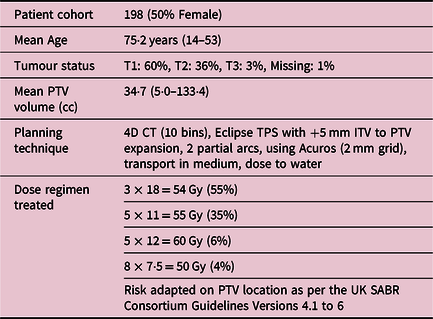
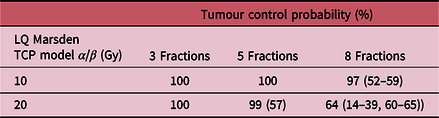
Patient characteristics and centre data are shown in Table 1. The TCP values obtained are given in Table 2. The TCPs were all 100% for 54 Gy in three fractions (#), regardless of the α/β value used.
Patient characteristics and centre data

Average tumour control probabilities and ranges

For the 5 # group at both dose levels (55 and 60 Gy), the TCP was 100% when using α/β = 10 Gy but reduced to an average of 99% (range 97–100) when using α/β = 20 Gy. The average TCP value for 50 Gy in 8 # was lower and showed a broader variation with mean values at 97% (α/β = 10 Gy) and 64% (α/β = 20 Gy).
A paired samples T-test was performed to compare all the TCP values when using an α/β ratio of 10 Gy versus 20 Gy. There was a significant average difference between groups (p = 0·001). On average, the TCP values using an α/β of 10 Gy were 1·76 percentage points [0·76–2·46] higher than the TCP values using an α/β of 20 Gy. Because greater variation was shown in the α/β = 20 Gy group, these TCP values were used when comparing groups by fractionation as a worst-case scenario.
Significant statistical differences were found between the 3 # and the 5 # groups (T-test, t 79 = 10·315, p < 0·001), the 3 # and the 8 # groups (T-test, t 8 = 9·434, p < 0·001) and the 5 # and the 8 # groups (T-test, t 8 = 9·434, p < 0·001).
There are no statistical difference seen between tumour status (grouped generically by T1, T2 and T3).
There was no difference between male and female groups.
Discussion
This study sought to present TCP prediction values from a typical UK centre adhering to the UK Consortium Guidelines, which is largely absent in the literature.
The TCP was 100% in all cases for the 3 # schedule regardless of the α/β ratio used. The majority (55%) of clinically treated schedules in our institution are 54 Gy in 3 #. For the 5 # schedules, some variation in the TCP was seen, but all probabilities were greater than 97%. For the 8 # schedule, a broader range of TCP values was seen regardless of α/β ratio used.
There is considerable debate regarding the accuracy and appropriateness of the various parameters used for radiobiological modelling, as described in the excellent review by McMahon. Reference McMahon6 New and complex modifications to the basic TCP model and its parameters are published frequently. Reference Alaswad, Kleefeld and Foley7 One of the limitations of this study is that the LQ Marsden TCP model was used without any of these types of modification, for example, regrowth. This was intentional as relatively simplistic modelling using LQ parameters is used clinically in many hospitals to compare and contrast patients’ fractionations and does not depend on the availability of advanced mathematical computational skills. Recently, the impact of the COVID-19 pandemic has influenced treatment fractionation and increased the use of radiobiological calculation in radiotherapy clinics with the intention of reducing radiotherapy outpatient footfall and correcting for breaks in the treatment.
Although there were significant differences between each groups, the TCP values can be considered high compared with conventional radiotherapy, Reference Alaswad, Kleefeld and Foley7,Reference Willner, Barier, Caragiani, Tschammler and Flentje8 and therefore demonstrate why excellent clinical results can be observed for patients undergoing lung SABR despite them so often being elderly, non-operable and presenting with other comorbidities. The values here are consistent with those published by Lu et al. Reference Lu, Lin, Lin and Huang9 and the more recent multiple cohort data by Alaswad et al. Reference Alaswad, Kleefeld and Foley7 However, it should be noted that in this study, the 8 # schedule, often used when constraints cannot be met for 5 # plans, gave worse TCPs which were similar to those values published for 3D conformal radiotherapy (ibid). This regime is reserved for poorer performance status patients. It has the effect of losing the advantages of SABR in terms of tumour control.
Given that the TCP may be much reduced for patients receiving eight fractions, the advantages of even shorter fractionation (e.g., reduced overall treatment time, reduced patient visits and improved therapeutic gain) could be considered to improve tumour control in parallel to any potential increased risk of normal tissue toxicity. This work has not considered the corresponding NTCP for the toxicities associated with OAR for lung SABR, namely, chest wall pain, rib fracture and radiation pneumonitis. The literature suggests that some rates of OAR toxicity have been historically high Reference Thibault, Chiang and Erler10–Reference Baker, Han and Sarangkasiri12 , but our initial observed clinical outcomes Reference Marsden and Wieczorek13 suggest that by following the UK SABR Consortium Planning Guidelines these rates reduce considerably. Published toxicity rates need to be appraised carefully, especially when reported over long periods of time. This is because of the huge technological advances that have emerged over those same time periods such as 4D verification imaging and more sophisticated, semi-automated planning techniques. OAR toxicity should therefore be reviewed within each centre on a regular basis and compared with current literature. Preliminary results using this same dataset suggest that our NTCPs across a range of toxicity end points can easily be kept below 3–5%. Benchmarking values of NTCP will be further work for our institution.
Following the Consortium Planning Guidance constraints and considering only those OAR that fail to meet tolerance doses would make patient-specific appraisals relatively simple to perform in the clinic. Only failing OAR DVH need be exported and assessed. An individual assessment of the acceptable TCP and NTCP values for a given patient initially considered for the eight fraction scheme could be carried out prospectively to improve tumour control and individualise fractionation. This could be implemented simply by first considering the existing 3 and 5 # regimes as possible alternatives, before contemplating non-standard schemes.
Conclusion
The data presented provide a benchmark for TCPs achievable with current planning techniques in the UK and give an insight into why the majority of these patients do so well, despite being elderly and often non-operable. The ultra-conservative 50 Gy in 8 # scheme gives a significantly lower TCP, comparable to 3D conformal radiotherapy techniques.
Acknowledgements
The author would like to acknowledge all the local radiotherapy staff involved with SABR radiotherapy and the assistance of Craig Moore, Michael Merchant and Andy Beavis in preparing this manuscript.
Financial Support
This work was carried out as part of the UK Higher Specialist Scientist Training Scheme, supported by Health Education England.