Introduction
The British Museum holds a vast number of objects that focus on the history of British collecting from across the world since the museum's founding in the middle of the 18th century. There are various stories of important collectors – archaeologists, explorers, diplomats, and scholars, whose donations have helped shape the British Museum's collection. T. Richard Blurton, Head of South and Southeast Asia collections in the Department of Asia, once said that ‘the South Asia collections at the British Museum are amongst the finest anywhere in the world and the story of their assembly in Bloomsbury is of great interest’.Footnote 1
History of the South Asia collections
The earliest South Asian objects and manuscripts came to the Museum from Sir Hans Sloane's collection and included an album of Deccani miniature paintings. The antiquarian interest in India was slow to develop in Britain. Even 50 years after the museum's founding, only a small number of Indian objects were represented among the museum's collections. At this time, scholarly study of Indian antiquities and manuscripts was linked to learned societies such as the Royal Asiatic Society instead of public museums, and it was often at those institutions that Indian material was deposited.Footnote 2
Manuscript collections began to play an important role in the development of studies of the subcontinent and surrounding regions in the 19th century. Arundell Esdaile, Secretary to the British Museum (1926–1940) made a comprehensive attempt to detail the history of the Indian manuscripts and printed books in the Department of Printed Books and of Manuscripts. For example, Esdaile states that with Sloane's initial donation of six Sanskrit and 20 Tamil manuscripts and Sir William Jones's research into Indology, the East India Company founded a library of Indian literature in 1798.Footnote 3 Jones's translation of Sankuntala, published a year later, had a major impact that led to the rise of Orientalism as Europeans ‘fell in love’ with the Indian play of Hindu gods and imagery.Footnote 4 Fourteen manuscripts from the subcontinent then came from collector T.H. Bates in 1829 and 143 manuscripts mostly detailing the subject of Jainism from Dr. H. Jacobi came after. These Sanskrit manuscripts made up the bulk of the important texts that came to the British Museum and most are now part of the India Office of the British Library.Footnote 5 With an increased interest in Indian imagery amongst Western audiences, there were a number of important individual donations that followed in 1830, e.g. Sir Robert Browrigg's 8th-century statue of Tara and the large Mughal jade terrapin acquired from Mr Thomas Wilkinson ‘through James Nairne, Esq’. However, the acquisition of the Charles ‘Hindoo’ Stuart collection truly transformed the South Asia collections.
Major-General Stuart was knowledgeable about Indian iconography and Hinduism but his interest in the life and religion of India contributed to developing scholarship, as his collection grew to reflect the cultural landscapes of South Asia.Footnote 6 His encyclopaedic collection of objects, including holdings of Eastern and Central Indian sculpture, were sold on his death and acquired at a London auction in 1830 by businessman and trader John Bridge for his own museum collection. Augustus Wollaston Franks, Keeper of British and Mediaeval Antiquities and Ethnography at the museum, helped facilitate the donation of the Bridge Collection of 120 pieces of Indian and Burmese sculpture to the British Museum in 1872 after the death of his son, George Bridge. It was not long after that Professor J. F. Blumhardt compiled the first catalogue of Hindi, Punjabi and Hindustani manuscripts in the Library of the British Museum. Some 119 manuscripts and 18,000 printed books, many from William Erskine and Colonel George W. Hamilton's collections, included works of Jain literature, Hindi and Punjabi medieval religious poetry and historical texts.Footnote 7
Moving into the 20th century
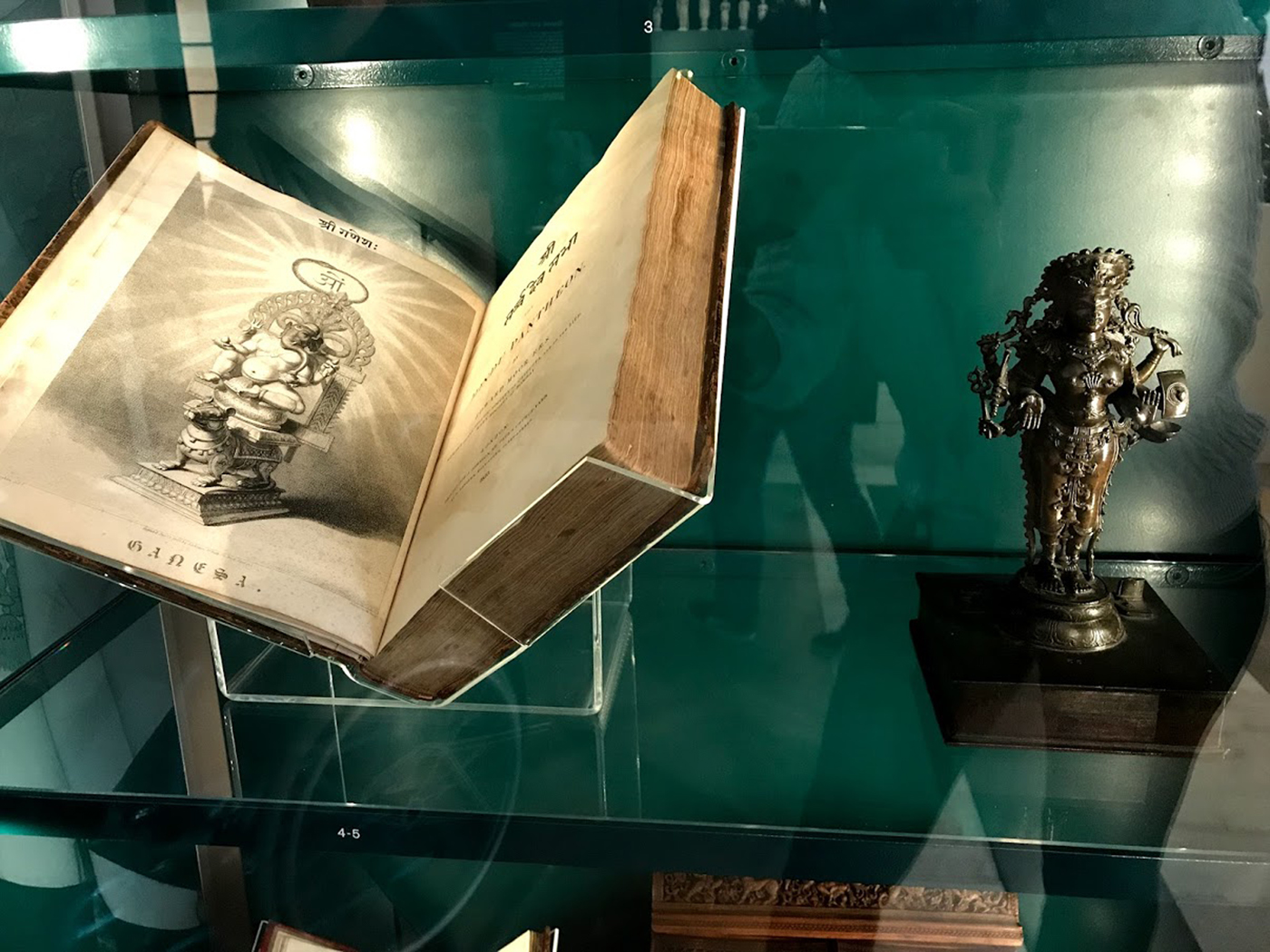
Under Franks’ influence, the museum greatly expanded its remit for collecting Indian sculpture of the highest quality, historical importance, and iconographic variety. One such gift with high scholarly importance was the donation of Edward Moor's collection of 300 small bronzes and 100 paintings through his descendant, Mrs. A. G. Moor in 1940. One of the first European language books that provided a scholarly investigation of Hindu mythology through illustration of these small devotional bronzes is Moor's the Hindu Pantheon from 1810. Since November 2017, this pioneering volume, widely used as an encyclopaedic reference, has been displayed next to Moor's figure of the goddess Kali in the newly refurbished Sir Joseph Hotung Gallery of China and South Asia. This bronze standing figure of the goddess Kali (Bhadra Kali) also illustrated in the Pantheon provides an excellent example of the physical object positioned next to a written publication that provides context regarding the object.
Edward Moor's the Hindu Pantheon next to the Goddess Kali on display in the Sir Hotung Gallery of China and South Asia at the British Museum.

The closing of the India Museum and subsequent dispersal of its collections in early 1880 saw the arrival of 120 sculptures from the site of the Buddhist stūpa at Amaravati in Andhra Pradesh, which date from c.200BC – 200 AD. They make up one of the three main schools of ancient Indian art, the other two being Mathura and Gandharan styles. The sculptures were excavated and transported from Madras (now Chennai) to London by Sir Walter Elliot of the Madras Civil Service and so acquired the name the ‘Elliot Marbles’. The manuscripts from Marathi were ‘not numerous’,Footnote 8 the Catalogue of the Marathi, Gurajarti, Bengali Asssamese, Oriya and Pushtu and Sindhi manuscripts and their supplementary catalogues describe 79 Marathi manuscripts and some 8000 printed books again mostly from the collections of Erskine.Footnote 9
Lastly, Franks’ acquisition of Major General Sir Alexander Cunningham's (1814–1893) collection further demonstrates the development of scholarship on South Asian studies. Cunningham was appointed the first Archaeological Surveyor of the Government of India in 1861 and established the Archaeological Survey of India in 1871. A 23-volume detailed survey of the Buddhist sites he excavated was published around the same time and the British Museum acquired some of his collection of sculptures, inscriptions, Indian coins and Buddhist reliquaries in 1888, 1893 and 1894.
In total, eleven catalogues from the Library of the British Museum were published from 1894 until 1912 and seven supplementary catalogues between 1886 until 1928.Footnote 10 This publication record demonstrates the growing interest in collecting and cataloguing South Asian manuscripts. Approximately half of these manuscript holdings were kept at the British Museum until their move to the British Library building in 1997.Footnote 11 The 1973 Act of Parliament to join the Library of the British Museum with a number of other holdings to create the British Library meant that the majority of these manuscripts are now part of the 80,000 volumes of South Asian manuscripts in the British Library. It was also in 1973 that the British Museum held its last exhibition focused primarily on manuscripts displayed in the King's Library. The exhibition consisted of the 278 Asian manuscripts, including those from South Asia, from the Department of Oriental Printed Books and Manuscripts in the British Museum.Footnote 12 After this exhibition there was a shift in the British Museum's collecting practices to more modern and contemporary works of art and sculpture and less illuminated manuscripts and text.
The Library and future collecting
The British Museum's current strategy for collecting towards the year 2020 focuses on building on its strengths by continuing to collect in those areas in which it has traditionally collected. At the same time, it is collecting new categories of modern objects that have taken on the roles of traditional objects, e.g. Japanese mobile phone toggles resembling 18th and 19th century netsuke used to hold a medicine case on the sash of traditional Japanese clothing. In addition, the museum is also open-minded about other categories that help to document human activity. As such, the Department of Asia continues to collect sculpture, paintings and archaeological artefacts alongside modern artwork and popular culture that depicts the way in which ancient traditions continue today.
The visual aspect of the British Museum collection has been available online through the ‘British Museum Collection Online’ on the website with an ‘estimated 8 million registered objects since 2012’Footnote 13 but only two million are currently searchable. This catalogue has been used to access and research the museum's collection and contribute to collaborative digital research projects. A bibliography of resources related to the objects is listed on each item record and can be found in the department libraries and study rooms at the British Museum. In addition, images of the objects on the website are linked from the collection management system, Museum Index Plus (formerly Merlin) through Odin, a digital image asset management system.
Collecting practices
The Department of Asia Library (which holds research resources) has supported the activities of the Department of Asia and its aim of ‘collecting modern and contemporary Asia’ to 2020. The creation of the Department of Asia Library collection development policy (2017–2020) has provided a framework to build on the strengths of traditional library collecting (predominately printed resources). It has also provided a remit for future collection development that has dramatically transformed the library into a useful resource centre for Asian art, culture and history, spanning the Neolithic (4000 BCE) to the present day (see figure 2). The current collecting focus for the library is related to curatorial research and cross-departmental research themes set out in the British Museum's Research Strategy to 2020.
Venn diagram of the Department of Asia Library's wider subject matter by regional sections.

The South Asia research section of the Department of Asia Library is made up of mostly printed materials regarding India, Sri Lanka, Nepal, Pakistan and North West Frontier/Buddhist Afghanistan (non-Islamic). The core of the collection is on art, archaeology, crafts, paintings, religious studies, sculpture, architecture, epigraphy, catalogues, seals, some medals, festschrifts, language and literature. The future collecting focus of South Asia is currently centered on visual culture in South India (10th century to present) and tantric material in the British Museum collection. The nature of ‘visual culture’ overlaps heavily with film, music and performance art studies which may not be print in format. However, such audio-visual material is largely absent from the Department of Asia Library and the object collection database. In fact, the British Museum's own digital repository has not supported film and 3-D moving imagery in the past. As we have moved into the 21st century, there is a growing question as to whether audio-visual and digital material should be collected for the future and how should they be presented.
Audio-visual challenges
In the 1980s, it was argued that ‘films on art were an engaging and educational way of instructing audiences of museums and public library about art’.Footnote 14 During these times audio-visual technology may have been in its infancy with the use of audiocassette and slide/filmstrips set, however today we currently enjoy a wide range of formats and platforms to showcase art history. For example, in March 2017, the British Museum announced its South Asia season to mark the 70th anniversary of Indian Independence from colonial rule as part of the UK-India Year of Culture with three events. This included the reopening of the Sir Joseph Hotung Gallery of China and South Asia after refurbishment in November 2017 and two exhibitions: ‘Politics and paradise: Indian popular prints from the Moscatelli Gift’ (19 July–3 September 2017) and ‘Virtual pilgrimage: reimagining India's Great Shrine of Amaravati’ (10 August 2017–8 October 2017).Footnote 15
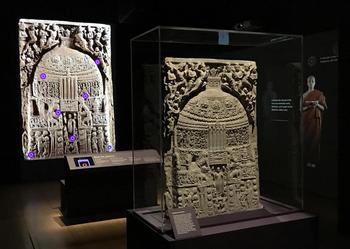
The ‘Virtual Pilgrimage’ exhibition in the Asahi Shimbun Display creatively engaged visitors to interact in greater detail with an important double-sided relief from Amaravati using their mobile phones. Visitors to the exhibition could also view four individual donors that made the Amaravati site possible brought to life by actors projected on the gallery walls. This collaboration with Google Creative Labs, Sydney is one of the newest experimental models of interactivity with mobile browser-based web technology in the museum instead of an audio guide or a simple photograph.
Asahi Shimbun Displays ‘Virtual Pilgrimage’ exhibition. Photo ©Trustees of the British Museum.

It has been argued that the infancy of audio-visual material and the connection with educational technology makes the scope of the material presented ‘too general, which was frowned upon by university circles’.Footnote 16 It could be said that the same applies today as this Google technological experiment formed part of the museum's public programme. The beauty of curating your own narrative suggests that the material can be re-purposed for different audiences. For example, the ‘Virtual Pilgrimage’ exhibition drew thousands of visitors between July and October 2017 and the blog post about the exhibition on the website had 3,981 page views, as of 27 June 2018.Footnote 17 By further teaming up with Sketchfab, the creators of the 3D model of the slab, the museum has attracted a community of artists, designers, architects, game studios and more to explore architectural objects in the British Museum. It has provided worldwide access to the detailed inscriptions of the slab to facilitate scholars and researchers to further the study of this important sculpture in a way that current library resources have not.
Film and Social Media
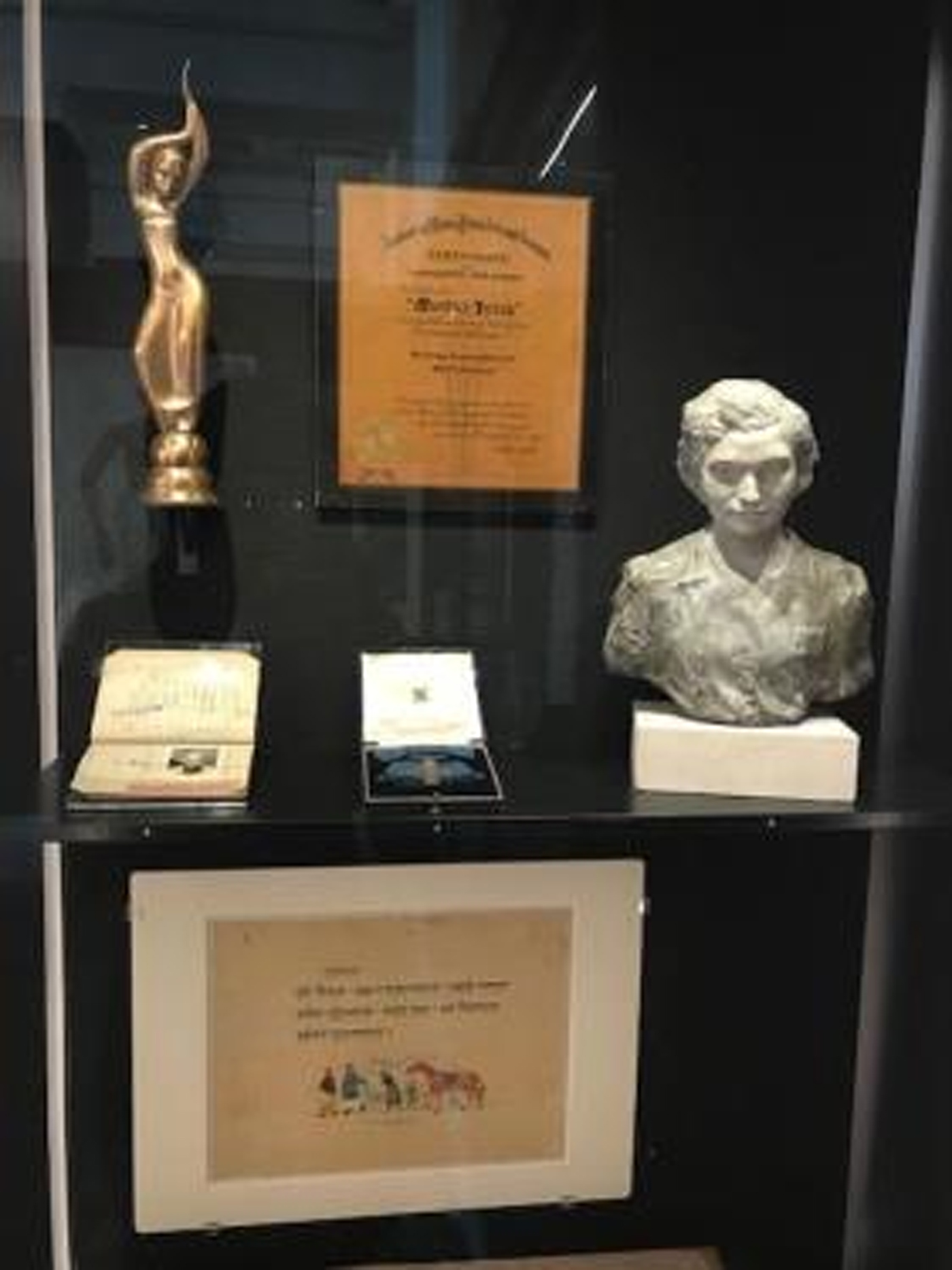
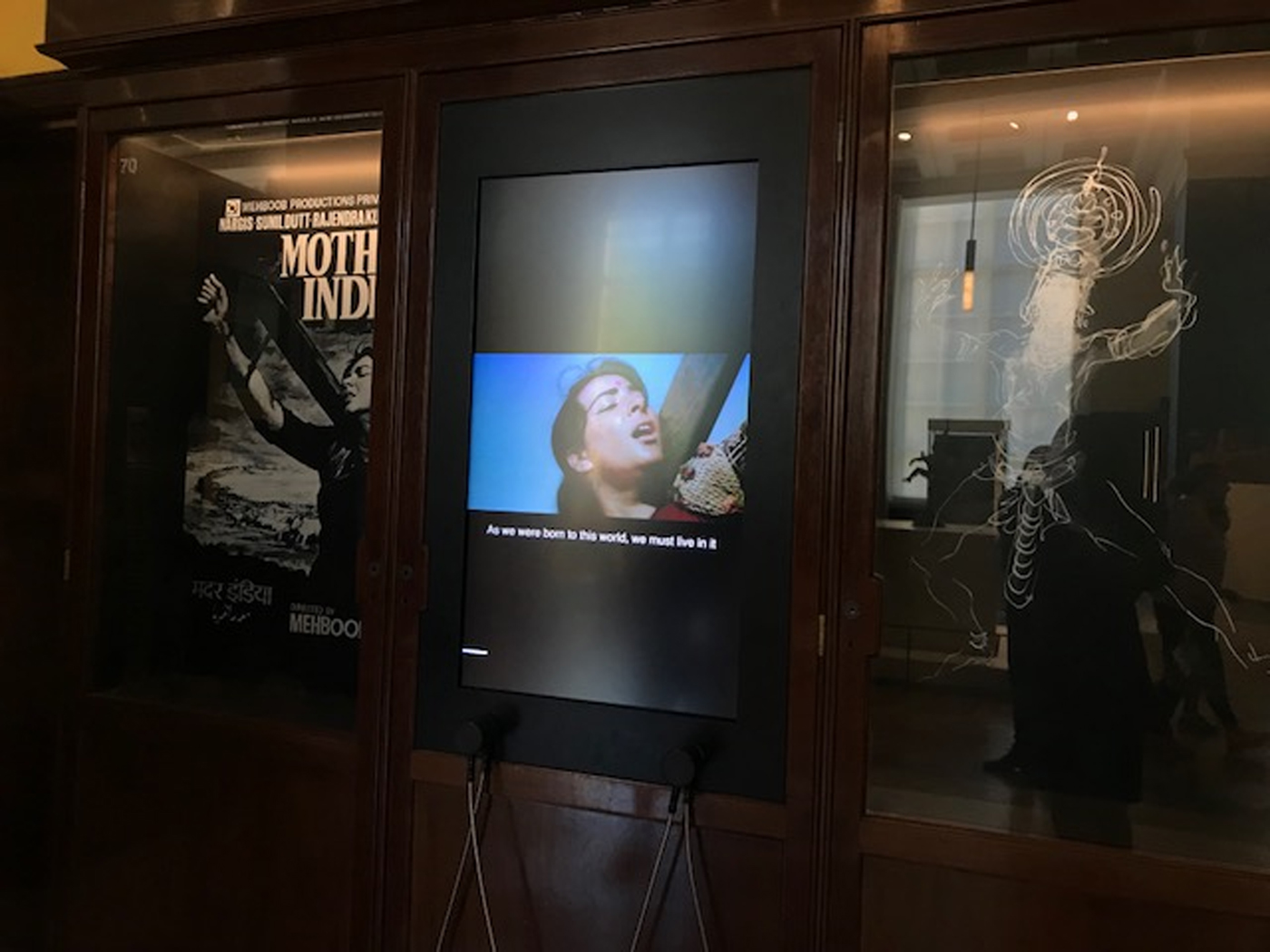
As the British Museum furthers its mission to be a ‘museum of the world for the world’ audio-visual materials have been introduced to tell stories about collections within the galleries through film. For example, figure 4 depicts the newly acquired ‘Mother India’ Oscar nomination next to a running clip of the film kindly licensed to the British Museum for the Sir Joseph Hotung Gallery of China and South Asia permanent gallery by Mehboob Productions Private Ltd (see figure 5). The central character of the film, Radha is seen struggling to raise her children alone and presented as a heroic symbol of newly independent India determined to rebuild. One disadvantage of this film, is that the British Museum are not the copyright holders and thus do not own it, and cannot make it accessible to external audiences — its only purpose was specifically to be part of the gallery narrative on independence, partition and diasporas. Furthermore, while there are a few cine films within the South Asian collection and some DVDs and CDs within the Department of Asia Library, they are not digitized and thus cannot be made available outside the museum.
‘Mother India’ Oscar nomination for Best Foreign Language Film (1958) in the Independence, Partition and Diaspora section of the Sir Joseph Hotung Gallery of China and South Asia.

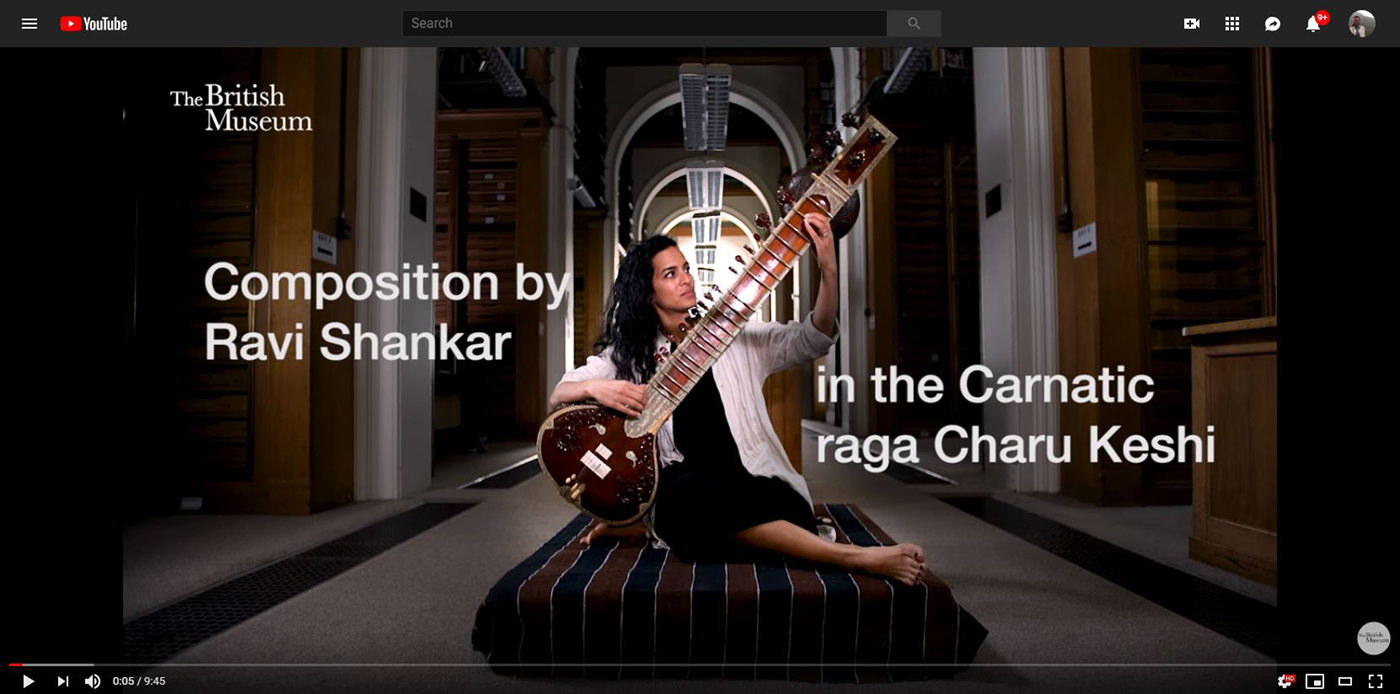
As such, the museum has been promoting in-house film creation and the use of social media to increase the lack of audio-visual and digital content through the website. For instance, last year the British Museum received the very generous gift of a sitar once owned by the great musician Ravi Shankar (1920–2012) by Sukanya Shankar, the widow of Ravi Shankar, their daughter Anoushka Shankar and the Ravi Shankar Foundation. On the day of this donation, Anoushka, who is also a world renowned sitar player, was filmed performing on her father's sitar for the last time, which was uploaded to YouTube. This performance has received widespread reviews and 33,202 video views, 790 likes and 40 comments on YouTube, as of 27 June 2018 (figure 6).
Running clip of the film ‘Mother India’ displayed in the Sir Joseph Hotung Gallery of China and South Asia.

Video of Anoushka Shankar playing Ravi Shankar's sitar on YouTube.

The British Museum may retain ownership of this film, however, it is important to mention that YouTube's subscribed terms of service means that the museum has ‘granted YouTube a non-exclusive, worldwide, perpetual license to freely sub-license, re-distribute, re-publish and monetise their video’.Footnote 18 Therefore, the museum has no control over its usage in comparison to its licensed films for television. It could be argued that a lot of the British Museum's website content is open to shared creative commons licences and thus also open to redistribution, however the only difference is that the museum can control the narrative from the source, its own website. It is justifiable to suggest that there should be questions about ‘ethical museum practices in emergent social media landscapes’Footnote 19 to ensure accurate information is provided in a responsible way that does not damage public trust in the institution and that retains communication and transparency.
One great example of the how the museum is controlling the narrative about its collections and research when engaging with the public is with the current Arts and Humanities Research Council (AHRC) funded project, ‘Late Hokusai: thought, technique, society’. Its research underpins the exhibition, ‘Hokusai: beyond the Great Wave’ and features a ground-breaking documentary and private view released in selected cinemas in the UK on 2 June 2017. Using pioneering 8 K video technology, Hokusai's paintings and prints are examined by world experts who are at the forefront of digital art history. The Hokusai film trailer quickly went viral on Facebook shortly after the film release with one post garnering 49,000 views. The film was made into a physical DVD that can be purchased by the public worldwide and has been acquired and played within the Department of Asia Library study room. However, the final in-gallery film content for the ‘Late Hokusai’ exhibition is retained on restricted access internally with a strict archiving policy and it is not clear when it will be made available in an online repository.
Conclusions
It is clear that film, social media, and digital technology are now a part of the information resources available to users alongside traditional library printed resources held in the British Museum. The museum is currently exploring audio-visual and digital preservation possibilities and research service products to create a repository platform that supports audio-visual content related to its objects and past and future exhibitions.
There are examples of where South Asian collections have been successfully digitized – the ‘Celebrating Ganesha’ virtual exhibit on Google Arts & Culture and various audio-visual initiatives have been undertaken at the Indira Gandhi National Centre for the Arts.Footnote 20 However, without determining which technical strategies can be used to best provide continuing access to audio-visual resources, the British Museum will remain in a stage of ‘digital infancy.’ Hence, it is vital for any museum or cultural institution to invest in repositories old and new in order to safeguard research and content so that not only are objects and collections preserved for future generations, but also the knowledge and context about these objects are accessible for years to come.