At the time of their nomination by the president, prospective Supreme Court justices are generally the subject of much discussion, with speculation centering on their judicial ideology. While most nominees have previous judicial experience (often in the federal court system), observers frequently struggle to understand exactly what type of justice a nominee will be if confirmed for a position on the Supreme Court. Exacerbating this uncertainty is the fact that nominees are generally reluctant to provide information about their views on cases or issues, whether hypothetical or historical. Senate confirmation hearings provide some glimpses into the basic judicial philosophies of the nominees, but such information often comes in the form of vague statements about “deciding each case on the merits” or “exercising judicial restraint.” Recent nominees have tended to follow the so-called “Ginsburg Rule” in responding to Senate Judiciary Committee questions, offering “no hints, no forecasts, no previews” about specific positions they might take in future cases or controversies. For example, Chief Justice Roberts, responding to questioning from Senator Joseph Biden during his 2005 confirmation hearings, argued that “the independence and integrity of the Supreme Court requires that nominees before this committee for a position on that court not forecast, give predictions, give hints about how they might rule in cases that might come before the court” (Washington Post/Morningside Partners/FDCH 2005). The judicial ideology of Supreme Court nominees is likely to receive particular scrutiny with the recent nomination of Elena Kagan, who has never served as a judge and thus offers observers few sources from which to glean information about her views on law and the Constitution.
This article examines the recent Supreme Court appointments of John Roberts, Samuel Alito, and Sonia Sotomayor and proposes a method for learning about their ideological positions as the Court decides successive cases. The method is based on traditional ideal point models and the concept of belief updating according to Bayes' theorem. We track the justices' estimated positions over time, as well as the amount of uncertainty for each estimate and the probability of various hypotheses concerning the ideological ordering of the justices relative to those justices they have replaced and those justices who are currently sitting. In addition to providing estimates of the ideological positions of these new justices, our methods also track the amount of information that each new vote a justice casts contributes to our understanding of his or her ideological position. The results shed important light on the ideological climate of the new Roberts Court and demonstrate more generally that we can learn much about the ideology of justices from relatively few votes.
OPERATIONALIZING THE ATTITUDINAL MODEL
The attitudinal model of judicial decision making (Segal and Spaeth Reference Segal and Spaeth1993; Segal and Spaeth Reference Segal and Spaeth2002) holds that judges decide cases based on their own ideological views. Accordingly, much of the recent scholarship on judicial politics is structured around the idea of judicial ideology, and in recent years, much of the focus has been on the appropriate estimation of the ideological positions of justices. The use of statistical models to estimate ideology has a long history in political science (e.g., Poole and Rosenthal Reference Poole and Rosenthal1985; Poole and Rosenthal Reference Poole and Rosenthal1997; Heckman and Snyder Reference Heckman and Snyder1997; Clinton, Jackman, and Rivers Reference Clinton, Jackman and Rivers2004) and is largely based on earlier work in the area of educational testing (Rasch Reference Rasch1960; Rasch Reference Rasch1966; Stene Reference Stene and Fischer1968). While early applications of these models tended to focus on legislative voting, this approach has been increasingly applied to judicial politics (e.g., Martin and Quinn Reference Martin and Quinn2002; Epstein et al. Reference Epstein, Martin, Segal and Westerland2007; Bailey Reference Bailey2007). This section describes a statistical model for estimating the ideology of Supreme Court justices that includes a simple framework for updating these estimates as new cases are decided by the Court.
Statistical Model for Supreme Court Voting
We begin by coding each justice's vote on a given case as 1 if the justice voted with the majority and as 0 otherwise. We then model votes as

in which Λ denotes the logistic function, y ij represents Justice i's vote on case j, αj and βj represent the “difficulty” and “discrimination” parameters for case j, and x i represents Justice i's ideal point (or ideological position)—the central parameter of interest for our study. The difficulty parameter αj represents how much support generally exists for the majority disposition, with higher values indicating more opposition. The discrimination parameter βj indicates how sharply a case is divided along ideological lines. This stage of the model is similar to the setup employed by Clinton, Jackman, and Rivers (Reference Clinton, Jackman and Rivers2004).
In addition to this standard setup, we impose a further degree of structure on the case parameters αj and βj to take advantage of the idea that while the characteristics of various cases certainly differ, they also tend to have similarities. Therefore, we assume that the case parameters are drawn from normal distributions, for which means and variances can be estimated. Formally, we assume that


We believe that this structure provides a more realistic estimate of a justice's ideal points by appropriately accounting for the similarities of the cases in the Supreme Court's docket.Footnote 1 As is common with latent-trait models, these parameters are not identified. We solve this problem by imposing the restriction that former justice Sandra Day O'Connor and former chief justice William Rehnquist have ideal points located at 0 and 1, respectively. This restriction has no impact on the resulting estimates and simply adds definition to the scale on which the justices' ideologies are estimated.Footnote 2 In addition to identifying the model, these restrictions allow for easier interpretation of the model's results, particularly the comparison of the new justices' ideologies to the ideologies of O'Connor and Rehnquist, as discussed in the following.
Specifying Prior Beliefs for Justice Ideology
To obtain informative beliefs about the ideologies of those justices who served immediately before the appointment of Chief Justice Roberts, we ran our ideal point model on all cases decided between the appointment of Justice Breyer, the last appointee to the Rehnquist Court, and the appointment of Chief Justice Roberts (i.e., during the last Rehnquist natural court).Footnote 3,Footnote 4 This approach produced relatively specific information about the ideologies of all the sitting justices. We then specified prior distributions for the ideal points of Roberts, Alito, and Sotomayor, which represented beliefs about the justices' ideologies before they ever cast a vote on a Supreme Court case. As discussed previously, observers have many possible sources of information about the likely behavior of these justices. We chose to specify somewhat vague priors that would be indicative of relatively uncertain beliefs. Specifically, we used normal priors with mean 1 and variance 2.5 for both Roberts and Alito and a normal prior with mean −1 and variance 2.5 for Sotomayor. These priors imply, for example, a 50% chance that Roberts is more conservative than Rehnquist and a 74% chance that Roberts is more conservative than O'Connor, with the probabilities being the same for Alito, since we placed the same prior distribution on their ideal points. The prior probability that Sotomayor is more liberal than Stevens was 17%, while the prior probability that she is more conservative than Rehnquist was only 10%. While it could be argued that we actually had more information about the justices' ideological predispositions prior to the beginning of their Supreme Court careers, we chose to adopt a conservative approach here, specifying relatively uncertain prior beliefs and focusing on what the voting behavior of these justices can tell us about their ideologies. All data used in this article come from the Supreme Court Database (Spaeth et al. Reference Spaeth, Epstein, Ruger, Whittington, Segal and Martin2010).Footnote 5
Model Estimation
We estimated the model after each Court decision following a justice's appointment, adding new cases to the existing dataset.Footnote 6 This approach provided estimates of each justice's ideology, updating beliefs on the basis of the new information suggested by his or her vote on each new case. At each point in time, our beliefs about a justice's ideology were based on the votes he or she had cast up to that point. Our focus was on the relative ideological positions of each justice. More specifically, we were also interested in answering questions about whether newly appointed justices were more liberal or conservative than the justices they replaced.
ESTIMATES OF JUSTICE IDEOLOGY
In this section, we examine our estimates of justice ideology, particularly by looking at the updating of our beliefs to incorporate the information revealed by the justices' votes on each new case heard by the Court, as well as the level of precision of these beliefs after various numbers of votes are cast. Figure 1 displays our estimated beliefs about the ideology of the justices over time. Prior beliefs about the positions of Roberts and Alito are centered at 1, the same position as Rehnquist, while prior beliefs about Sotomayor are centered at −1.
Marginal Posterior Trends

We see that Roberts' early votes suggested that he might be more conservative than initially thought. For example, our estimate of his ideology after his first six votes was 2.21—significantly more conservative than Rehnquist and nearly as conservative as Scalia and Thomas.Footnote 7 By the end of the votes analyzed here, estimates of Roberts' ideal point became relatively precise, centering slightly to the right of Rehnquist's position, as indicated by the relatively narrow 95% highest posterior density (HPD) interval shown in gray.Footnote 8 We also learned fairly quickly that Roberts is almost certainly more conservative than O'Connor. As mentioned previously, the prior probability (before he had cast any votes) that Roberts is to the right of O'Connor is 74%. After Roberts had cast only his first six votes on nonunanimous cases, however, his 95% HPD no longer contained O'Connor's ideal point of zero, and his probability of being more conservative than O'Connor moved to 99.77%.
Our beliefs about Justice Alito followed a somewhat different pattern over time. His early decisions suggested that he would be a relatively moderate justice. After his first eight votes on nonunanimous cases, his estimated ideology was 0.58, placing him squarely between O'Connor and Rehnquist. His vote on cases such as Youngblood v. West Virginia (547 U.S. 867) suggested that Alito was more liberal than initially believed. Subsequent votes, however, revealed that Alito was likely to be more conservative. As he cast more votes, it became clear that his views fall further to the right side of the spectrum of judicial ideology.
As the newest appointee in our dataset, Justice Sotomayor has cast relatively few votes up to this point in time. Accordingly, we have less information to guide our beliefs about her ideological position. Her early voting provided some suggestion that she might be more moderate than initially believed. Later votes, however, have been more reliably liberal, moving estimates of her ideal point farther to the left. As our belief updating for Roberts' and Alito's ideologies shows, dozens more decisions will likely need to be observed before we can pinpoint Sotomayor's ideology with a reasonable amount of precision. We can, however, say that based on her voting history thus far, Sotomayor appears to be a fairly liberal justice.
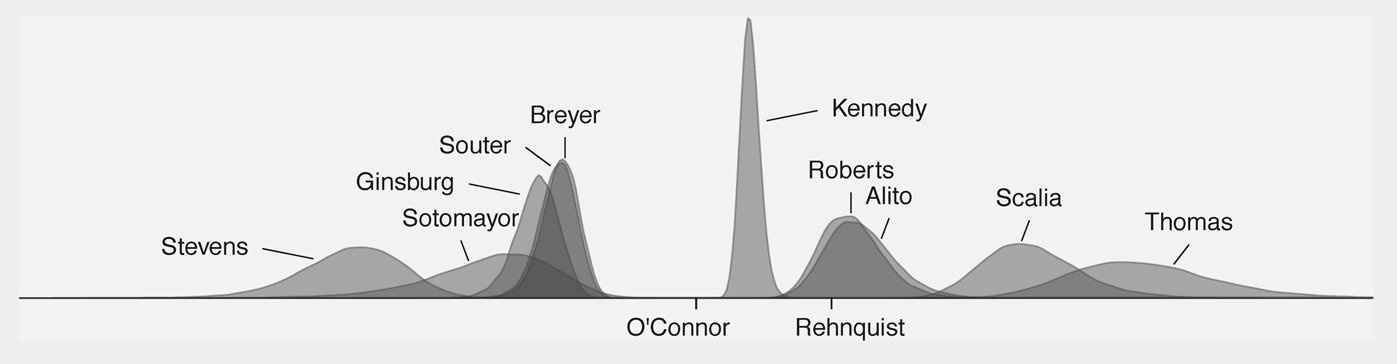
In addition to tracking our information about the justices' ideologies over time, we can examine our beliefs using all the votes cast up until the present time. Accordingly, figure 2 plots the marginal posterior distributions for each justice's ideal point. These distributions represent beliefs about each individual's ideological position, taking all of their votes into account. As expected, the justices of the last Rehnquist natural court are estimated to have their expected ideological ordering, with Stevens clearly being the most liberal and Ginsburg, Souter, and Breyer rounding out the liberal-to-moderate wing. O'Connor and Kennedy are estimated to have relatively centrist ideological positions, and Rehnquist, Scalia, and Thomas are identified as the Court's most conservative members. While there is still considerable uncertainty about her exact ideological location, beliefs about Sotomayor's position are centered squarely in the Court's traditionally liberal voting bloc. Beliefs about the positions of Roberts and Alito lie toward the right side of the ideological spectrum, centered to the left of both Scalia and Thomas but to the right of Kennedy. This distribution suggests that although these two new justices are likely to be conservatives, they do not seem as conservative as the Court's two traditional “right-wingers.”
Marginal Posterior Distributions for Justice Ideal Points

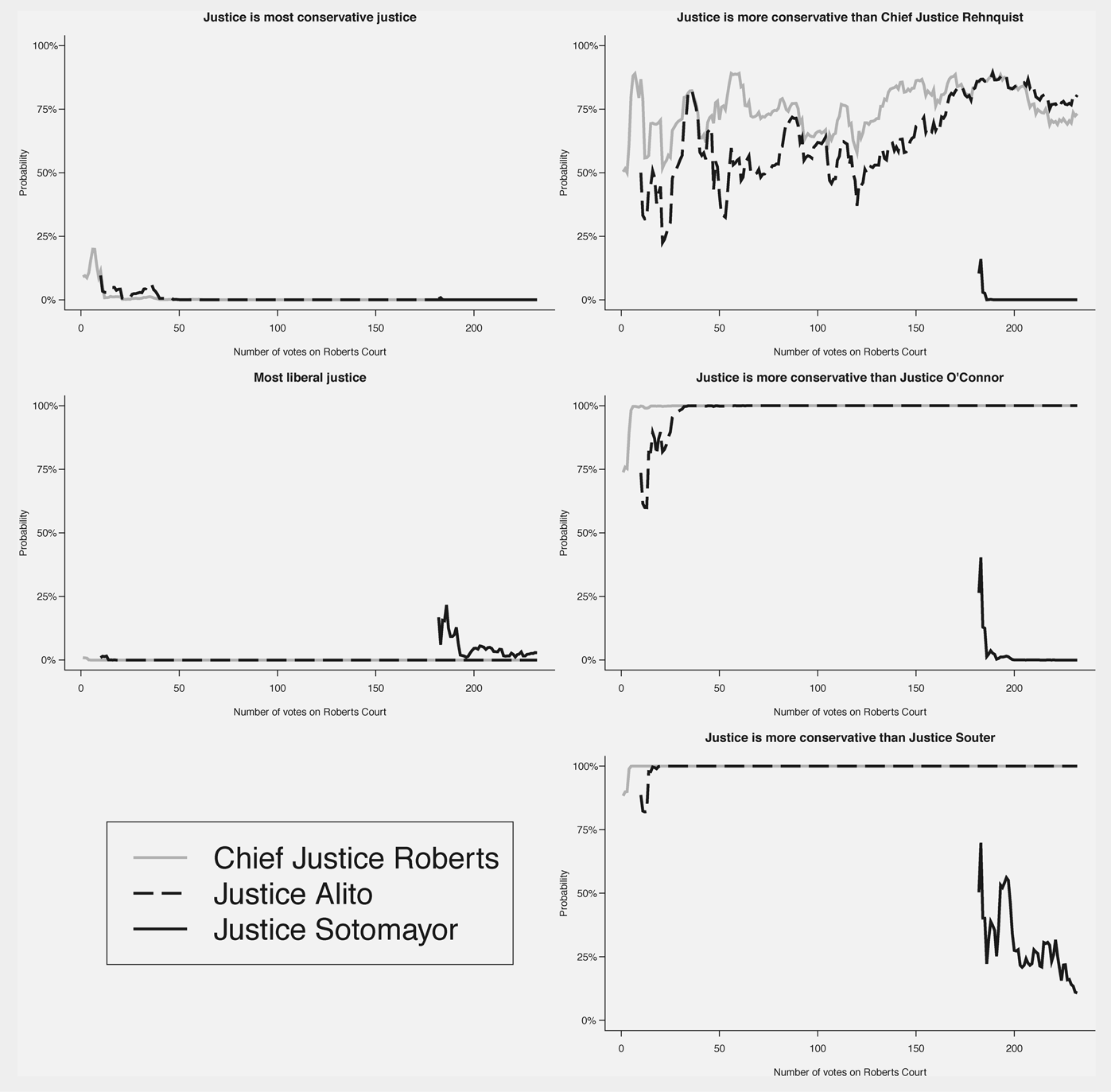
A further benefit of the modeling approach used here is the relative ease with which we can test various hypotheses about justice positions. Figure 3 plots the probability that various hypotheses about justice ideal points are true, tracking these probabilities for each justice after every vote they cast. For example, after observing a certain number of votes, we may want to know the likelihood that a justice is the most conservative member of the Court. We can see that although both Roberts and Alito started their Supreme Court careers with a nontrivial probability of being the most conservative justice, it became clear after a relatively small number of votes that this was not the case. We also see that Sotomayor has a relatively low probability of being the most liberal justice on the Court. While we are still relatively uncertain about her specific ideological position, her early votes reveal that it is relatively unlikely that she is more liberal than Justice Stevens was.
Hypothesis Test Plots

We can also examine the likelihood that each newly appointed justice is more conservative than the justice he or she replaced. While Roberts started out his term equally likely to be more liberal or conservative than Rehnquist, his early votes suggested that his ideal point was actually to the right of the former chief justice. Some subsequent votes, however, indicated that the new chief justice might be more liberal than his predecessor. For example, in Jones v. Flowers (547 U.S. 220), a case in which the Court considered the meaning of the due process clause in relation to a state's sale of a home for unpaid taxes, Roberts authored a majority opinion that saw Kennedy, Thomas, and Scalia joining together in dissent. Casting a vote against the Court's two most reliable conservatives and the generally moderate Kennedy offered some suggestion that Roberts might be more moderate than previously thought. Over time, however, as Roberts cast more and more votes, it became increasingly likely that he was more conservative than his predecessor. By the end of the time period studied here, the probability that Roberts was more conservative than Rehnquist was 73%. Therefore, while we will have to observe further votes to be more certain, it seems fairly likely that the new chief justice is more conservative than his predecessor.
We can also examine the probability that Alito is more conservative than O'Connor, the justice whom he replaced. While his early voting record leaves Alito's position relative to O'Connor somewhat uncertain, his subsequent votes leave virtually no doubt that he is more conservative than his predecessor. After Alito cast his first 19 votes on nonunanimous cases, for example, the probability that he is more conservative than O'Connor rose to more than 99%. Finally, while Justice Sotomayor was initially believed to have a 50% chance of being more conservative than Justice Souter, her early votes increased this probability dramatically. Later votes cast by Sotomayor, however, have made it far less likely that she lies to the right of Souter. At the close of the 2010 term, her probability of being more conservative than her predecessor is estimated to be 11%.
A final question of interest is which of the two Court members appointed by President George W. Bush is the most conservative. To investigate this question, figure 4 plots the probability that Roberts is more conservative than Alito, again estimating this probability after each new vote cast. Roberts' early voting history suggested that he was likely to be more conservative than initially expected, leading to an early increase in his probability of being more conservative than Alito, who had not yet cast any votes. Once Alito took his seat on the bench, however, the trend reversed. In Danforth v. Minnesota (551 U.S. 264), Roberts joined Kennedy as the only dissenters, providing some evidence that Roberts might actually be more conservative than Alito. Later cases, however, such as Yeager v. United States (557 U.S. ___), in which Alito joined Thomas and Scalia in dissenting, indicated that Alito was more likely to be the most conservative of the Bush appointees. Looking at the full set of cases through the present time reveals a 40% probability that Roberts is more conservative than Alito. This outcome means that while it is still unclear which of the Bush appointees is more ideologically conservative, some moderate evidence supports Alito.
Plot for Test of Hypothesis that Chief Justice Roberts Is More Conservative than Justice Alito

DISCUSSION
Speculation about the likely ideology of Supreme Court nominees has long been a favorite pasttime of senators, the media, and ordinary political observers. The recent nomination of Elena Kagan to succeed Justice John Paul Stevens on the Court has again revived speculation. Conjecture about Kagan's views has been distinctive, because she has no prior experience as a judge that might be used to predict how she will act on the Court. The method presented in this article provides a principled way to learn about the ideology of new Supreme Court appointees, as well as to test various hypotheses about these values.
Overall, we are able to learn several things about the ideology of the three newest Supreme Court members using their voting records over a relatively short time period. First, it seems quite likely that both Roberts and Alito are fairly strong conservatives. Although we cannot be certain, both seem to be more conservative than Rehnquist was during his time on the Court. We can, however, be fairly certain that neither of these new Republican appointees is as conservative as Thomas or Scalia. Furthermore, the behavior of Roberts and Alito has suggested that they are likely to have relatively similar ideological positions, and although our best guess is that Roberts may be slightly more moderate than Alito, we cannot yet be sure of which is most conservative. Because Justice Sotomayor has cast votes on a much smaller number of cases since her appointment than have other justices, our conclusions about her ideology are more speculative. Although it seems very likely that she is more conservative than Stevens, we cannot yet precisely identify where she will fall relative to the other members of the Court. It seems likely, however, that she will be among the Court's most liberal members, possibly even becoming the most liberal justice after Stevens' departure.
Broadly speaking, these findings suggest that none of these three recent appointments is likely to cause a seismic shift in the Court's rulings. The replacement of Rehnquist with another conservative justice, albeit one who seems even farther to the right than his predecessor, will not alter the position of the Court's median voter and therefore is not expected to be consequential in most cases. The most likely result of the replacement of O'Connor with Alito is that Kennedy will become the new median justice. While this reshuffling represents a slight shift toward the right from the Court's previous median, it will likely only be consequential in a narrow set of cases. Finally, although Sotomayor is likely more liberal than Souter, her appointment is unlikely to result in any significant change, both because she will almost certainly fall on the same side of the median and because her early voting record does not seem to diverge much from that of her predecessor.
The approach used in this article provides a principled method for incorporating new information about Supreme Court justices' votes into beliefs about the ideological position of each justice. We have shown that a relatively small number of votes—in some cases, as few as 20 or 30—can provide a reasonable amount of information about what type of justice a new appointee is likely to be. More specific conclusions, however, such as the precise location of a justice or his or her position relative to every other sitting justice, require many more votes to produce a full understanding.
These results should provide more direct and objective information about the justices' views than is commonly found in popular discourse about the Court. As Ruger et al. (Reference Ruger, Kim, Martin and Quinn2004) shows, for example, expert opinions and predictions are often significantly less accurate than the estimates of statistical models. Therefore, these methods may provide a more objective method that could substitute for or complement expert opinions.
More broadly, this model may provide a way to account for the beliefs of other actors, including members of Congress and the president. It is also possible that this or similar methods could be used to provide measures of the beliefs of observers (e.g., potential parties to Supreme Court cases) about the Court's likely decisions following the seating of new justices. Scholars may find such measures useful in testing theories that involve strategic behavior by actors based on their beliefs about potential decisions by the Court. The estimated variation in the information about the ideological positions of newly appointed justices may provide analytical leverage in these and related situations.