




No CrossRef data available.
Article contents
Situation analysis of prenatal diagnosis technology utilization in China: Current situation, main issues, and policy implications
Published online by Cambridge University Press: 01 November 2004
Abstract
Objectives: The purpose of this study is to describe the situation with the distribution and utilization of prenatal diagnosis technology in China, to identify some important barriers to prenatal diagnosis use, and to suggest changes to improve the present situation.
Methods: The study uses cross-sectional surveys to capture quantitative data from both providers and consumers. Qualitative information based on focus group discussions is also presented.
Results: A mail survey of the provincial Bureaus of Health (BOHs) reveals that sixteen provincial prenatal diagnosis centers and twelve city level centers were accredited by the BOHs by July of 2001. These centers were located in thirteen provinces, of thirty in all of China. Of 147 selected institutions surveyed separately, 90.5 ercent offer ultrasound examination, 72.1 percent provide pathogen tests (mainly Toxoplasma, rubella virus, cytomegalovirus, and herpes simplex or TORCH), 57.1 percent do biochemical tests, 21.8 percent have genetic counseling, 13.6 percent do karyotype testing, 7.5 percent do enzymology testing, and 5.4 percent carry out molecular genetic testing. Chromosome diseases, congenital diseases, and several gene diseases are the target diseases. According to qualitative data, macromanagement for prenatal diagnosis, supplier provision of tests, and population demand are the main influences on prenatal diagnosis use.
Conclusions: From the quantitative and qualitative analysis, it is clear that the technology of prenatal diagnosis is not diffusing well throughout China and is apparently not appropriately used. The situation of prenatal diagnosis has implications for policy-makers, including identification of priorities, regulation of prenatal diagnosis, strategic planning, development of guidelines based on health technology assessment, and consumer orientation.
Information
- Type
- GENERAL ESSAYS
- Information
- International Journal of Technology Assessment in Health Care , Volume 20 , Issue 4 , November 2004 , pp. 524 - 530
- Copyright
- © 2004 Cambridge University Press
Health technology assessment (HTA) in China began in the 1980s. HTA is gradually becoming a “language” of health policy. In 2001, the national Ministry of Health (MOH) selected technology assessment of prenatal diagnosis as one of its priorities. The MOH took action for two main reasons: First, the prevalence of birth defects has risen in recent years, whereas infant mortality has remained stable at a level of approximately 33 per 1,000 live births from 1997 to 2000 (2;6). With the moderately low infant mortality rate, birth defects and disability due to genetic diseases have gradually become relatively more important. As a result of the fall in both infant mortality and birth rates, the focus of health policy development is shifting from acute problems toward management of noncommunicable diseases. This change is particularly marked in the area of reproductive and child health, because an increasing proportion of infants born with potentially disabling conditions, who previously would have died undiagnosed, now survive and require medical and supportive interventions (9). Those disabilities due to birth defects and genetically determined disorders are leading to a large disease burden. Prenatal diagnosis, including medical genetics, can influence this disease burden.
Second, the Law of P. R. China on Maternal and Infant Health Care was enacted in June 1995. There are several articles of the law focusing on prenatal diagnosis, including provisions for identifying high-risk people and administrative principles for health personnel and institutions. The Chinese premier Rongji Zhu issued The Implementation Statute of the Law on Maternal and Infant Health Care in 2001. In the statute, prenatal diagnosis is singled out. People with a medical history or pregnant women with certain symptoms are advised to have a prenatal diagnosis by a physician. Health-care institutions and the professionals that provide prenatal diagnosis should be certified by the provincial Bureau of Health. Regulation of this field is also called for.
There is a lack of information about prenatal diagnosis utilization in China. Review of the literature from 1995 to 2001 found only one study focusing on prenatal diagnosis use in Shanghai. The results showed that, in the seventy hospitals with maternity services, 62 percent had exclusive ultrasound in the department of obstetric and gynecology, 62 percent had prenatal screening, 54 percent had pathogen tests (mainly Toxoplasma, rubella virus, cytomegalovirus, and herpes simplex or TORCH), 11 percent had genetic counseling, and 3 percent had genetic diagnosis (12). Despite the high level of economic development in Shanghai, prenatal diagnosis obviously is not widely spread. It was decided, therefore, to conduct a national survey to gain insights into the use of prenatal diagnosis in all of China.
This study presents the surveys concerning prenatal diagnosis in China. It also explores the main experiences/barriers that facilitate or hinder prenatal diagnosis services in China. The main purpose of the research is to recommend directions for action to policy-makers of the MOH.
METHODS
Mail Survey
Because there is no information in China about the capacity of health-care institutions to provide prenatal diagnosis services, a mail survey was conducted in 2001 to ascertain the distribution of institutions accredited by the health authority of all of China. Despite the requirements of the law, it was known that the Bureaus of Health (BOHs) have not actively accredited centers for prenatal diagnosis; therefore, routine data are not reliable. The questionnaire to identify the number of accredited institutions rendering prenatal diagnosis at provincial, city, and county level was mailed to Department of Maternal and Child Health (MCH) at thirty-one provincial BOHs at the beginning of August 2001. By the end of October 2001, thirty of thirty-one Departments of MCH of the BOHs responded to the survey.
Field Survey
We used a conventional sampling strategy to select field survey sites. The sampling took three factors into considerations: socioeconomic level, incidence of birth defects, and infrastructures of prenatal diagnosis. A, B, C, and D provinces, representing low, medium, and high socioeconomic levels based on GDP per capita were chosen as sample provinces. In each selected province, two cities were taken as sample cities, one of which was the capital of the province.
The survey was carried out as follows: (i) Random sample survey in health-care institutions that provide maternity services was carried out in the eight cities. We used stratum random sampling, stratified by the level of health-care institutions first and then sampled by pure randomization. The main contents of this part of survey include the basic information of health-care institutions, basic prenatal diagnosis services, and so forth. (ii) In-depth survey in health-care institutions offering prenatal diagnosis at provincial and city level was done in the eight cities. Three institutions were investigated in each province, including one provincial level facility in the capital and two city level facilities in the capital and the other city. The main objective of this survey was to gain information about issues, including the services provided, their quantity, their quality, infrastructure, human resources, and charges. In addition, self-completed questionnaires for pregnant women of 28 weeks gestation or more and pregnant women who had had prenatal diagnosis were conducted to examine prenatal diagnosis in the view of pregnant women.
The field survey was conducted from September through November of 2001. Except for the data from consumers, all data were for the year of 2000.
Focus Group Discussion
In each investigated city, two separate focus group discussions were held, one involving clinical experts and the other by administrative experts on maternal and child health. With the consent of the participants, audio and written recordings were made. The qualitative survey was to identify the main factors that facilitate or hinder prenatal diagnosis in China and to seek countermeasures to improve the quality and use of prenatal diagnosis.
Literature Retrieval and Review
In addition to those methods, literature retrieval and Web site searching was used to collect HTA reports and guidelines for prenatal diagnosis. Our key words focused on prenatal diagnosis, ultrasound, prenatal screening, karyotype by chorionic villus samples (CVS), amniocentesis (AC), percutaneous fetal umbilical blood sampling, and prenatal genetic diagnosis.
RESULTS
Distribution of Accredited Prenatal Diagnosis Centers in China
On the basis of the mail survey, sixteen provincial prenatal diagnosis centers and twelve city level centers were accredited by the provincial BOH by July 2001, located in thirteen of thirty provinces. Heilongjiang, Shaanxi, and Xinjiang have two provincial centers each. Two provinces, Liaoning and Zhejiang, have local regulations on prenatal diagnosis, and the BOH has launched programs to accredit city-level prenatal diagnosis centers, with twelve city level centers accredited. The other centers are spread through eight provinces. However, seventeen provinces have not implemented accreditation programs, although there are probably some health-care institutions providing prenatal diagnosis services.
In the sixteen provincial prenatal diagnosis centers, 62.5 percent of centers are affiliated with general and MCH hospitals, 12.5 percent are affiliated with a university or a college, 12.5 percent are designated as “outstanding institutions,” and 12.5 percent are of another type of institution.
The clinical services include genetic counseling, biochemical testing, ultrasound examination, karyotype testing, and molecular genetics testing. The main target diseases are chromosome abnormalities, congenital anomalies (such as neural tube defect), some inherited gene diseases, and genetic metabolic diseases.
Prenatal Diagnosis Services in Sampled Health-Care Institutions
In eight cities in four provinces, 20 percent of health-care institutions, which provide delivery, were randomly selected by the hospital level (primary care, secondary care, tertiary care, and other unclassified), except that all institutions that provide delivery were investigated in a noncapital city in B province. A total of 147 sample hospitals were obtained.
In the 147 institutions, 90.5 percent have ultrasound, 72.1 percent provide pathogen testing (mainly TORCH), 57.1 percent delivery biochemical testing, 21.8 percent have genetic counseling, 13.6 percent do karyotype testing, 7.5 percent do enzymology testing, and 5.4 percent carry out molecular genetic testing. It is clear that ultrasound, pathogen testing, and biochemical testing are relatively routine prenatal diagnosis techniques in four provinces, whereas other services are not (see Table 1). The question is whether the capacity for prenatal diagnosis we already have is distributed and used appropriately and whether the absent technology is of high priority of health needs.

Considering hospital level, the tertiary hospital has the capacity to deliver all kinds of services, and almost 100 percent of these institutions can supply ultrasound, pathogen testing, and biochemical testing, but only approximately 30 percent provide molecular genetic testing and enzymology testing. In the secondary hospital, the capacity to provide karyotype, genetic counseling, enzymology, and molecular genetic testing is weak, lower than 25 percent. In the primary and unclassified institutions, 50 percent of institutions can provide ultrasound and pathogen testing. Except for ultrasound, statistical differences among different institution's levels exist at α=.05.
Factors influencing the capacity for prenatal diagnosis were identified and analyzed. Some factors have statistical significance on capacity of prenatal diagnosis, including number of doctors in Departments of Obstetric and Gynecology, annual number of deliveries in the institution, annual number of live births in the institution, annual number of birth defects experienced in the institution, presence of a Department of Pediatrics, designation as a teaching hospital, level of the institution, and type of institution.
In an established nonconditional logistic model, two factors are included in the equation at α=.05, which are level of health-care institution and annual number of birth defect in the institution. Compared with the tertiary institution, the secondary and primary health-care institutions are not apt to provide comprehensive prenatal diagnosis. The annual number of birth defect in the institution is positively correlated with the capacity for comprehensive prenatal diagnosis.
Prenatal Diagnosis Services Supply and Use in Health-Care Institutions Involved in the In-Depth Survey
Prenatal Diagnosis Supply
The planning samples of the in-depth survey were twelve institutions that had good infrastructure for prenatal diagnosis, plus two additional institutions are in C and D province each.
The main prenatal screening services include Down's syndrome, congenital metabolic diseases, TORCH, neural tube defect (NTD), single gene diseases, and fragile X syndrome. Even if those are good hospitals with the capability of prenatal diagnosis, it is clear that not too many institutions provide prenatal screening. (see Table 2)
The main prenatal diagnosis services compose chromosome diseases (Down's syndrome and others), infectious diseases (mainly TORCH), single gene diseases (such as thalassemia, Duchenne's muscular dystrophy, and hemophilia), and congenital anomalies (mainly NTD). The survey shows that only 50–70 percent of institution can diagnose birth defects or genetic diseases in the hospitals sampled (see Table 3).


The main intention of the in-depth survey was to obtain quantitative and qualitative information concerning prenatal diagnosis, including screening. Some major problems are obvious. There are large gaps among different institutions in both quantity and quality of services (positive rate, false-positive rate and false-negative rate). For example, six institutions provided Down's syndrome screening, but only three institutions could provide data on how many pregnancy women were screened, and only two institutions could provide the positive rate found in screening. The annual number of screening tests was 550, 1,000, and 1,285, respectively, with 1.2 percent, not applicable, and 2.41 percent positive rate, respectively. For chromosome prenatal diagnosis, the lowest number of services provided was 14, and the highest 900 in 2000, with a positive rate ranging from 3 to 12 percent. Such differences seem likely to be due to low capacity and poor quality. We were unable to obtain quality indicators, such as false-positive rate and false-negative rate, because there is no formal and explicit system to follow-up and determine accuracy after the diagnosis was made.
Ultrasound Utilization in Pregnant Women
Because ultrasound is widely available in health-care institutions, a survey in pregnant women was intended to reveal its utilization. Questionnaires for pregnant women at 28 weeks and more of pregnancy and pregnant women with prenatal diagnosis were conducted at twelve institutions that were included in the in-depth survey.
A total of 210 questionnaires for ordinary pregnant women were obtained. Based on these respondents, they averaged 27 years of age and were on average in their 35th week of pregnancy. These women had an average of three ultrasound scans starting at the 16th week.
A total of 127 pregnant women with prenatal diagnosis responded to the questionnaires. These women were an average 29 years of age and were in their 30th pregnant week. They had received an average of three ultrasound scans starting at the 15th week.
Prenatal ultrasound is a widespread practice. However, there is no strong evidence of its efficacy or cost-effectiveness (10). There is evidence that routine ultrasound in early pregnancy provides detection of clinically unsuspected fetal malformation at a time when termination of pregnancy is possible; however, these effects have not been shown to improve ultimate fetal outcome. Detection rate varies with organ system affected with generally high rates of detection of abnormalities of the central nervous system and low rates for skeletal and cardiac abnormalities (1). Ultrasound should be done at the correct time for the appropriate abnormalities by properly trained personnel, using equipment no more than 5 years old, otherwise the modality is less useful and may be unsafe. There is an inclination in many countries to overuse ultrasound, based on the evidence of efficacy.
Down's Syndrome Screening and Diagnosis
Prenatal screening is recommended in suspected cases of Down's syndrome, so that preventive interventions are more cost-effective. There are nine alternative screening strategies with different outcomes to date (3). In China, alpha-fetoprotein (AFP) plus human chorionic gonadotropin (hCG); and AFP, hCG, plus μE3 are main screening methods with a 2∼9 percent positive rate, but only 10.6∼28 percent of the pregnant women with a positive screening test accepted the AC or CVS (5;7;11). This finding shows that the acceptability of an invasive procedure for pregnant women is quite low. The other reason is the provider seldom carries out the procedure and cannot ensure a successful rate of AC or CVS. The procedure-related miscarriage rate due to AC and CVS is 0.9 percent (0.0∼1.9 percent) and 0.9 percent (−2.2∼2.0 percent) in the Western journals (3;4), but the Chinese experience is considerable worse than this level.
Informed Information to the Patients of Prenatal Diagnosis
What kind of information did the doctor tell the patient in the prenatal diagnosis service? The survey revealed that 55 percent and more of the doctors told patients about test content, risks, technical error, results and explanation, probability of different outcomes, and suggestions (see Table 4).

Focus Group Discussion
In eight cities, sixteen focus group discussions were held in the fall of 2001. A total of 113 clinical and administrative experts, all key informants of prenatal diagnosis, were invited to participate. The qualitative survey was to gain a good understanding of prenatal diagnosis services in different areas in China, to identify key problems, and to develop suggestions for change.
The main problems hindering prenatal diagnosis services in China seem to be macromanagement for prenatal diagnosis, supplier provision, and population demand. On the demand side, several problems were identified. Some pregnant women or their families are unable to pay rising health-care costs, even for routine pregnancy examination, and prenatal diagnosis is relatively expensive. The urban unemployed, the migrant people from rural areas, farmers, and other low-income groups, in particular, have this problem. On the other hand, some pregnant women or their families are not aware of the value of such services, so may not be willing to pay. The other point influencing compliance of prenatal diagnosis is the Chinese population's traditional attitude about pregnancy. In general, women are afraid of accepting intrusive interventions when they are pregnant, such as CVS and AC.
There are many problems on the side of providers. First, there is a lack of qualified health professionals and teams for prenatal diagnosis. Because there are few clinical geneticists, health professionals working in prenatal diagnosis are mostly gynecologists and pediatricians, with varying levels of training in clinical genetics. Therefore, the level of services varies quite a lot. The other important factor is that there is no appropriate track for personnel in clinical genetics in hospitals. If a person with genetics training works as a counselor or in the lab, it is very difficult for him or her to gain promotion to a higher rank. Therefore, most physicians prefer to work in a clinical specialty.
Second, equipment and devices for prenatal diagnosis are very poor. The reimbursement for hospitals in China is mainly by charging for the services provided. Because the fees for prenatal diagnosis are rather low, while there is a high capital investment, high recurrent costs, and high risks, the leaders of health-care institutions see that it is not profitable. They avoid investing in the infrastructure for prenatal diagnosis.
Third, there is a lack of quality control of lab tests, especially lab kits. There are many companies producing prenatal diagnosis and screening lab kits, and the quality of these kits ranges widely. No authority or agency is responsible for controlling quality. As a user, the provider of prenatal diagnosis finds no information except that from advertising by the company.
Fourth, there are no guidelines for prenatal diagnosis. Prenatal diagnosis includes a varied group of technologies, some mature, and some developing. Guidelines, therefore, are difficult to formulate. At the same, the Chinese academic associations have only recently begun to develop professional guidelines, so there is a lack of expertise for guideline development. Without guidelines, there are many negative consequences, such as medical malpractice in case of adverse outcomes. It is difficult in such cases to determine fault.
The health authorities do not have a good governance of prenatal diagnosis. The central or local health authorities have few regulations under the structure of The Law of P. R. China on Maternal and Infant Health Care, and there is little strategic planning in this field of prenatal diagnosis technology. The lack of attention to prenatal diagnosis has led to irrational distribution and allocation of health-care institutions that provide prenatal diagnosis, no prenatal diagnosis provision system or network, duplicate services, and vicious competition. The delivery system has three clear weaknesses: the lack of a referral system from the bottom to the top facility, lack of a mechanism of coordination of services, and no communication and feedback mechanism for improving services.
DISCUSSION
Situation Analysis of Prenatal Diagnosis Technology Use in China
In this study, six main issues with prenatal diagnosis have been identified: First, a few health-care institutions have the capacity to provide comprehensive prenatal diagnosis, and tertiary health-care institutions have more likelihood to render such services. Second, a few prenatal diagnosis services are provided to the pregnant women. Ultrasound, pathogen testing, and biochemical testing are the most available technologies, whereas typical cell genetic and molecular genetic testing are rare even in the tertiary institutions. Third, the target diseases are limited, mainly a few chromosome diseases, congenital diseases, and several gene diseases. Fourth, the number of prenatal diagnoses is rather small, with a big deviation, from dozen to hundreds. Fifth, the quality of care needs to be improved dramatically. There is a need for routine mechanisms for determining quality, with a feedback mechanism to improve services. Sixth, an information asymmetry also exists in the use of prenatal diagnosis. Providers have not communicated with the consumer very well. The current situation of prenatal diagnosis development in China does not respond to the population's health-care needs and fails to respond to the shift in policy emphasis toward noncommunicable diseases.
Underlying Reasons for an Unsatisfactory Development of Prenatal Diagnosis Technology in China
There are several apparent reasons for this situation, including supply, demand, and relating to the role of the macrohealth authority level to microinstitution level. The national and provincial authorities have not made clear policy with explicit objectives. Although there is the law and the statute, there are no detailed rules or administrative actions concerning prenatal diagnosis. Institution accreditation and professional licensure, therefore, have not developed. The government has no strategic planning concerning how to structure the prenatal diagnosis system, how to distribute the limited health resources, and how to maximize effectiveness. In China, the development and distribution of prenatal diagnosis facilities is occurring without guidance, with resulting gaps and duplications. Health-care institutions have no incentives to develop prenatal diagnosis, and there is no precondition for sustainable development.
Implications for Health Policy on Prenatal Diagnosis in China
What is the government role or government function in the prenatal diagnosis? Based on the health system model developed by Roemer (8), we suggest that the government needs to pay attention to four aspects. First, the government should have a good understanding of the current situation of birth defects, such as mortality, morbidity, disability, disease burden, cause, and potential preventive strategy, etc., and priorities should be identified. Second, the health authorities should strengthen their regulation on prenatal diagnosis, such as technology acceptance, institution accreditation, and professional licensure, and quality control and assurance. Third, the health authorities should draft a strategic plan for prenatal diagnosis, including long-term and medium-term planning, rational distribution of prenatal diagnosis centers, prenatal diagnosis delivery network, capacity building, research and development, health education and promotion in the population. For example, it is projected that around 27,000 infants with Down's syndrome would be born each year in China if without any intervention. To lower the incidence of this condition, China needs clear multiple-stage planning. It must cover many factors, such as institution infrastructure development and keeping the appropriate economy scale (service capacity), human resource capacity building, selection of cost-effective interventions based on evidence-based medicine, a health-care delivery system with referral, coverage of intervention in the community, and the acceptance of the technology by pregnant women. Fourth, the authorities should develop benchmarks and guidelines with the assistance of professional associations. Evidence-based medicine and health technology assessment methodology should be applied in this field. With the technology of prenatal diagnosis in widespread use and still diffusing, there are concerns on safety, effectiveness, cost, and ethical impact of such technology. Fifth, the health authorities should protect the consumers' benefits and rights, and keep the provider's clear and sound information to consumers.
Prenatal diagnosis, one health policy priority set by the MOH, was studied to identify the main barriers to its well use; and suggestions for changes were made. On the basis of the situation analysis, the MOH formulated a new policy for prenatal diagnosis in China, targeting most of the issues the study had found. The Regulation of Prenatal Diagnosis, reflecting and composing the evidence-based policy, was issued by the Minister of the MOH in December 2002, and it was implemented in China in May 2003.
This research was supported by a grant from the Ministry of Health, People's Republic of China. A Fudan University Research Grant for the Young Faculty also contributed to this project. The findings, interpretations, and conclusions expressed in this article are entirely those of the authors. They do not necessarily represent the views of the Ministry of Health or Fudan University. We wish to express our sincere gratitude to many people who assisted us, including officers of different level of health authority and specialists in prenatal diagnosis, who have offered their help in field survey, data analysis, Chinese report draft, and preparation of this article.
References
Bricker L,
Garcia J,
Henderson J, et al.
2000
Ultrasound screening in pregnancy: A systematic review of the clinical effectiveness, cost-effectiveness and women's views.
Health Technol Assess.
4:
iii–
vi.Google Scholar
Center of Statistics and Information, Ministry of Health.
Available at: www.moh.gov.cn.
Gilbert RE,
Augood C,
Gupta R, et al.
2001
Screening for Down's syndrome: Effects, safety, and cost effectiveness of first and second trimester strategies.
BMJ.
323:
423–
425.Google Scholar
Gilbert RE,
Augood C,
Gupta R, et al.
2001
Screening for Down's syndrome: Cost-effectiveness and safety effectiveness.
323:
423–
425.Google Scholar
Lin AH,
Wu JM,
Jiang W, et al.
2000
Study on maternal serum screening of AFP and HCG for Down's syndrome.
Chin MCH.
15:
258–
259.Google Scholar
Maternal and child health surveillance of China.
Available at: www.wcums.edu.cn/cmachs/web-english.html.
Program for birth defect intervention in one city in D province.
2001.
Roemer MI.
1991:
National health systems of the world.
New York:
Oxford University Press;
31–
33.
WHO.
1999.
Primary health care approaches for prevention and control of congenital and genetic disorders.
Report of a WHO meeting in Cairo
Woolf S.
2001
Accuracy of effectiveness of routine population screening.
Int J Technol Assess Health Care.
17:
275–
304.Google Scholar
Yu KM,
Wang TF,
Zhong HL, et al.
2001.
Feasibility study of maternal serum screening for Down's syndrome.
The 3rd National Prenatal Diagnosis Seminar.
Qindao:
Zhu LP,
Wang HJ,
Zhou BH, et al.
2000
Current situation of prenatal diagnosis services in Shanghai.
Chin J Genet.
8:
148–
149.Google Scholar

Prenatal Diagnosis Services Provision in Selected Health-Care Institutions in A, B, C, and D Provinces
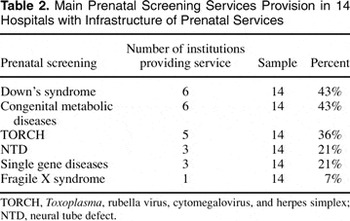
Main Prenatal Screening Services Provision in 14 Hospitals with Infrastructure of Prenatal Services
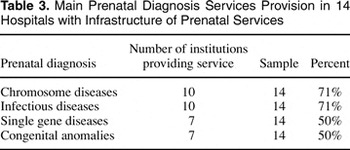
Main Prenatal Diagnosis Services Provision in 14 Hospitals with Infrastructure of Prenatal Services

Pregnant Women Accepted Information Informed by the Doctor (%) in 14 Hospitals with Infrastructure of Prenatal Services in A, B, C, and D Provinces
 You have
Access
- 10
- Cited by