1. Introduction
Commercially available manufacturing serial robots with multiple manipulators have indeed been effectively accepted and further improved in accurate automation processes for a wide range of application areas during the last few decades. Their relatively lower cost in comparison to specialist surgical robots has sparked greater interest in medicinal uses [Reference Zhou, Yu, Huang, Mahov, Eslami, Maier, Lohmann, Navab, Zapp, Knoll and Nasseri1, Reference Chen, Jiang, Cheng, Knoll and Zhou2], especially in minimally invasive surgery (MIS) procedures. A tiny incision inside the abdominal wall is required for these operations to facilitate the insertion of a medical instrument. A robotic application of these procedures offers the possibility of improved surgical tool control and precision while lowering patient trauma [Reference Okamura3]. The minor incision places a limitation upon the inserted robot end effector referred to as the remote center of motion (RCM) constraint [Reference Su, Hu, Karimi, Knoll, Ferrigno and De Momi4]. While a mechanical implementation is typically deemed safer, it needs bulky, costly structures plus calibration processes, a programmable RCM regulating motion by the control algorithm is less costly and more versatile, making it a better alternative [Reference Su, Qi, Schmirander, Ovur, Cai and Xiong5, Reference Su, Mariani, Ovur, Menciassi, Ferrigno and De Momi6]. It is true that more than the surgical scenario, many industrial applications involve the RCM. For example, a safety region convolutional neural network (CNN) method adapted with the RCM method was implemented on Baxter robot, a seven-degrees of freedom redundant manipulator, demonstrating the feasibility of RCM control in industrial area [Reference Guo, Su and Yang7].
Although many works have been performed and implemented to maintain the movement constraints, few works have considered a moving RCM constraint, presenting the challenge with dynamic kinematic and dynamic disturbance. Since the moving RCM forges a dynamic kinematic obstacle, it is uncomplicated to make the robotic tool contact and interact with the hole, which delivers a dynamic interaction. This makes it unlike a fixed RCM and becomes an additional complex issue. Additionally, for safer robot operation, the moving RCM constraint must be preserved. Ortmaier et al. employed the inverse kinematic control to prevent any force exerted on the RCM constraint [Reference Ortmaier and Hirzinger8]. In ref. [Reference From9], a general kinematic formalisation in joint space to address the RCM constraint was offered. A new control architecture was put forward by Sandoval [Reference Ortmaier and Hirzinger8] for redundant robots to tackle fixed RCM constraints with Cartesian admittance control [Reference Sandoval, Poisson and Vieyres10] without taking into account the movement of the RCM. But nearly all of these works consider only fixed movement constraints.
In recent years, more attention has been drawn to neural learning improved adaptive control methods [Reference Ge, Hang, Lee and Zhang11–Reference Zhang, Liu, Xu, Yu and Chen13]. The nonlinear kinematic terms were compensated by integrating a smooth function in refs. [Reference Wen, Zhou, Liu and Su14, Reference Zhang, Jiang, Lu and Xu15]. In ref. [Reference He, Dong and Sun16], an adaptive neural resistance control technique was developed for a
 $n$
-link robotic manipulator with kinematic constraints. A supplementary system was added to the controller architecture to address the effect of the above limits.
In this work, a neural-learning boosted Cartesian admitting control system that relies on the neural approximation is suggested to improve end effector accuracy while still obeying the active RCM requirement. This paper’s control framework includes:
-
1. A Cartesian admittance control is used in robotic devices to produce compliant behaviour while considering environmental dynamics in Cartesian space.
-
2. A decoupled controller is employed to maintain the RCM constraints on its kinematic level.
-
3. An adaptive controller compensates for the uncertainty in the robotic system caused by the shifting RCM restrictions.
Different from the previous works, this work considers a moving movement constraint and conducts a demonstration and analysis to check its feasibility to use an adaptive approximation to compensate for the disturbances generated by uncertain RCM point movement.
The rest of this manuscript is structured as follows. Section 2 contains the research problem and preliminary information. Section 3 discusses control creation with neural networks in the context of moving RCM limitations. Finally, in Section 4, the experimental data are displayed, and in Section 5, the conclusions are formed.
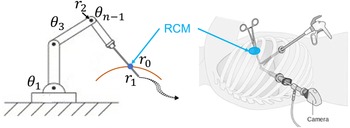
Remote center of motion in medical application.

1.1. Problem statement and preliminaries
1.2. Moving RCM constraints
1.2.1. Kinematics analysis
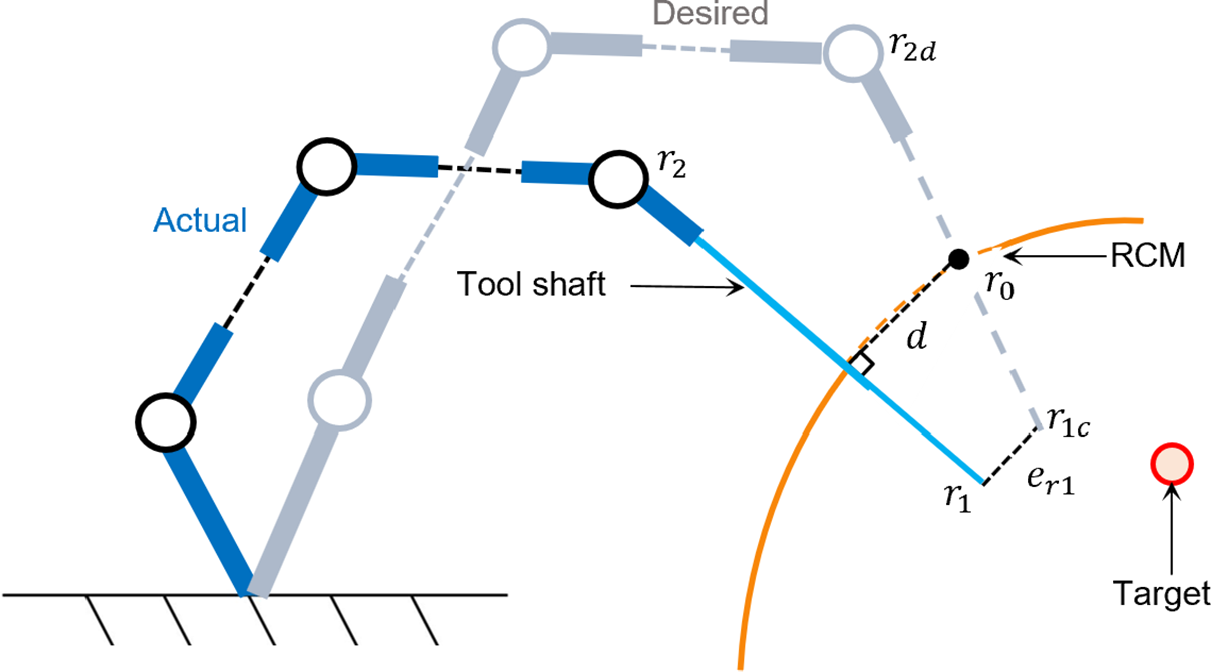
To track the trajectory from the actual Cartesian position to the target position during the robot manipulation, as shown in Fig. 1, the end effector must go through the small incision
 $\boldsymbol{P}$
on the obstacle wall, representing the RCM constraint, where
 $\boldsymbol{r}_{0}$
is the RCM position,
 $\boldsymbol{r}_{1}$
is the actual Cartesian position, and
 $\boldsymbol{r}_{2}$
is the actual position of the position of joint
 $\theta _{n-1}$
. To respect the RCM constraint,
 $\boldsymbol{r}_{0}$
should always be on a straight line from the tooltip’s position,
 $\boldsymbol{r}_{1}$
, to the position of the joint holding the tool,
 $\boldsymbol{r}_{2}$
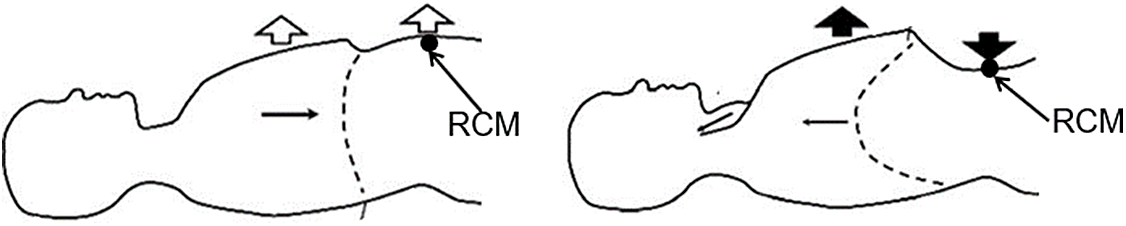
. In most previous works, no movement was applied to this point has been frequently assumed to simplify the complexity of the application. However, for an actual clinical operation, the patient’s abdominal wall may not be fixed due to breathing or heart beating, as it is shown in Fig. 2. The relation can be derived as
 \begin{equation} \!\left(\boldsymbol{r}_{0}-\boldsymbol{r}_{1}\right)\times \left(\boldsymbol{r}_{2}-\boldsymbol{r}_{1}\right)=0 \end{equation}
Moving remote center of motion due to breathing.

Assumption 2.1: The RCM constraint position
 $\boldsymbol{r}_{0}\in R^{3}$
is known or can be detected with optical tracking.
Consider an n-degrees-of-freedom manipulator, the projection from its joint space to the Cartesian coordinate
 $\boldsymbol{r}_{1}\in R^{m}$
of its end effector is characterised by the following nonlinear function:
 \begin{equation} \begin{array}{c} \boldsymbol{r}_{1}=f_{1}(\boldsymbol{\theta })\\ \boldsymbol{r}_{2}=f_{2}(\boldsymbol{\theta }) \end{array} \end{equation}
where
 $\theta \in R^{n}$
can be seen as the joint angle vector. The nonlinear function
 $f_{1}(.)$
and
 $f_{2}(.)$
for serial manipulators can be obtained through a systematic method known as the D-H convention. For excessive manipulators,
 $n\gt m$
. Straightforwardly, computing the time derivatives on both sides of (1) yields
 \begin{equation} \begin{array}{c} \dot{\boldsymbol{r}}_{1}=J_{1}\!\left({\theta }\right)\!\boldsymbol\omega \\ \dot{\boldsymbol{r}}_{2}=J_{2}\!\left({\theta }\right)\!\boldsymbol\omega \end{array} \end{equation}
where
 $\dot{\boldsymbol{r}}_{1}=\boldsymbol{d}\boldsymbol{r}_{1}/\boldsymbol{d}t, \dot{\boldsymbol{r}}_{2}=\boldsymbol{d}\boldsymbol{r}_{2}/\boldsymbol{d}t, J_{1}(\boldsymbol{\theta })=\partial f_{1}(\boldsymbol{\theta })/\partial \boldsymbol{\theta }, J_{2}(\boldsymbol{\theta })=\partial f_{2}(\boldsymbol{\theta })/\partial \boldsymbol{\theta }$
, and
 $\omega =\dot{\boldsymbol{\theta }}=\mathrm{d}\boldsymbol{\theta }/\mathrm{d}t$
.
1.2.2. Dynamic modelling
 $\boldsymbol{F}_\boldsymbol{e}$
is the outside force created through the physical contact [Reference Chen, Chen, Wang, Yang, Ma, Leng and Fu17, Reference Chen, Zhang, Liu, Leng and Fu18] of the RCM constraint and the robot tool shaft, which maybe be modelled using a mass-damping-spring model:
 \begin{equation} \boldsymbol{M}_{\boldsymbol{P}}\ddot{\boldsymbol{P}}+\boldsymbol{H}_{\boldsymbol{P}}\!\left(\boldsymbol{P},\dot{\boldsymbol{P}}\right)\!\dot{\boldsymbol{P}}+\boldsymbol{G}_{\boldsymbol{P}}\!\left(\boldsymbol{P}\right) = \boldsymbol{F}_\boldsymbol{e} \end{equation}
where
 $\boldsymbol{M}_{\boldsymbol{P}},\boldsymbol{H}_{\boldsymbol{P}},\boldsymbol{G}_{\boldsymbol{P}}$
are the inertia, damping and stiffness matrices of the obstacle wall around the RCM constraint,
 $\boldsymbol{F}_\boldsymbol{e}\in R^{3}$
is the outside force from the physical contact, and
 $\boldsymbol{P}$
is the actual contact point between the surgical tool shaft and the obstacle.
 $\boldsymbol{F}_\boldsymbol{e}$
can be decomposed into two components
 $\boldsymbol{F}_\boldsymbol{eX}\in R^{3}$
and
 $\boldsymbol{F}_\boldsymbol{eN}\in R^{3}$
[Reference Ott19], where
 $\boldsymbol{F}_\boldsymbol{eX}$
is the projected outside force on the tooltip in the task space, and
 $\boldsymbol{F}_\boldsymbol{eN}$
is the external force acting on the corresponding null space of the tooltip.
Assumption 2.2: The time-varying external force
 $\boldsymbol{F}_\boldsymbol{e}\boldsymbol{(}\boldsymbol{t}\boldsymbol{)}\in R^{3}$
from physical interaction between the robot tool shaft and the obstacle wall is continuous in terms of time and constrained by a constant
 $\beta$
as follows:
 \begin{equation} \exists \beta \in R,\parallel \boldsymbol{F}_\boldsymbol{e}\mathbf{(}\boldsymbol{t}\mathbf{)}\parallel \leq \beta,\forall t\geq 0 \end{equation}
1.3. Robot modelling
The dynamic model of the
 $n$
degrees of freedom (DoFs) serial manipulator in the Lagrangian formulation can be expressed as [Reference Yang, Wang, Cheng and Ma20]
 \begin{equation} \boldsymbol{M}\!\left(\boldsymbol{\theta }\right)\ddot{\boldsymbol{\theta }}+\boldsymbol{C}\!\left(\boldsymbol{\theta }\mathbf{,}\dot{\boldsymbol{\theta }}\right)\dot{\boldsymbol{\theta }}+\boldsymbol{g}\!\left(\boldsymbol{\theta }\right)-{{\boldsymbol\tau}}_{\mathbf{e}} = \boldsymbol{\tau}_{\mathbf{C}} \end{equation}
where
 $\theta \in R^{n}$
is the joint vector,
 $\boldsymbol{M}\mathbf{(}\boldsymbol{\theta }\mathbf{)}\in R^{n\times n}$
is the positive definite, symmetric and bounded inertia matrix in the robot joint space,
 $\boldsymbol{C}\mathbf{(}\boldsymbol{\theta }\mathbf{,}\dot{\boldsymbol{\theta }}\mathbf{)}\in R^{n\times n}$
is a matrix which represents the effects for Coriolis and centrifugal and
 $\boldsymbol{g}\mathbf{(}\boldsymbol{\theta }\mathbf{)}\in R^{n}$
is the vector for gravity torques. The torque vectors
 ${\boldsymbol\tau} _\boldsymbol{C}\in R^{n}$
and
 ${\boldsymbol\tau} _{\mathbf{e}}\in R^{n}$
, respectively, symbol the control torques [Reference Li, Deng and Zhao21] and the outside disturbance torque vectors [Reference Li, Xu, Wei, Shi and Su22, Reference Li, Zhao, Zhang, Wu, Zhang, Li, Li and Su23]. For simplicity, it is presumed that the surgical robotic system is different from any pseudoinverse and singularity of the Jacobian matrix,
 $\boldsymbol{J}_{{\textbf{1}}}\mathbf{(}\boldsymbol{\theta }\mathbf{)}\in R^{m\times n}$
, in existence.
Since for Cartesian admittance control, the task space expresses the expected behaviour of the serial robot, and the generalised formulation can be written as [Reference Ott19, Reference Khatib24, Reference Albu-Schaffer, Ott, Frese and Hirzinger25]

where
 $\boldsymbol{r}=\boldsymbol{r}_{1}\in R^{m}$
is the vector of the task space coordinates,
 \begin{equation} \boldsymbol{M}_{\boldsymbol{r}}\mathbf{(}\boldsymbol{r}\mathbf{)} = \boldsymbol{J}_{\mathbf{1}}^{-{{\boldsymbol{T}}}}\boldsymbol{M}\mathbf{(}\boldsymbol{\theta }\mathbf{)}\boldsymbol{J}_{\mathbf{1}}^{-\mathbf{1}}, \end{equation}

 \begin{equation} \boldsymbol{F}_\boldsymbol{eT} = \boldsymbol{J}^{-\mathbf{T}}{\boldsymbol\tau} _{\mathbf{e}}. \end{equation}
The matrix
 $\boldsymbol{M}_{\boldsymbol{r}}\mathbf{(}\boldsymbol{r}\mathbf{)}\in R^{m\times m}$
is the Cartesian inertia matrix,
 $\boldsymbol{H}_{\boldsymbol{r}}\mathbf{(}\boldsymbol{r}\mathbf{,}\dot{\boldsymbol{r}}\mathbf{)}\in R^{m\times m}$
is the Coriolis and centrifugal force effects in the task space and
 $\boldsymbol{F}_\boldsymbol{eT}\in R^{m}$
is the external force in the task space, which is bounded by
 $\beta$
.
 \begin{equation} \exists \beta \in R,\parallel \boldsymbol{F}_\boldsymbol{eT}\parallel \leq \beta,\forall t\geq 0 \end{equation}
Property 2.1: The Cartesian inertia matrix,
 $\boldsymbol{M}_{\boldsymbol{r}}\boldsymbol{(}\boldsymbol{r}\boldsymbol{)}$
, as defined in (8), positive and symmetric, and it is also bounded as
 \begin{equation} \lambda _{1}\!\parallel \boldsymbol{A}\parallel \leq \boldsymbol{A}^\boldsymbol{T}\boldsymbol{M}_{\boldsymbol{r}}\boldsymbol{(}\boldsymbol{r}\boldsymbol{)}\boldsymbol{A}\leq \lambda _{2}\parallel \boldsymbol{A}\parallel,\forall \boldsymbol{A},\boldsymbol{r}\in R^{m} \end{equation}
where
 $\lambda _{1}$
and
 $\lambda _{2}$
are positive constants, and
 $\boldsymbol{A}$
is assumed as non-singular matrix.
Property 2.2: The Cartesian matrix,
 $\boldsymbol{H}_{\boldsymbol{r}}\boldsymbol{(}\boldsymbol{r},\dot{\boldsymbol{r}}\boldsymbol{)}$
, and the time derivative of the Cartesian inertia matrix,
 $\boldsymbol{M}_{\boldsymbol{r}}\boldsymbol{(}\boldsymbol{r}\boldsymbol{)}$
, fulfill the criterion:
 \begin{equation} \boldsymbol{A}^\boldsymbol{T}\left[\dot{\boldsymbol{M}}_{\boldsymbol{r}}\!\left(\boldsymbol{r}\right)-2\boldsymbol{H}_{\boldsymbol{r}}\!\left(\boldsymbol{r},\dot{\boldsymbol{r}}\right)\right]\boldsymbol{A}=0,\forall \boldsymbol{A},\boldsymbol\theta,\dot{\boldsymbol\theta }\in R^{n} \end{equation}
where
 $\boldsymbol{A}$
is assumed as a non-singular matrix.
1.4. Cartesian admittance control
In some applications in which the objective is to control the end effector to follow a path in free-space, position control methods are appropriate. Nevertheless, in some instances with a rigid interaction between the environment and the end effector, a large force will be generated and compromise the safety of the operation. This could be avoided by putting in place a compliant controller on the robot. Among the most commonly used compliant control approaches, Cartesian admittance control is an efficient mechanical admittance method [Reference Shuzhi, Hang and Woon26], featuring damping, stiffness and mass terms:
 \begin{equation} \boldsymbol{F}_{ext}=\boldsymbol{M}_{d}\ddot{\boldsymbol{r}}_{e}+\boldsymbol{D}_{d}\dot{\boldsymbol{r}}_{e}+\boldsymbol{K}_{d}\boldsymbol{r}_{e} \end{equation}
where
 $\boldsymbol{r}_{e}=\boldsymbol{r}_{1c}-\boldsymbol{r}_{1d}, \boldsymbol{M}_{d}, \boldsymbol{D}_{d}$
and
 $\boldsymbol{K}_{d}$
are the symmetric and positive definite matrices of the desired inertia, damping and stiffness, respectively.
 $\boldsymbol{r}_{1d}\in R^{m}$
is the desired trajectory, and
 $\boldsymbol{r}_{1c}\in R^{m}$
is the desired trajectory determined by the external force
 $\boldsymbol{F}_{ext}$
on the end effector. It can be seen that
 $\boldsymbol{r}_{1c}=\boldsymbol{r}_{1d}$
when there is no external interaction on the end effector, that is,
 $\boldsymbol{F}_{ext}=0$
. Meanwhile, when
 $\boldsymbol{F}_{ext}\neq 0$
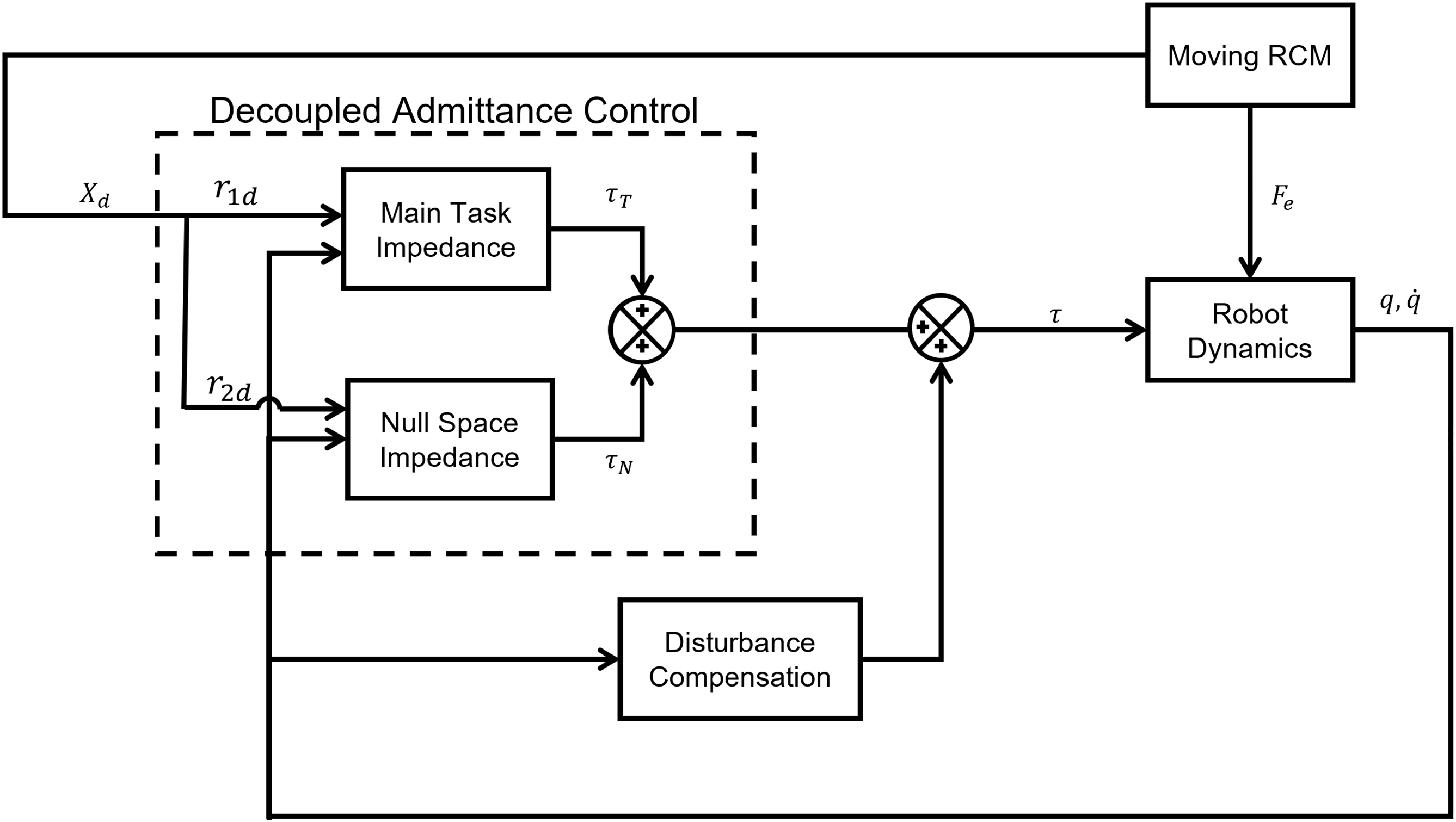
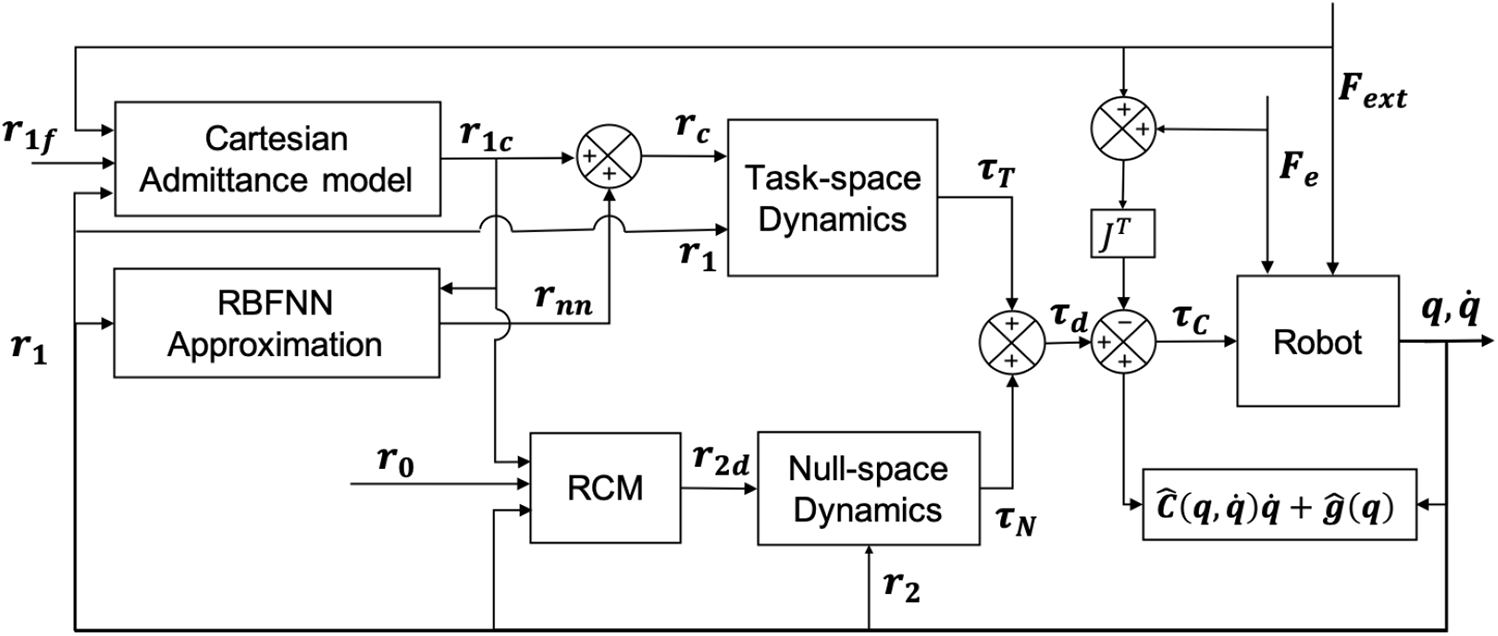
indicates external interaction on the end effector, the desired trajectory will be modified as a new trajectory that can be seen as the adaptation relation between the external force and the target admittance model in [Reference Buerger and Hogan27]. As it is shown in Fig. 3, the proposed framework is constructed with a decoupled control and adaptive approximation layer.
The proposed control architecture.

1.5. Null-space projection and decoupling control
By specifying the joint angular velocity in the joint space and the end effector velocity in the workspace:
 \begin{equation} \dot{\boldsymbol{r}}_{\mathbf{1}}=\boldsymbol{J}_{\mathbf{1}}\!\left(\boldsymbol{\theta }\right)\dot{\boldsymbol{\theta }} \end{equation}
where
 $\dot{\boldsymbol{r}}_{\mathbf{1}}\in R^{3}$
is the real Cartesian velocity for the end effector, and
 $\boldsymbol{J}\mathbf{(}\boldsymbol{\theta }\mathbf{)}\in R^{3\times n}$
is the Jacobian matrix from the base to the end effector. To drive the end effector (
 $\boldsymbol{r}_{\mathbf{1}}\in R^{3}$
) to reach the desired position (
 $\boldsymbol{r}_{{\textbf{1}}\boldsymbol{d}}\in R^{3}$
), the task control torque,
 ${\boldsymbol\tau} _{\mathbf{T}}$
, can be defined as
 \begin{equation} \boldsymbol\tau _\boldsymbol{T} = \boldsymbol{J}_{\mathbf{1}}^\boldsymbol{T}\!\left(\boldsymbol{K}_{\boldsymbol{r}{\textbf{1}}}\tilde{\boldsymbol{r}}_{\mathbf{1}}-\boldsymbol{D}_{\boldsymbol{r}{\textbf{1}}}\dot{\boldsymbol{r}}_{{\textbf{1}}}\right) \end{equation}
where
 $\boldsymbol{J}\mathbf{(}\boldsymbol{\theta }\mathbf{)}\in R^{3\times n}$
is the Jacobian matrix from the base to the end effector,
 $\tilde{\boldsymbol{r}}_{\mathbf{1}} = \boldsymbol{r}_{{\textbf{1}}\boldsymbol{d}}-\boldsymbol{r}_{\mathbf{1}}\mathbf{(}\boldsymbol{\theta }\mathbf{)}\in R^{3\times n}, \boldsymbol{K}_{\boldsymbol{r}{\textbf{1}}}\in R^{3\times 3}$
is the diagonal stiffness matrix and
 $\boldsymbol{D}_{\boldsymbol{r}{\textbf{1}}}\in R^{3\times 3}$
is the diagonal damping matrix.
Because the number of the degrees of freedom is larger than three, the redundant serial robot can be employed to complete additional tasks by the null-space controller (
 ${\boldsymbol\tau} _\boldsymbol{N}\in R^{n}$
), which can be specified as

where
 ${\boldsymbol\tau} _{{\boldsymbol{T}}_{\mathbf{2}}}\in R^{n-3}$
serves as the torque to complete the additional assignment with redundant degrees,
 $\boldsymbol{J}\mathbf{(}\boldsymbol{\theta }{\mathbf{)}}_{\boldsymbol{M}}^{+}$
is the inertia-weighted pseudoinverse matrix [Reference Khatib24] defined as
 \begin{equation} \boldsymbol{J}\mathbf{(}\boldsymbol{\theta }{\mathbf{)}}_{\boldsymbol{M}}^{+} = \mathbf{(}\boldsymbol{J}_{\mathbf{1}}\mathbf{(}\boldsymbol{\theta }\mathbf{)}\boldsymbol{M}\mathbf{(}\boldsymbol{\theta }\mathbf{)}^{-\mathbf{1}}\boldsymbol{J}_{\mathbf{1}}\mathbf{(}\boldsymbol{\theta }\mathbf{)}^\boldsymbol{T}\mathbf{)}^{-\mathbf{1}}\boldsymbol{J}_{\mathbf{1}}\mathbf{(}\boldsymbol{\theta }\mathbf{)}\boldsymbol{M}\mathbf{(}\boldsymbol{\theta }\mathbf{)}^{-\mathbf{1}} \end{equation}
1.6. Adaptive neural approximation
The neural approximation has been well known to be adopted for the approximation of the uncertain disturbances [Reference Zhang, Li and Yang28], and here introduces a kind of feedforward neural web which is constructed with three general layers, that is, the hidden layer, the input layer and the output layer. Regarding the minimum MSE, it attains a globally optimised solution to the adjustable weights. The inputs variables (
 $Z_{1},\ldots Z_{m}$
) are distributed from the input layer to the hidden layer. The hidden layer consists of
 $N$
neurons, and each neuron computes the Euclidean distance between the inputs and the centres. Every neuron from the hidden layer employs a radial basis function
 ${\xi}$
as its nonlinear activation function. In this paper [Reference Yang, Wang, Cheng and Ma20], the Gaussian function is depicted as the most commonly used activation function in the RBFNN algorithm. The hidden layer conducts a nonlinear transform of the input, the output layer serves as a mixture of the weighted hidden layer outputs that calculates the approximated output variable (
 $y_{1},\ldots,y_{j}$
). The output of RBFNN (
 $y_{1},\ldots,y_{j}$
) is computed as
 \begin{equation} y_{i}=\sum\limits_{k=1}^{N}\omega _{ki}{\xi} _{i},\,\,\,\,\,\,i=1,2,\ldots,j \end{equation}
where
 $y_{i}$
is the
 $i$
th output,
 $\omega _{ki}$
is the connection weight from the
 $k$
th hidden unit to the
 $i$
th output unit and
 $j$
is the dimension of the outputs.
The approximation is employed in this study to correct for the Cartesian position mistake. As a result, the input
 $Z$
is picked with the Cartesian position
 $\boldsymbol{r}$
. The uncertain disturbance
 $\boldsymbol{\Xi }\mathbf{(}\boldsymbol{r}\mathbf{,}\dot{\boldsymbol{r}}\mathbf{)}$
is represented as
 \begin{equation} \boldsymbol{\Xi }\!\left(\boldsymbol{r}\mathbf{,}\dot{\boldsymbol{r}}\right) = \boldsymbol{\Omega }\cdot \boldsymbol{\xi} \!\left(\boldsymbol{r}\mathbf{,}\dot{\boldsymbol{r}}\right)+\varepsilon \end{equation}
where
 $\varepsilon$
is the smallest approximation error of RBFNN algorithm,
 $\boldsymbol{\Omega }=[\omega _{1},\omega _{2},\ldots,\omega _{l}]^{T}$
is the best constant weight matrix of neural web,
 $l$
is the number of nodes used in neural networks and
 $\boldsymbol\xi \mathbf{(}\boldsymbol{r}\mathbf{,}\dot{\boldsymbol{r}}\mathbf{)}=[{\xi} _{1},{\xi} _{2},\ldots,{\xi} _{l}]$
is Gaussian function matrix. According to the RBFNN approximation theory, the approximation error has an upper bound
 $\varepsilon ^{*}$
, i.e.
 $| \varepsilon | \leq \varepsilon ^{*}$
, with a positive constant
 $\varepsilon ^{*}\gt 0$
.
The Gaussian function matrix employed in the RBFNN algorithm is specified as below:
 \begin{equation} {\xi} _{i}\!\left(Z\right)=\exp \left[\frac{-(Z-c_{i})^{T}(Z-c_{i})}{{b}_{i}^{2}}\right] \end{equation}
Whereas
 $c_{i}$
is the central point of receptive field,
 $b_{i}$
appears as the width of the Gaussian function. In accordance with the rule of approximation, a positive constant
 $\delta$
such that
 $\parallel {\xi} (Z)\parallel \leq \delta$
with
 $\delta \gt 0$
exists.
The adaptive neural web update law [Reference Zhang, Li and Yang28] is presented to modify the weights of neural network as:
 \begin{equation} \dot{\boldsymbol{\Omega }} = \boldsymbol\gamma \!\left[\boldsymbol{E}\boldsymbol\xi ^\boldsymbol{T}\!\left(\boldsymbol{r}\mathbf{,}\dot{\boldsymbol{r}}\right)+\boldsymbol{\varsigma }\boldsymbol{\Omega }\right] \end{equation}
where
 $\boldsymbol\gamma$
is a diagonal positive definite constant matrix that determines the update pace,
 $\boldsymbol{E}$
is the error vector and
 $\boldsymbol\varsigma$
is a neural network momentum factor matrix that can boost both training speed and accuracy accuracy and training speed.
2. Control development and stability analysis
In this part, the neural-learning improved admittance control method with RCM constraints has been developed, as displayed in Fig. 4. Given the required Cartesian location, the end effector of the robot should attain
 $\boldsymbol{r}_{{\textbf{1}}\boldsymbol{d}}$
without breaching the RCM constraints. The desired trajectory is adapted to the interaction on the end effector, while the external interaction force on the RCM constraints should not influence the desired trajectory and its accuracy. The RCM constraint interaction, shown in Fig. 1, is regarded as the disturbance of the system which is compensated by neural network adaption.
Robots control with RCM constraints.

2.1. Remote center of motion
In order for the end effector position from the master (
 $\boldsymbol{r}_{\mathbf{1}}\in R^{3}$
) to reach the desired position (
 ), an interpolation approach is formulated so to move towards the wanted location smoothly as [Reference Su, Mariani, Ovur, Menciassi, Ferrigno and De Momi6]

where
 $k_{0}\gt 0$
serves as a positive coefficient. On the basis of the
 $\boldsymbol{r}_{{\textbf{1}}\boldsymbol{d}}$
, we can get the wanted input
 from the model of admittance control (14).
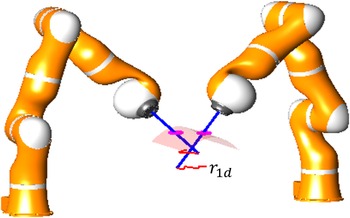
Achieving active RCM constraint with a serial robot.

In accordance with the scene in Fig. 5 with a serial robot,
 $d$
is the distance between the tool (for a better understanding, the RCM constraint is increased in size.) and the RCM point (
 $\boldsymbol{r}_{\mathbf{0}}$
). The tooltip position
 $\boldsymbol{r}_{\mathbf{1}}$
has been controlled to trace the objective
 $\boldsymbol{r}_{{\textbf{1}}\boldsymbol{d}}$
in the patient’s abdomen. The value
 $\boldsymbol{v}_{\mathbf{2}}$
represents the velocity for moving the wrist out of its current location
 $\boldsymbol{r}_{\mathbf{2}}$
to its expected position
 $\boldsymbol{r}_{{\textbf{2}}\boldsymbol{d}}$
, where the tool shaft traverses the RCM point
 $\boldsymbol{r}_{\mathbf{0}}$
. Thus, the wanted wrist position
 $\boldsymbol{r}_{\mathbf{2}\mathbf{d}}$
can be acquired from (1):
 \begin{equation} \boldsymbol{r}_{{\textbf{2}}\boldsymbol{d}}=\boldsymbol{r}_{{\textbf{1}}\boldsymbol{d}}+\frac{\boldsymbol{r}_{\mathbf{0}}-\boldsymbol{r}_{{\textbf{1}}\boldsymbol{d}}}{\parallel \boldsymbol{r}_{\mathbf{0}}-\boldsymbol{r}_{{\textbf{1}}\boldsymbol{d}}\parallel }\parallel \boldsymbol{r}_{\mathbf{2}}-\boldsymbol{r}_{\mathbf{1}}\parallel \end{equation}
The whole control framework is shown in Fig. 6. Different from the previous studies, considering the disturbance from the moving RCM, a neural approximation scheme is utilised in the control loop to manage the disruption in the kinematic level, and a Cartesian Admittance control is employed to achieve compliant interaction.
The overview of the control scheme.

2.2. Controller development
In this part, we create a controller to trace the wanted trajectory with RCM constraints. Firstly, we define a reference trajectory in the Cartesian space and an RCM constraint trajectory which is moving
 $\boldsymbol{r}_{\mathbf{0}}$
in the workspace of the robot. Then we define the related error signals, shown in Fig. 5, as follows:
 \begin{align} \boldsymbol{e}_{r1} & =\boldsymbol{r}_{1c}-\boldsymbol{r}_{1} \nonumber \\ \boldsymbol{e}_{r2} & =\boldsymbol{r}_{2d}-\boldsymbol{r}_{2}\\ d & =\parallel \!\left(\boldsymbol{r}_{0}-\boldsymbol{r}_{\mathbf{1}}\right)\times \frac{\boldsymbol{r}_{\mathbf{2}}-\boldsymbol{r}_{\mathbf{1}}}{\parallel \boldsymbol{r}_{\mathbf{2}}-\boldsymbol{r}_{\mathbf{1}}\parallel }\parallel \nonumber \end{align}
According to the decoupled control strategy [Reference Ott19], the optimal torque control,
 ${\boldsymbol\tau }_\boldsymbol{C}^{\mathbf{*}}$
, can be defined as
 \begin{equation} {\boldsymbol\tau }_{\boldsymbol{C}}^{\mathbf{*}}=\boldsymbol\tau _\boldsymbol{dynamics}+\boldsymbol\tau _\boldsymbol{T}+{\boldsymbol\tau} _\boldsymbol{N}+\boldsymbol\vartheta +\boldsymbol\tau _\boldsymbol{e} \end{equation}
 \begin{equation} {\boldsymbol\tau} _\boldsymbol{dynamics}=\hat{\boldsymbol{C}}\!\left(\boldsymbol{q}\mathbf{,}\dot{\boldsymbol{q}}\right)\dot{\boldsymbol{q}}+\hat{\boldsymbol{g}}\!\left(\boldsymbol{q}\right) \end{equation}


where
 ${\boldsymbol \tau} _{{\boldsymbol{dynamics}}}$
is the robot dynamic torque computed inside the robot motion kernel [Reference Schreiber, Stemmer and Bischoff29],
 $\hat{\boldsymbol{C}}\boldsymbol{(}\boldsymbol{q},\dot{\boldsymbol{q}}\boldsymbol{)}$
and
 $\hat{\boldsymbol{g}}\boldsymbol{(}\boldsymbol{q}\boldsymbol{)}$
are the estimated inertia matrix, Coriolis and Centrifugal effects and gravity term in the joint space, respectively [Reference Schreiber, Stemmer and Bischoff29].
 $\boldsymbol\vartheta$
is the estimation error of the
 is the task space control input,
 ${\boldsymbol\tau} _{e}$
is the outside torque in the robot combined space.
 $\boldsymbol{K}_{\mathbf{1}}$
is the stiffness matrix in the Cartesian space and
 $\boldsymbol{D}_{\mathbf{1}}$
is the damping matrix in the Cartesian space.
 $\boldsymbol{K}_{\mathbf{2}}$
is the stiffness matrix for the wrist position control, and
 $\boldsymbol{D}_{\mathbf{2}}$
is its damping matrix.
According to the control aim, the reference trajectory should be only modified by external forces
 $\boldsymbol{F}_\boldsymbol{ext}$
on the end effector in (14), and not be influenced by the force on the tool shaft
 $\boldsymbol{F}_\boldsymbol{e}$
. Since
 $\boldsymbol{F}_\boldsymbol{ext}$
has been considered in the design of the Cartesian admittance control model, the uncertain terms in (26), which represent the disturbances from external force
 $\boldsymbol{F}_\boldsymbol{e}$
and gravity compensation error, are compensated by the adaptive approximation of artificial neural networks. Instead of approximating the disturbances in the joint space, we propose to estimate the disturbance in the Cartesian space and introduce an adaptive term
 $\boldsymbol{r}_\boldsymbol{nn}$
. Given the desired trajectory
 $\boldsymbol{r}_{{\textbf{1}}{{\boldsymbol{c}}}}$
from the Cartesian admittance control model, there is an error between the actual position
 $\boldsymbol{r}_{\mathbf{1}}$
and the desired position
 due to the external force
 $\boldsymbol{F}_\boldsymbol{e}$
on the tool shaft.
The neural network approximation gives:
 \begin{equation} \hat{\boldsymbol{r}}_{{{\boldsymbol{nn}}}} = \boldsymbol{\Omega }\cdot \boldsymbol\xi \!\left(\boldsymbol{r}_{\mathbf{1}}\mathbf{,}\dot{\boldsymbol{r}}_{\mathbf{1}}\right) \end{equation}
The updating law
 $\boldsymbol{\Omega }$
of RBFNN is
 \begin{equation} \dot{\boldsymbol{\Omega }} = \gamma \!\left[\boldsymbol{e}_{\boldsymbol{r}\mathbf{1}}{\boldsymbol\xi} ^\boldsymbol{T}\!\left(\boldsymbol{r}_{\mathbf{1}}\mathbf{,}\dot{\boldsymbol{r}}_{\mathbf{1}}\right)+\boldsymbol{\varsigma }\boldsymbol{\Omega }\right] \end{equation}
where
 $\boldsymbol\gamma$
is a diagonal positive definite constant matrix that determines update speed,
 $\boldsymbol{e}_{{\boldsymbol{r}_{\mathbf{1}}}}$
is the error vector and
 $\boldsymbol\varsigma$
is the neural network momentum factor matrix, which is able to boast both accuracy and training speed.
The final control optimal term is
 \begin{equation} {{\boldsymbol\tau} }_{\boldsymbol{C}}^{\mathbf{*}}={\boldsymbol\tau} _{\boldsymbol{dynamics}}+{{\boldsymbol\tau} }_\boldsymbol{T}^{\mathbf{*}}+{\boldsymbol\tau} _\boldsymbol{N} \end{equation}

where
 $\boldsymbol{r}_\boldsymbol{c} = \boldsymbol{r}_{\mathbf{1}{{\boldsymbol{c}}}}+\boldsymbol{r}_{{{\boldsymbol{nn}}}}$
is the adapted input in the task space.
3. Experimental demonstration
The control was validated by using a KUKA robot, tracking various trajectories using the developed controller defined in (32) with the comparison of the controller developed in ref. [Reference Sandoval, Poisson and Vieyres10]. A straight tool with the length
 $\textit{l} = 0.22\, {\rm m}$
is attached to the robot manipulator. The RCM was set to move in a sinusoidal way, and the RBFNN was introduced to compensate for this uncertain disturbance due to the RCM constraints.
A 7-DOF KUKA LWR4+ robot was controlled to track the desired trajectory. The end effector was utilised to track various trajectories starting from a non-singular home Cartesian location of the end effector
 $\boldsymbol{r}_{1f,0}$
to a final point
 $\boldsymbol{r}_{1f,n}$
in the robot workspace. Initially, a fixed RCM was established to validate the decoupled control strategy and then a moving RCM was used to validate and compare the developed neural-enhancing controller and the controller developed in [Reference Sandoval, Poisson and Vieyres10].
3.0.1. Test of fixed RCM constraints
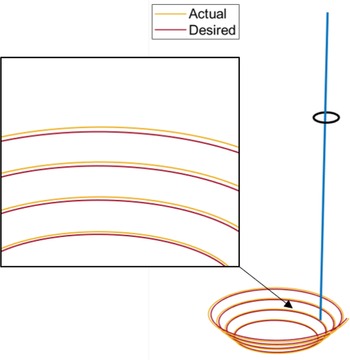
Firstly, the experimental setup was tested with fixed RCM constraints and various reference trajectories in its workspace. One of the experiments was shown in Fig. 7 with a helix trajectory.
 $\boldsymbol{r}_{1f,0}=[\!-\!0.2285,0.4835,0.2095]\enspace \mathrm{m}$
and
 $\boldsymbol{r}_{1f}=\boldsymbol{r}_{1f,0}+[(0.025+0.02t)\cos\!(8\pi t),(0.025+0.02t)\sin\!(8\pi t),0.02t]\enspace \mathrm{m}$
. A fixed RCM constraint point was chosen as
 $\boldsymbol{r}_{0}=[\!-\!0.2285,0.4835,0.2095]\enspace \mathrm{m}$
. The control parameters were chosen as:
 $k_{0}=0.1, \boldsymbol{K}_{\mathbf{1}}=diag[3000,3000,3000], \boldsymbol{D}_{\mathbf{1}}=diag[30,30,30], \boldsymbol{K}_{\mathbf{2}}=diag[300,300,300]$
, and
 $\boldsymbol{D}_{\mathbf{2}}=diag[3.5,3.5,3.5]$
.
Fixed RCM constraint without neural learning. The desired helix trajectory and the actual trajectory are shown.

As shown in Fig. 7, the robot tool shaft needed to go through the RCM constraint point at all times during the trajectory tracking of the end effector. The 3-D tracking trajectory was magnified to highlight the tracking error.
3.0.2. Test of moving RCM constraints
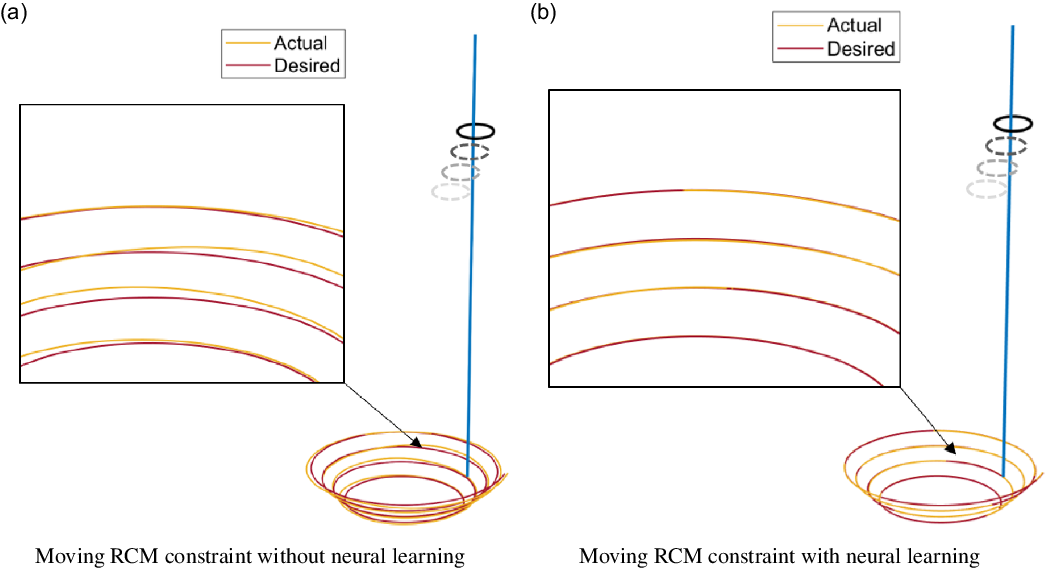
Subsequently, the experimental setup was tested with moving RCM constraints and various reference trajectories in its workspace. The experiment with a helix trajectory with increasing radius was shown in Fig. 8.
 $r_{1f,0}=[\!-\!0.2285,0.4835,0.2095]\enspace \mathrm{m}$
and
 $r_{1f}=r_{1f,0}+[(0.025+0.02t)\cos\!(8\pi t),(0.025+0.02t)\sin\!(8\pi t),0.02t]\enspace \mathrm{m}$
. A moving RCM constraint point was chosen as
 $r_{0}=[\!-\!0.2285,0.4835,0.2095]\enspace \mathrm{m}$
. Firstly, the controller developed in ref. [Reference Sandoval, Poisson and Vieyres10] was applied to control the end effector tracking with the parameters:
 $k_{0}=0.1, \boldsymbol{K}_{\mathbf{1}}=diag[3000,3000,3000], \boldsymbol{D}_{\mathbf{1}}=diag[30,30,30], \boldsymbol{K}_{\mathbf{2}}=diag[300,300,300]$
, and
 $\boldsymbol{D}_{\mathbf{2}}=diag[3.5,3.5,3.5]$
. And the neural-learning-enhanced controller was applied on the same trajectory tracking with parameters set as:
 $k_{0}=0.1, \boldsymbol{K}_{\mathbf{1}}=diag[3000,3000,3000], \boldsymbol{D}_{\mathbf{1}}=diag[30,30,30], \boldsymbol{K}_{\mathbf{2}}=diag[300,300,300], \boldsymbol{D}_{\mathbf{2}}=diag[3.5,3.5,3.5]$
. Fur- thermore, we employed 6 nodes for each input dimension of the neural network, with initial weights
 $ \Omega(0)=[0,0,0,0,0,0]$
, the learning rate
 $\gamma =0.2$
and momentum
 $\varsigma =0.05$
. The centres of the radial basis functions were defined as
 $c_{i}=[\!-\!3,-1.5,0,1.5,3,3.5]$
and their widths as
 $b_{i}=[2,2,2,2,2,2]$
.
Moving RCM simulations when the (a) null-space and (b) RBFNN controller are implemented for a helix trajectory.

The performance of the controller in ref. [Reference Sandoval, Poisson and Vieyres10] with moving RCM constraint was shown in Fig. 7, and the performance of neural-learning-enhanced controller in (32) was shown in Fig. 7. Compared to the 3-D tracking error with the controller applied in ref. [Reference Sandoval, Poisson and Vieyres10], the tracking error was almost eliminated by employing the proposed neural-learning-enhanced controller.
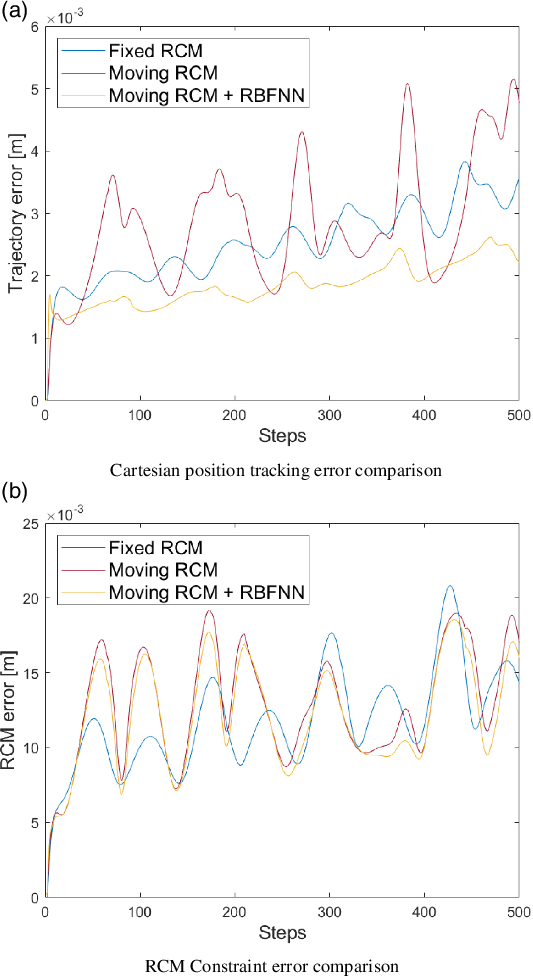
The above Cartesian trajectory tracking error and the RCM constraint error of the helix reference trajectory were further compared in Fig. 9. As shown in Fig. 8, the performance of Cartesian position tracking with neural learning was much better than without neural enhancement, regardless of fixed RCM constraints or moving RCM constraints. It, furthermore, showed a small improvement in the RCM constraint error with neural enhancement in Fig. 8.
Error comparison under different situations.

To validate the performance with different reference trajectories, a straight line with
 $x_{EE,d}=x_{EE,0}+[0.013t,0.1t,0.0095t]\enspace \mathrm{m}$
and a sine wave trajectory with
 $x_{EE,d}=x_{EE,d}+[0.1t,0.05*\sin\!(4\pi t),0]\enspace \mathrm{m}$
were designed and simulated with moving RCM constraints additionally to the more complex helix trajectory. The sinusoidal motion of the RCM along the z-axis had an amplitude of
 $[0.05]m$
with a frequency of
 $[5]Hz$
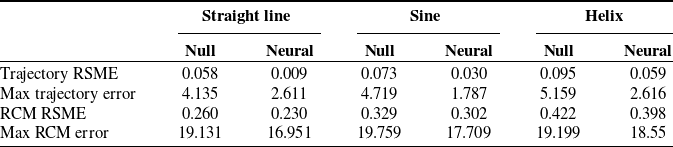
. The RMSE of the tracking error of Cartesian position and RCM constraints was computed for each trajectory and were depicted in Table I.
3.1. Discussion
Figure 7 illustrated the performance of the trajectory tracking with a fixed RCM constraint and Fig. 8 depicted the performance of the trajectory tracking with a moving RCM constraint. It could be noticed that the 3-D Cartesian position tracking accuracy was worse when the RCM constraint moved using the controller without neural learning. In Fig. 9, a relatively small difference in the RCM constraints was evidenced when using the decoupled controller without neural learning and when implementing the RBFNN-based neural learning strategy. As for the moving RCM, in Table I, the RSME and maximum errors of the different simulated trajectories were summarised. As expected, the RBFNN-based control not only eliminated the trajectory errors but also reduced the RCM errors. In Fig. 8, the RSME errors were evidently lower when the neural approximation was employed. From the results, it could be concluded that the neural-learning-enhanced controller had better accuracy and stability with respect to the controller developed in ref. [Reference Sandoval, Poisson and Vieyres10]. Hence, these results demonstrate that promising performance for the moving movement constraints using the neural enhancing solution. The idea of using an adaptive approximation to manage the disturbance generated by the moving RCM constraints can be useful for a similar application scenario more than the surgical application.
Comparison of the tracking performance between decoupled controller [Reference Sandoval, Poisson and Vieyres10] and the neural-learning-enhanced strategy.

4. Conclusion
This paper presented a neural-learning-enhanced Cartesian admittance control of the robot with moving RCM constraints, which presents nonlinear uncertain kinematic and dynamic disturbances. The proposed control scheme integrated neural approximation-based disturbance estimation as well as admittance control for a serial robot to operate with a moving RCM constraint. Furthermore, admittance control was introduced to adapt the desired trajectory achieving compliant behaviour in its operational space. The adaptive neural approximation solution demonstrates that the adaptive could enhance the accuracy of the tracking tasks and decrease the Cartesian tracking errors of the constrained robot system. Finally, experiments were validated on a serial robot with moving RCM constraints to validate the efficacy of the presented controller. It showed improved tracking accuracy with the neural-learning-enhanced control strategy. In the near future, we will navigate more challenging issues in a clinical environment (e.g. soft tissue interaction, time delay and dead zone) in our proposed control solution [Reference Zhong, Wang, Miao, Li, Fan and Zhang30]. System stability and tracking accuracy might not be guaranteed under these situations. Full proof of stability and robustness will be provided and validated in a real scenario. At the same time, how to tracking the real-time movement of the RCM point is also a challenging topic. The modelling of the RCM point between its changing trajectory and breathing time is helpful for the construction of stable operating performance. Furthermore, experimental validations and analysis will be performed with physical interaction on the robot’s end effector, facilitating the feasibility of the proposed neural-learning-enhanced admittance control scheme. For future works, we will develop a real phantom with a moving RCM generated by simulated human breathing to evaluate the proposed algorithm.
Author contributions
Hang Su, Yunus Schmirander and Wen Qi wrote the paper. Hang Su, Yunus Schmirander, Wen Qi and Juan Sandoval conceived and designed the study. Yunus Schmirander and Sarah Elena Valderrama-Hincapie conducted the data gathering and analysis. Salih Ertug Ovur and Juan Sandoval performed statistical analyses.
Financial support
This research received no specific grant from any funding agency, commercial or not-for-profit sectors.
Conflicts of interest
The authors declare no conflicts of interest exist.
Ethical approval
Not applicable.