INTRODUCTION
Older adults are faced with many situations that require making important decisions about financial management, medical care, retirement, housing, and transportation. Unfortunately, it is not uncommon to read of accounts in the local newspaper of elderly individuals being victimized by a range of scams involving home repair, fraudulent lottery or sweepstake winnings, identity theft, and fraudulent charitable organizations. It is a fact that older adults are preferentially targeted by fraudulent and misleading advertising (American Association of Retired Persons, 1996), presumably because they are more likely to make ill-informed decisions that make them easier prey for scam artists.
The poor decisions observed in some older adults are thought to be due to either age-related declines in general cognitive function (Band et al., 2002) or to age-related declines in specific executive cognitive abilities associated with changes in the frontal lobe (Raz et al., 1998; West, 1996). For instance, older adults deliberate less when solving problems and have lower working memory capacity, short-term memory capacity, and speed of information processing (Johnson, 1990; Kim et al., 2002; MacPherson et al., 2002; Salthouse, 1996; Schaie & Willis, 1999). Lower working memory capacity or reduced deliberation/reflection time when making decisions is associated with impulsive decisions (Finn et al., 2002). Studies show that lower working memory capacity in younger populations is associated with less advantageous, impulsive decision making (Bechara & Martin, 2004; Finn et al., 2002; Hinson et al., 2003). Furthermore, magnetic resonance imaging studies have shown that aging is highly correlated with shrinkage in prefrontal regions such as the lateral prefrontal cortex, the orbitofrontal cortex, and in prefrontal gray and white matter volumes (Raz et al., 1997, 2004).
The past decade has seen a substantial amount of research on decision making in populations, such as alcoholics, drug abusers, and those with antisocial traits, who typically display patterns of impulsive decisions characterized by choices that favor larger versus smaller immediate rewards even though such choices may result in long-term negative consequences. This pattern of decision making, labeled as a disadvantageous “myopia for the future,” is usually assessed using the Iowa Gambling Task (IGT) developed by Bechara and colleagues (1994) to study the decision-making impairments of patients with lesions of the ventromedial prefrontal cortex who develop what is called acquired sociopathy. Decision-making impairments on this task are also associated with substance abuse problems, antisocial behavior, and personality traits reflecting low levels of socialization and higher levels of impulsivity (Bechara et al., 2001; Fein et al., 2004; Mazas et al., 2000).
Studies conducted in recent years that examine decision making on similar tasks in older adults have yielded mixed results. Recent studies using the IGT suggest that decision making in older adults is associated with different cognitive processes than in younger adults (Wood et al., 2005), and there may be some evidence that at least some older adults make less advantageous decisions than younger adults (Deakin et al., 2004; Denburg et al., 2005). Denburg and colleagues (2005) found that older adults (56–85 years of age) made generally less advantageous decisions compared with their sample of younger adults (26–55 years of age). The analyses by Denburg et al. (2005) revealed that nearly half of their older adults were clearly impaired in their decisions and never learned to shift their decision-making strategies to make more advantageous decisions. However, the other half of the older adults were not impaired at all and showed the same pattern of advantageous decisions as the younger adults in their sample. Wood and colleagues (2005) also used the IGT to assess decision making in younger (18–34 years old) and older (65–88 years old) adults. While Wood et al. (2005) did not report any significant age-related differences in advantageous decisions, the mean performance for older adults was nonsignificantly lower than that of younger adults and older adults used different strategies than younger adults when learning the task. Finally, MacPherson and colleagues (2002) reported no significant differences in advantageous decision making between younger and older adults; however, as pointed out by Denburg et al. (2005), older adults had generally flatter learning curves compared with younger adults, which seems to suggest some impairment in the ability to learn to make more advantageous decisions over time.
The current study follows up on these studies by assessing decision-making differences between older and younger adults using the IGT and by assessing cognitive and other psychological correlates of decision making in these two age groups. The motivation for our study was twofold. First, in anticipation of examining IGT performance in elderly samples of long-term abstinent alcoholics (and comparing those data with data that we have previously published on young-to-middle-aged long-term abstinent alcoholics), we wanted to compare the elderly control group with the younger control subjects used in our earlier studies. Second, we wanted to replicate the findings of the study by Denburg et al. (2005). Our primary hypotheses is that older adults would show less advantageous decisions compared with younger adults. Furthermore, consistent with studies linking less advantageous decisions in young adults with more antisocial behavior, we proposed that antisocial behavior (and psychological measures of deviance proneness) would be associated with less advantageous decisions in young adults, but not in older adults. The basic idea is that different mechanisms will contribute less to advantageous decisions in younger versus older adults.
METHODS
Participants
A total of 164 men and women ranging in age from 18 to 85 were recruited from the San Francisco Bay Area via an Internet posting, newspaper ads, café postings, and subject referrals. All participants were chosen as healthy comparison subjects for one of two different studies on the effects of alcoholism. One study examined abstinent alcoholics ranging from 35 to 85 years of age, and the other examined active, treatment-naive alcoholics who were 18 to 55 years of age. Following Denburg et al. (2005), participants were divided into younger and older groups at a breakpoint of 55 years of age. The younger group consisted of 49 men, and 63 women from 18 through 55 years old (M = 37.8, SD = 10.7). The older group consisted of 18 men, and 34 women ranging from 56 to 85 years old (M = 73.7, SD = 7.4). Table 1 presents subject demographics as well as a summary of the gambling task (IGT) and neuropsychological results.
Demographics, gambling game, and neuropsychological measures

Participants were excluded for the following reasons: (1) lifetime diagnosis of schizophrenia or schizophreniform disorder; (2) lifetime history of alcohol or drug (other than nicotine or caffeine) dependence or abuse; (3) significant history of head trauma (head injury with loss of consciousness) or cranial surgery; (4) history of diabetes, stroke, or other significant neurological disease that required medical intervention; and (5) clinical evidence of Wernicke–Korsakoff syndrome. These exclusion criteria were developed to support our studies and assessments of active alcoholics and abstinent alcoholics, including a focus on the prevalence and manifestation of comorbid mood, anxiety, and externalizing disorders in the study samples.
Assessment
Subjects participated in a total of four sessions that lasted between 1.5 and 3 hr. The sessions included clinical, neuropsychological, electrophysiological, and neuroimaging assessments. All participants were asked to abstain from drinking alcohol for 24 hr before each lab visit, and a Breathalyzer was administered before each session. No participants in the current study had positive Breathalyzer results (>0.000) on any of their study sessions. Furthermore, participants were asked to get a blood draw to test hepatic function (all participants in the current study had normal hepatic function). Participants were informed of the study's procedures and aims and signed a consent form prior to participation. Those who completed the sessions were given monetary compensation for their time and travel expenses, plus an additional bonus once they had completed the study. All of the procedures, measures, and compensation were reviewed and approved by an institutional review board.
Psychodiagnostic and Personality Assessment
Lifetime and current (prior year) psychiatric diagnoses and symptom counts were determined using the computerized version of the Diagnostic Interview Schedule (CDIS; Robins et al., 1998). Table 2 presents the number of positive diagnoses by group and gender. Personality traits reflecting antisocial tendencies (Finn & Hall, 2004) were assessed using the Psychopathic Deviance scale of the MMPI-2 (MMPI_Pd; Hathaway & McKinley, 1989), the Socialization scale of the California Psychological Inventory (CPI_So; Gough, 1969), and the sum of Conduct Disorder and Antisocial Personality Disorder symptom counts from the CDIS (CD_ASPD). Research shows that these different measures of personality and antisocial symptoms are significantly associated with disadvantageous decisions on the IGT in young adult samples (Mazas et al., 2000; Stout et al., 2005).
CDIS current and lifetime diagnoses

Neuropsychological Assessment
A neuropsychological assessment was administered on the second day of testing. This assessment began with the administration of the following individual tests: Rey–Osterrieth Complex Figure (copy, immediate, and delay; Osterrieth, 1944), Trail Making Test A and B (Reitan & Wolfson, 1985), Symbol Digit Modalities Test (written administration only; Smith, 1968), American version of the Nelson Adult Reading Test (AMNART; Grober & Sliwinski, 1991), Short Category Test (booklet format; Wetzel, 1982), Controlled Oral Word Association Test (COWAT; Benton & Hamsher, 1983), Paced Auditory Serial Addition Test (PASAT; Gronwall, 1977), Block Design (WAIS; Wechsler, 1981), Stroop Color and Word Test (Golden, 1975), Fregly Ataxia Battery (Fregly et al., 1973), and the Iowa Gambling Task (IGT, described in detail below; Bechara et al., 1994). After a 15-min break, the subject completed the MicroCog (MC) Assessment of Cognitive Functioning (standard version; Powell et al., 1993), a computerized battery that includes 18 subtests and takes approximately 1 hr to complete.
Normative scores derived from a nationally representative sample of adults are available for each test, either from the creators or distributors of the tests. Z scores for the neuropsychological domains and measures were computed based on standardized norms adjusted for age [Stroop (Golden, 1978), Short Categories (Wetzel & Boll, 1987), PASAT (Stuss et al., 1988), Block Design (Wechsler, 1997), and Rey (Denman, 1987)]; years of education [AMNART (Grober & Sliwinski, 1991)]; age and years of education [Symbol Digit Modalities (Smith, 1982), MicroCog (Powell et al., 1993)]; and age, gender, and years of education [(Trails A and B; Heaton et al., 1991), COWAT (Ruff et al., 1996)]. The Stroop, Symbol Digit Modalities, and the MicroCog test norms are not specific to gender, because gender did not significantly affect scores in the normative samples (Golden, 1978; Powell et al., 1993; Smith, 1982). The AMNART is used as a measure of premorbid intelligence (Grober & Sliwinski, 1991). The AMNART did not have age norms, because the test was designed to be resistant to the effects of normal aging and most neurodegenerative diseases. Additionally, Grober and Sliwinski (1991) have reported that gender does not influence AMNART scores.
The final neuropsychological battery consisted of the following nine domains, and their component tests: (1) Attention (Stroop Color, MC Numbers Forward, MC Numbers Reversed, MC alphabet, MC Word List 1), (2) Verbal Ability (COWAT, AMNART), (3) Abstraction/Cognitive Flexibility (Short Categories, Stroop interference score, Trail Making Test B, MC Analogies, MC Object Match A and B), (4) Psychomotor (Trails A, Symbol Digit), (5) Immediate Memory (MC Story immediate 1 and 2, Rey immediate recall, MC Word List 2), (6) Delayed Memory (MC Story Delay 1 and 2, MC Address delay, Rey delayed recall), (7) Reaction Time (MC Timers 1 and 2), (8) Spatial Processing (MC Tic Tac 1 and 2, MC Clocks, Block Design), and (9) Auditory Working Memory (PASAT at delays of 2.4, 2.0, 1.6, and 1.2 s).
Decision Making
The IGT, used to assess decision making, was administered during the second day. Participants were seated in front of a computer, and the rules were both explained on the computer screen and reviewed by the experimenter. Participants started out with $2000 of fake money. The object of the task was to end up with as much money as possible. Participants select one card at a time from any of four different decks. This card would indicate an amount either “won” or “lost,” and would add or subtract that amount from the participant's running total. Participants were told that they could switch from one deck to another at any time and as often as they wished. Each deck had a total of 60 cards, and the game ended after a total of 100 cards were selected. Participants were told that they would not know when the game would end, that some decks are better than others, and that the computer does not change the order of the cards after the game starts. Within the gambling game, the “good” decks (decks C & D) have smaller immediate rewards and lower long-term punishment, and the “bad” decks (decks A& B) have higher immediate rewards, but also higher long-term punishment. The participant's performance on the task is reflected by a measure of advantageous decision bias quantified as the number of cards chosen from the good decks minus the number of cards chosen from the bad decks (Fein et al., 2004; Mazas et al., 2000).
Statistical Analysis
The data were analyzed with SPSS (SPSS, Inc., 2004). Comparisons between the two groups were done with the general linear models procedure. The different psychological and neuropsychological measures were examined as covariates in an analysis of variance and/or Pearson's correlations to determine their association with IGT performance. Multiple regression analyses of the psychological and neuropsychological predictors of decision making were also performed.
RESULTS
Gambling Task Performance
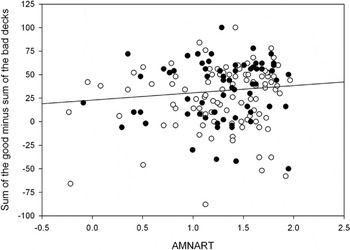
Analysis of variance on IGT performance revealed significant group differences [F(1,160) = 14.08, p < .001], with the older group performing less advantageously than the younger group, but no significant gender or group by gender interactions. Participants were divided into two groups with the cutoff at age 55 based upon the study by Denburg et al. (2005). We performed polynomial regression of IGT performance as a function of age to examine how age affected IGT performance over the entire study age range. A linear fit was significant [F(1,162) = 19.1, p < .0001, adjusted r2 = .100], but the best fit was a quadratic function of age [F(2,161) = 13.20, p < .0001, IGT = 12.045 + 1.38 * age − 0.019 * age2, adjusted r2 = .130]. The quadratic term accounted for additional IGT variance with no improvement to the prediction of IGT performance by adding a cubic age term (p > .83). This best fit quadratic is displayed in Figure 1, where it shows that the negative association of advantageous decision bias on the IGT with age does begin in the mid-fifties. An advantageous decision bias was not associated with age in the under 55 group (r = −.03, p = .79), but was negatively associated with age in the over 55 group (r = −.34, p < .05). IGT performance was also associated with years of education (r = .18, p < .03; Figure 2), but not, however, with indices of premorbid intelligence as assessed by the AMNART (r = 0.11, p = .15; Figure 3).

The best-fit quadratic equation (IGT = 12.045 + 1.38 * age − 0.019 * age2), which was a result of polynomial regression of Iowa Gambling Task (IGT) performance as a function of age. It shows that the negative association of advantageous decision bias on the IGT with age does begin in the mid fifties. Black circles = men; white circles = women.

The association between Iowa Gambling Task performance (total number of cards drawn from the “good” decks minus the total number of cards drawn from the “bad” decks) and years of education. Black circles = men; white circles = women.

The association between IGT performance (total number of cards drawn from the “good” decks minus the total number of cards drawn from the “bad” decks) and the AMNART, (a measure of pre-morbid intelligence). Black circles = men; white circles = women.
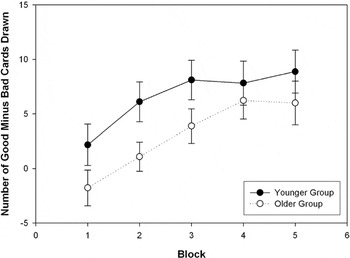
We also examined decision bias on the IGT broken down into five blocks of 20 cards each. Unfortunately, card sequence was not originally saved during the testing, so these analyses were performed only on subjects who had card sequence data (18 younger women, 16 younger men, 24 older women, and 11 older men). The older subjects performed more poorly across blocks [F(4,62) = 3.13, p < .02], but there were no significant block by group, block by gender, or block by gender by group interactions [all F(2,62)'s < 1.46, p's > .23]. Figure 4 shows the performance of the younger and older groups across blocks, with the performance curves for the older and younger groups roughly parallel across blocks.

The average Iowa Gambling Task performance with standard error bars across blocks for the younger and the older groups, where blocks are sequences of 20 cards.
Furthermore, in following with Denburg et al. (2005), we used binomial probability to determine whether each participant's IGT performance was significantly different from random performance. Denburg categorized individuals who performed significantly better than chance as “unimpaired” and individuals performing significantly worse than chance as “impaired.” We found a higher percentage of “impaired” individuals in the older compared with the younger group (8 of 52, ∼15% vs. 5 of 112, ∼4%; Fisher's exact test p = .03), and a lower percentage of individuals who were “unimpaired” in the older group compared with the younger group (24 of 52, ∼46% vs. 79 of 112, ∼71%; χ2 = 9.03; p < .01). IGT block information was available on 3 of the 8 older “impaired” participants, none of whom demonstrated learning as the task progressed.
Neuropsychological Variables and Their Association With Advantageous Decision Biases
Analysis of variance revealed significant group differences on various age-adjusted Z scores for neuropsychological domains (see Table 1; Table 3 contains results from analyses on the raw scores). There was no difference in the average Z score across domains [F(1,160) = 0.15, p > .70]. On specific domains, the younger group performed more poorly than the older group in delayed memory [F(1,160) = 4.88, p < .03] and reaction time [F(1,159) = 9.09, p < .01]. The average Z score across domains was associated with IGT performance across all subjects (r = .29, p < .001). Within the younger group, advantageous decision making was associated with auditory working memory (r = .32, p = .001), psychomotor ability (r = .29, p = .002), and the average Z score across domains (r = .28, p = .003). Within the older group, decision making was associated with abstraction/cognitive flexibility (r = .40, p = .003), immediate memory (r = .44, p = .001), spatial processing (r = .45, p = .001), and the average Z score across domains (r = .39, p = .004). Multiple regression analysis for the younger and older groups was analyzed separately, first entering all neuropsychological domains, followed by backward deletion. For the younger group, this strategy resulted in the combination of auditory working memory and psychomotor ability together accounting for 12.0% of the IGT performance measure (adjusted R2). For the older group, there was a single predictor, immediate memory, accounting for 19.1% of the IGT performance measure.
Neuropsychological domains and individual tests (raw scores)

Psychological Variables and Their Association With Advantageous Decision Biases
Analysis of variance revealed significant group differences on several CDIS symptom counts. Compared with the older group, the younger group reported more manic symptoms [F(1,160) = 5.76, p < .02], post-traumatic stress disorder symptoms [F(1,160) = 3.89, p = .05], psychotic symptoms [F(1,160) = 5.53, p = .02], and conduct disorder symptoms [F(1,160) = 5.89, p < .02]. The older group did not have higher symptom counts on any measures.
We examined the effects of each symptom count variable on IGT performance by using that symptom count variable as a covariate in an analysis of variance. Group by covariate interactions were present only for obsessive symptoms [F(1,158) = 3.14, p < .05], hyperactivity symptoms [F(1,157) = 3.27, p < .05], and antisocial personality symptoms [F(1,157) = 3.10, p < .05]. Obsessive symptoms and hyperactivity symptoms were more negatively associated with advantageous decision bias in the older compared with the younger group (r = −.32, p < .02 vs. r = −.07, p = .46; and r = −.20, p = .15 vs. r = .15, p = .12), while antisocial personality symptoms were more negatively associated with advantageous decisions in the younger compared with the older group (r = −.18, p = .06 vs. r = .12, p = .39). Multiple regression analysis of the symptom count variables was performed in the same manner as for the neuropsychological variables. For the younger group, antisocial personality disorder symptoms were a single predictor, accounting for 2.2% of the IGT performance measure. For the older group, there was also a single predictor, with obsessive symptoms accounting for 8.7% of the IGT performance measure.
Group analysis of variance for the MMPI_Pd and CPI_So scale revealed higher MMPI_Pd scores in the younger group [F(1,160) = 7.37, p < .01], but no difference on the CPI_So scale or CD_ASPD symptom counts. There were no associations between IGT performance and any of these variables, nor were there differences in the associations between groups.
DISCUSSION
The current study replicates the major finding of Denburg et al. (2005) that individuals older than age 55 exhibit less advantageous decisions on the IGT compared with individuals younger than age 55. The analysis of IGT performance versus age data using polynomial regression found that a quadratic curve best fit the data. As shown in Figure 1, IGT performance as a function of age revealed that age 55 was a reasonable cutoff for demarking the beginning of an age-related impairment. Using Denburg's definition of “impaired” and “unimpaired,” IGT performance as being significantly worse than chance and significantly better than chance, respectively, we replicate their finding of more impaired performance in the over 55 compared with more unimpaired performance in the under 55 group. Our percentage of older individuals with unimpaired performance was lower than that in our younger sample and was comparable to that of Denburg (46% vs. 38%); however, our percentage of older individuals with impaired performance, while higher than that in our younger sample, was lower than that reported by Denburg (15% vs. 35%). In addition, Denburg did not find any associations between the IGT and performance on cognitive tests, while we reported an association with the average Z score across all nine cognitive domains assessed. Furthermore, Wood et al. (2005) found that older and younger adults use different cognitive strategies in regard to decision making as assessed by the IGT. Analyses of our participants also revealed that different cognitive processes are associated with decision making in older versus younger adults. Auditory working memory and psychomotor abilities were associated with IGT within the younger group, and immediate memory was associated with IGT performance in the older group.
Regarding neuropsychological performance, it is important to note that all participants performed within the normal range compared with age and education adjusted norms (see Table 1). The groups did not differ on age and education adjusted scores, except for the older group performing better on reaction time and delayed memory. These differences were subtle impairments and were not clinically significant. Furthermore, looking at the raw scores (Table 3), older adults performed worse than younger adults on these two domains. The better performance in terms of the scaled scores suggests that older adults in the Bay Area (from which our sample was drawn) perform better than the older sample from which the normative data were derived. For all subjects, the average Z score across domains was positively associated with advantageous decisions on the IGT, and there was no significant difference in this association between groups.
Within the younger groups, especially among the young women, there was a relatively high proportion of individuals who met lifetime criteria for depression. Analysis of covariance did not, however, reveal any association between depressive symptoms and performance on the IGT. This higher rate of depression reported in the younger groups may reflect a combination of factors. Depressed older individuals are subject to survivor effects because depressed individuals die at an earlier age than nondepressed individuals (Schulz et al., 2002). In addition, it is possible that our elderly participants were a select sample (with a relatively low rate of depression) because of their propensity to volunteer for a 4-day research study. They reported that their participation was mostly for altruistic reasons and to learn more about themselves, as compared with the younger subjects who more often reported monetary considerations as a motivating factor. Finally, possible cohort differences in the acknowledgment of psychological distress may also have played a part.
The results also indicate different psychological correlates of impaired decision making in older versus younger adults. For younger adults, even though these subjects were healthy normal individuals, antisocial behavior was significantly associated with less advantageous decisions. This result is consistent with studies that show that young adults with diagnosable disinhibitory syndromes, such as conduct disorder, antisocial personality disorder, and substance abuse, demonstrate less advantageous decisions (Mazas et al., 2000). However, for older adults, symptoms of obsessiveness were associated with less advantageous decisions. More studies are needed to replicate these findings and to determine what aspects of obsessiveness might contribute to impaired decisions in older adults. We are very aware of the difference between diagnosable psychiatric illness and subdiagnostic signs and symptoms associated with such illness. We published a study in which we examined both phenomena in long-term abstinent alcoholics compared with age and gender comparable controls (Fein et al., 2007). We found that the major difference between the groups in psychiatric illness was carried by subdiagnostic psychopathology. We believe that, in comparison to the limited view provided by using only symptomatology that meets meet criteria for a diagnosis, the use of continuous measures of psychiatric symptomatology and psychological abnormality yields a much more accurate picture of psychiatric illness; however, we are very aware that the measures we are discussing here are subdiagnostic.
Despite our findings that older adults demonstrate less advantageous decision making than younger adults, the IGT remains a laboratory task in a fixed environment. Although the gambling task models real-life decisions that involve weighing short-term rewards and long-term consequences, it remains an artificial task and it may not be sensitive to more subtle deficits in decision making, or to the influence of context on decision making. Given these limitations, one cannot conclude that older adults would demonstrate impairment regarding decisions in other aspects of their lives.
Finally, the results reported here have implications for the prognosis of the alcohol- or drug-dependent individual as they age. Aging may independently affect a brain system (evaluation of rewards and punishments) that is already compromised in the alcoholic or drug abuser. This affect would result in even greater impairments in decision-making ability in elderly individuals with a history of alcohol or drug abuse and may make them particularly vulnerable to making disadvantageous decisions. Studies examining decision-making ability in elderly individuals with a history of alcohol or drug abuse are warranted.
ACKNOWLEDGMENTS
This work was supported by grants AA11311 (G.F.) and AA13659 (G.F.), both from the National Institute of Alcoholism and Alcohol Abuse. We also express our appreciation to the Neurobehavioral Research, Inc., recruitment and assessment staff and to each of our volunteer research participants.