Introduction
Trans-tympanic injections are recommended for treating a variety of otological conditions, such as idiopathic sudden sensorineural hearing loss, Ménière's disease, vestibular disease and immune-mediated sensorineural hearing loss.Reference Doyle, Bauch, Battista, Beatty, Hughes and Mason1 However, the overall efficacy and appropriate dosage varies from patient to patient, and the determination of effective dosages has proven difficult.
Alzamil and LinthicumReference Alzamil and Linthicum2 have shown that there is anatomical variation of the round window niche, and 33.2% of specimens with obstruction of the round window niche. Silverstein et al.Reference Silverstein, Rowan, Olds and Rosenberg3 retrospectively evaluated 41 patients undergoing middle-ear endoscopy to evaluate the round window niche. A significant portion of patients had either partial (17%) or complete (12%) obstruction of the round window requiring lysis of adhesions. The authors concluded that middle-ear endoscopy should be contemplated in patients requiring intra-tympanic instillation of medication for inner ear disease, to promote adequate drug delivery and diffusion.Reference Silverstein, Rowan, Olds and Rosenberg3
Middle-ear endoscopy may have a role in trans-tympanic therapy. It can enable visualisation of the round window niche, identification and removal of obstructive tissue, and administration of medications under direct visualisation.
Endoscopic visualisation of the middle-ear space and trans-tympanic administration of medication have been the subject of ongoing research and development in cadaveric and human studies for several decades. Mer (in 1967) and Eichner (in 1978) were the first to describe the use of fibre-optic and rigid endoscopes in the middle-ear space, respectively.Reference Poe, Rebeiz, Pankratov and Shapshay4 Several authors have validated the advantages of endoscopic assessment of middle-ear pathology. Poe et al. Reference Poe, Rebeiz, Pankratov and Shapshay4 studied the advantages and pitfalls of a variety of oto-endoscopes. While flexible scopes (0.4 and 0.7 mm) have the advantage of manoeuvrability, the fibre-optic scope (1 mm) had better image quality and size. Also, the rigid telescope (1.9 mm) was found to have better optics, and a clarity comparable to views obtained with an operating microscope. However, the size of this telescope made it difficult to place through the myringotomy. Endoscopically assisted diagnostic and surgical procedures have been described, but there have been few reports on the interventional capabilities of oto-endoscopes. Plontke et al. Reference Plontke, Plinkert, Plinkert, Koitschev, Zenner and Lowenheim5 described the use of a fibre-optic micro-endoscope with a total outer diameter of 1.2 mm, which had a working channel (0.3 mm) and an irrigation and suction channel (0.27 mm), for trans-tympanic endoscopy and drug delivery to the round window. The Marchal sialendoscopeReference Marchal6 (1.3 mm, 0.65 mm working; Tuttlingen, Germany) and the Erlangen sialendoscopeReference Iro, Zenk, Koch and Bozzato7 (1.1 and 1.6 mm, 0.45 and 0.8 mm working; Tuttlingen, Germany) are compact, functional scopes developed for salivary duct endoscopy. These sialendoscopes have similar capabilities to 1.2 mm oto-endoscopes, but have a different interventional port diameter and overall length.
The current study aimed to assess the feasibility of using a 1.3 mm, semi-rigid, interventional salivary endoscope for middle-ear endoscopy and also as a route for trans-tympanic delivery of medication, in human cadaveric temporal bones.
Materials and methods
Five temporal bones harvested from human cadavers were examined. The procedures were performed at the Center for Advanced Learning, Louisiana State University, Health Sciences Center, New Orleans, Louisiana, USA.
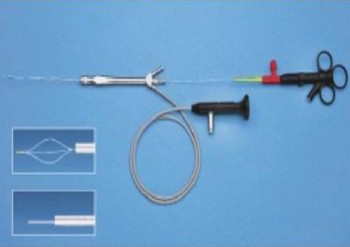
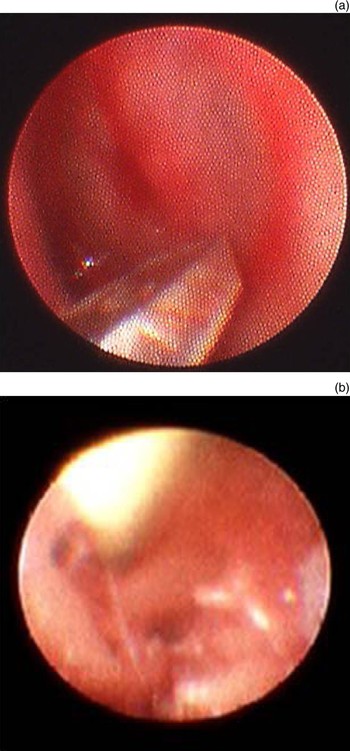
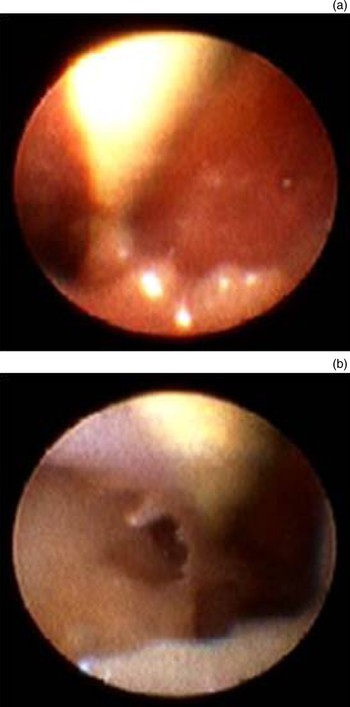
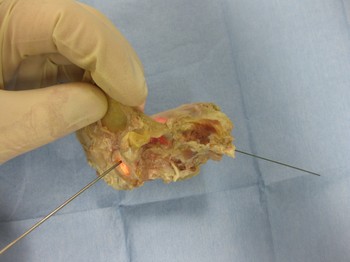
The temporal bones were oriented to a surgical view. The procedure required one person to navigate the scope and an assistant to help with the interventional procedures (i.e. irrigation and injection). A 1.3 mm diameter, 0° Marchal interventional sialendoscope (Storz, Tuttlingen, Germany) equipped with an interventional channel (0.65 mm) and an irrigation channel was connected to an endoscope tower with a camera and halogen light source via a remote eye piece, as per routine endoscopic sinus surgery (Figure 1). The endoscope was used to visualise the tympanic membrane. A video-assisted, endoscopic, postero-inferior myringotomy was performed (Figure 2a). The sialendoscope was guided through the incision to enable visualisation of the round window niche. A guide wire was then passed via the working channel, to assess the feasibility of performing interventional procedures in the area of the round window niche (Figure 2b). In addition, an antero-superior myringotomy was performed to enable identification and examination of the eustachian tube orifice. Using the interventional port, a guide wire was passed into the eustachian tube orifice (Figure 3). Complete eustachian tube cannulation was confirmed when the guide wire could be seen exiting the eustachian tube's nasopharyngeal opening (Figure 4).
A 1.3 mm interventional sialendoscope with a remote eye piece for the attachment of the camera head and light source. Inset shows the interventional port, housing a wire basket.

(a) Postero-inferior myringotomy (left ear). (b) Endoscopic view of the round window niche, with placement of a 0.4 mm guide wire through the interventional port (left ear).

Endoscopic views of the eustachian tube orifice, with a 0.4 mm guide wire placed via the interventional port: (a) left ear; (b) right ear.

Right temporal bone showing eustachian tube cannulation.

Results
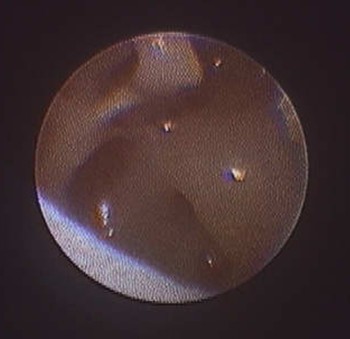
Middle-ear examination was successful in all specimens (n = 5). Four temporal bones had intact tympanic membranes, while one had a tympanic membrane with a perforation in the antero-inferior quadrant. Access to the round window niche was obtained via a postero-inferior myringotomy in all five temporal bones (100 per cent). A guide wire could be navigated to the round window niche without difficulty in all patients. The endoscope provided adequate visualisation of the round window. Other structures identified included the incudostapedial joint, stapedius tendon, pyramidal eminence and facial nerve (Figure 5). Adequate visualisation of the contents of the postero-superior quadrant required an extension or widening of the incision. The anterior middle-ear space was also successfully examined via a video-assisted, endoscopic, antero-superior myringotomy. The opening to the eustachian tube was visualised and could be cannulated with a guide wire in all cases in which this was attempted (n = 3). In one case, eustachian tube access was obtained via an existing tympanic membrane perforation, without the need for an additional incision.
Endoscopic view of the right middle-ear space, showing the incudostapedial joint, stapedius tendon, pyramidal process, promontory and round window niche.

Discussion
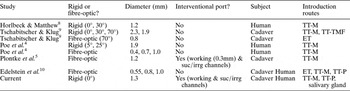
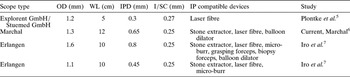
Several types of flexible and rigid endoscopes have been investigated and are in use for middle-ear endoscopy (Table I). Similarly, there are several sialendoscope configurations that are currently being used routinely to visualise the salivary duct and to perform interventional procedures (such as fragmentation and removal of stones and dilatation of strictures). The Marchal 1.3 mm (0.65 mm working) sialendoscope and the Erlangen (1.1 and 1.6 mm; 0.45 and 0.8 mm working) sialendoscope are compact, ‘all-in-one’ scopes with inbuilt working and irrigation channels comparable to the configuration of oto-endoscopes. Such interventional sialendoscopes have fibre-optic capabilities similar to oto-endoscopes currently in use, and the adequacy of their optics and interventional capabilities have been validated in clinical studies addressing salivary gland pathology. The irrigation port of the sialendoscope has proven valuable as a drug delivery mechanism in patients who require intra-glandular instillation of medication for conditions such as radio-iodine induced sialadenitisReference Bomeli, Schaitkin, Carrau and Walvekar11 and recurrent viral parotitis.Reference Nahlieli, Shacham, Shlesinger and Eliav12 In addition, such compact scopes have a larger working channel, compared with the 1.2 mm micro-endoscope described by Plontke et al. Reference Plontke, Plinkert, Plinkert, Koitschev, Zenner and Lowenheim5 This interventional port allows a variety of tools to be housed, such as a hand-driven micro-burr, cup forceps, laser fibre, balloon dilator and wire basket, at the expense of a small increase in scope diameter (especially with the larger diameter sialendoscopes, i.e. 1.6 mm). In comparison, the oto-endoscope is currently not equipped to house these interventional tools (Table II). The use of the sialendoscope for oto-endoscopy does not require a larger tympanic membrane incision; a controlled endoscopic incision using a myringotomy knife is large enough to easily allow introduction of a 1.3 mm interventional sialendoscope. In our opinion, such an incision should also be adequate to permit easy introduction of a 1.6 mm sialendoscope. We found that the additional working length of the salivary endoscope (12 cm, as compared with a micro-endoscope length of 5 cm) did not hamper the use of a second instrument in the external ear, allowing a two-handed technique for surgical manoeuvres. The weight of the beam splitter and camera has been noted to make the observation end of rigid endoscopes bulky for the user.Reference Poe, Rebeiz, Pankratov and Shapshay4 The sialendoscope, and also newer oto-endoscopes, may offer an advantage here, since the camera and light source are not connected to the body of the scope.
Reported types of middle-ear endoscope

TT-M = trans-tympanic via myringotomy; TT-TMF = trans-tympanic via tympanomeatal flap; ET = eustachian tube orifice; TT-P = trans-tympanic via preexisting perforation
Comparison of interventional sialendoscopes vs interventional micro-endoscopes

OD = outer diameter; WL = working length; IPD = interventional port diameter; I/SC = irrigation and suction channel
The use of interventional sialendoscopes has not previously been investigated for middle-ear procedures. Our study shows that the image quality, manoeuvrability and interventional capabilities of the sialendoscope can be translated to the middle-ear space. These capabilities are equivalent to those offered by oto-endoscopes. Additional interventional capability (such as the use of a laser fibre, micro-burr or cup forceps) is also feasible using a sialendoscope. In addition, further validation of the use of sialendoscopes for otological indications will extend the clinical applications of sialendoscopy equipment, consequently increasing its cost-effectiveness.
• Middle-ear endoscopy has a definite role in middle-ear surgery and trans-tympanic therapy
• Sialendoscopes used for salivary endoscopy, a relatively new surgical discipline, offer additional interventional capabilities and advantages compared with current oto-endoscopes
• This study investigated the 1.3 mm sialendoscope, which allowed adequate visualisation of the eustachian tube, middle-ear space and round window niche, with the possibility of introducing interventional tools (represented in this study by a guide wire)
• This sialendoscope's irrigation channel (validated for drug delivery for the management of salivary gland disease) also confers the possibility of trans-tympanic drug delivery under endoscopic vision
• This study confirms the feasibility of sialendoscope-mediated middle-ear endoscopy, with good image quality and the capacity for trans-tympanic drug injection, in a cadaveric model
The disadvantage of the sialendoscope is that the 0° angle and the semi-rigid nature of the scope do not allow visualisation of the entire middle-ear cavity via a single tympanotomy incision.
Conclusion
The 1.3 mm interventional sialendoscope allowed adequate visualisation of the eustachian tube, middle-ear space and round window niche in a cadaveric model, and also had interventional capabilities. Our result validates the feasibility of its use for trans-tympanic drug delivery. However, this indication for the use of the sialendoscope needs to be evaluated in a clinical setting.
Acknowledgements
The authors would like to thank Anthony Wells and Reginauld Delmore (Department of Anatomy, Louisiana State University School of Public Health), Trey Joseph (Stryker, USA), and Johnny Padilla (Karl Storz, USA).