1. Introduction
Dutch has a relatively elaborate paradigm for second person pronouns. Learners of Dutch as a foreign language are likely to have problems with its morphological complexity, but even more so with its sociolinguistic vagaries. This article is about the latter, more particularly how a period of residence in the Low Countries can help advance students’ proficiency in using these pronouns appropriately. The research is based on interviews with final-year students of Dutch in the UK, whose analysis is framed in terms of intercultural communicative competence and approaches to learning. Before presenting and discussing the data, we give a brief survey of Dutch forms of address, followed by some theoretical and methodological considerations.Footnote *
2. Dutch Forms of Address
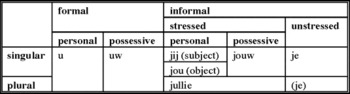
In standard modern Dutch there are three second-person pronouns: informal singular, informal plural, and formal. The formal pronoun can be used both for singular and plural addresses. The informal singular has the most complex morphology of the three: it has distinct subject and object forms and a parallel possessive pronoun, but also an unstressed form that can replace all three more emphatic forms. The formal pronoun only has a parallel possessive pronoun. The plural informal form is used in all pronominal functions, although the singular unstressed form can under certain circumstances be substituted. Each pronominal subject form is associated with its own verbal morphology.Footnote 1 See table 1 for a schematic representation.
Dutch second person pronouns.

The norms for using second person pronouns in Dutch have been subject to increasingly rapid changes over the last fifty years and there is no evidence that the norms are stabilising, with much uncertainty amongst native speakers as a result. One of the most recent studies of the current situation is Vermaas (Reference Vermaas2002) who starts from Brown & Gilman's (Reference Brown, Albert and Sebeok1960) classic distinction between pronouns of power and of solidarity. According to this, power is expressed when the forms of address are used asymmetrically. Someone in a superior position is addressed by someone in an inferior position with a formal pronoun (in Dutch u) but uses the informal pronoun (so the other forms in Dutch) to address the inferiors. Symmetrical use of forms of address point to formality (when speakers address each other with the formal pronoun) or solidarity (when speakers use the informal pronoun). However, following Van den Toorn (Reference Van den Toorn1977:528), Vermaas (Reference Vermaas2002:60) concludes that in Dutch there has been a shift such that on the one hand solidarity has become more prominent than power (leading to an increased use of je/jij), and that on the other hand u has become the pronoun of distance instead of the pronoun of politeness.Footnote 2 This suggests that the Dutch forms of address have largely lost their asymmetrical use and now only give expression to either solidarity (je/jij) or distance (u). In other words, the power dimension of their use has been lost.
On a brief comparative note, the Dutch system is reminiscent of English where first name (FN) is used to express solidarity and title plus last name (TLN) to express distance (see Ervin-Tripp Reference Ervin-Tripp, Pride and Holmes1972).Footnote 3 The source for this system is American English, but over the last 40 years it has spread over the anglopohne world (Durrell Reference Durrell, Behr, Larrory and Samson2007). However, the Dutch system is quite different from German, where there are two parallel systems: a traditional deferential one in which Sie is the default form of address and du marked, and a more recent solidarity-based one where the roles of Sie and du are the reverse (Durrell Reference Durrell, Behr, Larrory and Samson2007). This is relevant here, because many English students of Dutch already know German.
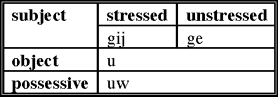
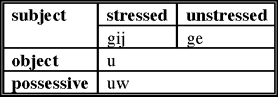
A complicating factor in this is the fact that Dutch is a pluricentric language with a northern (Netherlands) standard and a slightly different southern (Flemish) one. Whilst the paradigm in table 1 applies to both varieties of standard Dutch, the southern variety is slightly more conservative in its use of second person pronouns.Footnote 4 Moreover, Flemish colloquial speechFootnote 5 has a much simpler paradigm with only one second person pronoun that is used in both formal and informal situations: ge (with stressed gij). However, crucially, the object form of ge/gij is u and the possessive uw (see table 2 and Vandekerckhove Reference Vandekerckhove2005). As we see below, this poses a particular challenge to students of Dutch when visiting Flanders, especially since the object of their study is the standard language but their Flemish peers have a strong preference for using the colloquial Flemish address system (see Vandekerckhove Reference Vandekerckhove2005).Footnote 6
Second person pronouns in colloquial Flemish.
3. Research Background
Three earlier articles on this topic (Vismans Reference Vismans2003/04, Reference Vismans2004, and Reference Vismans2007a) were based on two questionnaires amongst students of Dutch at four English universities where the language has been taught at honours level.Footnote 7 Respondents were divided over three levels of proficiency: beginners (normally first-year students), intermediate (second-year students who had completed a beginners course in the first year) and advanced (final-year students who had completed an intermediate course in the second year and spent (part of) their Year AbroadFootnote 8 in Flanders or the Netherlands). The main aim of Vismans Reference Vismans2003/04 is to establish when English students of Dutch think these pronouns are used. I have labelled the type of student knowledge that emerges from this “explicit” knowledge. Vismans Reference Vismans2004 investigates students’ evaluation of a number of given situations through questions about their perceptions of correct use (“implicit” knowledge). Vismans Reference Vismans2007a asks which pronoun students themselves would use in a number of given situations (“active” knowledge). Briefly, the results of these studies show that students can explain quite well (and early on in their acquisition of Dutch) when a specific pronoun should be used. The most important key words they use respectively for u and je/jij are “formal” and “informal.” However, when they have to evaluate specific situations, they are less certain. Moreover, their evaluations are predominantly couched in terms of familiarity/ unfamiliarity, which is at odds with their explicit knowledge and differs from the assertion in Vermaas Reference Vermaas2002 that native speakers use je as solidarity pronoun and u as distance pronoun. Finally, when confronted with specific situations, advanced students show in their choice between u and je that they have more refined judgements about social situations and the consequent use of second person pronouns than lower-level students.
Vermaas Reference Vermaas2002 argues that native speaker choice of form of address depends on three external factors: the relationship between speaker and addressee, the (level of formality of the) situation in which an exchange takes place and the addressee's personal characteristics (age, sex, status). It equally depends on four speaker-internal factors: age, sex, level of education and religious denomination. These factors determine the socio-cultural environment for pronoun choice. Students of Dutch as a foreign language do not share all the native speaker characteristics that are part of this environment (for example religious denomination) and also bring a different factor into the environment: their foreignness. They are thus negotiating between the target culture and their own, and because of this the ideal of near-native speaker competence is not a realistic option. This echoes criticism of the near-native speaker ideal elsewhere in the literature on intercultural learning (for example, Byram Reference Byram1997:10–12).
It is for these reasons that I argued in the conclusion to Vismans Reference Vismans2004 that non-native speakers of Dutch have to develop an “individual style” in using Dutch second person pronouns. The refined judgements shown by advanced students in Vismans Reference Vismans2007a suggest that students at this level have indeed started doing so and no longer equate language use with (grammatical) rules. This development was associated (Vismans Reference Vismans2007a:180–181) with advanced intercultural communicative competence (ICC), a concept primarily taken from Byram Reference Byram1997, but widely discussed elsewhere in the language teaching literature (specifically for Dutch Van Baalen et al. Reference Van Baalen, Ludo and Alice2003, in particular Van Kalsbeek, who bases her analysis on Kramsch Reference Kramsch1993).
For Byram (Reference Byram1997:31–38) the competence of a proficient intercultural speaker depends on five interrelated factors. Two of these factors are essentially preconditions for proficient ICC: knowledge of self and others, but also of the processes of human interaction, and an open attitude towards the other, but also, crucially, towards the self. Two other factors are sets of skills: interpretive skills and skills of discovery. Interpretation in an intercultural context means an ability to “identify relationships between [cultural phenomena] from different countries” and this requires knowledge. Social interaction often leads to discovery, so discovery also implies the presence of good interactive skills. Finally, these preconditions and skills are tied up with critical cultural awareness, in particular an “ability to … interact and mediate in intercultural exchanges …, negotiating where necessary a degree of acceptance … by drawing on one's knowledge, skills and attitudes” (Byram Reference Byram1997:64). I use these factors as a diagnostic tool for students’ ICC in section 5.
Byram (Reference Byram1997:12) seems to suggest that (socio-)linguistic abilities (like the use of forms of address) do not fall within the areas of socio-cultural and social competence that he is concerned with. They rather relate to discourse competence: “the ability to use, discover and negotiate strategies for the production and interpretation of … texts which follow the conventions of the culture of an interlocutor” (Byram (Reference Byram1997:48). My reason for taking ICC as a starting point in spite of this, is that forms of address are an intrinsic part of culture, an area where language is culture. Using them appropriately is not only a (socio-)linguistic skill, but also a (socio-)cultural one. The ability of a language learner to negotiate forms of address in a foreign language successfully (that is, developing an “individual style”) is ICC in action.
In this article I also relate ICC to higher education students’ approaches to learning. Ramsden (Reference Ramsden2003:6–7) describes learning as “changing the ways in which learners understand … the world around them” and says that understanding goes well beyond having “a facility with a subject's techniques and an ability to remember its details.” Understanding is having an ability to “apprehend and discern phenomena related to the subject.” Quoting Säljö Reference Säljö1979, he describes a system of five hierarchically arranged categories of learning (Ramsden Reference Ramsden2003:27–28):
1. learning as a quantitative increase in knowledge;
learning as … storing information that can be reproduced;
learning as acquiring facts, skills and methods;
learning as making sense or abstracting meaning;
learning as interpreting and understanding reality in a different way.
Ramsden (Reference Ramsden2003:28) notes a qualitative difference between the first three and the last two of these categories: the latter “imply a more relativistic, complex and systematic view of knowledge and how it is achieved and used.” Furthermore, a student's approach to learning determines the kind of learning they engage in. There are two broad approaches: deep and surface. Deep approaches are said, inter alia, to “focus on ‘what is signified’ … relate previous knowledge to new knowledge” and theory to experience. Surface approaches, on the other hand, “focus on ‘the signs'” and “associate facts and concepts unreflectively” (Ramsden Reference Ramsden2003:47). The implication is that a surface approach can only lead as far as the third category of learning and that categories 4 and 5 require deep learning. If we now consider the factors determining ICC in the light of these two approaches to learning, then at least three (discovery, interpretation and critical cultural awareness) require more from the learner than merely “acquiring facts, skills and methods.” In other words, intercultural communicative proficiency requires a deep approach to learning.
As has been demonstrated elsewhere,Footnote 9 the Year Abroad provides an opportunity to build up ICC. The aim of the present article is, therefore, to establish how and to what extent students develop an individual pronominal style through ICC during the Year Abroad,Footnote 10 and to relate this to their approaches to learning. Section 4 first discusses some methodological issues.
4. Methodological Issues
The small numbers of students doing Dutch at advanced level in the UK led to the adoption of a qualitative discourse-analytical methodology for this study. The data below are drawn from digitally recorded group discussions I conducted with final-year students at two English universities, the University of Sheffield (9 May 2007, 5 participants, 39 minutes 15 seconds) and University College London (UCL; 15 January 2008, 4 participants, 44 minutes 28 seconds).Footnote 11 The nine participants were all 22 or 23 years old and most of them knew German fairly or very well. Those in Sheffield all studied Dutch alongside German, as did one at UCL. Of the other three students at UCL only one knew no German.
The discussions were based on seen prompts covering four areas (see Appendix): students’ own reactions to particular forms of address; comparisons between their own and Dutch peers’ use of forms of address; their own production of Dutch forms of address; and discussions about Dutch forms of address with Dutch/Flemish peers. However, the discussions were less structured than this schema would suggest: participants moved freely between prompts and indeed discussed other areas of relevance too. The data presented below follow the five factors affecting ICC presented in section 3.
What needs to be borne in mind with this methodology is that students do not report actual use, but their perceptions of it. For example, one student insisted that for a project he only ever addressed a visiting academic with u, both in correspondence and in a face-to-face interview. However, a colleague subsequently reported overhearing him using je to the visitor (and feeling embarrassed by it). Whilst this reveals a great deal about the student's knowledge, attitude and development, it illustrates that the comment cannot be taken at face value.
Although the two discussions were transcribed as fully as possible, including hesitations, repetitions and pauses, for the sake of economy and clarity the data are presented here with few of these phenomena, except where they are relevant. Contributions to each discussion were anonymised for the purposes of this article, with each contributor first receiving a number and subsequently a pseudonym. These are listed in table 3.
Participating students' pseudonyms.Footnote 12

5. Data: Dutch Pronouns and ICC
5.1. Preconditions: Open Attitude and Knowledge
Sometimes it is difficult to discern an open attitude from students’ responses. For example, in response to prompt 1b, which asked if they had ever felt offended by a particular form of address, Rhys’ feelings appear to have been hurt by a Flemish flatmate saying u:
(1) I felt offended of course when my flatmate referred to me as u all the time, even though that's what I felt she was used to saying. But to me it was like “I'm on the same level as you. Why are you using a formal tone with me.” (Rhys)
Whilst showing evidence of knowledge about regional variation, this student is unable to reconcile it with his own intuitions.Footnote 13 Similarly, it is not clear whether the following response to prompt 3b (asking about specific use of jullie) reflects real use or is a recollection of something that has been learnt explicitly. In either case, this is at best evidence of knowledge, but not of any engagement:
(2)


However, when students fail to observe, knowledge appears almost completely absent:
(3) Most of the time I just focused on what they're saying, not really the address, you know, whether they use je. (Ray)
(4) I didn't really pay a lot of attention to [pronouns]. (Laurie)
Likewise, it is doubtful whether the following is evidence of real knowledge:
(5) If I were in a situation where somebody was serving me … I think I would expect that person to say u to me. … I think that a waiter has to have a bit of respect for the customers he's serving. (Laurie)
This attitude has perhaps been inspired by exposure to another language (German), but it can also be the expression of a student's own rigid rules. For example, you must always use u in negotiations and in a bank, or when hitchhiking:
(6) So in a bank it's always u. Also when I've hitchhiked in the Netherlands I've always addressed drivers with u because I'm asking a big favour of them. [I] sometimes continue with u if the person is very old or if they've got some other position, for example I got picked up by a priest and it didn't feel very right to say je to him. (John)
Observations like this are relatively rare, however. Students mostly show evidence of advanced interpretation and discovery skills, for which knowledge and an open attitude are prerequisites.
5.2. Skills: Interpretation and Discovery
The first prompt (asking students to remember when they were first addressed with u) was a memory trigger. Both conversations begin with students claiming not to remember, but a notable anecdote soon emerges reporting the unexpected use of the formal pronoun. The students’ reaction to this, surprise fed by an expectation to hear je, is not just an indication of their knowledge about the use of forms of address in social interactions, but also of interpretive skills: they recognise a dysfunction, or at least they think they do. However, they seem unable to explain it:
(7) I do remember an occasion actually, perhaps not totally serious, but of a tramp who was outside a pub in Utrecht, slightly drunk I think and he was singing along and I just walked past and he said ‘heeft u misschien 15 cent?’ and in this case he used u and I do remember it specifically because I was quite surprised that a tramp would use a polite form because my experience of … tramps in this country is that they're not always polite, so [laughter] this was quite surprising. But that's one incident I do remember specifically. (Laurie)
(8) An old lady came up to me in the street and said: ‘Excuseer meneer, bent u hier bekend?’ it seemed a little shocking at the time. (Rhys)
Sometimes a simple observation leads to discovery:
(9) I remember once in McDonalds I was addressed with u and I didn't expect [it]. I don't go to McDonalds that often, maybe they do [it] all the time, but that time they said u. [And I thought] ‘oh that's really nice'. (Rosy)
However, more often discovery and interpretation go hand in hand. This is illustrated by a student reporting regular encounters with someone serving in a station café, who habitually uses je except when she resorts to u as a rebuke:
(10) She always used je, but one time we got into an argument and she started using u and meneer and heer and stuff. And I felt put down when she used it. (Rhys)
Such combinations of discovery and interpretation can also be triggered by students observing their own behaviour. Prompt 1c asked about occasions when they (thought they) had used the wrong form of address:
(11) I wrote an email to a lecturer once, using je all the time, and then she wrote back saying because I'm one of your teachers it should be u. That was when I first arrived in Belgium as well so I thought ‘oh, brilliant start there.’ [laughter] That was really horrible, I thought I had really offended her. But she was ok. (Rudy)
The tutor's reprimand heightens this student's embarrassment, but when there is no noticeable reaction to the faux pas, the embarrassment disappears. This is the case of the student who had written to a diplomat, taking all niceties into consideration, but:
(12) … as soon as I picked up the phone it was like: ‘Hoe gaat het met je?’ And I was like: ‘argh! Shouldn't have done that.’ But he didn't pick up on that. (Rhys)
This concern at their own behaviour demonstrates some knowledge of the unwritten rules of interaction. What both these students seem to take away from this is that choosing the wrong pronoun once does not immediately ruin a situation. However, another student needs to be reassured by a housemate. In this case it is through observation of own behaviour followed by discussion that the student discovers:
(13) I can't remember where I was, if I was on the bus or in a shop or somewhere but I remember coming home and speaking to my housemate then, I was really worried that I hadn't said u. And he said it doesn't matter, there is no need, it is only a shop or its only a … you know he said you can use jij all the time or most of the time unless it's somebody older or in a very formal situation. (Anne)Footnote 14
Another case of discovery by a combination of self-observation and discussion is Martin noticing others using je where he was using u and talking about it with his friends (who make comparisons with German). He reduces his use of u as a result (with the additional benefit of making life easier as using u had been an effort).
(14) I think in the beginning I was more likely to use u than Dutch people seemed to be and I think I reduced that with time ‘cause I noticed that other people if they were in a pizzeria or something if it was quite informal like the waitress was probably a student or something similar, they all used jij. And at first I used u but then I changed. And when the other students told me what to say, they said we don't use u anywhere near as much as Germans use it, so therefore they noticed. (Martin)
In 15 he explains his actions as a normal language learning strategy. This is not only evidence of a highly positive attitude and well-developed skills of discovery, but also of a strategic approach to language learning.
(15) One of my friends actually said to me you don't need to use u as much ‘cause [it] sounds overly polite so I remember thinking I'll try and reduce it but it wasn't like I must reduce it, it was just when you're learning a language you have these things that you work on. (Martin)
There are more instances of such changes in behaviour following self-observation. In 16 and 17 Ruth and Rudy reflect on their use of u, with the latter also showing an awareness of its relative frequency in Flanders and the Netherlands and of the influence of German on his own behaviour in Dutch. In 18–20 it concerns changes in the use of stressed pronouns, in response to prompt 3b.
(16) After a good few weeks in the Netherlands I definitely felt more confident using u just ‘cause I practised it and I made a special effort to use it. (Ruth)
(17) I think I heard u a lot more in Belgium than I would have done if I was in Holland. I visited Holland before and I can't remember hearing it that much. I'm trying to think how that might have changed me. I think maybe I would use it more often I think. But I think I would have used it more anyway because, I mean, I study German as well and there there's a really clear distinction between du and Sie. So maybe that's why I'm a bit more conscious of calling strangers u. (Rudy)
(18) Actually, I stopped using jou that often, because my friends were pointing it out that it kind of stresses, doesn't it. So I just switched to je. (Rosy)
(19) Before my year abroad I usually used jij at the beginning of sentences and things like that and then after I mentioned it first of all then it became je. But then, when I was on my year abroad I kind of properly understood how you use it, you know, to really distinguish. (Rudy)
(20) I think I used the stressed versions less both generally as I was learning Dutch and then specifically when I was in Holland. I'd use je a lot more as time went on because I think with a lot of words if you're speaking more fluently things kind of not mesh together, but your sentences link up and so you've less need to use a stressed version. (Martin)
The last two examples are evidence of a growing insight into the nature of informal conversation and, in 20, of the nature of language learning. This goes well beyond demonstrating skills of interpretation and discovery (although they are also used). By successfully and consciously negotiating the learning process in this way, these students show that they have critical self-awareness, and critical awareness of language and the language learning process.
5.3. Critical Cultural Awareness
Critical cultural awareness is demonstrated by Rudy, who spent the Year Abroad in Flanders. It is interesting to consider the various stages he goes through in his encounters with ge/gij, which initially confuses him. He first only seems to have knowledge of its biblical use, but a series of observational discoveries lead to an adjustment of his knowledge. First he realises that it is actually used informally in everyday life:
(21) I thought it was so confusing though … quite unusual to see a sign on the door saying ‘who shuts the door? … Gij!' You know, it was quite strange to see it written down, because my understanding of it before was that it's only in the Bible. Yes, and then it's like here! But then it was normal after you'd heard it a while.
He also notices that when talking amongst themselves, his Flemish peers tend towards colloquial use, which includes the second person pronoun ge/gij. However, in interactions with him (and indeed with students from the Netherlands) je/jij is used. Statement 22 therefore demonstrates further discovery by observation.
(22) Amongst themselves they used ge and gij. But then with me it was always je. So that was a difference, if I was in the conversation, it would be je.
Finally he manages to introduce it in his own repertoire:
(23) I understand it and I can use it sometimes, but only if I'm making the point that I can say this little phrase.
This may seem quite minimal at first, but we need to bear in mind the stage where Rudy is in his language learning. He is by no means fully integrated into Flemish student society yet and it might even seem inappropriate for him as a foreign learner of the language to take full ownership of his Flemish peers’ colloquial style.
In a number of cases we have seen Dutch peers reportedly under-playing the use of and need for u. In 14 Martin reported his Dutch peers making comparisons with German. These comparisons throw light on Dutch attitudes, not only to the use of u, but also implicitly to German people. Martin continues as in 24.
(24) I think they said when you use u it sounds over polite and I think they liked to think of themselves as more egalitarian than eh Germans [giggling]. So they seemed to be saying it almost sounded snobby to use u. … they were Dutch students but studying German and they seemed to think that jij or je was better in a kind of in a modern society. (Martin)
What is remarkable here is Martin's awareness that these are subjective attitudes. That makes this the best example of a student going beyond attitudes, knowledge and skills of interpreting and discovery. It demonstrates an ability to negotiate cultural differences, critical cultural awareness.
6. Discussion and Conclusion
This article aimed to establish how students successfully begin to develop a personal style in their use of Dutch second person pronouns during the Year Abroad and to relate this to their approaches to learning. The data in this study show that a deep approach to learning, as demonstrated more by some of the participants of this study than by others, appears to go hand in hand with a higher level of ICC. Martin has developed this best: he is aware of his own language learning strategies and his skills of discovery and interpretation are thus more keenly developed than the others'. Rudy also demonstrates these skills to a high degree and both try to adopt (some of) the linguistic habits of their peers without losing sight of their own special place as non-native speakers. Further down the scale, John demonstrates knowledge and a willingness to engage with the Dutch address system (that is, he has an open attitude), but the requisite skills are largely absent. And Ray is unique in that he appears not even to engage much.
An important factor in the acquisition of the components of ICC that has not been considered so far is the learning environment. Prompt 2b concerned interactions between students and university teachers during the Year Abroad, which are more likely to be marked for distance. In each group one student reports that one of their tutors explicitly required to be addressed with u. Others explicitly asked for je, but elsewhere (esp. language classes) the use of je was enforced more implicitly, and successfully so: je was always used. Two students mention that a younger tutor contributed to this. Clearly, the approach to forms of address amongst tutors in Flanders and the Netherlands is idiosyncratic. However, comments about the home universities in the UK are in fact more enlightening. In both institutions concerned Dutch tutors maintain an informal atmosphere where even full professors and external examiners are addressed with je. This contrasts with some German tutors and reveals the strong influence tutors at home can have on linguistic habit formation.
(25) In the first year [teacher X] always used je with us so if my if my teachers use je and expect us to use je then there aren't actually that many situations where you'd use u. (Martin)
(26) I remember asking [teacher Y] in second year what should I say to [the External Examiner] and he said ‘je that's fine. You've never said u to me so why would you say it to her?’ (Anne)
(27) How we address our teachers here? That's always je. Which makes it different from the German department. But I don't think I've ever called a tutor in the Dutch department u, never. (Rudy)
During the Year Abroad students need to negotiate the live complexities of the Dutch address system, for example by responding to different demands from a variety of tutors. The question arises whether they are sufficiently prepared for this. The students appear to be saying that the (well-intentioned) informality of the learning environment at home prevents them from discovering and interpreting the system's complexities fully. A typical lesson about second person pronouns in the UK will present the required knowledge, but the experiences of Rudy indicate that information about the Flemish situation is often scant. Exercises will present an opportunity for some engagement with the system, but this depends largely on teacher input. We also know (Vismans Reference Vismans2003/04:165–167) that teaching materials provide some practice, but present little or no information beyond the purely grammatical. Belz and Kinginger (Reference Belz and Celeste2003:599–600) demonstrate that the same holds for German. This leads Durrell (Reference Durrell, Behr, Larrory and Samson2007) to argue that teachers of German at the highest levels of secondary education should make every effort to familiarise their students systematically with the complexities of the German address system(s), especially given that the German and English systems are so dissimilar.
The situation for Dutch is different again, of course. On the one hand northern Dutch and English are closer to one another than German and English, as was pointed out in section 2 above. Dutch and English both give prominence to solidarity while also expressing distance. However, they code solidarity and distance differently, and the Dutch plural informal and stressed pronouns make for a further complexity. More-over, Dutch and English have different pluricentric configurations, which is reflected in different configurations of their pronominal systems. This means that the Dutch forms of address definitely deserve more attention than they currently receive in Dutch classrooms for native speakers of English.
APPENDIX: STUDENT PROMPTS
1. Reaction.
a) Do you remember first being addressed with the polite form of address u (or uw). When and where was this? Why was it memorable?
b) Did you ever feel offended by someone addressing you with either form of address? If so: which form, by whom, when, where?
c) Were you ever embarrassed because you felt you had used the wrong form of address? If so: which form, to whom, when, where?
2. Comparison.
a) Comparing your own conversations with Dutch friends/ fellow students and conversations between your Dutch friends/ fellow students, did you notice any differences in the forms of address used? When, where, between whom?
b) Comparing your own conversations with Dutch tutors and your Dutch friends/ fellow students' conversations with tutors, did you notice any differences in the forms of address used? When, where, between whom?
3. Production.
a) Can you sketch the development of your own use of the Dutch forms of address in the course of your semester in the Netherlands? If it changed, can you say what caused the changes?
b) In this context, can you give an estimate of your own use in percentages of the formal (u and uw) and familiar (je, jij, jou(w)) forms of address? What about familiar single (je etc.) and plural (jullie)?
c) Was/Is there a Dutch form of address you never use(d)?
4. Discussion.
Did you ever discuss the Dutch forms of address explicitly with friends or other people? If so, what triggered the discussion? What was the conclusion of this discussion? Did it result in a change in your own use?