How much power does a president have to enact policy change within a bureaucracy? On the one hand, the scope of the president’s power may appear substantial if the president can issue legally binding directives to subordinates within the bureaucracy, and if competing branches of government do not intervene with overwhelming objections (Chiou and Rothenberg Reference Chiou and Rothenberg2017). In the US bureaucracy, a president has the right to issue directives – such as executive orders, presidential memoranda, and related policy instruments (Mayer Reference Mayer2002) – and, provided Congress or the courts do not intervene, the president can, in theory, enact policy changes within the bureaucracy “unilaterally” (Moe and Howell Reference Moe and Howell1999; Howell Reference Howell2003). There is a compelling logic to this view of presidential power and bureaucratic policy change, but this view also raises questions about what happens when the president does not share the same policy goals as the bureaucracy (Kennedy Reference Kennedy2015), as is periodically the case (Resh Reference Resh2015; Harris and Milkis Reference Harris and Milkis1996; Nathan Reference Nathan1975). Even though a president has the right, or formal authority, to direct subordinates in the bureaucracy to take action, does the president also have the real authority necessary to ensure that a directive is implemented (Aghion and Tirole Reference Aghion and Tirole1997)?
To have real authority – or power – a president must be able to compel subordinates in the bureaucracy to do something that they would not voluntarily do (Dahl Reference Dahl1957). Footnote 1 Although exercising such power may seem trivial for a president who is operating within acceptable legal bounds, there are other obstacles that can stand in the way. It is not just that bureaucrats can have policy goals that differ from the president’s goals, but also that bureaucrats are: (i) better informed about how to develop and implement policy change (Gailmard and Patty Reference Gailmard and Patty2012; Lowande Reference Lowande2018; Turner Reference Turner2020); (ii) numerous to the point of vastly outnumbering the president’s political staff; (iii) prolific policymakers that are generally able to execute more decisions than the president’s staff can reasonably monitor (Acs Reference Acs2018; Potter Reference Potter2019) and (iv) largely protected from removal by the president. Given these obstacles, how effective can a president’s directive be?
One answer to this question is that a president does not issue directives to career bureaucrats, at least not typically, but instead issues them to the president’s political appointees. Given that these appointees are embedded within the career bureaucracy, often as managers, some of the obstacles alluded to may be surmountable (Lewis Reference Lewis2008). Skilled appointees can learn how to advance the president’s policy priorities on their own or, more realistically, they can learn which careerists to entrust to aid them in these efforts. Appointees can also help presidents to monitor the myriad policy changes that take place within an agency, especially those spearheaded by career bureaucrats (McGarity Reference McGarity1991). Furthermore, unlike career bureaucrats, the president can, in many cases, remove an appointee that fails to advance the president’s policy goals. That is, just as the president has the formal authority to issue a directive, the president has the formal (legal) authority to remove an appointee. Yet, although suggestive of power, this removal right raises similar questions about how much actual power it transfers to the president, especially if the president cannot be certain about the loyalty of individual appointees (Warren Reference Warren2012; Hirsch Reference Hirsch2016).
In this paper, I explore the conditions under which a president’s possession of these two rights – the right to issue a directive and the right to remove an appointee – will translate into real authority over policy outcomes. In doing so, I am motivated by the agency problems that a president faces when managing the bureaucracy, particularly when a president must decide whether to remove an appointee after observing that the appointee failed to implement a directive. For starters, removing an appointee is costly and will impose transaction costs on the president that could include, but are not limited to, the cost of searching for a replacement (Hollibaugh and Rothenberg Reference Hollibaugh and Rothenberg2017), the political cost of exposing management problems within the bureaucracy, and, of course, the inherent risk that the next appointee will be no better than the incumbent, that is, an adverse selection problem. Footnote 2
Furthermore, a president may not observe whether an appointee was personally responsible for an unimplemented directive. This creates the potential for moral hazard, which is not always appreciated in this context, especially since appointees are picked by the president, so it is tempting to think that appointees will solve a president’s agency problems with the bureaucracy, not create new ones. Yet, we know that a president faces pressure (and has incentives) to pick appointees that are less than perfect agents, and who do not share all of the president’s policy goals (Bertelli and Feldmann Reference Bertelli and Feldmann2007; McCarty Reference McCarty2004). On top of this, a president is typically far removed from the front lines of the policymaking process in which these appointees operate. Christopher DeMuth, a veteran of the Reagan administration and longtime observer of Washington politics, puts this in blunt terms with his observation that:
The president never deliberates with his domestic Cabinet officers [the appointed heads of the executive branch departments], indeed never even sees or talks with them outside of ceremonial photo-ops and highly scripted group meetings. (De-Muth Reference DeMuth2011, p.108).
Even if DeMuth’s view is somewhat exaggerated and only partially true (I am not suggesting that it is), it still raises the question of what a president will do after observing that subordinates in the bureaucracy have failed to implement a directive. Is an appointee at fault, or is blame better placed on the career staff? Under circumstances where the president has only piecemeal information about the policymaking process, even an appointee that is a devoted loyalist of the president can appear otherwise if an unreliable career staff fails to help implement the president’s directives. At the crux of the president’s agency problem is this: if the president exercises a removal right and replaces an appointee after observing an unimplemented directive, the president risks committing a so-called Type II error, that is, removing a loyal appointee. In such a situation, the president must decide what level of noncompliance is tolerable.
To better understand these managerial challenges faced by presidents, I study a simple two-period model where a president can issue a directive to an appointee, but cannot fully observe the process that contributes to the success or failure of the directive. Although the model is novel in the context of presidential policymaking, the accountability mechanism upon which it is built resembles what has been used in models of electoral accountability, which study how voters select and retain desirable representatives in government (Ashworth Reference Ashworth2012; Besley Reference Besley2006).
The model highlights two distinct stages in which presidential power can manifest. One is the implementation stage, which is when a president is able to compel an appointee to comply with a directive because the president’s implicit threat to remove the appointee is credible. The second is the issuance stage, where the president decides whether to issue a directive in the first place. Here, the model highlights a familiar tradeoff: just as a president is reluctant to issue a directive that is expected to be overturned by Congress or rejected by the courts (Moe and Howell Reference Moe and Howell1999), a president should also be reluctant to issue a directive that faces major implementation challenges. Doing so would, at the very least, squander the president’s resources and, in more severe cases, tarnish the president’s reputation as a competent manager of the bureaucracy (Reeves and Rogowski Reference Reeves and Rogowski2018).
To bring some of the model’s implications regarding presidential power into focus, I use the second part of the paper to analyse the issuance, and subsequent implementation, of two presidential directives associated with Clinton’s E.O. 12866, “Regulatory Planning and Review” (henceforth 12866), which is arguably one of the most consequential executive orders of the modern presidency (Mayer Reference Mayer2002, ch.4). A particularly attractive feature of 12866, at least for this study, is that it has two key directives that were applied to different sets of agencies within the federal government. The first directive requires that agencies publicly report on their upcoming regulatory activity, and it was issued broadly to all agencies (Copeland Reference Copeland2015). The second directive requires that agencies submit any “significant” regulatory proposals to a presidential review, and it was issued narrowly to those agencies where the president has removal rights, thus exempting the so-called independent agencies. Given that the Clinton administration had the legal authority to apply both directives to all agencies, as articulated by his Office of Legal Counsel and the American Bar Association (Chu and Shedd Reference Chu and Shedd2012; Strauss and Sunstein Reference Strauss and Sunstein1986), a lingering question is why Clinton limited the application of his review directive to the agencies where he had removal rights. Footnote 3 The theoretical model I develop in this paper suggests an answer to this question that depends on the relative political stakes associated with each directive and the likelihood that the directives would be “self-executing,” to borrow a term from Richard Neustadt for a directive that effectively implements itself without pressure from the president (Neustadt Reference Neustadt1991, p.17).
This paper makes a number of contributions to our understanding of presidential power, bureaucratic policymaking, and, more generally, the types of agency problems that exist within hierarchical systems of public administration. For one, I further develop the theoretical distinction between presidential rights and power (Dickinson Reference Dickinson, Bert and Richard2007). A president has the right, or formal authority, to issue policy directives and remove some subordinates within the bureaucracy, but this does not guarantee that the president has the power, or real authority, to influence a policy outcome. I also contribute to a line of research that has explored some of the key control problems that presidents face when managing the bureaucracy (Krause and Dupay Reference Krause, Dupay, Provost and Paul2009; Krause Reference Krause2009; Dickinson Reference Dickinson2009; Rudalevige Reference Rudalevige2012; Kennedy Reference Kennedy2016). It is noteworthy, however, that few studies focus on how a president can overcome these problems beyond suggesting that some degree of “coordination” in the executive branch is necessary. Exceptions to this include Lowande (Reference Lowande2018) and Neustadt (Reference Neustadt1991, p.35), who both allude to the importance of the president’s removal right in the context of the president’s right to issue directives, although they do not explore the conditions under which these rights can transfer real authority to the president.
Finally, my analysis has relevance to the ongoing debate about the future of the independent agencies. Footnote 4 One conclusion I draw is that the independent agencies may be even less accountable to the president than is often appreciated. Most of us already assume that these agencies are less accountable, by virtue of the fact that the president cannot replace the heads, or commissioners, of these agencies for political reasons. (If the president could, of course, the president would immediately fill these positions with loyalists. Footnote 5 ) What my analysis shows, however, is that the absence of removal rights also limits the president’s incentive to deliver directives to the independent agencies. This suggests that their independence from the president may be greater, in practice, than what is implied by the president’s formal authority over them. After all, the president still has the right to issue directives to these agencies. The president just chooses to exercise this right cautiously.
The model
Overview
The model is a strategic game of presidential policymaking that is played between a President and an Appointee. The President’s formal authority in the game is limited to two specific rights: the right to issue a directive to the Appointee and the right to remove (and replace) the Appointee after observing whether the directive was implemented. This setup allows us to focus on the question of when a president’s formal authority to exercise these two rights will actually yield real authority over the direction of policy change. That is, the model specifies the President’s formal authority exogenously, and allows any real authority to emerge endogenously from the strategies taken by each player. Footnote 6
In the first period, the President decides whether to issue a directive to the Appointee and, if doing so, the Appointee decides whether to implement the directive (the game ends if the directive is not issued). After observing the Appointee’s decision to implement the directive, the President then decides whether to replace the Appointee at a cost k, which reflects the transaction costs associated with removal and replacement. In the second period, the Appointee again decides whether to implement the directive (either the incumbent Appointee or the replacement). The President’s payoff depends on how many times the directive is implemented. Footnote 7 This setup reflects the implementation of a procedural directive, where appointees must continually make choices about whether to comply with the directive (Mayer Reference Mayer2002). Footnote 8
I assume that the Appointee is career motivated in that the Appointee values implementing the directive, but receives no added payoff from simply holding office or having a replacement implement the directive. These assumptions broadly reflect a situation where an appointee’s opportunity cost of holding office, and thus forgoing employment elsewhere, only yields a net benefit if the appointee personally accomplishes something, that is, if an appointee implements the president’s directive. Footnote 9
The directive can vary in terms of: (i) the benefit it supplies to the players when implemented; (ii) how costly it is to implement and (iii) how costly it would be to the President if it were issued but not implemented. These three facets of a directive are assumed to be correlated in that they all depend, to varying degrees, on the “stakes” of the directive, b. What these stakes represent can have different interpretations, such as the salience or scope of a directive, or how politically ambitious it is. Footnote 10 The model simply assumes that as b increases, the three facets listed above also increase. Furthermore, the stakes of the directive are assumed to be exogenous, which captures the idea that a president is somewhat limited by the supply of potential directives. (Naturally, a president would prefer a tradeoff-free directive with high benefits and low costs, but the model requires that increasing the benefit imposes at least some increase on the cost of implementation and the cost of failure.)
The degree to which each player is affected by the stakes of the directive does, however, depend on each player’s ability. For the Appointee,
 $\phi $
is a policy competence parameter that captures the Appointee’s ability to implement the directive, which could reflect prior work experience, education, and related factors. For the President,
 $\sigma $
is a political competence parameter that captures, among other factors, a president’s stock of political capital, such as the ability to minimise any political fallout from a directive that is issued but not implemented (Christenson and Kriner Reference Christenson and Kriner2014).
The President’s agency problem is driven by two sources of uncertainty. The first is uncertainty over whether the Appointee is loyal, that is, whether the Appointee shares the President’s policy goals and thus will benefit from implementing the directive (only a loyal Appointee benefits from implementing the directive). Secondly, the President is uncertain about whether the policymaking environment, or state, in which the Appointee works is loyal and, thus, whether the Appointee can rely on the relevant office, bureau, or commission to assist in implementing the President’s directive. I assume that the Appointee does not have to pay to implement the directive when the state is loyal.
I parameterise the President’s uncertainty about the Appointee using
 $\alpha$
, which is the prior probability that the Appointee is loyal. This probability applies both to the incumbent Appointee and to any replacement. Given that presidents are generally able to select appointees who share the same party affiliation, it seems reasonable to assume that
 $\alpha$
is large, as I do in the analysis below, but still less than 1 to keep open the possibility of an adverse selection problem.
I parameterise the President’s uncertainty about the state using
 $\beta$
, which is the prior probability that the state is loyal in any period of the game. If the state is loyal, the Appointee can offload the cost of implementation, which reflects a situation where career bureaucrats assist in implementing the directive. But when the state is disloyal the Appointee must work alone and pay the full cost of implementation. Thus, setting
 $\beta$
to a higher value reflects a more reliable policymaking environment for the Appointee. Although a president obviously prefers a higher value of
 $\beta$
, the uncertainty generated by this parameter reflects the fact that a president has only so much control over the bureaucracy, which is largely inherited from the president’s predecessors.
Footnote 11
And unlike the Appointee’s loyalty, the President cannot influence the state through replacement. Nonetheless, given the relative professionalisation of the federal bureaucracy, it is reasonable to assume that
 $\beta$
is large, as I do in the analysis below, although not as large as
 $\alpha$
given that the bureaucracy is still inherited, not chosen.
The President’s uncertainty about the Appointee and the state sets up a classic agency problem. Should the President remove the Appointee after observing a bad outcome, that is, a directive that is not implemented, or should the President give the Appointee the benefit of the doubt and assume that the bad outcome was the result of a disloyal state? If the President is willing to remove the Appointee after a bad outcome, the Appointee will internalise this when deciding whether to implement the directive. But if the President is not willing to remove the Appointee after a bad outcome, even a loyal Appointee might take advantage of the President and not implement the directive when the state is unfavourable. For a disloyal Appointee, the situation is more straightforward: The Appointee does not benefit from being in office and, thus, is unresponsive to the President’s removal threat and never implements the directive.
As in other political agency models, the President’s control over policymaking works through two mechanisms. One is through replacement, where the Appointee can be removed after failing to implement the directive. The other works through coercion, or changing the behaviour of Appointee through the credible threat of removal, whereby the Appointee is willing to implement the directive even if it brings negative utility in the first period because the Appointee wants to remain in office in the second period. Footnote 12 (As an empirical matter, it is noteworthy that if accountability works mostly by changing the behaviour of appointees, we may never observe the removal of appointees.)
Given the President’s agency problem, some directives will be easier to enforce than others. This is most apparent in the case where the Appointee is loyal, whereby remaining in office for a second period is desirable, all else equal, but the state in the first period is disloyal so the Appointee bears the cost of implementing the directive. In this case, the model suggests three types of directives: (i) a directive is self-enforcing when the Appointee will implement it regardless of the removal threat, which echoes Neustadt’s description of a “self-executing” directive; (ii) a directive is unenforceable if the Appointee will never implement it and (iii) a directive is enforceable if the Appointee will only implement the directive when the removal threat is credible.
What is noteworthy about this taxonomy of directives is that only the enforceable directive is suggestive of presidential power, at least coercive power. For the other directives, the President’s influence over policymaking, if any, can work only through the mechanism of replacement.
So far I have described a removal rights model, where the President has the right to remove the Appointee. To establish a benchmark set of predictions, which will be useful in the next section, I also developed a benchmark model, which is identical to the model just described except that the President lacks removal rights and thus cannot remove the Appointee. In terms of the taxonomy of directives, the benchmark model has only two types of directives, namely those that are self-enforcing and those that are unenforceable (the President has no coercive power, so there are no enforceable directives). Because the two models yield a number of different predictions, they can help us to identify the impact that removal rights have on the strategic choices made by each player, including whether the President will issue a directive and whether the Appointee will implement it.
Preview of results
The issuance decision
When will the President issue a directive? In general, the President wants to issue a directive when: (i) the probability that the Appointee is loyal,
 $\alpha$
, is relatively high; (ii) the probability that the state is loyal,
 $\beta$
, is relatively high and (iii) the directive is either self-enforcing or, if the President has removal rights, the directive is enforceable and the President’s removal threat is credible.
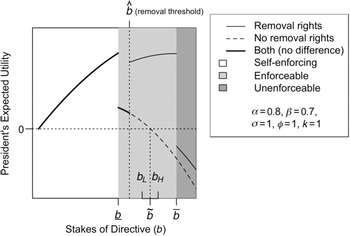
To illustrate how these factors shape the President’s decision to issue a directive, Figure 1 plots the President’s expected utility from issuing a directive as a function of the stakes of the directive, b. The thick lines show regions where the President’s utility is identical regardless of whether the President has removal rights, and the thin lines show regions where the President’s utility differs. The figure also identifies the regions where the directive is self-enforcing, enforceable or unenforceable, which are divided by the cutpoints
 ${\underline {b}}$
and
 $\bar b$
. What is immediately clear is that the region in which a directive falls can have a dramatic impact on the President’s utility. The President’s utility is generally lowest from issuing an unenforceable directive and it is generally highest from issuing a self-enforcing directive. And whether the President gains from issuing an enforceable directive depends on whether the removal threat is credible.
Footnote 13
The President’s issuance decision.
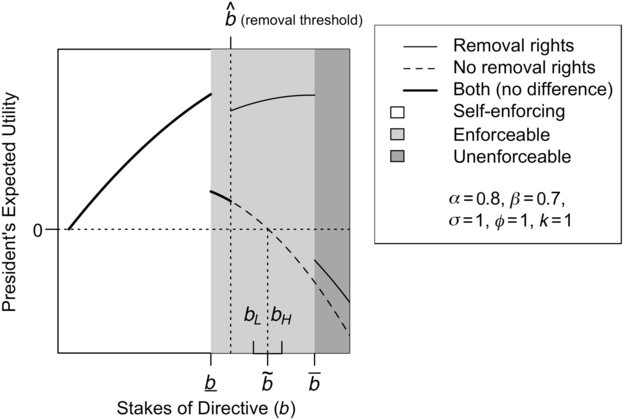
The figure identifies a removal threshold,
 $\hat b} $
, which indicates the point at which the President’s removal threat becomes credible (when
 $b \gt \hat b} $
). When the removal threshold is surpassed, the President’s right to remove the Appointee transforms into actual coercive power over the Appointee, although this power persists only up to
 $\bar b$
, at which point even a loyal Appointee will not implement the President’s directive (for
 $b \gt \bar b$
the directive is unenforceable). In the figure, the removal threshold sits midway through the enforceable region, which is a reminder that the President’s removal right is a blunt instrument. For the threat of removal to be credible, the stakes of a directive must be sufficiently high.
The removal threshold also marks the point at which the President’s utility from issuing a directive starts to depend on whether the President has removal rights. As the stakes of the directive increase and the removal threshold is surpassed, a President with removal rights will continue to see utility gains from issuing higher-stakes directives. Yet, for a President that lacks removal rights, the same higher-stakes directives will bring about a decrease in utility. I state the implications of these patterns as a hypothesis.
Hypothesis 1 (H1) A president will only issue a relatively high-stakes directive when the president has removal rights, although the stakes of the directive must still be low enough such that the directive is enforceable and, thus, can be implemented by the president’s appointees if necessary.
The implementation decision
If the President issues a directive, under what conditions will the Appointee implement it? To characterise the Appointee’s implementation decision, I focus on the compliance rate, which reflects the probability of implementation given the uncertainty surrounding both the loyalty of the Appointee and the loyalty of the state.
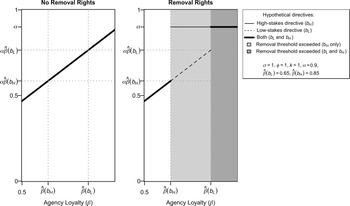
To compare the predictions of the two models, Figure 2 plots a directive’s expected compliance rate, with the benchmark model situated on the left panel and the removal rights model situated on the right panel. In each case, the compliance rate is given as a function
 $\beta$
, the probability that the state is loyal (this is labeled as “Agency Loyalty” in the figure).
Compliance rates.
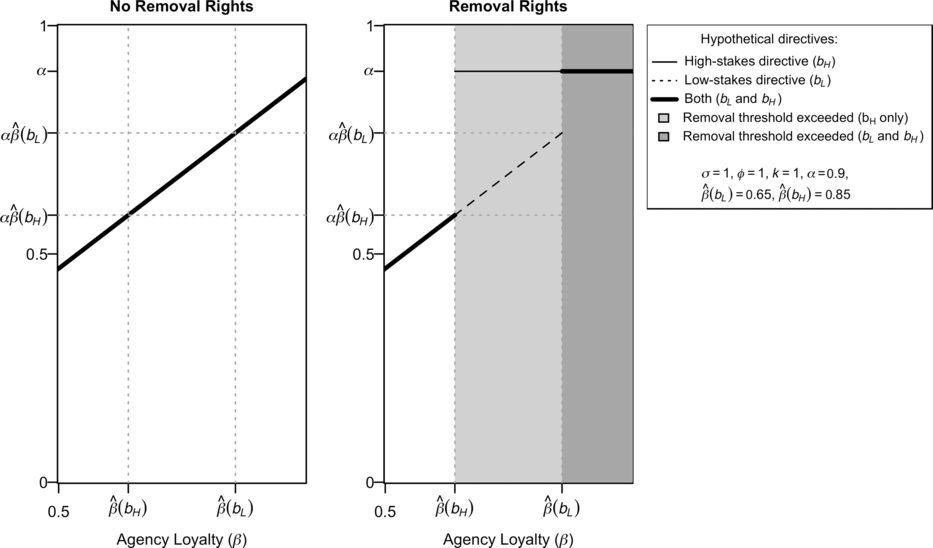
When the President lacks removal rights, as the President does in the benchmark model, the compliance rate is only a function of the uncertainty parameters,
 $\alpha$
and
 $\beta$
. This is reflected in the left panel where the compliance rate increases linearly in
 $\beta$
for a fixed value of
 $\alpha$
. In contrast, when the President has removal rights and the removal threshold has been exceeded, the compliance rate jumps to
 $\alpha$
(and stays there). When this happens, compliance depends entirely on whether the Appointee is loyal.
The location of the removal threshold in the figure is re-expressed in terms of the state variable as
 ${\hat \beta} $
, and to highlight how this threshold varies with the stakes of a directive, I include two hypothetical directives in the figure,
 ${b_L}$
and
 ${b_H}$
, where
 ${b_L}$
has relatively lower stakes and
 ${b_H}$
has relatively higher stakes. In general, the higher the stakes of a directive, the quicker the removal threshold is triggered so that
 ${\hat \beta} ({b_H}) < {\hat \beta} ({b_L})$
.
Figure 2 clearly illustrates that the Appointee’s compliance rate depends on both the stakes of a directive and whether the President has removal rights. We can also use the figure to make predictions about what compliance rates should look like on average for different directives, that is, when we average across the range of
 $\beta$
values (the averages are given by the area under each compliance rate curve). I state the relevant predictions in the following hypothesis.
Hypothesis 2 (H2) Compliance with a directive depends on the directive’s stakes and whether the president has removal rights:
-
(a) When the president has removal rights, the average compliance rate will increase in the stakes of a directive and
-
(b) When the president lacks removal rights, the average compliance rate will be lower than when the president has removal rights.
The model also makes predictions about how the compliance rate should vary with
 $\beta$
. Thus far, I have referred to
 $\beta$
in broad terms as the state variable, although we can also think of it as how loyal an agency is to the president. Under this interpretation, it is intuitive that compliance should increase in agency loyalty.
Footnote 14
Yet, the model highlights that this only happens when the President’s removal threat is not credible. When the threat is credible – that is, when the removal threshold has been surpassed – the compliance rate plateaus and its correlation with agency loyalty falls to zero. I state these predictions as a hypothesis.
Hypothesis 3 (H3) The relationship between how loyal an agency is to the president and the agency’s compliance with a presidential directive is conditional:
-
(a) If the president’s removal threat is credible, there is no relationship between agency loyalty and the compliance rate; but
-
(b) If the removal threat is not credible, or if the president lacks removal rights, the compliance rate will increase with agency loyalty.
The removal decision
When will the President remove the Appointee for not complying with a directive? What the model suggests is that the President will remove the Appointee if two conditions are met. First, the Appointee must fail to implement the directive, and secondly, the directive must exceed the removal threshold (
 $b \gt {\hat b} $
). My focus in this section is on how likely this is to happen.
To evaluate the model’s implication for the likelihood of removal, recall that the President’s utility is typically lowest when the directive is in the unenforceable region, as illustrated in Figure 1. This was captured by H1, which states that a president should issue directives that have relatively low stakes, at least low enough so that the president’s appointees can implement the directive alone. When this happens, a president should rarely need to resort to removing an appointee. We can see this clearly in the context of the model: If the President only issues a directive that is either self-enforcing or where the removal threat is credible, the probability that the President will resort to removing the Appointee is 1 − α, which, as I have suggested already is likely to be a small number. I state this implication as a hypothesis.
Hypothesis 4 (H4) Given a president’s incentive to only issue directives that can be implemented by appointees, a president is unlikely to have to resort to removing an appointee over noncompliance with a directive.
In terms of H4’s broader implications, if we view a directive as a delegation of policymaking authority to an agency, as has been suggested (Lowande Reference Lowande2018; Turner Reference Turner2020), then the directives we do observe should be relatively modest in scope, especially in comparison to the sweeping grants of policymaking authority that Congress has delegated to agencies, which often require major endowments of expertise and manpower to implement (Epstein and O’Halloran Reference Epstein and O’Halloran1999).
Empirical illustration
The theoretical model characterises the strategic environment in which presidents issue directives and in which those directives are subsequently implemented. To help bring the implications of the model into focus, as well as to shed new light on two of the more consequential presidential directives issued in recent decades, I use the hypotheses developed above to analyse President Clinton’s executive order on “Regulatory Planning and Review”, E.O. 12866.
To start, recall that 12866 has two key directives, a reporting directive and a review directive. The reporting directive requires all regulatory agencies, independent agencies included, to publish a timely semi-annual agenda of their planned regulatory activity in the Unified Agenda of Federal Regulatory and Deregulatory Activity (henceforth, the Unified Agenda), thus broadcasting news of their upcoming regulatory plans:
[All agencies] shall prepare an agenda of all regulations under development or review…[that] shall contain, at a minimum, a regulation identifier number, a brief summary of the action, the legal authority for the action (Section 4(b)).
Although the reporting directive is bold in its effort to centralise the regulatory process and improve its transparency, the overall political stakes involved in implementing the directive are arguably modest. The directive does not compel any specific regulatory policy, nor does it require that agency policymaking conform to the president’s policy priorities.
By contrast, the review directive requires agencies to send their significant regulatory proposals, as broadly defined in 12866, to the president for a political review, and the proposals are expected to be in line with presidential priorities:
[Agencies] are responsible for developing regulations and assuring that the regulations are consistent with applicable law, the President’s priorities, and the principles set forth in this Executive order (Section 2(a)).
Given these expectations, it is not surprising that the review directive has been an ongoing source of tension between agencies and presidential administrations (Steinzor Reference Steinzor2012; Bressman and Vandenbergh Reference Bressman and Vandenbergh2006; Heinzerling Reference Heinzerling2014). That said, it is important to underscore that the review directive does not ask appointees to develop specific regulations. Rather, the directive asks the heads of agencies to simply ensure that any regulations that are developed – either by the appointees or, more likely, by the career staff – are consistent with the president’s priorities when they are ultimately submitted for review. Footnote 15
Although 12866 is of obvious importance to presidential policymaking in its own right, it also serves as a useful vehicle for illustrating the boundaries of presidential power in ways that are highlighted by the model. For one, 12866’s directives were issued to different agencies. The reporting directive was issued broadly to all agencies and the review directive was issued narrowly to only those agencies where the president has removal rights. This makes 12866 revealing in a way that comparing directives across executive orders is often not. That is, because 12866’s directives sit within the same order, many of the potential confounders that might also shape a president’s decision to issue a directive narrowly (or broadly) are effectively controlled for.
Secondly, the stakes associated with 12866’s two directives are quite different. The review directive is a relatively high-stakes directive whereas the reporting directive is a relatively low-stakes directive. This allows each directive to be analysed in the context of the model, which yields different predictions based on the stakes of a directive.
A third advantage is that measures exist to track the compliance rate associated with each 12866 directive. And since both directives are procedural in nature, each regulatory action that an agency considers is effectively a “compliance opportunity” for us to analyse. This allows the hypotheses related to compliance with a directive – H2 and H3 – to be tested empirically. I turn to these tests in the sections that follow, after first analysing the decisions made when issuing 12866.
The issuance of 12866
Since 12866 is just one executive order, it precludes testing H1 by analysing the president’s issuance decision across many directives. Nonetheless, it is notable that 12866 does not stand completely alone. Rather, every president since Clinton has reaffirmed 12866 in successive orders, including E.O. 13422 (George W. Bush administration) and E.O. 13563 (Obama administration). And 12866 also has predecessors, namely the two review directives issued by the Reagan administration and maintained by the George H.W. Bush administration, E.O.’s 12291 and 12498. Like 12866, all of these orders also limited the issuance of the review directive to the agencies where the president has removal rights, and they did this despite early assurances from Reagan’s Office of Legal Counsel and the American Bar Association that extending the review directive to the independent agencies was within the president’s constitutional authority (Strauss and Sunstein Reference Strauss and Sunstein1986, p.206). Footnote 16
To gain insight into why the review directive was issued narrowly to agencies where the president has removal rights, we can use the model to construct a counterfactual scenario: What would have happened if the directive were instead issued broadly to all agencies? The main contours of the counterfactual can be seen in Figure 1 above, where
 ${b_L}$
and
 ${b_H}$
are two hypothetical directives, one low-stakes and one high-stakes, that we can imagine reflecting the reporting directive and the review directive, respectively. In the figure, the two directives straddle
 $\tilde b$
, the point at which the President is indifferent about issuing a directive when the President lacks removal rights. If the stakes of a directive are greater than this indifference point, as they are for
 ${b_H}$
, the President will only issue the directive if the President has removal rights. Doing otherwise would give the President a negative payoff, as reflected by the dashed line that descends below zero. These payoffs capture the idea that a directive with higher stakes is more difficult for appointees to implement alone (although not impossible given that
 ${b_L}$
and
 ${b_H}$
fall within the enforceable region), and also that a directive with higher stakes imposes more severe consequences on a president when it is not implemented.
It is easy to see how this counterfactual scenario is relevant to the issuance of 12866. If a president were to issue a review directive to agencies where the president lacks removal rights, a policy disagreement would inevitably arise between the president and one of these agencies over whether to promulgate a regulation, just as it happens with the agencies where the president has removal rights (Heinzerling Reference Heinzerling2014). When the president lacks removal rights, however, a disagreement is harder to resolve because the president’s leverage over the situation is limited. Typically, when the president has removal rights, an appointee will rescind a proposal that, upon review, is found to be problematic for the president. Footnote 17 Yet, when the president lacks removal rights a stubborn appointee does not have to retreat in this way, and can rebuff the president and promulgate the regulation anyway. What the model highlights is that presidents anticipate showdowns like these – and they avoid them.
Compliance rates
In light of H2, the compliance rates associated with the two 12866 directives should depend on the stakes of each directive and whether the president has removal rights. The specific conditions can be re-expressed in a simple two-by-two table, shown here in Table 1, where the compliance rate is: (i) highest for the high-stakes directive when the president has removal rights; (ii) lowest for the low-stakes directive when the president lacks removal rights and (iii) moderate for the low-stakes directive when the president has removal rights. No compliance rate exists for the high-stakes directive when the president lacks removal rights because such a directive is not issued in equilibrium.
Compliance rates by agency and directive type

In the analysis that follows, I measure compliance differently for each directive. Although this is unavoidable since the directives require agencies to take different actions, the measures nonetheless broadly capture whether the president received what the president asked for when issuing each directive. And since nearly every regulatory proposal developed by an agency presents a compliance opportunity, we can construct compliance rates for each directive, both across agencies and over time.
Data and measures
To measure compliance with 12866, I use administrative data on regulatory activity that starts in the Clinton administration and goes through the George W. Bush and Obama administrations. In all, the data covers 118 regulatory agencies and over 11,000 regulatory proposals. Appendix B includes more details on the data collection, summary statistics, and a list of agencies.
To measure compliance with the reporting directive, I use data on all of the proposed regulations that were published in the Federal Register as a Notice of Proposed Rulemaking, or NPRM (
 $N = 11,887$
). According to 12866’s reporting directive, an agency is supposed to announce its planned NPRMs in the Unified Agenda in order to give the public advanced notice. I measure compliance with the indicator ComplianceReporti
that takes on a value of 1 if proposal i (a published NPRM) was preceded by an announcement in the Unified Agenda and a value of 0 if it was not.
To measure compliance with the review directive, I use data on all of the proposed regulations that were submitted to OIRA for review (N = 2,278). Although OIRA does not provide a public record of which proposals are compliant with 12866, they do provide information about which proposals successfully completed the review process and which were instead returned to the agency. I measure compliance with the indicator ComplianceReviewi that takes on a value of 1 if proposal i (a proposal under review) successfully completed the review process and a value of 0 if it was instead returned to the agency. Footnote 18
The president’s removal right is captured by RemovalRightsa , which takes on a value of 1 if the president has removal rights for agency a and a value of 0 if the president does not (for the review directive, RemovalRightsa is always equal to 1 and, thus, is dropped from the analysis).
An agency’s loyalty to the president is captured by the continuous variable AgencyLoyaltyat , which is an approximation of the ideological distance between each agency a and administration t. To create this measure, I took the measure of agency ideology developed by Clinton and Lewis (Reference Clinton and Lewis2008) and pegged each president to the edge of the ideological distribution. That is, I assume that a Democratic president is as liberal as the most liberal agency and a Republican president is as conservative as the most conservative agency. Footnote 19 This assumption is broadly consistent with what other studies have found (Clinton, Bertelli, et al. Reference Clinton and Bertelli2012).
Finally, I measure the stakes associated with each regulatory proposal. This is necessary because individual proposals vary: Some are simply more salient and have greater political implications than others. To account for this variation, I created an index, RegulationStakesi , by applying factor analysis on all of the proposal-specific variables available in my data. This includes, for example, whether a given proposal is expected to impact small businesses, or whether the proposal will impose “unfunded mandates” on lower levels of government. A full list of the variables used to create the index, as well as details on how the index was constructed, is provided in Appendix B.
Empirical models and results
I estimate compliance rates for each directive using a multi-level model, which has the advantage of accounting for the multi-level structure of the data, where regulatory proposals are nested within agencies and presidential administrations. Each model I estimate includes “varying intercepts” (or random effects) for agencies, years and agency-administration pairs, which helps both to account for correlation within these units and, critically, allows for the inclusion of agency-level variables like RemovalRightsa .
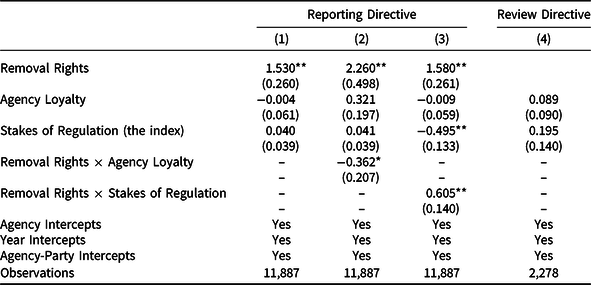
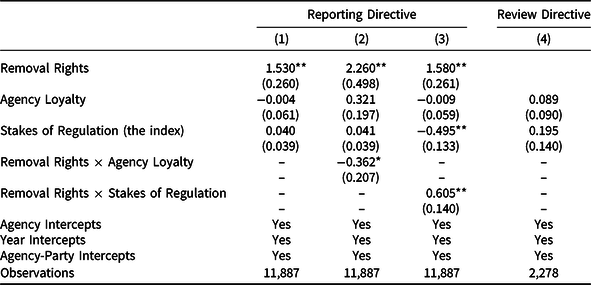
The results from estimating the models are shown in Table 2. In columns 1 through 3, the dependent variable is ComplianceReporti and in Column 4 the dependent variable is ComplianceReviewi . Overall, the results are largely consistent with the hypotheses above. Removal rights clearly increase compliance, as predicted by H2. So does agency loyalty, although this only happens when the president lacks removal rights, as predicted by H3.
Compliance rates (multi-level logit models with varying intercepts)
Note: *p < 0.1; **p < 0.05; ***p < 0.01.
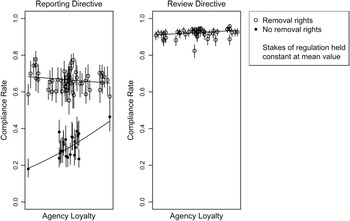
To better appreciate the quantity of interest – the compliance rates – Figure 3 plots a predicted compliance rate for each agency against the measure of agency loyalty. The rates for the reporting directive are on the left panel, which are estimated using the Column 2 model, and the rates for the review directive are on the right panel, which are estimated using the Column 4 model. (Note that an agency shows up twice in each panel because the measure of agency loyalty, AgencyLoyaltyat , varies across administrations.)
Agency compliance rates. Notes: the line segments associated with each circle represent a one standard error deviation from the estimated compliance rate.
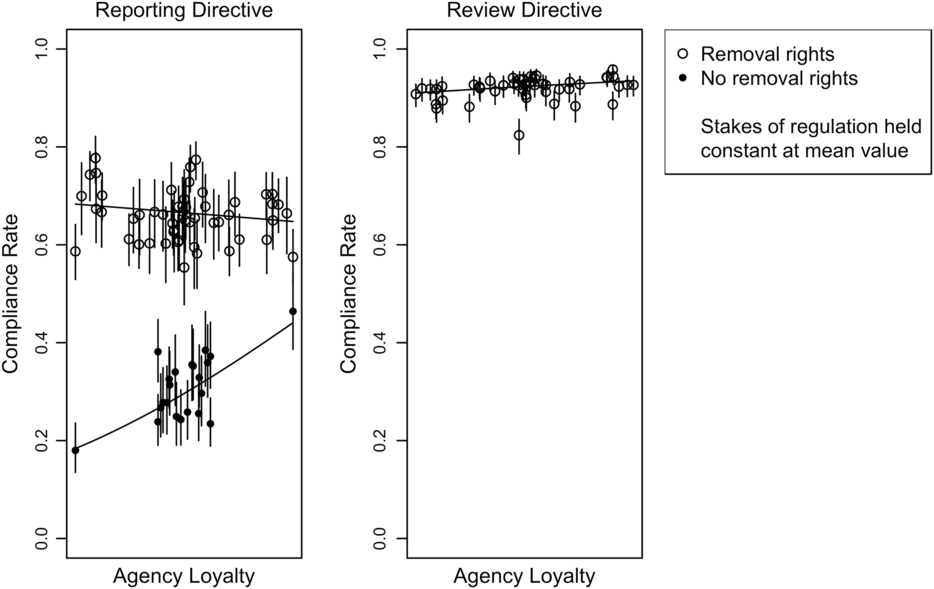
Consistent with H2, the figure shows that compliance with the reporting directive is about 30% points higher in the agencies where the president has removal rights (open circles) compared to the agencies where the president does not (closed circles). Compliance with the review directive is even higher, at a rate of around 0.9, which is also consistent with H2 (though note my caveat about comparing compliance rates across directives). And consistent with H3, the figure shows no apparent relationship between compliance and agency loyalty except in the agencies where the president lacks removal rights. Overall, the patterns in Figure 3 bear a resemblance to the theoretical patterns shown in Figure 2 above.
The empirical results also allow us to consider how the stakes associated with each regulatory proposal affect compliance. For the review directive, it is notable that increasing the stakes of a proposal has no impact on compliance. This suggests that the stakes associated with implementing the review directive are already substantial enough to induce the removal threat. Thus, any added variation in the stakes due to the proposals themselves has no discernible impact on the compliance rates. Footnote 20
For the reporting directive, however, Column 3 suggests that the stakes associated with individual proposals can affect compliance. When the president has removal rights the compliance rate increases by about 13% when moving RegulationStakesi from its lowest value to its highest value. This pattern suggests that the credibility of the removal threat does, in fact, hinge on the stakes associated with individual proposals, whereby the higher the stakes, the more credible the removal threat. Yet, when the president lacks removal rights, the compliance rate decreases by about 30% for the same shift in the index. This suggests that proposals with higher stakes make it more costly for an agency to comply with the reporting directive. Notably, we can only observe this phenomenon in agencies where compliance is not induced by a removal threat. Footnote 21
The results in Table 2 are robust to different estimation approaches, including: (i) pre-processing the data using a genetic matching algorithm to create “balance” between the proposals in agencies where the president has removal rights and those in agencies where the president does not (Ho et al. Reference Ho2007); and (ii) controlling for additional factors that may affect the transaction costs associated with replacing appointees, including presidential approval rates, the number of senators in the president’s party, and formal limitations on replacing an appointee, as captured by a popular measure of agency independence (Selin Reference Selin2015). Details on these robustness checks are available in Appendix C.
Removal of appointees
I close my analysis of 12866 by returning to the question of whether presidents remove appointees over noncompliance. In light of H4, this should be a rare occurrence since presidents have an incentive to only issue directives that are either self-enforcing or enforceable. Testing this prediction, however, is not straightforward. When appointees part ways with an administration, they usually do so discretely, without revealing whether their departure was preceded by a policy dispute with the president. Nonetheless, the model offers a framework for making inferences about removal decisions from the data we do observe.
In the case of the review directive, one indication that appointee removals have been rare is that the compliance rates associated with the review directive have been so high (around 0.9 on average). In light of the model, this suggests that the president’s removal threat has, for the most part, been credible, and that agencies have responded to this implicit threat by generally supplying the types of regulatory proposals that fit within presidential priorities (of course, many agencies and appointees are loyal to the president – both β and α are likely close to 1 – so they will comply with or without a credible removal threat). Another indication that appointee removals have been rare is that compliance with the review directive does not appear to depend on the loyalty of the relevant agency or the stakes of individual proposals. As discussed, the lack of variation here is consistent with the existence of a credible removal threat.
In the case of the reporting directive, compliance has generally been lower, at around 0.7 when the president has removal rights. Does this indicate that appointees have been removed for noncompliance? Probably not (although it does indicate that the directive has not been self-enforcing). More likely, the lower compliance rates are driven by variation in the stakes of individual regulatory proposals. Some proposals may push the stakes associated with implementing the directive above the removal threshold, whereas other proposals may not reach this bar. This is consistent with the evidence in Column 3 of Table 2, which shows how compliance with the reporting directive increases with the stakes of individual proposals when the president has removal rights. Footnote 22
Conclusion
I motivated this paper with a question about whether presidents have the power to direct subordinates in the bureaucracy to enact policy changes. One reason this question has been difficult to answer is that presidents generally tend to only issue directives when the conditions necessary for implementation are favourable (Turner Reference Turner2020), such as when there is sufficient policy coordination within the bureaucracy (Krause and Dupay Reference Krause, Dupay, Provost and Paul2009; Rudalevige Reference Rudalevige2012), or when an agency is already working on a policy that aligns with a president’s goals (Kagan Reference Kagan2001, p.2299). All of this suggests that the issuance of a directive may not tell us anything about the scope of a president’s real authority over policy change.
To account for the strategic situation in which directives are issued, I develop my predictions for how presidential power should manifest from a game-theoretic model of decision-making, which assumes that a president has the formal authority to both issue directives and to remove some subordinates in the bureaucracy. I then use the predictions from the model, as stated in the hypotheses above, to analyse the issuance and compliance decisions surrounding a unique set of presidential directives contained in E.O. 12866 and its successors.
My analysis highlights that the president’s real authority over policy change is far from absolute. It is also beset by a simple paradox. A president can exert more influence over subordinates by issuing higher-stakes directives, which are advantageous because they make a president’s removal threat more credible and, consequently, incentivise compliance. But issuing directives with higher stakes also means that the directives will be more challenging to implement, even for loyal subordinates of the president, which in turn creates a new set of compliance challenges. At the heart of it, a president’s leverage over subordinates in the bureaucracy rests on a blunt instrument – the removal right – which can limit a president’s ability to use directives to exert real authority over the direction of policy change.
Although my analysis focuses on presidential power in the US, the overall framework is quite general. It would be straightforward to extend the model to study the implications of allocating different formal rights to a president. For example, the benchmark model extends the basic framework by stripping the president of its removal right, but a different extension could analyse a situation where bureaucrats have fewer civil service protections, and, consequently, the president’s removal rights are more expansive. This may be as simple as assuming that the state variable, β, takes on relatively higher values, which are more favourable to the president. In terms of specific empirical settings, my focus has been on a separation of powers system, but many features of the setup would also apply in a parliamentary setting, where a prime minister has the right to remove ministers and to direct them to take action, and where ministers must, in turn, rely on a standing bureaucracy to implement policy changes. In essence, if we carefully specify the formal rights allocated to those at the top of a hierarchy, we can analyse how these rights confer real authority over policy decisions.
Data Availability Statement
Replication materials are available in the Journal of Public Policy Dataverse at https://doi.org/10.7910/DVN/W1OKNR, Harvard Dataverse, V1.
Supplementary material
To view supplementary material for this article, please visit https://doi.org/10.1017/S0143814X20000264.
Acknowledgements
I thank Sharece Thrower, two anonymous reviewers, and seminar participants at SPSA 2018 for helpful comments and suggestions. All remaining errors are my own.