It is without controversy that the current opioid crisis in the United States was initiated by the high-volume prescription opioid prescribing habits of clinicians fueled by aggressive marketing by manufacturers and lax controls over distribution.Reference Volkow, McClellan, Van Zee, Guy, Zhang and Bohm1 High volume opioid prescribing got its start in 2001 when the U.S. Drug Enforcement Agency joined other health care organizations in calling for more aggressive treatment of pain, and sharply increased its manufacturing quotas for a range opioid products.Reference deShazo, Johnson, Eriator and Rodenmeyer2 As a result, nearly 400,000 Americans have died since 1999, opioid overdose deaths have increased more than five-fold since 1999, and more than 47,000 Americans died in 2017 alone.Reference Bohnert, Valenstein and Bair3 Rates of prescription opioid overdose deaths increased steadily to 4.9 per 100,000 in 2011, then declined for two years to 4.4 per 100,000 in 2013 before beginning to increase again 2014.4 Although the majority of opioid-related overdose deaths since 2014 have been attributed to non-prescription opioids such as heroin and illicit fentanyl, prescription opioids were still involved in 40% of opioid-related overdose deaths in 2017.5
In addition to the staggering opioid-related death rates, high volume prescribing has also contributed to a stark increase in prescription opioid misuse (e.g., taking more than prescribed or taking in a manner other than prescribed, such as to help one relax) and dependence.Reference Guy, Zhang, Schieber, Young and Dowell6 The National Survey on Drug Use and Health found that 9.9 million Americans reported misusing opioid analgesics in 2018, and an additional 1.7 million Americans met diagnostic criteria for a prescription opioid use disorder in 2018.7 Rates of misuse of opioid analgesics peaked in 2009 at 2.1% of the U.S. population, then declined to 1.2% in both 2016 and 2017, and 1% in 2018.8
The Availability of Prescription Opioids
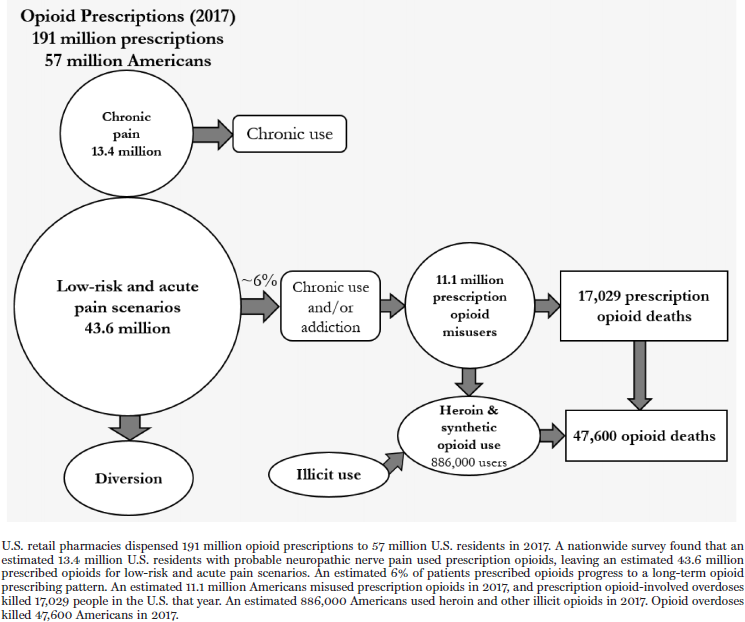
Despite a decline in prescribing since 2011, in 2017 U.S. retail pharmacies still dispensed 191 million opioid prescriptions to 57 million U.S. residents,9 and the quantity in morphine milligram equivalents in 2017 (166.9 billion MMEs) still remained 35% greater than in 2002 (123.7 billion MMEs).Reference DiBonaventura, Sadosky and Concialdi10 A study of 14 million commercially insured patients found that 80% of opioid-naïve patients filled prescriptions for an opioid analgesic after undergoing a low-risk surgical procedure such as carpal tunnel release, hernia repair, and knee arthroscopy.Reference Wunsch, Wijeysundera, Passarella and Neuman11 Of prescriptions filled, 86% were for hydrocodone- or oxycodone-combination products, which remain among the nation's most commonly misused medications.
Evidence that high volume prescribing continues comes from the results of patient surveys about behaviors after dispensed opioid prescriptions. For example, surveys have revealed that 67% to 92% of patients reported unused tablets after surgeries, and that up to 71% of opioid tablets dispensed remain unused.Reference Bicket, Long, Pronovost, Alexander and Wu12 Findings such as these have led researchers to conclude that prescribing exceeds use from 1.9-to 6.8-fold for all procedures for which opioids are prescribed.Reference Theisen, Myrga and Hale13 More alarming is the finding that only a small minority of patients (between 4% and 30%) reported plans to properly dispose of unused opioid tablets, and a large majority of patients (73% to 77%) reported storing opioids in an unlocked location.14 This reservoir of unused opioid tablets has important social implications because these medications are then available for diversion (use by someone not prescribed) or misuse. For example, an estimated 53% of Americans who misused prescription opioids in 2017 reported that they obtained them from a friend or relative, often for free.15
Furthermore, an examination of nationwide insurance claims data found that 6% of privately insured patients continued to use opioids at least 90 days after undergoing a surgical procedure; a timeframe far beyond that required for typical healing.Reference Brummett, Waljee and Goesling16 Also, of patients prescribed opioid analgesics for low-risk procedures, 6% progressed to long-term opioid use.Reference Hooten, St. Sauver, McGree, Jacobson and Warner17 These facts provide support for the conclusion that chronic opioid use represents a common and under-recognized complication for the estimated 50 million Americans who undergo outpatient surgical procedures each year.Reference Wunsch, Wijeysundera, Passarella and Neuman18
Opioid Availability and the Movement from Use to Misuse to Chronic Use — Prescribing Practices
Not only does the wide availability of prescription opioids contribute to the likelihood of misuse and chronic use, but more specific prescribing practices of clinicians does as well. These practices include high-dose prescribing, lengthy prescription periods, and prescribing long-acting opioid formulations over immediate-release formulations.Reference Dowell, Haegerich and Chou19 For example, a study of prescribing data collected from 1.3 million patients from 2006 to 2015 found that the probability of long-term opioid use increased sharply in the first days of therapy.Reference Shah, Hayes and Martin20 Patients prescribed an initial opioid for seven days had a 16% risk of continued use at one year, and an 8% risk of continued use at three years.21 Long-acting extended-release opioid formulations were also associated with the greatest probability of continued use after one year (27.3%), and at three years (20.5%).22 Higher opioid dosages are also associated with an increased risk of overdose with prescribed dosages at or above 50 morphine milligram equivalents (MMEs) per day carrying twice the risk of overdose compared with prescribed dosages of 20 MME per day or less.23 Not reviewed here, but significantly increasing the risk of prescription opioid-overdose mortality, is other high-risk prescriber behavior such as co-prescribing opioids with benzodiazepines or other sedative-hypnoticsReference Peckham, Fiarman, Awanis and Early24 which remains a significant concern despite the FDA's black-box warning in 2016.
Recognition of the Association between Opioid Prescriptions and Opioid-related Overdose Deaths
The connection between prescription opioid prescribing, misuse and overdose deaths was recognized by the CDC in 2011 when the agency reported that opioid analgesic sales, rates of nonfatal opioid prescription opioid overdose treatment admissions, and rates of overdose deaths all increased in parallel from 1999 to 2008.25 Rates of death from prescription opioid overdoses increased four-fold from 2000 to 2014 (from 1.5 to 5.9 deaths per 100,000 persons).Reference Compton, Jones and Baldwin26 Prescription opioid misuse also is a major risk factor for later heroin use.Reference Muhuri, Gfroerer and Davies27 Of the estimated 886,000 Americans who used heroin and illicit opioids in 2017, nearly two-thirds (562,000) also misused prescription opioids.28 To make matters worse, increased opioid analgesic prescribing also contributed to increased heroin use, and a related five-fold increase in heroin overdose deaths from 2000 to 2014.29 From 2012 to 2017, however, the number of heroin-involved deaths increased from 5,925 to 15,482, or a 161% increase in just five years. The official tally of overdose deaths involving illicit synthetic opioids such as fentanyl have increased an astonishing 10-fold in the same period, from 2,628 in 2012 to 28,466 in 2017.30
Limitations and Restrictions: A Response to Opioid Over-Prescribing Federal and Industry Response.
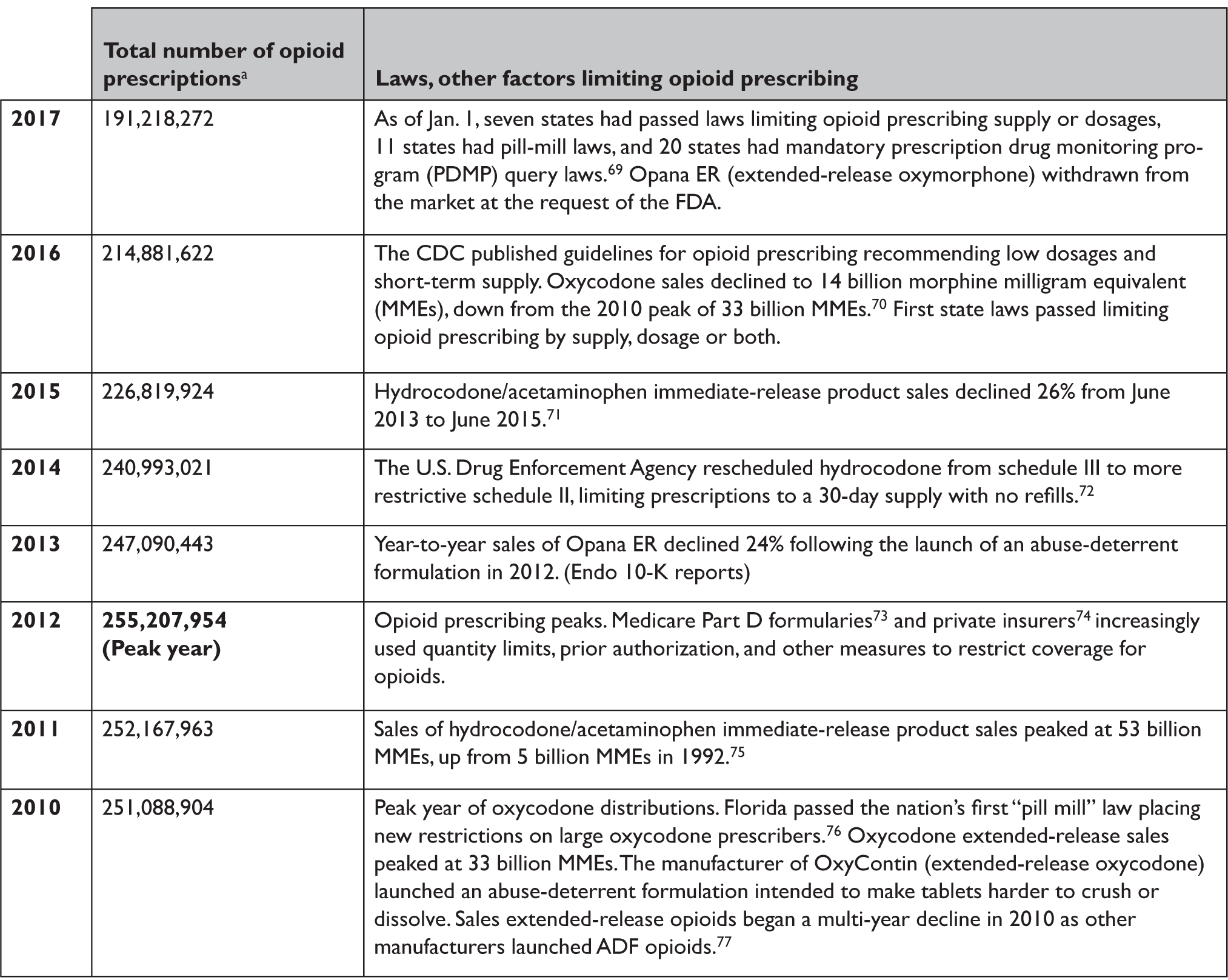
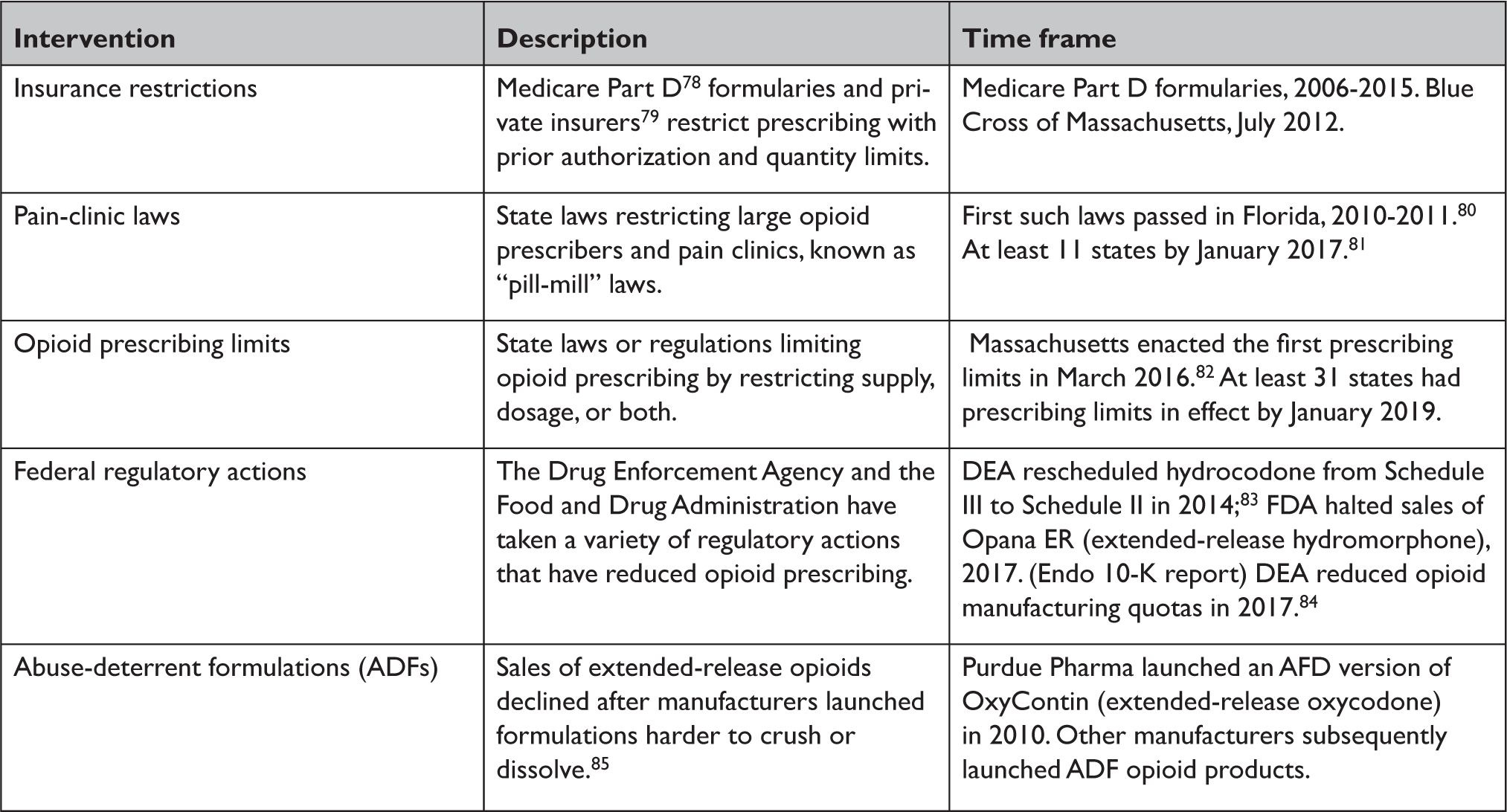
The period between 2010 and 2012 marked the beginning of a change in awareness of the influence of prescription opioid over-prescribing on opioid-related overdoses in the United States. The recognition of opioid over-prescribing led to a variety of overdue interventions aimed at limiting prescribing, that appear to have contributed to a decline in opioid prescribing from its peak in 2011.31 One such intervention came from the federal government and insurance industry. From the period beginning in 2006 through 2015, Medicare Part D formularies and private insurers used prescription quantity limits and prior authorization to restrict increasingly the coverage of prescription opioids.Reference Samuels, Ross, Dhruva, Garcia, Dodek and Kowalski32 Beginning in 2010, several pharmaceutical manufacturers also launched abuse-deterrent formulations (ADF) of their extended-release opioid anal-gesics intended to make the tablets more difficult to crush or dissolve for purposes of misuse. ADF formulations led to a multi-year decline in sales of extended-release opioids.33
Opioid prescribing leads to misuse and overdose deaths

Additional federal agencies also took steps to restrict opioid prescribing. The U.S. Drug Enforcement Agency (DEA) rescheduled hydrocodone from a Schedule III drug to the more restrictive Schedule II controlled substance in 2014 and limited prescriptions to a 30-day supply with no refills.Reference Jones, Lurie and Throckmorton34 The rescheduling of hydrocodone resulted in a 22% decline in sales of hydrocodone-acetaminophen combination products in the following year.35 The DEA also reduced quotas for manufacturers of opioid products in 2017.36 Also in 2017, the U.S. Food and Drug Administration (FDA) requested that Endo Pharmaceuticals remove Opana ER (extended-release oxymorphone) from the market37 after abuse of the reformulated drug was linked to local outbreaks of HIV and hepatitis C.Reference Broz, Zibbell and Foote38
State and Local Responses
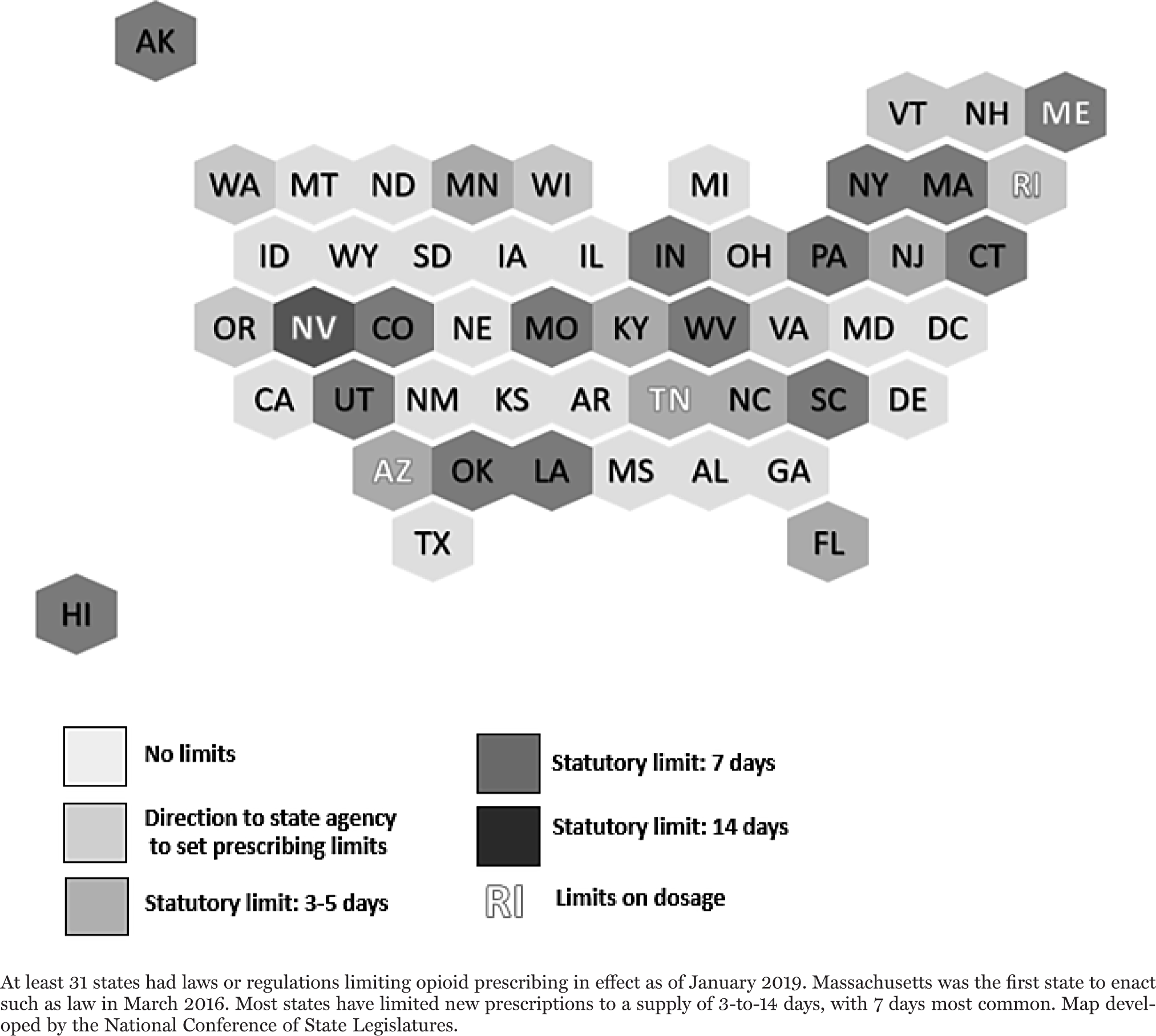
State governments have led some of the most ambitious efforts to restrict opioid prescribing (Figure 3). The new restrictions on opioid prescriptions implemented at the state level have focused on the duration and the dosage of the opioids prescribed. Florida law-makers responded to a steep increase in prescription opioid overdose deaths from 2003-2009 by enacting a variety of laws, collectively known as “pill-mill laws,” in 2010 and 2011 that placed strict restrictions on pain management clinics with the goal of preventing clinics from dispensing opioids without medical indication.Reference Rutkow, Vernick and Alexander39 Those laws, and the enforcement efforts that followed, are credited with a 27% decline in prescription opioid overdose death rates in Florida from 2010 to 2012.Reference Johnson, Paulozzi, Porucznik, Mack and Herter40 By 2017, at least 11 states had enacted similar legislation.
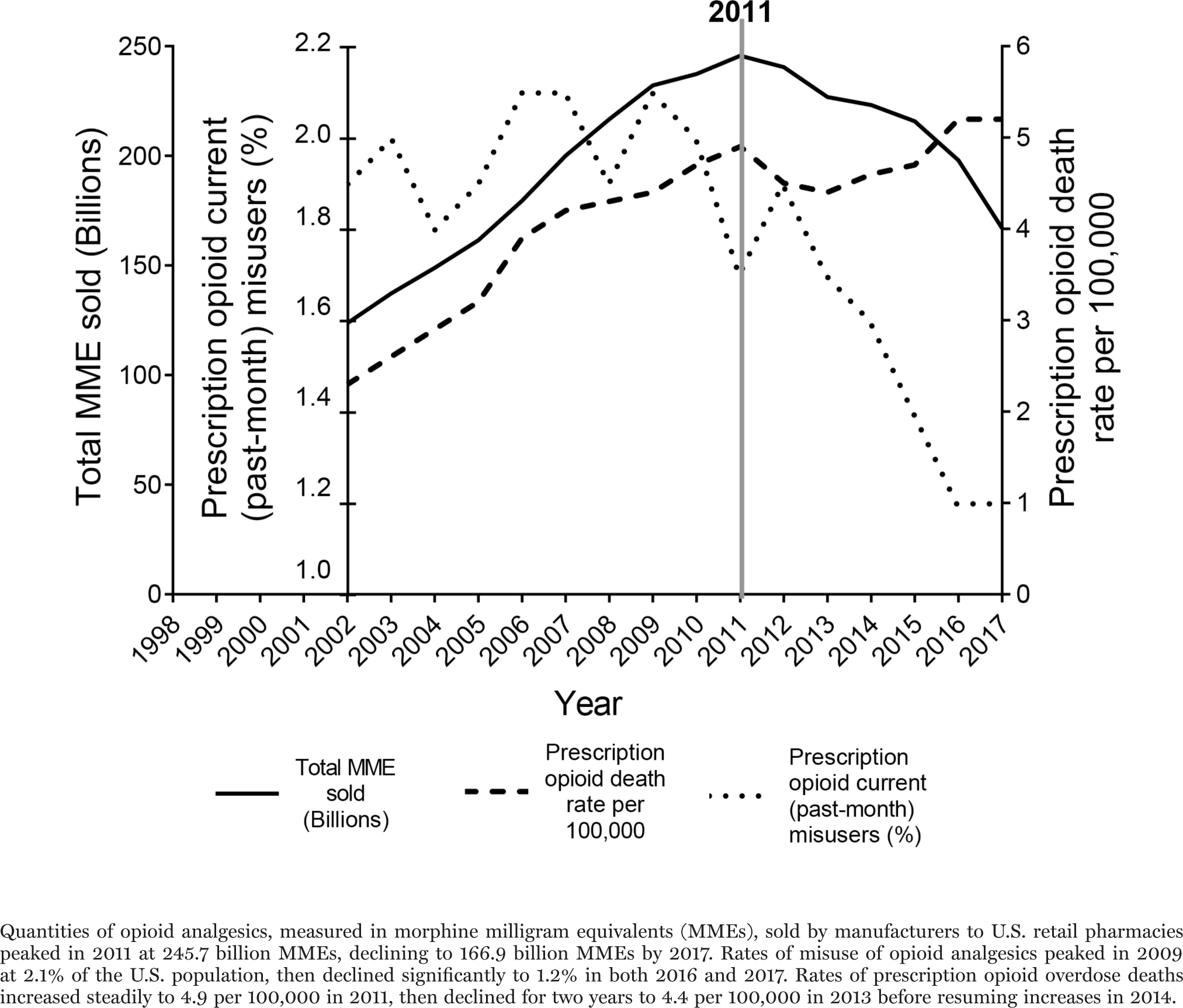
Opioid prescriptions and misuse peak in 2009-2011

Recent state laws and regulations limiting opioid prescribing

In 2016, Massachusetts passed the nation's first law limiting first-time prescriptions to a seven-day supply limit.Reference McGinty, Stuart, Caleb Alexander, Barry, Bicket and Rutkow41 Other states have followed suit, and as of early 2019, at least 31 states had similar laws, regulations or policies in place. The time supply limits on first-time prescriptions of these similar laws, regulations or policies in other states range from three to 14 days with a seven-day restriction being the most common.42 At least five states have also placed specific restrictions on daily dosages, and specific restrictions on prescribing for minors.43
Although these prescribing limits were also enacted with other regulatory efforts directed at opioid prescribing, such as prescription monitoring programs (PMPs), and first-responder naloxone training,Reference Henke, Tehrani, Ali, Mutter, Mazer-Amirshahi, O'Brien and Mark44 restricting opioid prescribing appears to be an important facet of a multi-pronged policy approach to reducing prescription opioid-related misuse, dependence and overdose death. A decline in opioid prescribing since 2011 has coincided with a steep decline in opioid analgesic misuse, and a two-year (2012-2013) decline in the rate of prescription opioid overdose deaths. Quantities of opioid analgesics sold by manufacturers to U.S. retail pharmacies peaked in 2011 at 245.7 billion morphine milligram equivalents (MMEs), declining to 166.9 billion MMEs by 2017.Reference Huang, Keyes and Li45
One challenge to restricting opioid prescribing, especially related to the Centers for Disease Control recommendations and one of the unintended effects of these guidelines is that they did not account for patients who were stable on higher than recommended doses nor did they account for safe tapering of patients on high doses of opioids.Reference Kertesz, Satel, DeMicco, Dart and Alford46 In a study of patients tapering off of opioid therapy for chronic pain, 56.5% of patients continued to use prescription opioids to avoid opioid withdrawal syndrome.Reference Weiss, Potter, Griffin, Kosten and Baxter47 There are now several guidelines available to prescribers on methods of managing opioid withdrawal in their patients, and their use is strongly indicated because of the severe medical complications that can accompany opioid withdrawal including severe dehydration from vomiting and diarrhea, as well as dropout due to withdrawal symptoms and overdose soon after dropout from treatment.48
Discussion
The recognition that high volume opioid prescribing fueled the country's opioid epidemic and the resulting restrictions placed on such prescribing as well as other regulatory efforts appear to be having their desired effect as opioid prescribing and prescription opioid misuse have declined in tandem in recent years. The quantity of morphine milligram equivalents (MMEs) sold by U.S. pharmacies peaked in 2011 at 245.7 billion MMEs, then declined steadily to 166.9 MMEs in 201749 (Figure 2). Rates of prescription opioid misuse also have declined steadily since 2012. After hovering between 1.8% and 2.1% of the U.S. population from 2002 to 2012, misuse declined to 1.2% in both 2016 and 2017.50 Perhaps most encouraging of all, the decline in opioid prescribing is also appearing to slow decades of increasing opioid overdose deaths. Rates of prescription opioid-involved overdose deaths have climbed consistently each year, from 2.3 per 100,000 in 2002, to 4.9 per 100,000 in 2011. Beginning in 2012, the prescription opioid overdose death rate declined for two years, dropping to 4.4 per 100,000 in 2013 before resuming a gradual increase the following year.51 Some have argued that most of the decline in opioid prescribing and decline in prescription opioid mortality has resulted from the implementation of prescription monitoring programs (PMPs) across the country. A recent meta-analysis did not find, however, evidence to support an association between PMPs and decreased opioid prescribing.Reference Wilson, Hayden, Rhodes, Robinson and Asbridge52 In fact, a recent examination of the effects of a law mandating that providers review PMP data before prescribing opioids in the emergency department found no differences in pre-PMP legislation to post-PMP legislation on the prescribing of opioids.Reference Khobrani, Perona and Patanwala53 The percentages of patients prescribed opioids and the morphine milligram equivalent doses were exactly the same. Automated PMPs (where the PMP “pushes” clinically relevant data to providers during a patient encounter) have also shown no effect on opioid prescribing in emergency departments.Reference Sun, Charlesworth and Lupulescu-Mann54 What has been shown to be effective at reducing the percentage of emergency department patients who receive opioids and reduced morphine milli-gram equivalent doses when prescribed is prescribing guidelines.Reference Weiner, Price, Atalay, Harry and Pabo55 There is also evidence that distribution of naloxone (drug used for reversing an opioid overdoes) has been rapidly expanded and has shown some efficacy in reducing opioid-related overdoses, but broader distribution and education about prescription opioid overdose signs and symptoms continues to be needed. Prescription opioid overdose reversals were the lowest and in those that were reversed by naloxone, the doses were not administered by laypersons.56 Although it is important to utilize additional ways to reduce opioid misuse and overdose deaths, findings such as these highlight the fact that the pressure must remain on prescribing limitations in order to have the most direct effect on reducing opioid prescribing and prescription opioid overdose death.
There have also been arguments that the distribution of take-home naloxone with an opioid prescription obviates the need to further restrict opioid prescribing. Take-home naloxone is an increasingly accepted and effective public health strategy to reduce opioid-related overdose death,Reference McDonald, Campbell and Strang57 however, a closer examination of the effectiveness of take-home naloxone illuminates the need for much more work in this area. In one examination of the effectiveness naloxone revealed that heroin and prescription overdoses occurred equally in the presence of others, received equal paramedic dispatch and CPR delivery, but that heroin overdoses received naloxone rescue at twice the rate as prescription opioid overdoses (20.8% heroin vs. 10% prescription opioid).Reference Levy, Spelke and Paulozzi58
The opioid crisis in the United States has become more complex in recent years with a dramatic increase in the number of overdose deaths involving illicit opioids. This surge in illicit opioid deaths has also led some to argue that prescription opioids are no longer central to the opioid crisis and that further efforts to restrict prescribing would have limited benefit and drive many medical systems to severely limit or prohibit opioid prescribing.Reference Comerci, Katzman and Duhigg59 Prescription opioid overdose deaths continue to account for greater than 36% drug overdose deaths nationally, both because they remain widely prescribed by historical measures, and because large quantities of opioid pills find their way into the illicit market where they become available for misuse. An analysis of National Survey on Drug Use and Health data found that among persons aged 12 to 49, the heroin incidence rate was 19 times higher among those who reported nonmedical use of prescription opioids than among those who did not.Reference Muhuri, Gfroerer and Davies60 The risk for transition from legitimate use to misuse is even more acute for adolescents. For example, legitimate use of opioids by adolescents is independently associated with a 33% increase in the likelihood of future opioid misuse in drug naïve adolescents.Reference Miech, Johnston, O'Malley, Keyes and Heard61 Misuse of opioid analgesics also offers a predictable pathway to heroin use, particularly for adolescents. A recent study of young adult opioid users found that the initiation of nonmedical prescription opioid use in mid-adolescence provided an entryway to heroin use and injection heroin use for many young users.Reference Guarino, Mateu-Gelabert, Teubl and Goodbody62 Moreover, given the high rates of morbidity and mortality associated with prescription opioids, we strongly emphasize that clinical guidelines consistently note the weak and limited evidence for the use of opioids for the management of chronic pain.Reference Chou, Fanciullo, Fine, Adler, Noble, Treadwell, Tregear, Coates, Wiffen, Akafomo and Schoelles63
Opioid prescribing and influencing factors
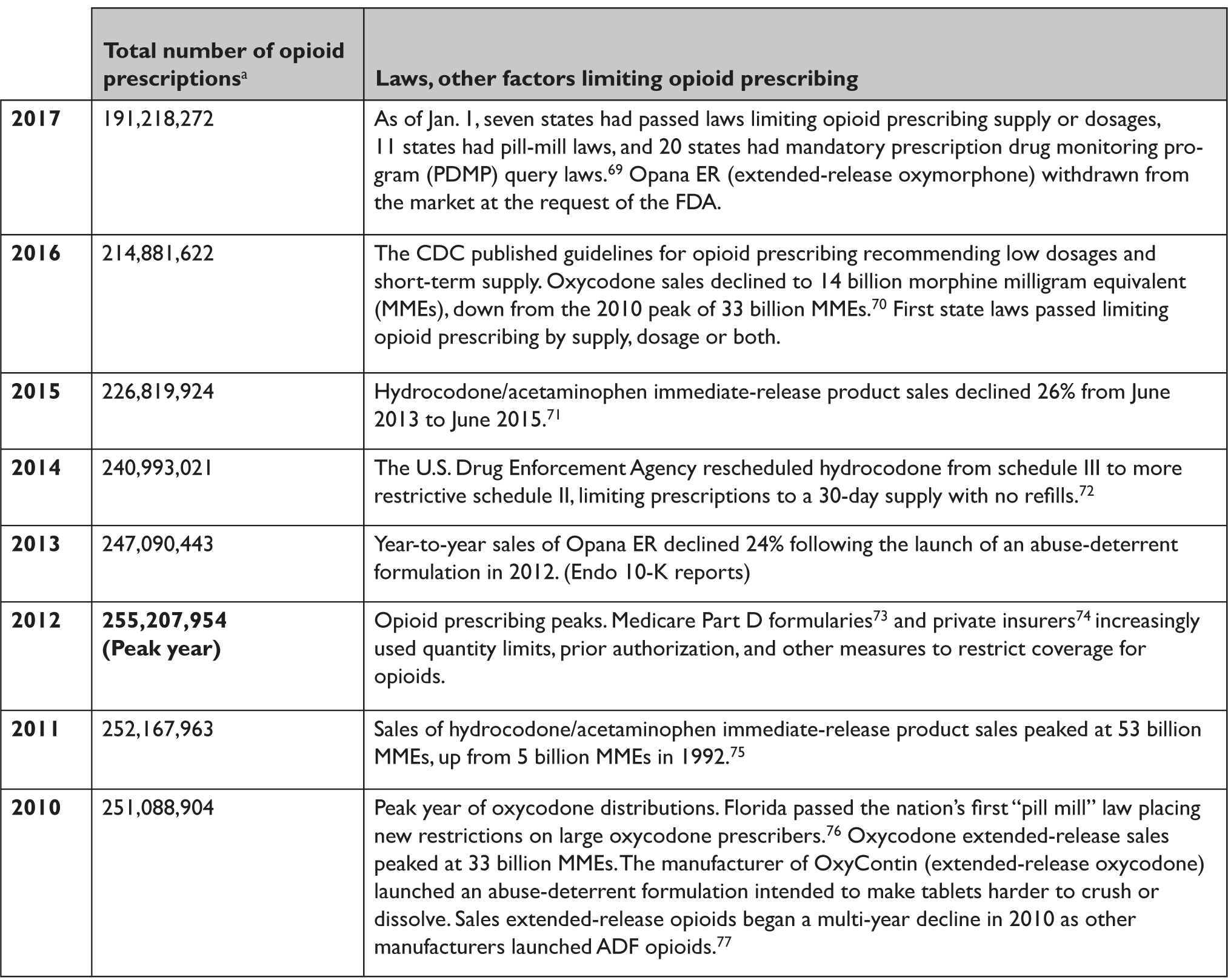
a Prescription defined as an initial opioid prescription or refill dispensed by a retail pharmacy.
In addition to continued restrictions on opioid prescribing, we also recommend the implementation of opioid stewardship programs which are an additional important effort at the level of health systems. Opioid stewardship programs are modeled after antibiotic stewardship programs, which have been shown to be very effective at reducing inappropriate antibiotic prescribing and the associated poor patient outcomes.Reference Davey, Brown, Charani, Malani, Richards, Kapila, Otto, Czerwinski and Singal64 Successful antibiotic stewardships programs have seven elements that translate nicely to opioid steward-ship programs. These elements include Leadership Commitment and the commitment of appropriate resources; Accountability of a single leader responsible for opioid-related outcomes; Drug Expertise in a single physician responsible for working to improve opioid use; Action in conducting systematic evaluation of ongoing treatment; Tracking of opioid prescribing and outcomes; Reporting on opioid use that is routine to physicians and nurses; and Education of clinicians about appropriate opioid use. The goals of these programs are to prevent opioid-naïve patients from receiving opioids unnecessarily, to encourage monitoring for patients who are prescribed opioids, and to provide medication assisted treatment with medications such as buprenorphine for patients with opioid-use disorders.Reference Weiner, Price and Atalay65 Opioid stewardship programs are likely to become more common under new standards from the Joint Commission, effective January 2018, that require hospitals to ensure safe and judicious use of opioids.
It is without controversy that high volume opioid prescribing contributed to this country's current opioid crisis, both before and after 2011 when opioid prescribing peaked. State and federal actions, including Medicare formulary restrictions, constrained physician prescribing and led to reductions in opioid misuse.66 Most strikingly, the rate of prescription opioid overdose deaths declined in 2012 and 2013 after more than a decade of annual increases.67 We argue that in combination with other regulatory policies aimed at changing prescriber patterns, that opioid prescribing restrictions are an important facet of in multi-pronged policy approaches. This study also offers evidence that opioid analgesics remain overprescribed, widely misused, and too often serve as a bridge to other illicit opioid use. Continued studies are needed to examine the effectiveness of the interventions intended to mitigate excessive opioid prescribing, and better inform policy-makers. State laws limiting opioid prescribing mark a major new policy initiative, but their effectiveness has yet to be thoroughly evaluated.Reference Parker, Strunk and Fiellin68
Interventions that contributed to declines of opioid prescribing