A great deal of work in both political science and economics has asked the question of whether subjective economic assessments (i.e., retrospective perceptions and/or expectations) are accurate – at either the individual level or when averaged over a representative sample of individuals.Footnote 1 In economics, interest in this question is animated by the desire to test the assumptions of rational expectations models that assume that the individual’s economic assessments are as accurate as they can be. In political science, interest in the question stems from the ubiquitous use of, and apparent empirical power of, economic assessments in individual models of the vote choice.
In this article, we hope to advance the general discussion of the accuracy and sources of economic assessments in three ways. First, following the large literature testing rational expectations in economics, we use a new dataset that allows us to test the unbiasedness implication of the rational expectations hypotheses (REH) in a larger sample of countries (over a larger time period) than has previously been possible. This exercise reveals a great deal of country-by-country and over-time variation in both the accuracy of expectations and the nature of the biases in expectations (i.e., whether they are pessimistic or optimistic). In addition, in only three of our ten countries do we fail to formally reject the unbiasedness condition of the REH. Secondly, given this variability in the accuracy of expectations across countries, our second contribution is to elucidate a theory of expectation formation that both encompasses the unbiasedness prediction of the REH and sets out the conditions under which economic expectations should be too optimistic or too pessimistic. Thus, we can use it to identify variables that may condition the accuracy of expectations across contexts. Our theoretical approach builds on Zaller’s theory of attitude formation.Footnote 2 We think this approach draws a useful link between the way political scientists think about attitude formation and how economists usually think about expectation formation. Finally, our theory suggests how the political context affects the formation of expectations and hence their average accuracy; we test these predictions with our large dataset of expectations.Footnote 3 To our knowledge, this represents the first systematic examination of the way that political context can impact the accuracy of expectations across a large number of different contexts. Before we get to the theory and analysis, however, it will be useful to briefly review the work in political science that motivates this project and that we hope it informs.
Economic assessments and economic voting in political science
Subjective economic evaluations are widely employed in both micro-models and macro-models of vote choice – the ubiquitous economic voting models. But the inclusion of these subjective evaluations in voter preference models is controversial. At the individual level, studies have documented the extent to which individuals are poorly informed about the real economyFootnote 4 or demonstrated that their economic evaluations are shaped by factors unrelated to the real economy.Footnote 5 Also, at the aggregate level, some recent studies suggest a disconnect between economic evaluations and the actual economy.Footnote 6
Kramer’s classic essay is an important foundation for the notion that individual-level measures of subjective economic evaluations suffer from serious measurement error.Footnote 7 He suggested that variations in economic evaluations were essentially variations in responses to a question regarding perceptions of a constant (the national economic outcome which does not vary in a cross-sectional survey). Any error in individual perceptions of this constant would be likely, he argued, to be influenced by vote preference. Kramer’s conclusion was that this would inflate estimates of the magnitude of the economic vote. And there is a body of empirical literature documenting the factors that probably influence the ‘error’ in individual evaluations. Partisanship, as Kramer points out, is one of the most important factors but other factors also can influence this measurement error, such as attention to the media or information levels.Footnote 8
If, in fact, there is serious systematic error associated with individual-level measures of economic evaluations, this would certainly raise the possibility that, once averaged over individual respondents, these evaluations might incorporate this error and hence deviate significantly from actual economic outcomes. One school of thought, however, concedes that at the individual level measures of economic evaluations are rife with measurement error, but that these evaluations aggregated to the macro-level provide a meaningful gauge of economic sentiment: ‘Whatever bizarre, confusing, or personally biased perceptions individual citizens bring to the evaluation task, in the aggregate all that idiosyncratic variation is self-canceling. The aggregate of individual expectations then becomes a quite orderly response to the flow of economic news’.Footnote 9
Empirically, Mackuen, Erikson and Stimson establish their case by conducting standard Granger causality tests demonstrating, first, that the real economy causes economic sentiment and, secondly, that the real economy causes popular approval of the president.Footnote 10 Just as importantly, they establish that the real economy’s impact on presidential approval is primarily through its effect on economic evaluations. Thus, while economic evaluations might be error ridden at the individual level, once aggregated to the national level they provide a reliable gauge of mass economic sentiment. This suggests that the real economy and the aggregate evaluations of the real economy should be highly correlated (again, recognizing that there is some disagreement regarding the precise functional form of this relationship).
This is not universally accepted. In fact, another school of thought argues that the biases reflected in measures of economic evaluations at the individual level are also prevalent in aggregate series of economic evaluations. For example, Durr provides evidence that deviations between the real economy (as captured by four objective economic indicators) and economic expectations in the United States are systematically responsive to trends in the popularity of the president.Footnote 11 Specifically, when the president evoked particularly high (or low) levels of popularity, economic evaluations were higher (or lower) than levels one would expect given the objective economy. This result is echoed in the work of Freeman et al.,Footnote 12 who re-examine the empirical estimates on which Mackuen, Erikson and Stimson base their argument that economic sentiment mediates the impact of the real economy on presidential popularity.Footnote 13 By accounting for the possibility that measures of popularity, economic performance and economic sentiment are cointegrated, the authors demonstrate that presidential popularity has a causal impact on business expectations and, consequently, that a considerable portion of the variance in economic sentiment is related to factors other than fluctuations in the real economy.
More recently, De Boef and Kellstedt, adopting a strategy similar to Durr, demonstrate once again that considerable variation in economic sentiment in the United States is unrelated to actual economic outcomes. They identify presidential popularity as having a significant and direct impact on the US consumer confidence series and demonstrate that media representations of the economy indirectly affect the consumer confidence series through its effect on evaluations of the government’s handling of the economy.Footnote 14
While these are not the only studies that examine the relationship between economic evaluations and the objective economy, they are representative of the main empirical messages in the literature. Thus, it seems that there are two divergent answers to the question of whether the aggregate economic evaluations closely track the economy in the United States. One view, identified with McKuen, Erikson and Stimson, claims that despite systematic influences of non-economic factors on individual economic evaluations, aggregate evaluations of the economy closely track (or predict) corresponding objective indicators. The second view, while recognizing the role of objective indicators in shaping evaluations, focuses much more on the disconnect between aggregate economic evaluations and the real economy induced by political variables (especially presidential popularity).Footnote 15
In order to settle these contradictory views properly, we argue, first, that accuracy in individual attitudes about the economy has a very precise definition in economic theory, grounded in a well-developed micro-model of economic decision making: accuracy, in our view, should be established by testing the unbiasedness implication of the rational expectations hypotheses (REH). Secondly, we suggest that a focus on context may help account for these contradictory views. Our claim is that economic assessments are more accurate in some contexts, over some time periods, and less accurate in others. But existing micro-models of economic attitudes do not account for context. Accordingly, we propose an extension of Zaller’s classic model of attitude formation, which identifies how features of the political context impact the accuracy of individual attitudes about the economy. One of the implications of this contextual model is that variation in partisan asymmetry will affect the accuracy of inflation expectations. By gathering data on inflation expectations from a wide variety of contexts, we are able to test this proposition. Before providing this contextual analysis, however, we first need to ask a simpler question: to what extent is there even variation in the accuracy of economic assessments across contexts?
Measuring Economic Perceptions, Expectations and Outcomes
Since in what follows we will describe a number of theoretical models and tests and then provide the accompanying empirical work, it will be convenient to provide a brief description of the dataset we will use in all the analyses before we continue further.
Our measures of aggregate economic evaluations come from the European Union Consumer Confidence Surveys, which are administered monthly in each of the member countries of the European Union.Footnote 16 We use two different economic evaluations series: inflation perceptions and inflation expectations. However, as we will show below, to do meaningful comparisons of the accuracy of average evaluations, we will have to transform the qualitative measures of economic evaluations that are gathered in the surveys into quantitative measures that are on the same scale as the economic aggregates they are meant to track. The most accepted method for doing this uses the perceptions data as a basis for transforming the expectations data.Footnote 17 Thus, while we have raw data on both perceptions and expectations, the scaling of the inflation data uses the perceptions data – effectively mixing the information in both (something generally ignored by the very large literature testing the REH in economics, most of which makes this kind of transformation).Footnote 18 Consequently, there is no independent way to put the perceptions data on the same scale as the appropriate economic aggregate and so we focus our empirical work on the transformed expectations series.Footnote 19 Each of the raw evaluations questions has a specific temporal horizon that is reflected in the question’ wording.
Given these measures of economic evaluations, we selected our measures of ‘the real economy’ in order to precisely match the temporal references in the questions in Table 1 (and in the associated response categories). For example, the surveys ask the following question about price expectations: ‘By comparison with the past 12 months, how do you expect that consumer prices will develop in the next 12 months?’ In addition, the response categories offered are: ‘increase more rapidly’, ‘increase at the same rate’, ‘increase at a slower rate’, ‘stay about the same’, ‘fall’, and ‘don’t know’. Question phrasing such as ‘increase at the same rate’ implies not only the direction and size of change but also a comparison of the current situation with past outcomes. Accordingly, the percentage change in prices is the most appropriate economic indicator against which to benchmark the aggregate evaluations measured using this question.
Measuring Economic Sentiment by means of EU Consumer Confidence Surveys

Source: European Union Harmonized Consumer Sentiment Questions (EU Users Guide). From the individual answers to these questions, the aggregate series were constructed by subtracting the percentage of positive answers from the percentage of negative answers. Thus, the theoretical range of the series is from −100 to +100. Finally, the series for each country are seasonally adjusted using the EU’s ‘Dainties’ methodology (see the Joint Harmonized EU Programme of Business and Consumer Surveys Users Guide, 2003). Note that prior to 2002, the questions did vary somewhat by country. A complete history of the question’ wording for each country, as well as what counted as positive and negative responses, is available at www.raymondduch.com/economicvoting.
In addition to trying to match macroeconomic indicators to the type of evaluations questions asked, we also only use macroeconomic indicators as they were reported in the media at the time they were released by national statistical agencies, rather than as they were subsequently updated. This difference from the usual practice of using the latest updated series is potentially important because there are often substantial revisions to economic time series that could not have been part of what was known to people at the time the surveys were conducted.Footnote 20 Table 2 presents each of the aggregate economic measures that we use, their temporal horizon and their source.
Measuring Economic Performance

Finally, as mentioned above, we follow much of the literature in using Pesaran’s ‘regression approach’ to transform our qualitative expectations data onto the scale of our data on real price movements.18 The method begins by regressing the real (retrospective) economy on a set of independent variables that measure the percentage of respondents giving each qualitative response to the retrospective economic evaluation question. The coefficients from this regression are treated as weights that are then applied to the equivalent categories in the prospective data, which results in a metric for the prospective economy that can be benchmarked against the real retrospective economy. Unfortunately, we were not able to obtain the necessary categorical data for all of our countries. Thus, we use a slight modification of this method (similar to the approach of Madsen)Footnote 21 that begins with the balance statistic (a number we have for each month for all countries – it is the number of positive responses minus the number of negative responses, see the note in Table 1) and uses an analogous regression and weighting to transform a non-linear function of the balance statistic to the scale of the real economic data. When we compare the results of this transformation to the results using Pearson’s method (on the smaller set of countries), we get an almost exact match in each country. Thus, in what follows, we use the regression method as applied to the balance statistic for our inflation expectations.
Testing the rational expectations hypothesis in ten countries
Before we can examine the contextual sources in the accuracy of inflation expectations, we need to evaluate the extent to which they are or are not accurate in each country. This is precisely the goal of the large literature in economics that seeks to test whether inflation expectations meet the requirements of rational expectations theory. Previous tests have usually focused on one or a few countries and results have been mixed, seemingly dependent on the particular country, time period or (to a lesser extent) methodology used.Footnote 22
This literature has examined and settled a number of difficult econometric issues that arise when testing for rational expectations using survey data of the type we have. Thus, it makes sense for our initial examination of the data to rely on the lessons of this literature in specifying our empirical models and testing of rational expectations in each country (i.e., in accessing their accuracy).
Rational expectations theory views economic agents as forward looking and efficient consumers of economic information,Footnote 23 and it has had a significant impact on how scholars who claim that economic issues influence voting represent the acquisition of economic information.Footnote 24
Following Lopes’sFootnote 25 useful discussion, we can add a little formality to the rather loose use of rationality in most of the political science literature. Lopes emphasizes that the rational expectations hypothesis (REH) requires that the following relationship hold:

Where yt +h is the realization of some variable in period t + h and  is its rational expectation formed by agents at the end of period t. Ωt is the set of all relevant information available when expectations are formed. If we let
 be the rational expectations errors, then the strongest forms of the REH require:Footnote 26
(P1) orthogonality: E [εt+h|Ωt] = 0
(P2) no serial correlation: E [εt+h, εt−i+h] = 0 ∀i ≠ 0
(P3) efficiency: E [εt+h|yt− 1+h, yt −2+h, yt −2+h, …] = 0
(P4) unbiasedness: E [εt+h]=0
Lopes points out that P2–P4 are corollaries of P1, though P1 is far less frequently tested than are these corollaries. Indeed, the most common tests of the REH have simply focused on whether P4 holds, though Holden and Peel point out that the most common of these tests are actually joint tests of P4 and P3.Footnote 27 The most sophisticated treatments of the topic in political science also emphasize the distinction between ‘weak’ and ‘strong’ rational expectations,Footnote 28 where the former refers to expectations that are correct on average (P4) and the latter to expectations that are efficient in the sense that they optimally incorporate all information available at the time expectations are formed (i.e., P1–P4 holds). As Krause and Granato point out, political scientists are rightly concerned primarily about P4, since their problem with the whole issue stems principally from worries about the ability of voters, on average, to hold politicians accountable for economic outcomes.
Our empirical approach in this section mirrors these earlier efforts in that we focus primarily on estimating whether or not expectations are unbiased. We begin with the following equation:

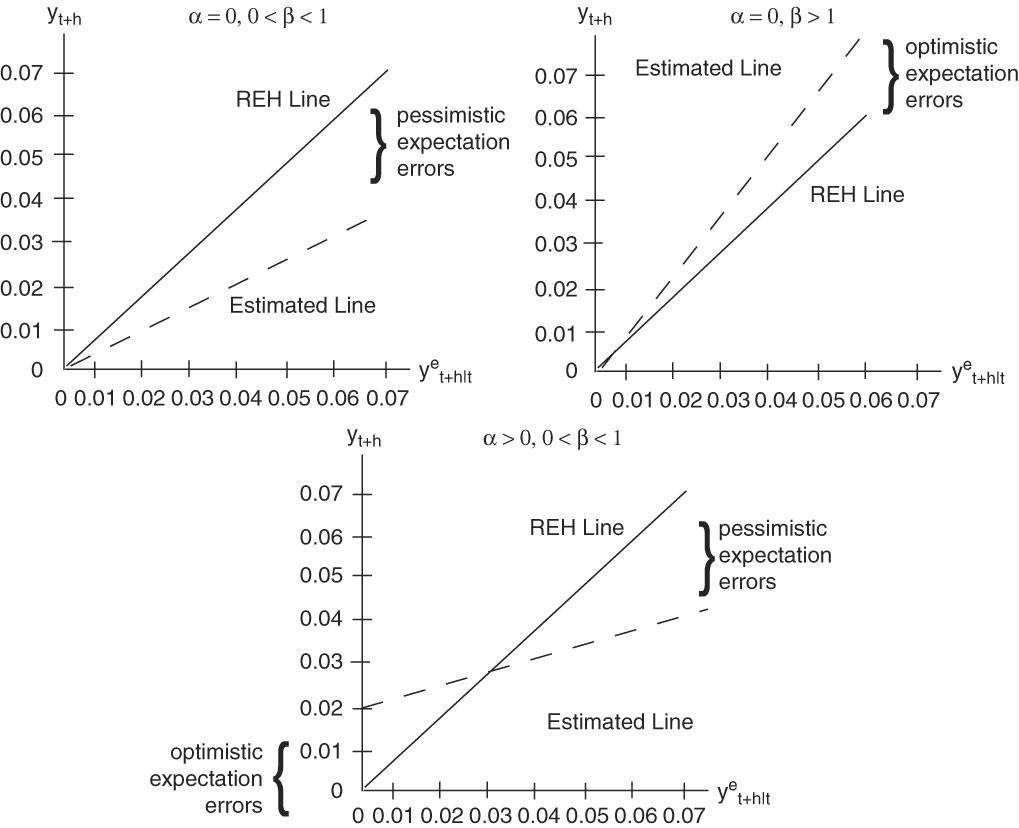
The classic ‘unbiasedness test’ of the REH simply uses ordinary least squares (OLS) to estimate the parameters in Equation 1 and then tests the joint hypothesis that (α, β) = (0, 1). This relies on the observation that if α = 0 and β = 1, expectations will satisfy P4. Equation 1 also gives specific form to the kinds of biases that empirical models based on it can reveal. Specifically, different combinations of α and β reveal different kinds of biases and, since we will ultimately be concerned with comparing the nature of these biases across cases, it is important to take a moment to understand the substantive meaning of these differences. Several cases that will be relevant to the empirical work below are illustrated in Figure 1. The 45° line in the figure corresponds to the expected relationship between average expectations and the realized economy under the REH (i.e., when α = 0 and β = 1). The ‘estimated line’ is a hypothetical relationship between expectations and the realized economy that has been estimated from data on expectations. Thus, the distance between these two lines at any level of expectations is the size of the estimated average ‘expectational error’ at that level of expectations. The sum of all these distances gives us an idea of what the data are telling us about the overall extent of expectational errors. Clearly, the existence of expectational error is indicated either by α ≠ 0 or by β ≠ 1 (or both), which is why the rational expectations literature focuses on joint tests of whether (α, β)=(0, 1). Further, if β ≠ 1, the size of the expectational error will vary with the level of economic expectations. For example, the upper left panel of Figure 1 illustrates a situation in which expectations are generally pessimistic – that is, the estimated averages of expectations are too pessimistic at all levels of expectations. However, they are also more pessimistic at higher levels of expectations (or realized inflation).
Parameter estimates and expectational errors

The bottom panel illustrates a more complex situation. In this case, the estimated slope of the average errors is less than one, but the intercept is greater than zero. In this situation, the estimated average expectational errors are not consistently optimistic or pessimistic across the whole range of expectations; instead, they are pessimistic for expected rates of inflation (or realized inflation) above of about 3 per cent and optimistic for rates below this number. While estimated expectations lines like this pose no difficulty for testing the REH (since the tests are agnostic about the direction or nature of any errors), they make it more complicated to assess the overall nature of expectational errors. Intuitively, of course, if the intersection of the REH and estimated expectations lines occurs far enough to the left of the graph (which occurs when the slope of the estimated expectations line is quite flat and the intercept is not too large), then the large range of pessimistic expectations would far outweigh the small range of optimistic expectations and so we would conclude that the data were trying to indicate a general pessimism.
The point of this example is simply to highlight that any set of estimates from a model like Equation 1 will contain information about the nature of bias (i.e., it implies a ‘picture’ of expectations like those in Figure 1) that goes well beyond a simple test of whether one can reject the REH. Since our purpose in this article is ultimately to explore how differences in political context condition the overall nature or direction of expectational errors, this full picture will be important to keep in mind.
Formal tests of REH have normally been estimated using the representation in Equation 1 and we will stick to that convention in this section. As we noted above, the basic unbiasedness test is simply a joint test of whether (α, β) = (0,1) in Equation 1. In practice, however, three complications can arise in estimating this equation, all of which are likely to be relevant to our data. First, if both the inflation and inflation expectations series in Equation 1 are non-stationary, the usual inferential tools for testing hypotheses about the parameters of Equation 1 are invalid. Secondly, despite the well-known ‘super-consistency’ of the OLS estimates in this situation, this asymptotic result does not hold up well in finite samples. For example, Maddala and Kim’s review of a dozen Monte Carlo studies leads them to advise that, despite their good asymptotic properties, ‘estimation of the long run parameters by static regressions is to be avoided’.Footnote 29 Secondly, when h is greater than one and the data are measured on a smaller time scale than h, the error term will have serial correlation that must be dealt with to obtain reliable inferences about the parameters of interest. In our case, this will be important because our expectations measure is a 12-month forecast (with corresponding economic series), while the frequency of our data is monthly. Thus, each observation in Equation 1 will have an 11-month overlap with adjacent observations in the expectation series – thus inducing serial correlation.Footnote 30
Many different solutions to these problems have been suggested; however, almost all of the commonly used solutions fall into two broad types: those that apply non-parametric corrections to the OLS estimate of the parameters in Equation 1Footnote 31 and those that estimate unmodified OLS (or a variant like GLS) on a modified estimating equation.Footnote 32 The usual applications of both these general procedures have been shown to produce valid asymptotic inferences and to perform reasonably well in small samples (though the controversy over which procedure performs best in small samples remains).Footnote 33 Below, we report results using both approaches.
Specifically, we report Phillips and Hansen’s fully modified OLS estimates (FM-OLS) as well as Saikkonen’s dynamic OLS estimates (DOLS). The FM-OLS procedure corrects for the various problems in making inferences about the parameters in Equation 1 by simultaneously applying a non-parametric correction for the serial correlation in the errors (essentially a Newey–West correction) and correcting for any endogeneity (including that caused by the variables being integrated) by estimating the long-run covariance between the regressand and repressors. The DOLS procedure tries to correct for the endogeneity by augmenting Equation 1 with a (potentially) large number of leads and lags of differences in  . Thus, the DOLS model is:

where m is the lag-length that must be specified and Δ indicates a first difference.Footnote 34 While the FM-OLS estimator includes a generic correction for the serial correlation created by overlapping observations (or any other kind of serial correlation), the DOLS model does not. To remedy this, we use Newey–West’s non-parametric estimates of the standard errors (with an 11th order lag structure). This accomplishes the same thing as the GLS corrections to DOLS advocated by Stock and Watson.Footnote 35
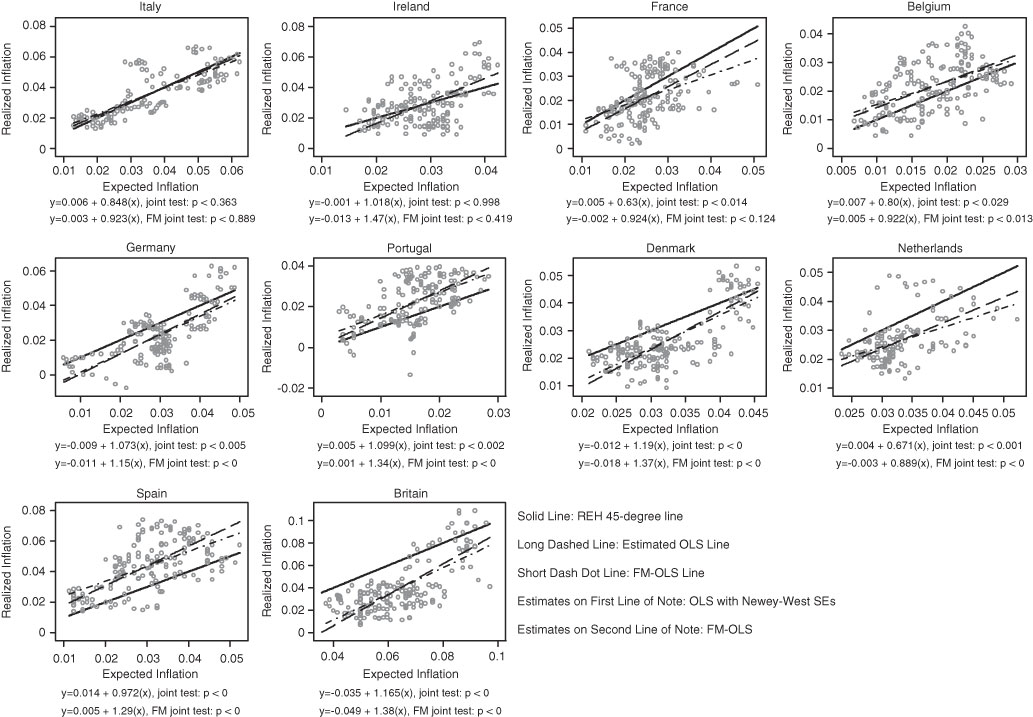
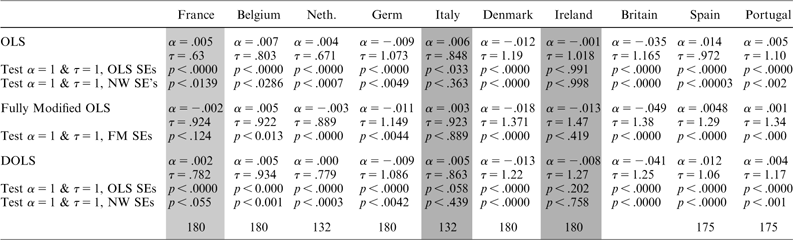
Figure 2 provides a graph of the raw data along with the fitted lines from FM-OLS and OLS estimates of α and β from Equation 1.Footnote 36 It also provides a test of whether the parameters are jointly equal to 0 and 1, as REH predicts (the test uses Newey–West standard errors for the OLS estimates). These estimates are quite similar to the DOLS estimates, as an examination of Table 1 in the Appendix shows.
Expectations and realized inflation in ten countries

We have (roughly) ordered the cases in Figure 1 from those in which REH receives the most support (top left) to those in which it is most clearly rejected (bottom right). However, before focusing on this variation, it is important to note that in all of our cases we do get positive estimates for β (which tend to either be relatively close to 1 or are above 1). Further, with the exception of Britain, all the estimated α’s are within about 0.015 of 0 (with most much closer). Thus, while expectations may not always meet the requirements of weak rationality, these data make it clear that there is a high degree of regularity in the relationship between inflation expectations and realized inflation that applies across countries, and this gives us some confidence in the data and the basic empirical specifications.Footnote 37
Looking now at the variation across cases, we can identify three groups of cases. First, we cannot reject REH in Ireland, Italy, France and (less conclusively) Belgium. In each of these cases, the data fall more or less equally above or below the 45° line, and so the average inflation expectation in these countries is neither too pessimistic nor too optimistic. In contrast, a second group of cases evidence substantial pessimistic bias in expectations. In Britain, the Netherlands, Denmark and Germany, our data suggest that individuals consistently expect inflation to be higher than it turns out to be; consequently, most of the monthly data points in these countries fall below the 45° line. Finally, in, Portugal and Spain, individuals in our data tend to be more optimistic, consistently expecting inflation to be lower than it turned out to be. Thus, our data evidence a significant degree of variation in both the extent to which inflation expectations are accurate and the nature of the inaccuracies that exist. Further, the types of biases appear to be fairly consistent within countries, which suggest – at least to us – that there may be contextual factors associated with countries that could help us explain these differences. In the sections that follow, we will use a new theory of the formation of expectations, drawn from the political science literature on attitude formation, to explain some of this variation in the nature of expectations.
Political and economic context and the accuracy of inflation expectations
More than just describing variation in the accuracy of inflation expectations across countries, our hope is to explain some of this variation in terms of the political and economic contexts in which expectations are formed. To do that, we first need a theoretical roadmap that can identify the kinds of contextual factors that we should expect to have an impact on the accuracy of expectations and that will produce testable empirical hypotheses about the impact of these contexts. Clearly, any such theoretical enterprise must begin with some individual-level model of expectations formation. Further, given the rejection of the rational expectations hypothesis for some, but not all, of our countries (as well as the overall mixed results in the literature), our individual-level model should allow for situations (configurations of the parameters of the model) that reproduce the same empirical relationships implied by the REH (expectations that are accurate on average), as well as deviations from this level of accuracy. To be especially fruitful, the model should also tell us something about how variation in the political and economic context would change the parameters of the individual level model in ways that would lead to systematic aggregate level biases in a given direction (i.e., systematically pessimistic or optimistic deviations from the predictions of REH). In the next section, we propose one such model that builds on John Zaller’s influential theory of attitude formation.Footnote 38
Inflation expectations in Zaller’s Model of attitude formation
Zaller’s comprehensive theory of attitude formation and change has had a large impact on work in political science, but has not influenced thinking about the formation of economic expectations.Footnote 38 We argue, however, that Zaller’s model provides a fruitful foundation from which to build comparative theories of expectation formation that do not depend on assumptions of rationality but that encompass the predictions of rational expectations models under certain conditions. Building on the early two-step communication flow model of Lazarsfeld and his colleagues, Granato and Krause have taken a first step in this direction.Footnote 39 They demonstrate that expectation formation at the mass level results from the asymmetric transmission of economic information from more informed ‘elite’ groups.Footnote 40 Zaller’s model, we believe, advances our understanding of how, and what, economic information gets processed by the average individual.
Zaller’s Reception–Acceptance-Sampling (RAS) model posits that a person’s expressed opinions about any topic, which might include opinions about the future state of the economy, are a sample of the media messages about that topic that the person has recently received and accepted. The probability that any individual receives any specific message about a topic is a function of the frequency with which the message is repeated in the media (its volume) and the individual’s level of political sophistication or awareness (with more aware people receiving more of the lower volume messages).Footnote 41 If there were only one message about a topic (for example, ‘the US president’s last name is Obama’), then any variation in opinion on the topic over individuals should stem only from differences in political awareness (i.e., very unaware people would not know President Obama’s last name and everyone else would).Footnote 42
For most topics, however, a range of different messages will be available from the media and these messages may well conflict (for example, ‘President Obama was not born in America’ or ‘President Obama was born in America’). If we consider only the ‘reception’ portion of Zaller’s model, the average opinion on such topics will reflect the extent to which the volume of one of these messages is higher than the other. Thus, anything about the political context that would systematically cause one set of messages on a topic to have a higher volume than others would lead average opinion to lean in that direction. To determine whether this leaning constitutes ‘bias’ requires that it be compared to some standard of ‘truth’. For inflation attitudes, we may well have such a standard (as argued below) in either the realized future economy or the distribution of professional forecasts of the economy. In the next section, we suggest several possibilities for contextual factors that may create biases in the media message by causing some kinds of messages about future inflation to be systematically over-reported relative to others.
The reception of messages is only the first step in Zaller’s model. Once a message is received, an individual can accept it or not. More specifically, individuals who receive a message may identify it as a partisan political message and reject it if it does not conform to their partisan predispositions.Footnote 43 While this part of the model is rich in implications for variation in opinion across individuals, it is less interesting as a source of variation in average opinion unless one can argue that there is an asymmetry in the partisan make-up of the population. In that case, even a balanced media message on a topic will be rejected asymmetrically in the population leading to partisan biases in average opinion. Below, we argue that, across the Western democracies, we often see a kind of partisan asymmetry – reflecting variation from context to context (and over time) in the ratio of ‘in’ and ‘out’ partisans – that is particularly relevant to the formation of attitudes about future inflation. Before we do so, however, we need to ask whether the underlying assumptions of Zaller’s model could plausibly apply to the case of opinions about future inflation.
First, we need to ask whether elites and the media actually generate and report a distribution of different ‘forecast messages’ about future inflation rather than a uniform message. If the message is uniform (or approximately uniform), then Zaller’s model makes it clear that that average opinion about future inflation in the population will reflect this uniform message directly and any inaccuracy in these opinions could only be due to inaccuracies in the uniform elite and media message about future inflation – not contextual differences in characteristics of populations, like partisan asymmetry. An examination of the record for the US case, however, suggests that there is quite a lot of diversity in available messages about future inflation.Footnote 44 Specifically, professional forecasts of inflation at any particular point in time (upon which much media reporting of future inflation appear to be based) vary substantially. For example, after analysing US inflation forecasts, Zarnowitz and Braun conclude that:
there is much dispersion across the forecasts … Forecasters differ in many respects and so do their products. The idea that a close consensus persists, i.e., that current matched forecasts are generally alike, is a popular fiction. The differentiation of the forecasts usually involves much more than the existence of just a few outliers.Footnote 45
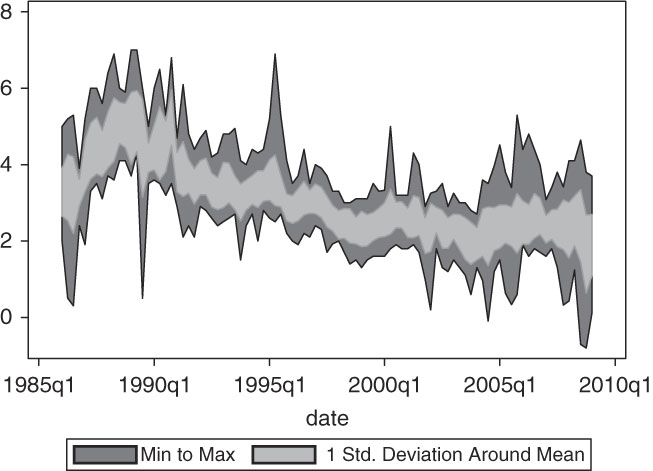
Figure 3 confirms this claim for the period examined by Zarnowitz and Braun as well as for more recent years. Throughout the period, there is considerable variation in the US inflation forecasts that were available from professional forecasters. Clearly then, there are different messages about inflation available to media outlets, which may pick and choose which ones to report. Further, besides choosing among forecasts to report, the media may well frame the same forecasts in different ways. A case in point is the Lamla and Lein study of consumer inflation expectations in Germany.Footnote 46 The authors find that both the volume and the tone of news reports about inflation can bias consumer expectations about inflation. In particular they find considerable asymmetry in media reporting about inflation – the media tend to exaggerate rising rates of inflation and significantly underreport falling inflation rates.Footnote 47
Variation in one-year US inflation forecasts

Recent work on understanding consumer inflation expectations has increasingly recognized the importance of the media in shaping consumer attitudes about inflation and, secondly, the likelihood that media bias will get incorporated into consumer expectations. Models of inflation expectations are increasingly grappling with how to incorporate better representations of the process by which individuals inform themselves about the macro-economy. Mankiw and Reis, for example, propose a sticky-information model of inflation expectations because of the relatively slow manner by which pricing information is disseminated through the population.Footnote 48 Carroll has extended this model by essentially suggesting micro-foundations for ‘stickiness’ – in particular, the fact that people only occasionally pay attention to news reports about price trends.Footnote 49 Moreover, there is also a growing empirical literature establishing how information about inflation – in particular, mediated messages about price trends – affects consumer expectations. Initially, the empirical insights have built on the Michigan Consumer Sentiment Series and the Conference Board series that date back to the 1970s. More recently, similar analyses of consumer inflation expectations have been conducted using the European Commission’s monthly consumer series. Empirical support for the sticky information model of inflation expectations has been reported for the United States and for selected European countries.Footnote 50 The Granato and Krause findings that inflation expectations at the mass level are transmitted in an asymmetric fashion from more informed ‘elite’ groups are consistent with this notion of delayed diffusion of pricing information.Footnote 51
The empirical work in this area has paid particular attention to how the media represents price fluctuations and also the impact of these representations on consumer expectations. First, there is considerable evidence that reporting on the economy has not been consistent with actual economic outcomes in the United States. There appears to be a consistent pattern in these empirical results that consists of a positive relationship between the volume of economic news and the accuracy of consumer expectations.Footnote 52 Since the volume of news tends to be particularly high during periods of rapidly rising prices, this frequently results in more rational inflation expectations during periods of higher inflation. There is also evidence that the tone of coverage – typically, the extent of negativity – can result in a media bias in consumer expectations.Footnote 53
Thus, it seems clear that there is a variety of inflation messages available to the media to report and frame as they see fit. Consequently, we would expect a certain amount of variation in opinion about future inflation across individuals (whose actual samples of messages will necessarily differ), even if citizens inform themselves in an unbiased way.
Increasingly, the literature on consumer expectations recognizes that these expectations are attitudes subject to information-gathering costs and bias due to the particular channel through which this information is obtained. Zaller’s model leads us to push this issue of a biased economic message even further and to ask whether forecast messages are perceived (by at least some individuals) as partisan political messages that are subject to selective rejection. There is a great deal of evidence that bears on this question. Specifically, much of the literature mentioned in the introduction to this article has found that individuals appear to be systematically more optimistic about the economy when they are partisans of the incumbent than when they are partisans of the opposition.Footnote 54 Our own calculations mirror the results in the literature. Specifically, we examined the difference in the retrospective economic evaluations of partisans of government and opposition parties in a sample of citizens of European countries in 1999 and 2004. The average economic assessment (over different surveys) of ‘in’ partisans in this sample was one point more optimistic than the average assessment of ‘out’ partisans (on a theoretical five-point scale, but with an observed range from 0.33 to 2.8).Footnote 55 Indeed, Spain, France, Italy and Ireland all had at least one survey in which the difference in average assessments was greater than 2.
This certainly suggests that partisans understand economic messages as political messages and should, according to Zaller’s model, reject messages that do not reinforce their partisan interpretation of the world. Consequently, we should expect ‘in’ partisans to reject messages suggesting higher future inflation and ‘out’ partisans to reject messages about lower future inflation.
In the next section, we more formally characterize some of the comparative implications from Zaller’s model; but before doing that, it is worth emphasizing that when we apply Zaller’s theory to the question of expectations formation, we paint a picture of expectation formation that is different from a strict rational expectations perspective that would characterize individuals as being ‘active’ in seeking out economic information (even if not the optimal amount) and then integrating this into an expectation using either some intuitive ‘model’ of the economy or at least a belief about the persistence of economic outcomes (so one might use information on the past to inform expectations about the future). In contrast, the individuals in Zaller’s model are not ‘active’ at all. When asked for an opinion, these individuals passively repeat the messages that they have received and accepted (the ‘Sampling’ portion of the RAS model). They certainly do not have any kind of ‘economic model’ that they use to integrate relevant information about the economy into an optimal forecast.
As we pointed out earlier, economists have struggled with the question of why aggregate inflation expectations frequently diverge from theoretical expectations. One recent suggestion by Mankiw and ReisFootnote 56 is a sticky-information model in which information diffuses relatively slowly through the population. Others have expanded on the micro-foundations of this model, suggesting that we need models of the acquisition of price information by the mass public that are better at reflecting how individuals acquire economic information.Footnote 57 We believe that the Zaller theory of attitude formation applied to economic information provides at least one element of such a micro-foundation.
Contextual implications of Zaller’s Model of attitudes about future inflation
We have alluded to some of the contextual implications of Zaller’s theory above, but in this section we provide a somewhat more formal statement of Zaller’s theory as applied to opinion about future inflation. The set of equations clarifies how political context may condition the accuracy of attitudes about future inflation in the model. This limited amount of formalism will also be useful in connecting the empirical specifications we will test both to the theoretical model and to the empirical specifications that have been used in testing rational expectations (and that we used above). Specifically, we will show that the same specifications implied by (and used to test) rational expectations are a special case of our formalization of Zaller’s model.
Start by assuming that we have four random variables: future inflation, Y, a professional or elite forecast of future inflation, Y f, the media message about future inflation, Y m, and the individual’s attitudes about future inflation, Y e. We assume that the conditional means of these random variables are linear and related to the realizations of the other random variables as follows (we drop the time subscripts for this discussion):


This specification means that if, for example, αy = 0 and βy = 1, professional forecasts of future inflation are unbiased in exactly the way posited by the REH. However, unlike the REH formulation, there is no direct connection between an individual’s inflation expectations and realized future inflation. Instead, this relationship is mediated by the way that the forecast message reflects the true economy and the way the media message reflects this forecast message. To see exactly how this mediation occurs, we need to transform these equations and make some substitutions. Specifically, we can use the Law of Iterated Expectations to write these conditional expectations as unconditional expectations as follows:


With this, we can do successive substitutions to write:

Multiplying this out and then using the Law of Iterated Expectations to go back to conditional expressions, we get the conditional expectation of Y as a function of individual inflation expectations (or attitudes about future inflation) in an equation that is quite similar (but generalizes) the systematic part of Equation 1 from our discussion of the REH:

Each pair of betas and alphas in Equation 10 represents the extent of bias at each stage of the attitude formation process. The coefficients subscripted by y indicate how accurately professional forecasts reflect realized inflation, the coefficients subscripted by f indicate how accurately the media message represents the forecasts, and the coefficients subscripted by m indicate how accurately individuals’ attitudes reflect the media message. If the elements of each pair of coefficients are equal to (0, 1), the forecasts, media messages and attitudes are unbiased with respect to realized inflation, forecasts and messages, respectively; and, in that case, Equation 10 reduces to the expression required for the unbiasedness criterion of the REH to hold.
While we could work with this very general expression – positing different contextual factors that impact bias at each level of the process of attitude formation – we begin somewhat more simply. Specifically, one reasonable simplification of Equation 10 comes from assuming that professional inflation forecasts meet the unbiasedness condition of rational expectations. Although early studies of the forecasts of professional economists and forecasters (using the Livingston Survey and the Survey of Professional Forecasters (SPF) in the United States) suggested that these forecasts were systematically biased, more recent re-analyses that have corrected a variety of methodological flaws in these early studies (including comparing their forecasts to real-time economic data rather than the usually heavily adjusted historical series provided by standard sources) have concluded quite strongly that they are not.Footnote 58 Given this, we simplify our analysis of context by assuming that (αy, βy) = (0, 1) in Equation 10.Footnote 59 Thus, we can rewrite that equation as:

Adding an error term gives us the general form of the equation we will work with in the empirical part of this article:

Equation 12 makes it straightforward to incorporate contextual effects into the model and focuses our attention on distinguishing where in the process of attitude formation a given contextual effect comes into play. For example, we have argued that the impact of partisan asymmetry (PA) should be to bias the average attitude of individuals away from the media message (irrespective of whether the media message was itself a biased or unbiased reflection of professional forecasts). Thus, the theory suggests that PA will impact βm, αm or both. One specification that captures this impact is:


If PA is operationalized so that positive numbers reflect an incumbent advantage in partisanship and negative numbers reflect an opposition advantage, we expect higher levels of PA to lead to more optimism about future inflation. Thus, higher levels of PA should increase both (or either) the slope of βm and the intercept, i.e. γm 1 > 0, λm 1 < 0. Importantly, however, this implication is only about the relationship between attitudes about future inflation and the media message; we still have to plug this back into Equation 12 to get the implied relationship between attitudes and realized inflation. Doing this, we get:

This specification reveals that any change in the slope or intercept (i.e. the accuracy) of the linear relationship between y e and Y that is due to different values of PA across contexts will be moderated by βf and αf – i.e., how accurately the media message reflects the forecast messages. If this relationship is unbiased, so βf = 1 and αf = 0, then Equation 15 becomes:

Thus, we see that our inclusion of context via Zaller’s model results in nothing more than a simple interactive version of the usual REH model in which we include main effects for PA and its interaction with measured inflation attitudes. Under the maintained assumption of unbiased professional forecasts and unbiased media messages, the slope coefficient on y e (that is the one usually estimated in REH models) is:

and the intercept is:

If attitudes are unbiased in the absence of partisan asymmetry, then the estimate of λm 0 must equal 0 and the estimate of γm 0 must equal 1, which implies that for PA = 0 (no partisan asymmetry), the intercept and slope coefficients would indicate no bias.
When media messages are not unbiased with respect to forecast messages – i.e., (αf,βf) ≠ (0,1) – Equation 15 does not reduce to Equation 16 and suggests that the impact of PA (or any other similar factor that moderates the relationship between individual attitudes and the media message) will be moderated by this bias. For example, some have suggested a general tendency for negativity in media reporting on inflation, which in the context of our theory would mean that the media systematically selects to report, out of the distribution of professional forecasts, the most negative forecasts.Footnote 60 In this case, we would expect either  or
 , either of which would indicate a media message that was pessimistic relative to professional forecasts. As Equation 15 makes clear, the impact of this would be to dampen the slope and/or intercept of the line describing the relationship between individual attitudes and realized inflation. Of course, this general impact (if it applied in the same way across contexts) would not be detectable in variations across context, but would be one reasonable interpretation, given our model, of any pessimism in evidence when PA = 0.Footnote 61
We have proposed a general model of context and economic attitudes that builds on Zaller’s theory of attitude formation. Any contextual factor that impacts either the extent of bias in the media message relative to professional forecasts or the extent of bias in individual attitudes relative to the media message will enter a model of attitudes and the realized economy interactively with all other contextual factors. In our elaboration of the model, we refer to three contextual factors that could result in bias. For the purposes of exposition, we assumed that professional or elite representations (or forecasts) of the economy are unbiased. But this is, of course, controversial, particularly amongst economists.Footnote 62 This assumption can be relaxed in our model, but the empirical challenge, which we do not address here, is identifying contextual variation in these professional biases that would facilitate empirical tests. In this particular elaboration of our model, we also assume that media representations of the economy are unbiased. But one can well imagine that biases in representation of the economy could vary systematically across media market contexts. Armed with quality measures of the variation in the media market (see Pippa Norris’s review article for a discussion of what needs to be done to create such measures),Footnote 63 this assumption should be relaxed in order to explore how media context impacts attitudes about future inflation. Our empirical test of the model focuses on the coefficient in the model that captures how accurately individuals’ attitudes reflect the media message. In the empirical section that follows, we examine how variation in one critical context – variation in partisan asymmetry – impacts the relationship between individual attitudes and the realized economy by including measures of this context in appropriate interactive models.
Empirical model and results
We now have a theoretical expression that relates attitudes about future inflation to the expected value of future inflation in a way that incorporates the critical pieces of Zaller’s theory of attitude formation and that includes, as a special case, the unbiasedness prediction from rational expectations models (i.e., when Equations 5–7 all have 0 intercepts and slopes of 1). This connection with the usual formulation of the unbiasedness tests of REH makes it clear that our empirical strategy for testing contextual hypotheses must account for the same econometric issues that were raised in the earlier analysis in which we performed country-by-country tests of REH – including issues of endogeneity, integration and overlapping data. Consequently, we will stick quite closely to the statistical methods used in those analyses (and that reflect the received wisdom on the statistical testing of expectation formation models using data on the real economy and expectations).
Within this basic estimation framework, however, several changes from the earlier analysis are necessary to deal with our focus on context. First, instead of looking at each country separately, we will stack the data for all ten countries. This will let us test for the influence of context using appropriate interactions as described above. Secondly, our focus on contextual effects requires that we pay attention to the usual issues of dependency and parameter variability (across contexts) that arise in panel data. In order to do this efficiently, we rely on the DOLS method described above as our baseline model relating attitudes to realized inflation. This is useful because, unlike the alternative FM-OLS approach, we can easily adapt DOLS for use with both interactive models and panel data. Specifically, along with simple interactive DOLS models with fixed effects for countries, we also estimate DOLS versions of multi-level, random coefficient models that allow us to deal efficiently with dependencies in the data that result from the fact that groups of observations come from the same context (we define our random effects over observations in the same country).Footnote 64 Further, by allowing random coefficients for both the betas and alphas, we can explicitly allow for the possibility that unmeasured contextual factors also impact the accuracy of attitudes about future inflation. This is important since if we think that measured features of context impact the extent and nature of bias in expectations (which is our whole point), then we should certainly allow for the possibility that unmeasured factors have similar effects. Finally, since it was not possible (without developing new estimation techniques) for us to simultaneously combine a DOLS specification, Newey–West standard errors and a multi-level model, we present the different combinations of these possibilities separately. Thus, in the results below, we show (1) an interactive OLS model with Newey–West standard errors (with an eleven-period lag chosen for the reasons discussed above), (2) an interactive, multi-level OLS model in which we allow random intercepts and random coefficients, (3) an interactive DOLS model with Newey–West standard errors, and (4) an interactive, multi-level DOLS model in which we allow random intercepts and random coefficients.
Measurement of Partisan Asymmetry
The clearest implication to come out of our theoretical discussion was that bias in opinion about future inflation should be more optimistic when the incumbent cabinet has a greater partisan advantage in the population (there are more ‘in’ partisans than ‘out’ partisans). Conversely, this bias should become more pessimistic as opposition parties have relatively more partisans in the population. In order to test this hypothesis, we collected data on the partisan make-up of the population in each of our ten countries over the time period under study. Specifically, we used the 1989, 1994, 1999 and 2004 European Election Studies (EES) to quantify the percentage of partisans supporting each party (and, after aggregation, the percentage of partisans supporting the government and opposition). Our coding identified partisans as those respondents in the survey that said they were ‘very close’ or ‘fairly close’ to a particular party (counting self-identified ‘sympathizers’ as non-partisans). Next, for each month for which we had expectations data, we aggregated the percentage of partisans who supported the parties in government and the percentage who supported the opposition (and, of course, the percentage of non-partisans) using the data from the EES survey that was most proximate to the month in question.Footnote 65 We used Mueller and Strom’s data,Footnote 66 with subsequent updates, to code which parties were in the government in any given month.
Results
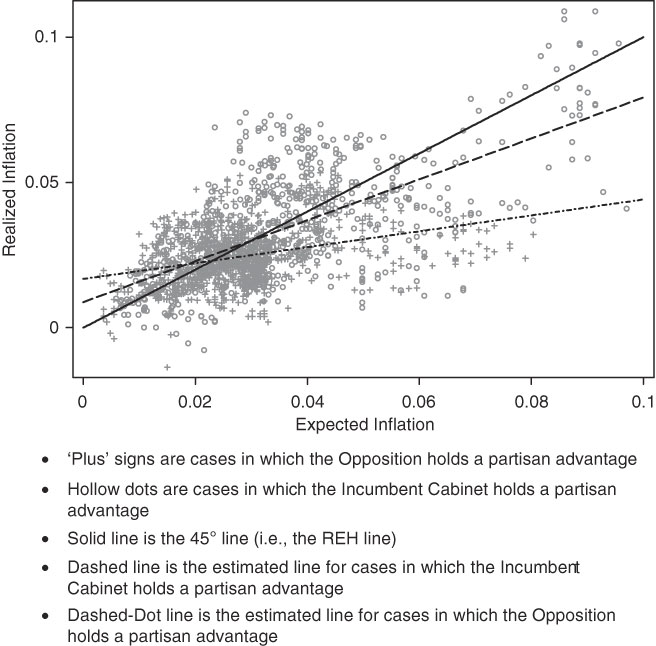
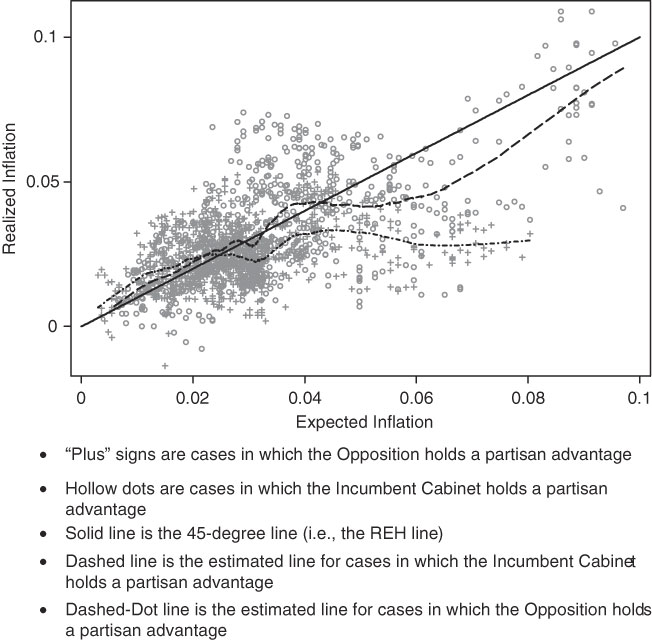
Before we provide the estimates of the statistical models, we can get a good sense of the underlying relationships in the data, on which these estimates are based, by plotting our measure of monthly inflation expectations in each country against the realized level of inflation, dividing the cases into those in which the opposition holds a partisan advantage and when the incumbent government holds a partisan advantage. We do this in Figure 4, adding the best fitting line for each set of cases, along with the 45° REH line.
Partisan asymmetry and accuracy of inflation expectations

The figure makes it plain that the plotted points for the realized economy and attitudes about future inflation are much more often below the REH line (i.e., pessimistic) in the case when the opposition has a partisan advantage (the ‘plus’ signs in the figure). Accordingly, the fitted line for cases of opposition partisan advantage is significantly flatter than for the case of incumbent partisan advantage, as predicted by the partisan asymmetry hypothesis. As predicted, bias in opinion about future inflation is more optimistic when the incumbent cabinet has a greater partisan advantage in the population. Of course, it is also the case that the intercept for the case of opposition partisan advantage is above the one for the case of government advantage. This is not consistent with the hypothesis, but is a relatively minor qualification for two reasons: first, it is clear from the figure that, given the range of the data, the ‘area of pessimism’ for cases of government partisan advantage is much greater than for opposition partisan advantage, regardless of the intercepts being somewhat out of order (since the differences in this area are almost entirely determined by the differences in the slopes). Secondly, if we look at Figure 5, which relaxes the assumption of strict linearity in the relationships, we see that the data actually indicate that, in both cases, attitudes about future inflation that are below about 2 per cent tend to reflect reality closely despite partisan asymmetry, so that the difference in intercepts apparent in Figure 4 appears to occur only because of the strong linearity assumptions imposed on the relationship in that figure. In contrast, the differences in the slopes between cases of opposition partisan advantage and government partisan advantage remain even in these non-linear, semi-parametric plots.
Relaxing linearity

Two other features of Figure 4 are important. First, it is clear from the figure that expectation errors seem to increase with the level of inflation. Secondly, the figure suggests that when the government has an advantage in the ratio of partisans in the population, it is not actually able to push expectations into the optimistic range, but only to ensure that they are more or less accurate. Indeed, the plots suggest that in a situation of balance in the distribution of partisanship between the opposition and government, attitudes about future inflation will be somewhat pessimistic. This result is consistent with (though certainly not evidence for) the idea that the media are generally pessimistic in their reporting of inflation forecasts.Footnote 67
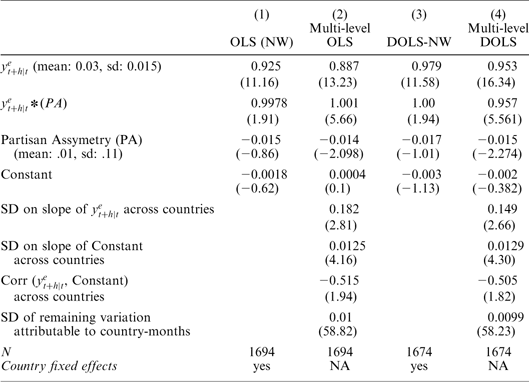
Of course, these graphs provide only impressionistic evidence since the fitted lines do not account for any of the various econometric issues that we need to account for in accessing the accuracy of inflation attitudes. Further, the distinction between opposition and government partisan asymmetry that is reflected in these figures is dichotomous, while the data we have is continuous (the data on partisan asymmetry range from a government advantage of about 20 per cent to an opposition advantage of about 30 per cent, with a mean of 1 per cent in the government’s favour). Estimates from statistical models that remedy these limitations are provided in Table 3.
Partisan Asymmetry (Estimates of Specification in Equation 16)

Notes: PA is measured so that positive numbers indicate a government advantage, 0 represents balance, and negative numbers indicate opposition advantage; t-ratios are in parentheses; Columns marked ‘NW’ use Newey–West standard errors with an 11-month lag; coefficients on country-fixed effects and on lagged differences in the DOLS models were omitted.
The first thing to notice about the estimates in Table 3 is that they are broadly consistent across specifications. Further, though partisan asymmetry seems to have a significant impact on the accuracy of expectations (discussed below), the two random coefficients specifications make it clear that there is still quite a lot of remaining variation in the slope and intercept coefficients (and therefore in net pessimism) that is not accounted for by the measured contextual variables in this equation (i.e., partisan asymmetry). Indeed, the estimate of 0.149 for the standard deviation in the slope coefficient on expectations in column 4 suggests that across our countries this moves around.
To understand what the coefficients in Table 3 are telling us about the relationship between attitudes about future inflation and realized future inflation, we should consider the implied slope and intercept coefficients at various levels for partisan asymmetry. Specifically, if we focus on column 3, the slope coefficient on attitudes is (0.979 + 1*PA) with intercept (−0.003 −0.017*PA). Thus, in a situation of balance in partisan asymmetry, these estimates suggest that:

The joint test that the intercept and slope are equal to 0 and 1, respectively, in this equation cannot be rejected (p = 0.1438). This argues against the hypotheses of a negative media bias that we speculated about in the discussion of Figures 4 and 5, since if media pessimism applies across countries, we should see it when PA = 0. In contrast, if partisan asymmetry favours the opposition (by one standard deviation), this equation becomes:

The joint test in this case can be rejected (p = 0.02). Results from the other equations are similar. Thus, the estimates in the table support our earlier conclusions, but add that we cannot formally reject the conclusion that attitudes about future inflation are unbiased when partisan asymmetry is balanced, while we can when they are unbalanced. In the next section, we consider whether the direction of the bias is consistent with the hypothesis. This is a more difficult question than it may at first appear, since the direction of the bias (more pessimistic or optimistic) is determined by both the slope and intercept coefficients and in our case changes in context tend to move them in opposite directions relative to the kind of bias these movements create (i.e., the estimates consistently indicate that greater opposition advantage in partisan asymmetry flattens the slope of the estimated expectations line (indicating more pessimism in these situations), but increases its intercept (indicating more optimism). Thus, to understand fully what the estimates are telling us about how context changes the extent of optimism or pessimism in attitudes about future inflation, we must develop a method for quantifying the overall extent of such biases indicated by the joint movements in the slope and intercept coefficients. We do this in the next section; but, to preview, we consistently find that the movements in the slope towards more pessimism (when the opposition has a greater advantage) far outweigh the increases in the intercept. This formal conclusion is clearly consistent with the more qualitative impression given by Figures 4 and 5.
Quantifying Changes in the Overall Nature of the Bias across Contexts
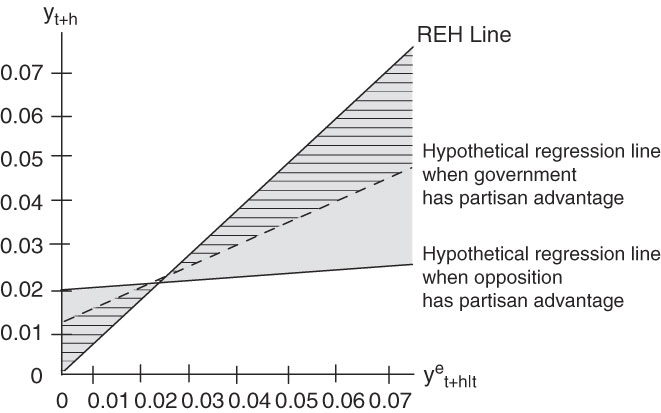
Figure 6 provides a hypothetical situation that corresponds closely to the one described by the estimates in Table 3. Specifically, it shows a case in which the difference in estimated expectations lines for different values of partisan asymmetry corresponds to a flattening slope and increasing intercept when the opposition has an increasing advantage. Our intuition is that a fair measure of the overall extent of bias reflected by either of these estimated lines should be based on the area between each and the 45° line. Specifically, the area between the 45° line and the estimated expectations line that falls below the 45° line represents the extent of pessimism reflected in the estimated line, while the area between the 45° line and the estimated expectations line that falls above the 45° line represents the extent of optimism reflected in the estimated line. Thus, if we subtract the latter area from the former, this will give us a measure of the net pessimism represented by an estimated expectations line. This will be positive when pessimism outweighs optimism, negative in the opposite case, and zero when optimism and pessimism are balanced. With this, we can calculate the change in net pessimism that results from differences in context and take this as a quantification of the overall impact of context on the nature of expectational errors. In the hypothetical situation portrayed in Figure 6, a change in partisan asymmetry from government advantage to opposition advantage results in an increase in the ‘area of pessimism’ (under the 45° line but above the estimated line) and a much smaller increase in the ‘area of optimism’. Thus, in this situation, the impact of the change in partisan asymmetry is to increase net pessimism.Footnote 68
Hypothetical changes in net pessimistic expectation errors for different levels of partisan asymmetry

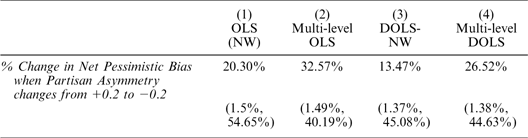
Using these numbers, we can calculate how much differences in context impact both the size and nature of the bias in attitudes about future inflation. Specifically, in Table 4 we report the percentage change in net pessimistic bias. If this is negative, then the change in context leads attitudes about future inflation to become more optimistic; if it is positive, then they become more pessimistic. Bigger numbers indicate larger change. In each case, the net change in the pessimistic bias when partisan asymmetry becomes less favourable to the incumbent parties increases, exactly as our application of Zaller’s model predicts.
Impact of Partisan Asymmetry on Net Pessimistic BiasFootnote *

* Calculated from the corresponding models in Table 3.
Conclusions
In this article, we have examined the accuracy of inflation expectations in a large number of countries over a long time period, suggested a theory to account for some of the variation in accuracy across political contexts and offered an initial test of the implications of the theory. We think that each of these efforts contributes to scholarship on the nature and sources of economic expectations and, we hope, points the way forward in producing a truly comparative literature on attitudes about the economy. On the one hand, the paper speaks to economists seeking theories of non-rational expectation formation – and directs them to the well-developed literature on attitude formation in political science. We also speak, on the other hand, to political scientists about the need to incorporate the decades of advances in econometric modelling of expectations in our own work and to strive for our theories to include (at least as special cases) the main theoretical implications of rational expectations theory. Finally, this essay speaks to both political scientists and economists about the need to take the political (and economic) context seriously when thinking about how individuals come to understand the economy.
There is now considerable evidence indicating that economic attitudes are just that, attitudes, and that a variety of factors in addition to the real economy shape these attitudes.Footnote 69 This is a good point of departure, but we have argued in this article that this is insufficient. We know, for example, from the work of Sanders and his colleagues that the press in Britain has an overall effect on economic expectations. But we believe an important unanswered question in this research is understanding the nature of this bias and whether it generalizes to all democratic contexts or whether there are features of the information context that exaggerate or minimize these biases. Is this result for Britain an artefact of the distinctive differences between the tabloid and broadsheet press? Or are professional forecasts of economic outcomes so highly controlled by the incumbent government that they misrepresent future inflation levels? These are characteristics of political systems that we believe vary systematically and shape the nature of bias in economic attitudes. Our contextual model of economic attitude formation, which builds on Zaller, provides a general framework for explaining how economic assessments will vary systematically across political contexts. We identify three broad features of context that should be incorporated into these models: professional and elite forecasts; media message; and individual attitudes.
The empirical analysis in this article only focuses on the third element in the model, individual attitudes, and demonstrates how partisan asymmetry in the electorate can contribute to inaccurate inflation expectations, but our finding has important implications for both macro-economic policy and theories of democratic representation. The results indicate that when the opposition has a partisan advantage in the population inflation, expectations will be biased in a pessimistic direction. Policies predicated on assumptions regarding rational inflation expectations should be adjusted accordingly. Our results suggest that incumbent governments are less able to sway citizens to optimistic forecasts but opposition can make citizens feel inflation is actually worse. And the opposition gets a benefit premium from bad news. These results are compatible with past studies of economic voting that find that incumbent governments will be sanctioned more heavily for poor economic performance than they will be rewarded for good economic performance or over-respond to high inflation versus low inflation.Footnote 70
But partisan asymmetry is only one of a much richer set of contextual factors implied by our model. Our hope is that this article will inspire closer scrutiny of other contextual variables that may impact the accuracy (and the nature of the bias) of economic expectations (some of which may well be readily incorporated into the theoretical framework we have proposed here). As the estimates from our random coefficient models show, there is considerable unexplained variation remaining in the estimated slopes and intercepts of the regression of the realized economy on inflation expectations across countries. One could readily imagine incorporating such contextual variables as the ownership structure and partisanship of the media, the existence of inflation targeting or variables like the independence of central banks into analyses similar to those suggested here.
Expectations of Inflation over Next Year and Actual Inflation over the Next Year

• All Newey-West estimates use a lag-length of 11.
• Lag-lengths of the difference terms in the DOLS estimate vary by country and were chosen optimally using a general-to-specific methodology. Estimated coefficients for these lagged terms are not shown.
• Estimates in shaded columns indicate a failure to reject REH.