Introduction
Nearly one in five Australians have a disability (Australian Bureau of Statistics, 2009, 2012); however, ‘current disability support arrangements are inequitable, underfunded, fragmented and inefficient, and give people with a disability little choice’ (Australian Productivity Commission, 2011: 5). There is now a wide acceptance in countries such as Australia and the UK of the ‘policy story-line’ (Needham, Reference Needham2011), that care services need to become more ‘client-centred’ and ‘personalised’ (for example, Kodner and Spreeuwenberg, Reference Kodner and Spreeuwenberg2002; McCormack and McCance, Reference McCormack and McCance2006; Baker and Dennis, Reference Baker and Denis2011; Sawyer and Green, Reference Sawyer and Green2013). In the case of disability care, the client-centred focus has been underpinned by a shift from a benevolent to a rights-based approach to care promoted by, amongst others, the United Nations (Fattore et al., Reference Fattore, Evesson, Moensted and Jakubauskas2010). In this article we focus on one frequently cited barrier to achieving more client-centred disability services, the poverty of the existing ‘informational environment’ – that is, the organisational and technological means by which information concerning clients and the delivery of care services to them is routinely captured, recorded, shared, evaluated and governed within a given community of care.
Our discussion is structured as follows. First, we identify some of the new informational requirements involved in moves towards client-centred care. Second, we outline an existing insurance-based scheme covering transport accidents in the state of Victoria which provides the context for our own research on the challenges posed by a new ‘independence’ care model. We then present our findings concerning the informational practices of Care Providing Organisations (CPOs) contracted by the scheme to deliver attendant care. We use these findings to highlight some of the issues and problems faced by the sector in developing an information environment to support more client-centred approaches. We conclude by briefly commenting upon the prospects of a co-design approach to nurture new conversations of care in the context of increasing independence in the disability sector and understanding of the informational needs involved.
The informational requirements of client-centred care
The current context of disability care in Australia is defined by the new national policy to implement a ‘once-in-a-lifetime’ transformation of services for all Australians. Following a long process of policy and legislative development (see Figure 1), a National Disability Insurance Scheme (NDIS), to be administered by a National Disability Insurance Agency (NDIA), was established in July 2013. The scheme, currently being trialled, will be rolled out nationwide from 2015. The scheme aims to increase the personalisation of services and competitiveness in the service provider market, whilst changing the process of service commissioning and improving the co-ordination of service providers (Australian Commonwealth Government, 2013). It has bipartisan political and strong public support (Cortis et al., Reference Cortis, Meagher, Chan, Davidson and Fattore2013; Whalan et al., Reference Whalan, Acton and Harmer2014).
Policy evolution of the NDIS

The published details (see Australian Commonwealth Government, 2013) of how the NDIS will operate suggest new roles, relationships and interactions between clients, service providers and commissioners that will require a far higher level of Information Systems support. For example, establishing client entitlement will involve clients or their representative making an access request that is assessed by an ‘NDIA delegate’ (an NDIA officer). People with a disability (‘participants’) or their representative will be encouraged to complete an on-line self-assessment to check if they are likely to meet the access requirements. Prospective participants will also be supported by ‘local area co-coordinators’ responsible for providing information about the scheme. Similarly, needs assessment and the development of a care plan will involve in-depth conversations between the participant and an NDIA delegate. The process of preparing the support plan is intended to be directed by the participant on the basis of their goals and aspirations, and the role of family, carers and other supporters is to be considered, respected and strengthened as part of this. There is provision for specialist assessment, where applicable, and a range of decision support tools will be available for the NDIA delegate to use in developing and testing care plans. Finally, participants (or their nominee) will be responsible for managing their care budget and making monthly reports, which will all be overseen by the NDIA delegate who retains a responsibility to ensure monies have been spent in accordance with the plan. There are also provisions for participants to initiate a review of the plan, or for the NDIA delegate to request a review, should circumstances change. These new roles, relationships and interactions are summarised in Figure 2.
New conversations of care and the NDIS
Information spaces in self-directed care Source: Martin, 2011: 7.
The operationalisation of policies aimed at making care more client-centred and personalised clearly suggest that fundamental changes in the way services are delivered and commissioned will be required. This also suggests that new ways and means of capturing, recording and sharing information will be required, not just for administering the transactional elements of the scheme by the NDIS, but by all those involved in the community of care as a whole. Clients and their representatives, for example, will need information on available services and guidance on their likely suitability and effectiveness, a means of documenting and recording their expenditures on these services once chosen and their experience in using them, and for evaluating and assessing how far the benefits of having received a service have assisted them to achieve the goals and aspirations expressed in their care plan. Service commissioners will certainly require a system which enables them to allocate resources, monitor expenditures and ensure both the probity and viability of the scheme over time. However, they may also wish to draw upon new information, such as that concerning aggregate client experience and outcomes of service delivery, to evaluate the effectiveness of the commissioning process in meeting care needs in the sector as a whole, and the extent to which objectives to improve service co-ordination are being achieved in practice.
Drawing upon the example of policy developments in the UK, Martin (Reference Martin2011) suggests that these new informational requirements can be represented as an ‘information process map’ of ‘individual care cycles embedded in wider commissioning and evaluation cycles’ (Martin, Reference Martin2011: 2). This highlights the ‘personal information space’ where clients and practitioners might record, share and evaluate care plans and configure information about services and support to suit client needs and experience and the wider ‘information economy’ through which ‘offers, products and services are published and information about use, approvals and outcomes are signaled’ (Martin, Reference Martin2011: 2). According to Martin (Reference Martin2011), such an information environment would require a different type of information system to that commonly employed within service commissioning agencies to capture and record data. A recent consultant's report, which assessed the current information system (IS) capacity of CPOs in the state of Victoria in the context of the new, ‘self-directed approaches and individualised funding’, identified improving IS capacity and user capability to support key processes, such as care management and planning, as a key challenge (Nous Group, 2011: 2). In fact, the report revealed, one-third of CPOs had predominantly paper-based processes and made limited use of IS to support service delivery (Nous Group, 2011: 2). We now turn to our study of the current information practices of CPOs in one segment of the Australian disability care sector.
Towards client-centred care in Victoria
The general picture of a ‘fragmented’ model of disability care in Australia is further complicated by the existence of a variety of state-level insurance schemes that provide cover for disabilities acquired in transport accidents and in the workplace. The existence of such schemes effectively creates two disability care sectors within Australia, the insured or ‘compensable’ sector for those who acquire a disability covered by these state schemes, and, by default, the uninsured or ‘non-compensable’ sector covering those born with disabilities and those with other acquired disabilities. The NDIS will in due course, it is hoped, transform this inequitable situation. For the moment, the compensable sector provides at least a guide to the problems and issues that may be faced in practice and the prospects for the development of a comprehensive insurance-based scheme covering all Australians. Moreover, both compensable and non-compensable sectors rely, by and large, on the same system of care delivery through CPOs. Similarly, the national scheme, initially at least, will largely rely upon this system as well. In this section, we outline one of the state-level schemes, which has provided the context for our research study. We then outline the research design and methods used.
The Victorian Transport Accident (TAC) insurance scheme
The TAC is a statutory agency charged with providing lifetime support for clients with an acquired disability arising as a result of a transport accident. The scheme covers payments for treatment and benefits and TAC's role is to fund and co-ordinate care services for clients. In an effort to improve performance in scheme viability, experience and outcomes for clients, the TAC has embarked on an ‘independence strategy’ (TAC, 2009). This is based on a more ‘holistic’ client-centred approach, the ‘over-riding philosophy’ being, ‘that the client is an active participant through the life of their claim with client goals directing service provision’ (TAC internal presentation). The approach is seen as especially relevant to a small but highly significant client group, those who have acquired traumatic brain injuries (TBI) or spinal-cord injuries (SCI) in transport accidents. Providing care for such injuries involves significant life-time costs (Access Economics, 2009). Such injuries can result in permanent disability, involving physical, cognitive and emotional impairments, and a range of psychiatric symptoms such as depression, anxiety disorders, mood disorders and/or panic disorders (Chan et al., Reference Chan, Parmenter and Stancliffe2009), and more client-centred approaches have encouraged the adoption of new therapies based on building positive behaviours, independence and personal goal setting (Ylvisaker et al., Reference Ylvisaker, Feeney and Capo2007). The quality and costs of services provided by CPOs (of which attendant care is the major contributor) are major factors determining client experience and outcomes, and ultimately have a significant bearing on the viability of the accident insurance scheme as a whole.
A pilot study of CPOs and attendant care
Our study was funded by the TAC through its research partner, the Institute for Safety, Compensation and Recovery Research (ISCRR) – a joint initiative of WorkSafe Victoria, the TAC and Monash University. Our pilot study is part of a broader ‘co-design’ initiative to develop ‘smart independent living environments’ (SmILE, see http://www.iscrr.com.au/research/programs/health-disability/smileproject.html). The initiative gathers together the perspectives and expertise of academics, industry experts, health care professionals, service providers, the TAC and clients and families living with TBI and/or SCI. The aim of our pilot work has been to examine the problems and issues involved in implementing the new model of client-centred care for CPOs (a second phase of the research will commence in July 2014). In this article, we focus on the informational dimension of the challenges faced. In the context of TAC's independence strategy, our overall research question sought to address current informational practices and the prospects for improvement through a co-design approach (see Sohal et al., Reference Sohal, McLoughlin, Cooke, Prajogo, Cooney, Ying, Purushothaman and Bayati Bojakhi2013).
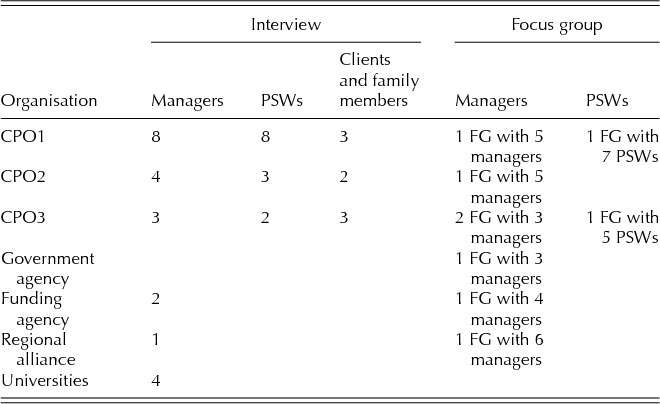
Data were collected through a multiple-case research design and followed the logic of replication for the purpose of analytically generalising findings and identifying research gaps (Yin, Reference Yin and Hills2009). In order to understand the existing models of service delivery and the problems and challenges faced, we focused on collecting primary data from three CPOs through semi-structured interviews and focus groups with managers and paid support workers (PSWs) providing attendant care. We also attended a one-day training course for PSWs, conducted interviews with eight clients and/or family members, visited two special purpose care homes and interviewed a range of other institutional stakeholders and experts. Data analysis involved the comparison of field notes with the transcripts of audio-recordings of interviews and focus groups. This process allowed us to identify redundancies, check for reliability and to identify emerging themes and develop a schema for organising and categorising the data. Qualitative data analysis software was then used to search the transcripts to confirm categories and begin pattern-matching and explanation-building using analytical templates developed from our research questions. The details of the study sample are summarised in Table 1.
Number of interviews and focus groups
Information and client-centred care: problems and issues for CPOs
The three CPOs in our study were relatively large employers within the sector, with a well-established history of operations − in one case for over twenty-five years. Each organisation provided care services in particular, but not exclusively, for the disability sector and within the sector for both compensable and non-compensable clients. In each CPO, the TAC was a major, if not the major, commissioner and purchaser of services. However, services were also provided under contract for other commissioners, most notably the Victorian Department of Human Services (DHS). In future, of course, the CPOs would also be bidding to provide services under the new national scheme. This would involve a major change in funding models. Currently, this is provided by service commissioners on a ‘block basis’ which provides CPOs with an assured income through which to engage staff to deliver services. As such, there is seemingly little or no incentive for providers to ‘personalise’ service delivery to meet the goals and needs of individual service users.
Our findings confirmed that the current service delivery model remained provider-centric and fragmented, and that the new independence model had yet to make a significant difference to the practice of CPOs. For example, there was limited attention paid by service providers to care planning and to client preferences and choice. The goals of service delivery appeared to mainly address immediate care needs rather than the future long-term goal-setting of clients. CPO managers openly admitted that the current approach did not efficiently utilise the untapped resources of family and friends (the unpaid carers) to tailor care plans that were holistic and truly client-centred. However, despite expressions of enthusiasm, there was also confusion amongst CPO managers about the meaning of ‘client-centredness’. This was also reflected in observations made by clients, and their families, who informed us of their feelings of confusion in organising accurate and relevant care plans for their needs. Those in the non-compensable sector (and therefore not covered by the TAC scheme) especially felt that their voices were often ‘drowned out’ and that they did not have much say in the choice of treatment/rehabilitation and, by the same token, were not always informed, consulted or included in decision-making.
When we explored the information environment underpinning this fragmented system of care, we found, unsurprisingly, that there was variable and fragmented information available for clients and their families. For example, paper-based media were typically used to communicate the service offer, such as those found in display racks at the many care provider, health and voluntary and community organisations engaged in the sector, and did not provide clients with a holistic view of the available services or make clear what processes they needed to follow to get access to what they needed. Information about clients was distributed across different service ‘silos’ within the care delivery system. One consequence was that clients had to repeat their stories, needs and goals to different service providers. The TAC clients appeared the more fortunate, in the sense that they had a case manager who acted as an intermediary to assist in dealing with access to service information. Clients and families also reported that they often discovered information that was crucial to them by chance. However, clients and families in the non-compensable sector felt they were neither empowered with the relevant knowledge nor had the skill to navigate through the complex environment of systems and processes involved in sourcing services.
It appeared that one factor underlying their experience was a lack of information sharing, and the limitation of the available processes and systems to share information, both within CPOs and between them and other care providers and service commissioners. For example, managers in the CPOs complained that, although the assessment reports sent to them by the TAC were often predetermined and clear, there was no clear consistency in the reporting structure to ensure the capture of all the relevant information relating to the unique needs of different individual clients. What was recorded seemed to be dependent on the person who wrote the report and what they thought was appropriate to record and at what level of detail. Managers claimed that referrals sent to CPOs quite often did not match the client's needs. By the same token, even though there is a contractual requirement for providers of services commissioned by the TAC to develop care plans for clients, there was no common template used by CPOs, and the plans themselves were, in the TAC's view at least, inconsistent in guiding and monitoring the care that was actually delivered. Both PSWs and clients also advised us that care plans were not updated regularly, and that attendant carers did not find them useful and informative. Similarly, the valuable knowledge of attendant carers who work with one client for a long period of time (which in turn might have permitted key information to be readily made available to other carers or used for updating care plans) was not routinely captured and recorded in any systematic way in the planning process.
Indeed, attendant care workers and managers both suggested that not having access to accurate, timely and appropriate formatted information about clients was one of the biggest problems that they faced:
So you roll up to a job and there's a person lying in bed and you don't know if he's got muscular dystrophy, spina bifida . . . [you] . . . just don't know what you’re dealing with. So a lot of the cases it's like that and I think you need some sort of paperwork or assessments or a case history of people . . . it helps the carer be involved and be aware of what you’re dealing with. (PSW)
If they [carers] don't understand why that client is acting in that way or they feel that they’re not equipped with the knowledge or the skills of the different strategies in order to de-escalate situations, then it seems something then that's out of control and then it just leads to more stress on their part. (Manager, CPO)
When it came to the experience and outcomes of attendant care, the implications of this were worrying. We were told, for example, about incidents experienced by clients that apparently had resulted from miscommunication within the CPO which had negative effects on the client's health and well-being, whilst in other instances PSWs said that they had been placed in potentially dangerous situations.
In sum, our findings emphasised that the poverty of the information environment in which care for TBI and SCI clients was being delivered was one factor that served to constrain the development of more client-centred care conversations consistent with the TAC's independence model. One consequence was that there was no clear and regularly updated ‘view’ of the client, but rather and at best only partial ‘views’ held by different organisational members. Overall, the client view on all of this was, ‘no one knows me’.
‘Knowing me’ or ‘knowing all about me’? Information to support client-centred care
One of the key recommendations of the consultant study cited above was the development of a ‘national information sharing framework’ which enables CPOs to provide integrated services, monitor client outcomes, and take a client-centric focus’ (Nous Group, 2011: 13). However, the report and the state-level strategy and action plan that followed it (see NDS, 2012) did not go in any depth into what might be needed in order to accomplish this, other than to recommend the resourcing of measures to improve ICT capacity and capability. A recent capability review conducted on the NDIA in its first few months of operation observed that even in the context of its own internal operations, the agency is struggling with an ICT system that is not ‘fit for purpose’ (Whalan et al., Reference Whalan, Acton and Harmer2014: 20). This was largely, it seems, because the system had been built prior to the agency's own informational needs and requirements being determined.
In this respect, the disability sector could be seen as in danger of following a familiar path. For example, Gillingham (Reference Gillingham2011, Reference Gillingham2013) notes issues identified in various Australian states that have introduced information systems to support the child protection services that have proved ineffective, if not counter-productive, in practice. His own research in Queensland found that whilst such systems require increasing amounts of information to be recorded about clients, service providers ‘struggled to match the embodied structures of the IS with the reality of day-to-day practice, as the structures failed to account for the complexity and diversity of the situations of children and parents, leading to confusion and frustration’ (Gillingham, Reference Gillingham2013: 440). The ‘embodied structures’ in the IS reflected assumptions that had been made during the development of the system about how practitioners should work, rather than how they actually worked, and reflected policy makers and service commissioners imperatives to reduce risk and create audit trails.
The significance of the development process and the manner in which structures that ultimately undermine the utility and use of information systems are embodied in them is emphasised by Walsh et al. (Reference Walsh, Wilson, Baines and Martin2012) in findings from the UK. Here local authorities responsible for commissioning child services were prone to a provider-centric approach in putting information on-line (aided by the nature of the vendor solutions on offer) and by seeking to monopolise all of the roles and responsibilities associated with the production and maintenance of this information. As a result, local government officers sought to retain control over directory content and its upkeep; however, the resulting on-line information was seen as of limited use. Parents of children with disabilities, for instance, appeared, ‘bewildered about the proliferation of web-based directories’ that were being produced in this way (Walsh et al., Reference Walsh, Wilson, Baines and Martin2012: 672).
Given the low level of current IS development and use in the Australian disability sector, it could be argued that there is clearly still an opportunity to shape things differently. Certainly our own interviews and focus groups confirmed that there is great interest amongst clients and their families in finding ways to benefit from new information and assistive technologies to support long-term care, an expectation heightened by the promise of the NDIS. However, as experiences such as those in the UK suggest, it will be vital for this to be accomplished in a manner that ‘cultivates’ rather than ‘monopolises’ other informational environments (Walsh et al., Reference Walsh, Wilson, Baines and Martin2012: 678). Or, to put this another way, through an approach to understanding the information requirements generated by new conversations of care, that is focused upon ‘knowing the client’ rather than seeing IS as the means for capturing and recording ‘everything to be known’ about them.
As we have seen, a client-centred approach will typically involve new roles, relationships and interactions. Martin (Reference Martin2011) suggests that these relationships and interactions can in principle be considered as a series of ‘care conversations’ between those occupying the various roles in the community of care. Moreover, these conversations involve not just processes (for example, the delivery of care services) and outcomes (for example, well-being), but also ‘the intention of the carer who is seeking to achieve particular outcomes . . . by the exercise of appropriate practices’ (Martin, Reference Martin, Gaddi, Capello and Manca2014: 71). As such, care ‘is embedded in a complex mesh of relationships between intention, action and outcome as conceived and experienced by both the giver and the receiver’ (Martin, Reference Martin, Gaddi, Capello and Manca2014: 71).
The importance of recognising the conversational nature of care in these terms is that it directs attention not just to the observable and behavioural dimensions of actions and interactions and the responses and interpretations that they evoke, but also to the ‘shared recognition of significance and mutualities’ which guide behaviour in the first place. In terms of the development of IS, the informational environment has typically been conceived in terms of what is observable and the task of system development to find ways of instantiating the actions and interactions involved in the functionality (i.e. ‘embedded structure’) of IS systems. However, the creation of appropriate information environments to support the intentional dimensions of client-centred conversations of care involves more than just the specification, procurement and deployment of the necessary IS functionality. Rather, ‘what is at issue’, Martin argues, ‘is who is providing it, for what purpose and under what governance arrangements’ (Martin, Reference Martin, Gaddi, Capello and Manca2014: 77). Moreover, these questions should be ‘material to all users who are engaged in any aspect of the support and delivery of networks and relationships of care’ (Martin, Reference Martin, Gaddi, Capello and Manca2014: 77).
The clear implication of this line of argument is that for information to be captured, recorded and shared in a way that supports client-centred care, choices and decisions concerning the operation, management and governance of information need to be made, in so far as is possible, by and within the community of care itself. In other words, such decisions should not be left exclusively to those who develop and procure IS systems. In this way, the risk that assumptions will be made that have little or no regard to the intentions of the user community with regard to such things as the nature of client-centred care can perhaps be mitigated. At the very least, what is ‘embodied’ in the structure of systems will not just be a function of system developers’ best guesses as to what might be needed. It follows that the informational requirements of client-centred care are not just to be interpreted in terms of ‘more and better’ ICT systems and the need to improve the capacity of CPOs and others to ‘know all about the client’. Rather these requirements need to be understood in terms of the shared understandings and purposes of those engaged in conversations of care, especially clients themselves and their families and other carers, and the everyday practice that this entails.
Conclusion
The capability review of the NDIA noted that ‘effective innovation and the sustainability of the NDIS in Australia was dependent upon good data and good ICT systems which have been well-designed and built’ (Whalan et al., Reference Whalan, Acton and Harmer2014: 24). However, we have suggested that the problems and issues involved in the disability sector go beyond the well-recognised and not insignificant challenge of improving IS capacity and use. What is also required is a detailed understanding of the changes to the care conversations involved in the practice of delivering client-centred care. The changes in these conversations generate new informational requirements which must be understood, not just in terms of the technicalities of data collection and recording, but also more fundamentally in terms of choices over the operation, management and governance of the informational environment.
As Gillingham (Reference Gillingham2013) observes, a detailed understanding of current every-day practices within a care community is ‘one of the keys to the future design of IS in human service organisations’ (Gillingham, Reference Gillingham2013: 441). However, Martin (Reference Martin2011) argues that, in order to accomplish this, a different ‘co-productive architectural language’ is required to that normally used by consultants and vendors in specifying ‘IT solutions’ (Martin, Reference Martin2011: 19). Of course, there are many documented pitfalls and constraints in undertaking ‘user participation’ in IS development (see for example, Kensing and Blomberg, Reference Kensing and Blomberg1998; Howcroft and Wilson, Reference Howcroft and Wilson2003; Stewart and Williams, Reference Stewart, Williams and Rohracher2005; Iivari and Iivari, Reference Iivari and Iivari2011; McLoughlin and Wilson, Reference McLoughlin and Wilson2013). However, our early experience from involvement in the SmILE co-design project in Victoria suggests that there may be possibilities for more successful engagement if the focus of co-design is shifted from user engagement with the required technical functionalities of systems to understanding the intentions of users when engaged in new care conversations. That is, a co-design process focused on questions such as: ‘What do I want to be known about me?’ ‘By who?’ ‘When and in what circumstances?’ ‘Why, how and when do I want them to share this knowledge with others?’. Questions such as these set the agenda for the next phases of our research within the SmILE initiative.
Acknowledgement
We are grateful to ISCRR and the TAC for their support for our research and to them and the anonymous reviewers for comments on earlier drafts of this article.