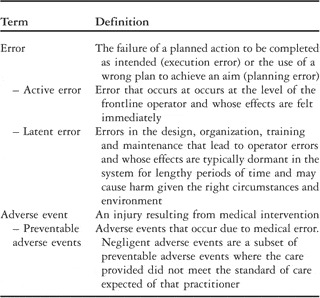
The complexity of the modern systems providing health care presents a unique challenge in delivering care of the required quality in a safe environment. Issues of safety have been thrust into the limelight because of adverse events highly publicized in the general media, and through two landmark studies on medical errors.Reference Leape, Woods, Hatlie, Kizer, Schroeder and Lundberg1, Reference Kohn, Corrigan and Donaldson2 The so-called Harvard Medical Practice study, conducted in New York, estimated an adverse event rate of 3.7% for all admissions to hospital during the calendar year of 1984.Reference Leape, Brennan and Laird3, Reference Brennan, Leape and Laird4 Of these medical errors, just, over one-quarter were considered negligent, almost one-sixth proved fatal, and another 2.6% resulted in permanent disabilities. In another study examining hospital admissions in Colorado and Utah during the year 1992, adverse events were observed in 2.9% of all hospital admission, of which three-tenths were classified as negligent, and carried a mortality rate of 6.6%.Reference Thomas, Studdert and Burstin5 When deaths related to medical error were extrapolated to a national estimate of 33.6 million admissions to hospitals each year in the United States of America, adverse events related to health care would have resulted in between 50,000 and 100,000 deaths, placing medical errors as one of the ten leading causes of death in the United States of America.6 Nationally, the cost associated with medical errors, including expenditure related to lost income, productivity, disability and the cost of health care, is large, and estimated to range from 17 to 29 million US dollars per year. Most importantly, at least half of the adverse events described in the two studies were thought to be preventable, providing an opportunity to identify risk factors, implement changes, and improve the outcomes of healthcare, and costs related to injury to the patients. Improving the safety and quality in health care, therefore, has been set forth as a priority in the report from the Institute of Medicine for improvements in the 21st century.Reference Briere7 Many measures have now been initiated for improving the safety of patients at a hospital, state, and national level, and through initiatives sponsored by governments and private organizations. In this review, we summarize known concepts and current issues on the safety of patients, and their applicability to children with congenital cardiac disease. Prior to examining the issues of medical error and safety, it is important to define what we understand by these terms, so we have listed some commonly used definitions in Table 1.Reference Kohn, Corrigan and Donaldson2
Taxonomy of medical errorReference Kohn, Corrigan and Donaldson2.

Causes of medical error
Research by Reason and others,8–Reference Reason10 and analyses of major accidents, have shed new light in the understanding of the mechanisms that lead to error. It is now well known that human and non-human factors, the latter involving the systems, and an interaction of the two, have a role in the genesis of the majority of medical errors. Factors emanating from the systems include suboptimal organizational culture, inadequate resources, poor investment in auditing and training staff, poorly designed environments and processes for the delivery of care delivery, and failure to learn from experience. Human factors include failure to apply knowledge, errors in communication, inexperience and lack of technical expertise, lack of supervision and teamwork, fatigue, fear and guilt. Both sets of factors may act latently in the causal pathway of an error, and their recognition is important for creating safety mechanisms.
Are children with cardiac disease particularly vulnerable to medical error?
Although there is a growing body of literature on adverse events in hospitalized children, as far as we are aware, no studies to date have specifically assessed adverse events in children with cardiac disease.Reference Sharek and Classen11 Woods et al.,Reference Woods, Thomas, Holl, Altman and Brennan12 using a cohort of hospitalized children in Utah and Colorado in 1992, reported an adverse event rate of 1 in 100 hospitalizations, of which they opined that three-fifths were preventable.Reference Woods, Thomas, Holl, Altman and Brennan12 Miller and Zhan,Reference Miller and Zhan13 using administrative discharge data from 27 states during the year 2000, and indicators of the safety of patients from the Agency for Health Care Research and Quality, reported a rate of adverse events of 0.9 for each 100 discharges. Sharek et al.Reference Sharek, Horbar and Mason14 reported a rate of adverse events of 74 per 100 admissions for neonates at high risk admitted to neonatal intensive care units. Of these adverse events, again almost three-fifths were judged to be preventable. These data indicate that hospitalized children are at risk from adverse events, and that those at high risk are more likely to be vulnerable to error.
Previous work has shown that the field of cardiac surgery is prone to adverse events and medical errors because of the high work load, the complexity of the tasks undertaken, the utilization of multiple specialists needed to provide care, the need for completion of the tasks in concurrent fashion, and the uncertainty, and dynamic nature, of the management plans.Reference Catchpole, Giddings and de Leval15, Reference Carthey, de Leval and Reason16 Because of the high risk associated with cardiac disease, the consequences of medical error on outcomes may be particularly significant in children with such disease. For example, neonates undergoing cardiac surgery may be particularly vulnerable to adverse outcomes from medical errors because their cardiac lesions are often corrected urgently or emergently rather than electively. Patients are more vulnerable in the emergent situation, with a limited capacity to tolerate physiological perturbation brought on by an error.Reference Rossi, Seiden, Gross and Griepp17 In addition, the relatively low incidence of complex congenital cardiac disease, the variability in anatomical issues in children with structural heart defects, the unpredictable response to reparative or palliative surgery, and limited knowledge of the providers of care, may decrease the opportunity for standardization, and increase the variability in practice, making children with cardiac disease increasingly vulnerable to medical error. Children with congenital cardiac malformations are also inherently high users of resources, and the addition of morbidity from adverse events during hospitalization may escalate the costs of their care.Reference Connor, Gauvreau and Jenkins18
Few studies to date have investigated human factors that lead to errors in children with congenital cardiac malformations undergoing cardiac surgery. Catchpole et al.Reference Catchpole, Giddings and de Leval15 studied the failure of systems following paediatric cardiac surgery in a small series utilizing median sternotomy and cardiopulmonary bypass. A single observer utilizing both implicit and explicit techniques for collection of data gathered information on failures in the operating room, and classified them as major or minor failures. Sources of these failures were then categorized into threats, related to the organization, the patient, the task, or the environment, and errors, which could be technical or non-technical, and included errors in communication and coordination. They noted a total of 7 major and 366 minor failures in their small series of less than 25 patients. Both types of failure were related to the duration and complexity of the operation. Errors in coordination and communication that related to dissemination of important information within the surgical team, and timely execution of procedures that required the interaction between two individuals, produced the highest observed cause of minor failures, at almost 2 for each operation. Failures were more commonly associated with non-technical errors, accounting for over one-quarter, compared to technical errors, which occurred in just under one-fifth on instances, indicating that failures in the system were more likely due to environmental or team coordination than to individual skill.Reference Catchpole, Giddings and de Leval15, Reference Carthey, de Leval and Reason16, Reference de Leval, Carthey, Wright, Farewell and Reason19
Concepts for the design of programs to improve safety
Using the first models concerned with human error, evaluating human error can take two approaches.Reference Reason20 The approach based on “the person” uses the notion that unsafe acts and violations that cause harm are due to unsafe acts arising primarily from the individual or individuals directly involved in an incident. In this approach, strategies focus on improvement and decreasing variability in human performance using disciplinary measures, retraining, or further education. The approach based on “the system”, in contrast, emphasizes that human errors are to be expected and are inevitable, and that errors occur because of factors that are present in a system in which humans interact. Management of errors using this approach focuses on building defense mechanisms against errors in the system. Although the approach based on the person is the dominant mechanism prevalent in medicine, it has serious shortcomings. Focusing primarily on the individual involved is unlikely to uncover factors present in the system that may have contributed to the error, and may overlook the fact that, given the same set of circumstances, the error can recur regardless of the person involved. Performance of human beings is greatly influenced by the environment and technology, and not only by individual performance. Thus, an approach focusing on the improvement of the system is more likely to promote safety by revealing deficiencies that are inherent to any system, and mitigating them before circumstances develop that result in harm to a patient.
We also have safety models from organizations requiring high reliability, such as aviation industry, nuclear power plants, and aircraft carriers. These organizations have achieved a high degree of safety and reliability despite operating in hazardous conditions.Reference Reason20–Reference Pronovost, Berenholtz and Goeschel22 The common features of these organizations include a culture of leadership and organization with a high priority for safety, an obsession with “failure”, leading to the development of sophisticated research methods and management strategies to recognize and recover from errors, recognition that human compensation and adaptation to changing events is an important safeguard because safety is preserved by timely human adjustment, designing processes to detect and overcome areas of system vulnerability, and disseminating their experience to other organizations so that others can benefit. Many principles of the safety of patients that exist in the setting of health care have been modeled based on experiences with preventing errors and promoting safety from organizations working in an environment of high risk.
An important concept for the investigation of an adverse event is the avoidance of bias from hindsight.Reference Reason20, Reference Pronovost, Berenholtz and Goeschel22, Reference Stevens, Matlow and Laxer23 Such bias frequently leads to an assumption that the event was predictable, and thus preventable, because of bias introduced by retrospective evaluation of an event. This may lead to simplification of the cause, and prevents identification of the multiple layers that lead to the event. Thus, it is important that errors are viewed from the perspective of the front-line personnel, who often have first-hand knowledge of all factors that contributed to the error, so that these factors can be adequately assessed. Rigorous and structured methods, such as root cause analysis, have been adapted to the setting of health care to identify deficiencies in the system that allow human errors to cause, or nearly cause, injury to patients. The failures in systems or processes identified in this manner should be prioritized for improvements most relevant to a given institution. Honest, transparent, proactive, and fair strategies for the management of risk are very important if loss of error-related information is to be avoided from non-disclosure, or under reporting of errors, due to the fear of punitive action or litigation.
A framework for the development and implementation of a programme designed to improve the safety of patients
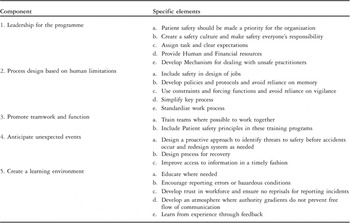
Key components for any programme designed to improve the safety of patients have been outlined well in an excellent article by Stevens et al.,Reference Stevens, Matlow and Laxer23 and in a publication from the Institute of Management entitle “To Err is Human”.Reference Kohn, Corrigan and Donaldson2, 6 Many of the important key elements of such a programmes are summarized in Table 2. In addition, the Departments of Public Health, the Joint Commission on Accreditation of Healthcare Organizations, and financial incentives for institutions brought from those paying for health care to provide care of better quality can be powerful influences to force change in the organizations providing health care, and to improve the quality of the care and the safety of the patients.
Important components for development of programmes to improve the safety of patientsReference Weick21.

A model widely used for programmes designed to improve safety includes the development of specific objectives, such as identification of key issues for improvement, and defining a goal to be accomplished. This is followed by the development of tools for measurement to confirm that change would lead to improvement, and help identify and develop additional ideas for change.Reference Horbar, Plsek and Leahy24 Ideas for change can then be tested through a continuous improvement-change cycle called the “Plan-Do-Study-Act” cycle. The first step is to “Plan”, and develop a blueprint for the change, and create a tool for measurement necessary for assessing improvement. This step is followed by carrying out the plan for change, or “Do”, collecting data for assessing improvement using the tool designed for measurement. In the “Study” phase, analysis is completed, summarized, and evaluated, leading to further changes in the phase of “Act”. Results from implementing changes during the phase of “Study” can help build knowledge about the system, help manage risk associated with change, and encourage participation as individuals see improvement brought on by change.
What should we change in the care of children with cardiac disease to improve safety?
Clearly, well known measures that apply to the safety of all hospitalized patients, such as promoting safe delivery of medication by implementing computerized systems for the entry of ordered medications, or preventing nosocomial infection by utilizing proper barrier precautions, should be applied to children with cardiac disease.Reference Pronovost, Needham and Berenholtz25, Reference Fortescue, Kaushal and Landrigan26 Root cause analyses conducted on large series of the most serious adverse events demonstrate that failure in communication plays a significant causal role in about two-thirds.27 The steep hierarchies in the settings of surgery and intensive care have been shown to discourage critical communication and teamwork, particularly among nursing staff.Reference Sexton, Thomas and Helmreich28–Reference Thomas, Sexton and Helmreich30 Thus, focussing on teaching effective communication, and the skills of teamwork intra-operatively, during transitions of care to other teams following surgery, and during the stays in the intensive care unit and hospital, using standardized methods of communication, or education based on simulation, can provide the important skills in communication and team work needed to provide safe care for children with cardiac disease.Reference Catchpole, Giddings and de Leval15, Reference de Leval, Carthey, Wright, Farewell and Reason19, Reference Salas, Wilson, Burke and Priest31, Reference Allan, Beke, Kappus, Laussen and Thiagarajan32 Furthermore, results and outcomes of implemented safety measures need to be reported, and be accessible to all those caring for children with cardiac disease, so that the valuable lessons learnt from these exercises can be shared to help improve safety for all children with cardiac disease.
Conclusions
Much is yet to be learned about the risk and incidence of adverse events during hospitalization of children with congenital cardiac disease. Errors due to human factors, such as poor communication, poor coordination, and team work have shown to be important causes of adverse outcomes in children undergoing cardiac surgery, and should be a focus for improvement. Future research on evaluating causes and prevention of medical errors and adverse events in this population at high risk, and consuming high resources, is essential.