In about two months, more than 90 million Americans (roughly 40% of those eligible to vote) will elect 435 members of the US House of Representatives and 36 members of the US Senate. The results of this midterm election will go a long way in determining the direction and extent of political change during the next two years. At present, like the nation itself, Congress is divided. Democrats hold a majority in the Senate, Republicans a majority in the House. To take control of the House, Democrats must gain 17 seats beyond the 201 they won in 2012 or 19 more than their current 199 seats (with three vacancies). Republicans must pick up six seats to regain their Senate majority. The Senate’s current party division is 53 Democrats and 45 Republicans. The two independents who caucus with the Democrats and the vice presidential tie-breaker put the Republicans’ magic number at six.
This symposium brings together five election forecasting models that predict the election’s national outcome for the major parties. This is the sixth American national election forecasting symposium published in PS: Political Science and Politics and the third focusing on midterm election forecasts. Footnote 1 Along with my forecasts, the symposium includes predictions from Alan Abramowitz; the team of Michael Lewis-Beck and Charles Tien; the team of Joseph Bafumi, Robert Erikson, and Christopher Wlezien; and the team of Benjamin Highton, Eric McGhee, and John Sides. Before delving into the articles that give the details of the forecasting models and their specific predictions for 2014, I provide a general perspective on the forecasts by setting the 2014 election in its contexts—the broad historical context, its intermediate context, and the precampaign political climate that has developed this year.
HISTORICAL CONTEXT
The broad historical context this year favors the Republicans. Based solely on the historical record of the presidential party in midterm elections, Democrats would appear to have virtually no chance of gaining 17 seats in the House. Since the Civil War, the president’s party has gained House seats in only three midterm elections and has never gained more than 10 seats. In the last seven midterm elections (1986 to 2010), House seat change for the president’s party has ranged from a gain of eight seats in 2002 to a loss of 64 in 2010. The median seat swing in this period is an eight-seat loss in 1990. It would be unprecedented for Republicans to lose their House majority in 2014.
Although the majority is unlikely to change in the House, which party will emerge from the election with control of the Senate is much less clear. Again, simply based on the historical record, Republicans stand a realistic chance of achieving a Senate majority. There is ample precedent in midterm elections for the out-party to gain six seats. In the 25 midterm elections conducted since the popular election of senators in 1912, the out-party has (surprisingly) gained a net of six or more Senate seats about half of the time (12 of the 25). Focusing on more recent midterm elections, the president’s party has lost six or more seats in four of the seven midterms from 1986 to 2010. Footnote 2
In a presidential party’s second midterm or more, like 2014, with surge and decline in Senate elections on a six-year timetable and with second-term presidents bearing clearer responsibility for grievances, the in-party’s prospects may be particularly bleak (Abramowitz, Cover, and Norpoth Reference Abramowitz, Cover and Norpoth1986; J. Campbell Reference Campbell1997; Grofman, Brunell, and Koetzle 1998; Petrocik and Steeper Reference Petrocik and Steeper1986). Since 1912, of the 14 midterms in a party’s second presidential term or more, the out-party has gained six seats or more nearly two-thirds of the time (9 of 14). As the out-party, Republicans gained six or more Senate seats in the midterms of 1918 (6 seats), 1938 (6), 1942 (10), and 1946 (13). Democrats as the out-party gained six or more Senate seats in the midterms of 1926 (6 seats), 1930 (8), 1958 (15), 1986 (8), and 2006 (6). In another two midterms (1950 and 1974) six or more years into a party’s presidential tenure, the out-party gained five seats. In short, from a historical standpoint, a six-seat or larger gain in Senate seats for the Republicans this year would not be at all unusual.
INTERMEDIATE CONTEXT
The intermediate context of the election suggests that change in 2014, at least in the House, is likely to be small. American politics is now nationally hypercompetitive and very polarized (Abramowitz Reference Abramowitz2010, Pew 2014). Macropartisanship is near parity with a slight tilt to the Democrats, but aggregate political ideologies make up for this with a Republican-favoring tilt to the conservatives (Campbell Reference Campbell2010).
Despite the 2006, 2008, and 2010 elections being big change “wave” elections (with 2010 producing a Republican tidal wave of more than a 60-seat swing), the median seat swing in congressional elections in the last three decades has been in single digits (7 or 8 seats). Since 1984, presidential elections have been unusually close contests, with neither party’s presidential candidate receiving as much as 55% of the two-party vote. This situation has tended to produce smaller than normal presidential surges and smaller than normal midterm declines (A. Campbell 1960; J. Campbell Reference Campbell1997). The 2012 presidential election fits the mold of a small surge election with President Obama’s two-party popular vote reaching only 52%. The near absence of split-result districts in 2012 reflects the extent of party polarization and the competitive balance of the realigned parties as well as the closeness of the 2012 presidential contest. In House races, split-result congressional districts are rare. There are fewer split-result districts now (26 in 2012) than at any point since 1920. Neither party holds many seats on what might be regarded as the other party’s turf—in the House. With no apparent disruptive wave on the horizon and no wave in 2012 to recede from, the House looks to be already much where we would expect it to be.
The Senate, however, is another matter. While split-result districts in the House are few and far between, six of the Senate seats up for Democrats were in states carried solidly by Mitt Romney in the 2012 presidential election. Democrats are attempting to hold Senate seats in Alaska, Arkansas, Louisiana, Montana, South Dakota, and West Virginia. In 2012, Romney received at least 57% of the two-party vote in each of these six states. Three of them are now open seats (South Dakota, West Virginia, and, after an appointed senator’s withdrawal from the race, Montana). Like the broad historical context, the intermediate context looks favorable for Senate Republicans this year.
The overall context of the 2014 midterm suggests that it is likely to be a generally good year for Republicans and a rough one for Democrats—but these are general impressions.
Summary of the 2014 Midterm Congressional Election Forecasts

POLITICAL CLIMATE
Finally, the political climate of the 2014 midterm election favors Republicans, but not overwhelmingly so. The best overall indicator of the political climate is the president’s approval rating (Tufte Reference Tufte1975). Footnote 3 President Obama’s approval rating dipped into the low-40% range in midsummer. Since the only presidential parties to have gained seats in midterm elections had presidents with approval ratings in the mid-60% range, on balance, President Obama and his record appears to be a liability for Democratic Party candidates. With the economic recovery remaining anemic, the economy shrinking in the first quarter of the year (real GDP change in the first quarter was -2.9%), and a series of controversies besetting the president’s second term (including the Benghazi investigation, the Internal Revenue Service’s targeting of conservative groups, the National Security Agency’s broad wire-tapping program, the Veteran’s Administration scandal, the prisoner trade with the Taliban, and the unraveling of the situation in Iraq), prospects for an improved political climate for Democrats and significantly improved approval ratings for the president are poor. It is difficult to gain ground when you are continually playing defense.
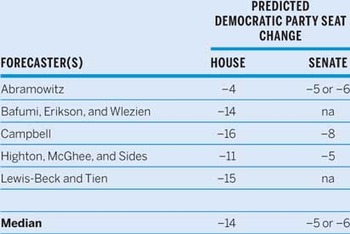
The overall context of the 2014 midterm suggests that it is likely to be a generally good year for Republicans and a rough one for Democrats—but these are general impressions. The forecasts in the following five articles of this symposium provide more systematic and specific evaluations of where the election is likely to leave the parties. Table 1 summarizes the bottom-line predictions of these forecast models. The House election forecasts range from Republican Party gains of 4 to 16 seats. The median forecast is a Republican gain of 14 seats. None predict Democrats retaking the House. Of the three models forecasting the Senate election, forecasts range from Republican gains of 5 or 6 seats to as many as 8 seats. One forecasts a new Republican majority in the Senate, and two see control of the Senate as a toss-up. That is the overview—now let’s take a look at the forecasts.
SYMPOSIUM CONTRIBUTORS
Alan I. Abramowitz is the Alben W. Barkley Professor of Political Science at Emory University. He has authored or coauthored six books, dozens of contributions to edited volumes, and more than 50 articles in political science journals dealing with political parties, elections, and voting behavior in the United States. He is also one of the nation’s leading election forecasters. Abramowitz’s most recent book, The Polarized Public: Why American Government Is So Dysfunctional, examines the causes and consequences of growing partisan polarization among political leaders and ordinary Americans. He can be reached at polsaa@emory.edu .
Joseph Bafumi is associate professor of government at Dartmouth College. He conducts research in American politics and has published in numerous scholarly journals including the American Political Science Review, Journal of Politics, Political Analysis, and Quarterly Journal of Political Science. He has taught courses on voting behavior, public policy and methodology. In 2010–2011, he was awarded an APSA Congressional Fellowship and worked as a budget analyst for the Senate Budget Committee. He can be reached at joseph.bafumi.jr@dartmouth.edu .
James E. Campbell is a UB Distinguished Professor of Political Science at the University at Buffalo, SUNY. He is the author of three books, including The American Campaign: US Presidential Campaigns and the National Vote, and more than 80 journal articles and book chapters. He previously served as Chair of the Political Forecasting Group, President of Pi Sigma Alpha, an APSA Congressional Fellow, and an NSF program director. He has edited forecasting symposia in each of the last five presidential elections and in the 2010 midterm elections. He can be reached at jcampbel@buffalo.edu .
Robert S. Erikson is professor of political science at Columbia University. His research on American politics and elections has been published in a wide range of scholarly journals, and he is coauthor of The Timeline of Presidential Elections (Chicago), The Macro Polity (Cambridge), Statehouse Democracy (Cambridge), and American Public Opinion (Pearson). He is a former editor of the American Journal of Political Science and Political Analysis. He can be reached at rse14@columbia.edu .
Benjamin Highton is a professor in the department of political science at University of California, Davis. He joined the department in 1999. Previously he was an APSA Congressional Fellow. His research and teaching interests include American national politics, political behavior, elections, public opinion, and research methods. His recent publications include Facing the Challenge of Democracy: Explorations in the Analysis of Public Opinion and Political Participation (2011). His numerous articles have been published in a variety of journals, including Political Behavior, Journal of Politics, Legislative Studies Quarterly, and Perspectives on Politics. He can be reached at bhighton@ucdavis.edu .
Michael S. Lewis-Beck is F. Wendell Miller Distinguished Professor of Political Science at the University of Iowa. His interests are comparative elections, election forecasting, political economy, and quantitative methodology. Professor Lewis-Beck has authored or coauthored more than 225 articles and books, including Forecasting Elections, Economics and Elections and Applied Regression. He has served as editor of the American Journal of Political Science and of the Sage QASS series (the green monographs) in quantitative methods. Currently he is associate editor of International Journal of Forecasting and data editor of French Politics. In spring 2013, Professor Lewis-Beck was visiting scholar, Centennial Center, American Political Science Association, Washington, DC. He can be reached at michael-lewis-beck@uiowa.edu .
Eric McGhee is a research fellow at the Public Policy Institute of California (PPIC) with expertise in elections, legislative behavior, political participation, political parties and party polarization. His publications include California’s Future: Political Landscape, Voter Turnout in Primary Elections, and California’s 2011 Redistricting: The Preliminary Plan, all for PPIC. He also is a contributor to the Monkey Cage. He is a former APSA Congressional Fellow. He can be reached at mcghee@ppic.org .
John Sides is an associate professor in the department of political science at George Washington University. His work focuses on political behavior in American and comparative politics. He is the author, with Lynn Vavreck, of The Gamble: Choice and Chance in the 2012 Election. He can be reached at jsides@gwu.edu .
Charles Tien is a professor in and chair of the department of political science at Hunter College, CUNY. His areas of research include American politics, Congress, and quantitative research methods. His recent work has appeared in International Journal of Forecasting, Polity, DuBois Review, and Defense Analysis. He can be reached at ctien@hunter.cuny.edu .
Christopher Wlezien is Hogg Professor of Government at the University of Texas at Austin. His research on American and comparative politics has appeared in numerous journals, and he is coauthor of Degrees of Democracy (Cambridge) and The Timeline of Presidential Elections (Chicago) and coeditor of a number of other books, including Who Gets Represented? (Russell Sage). He was founding coeditor of The Journal of Elections, Public Opinion and Parties and currently is associate editor of Public Opinion Quarterly. He can be reached at Wlezien@austin.utexas.edu .