Mesoamerican archaeologists are the beneficiaries of a large ethnohistoric and ethnographic literature. These works enrich archaeological interpretation in matters as diverse as artifact function (Linné Reference Linné1948; Montell Reference Montell1937), rural economy and craft production (Arnold Reference Arnold1991; Cook Reference Cook1982; Greenfield Reference Greenfield2004; Hayden and Cannon Reference Hayden and Cannon1984; Parsons Reference Parsons2001, Reference Parsons2006; Parsons and Parsons Reference Parsons and Parsons1990; Wauchope Reference Wauchope1938), political dynamics (Alva Ixtlilxóchitl 1970–71; Chimalpahin 1997; Codex Mendoza Reference Berdan and Anawalt1992; Durán 1994; Lockhart Reference Lockhart1992), and religious belief, ritual, and iconography (Durán Reference Durán, Horcasitas and Heyden1971; Gossen Reference Gossen1974; Monaghan Reference Monaghan1995; Myerhoff Reference Myerhoff1974; Sahagún Reference Sahagún, Anderson and Dibble1950–82; Sandstrom Reference Sandstrom1991; Sandstrom and Sandstrom Reference Sandstrom and Sandstrom1986; Vogt Reference Vogt1976).
Of course, the value of this literature depends upon how it is used. As with all archaeological interpretations via analogy, text-based interpretation in Mesoamerica seems most secure when the written records and archaeological data are closely associated in time and space. George Kubler (Reference Kubler1967) and Henry B. Nicholson (Reference Nicholson and Nicholson1976) debated whether documents from sixteenth-century central Mexico could be used to interpret the murals of Teotihuacan, which are a thousand years older than the documents, or if these texts might even throw light on Olmec iconography, still further removed in time and space. The Kubler-Nicholson debate reflects “source-side concerns” in ethnographic analogy. That is, which texts provide the firmest basis for archaeological interpretation via analogy (Stahl Reference Stahl1993; Wylie Reference Wylie and Schiffer1985)? The discussion of “source-side issues” continues among Mesoamericanists. Those who emphasize the overarching unity of Mesoamerican culture (e.g., Gossen Reference Gossen and Gossen1996; Hamann Reference Hamann2002; Headrick Reference Headrick, Koontz, Reese-Taylor and Headrick2001; Hendon Reference Hendon and Robb1999; Hunt Reference Hunt1977; Marcus Reference Marcus and Kyriakidis2007) feel confident that ethnographic and ethnohistoric documents can be usefully applied to archaeological materials even when texts and artifacts are far apart in time and space. Scholars who are sensitive to cultural change and diversity in Mesoamerica prefer to limit their analogies to documents and archaeological data that come from shared historical and regional contexts (e.g., Marcus Reference Marcus, Renfrew and Zubrow1994).
Mesoamericanists have devoted less attention to “subject-side concerns,” that is, how to validate archaeological interpretations based on analogy (Stahl Reference Stahl1993; Wylie Reference Wylie and Schiffer1985). Ideally, text-based interpretations would be treated as hypotheses to be confirmed or rebutted through additional archaeological research (e.g., Binford Reference Binford1967; Elson and Smith Reference Elson and Smith2001; Marcus Reference Marcus, Renfrew and Zubrow1994). In practice, however, Mesoamericanists have been willing to accept almost any text-based interpretation of archaeological data so long as it supplies a coherent account of the data. Again ideally, Mesoamericanists would show equal interest in points of similarity and difference between the documents and the archaeological data (Stahl Reference Stahl1993; Wylie Reference Wylie and Schiffer1985). In practice, however, researchers have focused their attention on similarities and have ignored differences, perhaps because they feel that any admission of differences would undermine their proposed analogy.
However, the refusal to admit, and to systematically explore, the differences between documentary and archaeological data constitutes an unfortunate rejection of a potentially rich source of interpretative possibilities. Alison Wylie (Reference Wylie and Schiffer1985) and Ann Stahl (Reference Stahl1993) both argue that focusing on the differences between textual accounts and archaeological data enables archaeologists to:
(1) recognize that some ancient practices have no parallel in the historic or contemporary eras, i.e., some practices are unique to the prehistoric past. This enables archaeologists to make original contributions to our knowledge of human history and frees archaeology from “the tyranny of the ethnographic record” (Wobst Reference Wobst1978).
(2) explore the causes of difference, that is, the “principles of connection” that produced the varied outcomes observed in ethnohistoric, ethnographic, and archaeological cultures. Comparing historically related but differing cultural practices enables archaeologists to construct secure “networks of understanding,” i.e., to identify the causal relationships between variables which explain why an analogy might, or might not, apply to a specific archaeological situation (Wylie Reference Wylie and Schiffer1985:104; Robin Reference Robin2006).
To these we might add a third advantage—a focus on differences reveals the variants of an institution that might otherwise be ignored. When the differences between documentary evidence and archaeological data are acknowledged, or actually sought out through systematic comparison, archaeological data can enrich our understanding of enduring institutions and pose new questions for anthropological research (Brumfiel and Robin Reference Brumfiel, Robin, Robin and Brumfiel2008; Fogelin Reference Fogelin and Kyriakidis2007; Stahl Reference Stahl2001). For example, a comparative historical study of backstrap-loom weaving in Mesoamerica led me to investigate a number of topics that I had initially ignored: the costs and benefits of tapestry, embroidery and cloth painting as decorative techniques, the impact of the factory production of thread and cloth on handmade textiles, and the possible divisions of labor in household cloth production (Brumfiel Reference Brumfiel2006).
In addition, acknowledging historical variation in the presence of historical continuity injects agency into archaeologists’ accounts of the past. Historical change demonstrates humans’ ability to redeploy traditional skills and knowledge in flexible and adaptive ways. Using ethnohistoric and ethnographic documents to highlight differences from the archaeological record is the best way to overcome the static view of the past which some archaeologists (e.g., Emerson et al. Reference Emerson, Alt, Pauketat and Fogelin2008) have claimed is inherent in the use of written texts.
To illustrate the value of using texts and archaeology to define differences and not just similarities in historically related cultures, this article deals with variation in the Mesoamerican 260-day divinatory calendar in time and space. Archaeologists have long drawn upon ethnographic and ethnohistoric documents to understand the operation of Mesoamerica's complex calendrical system, and yet they have ignored a sharp disjunction between archaeological manifestations of the calendrical system and the calendar as a part of the cultures recorded by ethnographers and ethnohistorians. In archaeological contexts, calendrics are most often recognized from glyphs inscribed on stone monuments which record the births, marriages, and conquests of local elites (Marcus Reference Marcus1992; Rice Reference Rice2008); in contrast, the calendar studied by ethnographers and ethnohistorians has been part of commoner life (Colby and Colby Reference Colby and Colby1981; Tedlock Reference Tedlock1982).
This difference has gone unnoticed because, in their emphasis upon similarities in the operation of ancient and historic calendars, archaeologists have ignored the dissimilarities in calendar use. Focusing on salient forms of archaeological data, while ignoring aspects of the ethnographic and ethnohistoric record, many Mesoamericanists have simply assumed that, in ancient times, the calendar was an elite institution. For example, Marcus (Reference Marcus1992:142) states, “The calendar was a tool of the ruling class to be manipulated for propaganda purposes, by linking actual rulers to renowned mythical ancestors, selecting names that ensured good fortune for rulers, and removing blame for nobles’ bad decisions by attributing it to the inevitability of fate.” In a similar vein, Smith and Berdan (Reference Smith, Berdan, Smith and Berdan2003:9) argue that cultural interaction in Mesoamerica, including the spread of divinatory almanacs, was necessarily the province of elites: “The information network pertained mostly to elites because the information exchanged tended to be esoteric knowledge (often religious) that required literacy in codex-reading.” In short, archaeologists have been more likely to ask how and why Mesoamerican elites invented the calendar rather than to inquire how the use of the calendar by elites and others varied over time and space (Rice 2007). Even Hassig (Reference Hassig2001), who studied recalibration in the Aztec calendar, assumed that the calendar performed a single function throughout Mesoamerican prehistory: synchronizing commoners to meet their obligations to governing elites.
Regarding the calendar as an exclusively elite institution has consequences for archaeologists’ views of commoner cosmology. It has encouraged archaeologists to regard commoners as passive consumers of elite ideologies who limited their own rituals to immediate concerns such as the health and reproduction of household members, the success of crops, and communication with household ancestors. However, the apparent discontinuity between ethnographic and archaeological evidence suggests that we return to the archaeological record to seek evidence of commoner cosmology and ritual in data that have been previously ignored. Ceramic design motifs can sometimes be related to commoner world view (Brumfiel Reference Brumfiel, Hendon and Joyce2004; Forde Reference Forde2006; Vega Sosa Reference Vega Sosa1984). In Postclassic period central Mexico, ceramic designs suggest that commoners maintained a broad cosmology and used calendrical knowledge for their own purposes for at least a millennium.
Reviewing variation in the use of the Mesoamerican calendar over time and space, this article begins with a description of the day-count in an ethnographic context, twentieth-century highland Guatemala. It then examines the day-count as recorded in sixteenth-century historical documents from central Mexico. Ceramic motifs on Postclassic pottery from Xaltocan, Mexico, extend this study back into the eleventh through sixteenth centuries. This examination suggests that commoners were more knowledgeable and more active agents with respect to cosmology than many Mesoamericanists have previously supposed.
THE 260-DAY CYCLE IN TWENTIETH-CENTURY GUATEMALA
As recently as the mid-twentieth century, the members of 57 Maya-speaking communities in Chiapas and Guatemala used a 260-day divinatory calendar to guide their personal affairs (Miles Reference Miles and Tax1952). For example, ethnographer Barbara Tedlock (Reference Tedlock1982), who trained from 1975 to 1979 as a calendrical specialist in the Quiche Maya town of Momostenango, Guatemala, found that the calendar round was generated from a sequence of 20 named days combined with 13 numbers. She learned that each day-name and number combination exerted power or influence on the events of that day, affecting a wide range of human affairs. These included the personality traits of individuals born on a particular day, and the success or failure of business ventures, social alliances, or sorcery initiated on that day. Similar beliefs were recorded by Colby and Colby (Reference Colby and Colby1981) in their conversations with Shas Kỏw, an Ixil Maya calendrical specialist from Nebaj, Guatemala, in 1966–1970.
In many Maya villages during the 1960s and 1970s, knowledge of the 260-day cycle belonged to specialists known as daykeepers. These specialists learned their art through apprenticeship to knowledgeable lineage priests, who were always male. In Momostenango, both men and women could become daykeepers; in fact, husbands and wives were encouraged to undertake their training together. Calendrical knowledge was widespread. Tedlock (Reference Tedlock1982:36) found 10,000 daykeepers in a municipality of 43,000 people. About 5% of the daykeepers undertook specialized apprenticeships to become midwives, bone-setters, singers, marriage spokesmen, and spiritualists (Tedlock Reference Tedlock1982:74). Some specialties were limited to men (bone-setters, singers, and marriage spokesmen) and others to women (midwives). Both men and women could become spiritualists, although this was considered dangerous for both (Tedlock Reference Tedlock1982:74).
The basic knowledge required to become a twentieth-century daykeeper included a familiarity with the sequence of the days and with the influence that each day-name and number combination exerted on human affairs. Usually, this knowledge was acquired through oral instruction and memorization; the information was not recorded in written form, although non-textual mnemonic aids such as calendar wheels or calendar boards were used in a few communities (Tedlock Reference Tedlock1982:92). Instruction included periodic prayers and ritual offerings. These established and maintained a positive, respectful relationship between the novice daykeeper and the supernatural powers that influenced human affairs.
Daykeepers provided individuals and households with the information that they needed to plan their activities and manage crises. The residents of Momostenango consulted daykeepers about illnesses, accidents, land disputes, house-building, inheritance, lost property, business transactions, travel, marriages, adultery, quarrels, births, deaths, dreams, and omens (Tedlock Reference Tedlock1982:153). When these villagers consulted daykeepers to determine the likely outcome of marriage proposals or business dealings, the daykeepers tried to assess the wisdom of the proposed alliance. If all indications were positive, then the daykeepers would choose an auspicious date when their clients could approach potential partners with proposals for the joint undertaking. This had to be done carefully, for spurned proposals lowered the status of the proposing household and made it a less attractive ally for other households. In addition, poorly considered marriages or business ventures caused quarrels and recriminations, possibly leading to witchcraft attacks and illness.
Calendrical divination was considered an art because the influences ascribed to the days were phrased in broad terms, like the fortunes in fortune cookies, and this information had to be tailored to individual cases. The proper interpretation of calendrical auguries required dialogue between the client and the daykeeper, the client supplying information on his or her personal affairs and the daykeeper using his or her knowledge of the days, the client, and the community to translate the day names into wise answers and useful advice. The calendar was a sort of information technology, which through dialogue provided the client with perspective on family affairs and inter-household relationships. In this way, calendrical divination enhanced a client's ability to manage his or her affairs effectively (Colby and Colby Reference Colby and Colby1981; Tedlock Reference Tedlock1982).
In Momostenango, basic knowledge about the calendar was widely diffused within the Maya community and was limited to that group. Thus, calendrical divination might be regarded as one aspect of a “commoner religion,” that is, the cosmology of people who stood outside the ruling institutions of church and state in twentieth-century Guatemala. Still, calendrical knowledge conferred a degree of wealth, power, and prestige upon daykeepers and lineage priests, and it constituted one basis for inequality within Maya communities, although by no means the only basis. Kay Warren (Reference Warren1998:181) records a case in which a daykeeper aligned himself with power-holding Ladino outsiders to defend his position within the Maya community.
THE 260-DAY CYCLE IN SIXTEENTH-CENTURY MEXICO
The 260-day cycle of sixteenth-century central Mexico (the tonalpohualli) was both similar to and different from the system in twentieth-century Guatemala. Similarities include the basic 20-day, 13-number, 260-day structure of the cycle, the belief that the supernatural forces linked to these days affected a wide range of human affairs, the existence of trained specialists who provided advice based on calendrical knowledge and dialogue with their clients, and finally, widespread use of the calendar by commoners to guide their household affairs. Differences include the use of painted divinatory almanacs in sixteenth-century Mexico, the training of specialists in state-run schools, and the larger number of calendrical cycles taken into account in determining the outcome of cases.
Two types of ethnohistorical documents provide information on the calendar in sixteenth-century Mexico. The first are the actual almanacs used by native calendrical specialists to formulate their responses to their clients (Boone Reference Boone2007). The second are accounts by European observers, usually friars engaged in converting the natives to Christianity, who described the operation of the system (e.g., Durán Reference Durán, Horcasitas and Heyden1971; Sahagún Reference Sahagún, Anderson and Dibble1950–1982:Book 4).
Unlike twentieth-century Guatemalans, people in sixteenth-century Mexico recorded their calendrical knowledge in painted books of deer hide or bark paper, called tonalamatl (Figure 1). Only nine almanacs from central Mexico survive; with one possible exception, they are all copies of pre-Hispanic originals made in the early colonial era. Boone (Reference Boone2007) supplies an elegant analysis of these sources. In colorful imagery, these books recorded the sequence of the days, the deities that were ascendant on each day, and their impact on human affairs.
Codex Borbonicus 5, the fifth trecena, showing the conjunction of supernatural forces for a 13-day sequence (trecena) in the tonalpohualli, the 260-day divinatory calendar.

These texts are supplemented by the records of European observers, but their interpretations are abbreviated and distorted, first by their European frames of reference (for example, they expected Mesoamerican calendrics to resemble the astrology of medieval Europe) and second by their hostility to a system of knowledge that challenged their own proselytizing efforts (Prem Reference Prem2008). However, European and native people working together provided Spanish glosses for the pictorial content of some native almanacs, which are very helpful to modern scholars (Quiñones Keber Reference Quiñones Keber1995, Reference Quiñones Keber and Quiñones Keber2002).
People in sixteenth-century Mexico believed that each day, each new rising of the sun, was a period of time influenced by a unique conjunction of supernatural forces. Perhaps because they were aided by written texts, the people of sixteenth-century Mexico took a great number of cosmic cycles into account: each day of the cycle, to be sure, but also the influence that the first day of each cycle of 13 numbers (each trecena) exerted over the other remaining days of the cycle, the influence of the Nine Lords, the Thirteen Birds, the influence of the initial day of the 365-day solar year and of each of its 18 months, and the influence of Venus rising as the morning star (Broda Reference Broda1969).
The Aztecs used the term tonalli to refer to the determination of earthly affairs by the forces at work on a particular day (Monaghan Reference Monaghan1998). Tonalli is derived from the Nahuatl verb tonal, “to irradiate,” and depending on context, tonalli had the following meanings:
a. irradiation; b. solar heat; c. summer; d. day; e. day sign; f. the destiny of a person according to the day of his birth; g. “the soul and spirit” (Molina: totnal); h. something meant for, or the property of, a certain person (Molina: tetonal) [López Austin Reference López Austin, de Montellano and de Montallano1988:204–205].
Each day was distinguished from the others by its unique tonalli, and this influenced the fate of newborn babies as well as the productivity of maize crops, the desirability of proposed marriages, and the outcomes of journeys. Separate sections of the divinatory almanacs were devoted to each of these topics and to protocols for ritual offerings that would insure success in these varied activities (Boone Reference Boone2007).
The almanacs were read by a specialist, called a tonalpouhqui. The sixteenth-century friar Bernardino de Sahagún (Reference Sahagún, Anderson and Dibble1950–1982:Book 10, Chapter 9) described the tonalpouhqui as “a wise man, an owner of books [and] of writings. The good soothsayer [is] one who reads the day signs for one; who examines, who remembers [their meaning].” The existence of other terms for book-using specialists suggests that a degree of specialization existed among the diviners of sixeenth-century Mexico, as it did among the twentieth-century Maya. For example, Sahagún (Reference Sahagún, Anderson and Dibble1950–1982:Book 10, Chapter 8) describes the tlamatini, “the wise man”:
He possesses writings; he owns books….The good wise man [is] a physician, a person of trust, a counselor; an instructor worthy of confidence, deserving of credibility, deserving of faith; a teacher. [He is] an adviser…; a teacher of prudence, of discretion; a light, a guide who lays out one's path, who goes accompanying one. [He is] reflective, a confessor, deserving to be considered as a physician, to be taken as an example. He bears responsibility, shows the way, makes arrangements, establishes order….
León-Portilla (Reference León-Portilla1963) discusses the tlamatinime in their role as philosophers, but working as physicians, the tlamatinime used the 260-day cycle to interpret dreams, divine the causes of illness, and prescribe appropriate offerings to the gods (Boone Reference Boone and Boone2005).
An illustration of a diviner at work in the sixteenth-century manuscript Codex Magliabechiano (Reference Boone1983:78r) suggests several parallels between Aztec practices and those of twentieth-century Maya. The Codex Magliabechiano shows the diviner throwing seeds; this resembles the actions of daykeepers in Momostenengo and Najab who counted out seeds to determine which day-sign was relevant to the case before them (see also Durán Reference Durán, Horcasitas and Heyden1971:398). The Codex Magliabechiano depicts speech-scrolls issuing from the mouths of both the diviner and the client suggesting that the two are engaged in dialogue, so perhaps Aztec diviners took account of existing social circumstances in formulating their advice, like the daykeepers in twentieth-century Momostenengo and Najab.
Calendrical knowledge may have been less widespread in the communities of sixteenth-century central Mexico than within twentieth-century Maya communities. For example, Sahagún (Reference Sahagún, Anderson and Dibble1950–1982:Book 4, Appendix:141) observed:
The Indians who well understood the secrets of [the] calendar showed and explained them to but few, because through their knowledge they gained their livelihood and were held in esteem and considered wise and intelligent. Nevertheless, almost all adult Indians knew and were informed about the year, as to both the number and house in which they were. But of the names of the days and weeks, and many other secrets and counts which they possessed, only those masters who worked with them attained knowledge.
This is consistent with a colonial census from the province of Huexotzinco in 1560. This census lists 9,658 heads of households, of whom only 66 (0.7%) were identified as tlama or native doctors (Brumfiel Reference Brumfiel, Brumfiel and Earle1987a:105; Prem Reference Prem1974). Tlama were less numerous than wood workers, mat makers, stone cutters, and potters, but more common than basket makers, lime burners and feather workers. If these doctors were equivalent to the tlamatinime in their role as physicians, then this knowledge was not widespread.
On the other hand, Boone (Reference Boone2007:256–257) points out that Sahagún (Reference Sahagún, Anderson and Dibble1950–1982:Book 10, Chapter 12) describes the good horticulturalist as “a knower of books, a reader of the day signs, of the months, of the years.” This implies that the ability to read the almanacs, at least at an elementary level, was widespread. So, perhaps the knowledge of a recognized tlamatini was equivalent to a specialized apprenticeship undertaken by 5% of the Guatemalan daykeepers in the twentieth century.
Sahagún (Reference Sahagún, Anderson and Dibble1950–1982:Book 3, Appendix:Chapter 8) states that the day count, the interpretation of dreams, and the reading of historical annals were taught in the calmecac, a school attached to state-sponsored temples. But knowledge of the tonalpohualli survived the collapse of indigenous state institutions after Spanish Conquest, suggesting that the transmission of this knowledge was not completely monopolized by the state. In 1579, nearly six decades after Spanish Conquest, Fray Diego Durán (Reference Durán, Horcasitas and Heyden1971:398) could complain, “There are few places where the ancient calendars are not kept in hiding, consulted often, and taught to the new generation.” Perhaps, in addition to being taught in state schools, calendrical knowledge was transmitted through individual apprenticeship, as it was shortly after the Conquest (Durán Reference Durán, Horcasitas and Heyden1971:404) and as still occurred in Guatemala during the 1970s (Tedlock Reference Tedlock1982).
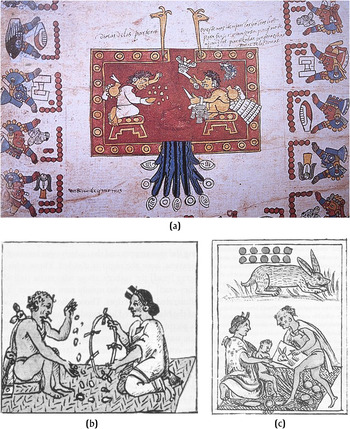
The diviners and soothsayers depicted in native documents give no indication of having elite status (Figure 2). The Codex Borbonicus (1991:Panel 21) shows the primordial diviners Oxomoco and Cipactonal as an old woman and an old man accompanied by the instruments of their trade: divinatory seeds and the calendar (signaled by the Cipactli glyph, the first day in the Aztec day-count). Both are dressed simply (he in a loincloth, she in a plain white skirt and over-blouse); both are barefoot and wear little jewelry. In the Florentine Codex, Oxomoco and Cipactonal appear again, and here too they are simply dressed and barefoot (Sahagún Reference Sahagún, Anderson and Dibble1950–1982:Book 4, Chapter 1). A practicing tonalpouhqui depicted in the Florentine Codex is barefoot, wears a plain loin cloth and cape and no jewelry whatsoever (Sahagún Reference Sahagún, Anderson and Dibble1950–1982:Book 4, Chapter 14).
Depictions of diviners as commoners: (a) Cipactonal and Oxomoco in the Codex Borbonicus (21); (b) Cipactonal and Oxomoco in the Florentine Codex (Book 4, Chapter 1); and, (c) an Aztec diviner reads the fate of a child borne on the day 10 Rabbit in the Florentine Codex (Book 4, Chapter 14).

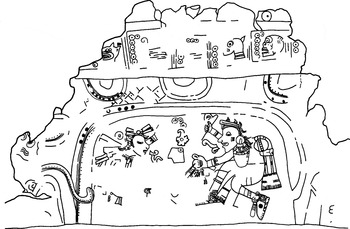
The single, notable exception is a mural from the Calendrical Temple in the main plaza at Tlatelolco (Guilliem Arroyo Reference Guilliem Arroyo1998) (Figure 3). Here, Oxomoco and Cipactonal are shown wearing fancy ear spools, necklaces, armbands and sandals, all markers of elite status. The depiction of Oxomoco and Cipactonal as elites in this mural (dating to 1468), as well as the construction of a state temple devoted to the tonalpohualli, the teaching of the divinatory arts in the state-sponsored calmecac, the Aztec state's use of human sacrifice to mark a few of the days of the tonalpohualli (Sahagún Reference Sahagún, Anderson and Dibble1950–1982:Book 2, Chapter 19), and the inclusion of the 20 signs of the tonalpohualli on late Aztec stone monuments such as the Aztec Calendar Stone and the Amecameca monument, (both of which date to the reign of Moctezuma II [López Luján Reference López Luján2009; Umberger Reference Umberger, Berdan, Blanton, Boone, Hodge, Smith and Umberger1996:99]), all suggest belated efforts by the Aztec state to claim calendrical knowledge as an elite monopoly to marginalize commoner practitioners and enhance state power.
Cipactonal and Oxomoco depicted as nobles on the Calendar Temple, Tlatelolco. Drawing by Heather Hurst, reprinted by permission of Elizabeth Boone.

Whether or not calendrical knowledge was monopolized by elites, reliance on the calendar was widespread. Both the structure of the divinatory almanacs and the comments of European observers indicate that the tonalamatl was consulted on many occasions—for births, marriages, and illnesses, at critical junctures in the farming cycle, to determine favorable times for trade expeditions, military campaigns, etc. (Durán Reference Durán, Horcasitas and Heyden1971:395–399; Sahagún Reference Sahagún, Anderson and Dibble1950–1982:Book 4, Chapters 8, 19; Book 5, Chapter 1; Book 6, Chapter 23; Book 9, Chapters 3, 7; Book 10, Chapters 8, 12). Many of these events were marked by household feasts. Feasts marked the births, marriages, and deaths of household members (Durán Reference Durán1967:II:123, 297; Durán Reference Durán, Horcasitas and Heyden1971:122; Sahagún Reference Sahagún, Anderson and Dibble1950–1982:Book 4, Chapters 12, 37; Book 6, Chapter 23), and feasts were held to celebrate the success of household members in ventures such as warfare, trade expeditions, and the fulfilling of religious vows (Sahagún Reference Sahagún, Anderson and Dibble1950–1982:Book 2, Chapters 21, 25, 35, 37; Book 4, Chapters 15, 25; Book 9, Chapters 7, 10). All critical events in the life of the household were typically preceded by consultation with calendrical specialists and were concluded with feasts.
Just as the twentieth-century Maya conducted divination-based rituals apart from the annual cycle of the Catholic Church, divination and household ritual among the Aztecs were independent of state rituals, which unfolded according to the solar year, the 365-day xiuhpohualli. Household ritual and state ritual coincided only occasionally. During the months of Tlacaxipehualiztli and Ochpaniztli, warriors offered captured enemy soldiers for sacrifice in state rituals, and each warrior's family called attention to his offering by sponsoring a household feast, which featured the hanging of the sacrificial victim's thigh bone in the patio of his captor's house (Brumfiel Reference Brumfiel, Alcock, D'Altroy, Morrison and Sinopoli2001).
THE 260-DAY CYCLE IN POSTCLASSIC XALTOCAN
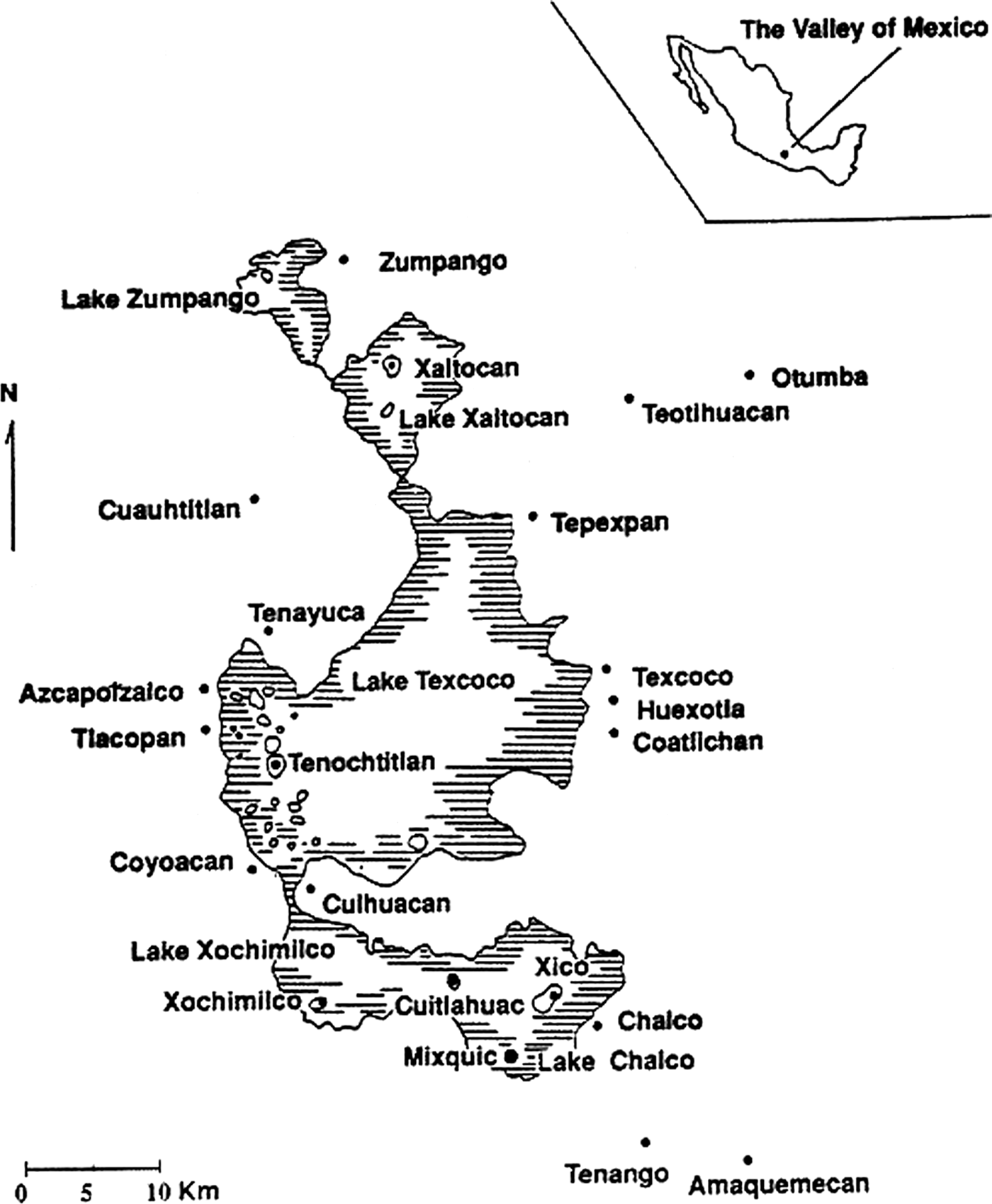
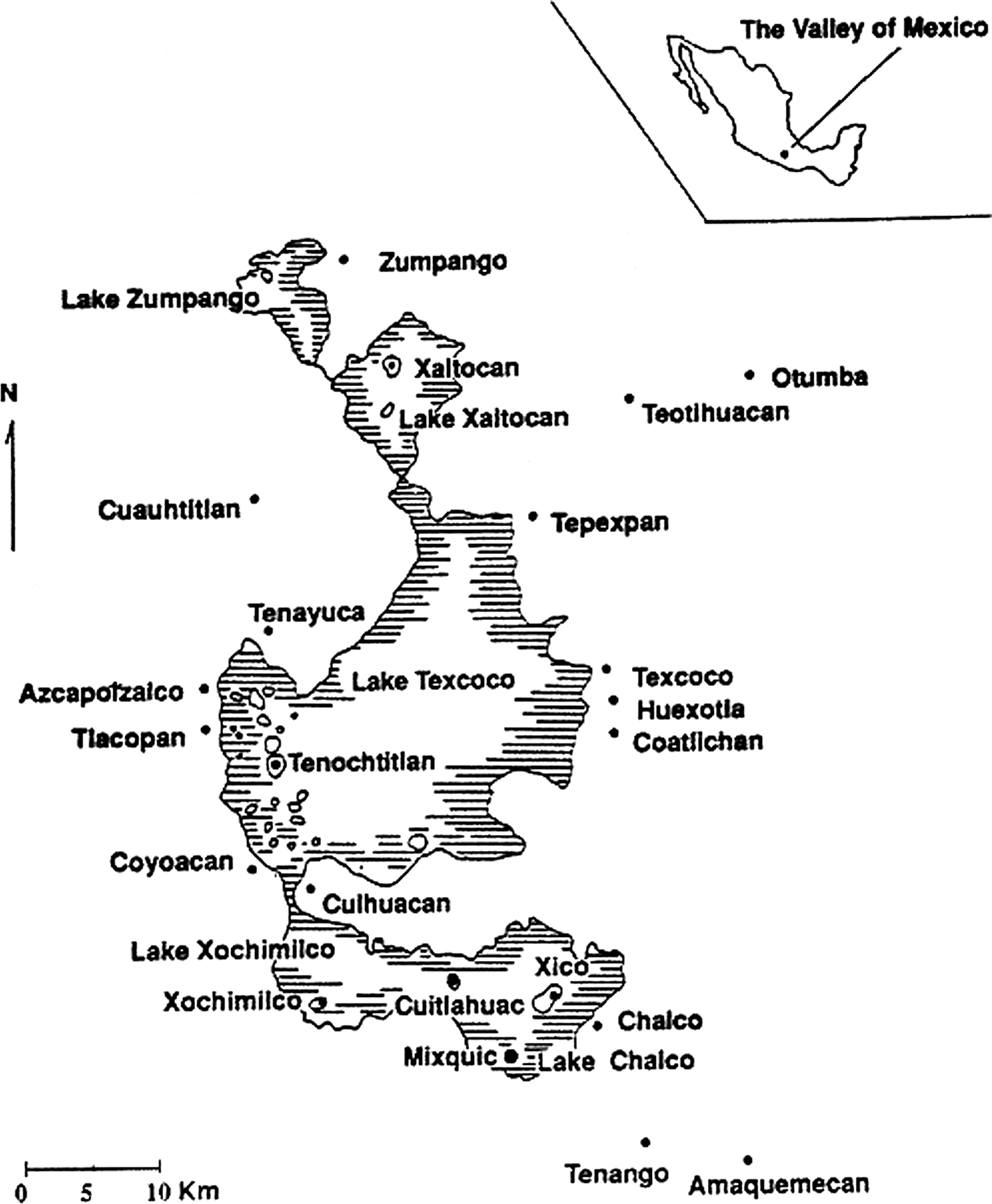
Ceramics from Xaltocan in the northern Basin of Mexico suggest that commoners were extensively involved with calendrics and household ritual for many centuries prior to Aztec rule. Xaltocan is a large Postclassic period site in the northern Basin of Mexico (Figure 4). In pre-Hispanic times, the site was surrounded by a shallow, brackish lake and marsh which was drained only in the mid-twentieth century. The surface of the site is marked by scatters of pottery, lithic debris, and large, low, irregular mounds, extending over an area of 68 ha. The mounds contain the remains of domestic structures, refuse, and fill in deposits up to 5 m thick. These deposits lie directly on the grayish-brown clay floor of the ancient lakebed, which suggests that the “island” of Xaltocan is entirely man-made, built from the deposition of stratified deposits on the lakebed floor over the course of eleven centuries.
The Basin of Mexico, showing the locations of Xaltocan, Tenochtitlan, and other important settlements.
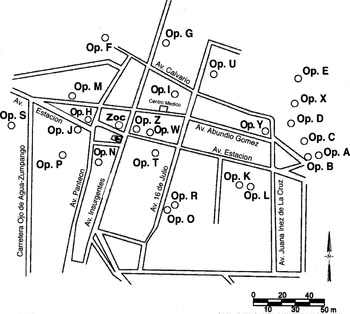
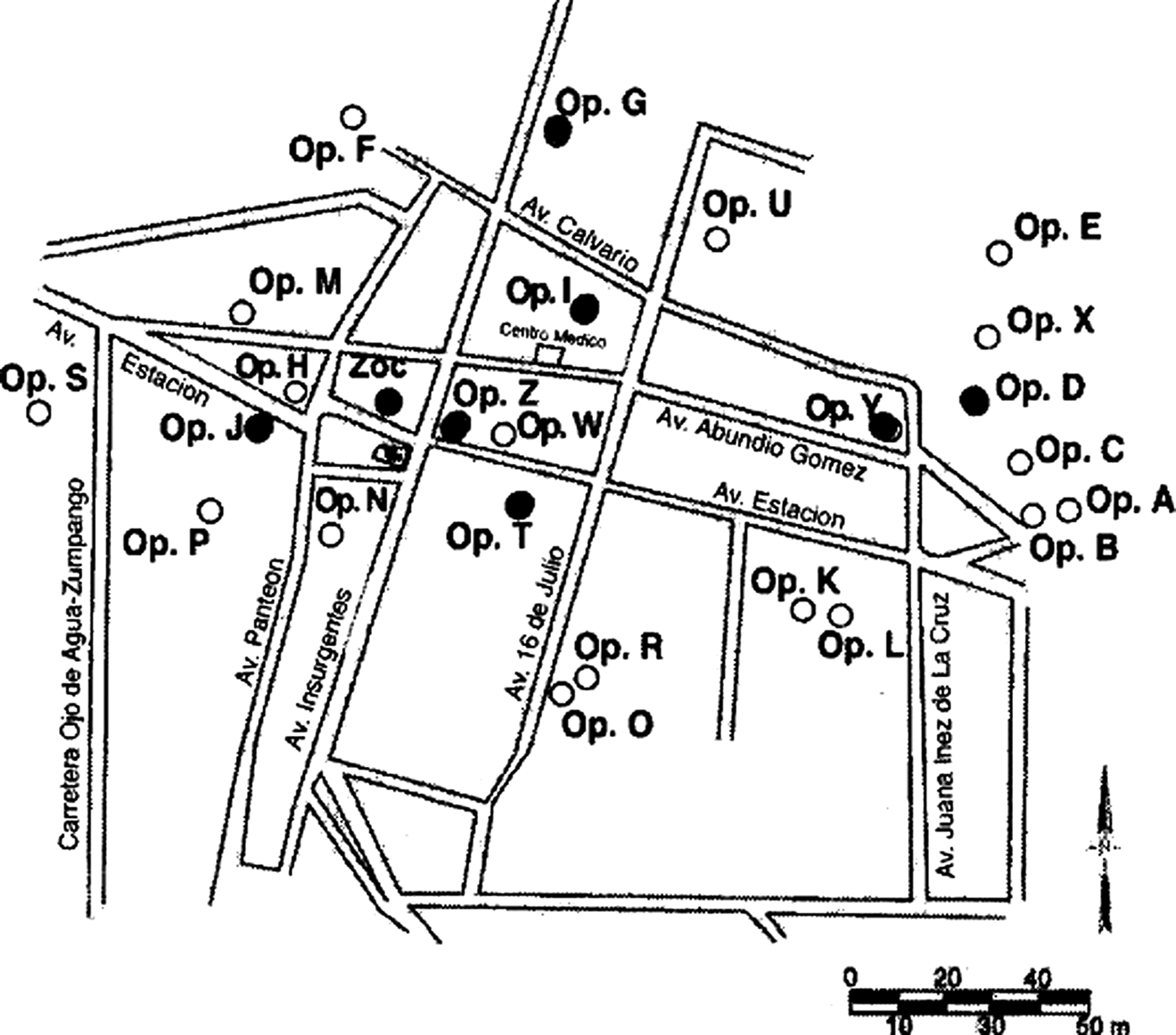
Archaeological research at Xaltocan began in 1987 with the mapping and the systematic surface collection of most of the site. This was followed by the excavation of thirty-one 2 m × 2 m test pits, along with broader excavations of four Aztec I houses (Brumfiel Reference Brumfiel and Brumfiel2005a, Reference Brumfiel and Brumfiel2011; Brumfiel and Rodríguez-Alegría Reference Brumfiel and Rodríguez-Alegría2010) (Figure 5). Ceramics from these excavations provide the basis for the discussion that follows.
Xaltocan, showing modern street grid and test pit locations.

Ethnohistoric documents and archaeological survey data indicate that during the tenth through fourteenth centuries, Xaltocan was an important regional center for the northern Basin of Mexico, the capital of a small autonomous state (Alva Ixtlilxóchitl Reference Alva Ixtlilxóchitl and O'Gorman1975–1977:I:423, II:299; Nazareo de Xaltocan Reference Nazareo de Xaltocan and Francisco del Paso y Troncoso1940; see also Carrasco Reference Carrasco1950). But Xaltocan was conquered by its neighbor Cuauhtitlan in 1395 and incorporated into the Aztec Empire in 1428 (Anales de Cuauhtitlan Reference Velázquez1945:50). The rulers of Tenochtitlan and Tlatelolco sent tribute-payers to settle in Xaltocan and the town was administered by military governors appointed by Tenochtitlan's ruler (Hicks Reference Hicks, Marcus and Zeitlin1994; Nazareo de Xaltocan Reference Nazareo de Xaltocan and Francisco del Paso y Troncoso1940). In 1521, Xaltocan was attacked and burned by Cortés (Cortés Reference Cortés1970:118). However, the town continued to be occupied throughout the colonial era (Rodríguez-Alegría Reference Rodríguez-Alegría2008a, Reference Rodríguez-Alegría2008b), and it flourishes today.
One of the remarkable characteristics of occupation at Xaltocan and in the Postclassic Basin of Mexico generally is the high frequency of decorated ceramics, about 30% of all ceramic rims. Decorated vessels include tripod dishes and molcajetes (dishes with striated bottoms used to grind vegetables for sauces), plates, and bowls; these decorated vessels were used to serve food and drink (Smith et al. Reference Smith, Wharton, Olson and Bray2003). The high frequency of decorated serving vessels suggests that feasting was popular in Early and Middle Postclassic period Mexico, as it was in Aztec times (Brumfiel Reference Brumfiel1987b, Reference Brumfiel, Hendon and Joyce2004; Smith Reference Smith1987; Smith et al. Reference Smith, Wharton, Olson and Bray2003). The linkage of household affairs with calendrical divination and feasting is evident in the decorative motifs appearing on the Postclassic pottery from Xaltocan.
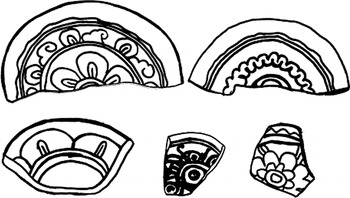
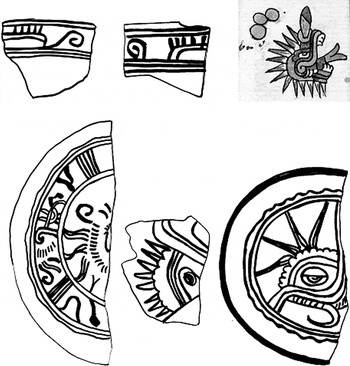
In the Early-Middle Postclassic period (a.d. 900–1250), ceramics include three decorated types: locally made and imported Aztec I Black-on-Orange (Brumfiel Reference Brumfiel and Brumfiel2005a; Nichols et al. Reference Nichols, Brumfiel, Neff, Hodge, Charlton and Glascock2002), imported Cholula Polychrome (Lind Reference Lind, Nicholson and Quiñones Keber1994; McCafferty Reference McCafferty2001), and gray-brown slightly carinated bowls, half of which have spiral designs incised on their exteriors. Aztec I Black-on-Orange is by far the most common decorated type, accounting for 58% of the decorated rim sherds in Early-Middle Postclassic assemblages. Aztec I vessels are fired to an orange or brownish-orange base color, and decorated with complex glyph-like designs painted in a heavy black line (Brenner Reference Brenner1931; Griffin and Espejo Reference Griffin and Espejo1950; Minc Reference Minc, Hodge and Minc1991; Séjourné Reference Séjourné1970). Vessel forms include tripod dishes, molcajetes, hemispherical bowls, and upright-rim bowls. Tripod dishes and molcajetes always bear a decorative panel on their interior walls, with vessel floors either plain or bearing a complex curvilinear design. On hemispherical bowls, a smooth curve unites the bottom and sides of the vessel, and decoration extends upward from the vessel floor to cover the lower walls. On upright-rim bowls, designs are confined to a decorative panel on the exterior wall. A link between Aztec I pottery and the divinatory calendar is suggested by the high frequency of flowers and the stylized reptilean heads (cipactlis) on Black-on-Orange vessels at Xaltocan (and contemporary Culhuacan, see Séjourné [Reference Séjourné1970]) (Figures 6 and 7).
Flower motifs on Aztec I vessels from Xaltocan.

Cipactli motifs on Aztec I vessels from Xaltocan: (top right) cipactli in the tonalpohualli (Codex Telleriano-Rememsis, 13v.); (bottom right) cipactli on an Aztec I vessel from Culhuacan (Brenner Reference Brenner1931:Figure 16).

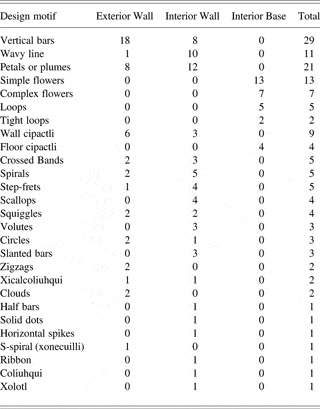
An examination of the designs on 72 Aztec I sherds from Xaltocan identified a total of 27 distinctive motifs (see Brumfiel Reference Brumfiel2009). These designs are listed in Table 1. The most common motif was a series of heavy vertical bars that created divisions within the decorative panel. This was probably an element of design composition rather than a motif with symbolic meaning in and of itself. Aside from this compositional element, the designs fell into three groups: (1) flowers, flower petals and flower-like motifs; (2) cipactli motifs; and, (3) oscillating motion or reciprocal motifs.
Design motifs on Aztec I Black-on-Orange sherds from Xaltocan.

Flowers, flower petals and flower-like motifs were the most common motifs (Figure 6). Petals have sometimes been regarded as feathers or stellar eyes (Brenner Reference Brenner1931:60–61; Séjourné Reference Séjourné1970:211). However, Hodge (1992:439) identifies these concentric arcs as petals, and they appear as the petals of the central flowers that occur on many Aztec I vessels and spindle whorls from Xaltocan. Furthermore, the petal motif occurs only on vessel walls, in complementary distribution with the simple and complex flowers which occur only on vessel floors. Simple flowers have petals surrounding a central circle. Complex flowers are simple flowers surrounded by spikey motifs that may constitute leaves or flower casings. Loops and tight loops surrounding a central circle constitute another flower-like motif which grades into sunburst motifs. Flower motifs of various sorts appear on 60% of the sherd sample (Table 1).
What I am calling a cipactli motif has been variously called a serpent head (Brenner Reference Brenner1931:41–45), a triangle and solar eye (Séjourné Reference Séjourné1970:123, 167), and an unidentified flower (Enciso 1971:18–19). However, the consistent association of a reptilian eye, a curved open mouth and pointed and rounded plumes in a decorative crest at the back of the head link this motif to the cipactli glyph, especially as it appears in the Codex Telleriano-Remensis (Quiñones Keber Reference Quiñones Keber1995) (Figure 7). Like the petal and flower motifs, this cipactli assumes one highly stylized form on vessel walls and another more realistic form on vessel floors (Brenner Reference Brenner1931:40–59). Cipactli motifs occur on 17% of the sherd sample.
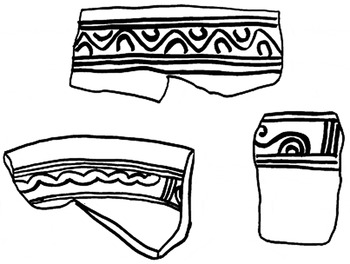
A third set of motifs includes wavy lines, spirals, step-frets, scallops, squiggles, zigzags, step-fret spirals (xicalcoliuhquis), S-spirals (xonecuilli), curved hills (coliuhqui) and ribbons (Figure 8). These varied motifs are united as a group because of their use of oscillating or reciprocal design elements. These designs appear on 54% of the sherd sample.
Reciprocal motifs on Aztec I vessels from Xaltocan.

Flower and cipactli motifs link these vessels to the tonalpohualli. Both flowers and cipactlis occupied a strategic place in the Aztec tonalpohualli. Cipactli was the first day of the 260-day count, and because it was the first day, Cipactli served as a symbol of the entire cycle as a whole (Arellano Hernández Reference Arellano Hernández, Rodríguez-Shadow and Piña Chan1990; Caso Reference Caso, Ekholm and Bernal1971). Xochitl (flower) was the last day of the day-count. In Aztec thinking, the beginnings and ends of cycles were important junctures, fraught with uncertainty and power (Gillespie Reference Gillespie1989).
In addition, flowers symbolized the sun in Aztec thought (Heyden Reference Heyden1983; Velasco and Nagao Reference Velasco and Nagao2006). For example, the Codex Magliabechiano (Reference Boone1983:8v) illustrates a textile bearing a single multi-colored flower accompanied by a Spanish gloss that identifies it as “manta del sol” or “mantle of the sun.” Jane Hill (Reference Hill1992), who has studied the meaning of flowers across the Uto-Aztecan language family, concludes that flowers stand both for literal flowers and for many other brightly-colored things: the dawn and sunset, rainbows, hummingbirds, butterflies, iridescent insects, shells, crystals, colored lights and flames, all of which radiate tonalli, a divine energy or animating force emanating from the sun (López Austin Reference López Austin, de Montellano and de Montallano1988:204–205). Thus, in Uto-Aztecan thought, flowers represented all the varied manifestations of tonalli, the force that determined the fate of the days.
The set of motifs that includes spirals, step-frets, the coliuhqui, and the xicalcoliuhqui may represent the movement of air and water in Aztec thought. Spirals, particularly double spirals, might also refer to the movement of the sun through its daily and annual cycles (Vega Sosa Reference Vega Sosa1984). Thus, these motifs, like the flowers and cipactlis discussed above, might allude to calendrical cycles. In addition, many of these motifs are created from reciprocal design elements, and can be interpreted as embodying the key Nahua concepts of reciprocal action and balance (Brumfiel Reference Brumfiel, Johansen and Bauer2012; Gingerich Reference Gingerich, Josserand and Dakin1988; Hunt Reference Hunt1977:129; León-Portilla Reference León-Portilla1963:56; López-Austin Reference López Austin, de Montellano and de Montallano1988:267–270; Maffie Reference Maffie2007). These designs may have symbolized the intended goal of feast activities: the flow of exchanges and mutual assistance between guests and hosts in the wake of household feasts. These designs may have emphasized the creative possibilities of social alliance and the mutual accommodation that was required to ensure such a positive outcome. Interestingly, flowers are much less popular motifs on spindle whorls from these same households, and the cipactli motif appears on only one spindle whorl, supporting the association of calendrical motifs specifically with intermittent events, such as household feasts, that would have been scheduled in consultation with calendrical specialists (Brumfiel Reference Brumfiel, Johansen and Bauer2012).
Vessels with cipactli and flower motifs were widely distributed at Early-Middle Postclassic Xaltocan. Sherds bearing these motifs came from eight different excavation units (Operations D, G, I, J, T, Y, Z, and the Zocalo units), distributed across the length and breadth of the site (Figure 9). Among excavation units with Early-Middle Postclassic occupation, only one (Operations M) yielded no examples of cipactli or flower motifs, and this may reflect the small number of analyzed Black-on-Orange sherds from this unit. The presence of pottery bearing calendrical motifs at eight households with no other indications of elite status (such as stone architecture, metal artifacts, or high frequencies of polychrome pottery) suggests that in tenth through thirteenth century Xaltocan many commoners as well as elites were using the divinatory calendar to legitimate their efforts at alliance-formation.
Xaltocan, showing the locations of test pits with Black-on-Orange vessels bearing cipactli or flower motifs.

The bright orange base-color of Black-on-Orange ceramics may provide another indication of the linkage between the calendar and ceramics vessels. In Late Postclassic manuscripts, polychrome ceramics, and painted sculpture, the sun is depicted by a bright orange disk overlain by red solar rays (e.g., Codex Borgia Reference Byland1993:Plate 40; Solís Reference Solís, Moctezuma and Solís2004:95). Thus, orange was associated with the sun and its tonalli, and orange was an appropriate color for vessels used to celebrate events that unfolded according to tonalli: births and other life crises, and household ventures in farming, warfare, and travel (Brumfiel Reference Brumfiel, Hendon and Joyce2004:252; see also Hernández Reference Hernández Sánchez2005:93).
Commoners at Xaltocan did not produce the Aztec I pottery that they used. Instrumental neutron activation analysis (INAA) results suggest that the Aztec I pottery found at Xaltocan was manufactured from local clay and from four other clay sources scattered throughout the western and southern Basin of Mexico (Nichols et al. Reference Nichols, Brumfiel, Neff, Hodge, Charlton and Glascock2002). Thus, the Aztec I pottery used at Xaltocan was probably purchased in the market. Although consumers did not manufacture their own ceramic vessels, they chose them according to their own interests and perspectives. Their purchases would have influenced the range of wares offered by merchants and ultimately influenced the choice of designs applied to the wares by specialized producers.
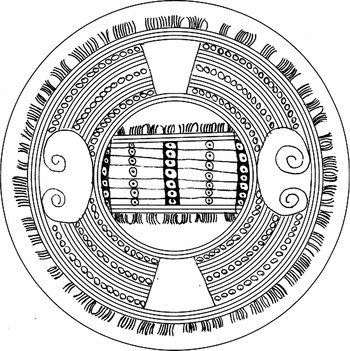
During the Middle Postclassic (a.d. 1250–1430), commoner concern with the calendar continued, although day-sign motifs disappeared. One attribute that suggests continuity is the orange base color of Aztec II Black-on-Orange vessels, which may reflect a continuing concern for the sun, tonalli, and the fate of the days. However, changes occur in design motifs and design composition: concentric circles and dots replace cipactlis and flowers as popular decorative motifs on Aztec II vessels and quadripartite designs become common (Figure 10).
Crossing-motif, dots, and a quadripartite design on an Aztec II vessel from Xaltocan.

Although Solís et al. (Reference Solís, Velásquez, Velasco, Solís, Uruñuela, Plunket, Cruz and Rodríguez2005:112) regard concentric circles as stylized precious stones, the dots and concentric circles on Aztec II pottery probably represent suns or days and their associated fates. In divinatory almanacs (e.g., the Codex Borbonicus, the Codex Magliabechiano), dots or concentric circles are used to represent the numeral coefficients (1–13) that, in conjunction with day-signs, identify the days of the 260-day cycle. In compressed divinatory tables (e.g., the Codex Fejérváry-Mayer), a sequence of twelve dots or concentric circles represents the twelve days that follow the initial day of a 13-day segment of the calendar (a trecena), with each dot or concentric circle representing a “sun,” a whole day (Boone Reference Boone2007:75–78). The solar referent of dots is particularly clear in the Codex Cospi where dots and bars are used to specify quantities of goods in the counted offerings section of the document but dots alone are used to count the succession of days in the calendrical section of the document. The solar symbolism of the concentric circle motif is confirmed in the Codex Magliabechiano (Reference Boone1983:8r), where a textile bearing a large concentric circle design is identified by a gloss in Spanish as “manta del sol” or “mantle of the sun.”
Lacking the specificity of actual day-signs, the dots and concentric circles on Aztec II pottery seem to relate generally to the succession of days in both the 260-day divinatory cycle (the tonalpohualli) and the 365-day solar year (xiuhpohualli). Commoner interest in the solar year is also evident in the quadripartite composition of Aztec II pottery designs which, according to Constanza Vega (1984), refers to the annual cycle of the sun.
Vega (1984) analyzed the designs on Late Postclassic serving vessels from El Volador, an offering excavated in the elite precinct of Tenochtitlan (Solís and Morales Reference Solís and Morales1991). Vega found that the decoration on these vessels was organized in a four-part pattern, with design motifs distributed symmetrically in the four quarters of the vessel. Following Aveni (Reference Aveni1980), Vega argued that the quadripartite designs represent the four quarters of the universe, defined by lines radiating from the inter-cardinal directions, or more precisely, the points where the sun rises and sets at the summer and winter solstices. This quadripartite pattern, then, traces the movement of the sun during its annual, 365-day cycle.
Twenty-six complete Aztec II Black-on-Orange vessels were recovered from Xaltocan (part of a cache of 54 complete vessels discovered by a crew of local road workers in 2001), probably from an Aztec II cemetery. Excavations in this area (Op.Y) in 2003 encountered 13 burials, all accompanied by simple grave goods such as a spindle whorl, or between four and thirteen pots of the types prevalent in commoner households (De Lucia Reference De Lucia and Brumfiel2011). The whole vessels permit us to examine the composition of Aztec II designs. A four-part pattern is present on thirteen of these vessels. In addition, nine vessels bear a specific design: widely-spaced parallel lines are joined by a row of small concentric circles or spirals. This motif, appearing on either the vessel wall or its interior base (Figure 10), suggests the vault of the heavens, crossed by the sun along different paths, according to the seasons of the solar year. Since in Aztec times, the 365-day solar year was marked by state-sponsored ceremonies, the quadripartite designs and the crossing design pattern on earlier Aztec II vessels may indicate the growing presence of state religion in commoner worldviews.
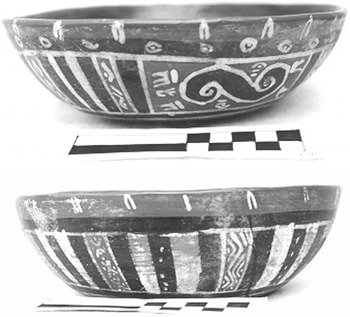
One final difference distinguishes the Aztec II from the Aztec I assemblage at Xaltocan: in Aztec II assemblages, Red Ware joins Black-on-Orange ware as a dominant decorated type (Figure 11). Together, these two wares account for 93% of the decorated pottery at Middle Postclassic Xaltocan. The vessel forms of Black-on-Orange and Red Ware pottery are complementary. Black-on-Orange vessels include tripod dishes, molcajetes, and plates, all of which would have been used to serve food. However, 93% of the Red Ware vessels are bowls, which would have been used to serve drink, particularly the alcoholic beverage pulque.
Black-and-White-on-Red bowls from Xaltocan.

This difference suggests a symbolic opposition between Black-on-Orange and Red Ware vessels. The bright orange Aztec II vessels may have represented the sun, cosmic order, and the life-giving tonalli present in maize-based foods such as tortillas, tamales, and maize-fed turkeys. The darker Red Ware bowls may have represented night, death, and cosmic chaos of which pulque consumption and drunkenness were a part (Brumfiel Reference Brumfiel, Hendon and Joyce2004, Reference Brumfiel, DeMarrais, Gosden and Renfrew2005b; see also Hernández Sánchez Reference Hernández Sánchez2005:93). The struggle of the sun against forces of darkness was an important element in the warfare-centered ideology of the Aztec state (Caso Reference Caso and Dunham1958). The structure of the Aztec II ceramic assemblage at Xaltocan suggests that this militaristic ideology was already present in pre-Aztec times, when Xaltocan was locked in struggle with its neighbor, Cuauhtitlan.
The trends evident in Middle Postclassic ceramics continue into the Late Postclassic period (a.d. 1430–1521), the period when the Aztecs dominated Xaltocan. Quadripartite composition may or may not be present in the Aztec III Black-on-Orange ceramics at Xaltocan; we have not recovered enough complete Aztec III vessels to determine the pattern. But Black-on-Orange dishes and Red Ware bowls continue their dominance: together they account for 96% of all decorated rims in the Late Postclassic assemblage. This suggests continuing attention to the opposition of the forces of light and cosmic order and the forces of darkness and chaos.
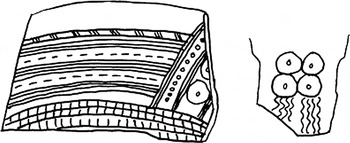
Circles and dots, now supplemented by dashes, continue as common design motifs (Figure 12a). In fact, the decoration on Aztec III Black-on-Orange vessels is typically a simple series of lines, dots, and dashes. These designs seem to focus narrowly on the succession of days and/or on the act of counting. Circles, dots and dashes do not appear in groups of 4, 9, 13, 18, 20, 52 or other calendrically significant numbers. Perhaps, like the pseudo-glyphs on Maya cylindrical vessels, they merely allude to a sophisticated knowledge system (i.e., the counting of the days) without actually reproducing the particulars of that knowledge. Finally, the slab supports attached to Aztec III vessels are sometimes decorated with a block of four concentric circles (Figure 11b). In the Aztec writing system, this is a glyph for tonalli (Berdan Reference Berdan, Berdan and Anawalt1992:220, 233; Hernández Sánchez Reference Hernández Sánchez2005:73), an indication of a continuing interest in the heat-energy associated with the fate of the days.
(Left) circles, dots, and dashes on an Aztec III molcajete from Xaltocan; (right) slab support with a four-circle tonalli glyph and radiating energy below, attached to this same vessel.

Significantly, the rows of circles, dots, and dashes which characterize Aztec III Black-on-Orange pottery appear only on some Aztec IV Black-on-Orange vessels, from very late pre-Hispanic times. Under the Spanish regime, counting the days dropped out of ceramic design and public discourse; divination became an “offstage” activity (see Scott Reference Scott1990).
CALENDARS AND HOUSEHOLD STRATEGIES
The ethnohistoric sources suggest that Aztec household strategies featured calendrical consultation, feasting, decorated pottery, and inter-household alliance-building. The motifs on Black-on-Orange pottery suggest that these elements were also a part of earlier Early-Middle Postclassic household strategies.
In Aztec Mexico, feasts marked critical junctures in the household lifecycle, and well executed feasts probably promoted alliances with other households in marriages, trade expeditions, and other undertakings. If the inhabitants of Postclassic Xaltocan went through a similar process of consultation and review with calendrical specialists prior to undertaking household ventures, then ceramics with calendrical motifs would have been appropriate serving vessels for the feasts. Calendrical motifs would have affirmed that this household undertook ventures which were both socially viable and cosmologically opportune.
This was a new use for calendrical systems in central Mexico. Before the Postclassic, calendrical signs were extremely rare in the region. Fifty years ago, Alfonso Caso (Reference Caso1937) asked, “Did the Teotihuacanos have knowledge of the tonalpohualli?” He answered in the affirmative, but he presented fewer than a dozen examples of bar-and-dot numerals associated with possible day-signs from Teotihuacan. Edmonson's (Reference Edmonson and Boone2005) more recent study presents only six examples of calendrical dates from the city. Given this limited corpus, Langley (Reference Langley1991:290) cites the “absence of convincing evidence” for calendrical notation at Teotihuacan, and López Luján et al. (Reference López Luján, Neff, Sugiyama, Carrasco, Jones and Sessons2000:220) characterize calendrical dates at Teotihuacan as “an extremely rare phenomenon.”
On the other hand, Sugiyama's (Reference Sugiyama1993, Reference Sugiyama, Renfrew and Morley2010) studies of measurement at Teotihuacan reveal that the dimensions of many structures and the distances between structures are a standard Teotihuacan Measurement Unit (0.83 m) multiplied by 260 or some multiple of 260. From this, Sugiyama concludes that the 260-day cycle was used by Teotihuacan's rulers to construct the city according to a sacred cosmogram: “rulers thus proclaimed their earthly political power to create, maintain, and modify cosmograms…materialized in the city layout.” Clearly, the 260-day cycle was present in Classic Teotihuacan, but it was used in quite a different way than in Postclassic Xaltocan. At Teotihuacan, the 260-day cycle was used primarily in the context of urban planning organized by ruling elites, but at Xaltocan, it was used primarily to guide decision-making in both commoner and elite households.
Two factors might explain this difference. First, Postclassic commoners had greater access to a broader range of both goods and knowledge than the commoners of Teotihuacan. Smith and Berdan (Reference Smith, Berdan, Smith and Berdan2003) suggest that the wide diffusion of styles and symbols in Mesoamerica was an important feature of the Postclassic era. A shared inventory of styles and symbols facilitated the flow of information and constituted crucial elements in strategies of social and political interaction. Smith and others focus on shared symbols and styles as components of elite strategies, and yet, the presence of large quantities of market goods at Postclassic period sites such as Xaltocan and the popularity of calendrical motifs on Postclassic pottery implies that commoners also had the ability to shape strategies of social and political action, using market goods and information management to participate in socially potent performances (Brumfiel Reference Brumfiel1987b, Reference Brumfiel, Hendon and Joyce2004; Smith Reference Smith1987). The implementation of these consumption-based alliance strategies might account for the diffusion of vaguely similar inter-regional styles and the intensification of exchange that characterizes the Postclassic in central Mexico (Garraty Reference Garraty2000; Nichols et al. Reference Nichols, Brumfiel, Neff, Hodge, Charlton and Glascock2002; Smith and Berdan Reference Smith, Berdan, Smith and Berdan2003; Smith and Heath-Smith Reference Smith and Heath-Smith1980).
Second, Postclassic households may have suffered from increased vulnerability, making inter-household alliances more essential for the people of Postclassic Mexico. At Classic Teotihuacan, the urban populace lived in large apartment complexes that housed from 20 to 100 people. These large households, with their diversified activities, were probably more viable economic units than the smaller Postclassic households which followed. Their affairs seem to have been managed by a compound head, and their survival may have been buffered by the Teotihuacan state (Cowgill Reference Cowgill1997; Manzanilla Reference Manzanilla and Berlo1993, Reference Manzanilla, Hendon and Joyce2004).
Postclassic households were typically smaller nuclear or joint family units (Calnek Reference Calnek1972; Kellogg Reference Kellogg, Santley and Hirth1993). Small family units are more vulnerable to annual and cyclical fluctuations in labor, dependents, income, and so on. Moreover, relatively large, densely-occupied settlements such as Xaltocan may have relied upon the market to supply some or all of their food, and this would have made survival even more uncertain. In years of poor harvests, food-producing peasants provision their own families first and bring little food to market for public sale (Hicks Reference Hicks, Claessen and Velde1987; Mellor and Gavian Reference Mellor and Gavian1987). Food prices skyrocket as supplies of marketed food dwindle. People at nucleated centers like Xaltocan, Culhuacan, and Chalco may have relied upon inter-household alliances to provide food, labor, and capital that evened out fluctuations in the household and market economies. At Postclassic centers, inter-household relationships would have merited careful investment and monitoring—hence, calendrics, feasting and decorated pottery.
Xaltocan ceramics also suggest that, over time, commoner consciousness expanded to include the 365-day solar calendar (xiuhpohualli) as well as the 260-day divinatory calendar (tonalpohualli). Four notched human femurs from Early-Middle and Middle Postclassic period domestic contexts at Xaltocan suggest that members of commoner households participated in state-sponsored warfare (see McVicker [Reference McVicker2005] and Pereira [Reference Pereira2005] for discussion of notched femurs in Postclassic Mesoamerica). These bones might mark occasions when household feasts and state rituals coincided. On these occasions, Xaltocamecas’ attention would be engaged by both the 365-day solar calendar which regulated state-sponsored human sacrifice and the 260-day divinatory calendar which foretold fortunes of household members who engaged in warfare.
Further evidence for the existence of a militaristic ideology at Middle Postclassic Xaltocan is provided by the opposition of Black-on-Orange and Red Ware in Aztec II assemblages, suggesting some variant of the belief that the daily journey of the sun was threatened by the forces of darkness, and that survival depended upon warfare and human sacrifice. Furthermore, male figurines, many of which wear warrior attire, are most common in Aztec II contexts at Xaltocan (Overholtzer Reference Overholtzer2008). It is probably no coincidence that signs of militarism peak in Xaltocan during the Middle Postclassic, when Xaltocan was locked in combat with its neighbor Cuauhtitlan.Footnote 1 The intensification of warfare both heightened household insecurity and offered a new potential source of household income, the tribute wealth awarded to outstanding warriors by their grateful sovereigns.
During the Late Postclassic, household feasting continued using Black-on-Orange vessels that expressed concern with the sun, tonalli, and the counting of the days. The Black-on-Orange Ware:Red Ware opposition continued, but other signs of militarism diminished. Notched bones have not been found in Xaltocan in Late Postclassic period contexts, and the ratio of male to female figurines declined dramatically: from approximate parity during the Middle Postclassic to a 1:3 ratio (favoring females) during the Late Postclassic (Brumfiel Reference Brumfiel and Wright1996; Overholtzer Reference Overholtzer2008). Evidently, with the imposition of a pax azteca on the Basin of Mexico, and with most of the proceeds of conquest going to the imperial capitals, the Xaltocamecas became less enthusiastic participants in state-sponsored warfare.
CONCLUSIONS: HISTORICAL CHANGE IN THE 260-DAY CYCLE
This examination of the Mesoamerican calendar reveals significant variation in its function over time and space. The calendar was used (1) by Maya and Zapotec elites to commemorate biographical events, (2) by Teotihuacan's rulers to design an urban plan, and (3) by Postclassic commoners to manage household affairs. Comparative historical study of the Mesoamerican calendar reveals that, despite its reputation as an exclusively elite institution, the calendar has served commoner purposes for at least a millennium.
Recognizing that commoners used and still use the Mesoamerican calendar enables us to critique two largely implicit beliefs that archaeologists have held about commoner cosmology, in Mesoamerica and elsewhere (Gonlin and Lohse Reference Gonlin and Lohse2007; Plunket Reference Plunket2002). The first is that commoners play a passive role with respect to ideology. As Jon Lohse (Reference Lohse, Gonlin and Lohse2007:6) points out, two scholarly traditions have contributed to our view that commoners are “mute, passive and acquiescent” in the face of religious belief and practice. Functionalist approaches to religion, based on Durkheim (Reference Durkheim and Swain1915), highlight the role of ritual in making people willing conformists to social norms. Ideological domination approaches, based on Marx and Engels (Reference Marx, Engels and McLellan1977), emphasize the role of religion in legitimating social inequality. Particularly this latter approach has encouraged archaeologists to regard elites as the source of innovation in cosmology, those individuals who were most likely to manipulate ideology to achieve their purposes (Clark and Blake Reference Clark, Blake, Brumfiel and Fox1994; Conrad and Demarest Reference Conrad and Demarest1984; Demarest Reference Demarest, Demarest and Conrad1992; DeMarrais et al. Reference DeMarrais, Castillo and Earle1996; Emerson and Pauketat Reference Emerson, Pauketat and O'Donovan2002; Joyce and Winter Reference Joyce and Winter1996; Lucero Reference Lucero2003; Miller and Tilley Reference Miller, Tilley, Miller and Tilley1984; Siegel Reference Siegel1999; see Baines and Yoffee Reference Baines, Yoffee, Feinman and Marcus1998 for a non-Marxist view of elites as cultural innovators). Alternatively, archaeologists have presented commoners as engaging with or resisting elite ideologies (Brumfiel Reference Brumfiel and Wright1996; Hutson Reference Hutson2002; Joyce et al. Reference Joyce, Bustamante and Levine2001; Joyce and Weller Reference Joyce, Weller, Gonlin and Lohse2007; Spence and Rattray Reference Spence, Rattray and Gallut2002). Examples of commoners producing their own perspectives or commoner religion serving distinctly commoner goals (what Joyce et al. [2001:369–70] refer to as “avoidance” or “independence”) are still few in number (but see Hutson Reference Hutson2002; Robin Reference Robin1999; Sheets Reference Sheets2002).
Assuming that commoners are passive consumers of cosmology, archaeologists might regard commoners’ use of the calendar during the Postclassic as an instance of “trickle down” religion. Ritual practices flowed from elites to commoners in the same way as formerly exclusive prestige goods became market commodities during the Postclassic (Smith and Berdan Reference Smith, Berdan, Smith and Berdan2003:7). Postclassic commoners might be seen as adopting elite goods and ideas because they wanted to be more like elites; thus, commoners might be regarded as capable of intellectual emulation but not innovation. But recent research in technology studies and consumer studies (Holloway and Valentine Reference Holloway and Valentine2001; Miller Reference Miller1987, Reference Miller1988; Silverstone et al. Reference Silverstone and Hirsch1992) indicates that modern households appropriate even highly standardized consumer goods and highly sophisticated technologies in multiple ways, shaping them to suit their own preferences and goals. In the light of ethnographic and ethnohistoric data on commoner use of the calendar, I suggest that in a similar fashion commoners at Xaltocan adopted the calendar and put it to use for their own, specifically commoner, purposes: at first, to build strong alliances that would buffer their households against demographic and market fluctuations, and later, to motivate young, male household members to participate in warfare.
A second implicit belief that archaeologists have held with regard to commoner cosmology is that commoner ideology (insofar as it differs from elite ideology) is limited to a narrow range of interests immediately related to the household: the health and reproduction of household members, the success of household crops, and communication with household ancestors (Brumfiel Reference Brumfiel and Wright1996; Cohodas Reference Cohodas1985; Cowgill Reference Cowgill and Gallut2002; Klein and Victoria Lona Reference Klein, Lona, Halperin, Faust, Taube and Giguet2009; Marcus Reference Marcus1998; McCafferty Reference McCafferty, Gonlin and Lohse2007). But many ceramic attributes from Xaltocan (including color, vessel form and function, design composition and design motifs) suggest that commoners were interested in abstract and large-scale cosmological concepts: the nature and meaning of time, the sun's cycles as they defined the limits of time and space, the circulation of sacred tonalli and its role in creative processes. These broad cosmological perspectives are also evident in other household artifacts such as spindle whorls and figurines (Brumfiel Reference Brumfiel, Montón-Subías, González-Marcén, Picazo and Sánchez-Romero2008, Reference Brumfiel and Brumfiel2011; Brumfiel and Overholtzer Reference Brumfiel, Overholtzer, Halperin, Faust, Taube and Giguet2008; Zaro and Lohse Reference Zaro and Lohse2005); they are also implicated in archaeological evidence of commoner renewal ceremonies, trash disposal practices and dedicatory caches (Elson and Smith Reference Elson and Smith2001; Garber et al. Reference Garber, Driver, Sullivan, Glassman and Mock1998; Hutson and Stanton Reference Hutson and Stanton2007; Mathews and Garber Reference Mathews and Garber2004; Robin Reference Robin2002). Many of these concepts continue to interest indigenous Mesoamerican people, today (e.g., Brown Reference Brown2004; Gossen Reference Gossen1974; Hanks Reference Hanks1990; Monaghan Reference Monaghan and Monaghan2000; Sandstrom Reference Sandstrom1991; Schaefer Reference Schaefer2002; Taggart Reference Taggart1983; Tedlock Reference Tedlock1997).
In the past, iconographic studies in Mesoamerica have tended to focus on elite products (such as murals, stelae, and writing) and their uses for building elite authority and power. Studies of the iconography of commoner artifacts such as figurines and spindle whorls have focused on issues of personal identity along the lines of status, gender and ethnicity. But we might do well to ask two additional questions: How did the iconography of commoner goods (e.g., glyphs on pottery) relate to social practices (e.g., feasting), and how were these social practices related to broader strategies (e.g., household buffering) which commoners used to promote their own well-being?
To answer these questions, even to formulate them, we will have to draw on the power of a systematic search for differences to reveal historical change in the past. Analogies will help, but analogies alone will not suffice. Analogy must by accompanied by the systematic analysis of differences in order to endow our studies with adequate variability, context and dynamism.
RESUMEN
Este artículo explora no sólo el valor de utilizar las analogías etnográficas y etnohistóricas en la arqueología, sino también las ventajas de explorar sistemáticamente las diferencias entre los registros textuales por una parte y los datos arqueológicos por otra. Este artículo examina tanto las continuidades como los cambios en el calendario en Mesoamérica desde el siglo XI a tiempos modernos. Primero, describo la cuenta de los días en el contexto etnográfico de Guatemala del siglo XX. Después, examino la cuenta de los días según documentos históricos del siglo XVI del México central. Por último, utilizo los motivos cerámicos en cerámica del posclásico temprano-medio de Xaltocan, México, para examinar el calendario durante los siglos XI-XVI.
En Xaltocan, una relación entre la cerámica Azteca I y el calendario adivinatorio es sugerida por la popularidad de dos signos de día, cipactli (el cocodrilo) y xochitl (la flor), como los motivos decorativos de vasijas de servir. Cipactli y xochitl son el primer y el último día del calendario adivinatorio de 260 días (el tonalpohualli). Estos motivos sugieren que la gente común consultaba el calendario y organizaba los banquetes en coyunturas críticas en el ciclo vital doméstico durante el posclásico temprano-medio (900–1300 d.C.), tal y como se hacía poco antes de la conquista española.
Durante el posclásico medio (1300–1430 d.C.), una serie de círculos y puntos concéntricos en vasijas Azteca II parece simbolizar el pasaje de los días y ciclos solares, incluyendo el ciclo del calendario adivinatorio de 260 días (el tonalpohualli) y el año solar de 365 días (el xiuhpohualli). La expansión de interés de parte de la gente común en incluir el xiuhpohualli así como el tonalpohualli, es también evidente en la composición cuadripartida de los diseños de la cerámica Azteca II, que traza el suceso anual de los solsticios. También durante el posclásico medio, la vajilla Roja y la cerámica Negro-Sobre-Anaranjado mantenían una oposición simbólica: las vasijas Negro-Sobre-Anaranjado representaban el sol, el orden cósmico, y el tonalli animador presente en la comida de maíz como las tortillas, los tamales y en los pavos alimentados de maíz, mientras que las escudillas de vajilla Roja representaban el consumo de pulque y la embriaguez, la noche, la muerte y el caos cósmico. Esta oposición fue parte de una ideología militarista que apareció en Xaltocan durante el posclásico medio, cuando Xaltocan estaba de guerra contra su vecino Cuauhtitlan.
Durante el posclásico tardío (1430–1521 d.C.), la decoración en vasijas Azteca III Negro-Sobre-Anaranjado se reducía a patrones sencillos de líneas, puntos y arranques. Estos diseños parecen enfocarse estrechamente en la sucesión de días y/o en el acto de contar.
La alta frecuencia de vasijas de servir con motivos caléndricos puede ser atribuida a la popularidad de banquetear en las unidades domésticas del México posclásico. Sugiero que las familias nucleares pequeñas del posclásico dependían mucho de alianzas interfamiliares para suministrar alimento, trabajo, y/o capital que podían equilibrar fluctuaciones en trabajadores domésticos, cosechas y los precios de mercado. Las alianzas inter-familiares merecían atención cuidadosa y vigilante, de ahí, el calendario adivinatorio el cual se usaba para juzgar si las alianzas eran ventajosas, el banquete el cual se usaba para construir la alianza, y la cerámica Negro-Sobre-Anaranjado la cual se usaba para registrar el proceso de alianza.
La expansión durante el posclásico medio y tardío del conocimiento popular para incluir el calendario solar así como el calendario adivinatorio puede reflejar el militarismo creciente. El militarismo en el nivel doméstico podía haber animado a miembros de la casa masculinos jóvenes a participar en las acciones militares del estado, beneficiando a la familia al defender sus campos y casas y aumentar su acceso a la riqueza de tributos.
En conclusión, a pesar de su reputación como instituciones exclusivamente de elites, los calendarios han servido propósitos de la gente común durante por lo menos un milenio. La gente común estaba más informada y más activa con respecto a la cosmología que los mesoamericanistas han creído. El análisis histórico comparativo, es decir, la búsqueda sistemática de diferencias así como similitudes en los registros etnográfico, ethnohistórico y arqueológico, aumentará las contribuciones que hacen la etnografía y la ethnohistoria a la arqueología mesoamericana.
ACKNOWLEDGEMENT
An early version of this paper was presented as the Inaugural Jeffrey R. Parsons Lecture, Museum of Anthropology, The University of Michigan, 2007. I thank the UMMA audience for their stimulating questions and comments. Later versions of this paper were presented at the session “Inter-Valley Relations in the Central Mexican Highlands,” organized by Destiny Crider and Tatsuya Murakami, Society for American Archaeology, 72nd Annual Meeting, Austin, TX, 2007, and the session “Gender and Material Culture,” organized by Kathryn Weedman and Lisa Frink, American Anthropological Association, 106th Annual Meeting, Washington, DC, 2007. Archaeological Field Work at Xaltocan has been generously supported by the Heinz Grants in Latin American Archaeology; The National Science Foundation (BNS-8919095 and BCS-0612051), and numerous Faculty Development Grants from Albion College. George Cowgill and Saburo Sugiyama kindly provided me with information on calendar use at Teotihuacan. Helen Schwartzman helped me understand the relevance of technology studies for the Mesoamerican calendar. Arthur Joyce, Prudence Rice, Cynthia Robin and Enrique Rodríguez-Alegría provided insightful comments on earlier drafts of the paper.