INTRODUCTION
This research constitutes a follow-up to an article written during the late fall of 2005 (Reese Reference Reese2006). Footnote 1 The original paper focused on the economic development impacts of natural as opposed to economic disasters, exploring the political and policy ramifications of the sudden versus slow economic death of cities. More specifically, the slow economic death of Detroit was used as the rhetorical opposite of the sudden death of New Orleans in the wake of Hurricane Katrina. The case was made that many of the approaches and responses to sudden natural disasters might be applied effectively to areas experiencing more chronic economic decay.
The primary focus of this paper is to revisit the recommendations presented in the first article with the benefit of nearly a decade of observations of the post-Katrina experience in New Orleans as well as the serious governmental, economic, and social changes in the city of Detroit. Below is a summary quote from the earlier analysis:
Both Detroit and pre-hurricane New Orleans suffer from significant economic distress. Media and other reporting in the wake of Katrina rightly emphasized the exceptionally stressed economic conditions of New Orleans and its poorest residents prior to the hurricane; Detroit’s problems are generally more severe. In short, on August 28, 2005, the day before hurricane Katrina, both Detroit and New Orleans represented cities that were experiencing slow economic death. Many residents, particularly residents of color, were in poverty, public infrastructure was old and decaying, and the school systems suffered constant criticism regarding quality. Little was being done in any concerted way at federal and state levels to address these issues regardless of the reasons (lack of political will, racism, limited state resources, lack of foresight, etc.). Then, within days, national attention was focused on New Orleans (Reese Reference Reese2006, p. 224).
The article went on to identify the elements of a successful response in the wake of a natural disaster that could also lead to long term economic improvements in cities experiencing prolonged economic decay. With the benefit of hindsight, observations made at that time appear overly optimistic. The record suggests that the significant investment of resources in post-Katrina New Orleans was either insufficient or ineffective in shifting that city’s economic trajectory much beyond Detroit’s. This paper looks at this situation and poses some suggestions for why this might be the case.
PROGNOSTICATIONS: SUDDEN VERSUS SLOW DEATH
Previous research on interventions following natural disasters suggested that New Orleans would benefit from several phenomena that a city like Detroit, experiencing slow death, would not have been offered: sustained media attention; a sense of urgency; federal and state financial assistance; and an intensive focus on the public sector (Reese Reference Reese2006).
Media Attention
One significant difference between natural and economic disasters is the media attention attendant to the former as opposed to the latter, although the final death throes of a city (i.e., bankruptcy) garner media scrutiny akin to gawkers at the scene of a fatal accident (Eisinger Reference Eisinger2014). While there have been many recent books and media reports on the financial demise and ultimate bankruptcy of Detroit (see Binelli Reference Binelli2012; Galster Reference Galster2012; LeDuff Reference LeDuff2013), this has not come close to the intensity and accessibility of the media attention focused on New Orleans after Katrina. Reporting covered not only the scope of the disaster but also raised the underlying issues of race, poverty, and governmental capacities. The extensive media play on Katrina and public fascination with disasters suggested that a long-term focus on the underlying needs of an economically, racially, and geographically segregated city might develop and lead to public discussion about what it might take to address these needs. It was expected that this public focus would have supported the rebuilding of New Orleans in a fashion that would have potentially addressed the long-term issues of racial and economic inequality. And, it was argued that if such media attention had been paid to Detroit, with its chronic economic crisis, then it might also have prompted sustained redevelopment efforts.
Sense of Urgency/Long-range Vision
Natural disasters foster a sense of urgency as it is necessary to respond to them immediately and with large-scale measures opening the door to creative, long-range solutions such as: the development of a diversified or sustainable economy, reconfiguring and rebuilding the city in a more environmentally sound manner with greater attention to issues of environmental justice, and developing different forms or modes of service delivery, or significantly enhanced infrastructure, for example. Thus, the crisis should allow for new and more open planning processes to occur, leading to creative problem solving on a large scale supported by a significant influx of funding from a variety of actors in different levels of government. Disasters on the scale of New Orleans provide the opportunity for sweeping clearance, a chance to start anew, which is almost impossible to attain under conditions of slow economic deterioration where abandonment occurs sporadically across a city. Consideration of large scale or non-traditional redevelopment options opened by a natural disaster might be expected to lead to more rapid and innovative solutions than those posed for slow economic death.
Federal and State Assistance
Intense and focused public investment is essential to rebuilding after a natural disaster. It was assumed that enhanced and targeted investment in New Orleans would exceed the more indirect and piecemeal efforts in Detroit represented by such federal programs as Federal Title 1 Urban Renewal Funds, Community Development Block Grants, the Model City Program, and the more recent Neighborhood Stabilization, Enterprise Community, and HOPE VI programs (Thomas Reference Thomas1997; Wright and Mowitz, Reference Wright and Mowitz1962). Even though the Empowerment Zone brought $100 million to Detroit, it does not compare to the presumably larger and more intense investment after Katrina.
Investing in the Public Sector
The importance of public investment in buildings, services, and other infrastructure in sustaining civic pride—emphasizing that a community is important, worth investing in, and being a part of—should not be underestimated. The significant investment in public infrastructure in the wake of Katrina should have provided not only a new physical face for the city but also the sense that New Orleans and its people were worth the investment.
Again, the central question posed here is how did New Orleans benefit from the infusion of attention and investment? Was the response enough to shift the city from disaster to health? More specifically the following research questions are addressed:
-
• What were the economic and social trajectories of Detroit and New Orleans prior to their respective disasters?
-
• How did the responses to the hurricane impact New Orleans?
-
• Despite the attention given to New Orleans, why do current conditions differ little from Detroit?
The discussion proceeds with a synopsis of the economic decline of Detroit and New Orleans. It is followed by a summary of interventions in post-Katrina New Orleans. The third section compares the current economic context of both cities. The final section discusses why the media focus, sense of urgency, and financial investments were apparently not sufficient to significantly change New Orleans’ trajectory.
PARALLEL TRACKS OF RECESSION
Detroit
During the twentieth century, Detroit experienced rapid growth followed by decades of decline (Binelli Reference Binelli2012). Population loss began in 1950, and over the next five decades, the city lost 1.13 million residents and an additional 237,500 from 2000–2010 (US Census 2010). This population loss has been coupled with significant employment loss. The number of jobs in the city fell by over half (52.8%) between 1970 and 2010; the number of city residents with jobs dropped by 43.5% over the same period (American Community Survey 2011; US Census 1970). Unemployment has been in double digits during most of this time (Michigan Labor Market Information System 2013).
This job loss and flat average earnings (at just over $21,000 in both 1999 and 2010) affected the city’s housing market (American Community Survey 2011; US Census of Population 2000), causing vacancies and mortgage and property tax foreclosures increased (Skidmore and Sands, Reference Skidmore and Sands2012). As of 2013, roughly 80,000 (23%) of the city’s 349,170 housing units, 36% of commercial parcels, 22% of industrial properties, and about twenty square miles of the land area were vacant. Detroit’s municipal finances have suffered as a result. Property tax rates are at the maximum allowed and debt millage makes up about one-third of the city’s total property tax levy. Despite the introduction of new taxes, Detroit had a budget deficit in nine of the eleven fiscal years between 2002 and 2013 (see Reese et al., Reference Reese, Sands and Skidmore2014 for discussion of this decline).
The City eliminated 44% of its employees in the past decade, leaving just 10,545 in FY12; the FY14 budget called for elimination of an additional 2,227 positions. Service reductions have been extensive (Reese et al., Reference Reese, Sands and Skidmore2014). The FY13 budget reduced city spending by 18% from FY12 (Detroit FY13 Executive Budget Summary); and the FY14 budget called for additional cuts of more than $40 million (Bomey et al., Reference Bomey, Snavely and Priddle2013).
An emergency financial manager took over the city administration in May of 2013 and the city filed for protection under Chapter 9 of the Federal bankruptcy code on July 18th of the same year (Davey and Williams-Walsh, Reference Davey and Williams-Walsh2013). Although the city emerged from bankruptcy in late 2014, the simple elimination of the debt burden will not address the root economic and structural problems (Reese et al., Reference Reese, Sands and Skidmore2014; Stiglitz Reference Stiglitz2013).
New Orleans
By the time Katrina hit, New Orleans was one of the poorest cities in America; research by the Brookings Institute indicated that in 2000, New Orleans ranked second among all U.S. cities in concentrated poverty (Durant and Sultan, Reference Durant, Sultan, Marable and Clarke2008) with a 12% unemployment rate, double that of the nation (Holzer and Lerman, Reference Holzer and Lerman2006).
New Orleans has much lower property tax rates than Detroit. The state does not use an equalization value system and all property taxes (for land) are fixed at 10%; each homeowner is exempt from parish, state or special ad valorem taxes in the amount of $7,500 dollars (Louisiana Tax Commission 2013). The city does have its own sales tax (parish tax of 15.10 mills in 2012), and the brunt of property tax revenue falls on local businesses and renters. The city levies other taxes, but according to the 2013 Louisiana Tax Commission’s Annual Report, no special levies have been enacted in recent years to make up for budgetary deficits, although New Orleans has had a positive general fund balance for the past decade (CAFR 2013).
The oil bust in 1983 and 1984 caused a significant drop in oil and gas jobs leading to substantial and chronic unemployment. From the 1980s, the metropolitan area experienced sluggish job and population growth, and the number of vacant homes increased significantly (Plyer et al., Reference Plyer, Ortiz, Horowitz and Hobor2013). But, in the 1990s and early 2000s, New Orleans hit its stride as one of America’s tourism destinations. While some in the city have lamented the “Disneyfication” of the French Quarter, the success of the city’s transition to a tourism and convention destination is clear (Souther Reference Souther2007). In 2004, prior to hurricane Katrina, the city experienced a record high of over 10 million visitors, this number plummeted after the disaster, rebounding in 2013 to over 9 million visitors annually (Landrieu Reference Landrieu2014). Tourism is the driving force of the economy, supplying the city with over 66,000 jobs in 2004 (Carson Reference Carson2000). The influx of tourists is a double-edged sword however; many jobs within the tourism industry are low paying and seasonal. Retail businesses connected to tourism typically recover last after natural disasters (Waugh Reference Waugh2006) and after Katrina, the effects of the city’s reliance on tourism became evident (Redwood Reference Redwood, Marable and Clarke2007). Directly after the storm, the New Orleans area lost over 200,000 jobs in both the public and private sectors. In November of 2005, the unemployment rate was 17.4% compared to the 4.6% reported in 2004 (Whelan Reference Whelan, Squires and Hartman2006). Although unemployment fell to 8.2% in December of 2005 and had mostly recovered by April of 2006 (5.1%), problems with housing and insurance claim processing hampered the ability of businesses to recover. The Great Recession in 2008 and 2009, which affected the majority of employment markets in the country, caused a considerable dip in jobs and, as of 2013, the unemployment rate in New Orleans hovered around 9% (U.S. Bureau of Labor Statistics 2013).
Although suffering from similar levels of economic distress, Detroit and New Orleans have historically performed very different roles in the national economy. Detroit’s economy was based on manufacturing beginning in the 1800s with flour milling, building and repairing ships, marine stream engines, and the export of copper ores. This served as the roots for the development of the internal combustion engine for boats, pharmaceuticals, the manufacture of coaches and carriages, and ultimately, the beginning of the auto industry in the early twentieth century. The rapid expansion of manufacturing in the city led to a concomitant investment in infrastructure. Its population increase was matched by construction that vastly expanded the physical city: housing, industrial and commercial buildings, as well as streets, water and sewer lines, government buildings, and high quality hospitals and arts investments (Ryan Reference Ryan2012). However, currently much of Detroit’s public infrastructure is eighty to 110 years old and is hence nearing the end of its useful life. Its continued use will require substantial investment in renovation or replacement.
The New Orleans economy on the other hand, had a very different role in the nation. As a principal port, New Orleans had a major position in the nation’s slave trade with the largest domestic slave market. An ancillary economy grew up around the trade in slaves—for transportation, housing and clothing, and fees, etc. All of this amounted to tens of billions of dollars (2005 dollars, adjusted for inflation) during the antebellum period, with New Orleans as a prime beneficiary (Johnson Reference Johnson2001). Over time, New Orleans has been dominated by four sectors: oil and gas related activities, tourism, shipbuilding, and aerospace manufacturing. Although the city is home to only one Fortune 500 company (Entergy) a variety of federal agencies and military facilities are located in the New Orleans region.
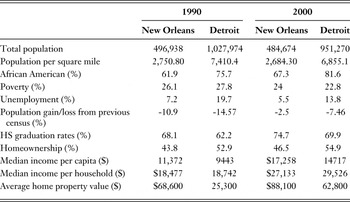
Despite these different roles in the national economy, it is clear from Table 1 that, prior to the hurricane in 2005, Detroit and New Orleans were on similar economic trajectories. Total population and population density were dropping, although more severely in Detroit. The percentage of the population that was African American was increasing in both cities at a similar rate. Reflective of the economic prosperity going into the 2000s, both cities experienced modest decreases in unemployment and poverty and increases in high school graduation rates, incomes, and property values. However, these markers of economic growth still lagged behind other major cities in the country for the same time period (Delgado et al., Reference Delgado, Porter and Stern2012; Porter Reference Porter2003).
Economic Trajectories

Source: Social Explorer Dataset (SE), Census 1990, 2000 Social Explorer; U.S. Census Bureau.
INTERVENTIONS IN THE WAKE OF KATRINA
The amount of federal and state dollars spent to rebuild and aid New Orleans in the aftermath of the storm was unprecedented. Congress, the President, the state of Louisiana, and local government introduced the following programs and initiatives:
-
• In December 2005 and again in June 2006, Congress approved emergency supplemental appropriations providing $11.5 and $5.2 billion in Community Development Block Grant assistance for hurricane relief. Just over $10 billion of this money was given to the state of Louisiana (Office of Policy Development and Research 2006).
-
• The White House and Congress approved $109 billion in funding for the Gulf Coast region. Thirty-five billion dollars of this supported longer-term rebuilding efforts and included $18.2 billion in state and local infrastructure repairs and $16.7 billion in CDBG funds (including $8.8 billion for Louisiana) for home and apartment owner repairs (Liu Reference Liu2006).
-
• Congress and the White House tripled the availability of Low-Income Housing Tax Credits in the Gulf Opportunity Zone Act of 2005 to give the private sector resources to build affordable housing.
-
• The Gulf Opportunity Zone Act also provided $8 billion dollars in tax relief and incentives for businesses to produce new development in parishes along the coast.
-
• In Louisiana, the Road Home Program supplemented CDBG ($10.4 billion) and state funds ($6.3 billion) to provide aid to homeowners. One and a half billion dollars were targeted for the refurbishment of rental housing.
-
• Louisiana made the historic decision to merge levee protection and coastal restoration activities under a single governmental entity (Liu Reference Liu2006).
-
• Months after the hurricane the state of Louisiana took ownership of 107 of the 117 schools in the New Orleans school district placing them under the jurisdiction of the state’s Recovery School District.
-
• Mayor Mitch Landrieu implemented a $52.3 million soft-second mortgage program to further assist homeowners and prospective homebuyers in New Orleans. Originally initiated by the Nagin administration, Landrieu, under pressure from various nonprofit and local groups, began allocating funds in 2011 (Hammer Reference Hammer2011).
CURRENT ECONOMIC CONDITIONS
It [Detroit’s] was the largest percentage loss for any American city with more than 100,000 residents over the last decade, apart from the unique situation of New Orleans, where the population dropped by 29 percent after Hurricane Katrina in 2005…The number of people who vanished from Detroit—237,500—was bigger than the 140,000 who left New Orleans (Seelye Reference Seelye2011).
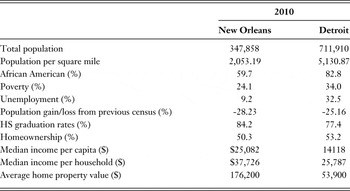
Generally, current economic conditions in Detroit are worse than those in New Orleans by almost any standards. Yet, some important parallels remain and the fates of the two cities have been linked by several scholars (Burns and Thomas, Reference Burns and Thomas2006; Vanderleeuw and Liu, Reference Vanderleeuw and Liu2002). Table 2 presents basic census data from 2010. Both cities have lost high percentages of their population since 2000 and population per square mile has similarly declined. As of 2011, an estimated 43,000 abandoned properties and vacant lots remained in New Orleans (Hardman Reference Hardman2011) leaving a physical profile not quite as extreme as the abandonment in Detroit, but certainly more than the city experienced prior to the storm. Poverty in New Orleans is flat while it increased in Detroit by 11% during the decade. Unemployment increased in both cities although more dramatically in Detroit. It is on the household wealth measures that New Orleans appears to have moved ahead: median income, homeownership, and property value have all increased in New Orleans but continued to decrease in Detroit. There is another feature on which the cities are now showing different trajectories—New Orleans has seen an 8% decrease in African American population while the Black population in Detroit increased 1% over the decade despite a general exodus of residents of all races. Pre-Katrina, Blacks in Orleans parish totaled 302,041; in 2005 the number stood at 89,891(Louisiana Recovery Authority 2007). In 2010, this number had increased to just over 206,000. Thus, the current population of New Orleans is less Black than before, though Blacks in Orleans parish still make up almost 60 %of the total population up from 47% directly after the storm. As a whole, the entire New Orleans metropolitan area has a population that is less than half of pre-Katrina levels.
2010 Comparison

Source: Social Explorer Dataset, Census 2010; U.S. Census Bureau.
While the death analogy has been applied to Detroit in several academic treatments (Eisinger Reference Eisinger2014; Galster Reference Galster2012) media representations over recent months have pointed to a possible regeneration. A careful examination of the recovery to this point suggests that it is quite limited in both level and scope. Even before the city of Detroit emerged from federal bankruptcy proceedings at the end of 2014, it was possible to see signs of improvement in some aspects of city life. Many of these are highlighted in the 7.2 Square Miles report published by the Hudson-Weber Foundation (2015). This report describes the flurry of investment and development activity in the central area of Detroit; an inverted T-shape, running up Woodward to the New Center and along the riverfront.
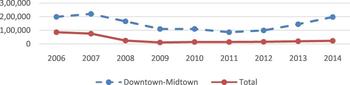
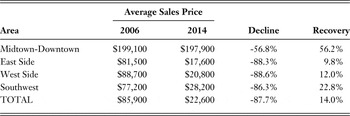
While this part of the city has made significant progress in recent years, other parts of Detroit have not fared as well and the gap between the 7.2 square miles and the remaining 95% of the city is increasing. This is perhaps best illustrated by the trends in residential sales prices in the city since 2006 (Figure 1). Like most cities in the United States, Detroit experienced a significant decline in average sales prices between 2006 and 2009. In some neighborhoods, the average sales price fell by more than 80%. Over the last five years or so, prices have stabilized in most parts of the city, typically at about $50–$60,000 below the 2006 average (Sands Reference Sands2015).

As Figure 1 illustrates, there has been one prominent exception to this—the Downtown/Midtown area. The ‘7.2 Square Mile’ central area of Detroit has been able to attract residents and investment, and is enjoying a strong housing market. In these neighborhoods, home sales prices have rebounded to the point where they are less than 1% below the 2006 average. Home sales prices in other parts of the city, however, continue to lag well below their peak levels (see Table 3). The recovery of the 130 square miles of Detroit that is not part of the core will be tenuous if significant inroads are not made in the high concentrations of poverty that exist in many of these neighborhoods.

In summary, New Orleans is getting less Black and has experienced an increase in personal wealth. The latter may be driven by different forces: increasing number of Whites that may have higher incomes, or a tendency for residents with greater means to return, repair, or find housing. It should also be noted that although many African Americans have left both Detroit and New Orleans in recent years, the drivers are different. In Detroit, issues such as the lack of employment (particularly in the auto industry), poor public services (particularly schools), crime, high taxes, and falling housing prices have led many Blacks with the economic wherewithal to do so to leave the city for its suburbs. Again, this has been a process of decline that has been going on for many years. In New Orleans the exodus was much more sudden as a result of the natural disaster and many, even the poor Blacks, that left the city did not return because of economic opportunities outside the city and barriers to rebuilding within it. Yet, on other indicators of economic health—population loss, poverty, and unemployment—the two cities are little different despite the investment in New Orleans.
FAILURE OF ASSUMPTIONS
As noted at the outset of this paper, it was assumed that the intensive media attention and targeted investment in New Orleans after the natural disaster would change its past economic direction, and thus, the same levels of attention and investment would assist Detroit in its economic disaster (Reese Reference Reese2006). But, how did the widespread media attention on and investment in New Orleans actually play out?
Media Attention
Media attention was integral to highlighting many issues that faced the Gulf Region after Hurricane Katrina, including race and the effect of race in perceptions of federal, state, and local responses to the hurricane (Eyerman Reference Eyerman2015). Two complementary, but distinctly different, images were presented in both the print and televised media. First and foremost, Hurricane Katrina was shown as an unavoidable natural disaster, perhaps exacerbated by slow human response, but not caused by residents or their leadership. In almost all accounts, the hurricane was viewed as one of, if not the most, devastating natural disasters to ever hit an American city. Based on this “story” a natural outpouring of sympathy and aid to the region could be expected.
The second media story painted a very different picture of the disaster and one scene in particular, made an indelible imprint on the American psyche—the New Orleans Superdome. This image, accompanied by the deteriorating situation in the nearby Convention Center, showed Americans outside the region a different face of natural disaster, with the disproportionate effects of the hurricane on Blacks within the city clearly introducing the dimension of race. The media told a story of race that led to divergent responses from the public. For example, a Newsweek magazine poll found that 65% of Black Americans thought the government response was slow because many of the victims were African American; only 31% of White Americans agreed (Page and Puente, Reference Page and Puente2005). While there was substantial agreement among Blacks (94%) and Whites (81%) that most of those who stayed behind in the city after the hurricane were poor, a discrepancy in how these individuals were viewed was apparent. Seventy percent of Blacks felt very sympathetic to those left behind after the hurricane compared to only 42% of Whites. Whites expressed stronger sympathy for those who evacuated than for those that were unable to do so (Huddy and Feldman, Reference Huddy and Feldman2005).
David Grusky and Emily Ryo (Reference Grusky and Ryo2006) tested the “dirty little secret” hypothesis uncovering additional differences in how people used media reports to assess the situation after the hurricane. According to this hypothesis, poverty and inequality in the United States are typically hidden from the public, creating apathy and ignorance. Using polling data from before and after the hurricane several pre-existing poverty ideologies were identified, suggesting that media exposure had no effect on “deniers,” individuals who do not feel there is a poverty problem in the United States. They concluded that media coverage of the hurricane did little to elevate public awareness of poverty and inequality.
Other scholars explored the potential public opinion effects of Katrina coverage, focusing on the meritocracy and color-blind ideologies of racial difference. The former ideology operates on the premise that everyone has an equal chance to succeed in life; hard work is what determines success. The latter posits that individual characteristics determine inequality and that some inequality is natural; race is not central in causing inequities. Both of these ideologies fail to take into account differences between races in their assessments of equal opportunity as well as the many structural impediments that suppress opportunities of subordinate groups (Sweeney Reference Sweeney2006). In the wake of rapper Kanye West’s criticism of President Bush during a live fundraiser in September of 2005, support for the color-blind approach remained robust; survey respondents stated that they did not understand how race had anything to do with a natural disaster. Many mentioned that they wished, “Black people would stop injecting race into this discussion” (Sweeney Reference Sweeney2006, p. 170). Overall, the media focus on the disparate impacts of the hurricane based on race and poverty did not appear to significantly affect pre-existing attitudes.
It is possible that any long-term impacts of the media on public opinion were mitigated by the mixed messages portrayed. While the plight of the urban poor was starkly highlighted, a second dimension of media attention resulted in a preoccupation with violence (or supposed violence) in the aftermath of the storm. The media produced many images using “underclass” to describe urban poor in captions of photos of individuals foraging for food. Blacks were depicted as “looters” and Whites as “finders,” or Blacks as “victims” of the storm, and Whites as “survivors.” In addition, initial reports from the Superdome described rape and murder although later police and governmental reports showed little evidence supporting these stories (Rosenblatt and Rainey, Reference Rosenblatt and Rainey2005).
Alford Young (Reference Young2006) concludes that in order to move the discourse on race and issues of urban inequality to one that is more productive, a concerted effort must be made to repudiate “underclass” notions of Blacks as helpless and violent. The media reporting of Hurricane Katrina for the most part defaulted to depicting storm survivors in terms of race and thus portrayed Blacks unequally and consequently shaped public opinion of hurricane victims (Young Reference Young2006). Thus, the potential of media attention to raise national awareness of and commitment to addressing poverty and inequality in New Orleans was lessened by both mixed messages and perceptions of them.
Sense of Urgency/Long Range Vision
Two arguments can be made about the apparent limited effectiveness of Katrina recovery efforts: they were insufficient or were flawed in implementation. From the start of the redevelopment process, planning was uncoordinated. At the state level, Governor Kathleen Blanco set up the Louisiana Recovery Authority to guide planning and redevelopment in the parishes affected by Hurricanes Katrina and Rita. But, New Orleans also implemented its own local planning vehicle, the Bring New Orleans Back Commission (BNOBC), spearheaded by Mayor Ray Nagin. The Commission brought in professional planners and developers to “envision” what needed to occur in the city. The resulting plan proposed that homeowners not be allowed to move back into flood ravaged homes in the hardest hit neighborhoods for at least four months following the storm. The plan also included a clause that stated that neighborhoods that did not create acceptable plans (to be voted on by the planning commission) for rebuilding be bulldozed and former residents reimbursed by the city. The “shrinking footprint” idea, supported by planners and insurers, and codified in this proposal, would have allowed parts of the city that were deemed too risky to rebuild to revert to marshlands. The plan was ultimately not adopted by the council, however, due to pressure from neighborhood residents (Saulny and Rivlin, Reference Saulny and Rivlin2006). The failure of the city-sponsored planning process produced a new tactic, allowing neighborhood groups to create their own neighborhood planning mechanisms to be combined into thirteen district plans, sutured together by the master planners of the city and presented to the planning commission for adoption and inclusion in the city’s master plan. This “Unified New Orleans Plan” was more community-based, utilized collaborative charrettes to determine the best way to redevelop each neighborhood while simultaneously grappling with city-wide planning issues, and allowed residents more time to determine how they wanted their neighborhoods to look. Yet it also ensured a fragmented process with multiple “visions.”
Pressure to rebuild quickly undercut land use and preservation policies in the master plan and the influence of developers led to approval by city council for projects that otherwise did not adhere to sound land use polices (Eckdish-Knack Reference Eckdish-Knack2006). As of the spring of 2010 (five years post-Katrina), the City Planning Commission finally passed a comprehensive update to its Master Plan. This unanimously adopted document is an ambitious plan, which seeks to provide a credible base for local decision-making. The first of its kind for the city of New Orleans, it requires the city to create a system for neighborhood participation in decisions that affect residents’ quality of life. These efforts won the National Planning Excellence Award in 2011 and have been recognized by the American Planning Association (Eggler Reference Eggler2011). But, they occurred five years and much ad-hoc building too late.
Another complication for redevelopment processes in New Orleans that still remains a problem is the proportion of renters. Billions of dollars in housing aid flowed into New Orleans during 2006; however, most of the money was earmarked for homeowners (Pear Reference Pear2006). The Brookings Institute reports that nearly 48,000 rental units were destroyed by the hurricane. In response to the potential demolition of apartment buildings abandoned or damaged by the storm, the Louisiana Recovery Authority set aside $859 million to help landlords retain and improve their properties. As of September 2006 this program had not been completely implemented and although the Landrieu administration had attempted to require property owners to follow a uniform code of rental enforcement, these efforts have been uneven at best (Webster Reference Webster2013). Homeowners also had problems. The $7.5 billion program authorized by the President to help homeowners repair or replace their homes—the Road Home program—has been problematic. Nearly 79,000 people applied for program support, but as of November 2006, only 1721 had been told how much grant money they would receive. As of 2011 the state had paid only $473 million to 13,361 homeowners although 1500 additional homeowners were granted money and an additional year to rebuild their homes as the result of a $62 million federal court settlement rectifying racial discrimination in the program (Reckdahl 2011). All told about 130,000 southeast Louisianans received grants to repair their homes by 2014 although paperwork and fraud proceedings continued into 2015 (Bullington Reference Bullington2015; McClendon Reference McClendon2014a).
State and Federal Assistance Programs
Overall, it appears that significant federal and state resources have been designated for or invested in the redevelopment of New Orleans. However, gross numbers of programs and dollars do not speak to the quality or effectiveness of program implementation. Further, in the larger state and federal funding context, investment in New Orleans post-Katrina may not have been as significant as might be expected.
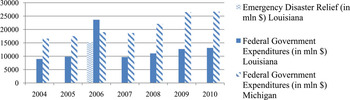
Due to data limitations, it is difficult to compare federal investment in New Orleans and Detroit generally and to calculate hurricane-related investment in New Orleans specifically because federal sources tend to report totals for the Golf Coast as a whole. Table 4 provides a general (but not exhaustive) comparative sense of federal direct payments to both Louisiana and Michigan from 2004–2010. In 2004, direct payments to individuals from the Federal government in Louisiana were just over $9 billion. Footnote 2 These totals are drawn from the Consolidated Federal Funds report which includes all funds transferred from federal agencies to individuals and government entities per state. In context, the total amount of funding from all sources for emergency disaster received post-Katrina was just over $15 billion. Footnote 3 In the year 2004, the green bar represents the total emergency disaster relief received in millions, including Individual Assistance granted to individuals for housing needs and Public Assistance which includes funds granted to state and local governmental, nonprofit and non-governmental agencies for rebuilding and repairing infrastructure, as well as Road Home dollars. Footnote 4 Totals include all payments to individuals and of these, both the city of New Orleans and Detroit (i.e., Orleans and Wayne counties), make up about 15% to 21% respectively. Michigan’s direct payments to expenditures (in red) have consistently outpaced Louisiana’s, save the year 2006, which corresponds to the time period by which most of the claims filed via the Individual and Public Assistance FEMA funds were closed. Public investment as a result of the storm does not appear to be as significant when viewed in the larger context.
Public Investment
Source: Consolidated Federal Funds Report. www.census.gov/prod/2011pubs/cffr-10.pdf.

Investing in the Public Sector
Public infrastructure and restoration of public services are essential to redevelopment after a disaster. In New Orleans, the damage to local schools, hospitals, and other public buildings and disruption of services, public safety in particular, deterred residents from moving back to the city and indeed appeared to have caused some returnees to leave again. School and police services tell useful stories of the efficacy of investment in services after the storm.
Many service challenges increased exponentially because of poor quality prior to the disaster. The pre-Katrina public school system had gone through ten superintendents in ten years. The city operated fifty-five of Louisiana’s seventy-eight failing schools under the federal No Child Left Behind Act (Newmark and de Rugy, Reference Newmark and Rugy2006). The Brookings Institute reported that only 21% of public schools in the city had reopened ten months after the storm. A labyrinth of state, city-run, and charter schools developed, each with its own rules, regulations and start dates. However, over the longer term, the school system may be the most significantly changed and potentially enhanced aspect of the recovery. It has been argued, however, that an over-prescription of neoliberal, privatized solutions to bolstering school performance has taken place. The results have been uneven for students of color, those with disabilities, and families confused by the burgeoning number of charter schools (Akers Reference Akers2012; Buras Reference Buras2011; Finch et al., Reference Finch, Emrich and Cutter2010).
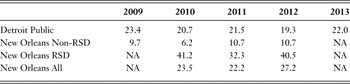
It is difficult to compare the quality of schools in Detroit and New Orleans due to the lack of uniform national and state data. Although the years compared are not identical, it appears that both Detroit and New Orleans schools have consistently high and relatively flat drop-out rates (Table 5). This conforms to media reports about Detroit but not necessarily New Orleans where assessments have been more optimistic. Footnote 5 The situation in New Orleans is difficult to evaluate, however, due to unreported data right after the hurricane, the assignment of many schools to the Louisiana Recovery School District (RSD), and the high numbers of charters after the storm. Clearly, non-RSD schools do much better than the rest of the district and better than public schools in Detroit. Although it appears that post-hurricane improvements have not occurred in New Orleans, data are poor and there is much more to school quality than simple drop-out rates.
Drop-Out Rates

Source: Detroit: Center for Educational Performance Information (CEPI).
New Orleans: Department of Education, Louisiana Believes.
Police services also suffered after the storm as a surge of violence occurred in the city. In 2006 there were 161 homicides; as of January 2007, eighteen homicides had taken place within city limits. About two-thirds of the deaths have thus far gone unsolved. Many homicides take place in areas where violence was already rampant and residents feared retaliation if they spoke out against perpetrators; this has largely remained unchanged (Nossiter and Drew, Reference Nossiter and Drew2007). Public safety issues have been so great a concern that the U.S. Department of Justice was brought in to overhaul police procedures after a series of failed internal changes. In late 2012, a consent decree between the Department of Justice and the New Orleans Police Department was signed. The agreement, notable for the broad array of issues it addresses, deals with recruitment and training, performance evaluations and promotions, misconduct complaints, and even the lucrative off-duty work assignments that had become a potent source of corruption (Kunzelman and McGill, Reference Kunzelman and McGill2013).
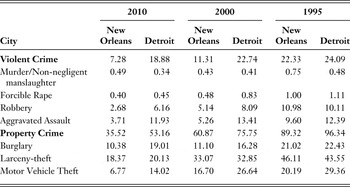
Table 6 provides a sense of the quality of police service before and after Katrina in comparison to Detroit. On the whole the respective crime rates of each city have changed very little over time. Positions on violent crimes, assault, larceny, and vehicle theft remain relatively static. New Orleans has decreased relative rates of robbery and burglary. Detroit has improved its relative position on rape, and murder rates in New Orleans are consistently higher over time. In short, little appears to have changed on this measure of public service quality.
Crime Comparison, Rate per Thousand

Source: FBI Uniform Crime Reports.
Leadership
The inability of both cities to make optimal use of state and local investment and to address long term public service issues is also linked to weak internal local leadership. Detroit has a “strong mayor” form of municipal government; a nine-member City Council has been elected at large for the past century (although the city shifted to a ward-based council system in 2013 with seven members elected by district and two at-large). The strong mayor system has provided opportunities for mayoral leadership to deal with major economic crises. Detroit, for example, is the only city that has two representatives on Melvin Holli’s list of the ten best big city American mayors (1999): Hazen S. Pingree and Frank Murphy. A recent list of Detroit’s five best mayors include: Pingree, Murphy, John C. Lodge, and Coleman A. Young (Austin Reference Austin2015). Unfortunately, Detroit’s more recent mayors have been much less effective and Coleman Young’s presence on the list is not without contention due to issues noted below.
Over the years, Detroit has faced and recovered from a number of economic disasters. Hazen S. Pingree, a Progressive Republican businessman, was elected mayor (1890–1897) on an anti-corruption platform (Holli Reference Holli1999). When the national financial collapse occurred in his second term, he exhibited strong leadership, introducing programs that provided short-term benefits to mitigate the worst of the economic distress. While these reforms provided some temporary relief, real recovery did not occur until Henry Ford and other entrepreneurs began producing motor vehicles stimulating recovery and rapid growth. Four decades later, the Great Depression erased much of the city’s economic progress. Once again, a strong and effective mayor, Frank Murphy (1930–1933), improved the delivery of municipal services and introduced important reforms. Nevertheless, despite Murphy’s efforts, the economic recovery of Detroit did not really take off until World War II created demand for new products and an outlet for excess labor.
Jerome P. Cavanagh (1960–1968) was elected as a reform mayor and was successful in implementing measures that benefited Detroit’s growing Black population and in attracting federal funds from the Kennedy and Johnson administrations. His political career was destroyed by the 1967 riots, however, and his successor, Roman Gribbs, accomplished little in his single term. Coleman A. Young, a prominent figure in the Civil Rights movement and a State Senator, was elected mayor in 1974 and served for the next twenty years. Young’s racially-based rhetoric increased the divide between city and suburbs. Although he did work with individual business leaders, private sector investment and participation in Detroit came at a price, as every dollar of private investment involved land write downs, tax abatements, or other incentives.
Dennis Archer, who succeeded Young as mayor served two terms (1991–1999) and although he had moderate success in building relationships with the suburbs, the business community remained outside of the governing regime, refusing to make investments without public subsidies. As a result, the city made little economic progress during the boom years of the 1990s. The next mayor, Kwame Kilpatrick, was young, ambitious and eloquent but was removed from office after being convicted on federal corruption charges early in his second term. Kilpatrick’s successors, Kenneth V. Cockrel (2008–2009) and Dave Bing (2009–2014), were honest and dedicated but essentially overwhelmed by the economic circumstances that they inherited. Currently the mayor’s office is held by Mike Duggan, Detroit’s first White mayor in 44 years (taking office in January of 2014). The emergence from bankruptcy and the handing of the reigns of leadership back to the elected mayor took place roughly ten months into his term. Thus, his track record is short and remains unproven. While it appears that greater cooperation with the business community and the suburbs may be taking place, the much publicized economic recovery of the city is neither wide nor deep.
Detroit’s mayoral “stars” (Pingree and Murphy) benefited from timing and circumstances. For more than three decades, under four different mayors, Detroit drifted inexorably downward regardless of the individual at the helm. The city weathered economic storms primarily because it was thrown a life raft from without as opposed to having the leadership generate economic growth from within.
The current electoral system in Louisiana dates back to Edwin Edward’s efforts to limit the power of the Republican Party within the state. In 1976, the democratic governor instituted a change in the state’s constitution that called for an all-inclusive primary, in which candidates would initially run against all other candidates for the same office, regardless of party affiliation (Warren Reference Warren2008). If a candidate receives more than 50% of the vote, there is no run-off election and the candidate is the winner. If no candidate wins a 50% majority of the popular vote, the top two candidates face off in a run-off election. Additionally, candidates who lose in the “jungle primary” are free to throw their support behind a candidate in the runoff election in hope of gaining a position in the coming administration. New Orleans has a mayor-council form of government with the mayor being elected for four-year terms, limited to two consecutive terms. Such term limits have ensured that a long-term mayor such as Coleman Young in Detroit would not be able to establish power in New Orleans, and serves as a potential limitation on mayoral power in the city generally.
Democratic politicians and African American candidates have fared well under these electoral rules (Bullock and Rozell, Reference Bullock and Rozell2013). With the enfranchisement of Blacks in the 1960s, the substantial increase in Black voter representation resulted in the election of many Black public officials (Whelan et al., Reference Whelan, Young and Lauria1994). In 1977, Ernest Morial was elected as the first Black mayor of New Orleans and served until 1986. He was responsible for the development of Canal Place, a major economic development project and shopping destination bridging the Central Business District and the French Quarter. The election of Morial was followed by the election of another African American, Sidney Barthelemy, who served from 1986–1994. Marc Morial, son of Ernest Morial, served from 1994–2002 and was succeeded by Ray Nagin in 2003 (Bullock and Rozell, Reference Bullock and Rozell2013).
Like Detroit, New Orleans has a long history of colorful mayors, most notably Mitch “Moon” Landrieu in the 1970s who was responsible for desegregating the city government’s workforce, planning the famous Superdome, and the Moon Walk, a promenade along the Mississippi River, which made the waterfront accessible to tourists and residents alike. Many of these successes were possible because an expanding federal revenue pie allowed him to open opportunities for Blacks without antagonizing Whites (Hirsch Reference Hirsh, Hirsh and Logsdon1992). Morial’s later success in economic development and in increasing Black representation in municipal jobs was also supported by an influx of federal funding (Whelan et al., Reference Whelan, Young and Lauria1994). While these mayors, and Barthelemy to follow, were successful in the areas of social justice, economic development, and the transition to a tourist economy, much of their success was supported by federal dollars and activist state governors (Burns and Thomas, Reference Burns and Thomas2004). Given the entrenched social aristocracy in the city, it is questionable whether these mayors would have been as successful without external support. As suggested by Peter Burns and Matthew Thomas, “the loss of many major businesses and decreases in federal aid created a leadership and resource void in New Orleans” (2004, p. 795).
In summary, then, while mayoral leadership in both cities has led to many successful projects and there were periods of strong mayoral leadership, stable mayor-led regimes never developed in either Detroit or New Orleans. Limited local resources and business support in both cities curtailed the power and success of mayors who tended to be “saved” by external forces such as the growth of the auto industry and the war effort in Detroit and federal funding and gubernatorial interventions in New Orleans.
UNDERLYING BARRIER OF RACIAL SEGREGATION
Although the plight of New Orleans after Katrina has clearly been mitigated by attention and investment, the outcomes are not so significant that its historic trajectory has substantially changed. Indeed, extant conditions are not too different (albeit absent bankruptcy) from those in Detroit. The previous discussion suggests some of the reasons why things did not work out quite as anticipated. However, there appear to be other very significant features that the cities have in common that serve as barriers to long term economic health and quality of life for local residents, particularly racial and economic stratification. These issues and others discussed in the concluding section have likely contributed to the counterintuitive lack of progress in the New Orleans case.
Detroit and New Orleans have different histories of immigration and race relations, yet both have led to significant economic and geographic stratification by race. Detroit has long been a city of immigrants ranging from early French and English settlers in the eighteenth century, through Irish, German, and Polish immigrants in the late 1800s. With the increasing demand for labor in the auto industry immigration from other areas of Europe and Canada expanded. During World War II, the labor needs of the defense industries were met by migrants, this time by Blacks and Whites from the American South. Significant immigration from the Middle East occurred after 1970. In short, Detroit is very much a city of immigrants.
The population history of New Orleans falls into three distinct periods. In the first, from the city’s founding until the end of the nineteenth century (1718–1899), migration-driven population growth provided the city with the labor of African slaves, their descendants, and the Irish and Italian migrants who replaced them. The second period (1900–2005) was characterized by slower growth, driven by births and longer life expectancy rather than net in-migration, and the consolidation of a biracial society. The last period (2005–present) began after New Orleans’s population vacated the city in the wake of Katrina, pre-Katrina residents selectively returned to the city, and an influx of largely undocumented Latino migrant workers arrived (Fussell Reference Fussell2007, p. 846).
New Orleans experienced a great deal of immigration early in its history as refugees from the Haitian Revolution, both White and free people of color, streamed to the city in the early 1800s. In the 1850s, White Francophones remained an intact and vibrant community and by 1860, the city had 13,000 free people of color (gens de couleur libres), mostly of mixed race. Largely part of the Francophone group, they constituted the artisan, educated, and professional class of African Americans. Most Blacks, however, were still enslaved: working at the port, in domestic service, in crafts, and mostly on the many large, surrounding sugar cane plantations. After the Louisiana Purchase, Germans, Italians, and Irish immigrants arrived in New Orleans and with a statewide push for English-only policies in 1864, French usage began to fade. Still, as late as 1902 a quarter of the city’s residents spoke French in their daily interactions.
The rapid growth of Detroit’s African American population during the 1940s and 1950s occurred at a time when the city’s White population was also growing but by 1980 African Americans made up 76% of the city’s total population (US Census 2010). Detroit’s White population peaked in 1950, declining by more than a million by 1980. The African American population of Detroit, however, continued to grow, reaching a plateau of just under 800,000 in 1980 (US Census 2010). The expansion of Detroit’s African American population led to competition and conflict with the White population, particularly over housing (Sugrue Reference Sugrue1996). Attempts to integrate the growing Black population into White neighborhoods led to protests in 1925 and 1942, and riots in 1943 and 1967 (Galster Reference Galster2012). The race riot of 1943, which was eventually quelled by federal troops after three days, left thirty-four dead and was America’s deadliest civil disturbance to date (Sugrue Reference Sugrue1996). The racial conflict in 1967, which lasted for five days, resulted in forty-three deaths and once again required the intervention of federal troops.
To fully understand the racial history of Detroit, the larger metropolitan area must also be considered. Detroit has consistently been among the top ten U.S. cities with the highest dissimilarity indexes over the past thirty years (Data Driven Detroit 2012). A majority (74% as of 2010) of Black (or White) residents would have to move within the larger metropolitan area for Detroit and its suburbs to achieve an even racial distribution. The confluence of de facto racial and economic segregation resulting from the exodus of higher income residents of all colors, as well as businesses, has created a situation where poor Black residents are geographically, economically, and politically separated from more affluent Whites. The resulting relationship between Black Detroit and its mostly White suburbs has been likened to apartheid South Africa (Reese et al., Reference Reese, Sands and Skidmore2014).
Issues of race and racial segregation in New Orleans have been quite different from those in Detroit historically. Because of the “backyard” pattern of slave residences, Blacks and Whites lived in close proximity separated by rigid social and economic barriers. Geographic segregation did not begin until the 1950s when Whites began to move to drained land outside of the central city (Spain Reference Spain1979). Thus by 1970, New Orleans had begun to catch up to other cities with significant African American populations in terms of geographic segregation (Spain Reference Spain1979). Spatial concentration of poverty also increased during the same time period (Logan et al., Reference Logan, Stults and Farley2004); from the 1970s to 2000 the number of neighborhoods with concentrated poverty grew by two-thirds (Berube and Katz, Reference Berube and Katz2005). And by the time of the hurricane, most of the areas of concentrated poverty were also primarily Black and low-lying (Fussell et al., Reference Fussell, Sastry and VanLandingham2010; Sharkey Reference Sharkey2007). Indeed, research on return rates after the storm by race suggested that extent of housing damage was more important than race in determining how quickly and which residents returned (Fussell et al., Reference Fussell, Sastry and VanLandingham2010). Thus, the confluence of geography, poverty, and race may have been more important historically in New Orleans than in Detroit. Yet, current levels of segregation are similar.
Table 7 provides Black/White segregation data (Indexes of Dissimilarity) for Detroit and New Orleans. It is clear that both cities have high rates of racial segregation—Detroit ranks first and New Orleans eighteenth of twenty-five U.S. metropolitan areas with the largest Black populations. Declines in segregation are due only to the significant population disruptions resulting from economic distress in the former and the hurricane in the latter:
Two of the most highly segregated metropolitan areas, Detroit and New Orleans, had substantial declines in segregation for the first time since 1980. These changes coincided with very substantial declines in the central city Black populations in both areas, New Orleans as a result of Hurricane Katrina and Detroit as part of the fallout from the recession and foreclosure crisis. Detroit experienced a 25 percent decline in population between 2000 and 2010 (Logan and Stults, Reference Logan and Stults2011, p. 6).
Racial Segregation

Source: Project Census 2010.
CONCLUSIONS
The research questions posed earlier are revisited and briefly answered below.
-
• What were the economic and social trajectories of Detroit and New Orleans prior to their respective disasters?
Detroit and New Orleans were clearly both highly distressed cities, with large minority populations and significant inequality prior to Katrina although Detroit’s situation was arguably more severe.
-
• How did the responses to the hurricane impact New Orleans?
Significant media attention and investment in New Orleans appeared to follow in the wake of the hurricane. However, looking at federal and state investment in context suggests that it was not as high as might have been expected and implementation delays may well have lessened its impact. It is not at all clear that the response in New Orleans changed its economic trajectory much beyond that of Detroit, suggesting that the response to sudden disaster might not have aided the slow death of Detroit.
-
• Despite the attention given to New Orleans, why do current conditions differ little from Detroit?
There are several potential explanations for this outcome suggested here. First, media attention failed to tell a consistent story and interpretations of reporting differed significantly between Blacks and Whites. As noted above, it does not appear that public investment was sufficient to address the devastation. In addition, changes in public planning and services do not appear to have been bold or long-range enough to make a significant difference. How the disaster in both cities has been framed in the media likely has important effects on long-run distress. The media have tended to portray issues in Detroit as the result of internal political corruption, economic excess by city leaders, and emphasized the dangers of the city (crimes and fires for example) as well as its poor schools (Chafets Reference Chafets2013; Nickell Reference Nickell2014; Poindexter et al., Reference Poindexter, Smith and Heider2003; Ulbrich Reference Ulbrich2011). The mixed messages in media reports of post-Katrina New Orleans noted here also served as a frame that might lead the public to blame the victims. Future research would do well to explicitly consider potentially using content analysis, and the linkages between framing economic and social outcomes in the wake of both sudden and slow disasters.
Another possible explanation for the poor performance of both cities is the overlay of economic and racial stratification creating multiple urban realities. Robert Olshansky (Reference Olshansky2006) describes divergent possible futures for New Orleans implying different outcomes for different groups. One future would entail a complete transformation of the city with restoration of wetlands, elevation of homes to decrease risk of flood damage, reconstructed neighborhoods with opportunities for lower-income housing, better evacuation plans, and an energized and coherent environment for planning. A second, less-optimal future, could have four possible “cities,” separate, but unequal: a tourist city, consisting of waterfront entertainment and the French Quarter; a downtown corporate city; a city of mostly middle-class homes rebuilt where they were previously located; and a city where low-income renters and public housing dwellers leave permanently, buildings remain vacant for years, and businesses fail. In the long run, this fourth city would severely undermine the others (Olshansky Reference Olshansky2006) and it does not appear that planning processes to date will assure that this last city is avoided. For Detroit, the situation really is one of multiple cities whereby individuals (of all races) with the economic resources to do so have moved, over a period of fifty years, to the suburbs.
The situation of the Lower Ninth Ward has been a very visible example of the issues of race and space in post-Katrina New Orleans. As of 2010, the Lower Ninth had a greater Black population than New Orleans Parrish (95.5% vs. 59.6%), more vacant housing units (48% vs. 25%), and more residents in poverty as of 2008–2012 (31.3% vs. 27.2%). Directly after the storm then-mayor Nagin proposed converting large swaths of land including much of the Lower Ninth ward into green space. Former residents of the Lower Ninth were activated into protest over this proposal and the mayor’s office instead adopted a “laissez-faire” approach to the development of the area. Residents were allowed to return as they desired, aided by state and federal funding, and the city’s footprint remained unchanged. Yet many residents found they couldn’t return to the Lower Ninth Ward because there was nothing to return to. Jobs were sparse, the land was virtually wiped away, and the trickle of former residents back to the area left it low on the city’s priorities in terms of providing much needed local services. As of late 2012, there was still no grocery store, hospital, police station or fire station to service the area. According to the latest figures from the Greater New Orleans Data Center, the Lower Ninth Ward remains one of the least repopulated post-Katrina areas with less than half the population returned nearly a decade after the disaster (Mack and Pyler, Reference Mack and Pyler2014).
The Lower Ninth Ward also became a dumping ground for trash, abandoned pets, and construction debris (Rich Reference Rich2012). Many lots became overgrown with vegetation. The attendant hazards became so great that mayor Landrieu started the Nuisance Lot Maintenance Pilot Program to assist in refuse and blight clearance. This program has only been marginally successful. Landrieu’s office committed other funds to the Lower Ninth Ward since his election, earmarking just over $120 million dollars for a new community center, road construction, and schools, but without clear land on which to build the efforts have not come to fruition. Even after the lots are cleared the mayor’s office has been adamant that the private market (i.e., investors or private developers) should be largely responsible for bringing back this area of the city. Thus the initial suggestion by the Nagin administration to let the Lower Ninth Ward revert to green space may result from the persistent lack of coordination between residents, city officials, and developers.
Although households in New Orleans have higher median incomes and there are fewer households in poverty than before the storm, poverty among individuals has increased. As of 2007, non-related individuals over fifteen accounted for 30% of those in poverty (Plan for the 21st Century New Orleans 2009). It has been suggested that this is the case because of the influx of migrant workers searching for construction jobs after the storm and, to the extent that such workers are undocumented, poverty rates for this group may be even higher. The homeless population also appears to have increased to the point that as of 2008, almost one in every twenty-five residents was homeless (Jervis Reference Jervis2008). Thus, even with an absolute decline in the number of poor families and an increase in tourism jobs, increases in individual levels of poverty and the income bifurcation endemic to a tourist economy (McClendon Reference McClendon2014b) have kept the relative standing of New Orleans from shifting upward significantly.
Finally, an underlying feature of this research is the issue of social stratification, which in the United States, can be equated to racial stratification (Bond and Saunders, Reference Bond and Saunders1982; LeMay Reference LeMay2005). Numerous scholars have suggested that underlying issues of economic and/or racial stratification have led to a variety of social ills: educational underachievement, housing and job discrimination, and geographic divisions that affect both upward mobility and participation in political and policy processes (Lewis and Hamilton, Reference Lewis and Hamilton2011; Polsby Reference Polsby1963; Reskin Reference Reskin2012). In Detroit, this effect is especially stark. In New Orleans, post-Katrina, these patterns are becoming cemented in planning for the city’s rebirth. Thus it is possible that neither a slow economic death nor a sudden death in the form of a natural disaster could be overcome with money, attention, or social goodwill. The increasing globalization of the economy that adds additional opportunities but also challenges to American cities is likely to exacerbate these inequities or at the very least make them more significant barriers to long range economic prosperity. Only addressing underlying economic and racial stratification or acting more forcibly on leverage points (i.e., changing policy that reinforces spatial concentrations of Blacks in the urban core, or changing policies that are related to a variety of issues that have historically relegated people of color to the margins) would result in substantial changes in the economic, social, and political fortunes of places like Detroit and New Orleans.