Introduction
The document published here for the first time, “Group Life and Literature,” is an unfinished late essay by Claude McKay, the vagabond poet and enfant terrible of the Harlem Renaissance.Footnote 1 Although no date is given on the typescript or on the folder in which it resides at Yale University’s Beinecke Library, in the James Weldon Johnson Memorial Collection, it was probably written in 1938 or 1939. The reference to Richard Wright’s Uncle Tom’s Children, which was published in 1938, as a “recent startling phenomenon,” added by hand on the typescript, means that at least this annotation could not have been made earlier. Despite being professional rivals at the time, notably in their conflicting relations to the Communist Party, McKay and Wright were then both part of the Federal Writers’ Project and worked together in the FWP’s New York City offices (see Cooper 362). As a New Deal program launched by the Works Progress Administration (WPA) agency, the FWP ran from 1936 to 1940 and provided life-sustaining employment to thousands of established and emerging US writers during the latter half of the Great Depression, including, among many others, Zora Neale Hurston, Arna Bontemps, Richard Durham, Robert Hayden, Margaret Walker, Dorothy West, and a young Ralph Ellison (who also worked at the New York branch).
Today remembered largely for its American Guide series, which detailed, to an unprecedented extent, the histories, folklore, culture, geography, natural resources, and so forth of every state in the nation, the FWP also collected “first-person narratives (called life histories) describing the feelings of men and women coping with life and the Depression; studies of social customs of various ethnic groups; authentic narratives of ex-slaves about life during the period of Slavery; and Negro source material gathered by project workers” (“About This Collection”). The FWP was lauded by many as an attempt to democratize American culture, and today its archives represent an invaluable heritage, but the project was short-lived. It was stripped of its federal funding in 1939 by a newly elected Congress following a string of conservative attacks from the House Un-American Activities Committee (HUAC), which had been created in 1938. Once federal sponsorship of the FWP ended in 1939, thousands of federal workers employed by the WPA were laid off; the work was allowed to continue in some states (like New York) for another year, provided the states shouldered the expenses. Plus ça change …
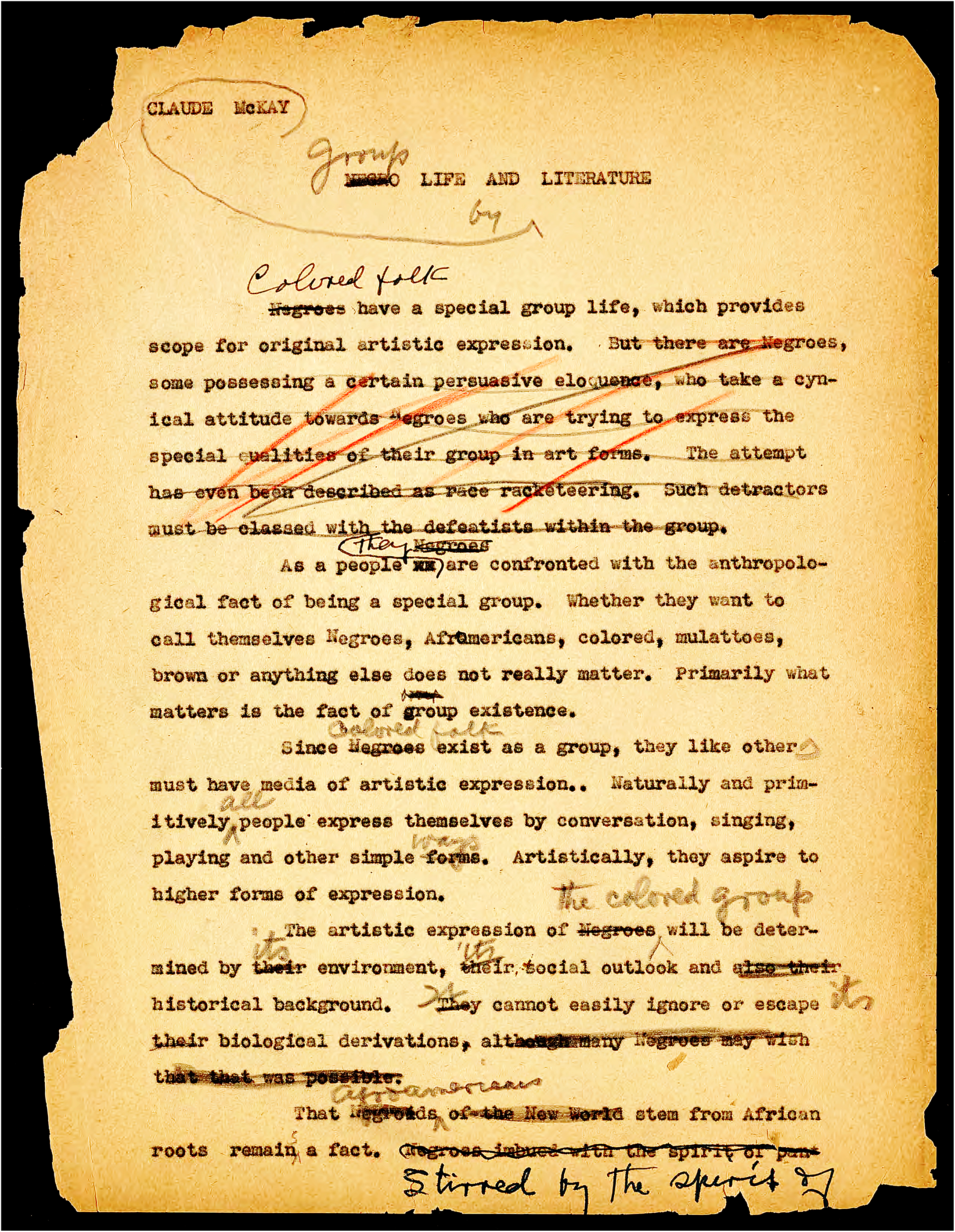
Since McKay was on the FWP payroll from 1936 to 1939, “Group Life and Literature” is likely one of his last assignments. Despite its unfinished nature—which McKay signals in two places with a hand-written annotation, “to be continued”—the essay is so rich as to warrant wider circulation. Although relatively brief, clocking in at roughly 2,500 words (including passages struck out), it is brimming with McKay’s trademark flair, with flashes of pride, impressive historical cognizance, a palpable love of global literature, and an unmistakable cosmopolitan erudition gained through years of travel and study. Even a hundred years after The New Negro, the essay seems evergreen as a contribution to ongoing debates around the proper—or “suitable” (to use McKay’s word)—role of literature in society, especially in terms of race relations. More specifically, as the title indicates, McKay is here expounding on the ever-charged relationship between “group life and literature,” the group in question here being Black peoples of the world (his original title was “Negro Life and Literature”; fig. 1). Group life is something McKay actively theorized—and tried to practice, with various results—his entire life, but it increasingly holds his writerly attention in the latter half of his career.
The first page of the manuscript of Claude McKay’s “Group Life and Literature.”

Fig. 1. Long description
At the top, ‘CLAUDE McKAY’ is typed left-aligned, followed by the centered title ‘Group Life and Literature’ with ‘Group’ crossed out and replaced by handwritten ‘Colored folk’ above. The word ‘by’ is handwritten below the title. The main body consists of typed text discussing group life and artistic expression, with numerous words and sentences struck through in black ink, especially those containing ‘Negroes’ and related terms. Handwritten replacements such as ‘Colored folk’ and ‘the colored group’ are inserted above or beside the stricken text. Marginal notes and edits appear throughout, including ‘Stirred by the spirit of’ handwritten at the bottom margin. The page is yellowed, with torn edges and visible creases, indicating age and frequent handling.
In fact, group life is one of the major thematic strains in three of McKay’s texts from 1937: his timely antifascist article, “For Group Survival,” published in Jewish Frontier; his “Circular Letter for the Creation of a Negro Writers’ Guild,” an abortive effort to create an all-Black intergenerational group of writers and intellectuals; and his memoir, A Long Way from Home, whose rousing final section urges Black people to nurture greater group life by establishing institutions that can strengthen their political, financial, and cultural standing.Footnote 2 McKay wanted Black Americans to attain what he had seen so many other racial and ethnic groups achieve during his years of vagabondage: “Wherever I traveled in Europe and Africa I was impressed by the phenomenon of the emphasis on group life, whether the idea behind it was Communist co-operative or Fascist collective or regional autonomy” (Long Way 349). Since his return to the United States in 1934, McKay had seen “very little group spirit among Negroes”; he felt that, despite being “the most advanced in the world,” the “American Negro” “sadly lacks a group soul” (350) and pressed his group “to face the need to save itself” (349).
During much of his stint on the FWP, McKay immersed himself in Harlem life, living at 33 West 125th Street, in the same building as Romare Bearden and Jacob Lawrence. One of his assignments was to prepare an extensive report, “Negro Artists in New York,” for which he personally profiled artists such as William Ernest Braxton, Malvin Gray Johnson, Albert Alexander Smith, Charles H. Alston, Henry W. Bannarn, Richmond Barthé, Sara Murrell, Bearden, E. Simms Campbell, Aaron Douglas, Beauford Delaney, Richard Bruce Nugent, Robert Savon Pious, Earle Wilton Richardson, and Augusta Savage. As his letters attest, McKay took pleasure in the work he did for the FWP and the research he conducted proved crucial to most of his late-career projects, even as it sometimes delayed his poetic endeavors or introduced interpersonal tensions between himself and some of the up-and-coming Black intellectuals. “I like that research work,” he told Orrick Johns, “and I have been privileged to suggest the items I like to work on” (qtd. in Cooper 314). He particularly relished the “special research work” assigned to him by the FWP “because the facts we unearthed were of intrinsic value to those of us who were writing about Negro life in our off-project time” (Harlem 240). And yet, he remarked in 1937 that even though his FWP work allowed him to pile up “a lot of material for a new story,” he grew frustrated with the creative delays that his employment caused; he complained, “I crave to get away from the enervating atmosphere of the Federal Writers’ Project” (Letter to Gannet). In a Guggenheim fellowship application that same year, he wrote that he wanted “to devote my time to a creative novel of Harlem life,” but “at present I am employed in research and rewriting on the Harlem section of the Federal Guide Book” (Plan of work). The novel he was then working on was Harlem Glory; ultimately published in 1990, it was left unfinished and shares many of the same settings and themes as the complete Amiable with Big Teeth, written in 1941.
His time on the FWP gave McKay a unique opportunity to investigate the history and community life of Harlem with an unprecedented level of thoroughness and to obtain sketches of contemporary Harlem notables such as Father Divine, Faithful Mary, Caspar Holstein, Chappy Gardner, Hubert Fauntleroy Julian, and Sufi Adbul Hamid, among others, all of whom appear (though some in veiled form) in Amiable with Big Teeth. At the same time, as his research notes and the clippings he preserved attest, Footnote 3 this investigative research allowed him to study the growing influence of the Popular Front among African American organizations. Even though McKay had, in his youth, served as the unofficial African American representative to the Fourth Congress of the Third International and had given an address from within the Kremlin itself in 1922, by 1938 he had grown to regard communism with suspicion, and it was this new turn that led him to mobilize his energies into promoting “group life,” prioritizing an autonomous Black solidarity free of communist and white influences. McKay was now heading in a different direction from many of his younger Black FWP colleagues—such as Wright and Ellison—who were then embracing communism. Though they did not appreciate what the elder McKay had to say at the time (much to his chagrin), both Wright and Ellison would themselves later go on to disavow the “god that failed” (Crossman).Footnote 4
At this stage in his life, McKay saw what he called the “chicanery and intrigue” of communism as a key threat to his dreams of an all-Black solidarity (qtd. in Cooper 326)—he felt the Comintern’s encroachment into every institution undermined Black independence. In his memoir, he further explains that “the greatest hindrance to the growth of a group soul is the wrong idea held about segregation. Negroes do not understand the difference between group segregation and group aggregation” (Long Way 350). He diagnosed what he called a “fear of segregation” among African Americans that had pushed them to “patronize white institutions and support white causes in order to demonstrate their opposition to segregation” rather than give “Negro institutions and unique Negro efforts … a chance for full development.” He had seen his Negro Writers’ Guild derailed by this “fear of segregation” harbored by what he called, in a passage struck out from “Group Life and Literature,” “the defeatists within the group.” Because of his sometimes contentious relations with fellow Black intellectuals and artists, as McKay stressed the need for “Negro writers to draw closer together in mutual fellowship” (Long Way 233–34), his initiatives were themselves criticized as a cloaked form of segregation by some members of the Black intelligentsia, including Alain Locke who, in an infamous 1937 New Challenge issue, edited by Wright, described McKay’s career as “not one of cosmopolitan experiment or even of innocent vagabondage, but … one of chronic and perverse truancy” (82). Locke condemned McKay for having “repudiated all possible loyalties” to any of the “half dozen movements” that Locke saw as part of the “program of the Negro Renaissance” (84, 82, 85)—in effect accusing McKay of sabotaging earlier efforts at achieving group life.
Some of what Locke was reacting to can be discerned in “Group Life and Literature,” notably when McKay appears to disparage some of his fellow Black writers, declaring, for instance, that “[t]he sociological field has attracted the elite of the Afro-American group as investigators. Someday perhaps a real novelist will emerge from among them,” or that, although James Weldon Johnson at least “indicates an approach to the psychological novel,” “[t]o my knowledge no Negro novelist has attempted to explore the psychological field. Perhaps it will take a future generation or generations to produce such a novelist.” And yet, despite casting such aspersions, McKay also expresses admiration, such as when he singles out Countee Cullen as “the charming poet of our group” or praises Jessie Fauset for having “boldly entered” the “field of manners and customs” with “her novels of better class people.” He aligns himself with Émile Zola and Maxim Gorky as novelists who explore “the field of the lower depths of rural and urban life,” adding proudly, “I know of no colored writers truly representative of that field, excepting myself. My novels, Home to Harlem and Banjo, belong to it,” he writes, once again demarcating his fierce spirit of independence: “It is not my intention here to explain or defend my own works. I do not think there need be any apology for a novel about the submerged world of the colored man.”
In a way, this tumultuous dynamic defined the latter half of McKay’s career; even as he was being accused, by his own group, of lacking the very group spirit he sought to strengthen among his fellow Black artists, white “supporters” were decrying his grassroots efforts at group solidarity, such as the creation of a Black writers’ guild or his proposed coeditorship (with Cullen) of The African: A Journal of African Affairs in 1938, as stemming from an ill-conceived segregationist ideology. McKay had invited both James Weldon Johnson and W. E. B. Du Bois to serve as honorary editors for The African, a journal he hoped to turn into “an organ of group culture,” but this plan also fell apart because of misunderstandings around the issue of “group work and consolidation.” “My attitude in the Guild is merely part of a plan I hope to formulate for intensive group work and consolidation,” McKay wrote to a white supporter who wanted to join the Negro Writers’ Guild. Even if “65 per cent or more of Negro Americans will disagree with me at first,” McKay added, “the Negro group badly needs self-confidence, self-reliance and group unity … to build itself up on a sound foundation” (Letter to Boardman). But such pronouncements, as often happened throughout his unapologetic life, were misinterpreted as merely demonstrating a “lack of purposeful and steady loyalty” that could only lead to “self-imposed apostasy” (Locke 84).
And so, after the failures of his writers’ guild and his plans for The African, and after the tepid reception of his memoir and of his unsparing nonfiction work, Harlem: Negro Metropolis, McKay turned back to literature and composed Amiable with Big Teeth (originally titled “God’s Black Sheep”) in 1941 to dramatize the need for nurturing group life. The battle over the souls of Black folk lies at the ideological heart of the novel, which sensationally depicts the warring efforts, on the American home front, to support Ethiopia in 1936: Will God’s Black sheep support a white-controlled Comintern front, or will they back the all-Black Hands-to-Ethiopia, run by a former numbers-game boss who now tries to use his amassed wealth to give Black people institutional footholds in Harlem?
The unmistakable political DNA of Amiable with Big Teeth retrospectively brings an interesting dimension to McKay’s statement in “Group Life and Literature” that writers who “treat primarily” “prejudice,” “discrimination or segregation because of race or color,” and “disfranchisement and mob violence,” only produce what he calls “a literature of protest”—and that “such subjects are not suitable for literary treatment.” For McKay, protest literature requires “a special passion and outlook” to prevent it from inadvertently reducing Black group life to “a gesture of eternal protest”; it should instead show “the common pattern” that Black lives share with “other groups or nations of people who have existed under oppression… .” Readers can judge for themselves whether or not McKay wrote with enough “passion and outlook” to meet his own rigorous criteria for bringing together “group life and literature.” Such work is never done, of course, and McKay concludes by underscoring how “our group has need of a great novelist in the historical field. A novelist who could depict the enthralling romance of the lives of the towering figures of the colored world”—a rallying declaration he follows with a list of such figures. “To be continued,” he adds. Yes, indeed: to be continued.
Colored folk have a special group life, which provides scope for original artistic expression. But there are Negroes, some possessing a certain persuasive eloquence, who take a cynical attitude towards Negroes who are trying to express the special qualities of their group in art forms. The attempt has even been described as race racketeering. Such detractors must be classed with the defeatists within the group. As a people they are confronted with the anthropological fact of being a special group. Whether they want to call themselves Negroes, Afroamericans, colored, mulattoes, brown, or anything else does not really matter. Primarily what matters is the fact of group existence.
Since colored folk exist as a group, they like others must have media of artistic expression. Naturally and primitively all people express themselves by conversation, singing, playing, and other simple ways. Artistically, they aspire to higher forms of expression.
The artistic expression of the colored group will be determined by its environment, its social outlook and historical background. It cannot easily ignore or escape its biological derivations.
That Afroamericans stem from African roots remains a fact. Stirred by the spirit of Africanism, Afroamericans may be inclined to a highly-sentimentalized conception of their African origin. Such an attitude may be dangerous and inimical to the group’s interests here in America. Because for better or worse the future of Afroamericans depends upon the welfare of this country. Their struggle for existence is here.
Nevertheless, even as Americans of European descent cannot disavow their cultural affinity with Europe, likewise Americans of African descent cannot repudiate their African heritage. In white America there are compositions of English, Irish, Spanish, German, Scandinavian, Jewish, French, and others who are materially and spiritually influenced by their European background. The history of modern America does not begin abruptly with the first landing of the pilgrims, nor with the declaration of Independence. It is linked up with its European roots. Actually modern America is only a vast overseas extension and growth of European civilization.
Biologically and culturally, the Afroamerican group also has European roots. But social reality relates this group more closely to its African roots. Today, educated and intelligent colored persons do not believe that the cultural development of Afroamericans began only when its forbears were brought here as slaves. They are repudiating what they were taught as children—namely that in the beginning of black slavery in America, Africa was a continent of wild tribes who possessed no cultural life worth while.
Now that the colored people have reached a high stage of development, they are in a position to supplement the folklore of their forefathers with scientific knowledge.
We know that in West Africa there existed great empires with high levels of culture, which paralleled the Ethiopian Empire in East Africa, and the more recent Moroccan empire of North Africa. Some like Senegal, and the empire of which Timbouctou was the capital, were great nations which preserved their cultures intact until the 19th century. In the 11th century Morocco was invaded and conquered by the Senegalese. In the 16th and 17th centuries, Timbouctou was the great seat of West African learning.
Colored Americans should be increasingly aware of such significant knowledge. The different European groups in this country know a lot about their respective origin. In the schools they learn about the historical development of the countries of their ancestors. They are not ignorant of their cultural links. With a knowledge of the old world of their ancestors their minds are better able to appreciate civilization in the new world. They should be better Americans because of their knowledge.
But Negro children grow in something like a vacuum. I remember my textbook in history taught me that the African race was inferior to other races and that my ancestors were unregenerate savages. If like Jewish children, young Negroes learned something of the truth about their people’s past, they would be fitted to face life with greater strength and fortitude.
It is generally admitted that Negro spirituals and blues are authentic contributions to American art. Some enthusiasts go so far as to say that they are the only genuine American art, forgetting the Indian contribution. Perhaps the spirituals and blues are the beginning of Afro-American artistic expression. But also authentic is the transplanted African folklore: the animal tales of Brer rabbit and fox, monkey and the rest of the so very human animals. These tales, similar to the Annancy stories of the West Indies [that] have been handed down from generation to generation of colored people: Their significance is enormous, if only because African life is so actively and intimately linked with animal life.
Like a complement to the tales is primitive African sculpture. It was about the beginning of this century that the artistic world of Europe and America became excited about West African sculpture. Most of it carved out of wood, this sculpture ranks with the best of all time.
To the colored public mainly familiar with the Greek style of sculpture, the work of the uneducated African artists may seem strange. Yet stylistically, it has close affinity to the sculpture of ancient Egypt. And to me the sculpture of ancient Egypt is far superior to the sculpture of ancient Greece. It is possible that the inimitable native style in sculpture might have been taken by migrants from Nigeria across the jungles into the Egyptian Sudan, whence it was carried down the Nile into Egypt. It is quite plausible even as some scholars believe that primitive religion was taken from Ethiopia down the Nile into Egypt, where it evolved into a great religion, from which subsequently sprang Judaism, Christianity and Mohammedanism.
Personally, I have never found the African sculpture strange. When I saw the first representative specimens of it in London, nearly twenty years ago I immediately perceived their close affinity with American and West Indian Negro types. I felt closely related to them. For they were no stranger than the Brer Rabbit tales of the South and the Annancy tales of the West Indies. Indeed I seemed to see in some of them illustrations for some of those tales. The Negro group should salute the white artistic world for the discovery and the high evaluation of African Negro sculpture. It has contributed more than we realize to recognition of the aspirations and achievements of American Negroes in the arts.
This African sculpture with our folklore and slave chants is the authentic background of our culture. It helps appreciation [of] their versatility, imagery, charming mischief, and satirical sense of humor of the animal stories. These stories possess the same flavor as Aesop’s fables, which charmed us as children. And it is significant that Aesop has been identified as a black who was a slave in ancient Greece.
I listened to similar tales told by West Africans in Marseilles. They seem to plomb the depths of the life of Negroes everywhere. They range from the naïve, simple and gay to the serious and melancholy—tears, laughter, satire, comedy, tragedy—they contain all the essentials of great literature.
With many colored families moving from rural to urban areas there is a danger of our losing these tales. They should be preserved. All colored children should know them. And all colored writers should read them. They are a grand commentary upon life and they contain the sum of life. They contain the fragrance of ancient Africa transplanted to the new world and the magic of Arabian Nights. They are essentially moral tales. And they stand a warning to bigoted minds in the colored group, who would limit the material, the scope and range of the literature of Afro-American life. I mean those nice persons who demand: Why don’t the Negro writers write about us—the nice people. But I declare that creative writing cannot be limited to the few us. – To be continued –
Afro-American life, although drastically circumscribed, is nevertheless just one part of the whole of human life. Colored people are born and they grow, live and love and die like any other people. Within the compass of their lives may also be found all the elementary vices and virtues of all of human life. A literary record of the expression of our group life should be as manifold and multi-colored as the whole of life.
There are, of course, the very obvious things about the life of the colored group. Outstanding is our relationship to white groups, socially and politically. Obviously, we are confronted with prejudice: discrimination or segregation because of race or color is our lot in the social and labor world. In the Southern states, disfranchisement and mob violence make conditions more acute.
The colored writers who treat primarily such conditions, their work obviously would be a literature of protest. There could be no objection that such subjects are not suitable for literary treatment. We have historical precedents to guide us, such as the immortal tirades of Hebrew literature. In modern literature there are Victor Hugo, Milton, Shelley, Byron, Heine, Mrs. Gaskell and Mrs. Browning, Harriet Beecher Stowe and others. All wrote mightily against social injustice. In our times there are Ibsen, Gerhart Hauptmann, H. G. Wells and George Bernard Shaw. Here in America Upton Sinclair who is our most prolific social propagandist novelist. In our own group there is Dr. W. E. B. Du Bois with his militant essays and Walter White’s contribution: The Fire in the Flint. A recent startling phenomenon is Richard Wright’s picture of Uncle Tom’s Children.
However, the literature of protest requires a special passion and outlook. It is a field that does not make an appeal to the majority of creative writers. Colored writers should bear in mind that despite demarcations and barriers their group life is not a gesture of eternal protest. Our life follows the common pattern, even like that of other groups or nations of people who have existed under oppression, such as: the Irish, Greeks, Jews, Indians, Chinese. Within our group we have our own social intercourse, family life, social life, religious life.
Basically, it conforms to the vast field of manners and customs which has always been the greatest and most exploited in literature. The most outstanding masters of fiction have excelled in it such as: Thackeray, Fielding, Dickens, Dumas fils, Balzac, Flaubert, Maupassant, Tolstoy, George Eliot and Jane Austen, and the rest. Few of our colored novelists have boldly entered this field. It has been approached by Jessie Fauset in her novels of better class people.
Another field of literature and a very difficult one is the psychological. Its greatest master is the Russian, Fyodor Dostoevsky. Also belonging to it are Romain Rolland, Thomas Mann, Marcel Proust, André Gide, James Joyce, Henry James, and D. H. Lawrence. It will be an achievement of great social interest, when a colored writer presents a representative character in an analysis of our individual or group mind, especially in its attitude and relationship to the white world. To my knowledge no Negro novelist has attempted to explore the psychological field. Perhaps it will take a future generation or generations to produce such a novelist. The only book by a colored writer which indicates an approach to the psychological novel is The Autobiography of an Ex-Colored Man, by James Weldon Johnson.
The sociological field is contiguous to the psychological and sometimes they merge into each other. Some prominent writers in this field are the playwrights Ibsen and Gerhart Hauptmann, the novelists H. G. Wells, Theodore Dreiser, and Sinclair Lewis. The sociological field has attracted the elite of the Afro-American group as investigators. Someday perhaps a real novelist will emerge from among them.
Another great field of literature vaster than any is the romantic. It is the storehouse of good and bad stuff, great love stories and bad ones. Hot magazine fiction. In it we find all the sensitive and pseudo-sentimental poets, from the author of the Rubaiyat of Omar Khayyam to the French poets Baudelaire and Verlaine and novelists from the Brontë sisters and Walter Scott, Alexander Dumas to Pierre Loti. Among colored writers I think the charming poet of our group, Countee Cullen, belongs to the romantic field.
Also there is the field of the lower depths of rural and urban life. Two of its greatest exponents are Émile Zola and Maxim Gorky. I know of no colored writers truly representative of that field, excepting myself. My novels, Home to Harlem and Banjo, belong to it. It is not my intention here to explain or defend my own works. I do not think there need be any apology for a novel about the submerged world of the colored man. For the fact stands that the great majority of colored people live in the lower depths.
There are minor fields of literature such as that of the historical romance as exemplified by Walter Scott and Alexander Dumas, Bulwer Lytton and others. Also there is the field of imperialist literature whose undisputed master, it seems to me, is the great artist Rudyard Kipling. As the colored group is a victim and not an agent of Imperialism, we should not expect to find its writers excelling in that field.
However, I think our group has need of a great novelist in the historical field. A novelist who could depict the enthralling romance of the lives of the towering figures of the colored world such as Antar, the Arabian poet, Ahmed Baba, the savant of Timbouctou, Moulay Ismail, the black Sultan of Morocco, Menelik of Abyssinia, Behanzin of Dahomay, Prempeh of Ashanti, Cetawayo of Zululand, Toussaint L’Ouverture, Dessalines and Christophe of Haiti, George William Gordon of Jamaica. And Nat Turner, Denmark Vesey, Frederick Douglass, Booker Washington, Matthew Henson, and others. (To Be Continued)