INTRODUCTION
The principle of ‘no net loss’ of biodiversity or ecosystem functions has been adopted as a cornerstone of nature conservation policies worldwide (Gardner et al. Reference Gardner, Von Hase, Brownlie, Ekstrom, Pilgrim, Savy, Stephens, Treweek, Ussher, Ward and Ten Kate2013) and habitat banking and tradable permits are pertinent policy instruments that have become increasingly popular with policymakers, environmental practitioners and industry (ELI [Environmental Law Institute] 2002; Madsen et al. Reference Madsen, Carroll, Kandy and Bennett2011; TEEB [The Economics of Ecosystems and Biodiversity] Reference ten Brink2011). This is primarily due to their interpretation as tools with the capacity to reconcile nature conservation with economic development (McKenney & Kiesecker Reference McKenney and Kiesecker2010), thereby enhancing the acceptance and effectiveness of regulatory conservation approaches such as biodiversity offsets and land-use zoning. They also cause controversy, however, as they call for acceptance of ecological losses in return for the recreation or restoration of equivalent habitats (Bekessy et al. Reference Bekessy, Wintle, Lindenmayer, McCarthy, Colyvan, Burgman and Possingham2010; Bull et al. Reference Bull, Suttle, Gordon, Singh and Milner-Gulland2013). Establishing when and where they can be used as an appropriate tool is likewise a difficult task (Kiesecker et al. Reference Kiesecker, Copeland, Pocewicz and McKenney2010).
Habitat banking can be seen as an extension of biodiversity offsets. Offsets are actions with beneficial biodiversity outcomes. They are undertaken by developers to compensate for residual environmental impacts that persist after appropriate steps have been taken to avoid or minimize impacts on site (McKenney & Kiesecker Reference McKenney and Kiesecker2010; Bull et al. Reference Bull, Suttle, Gordon, Singh and Milner-Gulland2013). Habitat banking is the practice of restoring, creating, enhancing or preserving off-site areas to provide compensatory mitigation for authorized impacts on habitats or biodiversity. A public agency, private organization or landowner, rather than the developer, establishes conservation areas as mitigation for permitted impacts on biodiversity and ecosystems. Permittees are released of their obligation to produce compensatory mitigation and can instead purchase credits from an entity that, in most cases, has produced and ‘banked’ them for this purpose (ELI 2002). The USA's wetland mitigation scheme in the 1970s is seen as the trigger for the habitat banking concept (ELI 2002; Burgin Reference Burgin2008). The conservation banking scheme was launched in California and extended to other parts of the USA after the wetland mitigation experience. The aim was to offset impacts on species rather than to replace wetland functions and values (McKenney & Kiesecker Reference McKenney and Kiesecker2010). Habitat banking schemes now exist in many parts of the world including Australia, Canada, France and South Africa (Madsen et al. Reference Madsen, Carroll, Kandy and Bennett2011).
Habitat banks convert offsets into tradable assets, thereby enhancing the efficiency of offset regulation. Habitat banking first of all circumvents having to negotiate case-by-case responses and replaces low-performance on-site mitigation measures with meaningful contributions to regional conservation targets (Gillespie & Hill Reference Gillespie and Hill2007). Secondly, banking biodiversity credits for future use reduces time lags when restoring habitats or species, and enables optimization of habitat connectivity by concentrating mitigation in large areas (Fox & Nino-Murcia Reference Fox and Nino-Murcia2005). Furthermore, buying credits exempts developers from providing offsets on their own contributing to reduce their burden by shifting liability to providers (Carroll et al. Reference Carroll, Fox and Bayon2008).
Tradable development rights (TDR) are a related market-based approach to enhance land-use zoning by limiting land development and promoting biodiversity conservation. In areas to be preserved (‘sending zones’) landowners are assigned TDR as compensation for restricted development options, whereas in predicted growth areas (‘receiving zones’) developers can choose to build at a baseline density or buy TDR and realize a denser level of development (see for example McConnell & Walls Reference McConnell and Walls2009). The first experience with TDR dates back to the 1980s. More than 140 programmes have since been launched in the USA alone (Pruetz Reference Pruetz2003). Throughout the last decade, TDR has gained currency across the globe (see for example Micelli Reference Micelli2002; Janssen-Jansen Reference Janssen-Jansen2008; Wang et al. Reference Wang, Tao and Tong2009).
Economic policy analysis traditionally focuses on single instruments when evaluating the impact of environmental and conservation policies or improving their design. The scant literature on instrument interaction and combinations deals largely with pollution and emission-related policies (Sorrell Reference Sorrell2003) rather than biodiversity conservation, although there are notable exceptions (Gunningham & Young Reference Gunningham and Young1997; OECD 1999, 2007). Biodiversity conservation tends to build on strategies involving a wide range of policy instruments and is affected, intentionally or unintentionally, by other sectoral policies. A policy mix can be understood as a combination of policy instruments that has evolved to influence the quantity and quality of biodiversity conservation (Ring & Schröter-Schlaack Reference Ring, Schröter-Schlaack, Ring and Schröter-Schlaack2011, p. 15). As a result of sequential interactions, complementarities or conflicts with other measures applied, mixing affects instrument performance (Gunningham & Sinclair Reference Gunningham and Sinclair1999). Hence, it is vital that the specific role of each instrument in the policy mix be considered (Ring & Schröter-Schlaack Reference Ring, Schröter-Schlaack, Ring and Schröter-Schlaack2011).
This paper reviews the use of habitat banking and TDR as instruments for biodiversity conservation and assesses their roles in the conservation policy mix. We first of all outline our methodological approach to analysing instrument roles in a policy mix and present key features of the two instruments under review in more detail. We then analyse their performance in the policy mix in relation to selected evaluation criteria, namely ecological effectiveness, cost effectiveness and social impacts, as well as institutional context and legal requirements, based on a literature review and selected case studies. Finally, we discuss the role of habitat banking and TDR in the policy mix for biodiversity conservation, highlighting sequential relationships with other instruments, as well as complementarities, synergies, redundancy and conflicts.
METHODS
The aim of analysing the role of instruments in a policy mix is to examine the relationship or interaction between them rather than to identify which is the most effective or efficient (Gunningham & Sinclair Reference Gunningham and Sinclair1999; Sorrell & Sijm Reference Sorrell and Sijm2003; OECD 2007). Ideally, a policy mix builds on the strengths of individual instruments, while compensating for their weaknesses with additional or complementary instruments, thereby maximizing overall policy performance.
Assessing these roles calls for a thorough understanding of the instruments themselves and their key features in terms of instrument baselines, relevant government levels, actors addressed, and monitoring and enforcement.
We base our review of habitat banking and TDR performances in the conservation policy mix on traditional evaluation criteria mentioned in the literature on the economic analysis of policy instruments (Turner & Opschoor Reference Turner, Opschoor, Opschoor and Turner1994; OECD 1997) while moving beyond the core criteria of effectiveness and cost effectiveness, and synthesize the findings on four aspects (Ring & Schröter-Schlaack Reference Ring, Schröter-Schlaack, Ring and Schröter-Schlaack2011):
-
• Conservation effectiveness: to what extent do habitat banking and TDR help to achieve conservation objectives?
-
• Cost effectiveness: can habitat banking and TDR reduce the overall cost of achieving conservation goals?
-
• Social impacts and policy legitimacy: what impacts are to be expected in terms of equity, fairness and legitimacy?
-
• Institutional aspects: how do institutions influence the design and implementation of habitat banking and TDR, and how do these instruments affect existing rules and regulations?
Finally, we analyse the role of habitat banking and TDR in the conservation policy mix. We use a framework that highlights the functional roles of each instrument in the policy mix (for further detail, see Ring & Schröter-Schlaack Reference Ring, Schröter-Schlaack, Ring and Schröter-Schlaack2011; Schröter-Schlaack & Ring Reference Schröter-Schlaack, Ring, Ring and Schröter-Schlaack2011; Ring & Barton Reference Ring, Barton, Martínez-Alier and Muradian2015). We distinguish five functional instrument roles: (1) path dependency or sequential interaction, where one instrument follows another in a temporal sequence; (2) complementarity, where a second instrument is added in order to unilaterally improve the performance of an existing instrument in line with one or several criteria (such as cost effectiveness or fairness); (3) synergy, where two instruments mutually reinforce each other positively, thereby improving the overall performance of the policy mix in line with one or several criteria; (4) redundancy or overlap, where two or more instruments address the same target actors or goals, thereby potentially lowering the performance of the overall policy mix; and (5) conflict, where two instruments interact negatively, thus diminishing the overall performance of the policy mix.
For our analysis, we surveyed published reviews of instrument application, supplementing this with individual case study analyses. Based on their relevance for policy implementation, we selected cases that would cover the experience of instrument application in different parts of the world and at different stages of implementation. Since our main goal was to assess how habitat banking and TDR work in the policy mix, in order to find typical ways of interaction with other instruments, we selected cases that were well covered in literature, to extract information on this issue (not explicitly or directly covered in previous assessments) from different sources. The schemes mentioned are well renowned, and thus an important learning resource for policymakers. For habitat banking, our review included examples from the USA's Wetland Mitigation Banking scheme (EPA [US Environmental Protection Agency] 2009) and Conservation Banking (US Fish & Wildlife Service 2012), the Australian New South Wales (NSW) BioBanking (DECC [NSW Department of Environment and Climate Change] 2007) and BushBroker (DEPI [Department of Environment and Primary Industries, Victoria] 2010) schemes, the French CDC Biodiversité (CDC Biodiversité 2010), the South African National Grasslands Biodiversity Programme (NGBP; Cox & Kotze Reference Cox and Kotze2007), and the Malaysian Voluntary Malua Biobank (Voluntary Malua Biobank 2010). For TDR, we reviewed publications on individual schemes and comparative meta-analyses across multiple programmes implemented in the USA and Europe in order to identify the functional roles of the TDR approach in different biodiversity policy mix setups (for example Brabec & Smith Reference Brabec and Smith2002; Cohen & Preuss Reference Cohen and Preuss2002; Machemeer & Kaplowitz Reference Machemer and Kaplowitz2002; Micelli Reference Micelli2002; Pruetz Reference Pruetz2003; McConnell et al. Reference McConnell, Walls and Kopits2006; Kaplowitz et al. Reference Kaplowitz, Machemer and Pruetz2008; McConnell & Walls Reference McConnell and Walls2009; Pruetz & Standridge Reference Pruetz and Standridge2009; Schröter-Schlaack Reference Schröter-Schlaack, Hansjürgens, Antes and Strunz2011).
KEY FEATURES OF HABITAT BANKING AND TRADABLE DEVELOPMENT RIGHTS
Baseline
Offsets and compensation schemes are designed to ensure a ‘no net loss’ or a net gain of biodiversity (Gardner et al. Reference Gardner, Von Hase, Brownlie, Ekstrom, Pilgrim, Savy, Stephens, Treweek, Ussher, Ward and Ten Kate2013). The principle of no net loss is to prevent the loss of ecosystems and their functionality (Bovarnick et al. Reference Bovarnick, Knight and Stephenson2010) or of specific ecological traits or species. In other words, the species or habitat must be recreated elsewhere within the ecosystem or species range, typically on a per-area basis, to compensate for the loss incurred by development of the original area (Burgin Reference Burgin2008; eftec et al. 2010). Since habitat banking is one option for developers to offset the degradation or destruction of a natural habitat in the wake of their activities by purchasing credits on the market (Drechsler & Hartig Reference Drechsler and Hartig2011), its baseline is defined by the design of the offset regulation.
Most TDR programmes are implemented on top of zoning systems, which establish maximum density development for different parts of a region (McConnell & Walls Reference McConnell and Walls2009). Hence the baseline is defined by the planning regulation for land development. Some programmes see a parallel reduction in the baseline zoning of the receiving area, namely developers are obliged to buy TDR even when their project complies with the prevailing density stipulation. This design feature strengthens TDR demand and price, and raises compensation for sending zone landowners.
Governmental levels of instrument implementation
Habitat banking has been implemented at various government levels in a growing number of countries and sectors (Madsen et al. Reference Madsen, Carroll and Moore Brands2010, Reference Madsen, Carroll, Kandy and Bennett2011). The majority of published cases apply at state, regional or local level (for example the New South Wales BioBanking scheme), although US Wetland Mitigation Banking, for example, is applied on a national scale.
In general, habitat banking requires strong commitment at national and regional government levels (Bovarnick et al. Reference Bovarnick, Knight and Stephenson2010) in order to enforce offset regulations. Local implementation of the instrument also involves local actors (such as municipalities and watershed authorities) when it comes to articulation of land-use planning mechanisms and to enforcement and monitoring tasks (eftec et al. 2010).
TDR is applied at the relevant land-use planning level. In the USA, for example, most schemes are implemented at county level (Pruetz Reference Pruetz2003), although some work at protected area level, such as the New Jersey Pinelands Development Credit Bank (Machemer & Kaplowitz Reference Machemer and Kaplowitz2002). Other schemes operate at city level, as in Italy (Micelli Reference Micelli2002).
Actors involved
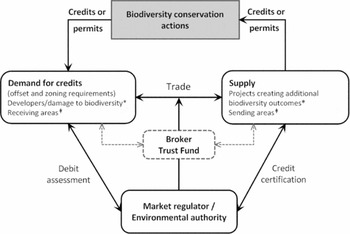
Depending on the context, applying habitat banking and TDR calls for several actors with different institutional roles. The principal actors here are buyers, sellers and regulators (Fig. 1).
Actors and roles in habitat banking* and TDRǂ schemes.

Developers generate credit demand in habitat banking schemes, since their activities must meet regulatory obligations and comply with corporate social responsibility objectives. Philanthropists or non-governmental organizations (NGOs) can also create demand, although they tend to keep their credits, enhancing the ecological value of a particular region (Bovarnick et al. Reference Bovarnick, Knight and Stephenson2010; Wissel & Wätzold Reference Wissel and Wätzold2010). Landowners in receiving zones who wish to develop their land to a level beyond their initial baseline allocation likewise generate a demand for credits in TDR schemes.
Credit suppliers are ‘those with suitable land for whom creating and selling credits offers profit opportunities’ (eftec et al. 2010). They are the guarantors of implementation of conservation measures. The supply comes primarily from private landowners, such as farmers and foresters. Government bodies and conservation organizations in possession of land are also potential credit suppliers (Wissel & Wätzold Reference Wissel and Wätzold2010). The credit suppliers in TDR schemes are private landowners in sending zones.
Successful implementation of habitat banking and TDR requires a heavy commitment from the public sector. Governments play a significant role in setting standards for instrument design, implementation, enforcement and monitoring. The trading process calls for an effective regulator, as the market is a long way from being characterized as perfectly competitive (Carroll et al. Reference Carroll, Fox and Bayon2008). The role of NGOs in supporting the regulator is of similar importance, as these organizations contribute additional technical expertise, act as facilitators and ensure greater transparency and accountability (Briggs et al. Reference Briggs, Hill and Gillespie2009).
Trading schemes are highly complex and can involve a range of additional stakeholders whose engagement is crucial to success. Some habitat banking schemes (such as the New South Wales BioBanking Scheme) include an independent trust fund to allocate funds received in lieu of biodiversity debits. This has two major advantages: (1) the capacity to enforce the purchase of credits according to strategic conservation priorities and maximize the benefits of delivering a ‘no net loss’; (2) the potential to reduce transaction costs, for instance due to the capacity to pool demand for credits from several small developers and find opportunities to purchase equivalent credits on behalf of all of them (eftec et al. 2010). Other relevant stakeholders are local communities, whose agreement to the proposed land-use changes is a key aspect of the planning process (Carroll et al. Reference Carroll, Fox and Bayon2008), and conservation brokers, whose role in facilitating credit transactions gains in significance when the potential number of participants in the market increases (as in, for example the BushBroker Scheme in Victoria, Australia).
Monitoring and enforcement
Enforcement is a major issue when it comes to managing habitat banking and TDR (Burgin Reference Burgin2008; Schröter-Schlaack Reference Schröter-Schlaack, Hansjürgens, Antes and Strunz2011). Effective monitoring and verification of biodiversity impacts is vital to long-term environmental integrity. Monitoring is needed in order to (eftec et al. 2010):
-
• ensure legal compliance with respect to actions/processes, biodiversity impacts and, their additionality;
-
• facilitate adaptive management of individual projects;
-
• provide the authorities responsible for schemes with scientific feedback on the effectiveness and cost of specific measures;
-
• provide feedback to other stakeholders, such as conservation organizations and local communities; and
-
• inform policy development.
Ideally, monitoring should be carried out by the regulator or accredited third parties, since transparency in verification processes can enhance market confidence (Bovarnick et al. Reference Bovarnick, Knight and Stephenson2010).
Reviews of habitat banking schemes have pointed out high rates of non-compliance with agreed conditions (Gibbons & Lindenmayer Reference Gibbons and Lindenmayer2007). Several schemes in the case studies under review include mandatory monitoring and give priority to ensuring their effectiveness. Monitoring is also a prerequisite for the success of TDR markets. Once TDR are sold, sending areas should be under permanent protection if conservation is to be successful (Pruetz & Standridge Reference Pruetz and Standridge2009).
Regulatory provisions, binding contracts and funding mechanisms are some of the approaches used in securing long-term compliance (eftec et al. 2010). For example, owners of lands included in the BioBanking Trust Fund, established in New South Wales (Australia), receive an annual payment from the fund if management actions agreed upon are implemented adequately (DECC 2007).
POLICY ANALYSIS
Do habitat banking and TDR help to achieve conservation objectives?
Drawing a definitive and general conclusion on the environmental effectiveness of habitat banking or TDR in terms of their contribution to achieving fixed conservation objectives (for example ‘no net loss’) is not possible. In many cases, data refer to output-based indicators only. These include the number of offsets implemented, area covered and credits traded. While the findings in some cases are positive and the main goals have been fulfilled, other schemes show evidence of only partial success or of failure. Since habitat banking and TDR ultimately complement offset regulations and zoning, their effectiveness depends heavily on strict enforcement of these baseline policies.
US Wetland Mitigation Banking, which contributed to the generation of thousands of hectares of wetland and protected sites ‘that would not have existed had the law not required developers to offset their impacts in this way’ (ten Kate et al. Reference ten Kate, Bishop and Bayon2004), is a strong argument for this instrument. Developers are often obliged to buy more credits and restore or protect larger wetland areas than those forfeited to development (Burgin Reference Burgin2010). The two major habitat banking programmes in the USA permanently protect c. 213000 ha via wetland, stream or conservation banks, with an annual average growth of 10500 ha, resulting from a steady increase in the setting up of new banks (Madsen et al. Reference Madsen, Carroll, Kandy and Bennett2011). Despite broad implementation, with most bank owners and operators reporting economic success and mixed ecological results, numerous banks have been unable to effectively replace the wetland functions that have been destroyed (eftec et al. 2010).
In Australia, the market activity of the BushBroker (Victoria) and BioBanking (New South Wales) schemes has fallen short of expectations. BushBroker facilitated 300 trades resulting in AUD 34 million for 3420 ha of credits (2007–2011). The ecological relevance of the scheme is limited, since 75–80% of native vegetation offsets in Victoria occur outside the BushBroker scheme (Madsen et al. Reference Madsen, Carroll, Kandy and Bennett2011). Until July 2014, 29 agreements were approved, under the NSW BioBanking programme, conserving > 4700 ha of native vegetation and threatened species in perpetuity (State of NSW & Office of Environment and Heritage 2014). Despite the growing interest from landowners, the demand for offset areas largely outstrips the supply. Limiting factors to the offset supply are high implementation costs and the pressures from competing land uses (Madsen et al. Reference Madsen, Carroll, Kandy and Bennett2011). From a conservation perspective, however, this is good news, as high credit prices incentivize developers to further avoid and minimize impacts.
Among the more than 140 TDR programmes in place in the USA, designs and results vary considerably (Walls & McConnell Reference Walls and McConnell2007). Some are huge success stories in terms of trading activity and protected hectares of open space and prime farmlands. The TDR programme in Montgomery County, Maryland, is seen in particular as one of the most effective schemes. By 2008, it had preserved > 50000 acres (20234 ha) of land in the densely developed Baltimore–Washington corridor by transferring more than 8000 development rights, which accounts for 75% of the preserved agricultural land in the county (Pruetz & Standridge Reference Pruetz and Standridge2009). Admittedly, without the TDR programme, not all of this land would have been developed (see for example Levinson Reference Levinson1997). However, it has led to long-term preservation of agricultural land despite the approaching development frontier.
These substantial gains notwithstanding, mitigation efforts are frequently criticized for target failure, and instruments such as habitat banking and TDR face several challenges and risks. Key obstacles include: (1) risk of excessive damage, (2) failure to deliver ‘no net loss’, (3) assessment of equivalence in terms of impact on biodiversity, and (4) ensuring additionality of credit generating projects.
Firstly, risk of excessive damage arises from providing a compensation option that entails approval of otherwise unacceptable development destruction. Habitat banking and TDR can lead to less reticence to undertake harmful projects, since developers are no longer engaged in offsetting the impacts themselves but buy credits anonymously on the market. Against this background, a strong regulatory framework is needed to ensure adoption of the mitigation hierarchy (impact avoidance or minimization prior to offsetting) and to determine the impacts to be offset. Ultimately, society and the regulators play a major role in defining what constitutes an acceptable trade-off between avoidance and mitigation of impacts on-site and off-site compensation through offsets and in particular habitat banking (Carroll et al. Reference Carroll, Fox and Bayon2008).
Secondly, assessing whether combining offsets with banking and zoning with TDR contributes to the achievement of ‘no net loss’ raises serious questions (Alvarado-Quesada et al. Reference Alvarado-Quesada, Hein and Weikard2014). On the one hand, it seems that many programmes have fallen short of expectations with regard to conservation benefits. Despite the relative popularity of the US Wetland Mitigation Banking in terms of wetland area created, Burgin (Reference Burgin2010) identified several reviews (such as NRC 2001; Turner et al. Reference Turner, Redmond and Zedler2001; Kihslinger Reference Kihslinger2008) that concluded that it had failed to achieve the ‘no-net-loss’ goal, and declared mitigation to be nowhere near to compensating for the affected area. Hallwood (Reference Hallwood2007) also pointed out that only about 25% of the mitigation wetland projects were ecologically successful, in the sense that they had or would probably become serviceable wetlands of the type permitted. In the case of the US Conservation Banking scheme, Fox and Nino-Murcia (Reference Fox and Nino-Murcia2005) pointed to the possible danger of failing to achieve the ‘no-net-loss’ goal due to the high credit ratios allocated to some banks and the fact that most (94%) of the banks corresponded to preserved rather than restored or created habitats.
On the other hand, the introduction of biodiversity credit banking and TDR provides additional conservation benefits compared to offset regulation and zoning alone (Fox & Nino-Murcia Reference Fox and Nino-Murcia2005). Time lags between impacts and related offsets are reduced, since habitats or species are restored or conserved prior to impacts, although the conservation bank would have to be in place for some time for the time lag to be actually reduced. Concentrating mitigation in large areas with optimized habitat connectivity enhances conservation benefits (Kiesecker et al. Reference Kiesecker, Copeland, Pocewicz and McKenney2010).
Thirdly, trading schemes must ensure equivalence of biodiversity values or ecosystem functions lost with those restored/created in order to at least maintain the overall ecological value (Wissel & Wätzold Reference Wissel and Wätzold2010). Unless gain and loss equivalence is established, credit provision will remain a form of compensation rather than a genuine biodiversity offset in the interests of ‘no net loss’.
Determining the equivalence of an impact or damage and offsets or habitat credits is not easy. Some elements of the natural environment can clearly be restored or recreated, while the recreation of others cannot be guaranteed (Morris et al. Reference Morris, Alonso, Jefferson and Kirby2006). Equivalence is primarily affected by three dimensions: type (restored and destroyed habitats have different functional values), space (size, site configuration and connectivity) and time (habitat restoration takes time, leading to increased uncertainty) (Salzman & Ruhl Reference Salzman and Ruhl2000; Ring et al. Reference Ring, Drechsler, van Teeffelen, Irawan and Venter2010; Wissel & Wätzold Reference Wissel and Wätzold2010).
Habitat banking and the underlying offset schemes can only function properly with an effective measurement of biodiversity values gained and lost. Reliable methods for this purpose are still lacking, however, and data availability could be a constraint (Burgin Reference Burgin2008). Measuring the ecological value of destroyed and restored sites calls for an exchange unit (Wissel & Wätzold Reference Wissel and Wätzold2010), albeit currency units may not be fungible (Salzman & Ruhl Reference Salzman and Ruhl2000; Bovarnick et al. Reference Bovarnick, Knight and Stephenson2010). The use of a simple unit (such as area) facilitates measurement but ignores essential factors such as habitat quality, function and connectivity (Wissel & Wätzold Reference Wissel and Wätzold2010). However, the use of a more accurate currency would increase complexity and be difficult or impossible to apply (Bonnie Reference Bonnie1999). In theory, multiple units can be used to capture the range of biodiversity aspects without risk of trade-off concealment. For this reason, some schemes envisage choosing from alternative ecological currencies (Australian Government 2012). The more complex the calculation, however, the more costly the procedure.
Analysis of the selected cases shows that, even in the same country, the methods, indicators and units for biodiversity assessment vary. For example, although a similar regulatory approach is adopted in the US Wetland Banking and Conservation Banking schemes, the units applied differ greatly. Building on extensive stakeholder consultation and involvement of the scientific community, the recently amended Australian Environmental Offsets Policy (Australian Government 2012) now foresees choosing from seven possible ecological currencies to measure offset (gain) and impact (loss) in equivalent units in terms of threatened species and communities: area of community, area of habitat, number of features, condition of habitat, birth rate, mortality rate, and number of individuals.
Lastly, ensuring the additionality of credit-generating offset projects is yet another challenge (Madsen et al. Reference Madsen, Carroll and Moore Brands2010). Not all credits sold are, in fact, additional biodiversity benefits: management actions already in place or outcomes that occur naturally as a result of habitat evolution are also sold as credits (eftec et al. 2010). Burgin (Reference Burgin2010) stated that ‘there have been over 16000 hectares of conservation banks developed under US mitigation schemes, but 75 per cent or more would probably have been developed even without legislation to mitigate loss’. One example is the Stillwater Plain Conservation Area (USA), which proved to be financially unviable for development and therefore not in immediate danger of loss (Bayon Reference Bayon2002). Hence, trading wetlands under threat elsewhere with credits from this area cannot be seen as an additional benefit to biodiversity conservation (Burgin Reference Burgin2010).
Equivalence and additionality are also drawbacks for TDR programme effectiveness. Since markets work on a voluntary basis, TDR for sites unlikely to be developed are sold first (Lynch & Musser Reference Lynch and Musser2001). Moreover, since the transfer of rights is usually conducted on a simple ‘hectare per hectare’ basis, differences in the conservation potential of sending site parcels are neglected (Lynch Reference Lynch, Goetz, Shortle and Bergstrom2005).
Can habitat banking and TDR reduce costs of achieving conservation goals?
Habitat banking and TDR are explicitly designed to make offset regulation and zoning more flexible and enhance cost effectiveness of conservation policies. Regulators will benefit from circumventing case-by-case responses to project-related impacts. In the case of habitat banking, developers obtain the necessary permits by restoring a habitat of equivalent value or purchase them on the market. As a result low-performance on-site mitigation measures are replaced with meaningful contributions to regional conservation targets (Gillespie & Hill Reference Gillespie and Hill2007). Buying credits can reduce offsetting costs borne by developers, who would otherwise have to offset the impacts themselves (Carroll et al. Reference Carroll, Fox and Bayon2008). Although not all TDR programmes operate in the same way, they share a common feature: density is transferred from one area to another. Trading gives programmes the potential to enhance efficiency compared to land-use zoning alone, where density limits are assigned uniformly across multiple property owners (McConnell & Walls Reference McConnell and Walls2009).
Another major benefit of habitat banking is the establishment of a market for the property rights of biodiversity resources as an incentive for landowners to ‘designate their land in such a way that a cost-effective allocation of land-use types emerges’ (Wissel & Wätzold Reference Wissel and Wätzold2010). This instrument replaces liability with opportunity, enticing landowners to engage in biodiversity conservation (Carroll et al. Reference Carroll, Fox and Bayon2008). A further advantage is that mitigation banking gives developers greater planning certainty (Wissel & Wätzold Reference Wissel and Wätzold2010). Knowing the predicted outcome of the mitigation project increases developers’ confidence levels.
Involving private landowners in conservation efforts via TDR is particularly beneficial from a government perspective, since land is preserved without government expenditure. For example, Walls and McConnell (Reference Walls and McConnell2007) estimated that preserving 48000 acres (19425 ha) of land in Montgomery County, Maryland, would have cost the county approximately US$ 68 million if achieved through the public purchase of development rights. By making development rights tradable among private landowners, compensation for landowners in conservation areas is financed by TDR prices paid by developers in receiving areas.
In 2011, the global annual market dimension of compensatory mitigation programmes was estimated at between US$ 2.4 billion and US$ 4 billion. The annual conservation impact of this market includes at least 187000 hectares of land under some form of conservation management or permanent legal protection (Madsen et al. Reference Madsen, Carroll and Moore Brands2010). Credit prices and market volumes vary significantly between schemes. In the NSW BioBanking scheme, the average market volume is estimated at US$ 1.1 million yr−1 and the average protected area is 100 ha yr−1, while for the US Conservation Banking scheme, the average protected area is 3780 ha yr−1 and the average market volume is US$ 200 million yr−1 (Alvarado-Quesada et al. Reference Alvarado-Quesada, Hein and Weikard2014) (average values are calculated as total values divided by number of years the scheme has functioned).
Key constraints on enhancing the cost effectiveness of offsets and zoning via banking and TDR lie in the generation of credit supply and demand, and thus in the establishment of liquid markets. Supply depends on the availability of appropriate land, and varies according to habitat type, location, and zoning regulation. The credit supply for habitats with high land-use values and opportunity costs (notably coastal areas) frequently constitutes a constraint, while land in habitats with low opportunity costs is in abundance (eftec et al. 2010). Another constraint on the supply of credits is the viability of restoring different types of biodiversity. Biodiversity resources that take longer to restore are more costly, given the opportunity and restoration costs (Drechsler & Hartig Reference Drechsler and Hartig2011). Forests, for example, require decades or even centuries of growth, whereas wetland restoration typically takes only a few years. Long time-scales mean that credit suppliers take longer to deliver, incurring greater monitoring and management costs (Bean et al. Reference Bean, Kihslinger and Wilkinson2008). Hence, credit suppliers face set-up and opportunity costs that can only be overcome by a strong market demand for credits (Carroll et al. Reference Carroll, Fox and Bayon2008). In TDR systems, the credit supply depends on zoning regulation in sending areas, since landowners receive tradable credits as compensation for reduced development opportunities.
Credit demand in banking schemes is closely linked to offset regulation and whether developers are forced to buy credits on the market or are free to offset impacts in another way. If biodiversity compensation is required by law, the market allows credits to be priced at a level that secures appropriate land for its delivery (Carroll et al. Reference Carroll, Fox and Bayon2008). In TDR schemes, demand relies primarily on the attractiveness of development in the receiving areas. In some cases, such as in Montgomery County, Maryland, credit demand was hampered by growing public concern about dense development in receiving areas and the lack of local infrastructure to absorb further development (Cohen & Preuss Reference Cohen and Preuss2002).
Regional markets with a large number of participants lead to greater differences in opportunity costs and increased trading potential compared to small-scale local markets (Wissel & Wätzold Reference Wissel and Wätzold2010). Instrument performance is, in turn, affected by the decline in transaction frequency resulting from a low credit demand, additional regulations that restrict trading opportunities, and transaction costs that weaken the incentive to trade (Wissel & Wätzold Reference Wissel and Wätzold2010). Complex trading schemes involving the individual assessment of sending sites were found to have substantially lower transactions and programme participation, and hence lower conservation effects (Machemer & Kaplowitz Reference Machemer and Kaplowitz2002; Walls & McConnell Reference Walls and McConnell2007).
The introduction of a competitive bidding or auction mechanism is a potentially interesting approach to magnify the cost effectiveness of trading schemes (Reeson et al. Reference Reeson, Rodriguez, Whitten, Williams, Nolles, Windle and Rolfe2011). It can help to reduce information asymmetry, mainly by revealing hidden information (such as real opportunity costs for conservation), saving regulator costs in the process.
What impacts are to be expected in terms of equity, fairness and legitimacy?
The literature on and evidence of the social impacts of mitigation offsets, habitat banking and TDR is negligible compared to work on issues such as effectiveness and cost effectiveness.
One positive effect of these two instruments is the creation of new sources of income for landowners through credit transactions and the potential for business and job creation that comes with the establishment, maintenance and monitoring of habitat banks. Community-based habitat banks generate income for local community development programmes and alternative livelihood projects (Bovarnick et al. Reference Bovarnick, Knight and Stephenson2010). Depending on their management and implementation, these markets have the potential to benefit low-income land stewards, particularly in developing countries, thus contributing directly to the achievement of poverty alleviation goals. However, this potential (also relevant to other market-based instruments such as payment for ecosystem services) has yet to be fulfilled, and the institutional conditions have not been established in all cases (Fisher et al. Reference Fisher, Maginnis, Jackson, Barrow and Jeanrenaud2005; Milder et al. Reference Milder, Scherr and Bracer2010).
One important aspect in the analysis of equity issues in habitat banking schemes is the overall tendency of mitigation policies to shift natural resources across landscapes, moving them between different human populations along an urban–suburban–rural gradient. Natural assets are lost from affluent urbanized areas (or areas in the development frontier) and mitigated at sites in less affluent rural areas (BenDor & Stewart Reference BenDor and Stewart2011). The effects of such shifts in property values and community income are very much dependent on the context and on the design and management of the scheme. For example, the raising of monetary rents for land areas appropriated by instruments such as habitat banks may serve to displace people from these areas, as governments and investors seek to ‘grab’ new values, and can impact on the legal and customary rights of indigenous peoples and local communities (Sullivan Reference Sullivan2012).
These instruments can also adversely affect landowners accustomed to traditional land-management practices. New technical skills and knowledge are needed (Hallwood Reference Hallwood2007) and there is a real risk that less skilled farmers will be excluded. Conversely, positive impacts, such as capacity building and stakeholder engagement in conservation efforts, are likewise possible.
Zoning regulation in land-use policy typically leads to windfall profits for landowners with development zoning, since their parcels are devoted to development while others are restricted to less profitable land uses. Against this background, TDR schemes increase social justice where zoning is concerned. Development restrictions for property owners in sending zones are compensated for by the TDR return on sales, whereas developers in receiving zones have to pay for any additional development exceeding the prevailing legal limits (Thorsnes & Simons Reference Thorsnes and Simons1999). In this way, TDR complements zoning and most likely enhances acceptance of the policy mix and the respective land-use restrictions.
Cohen and Preuss (Reference Cohen and Preuss2002) assessed social equity issues in the Montgomery County TDR programme, some of which were typical of TDR programmes in general. They recognized the capacity of TDR to support intergenerational equity by ensuring long-term preservation of open space and farmland, thus protecting natural resources for succeeding generations. They also found that, as a rule, TDR provided new farmers with equity; in other words, TDR made affordable land available to farmers. Furthermore, they concluded that TDR performed less well on ‘equity for current landowners’, since neither the actual opportunity costs of landowners nor the conservation value of affected sites in sending zones were taken into account. TDR were sold at the same price regardless of whether the land was in close proximity to the development frontier or further away (and hence unlikely to be developed without implementation of TDR), or whether it was important, for example, to the survival of threatened species. Cohen and Preuss (Reference Cohen and Preuss2002) also criticized the lack of support for receiving sites to accommodate additional development density.
How do institutions influence design and implementation of habitat banking and TDR, and how are existing rules and regulations affected?
Market regulation is essential if habitat banking or TDR programmes are to meet the conservation target. The regulator must draw up the legal basis for instruments to conform with existing policies and laws, design rules to determine habitat equivalence (destroyed versus created), and assess habitat value (Wissel & Wätzold Reference Wissel and Wätzold2010). Another task is to ensure scheme transparency and accessibility of data to all stakeholders, and produce participant guidelines to create certainty and minimize costs and risks resulting from regulation (OECD 2004). Regulators also need to guarantee effective compensation for biodiversity damage. To this end, the ecological, legal and financial requirements must be enforced, monitored and audited (eftec et al. 2010).
Lack of regulation and monitoring will curtail delivery of conservation goals (OECD 2004). The chief constraint on habitat banking (and with offsets in general) in France, for example, is the absence of national standards (CDC Biodiversité 2010). The reinforcement of standards at national level is a precondition for the coherent design of offset projects and thus of credit creation in terms of duration, location and additionality.
Local communities and the private sector are likewise a key to success. As buyers, businesses create the demand that pushes the market forward; without demand, there is no incentive for suppliers. Credit suppliers are mostly private landowners. Apart from the key role of land provision and land management, they possess local knowledge on land characteristics beyond the reach of central governments or other institutions (Ring et al. Reference Ring, Drechsler, van Teeffelen, Irawan and Venter2010). This expertise intensifies the effectiveness of planned actions and the measures applied.
THE ROLE OF THE INSTRUMENTS IN A POLICY MIX
Biodiversity conservation is commonly based on strategies that involve a policy mix and include a combination of voluntary, economic and regulatory approaches. Based on the five functional instrument roles in a policy mix that we identified earlier, policy performance is impacted by the sequential interactions (or path dependence), complementarities or synergies, redundancy (or overlap) or conflicts of the instruments involved (Ring & Barton Reference Ring, Barton, Martínez-Alier and Muradian2015). In our case, it is therefore useful to discuss and clarify the role of habitat banking and TDR in the mix of policy instruments for biodiversity conservation.
Sequential interaction
As habitat banking and TDR in most cases build on and temporally follow existing regulatory approaches to biodiversity offsetting and land-use zoning, both market-based instruments are characterized by sequential interaction or path dependence. In countries where offset regulation exists, habitat banking can be launched on top of regulation. In the absence of offset regulation, habitat banking and offset regulation can be introduced simultaneously. As a market-based tool, TDR is always designed on top of land-use zoning and temporally follows regulation. Regulatory approaches such as offset and zoning requirements are indispensable to safeguarding the integrity of biodiversity and ecosystems, and ensuring conservation goal attainment. Regulations also clarify landowner property rights, an enabling condition for the use of market-based conservation instruments.
In this context, habitat banking is closely linked to the regulatory framework, as defined by offsetting requirements. Habitat banking focuses on market creation and functioning, assuming that background regulation has been established to define the constraints on development projects according to conservation objectives and priorities (Carroll et al. Reference Carroll, Fox and Bayon2008). Regulation is the main driver for developers to offset their impacts, and is crucial to the success of such market schemes: without regulation, demand is seriously at risk (eftec et al. 2010).
The regulatory frameworks underlying the numerous habitat banking schemes vary considerably. The NSW BioBanking scheme, for example, was designed to support the biodiversity certification process under the Australian Threatened Species Legislation Amendment Act 2004 and be consistent with the property vegetation planning process. It uses provisions from other acts to ensure that scheme and management actions (offset measures) are enforceable (DEC [NSW Department of Environment and Conservation] 2005). As Australia has recently amended and improved its national level Environmental Offsets Policy (Australian Government 2012), existing sub-national banking programmes and new market-based instruments for the delivery of offsets relevant to the matters regulated under the national legislation need to be checked for consistency against the amended regulatory baseline.
Habitat banking can make a significant contribution to several European Union (EU) policies, such as the Common Agricultural Policy and the Habitats Directive (eftec et al. 2010), and tackle the cumulative fragmentation of Europe's habitats by helping to restore, enlarge and reconnect high nature value habitats. Although EU biodiversity policy does not yet specifically include provisions on biodiversity offsetting as a prerequisite for habitat banking schemes, several legal requirements, such as the Environmental Liability Directive and the Environmental Impact Assessment and Strategic Environmental Assessment Directives, have established a framework for compensation that potentially creates demand.
TDR is explicitly designed to operate within the frame of a zoning approach. Its role is to compensate landowners in sending zones for restrictions imposed on potential land use and to provide schemes with a strong regulatory framework to ensure equivalence and additionality (Nuissl & Schröter-Schlaack Reference Nuissl and Schröter-Schlaack2009).
Complementarity or synergies
Regulations tend to ignore differences in opportunity costs for conservation across actors, leaving room for incentive-based approaches to complement these instruments (see for example Sterner Reference Sterner2003). Habitat banking and TDR programmes unilaterally improve the performance of offset regulation and land-use zoning in accordance with specific criteria, thereby compensating for several weaknesses in the regulatory approaches. It is the economic tools that render regulation, and thus the overall policy mix, more flexible, more economical and, in some cases, more fair, and not the other way around. Hence we speak of the complementarity of, rather than the synergy between these market-based instruments and their underlying regulation (Ring & Barton Reference Ring, Barton, Martínez-Alier and Muradian2015).
Complementing land-use zoning with TDR programmes has the potential to increase fairness and social equity (Cohen & Preuss Reference Cohen and Preuss2002). Property owners in sending zones are now compensated for development restrictions by TDR return on sales, and developers in receiving zones pay for additional development that exceeds the prevailing legal limits. In this way, economic incentives contribute to acceptance of biodiversity conservation and land-use controls, as distinct from the sole use of regulatory approaches.
Redundancy and conflict
In some situations instruments overlap or conflict with habitat banking and trading schemes. In the general context of environmental policies, overlap is primarily mentioned as a potential source of inefficiency (OECD 2007) and analysed for negative interaction. In contrast, several authors recommend instrument overlap in biodiversity policies (Gunningham & Young Reference Gunningham and Young1997; OECD 1999) and consequently discuss it in the frame of positive interaction. It has been argued that overlap or functional redundancy of individual instruments increases the resilience of the overall policy mix, especially where there is substantial environmental heterogeneity and variability, as is the case with biodiversity (Ring & Schröter-Schlaack Reference Ring, Schröter-Schlaack, Ring and Schröter-Schlaack2011).
When habitat banking is introduced to complement offset regulations, the economic instrument tends to overlap the regulatory instrument. The NSW BioBanking scheme, for example, is redundant to the offset regulation in place. Developers can choose between adopting the habitat banking scheme or negotiating an offset with the NSW government. The latter was their sole option prior to introduction of the BioBanking scheme. Developers are thus free to choose between offsetting the impact themselves and purchasing the required credits. This kind of overlap heightens the flexibility and cost effectiveness of the overall policy mix to achieve conservation goals.
It is no surprise that preservation programmes with multiple goals call for multiple instruments. Many counties in the USA combine several conservation measures to achieve the full range of land-use planning goals. Although Montgomery County, for example, has a highly successful TDR programme that has led to the preservation of vast areas at little cost to the county government, the authorities added a tax-funded programme to directly buy up easements on parcels under high development pressure or of high ecological value (Lynch & Musser Reference Lynch and Musser2001).
Overlap can also occur with other policy instruments in the mix. The overlapping of multiple biodiversity conservation policy instruments, such as national legislation (for example national parks), European legislation (such as Natura 2000) or international conventions (like the Ramsar Convention) can have an adverse effect on trading schemes (eftec et al. 2010). One issue is additionality: credits should not be based on biodiversity outcomes that would have occurred automatically as a result of existing instruments (such as management obligations set up for Natura 2000 sites in line with the European Habitats and Birds Directives). The interaction of different conservation legislations could lead to additional constraints on project developers, producing further administrative and transaction costs (eftec et al. 2010).
A number of tools used in policy sectors outside the realm of biodiversity policies (such as energy, agriculture and development) can cause friction with conservation policy instruments in general, and with habitat banking and TDR in particular. In the EU, as elsewhere, the existence of environmentally harmful subsidies granted by governments and alternative offset options reduces the attractiveness and effectiveness of these instruments (Lynch Reference Lynch, Goetz, Shortle and Bergstrom2005; Pascual & Perrings Reference Pascual and Perrings2007).
CONCLUSION
Given the alarming rate of biodiversity loss, any effort to stabilize and reverse this trend is relevant. Instruments such as habitat banking and TDR have the potential to contribute positively to overcoming the stalemate between biodiversity conservation and economic development objectives. Potential market failures and issues of equivalence and additionality can, conversely, produce unintended costs and environmental consequences. Careful monitoring and a strong enforcement capacity are crucial in this context.
Habitat banking and TDR encourage businesses to actively engage in biodiversity conservation and may lessen their resistance towards the integration of conservation goals into their business strategies, thus creating a new mind-set more favourable to public-private cooperation in biodiversity conservation.
As market-based approaches, habitat banking and TDR are, in principle, more cost effective than purely regulatory approaches such as biodiversity offsets and land-use zoning. Nonetheless, a clear, enforceable regulatory approach is a prerequisite for the success of these schemes in terms of their conservation effectiveness. The key aspect here is how these market-based approaches are integrated into the biodiversity conservation policy mix (for example, sequential interactions and path dependence, complementarities, synergies, redundancy, overlap and conflicts of the instruments involved).
Habitat banking can also contribute to poverty alleviation goals, as we have discussed, and improve the livelihoods of socially-deprived local communities by making them beneficiaries of rehabilitated sites and new income opportunities. In turn, TDR provides powerful incentives for compliance with regulatory norms and ensure that the benefits and costs of land-use controls are distributed more evenly among landowners. This would lead to reduced government spending on monitoring and enforcement of regulatory norms, and less welfare loss from the rent-seeking activities of planning addressees.
Applied within a regulatory land-use planning framework, habitat banking and TDR perform essential functions in the policy mix (Nuissl & Schröter-Schlaack Reference Nuissl and Schröter-Schlaack2009, p. 277 onwards). Banking and TDR facilitate compliance with the regulatory obligations of offsetting and land-use planning, while maintaining or offering scope for individual compliance measures. They complement regulatory approaches and are designed to augment the efficiency and flexibility of land-use management previously upheld by planning regulations alone. A policy mix that includes economic instruments is likely to enhance political acceptance of biodiversity conservation and land-use control in general. Since the obligations of land-use control must be tightened in the future to achieve more sustainable land-use patterns, this aspect will gain considerable significance.
ACKNOWLEDGEMENTS
The research presented in this paper was carried out with the support of the EU-funded project POLICYMIX (grant agreement no. 244065). CENSE is financed through Strategic Project Pest-OE/AMB/UI4085/2013 from the Fundação para a Ciência e Tecnologia, Portugal. We also thank two anonymous reviewers, the Associate Editor and the Editor-in-Chief for their detailed, valuable and constructive comments, which helped improve the manuscript substantially.