INTRODUCTION
Larval release of marine invertebrates is usually timed according to different environmental periodicities, of which the light–dark, lunar, tidal and tidal-amplitude cycles are the most common (Morgan, Reference Morgan and McEdward1995). These rhythms combined may produce temporal larval release patterns which favour rapid transport offshore, thus minimizing stranding and predation by nearshore fish assemblages (Forward, Reference Forward1987; Morgan & Christy, Reference Morgan and Christy1994). Rhythms related to the tidal-amplitude cycle, with peak release events centred in syzigies, are quite frequent, and might be crucial to avoid excessive offspring loss during the first few hours after hatching. In terms of reproductive potential of benthic populations, releasing larvae at the optimal temporal window may represent substantial increase of per capita contribution to a common offshore larval pool. However, reproductive activities, even when timed according to natural environmental oscillators, rarely match the expected optimal trend. Despite the demonstration of clear rhythmic patterns following the tidal-amplitude cycle, offspring may either be released shortly, but persistently, before or after the dates of maximum tidal range (Yamahira, Reference Yamahira1997; Mizushima et al., Reference Mizushima, Nakashima and Kuwamura2000). Consequently, the rhythms are timed with suboptimal accuracy, or delivered over more or less protracted periods, consistently around predicted dates but leading to suboptimal precision (Morgan & Christy, Reference Morgan and Christy1994; Flores et al., Reference Flores, Mazzuco and Bueno2007). Surprisingly, as far as we are aware, explicit inter-population comparisons of these larval release parameters have never been reported.
Dense populations of grapsid crabs may be found on virtually any marine intertidal rocky outcrop, from warm temperate to tropical regions, indicating their capacity to cope with a wide array of environmental conditions. These crabs rove over relatively large areas (Abele et al., Reference Abele, Campanella and Salmon1986; Cannicci et al., Reference Cannicci, Paula and Vannini1999), and therefore may share a specific set of resources and be exposed to similar physical conditions within spatial distances compatible with the size of natural rocky intertidal areas. They are regarded as opportunist feeders, preying on many different invertebrates and algae (Kennish & Williams, Reference Kennish and Williams1997; Cannicci et al., Reference Cannicci, Gomei, Dahdouh-Guebas, Rorandelli and Terlizzi2007), and find shelter either in rock crevices or refuges in biogenic substrata (Flores & Negreiros-Fransozo, Reference Flores and Negreiros-Fransozo1999). Their reproductive output may however depend on habitat quality, which certainly varies among populations of these generalist crabs. In terms of reproductive timing, it has been shown that fiddler crabs exhibit contrasting performance in response to resource availability. Kim & Choe (Reference Kim and Choe2003) showed that Uca lactea food-deprived males delay their semilunar courtship, and Derivera (Reference Derivera2005) indicated that larval release in U. crenulata takes place at the right time only when females occupy burrows that fit their size. These studies focus on the response of individuals, groups of individuals within plots or along transects, or individuals within a single population. It is still unclear whether the observed contrasts persist at larger spatial scales, namely when comparing different populations. Such larger-scale analyses are however of prime importance in defining areas where offspring production is particularly high, performing as sources in the metapopulation context (Roughgarden & Iwasa, Reference Roughgarden and Iwasa1986).
The mottled shore crab Pachygrapsus transversus (Gibbes) is a rocky shore species widely distributed along the tropical western Atlantic (Williams, Reference Williams1984). Its reproduction is more intense during the summer (Flores & Negreiros-Fransozo, Reference Flores and Negreiros-Fransozo1999) and events of larval release are more frequent at times when tidal-amplitude is highest, around both diurnal and nocturnal high tides (Morgan & Christy, Reference Morgan and Christy1994; Flores et al., Reference Flores, Mazzuco and Bueno2007). However, the sharpness of the fortnightly release pattern may vary considerably among populations. Within the same study region and tidal regime, we recently reported a clear pattern on a very sheltered shore and, although evident, a more blurred trend at a more exposed site (Flores et al., Reference Flores, Mazzuco and Bueno2007). Because tidal-amplitude in south-eastern Brazil is narrow (maximum around 1.5 m during spring tides), we suggested that wave exposure could directly affect synchronism of larval release by disrupting an otherwise clear signal of pressure delivered by the periodic raise and fall of tides. Hydrostatic pressure is known to affect activity rhythms in some marine invertebrates (Naylor & Williams, Reference Naylor and Williams1984) and entrain circatidal larval release in the crab Rhithropanopeus harrisii (Gould) (Forward & Bourla, Reference Forward and Bourla2008). Therefore, a similar cueing mechanism may modulate larval release rhythms in Pachygrapsus. Effects of wave exposure would likely operate at spatial scales large enough to drive among-shore contrasts. It should be pointed out, however, that an early study reporting larval release patterns of Pachygrapsus in Panama indicated a more apparent fortnight rhythm in the Caribbean, where tidal amplitude is small (0.3–0.5 m), compared to the Pacific, where average tidal range is about 5 m (Morgan & Christy, Reference Morgan and Christy1994). Their results would not support the above stated hypothesis, but it should be stressed that very different systems and, possibly, different crab species (Cuesta & Schubart, Reference Cuesta and Schubart1998; Poupin et al., Reference Poupin, Davie and Cexus2005) were examined.
In the present study we compared estimates of phase and amplitude of larval release activity over the tidal-amplitude cycle among different populations of the mottled shore crab. Results were used to evaluate the implications of suboptimal timing in the reproductive success of this species. A sampling protocol over a 50-km coastline was designed to simultaneously assess the temporal consistency of among-shore variability, and provide a test for the effect of wave exposure in the degree of larval release synchronism.
MATERIALS AND METHODS
Duration of embryo stages
Dates of larval release were estimated by staging the embryos of ovigerous females and projecting the time they would take to fully develop and hatch. Estimates of the duration of embryo stages were only obtained at a single site, not including variation of environmental conditions among different shores. Even within the same region and experiencing similar temperature variation, slight changes could significantly alter embryo development rate (Wear, Reference Wear1974) and hamper analyses. However, estimates of average hatching dates at the sampled shores nearly match (see Results), indicating that the differences of incubation time were minor.
In order to measure the duration of each of the ten stages (Boolootian et al., Reference Boolootian, Giese, Farmanfarmaian and Tucker1959), we installed four different containers at the mid-intertidal level of permanently shaded vertical walls at the rocky shore of Ilha Porchat, São Vicente, São Paulo State, Brazil (23°58′50″S 46°22′03″W). Each container consisted of a plastic box (11 × 11 × 12 cm) with screened lateral faces and a perforated bottom to allow water flow and complete drainage during low tides, in an attempt to make internal conditions as close as possible to the natural surrounding conditions of humidity and temperature. Pieces of PVC pipes were attached close to the bottom of the boxes to provide shelter for crabs. These units were held in the field for 24 days, during which an average of four to five breeding females, always collected nearby, were kept in each container at any given time. Confined crabs were identified by small plastic labels attached to the carapace with cyanoacrylate glue. Females which released their larvae were replaced by new individuals. Adult non-ovigerous females were occasionally introduced into boxes and frequently extruded a new egg clutch using stored sperm, thus allowing the measurement of the duration of the first embryonic stage on different occasions (N = 5). Each day, crabs were fed using shrimp muscle pieces, and their broods were sampled and rapidly transported to the laboratory for egg staging under a stereomicroscope. This experiment was carried out from 21 November to 15 December 2007.
Among-population comparisons of larval release patterns in Ubatuba
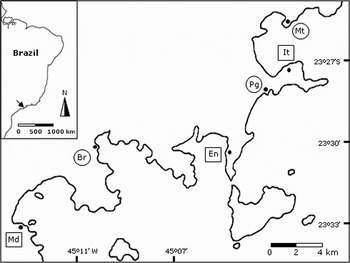
Six populations in the Ubatuba region were sampled during the main breeding season of this species. These comprised three populations at both sheltered (Itaguá, Enseada and Maranduba) and moderately exposed shores (Matarazzo, Praia Grande and Bravinha), interspersed over a 50-km coastline along the northern littoral of São Paulo State, Brazil (23°25′–33′S 45°02–13°W; Figure 1). In order to test whether wave exposure varies consistently between subjectively classified ‘sheltered’ and ‘exposed’ shores, we built recorders of maximum wave force based on the device described by Palumbi (Reference Palumbi1984), but employed a practice golf ball as a drogue (Bell & Denny, Reference Bell and Denny1994). Briefly, this device measures wave force as the extent to which a drogue is capable of pulling the sliding head of a nylon cable tie through its grooved plastic ribbon. The relative distance the sliding head moved over the ribbon, from zero (no movement) to 1 (full tie length), was recorded and used as a proxy of maximum wave force. These recorders sampled each of the six rocky shores during three 24-hour periods within 1.5 months. During each sampled period, five such devices were randomly allocated along each shore. The data were analysed following a nested ANOVA model, in which ‘shore’ (three levels; shore 1, 2 and 3), a random factor, was nested in ‘exposure’ (two levels; exposed and sheltered). Only consistent contrasts would render significant differences because replicates were pooled over sampling dates (N = 15) and weather conditions varied significantly among them.
Map of the Ubatuba coastline where among-population patterns were examined. Md, Maranduba; Br, Bravinha; En, Enseada; Pg, Praia Grande; It, Itaguá; Mt, Matarazzo. Squares and circles indicate sheltered and exposed sites, respectively.

Crab populations were sampled from mid-February to late March 2008, in the middle of the breeding season, over four consecutive neap-tide periods (8 days). In each period all sites were sampled every other day, rendering a total of 56 to 61 broods sampled for each period and site. Eggs were staged and dates of hatching were projected as explained above. Because dates of maximum tidal-amplitude exactly matched the days of full and new moon, projected hatching dates were converted to the time to the nearest syzygy (TNS), and thus ranged from –7.4 to +7.4 days. Releases at day zero took place at full or new moons. TNS histograms, with 1.5 days class intervals, were first plotted for a visual examination of its distribution at all sites. A Chi-square test was used to verify normality, and hence whether departures from maximum release come from a homogeneous breeding population.
Two different variables were examined to characterize larval release timing at the sampled populations. The average TNS was used as a central tendency estimate, and regarded as the accuracy of semilunar larval a proxy of the phase of the release cycle. By removing its sign, the average deviation from syzygial release was obtained, not distinguishing females releasing their larvae before or after maximum-amplitude tides. This second variable was used as a measure of hatching precision, a proxy of the amplitude of the cycle. In order to simultaneously test among-population contrasts and a possible effect of wave exposure on the timing of larval release, the data sets for these two variables were analysed according to a specific ANOVA model, in which ‘shore’ is a random factor nested in ‘exposure’, as explained above. In addition, the factor ‘period’ was added, with four levels (periods 1, 2, 3 and 4), in order to verify if spatial trends are consistent over time. Egg staging from each brood rendered a replicate value (N = 56). In all ANOVA analyses, homoscedasticity was verified using the Cochran's C statistic and the Student–Newman–Keuls (SNK) procedure was used for a posteriori comparisons when needed (Underwood, Reference Underwood1997).
RESULTS
Duration of embryo stages
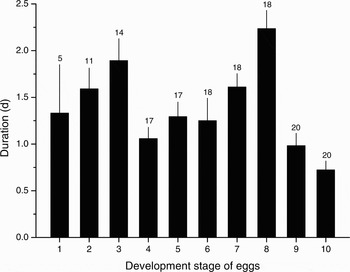
The duration of egg stages in captive females at Ilha Porchat is shown in Figure 2. Longer periods correspond to initial stages, when initial cleavage takes place and the early animal pole emerges, and to later stages when the embryo is almost fully developed, consuming the last yolk reserves. By summing the average duration of all egg stages, the total estimated time for the development of embryos at summer temperatures in this region is about 13.6 days.
Average duration of egg stages in captive brooding females at Ilha Porchat, São Vicente, São Paulo State. Bars represent standard errors and numbers above them stand for sample size.

Wave exposure indices at Ubatuba shores
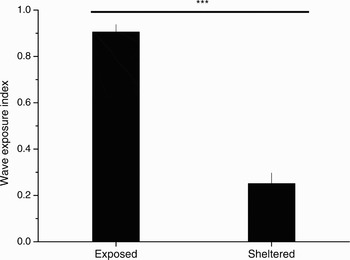
Previous classification of shores into ‘sheltered’ and ‘exposed’ categories proved to be realistic. Among-shore contrasts of the wave exposure index were not detected within exposure categories (F = 0.67, P > 0.05), but a large significant difference (261%; F = 201.8, P < 0.001) was observed between estimates for the ‘sheltered’ and ‘exposed’ conditions (Figure 3).
Wave exposure index at the categorized exposed and sheltered shores. Bars represent standard errors (N = 15). ***P < 0.001.

Larval release accuracy and precision at the sampled shores
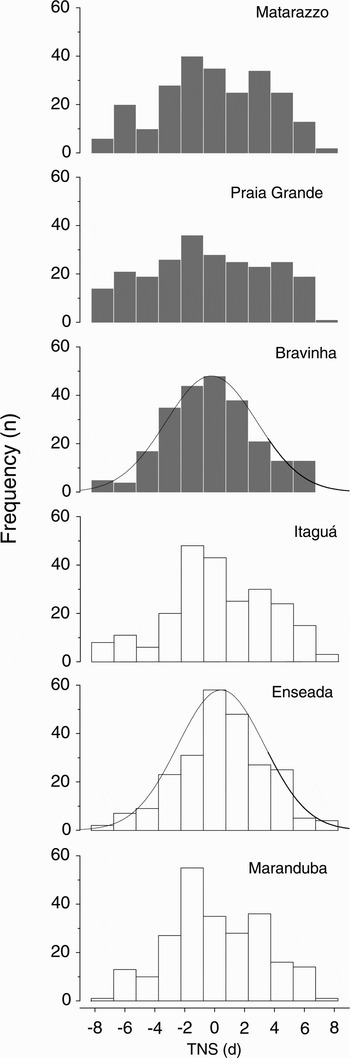
The estimated distribution of release events, pooled within each shore, differs significantly among the sampled populations (Figure 5). The spread around central values is higher at Matarazzo and Praia Grande, and lower at Bravinha and Enseada, where distributions do not differ significantly from normality (12.2 < χ2 = 12.3, P > 0.05). In all other shores, departures are significant from the Gaussian distribution (21.7 < χ2 < 56.7, P < 0.05; Figure 5), indicating that the occurrence of hatching at times other than peak events are not a result of random variation.
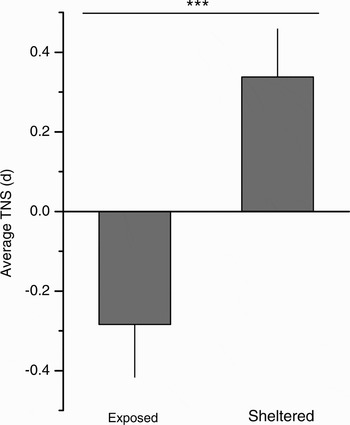
Variance of hatching times was unequal among compared groups (Cochran's C = 0.072, P < 0.05), but results of the ANOVA are robust because the experimental design is balanced and replication is large. Central tendencies are very similar, always around syzygies (Figure 4). Variation is all included within ±1 day from full or new moon and no differences were observed among sites of similar wave exposure (F = 0.48, P > 0.05). However, a significant contrast between average estimates for exposed and sheltered shores, suggest early and late hatching, respectively (F = 26.65, P < 0.001). There were overall timing differences at different sampling occasions (from +1.20 to –0.81 days; SNK tests, P < 0.05), but the lack of an interaction between ‘exposure’ and ‘period’ (F = 0.31, P > 0.05) indicates that differences driven by wave exposure are consistent through time.
Frequency distributions of hatching time to nearest syzygy (TNS) at the sampled shores. Closed and open histograms represent distributions at exposed and sheltered sites, respectively. The estimated probability curve is shown when departures from normality are not significant (χ2 test, P > 0.05).

Average hatching time to the nearest syzygy (TNS) according to wave exposure level. Bars represent standard errors (N = 672). ***P < 0.001.

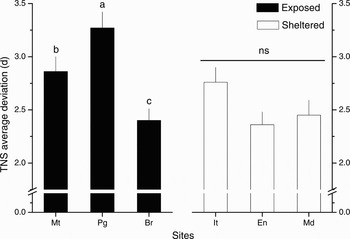
Variance of hatching spread was homogeneous among groups (Cochran's C = 0.059, P > 0.05). Hatching spread varied consistently among populations. A clear shore effect was verified (F = 6.59, P < 0.001), and the capacity to synchronize hatching remained unchanged for any particular population, since temporal variation was not significant (F = 1.71, P > 0.05). Variability was only found among exposed shores, of which Praia Grande and Matarazzo held the less synchronous populations (Figure 6). Yet, the effect of exposure level was not significant (F = 1.35, P > 0.05). The very low spread at Bravinha was comparable to sheltered shores, and records at Itaguá were relatively high (Figure 6).
Average deviation of hatching time to the nearest syzygy (TNS) at the sampled shores. Bars represent standard errors (N = 224). Variability was only found among exposed sites. Different letters assigned to shores indicate statistical differences (Student–Newman–Keuls; P < 0.05). Shore abbreviations as indicated in Figure 1. ns, not significant.

DISCUSSION
In most temperate species, population rhythms of larval release according to the tidal amplitude cycle reveal the segregation of reproductive activities between two different breeding groups in alternate syzygies, because egg incubation usually exceeds the fortnight period. This is not necessarily the case for the Pachygrapsus populations examined herein, in which the development of embryos takes less than 14 days. Since embryonic development is inversely proportional to temperature (Wear, Reference Wear1974) short incubation times may be expected for other tropical intertidal brachyurans. Provided the necessary resources for the development of gonads and the conditions for frequent mating, the reproductive output of these crabs during the breeding season could be relatively large compared to their temperate counterparts. Females of the mottled shore crab are capable of laying their eggs one or two days after larval release without previous mating for several days, as observed in our captive trials at Ilha Porchat, therefore maximizing the production of broods.
Reproductive fitness can be further enhanced by effective timing of larval release. Large scale release at new and full moons was observed, with all populations centring larval release activity within 1 day of peak spring tides. Within this very narrow range, populations at exposed and sheltered shores did exhibit a significant different timing, which may result, for instance, from hatching at different consecutive high-tide periods, since Pachygrapsus females release their larvae both during the day and night. Endogenous circasemilunar rhythms were shown for moulting, locomotory activity and larval release in different crustaceans (Williams, Reference Williams, Naylor and Hartnoll1979; Zeng et al., Reference Zeng, Abello and Naylor1999; Forward & Bourla, Reference Forward and Bourla2008). It is thus possible, although very speculative, that populations at exposed shores anticipate larval release due to mechanical stimulation and higher oxygen supply to embryos, while incubating females are already undertaking hatching-related behaviours.
In this study, a primary concern was to assess how much breeding females, from natural populations, may differ in their capacity to time larval release according to the tidal-amplitude cycle. Therefore, the spread of release activity over a presumed temporal optimal window was a particularly important parameter. Our initial hypothesis regarding the direct effect of wave exposure on the entrainment of larval release rhythmicity is not backed by results. If true, the ‘exposure’ factor should be significant because wave forces contrasted sharply and consistently between our two groups of shores, and replication was high, rendering a proper test power. In addition, one would expect to find larger, but still random temporal departures from peak events if lower synchronism were only an outcome of a noisy perception of tides, which was not the case. Departures from optimal timing are non-normal for populations releasing their larvae less precisely. This indicates that spread of larval hatching around syzygies is probably due to suboptimal breeding patterns of groups of females within these populations.
Advancing alternative mechanisms underlying the observed spatial structure of hatching synchronism is a challenging task. Decreased control of the timing of larval release is likely to reflect the capacity of ovigerous females to control embryo development rate. Synchronism of egg-laying was found to be considerably less precise than timing of larval release in the estuarine crab Neohelice (=Chasmagnathus) granulata (Ituarte et al., Reference Ituarte, Spivak and Luppi2004), suggesting that fine tuning will be provided by the behaviour of females while incubating. Grooming (Schlieder, Reference Schlieder1980; Kuris, Reference Kuris, Wenner and Kuris1991) and ventilation through abdominal flapping (Naylor et al., Reference Naylor, Taylor and Benett1999; Baeza & Fernández, Reference Baeza and Fernández2002) are common behaviours of brachyuran ovigerous females that ensure adequate brood care. Their frequency and intensity could possibly vary according to habitat quality, regardless of the environmental agents entraining breeding activities. In the case of mobile intertidal invertebrates, the suitability of refuges is certainly a very important component, but proper shelter is often restricted in rocky shores (Lohrer et al., Reference Lohrer, Fukui, Wada and Whitlatch2000). Limited access to an adequate refuge causes reduced growth and fecundity in stone crabs (Beck, Reference Beck1995), and would probably affect other reproductive parameters. The results of Derivera (Reference Derivera2005), showing a clear effect of burrow size in the timing of larval release of fiddler crabs, could be found in other systems and brachyuran species. This mechanism may contribute to the patterns observed herein, because Pachygrapsus aggregates around territories, usually of a few metres, where crevices of adequate size are abundant (Abele et al., Reference Abele, Campanella and Salmon1986). In less benign shores, crab patches may fall in impoverished habitat conditions and females fail to engage in timed reproductive activities.
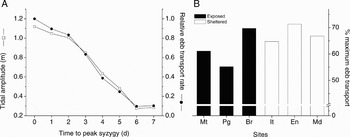
Differences of 1 day in the average hatching spread over syzygies, as observed in this study, suggest that larvae released at the sampled shores will experience rather contrasting offshore advective speed. Tidal exchange between coastal embayments, such as those enclosed in our study area, and adjacent ocean water is a function of tide-amplitude. By measuring transport of natural UV fluorescence tracers, Chadwick & Largier (Reference Chadwick and Largier1999) estimated an ebb transport rate proportional to tidal amplitude raised to a power of 1.66 at San Diego Bay, California. Rough calculations of relative larval survival at our sampled shores can be obtained if assumed that ebb transport rate is inversely related to residence time, and that the time larvae remain close to reef predators is in turn inversely proportional to early survival. Average tidal-amplitude at different days from syzygy during the study period, and respective estimates of relative transport rate during ebb tides (equal to 1 during springs), are shown in Figure 7A. The temporal frequency distributions of larval release shown in Figure 4 were converted in relative frequencies and multiplied by respective relative transport estimates for each sampled locality. As shown in Figure 7B, expected efficiency of larval transport during ebb tides ranged from 71% (Enseada) to 55% (Praia Grande), considering that 100% would represent a given population releasing their larvae only at the day of maximum tidal amplitude. In other words, these rough numbers suggest that larval release timing, alone, could respond to differences up to near 30% of viable offspring stock, free from initial nearshore predation. Such contrast is of comparable magnitude to natural variability of other parameters affecting egg production in populations of this species in the same region, namely adult density and average individual size, fecundity and ovigerous ratio (Flores et al., Reference Flores, Gomes and Villano2009). Therefore, identifying processes capable of affecting the timing of propagule release in marine invertebrates is apparently more important than previously thought.
Estimates of relative ebb transport as a function of tidal amplitude (A), and resulting predicted values of relative transport efficiency at the sampled shores (B), considering that full transport (100%) is taking place when larval release is restricted to syzygies.

ACKNOWLEDGEMENTS
We are grateful to Sara Vilar, Ronaldo Christofoletti and Thiago Fernandes for their help during fieldwork. Thanks are also due to two anonymous referees for their valuable criticism, which helped us to improve the paper. Funding was provided by the Fundação de Amparo à Pesquisa do Estado de São Paulo as a research grant to A.A.V.F. (01/11156-4) and a MSc fellowship to M.B. (06/58700-4).